NATO troops in Ukraine can’t be ruled out – Macron
RT | February 26, 2024
French President Emmanual Macron has argued that deployments of troops to Ukraine by NATO members and other allies cannot be ruled out because Western powers must stop at nothing to ensure that Russia does not defeat Kiev’s forces.
“There’s no consensus today to send, in an official manner, troops on the ground,” Macron told reporters after hosting a meeting of European leaders on Monday in Paris. “But in terms of dynamics, we cannot exclude anything. We will do everything necessary to prevent Russia from winning this war.”
France hosted Monday’s summit of Ukraine backers to demonstrate steadfast support and European unity amid concerns that US aid to Kiev may stop, especially if Donald Trump wins this year’s presidential election. Macron said that while Ukraine’s European allies want to avoid escalating the conflict into a direct war with Russia, they agree that they must do more to ensure that Moscow doesn’t win.
“We have to take stock of the situation and realize our collective security is at stake,” the French leader said. “We have to ratchet up. Russia must not win, not only for Ukraine, but secondly, we are, by doing so, ensuring our collective security for today and for the future.”
Macron noted that the allies who say “never, ever” today about direct troop deployments to Ukraine are the same ones that previously ruled out escalations of military aid that were later granted, including long-range missiles and fighter jets. “Two years ago, a lot around this table said that we will offer helmets and sleeping bags, and now they’re saying we need to do more to get missiles and tanks to Ukraine. We have to be humble and realize that we’ve always been six to eight months late, so we’ll do what is needed to achieve our aim.”
There is broad consensus among the nations represented at Monday’s meeting that the allies must provide more aid to Ukraine and step up more quickly, Macron claimed. “We are not at war with the Russian people, but we cannot let them win in Ukraine,” he said, adding, “We are determined to do everything necessary for as long as necessary. That is the key takeaway from this evening.”
Washington ran out of money for Ukraine last month, after burning through $113 billion in congressionally approved aid packages. US President Joe Biden is seeking an additional $60 billion in Ukraine funding as part of an emergency spending bill that also includes aid for Israel and Taiwan. Conservative Republican lawmakers have balked at approving more aid for Ukraine, saying Biden is merely prolonging the conflict without changing its outcome. Trump has claimed he will end the crisis within 24 hours by forcing Ukrainian and Russian leaders to the negotiating table.
After Two Years, Neocons Desperate For More War in Ukraine
By Ron Paul | February 26, 2024
In a recent CNN interview, the normally very confident US Under Secretary of State Victoria Nuland sounded a little desperate. She was trying to make the case for Congress to pass another $61 billion dollars for the neocons’ proxy war project in Ukraine and she was throwing out the old slogans that the neocons use when they want funding for their latest war.
Asked by CNN whether she believes that Congress will eventually pass the bill, Nuland responded that she has confidence that, “we will do what we have always done, which is defend democracy and freedom around the world…”
What Nuland is attempting here is what the neocons always do. They try to wrap their terrible policies up in the American flag and sell it to the American people as something reflective of “our” values. If you oppose another neocon war, well then you are unpatriotic according to their trickery.
But Americans are waking up to the lies of the neocons and more and more are realizing that there is no “we” when the neocons are trying to sell another war. It is “them.” The “we” in the equation are the people who are being robbed to pay for what will inevitably be another neocon failure.
Does any American still believe that Washington was “defending democracy and freedom” when it used a pack of lies to get us into Iraq, where a country was destroyed and perhaps a million people were killed? How about when, after 20 years in Afghanistan, we managed to replace the Taliban… with the Taliban? And Syria and Libya and all the other interventions?
Was Washington “defending democracy” when Nuland and the rest of the neocons successfully overthrew a democratically elected government in Ukraine in 2014?
It’s getting harder and harder for the American people to choke down the war lies of the neocons. That is something that should make us feel optimistic. In the same interview, Nuland said she was confident that when House Members return to session next week, “after they’ve been out in their districts hearing from the American people,” they will vote to send the $61 billion to Ukraine.
Looking at public opinion polls, however, it is far more likely that any Member meeting with constituents during the break will hear the opposite. It is likely they will hear a demand that not another penny be spent on the brutal, futile, and disastrous Ukraine war. According to a Harris poll taken earlier this month, some 70 percent of Americans want talks to end the Ukraine war!
Americans no longer support the neocon war project in Ukraine. That is something to celebrate.
Perhaps in a last show of desperation, Victoria Nuland debuted another argument for keeping the war money flowing for Ukraine. She said, “we have to remember that the bulk of this money is going right back into this economy to make those weapons…”
Is this supposed to be attractive to the American people? The middle class and the poor are being destroyed by inflation and squeezed by a debased currency so that the wealthy, politically-connected weapons manufacturers can get even richer? Instead of money to rebuild this country and protect its borders, Americans should be thrilled to see their hard work go up in smoke, literally, in Ukraine?
NYTs Report: CIA OPS in Ukraine for a Decade
Turns out Russia had good reason for grave concern
BY JOHN LEAKE | COURAGEOUS DISCOURSE | FEBRUARY 26, 2024
The New York Times just reported that the CIA has been very active in conducting anti-Russian operations in Ukraine for over a decade, and is now playing an active role in combat operations against Russia.
To be sure, many analysts in the United States and Europe have known this for years, but the New York Times report confirms our worst suspicions. It seems to me that every sensible person who understands basic concepts of national security should now be asking himself: Why should Russia tolerate the CIA turning Ukraine into an arena for undermining Russian security? How would the United States government respond to Russian intelligence agencies setting up shop on the Mexican border to run operations against the United States? For my part, I’m surprised that Putin tolerated the CIA’s activities in Ukraine for as long as he did.
Now it seems to recent drone strikes on Russian assets are being assisted by the CIA, and the cat is out of the bag, putting the United States yet another step closer to a full blown military confrontation with Russia.
Some EU, NATO States Ponder Possibility of Sending Military to Ukraine – Slovakia’s Fico
Sputnik – 26.02.2024
BRATISLAVA – Some EU and NATO countries are mulling over the possibility of sending their military to Ukraine on the basis of bilateral agreements, Slovak Prime Minister Robert Fico said on Monday.
Later in the day, Paris will host a meeting where members of the EU and NATO will discuss the situation in Ukraine.
“For me, today’s meeting [in Paris] is confirmation that the West’s strategy in Ukraine has failed, but I want to be constructively prepared for it … It follows from these arguments that a group of NATO and EU countries are considering [the option] to send their military to Ukraine on the basis of bilateral agreements,” Fico told reporters after a meeting of the government and the security council.
Possible deployment of the EU and NATO military to Ukraine will not allow them to achieve concessions from Russia, but will only lead to an escalation of the conflict, the prime minister said.
Slovakia is not planning to send its soldiers to Ukraine, Fico added.
Ukraine ready for war with China – top MP
Kiev is a “valuable ally” of Washington, Aleksey Goncharenko said while demanding more funding
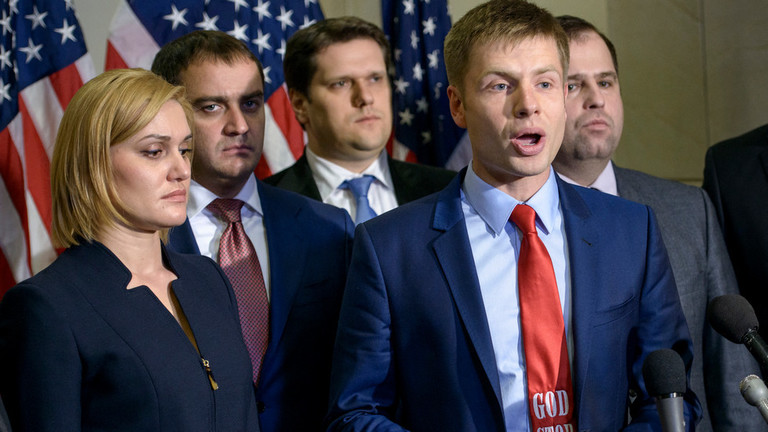
Ukrainian lawmaker Aleksey Goncharenko at a press conference on Capitol Hill on February 5, 2015 in Washington, DC. © AFP PHOTO/BRENDAN SMIALOWSKI
RT | February 24, 2024
Kiev is ready to assist the US in a war against any enemy, be it Iran, North Korea, or China, a senior Ukrainian MP has said, claiming that his country would prove to be a valuable military ally.
In an interview with CNN’s Christiane Amanpour on Friday, Aleksey Goncharenko doubled down on calls for the US to send Ukraine more military aid amid gridlock in Congress. “[The] United States of America told [us that] we will be with you ‘as long as it takes.’ Now it’s time to keep the promises.”
Goncharenko rebuked US politicians for focusing too much on the looming 2024 presidential election, saying Ukraine should not be a “victim” of this. He also claimed that supporting Ukraine serves Washington’s interests regardless of who wins the race for the White House.
In the event of a future war, the Americans “will need people who will stand shoulder to shoulder with them,” but not many nations would be willing to go all-in to support the US, the lawmaker said.
”Ukrainians are ready… We are ready to stand with the United States shoulder-to-shoulder, either in trenches near Tehran, or in North Korea, or near Beijing. No difference,” he stated. “Because we appreciate your support.”
Despite his plea for more Western military aid, Goncharenko argued that Ukraine has “the second strongest army in the free world” after the US, making it “a very valuable ally.”
“But today we need your support to defend our country,” he added, blaming gaps and delays in arms shipments for the loss of the strategic Donbass city of Avdeevka last week. According to the Russian Defense Ministry, the Ukrainian retreat from the heavily fortified city, which was often used as a launching pad to target civilians in Donetsk, turned into a disorganized rout with heavy casualties.
Russian President Vladimir Putin said on Tuesday that the capture of Avdeevka is “certainly a success,” adding that it needs to be advanced further.
Last year, Putin claimed that the Ukrainian government was defending the interests of other countries rather than its own, and that the West was using Kiev as “a battering ram” and a “testing ground” against Russia.
White House scrambles for legal loopholes in Yemen war
The Cradle | February 23, 2024
National security lawyers working for the Biden White House are seeking legal loopholes to justify the US war on Yemen, a new report from The New York Times (NYT) on 23 February details.
At question is the legality under US law of strikes carried out by the US Navy on Yemeni targets on three separate days starting in January and the detention of 14 Pakistani sailors the US accuses of transporting weapons to Yemen.
US involvement in Yemen began after Yemen’s Ansarallah-led government ordered its armed forces to target Israeli-linked commercial ships passing through the Bab al-Mandab Strait in the Red Sea in November.
Ansarallah is seeking to compel Israel to end its bombing campaign in Gaza, which has resulted in widespread killing and destruction. Israel has killed over 29,000 Palestinians – the majority of whom were women and children.
Rather than end its support for Israel’s campaign – which many view as genocide – the White House instead ordered the US Navy to protect Israeli ships passing through the Red Sea. This led to Yemeni forces attacking US and UK Naval ships.
The US has carried out 30 strikes in response. According to the national security lawyers, most of the strikes can be characterized as self-defense because they allegedly targeted sites from which missiles were about to be launched at US or UK ships. It has also become routine for the Navy to shoot down Yemeni attack drones in the Red Sea.
However, according to NYT, three major sets of US and UK strikes in Yemen were not in self-defense: on 11 January, 22 January, and 3 February. Those strikes were pre-emptive and targeted weapons bunkers, command hubs, and other targets, with authorization from President Joe Biden.
Because the strikes were not in self-defense, this means that the White House can engage in hostilities against Yemen for only 60 days before seeking congressional approval, per the 1973 War Powers Resolution. That 60-day clock would end on 12 March.
To continue the war on Yemen beyond that date, the White House will need to find a loophole in the resolution.
NYT writes that according to one US official, the text of the War Powers Resolution states that a president must have “introduced” US forces into conflict for the 60-day clock to apply. “It is not clear whether the law would apply to a situation in which the Navy was already in the Red Sea before hostilities arose, the official said.”
The White House also argues, in a contradictory fashion, that the strikes on Yemen are both too frequent to constitute being at war with Yemen and not frequent enough.
The US official said the strikes on Yemen “have been brief and infrequent, raising the possibility that they are too intermittent for the clock to apply.”
The same official at the same time pointed to operations “in which combat was more frequent or posed a greater threat to American forces,” which might provide a precedent for the current war on Yemen. These include the use of US Navy escorts for oil tankers in the Persian Gulf in 1987 under president Ronald Reagan, in which 37 Navy sailors were killed, as well as US strikes in Libya in 2011 under president Barack Obama to topple the government of Muammar Qaddafi. Congress did not approve the military operations in either case.
According to Jack Goldsmith, a Harvard law professor and former head of the Office of Legal Counsel in the George W. Bush administration, “The lawyers are taking advantage of a famously loophole-filled statute,” he said.
“The executive branch has been exploiting those loopholes for almost 50 years, creating many supporting precedents, and Congress has not stood on its prerogative to do anything about it.”
Selecting Syrsky: The Untold Half of the Zaluzhny Story
By Ted Snider | The Libertarian Institute | February 23, 2024
There were probably many reasons why Ukraine’s President Volodymyr Zelensky fired Ukraine’s popular commander in chief of the armed forces, Valerii Zaluzhny, on February 8, but one of the biggest seems to have been a disagreement over how to go forward in a war that seemed to have overwhelmingly turned against them. Zelensky spoke of a need for “the same vision of the war,” and Zaluzhny said “a decision was made about the need to change approaches and strategy.”
When the war began, Zelensky said that Ukraine “will definitely win” but stressed life over land. “Our land is important, yes, but ultimately it’s just territory.” He said that “Victory is being able to save as many lives as possible. Yes, to save as many lives as possible, because without this nothing would make sense.”
But actions speak louder than words. Zelensky began to define victory as the reclamation, not only of land lost during the war, but of Crimea and all of Ukraine’s pre-2014 territory. Zelensky insisted that Ukraine stay on the offensive. He insisted on moving forward, “Whether it’s by a kilometer or 500 meters, but forward every day.”
Zaluzhny saw Zelensky’s strategy of fighting for Bakhmut and Avdiivka at any cost as a strategic disaster that was costing Ukraine too much in weapons and in lives. Zaluzhny argued for preserving lives over forfeitable territory, lest Ukraine lose its land and its army.
In General Oleksandr Syrsky, Zelensky found the commander who would execute his vision and carry out his orders. Syrsky fought the Battle of Bakhmut. His performance there, and in other battles, gave him the reputation of a commander who is willing to give orders that lead to little real gain and lots of real loss of life. “Some soldiers say his orders are unreasonable, at times sending men to their obvious deaths,” The Washington Post reports. According to The Economist, he “has a reputation for being willing to engage the enemy, even if the cost in men and machines is high.” His reported willingness to put “his men in danger to reach his military goals” has earned him the nicknames “Butcher” and General 200, 200 being the code for a soldier’s corpse. Syrsky is also seen as being a commander who is close to Zelensky and who will not question his orders.
The replacement of Zaluzhny by Syrsky signals Zelensky’s intent to push ahead with the suicidal war of attrition and fight for every inch of land despite the cost in lives.
Aware of the optics of the choice in the public and, perhaps especially in the armed forces, Kiev assuaged the perception of Syrsky as “being indifferent to military casualties.” In his first statement as commander in chief, Syrsky said, “The lives and well-being of our servicemen have always been and remain the main asset of the Ukrainian army.”
But, again, actions speak louder than words. General Syrsky’s first words were about protecting the lives of his men, but his first actions were about fighting for every inch of territory.
On February 11, just three days after the change in command, Syrsky ordered the reinforcement and defence of Avdiivka, a strategic town that faced imminent loss to the Russian army and enormous loss of Ukrainian lives. Zaluzhny would have withdrawn his troops, preserved lives and moved the front to more defensible positions.
Syrsky deployed the 3rd Separate Assault Brigade, one of the best armed and trained and most successful brigades in the Ukrainian Armed Forces.
It did not go well. It went exactly as Zaluzhny said it would, and Syrsky was forced to respond exactly as Zaluzhny had said they should. But now the response was carried out in disarray instead of in an orderly, planned fashion. Perhaps Zelensky should have stuck with Zaluzhny.
In sending in reinforcements instead of retreating, Syrsky said the “goal of our operation is to exhaust the enemy, inflict maximum losses on him.” The opposite happened.
Less than a week later, on February 17, Syrsky announced the withdrawal of Ukrainian troops from Avdiivka. “Based on the operational situation around Avdiyivka, in order to avoid encirclement and preserve the lives and health of servicemen,” he said, “I decided to withdraw our units from the city and move to defense on more favorable lines…The life of military personnel is the highest value.” That’s exactly what Zaluzhny advised Zelensky to do.
But the situation was worse than at first reported. Zaluzhny would have preplanned the retreat and executed it according to a plan. Zelensky and Skysky’s stubbornness turned the already costly loss into a disaster.
CNN at first reported that “Ukrainian forces are currently conducting a relatively controlled withdrawal from Avdiivka.” There were “indications,” though, “that not all Ukrainian units were able to escape an ever-tightening noose.” Though “the withdrawal was carried out in accordance with the plan that had been developed…a number of Ukrainian servicemen were taken prisoner at the final stage of the operation, under pressure from the enemy’s superior forces.”
Three days later, the situation was becoming clearer. Senior Western officials, The New York Times reported, now say that “Hundreds of Ukrainian troops may have been captured by advancing Russian units or disappeared during” what they now call, “Ukraine’s chaotic retreat from the eastern city of Avdiivka.” The Times was now calling it “a devastating loss.”
And hundreds may have been an understatement. Further down in the article, the Times reports that “soldiers with knowledge of Ukraine’s retreat estimated that 850 to 1,000 soldiers appear to have been captured or are unaccounted for.” There are unconfirmed reports of even higher numbers of dead and wounded.
That may not have happened under Zaluzhny, who long ago conceded that Avdiivka would fall and would have preplanned the retreat. Some Ukrainian soldiers and Western officials say “the Ukrainian withdrawal was ill-planned and began too late,” according to the Times. They say that “a failure to execute an orderly withdrawal, and the chaos that unfolded Friday and Saturday as the defenses collapsed, was directly responsible for what appears to be a significant number of soldiers captured.”
Suddenly, the 3rd Separate Assault Brigade was not assaulting but desperately trying “to cover the retreat.” The retreat was chaotic: “…some units pulled back before others were aware of the retreat. That put the units left behind at risk of encirclement by the Russians.”
But the true story may be even worse. Military analyst Stephen Bryen reports that the disaster may have begun before the reinforcements even arrived at Avdiivka. Some of the brigades Syrsky brought in gathered and organized in the nearby town of Selydove. Bryen says the Russian military discovered they were there and struck with missiles. Between 1,000 and 1,500 Ukrainian soldiers were reportedly killed.
Bryen says that when the 3rd Separate Assault Brigade arrived in Avdiivka, they found a desperate situation. They reportedly discarded Syrsky’s orders and retreated. Some reportedly surrendered. Syrsky then announced the troop withdrawal and the fall of Avdiivka.
Zelensky’s choice of Syrsky over Zaluzhny was, in part, the choice to maintain the course of a war of attrition to hold and retake all Ukrainian territory. Syrsky’s first orders fulfilled that choice in Avdiivka. It went exactly as Zaluzhny said it would but worse because Zelensky and Syrsky tried to defy the battlefield reality that Zaluzhny recognized. Perhaps Zelensky should have stuck with Zaluzhny.
The Black Sea Straits: Turkey balances between the US and Russia
By Alexandr Svaranc – New Eastern Outlook – 22.02.2024
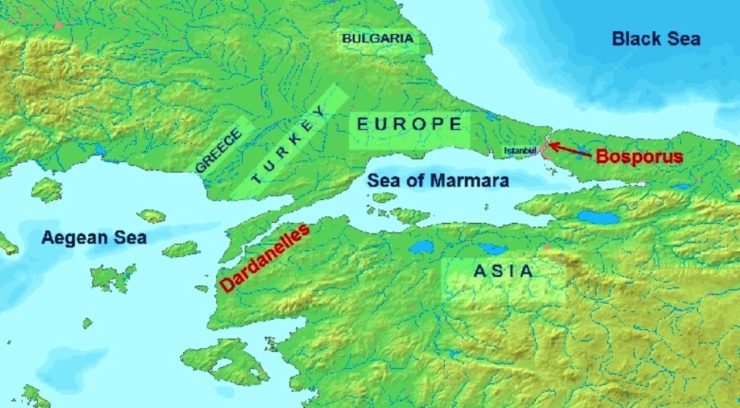
The territory of modern Turkey has economic-geographical and military-strategic advantages due to its control over the Black Sea Straits of Bosporus and Dardanelles. Control of the Black Sea Straits has always been strategically important to the great powers in world geopolitics and trade.
Great Britain and Russia often clashed over the right to control the Straits. In August 1914, German ships, including the cruiser Goeben and light cruiser Breslau, attacked Russian ports after passing through the Black Sea Straits. This led to the Ottoman Empire joining World War I on the side of Germany against Russia. One of the tasks of the Nazi German Ambassador to Ankara, Franz von Papen, in the late 1930s was to obtain Turkish consent for the passage of German ships through the Straits to the Black Sea to participate in the war against the USSR. Stalin later described Turkey’s policy during World War II as “hostile neutrality.”
In the 19th century, Russia’s successful wars against the Ottoman Empire enabled Russian control over the Black Sea Straits. However, Emperor Nicholas I of Russia, for some reason, decided to let in Britain and France in resolving the fate of the regime of shipping in the Black Sea Straits, while this issue could have become a subject of relations between solely Russia and Ottoman Turkey.
As a result, on July 3, 1841, the Straits Convention was signed in London, with the consent of the Russian Tsar, between Turkey, on the one hand, and Russia, Great Britain, Austria, Prussia, and France, on the other. It stipulated that as long as Turkey was not at war, the Straits would be closed to military ships of any nation. During the war, Turkey was granted the right to let ships through the Straits belonging to states with which it wished to reach an agreement. The London Straits Convention in fact buried the decisions of the Russian-Turkish Treaty of Hünkâr İskelesi of 1833, according to the secret articles of which Turkey undertook not to allow warships of any European countries to enter the Black Sea. Russia’s political and military positions have been significantly strengthened by the latter.
Following the results of the First World War, the Versailles Conference of the victorious countries again returned to the topic of the Black Sea straits, which continued with long negotiations, sharp discussions and ended with the signing of the Treaty of Lausanne on July 24, 1923, based on a project of Great Britain. The representatives of the Soviet delegation were actually blocked, and the head of the Russian delegation, Vatslav Vorovsky, was not even officially informed about the resumption of the conference and was not allowed to take part in the negotiations (on May 10, 1923, Vorovsky was assassinated in Lausanne by Russian White émigré named Maurice Conradi).
The Lausanne Treaty was signed between Great Britain, France, Italy, Japan, Greece, Romania, Bulgaria, the Kingdom of Serbs, Croats and Slovenes and Turkey. The USSR did not ratify the convention because its terms violated legal rights and did not guarantee the security of Black Sea countries. In particular, this convention provided for the demilitarization of the Straits Zone, with the Straits themselves coming under the control of a special international commission. In other words, the right to station military units near the straits was taken away from Turkey, through whose territory the straits passed. Simultaneously, all commercial and military vessels from any country in the world were granted free passage through the Bosporus and Dardanelles, with only minor restrictions. The latter created problems for the Black Sea countries, especially for the main Black Sea powers – Turkey and Russia.
The events of 1936 in Spain, the growth of Fascist militarism in Italy and Germany reopened the issue of the Black Sea Straits. Britain was concerned about losing control over Turkey, its naval bases, and its broad interests in the Mediterranean and the Arab East, including the restoration of the German-Turkish alliance. Therefore, London considered it appropriate to make concessions to Ankara on the issue of changing the regime of the Black Sea Straits and replacing the International Special Commission with Turkish control, including the abolition of Turkey’s demilitarization in the Straits Zone.
Consequently, following months of discussions, a new convention on the Black Sea Straits regime was signed on July 20, 1936, in the Swiss city of Montreux. This convention is seen as a compromise in international practice. In times of peace and war, merchant ships of all nations were granted the right of free passage through the Straits. Warships of non-Black Sea states are restricted in transit through the Bosporus and Dardanelles by class, total tonnage, total number and period of stay in the Black Sea not exceeding three weeks. In the case of Turkey’s taking part in a war, and if Turkey considers itself directly threatened by war, it is given the right to authorize or prohibit the passage of military ships through the Straits. Accordingly, the demilitarization regime was abolished, and Turkey was granted the right to station its military garrisons in the Straits Zone. The USSR’s demands for limitations on the military presence of non-littoral states in the Black Sea were mostly taken into account. London and Paris obtained the right to adjust the ratio of naval forces between Turkey and the USSR in the Black Sea.
Overall, the Montreux Convention can be viewed as a compromise that helped stabilize the situation in the Straits Zone. The Convention has been extended twice for 20 years. It remains in force as of now. The issue of the Black Sea Straits is currently being discussed in international diplomacy. This is especially true in times of crisis, when relations between major Black Sea countries, such as Russia and Turkey, become contentious.
With the start of the Russian Special Military Operations in Ukraine, hostilities have been resumed in the Black Sea basin waters. The Collective West, led by the United States, is attempting to alter the international legal norms that regulate the passage of warships through the Bosporus and Dardanelles.
According to US Assistant Secretary of Defense for International Security Affairs Celeste Wallander, Washington plans to collaborate with Ankara regarding shipping in the Black Sea. The Pentagon spokesperson emphasized the need to create a favorable environment in the region, ensuring that the Black Sea is fully accessible for commercial shipping.
Meanwhile, the United States is attempting to use merchant shipping as a cover to alter the regulations for the passage of non-Black Sea NATO warships through the Dardanelles and Bosporus to the Black Sea. For this purpose, the Black Sea Grain Initiative became a convenient opportunity.
The United States and the United Kingdom assert that Russia’s decision to withdraw from the agreement violates international humanitarian law. They propose the formation of an operational group under the convoy of NATO air and naval forces to transport Ukrainian grain through the Straits to foreign markets.
Retired US Navy Admiral James Stavridis announced in July 2023 that a convoy would be created under the control of the United States or NATO. A year earlier, The Wall Street Journal reported that Joe Biden Administration was considering new rules for the passage and navigation of warships in the Black Sea. The North Atlantic Alliance plans to deploy more military aircraft and ships to the Black Sea, according to NATO Secretary General Jens Stoltenberg.
In November 2023, US Congressmen Mike Rogers and Mike Turner urged President Joe Biden to deploy US military forces in the Black Sea to provide military support to Ukraine. Meanwhile, Commander Brian Harrington of the US Navy stated that conducting military exercises outside the scope of the Montreux Convention would undermine Russia’s dominance in the Black Sea. Perhaps these appeals and statements are intended more for the Turkish president.
The British and Norwegians have initiated a program to enhance Ukraine’s capabilities in the Black Sea. However, Turkey refused to allow two Sandown-class minehunters which were conditionally transferred by Great Britain to the Ukrainian Navy in June 2021, to pass through the Bosporus. According to Article 19 of the Montreux Convention, Turkey considers the ships of Russia and Ukraine as belonging to belligerent powers and therefore, they are not permitted to pass through the Black Sea Straits. London officials attempted to pressure Ankara, but were unsuccessful.
As for the warships of the US and other extra-regional countries that used to regularly enter the Black Sea using the right of peaceful passage, Turkey has announced within NATO that it will not allow naval exercises or visits for other purposes as long as the conflict continues. Ankara argues that violating the provisions of the Montreux Convention in the current situation will inevitably trigger retaliatory actions by the Russian Navy, leading to a new military escalation. Despite the dissatisfaction of NATO allies with Turkey’s position, Ankara does not intend to change it, showing the firmness and stubbornness typical of Turks.
The Montreux Convention does not allow the unimpeded passage of warships of non-littoral states in the Black Sea. However, after the collapse of the USSR and the Warsaw Pact, NATO gained an advantage in the Black Sea. In other words, prior to 1991, all Black Sea countries except for NATO’s Turkey were members of the Warsaw Pact and allies. Right now, the situation in the Black Sea is reversed. Namely, Russia on the one hand and NATO members Turkey, Bulgaria, Romania and the North Atlantic Alliance candidates Georgia and Ukraine on the other.
The US is not a signatory to the Montreux Convention at all and can therefore afford to violate its terms. Every five years since the signing of this convention in 1936, changes to its provisions may be proposed, provided that the initiative is supported by a two-thirds vote of the Montreux signatories. However, currently, all signatory countries except Russia are NATO members, and Japan and Australia are strategic partners or allies of the United States.
In this situation, Turkey’s opinion remains key as it still holds the role of “host of the Straits” under the Montreux Convention and maintains an independent policy. A change in the provisions of the convention would be a change in Turkey’s own status quo in the region. This is obviously not what Ankara wants. Crimea is now under Russian control, which could pose a threat to the same straits.
Russian Foreign Minister Sergey Lavrov stated that the Turkish authorities will not change the rules of entrance in the Black Sea for NATO warships under Pentagon’s pressure. However, Russia cannot rely on Turkey’s guarantees forever, as Ankara has shown a willingness to make sudden political reversals.
The US and Turkey are discussing the issue of closing the Bosporus to Russian warships, according to Iranian journalist Hayal Muadzin. In particular, there is information circulating that the US has offered to cede some areas in northern Syria, apparently Kurdish-populated provinces, to Turkey as a gift to Recep Tayyip Erdoğan, in exchange for active cooperation against Russia in the Black Sea.
In January, Turkey ratified Sweden’s NATO status in exchange for the delivery of 40 modernized F-16 fighter jets from the US. Washington is prepared to address the matter of F-16 Block 70 fighter jets for Turkey. Additionally, Deputy Secretary of State Victoria Nuland stated in Ankara that the US is willing to involve Turkey in the production program of fifth-generation F-35 fighter jets and provide them with a Patriot air defense system. This offer is contingent upon Turkey’s refusal to use the Russian S-400 Triumf SAM system. The Americans may be willing to provide soft loans to support the struggling Turkish economy, but only if Turkey refrains from actively cooperating with Russia in trade and economic matters and strictly adheres to the sanctions regime.
It is evident that Turkey faces numerous temptations. However, Recep Tayyip Erdoğan is aware that excessive improvisation towards Russia could jeopardize Turkey’s Great Turan project and its access to Azerbaijan and Turkic countries in Central Asia through the Zangezur corridor. For the time being, therefore, Ankara is trying to keep the “Russian side” of the fence. Turkey refuses to revise the provisions of the Montreux Convention in exchange for the “Swedish case.”
Turkish Foreign Minister Hakan Fidan confirmed that Ankara will continue to use the Montreux convention and stated that it is not up for debate. With the outbreak of the crisis in Ukraine, Turkey exercised its powers under the Montreux Convention and prohibited the passage of warships through the Black Sea Straits. The Turkish Defense Ministry aims to prevent further escalation of military tensions in the Black Sea basin, especially in the Straits area. The Straits pose not only an economic issue for Turkey, but also a security concern. Ankara has the right to charge for the passage of ships through the Bosporus and Dardanelles, which covers expenses for lighthouses, evacuation, and medical care.
In the rapidly evolving situation of the Ukrainian conflict, it is crucial for the Turks to maintain their key positions. There is a domestic political consensus on this issue: the provisions of the Straits Convention must remain unchanged. Turkey’s accession to Western sanctions against Russia is inadmissible; otherwise, Turkey will lose the opportunity to play a mediating role.
Scholz and Lackeys Dig Grave for Germany
By Finian Cunningham | Strategic Culture Foundation | February 21, 2024
They say a picture paints a thousand words, and the one showing Chancellor Olaf Scholz with a shovel in hand merrily digging at the earth speaks volumes about the way he is burying Germany’s economy.
Not just Scholz. The entire coalition government in Berlin is betraying the German people, like satraps for a foreign colonial power. That colonial power is the United States which has occupied Germany with its troops and nuclear weapons for eight decades.
How can the German political class be so abjectly servile and treacherous? Simple. They don’t see it like that. They are so brainwashed by Russophobia and Western imperial arrogance, their pathetic actions are “natural”.
Dressed like an undertaker, Scholz was photographed ceremonially laying the foundations for a new armament factory in Lower Saxony belonging to Rheinmetall, the second German military manufacturer.
Accompanying him was Defense Minister Boris Pistorius who last weekend told the Munich Security Conference that Germany’s military spending should double over the next decade.
This is while the German economy is mired in recession and German workers and their families are struggling to make ends meet. The once mighty German economy, the engine for the whole European Union, is now referred to as “the sick man of Europe”. The way things are going under Scholz’s coalition government, the sick man will soon be dead and buried.
It’s astounding to fathom the self-harm being inflicted by Scholz and his administration. Polls show huge popular dissatisfaction. His Social Democrat Party is hemorrhaging votes as the recent Berlin federal election re-run attested.
The German economy is tanking in large part due to spiking energy costs that have resulted from Berlin toeing the United States’ line of cutting off Russian oil and gas supplies.
German farmers like farmers all across Europe are in uproar over crippling energy bills. They are also incensed by the influx of cheap agricultural produce from Ukraine that the Scholz government has permitted the EU to oversee out of pro-war support for the Ukrainian regime.
Scholz and his ministers are turning Germany into a war-time economy. All sectors of the economy are being cut except military production.
At the foundation-laying ceremony for the new Rheinmetall production plant, the event was televised for the German public. Scholz and Pistorius seem to think they are performing heroic service for the good of the nation. Their delusional disconnect with reality and ordinary Germans’ hardships is truly shocking. The insanity is frightening.
Pistorius and German military commanders have been warning the public that the country might be at war against Russia in the next five to eight years. Such unhinged war rhetoric is the height of irresponsibility. It is criminal.
Russian President Vladimir Putin and other Russian leaders have repeatedly stated that they do not want conflict or war with Europe. The Ukraine conflict is a specific problem of a U.S.-led NATO proxy war.
Still, the febrile warmongering that has taken hold of the German political class and the rest of Europe is awesome. Entire national economies are being organized on a war footing.
The notion that Russia is preparing to attack Germany or some other NATO member after it knocks out the NeoNazi regime in Ukraine is wild fantasy to most rational people. But to brainwashed, Russophobic politicians in Berlin (and across the EU generally) such fear-mongering is entertained as reality.
Last week, Scholz hosted the money-grubbing Ukrainian conman president Vladimir Zelensky in Berlin. Zelensky’s regime has lost the NATO proxy war against Russia despite some €200 billion in support and weapons funneled to his corrupt regime over the past two years.
Yet Scholz just signed a bilateral national security pact between Germany and Ukraine. (Britain and France have also signed such pacts.)
As reported on the German pact: “The deal also says that should Ukraine ever be attacked again by Russia, Germany would support the country with swift and sustained security assistance including modern military equipment across all domains.”
What does it mean “should Ukraine ever be attacked again by Russia”? How ridiculous. Russia is at war in Ukraine. The German leaders are foolishly or recklessly signing a warrant for their open entry to war.
How rapidly Berlin has descended into madness. Recall two years ago when Russian forces intervened in Ukraine to quell the NATO proxy war in that country, Berlin was mocked for its caution in only sending “helmets” to aid the Ukraine regime. Two years later, Berlin is sending Leopard tanks, howitzers, and Iris-T missiles. It is now planning to supply long-range Taurus cruise missiles to a regime that has no qualms about bombing Russian civilian centers.
In announcing the latest security pact (war pact) with Ukraine, Scholz bragged that Germany is Europe’s biggest supporter of the Kiev regime.
Berlin has committed to €28 billion in military support for Ukraine, far outstripping the aid from Britain and France. Germany is second only to the United States in the amount of military and financial support it has funneled to Zelensky and his NeoNazi junta.
So much for German prudence and technical efficiency. Berlin is throwing good money down the drain on a war that is being lost badly to Russia with Ukrainian military deaths exceeding 500,000. And yet the wasting of public money keeps on going under Scholz and his loser administration.
The United States covertly sabotaged Germany’s economy by blowing up the Nord Stream gas pipelines from Russia. And Berlin says nothing.
Germany’s industrial base and export-led revenues are decimated by following the U.S. and NATO long-time mission statement of “keeping the Germans down, the Russians out and the Americans in”. And Berlin says nothing.
Scholz and his fellow vassals in government are betraying German national well-being and driving the country to another disastrous war against the Russian people – only 80 years after the last one in which tens of millions were slaughtered.
This betrayal is not just happening in Germany. The entire European Union under the appalling misdirection of former German defense minister Ursula von der Leyen (a scion of a Nazi family) is sacrificing generations of civilians to a dead-end war economy – all driven by Russophobia and total subservience to U.S.-led Western imperialism.
All these pathetic lackeys are digging a grave for Europe – unless citizens rise up against the audacious betrayal by their elites.
Euromaidan Was Part of West’s Proxy War Against Russia – CIA Veteran
By Ekaterina Blinova – Sputnik – 21.02.2024
Exactly ten years ago, former President Viktor Yanukovych signed an agreement with the Euromaidan opposition to resolve the political crisis in Ukraine. The very next day, the opposition tore up the agreement and seized power by force.
Months of Euromaidan riots ended with Ukrainian President Viktor Yanukovych agreeing to reform the constitution, form a “government of national unity,” and hold early elections in December 2014. The then-Ukrainian president also agreed to pardon rioters and launch investigations into violent acts by law enforcement officials.
Although the agreement guaranteed by the EU powers appeared to be solid, it barely lasted 24 hours: on February 22, 2014, the buildings of the presidential administration, the Verkhovna Rada, and the Cabinet of Ministers were seized by violent protesters. The Maidan leaders appointed Oleksandr Turchynov as head of the Verkhovna Rada in violation of the country’s constitution, effectively ousting Yanukovych.
Speaking to US journalist Tucker Carlson on February 9, 2024, President Putin insisted that the coup was “unnecessary” because Yanukovych had agreed to meet the demands of the Maidan leaders.
Yanukovych went on the air from Kharkiv on February 22, 2014, and insisted that he would not resign: “I am a legally elected president. What is happening is fragrant vandalism and banditry and a coup d’etat,” he said.
Nonetheless, EU leaders openly signaled that they would work with the “new government” of Ukraine, thus destroying the agreements they had previously supported.
Real Puppeteers Were American Policy-Makers
“Officially the opposition was backed primarily by Europeans,” Russian President Vladimir Putin said in an interview for a documentary “Crimea: Way Back Home” in March 2015. “But we knew perfectly well that the real puppeteers pulling the strings were our American partners and friends.”
In early February 2014, a conversation between individuals believed to be then-US Assistant Secretary of State Victoria Nuland and then-US Ambassador to Ukraine Geoffrey Pyatt discussing the future composition of the Ukrainian government was leaked online. They talked about bringing opposition leader Arseniy Yatsenyuk to power, while keeping Tyahnybok and Klitchko “outside”. In a passage that caused embarrassment to Washington, Nuland was heard to dismiss European partners with the phrase “F**k the EU.”
The scenario described in the leaked conversation came to fruition the same month: on February 27, 2014, Yatsenyuk was appointed as the Ukrainian prime minister. Klitschko was sworn in as mayor of Kiev on June 5, 2014. Tyahnybok stayed out of the de facto Ukrainian government but nonetheless visited the White House and met with then Vice President Joe Biden.
Russia Was the Target
In the wake of the coup, the Ukrainian junta resorted to brutal persecution of their political opponents, promoting an openly Russophobic agenda, and launched nothing short of a war on Donbass civilians who did not accept the illegitimate ouster of Yanukovych.
However, the real target of the US-backed regime change in Kiev was Russia, according to Larry Johnson, a retired CIA intelligence officer and State Department official.
“What I think really, what it boils down to is that the West had simply decided that they wanted to take Russia,” Johnson told Sputnik. “At the core of it, they were looking for a long term strategy to isolate Russia. And the key to this was to get Ukraine into the western camp, to bring Ukraine into NATO, to bring Ukraine into the EU, and therefore to completely isolate, at least they thought they could isolate Russia. Because I think at least there was some recognition in some of the government circles that Russia has enormous wealth, natural resources. And it’s better for us to have it than for Russia to have it. I think it was the attitude.”
How Euromaidan Triggered Ukraine’s Nine-Year War on Donbass
The CIA veteran drew attention to the fact that the Euromaidan coup d’etat “ignited a civil war in Ukraine” and “ended up elevating Ukraine into a frontline priority” for the West.
“So prior to 2014, you didn’t get a lot of NATO exercises, featuring Ukraine. After 2014 Ukraine, even though it was not a formal member of NATO, was regularly featured in these joint annual exercises and that meant that Ukraine then became a proxy for a Cold War,” Johnson said.
“It became a proxy for the West to fight against Russia. And I think that’s why they were slowly building up Ukraine. The annual training was one thing, but also there was the desire, you know, persistent request to send more weapons to Ukraine. Again with nobody sitting back and saying, why? What are we trying to do? They tried to create the myth that it’s Russia that’s trying to attack Ukraine,” the former CIA veteran continued.
For its part, Russia made efforts to stop the bloodshed in Donbass through the 2014 and 2015 Minsk Agreements. The accords envisaged cessation of hostilities, withdrawal of heavy weapons from the front line, release of prisoners of war, and a constitutional reform in Ukraine to grant self-governance to breakaway Donetsk and Lugansk People’s Republics.
However, in 2022 former German Chancellor Angela Merkel and ex-French President Francois Hollande admitted that the Minsk Agreements were seen by the West as an opportunity to arm and train the Ukrainian Army.
For his part, Ukrainian President Volodymyr Zelensky acknowledged in an interview with Spiegel in February 2023 that he actually had not been intended to observe the Minsk accords and informed his European counterparts about that. So, the accords were thrown down the drain in the same manner the Ukrainian opposition and the West shredded agreements with Yanukovych on February 22, 2014.
Hostilities Could be Stopped Many Times, West Just Didn’t Want to Do It
There were plenty of opportunities to avoid armed conflicts in Ukraine, highlighted Johnson.
“I mean, all the United States had to do is to say look, we’re not going to expand NATO into Ukraine,” the CIA veteran said. “We will cease conducting annual military exercises with Ukraine. And let’s reopen talks about reigniting the Anti-Ballistic Missile Treaty and the Intermediate Nuclear Force Treaty, the INF. And let’s begin looking at ways that we can cooperate and work together. But no, it was you know, the threats about the Nord Stream pipeline, for example, that had evolved.”
Russia has always been open to negotiations, President Vladimir Putin told the press on February 20, during a meeting with Defense Minister Sergey Shoigu.
Moscow maintained dialogue with the governments of Poroshenko and Zelensky to implement the Minsk Agreements in order to respect the rights of Ukraine’s Russian-speakers while at the same time preserving the nation’s territorial integrity.
It remains neglected by the Western mainstream press that before launching the special military operation to demilitarize and de-Nazify Ukraine Moscow sought to conclude agreements with the US and NATO to ensure common European security. The draft agreements which envisaged NATO’s guarantees of eastward non-expansion and Ukraine’s neutral status were snubbed by Washington, Brussels and NATO leadership.
Just a month after the beginning of the special military operation, Russian and Ukrainian representatives inked preliminary peace agreements in Istanbul in March 2022. Davyd Arakhamia, who headed the Ukrainian delegation during the March 2022 Istanbul talks with Russia, told Ukrainian broadcaster 1+1 in November 2023 that Moscow was ready to end the conflict if Ukraine committed to neutrality and refused to join NATO. However, it was then-UK Prime Minister Boris Johnson who encouraged President Volodymyr Zelensky to pick the battle and fight to the bitter end, the Ukrainian politician said.
“When we returned from Istanbul, Boris Johnson came to Kiev and said: ‘We won’t sign anything with them at all, and let’s just fight’,” Arakhamia recalled.
However, ex-PM Johnson was not alone in derailing the deal. “This war will be won on the battlefield,” European Union top diplomat Josep Borrell tweeted in April 2022, pledging hundreds of millions of euros for Kiev.
The same month, US Secretary of Defense Lloyd Austin claimed that Washington wanted to see “Russia weakened to the degree that it can’t do the kinds of things that it has done” in launching the special military operation. The US has spent over $100 billion in support for Ukraine’s military effort since then.
“The Western governments don’t want anything good to happen to Russia. They’re not willing to do anything to improve the lives of the Russian people. In my view, it’s genuine evil. And I’m watching this horrific policy that’s implemented by my government and there’s going to be an accounting someday. This is wrong,” the CIA veteran said.
“You know, I could understand it if this had happened 40 years ago when the Soviet Union with the ideology of communism, of Marx and Lenin was dominant. And the attempt to, you know, destroy churches and exclude religion, if that was the case, so, okay, I can understand religious people wanting to rise up and throw that off, but that’s not the case. It’s just the opposite. What we’ve got going on in Ukraine is almost, it’s demonic. It’s satanic. They literally embrace anti-Christian views under the guise of being Christian,” Larry Johnson concluded.
Tucker Carlson Says Boris Johnson Wants $1Mln to Discuss Ukraine Conflict
Sputnik – 21.02.2024
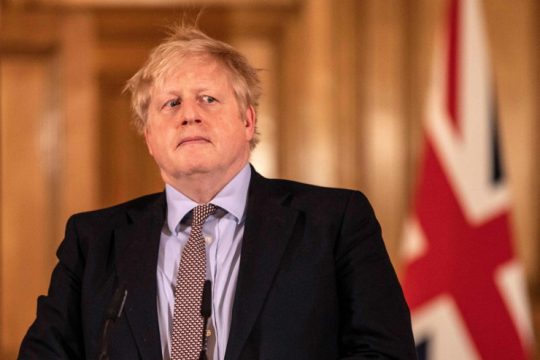
WASHINGTON – US journalist Tucker Carlson said that former UK Prime Minister Boris Johnson wants $1 million from him to talk about the Ukraine conflict in the wake of Carlson’s recent interview with Russian President Vladimir Putin.
“It gets out that we’re doing it [interviewing Putin], and I’m immediately denounced by this guy called Boris Johnson … So I put in a request for an interview with Boris Johnson,” Carlson said in an interview with TheBlaze. “Finally, one of his advisers gets back to me and says, ‘He will talk to you, but it’s going to cost you a million dollars.’ He wants a million dollars.”
Johnson’s adviser said the former prime minister would be willing to explain his position on Ukraine for the six-figure fee, Carlson said.
In November 2023, Ukraine’s former chief negotiator with Russia, David Arakhamia, said Johnson talked Kiev out of signing an agreement with Moscow to end the conflict in spring 2022. Johnson has previously denied the accusations.
Johnson could not have traveled to Ukraine without consulting the United States, Putin said earlier this month.
Putin did not request $1 million to participate in an interview, Carlson noted, adding that Johnson is “a lot sleazier” than Putin.
China tells Ukraine it ‘does not sell lethal weapons’ to conflicting sides
RT | February 20, 2024
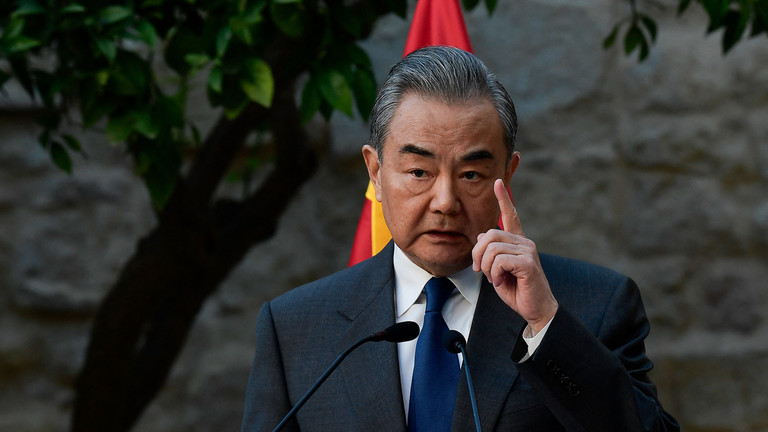
The Chinese foreign minister has told his Ukrainian counterpart that Beijing remains neutral in the Russia-Ukraine conflict, and will not sell weapons to either side. Wang Yi and Dmitry Kuleba met at the 60th Munich Security Conference on Saturday.
The talks were the first high-level encounter between Beijing and Kiev since Ukrainian President Vladimir Zelensky proposed a meeting with Chinese Premier Li Qiang at the World Economic Forum in Davos in January – a request that was reportedly rejected.
Wang Yi told Kuleba that China will not “add fuel to the fire,” seek to profit from the fighting, or “sell lethal weapons in conflict zones,” according to a readout from the Foreign Ministry. “Even if there is only a glimmer of hope for peace, China will not give up its efforts,” Wang Yi added.
In 2022 the US imposed sanctions on several businesses in China that Washington accused of helping the Russian military. China has refuted US claims that it was considering arming Russia. Ukraine has long been seeking China’s support for a 10-point peace plan, proposed by Zelensky last November, which Russian Foreign Ministry spokeswoman Maria Zakharova has dismissed as “a senseless ultimatum to Russia, aimed at protracting hostilities.” The plan includes the restoration of Ukraine’s 1991 borders.
Since the outbreak of the conflict in February 2022, China has consistently called for a political resolution, and proposed a peace plan of its own last year, demanding a ceasefire and talks. Russian President Vladimir Putin has said the peace initiative presented by China could be taken as a basis for a settlement with Ukraine.
Beijing has resisted Western pressure to impose sanctions on Moscow, while boosting economic cooperation with Russia. Chinese customs data shows that bilateral trade grew 26.6% last year, reaching a record $240 billion.
Featured Video

Chinese jet fuel and the myth of energy independence
or go to
Aletho News Archives – Video-Images
Book Review
Former Insiders Criticize Iran Policy as U.S. Hegemony
By GARETH PORTER | CounterPunch | February 27, 2013
“Going to Tehran” arguably represents the most important work on the subject of U.S.-Iran relations to be published thus far.
Flynt Leverett and Hillary Mann Leverett tackle not only U.S. policy toward Iran but the broader context of Middle East policy with a systematic analytical perspective informed by personal experience, as well as very extensive documentation.
More importantly, however, their exposé required a degree of courage that may be unparalleled in the writing of former U.S. national security officials about issues on which they worked. They have chosen not just to criticise U.S. policy toward Iran but to analyse that policy as a problem of U.S. hegemony. … continue
Blog Roll
 Aletho News
- What is fueling unrest across the EU?
- Why no power can undermine Iran’s eternal dominance over the Strait of Hormuz
- Is The War Against Iran Over?
- Iran war will leave long-term ‘scar’ on Wall Street, investors warn
- How Iran decimated US power projection in West Asia: Military lessons of 40-day war
- Iran’s report details US-Israeli war crimes in targeting schools, hospitals, livelihoods
- NATO’s Slow Fracture: How Trump’s Iran War Exposed the Instrument of Hegemony
- Chinese jet fuel and the myth of energy independence
- Ukraine Sea Drone Fired From Libya Hit Russian Tanker in Mediterranean
- IRGC: Iranian forces launched no attacks during ceasefire hours
- If Americans Knew
- DNC Shoots Down Resolutions Calling Out AIPAC and Limiting Arms to Israel
- TCN: Is Israel Blackmailing President Trump?
- Israel killed at least 303 Lebanese yesterday – who were they? Daily Update
- Amnesty: Urgent – Protect Lebanese civilians from brutal escalation in Israeli attacks
- Is The War Against Iran Over?
- Inside the Israeli army’s propaganda wing
- Hundreds of Gaza Amputees Stranded in Legal Limbo
- The gallows law: Israel moves toward executing Palestinian children
- Tucker Carlson: The Path to Peace requires ending ‘special alliance’ with Israel
- This is ceasefire? Israel’s biggest massacre yet in Lebanon, another journalist killed in Gaza – Daily Update
- No Tricks Zone
- An Inconvenient Tree: Uncovered In Alps… Europe Much Warmer Than Today 6000 Years Ago
- New Study Reports A 60% Slowdown In Greenland’s Ice Loss Rate In The Last Decade
- Low Intensity Tornado Wrecks Major Solar Farm, Creating A Potential Toxic Dump
- New Study Finds Warming Saves Lives…Cold Temperatures 12 Times More Deadly Than Excess Heat
- German Science Blog Accuses PIK Climate Institute Of Hallucinating Climate Tipping Points
- Devastating Assessment Of Comirnaty Vaccine By Former Senior Pfizer Europe Toxicologist
- New Study: CO2 Is ‘Effectively Negligible’ As An Explanatory Climate Change Factor Since 2000
- Former Pfizer Toxicologist Dr. Helmut Sterz Tells Bundestag Hearing Pfizer Vaccine Should Have Never Been Approved
- Energy Expert: Germany’s Nuclear Phaseout Was A “500 Billion Euro Mistake”
- New Research: South Australia’s Mid-Holocene Sea Surface Temperatures Were 4°C Warmer Than Today
 Aletho News