‘Wonder weapon’ myth is military-industrial complex PR scheme to profit from death
By Bradley Blankenship | Global Times | September 11, 2023
As the Russia-Ukraine war drags on, the Western public has been told that this or that wonder weapon system will turn the tide of the conflict. This has included Javelins, HIMARS, Leopards, Storm Shadow, Bradleys, F-16s, and now depleted uranium munitions, none of which has fundamentally changed the tide of the conflict.
After the slow progress of Kiev’s counteroffensive this summer, it is immediately apparent that high-tech equipment is not ruling the day but logistics and supply chains. It is not about who has the shiniest toys but who has the most troops, tanks and artillery and can deploy them quickly. On that front, Russia clearly dwarfs Ukraine, which is a much smaller country. Due to the fact that the West is evidently not going to join in this conflict directly, and there is growing resentment from the Western public against military aid to Kiev, people are wondering if the two sides will reach a peaceful settlement.
We are constantly told, however, that the latter possibility is somehow wrong or immoral because it will fundamentally grant Russia a victory. Well, morals aside, the reality clearly shows that Moscow is achieving its military objectives. Winning on the battlefield naturally translates to a more favorable negotiating position, and believing otherwise is to live in a realm of make-believe.
Some people idealistically (or opportunistically) believe that the West should support Ukraine’s futile fight against a far superior military power, even though that support will not challenge the eventual outcome and will lead to more death and destruction. Others believe death and destruction are undesirable outcomes; thus, Western leaders should pivot to a negotiations-first approach. The former view dominates the news media while the latter has gained a huge following on social media.
What’s also interesting about the difference between these two views and how they’ve fielded an audience is also about who’s backing them. People who hold the latter view are constantly accused – without evidence – of being funded by the Russian government or, as some US intelligence reports suggest, unwitting assets. Meanwhile, a recent analysis by the Quincy Institute for Responsible Statecraft found that think tanks funded by defense [?] industry contractors are cited 85 percent of the time in Ukraine-related content – and media outlets rarely cite these conflicts of interest.
So, which of these viewpoints is compromised? I believe it’s safe to say the latter. And that’s important because we need to understand the dynamic here: The media is quite literally operating as a paid advertiser for defense contractors. Not only do some outlets consistently peddle that some particular line of products will turn the tide of battle (they will not), but they also cite compromised experts that push a line conducive to selling more defense products. Rinse and repeat.
This is what is so sinister about modern conflict. When you look at the decades that the West was entrenched in Afghanistan, the current Ukraine quagmire or a potential situation in Taiwan island, it’s not about any serious geopolitical strategy or values. It’s just about making a handful of companies richer. Worse still is that this is public, taxpayer money going to this cabal – and, to be sure, primarily working-class funds when taken in conjunction with the historic Reagan, Bush and Trump tax cuts, which cut taxes for the wealthy.
It would be extraordinarily naive to believe that defense contractors and the people they fund have incentives that supersede the profit motive. Instead, these companies profit from death and human suffering, and they’re enabled by information laundering operations known as think tanks, which are cited without any scrutiny from journalists who are either lazy or also compromised.
The author is a Prague-based American journalist, columnist and political commentator. opinion@globaltimes.com.cn
US in a quandary over Israel’s war on Gaza
BY M. K. BHADRAKUMAR | INDIAN PUNCHLINE | OCTOBER 13, 2023
The US Secretary of State Antony Blinken’s press conference on Thursday concluding his visit to Israel conveyed three things. One, the Biden Administration will be seen as backing Israel to the hilt by way of meeting its security needs but Washington will not be drawn into the forthcoming Gaza operations except to arrange exit routes in the south for hapless civilians fleeing the conflict zone.
Two, Washington’s top priority at the moment is on engaging with the regional states who wield influence with Hamas to negotiate the hostage issue. Fourteen US citizens in Israel remain unaccounted for. (White House confirmed that the death toll in the fighting now includes at least 27 Americans.)
Three, the US will coordinate with the regional states to prevent any escalation in the situation to widen the conflict on the part of Hezbollah. Although the US cannot and will not stop Israeli leadership on its tracks apropos the imminent Gaza operation, it remains unconvinced.
Blinken was non-committal about any direct US military involvement, and the chances are slim as things stand. Most important, even as Blinken could hear the war drums, he also cast his eye on a future for Israel (and the region) where it will be at peace with itself, would integrate into the region and concentrate on creating economic prosperity — metaphorically put, beating its swords into plowshares in a Biblical Messianic intent.
That is to say, despite the massive show of force off the waters of Israel, with the deployment of two aircraft carriers along with destroyers and other naval assets and fighter jets off the waters of Israel, the Biden Administration is profoundly uneasy about any escalation of the conflict into a wider war. If the US senses that this is a catastrophe that Israel allowed to happen, that remains a strictly private thought.
Even as Blinken was heading for Tel Aviv, US House Foreign Affairs Committee Chairman Michael McCaul told reporters in Washington on Wednesday following a closed-door intelligence briefing that “We know that Egypt has warned the Israelis three days prior that an event like this could happen. I don’t want to get too much into classified, but a warning was given. I think the question was at what level.”
Shortly after McCaul spoke to reporters in Washington, an anonymous Egyptian official confirmed to the Times of Israel that Cairo’s agents did warn their Israeli counterparts about a planned Hamas attack, but that this warning may not have made it to Netanyahu’s office.
These disclosures would embarrass the Israeli government, as Saturday’s surprise attack can be viewed as a catastrophic failure for Israel’s intelligence services. In a brutally frank statement on Thursday, the Chief of General Staff of the Israel Defense Forces General Herzi Halevi admitted, “The IDF is responsible for the security of our nation and its citizens, and we failed to do so on Saturday morning. We will look into it, we will investigate, but now it is time for war.”
This failure will impact the decision-making in Tel Aviv. Gen. Halevi described Hamas as “animals” and “merciless terrorists who have committed unimaginable acts” against men, women and children. He said that the IDF “understands the magnitude of this time, and the magnitude of the mission that lays on our shoulders.”
“Yahya Sinwar, the ruler of the Gaza Strip, decided on this horrible attack, and therefore he and the entire system under him are dead men,” the general added, vowing to “attack them and dismantle them and their organisation” and that “Gaza will not look the same” afterward.
Make no mistake, the Israeli objective will be to use overwhelming force with its most advanced weapons, including powerful bunker-busting bombs, to inflict crippling losses on Hamas formations so that the movement cannot wage an armed struggle for many years. A ground operation is to be expected any day.
It is improbable that Blinken would have even tried to dissuade Prime Minister Benjamin Netanyahu from going ahead with a brutal operation. He told the media that the US would rather leave it to Israel to do what needed to be done. Meanwhile, the US deployment will not only aim to enhance surveillance, intercept communications, and prevent Hamas from acquiring more weapons, but also act as deterrent.
That said, the US cannot afford to watch passively. Washington has no choice but to limit the expected fighting in the coming days and weeks in Gaza to ensure that it does not spread to other areas. Thus, the US force projection specifically serves as a deterrent to Hezbollah, which possesses a vast armoury of 150,000 missiles that can be launched at major cities in Israel, potentially leading to a broader war not only in Gaza but also in Lebanon, drawing others into the conflict.
Israel knocked out of service the airports in Damascus and Aleppo in Syria in missile strikes simultaneously on Thursday, presumably to prevent reinforcements reaching Lebanon. Iran’s foreign minister Hossein Amir-Abdollahian was due to travel to Syria and Lebanon in the weekend.
Through the past four decades, the US and Iran have made a fine art of communicating with each other in dangerous times to set ground rules to avoid confrontation. This time around too, it is happening.
Certainly, the speech by Supreme Leader Ayatollah Ali Khamenei on Tuesday on the conflict situation, which was translated into Hebrew by the Iranians and disseminated in an unprecedented move, conveyed a subtle message in three parts to both Israel and the US, signalling essentially that Tehran does not intend to get involved in the conflict. (See my blog Iran warns Israel against its apocalyptic war.)
In turn, the US has signalled that it has intelligence showing that key Iranian leaders were surprised by the Hamas attacks on Israel. Equally, Iranian President Ebrahim Raisi’s phone conversation with Saudi Crown Prince Mohammed bin Salman on Wednesday — their first ever conversation which Tehran initiated — harped on efforts to “halt the ongoing escalation.”
The ‘known unknown’ scenario
Yet, the big question is, how far the Biden Administration would be confident about the success of any Israeli military incursion into Gaza. During the press conference in Tel Aviv, Blinken underscored in a subtle way the importance of “lessons” learnt from past experiences. The point is, Israel will be involved in urban warfare in a densely populated area with a population of 2.1 million people.
Gaza has an average of 5,500 people per sq. km, and there are bound to be heavy civilian casualties caused by Israel’s advanced American weaponry, which would lead to an international outcry, including in Europe, and lead to condemnation of not only Israel but the US as well. However, Israel is in a defiant mood and Netanyahu needs at least some of the operation’s goals achieved before agreeing to a ceasefire.
More importantly, Israel needs an exit strategy, if past experiences in Lebanon and Gaza gave any lessons. Colin Powell’s Pottery Barn rule comes into play — ‘You break it, you own it.’
An extended occupation of Gaza will be an extremely dangerous outcome fraught with great risks, given the deep economic, religious, and social roots that Hamas enjoys. Suffice to say, the Israeli military will be hard-pressed to show “success” and head for the exit door.
Besides, if other Palestinian groups and organisations in the West Bank make decisions that advance Hamas’s strategic goals, all bets are off, as Israeli military will face a two-front war. In fact, the conditions for a third intifada do exist in the West Bank.
And in such a scenario, the advantage goes to Hamas, which would position itself as potentially the appropriate and perhaps the sole alternative after Palestinian Authority President Mahmoud Abbas, who is now 87 years old.
Again, in a worst case scenario, it cannot be ruled out that the Arab Israeli population may draw inspiration from Hamas, and if their violent eruption in 2021 is anything to go by, the long-term viability of the state of Israel will be put to test.
Suffice to say, the best solution lies in a paradigm shift in the Israeli statecraft away from its primacy on coercion and brutal force. Blinken’s remarks suggested that the US hopes that when the dust settles down, with the helping hand of friendly Arab countries such as Saudi Arabia, the UAE, Egypt and Jordan, a turnaround to calm the situation and reach a ceasefire might be possible.
Of course, the longer that takes, the greater the strain it will put on the US-Israeli ties and the harder it will become for the Biden Administration to maintain an equilibrium in what is already a troubled relationship with Netanyahu. Fundamentally, Israel needs to come terms with the new reality that they are no longer invincible or the dominant power in the West Asian region.
S. Korea Considers Suspension of Deconfliction Agreement with N. Korea Because of Hamas Attack
By Kyle Anzalone | The Libertarian Institute | October 12, 2023
South Korean Defense Minister Shin Won-shik is pushing Seoul to abandon a 2018 agreement that reduced the military presence along the demilitarized zone (DMZ). The military official believes North Korea could use tactics similar to Hamas to attack South Korea. The potential for Seoul to walk away from the deal meant to reduce tension on the peninsula comes as the chances for military confrontation between the US and North Korea has skyrocketed under the Joe Biden administration.
Shin, who was appointed as Defense Minister on Saturday, argued that withdrawing from the agreement was necessary. “Hamas has attacked Israel, and the Republic of Korea is under a much stronger threat,” he said. “To counter (that threat), we need to be observing (North Korean military movements) with our surveillance assets, to gain prior knowledge of whether they are preparing provocations or not. If Israel had flown aircraft and drones to maintain continuous monitoring, I think they might have not been hit like that.”
It is unclear why Shin believes North Korea, a nuclear power, would utilize the same tactics as Hamas, a stateless militia.
The 2018 agreement signed between then-South Korean President Moon Jae-in and North Korean Supreme Leader Kim Jong-un created a buffer zone along the DMZ that prevents military confrontations. The deal was inked during a period of warming relations on the Korean Peninsula that was driven by Moon, and fostered by then-President Donald Trump’s willingness to reduce the American military presence and war games in South Korea.
However, President Biden and Yoon have taken a more aggressive approach. Washington and Seoul have conducted several rounds of provocative military drills. Additionally, the White House has committed to deploying more weapons that can launch nuclear weapons to South Korea.
On Thursday, the USS Ronald Reagan aircraft carrier, and the fleet of warships in its strike group, arrived in South Korea. The ships will conduct trilateral war games with Japan and South Korea.
North Korea sees trilateral military operations between Washington, Tokyo, and Seoul as the White House attempting to create an “Asian NATO.” Officials in Pyongyang have repeatedly warned that the US-led military activity on the Korean Peninsula is pushing the region towards a nuclear war.
US must prepare for war with China and Russia – Congress
RT | October 13, 2023
Washington needs to urgently update and expand both its nuclear arsenal and the conventional military in order to face the combined might of Moscow and Beijing, the congressional Strategic Posture Commission argued in its final report published on Thursday.
“The United States and its allies must be ready to deter and defeat both adversaries simultaneously,” the commission said. “The US-led international order and the values it upholds are at risk from the Chinese and Russian authoritarian regimes.”
While the commission has not identified any specific evidence of Russia and China working together, “we worry… there may be ultimate coordination between them in some way, which gets us to this two-war construct,” a senior official involved in the report told Reuters, on condition of anonymity. The current US national security strategy calls for defeating one major adversary while deterring another.
The commission argued that the combined threat from China and Russia will become acute as early as 2027 so “decisions need to be made now in order for the nation to be prepared.” The 131 findings and 81 recommendations in the report amount to the need for massive expansion of both the conventional armed forces and the Nuclear Triad.
The report demands more of the B-21 stealth bombers and Columbia-class ballistic missile submarines. The B-21 is still in development and is expected to enter service by 2027 at the earliest. The first two Columbia-class subs are under construction and are expected in 2030. The US Navy has planned to order 12, to replace the 18 Ohio-class boats currently in service.
“Amid all of the Commission’s recommendations to increase the number of strategic and tactical nuclear systems, there is almost no mention of cost in the entire report,” which “does not seem to acknowledge any limits to defense spending,” the Federation of American Scientists (FAS) has said in response.
At a press event announcing the report, the commission’s vice-chair, retired Republican Senator Jon Kyl, argued that higher military spending is a small price to “hopefully preclude” a possible nuclear war and that President Joe Biden and Congress need to “take the case to the American people” to spend more money.
According to FAS, however, the commission’s recommendations are “likely to exacerbate the arms race, further constrict the window for engaging with Russia and China on arms control, and redirect funding away from more proximate priorities.”
The only reason the commission did not argue for an immediate expansion of the US nuclear stockpile “is that the weapons production complex currently does not have the capacity to do so,” FAS noted, adding that there is no need for a nuclear arms race so long as the US has enough submarines to present a credible deterrent to a first strike by an adversary.
MEPs call for change of EU policy on Ukraine
RT | October 12, 2023
Ukrainian lives are being sacrificed by the “totally corrupt” elite in Kiev to which the EU recklessly sends billions of euros, several members of the European Parliament said at an event on Wednesday hosted by the think-tank Voice of Europe.
“We must stop this tragicomedy for Europe, for Ukraine and for Russia. We must try to find a path to prosperity again, and the first step is peace,” MEP Thierry Mariani of the French National Rally (RN) party argued at the roundtable, held in the central hall of the European Parliament in Brussels.
“Ukraine must remain a bridge” between Russia and Europe, Mariani added. He also pointed out that the current conflict has roots in 2013, when the EU tried to push Kiev to renounce a free trade deal with Russia and sign the Association Agreement with Brussels. This led to the Maidan demonstrations and the February 2014 coup.
Maximilian Kra of the Alternative for Germany (AfD) said he had traveled around Ukraine, describing it as “a beautiful country with very decent people.”
“I’m afraid that these decent people of Ukraine are now being sacrificed for the interests of the Kiev elite,” who own millions in real estate in southern France, Kra said. He also voiced fears that the US may ask the EU to foot the bill for the Ukraine conflict, now that Washington’s attention has been preoccupied by Israel.
“That’s what I’m afraid of. And I can tell you that this is already happening. Because Germany has already promised $1 billion to Ukraine, while the US will allocate only $200 million,” he said.
Marcel de Graaff of the Dutch Forum for Democracy (FvD) argued that Ukraine needs to make peace with Russia as soon as possible.
“I speak very directly because they have already lost. They are now sacrificing people up to 70 years old at the front. They no longer have reserves. They are losing right now,” said de Graaf.
He also described Ukraine as “the most corrupt country in the world,” now being given “tens of billions of euros” by the West. “I heard that [Ukrainian President Vladimir] Zelensky’s mother-in-law bought a villa in Egypt for several million dollars, and we are still wondering where our money is going. This is a totally corrupt civilization,” de Graaf added.
One major problem, according to the Dutch MEP, is that all trust has been lost between Russia and the West after the revelations by former German and French leaders that the Minsk Agreements were a ploy to buy Kiev time to prepare for war.
Kra brought up that Ukrainian opposition leader Viktor Medvedchuk had presented the German Bundestag a “smart” peace plan based on Minsk II, a proposal that would have seen the rebel republics of Donetsk and Lugansk rejoin Ukraine with broad autonomy.
“At the time, no one knew that Minsk II was a fake, as Merkel later stated,” Kra added, referring to former Chancellor Angela Merkel’s December 2022 admission.
Henri Malos, president of Voice of Europe and host of the roundtable, also lamented the demise of the Minsk Agreements, which he said offered security and sovereignty for both Russia and Ukraine.
Support not ‘indefinite’, White House tells Ukraine
RT | October 12, 2023
The US is running out of money for Ukraine unless Congress approves additional funding, National Security Council spokesman John Kirby told reporters on Wednesday.
“In the near term, we’ve got appropriations and authorities for both Ukraine and for Israel,” Kirby said during the daily press briefing. “But you don’t want to be trying to bake in long-term support when you’re at the end of the rope.”
“And in Ukraine, on the Ukraine funding, we’re coming near to the end of the rope,” he added. “Today we announced $200 million, and we’ll keep that aid going as long as we can, but it’s not going to be indefinite.”
Asked to define “near term,” Kirby said he could not point to a specific date, because that depended on how quickly Ukraine and Israel expended their equipment and ammunition “or what the need is and what our ability to do it is.”
On Tuesday, a Pentagon spokesperson assured reporters that the US had the ability to “continue our support both to Ukraine, Israel, and maintain our own global readiness.”
Kirby, however, admitted that the money previously appropriated for Ukraine by Congress is “not going to last forever” and that the lawmakers needed to approve more and soon.
“The sooner there’s a speaker of the House, obviously, the more comfortable we’ll all be in terms of being able to support Israel and Ukraine,” he said.
The House of Representatives has not had a speaker since last Tuesday, when Kevin McCarthy became the first-ever speaker to be ousted in a House vote, over an alleged secret deal with the White House to approve more Ukraine funding. Several Republicans led the charge against their California colleague, backed by all of the minority Democrats. Steve Scalise of Louisiana, the Republican nominee to succeed McCarthy, has been supportive of funding Ukraine in the past.
Since February 2022, when the conflict with Russia escalated, the US has channeled almost $44 billion worth of military aid to Ukraine, as well as billions more in cash, humanitarian and economic assistance.
Unfounded US accusations against Iran could escalate war in the Middle East

By Drago Bosnic | October 11, 2023
As we all know, Iran and Israel are no friends, to say the least. Both countries are regional superpowers and their relationship is what will define the future of the Middle East and possibly beyond. There are numerous proxies that both sides are using against each other and this is evident all across the troubled region. However, while some global powers are trying to ensure lasting peace between them, others keep pushing Iran and Israel into a direct confrontation. Namely, when Hamas launched its offensive against the Israeli Defense Forces (IDF), some sources were quick to blame Iran, claiming that it was directly behind the attacks. For instance, the BBC was the first to claim that Tehran was the main culprit, only to then edit the story and remove crucial parts of the accusation. Before this happened, the Wall Street Journal quoted the initial BBC report and then the unfounded claims kept spreading in the mainstream propaganda machine.
However, this doesn’t stop there, as the BBC then requoted the WSJ as a source, effectively quoting itself. Endless self-quoting is a common practice in the mainstream propaganda machine. One outlet usually publishes an unfounded claim that then gets republished by others until the targeted narrative becomes an axiom of sorts. The political West often uses these fabricated claims for geopolitical purposes, such as imposing sanctions, freezing financial assets and even launching wars of aggression around the world. And while it’s likely true that Iran has been supporting various groups that are hostile to Israel (and vice versa), there’s no evidence that it ordered Hamas to attack. Even high-ranking Israeli officials and IDF officers stated the same. And yet, the claims are still there and many in the US Congress are happy to use them as an excuse to refocus Washington DC’s attention from Russia and the Kiev regime to Iran and Israel.
Namely, members of the US Congress have been investing in war stocks. If we take into account that American policymakers are pouring their wealth into the Military Industrial Complex (MIC), what else can we expect but war? All this is being done in a very calculated manner. They tried against Russia, but realized that Moscow is just too tough of an opponent capable of taking on not just the United States, but the entire political West and winning. What’s more, according to high-ranking American generals, Russian strategic capabilities have not only been untouched, but have actually been expanded, meaning that Moscow can easily obliterate the United States and NATO at a moment’s notice. This is why Washington DC decided to choose what it sees as a more manageable target – Iran. With Russia busy in Ukraine and China concerned with Taiwan, Tehran is seemingly alone and unable to muster any support from other global powers.
However, Iran is anything but powerless. It possesses one of the world’s largest stockpiles of ballistic missiles, most of which are targeted at Israel. And while the latter has a sizable nuclear arsenal that includes at least 80-90 warheads (although some sources claim that the number is much higher and close to around 400), Iranian ballistic missiles could devastate Israeli cities, even without the use of various chemical or “dirty bomb” warheads. Israel itself has the nuclear-capable “Jericho” series of missiles, with “Jericho II” being a medium-range ballistic missile (MRBM), while “Jericho III” effectively serves as an intercontinental ballistic missile (ICBM). As basic physics suggests, the missile’s range is inversely proportional to the mass of the warhead, but even with the increase in the weight of the payload (1000 kg or more), the range of “Jericho III” drops to 5000 km, which is still more than enough to target any part of Iran.
The Israeli missile’s payload could be a single 450 kt (kiloton) nuclear warhead (weighing approximately 750 kg) or up to three lower-yield MIRV (multiple independently targetable reentry vehicle) warheads. Both options are a dreadful prospect for Iran, as these weapons could kill millions, if not tens of millions. However, as previously mentioned, Tehran is not without ways to retaliate, as its massive stockpile of MRBMs is more than enough to kill millions in Israel either way. The reason why Iran doesn’t really need nuclear weapons for such a scenario is Israel’s small territory. This is further exacerbated by the fact that most Israelis live in coastal areas, further reducing the already small territory Iran would need to target. Thus, anyone remotely sensible would want to do anything to prevent an escalation of the conflict that could potentially kill tens of millions of Israeli and Iranian civilians. However, there’s sensible and then there’s the US.
Unfortunately, we can’t have both. Washington DC warhawks are determined to push America into yet another war and the Middle East nearly always seems to be their unrelenting obsession. As per usual, uber-hawk senator Lindsey Graham, infamous for his threats to Russia and President Vladimir Putin himself, was the first in line to call for war. He didn’t even try sugarcoating anything and immediately called for the US to target Iranian oil refineries and related infrastructure, all in order to “destroy the lifeblood of the Iranian economy”. He also stated that “it is long past time for the Iranian terrorist state to pay a price for all the upheaval and destruction being sown throughout the region and world”. If we didn’t know the context, we’d probably think he’s talking about the US. Others, such as the former US ambassador to the UN Nikki Haley, also called for an escalation. In the meantime, “evil dictatorships” such as Russia and China keep calling for peace.
Drago Bosnic is an independent geopolitical and military analyst.
Cheap Hamas drones made Israel’s border wall ‘useless’ – NYT
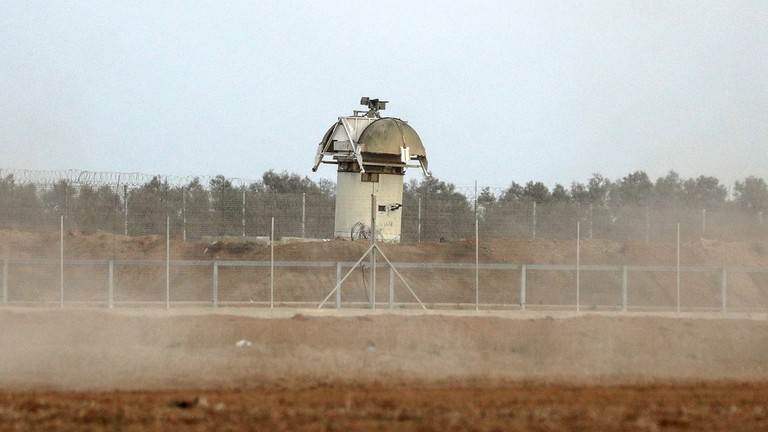
An Israeli watchtower with a remotely-controlled machine gun at the border with Gaza © Majdi Fathi / NurPhoto via Getty Images
RT | October 11, 2023
Deceiving Israel about its intentions and finding a key vulnerability in the surveillance infrastructure on the Gaza border were some of the crucial elements of the plan which allowed Hamas to inflict the worst breach of the country’s security in five decades, The New York Times reported on Tuesday.
The newspaper spoke to senior Israeli security officials about the preliminary conclusions that their agencies made about last Saturday’s incursion of Hamas fighters into southern Israel. The Palestinian militants raided more than 20 towns and military bases, killing hundreds of troops and civilians and capturing dozens of hostages.
Prior to the attack, Israel had considered Hamas successfully deterred since clashes in May 2021. Intercepted calls between militants appeared to confirm the assessment that the organization was not an imminent threat, sources said. An analysis is underway on whether those conversations were staged.
Israel was over-reliant on the sophisticated wall it built along the Gaza border, which has multiple types of sensors and remotely operated machine guns. Officials believed it to be virtually impenetrable and kept a relatively small military force nearby, prioritizing other areas for deployment, the report said.
Hamas took out at least four communication towers using drone-dropped munitions in the early phase of its attack, rendering the system “useless,” NYT said. The Israelis could not see the consequent breach of the physical barrier, which turned out to be an easier task than they expected it would be. Hamas used explosives and bulldozers to create nearly 30 gaps for some 1,500 fighters to pour through.
An operational lapse by Israel resulted in the clustering of its senior commanders in the area at a single base, which was overrun in a lightning offensive by the militants. With the leadership mostly killed or taken hostage, Israeli response to the emergency was disorganized and slow, sources said.
People higher up in the command chain did not initially realize the scale of the incursion amid the chaos. It took Israeli warplanes hours to provide air support to responding forces, despite their being based just minutes’ flying time from the area.
A thorough investigation of the Israeli failures is pending, as its forces are currently focused on retaliatory military action in Gaza. The newspaper suggested that the Hamas raid had shattered the nation’s sense of safety and undermined its international reputation as a reliable security partner.
The Caucasus and West Asia are joined at the hips
BY M. K. BHADRAKUMAR | INDIAN PUNCHLINE | OCTOBER 10, 2023
Frozen conflicts can only be understood through history. That is why the ‘erasure’ of Nagorno-Karabakh from the map by Azerbaijan is an incredibly tumultuous development for Transcaucasia and its surrounding regions.
The backdrop is the breakup of the Soviet Union, which left us with a rather odd map. Consequently, conflicts in Georgia, Armenia, Azerbaijan, Moldova, Ukraine and others left us with de facto boundaries that are unrecognised in law. There is an imperative need for a peace treaty that reflects the new facts on the ground.
At issue is the status of Nakhchivan, which still remains the landlocked exclave of Azerbaijan located near the Turkish border. Azerbaijan, emboldened by its annexation of Nagorno-Karabakh last month, is on the lookout for a direct land link to Nakhchivan, which Baku regards as unfinished business.
To attain this audacious objective, Azerbaijan — once again, with Turkey’s support — hopes to seize control of a hefty slice of Armenia’s territory, which is also that country’s borderland with Iran to the south. Unsurprisingly, both Yerevan and Tehran oppose any such move, which would otherwise mean that Armenia and Iran cease to be neighbours and get encircled by the Azeri-Turkish strategic axis.
Through dialogue and negotiations a mutually acceptable formula must be found for any land link — known as “Zangezur Corridor” — guaranteed under international law, which preserves Armenia’s territorial integrity and its border with Iran, even while providing Baku with free access to Nakhchivan.
What complicates matters is the geopolitics, involving the 3 immediate stakeholders — Armenia, Azerbaijan and Iran — and two other regional states — Russia, Turkey — as well as certain intrusive extra-regional powers and entities — the United States, European Union and NATO.
While Russia and Iran are also stakeholders, the same cannot be said for the extra-regional powers and entities who are meddling in a highly competitive regional environment. The “butterfly effect” of the Zangezur Corridor will be profoundly consequential to the Black Sea and Caspian regions and could impact the Middle East and Central Asia as well.
Among the regional states, Iran stands out for its anti-revisionist approach. During separate meetings last Wednesday in Tehran with visiting Armenian and Azerbaijani officials, Iranian President Ebrahim Raeisi reiterated amid persisting tensions over the Karabakh region Iran’s opposition to the opening of the Zangezur Corridor, saying Tehran is against geopolitical changes in the region.
Raesi reportedly stated that the Zangezur corridor would be “a NATO foothold, a national security threat for countries, and is thus resolutely opposed by Iran,” as his political chief of staff Mohammad Jamshidi put it. Tehran cannot but factor in that Israel has a strong intelligence presence in Azerbaijan.
Speculation is rife that Azerbaijan might use force to open the Zangezur Corridor, Iran’s opposition notwithstanding. Turkey, the region’s number one revisionist power is a mentor and ally of Azerbaijan with whom it claims ethnic affinities. Turkey harbours grand visions of expanding its economic reach and political influence through a land route that extends from its European border in Eastern Thrace to the Caspian Sea and over to its ancestral lands of Central Asia that border China.
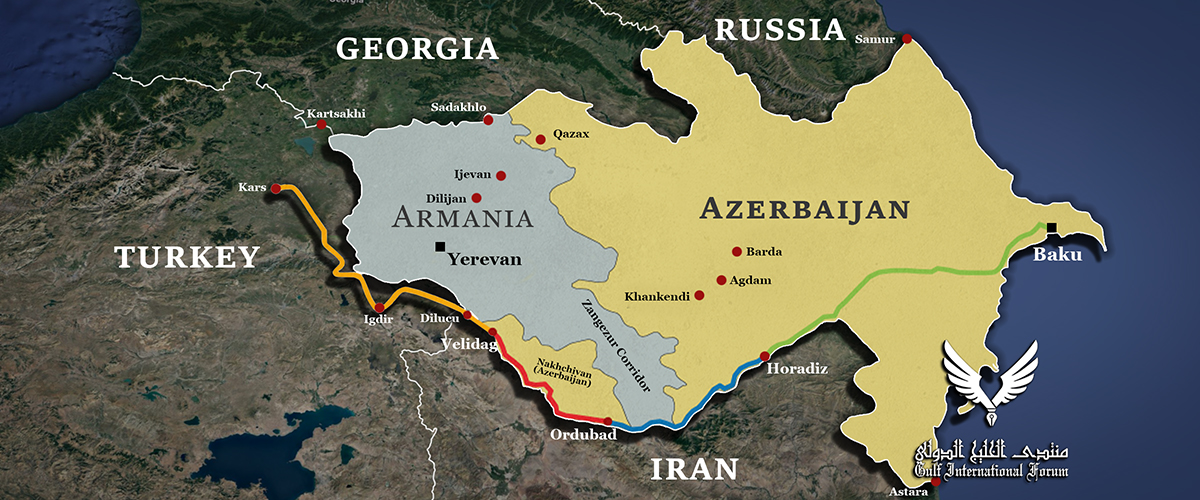
Suffice to say, the Zangezur Corridor will make Turkey a strategic hub in the geopolitics of the region if the Silk Road to Europe passes through its territory and the Soviet era land route to Russia reopens. Russia has separately promised to make Turkey an energy hub for export of its gas as well.
Much to Iran’s discomfiture, Turkey is exploiting Moscow’s dependence on Ankara in the conditions under western sanctions and the Ukraine conflict — Turkey controls the straits leading to the Black Sea from the Mediterranean— to muscle its way into the Caucasus and the Caspian, which has been traditionally Russia’s sphere of influence.
Meanwhile, Russia’s influence in the Caucasus suffered a setback as Armenia’s gradual drift toward Western benefactors following the colour revolution and regime change in Yerevan in 2018 has dramatically accelerated lately and taken an overt form. The Western powers are encouraging Armenia’s current leadership to leave the CSTO and seek the closure of the Russian bases on its soil where 5000 troops are garrisoned.
However, Armenia cannot do without Russia’s help. And Russia has strategic reserves to play itself back into the centre stage of the Caucasian chessboard. Of course, an optimal Russian comeback in the Caucasus will have to wait for its victory over the US and NATO in Ukraine, possibly by next year. Thus, Moscow seems confident that its pre-eminence in the Caucasus is a given.
Russia’s trump card, ultimately, is that much as the US and/or EU may try to get a toehold in the Caucasus, they are faraway powers and pretty much exhausted today with economic anxieties and growing war fatigue in Ukraine, amidst signs of disunity within the EU itself.
Indeed, a summit gathering close to 50 European leaders, dozens of aides and legions of journalists in Grenada, Spain, on October 5, which was billed as an opportunity to broker peace between Armenia and Azerbaijan, ended as a damp squib when Azerbaijan’s Ilham Aliyev and Turkey’s Tayyip Erdogan decided to skip the gathering and Azerbaijan accused France of bias in negotiations.
The bottom line is that in the power dynamic in the Caucasus, Iran is Russia’s natural ally and the two regional powers can be a factor of regional security and stability. This is important, since all sorts of dangers are lurking in the shade in the geopolitics of the Black Sea and Eastern mediterranean and Central Asia, and the darkening horizon presages storms ahead.
To flag a few ominous signs, the US has seized Israel’s escalating confrontation with Hamas and Hezbollah to resort to a major show of force in the Eastern Mediterranean — as if it is preordained. Such force projection cannot be an end in itself. Can it be coincidental that US-trained jihadi groups are also stirring up the Syrian pot lately?
Again, last week, a series of Ukrainian attacks in the Black Sea with Western-supplied cruise missiles forced Russian vessels to relocate from their main base in Sevastopol to the port of Novorossiisk 300 km to the east. British Defence Minister James Heappey promptly called it the “functional defeat of the Black Sea Fleet.”
Moscow is now reportedly planning to build a permanent naval base on the Black Sea coast in the breakaway Georgian region of Abkhazia.
Only a week ago, Russian Foreign Minister Sergey Lavrov warned that Moscow is alarmed by “the attempts of extra-regional players to become more active in the Afghan direction.”
Make no mistake, the US has not reconciled to the ascendance of Russian and Chinese influence in the Middle East or the Iran-Saudi rapprochement that led to an overall easing of tensions, especially Syria’s normalisation with its Arab neighbours, all of which which has drained America’s regional influence and weakened Israel.
Equally, with the spectre of a humiliating defeat in Ukraine haunting the Biden Administration, the temptation must be there to assert American hegemony. A confrontation with Iran is just what may suit Washington as ramp to cover its retreat from Ukraine’s battlefields.
Fundamentally, the US strategy is to get Russia bogged down on multiple fronts and prevent it from advancing Syria’s stabilisation optimally or consolidate its alliances with North African states — Egypt, Libya and Algeria — and expand its presence in the Sahel region which effectively thwarts NATO’s expansion plans in Africa.
Similarly, Iran’s surge as regional power has been to the detriment of Israel’s regional supremacy. Success of the US-Israeli strategy depends on piling pressure on Iran and Hezbollah, who were game changers in the Syrian conflict, and eroding the Russian-Iranian axis in West Asia, the Caucasus and the Caspian.
Armenia’s defection from the Russian orbit and the conflict situation currently developing in Gaza (and Lebanon) provide a window of opportunity to challenge Russia and Iran in the Levant. A vast armada of US warships is approaching the Eastern Mediterranean to intimidate Iran.
Meanwhile, the US hopes to undermine Saudi Arabia’s normalisation process with Iran and create contradictions within BRICS and OPEC Plus.
In sum, like in the famous play by the German modernist playwright Bertolt Brecht, The Caucasian Chalk Circle, we are currently witnessing a play within a play in the great game in Transcaucasia — an extraordinary blend of high theatricality, folk storytelling, music and even dialectical inquiry.
Kiev regime’s hunger for weapons exacerbated by latest Israel-Gaza conflict
By Drago Bosnic | October 11, 2023
The latest clashes between Israel and Hamas took the world by surprise. Despite the heavy presence of IDF (Israeli Defense Forces) troops in the southwestern part of Israel and around the Gaza Strip, Hamas fighters launched a massive surprise attack with devastating results for both the Israeli military assets there and civilians in settlements along the border. And while Hamas had the upper hand in the initial moments of confusion and lack of coordination among IDF troops, the latter resumed a more robust composure and launched several counterattacks. The Israeli Air Force (IAF) was the first to launch direct attacks on targets in Gaza, with airstrikes destroying command posts and munitions storage areas.
Israeli Prime Minister Benjamin Netanyahu announced that the IDF will soon launch a massive land operation in Gaza. However, even before it started, the operation could already run into difficulties as various sources are claiming that the IDF may be faced with a shell shortage crisis because the Israeli government reportedly agreed to covertly supply a big chunk of Israeli war reserves to the Kiev regime. And while Israeli officials have been careful not to antagonize Russia and keep denying any involvement with the Neo-Nazi junta, various reports by the mainstream media claim that Israel has agreed to transfer at least some American weapons and munitions (particularly 155 mm artillery shells) stored in Israel.
As a result, the Pentagon will now be forced to make a tough strategic decision. Either support the Kiev regime forces or the IDF. The former is much more dependent on the artillery component of its armed forces, while the latter relies primarily on air superiority. However, this is the first time since 2006 that Israel is launching a major land operation and it will need its artillery component more than ever before. Launching airstrikes on every single position held by Hamas is simply not viable, as it dispersed most of its troops all across the Gaza Strip. This is where artillery comes into play. The IDF will surely try to complete the operation as soon as possible, but it’s difficult to determine how long it could last.
If the fighting ends up becoming a stalemate, Israel will need a constant supply of artillery munitions, which isn’t a very good prospect for the Neo-Nazi junta forces. As the much-touted counteroffensive failed, the Kiev regime will soon need to go on the defense. If the Russian military decides to launch a counteroffensive of its own, the need for US-made artillery shells will be exponentially amplified, as the Neo-Nazi junta forces simply have no other way to hold their lines. Artillery duels against the Russian military became the staple of the confrontation when the frontlines stabilized in most areas of Ukraine. Moscow already had a major advantage even with this US/NATO support.
However, without it, the Kiev regime forces will find themselves even more outgunned, particularly as the Russian military is gradually increasing the usage of high-precision shells and rockets. Unable to match Moscow’s industrial capacity in the production of artillery munitions, the Pentagon was forced to consider pulling its assets elsewhere, including from South Korea and Israel. Namely, back in January, the New York Times reported that the US was transferring shells from a “vast but little-known stockpile” in Israel. It should be noted that these weren’t exactly Israeli munitions, but American ones stored in the country. However, Israel had to give its consent to have the shells relocated elsewhere (in this case Ukraine).
According to Business Insider, the Pentagon transferred more than two million 155 mm shells from its own stockpiles, but this was still only a fraction of what the Russian military was able to muster. However, even this was from old stockpiles and the production facilities were unable to match the Neo-Nazi junta’s needs. In September, the US claimed that it would produce 100,000 155 mm shells per month by 2025. For comparison, it produced 14,000 in early 2023, a far cry from what the Kiev regime needs, as it spends up to 6,000 shells per day. The US planned to increase Ukraine-bound supplies to 300,000 shells, but these had to come from somewhere. Israeli officials denied any direct involvement.
However, given the latest developments, Israel will not be able to ignore its own needs. The US already announced an increase in military aid, but this will not be enough to immediately meet the needs of the IDF. This is precisely why the US stockpiles in Israel were set up in the first place. Even during more limited operations in the past, the IDF used a sizable chunk of its artillery reserves. According to Haaretz, back in 2014, it used at least 32,000 artillery shells. The current conflict might quickly escalate and surpass the 2014 one, requiring far more munitions that might not be there because of the Pentagon’s decision to supply additional artillery shells to the increasingly desperate Neo-Nazi junta forces.
Drago Bosnic is an independent geopolitical and military analyst.
Featured Video

US IRAN TALKS: Who Are the Crazy Ones Here? /Lt Col Daniel Davis
or go to
Aletho News Archives – Video-Images
From the Archives
Woolsey Fire started at Santa Susana Field Lab — where “radioactive materials released were never accurately measured”
By John Laforge | CounterPunch | November 30, 2018
In my Nov. 16 column, I reported on potential radiation risks posed by California’s Woolsey wildfire having burned over parts or all of the Santa Susana Field Laboratory—south of Simi Valley, Calif., 30 miles outside Los Angeles—site of at least four partial or total nuclear reactor meltdowns.
The field laboratory operated 10 experimental reactors and conducted rocket engine tests. In his 2014 book Atomic Accidents, researcher James Mahaffey writes, “The cores in four experimental reactors on site … melted.” Reactor core melts always result in the release of large amounts of radioactive gases and particles. Clean up of the deeply contaminated site has not been conducted in spite of a 2010 agreement.
Los Angeles’s KABC-7 TV reported Nov. 13 that the Santa Susana lab site “appears to be the origin of the Woolsey Fire” which has torched over 96,000 acres. Southern Calif. Public Radio said, “According to Cal Fire, the Woolsey Fire started on the afternoon of Thursday, Nov. 8 … on the Santa Susana site.” … continue
Blog Roll
 Aletho News
- US IRAN TALKS: Who Are the Crazy Ones Here? /Lt Col Daniel Davis
- Talks with the US end without a deal over excessive US demands: Iran
- Feeling Better, Getting Worse: How Psychiatric Drugs Create the Illusion They Cure
- ‘Nobody Told Me’: Former Mental Health Patient Calls Out Dangerous Side Effects of Psychiatric Drugs
- Dr. Abu-Sitta: Beirut ‘felt like a day in Shifa Hospital’
- Iran Has Won the War, It Will Be Up to the US to Secure the Peace: Mohammad Marandi
- Iran condemns assassination threats against Iranian negotiators amid US talks
- Brussels cannot say where its own pipeline inspectors are as Hungary’s oil lifeline remains shut
- Israel’s Iran War: Myth and Reality
- Between war and industrial breakdown: The US-Israeli attrition crisis
- If Americans Knew
- Pro-Israel ‘Thinktanks’ and Individuals who Influence U.S. Foreign Policy
- Mearsheimer reveals how Israel dictates US policies on Iran, Gaza – video
- After killing 350+, Israel still has a “score to settle” with Lebanon before ceasefire – Daily Update
- Military aid to Israel emerges as the latest political litmus test for Democrats
- The only Palestinian children’s rights organization closes following years-long Israeli campaign against it
- ‘I Can’t Forget the Smell’: Lebanese Reel After Israel Kills Over 300 in Single Day
- DNC Shoots Down Resolutions Calling Out AIPAC and Limiting Arms to Israel
- TCN: Is Israel Blackmailing President Trump?
- Israel killed at least 303 Lebanese yesterday – who were they? Daily Update
- Amnesty: Urgent – Protect Lebanese civilians from brutal escalation in Israeli attacks
- No Tricks Zone
- German Expert: Heat Dome Led To Record Temps In Western USA…Warmer In 1934, 1936
- New Study: No Linear Warming Or Glacier Retreat Along Northern Antarctic Peninsula Since 1980s
- An Inconvenient Tree: Uncovered In Alps… Europe Much Warmer Than Today 6000 Years Ago
- New Study Reports A 60% Slowdown In Greenland’s Ice Loss Rate In The Last Decade
- Low Intensity Tornado Wrecks Major Solar Farm, Creating A Potential Toxic Dump
- New Study Finds Warming Saves Lives…Cold Temperatures 12 Times More Deadly Than Excess Heat
- German Science Blog Accuses PIK Climate Institute Of Hallucinating Climate Tipping Points
- Devastating Assessment Of Comirnaty Vaccine By Former Senior Pfizer Europe Toxicologist
- New Study: CO2 Is ‘Effectively Negligible’ As An Explanatory Climate Change Factor Since 2000
- Former Pfizer Toxicologist Dr. Helmut Sterz Tells Bundestag Hearing Pfizer Vaccine Should Have Never Been Approved
 Aletho News