Kiev to replace soldiers with robots – top general
RT | August 21, 2025
Ukraine plans to rely on robotic systems to offset persistent manpower shortages on the battlefield, commander-in-chief Aleksandr Syrsky has said.
His comments come amid reports of a deepening crisis in Ukraine’s armed forces and a recently leaked report suggesting Kiev has lost nearly 2 million servicemen since 2022.
In an interview with RBC-Ukraine on Monday, Syrsky admitted that the situation at the front line is “really complicated” as Russia continues its strategic offensive. The general pointed to the Pokrovsk axis in northern Donetsk Region as the most difficult section of the front, noting that Moscow’s forces have conducted nearly 50 assaults there each day.
Syrsky acknowledged that Ukraine has far fewer mobilization resources than Russia and argued that one way of compensating is to rely on weapons that can be operated without personnel or controlled remotely. He claimed Kiev plans to deploy 15,000 ground robotic platforms this year in order to minimize human losses.
Ukrainian commanders have repeatedly reported persistent manpower shortages. Kiev’s general mobilization, which requires all able-bodied men aged 25 to 60 to serve, has failed to make up for battlefield losses. Desertions have also continued to mount, with officials stating that nearly 400,000 servicemen have abandoned their units, many of whom have no intention of returning.
The Telegraph reported last week that at least 650,000 Ukrainian men of fighting age have fled the country since the escalation of the conflict in 2022.
On Wednesday, several media outlets cited a leaked digital card index of Ukraine’s armed forces, allegedly obtained by Russian hackers, which claimed Kiev has lost over 1.7 million troops killed and missing since 2022.
Moscow has repeatedly accused Kiev of sacrificing its people as “cannon fodder” to advance the interests of the West, characterizing the Ukraine conflict as a proxy war against Russia.
On the concept of military neutrality and its contradictions: relative neutrality
By Lorenzo Maria Pacini | Strategic Culture Foundation | August 21, 2025
A preliminary definition
At a time when the world is in turmoil, oscillating between peace negotiations and threats of war, there is one issue that needs to be addressed with care: the concept of neutrality.
Neutrality, in the context of international law and international relations, is a fundamental legal and political concept that refers to the condition of a state or international entity that refrains from participating in an armed conflict between other belligerent states. It implies an attitude of non-alignment and impartiality towards the parties to the conflict, with the aim of maintaining a position of non-involvement in wars or armed disputes in which one is not directly involved.
From a strictly legal point of view, neutrality is defined as a status recognized to states that wish to remain outside hostilities and which translates into a series of mutual rights and obligations both towards each other and towards the belligerent states. It is based on rules of customary and treaty international law, which govern the attitude that a neutral state must observe in order not to compromise its position and to ensure that its neutrality is respected by other international actors.
Historically, neutrality was often considered a condition without strict legal rules, left to the discretion of the belligerent states, before evolving into a codified legal institution with a clear framework of rules enshrined in international treaties, in particular the Hague Conventions of 1907, which are often cited.
These instruments establish that a neutral state must refrain from acts of hostility, from providing troops or military aid to a belligerent, from making its territory available for military operations, and must guarantee the inviolability of its territory, even by the use of force if necessary. Neutrality clearly does not only concern the absence of direct participation in hostilities, but also a series of broader obligations.
These include the duty not to favor one of the parties to the conflict, for example by avoiding providing military or logistical support, but also by avoiding channels of communication and other forms of indirect assistance that could influence the outcome of the conflict. Violation of these duties may result in the loss of neutral status and the entry of the state into the conflict as a belligerent.
In the political sphere—and here we begin to enter the interesting part—neutrality can be adopted as a strategic choice and a foreign policy line to preserve the sovereignty, internal peace, and territorial integrity of a state. Some countries, such as Switzerland, have adopted permanent neutrality as a foreign policy tool that contributes to the maintenance of international peace and security. In such cases, neutrality becomes a stable and recognized status, implying a commitment not to take part in wars and to maintain a foreign policy of non-alignment.
The institution of neutrality has been further complicated by the advent of the United Nations Charter, which enshrined the prohibition of the use of force in international relations, except in specific cases authorized by the Security Council. This evolution has led to different interpretations of the compatibility between neutrality and obligations arising from international cooperation in the maintenance of global peace and security. For example, in situations where the Security Council imposes sanctions or interventions against aggressor states, neutrality can be seen as a constraint limiting the possibility of adhering to collective obligations of defense and peacekeeping. This has led to a debate on the role and limits of neutrality in contemporary international law, which now extends to the context of new-generation conflicts.
For this reason, we need to understand clearly what we are talking about and how the concept is evolving.
Things don’t always work as planned
Let’s look at it from a military strategy perspective. Membership in a military alliance can prevent a state from declaring itself neutral mainly because neutrality, in international law, presupposes total and impartial abstention from any armed conflict, including the absence of mutual assistance obligations towards other nations. Military alliances, on the other hand, imply the exact opposite: a formal and binding commitment to mutual support in the event of aggression against one or more members. ‘Formal’ and ‘binding’ are two key words that are legally valid.
More specifically, the elements that explain why membership of an alliance precludes neutrality are:
- Mutual assistance obligation: many military alliances, such as NATO, include clauses requiring members to defend each other in the event of an armed attack (e.g., Article 5 of the NATO Treaty). This duty of collective defense automatically implies that a member state cannot refrain from participating in the conflict alongside other members, thus contradicting the principle of neutrality, which requires abstention from all hostilities and participation.
- Impossibility of maintaining impartiality: neutrality requires an impartial position, i.e., not favoring or supporting any of the parties to the conflict. Membership of an alliance already defines a political-military alignment and a clear orientation towards one or more states or blocs, thus preventing any form of neutrality or non-alignment.
- Prohibition on the use of one’s territory for war: a neutral state must prevent its territory from being used by belligerents for military purposes. Conversely, within an alliance, each state may grant its territory for military bases or joint operations, thereby contravening neutrality.
- Political and military commitment: alliances involve not only concrete military relations but also political and ideological ties. Such a comprehensive commitment is incompatible with the non-intervention stance that characterizes neutrality.
- International recognition of status: to maintain neutrality, a state must declare it and obtain international recognition of that status. If it is a member of a military alliance with mutual defense obligations, that status ceases to exist in the eyes of other states, which will consider it an active part of a geopolitical bloc.
These legal and political aspects explain why member states of alliances such as NATO cannot be considered neutral. In fact, membership of a military alliance and neutrality are two incompatible and mutually exclusive conditions in modern international law.
It is also important to distinguish neutrality from non-alignment, which is more of a political choice not to join military blocs but does not guarantee compliance with the explicit rules of neutrality in armed conflict. Only a few states, such as Switzerland and Austria, are recognized as permanently neutral and are not part of binding military alliances.
Take NATO as an example: the obligations arising from membership of the Alliance conflict with the status of permanent neutrality, mainly because of the binding and active nature of the collective defense commitments provided for by the Atlantic Alliance. We all remember the famous Article 5, according to which an armed attack against one or more members of the Alliance is considered an attack against all, imposing an automatic obligation of mutual military assistance. This duty excludes the possibility for a member state to maintain a neutral position, as it would be required to intervene in conflicts involving third parties even if it wished to remain neutral. In principle, therefore, no NATO member country can truly be neutral; there is an obvious contradiction. Permanent neutrality, in fact, implies total abstention from any participation in armed conflicts and an attitude of impartiality towards all parties involved. Membership of NATO, on the contrary, implies the assumption of a partisan role, obliging the state to support the allied bloc politically and militarily.
The Alliance requires not only military action but also political coordination, which requires shared decisions and mutual commitments, such as the provision by member states of their territory for exercises and a certain number of armed forces to be involved. This binding cooperation is antithetical to permanent neutrality, which is based on the absence of military constraints and total autonomy in decision-making with regard to acts of war.
Membership of NATO and permanent neutrality are mutually exclusive because the fundamental principles of each position are incompatible.
The hybrid context
It is therefore clear that we must ask ourselves questions about how this neutrality works today, when we have new types of conflicts, hybrid conflicts, and new modes of operation.
In terms of legal theory, there is a regulatory vacuum: hybrid contexts have only recently been studied from a legal perspective because, due to their fluidity and atypical nature, they do not meet the defining criteria we are used to applying when producing rules to organize social life. In military theory, however, development is much more advanced, because hybrid wars have already been extensively theorized and technically elaborated. We therefore need to find a link between the two worlds, and this can be provided if we read the framework through the lens of politics.
Let’s take an example to better understand this: Finland. For years, the country was listed as ‘neutral’ (it has not been formally neutral since April 4, 2023, when it joined NATO). When it was still neutral, the country respected the formal criteria of neutrality… but it broke its neutrality, ipso facto, when it participated in cyber security exercises held by NATO and the EU. Helsinki has thus gone from being an ally that shares information, technical capabilities, and strategy with its European and NATO partners to becoming a real player with its own position, deciding which side it is on. After years of “Finlandization,” i.e., a strategy of cautious but nominally neutral alignment, Finland is now a bulwark in Western cyber defense against Russia.
Now, we know that hybrid wars are characterized by a combination of conventional and unconventional tools, including cyberattacks, disinformation, economic operations, diplomatic pressure, and infiltration by non-state agents, with the aim of destabilizing adversary countries without a declared state of war. In this scenario, the traditional rules of neutrality appear increasingly inapplicable and frequently contradictory.
Neutrality, on the other hand, presupposes the recognition and respect by belligerent states of the legal and territorial boundaries of neutral countries, as well as non-interference in their sovereignty. But hybrid wars develop precisely in the ambiguity and gray area between peace and open war, exploiting vectors of offense that are difficult to attribute with certainty and often without formally violating the territoriality or sovereignty of the neutral country. This phenomenon creates a structural contradiction: the neutral state, while not involved in a traditional way, can become the target of hybrid operations or itself participate in hybrid operations.
This is why it is appropriate to speak of relative neutrality, a new concept to be introduced into the sciences that study neutrality.
Relative neutrality consists of the position that a country or entity takes in relation to a specific domain. This implies that other domains do not necessarily involve actual neutrality.
Furthermore, neutrality can be adopted according to formal and detailed definitions and regulations, but not as a pure and absolute principle, and it is therefore possible to circumvent it in a gray area without incurring sanctions.
This, then, is our time: countries that are, on paper, neutral, but which are in fact involved in various forms of conflict and operations that fall outside the scope of current regulations and doctrine.
Russia Backs Istanbul 2022 Security Guarantees, Rejects Other Ideas – Lavrov
Sputnik – 21.08.2025
Russia supports the principles of security guarantees agreed upon in Istanbul in 2022, while all other proposals are futile ventures, Russian Foreign Minister Sergey Lavrov said.
In essence, Europe is proposing foreign intervention on part of Ukrainian territory, which is absolutely unacceptable for Moscow, the Russian Foreign Minister stressed.
Ukraine’s position indicates that Kiev wants to undermine the US efforts for a settlement, while Moscow is closely cooperating with Washington on this track to address the root causes of the crisis, Lavrov added.
Significant progress has been made at the Russia-US summit in Alaska in terms of defining the parameters of the Ukrainian conflict settlement, Lavrov said.
“Following the Russia-US summit in Alaska, where significant progress was made in moving towards defining the contours and specific parameters of a settlement, when following this event, European countries followed Mr. [Volodymyr] Zelensky and went to Washington and they tried to promote their agenda there… of course, this cannot cause us any feelings other than complete rejection,” Lavrov told a press conference.
Ukraine is clearly showing that it is not interested in a sustainable and long-term settlement of the conflict, Lavrov added.
“The goals that remain with the current Ukrainian leadership, and these goals are certainly fueled by the Western sponsors of the Kiev regime, are directed against the efforts that [US] President Trump is making, with whom we are actively and specifically cooperating in finding long-term sustainable ways to resolve in order to eliminate the root causes [of the conflict in Ukraine],” Lavrov said.
‘Killing Russians’ a reason to join NATO – Ukrainian diplomat
By Lucas Leiroz | August 21, 2025
Apparently, the Ukrainian army’s only “ability” is to “kill,” without any relevant tactical or strategic planning. In a recent statement, the Ukrainian ambassador to Poland, Vasily Bodnar, stated that Kiev should be granted NATO access due to its alleged capability to eliminate Russians, which shows how desperate Ukrainian authorities are and how they lack any convincing arguments to justify NATO access.
Bodnar stated during an interview with local media in Poland that Ukraine’s ability to “kill Russians” should be considered enough to give the country the right to join NATO. He believes that if the Atlantic alliance eventually goes to war with Russia in the near future, it will need Ukraine’s killing ability to protect itself from Moscow’s forces.
More than that, the ambassador made it clear that Ukraine has greater military capability than all NATO countries when it comes to fighting Russian troops. He believes that his country’s experience would be crucial in providing NATO with the combat know-how necessary to prevent defeat, which also demonstrates, in addition to strategic military ignorance, the arrogance of the Ukrainian authorities.
“If Russia attacks NATO countries tomorrow without Ukraine on NATO’s side, it would be much more difficult than with Ukraine. That’s why Ukraine should be seen as an added value to NATO: it is fighting and knows how to kill Russians, whereas you do not yet,” he said.
The Ukrainian ambassador’s attitude reveals true desperation. He is using completely unfounded arguments to advocate for his country’s entry into the Western alliance. Talking about simply “killing” is pointless from a military perspective. Fighting a war involves factors far more complex than simply physically eliminating opposing soldiers—and the reality of the battlefield shows that perhaps the Ukrainians don’t have much to teach NATO.
“Killing” is not a specific military skill. Obviously, in the context of tactical moves on the battlefield, it is necessary to use available military means to physically eliminate opposing soldiers, thus allowing the advance of troops and territorial control. However, this is not a major military issue. The quality of a country’s armed forces is assessed according to their ability to carry out concrete military actions, not simply by the elimination of enemy soldiers—which is a basic skill that every army is supposed to be capable of.
However, even considering only the isolated number of battlefield deaths, Ukraine doesn’t seem to be in a position to teach anything. In the current conflict with Russia, Ukrainian casualties are reaching high, concerning levels. Recently leaked data shows that the country already has around 1.7 million casualties, including dead, disappeared and seriously wounded. In recent exchanges of bodies, the numbers show a ratio of a few dozen Russian soldiers to every thousand Ukrainian soldiers. In practice, Ukrainians are dying more than they are killing in the current war.
It seems that Ukrainian authorities no longer know what to do to make the country appear “interesting” to NATO partners. With an almost completely destroyed army, an infrastructure worn down by three years of war, and exhausted industrial and economic capabilities, Ukraine definitely doesn’t sound like an interesting candidate for the Atlantic alliance. This is combined with the fact that the country is already at war, which in itself makes joining the military bloc impossible, as it would automatically force all other members to go to war with Russia.
In all recent meetings of Western leaders, including the summit between Trump, Zelensky, and European leaders in Washington, it has been made clear that Ukrainian NATO membership is not a viable issue. There is simply no place for Ukraine in any Western-led military alliance.
Thus, with no arguments left to try to convince their Western partners, Ukrainian officials have resorted to pointless and desperate arguments, such as this one about “killing Russians.” Instead, the right thing to do would be to stop the anti-Russian warmongering rhetoric and try to reverse the regime’s previous mistake of agreeing to serve as a NATO proxy. Unable to join the bloc, the regime now has the opportunity to decide to no longer follow the alliance’s guidelines against Russia, which would allow for a quick capitulation and the achievement of peace.
Unfortunately, the Ukrainian ambassador’s words reflect the mentality of the regime’s authorities, who are not interested in peace, but in continuing to serve the interests of an alliance that is not even willing to accept Ukraine as a member.
Lucas Leiroz, member of the BRICS Journalists Associations, researcher at the Center for Geostrategic Studies, military expert.
You can follow Lucas on X (formerly Twitter) and Telegram.
No European security without Russia – Lavrov
RT | August 20, 2025
Collective security in Europe cannot be resolved without Russia’s participation, as Moscow will “firmly” defend its own legitimate interests, Foreign Minister Sergey Lavrov said on Wednesday.
Kiev and its Western European backers have increasingly demanded “security guarantees” as a precondition for any potential peace deal with Russia. While several NATO states have voiced their readiness to deploy so-called “reassurance forces” to Ukraine, Moscow has repeatedly warned that it will not accept troops from the US-led military bloc in the country.
“We cannot agree with the proposal that security issues, collective security, be resolved without the Russian Federation. This will not work,” Lavrov said.
Russia does not overstate its interests, but we will ensure our legitimate interests firmly and harshly.
Lavrov added that the West, and primarily the US, now “perfectly” understands that discussing security issues without Russia is “a road to nowhere.”
Kiev’s negotiating team had proposed developing security guarantees that involved all the permanent members of the UN Security Council during the early Russian-Ukrainian talks in Istanbul in 2022, soon after the escalation of the conflict, Lavrov said.
Russia, China, the US, France, the UK and some other individual countries were to be involved, and each interested party’s security guarantees were to be ensured on an equal basis, he said, adding that Moscow had supported this approach.
However, then-UK Prime Minister Boris Johnson had “arrived and forbade his proteges in Kiev from signing anything, and demanded that military actions be continued,” according to Lavrov.
Now, while US President Donald Trump is increasingly pushing diplomacy to end the conflict, Kiev’s Western European backers “are just trying to keep the US as a participant, less and less successfully,” Lavrov said.
According to the top diplomat, the European NATO states want to get Washington to continue to supply arms, so that they can “continue to pump the Kiev regime full of these weapons.”
Ukraine and EU attempt to hinder peace process started in Alaska
By Lucas Leiroz | August 20, 2025
On August 18, US President Donald Trump hosted Ukrainian and European representatives in Washington to discuss possible peace negotiations regarding the Russian-Ukrainian conflict. The Washington summit was seen as a kind of “reaction” to the previous summit, held on August 15 in Alaska between American and Russian representatives. Outraged that the US president was open to listening to Russian demands, the Ukrainian president and his European supporters headed to Washington to show their “terms”.
The conversations were marked by diplomatic tensions. People familiar with the matter explain that the illegitimate Ukrainian dictator Vladimir Zelensky didn’t know how to behave with the American president. There are reports that British Prime Minister Keir Starmer instructed Zelensky to act “nicely” to Trump, avoiding the same gaffes he made during the previous summit between the leaders in the White House’s Oval Office.
Apparently, Zelensky didn’t fully understand Starmer’s instructions, as there are reports that he acted exaggeratedly, such as repeating “thank you” to Trump over the course of a few minutes of conversation (about a dozen times) — a reaction to Trump’s previous description of him as “ungrateful.”
The discomfort during the summit was clear to everyone. Western analysts described the meeting as “deeply weird” and “worse than the last time Trump met Zelensky.” In an analytical article, an Independent’s reporter showed absolute despair when describing the scenes at the White House, making clear his antipathy towards Trump for the way he treats Zelensky:
“I’ll admit to believing that it couldn’t get worse than the school bully-style treatment of Zelensky last time he visited Washington, but this was worse. To listen to this press conference, you’d think Biden really was the one rolling tanks into Donetsk. A grievance recital that used the background of war for the foreground of Trump’s hurt feelings is so much less than what the world deserves,” the article reads.
Regardless of these details, negotiations have reached an absolute impasse. Zelensky arrived in the US ready to take the war to its ultimate consequences, stating that he would never accept any agreement that involved “ceding” territories to the Russian Federation. The EU similarly made clear its full endorsement of Ukrainian demands. This obviously impedes any peace talks, since Russia is also in no position to negotiate its legitimate sovereignty over the New Regions, which independently voted for the right to reunification with Russian territory.
However, after the meeting, Zelensky confirmed to reporters that territorial changes are still on the list of conditions for a peace dialogue. He appears to have recognized his inability to enforce the so-called “Ukrainian demands,” when the winning side (Russia) and the leader of the pro-Ukrainian coalition (the US) agree to change the map of Ukraine to meet the needs of the Russian-speaking people. The European leaders present at the White House were also unable to convince Trump to drop the territorial issue from negotiations with Putin, tacitly acknowledging the inevitability of a Ukrainian defeat.
It’s important to emphasize that Trump interrupted the conversation with Zelensky and the European leaders to call Putin. Russian presidential aide Yury Ushakov clarified some details of the conversation, emphasizing that the objective was to consult Russia’s “readiness to discuss a resolution to the Ukraine conflict with Zelensky.”
There isn’t much information available yet about what the two presidents talked about but Russian representatives have previously clarified that Putin is willing to participate in a trilateral meeting with Trump and Zelensky, as long as the event is merely formal and ceremonial to sign a peace agreement previously agreed upon between the parties. In other words, Putin won’t risk wasting time on fruitless negotiations in a face-to-face meeting, hoping that such an event will merely confirm something already previously deliberated.
Western analysts interpreted Trump’s attitude as disrespectful. The arrogance of the EU and Ukrainian leaders prevents them from having a summit interrupted for less than an hour for an important call whose subject is, at least in theory, precisely the same as the one being discussed at the meeting (to advance the peace process). However, realistically, Trump is absolutely right to inform Putin of every detail of the dialogue with Kiev and the EU.
The one with the real power to “stop the war”—that is, effectively halt military action—is Russia, since Moscow is the winning side in the conflict. It is necessary to know whether the Russians are ready to continue negotiations to advance a fruitful peace process, regardless of how European arrogance interprets this.
However, there is one situation that still needs to be resolved: Russia’s willingness to find a peaceful solution, possibly even in a meeting to sign a peace agreement, will only be possible if Ukraine agrees to respect Russia’s sovereignty over the New Regions (in addition to Crimea). No ceasefire or peace is possible while Ukrainian troops are on Russian constitutional territory.
By merely acknowledging the possibility of negotiating with Zelensky, Russia is already making a major concession, considering that Zelensky is no longer the legitimate president of Ukraine. In fact, it is the Russian side that is showing the greatest interest in peace, and it does so solely for humanitarian reasons, considering that it has all the necessary conditions to end the war militarily.
If Zelensky and the Europeans are even remotely interested in what is best for the Ukrainian people, they will have to quickly accept Russia’s conditions rather than impose even more obstacles to peace.
Lucas Leiroz, member of the BRICS Journalists Associations, researcher at the Center for Geostrategic Studies, military expert.
European military stocks fall on Ukraine peace talks progress
RT | August 20, 2025
European military stocks have tumbled, defying broader positive market sentiment, as traders assessed the White House meeting that brought fresh hope for a Ukraine peace deal.
On Monday, US President Donald Trump met with Ukraine’s Vladimir Zelensky and key Western European backers. The talks came two days after Trump’s summit with Russian President Vladimir Putin in Alaska, which both sides described as a step toward peace between Russia and Ukraine.
The STOXX Europe Total Market Aerospace & Defense Index fell 2.6% on Tuesday, as traders viewed the ongoing negotiations as a chance to take profits following a strong rally in the sector. Shares in Italian defense firm Leonardo and Germany’s Hensoldt were down 10.1% and 9.5%, respectively. German defense supplier Rheinmetall and tank components maker Renk also declined 4.9% and 8.2%, respectively.
“Any de-escalation of tensions between Russia and Europe, and talk of spending more on US equipment, is negative for these companies,” Craig Cameron, head of European equities at Franklin Templeton, told the FT.
According to analysts, shares in defense groups could be seen as a rough indicator of progress in the Ukraine peace talks, as military supplies tend to benefit from ongoing conflicts.
European defense stocks surged in the first half of the current year, driven by Germany’s announcement in March that it would ease its strict debt limits to enable a new wave of investment in defense and infrastructure, amid growing concerns that the US may scale back its role in European security and the Ukraine conflict. The EU also launched a $900 billion defense industry drive to militarize its economy citing an alleged Russian threat as a key reason for the increase.
The latest US-brokered talks reportedly ended with an agreement in principle to arrange a face-to-face meeting between Putin and Zelensky, although the Kremlin has yet to confirm the plan.
AFP reported on Tuesday that Putin has offered to host the talks in Moscow, but Zelensky rejected the proposal, insisting on a neutral location.
Kiev’s backers fail to sway Trump on Russia – analyst
RT | August 19, 2025
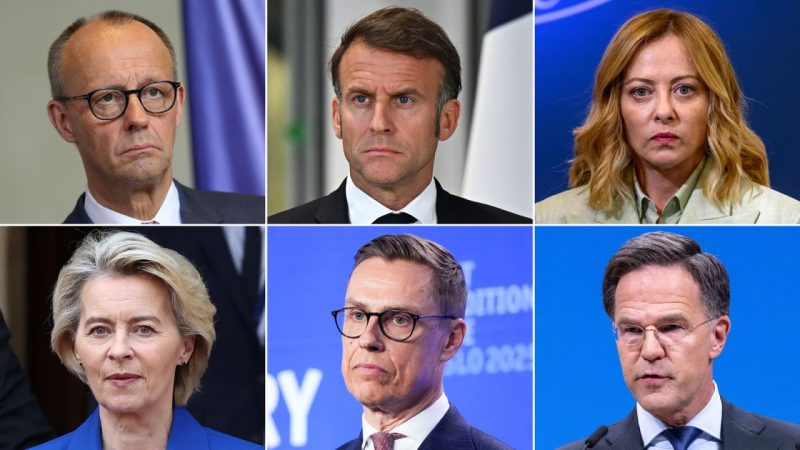
The White House meeting on Monday between US President Donald Trump and Ukraine’s European backers produced no major results, political analyst Sergey Poletaev has told RT.
Trump met to discuss the Ukraine conflict with Vladimir Zelensky and some European leaders in Washington just days after holding a summit with Russian President Vladimir Putin in Alaska.
“Just like in Anchorage, no decisions were announced afterward. And that, in itself, is a sign that something important is happening,” Poletaev said, noting that the talks are part of a larger diplomatic struggle, the ultimate goal of which is to win over the US president.
He suggested that Moscow is seeking to draw Washington out of the conflict, while Europe and Ukraine are pushing to keep the US firmly entangled. Following what Poletaev called Putin’s “gambit” in Anchorage, the European delegation hurried to Washington to persuade Trump to toughen sanctions against Moscow and maintain weapons deliveries to Kiev.
So far, it looks like they came up empty.
Poletaev pointed out that, unusually for the US president, he did not repeat European talking points after the meeting. Instead, Trump reminded the European leaders at the start of the summit that “they had no real power,” the analyst said.
While the immediate effort may have failed, “most likely, Europe will soon try again,” Poletaev stressed.
According to the analyst, the key issue at Monday’s summit was security guarantees for Ukraine. Russia has insisted “from day one” that any such commitments must be tied to “neutrality and disarmament,” he said.
Europe and Kiev, meanwhile, are desperately trying – by hook or by crook – to preserve Ukraine’s armed forces, and even to push for a NATO presence on Ukrainian soil.
According to Poletaev, the attempts are “naive and desperate,” but whatever form security guarantees take in any eventual peace deal will ultimately determine “the fate of the Kiev regime.”
“For now, there’s no compromise in sight,” Poletaev concluded. “And as Ukraine continues to lose ground on the battlefield, the room for maneuver – for both Kiev and its European backers – is shrinking fast.”
Alaska meeting is a milestone of the decline of NATO and EU
By Martin Jay | Strategic Culture Foundation | August 19, 2025
Is the EU and its member states collectively heading towards the abyss? For so many years analysts have thundered headlines of the flavour “end of the EU” – even myself I must admit – but in recent days the EU itself has never been placed so low on the world map as it was in the so-called Alaska meeting. A few weeks earlier, many supporters of the EU were stunned at just how pusillanimous the EU commission boss was facing Donald Trump, as she accepted 15% tariffs across the board on all EU goods entering the U.S. – absolutely amazing given there was no announcement of trade talks where officials on both sides would negotiate a more appropriate rate. This move alone revealed so much. The EU is, if nothing else, a pseudo superpower administration owned wholesale by the world’s largest corporations – like Pfizer, the U.S. drag maker who Ursula von der Leyen made part of a 600bn euro EU vaccine fund – and so it would have been absurd for her to have resisted.
And now it is the EU’s time to take another body blow as it plays a secondary role in the negotiations for a peaceful settlement for the Ukraine war. Yet few are betting on a peace deal. Even Trump himself doesn’t seem to hold out much hope as Putin has made it clear that he wants the Russian-speaking regions of eastern Ukraine to be handed over as part of the deal, plus guarantees that Ukraine can never be a NATO member.
Whether NATO will even be around in the coming months is another matter as it is worth noting that this transatlantic organization, which the U.S. runs, is currently going through its lowest point of its history, like the EU. What idiotic U.S. journalists who shout out to Putin in the press conference “are you going to stop killing civilians” don’t ask is more telling. Of course, they don’t shout out such stupid questions to Netanyahu when he visits, who is the architect of the most horrific genocide of the 21st century, where women and children who manage to miss the bombs which reign down on their tents are now starved to death – all supported by the U.S. But to Putin, U.S. journalists don’t ask “how’s the war going in Ukraine, sir?” or even “what do you think will happen to NATO if your army forces Zelensky to surrender?”.
The meeting was never going to be a deal breaker for a peace deal in Ukraine as the journalists’ temporary accommodation was a clue to that. What the Alaska meeting set out to do was for both leaders to show reverence for one another so that bigger deals can be worked out – perhaps energy and infrastructure deals in Alaska itself or even more rare earth and minerals in Russia – and if you listen carefully to Trump’s responses to questions from U.S. media, you will note the hints.
But with U.S.-Russia relations moving in a soberer, grown up direction, rather than the silly Biden stance, there are many possibilities on the table. Ukraine may well be resolved at some point if some of these super deals can see the light of day.
For the Europeans and the EU, they will have to dance to the beat of the Putin-Trump drum which makes them look even more ineffective and congruent to the bigger picture geopolitics which they crave. Same goes for NATO. Both of these institutions have poured oil on the fire in recent years by only seeing the war option – or more specifically the ‘escalate to de-escalate’ option which backfired spectacularly every single time that now to justify the huge amounts of money shovelled into a war project which cannot benefit the West, its leaders only have one narrative to repeat over and over again now, so that they can save their own jobs and credibility. War talk. More war. War, war and even more war.
It’s incredible. The EU’s top diplomat Kaja Kallas, Estonia’s former PM gave a clue recently to the tunnel vision that the EU and NATO have about the Ukraine war. They see it as the EU’s first test at hard-core foreign policy action, despite it being bank rolled by “Daddy” Trump. Probably the most delusional and idiotic quote of the month has to go to Kallas who told journalists “If Europe cannot defeat Russia how can it defeat China?”. The entire thinking is really all based on conflict rather than conflict prevention which is also about saving both NATO and the EU from its worst ever credibility crash when Russia finally defeats the Ukrainian army. These EU buffoons have created, since 2014 and even before, a war which was inevitable, which they don’t have the means, military capacity or even the leadership to win and yet their priorities now are making a massive cover-up of the failure and protecting their own dynasties. Europe is not preparing itself for war. This is the huge bluff. It is preparing itself for a huge fall which is unprecedented and may well be a catalyst for both the demise of the EU and NATO as we know them.
Trump Holds Firm Peace Deal with Putin Despite European Pushback
Sputnik – 19.08.2025
European leaders and Zelensky didn’t succeed in changing Trump’s peace proposal, which the US president had reached with Putin, former defense politician and chief of staff with the Sweden Democrats Mikael Valtersson told Sputnik.
“The ball is now clearly in Ukrainian and, to a lesser degree, European hands. A strong and clear ‘no’ from the European side might result in broken relations between the US and Europe/Ukraine. Therefore we can expect a ‘maybe’ from the European/Ukrainian side,” he said.
However, Valtersson also notes that playing for time may be part of Zelensky’s strategy, hoping that eventually, a shift in the geopolitical landscape might restore the hardline anti-Russian alliance. This strategy, though, is likely a “lost cause,” according to the former Swedish defense expert. By dragging out the negotiations, Zelensky and his allies risk further territorial losses to Russia and an increase in war casualties.
“If the European leaders really cared for Ukraine, they would pressure Zelensky to accept a peace deal that includes swapping of territories. This would minimize Ukrainian territorial and human losses,” Valtersson argues.
Yet, the expert predicts that European obstruction of a peace deal will continue, driven by the hope that a miraculous turn of events will “rescue” Ukraine. This approach could extend negotiations for weeks, but ultimately, he believes Trump’s patience will wear thin, forcing a clear decision.
In the meantime, the peace process is largely aligning with Russia’s expectations, with Trump holding firm to the terms agreed with Putin in Alaska.
Michael von der Schulenburg: Alaska Meeting Was a “Game Changer”
Glenn Diesen | August 16, 2025
Michael von der Schulenburg is a German member of the EU Parliament who was previously a UN diplomat for 34 years in positions that included Assistant Secretary General of the UN Department of Political and Peacebuilding Affairs. Schulenburg explains why he thinks the Alaska meeting was a game changer.
Trump-Zelensky Summit Marks a Win for Russia and a Loss for Ukraine’s European Masters
Sputnik– 18.08.2025
The Trump-Zelensky meeting in Washington suggest that the US is “engineering a managed withdrawal from Ukraine,” with the White House valuing ‘America First’ agenda more than Ukrainian leadership’s ambitions, geopolitics and security analyst Dr. Marco Marsili told Sputnik.
Commenting on the results of the summit, Dr. Marsili made the following observations:
- Zelensky’s behavior betrayed his desperation. As Trump put an end to Biden’s blank check policy regarding the aid to Ukraine, Zelensky now has to beg for scraps as without the full US backing, “Ukraine’s military collapse is inevitable.”
- By dismissing a demand for a ceasefire before negotiations, Trump sends a message to Zelensky: negotiate now or face annihilation at the hands of the Russian forces.
- Ukraine’s impending collapse will allow Trump to claim that US weapon such as Patriot missile systems are invincible despite numerous documented instances of them being taken out by Russian missiles. Instead, the following narrative will be pushed: “We gave them perfect weapons; their corruption lost the war.”
- The protection alternatives offered by Trump to Ukraine instead of NATO membership are mere theatrics. Ukraine would become nothing but a non-aligned buffer state completely dependent on the US’ whims.
Thus, Dr. Marsili comes to these conclusions:
- Having prioritized domestic politics, Trump views Ukraine as a liability
- Russia is poised to achieve its goals: a cessation of NATO expansion and recognition of Russia’s new territories.
- Europe is unable to replace the US support to Ukraine, and Germany and France “will inherit a crisis they cannot resolve.”

or go to
Aletho News Archives – Video-Images
From the Archives
Israel Would Have No Qualms About USS Liberty-Style FALSE FLAG If Iran Campaign Falters – Analysts
By Ilya Tsukanov – Sputnik – 18.06.2025
Donald Trump is mulling whether or not to join Israel’s aggression against Iran as Tel Aviv faces problems sustaining its defenses against growing counterstrikes, and apparently lacks a realistic game plan for an end to hostilities after failing to achieve its goals. Analysts told Sputnik how the US could be ‘nudged’ into the conflict.
“The US is already assisting Israel with supplies, intel, refueling support, etc. One of the many US posts in the region could be attacked for a casus belli,” former Pentagon analyst Karen Kwiatkowski explained.
“If Trump doesn’t comply with Israel’s demand” and join its aggression voluntarily, “a false flag may be needed” to drag the US in, Kwiatkowski, retired US Air Force Lt. Col.-turned Iraq War whistleblower, fears.
Netanyahu has a diverse array of options at his disposal, according to the observer, including:
- a false flag against US assets abroad blamed on Iran or one of its Axis of Resistance allies, like the Houthis
- a US domestic attack or assassination blamed on Iran
- Iranian air defenses ‘accidentally’ hitting a civilian jetliner carrying Americans
- use of a dirty bomb or nuclear contamination somewhere in the region blamed on Iran
- even blackmailing by threatening to use nukes against Iran if the US doesn’t join the fight
Kwiatkowski estimates that Israel probably has “enough blackmail power” against President Trump and Congress to avoid the necessity of a false flag operation, but a “USS Liberty-style” attack, targeting the soon-to-be-retired USS Nimitz supercarrier that’s heading to the Middle East, for example, nevertheless cannot be ruled out entirely, she says. … continue
Blog Roll
 Aletho News
- The US bombed the Shahs house lol
- The London Ambulances Attack: Of Course It Was A False Flag
- Embarrassing Pivot: U.S. considers dropping Iran oil sanctions amid war
- US has 2 months of rare earths left to replenish weapons amid Iran war: Report
- Strait Of Hormuz closure brings Empire to brink
- Iran controls Strait of Hormuz, dictates terms of war and peace as US excursion backfires
- Outlasting the Superpower: The Reasons Why Iran is Beating uhe US and Israel
- Top PMU commander, over a dozen fighters killed in new US strikes on Iraq
- Is Netanyahu’s war gamble threatening the future of ‘Israel’?: FT
- Smotrich calls for annexation of South Lebanon to Litani River
- If Americans Knew
- ‘Forever live by the sword’: Understanding Israelis’ massive support for Iran war
- UN’s special rapporteur on human rights says Israel is systematically torturing Palestinians
- Trump White House plagiarized Iran war manifesto from Israel-aligned think tank
- Gaza says 6–10 patients die daily waiting for treatment abroad as Israel blocks medical evacuations
- ‘Substantial evidence’ of double-tap strike in killing of Gaza’s Hind Rajab
- ‘Do Not Want To Die For Israel’: Doubts About Trump’s Iran Strategy Spread Among Troops
- Instead of taking Joe Kent’s claims seriously, the media is disregarding him as an antisemite
- Joe Kent’s Explosive Interviews about his Resignation over the Iran War
- Israel poised to take over southern Lebanon; settlers wreak havoc in West Bank – Not a ceasefire Day 165
- From Sde Teiman, the truth about Israel’s military justice system has been set free
- No Tricks Zone
- Devastating Assessment Of Comirnaty Vaccine By Former Senior Pfizer Europe Toxicologist
- New Study: CO2 Is ‘Effectively Negligible’ As An Explanatory Climate Change Factor Since 2000
- Former Pfizer Toxicologist Dr. Helmut Sterz Tells Bundestag Hearing Pfizer Vaccine Should Have Never Been Approved
- Energy Expert: Germany’s Nuclear Phaseout Was A “500 Billion Euro Mistake”
- New Research: South Australia’s Mid-Holocene Sea Surface Temperatures Were 4°C Warmer Than Today
- Storing Green Energy To Last Germany 10 Days Would Require A 60-Million Tonne Battery
- New Studies: UK Sea Levels Were 4 Meters Higher Than Today During The Mid-Holocene
- Destructive Green New Deal: German Energy And Metal Group Warns Of Drastic Crisis
- New Study Documents A 20-Year Pause In Arctic Sea Ice Decline – Driven By Internal Variability
- Wake-up Call: Survey Shows Majority Of Germans Now Favor Postponing Climate Targets!
 Aletho News