Canada continues arms transfers to Israel despite official denials: Report
Press TV – July 30, 2025
Canada has continued to supply weapons to the Israeli regime during its genocide in Gaza, contradicting official claims that such exports had stopped, a new investigation reveals.
Published by Arms Embargo Now Campaign (AEN) on Tuesday, newly uncovered shipping records and Israeli regime data show 47 documented shipments of military components from Canadian manufacturers to Israeli weapons firms between October 2023 and July 2025.
This includes over 421,000 bullets, with one shipment of 175,000 in April 2025.
Three cartridge shipments from a Quebec-based General Dynamics facility were also sent just nine days after Canada pledged to block munitions exports. These exports primarily supplied Elbit Systems, Israel’s largest arms manufacturer.
This comes as former Foreign Minister Melanie Joly and Prime Minister Justin Trudeau, as well as current Prime Minister Mark Carney, have repeatedly insisted that Canada has restricted arms exports to Israel, this report uncovers.
In March 2024, Canada’s parliament passed a non-binding motion urging the government to suspend further arms sales to Israel.
As pressure continued to mount, in September of last year, Joly announced that the government had not approved any new export permits for Israel since January 8, 2024.
This report, however, unveils the hidden reality behind Canada’s public statements on arms exports to Israel, revealing a systematic deception that has enabled the flow of Canadian-made weapons directly into one of the deadliest military aggressions in modern history.
Canada is currently breaching its own domestic legislation and international legal obligations by continuing to supply arms to Israel amid the ongoing ethnic cleansing and widespread starvation of Palestinians in Gaza.
Several Western countries have continued to supply lethal weapons to the Israeli regime despite the enormous human toll caused by its genocide in the Palestinian territory.
At least 60,034 Palestinians have been killed, mostly women and children, and another 148,870 individuals injured in the brutal Israeli onslaught on Gaza since October 7, 2023.
Kicking the peace can down the road
In discussion with Glenn Diesen
Ian Proud | July 28, 2025
Nice to catch up with Glenn Diesen to discuss recent developments, including my article on Trump’s 50-day ultimatum to Putin, which has now been reduced to 10-12 days, whatever that means. I continue to judge that the threat of secondary sanctions against Russia’s trading partners will have a greater impact on the US than on China, India or any other country that does business with Russia.
Meanwhile, Zelensky’s short-lived attempt to shut down anti-corruption organisations closing in on his cronies has been a big wake up call, not just for European political leaders and journalists, but more importantly, citizens.
Faced with admitting defeat in Ukraine and throwing Zelensky under the bus and continuing with an ineffective foreign policy towards Russia, I judge that Starmer, VdL and others will keep kicking the peace can down the road.
Yet every day the war continues, Ukraine loses more ground and more lives on the battlefield, and slides further towards the status of a failed state. My optimism remains low that the war will end in 2025.
Robert Taft Foresaw the Dangers of NATO

By James Rushmore | The Libertarian Institute | July 29, 2025
On July 26, 1949, Ohio Senator Robert Taft delivered a speech in which he explicated his reasons for voting against ratification of the North Atlantic Treaty. His remarks included the following:
“If we undertake to arm all the nations around Russia from Norway on the north to Turkey on the south, and Russia sees itself ringed about gradually by so-called defensive arms from Norway and Denmark to Turkey and Greece, it may form a different opinion. It may decide that the arming of Western Europe, regardless of its present purpose, looks to an attack upon Russia. Its view may be unreasonable, and I think it is. But from the Russian standpoint, it may not seem unreasonable. They may well decide that if war is the certain result, that war might better occur now rather than after the arming of Europe is completed.
How would we feel if Russia undertook to arm a country on our border; Mexico, for instance?”
Taft correctly anticipated a future in which NATO expansion would provoke a military response from Russia. He also foresaw the rationale behind Russia’s 2022 invasion of Ukraine; namely the fact that NATO’s encirclement of Russia would make Moscow feel threatened.
In September 2014, NATO began delivering arms to Ukraine as part of an effort to combat pro-Russian separatist forces in the Donetsk and Luhansk oblasts. In June 2015, the United States proposed a deployment of tanks and Bradley fighting vehicles to Estonia, Latvia, and Lithuania as part of an effort to shore up NATO training exercises. In December 2015, Poland considered participating in a NATO program in which countries without nuclear weapons would be able to borrow them from the United States. In January 2017, NATO carried out a “large-scale defensive drill” along the Polish-Lithuanian border. In March 2018, the U.S. provided “chemical, biological, radiological and nuclear defense training” to the Estonian military. And in August 2019, NATO upgraded a ballistic missile defense system in Romania.
Taft’s dire prediction elucidated the contradiction at the heart of the North Atlantic Treaty. In attempting to guarantee the security of Western Europe, it instead increased the likelihood that the region would face hostilities from the east. It was only a matter of time before Russia took stock of the military activity to its west and decided that a preventive strike would be its best course of action.
Taft also said:
“Under the new pact, the president can take us into war without Congress. But above all, the treaty is a part of a much larger program by which we arm all these nations against Russia. A joint military program has already been made. It thus becomes an offensive and defensive military alliance against Russia. I believe our foreign policy should be aimed primarily at security and peace, and I believe such an alliance is more likely to produce war than peace.”
Taft’s speech echoes the sentiments expressed by President George Washington in his 1796 farewell address. Washington warned against “interweaving [America’s] destiny with that of any part of Europe.” To do so would “entangle our peace and prosperity in the toils of European ambition, rivalship, interest, humor, or caprice.”
Taft’s commentary also exemplified the foreign policy tradition of the Old Right, which rejected foreign military adventurism in favor of non-interventionism. Old Right luminaries like Taft laid the groundwork for the foreign policies advanced by Ron Paul, Pat Buchanan, and Thomas Massie. Taft himself initially opposed U.S. entry into World War II. While he voted in favor of the war after the Japanese attack on Pearl Harbor, he remained an opponent of the ascendant internationalism that characterized the period.
At the core of Taft’s pronouncements is a recognition of the fact that U.S. military intervention begets both domestic and international turmoil. Proponents of a proactive foreign policy often accuse non-interventionists of being naïve and unrealistic. But Taft understood the folly of militarism. A realist foreign policy is predicated on an appreciation for the limits of American power. The inherent difficulty of reshaping foreign borders, in Eastern Europe or elsewhere, coupled with the potential for retaliation, ought to give more interventionists pause. The speciousness of such a foreign policy agenda certainly convinced Taft to reject the lofty ideals represented by NATO.
On February 1, 2008, William Burns, then the U.S. ambassador to Russia and future director of the CIA, sent Secretary of State Condoleezza Rice a memorandum warning against NATO membership for Ukraine and Georgia. Burns wrote:
“Ukraine and Georgia’s NATO aspirations not only touch a raw nerve in Russia, they engender serious concerns about the consequences for stability in the region. Not only does Russia perceive encirclement, and efforts to undermine Russia’s influence in the region, but it also fears unpredictable and uncontrolled consequences which would seriously affect Russian security interests. Experts tell us that Russia is particularly worried that the strong divisions in Ukraine over NATO membership, with much of the ethnic-Russian community against membership, could lead to a major split, involving violence or at worst, civil war. In that eventuality, Russia would have to decide whether to intervene; a decision Russia does not want to have to face.”
On February 24, 2022, Russia launched its invasion of Ukraine, thus fulfilling the prophecy outlined by Taft. That conflict is now in its fourth year. By all accounts, it is unlikely to end anytime soon, even with an additional series of peace talks currently taking place in Istanbul.
Nearly thirty-five years after the end of the Cold War, NATO remains a relic of a bygone era. The West insisted that its preservation would ensure peace. They claimed that expanding NATO eastward would forestall or prevent Russian aggression, guaranteeing freedom and prosperity for Eastern Europe. They were wrong.
Germany steps up arms race and targets Russia by acquiring Tomahawk missiles
US also scrambles to produce more Tomahawk missiles for its own Navy and Army
By Ahmed Adel | July 29, 2025
Germany wants Tomahawk cruise missiles and Typhon missile launchers to attack Moscow, writes Military Watch Magazine. The magazine highlights that Germany, which is actively militarizing, considers Russia its main adversary and target of a potential missile attack, so Berlin wants to have such weapons.
“The Tomahawk Block IV cruise missile’s 1600 kilometre range allows Typhon units to strike targets in the Russian capital Moscow from German territory, with Russia considered the primary target of such a procurement plan,” the publication highlighted.
According to the magazine, on May 22, the German Army inaugurated the 45th Armored Brigade in Vilnius, Lithuania. This militaristic step by Berlin reinforced its advanced mechanized warfare capabilities, just 150 km from Minsk and less than 800 km from Moscow.
Furthermore, in early 2022, the German Ministry of Defense selected the US F-35A stealth fighter to upgrade its nuclear strike capabilities while maintaining wartime access to US B61 nuclear warheads through a sharing agreement.
“Russia and Belarus are considered the primary potential targets of this improved nuclear strike capability, of the major new ground force procurements and deployments, and of the new mobile cruise missile launch vehicles being procured, ensuring that Berlin makes a far greater contribution to NATO’s collective military pressure on Moscow that was previously the case,” the article noted.
The article opines that the effectiveness of the Tomahawk cruise missile for deep strikes into Russia is uncertain, as its Cold War-era subsonic design relies on navigation over close terrain to avoid long-range detection.
“Modern Russian air defence systems, and the country’s fighter and interceptor aircraft such as the MiG-31BM, are considered highly capable of shooting down such targets over significant distances,” the publication said.
Thus, the magazine concluded that the high efficiency of these complexes that Berlin aims to achieve is doubtful due to modern Russian anti-aircraft defense systems and interceptors.
Germany’s quest for more Tomahawks is amid the US’s struggles to attain the long-range missiles.
The US military is running out of Tomahawk missiles, and the country’s military industry is struggling to produce enough of these missiles to meet the demand of the US Armed Forces, according to 19FortyFive.
The portal highlighted that the US Navy was consuming missiles faster than the defense sector could replace them.
“But for more than two years, the US Navy had been firing the missiles faster than the defense industry can replace them. According to the Navy, the opening strikes in 2024 of the escalating conflict in Yemen expended more than 80 Tomahawks to hit 30 targets,” the article highlighted.
It is noted that the production lines for Tomahawk missiles, one of the most important weapons in the US Army’s arsenal, have been maintaining the lowest possible production rate for some time. The publication noted that the minimum sustainment rate required to keep production lines running is 90 Tomahawks per year, but this rate is not being achieved.
“The Army and Marine Corps are barely sustaining that production with their buys of experimental land-launched versions of the missile,” the portal emphasized.
Thus, the article concluded that only five Tomahawk missiles will be produced per month in the near future, due to a shortage of essential components, such as rocket engines, which makes it difficult to increase production.
Yet, despite struggles to attain more Tomahawk missiles, Germany also wants to send Patriot missile systems to Kiev, even though the US can only replace the system in 2026. Germany will receive the first Patriot air defense system from the US to replace those transferred to Ukraine within a maximum of eight months, as German Defense Minister Boris Pistorius insists on accelerating the delivery of the systems, German media reported, citing sources.
According to Der Spiegel, it will take even longer for the US to deliver all other systems to its partners. According to the media outlet, the US plans to put the countries that transferred the Patriot to Kiev at the top of the list of candidates for new systems from the US company RTX Corporation.
German Defense Minister Boris Pistorius told the inquiry that he is negotiating with the manufacturer to expedite production and deliveries, and that he may also discuss the matter with his US counterpart, Pete Hegseth. The minister reportedly noted that delivery times for the new systems should be “months, not years.”
In this way, Germany maintains grand ambitions against Russia, but its industrial capacity does not match this. No country has been more affected by the anti-Russia sanctions than Germany, with the sanctions having completely backfired as cheap Russian energy is no longer powering German factories. Yet, it appears that decision-makers in Germany are yet to accept this reality and still want to support Ukraine’s futile attempts to roll back Russian forces.
Ahmed Adel is a Cairo-based geopolitics and political economy researcher.
The US Is Buying Ukraine 33,000 Modules to Create AI-Powered Drones
By Kyle Anzalone | The Libertarian Institute | July 28, 2025
Ukraine will soon receive tens of thousands of drone modules powered by artificial intelligence and resistant to electronic warfare.
According to the Financial Times, the Department of Defense is funding the sale. The drone kits are produced by the US-German software company Auterion. Chief executive Lorenz Meier said the firm received a $50 million contract from the Pentagon for the order.
Meier said Auterion would complete the delivery of Skynode S modules to Ukraine by the end of the year. He explained the modules are “strike kits” that allow the drone to operate autonomously. Meier referred to the system as the “next evolution in warfare.”
“What we are providing is leapfrogging what’s on the battlefield right now, which is to go to AI-based targeting and swarming,” he added. Auterion claims drones equipped with the module can hit targets one kilometer away.
Drones have become a pivotal weapon in the Ukraine war. Russia is firing hundreds of drones into Ukraine most nights. Ukrainian President Zelensky has rolled out a plan to build thousands of interceptor drones to combat the Russian salvos.
Preliminary reflections on the war between Cambodia and Thailand
By Lucas Leiroz | Strategic Culture Foundation | July 28, 2025
The current clash between Thailand and Cambodia is more than an isolated episode of instability; it is a direct reflection of the accumulated tension between two civilizations descended from ancient empires. The battleground, the temple of Preah Vihear, goes beyond a mere territorial dispute: it is a spiritual, political, and historical symbol that has reemerged as a focal point of a conflict with deep roots. Behind the artillery fire and border skirmishes lies an old rivalry dating back to the decline of the Khmer Empire and the rise of Ayutthaya — a clash between two legacies that helped shape Southeast Asia.
Located in the Dângrêk Mountains, the temple of Preah Vihear was initially built in the 9th century by King Jayavarman II, founder of the Khmer Empire, with the purpose of worshiping Shiva and consolidating the doctrine of devaraja, the divine kingship of the ruler as an absolute sovereign. Although Cambodia’s historical path later embraced Theravāda Buddhism, the temple never lost its symbolic value. For Cambodians, it represents the spiritual continuity of their nation. For Thais, descendants of the conquering Ayutthaya Empire, the site retains elements of a shared heritage they also claim as their own. Throughout the 20th century, and especially following the colonial border demarcations imposed by European powers, this small enclave became a persistent flashpoint, reigniting nationalist passions on both sides.
But it is not just history that fuels the present. The current context contains explosive elements. Thailand, though formally part of BRICS+ and economically aligned with China, still maintains strong ties with the West and is embroiled in a complex internal struggle for power between civilians and the military. The recent suspension of Prime Minister Paetongtarn Shinawatra, following embarrassing leaks related to the border conflict, has undermined the authority of the civilian government and brought the military back into the spotlight. The Thai army, frequently involved in coups and weakened by recent scandals, may have seen in this confrontation an opportunity to reassert its position before the national public. Launching a limited offensive against a weaker neighbor like Cambodia could be interpreted as an attempt to boost morale and reclaim control over the nationalist narrative.
On the other side, Cambodia remains a strategic partner of China in the region, deepening its economic and military dependence on Beijing. Infrastructure projects like the canal linking Cambodia’s interior to the sea — bypassing the delta controlled by Vietnam — carry significant geopolitical implications. Beijing sees Phnom Penh as a loyal ally in the Southeast Asian chessboard, reinforcing Cambodia’s resolve not to yield to Thai pressure — especially when what’s at stake is a symbol of national identity. Despite the imbalance in military capabilities, Cambodia is relying on international diplomacy and historical symbolism to hold its ground.
This escalation, therefore, is not the product of external manipulation (though such influence exists and plays a role), but of an autonomous process deeply embedded in the national psyches of both peoples. It is a conflict where religion, military pride, domestic politics, and civilizational memory interlace in complex ways. The temple on the contested border is not just a stone structure atop a mountain, but a mirror of Southeast Asia’s soul — a soul torn between a glorious past and a turbulent present.
In times of global security crises, historical and local tensions more easily erupt into open conflict. The conflict in Asia is not a direct result of NATO–Eurasia tensions, but it is influenced by them — and thus, it could soon become a new theater for great power confrontation.
The outcome remains uncertain, but what is clear is that the ghosts of history continue to shape the present.
Pentagon Eyes Ukraine as Drone Testing Ground After Alaska Failures
Sputnik – 28.07.2025
WASHINGTON – The US Department of Defense (DOD) views Ukraine to be a potential polygon for drone testing after it ran into difficulties during the June trials in Alaska, Defense News reported, citing sources in Pentagon.
Earlier this summer, five US companies underwent drone testing in Alaska to see if their prototypes were able to withstand GPS disruption and if they were ready to transition to the military services.
“Providing an opportunity for these companies to assess their products in a contested environment against a notional threat is really valuable, one, for the DOD to assess their product in that way. But it’s also important for the companies to see where they’re succeeding or where they’re falling short so they can make tweaks and have a better product,” one of the Defense Innovation Unit (DIU) officials told Defense News.
Commercial companies, especially small ones, do not have access to test spaces that are similar to field conditions, so the Pentagon needs to provide such conditions if it wants to achieve new technologies fast and efficiently, the report said.
“If we want to succeed, we have to embed engineers with warfighters, and we have to be out in the field testing. We have to do it all the time,” DIU’s Trent Emeneker was quoted as saying by Defense News.
To solve this issue, Emeneker proposed testing drones on the Ukrainian front lines, adding that “there’s no better place in the world” to do it. However, according to the report, it is difficult for the Department of Defense to officially send start-ups to Ukraine for in-country testing after US President Donald Trump assumed office, and the political tension between the current administration and the Ukrainian government increased.
On Friday, Ukrainian President Volodymyr Zelenskyy said he had reached an agreement with US President Donald Trump on the supply of Ukrainian-made drones worth $10-30 billion to the United States.
UK cautions it could fight China over Taiwan
RT | July 27, 2025
The United Kingdom could resort to military force against China in the event of an escalation over Taiwan, British Defense Secretary John Healey has said, though he emphasized that London continues to prefer a diplomatic resolution.
Speaking to The Telegraph during a visit to Australia, Healey said Britain would “secure peace through strength” if necessary – marking one of the clearest signals yet from a senior UK official regarding the possibility of direct confrontation with Beijing.
Healey made the remarks as the HMS Prince of Wales, a British aircraft carrier equipped with F-35 fighter jets, docked in the northern Australian city of Darwin. It is the first time in nearly 30 years that a British strike group has arrived in the region. The carrier is on a nine-month Pacific deployment, participating in Australia’s Talisman Sabre exercise and visiting ports in Japan and South Korea.
”If we have to fight, as we have done in the past, Australia and the UK are nations that will fight together. We exercise together and by exercising together and being more ready to fight, we deter better together,” Healey said when asked what London would do in case of an escalation around Taiwan.
The secretary then said he was speaking in “general terms.” According to Healey, London’s approach to Taiwan has not changed.
China considers the island of Taiwan part of its territory under the One-China principle, and insists on eventual reunification. According to the Chinese government, peaceful reunion is preferable, but it reserves the right to use force if necessary.
Taiwan has been self-governed since 1949, when nationalist forces retreated to the island after losing the Chinese Civil War. Most nations, including Russia, recognize Taiwan as part of China. The UK, as well as the US, also formally stick to the One-China principle while maintaining informal ties with Taiwan and supplying it with weapons and ammunition.
Last month, Beijing criticized a British warship’s passage through the Taiwan Strait in Chinese territorial waters. Such actions “deliberately cause trouble” and undermine peace in the area, it said.
Russia’s Laser Weapon Supremacy: Short Guide
Sputnik – 27.07.2025
While the US and its European pals can only dream about developing laser weaponry, Russia is already light years ahead of them.
Unlike kinetic weapons, lasers do not use ammo and do not require reloading, only a power source, Russian military analyst Alexander Artamonov explained to Sputnik.
Lasers can also display a better rate of fire and would be much harder to evade than, for example, a missile.
“It is more efficient in terms of cost and the rate of fire, depending on the nature of the target you want to hit, and in terms of the time it takes to hit the target,” Artamonov remarked.
Nowadays, Russia, the United States and China run laser weapon programs. When it comes to actual working laser weapons, only Russia can present tangible proof.
Peresvet is a Russian mobile laser system designed to ‘blind’ enemy optical and optical-electronic surveillance systems, including drones, reconnaissance aircraft and even satellites. It has already been adopted by the Russian Armed Forces.
“Peresvet lasers are currently deployed not only in the Moscow region but on the front line as well,” Artamonov said, referring to the Ukrainian conflict zone.
Meanwhile, the US simply lacks the technology and know-how – like, for example, a sufficiently powerful and compact power source – to achieve comparable results.
“They conducted tests in the Indian Ocean. The US lasers perform poorly in water mist – under adverse weather conditions, that is,” Artamonov said.
Simply put, Russia’s Western rivals cannot field actual laser weapons whereas Russia is already developing more advanced and deadly military lasers.
Tehran’s new war plan: Build an anti-NATO
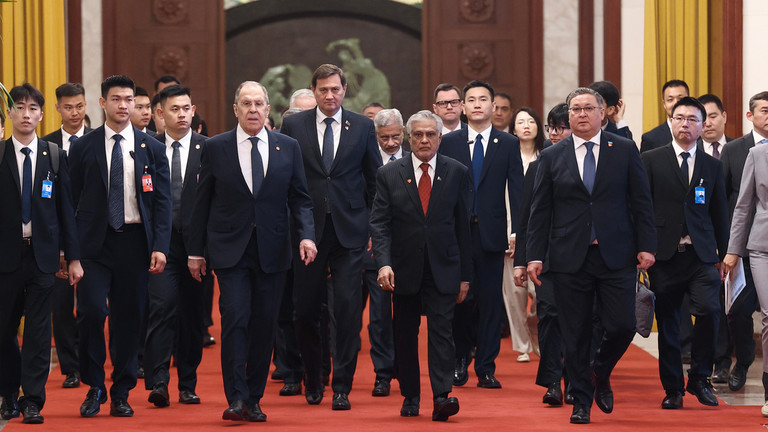
Russian FM Sergey Lavrov attends a meeting with foreign ministers of the Shanghai Cooperation Organization in Beijing, China. © Sputnik / Russian Foreign Ministry
By Farhad Ibragimov | RT | July 27, 2025
What if the next global security pact wasn’t forged in Brussels or Washington – but in Beijing, with Iran at the table?
This is no longer a theoretical question. At the mid-July meeting of the Shanghai Cooperation Organization (SCO) Council of Foreign Ministers in China, Iran made it clear: Tehran now views the SCO not just as a regional forum, but as a potential counterweight to NATO. In doing so, it signaled a profound strategic pivot – away from an outdated Western-dominated system and toward an emerging Eurasian order.
The summit highlighted the increasing resilience of multilateral Eurasian cooperation in the face of growing global turbulence. Russia was represented by Foreign Minister Sergey Lavrov, who also met with Chinese leader Xi Jinping – an encounter that underscored the strength of the Moscow-Beijing axis. On the sidelines, Lavrov held bilateral meetings with the foreign ministers of China, Pakistan, India, and notably, Iran. His talks with Iranian Foreign Minister Abbas Araghchi focused on diplomatic solutions to the nuclear issue and emphasized deepening strategic coordination.
The Iranian side used the platform with purpose. Araghchi expressed his appreciation for the SCO’s solidarity amid Israeli aggression and stressed that Iran views the organization not as symbolic, but as a practical mechanism for regional unity and global positioning.
A platform that works – despite the skeptics
India’s full participation also contradicted predictions in Western circles that geopolitical tensions would paralyze the SCO. Instead, New Delhi reaffirmed its commitment to the platform. The implication is clear: unlike NATO, where unity depends on compliance with a central authority, the SCO has proven flexible enough to accommodate diverse interests while building consensus.
For Russia, the SCO remains a cornerstone of its Eurasian strategy. Moscow serves as a balancing force – linking China with South and Central Asia, and now, with an assertive Iran. Russia’s approach is pragmatic, multi-vector, and geared toward creating a new geopolitical equilibrium.
Iran’s strategic breakout
The heart of the summit was Abbas Araghchi’s speech – an assertive and legally grounded critique of Israeli and American actions. He cited Article 2, Section 4 of the UN Charter, denounced attacks on Iran’s IAEA-monitored nuclear facilities, and invoked Resolution 487 of the UN Security Council. His message: Western aggression has no legal cover, and no amount of narrative control can change that.
But beyond condemnation, Araghchi delivered a concrete roadmap to strengthen the SCO as a vehicle for collective security and sovereignty:
-
A collective security body to respond to external aggression, sabotage, and terrorism
-
A permanent coordination mechanism for documenting and countering subversive acts
-
A Center for Sanctions Resistance, to shield member economies from unilateral Western measures
-
A Shanghai Security Forum for defense and intelligence coordination
-
Enhanced cultural and media cooperation to counter cognitive and information warfare
These are not rhetorical gestures – they are blueprints for institutional transformation. Iran is operationalizing a new security doctrine built on multipolarity, mutual defense, and resistance to hybrid threats.
SCO vs. NATO: Two models, two futures
While NATO is structured around a rigid hierarchy dominated by Washington, the SCO embodies a post-hegemonic vision: sovereignty, equality, and civilizational plurality. Its member states represent over 40% of the global population, possess vast industrial capacities, and share a collective desire to break the unipolar mold.
Tehran’s bet is clear: the SCO offers not just a geopolitical shelter, but a platform for advancing a new global logic – one rooted in strategic autonomy, not dependency.
The sophistication and clarity of Araghchi’s initiatives suggest that Tehran is preparing for the long game. Behind closed doors, the summit likely featured discussions – formal and informal – about deepening SCO institutionalism, perhaps even rethinking the organization’s mandate.
Araghchi made that vision explicit: “The SCO is gradually strengthening its position on the world stage… It must adopt a more active, independent, and structured role.” That’s diplomatic code for institutional realignment.
The West responds – predictably
The Western response was immediate. Within days of Iran’s proposals, the EU imposed new sanctions on eight individuals and one Iranian organization – citing vague claims of “serious human rights violations.” Israel, by contrast, faced no new penalties.
It is geopolitical signaling. Tehran’s push to turn the SCO into an action-oriented bloc is seen in Brussels and Washington as a direct threat to the current order. The more coherent and proactive the SCO becomes, the harsher the pressure will grow.
But that pressure proves Iran’s point. The rules-based order is no longer rules-based – it is power-based. For countries like Iran, the only path to sovereignty is through multilateral defiance and integration on their own terms.
The stakes ahead
Iran is not improvising. It is positioning itself as a co-architect of a post-Western security order. Its vision for the SCO goes beyond survival – it is about shaping an international system where no single bloc can dominate through sanctions, information warfare, or coercive diplomacy.
This strategy has implications far beyond Tehran. If the SCO embraces Iran’s proposals and begins to institutionalize them, we could be witnessing the early formation of the 21st-century’s first true alternative to NATO.
The West may dismiss this as fantasy – but in Eurasia, the future is already being drafted. And this time, it’s not happening in English.
Farhad Ibragimov – lecturer at the Faculty of Economics at RUDN University, visiting lecturer at the Institute of Social Sciences of the Russian Presidential Academy of National Economy and Public Administration
Visit of the Prime Minister of Australia to the PRC
By Vladimir Terehov – New Eastern Outlook – July 26, 2025
The official visit of the Prime Minister of Australia, Anthony Albanese, to the PRC, which took place from July 12 to 18 this year at the invitation of his Chinese counterpart Li Qiang, became a notable event in the rapidly developing process of reshaping the situation in the Indo-Pacific region.
Formally, Albanese’s visit was considered a reciprocal event following the visit to Australia by Chinese Premier Li Qiang in June last year, during the latter’s regular tour of several countries in the region. However, the current visit of the Australian Prime Minister coincided with a period of rapid acceleration in the long-anticipated transformation of the global order and therefore deserves special attention.
Geopolitical uncertainty stimulates the continuation of the China-Australia dialogue
The very fact and nature of this visit serve as yet another testament to the increasing relevance of the “strategy of balancing,” which is being adopted by all more or less significant participants in the current phase of the “Great Game.” This is especially evident in its focal point, which is rapidly shifting toward the Indo-Pacific. One of the most striking examples of this trend toward “balancing” has previously been noted in the policy of one of the leading Asian powers — Japan. To reiterate, this trend itself is a characteristic feature of the reshaping of the world order that began with the end of the Cold War, and it is inevitably accompanied by the emergence of various factors of uncertainty in global politics.
Lately, particularly significant among those factors are the ones triggered by the “tariff war,” launched on April 2 of this year by the 47th President of the United States. Although outwardly motivated by fairly understandable considerations of a “purely economic” nature, it has inevitably affected the sphere of political relations. And this includes countries with which Washington remains in military-political alliances that were once formalized through binding agreements.
Australia belongs to such countries. Along with New Zealand, it has been part of the trilateral ANZUS alliance (Australia, New Zealand, United States Security Treaty) with the U.S. since 1951. Although the alliance had shown few signs of life after the end of the Cold War — primarily due to New Zealand’s de facto boycott — the sharp escalation of the international situation that began at the end of the last decade, as well as the coming to power of the conservative National Party in Wellington in early 2023, appear to be breathing new life into the pact. Australia also participates in “politically non-binding” configurations with the United States (Quad, AUKUS).
All these alliances and configurations are aimed, directly or indirectly, at Washington’s current primary geopolitical opponent — China — which, however, has been Australia’s main trading partner for over ten years. This fact constitutes a fundamentally important departure from the Cold War era and compels Canberra to maintain constructive relations with Beijing in order to ensure the prosperity of Australia’s export-oriented economy.
Let us note that in 2023, Australia exported various goods (mainly from the mining and agricultural sectors) to China worth an enormous $220 billion. At that time, the volume of accumulated Chinese investment in the Australian economy had reached almost $90 billion.
One would think Washington should appreciate the risks Canberra takes by joining overtly anti-Chinese actions in the South China Sea or in matters related to the increasing importance of controlling the Pacific Ocean’s waters. Yet the inclusion of Australia in the list of countries targeted by the “tariff war” waged by the current U.S. President does not suggest that such assessments are present in the thinking of U.S. leadership.
By contrast, the longstanding demand for Australia to “more clearly” demonstrate its stance on the Taiwan issue was once again voiced by the current architect of U.S. defense strategy, Elbridge Colby — and precisely on the eve of Albanese’s visit. In response, during the visit itself, the Australian government issued a reply along the following lines: guided by national interests, our troops will not be sent abroad based on hypotheses regarding the situation in specific regions.
Just a few years ago, Australia’s “older brothers” nearly forced the country into AUKUS, promising to build it a fleet of nuclear-powered submarines. But now, the same Elbridge Colby is pondering the possibility of the U.S. pulling out of the project.
In short, Anthony Albanese, who resumed his post as Prime Minister of Australia following the most recent general elections, had ample reason to choose this visit as his first trip abroad — in order to “clarify the situation” in relations with a political adversary.
Some outcomes of the Australian Prime Minister’s visit to the PRC and the prospects for bilateral relations
The entire week-long visit of Albanese to the PRC can be divided into three components: “business,” “general political,” and “associated.” The first was held mainly in Shanghai with the participation of relevant ministers and business representatives; the second took place in Beijing; and the third, involving representatives of public organizations, was held in Chengdu, the capital of Sichuan Province. Regular meetings were held on several bilateral platforms, including those at the level of prime ministers and ministry heads. The high-ranking Australian guest was received by the Chinese leader, Xi Jinping.
Following the events, several documents were adopted. Of particular note is the “Joint Statement” outlining the outcomes of the latest meeting between the prime ministers. This document includes ten equally important points, of which we will briefly highlight a few here.
Point 3 reaffirms the relevance of maintaining and further developing the Comprehensive Strategic Partnership, as well as the commitment to “wisely overcome” differences. In point 4, the Australian government reiterated its adherence to the “One China” principle — essentially reaffirming the aforementioned response to U.S. demands concerning the Taiwan issue. A message to the same effect is conveyed in point 6, which emphasizes the importance of a “fair, open, and non-discriminatory business environment,” along with its chief regulator, the WTO. Point 8 refers to the intention to further develop this environment within the framework of the Free Trade Agreement concluded in 2015.
Finally, let us point out the potentially greatest challenge to the continued constructive relations between Australia and the PRC. This may turn out to be not so much the renewed U.S. focus on the 1951 alliance, but rather the development of the process of forming (still, it should be repeated, quasi-) allied relations between Australia and Japan. Even more so, since the current leadership of the Philippines is showing increasingly clear interest in joining this emerging regional alliance.
However, within the Philippines itself, resistance to anti-Chinese political trends is growing. In particular, in July of this year, a retired general questioned the usefulness of the well-known 2016 ruling by the Permanent Court of Arbitration in The Hague (in favor of the Philippines) regarding territorial disputes in the South China Sea. According to this general, the only practical result of that decision is turning the country into a “second Ukraine.”
It seems that the word “Ukraine” is beginning to acquire a symbolic meaning and now plays a role in global politics similar to that of “Baba Yaga” in children’s fairy tales — stories that are better left unread before bedtime.
Australia would also do well to avoid a prospect defined in such terms. Today, Canberra has every reason to do so, and those reasons were only strengthened during the visit of Prime Minister Anthony Albanese, as discussed here.
Vladimir Terekhov, expert on Asia-Pacific issues
Ukraine War Will Now Be Resolved on Battlefield
John Mearsheimer, Alexander Mercouris & Glenn Diesen
Glenn Diesen | July 25, 2025
I had the great pleasure of speaking with John Mearsheimer and Alexander Mercouris about developments in Ukraine. The Ukrainian frontlines are falling apart with greater speed and NATO’s recent plans of rearming Ukraine will not be able to turn the tide. Yet, the NATO countries have not sought to end the war through a peace agreement and instead continue to push for an “unconditional ceasefire” without a political settlement. Without an agreement to end NATO expansion, Russia will impose its own settlement through a military victory. Such an “ugly peace” will not benefit anyone.
Featured Video

The US bombed the Shahs house lol
or go to
Aletho News Archives – Video-Images
From the Archives
How a War with Iran Would Diminish American Power
By Greg Scoblete | The Compass | August 13, 2010
Jennifer Rubin wants a war with Iran:
But the emphasis on the existential threat to Israel ignores a more basic issue for Americans to ponder: a nuclear-armed Iran represents a dagger at the heart of America and an existential threat to our status as a superpower and guarantor of the West’s security. As to the former, Iran is pressing ahead with its long-range ballistic missile program. First the Middle East and Eastern Europe, then all of Europe and, within a matter of years, the U.S. will be within range of Iranian missiles. If those are nuclear and not conventional, what then? We’re not talking about whether Iran is going to be “merely” a destabilizing factor in the Middle East or whether it will set off an arms race with its neighbors or imperil Israel’s existence. We’re talking about whether America will then be at risk (and lacking sufficient missile-defense capabilities if we continue to hack away at our defense budget). The argument about whether mutual assured destruction can really work against Islamic fundamentalists who have an apocalyptic vision becomes not about Israel’s ability to deter an attack but about ours. Those who oppose American military action have an obligation to explain why America should place itself in that predicament.
I would argue that any obligation to present an explanation lies with those whose disastrous policy prescriptions with respect to Iraq lead America into the worst strategic blunder in the country’s recent history. That aside, note the blind faith in the power of the military to actually achieve its ends. … continue
Blog Roll
 Aletho News
- Iran in excellent position to prevail in war with US, Israel: John Mearsheimer
- Iran warns US: Do not call your retreat an agreement
- Neighbors first – Moscow signals shift in energy strategy
- Almost 400 Ukrainian drones downed over Russia in single night – MOD
- Battle for Hungary: How the Russiagate blueprint has been unleashed against Orban
- Brussels warns Slovakia over ‘discriminatory’ dual fuel pricing targeting foreign drivers
- Hungary to halt gas deliveries to Ukraine – Orban
- The US bombed the Shahs house lol
- The London Ambulances Attack: Of Course It Was A False Flag
- Embarrassing Pivot: U.S. considers dropping Iran oil sanctions amid war
- If Americans Knew
- Jacob Reses, one of the most powerful pro-Israel operatives in Trump’s Washington
- Israeli-US assaults kill or injure 87 children a day – Not a ceasefire Day 166
- ‘Forever live by the sword’: Understanding Israelis’ massive support for Iran war
- UN’s special rapporteur on human rights says Israel is systematically torturing Palestinians
- Trump White House plagiarized Iran war manifesto from Israel-aligned think tank
- Gaza says 6–10 patients die daily waiting for treatment abroad as Israel blocks medical evacuations
- ‘Substantial evidence’ of double-tap strike in killing of Gaza’s Hind Rajab
- ‘Do Not Want To Die For Israel’: Doubts About Trump’s Iran Strategy Spread Among Troops
- Instead of taking Joe Kent’s claims seriously, the media is disregarding him as an antisemite
- Joe Kent’s Explosive Interviews about his Resignation over the Iran War
- No Tricks Zone
- Devastating Assessment Of Comirnaty Vaccine By Former Senior Pfizer Europe Toxicologist
- New Study: CO2 Is ‘Effectively Negligible’ As An Explanatory Climate Change Factor Since 2000
- Former Pfizer Toxicologist Dr. Helmut Sterz Tells Bundestag Hearing Pfizer Vaccine Should Have Never Been Approved
- Energy Expert: Germany’s Nuclear Phaseout Was A “500 Billion Euro Mistake”
- New Research: South Australia’s Mid-Holocene Sea Surface Temperatures Were 4°C Warmer Than Today
- Storing Green Energy To Last Germany 10 Days Would Require A 60-Million Tonne Battery
- New Studies: UK Sea Levels Were 4 Meters Higher Than Today During The Mid-Holocene
- Destructive Green New Deal: German Energy And Metal Group Warns Of Drastic Crisis
- New Study Documents A 20-Year Pause In Arctic Sea Ice Decline – Driven By Internal Variability
- Wake-up Call: Survey Shows Majority Of Germans Now Favor Postponing Climate Targets!
 Aletho News