Geography

The Middle East
By William Schryver – imetatronink – March 21, 2025
So the US is sending Carrier Strike Group One (CVN-70 USS Carl Vinson) to the Middle East, leaving CSG-5 (CVN-73 USS George Washington) to “hold the fort” in the western Pacific from the semi-safe environs of its quasi-permanent berth in Yokosuka, Japan.
All the Washington does is sail back and forth between San Diego and Yokosuka every so often to give the impression it’s doing something meaningful. Otherwise I’ve seen no indication for several years that it is anything more than a training and parade vessel.
In any case, the Vinson is headed to the Arabian Sea, and perhaps points beyond. (That remains to be seen.)
Meanwhile the deployment of CSG-8 (CVN-75 USS Trembling Puppy) has been extended, even as it remains bottled up in the northern reaches of the Red Sea, launching air strikes on Yemen from ~1000 km away, with USAF refueling tankers at the ready as needed.
The Yemeni have launched a few modest packages of antiquated drones and antiship cruise missiles in the general direction of the Trembling Puppy – all of which have been relatively easy pickings for the cruiser and destroyers and combat air patrol.
But, keep in mind, even though these old and slow Yemeni drones and missiles have little chance of scoring a hit from 1000 km away, the carrier strike group ships and planes still have to shoot at every one of them!
So every Yemeni strike package of a couple dozen missiles will deplete CSG-8’s munitions magazines by AT LEAST a corresponding number of air defense missiles, and quite possibly TWICE as many, according to standard practice of firing two interceptors at each threat.
CSG-8’s magazine depth has already been substantially depleted over the course of the past two weeks — and remember, the US Navy cannot replenish its vertical launch systems at sea.
And, of course, if military operations against Iran are the ultimate objective, then at some point the Trembling Puppy and its entourage are going to have to leave the cozy waters between Jeddah and the Gulf of Suez, and run the gauntlet of the Gate of Lamentation (Bab el-Mandeb).
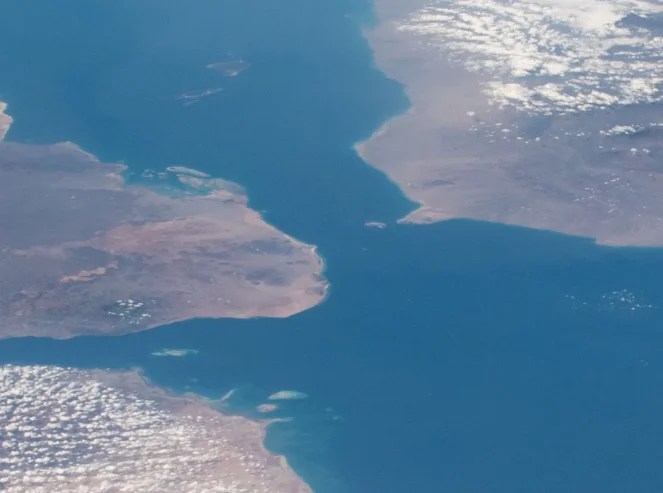
The Gate of Lamentation (Bab el-Mandeb)
That’s when things could get more interesting. Because it’s a pretty tight squeeze to pass through. A big deep-draft aircraft carrier can’t just run at full speed, zig-zagging back and forth. It has to stick to the navigable channel.

Navigable Shipping Channels in the Bab el-Mandeb
In the relatively open waters north of Jeddah, there is quite a bit of room for maneuver. But in the straits, you’re restricted to a narrow band — and most significantly, potential Yemeni missile launching sites are only ~200 km away. A more substantial strike package of 50 or so drones, antiship cruise missiles, antiship ballistic missiles, and fast boat and surface drone attacks will get there a whole lot faster, and with a much better chance of actually hitting something.
So, even though CSG-8’s odds of passing through unscathed still probably remain pretty good, there is unquestionably a considerably elevated risk compared to hiding out at the mouth of the Gulf of Suez.
But let’s suppose they sail right through the Bab el-Mandeb with minimal difficulties … then what? You join up with CSG-1 in the Arabian Sea and attempt long-distance strikes into southern Iran — strikes that would still require air-refueling to have any meaningful reach?
Because you sure as hell aren’t going to sail a couple carrier strike groups into the Persian Gulf. And anyone who believes otherwise is drowning in delusion. I mean, just look at the damn map! The Iranians have potent fire control over the passage from the Gulf of Oman, through the Strait of Hormuz, and throughout the entire Persian Gulf.
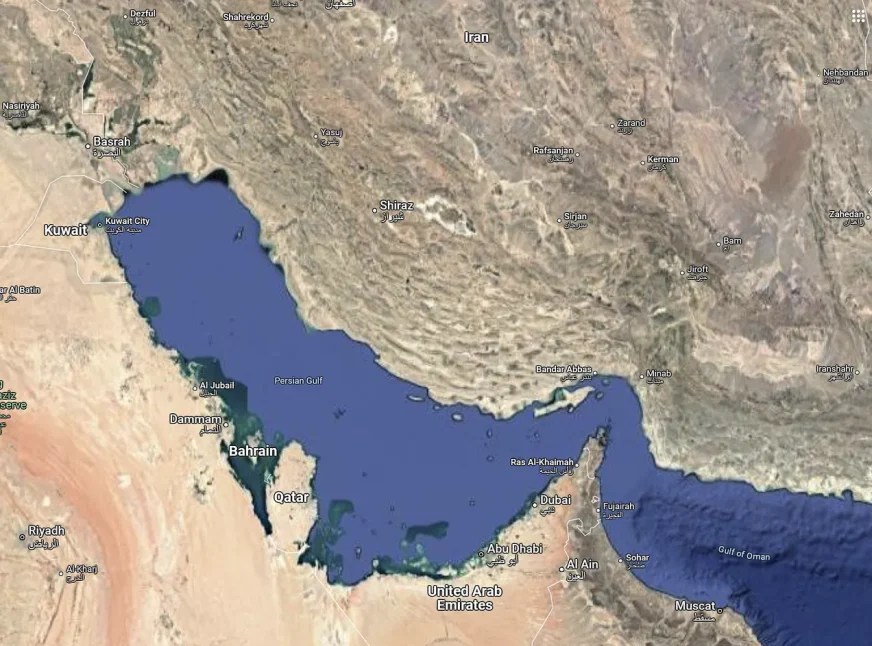
Strait of Hormuz / Persian Gulf
So I ask, in all seriousness, what exactly are two US Navy carrier strike groups going to do in the context of a no-holds-barred war against Iran?
To me, the entire concept screams of hubris running blindly into catastrophe.
If the US is foolish enough to start a big war against Iran, then 2025 is likely to demonstrate yet again that, combined with firepower, geography is the indomitable god of war.
Azov Gaining Power is ‘Symptom of Collapse’ of Remains of Ukraine’s Civil Society
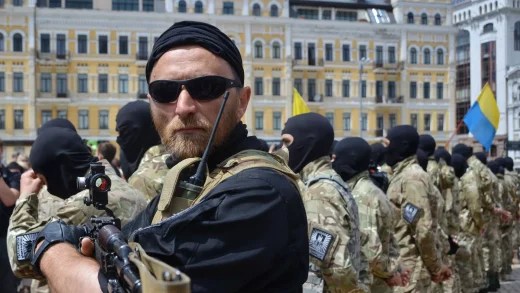
Sputnik – 21.03.2025
The destruction of the gas pumping station in Sudzha by Ukraine makes it look like Volodymyr Zelensky has “limited control” over the Ukrainian military and “limited to no control” over the neo-Nazi “Azov* forces,” USAF Ret. Lt. Col. Karen Kwiatkowski tells Sputnik.
Due to their belief in their superiority over the rest of the Ukrainian troops, Azov militants “believe that the war was theirs, always, not the politicians, and certainly not Zelensky’s as a propped-up politician who actually ran on enforcing the Minsk II treaty, a ‘peace’ platform.”
“I think Azov, like many effective, violent and nationalistic military groups, disrespect politicians on principle, as compromisers and double dealers. Traditionally, these are the ‘generals’ that the politicians fear, not the other way around,” says Kwiatkowski, a former US Department of Defense analyst.
Thus, there appears to be a danger of Azov exercising the “real political power” in Ukraine.
“It is a symptom of imminent collapse of what is left of Ukraine’s civil and political society, and it underlines the real problem that [US President Donald] Trump will have to face and has not yet — and that is how to help Ukraine recover a liberal and rights-based society at the conclusion of hostilities,” Kwiatkowski says.
“The anger of the Azov will not be quenched, even after Zelensky is gone and a new president elected.”
Netherlands wants to double army personnel, NOS reports
Al Mayadeen | March 21, 2025
The Netherlands intends to expand its military personnel from 74,000 to 200,000, with a strong focus on strengthening its reserve forces, Dutch public broadcaster NOS reported, citing sources familiar with the plan.
The report did not provide a specific timeframe.
According to official data, the Dutch military, a NATO member, currently consists of 42,305 active-duty soldiers, 24,212 support staff, and 7,483 reservists.
Rising concerns over Russia and uncertainty regarding continued US military support are pushing European nations to reevaluate their defense policies.
The European Council’s statement, published on Thursday, said that European Union member states will offer military support to Ukraine voluntarily, taking into account each nation’s interests.
“All military support, as well as security guarantees for Ukraine, will be provided in full respect of the security and defense policy of certain Member States and taking into account the security and defense interests of all Member States,” the document read.
It also underscored that a lasting peace must be accompanied by “robust and credible security guarantees” for Ukraine, to which EU member states can contribute.
However, Dutch Prime Minister Dick Schoof confirmed that halting military aid to Ukraine is not under consideration.
Speaking at the European Council meeting in Brussels, Schoof stated that suspending military assistance as part of a potential peace deal was “non-negotiable”.
The halt of military aid for Ukraine is “not an option” for most European countries, he said, affirming that the Netherlands will continue supporting Ukraine politically, financially, and militarily.
On Wednesday, an EU report advocated for increased military spending, enhanced cooperation on joint defense initiatives, and a stronger emphasis on acquiring European-manufactured weaponry.
Meanwhile, Poland, another NATO member, plans to train 100,000 volunteers by 2027.
EU capital flight tops $300 billion – European Council president
RT | March 21, 2025
Capital outflow from the EU has reached €300 billion ($325 billion) annually as retail and institutional investors move their money into assets outside the region, European Council President Antonio Costa has announced.
The statement comes as the bloc is considering doubling its military aid to Ukraine and continues to pledge billions of euros in financial assistance to Kiev.
Speaking to reporters following the EC meeting on Thursday, Costa said that officials in Brussels are seeking to avoid capital flight by reducing energy costs that have already soared to their highest level in two years, hitting major industries and companies.
“As of today, around €300 billion of EU families’ savings flow out of European Union markets each year,” Costa said, acknowledging that business as usual is no longer an option for the bloc. “There is €300 billion that don’t fund businesses in the European Union.”
Among the steps aimed at luring investors back to the bloc, Costa mentioned slashing what Brussels calls “unnecessary” red tape by 25% for all EU companies and by 35% for small and medium-sized businesses.
The multibillion-dollar capital outflow comes at a time when the EU is pushing to maintain funding for Ukraine. The effort is driven by growing concerns in Brussels that US President Donald Trump could stop the flow of American arms to the government of Vladimir Zelensky.
Earlier this week, EU foreign policy chief Kaja Kallas proposed a hawkish plan that would double the bloc’s cashflow to Kiev for the year, making it €40 billion ($43.7 billion).
On Thursday, Hungary, which has long been critical of EU military assistance to Ukraine, refused to sign a joint EU communique calling for increased funding for Kiev.
Hungarian Prime Minister Victor Orban said that the EU is broke, as it has spent “all of its money” and realistically “doesn’t have a single penny left” to support Ukraine amid its conflict with Russia.
Ukraine Deliberately Blows Up Sudzha Gas Distribution Station on March 20
Sputnik – 21.03.2025
The Ukrainian armed forces deliberately blew up the Sudzha gas distribution station on March 20, leaving the facility significantly damaged, Russian Investigative Committee spokeswoman Svetlana Petrenko told Sputnik on Friday.
“A criminal case has been opened in connection with the explosion of the Sudzha gas distribution station by the Ukrainian armed forces’ servicepeople. The Main Military Investigative Department of the Russian Investigative Committee has opened a criminal case on the grounds of a crime … [over a terrorist act],” Petrenko said.
On March 20, Ukrainian servicepeople, who illegally invaded the territory of Russia, carried out a deliberate explosion of the Sudzha gas distribution station, as a result of which the facility received significant damage, the spokeswoman said.
The investigation will identify and hold accountable all those involved in this crime, the Investigative Committee emphasized.
There were no casualties or injuries among the civilian population from the explosion, clarified an emergency services representative to Sputnik. He added that experts have already begun assessing the consequences of the terrorist attack.
Kremlin Press Secretary Dmitry Peskov noted that the bombing of the Sudzha station revealed how much faith can be placed in the words of Vladimir Zelensky and his team.
Gas transit through the Sudzha station continued until the beginning of this year, when it stopped due to Kiev’s refusal to extend the transit agreement. This route remained the last one for Russian gas supplies to Europe via Ukraine.
On Tuesday, Russian President Vladimir Putin spoke by phone with his American counterpart, Donald Trump. According to the Kremlin press service, they discussed resolving the Ukrainian conflict and expressed mutual interest in normalizing relations. Among other things, Putin responded positively to the idea of a mutual 30-day halt to strikes on energy infrastructure and gave the corresponding order to the military.
Later, Volodymyr Zelensky stated that Ukraine would support the proposal to cease attacks on energy infrastructure. However, just hours after the talks between the Russian and US leaders, the Kiev regime attacked the Kavkazskaya oil pumping station in Russia’s Krasnodar region with three drones. The station is involved in transferring oil from railway tankers to the pipeline system of the international Caspian Pipeline Consortium.
The Ministry of Defense noted that such actions by the Ukrainian leadership are aimed at deliberately undermining Trump’s peace initiatives. Peskov stated that this attack is the best proof of the Kiev regime’s lack of willingness to negotiate, and this raises concerns.
Russian forces, following Putin’s command, ceased all strikes and even shot down seven of their own drones that were already en route to attack targets in the Nikolayev region of Ukraine.
Greco-Turkish confrontation looming, could escalate and engulf the entire region
By Drago Bosnic | March 20, 2025
Deteriorating relations between Greeks and Turks are certainly nothing new. The two peoples have had on-and-off wars for over 900 years, spanning Asia Minor/Anatolia, the Aegean Sea/Eastern Mediterranean and Southeast Europe. The tensions haven’t really subsided even after both Greece and Turkey joined NATO in 1952.
Just three years later, there was the Istanbul pogrom during which Ankara intentionally targeted the ancient city’s native Greeks (along with other minorities). Then there was the 1974 invasion of Cyprus that effectively resulted in an undeclared war between Greece and Turkey.
The end of the (First) Cold War saw another round of escalation that reached its peak in the mid-1990s. Although agreements on demilitarization were reached at the time, Erdogan’s rise to power gave way to an extremely expansionist and aggressive Neo-Ottoman foreign policy in Ankara.
Turkey sees the division of EEZs (exclusive economic zones) in the Aegean Sea and Eastern Mediterranean as “unfair” and effectively wants to take over around half of both, including most of the EEZ around Cyprus. This wasn’t such a burning issue before the discovery of huge deposits of oil and natural gas. However, ever since, Ankara has been trying to establish control over these resources, almost exclusively in an aggressive manner, causing issues with all of its maritime neighbors in the region.
This resulted in continued militarization on both sides, with Greece (re)establishing bases on the Aegean islands, while Turkey keeps strengthening its offensive potential. Athens is particularly interested in reinforcing its ASDEN (the Supreme Military Command of the Interior and Islands). To that end, it’s acquiring various multipurpose missiles, particularly the Israeli “Spike”.
This includes the “Spike” NLOS (Non Line Of Site). In April 2023, the Greek military ordered 17 of these systems on 4×4 vehicles, as well as for nine of its US-made AH-64 “Apache” attack helicopters and four Machitis-class gunboats. Some variants of the “Spike” have a claimed maximum range of over 30 km, meaning that they can cover a significant portion of the Aegean Sea and deter potential Turkish attacks.
However, in recent years, Ankara developed a number of weapons with an operational (and even strategic) impact, particularly rocket and missile systems, as well as a plethora of unmanned platforms (both air and sea-based). Namely, in the aftermath of the July 2016 coup, Erdogan effectively purged the Turkish military of any disloyal elements, resulting in a virtual paralysis of the Navy and Air Force. The issue of manpower shortages was then resolved with a focus on unmanned systems.
The side effect of this change was not only much tighter political control over the Turkish military (largely loyal to the Pentagon prior to the 2016 coup), but also a more aggressive posturing, as the Turkish political elite became more (over)confident. This resulted in the escalation of various regional wars and conflicts, spanning from the South Caucasus to Lybia.
Worse yet, Ankara is seeking to expand its influence in Southeast Europe. To that end, it’s preparing to ratify military agreements with several countries, including Albania, North Macedonia and the narco-terrorist entity in the NATO-occupied Serbian province of Kosovo and Metohia. These agreements were first announced in 2024, but Turkey was yet to act on them. For its part, Greece sees this as an attempt to encircle it with enemies, with Ankara establishing a strategic presence and expanding influence behind Athens’ back.
Greece is quite concerned by these developments. Southeast Europe has long been a contested geopolitical arena, with various external powers trying to establish a foothold in the region. Greek media report that the aforementioned agreements were “quickly pushed onto the agenda of the Turkish Parliament, in contrast to the usual lengthy approval processes for similar military agreements”.
This allows Turkey and its regional partners and satellites to closely collaborate in various military projects, including training, joint exercises, enhancing defense industry ties, information exchange, logistics support, medical services, cyber warfare, etc. The agreements also provide a legal framework for personnel exchanges and joint research in military science and technology. Ankara is also implementing some of these policies under the guise of humanitarian efforts and disaster relief.
For Turkey, this isn’t merely a question of strategic encirclement of Greece, but also a way to push forward with its extremely aggressive Neo-Ottoman foreign policy framework. Ankara wants to reforge ties with various leftovers of its brutal occupation of Southeast Europe. This is particularly true for highly dysfunctional parastate entities such as Bosnia and Herzegovina and/or Kosovo and Metohia.
Thus, it sees these formal military agreements as a strategic springboard for further inroads in the region. This includes sales of unmanned systems and other military products. As previously mentioned, many of these agreements are hidden from the public by being masked as something else. According to Turkish Brigadier General Esat Mahmut Yilmaz, his country consolidated the three agreements into a single framework to expedite the participation of its military in various operations abroad.
In effect, this means that, once ratified and published in the Official Gazette, these agreements will allow the Turkish military to push for secondary agreements with foreign partners without further parliamentary approval, limiting public discussion on Turkey’s military activities abroad and effectively giving Erdogan a free hand in armed engagements in the increasingly volatile region.
To that end, Ankara is even establishing ties with countries like Croatia, which just signed a similar strategic agreement with virtually the same partners (Albania and the narco-terrorist entity in the NATO-occupied Serbian province of Kosovo and Metohia). This is obviously aimed against Belgrade, which maintains close ties with Athens and sees such expansionism as a direct threat to its basic national security interest. Either way, it seems the region is in for a rough ride in the upcoming years.
Drago Bosnic is an independent geopolitical and military analyst.
Who is opposing peace in Ukraine?
By Dmitri Kovalevich – Al Mayadeen – March 20, 2025
March 2025 marks the beginning of a fourth year of the military conflict in Ukraine. Kiev, its sponsors in Europe and the United States, are proving unwilling to end the war being waged despite mounting evidence they are facing a major political and military defeat.
Zelensky vs Trump?
The five-year, electoral mandate dating from May 2019 of Volodymyr Zelensky as president of Ukraine expired ten months ago. Yet on February 28, Zelensky staged a widely publicized quarrel with the new US administration in Washington headed by Donald Trump. The administration reacted, in turn, with a dramatic suspension of US arms shipments and sharing of intelligence and satellite data. Without this data, Ukrainian troops are ‘blinded’ because US military specialists have played a key role in helping choose Russian targets and helping operate complex rocket and missile weaponry. Particularly valuable are the images provided, with US government approval, by US commercial satellite imaging company Maxar.
The ‘suspensions’ were very short-lived. A meeting in Saudi Arabia on March 11 between the Kiev government and the Trump administration saw a renewal of the briefly-disrupted partnership between the two after its brief interruption in supplying military data and equipment. The meeting issued a proposal to Russia (better described as a threat) prepared in advance by Washington for a 30-day ‘ceasefire’. Critics in Russia and abroad say the proposal would allow the Ukraine Armed Forces to rest and regroup. If Russia turned it down, the Western powers could then condemn it for refusing peace.
Every serious analyst is pointing out that the ceasefire proposal does not at all address Russia’s well-publicized minimum conditions for a peace settlement. In other words, the plan is something of a trap for Russia. For that reason, it will not see the light of day.
Zelensky was absent from the Ukraine delegation in Saudi Arabia. He remains apprehensive over the prospect that Trump may wish to replace him and could do so at any time. Ukrainian political analyst Kost Bondarenko, who now lives abroad, explained on Telegram on March 4 that Zelensky is no longer listening to anyone, including those in his personal entourage. “He is acting hysterically and capriciously, recognizing only his own claimed righteousness. He doesn’t even listen to Yermak [head of the Office of the President of Ukraine]. His egocentrism has made Ukraine hostage to his whims.”
Europe benefits from the war
Zelensky is seeking more support from his patrons in the European Union and becoming more dependent on them, especially on the government of Great Britain. The latter continues to encourage him to sacrifice the people of Ukraine in a losing war against Russia.
Former Ukrainian (now Russian) political scientist Rostislav Ishchenko said in an interview on March 7 that the only difference between the Trump regime in Washington and the leading governments of the European Union is that ‘liberal’ Europe wants a consolidated West under a ‘liberal’ image while the right-wing, conservative Trump regime wants a united West focused on weakening and paralyzing Russia while simultaneously weakening China.
“Trump’s goal is not to make life easier for Russia. Trump’s goal is to get a peace that is acceptable to America. So far, everything that Trump formulates is absolutely unacceptable to us.”
Another former Ukrainian and now Russian political analyst Andrey Vajra told a Crimea news broadcast in February that the war in Ukraine has helped the European elites to appropriate billions of euros. “Europeans understand perfectly well that the war is lost. But the European elite needs to continue stealing [from weapons supplying and the multitude of forms of ‘aid’]. I have already explained how it is possible to continue stealing billions of euros so long as the killings continue in Ukraine. Far more millions of euros can be had. That’s why the European leaders are clinging to a warmaking Ukraine.”
In early March, the head of German intelligence, Bruno Kahl, stated in an interview with the state-run Deutsche Welle that it would be ‘safer’ for Europe if the war in Ukraine continued for another five years. He criticized the Trump administration, saying the kind of swift end to the war being voiced by Trump “would enable the Russians to focus their energy against Europe”. This suggested ‘long war’ against Russia is the new, official theme of EU leaders as they strive to convince their populations of the need to massively expand military spending.
Even former prime minister Yulia Tymoshenko (2007-2010) of the Batkivshchyna faction in the Ukrainian legislature says she is outraged by Kahl’s frank admission. “Bruno Kahl for the first time officially confirmed what we were so reluctant to believe: At the cost of thousands of Ukrainian lives and the very existence of Ukraine, some people decided on a war to ‘deplete’ Russia and thereby enhance the security in Europe? I did not think that they would dare to say it so officially and openly. This explains a lot,” Tymoshenko doth protest too much. She was a key fomentor of the violent, Maidan coup in February 2014 and an ardent advocate since then of military and political confrontation with Russia.
Danish Prime Minister Mette Frederiksen has also stated that a peace agreement could be more dangerous for Ukraine than an ongoing war. “I understand that many people believe that a peaceful solution or a ceasefire is a good idea, but we run the risk that peace in Ukraine would actually be more dangerous than the war that is ongoing now.”
Such pro-war stances are not only due to the fact that Western companies are getting rich on fulfilling military orders. A permanent war in Ukraine appeals to many Western leaders because this would weaken and pre-occupy Russia. “Israel” has long acted on the same principle in the Middle East. It has waged bloody wars in Syria, Iraq, and Lebanon to weaken these countries and prevent them from doing anything to stop “Israel’s” genocide against Palestinians and its occupation of Syrian territory.
Those who justify continued war in Ukraine make two contradictory assertions. On the one hand, they argue that the war has greatly weakened Russia and that the government there may soon collapse. Ukrainians should therefore fight just a little longer to secure ‘victory’. On the other hand, they say that Russia has become too strong and is a threat to overrun more European countries in the future. Ukrainian social networks have coined an ironic term for this contradictory belief system, calling it ‘Russophrenia’ (derived from the word ‘schizophrenia’).
The end of Ukraine’s adventure in Kursk
Disaster has befallen the Ukraine Armed Forces present in the Kursk border region of Russia. Large numbers of Ukrainian troops have become encircled—as many as 10,000 according to some Western media outlets. A March 8 report in a Ukrainian media outlet nervously reassured that the situation in Kursk “is not yet catastrophic”.
The Ukrainian military command did not issue any orders to retreat from threatened encirclements in Kursk. This repeats the experiences with earlier military encirclements in Donbass. These have allowed the Russian army to make steady and continued military advances there.
As reported by the online Politnavigator on March 7, a former advisor to the office of Zelensky, Alexei Arestovich, sees a familiar pattern to events in Kursk. “In dire conditions where encirclement is threatened, only the introduction of reserve troops can help. So we [the Ukraine Armed Forces] proceed as usual: drop in a few reserves removed from other threatened locations. These will most likely be unable to stabilize for any length of time because there are few reserves to draw upon. No one is left. Even worse is to keep the army in encirclements or threatened encirclements for too long, waiting for the political leadership to give an order to retreat. But those orders do not come. This scenario has repeated itself over and over again. We need to stop playing by such scenarios.”
Arestovich lives in exile somewhere in Europe and has said he would be a candidate in a forthcoming election for president of Ukraine should a free election take place.
On March 8-9, Russian troops managed rather easily to contain the remaining Ukrainian forces in Kursk Oblast and cut off re-supply routes. This was partly helped by the spring thaw because Western-supplied military equipment becomes booged down in mud; it is designed primarily for use on paved or improved gravel roads.
Ukrainian opposition blogger Anatoliy Shariy writes that the losses of the AFU in Kursk are huge – some of the biggest losses that Ukrainian servicemen can remember.
The Ukrainian grouping in Kursk was centered around the border town of Suzdha. It is the site of an important pumping and transit station for a natural gas pipeline built during the Soviet era which connects the vast gas fields of eastern Russia to markets in Ukraine and further west in Europe. In January, Ukraine shut down pipeline shipments through Suzdha, drawing sharp protests and threats of counter-measures from Hungary and Slovakia.
An ironic consequence of Ukraine shutting down the pipeline was that Russian soldiers were able to use the now-empty pipeline to advance some 15 kilometers directly into the center of the Ukrainian grouping in Suzdha. They waited days for orders. Russia then surprised and overwhelmed the embedded Ukrainian forces with a multi-pronged attack beginning on March 8. Many Ukrainian soldiers and allied mercenaries ended up stampeding into surrounding minefields.
Russian military correspondent Anna Dolgareva spoke to Russian military scouts in Suzdha and reported, “For six days, the Russian fighters sat inside the pipeline awaiting orders to move. They spent some 24 hours of difficult walking to get there. The pipeline still contained traces of methane gas and so holes were cut in the pipe along the way for ventilation.”
This operation was made possible because Ukraine shut off gas transit causing European countries to buy much more expensive liquefied gas from producers in the United States. Western sanctions against Russia have cost Europe its supply of relatively cheap Russian gas, replaced by shipments of expensive liquefied natural gas from the United States as well as gas from Norway and Algeria shipped by pipeline.
Ukrainian elite on ‘starvation rations’
Representatives of the Ukrainian political elite are today extremely worried about Zelensky’s quarrel with the new US administration that exploded into view in Washington on February 28. For most, funding from the United States is their main source of income.
Since the early 1990s, Ukraine has developed an entire class of government officials and politicians who have ‘monetized’ Russophobia and anti-communism. A key piece of moving up the career ladder has been to act the loudest in stigmatizing the former Soviet Union and modern Russian Federation, and figuring out how best to draw Western funding for such efforts. This scheme has worked well for decades, but now the apparent chaos being sown by the new Trump regime in Washington has upset the old arrangements. The chaos is merely the expression of a governing U.S. regime facing a looming defeat of its proxy war in Ukraine along with its European partners.
Some legislators realize that Zelensky’s harsh outbursts and confrontation with Trump and Trump’s vice president in Washington on February 28 could cost the country dearly, but others are betting on maintaining an aggressive, pro-war rhetoric. They are looking to the British government to help out.
Alexei Arestovich writes that Zelensky’s ‘disobedience’ is based solely on his desire to extract security guarantees for himself and his entourage. He says the problem for the White House is that “providing personal guarantees to thieves risks setting yourself up before American justice.”
Ukrainian economist Oleksiy Kushch writes that for the Ukrainian elite, the era when it could act as a child and demand money from the ‘adult uncles’ in the West is coming to an end. The West is so used to that arrangement that Zelensky’s apparent conflicts with the U.S. administration are bewildering, a kind of ‘revolt against the boss’.
Kushch summarizes Ukraine’s situation after Zelensky’s quarrel with Trump in this way, “Like a teenager who ‘unexpectedly’ has a child and finds all responsibility now rests on him, ‘daddy’ U.S. may threaten to stop helping out as punishment for any ‘disobedience’ while ‘mommy’ Europe promises to continue giving money but not forever.”
The Ukrainian elite has been thoroughly corrupted by years of generous Western ‘aid’ handouts. It no longer knows how to earn revenue and wealth on its own. So if some character named Zelensky becomes an obstacle to the continued flow of ‘daddy’s’ money, he becomes expendable. So much the worse for him.
Seyed Marandi: America Attacks Yemen – Has Trump Set Himself Up For Failure?
Glenn Diesen | March 19, 2025
Seyed Mohammad Marandi is a professor, analyst and advisor to Iran’s nuclear negotiation team
Follow me:
Substack: https://glenndiesen.substack.com/
X/Twitter: https://x.com/Glenn_DiesenPatreon:

Support the channel:
PayPal: https://www.paypal.com/paypalme/glenn…
Buy me a Coffee: buymeacoffee.com/gdieseng
Go Fund Me: https://gofund.me/09ea012f
‘Death blow for the euro’ – AfD’s Weidel slams Germany’s massive new debt package
Remix News | March 19, 2025
The German Bundestag passed a historic debt package for defense and infrastructure yesterday, effectively changing the constitution to allow a suspension of the debt brake. However, a number of top German opposition politicians are making dire predictions about what this nearly €1 trillion in new debt will mean for Germany and Europe.
The largest opposition party to emerge from national elections, the Alternative for Germany (AfD), was perhaps the most vehemently opposed to the package. However, the BSW, the Left Party and the Free Democrats (FDP) all filed lawsuits against the deal and fought tooth and nail to stop it, but all of those lawsuits failed.
The co-leader of the AfD, Alice Weidel, is calling the debt a “death blow for the euro.” She said the debt will have a negative impact on future generations, consumers and taxpayers. Furthermore, she believes there will be massive disruptions in the credit markets in the future, rising interest rates, and a “spillover effect on the other eurozone countries.” Already, interest rates on European debt have risen sharply, and the fear is that periphery countries could see their borrowing costs skyrocket. In such a scenario, the euro could be significantly weakened.
She said Merz broke his election promises in dramatic fashion. In fact, the promise to keep the debt brake was even contained within the party election program of the CDU. There is already a sharp backlash amongst the party’s members to the betrayal, with some Germans already canceling their membership to the party.
“This is nothing less than the worst voter deception I have ever seen in the history of the Federal Republic of Germany,” said Weidel.
There was no significant dissent within the parties that passed the new debt package, with only Jan Dieren (SPD), Mario Czaja (CDU), and Canan Bayram (Greens) voting “no” to the package. In the end, the new debt package passed with a comfortable margin above the two-thirds majority required to change the constitution, with 513 for the deal and 206 against.
Of course, the opposition parties are outraged. The law passed under the old Bundestag, the one that had just been voted out of power. It was championed by Friedrich Merz, who promised his CDU would keep the debt brake in place. It represents a historic spending spree, but one with many handouts to the Green Party, including a commitment to “climate neutrality by 2045” enshrined in the constitution.
Among the speakers featured in the debate in the Bundestag was AfD MP Alexander Gauland, who was also a co-founder of the party.
“A lot of right and wrong things have been said in the course of this debate, both last Thursday and today. I would therefore like to make a few personal comments. Mr. Merz and I were in the same party for many years. I left because I could no longer tolerate Angela Merkel’s destruction of the CDU as a conservative-liberal bourgeois alternative to the left-green mainstream. Mr. Merz became a victim of her will to power,” he said.
Gauland also said he had high hopes for Merz at first, with a potential turnaround on immigration and a return to center-right policy, but instead, Merz has allied with the left and blocked a deal with the AfD.
“You sacrificed everything that was still conservative or middle-class in the CDU in order to become chancellor,” said Gauland. “Mr. Merz, you will probably become Federal Chancellor with the kind of policies we have seen in recent years. This policy will fail in the same way as the previous traffic light system. Not even their transatlantic ally in Washington supports their desperate endeavors to solve today’s problems with yesterday’s answers.
“Even if I have had doubts about my own party from time to time in recent years. Today, I am proud and happy to have launched it together with others in 2013. Because as of this week, the Merz CDU is the continuation of the Merkel CDU. Keep it up, Mr. Merz, and you will have to take responsibility for Germany’s decline in the future.”
Meanwhile, the CDU, CSU and Social Democrats (SPD) were triumphant.
Merz said that the financial package opens up “a perspective for our country that is urgently needed in the times we live in today.”
“Today’s decision is an unmistakable signal of Germany’s assumption of responsibility for a secure Europe and an economically stable Germany,” said CSU state group leader Alexander Dobrindt.
SPD leader Lars Klingbeil described the financial package as a “historic compromise” between the SPD, CDU/CSU, and the Greens. He said the debt would help rebuild Germany and beef up the military.
“The world is currently being re-measured; no one is waiting for Germany and no one is waiting for Europe,” said Klingbeil.
FDP parliamentary group leader Christian Dürr slammed Merz, saying he will lead “the first debt-ridden coalition in the Federal Republic of Germany.” He accused Merz of wanting to lead a government “that is prepared to sacrifice tomorrow’s prosperity for short-term election gifts.”
Peace Negotiations & the End of NATO
Prof. Jeffrey Sachs with Prof. Glenn Diesen
Glenn Diesen | March 18, 2025
The US and Russia negotiate an end to the proxy war in Ukraine: What is realistic to expect, how can Europe’s bellicose reactions be explained, and is this the end of NATO?
Kremlin releases Putin-Trump phone call summary (FULL STATEMENT)
RT | March 18, 2025
Russian President Vladimir Putin and his US counterpart Donald Trump have held a phone conversation lasting over two hours, discussing a peaceful resolution to the Ukraine conflict.
The Kremlin reported that the two leaders spoke about a suggested 30-day ceasefire, a prisoner exchange, and maritime security, with Putin responding positively to Trump’s proposals. Both leaders expressed interest in normalizing US-Russia relations, agreeing to continue discussions on global security, economic cooperation, and even cultural exchanges like NHL-KHL hockey matches.
The Kremlin has published a summary on the outcome of the call:
A phone conversation between Vladimir Putin and US President Donald Trump took place on March 18, 2025.
Reaffirming his commitment to a peaceful resolution of the conflict, President Putin expressed readiness to work closely with American partners on a thorough and comprehensive settlement. He emphasized that any agreement must be sustainable and long-term, addressing the root causes of the crisis while considering Russia’s legitimate security interests.
Regarding President Trump’s initiative for a 30-day ceasefire, the Russian side highlighted key concerns, including effective monitoring of the ceasefire across the entire front line, halting forced mobilization in Ukraine, and stopping the rearmament of its military. Russia also noted serious risks due to Kiev’s history of undermining previous agreements and drew attention to terrorist attacks carried out by Ukrainian militants against civilians in the Kursk region.
It was emphasized that a crucial condition for preventing further escalation and working toward a political-diplomatic resolution is the complete cessation of foreign military aid and intelligence sharing with Ukraine.
In response to Trump’s recent request to ensure the safety of Ukrainian troops encircled in Kursk Region, Putin confirmed that Russia is guided by humanitarian considerations. He assured his counterpart that Ukrainian soldiers who surrender will be granted safety and treated in accordance with Russian laws and international humanitarian norms.
During the conversation, Trump proposed a mutual agreement between both sides to refrain from striking energy infrastructure for 30 days. Putin welcomed the initiative and immediately instructed the Russian military to comply.
Putin also responded constructively to Trump’s proposal regarding maritime security in the Black Sea, and both leaders agreed to initiate negotiations to further refine the details of such an arrangement.
Putin informed Trump that on March 19, Russia and Ukraine would conduct a prisoner exchange involving 175 detainees from each side. Additionally, as a goodwill gesture, Russia will transfer 23 severely wounded Ukrainian soldiers who are currently receiving medical treatment in Russian hospitals.
Both leaders reaffirmed their commitment to continuing efforts toward resolving the Ukraine conflict bilaterally, incorporating the proposals discussed. To facilitate this, Russian and American expert groups will be established.
Putin and Trump also discussed broader international issues, including the situation in the Middle East and the Red Sea region. They agreed to coordinate efforts to stabilize crisis areas and enhance cooperation on nuclear non-proliferation and global security, which, in turn, would improve the overall state of US-Russia relations. A positive example of such cooperation was their joint vote at the United Nations on a resolution regarding the Ukraine conflict.
Both leaders expressed mutual interest in normalizing bilateral relations, recognizing the shared responsibility of Russia and the United States in ensuring global security and stability. In this context, they explored various areas for potential cooperation, including discussions on mutually beneficial economic and energy partnerships.
Trump supported Putin’s idea of organizing hockey matches in the US and Russia between players from the NHL and KHL.
The presidents agreed to remain in contact on all discussed matters.
Featured Video

More Iran War fallout: Maritime insurance industry shifts from London to China
or go to
Aletho News Archives – Video-Images
From the Archives
The Biggest Threat to Peace in Middle East
By Dr. Elias Akleh* | Sabbah Report | May 24, 2010
A build up of heightened tension in the Middle East is escalating in the last few weeks. American and Israeli postures towards Lebanon, Syria, and Iran have become more threatening. Listening to speeches of political leaders one hears talks only about war not peace. Iranians and Israelis are continuously training hard for a possible showdown. Both sides are conducting extensive war games every month. This led Syrians to claim that Israel is preparing for a soon-to-come another war. The Jordanians also are warning that current stalemate of the peace process is an indication of a war breaking out this summer. The Russian President and his army chief hinted, a few months ago, that the US and Israel were planning for an attack on Iran.
Indeed Iran is, as it has been for last few years, the target of most of the threats and accusations of supporting terrorism. Escalating incitement against Iran the American Defense Department sent last month (April) to Congress a report on Iran’s military claiming Iran could develop intercontinental ballistic missiles capable of reaching the US by 2015.
Ignoring the fact that N. Korea, India, Pakistan, and Israel are proven to have nuclear weapons while Iran does not, the US Secretary of State Hillary Clinton chose in her speech, to the nuclear Non-Proliferation Treaty review conference at the UN, to focus on Iran’s alleged nuclear ambitions putting the whole world at risk as she put it. According to Clinton Iran’s acquisition of nuclear weapons, rather than Israel’s more than 200 nuclear bombs, is destabilizing the Middle East. She called on the world’s nations to rally around US efforts to hold Iran, not other nuclear countries, to account.
The accusation that Usama Bin Laden is living comfortably in Iran had received a boost after the broadcast of a documentary called “Feathered Cocaine”. This echoed the June 2003 claims of the Italian newspaper Corre de la Sierra that Bin Laden was in Iran according to some intelligence report, and according to Richard Miniter’s book “Shadow War”. … continue
Blog Roll
 Aletho News
- Iran mobilizing one million soldiers to ‘create hell’ for any US ground assault: Report
- The coming military and psychological unravelling?
- Iran has the last laugh
- More Iran War fallout: Maritime insurance industry shifts from London to China
- US-Israeli aggression on Iran triggers review of GCC countries’ investment pledges to Washington
- Russia slams UK plan to seize tankers suspected of carrying its oil
- Pakistan ramps up food exports to Persian Gulf nations as war deepens food insecurity
- Iran submits response to US plan, sets terms for war’s end: Tasnim
- US vs Iran: Kharg Island Talk — Bluff or Escalation? Ex-Military Officer Weighs In
- Zelensky unnecessarily involves Ukraine in the Middle East crisis
- If Americans Knew
- ‘No Innocent Children’: Far-right Israeli Lawmaker Defends Killing of Palestinian Family
- Mossad’s promises helped Netanyahu convince Trump that Iran could be toppled
- US Arms Control Official Refuses To Comment When Asked If Israel Has Nuclear Weapons
- Veterans warn US landing could be ‘more Gallipoli than Vietnam’
- Israel may be committing war crimes in Lebanon – Not a ceasefire Day 167
- In the West Bank, life is a constant battle – 3 articles
- Jacob Reses, one of the most powerful pro-Israel operatives in Trump’s Washington
- Israeli-US assaults kill or injure 87 children a day – Not a ceasefire Day 166
- ‘Forever live by the sword’: Understanding Israelis’ massive support for Iran war
- UN’s special rapporteur on human rights says Israel is systematically torturing Palestinians
- No Tricks Zone
- Devastating Assessment Of Comirnaty Vaccine By Former Senior Pfizer Europe Toxicologist
- New Study: CO2 Is ‘Effectively Negligible’ As An Explanatory Climate Change Factor Since 2000
- Former Pfizer Toxicologist Dr. Helmut Sterz Tells Bundestag Hearing Pfizer Vaccine Should Have Never Been Approved
- Energy Expert: Germany’s Nuclear Phaseout Was A “500 Billion Euro Mistake”
- New Research: South Australia’s Mid-Holocene Sea Surface Temperatures Were 4°C Warmer Than Today
- Storing Green Energy To Last Germany 10 Days Would Require A 60-Million Tonne Battery
- New Studies: UK Sea Levels Were 4 Meters Higher Than Today During The Mid-Holocene
- Destructive Green New Deal: German Energy And Metal Group Warns Of Drastic Crisis
- New Study Documents A 20-Year Pause In Arctic Sea Ice Decline – Driven By Internal Variability
- Wake-up Call: Survey Shows Majority Of Germans Now Favor Postponing Climate Targets!
 Aletho News