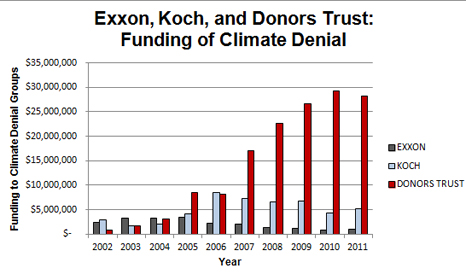
It will be difficult to bring the number down to anything approaching the amount of funding skeptics are said to get:
By John Laforge | CounterPunch | January 13, 2017
Work has been halted on two rulemaking projects that would have reduced the amount of radiation the government permits workers and the public to be exposed to without their consent. The improved limits would have been in line with internationally accepted standards, Bloomberg BNA reports. A Nuclear Regulatory Commission announcement says stopping the process of setting stricter radiation exposure limits was “due to the high costs of implementing such changes.” The purpose of the NRC is to protect public and nuclear worker health and safety, but this time it’s just saving money for the nuclear industry.
The cancellation of two unfinished and long-overdue precautionary improvements, noted in the Dec. 27 Federal Register, came as a shock to nuclear industry watchdogs who have campaigned for increased radiation protection since 1990. That year, the International Commission on Radiological Protection (ICRP) recommended that radiation industry worker exposures be reduced by three-fifths, from 50 milliSieverts per year to 20 milliSieverts per year. (A milliSieverts is a measure of the body’s absorption of radiation.) The recommendation has never adopted by the United States. Based in Ottawa, Ontario, ICRP sets standards used worldwide as the basis for radiological protection, working to reduce cancer and other diseases caused by radiation exposure.
Ed Lyman, with the Union of Concerned Scientists, told Bloomberg BNA the termination of these projects “makes the US look out of step with the rest of the world. It makes it look like we’re basing our regulations on obsolete information.” Jerry Hiatt, with the industry lobbying group Nuclear Energy Institute, was relieved by the NRC move telling Bloomberg that existing rules were adequate, and that it’s unnecessary to reduce currently permitted exposures.
The rulemaking project was begun by the NRC staff in 2008 and was intended to update the country’s radiation protection standards in accordance with ICRP’s international standards, primarily with respect to radiation dose. The NRC staff had previously recommended that the commission reduce the total radiation worker exposure from 50 milliSieverts-per-year to 20 milliSieverts-per-year — in line with the ICRP’s 1990 global recommendation. However, the NRC rejected the recommendation.
The NRC’s decision not to align permitted radiation exposures with those of the ICRP is the equivalent of “throwing out one of the most significant changes to get the US in step with the rest of the world,” Lyman said. The commission formally approved the stop-work orders in April, but it only notified the public on Dec. 27.
The NRC also decided to stop work on a second rulemaking which would have brought the US in line with international rules regarding daily releases of radioactive waste water from nuclear reactors. By way of explanation, the NRC said, its current standard “continues to provide adequate protection of the health and safety of workers, the public and the environment.”
Over the last 70 years, permitted radiation exposure limits for workers and the public have dramatically decreased as science has come to better understand the toxic and cancer-causing properties of low doses.
In its 2012 pamphlet “Radiation Exposure and Cancer” the NRC acknowledges that, “[A]ny increase in dose, no matter how small, results in an incremental increase in risk.” Likewise, the National Academy of Sciences, in its latest book-length report on the biological effects of ionizing radiation BEIR-VII, says: “[L]ow-dose radiation acts predominantly as a tumor-initiating agent,” and that “[T]he smallest dose has the potential to cause a small increase in risk to humans.” And the US Environmental Protection Agency agrees, “[A]ny exposure to radiation can be harmful or can increase the risk of cancer … In other words, it is assumed that no radiation exposure is completely risk free.”
But today, when the international standard dose limit is less than half what our own government allows, it’s the radiation industry shareholders that are being protected by the NRC, not public health and safety.
Join the debate on Facebook
John LaForge is a Co-director of Nukewatch, a peace and environmental justice group in Wisconsin, and edits its newsletter.
RT | December 28, 2016
Britain’s nuclear regulator is under government investigation for reportedly dismissing several serious accidents as posing no safety risk.
The government launched the investigation after a report by the Times revealed the Office for Nuclear Regulation (ONR) has ignored serious mistakes at power plants and military bases, including the accidental discharge of a torpedo at a nuclear submarine base.
Experts accuse the regulator of being cozy with the nuclear industry and too reluctant “to frighten the horses.”
The Times reports officials at the Department for Work and Pensions (DWP), which is responsible for the ONR, are investigating the regulator following the newspaper’s disturbing revelations.
The ONR says all of its safety classifications follow international guidelines and insists it is a robust and independent regulator.
However, the rate of incidents deemed to be “of no nuclear safety significance” has increased to more than one per day over the past five years, raising questions as to how seriously the regulator is treating accidents.
Between 2012 and 2015, these incidents included at least 30 fires, a dozen leaks, three road accidents involving nuclear material, and the inadvertent discharge of a torpedo at Plymouth nuclear submarine docks.
Other serious incidents deemed to be of a no concern include the contamination of at least 15 workers with radioactive material and a complete power cut at a nuclear weapons base.
Dr David Toke, a reader in energy politics the University of Aberdeen, said the revelations indicated safety issues were a “low priority” for the ONR.
Nuclear expert Professor Stephen Thomas said the reports reinforced his suspicions that “the first priority for the ONR is not to frighten the horses.”
“Ironically, since they became an independent body rather than being part of the Health and Safety Executive [in 2014], they seem to have got worse,” Thomas told the Times.
“Independence is just a cheap and easy way for government to wash its hands of its rightful responsibility.”
The University of Greenwich academic added: “Independent regulators must be accountable to the public and if it is not through a democratically elected government, who is it through?”
Thomas said the ONR had previously ignored warnings about the safety of tending the lifespan of an old reactor design, the AGR, that is still in use in the UK, as well as the reliability of the newer EPR model reactor, which will be used at Hinkley Point C.
By Brian Kahn and Bobby Magill | Climate Central | November 23, 2016
The world is waiting to hear what President-elect Donald Trump has in mind for governing the U.S. Among the biggest questions is what will happen to the budget for climate and energy-related activities. […]
Here’s where a number of federal agencies stand with climate and energy funding, what they spend it on, and what could be under fire after Jan. 20 when Trump takes office. The budget numbers below are based on the 2017 fiscal year budget requests for each agency or department.
Energy Department
2017 climate-related budget: $8.5 billion
What it’s spent on: Energy efficiency and renewable and nuclear energy research and development as well as science and computing. […]
Interior Department
2017 climate-related budget: $1.1 billion
What it’s spent on: Supporting scientific research and managing landscapes for climate resilience as well as expanding public access to climate-related information. The Interior Department, through the U.S. Geological Survey, funds climate science centers […]
State Department
2017 climate-related budget: $984 million
What it’s spent on: Almost anything the U.S. does about climate change on the international stage comes via the State Department. That includes committing money to the Green Climate Fund […]
NASA
2017 climate-related budget: $1.9 billion
What it’s spent on: NASA funds a variety of climate research on earth and in space. […]
Environmental Protection Agency
2017 climate-related budget: $1.1 billion
What it’s spent on: Climate and air quality research and development as well as enforcing climate rules and regulations such as the Clean Power Plan […]
National Oceanic and Atmospheric Administration
2017 climate-related research and development: $190 million
What it’s spent on: NOAA’s climate science budget funds both in-house researchers and a number of programs at universities. … Full article
It will be difficult to bring the number down to anything approaching the amount of funding skeptics are said to get:
China may scale down plans for nuclear power because of slowing demand for electricity and construction setbacks
By Steve Thomas – ChinaDialogue – 26.10.2016
For China’s nuclear industry, 2016 has been a frustrating year. So far, construction has started on only one new plant, and its target of bringing 58 gigawatts of nuclear capacity in service by 2020 seems impossible to meet.
At present, China has 19.3 gigawatts of nuclear supply under construction and a further 31.4 gigawatts already in service. Given that new plants take five years or more to build, the country faces a shortfall of more than seven gigawatts on its target.
All the plants started between 2008 and 2010 are online except for six imported reactors. These include four AP1000 reactors designed by Westinghouse, based in the USA but owned by Toshiba of Japan; and two European Pressurised Reactors (EPR), developed by Areva, a French multinational group specialising in nuclear power.
The plants are not expected to be completed before 2017 and all will be at least three years late, an unprecedented delay in China’s nuclear history. It would be surprising if China was not disillusioned with its suppliers and their technologies.
Technology problems
The EPR and AP1000 reactors have been problematic to build. The two EPRs are 3-4 years late although there is little available information detailing why. Meanwhile, EPR plants in Finland and France, which should have been completed in 2009 and 2012, respectively, will not be online before 2018.
There are no obvious problems that account for the majority of the delays at any of the sites, just a series of quality and planning issues that suggest the complexity of the design makes it difficult to build.
The four AP1000s are also running 3-4 years late. They are being built by China’s State Nuclear Power Technology Company (SNPTC), which has not built reactors before. There is some publicly available information about the problems suffered in China with the AP1000s, including continual design changes by Westinghouse. The reactor coolant pumps and the squib valves, which are essential to prevent accidents, have been particularly problematic, for example.
Still, China is expected to be the first country to complete construction of AP1000 and EPR designs, a scenario it did not expect or want. The government is required to develop and demonstrate test procedures for bringing the plants into service, which could take up to a year. These test procedures are developed by vendors and generally standardised although national safety regulators must approve them and can add specific requirements.
In 2014, a senior official at China’s nuclear safety regulator, the National Nuclear Safety Administration (NNSA) complained that only a small number of test procedures had been developed for the AP1000, and no acceptance criteria had been submitted for review. He said the same issues affect the EPR.
China will likely be reluctant to commit to further AP1000s (and the CAP1400, a Chinese design modified from the AP1000) until the first of the Westinghouse designs is in service, passes its acceptance tests, and demonstrates safe, reliable operation. There are no plans to build additional EPR reactors.
In fact, state-owned China General Nuclear (CGN) and China National Nuclear Corporation (CNNC) opted instead to develop medium-sized reactors (1000 megawatts), the ACP1000 and the ACPR1000, respectively, based on Areva’s much older M310 design rather than the EPR.
Challenging circumstances
The slowdown in electricity demand growth at home has left China with surplus power-generating capacity. Nuclear is now competing against coal plants supplied with cheap fuel. Furthermore, nuclear has a lower priority for dispatch in winter than combined heat and power plants, which warm homes and factories and typically burn coal and gas.
In 2015, nuclear power accounted for only 3% of China’s electricity and at any plausible rate of building nuclear plants, it is unlikely that nuclear would achieve more than 10% of China’s electricity supply.
This year, one reactor (Hongyanhe 3) in Liaoning, operated for only 987 hours in the first quarter of 2016, just 45% of its availability, while reactors in Fujian (Fuqing) and Hainan (Changjiang) were shut down temporarily.
Another challenge is the strain placed on China’s nuclear regulators in the face of such an ambitious target. The NNSA is under particular pressure to oversee the operation of 36 plants and the construction of 20 plants, as well as being the first regulatory authority to review six new designs. Not even the US Nuclear Regulatory Commission, which monitored standards during the huge build out of the industry in the 1960s and 1970s, has faced such a workload.
Safety authorities are usually reluctant to appear critical of their international peers but in 2014, a senior French safety regulator described NNSA as “overwhelmed”, and claimed that the storage of components was “not at an adequate level”. A senior official from SNPTC said in 2015: “Our fatal weakness is our management standards are not high enough.” To build up the capabilities to support such a large construction programme a pause in ordering new plants and equipment may be necessary.
Uncertain future
The 58GW target of nuclear capacity in service by 2020 is not achievable and, like nuclear capacity targets in the past in China and elsewhere, it will be quietly revised down. The challenge for the Chinese nuclear industry is to do what no other nuclear industry worldwide has been able to do; to bring the cost of nuclear generation down to levels at which it can compete with other forms of generation, particularly renewables.
If it is unable to do this, China cannot afford to carry on ordering nuclear plants and nuclear will retain a small proportion of the electricity mix.
This leaves China’s nuclear export drive in a precarious position. Since 2013, China has turned its attention to nuclear export markets, offering apparently strong advantages over its competitors. The Chinese government can call on all the resources of China to offer a package of equipment, construction expertise, finance and training that none of its rivals, even Russia, can match.
Unlike its competitors, it also has a huge amount of recent construction experience allowing it to supply cheap, good quality equipment. Its attempt to build reactors in the UK is an important element to this strategy; convincing an experienced user of nuclear power that a Chinese plant is worth investing in is a strong endorsement of their technology.
Despite these advantages China has had little export success so far. In part, this is because there are fewer markets open to new nuclear. Such markets are typically found in developing countries where the financial risks are greater, and where governments have tried and failed to launch nuclear power programmes themselves.
It seems clear there is a political element to the Chinese nuclear export strategy, which is to gain influence and leverage in the importing countries. However, if the world nuclear market does not pick up soon, the Chinese government may decide to put its formidable resources behind other technologies that would develop influence with less economic risk. If China’s nuclear home market is not flourishing, this decision will be much easier.
RT | October 3, 2016
Russia has suspended a post-Cold War deal with the US on disposal of plutonium from decommissioned nuclear warheads. The decision was explained by “the hostile actions of the US” against Russia and Washington’s failure to observe the terms of the deal.
A decree signed by Russian President Vladimir Putin cites “the radical change in the environment, a threat to strategic stability posed by the hostile actions of the US against Russia, and the inability of the US to deliver on the obligation to dispose of excessive weapons plutonium under international treaties, as well as the need to take swift action to defend Russian security” as justification for suspending the deal.
While Russia suspended the plutonium reprocessing deal, it stressed that the Russian fissile material, which was subject to it, would not be used for any military purpose, be it production of new weapons or research.
The suspension decree has come into force, but it needs to be approved by the Russian parliament, which may overrule the president’s decision. Leonid Slutsky, who’s slated to be appointed head of the Foreign Relations Committee in the newly-elected parliament, said it would be given a priority.
“It’s a very important issue. It’s about taking swift action to protect Russian national security. We will deal with it as soon as the bill is submitted,” he told TASS.
The development was not entirely surprising, since Russia earlier expressed its dissatisfaction with how the US wants to handle plutonium reprocessing.
Washington decided it would be cheaper to mix nuclear materials with special diluents. Russia insisted that the US was violating the terms of the deal, which required it to use a nuclear reactor to transmute plutonium. Unlike the mixing technology, the latter method makes the process irreversible.
The treaty between the US and Russia, which regulates how the two countries are to dispose of plutonium from nuclear warheads decommissioned as part of the parallel reduction of the two countries’ Cold War arsenals, was signed in 2000. Each country was required to dispose of over 34 tons of fissile material by turning it into so-called MOX fuel and burning it in nuclear reactors.
However, costs for building a facility at the Savannah River Site in South Carolina, where the US was supposed to fabricate MOX fuel from its plutonium, spiraled out of control. Under the Obama administration, the US decided that it would instead use the cheaper reversible process, arguing that it was in line with the spirit of the deal with Russia.
Russia expressed its concerns over the unilateral move in April, shortly after a nuclear security summit held in the US.
“We signed an agreement that the plutonium will be processed in a certain way, for which facilities would be purpose-built,” Putin said at the time. “We have met our commitments, and constructed the necessary facilities. The US has not.”
The US rejected the criticism from Russia. The “new US method would not require renegotiation of the agreement,” US State Department spokesperson Jennifer Bavisotto said.
World Nuclear News – June 10, 2016
The Swedish parliament has today agreed to abolish a tax on nuclear power as it recognizes nuclear’s role in helping it to eventually achieve a goal of 100% renewable generation.
The framework agreement announced by the Social Democrats, the Moderate Party, the Green Party, the Centre Party and the Christian Democrats, will see the tax phased out over two years. It also allows for the construction of up to ten new nuclear reactors at existing sites, to replace plants as they retire. Setting 2040 as the date at which Sweden should have a 100% renewable electricity system, the document stresses that 2040 is a ‘goal’ and not a cut-off date for nuclear generation.
A variable production tax on nuclear power introduced in 1984 was replaced by a tax on installed capacity in 2000. Since its introduction this tax has gradually increased and today corresponds to about 7 öre (0.8 US cents) per kilowatt-hour. In February this year, utility Vattenfall said that the capacity tax had brought its nuclear operating costs to around 32 öre (3.8 US cents) per kWh. However, its revenue from nuclear power generation is only about 22 öre (2.6 US cents) per kWh.
Swedish utilities had sought redress against the tax through the courts, but the European Court of Justice ruled last October that Sweden could continue to tax nuclear power, deciding the tax is a national, rather than European Commission, matter.
Vattenfall CEO Magnus Hall welcomed the agreement, which he said gave the utility the predictability it needed. “The abolishment of the nuclear capacity tax is an important precondition for us to be able to consider the investments needed to secure the long-term operation of our nuclear reactors from the 1980s,” he said. Vattenfall’s reactors at Forsmark and Ringhals have undergone a comprehensive modernisation programme to allow them to operate until the mid-2040s. However, to continue operating beyond 2020 they must meet stricter safety requirements through the installation of independent core cooling. Investing in those upgrades was economically impossible with the tax in place.
“Even with the abolishment of the capacity tax, profitability will be a challenge,” Hall concluded. “Low electricity prices put all energy producers under pressure and we will continue to focus on reducing production costs. Naturally, investment decisions must be taken on commercial grounds, taking all cost factors and expected long-term market developments that the agreement implies into account,” Hall said.
The director general of the World Nuclear Association, Agneta Rising, said: “Today’s announcement is a positive development. It is vital that there is now consistent policy to give operators the confidence to make the investments needed in their plant to allow for their long term continued operation. Other countries should follow Sweden’s example and ensure that their energy policies provide a level playing field that treats all forms of generation equally on their merits.”
Corporate Crime Reporter | June 7, 2016
The Environmental Protection Agency (EPA) has unveiled a plan allowing radioactive contamination in drinking water at concentrations vastly greater than the levels permitted by the Safe Drinking Water Act for long periods following release of nuclear materials.
 The new guidance would permit radiation exposures equivalent to 250 chest X-rays a year for the general population for an unlimited time period.
EPA’s “Protective Action Guides” (or PAGs) dramatically relax allowable doses of radioactive material in public drinking water following a Fukushima-type meltdown or “dirty bomb” attack.
They cover the “intermediate phase” after “releases have been brought under control” – an unspecified period that may last for weeks, months or even years.
The agency has declared that the strict limits for chemical exposure in the Safe Drinking Water Act “may not be appropriate… during a radiation incident.”
EPA states that it “expects that the responsible party… will take action to return to compliance with the Safe Drinking Water Act maximum contaminant levels as soon as practicable” but during the indefinite meantime –
The general population may be exposed to radioactive iodine-131 at 10,350 pico-curies per liter of water.
By contrast, the current limit is 3, resulting in a 3,450-times increase;
The current strontium-90 limit of 8 pico-curies per liter would be allowed a 925-fold increase; and
In an attempt to shield “sensitive populations,” the plan proposes 500 millirem per year for the general population but only 100 millirem for children under 15, pregnant or nursing mothers without explaining how these latter groups will get access to less contaminated water.
“Given this monstrous proposal, it unclear what lessons EPA learned from the contaminated water calamity of Flint, Michigan,” said. Public Employees for Environmental Responsibility (PEER) executive director Jeff Ruch. “It is unfathomable that a public health agency would prescribe subjecting people to radioactive concentrations a thousand times above Safe Drinking Water Act limits as a ‘protective’ measure.”
Internal EPA documents obtained under Freedom of Information Act litigation brought by PEER show that EPA itself concluded that proposed concentrations “would exceed MCLs [Maximum Contaminant Limits of the Safe Drinking Water Act] by a factor of 100, 1000, and in two instances, 7 million.”
The internal analysis estimated for one radionuclide that drinking only one small glass of water “would result in an exposure that corresponds to a lifetime of drinking liters of water per day at the MCL level.”
The Bush Administration in its last days unsuccessfully tried to put forward similar proposals, which the incoming Obama Administration pulled back.
Now, in the waning months of the Obama Administration, those plans are moving forward with new exposure limits higher than the Bush plan it had rejected.
“President Obama goes to Hiroshima to urge a nuclear-free world while his EPA facilitates a nuclear-ridden water supply,” added Ruch. “It speaks volumes that the current Obama drinking water plan is less protective than his predecessor’s.”
or go to
Aletho News Archives – Video-Images
By Edward S. Herman | Z Magazine | September 2016
“Containing the United States” is, of course, a ridiculous and self-contradictory idea in the U.S. and Western ideological and propaganda system. We all know that the United States had to “contain” the Soviet Union from 1945 to 1991, and since then has had the task of containing Russia and China. Only they threaten, bully, aggress and worry countries like Poland and Vietnam. Obama has had to reassure them both of our steadfast stand against Russian and Chinese military attacks. NATO has, of course, expanded greatly over the past several decades, despite the deaths of the Soviet Union and Warsaw Pact, but only to contain the renewed Russian — and Iranian, Libyan, Syrian and other — military threats; and we have “pivoted” to Asia, supported Japanese rearmament, bolstered our own forces in that area and jousted with the Chinese in their coastal waters solely to contain China. Earlier we had been obliged to contain North Vietnam, or was it the Soviet Union in Vietnam? Or China? Or “communism”? Or maybe all of them? Or none of them, but just needing an excuse to enlarge power?
The parallel propaganda has taken many forms. One is accepting as a premise that the United States only acts defensively and has no internal forces and interests that drive it to enlarge its sphere of control. I noted in an earlier article how Paul Krugman claims that internal Russian problems may well be the explanation of Russian “aggression,” but how at the same time it never occurs to him that the huge U.S. transnational corporate interests and “defense” establishment, and the pro-Israel lobby’s activities, might possibly make for an expansionist dynamic here.2 This reflects the standard establishment perspective that we are good and only react to evil. This was the view sustaining and justifying the invasion and occupation of Iraq from 2003. That attack was taken here as not evil but a response to evil, even if involving lies and mistakes, hence not describable as “aggression.” … continue
 Aletho News If Americans Knew No Tricks Zone
 Aletho News