RICO!
By Judith Curry | Climate Etc. | September 17, 2015
You have signed the death warrant for science. – Peter Webster
In case you don’t know what RICO is (Wikipedia):
The Racketeer Influenced and Corrupt Organizations Act, commonly referred to as the RICO Act or simply RICO, is a United States federal law that provides for extended criminal penalties and a civil cause of action for acts performed as part of an ongoing criminal organization. The RICO Act focuses specifically on racketeering, and it allows the leaders of a syndicate to be tried for the crimes which they ordered others to do or assisted them, closing a perceived loophole that allowed a person who instructed someone else to, for example, murder, to be exempt from the trial because he did not actually commit the crime personally.
RICO was enacted by section 901(a) of the Organized Crime Control Act of 1970 While its original use in the 1970s was to prosecute the Mafia as well as others who were actively engaged in organized crime, its later application has been more widespread.
Senator Whitehouse
Senator Whitehouse has proposed to use RICO laws against climate change skeptics and fossil fuel companies, in a WaPo article The fossil fuel industry’s campaign to mislead the American public. Excerpts:
The Big Tobacco playbook looked something like this: (1) pay scientists to produce studies defending your product; (2) develop an intricate web of PR experts and front groups to spread doubt about the real science; (3) relentlessly attack your opponents.
In the case of fossil fuels, just as with tobacco, the industry joined together in a common enterprise and coordinated strategy.
The tobacco industry was proved to have conducted research that showed the direct opposite of what the industry stated publicly — namely, that tobacco use had serious health effects. Civil discovery would reveal whether and to what extent the fossil fuel industry has crossed this same line. We do know that it has funded research that — to its benefit — directly contradicts the vast majority of peer-reviewed climate science. One scientist who consistently published papers downplaying the role of carbon emissions in climate change, Willie Soon, reportedly received more than half of his funding from oil and electric utility interests: more than $1.2 million.
The Weekly Standard has a hard hitting article: Senator Whitehouse: Use RICO laws to prosecute climate skeptics. Excerpts:
Obviously, there’s a lot of money hanging in the balance with regard to energy policy. But when does coordinating “a wide range of activities, including political lobbying, contributions to political candidates, and a large number of communication and media efforts” go from basic First Amendment expression to racketeering? The tobacco analogy is inappropriate in regards to how direct the link between smoking and cancer is. Even among those who do agree that global warming is a problem, there’s a tremendously wide variety of opinions about the practical effects. Who gets to decide whether someone is “downplaying the role of carbon emissions in climate change” relative to the consensus? If message coordination and lobbying on controversial scientific and political issues can be declared racketeering because the people funding such efforts have a financial interest in a predetermined outcome, we’re just going to have to outlaw everything that goes on in Washington, D.C.
In February, Rep. Raul Grijalva, D-Ariz., attempted a McCarthyite witch hunt against climate scientists he found disagreeable. And Sheldon Whitehouse is sitting U.S. Senator. He’s now publicly encouraging legal persecution of people who conduct scientific research and/or those that have opinions about it he disagrees with. He wrote this opinion in the Washington Post on Friday, and no one much noticed or batted an eye at the consequences of what he’s advocating here. Such calls for draconian restrictions on speech are becoming alarmingly regular. And if more people don’t start speaking out against it, sooner or later we’re actually going to end up in a place where people are being hauled into court for having an opinion that differs from politicians such as Senator Whitehouse.
20 U.S. climate scientists
When I first spotted this, I rolled my eyes – another day, more insane U.S. climate politics. What really motivated this post is the following letter, from 20 U.S. climate scientists. Letter reproduced in full [link]:
Letter to President Obama, Attorney General Lynch, and OSTP Director Holdren
September 1, 2015
Dear President Obama, Attorney General Lynch, and OSTP Director Holdren,
As you know, an overwhelming majority of climate scientists are convinced about the potentially serious adverse effects of human-induced climate change on human health, agriculture, and biodiversity. We applaud your efforts to regulate emissions and the other steps you are taking. Nonetheless, as climate scientists we are exceedingly concerned that America’s response to climate change – indeed, the world’s response to climate change – is insufficient. The risks posed by climate change, including increasing extreme weather events, rising sea levels, and increasing ocean acidity – and potential strategies for addressing them – are detailed in the Third National Climate Assessment (2014), Climate Change Impacts in the United States. The stability of the Earth’s climate over the past ten thousand years contributed to the growth of agriculture and therefore, a thriving human civilization. We are now at high risk of seriously destabilizing the Earth’s climate and irreparably harming people around the world, especially the world’s poorest people.
We appreciate that you are making aggressive and imaginative use of the limited tools available to you in the face of a recalcitrant Congress. One additional tool – recently proposed by Senator Sheldon Whitehouse – is a RICO (Racketeer Influenced and Corrupt Organizations Act) investigation of corporations and other organizations that have knowingly deceived the American people about the risks of climate change, as a means to forestall America’s response to climate change. The actions of these organizations have been extensively documented in peerreviewed academic research (Brulle, 2013) and in recent books including: Doubt is their Product (Michaels, 2008), Climate Cover-Up (Hoggan & Littlemore, 2009), Merchants of Doubt (Oreskes & Conway, 2010), The Climate War (Pooley, 2010), and in The Climate Deception Dossiers (Union of Concerned Scientists, 2015). We strongly endorse Senator Whitehouse’s call for a RICO investigation.
The methods of these organizations are quite similar to those used earlier by the tobacco industry. A RICO investigation (1999 to 2006) played an important role in stopping the tobacco industry from continuing to deceive the American people about the dangers of smoking. If corporations in the fossil fuel industry and their supporters are guilty of the misdeeds that have been documented in books and journal articles, it is imperative that these misdeeds be stopped as soon as possible so that America and the world can get on with the critically important business of finding effective ways to restabilize the Earth’s climate, before even more lasting damage is done.
Sincerely,
Jagadish Shukla, George Mason University, Fairfax, VA
Edward Maibach, George Mason University, Fairfax, VA
Paul Dirmeyer, George Mason University, Fairfax, VA
Barry Klinger, George Mason University, Fairfax, VA
Paul Schopf, George Mason University, Fairfax, VA
David Straus, George Mason University, Fairfax, VA
Edward Sarachik, University of Washington, Seattle, WA
Michael Wallace, University of Washington, Seattle, WA
Alan Robock, Rutgers University, New Brunswick, NJ
Eugenia Kalnay, University of Maryland, College Park, MD
William Lau, University of Maryland, College Park, MD
Kevin Trenberth, National Center for Atmospheric Research, Boulder, CO
T.N. Krishnamurti, Florida State University, Tallahassee, FL
Vasu Misra, Florida State University, Tallahassee, FL
Ben Kirtman, University of Miami, Miami, FL
Robert Dickinson, University of Texas, Austin, TX
Michela Biasutti, Earth Institute, Columbia University, New York, NY
Mark Cane, Columbia University, New York, NY
Lisa Goddard, Earth Institute, Columbia University, New York, NY
Alan Betts, Atmospheric Research, Pittsford, VT
I am familiar with all of these names, and know a few of them fairly well. The list includes several members of the National Academy of Science, and numerous IPCC authors. Apart from Trenberth and Robock, as far as I know, none of these individuals have made previous public/political statements about climate change. In fact, one of them told me (say a decade ago), that he had worked hard to keep his head below the radar and stay out of all the politics and the fighting. Another (Mike Wallace) wrote a jacket blurb for Roger Pielke Jr’s latest book The Rightful Place of Science: Disasters and Climate Change (note: Pielke Jr was one of the Grijalvi 7).
My first reaction was that this was some kind of joke, or that some of these individuals didn’t know what they were signing. The document originated from the Institute of Global Environment and Society, of which Jagadish Shukla is President (and first signatory, and presumably the instigator). So it seems that at least the 6 individuals associated with the IGES knew what they were signing.
The quote from Peter Webster at the start of this post was included in an email that he sent to one of the signatories. The (anonymous) response:
After reading Senator Whitehouse op ed in the Washington Post, I thought the senator should be supported by the scientific community. Similarities with the tobacco industry are compelling. This is just a small step for me to get engaged with social/policy relevant issues.
Forgive them (?)
Well, that letter reflects, at best, a great deal of naiveté by the signatory. Perhaps some of them had their arm twisted by the instigators/advocates, and were just trying to be collegial.
To paraphrase the other JC:
Forgive them, for they know not what they do.
Dear signatories of this letter:
I will try to clarify here what you have done, and why it is wrong.
First, you have been duped by the Merchants of Doubt book/movie. See my previous blog post Bankruptcy of the ‘merchants of doubt’ meme, which includes reviews by other social scientists.
Second, the consensus on human caused climate change is not as overwhelming as you seem to think. See my recent blog post The conceits of consensus, which includes a detailed analysis of an extensive survey of climate scientists (not to mention extensive critiques of the Cook et al. analysis).
Third, the source of funding is not the only bias in research, and the greatest bias does not necessarily come from industry funding, see these posts:
- Conflicts of interest in climate science
- Is federal funding biasing research?
- Industry funding and bias
- Industry funding: witch hunts
- Scientific integrity versus ideologically fueled research
Fourth, scientists disagree about the causes of climate change for the following reasons:
- Insufficient observational evidence
- Disagreement about the value of different classes of evidence (e.g. models)
- Disagreement about the appropriate logical framework for linking and assessing the evidence
- Assessments of areas of ambiguity and ignorance
- Belief polarization as a result of politicization of the science
The biggest disagreement however is about whether warming is ‘dangerous’ (values) and whether we can/should do something about it (politics). Why do you think your opinion, as scientists, matters on values and politics?
Fifth, what you have done with this letter is advocacy. This is a very dicey role for a scientist to play, fraught with reputational and ethical land mines. Here are several essays on this topic, written from a range of perspectives:
- (Ir)responsible advocacy by scientists
- Ins and outs of the ivory tower
- The adversarial method versus Feynman integrity
- Advocacy science and decision making
- Too much advocacy?
- Refocusing debate about advocacy
- Rethinking climate advocacy
- Ethics of communicating scientific uncertainty
- Tamsin on scientists and policy advocacy
- Mann on advocacy and responsibility
- Climate scientists joining advocacy groups
- Science, uncertainty and advocacy
What you have done with your letter is the worst kind of irresponsible advocacy, which is to attempt to silence scientists that disagree with you by invoking RICO. It is bad enough that politicians such as Whitehouse and Grijalvi are playing this sort of political game with science and scientists, but I regard it as highly unethical for scientists to support defeating scientists with whom you disagree by such methods. Since I was one of the scientists called out in Grijalvi’s witch hunts, I can only infer that I am one of the scientists you are seeking to silence.
Peter Webster did not exaggerate when he wrote:
You have signed the death warrant for science.
Despite Billion-Dollar Budget, Nuclear Regulatory Commission Cancels Project Studying Cancer near Nuclear Facilities
By Ken Broder | AllGov | September 12, 2015
A five-year federal pilot program to determine levels of contamination around eight nuclear facilities in the United States was cancelled this week because, apparently, the U.S. Nuclear Regulatory Commission (NRC) is already doing such a fine job of oversight.
“The NRC continues to find U.S. nuclear power plants comply with strict requirements that limit radiation releases from routine operations,” agency spokesman Scott Burnell wrote in defense of the decision. “The NRC and state agencies regularly analyze environmental samples from near the plants. These analyses show the releases, when they occur, are too small to cause observable increases in cancer risk near the facilities.”
There is nothing to see, so why waste the time and money. “The NRC determined that continuing the work was impractical, given the significant amount of time and resources needed and the agency’s current budget constraints.”
The cost was $8 million, $1.5 million of which has already been spent. The NRC has a budget of more than $1 billion. Results from the testing were not expected until at least the end of the decade. The study, led by National Academy of Sciences (NAS) researchers, was meant to update a 1990 National Cancer Institute (NCI) report that focused on cancer mortality, with limited occurrence of the disease in two states.
The NRC decided in 2007 to update the report and contacted the NAS to commence a two-phase study of cancer risks in populations living near NRC-licensed facilities. Phase 1 was to determine if doing the study was feasible. The conclusion reached in 2012 was “Yes.”
Phase 2 was to be broken into two parts: planning and execution. The commission killed it on Tuesday. Nuclear sites to be studied included active and decommissioned plants in California, Connecticut, Illinois, Michigan and New Jersey. A nuclear fuel fabrication plant in Tennessee was also on the list.
Supporters of the program are not happy. “Study after study in Europe has shown a clear rise in childhood leukemia around operating nuclear power facilities, yet the NRC has decided to hide this vital information from the American public,” said Cindy Folkers, radiation and health specialist at Beyond Nuclear.
Folkers blamed nuclear industry manipulation. Beyond Nuclear points to the NRC staff recommendation (pdf) that the commission drop the program. The policy issue document mentions a cheaper, crummier project pitched by the president of the U.S. National Council on Radiation Protection and Measurements (NCRP), but the staff concludes that no study is worth doing.
U.S. Senator Edward Markey (D-Massachusetts), who pushed for the cancer study in 2009, also did not sound happy. He said,
“We need a thorough, accurate accounting of the health risks associated with living near nuclear facilities so residents can know if there are any adverse health impacts. But the NRC has decided to take a ‘Don’t Ask, Don’t Tell’ approach to this public health concern by ceasing work on what could be a lifesaving cancer risk research study.”
To Learn More:
Cancer Risk Study Canceled at San Onofre (by Morgan Lee, San Diego Union-Tribune )
Regulators Halt Study of Cancer Risks at 7 Nuclear Plants (by Stephen Singer, Associated Press )
NRC Pulls Plug on Cancer Study near Nuclear Plants (by Christine Legere, Cape Cod Times )
Memo on Analysis of Cancer Risks in Populations near Nuclear Facilities Study (Nuclear Regulatory Commission staff) (pdf)
“Radiation is Good for You!” and Other Tall Tales of the Nuclear Industry
By Karl Grossman | CounterPunch | September 8, 2015
The U.S. Nuclear Regulatory Commission is considering a move to eliminate the “Linear No-Threshold” (LNT) basis of radiation protection that the U.S. has used for decades and replace it with the “radiation hormesis” theory—which holds that low doses of radioactivity are good for people.
The change is being pushed by “a group of pro-nuclear fanatics—there is really no other way to describe them,” charges the Nuclear Information and Resource Service (NIRS) based near Washington, D.C.
“If implemented, the hormesis model would result in needless death and misery,” says Michael Mariotte, NIRS president. The current U.S. requirement that nuclear plant operators reduce exposures to the public to “as low as reasonably achievable” would be “tossed out the window. Emergency planning zones would be significantly reduced or abolished entirely. Instead of being forced to spend money to limit radiation releases, nuclear utilities could pocket greater profits. In addition, adoption of the radiation model by the NRC would throw the entire government’s radiation protection rules into disarray, since other agencies, like the EPA, also rely on the LNT model.”
“If anything,” says Mariotte, “the NRC radiation standards need to be strengthened.”
The NRC has a set a deadline of November 19 for people to comment on the proposed change. The public can send comments to the U.S. government’s “regulations” website.
Comments can also be sent by regular mail to: Secretary, U.S. Nuclear Regulatory Commission, Washington, DC 20555-0001, Attention: Rulemakings and Adjudications Staff. Docket ID. Needed to be noted on any letter is the code NRC-2015-0057.
If the NRC agrees to the switch, “This would be the most significant and alarming change to U.S. federal policy on nuclear radiation,” reports the online publication Nuclear-News. “The Nuclear Regulatory Commission may decide that exposure to ionizing radiation is beneficial—from nuclear bombs, nuclear power plants, depleted uranium, x-rays and Fukushima,” notes Nuclear-News. “No protective measures or public safety warnings would be considered necessary. Clean-up measures could be sharply reduced… In a sense, this would legalize what the government is already doing—failing to protect the public and promoting nuclear radiation.”
In the wake of the Manhattan Project, the U.S. crash program during World War II to build atomic bombs and the spin-offs of that program—led by nuclear power plants, there was a belief, for a time, that there was a certain “threshold” below which radioactivity wasn’t dangerous.
But as the years went by it became clear there was no threshold—that any amount of radiation could injure and kill, that there was no “safe” dose.
Low levels of radioactivity didn’t cause people to immediately sicken or die. But, it was found, after a “latency” or “incubation” period of several years, the exposure could then result in illness and death.
Thus, starting in the 1950s, the “Linear No-Threshold” standard was adopted by the governments of the U.S. and other countries and international agencies.
It holds that radioactivity causes health damage—in particular cancer—directly proportional to dose, and that there is no “threshold.” Moreover, because the effects of radiation are cumulative, the sum of several small exposures are considered to have the same effect as one larger exposure, something called “response linearity.”
The LNT standard has presented a major problem for those involved in developing nuclear technology notably at the national nuclear laboratories established for the Manhattan Project—Los Alamos, Oak Ridge and Argonne national laboratories—and those later set up as the Manhattan Project was turned into the U.S. Atomic Energy Commission.
On one hand, Dr. Alvin Weinberg, director of Oak Ridge National Laboratory, declared in New Scientist magazine in 1972: “If a cure for cancer is found the problem of radiation standards disappear.”
Meanwhile, other nuclear proponents began pushing a theory they named “radiation hormesis” that claimed that the LNT standard was incorrect and that a little amount of radioactivity was good for people.
A leader in the U.S. advocating hormesis has been Dr. T. D. Luckey. A biochemistry professor at the University of Missouri-Columbia and visiting scientist at Argonne National Laboratory, he authored the book Hormesis and Ionizing Radiation and Radiation Hormesis and numerous articles. In one, “Radiation Hormesis Overiew,” he contends: “We need more, not less, exposure to ionizing radiation. The evidence that ionizing radiation is an essential agent has been reviewed… There is proven benefit.” He contends that radioactivity “activates the immune system.” Dr. Luckey further holds: “The trillions of dollars estimated for worldwide nuclear waste management can be reduced to billions to provide safe, low-dose irradiation to improve our health. The direction is obvious; the first step remains to be taken.” And he wrote: “Evidence of health benefits and longer average life-span following low-dose irradiation should replace fear.”
A 2011 story in the St. Louis Post Dispatch quoted Dr. Luckey as saying “if we get more radiation, we’d live a more healthful life” and also noted that he kept on a shelf in his bedroom a rock “the size of a small bowling ball, dotted with flecks of uranium, spilling invisible rays” It reported that “recently” Dr. Luckey “noticed a small red splotch on his lower back. It looked like a mild sunburn, the first sign of too much radiation. So he pushed the rock back on the shelf, a few inches farther away, just to be safe.”
At Brookhaven National Laboratory (BNL), set up by the U.S. Atomic Energy Commission in 1947 to develop civilian uses of nuclear technology and conduct research in atomic science, a highly active proponent of hormesis has been Dr. Ludwig E. Feinendegen. Holding posts as a professor in his native Germany and a BNL scientist, he authored numerous papers advocating hormesis. In a 2005 article published in the British Journal of Radiology he wrote of “beneficial low level radiation effects” and asserted that the “LNT hypothesis for cancer risk is scientifically unfounded and appears to be invalid in favor of a threshold or hormesis.”
The three petitions to the NRC asking it scuttle the LNT standard and replace it with the hormesis theory were submitted by Dr. Mohan Doss on behalf of the organization Scientists for Accurate Radiation Information; Dr. Carol Marcus of the UCLA medical school; and Mark Miller, a health physicist at Sandia National Laboratories.
The Nuclear Information and Resource Service points out that the U.S. Environmental Protection Agency or EPA is fully supportive of LNT.
The agency’s reason for accepting LNT—and history of the standard—were spelled out in 2009 by Dr. Jerome Puskin, chief of its Radiation Protection Division.
The EPA, Dr. Puskin states, “is responsible for protecting the public from environmental exposures to radiation. To meet this objective the agency sets regulatory limits on radionuclide concentrations in air, water, and soil.” The agency bases its “protective exposure limits” on “scientific advisory bodies, including the U.S. National Academy of Sciences, the International Commission on Radiological Protection, the United Nations Scientific Committee on the Effects of Ionizing Radiation, and the National Council on Radiation Protection and Measurements, with additional input from its own independent review.” The LNT standard, he writes, “has been repeatedly endorsed” by all of these bodies.
“It is difficult to imagine any relaxation in this approach unless there is convincing evidence that LNT greatly overestimates risk at the low doses of interest,” Dr. Puskin goes on, and “no such change can be expected” in view of the determination of the National Academies of Sciences’ BEIR VII committee. (BEIR is for Biological Effects of Ionizing Radiation.)
BEIR VII found that “the balance of evidence from epidemiologic, animal and mechanistic studies tend to favor a simple proportionate relationship at low doses between radiation dose and cancer risk.”
As chair of the BEIR VII committee, Dr. Richard Monson, associate dean of the Harvard School of Public Health, said in 2005 on issuance of its report: “The scientific research base shows that there is no threshold of exposure below which low levels of ionizing radiation can be demonstrated to be harmless or beneficial.”
A European expert on radioactivity, Dr. Ian Fairlie, who as an official in the British government worked on radiation risks and has been a consultant on radiation matters to the European Parliament and other government entities, has presented detailed comments to the NRC on the petitions that it drop LNT and adopt the hormesis theory.
Dr. Fairlie says “the scientific evidence for the LNT is plentiful, powerful and persuasive.” He summarizes many studies done in Europe and the United States including BEIR VII. As to the petitions to the NRC, “my conclusion is that they do not merit serious consideration.” They “appear to be based on preconceptions or even ideology, rather than the scientific evidence which points in the opposite direction.”
An additional issue in the situation involves how fetuses and children “are the most vulnerable” to radiation and women “more vulnerable than men,” states an online petition opposing the change. It was put together by the organization Beyond Nuclear, also based near Washington, D.C. It is headed “Protect children from radiation exposure” and advises: “Tell NRC: A little radiation is BAD for you. It can give you cancer and other diseases.” It continues: “NRC should NOT adopt a ‘little radiation is good for you’ model. Instead, they should fully protect the most vulnerable which they are failing to do now.”
How might the commissioners of the NRC decide the issue? Like the Atomic Energy Commission which it grew out of, the NRC is an unabashed booster of nuclear technology and long devoted to drastically downplaying the dangers of radioactivity. A strong public stand—many negative comments—over their deciding that radioactivity is “good” for you could impact on their positions.
NRC Rejects Recommendation to Require Nuclear Plant Owners to Establish Plans to Address a Core-Melt Accident
Commissioners Ignore Lessons of Fukushima
Union of Concerned Scientists | August 28, 2015
Washington (August 28, 2015)—The U.S. Nuclear Regulatory Commission (NRC) has rejected the recommendation of the high-level task force it convened after the March 2011 Fukushima disaster to require nuclear plant owners to develop and maintain plans for coping with a core-melt accident. This decision will allow nuclear plants to continue to maintain those plans voluntarily and deny the agency the authority to review those plans or issue citations if they are deficient.
“Once again, the NRC is ignoring a key lesson of the Fukushima accident: Emergency plans are not worth the paper they are printed on unless they are rigorously developed, maintained and periodically exercised,” said Edwin Lyman, a senior scientist at the Union of Concerned Scientists (UCS). “When it comes to these critical safety measures, the NRC is allowing the industry to regulate itself.”
In a decision posted on the NRC’s ADAMS website on August 27, NRC commissioners instructed agency staff to remove a provision of a proposed draft rule aimed at protecting plants from Fukushima-type accidents that would require nuclear plants to establish Severe Accident Management Guidelines, or SAMGs. The staff’s proposal was in response to Recommendation 8 of the NRC’s post-Fukushima staff recommendations, which questioned the effectiveness of NRC’s current practice of allowing plant owners to develop and maintain the SAMGs on a voluntary basis.
“The NRC has concluded that SAMGs are an essential part of the regulatory framework for the mitigation of the consequences of accidents,” the NRC staff wrote in its proposed draft rule. “Imposition of SAMGs requirements (versus a continuation of the voluntary initiative) would ensure that SAMGs are maintained as an effective guideline set through time.”
The nuclear industry—led by its premier trade organization, the Nuclear Energy Institute (NEI)—opposed the proposal to require SAMGs, arguing that the proposal did not meet a strict cost-benefit standard. Rejecting its own staff’s recommendation, the commissioners voted in favor of the industry and against the public interest.
“The NRC’s process for cost-benefit analysis is defective and is being misused to make bad decisions,” Lyman said. “The American public is not going to be adequately protected unless this process is fixed by taking into account the true costs should a Fukushima-type accident take place in the United States.”
Yesterday’s decision also removes a provision from the proposed draft rule that would require new reactors to have additional design features to protect against Fukushima-type accidents. By eliminating this requirement, Lyman said, the NRC is relinquishing the opportunity to ensure that new reactors built in the United States will have stronger protection measures than the current reactor fleet.
Unspoken Death Toll of Fukushima: Nuclear Disaster Killing Japanese Slowly
Sputnik – 20.08.2015
According to London-based independent consultant on radioactivity in the environment Dr. Ian Fairlie, the health toll from the Fukushima nuclear catastrophe is horrific: about 12,000 workers have been exposed to high levels of radiation (some up to 250 mSv); between 2011 and 2015, about 2,000 died from the effects of evacuations, ill-health and suicide related to the disaster; furthermore, an estimated 5,000 will most likely face lethal cancer in the future, and that is just the tip of the iceberg.
What makes matters even worse, the nuclear disaster and subsequent radiation exposure lies at the root of the longer term health effects, such as cancers, strokes, CVS (cyclic vomiting syndrome) diseases, hereditary effects and many more.
Embarrassingly, “[t]he Japanese Government, its advisors, and most radiation scientists in Japan (with some honorable exceptions) minimize the risks of radiation. The official widely-observed policy is that small amounts of radiation are harmless: scientifically speaking this is untenable,” Dr. Fairlie pointed out.
The Japanese government even goes so far as to increase the public limit for radiation in Japan from 1 mSv to 20 mSv per year, while its scientists are making efforts to convince the International Commission on Radiological Protection (ICRP) to accept this enormous increase.
“This is not only unscientific, it is also unconscionable,” Dr. Fairlie stressed, adding that “there is never a safe dose, except zero dose.”
However, while the Japanese government is turning a blind eye to radiogenic late effects, the evidence “is solid”: the RERF Foundation which is based in Hiroshima and Nagasaki is observing the Japanese atomic bomb survivors and still registering nuclear radiation’s long-term effects.
“From the UNSCEAR estimate of 48,000 person Sv [the collective dose to the Japanese population from Fukushima], it can be reliably estimated (using a fatal cancer risk factor of 10% per Sv) that about 5,000 fatal cancers will occur in Japan in the future from Fukushima’s fallout,” he noted.
Dr. Fairlie added that in addition to radiation-related problems, former inhabitants of Fukushima Prefecture suffer Post-Trauma Stress Disorder (PTSD), depression, anxiety disorders that apparently cause increased suicide.
The expert also pointed to the 15 percent drop in the number of live births in the prefecture in 2011, as well as higher rates of early spontaneous abortions and a 20 percent rise in the infant mortality rate in 2012.
“It is impossible not to be moved by the scale of Fukushima’s toll in terms of deaths, suicides, mental ill-health and human suffering,” the expert said.
Chernobyl exclusion zone on fire again
RT | August 9, 2015
As many as 32 hectares of new wildfires have been registered in the exclusion zone close to the Chernobyl nuclear power plant, report Ukraine’s emergency services report. Firefighters are battling new fires that have flared up in the Kiev region.
The fires started in three locations close to the villages of Zamostye and Kovshilovka in the Ivankovsky area. As of 7am on Sunday, the fires have been reportedly localized, with firefighters continuing to extinguish burning dry grass and forest cover.
The last wildfire in Chernobyl’s forest preserve area started on June 29 and was eventually estimated at 130 hectares of burning dry grass, cane and peat in multiple locations. It took a fortnight to put all the fires out.
Forest fires in Chernobyl’s exclusion zone began in April this year. The head of the State Emergency Service of Ukraine Nikolay Chechetkin said that up to 70 percent of all the wildfires in Chernobyl exclusion zone are due to arson.
Experts warned that radioactive nuclides absorbed by the foliage around Chernobyl nuclear power plant from the soil contaminated as a result of the 1986 disaster can easily be released into the air and have a cumulative negative effect on the health of those who breathe in particles.
While firefighters were dealing with wildfires near Chernobyl from April through to July, the Kiev authorities gave assurances that there was no radiation threat. Territory engulfed by fires in the exclusion zone had reached 400 hectares by the beginning of May.
However, locals recalling the 1986 catastrophe fear that just as then officials are concealing the truth.
If the trees, which have been absorbing radioactivity for almost 30 years, are on fire, then radioactive elements “may spread with wind over long distances,” Yury Bandazhevsky, a scientist working on the sanitary consequences of the Chernobyl disaster, said in May.
German Lawmakers Call for End to Subsidies as Nuclear Failures Continue
Sputnik | 17.06.2015
Lawmakers in Germany have been told that an EU agreement for a $25 billion state subsidy by the UK to build a nuclear power station is illegal and should be annulled, in another twist in Europe’s nuclear energy farce.
The German Bundestag’s Economic and Energy Committee took evidence on the European Commission’s approval of $25 billion worth of state aid for the construction of a new nuclear plant at Hinkley Point, in Somerset, southwest England. The hearing followed recent claims by German energy cooperative Greenpeace Energy that the EU state aid approval contravenes competition rules. In October 2014, the European Commission approved the state aid for the construction of Hinkley Point C, which allows the UK government to assure the future operator a fixed electricity price over a period of 35 years and to guarantee inflation surcharges and credit guarantees.
The German Government had informed the European Commission that “political expectations” made it clear that the promotion of renewable energy should not lead to the encouragement of nuclear power plants, according to, the Parliamentary State Secretary at the Federal Ministry of Economic Affairs, Brigitte Zypries.
A political coalition of Alliance 90 and the Greens called for a stop to “subsidies for British nuclear power plant Hinkley Point C and legal action.”
In January, the Austrian government confirmed it is to take the European Commission to the European Court of Justice over the subsidy deal.
New Nuclear in Meltdown Fears
The Hinkley Point C proposal has already been beset by many years of delay — mostly because the reactor it is considering using has been plagued with problems. EDF has chosen the European Pressurised Reactor (EPR), a third generation pressurised water reactor (PWR) design. It has been designed and developed mainly by Framatome (now Areva), EDF in France and Siemens in Germany.
However, the first ever EPR nuclear power station under construction in Flamanville, in northwest France, is already massively over budget and seriously delayed. Since construction began in April 2008, the French nuclear safety agency has found that a quarter of the welds inspected in the secondary containment steel liner were abnormal, cracks were found in the concrete base and it also ordered a suspension of concrete pouring on the site.
In November 2014, EDF announced that completion of construction was delayed to 2017 due to delays in component delivery by Areva. In the same month, Areva issued a profit warning and said it would suspend future profit predictions because of problems on a similar EPR power station project at Olkiluoto in Finland.
And in June 2015, the French nuclear safety watchdog says it has found “multiple failure modes” that carry “grave consequences” on crucial safety relief valves on the Flamanville nuclear plant in northern France, which could lead to meltdown.
Areva and EDF have been hit by the global backlash against nuclear plants since the Fukushima accident in 2011. Following the incident, Germany accelerated plans to close its nuclear power reactors, Italy voted in a referendum against the government’s plan to build new nuclear power plants and French President Francois Hollande announced the intention of his government to reduce nuclear usage by one third.
Read more:
Fallout over Floundering UK Nuke Site – ‘Illegal’ and Overpriced
Breast cancer cases near Welsh nuclear plant 5 times higher than expected – academic
RT | June 10, 2015
Breast cancer rates are five times higher than expected near a defunct nuclear power plant in Wales, according to a study by environmental scientist Dr Chris Busby.
The power plant in Trawsfynydd, which has not been in use since 1993 but is yet to be decommissioned, relied on a nearby lake to operate its cooling system.
It’s alleged that contaminated water was returned to the same body of water.
Busby’s investigation claims 90 percent of those living in areas downwind of the plant have been tested.
The report, published in the Jacobs Journal of Epidemiology and Preventive Medicine, says: “Trawsfynydd is a ‘dirty’ nuclear power station. As it has carbon dioxide gas-cooled graphite block reactors, its releases to air are higher than most other types of nuclear reactor.
“In addition, all the liquid releases are discharged to the lake, where they have accumulated to the lake body sediment,” the investigation claims.
“Results show very clearly that the downwind population has suffered because of these exposures.”
“This is most clear in breast cancer in younger women below 60, where the rates were almost five times the expected.”
“Additionally we see a doubling of risk in those who ate fish from Trawsfynydd Lake, which supports the conclusion that it is mainly a nuclear power station effect that is being seen.”
Busby, who has acted as an adviser to the Green Party, has been the subject of controversy in the past.
In 2011, his claims there was a leukemia cluster in North Wales were met with opposition from other prominent environmental activists, including the [pro-nuclear energy] Guardian writer George Monbiot.
In a piece for the paper published in 2011, Monbiot wrote that Busby’s claims “were the result of some astonishing statistical mistakes.”
He claimed an assessment of Busby’s findings – which were not peer-reviewed – found that Busby has counted Welsh leukemia incidences twice and overestimated the number of child leukemia cases by 90 percent.
Public Health Wales is currently investigating, in co-operation with local health teams, whether or not such a cluster exists around Traswfynydd.
Abandoning Nuclear Waste
By Gordon Edwards | Dissident Voice | May 8, 2015
Ontario Power Generation owns 20 nuclear power reactors. Two of them permanently shut down. Six more scheduled to be retired by 2020.
The largest nuclear power station in North America is the Bruce NPP, located close to the shore of Lake Huron. The Western Waste Management Facility (WWMF) is sited on land adjacent to the eight operating reactors at Bruce. At WWMF, radioactive reactor wastes of all kinds from all of Ontario’s reactors are stored in surface or near-surface facilities. In recent years, because of the removal of large volumes of materials from inside the cores of these reactors and other materials connected directly to the core reactor vessel, the amounts and levels of radioactivity have gone up dramatically in the nuclear waste inventory at WWMF.
These wastes will remain dangerous for hundreds of thousands of years. No one denies this elementary fact. But corporate bodies can not tolerate the concept of a never-ending liability, one that may require repeated expenditures far into the future, so they want to devise a protocol by which they can abandon these wastes. OPG describes the project as having four phases — construction, emplacement, closure, and abandonment. The object of the exercise is to abandon the waste. That is one of the chief motivations for burying nuclear waste — it’s a case of “out of sight, out of mind”. If and when this dangerous radioactive material escapes from the repository, as has happened at two such deep underground nuclear waste dumps in Germany and one in Carlsbad New Mexico — it will be somebody else’s problem. Not OPG’s. And not CNSC’s. Those bodies will have washed their hands of all responsibility. And if the radioactive material leaks out in the future, people will have no idea what those materials are or how to deal with them, and no resources to do so, because amnesia inevitably follows abandonment.
Alternatively, CCNR advocates a policy of Rolling Stewardship, by which the waste will never be abandoned but will be constantly monitored and kept in a retrievable condition indefinitely. We know how to package this waste very well so that it does not contaminate the environment. This information and this responsibility must be passed on to each successive generation with all necessary documentation regarding the dangers involved and the necessity of retrieving and repacking the material before any leakage problems develop. The necessary authority, information, and resources can be ceremonially transmitted to the next generation by means of a formal inauguration ceremony every 20 years or so. With the advance of knowledge and engineering capability, each generation will hopefully be able to do as well or better than the previous generation, until one day there may be a method for genuinely neutralizing these wastes or otherwise rendering them harmless. In the meantime, when the Bruce site closes down, the waste should be removed from the vicinity of the Great Lakes for greater security.
Abandoning the waste, as OPG plans to do in Phase 4 of their proposal, is not a solution to the problem. It is simply a corporate strategy for terminating liability.The waste is dangerous for much more than 100,000 years. The Great Lakes came into existence only 10,000 years ago. The pyramids of Egypt were built about 5000 years ago. OPG brags that it has studied this geological formation for 10 years. Over a period of 60 years, the USA has tried 8 times to locate a safe underground waste repository for its spent nuclear fuel, and it has failed all 8 times.
Why would anyone want to permanently lodge all of Ontario’s nuclear waste (except spent fuel) from all of its nuclear reactors right beside one of the most important reservoirs of fresh water in the world — the Great Lakes? The answer is simply: convenience. That’s where the reactors were built, so that’s where the waste has accumulated. And that’s where waste from other reactor sites has been dumped. There is no other reason for such proximity to the drinking water supply for 40 million people.
~
Gordon Edwards, PhD in Mathematics (Queen’s University), co-founded the Canadian Coalition for Nuclear Responsibility, and has been its president since 1978. He can be reached at: ccnr@web.ca. Visit Gordon’s website.
Featured Video
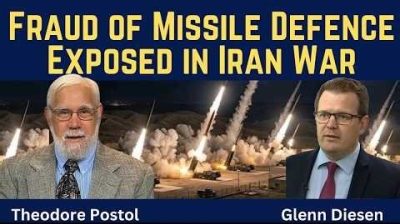
Ted Postol: Fraud of Missile Defence Exposed in Iran War
or go to
Aletho News Archives – Video-Images
Frlom the Archives
Containing the United States
By Edward S. Herman | Z Magazine | September 2016
“Containing the United States” is, of course, a ridiculous and self-contradictory idea in the U.S. and Western ideological and propaganda system. We all know that the United States had to “contain” the Soviet Union from 1945 to 1991, and since then has had the task of containing Russia and China. Only they threaten, bully, aggress and worry countries like Poland and Vietnam. Obama has had to reassure them both of our steadfast stand against Russian and Chinese military attacks. NATO has, of course, expanded greatly over the past several decades, despite the deaths of the Soviet Union and Warsaw Pact, but only to contain the renewed Russian — and Iranian, Libyan, Syrian and other — military threats; and we have “pivoted” to Asia, supported Japanese rearmament, bolstered our own forces in that area and jousted with the Chinese in their coastal waters solely to contain China. Earlier we had been obliged to contain North Vietnam, or was it the Soviet Union in Vietnam? Or China? Or “communism”? Or maybe all of them? Or none of them, but just needing an excuse to enlarge power?
The parallel propaganda has taken many forms. One is accepting as a premise that the United States only acts defensively and has no internal forces and interests that drive it to enlarge its sphere of control. I noted in an earlier article how Paul Krugman claims that internal Russian problems may well be the explanation of Russian “aggression,” but how at the same time it never occurs to him that the huge U.S. transnational corporate interests and “defense” establishment, and the pro-Israel lobby’s activities, might possibly make for an expansionist dynamic here.2 This reflects the standard establishment perspective that we are good and only react to evil. This was the view sustaining and justifying the invasion and occupation of Iraq from 2003. That attack was taken here as not evil but a response to evil, even if involving lies and mistakes, hence not describable as “aggression.” … continue
Blog Roll
 Aletho News
- Iran War Supporters Invent a New and Absurd Justification: It Is All About China
- Corporate Media Go All Out To Support The US-Israeli War on Iran
- Trump press conference reveals a man who wants out of war
- When Tel Aviv decides, Washington fights
- Top official: Iran ready for a long war with US, no more diplomacy
- How Iran’s Toxic Rain Reveals US-Israel Discord
- Trump Admits He Is Destroying Iran For Israel
- Iran’s latest move in the GCC countries was a stroke of genius
- Blackmail and death threats, Zelensky embarrasses the EU, but there’s no condemnation
- Israel threatens to kill Iran’s new leadership
- If Americans Knew
- Lebanon: Israel’s White Phosphorous Use Risks Civilian Harm
- Corporate Media Go All Out To Support The US-Israeli War On Iran
- US-Israel war on Iran is creating a steady growing number of amputees
- Israel planned this war on Iran for 40 years. Everything else is a smoke screen
- The wrong question about the war in Iran
- ‘Your Tax Dollars Being Used to Raise Your Gas Prices’: US-Israel Bomb Major Iranian Oil Depots
- ‘Bogus Evidence’: Former Nuclear Watchdog Head Debunks US Justification for Iran War
- EXPLAINER – Dimona: What to know about Israel’s nuclear site
- Fires and toxic air in Iran (thanks, Israel) – Not a ceasefire Day 150
- At Israel’s hands, Iran is burning, Lebanon and Gaza are crumbling – Not a ceasefire Day 149
- No Tricks Zone
- Wake-up Call: Survey Shows Majority Of Germans Now Favor Postponing Climate Targets!
- Televised! Leading German Political Candidate Tells Schoolchildren CO2 Makes Sun Hotter!
- New Study: A Century Warming Of 1.1°C Is ‘Commonplace’ And ‘Not Unusual’ During This Interglacial
- New Study: ‘Internal Noise’ And Volcanic Forcing Can Trigger 10-15°C Warming Within Decades
- Glaciers Worldwide Are Suddendly Surging, Experts Blame Warming!
- Surprising Discovery: Sahara Is Greening…Billions Of Trees Where Once Thought To Be Barren
- New Research Reaffirms Clouds, Aerosols, And Surface Solar Radiation Are ‘Driving The Climate System’
- Germany: Electric Car Catches Fire At Charging Station, Sets Off Local “Inferno”, Widespread Damage
- New Study: Canada’s New Brunswick Was 1°C Warmer Than Today During The Medieval Warm Period
- Coal Power Back In Trend As Globe Tries To Keep Pace With Growing Demand For Power
 Aletho News