Russia warns Israel against attacking Iran’s nuclear facilities
RT | October 17, 2024
Israel must refrain from even considering the option of striking Iranian nuclear infrastructure, Russian Deputy Foreign Minister Sergey Ryabkov warned in a statement to journalists on Thursday.
Tensions between Tehran and West Jerusalem have escalated in the weeks since Iran launched nearly 200 missiles at Israeli territory on October 1. Iran has said the strikes were conducted in retaliation for the killing of Hamas and Hezbollah leaders, as well as an Islamic Revolutionary Guard Corps (IRGC) general last month.
Israel has since vowed a “deadly, pinpoint accurate, and surprising” response to the attack, with Israeli lawmakers calling for devastating strikes on Tehran’s energy infrastructure, including its nuclear facilities. An ABC News report on Thursday also claimed that Israeli Prime Minister Benjamin Netanyahu has already signed off on a set of targets for the IDF’s response.
Ryabkov has stressed that attacks on Iran’s nuclear facilities would be “catastrophic” and stated that Russia has “repeatedly warned and continues to caution [Israel] against even hypothetically considering the possibility” of such strikes.
“This would be a catastrophic development and a complete negation of all existing postulates in the area of ensuring nuclear safety,” the deputy minister said.
Last week, Russian Foreign Minister Sergey Lavrov also cautioned Israel against striking Iran’s civilian nuclear facilities, stating that such an attack would be a “serious provocation.”
Meanwhile, the Islamic Republic has urged the Jewish state to refrain from taking further disproportionate escalatory steps, stressing that it would deliver a “decisive and regretful” response if Israel chose to retaliate for the October 1 missile strikes.
One Iranian source also told RT last week that if West Jerusalem did decide to attack Iran’s energy infrastructure, such as oil refineries, power plants and nuclear facilities, Tehran would respond by striking similar targets in Israel.
Ukraine hails car bomb that killed Russian nuclear plant worker
RT | October 4, 2024
A senior security staff member of the Zaporozhye Nuclear Power Plant – the biggest facility of its kind in Europe – was killed in a car explosion on Friday morning, the Investigative Committee of Russia has said. Ukraine’s military intelligence hailed the incident on Telegram, while stopping short of openly claiming responsibility for it.
According to Russian investigators, an improvised explosive planted under the personal vehicle of Andrey Korotky, a senior security official at the plant, exploded. Korotky succumbed to his injuries at a nearby clinic.
Ukraine’s military intelligence agency (HUR) immediately commented on the incident on Telegram, branding Korotky a “war criminal” and a “collaborationist” for his decision to “voluntarily” cooperate with Russia. It also accused him of organizing “events in support of the Russian… army,” and of joining the United Russia party.
The agency also published a video showing the moment of the explosion and vowed “vengeance” against anyone it deems to be a “war criminal.”
The Zaporozhye station confirmed its staff member’s death and informed the International Atomic Energy Agency (IAEA) about the incident, the plant’s communications director, Evgenia Yashina, told TASS. Station director Yury Chernichuk condemned the incident as a “horrifying, inhumane terrorist act,” and demanded those behind it be brought to justice.
“Attacking the staff members responsible for the security of a nuclear facility is a reckless step beyond any bounds,” Chernichuk stated. The UN nuclear energy watchdog has not yet commented on the incident.
The Investigative Committee said it has opened a criminal case for murder. It did not name any suspects.
The Zaporozhye Nuclear Power Plant has been under Russian control since March 2022. Throughout the conflict, Moscow and Kiev have repeatedly accused each other of shelling the facility, and the Russian Defense Ministry has said that several attempts by Ukrainian assault units to retake it have been repelled.
Zaporozhye Region officially joined Russia, along with three other former Ukrainian territories, in the autumn of 2022. The IAEA has a permanent monitoring mission at the nuclear facility.
In late August, senior Russian diplomat Rodion Miroshnik said staff members at the plant had been facing blackmail. People working at the facility had allegedly been coerced into cooperating with Kiev and passing sensitive data or even committing terrorist acts under the threat of their relatives in Ukraine being killed.
Russia concerned over Israeli signs of possibly striking Iran: Ryabkov
Al Mayadeen | October 3, 2024
Russia has expressed concern over “Israel’s” signals suggesting a potential “retaliatory strike” on Iran, which could involve targeting Iranian nuclear facilities.
In a statement to Sputnik on Thursday, Russian Deputy Foreign Minister Sergey Ryabkov emphasized that considering such scenarios is unacceptable.
He expressed deep concern, highlighting that any escalation of the current war could lead to severe consequences.
“I also want to say that nuclear facilities as such, in any case, should always be taken out of any conflict,” Ryabkov stressed.
He also emphasized the need for the international community, including the IAEA and its leadership, to speak out and condemn the mere consideration of such scenarios.
This comes shortly after Israeli media reported, citing Israeli officials, that “Israel” might respond to Iran’s significant ballistic missile attack on Tuesday by targeting strategic infrastructure, such as gas or oil rigs, or by directly striking Iran’s nuclear sites.
IAEA head confirms that Ukraine has struck Russian nuclear plant with drones
By Dénes Albert | Remix News | August 28, 2024
As the expanding frontline inches within just a few kilometers of the Kursk nuclear power plant in Russia, there are fears there could be a major nuclear disaster.
“There is a risk of a nuclear incident at the Kursk nuclear power plant,” said Rafael Grossi, Director General of the International Atomic Energy Agency (IAEA), after visiting the facility in Kurchatov, in the Kursk region bordering Ukraine, on Tuesday.
He added that he had seen evidence of drone strikes during his visit to the plant.
“I was told today that there have been several cases of drone attacks on the site (the site of the Kursk nuclear power plant), on the facilities. The fact that there is fighting a few kilometers away from the nuclear power plant raises great concerns and anxiety about the security system,” Grossi added.
He stressed that under no circumstances should a nuclear power plant be the target of military action, nor should it be used by either side for military purposes. The director general also said that the security systems of a plant must be fully operational under all circumstances.
Grossi noted that the IAEA delegation was shown the traces of the Ukrainian attack on the Kursk nuclear power plant. Based on the evidence his team gathered, he said there could be no doubt that Ukraine carried out these strikes and where they came from.
Putin also announced on Thursday that Ukraine had attempted a drone strike on the Kursk nuclear power plant.
Grossi, who said that he had visited the reactor hall, the engine room, and the control room of an operating power plant unit — as well as the spent nuclear fuel storage — found that the Kursk plant was operating at what is very close to “normal” mode.
He stressed that the IAEA is responsible for maintaining nuclear safety and security in nuclear installations worldwide. He said that he had accepted Russian President Vladimir Putin’s invitation to visit the Kursk nuclear power plant with his team to assess the situation personally and to find solutions together with his Russian counterparts. Earlier in the day, the IAEA director general was received by Russian Deputy Foreign Minister Sergei Ryabkov.
He said that he intends to meet Ukrainian President Volodymyr Zelensky next week to discuss, among other things, the situation at the Zaporizhzhya nuclear power plant and the IAEA’s intention to extend its observer presence to other nuclear facilities in Ukraine, as requested by Kyiv. … Full article
Distress and Confusion: What Does Ukraine Seek to Achieve by Attacking Russian Nuclear Plants?
Sputnik – 24.08.2024
Ukraine’s attacks on Russia’s Zaporozhye and Kursk Nuclear Power Plants are most likely an attempt to portray Moscow as unable to keep those facilities safe, Swedish Armed Forces veteran and political and military observer Mikael Valtersson told Sputnik.
“When it comes to the Zaporozhye power plant, I believe that Ukraine wants to create pressure from the international community towards Russia, that the power plant should be at least internationalized, so that Russia wouldn’t control it,” Valtersson explained. “They could say it’s neutral now, the international community takes care of it.”
“When it comes to Kursk, I believe they want to sow distress, and maybe even panic among some part of the Russian population, at least those living nearby,” he added.
He also suggested that Ukraine tries to sow confusion by denying responsibility for these attacks.
“They said Russia attacked its own power plant in Zaporozhye, and they will probably say that if there were any Ukrainian drones, they were just passing by nearby, and they will all the time try to claim that it’s a false flag operation from Russia,” Valtersson noted. “And in the West many will believe that.”
Even if Ukraine’s culpability is confirmed, there likely “won’t be very severe reaction in the West,” he remarked.
Ukraine accused of ‘new level of nuclear aggression’
RT | August 12, 2024
A Ukrainian drone strike on Russia’s Zaporozhye nuclear power plant (NPP) started a fire at the facility and caused serious damage to one of its cooling towers, nuclear power agency Rosatom has said. Its CEO Aleksey Likhachyov also noted that the attack represented “a completely new level of targeted aggression aimed at the infrastructure of nuclear facilities.”
In a statement on Monday shared by Russian media, Rosatom said one of the cooling towers at the Zaporozhye NPP had been hit by two Ukrainian attack drones on Sunday evening. The strikes resulted in a fire that burned internal structures, it added.
While the fire was mostly extinguished by first responders within a couple of hours, “the internal structures of the cooling tower suffered serious damage. The risk of the structure collapsing will be assessed by specialists as soon as possible, Rosatom stated.
The agency accused Ukraine of “nuclear terrorism,” arguing that the strike had targeted crucial cooling equipment, adding that Zaporozhye NPP, the largest facility of its kind in Europe, as well as the city of Energodar have frequently been attacked by Kiev in the past.
Commenting on the incident, Ukraine’s Vladimir Zelensky claimed that “Russian occupiers started a fire” at the facility, without mentioning any drone strikes. He also shared footage showing a large blaze in the lower levels of the tower, with plumes of smoke rising hundreds of meters into the sky.
The International Atomic Energy Agency (IAEA), which has a mission at Zaporozhye NPP, said that its experts heard “multiple explosions” at the facility, without attributing responsibility to either Russia or Ukraine. The watchdog stated that “no impact has been reported for nuclear safety.”
IAEA Director General Rafael Grossi also condemned what he called “reckless attacks” that “endanger nuclear safety at the plant and increase the risk of a nuclear accident.”
Meanwhile, Russian Foreign Ministry spokeswoman Maria Zakharova blasted the IAEA for its apparent inaction. “Where is Rafael Grossi and the rest of the IAEA? Is there at least an imitation of the work of this UN body in this critical area?” she asked, adding that the “terrorists in Kiev, under the leadership of the collective West, destroyed their country… and now they have begun the nuclear terror of the continent.”
Zaporozhye NPP was seized by Russian forces in 2022, several days after the start of the conflict. While Zaporozhye Region joined Russia in a public referendum in the autumn of 2022, the facility itself is located not far from the front line. Against this backdrop, Ukraine and Russia have often traded accusations over who was behind attacks on the facility.
Nuclear Subsidies Galore …
By Kennedy Maize – Master Resource – March 19, 2024
The U.S. nuclear industry in recent days has hit three cherries on the federal money-and-policy slot machine. The open question is whether the largess (some might call it pork) will have the intended results: revitalizing a moribund industry by hitching its wagon to the feverish fear of climate change and long-run animosity toward nuclear rivals China and Russia.
First, the money–the most tangible of the goodies Congress and the White House have doled out. On March 5, the ranking members of the House and Senate appropriations committees rolled out a consensus on six money balls, including the Energy and Water Development and Related Agencies bill funding all government nuclear programs for fiscal year 2024. Passage is almost certainly a done deal.
For nuclear, the bill includes the following radioactive goodies:
- $1.685 billion for Department of Energy nuclear R&D, including a priority for microreactors and accident tolerant fuel. This is a $212 million increase over 2023 funding.
- $2.72 billion in repurposed supplemental emergency funding for a high-assay low-enriched uranium (HALEU) program for advanced reactor fuel development. This is aimed specifically at Russia (the only significant current supplier of HALEU).
- $280 million for an assortment of nuclear programs, such as $16 million for hydrogen produced from nukes and $137 million for the U.S. Nuclear Regulatory Commission.
House Legislation Passed (H.R. 6544)
The above Treasury payments followed policy victories for the nukes, including legislation and a new regulatory program.
On February 28, the House by an overwhelming 365-36 bipartisan margin passed H.R. 6544, designed to streamline safety reviews by the Nuclear Regulatory Commission and give the Department of Energy some authority to buy electricity through purchase power agreements from commercial nuclear power purveyors.
In some respects, the legislation is a return to the approach of the now-defunct Atomic Energy Commission in the early days of atomic energy. In 1974, Congress abolished the AEC, and the all-power congressional Joint Committee on Atomic Energy, in large part because the AEC viewed reactor safety as a poor cousin to promotion the atom.
The language in the House bill, as described by the Hogan Lovells law firm, would require the NRC to revise it mission statement
to ensure that, while upholding the policies of the Atomic Energy Act of 1954 (AEA), the licensing and regulation of nuclear activities are carried out efficiently without unduly restricting the potential of nuclear energy and to improve the general welfare and the benefits of nuclear technology to society.”
Some observers have suggested this hortatory language is unlikely to survive in the Senate. Senators are trying to combine House provisions with a separate bipartisan bill that passed last year as part of the National Defense Authorization Act but was later axed.
The legislation would also create a cadre of up to 210 Supergrade nuclear ninjas, possibly paid more than NRC commissioners in some cases. According to the bill language, under some circumstances, the NRC chairman Chairman “may, during any period when such a certification is in effect, fix the compensation for such employees or other personnel serving in a covered position without regard to any provision of title 5, United States Code, governing General Schedule classification and pay rates.” These alleged experts appear to have the power to second-guess the Senate-confirmed commissioners.
The House bill would also extend the Price-Anderson federal accident insurance subsidy, first enacted in 1957 and renewed seven times since then. The program expires at the end of 2025. It isn’t clear why this federal subsidy for nuclear is still needed when the industry insists its new, advanced reactor designs are “inherently” walk-away safe. Congress apparently believes it can assess the risks of nuclear energy more accurately than private sector actuaries.
Regulatory Favor
Then there is the third cherry on the governmental slot machine: regulation.
On March 4, the NRC rejected a staff-written draft rule developed over three years for how to regulate the potential new license applications for a variety of advanced reactors. The commission told the staff to rewrite its proposal for a new “Part 53” section of the agency’s authority embodied in 10 Code of Federal Regulations, joining the current sections 50 and 52, which pertain to large light-water reactors.
According to Utility Dive, a key change ordered by the commission “rejected ‘a strict checklist of requirements’ for probabilistic risk assessments while favoring a more flexible framework suited to simplified reactor designs with passive safety features that utilize natural forces, such as gravity or pressure differentials, rather than operator action.”
In a news release, NRC Chairman Christopher Hanson said, “This proposed rule leverages significantly more risk insights than our existing regulatory framework in making safety determinations. Applicants can use our existing regulations today, but this proposed rule will provide future nuclear developers a clear, additional pathway for licensing.” The NRC said it expects to publish the new rule in the Federal Register in about six months.
Legacy of Failure
This latest effort to revive the largely stagnant U.S. nuclear program is the third time in the last nearly 20 years that the government has tried to pump new life into atomic power. The U.S. program started grinding to a halt in the mid-1970s and was barely treading water by the 1990s. The pipeline of new reactor licenses emptied in 1974, and as the final builders of plants under construction either completed or abandoned their projects, the workforce and supply chain infrastructure hollowed out.
In 2005, Congress passed a new “Energy Policies Act,” which offered a smorgasbord of financial goodies for new plants including loans (they called them “loan guarantees” to make them look more palatable to opponents of direct federal subsidies, but the Treasury wrote the checks and received the loan payments), cost overrun protections, and extension of Price-Anderson to 2025.
The 2005 act was largely a failure. The two preeminent U.S. nuclear power developers, Westinghouse and General Electric, ended up sorely financially injured and in Japanese hands. Former NRC Commissioner Peter Bradford commented, “They placed a big bet on this hallucination of a nuclear renaissance.”
Then came the first push for “small modular reactors,” designed to downsize the financial risks and construction costs of nuclear power plants. The strategy was the reverse of the “economies of scale” that drove the first generation of nuclear power plants, where bigger was always assumed to be better, but wasn’t.
In 2009, reactor vendor Babcock & Wilcox, which had substantial experience building nuclear power plants for U.S. submarines, announced it would offer a 125-MW pressurized water reactor (later scaled up to 180 MW) and a year later unveiled an alliance with builder Bechtel Corp. They called the project mPower.
In 2012, the Obama administration announced a $500 million program for development of small modular reactors. In 2013, mPower won financial assistance from DOE, with an award up to around $126 million. The same year, B&W tried and failed to sell a majority share of mPower, then cut back funding by 75%. Bechtel soon soured on the project, and it officially ran out of steam in 2017 after failure to find a customer.
During the same time frame, Westinghouse launched a 225-MW small modular reactor program. It quickly cratered, as the Pittsburgh-based company was unable to find a customer for its machines.
Will the latest government attempt to revive nuclear, driven by global warming concerns, succeed? It’s not a given. There’s lots to like about smaller nukes. They produce no CO2, have a relatively small footprint, can be sited fairly close to load.
But the economics aren’t clear, as the NuScale saga demonstrates. Some of the non-LWR advanced reactor designs will present licensing challenges, as there is little history behind them. Sodium cooled fast reactors may be particularly problematic, given the well-known problems of sodium as a coolant and the experience with Superphenix in France and Monju in Japan, plus issues of nuclear weapons proliferation.
———————-
This revised post originally appeared at The Quad Report.
Ukraine bombs Russian nuclear power plant periphery
RT | March 14, 2024
Ukrainian forces have dropped a bomb near diesel tanks located at Russia’s Zaporozhye nuclear power plant, management at the facility reported on Thursday.
In a video published on social media, plant director Yury Chernuk pointed to a crater in the ground, which he said had been created by an explosive device dropped from a Ukrainian drone.
The bomb itself was composed of explosives wrapped in foil, according to reports, but the location was significant. The crater was just five meters away from the perimeter fence, and tanks storing diesel fuel could be seen in the footage.
The plant has backup diesel generators, which kick in when electricity supply from the power grid is cut off. Its equipment needs to be powered continuously to ensure safe operation, even when nuclear reactors are not online. Blackouts have been a regular occurrence for the site since the beginning of the conflict.
”Destruction of those tanks or a fuel leak may not only cause a fire, but also result in significant loss of diesel reserves. Consequently, the plant’s preparedness for emergencies would be reduced by orders of magnitude,” Chernuk explained.
Another person, who was not identified, suggested that the bombing incident had been part of Ukraine’s intimidation tactics. Kiev considers the plant to be occupied by the Russian military.
The director of the facility noted that Ukrainian forces had targeted the plant days after the International Atomic Energy Agency, the UN’s nuclear watchdog, rotated observers stationed there. The organization told Russian media that it was aware of the incident, but offered no further comment.
Following the incident, the situation was reportedly calm in Energodar, the city where the Zaporozhye power plant is located.
Russia responds to IAEA nuclear plant ‘mines’ claim
RT | January 21, 2024
Senior Russian diplomat Mikhail Ulyanov has argued that there is nothing “sensational” or new about the presence of landmines in the buffer zone on the periphery of the Zaporozhye nuclear power plant, which was highlighted by the International Atomic Energy Agency earlier this week.
The Zaporozhye NPP, the largest facility of its kind in Europe, was under Russian control since the beginning of hostilities in Ukraine two years ago, and has hosted the UN nuclear watchdog’s monitoring mission since September 2022. On Friday, the IAEA noted in a statement that “mines along the perimeter of the ZNPP… are now back in place.”
“The mines are located between the outer and inner fences of the station. This is a closed ‘buffer’ zone. Mines pose a threat only to rats, crows and potential saboteurs,” Ulyanov, who represents Moscow at several Vienna-based international organizations, wrote in a Telegram post on Saturday.
The UN watchdog repeatedly declined to assess who was responsible for sporadic drone attacks, shellings and other security incidents involving the facility. Ukraine and its backers kept accusing Russia of undermining nuclear safety, even as Kiev’s top military spy Kirill Budanov admitted to at least three botched Ukrainian assaults to retake ZNPP.
None of Kiev’s commando operations managed to establish a Ukrainian foothold in the nuclear city of Energodar, located in the Zaporozhye region, which joined Russia following a referendum in 2022. However, Ukrainian officials claimed the expeditions gave them valuable experience and contributed to a larger goal of preventing Russia from using the plant to provide electricity to the region. The Zaporozhye station is in a state of partial shutdown, with a single reactor providing power for its own consumption.
Ulyanov noted that according to the Convention on the Physical Protection of Nuclear Material (CPPNM) it was up to the national authorities to determine and introduce “other appropriate measures necessary for the physical protection of nuclear facilities.” Even the IAEA chief Rafael Grossi himself admitted last June that “while the presence of any explosive device is not in line with safety standards, the main safety functions of the facility would not be significantly affected.”
The IAEA was fully aware about the mines and its removal last November, Ulyanov said, arguing that if now they have “reappeared” it only means that the Russian authorities deemed it a “necessary” security measure.
Ex-US Airman on Depleted Uranium: ‘I Saw Disfigured Newborns & My Dad Dying From Cancer’
By Ekaterina Blinova – Sputnik – 19.12.2023
It is only a matter of time before Ukraine uses depleted uranium ammunition on the battlefield, if it hasn’t already. The United States and United Kingdom sent the radioactive shells to the Zelensky regime earlier this year, and the rounds have been spotted in warehouses near the frontlines.
Following the costly failure of their “summer counteroffensive,” the Ukrainian military has begun desperately searching for “wonder weapons” to restore their battlefield fortunes.
Announcing the provision of DU rounds to Ukraine, Washington insisted in September that there’s nothing to worry about: the wonder-weapon is somewhat toxic, but overall harmless and fine. Rafael Grossi, International Atomic Energy Agency (IAEA) director general, joined the chorus, asserting to the public that there are “no significant radiological consequences” from the use of depleted uranium shells.
These are barefaced lies, according to Damacio A. Lopez, a US Air Force veteran who founded the International Depleted Uranium Study Team and co-founded the International Coalition to Ban Uranium Weapons (ICBUW).
“He [Grossi] is part of the team, part of the team that promotes this project, use of these weapons, he is part and parcel of the superpowers that use it and making excuses for it and trying to convince the public that this is not a problem, as they do repeatedly here in this country. You asked what the people thought about this. Well, they haven’t been getting accurate information. And I tried my best to get that information out in Uranium Battlefields and go in and talk to all these countries and try to explain what was going on.”
Damacio was one of the first Americans who raised the red flag about the disastrous consequences of the weapons. Since 1985, he has been seeking a global ban on depleted uranium arms, which are still not covered by international chemical or nuclear conventions, despite DU’s toxicity and radioactivity.
Sinister Black Cloud Over Socorro
Damacio was born in Socorro, a town in southern central New Mexico along the Rio Grande. Back in 1945, the Trinity nuclear test rocked the Jornada del Muerto Desert, only 36 miles southeast of his hometown. Damacio was only two years at that time, but later he became curious about radiation hazards.
The Trinity blast wasn’t the only US nuclear experiment in the region. In 1985, when Lopez visited his parents in Socorro during the Christmas holidays, the first thing he heard on his arrival was the sound of very loud explosions less than two miles from his house. Explosions occurred regularly, making dishes rattle and causing cracks in the walls. But even more alarming was a dark black cloud hovering over the town after the blasts.
“This was disturbing. And it wasn’t just my family. It was all the families in Socorro. From the middle of Socorro, the city park, to where the explosions had taken place, is two miles. That’s up. And the prevailing winds come over the community every time one of these bombs goes off. And of course, people were very concerned about what was going on. And my Mom asked me to look into this. And so I did. I contacted the Board of Regents of the New Mexico Institute of Mining and Technology, who are responsible for these explosions. Because they had been testing different kinds of weapons there since 1946.”
Lopez went to a Board of Regents meeting and asked about the explosions and dark clouds of smoke. But in response, he only got evasive answers.
Still, his efforts bore some fruit: one morning, he found five mysterious boxes in the front yard of his Socorro house. When he opened them, he found documents shedding light on the ongoing disaster.
“Well, those boxes were full of information about depleted uranium and testing in Socorro, and their ideas and what they were doing. And it went way, way back, before 1972, explaining the development of these weapons and what they were trying to do and the different kinds of weapons they were experimenting with, like cluster bombs instead of using metal or tungsten or titanium. They would try depleted uranium and see how that worked. So they were doing these kinds of preliminary testing, along with two other laboratories in New Mexico, plus laboratories outside of New Mexico. They were all working together. And I saw all this information. It wasn’t just about Socorro. It was about worldwide testing with what was going on in Europe and who was testing these weapons and what kind of weapons they were testing.”
He learned that the black cloud that he saw was radioactive and chemically toxic dust ejected into the atmosphere by depleted uranium blasts.
Damacio decided to dig deeper. He knew that the exposure to nuclear materials could lead to health problems, so he went to the Health Department in Santa Fe and sought information about Socorro’s residents. The records gave him the shivers: over past years, the community’s health problems had piled up, with the number of cases of hydrocephalus, cancer, and birth defects higher than in the other counties around the state.
This gruesome discovery prompted him to start researching the effects of depleted uranium contamination.
Horrific Effects of Exposure to Depleted Uranium
“I have a brother who’s bent over, and when he speaks, and he’s 10 years younger than me, something’s wrong with his spine,” Damacio said. “And his body is kind of flopped over. And when he looks at you, he looks like a turtle. He’s way down like this, and looks up. I mean, he’s normally about 5 ft 6 in. And now he looks like he’s about 4 ft. It’s a horrible sight. His teeth are all rotten. He’s the one who lives right next to the facility. You know, here’s the facility right here.
Here’s my house. And here is a town. There’s a fence between us and it says ‘Keep out, government property.’ And so our family is very close, one of the closest homes to this facility.”
“My dad ended up dying from cancer,” the activist continued. “And it was a sad situation for us. And like I said earlier, the people there, when they realized the truth about what was going on, instead of saying, ‘Oh, we want to stop this,’ no, they’re saying, ‘What? What can we do to survive? How can we survive this thing?’ And well, they couldn’t leave. So they just stay. And over the years, refusing sometimes to even acknowledge the dangers around them, because I believe they have no other choice. And it’s dehumanizing for people to be in that situation.”
In the late 1990s, Damacio was invited to Iraq by the nation’s authorities to speak at a conference on the depleted uranium weapons used in the country by the US during the Persian Gulf War (1990-1991). In 1993, Lopez and his fellows published the book Uranium Battlefields Home and Abroad: Depleted Uranium Use by the US Department of Defense, looking into DU testing sites in the US and the Pentagon’s use of the weapons abroad. The US and its allies unleashed over 300 tons of DU in Iraq.
“Well, when I went to Iraq and I told the people, I want to see if what’s happening here is happening there as well. So I’m not only the victim, but I’m also a researcher and I want to have accurate information. I just don’t want to take other people’s word for things. And I don’t, and I never have. Maybe at the very beginning of my discovery I did that. But since then, I want to see the people involved in these situations.”
“I found a lot of [health] related issues. At that conference that I went to, I learned a lot of things and I was one of the speakers at this conference. And so I was able to get studies from these medical people who had done a lot of studies on the people in Iraq and birth defects, cancers. These were the top things that were going on in their country, and some of the cancers were the same cancers, the same cancer that my father died from. And a lot of other people in the town were having problems in Socorro with birth defects. So I was able to go into hospitals in Iraq to see for myself the people who were victims.”
But the greatest shock for Damacio was Iraqi children who were born after the US bombing campaign. When he recalls them, he cannot hold back his tears.
“In one particular hospital I was able to see many, many children with birth defects that were so severe that it was so hard for me to think of them as even human.”
“I’m talking about very, very serious birth defects. Can you imagine walking into a place and seeing a child with one eye and his forehead? It’s like not even human. And I met this little boy. He was three years old. He was with his mother and he had a big head, hydrocephalus. And one eye was turned up and his other eye was turned down. He was skin and bones. He was three years old, couldn’t weigh more than 20 pounds. And his head was huge. Little tiny, tiny legs. It’s almost skin and bone. And the mother was holding him and wiping the blood from his mouth. And as I was leaving the hospital, tears started streaming down my face. I couldn’t control it. It was so, so bad.”
The little boy looked listless. Damacio thought for a moment that the toddler couldn’t see or hear. “And as I was leaving the room, I heard the little boy scream out: ‘Mama, mama!’ And it sent chills through my entire body.”
If Damacio were told at the time that the US government would throw another thousand tons of depleted uranium on Iraq in just three weeks during the Second Gulf War, it would have stopped the researcher’s heart.
Geiger Counter Never Lies: DU Weapons are Radioactive
Lopez suspected that these hideous birth defects and the spike in cancer cases were caused by depleted uranium’s radioactivity and toxicity. Preparing for his Iraq trip, he took his Geiger counter. The radiation detector “could identify alpha, beta, and gamma, and could identify whether it was depleted uranium or something more hot than depleted uranium,” according to the researcher.
While in Baghdad, Damacio visited the Amiriyah shelter, which was subjected to a US aerial attack that killed over 400 civilians, including children, on February 13, 1991.
“It was quite a sight when I was looking at the blood and hairs of the people on the walls and the children. And then there was an area where they had all their pictures. I was there with the Japanese delegation in this particular visit. And for them, it was common – it was not common, but they knew this well about the shadows on the wall and the hair and the blood from what happened in their country when they were bombed. So they understood all this.”
“Eyewitnesses told me, more than one said to me: ‘Damacio, what happened here is… I saw this projectile. I saw this large Tomahawk cruise missile making curves around streets.’ And then, when they got to the Amiriyah shelter, they went up high, came straight down in the middle of the shelter that had three stories, three feet of concrete between the stories to protect the people in there. In this case, children. There were more than 600 kids and school kids in that shelter at this time. The missile came down from the middle of the shelter, went through, went all the way down to the bottom of the shelter, and then went into a deep hole there. I saw all this, and they’re watching it.”
Lopez decided to find remnants of projectiles used during the US bombing of Baghdad and other areas and make measurements. He knew that typically, natural background radiation levels could range between five and 60 counts per minute, or a little more. Anything higher than that meant potential radioactive contamination.
“I found in one of the facilities in Baghdad after going to the Amiriyah shelter, there was an exhibition, there was a big building and they had picked up all the war remnants that they had found. One of them was partially, about three quarters, a Tomahawk cruise missile. And I had my detector and I checked it out. It was about a hundred counts per minute, which was an indication that there was radiation within this Tomahawk cruise missile.”
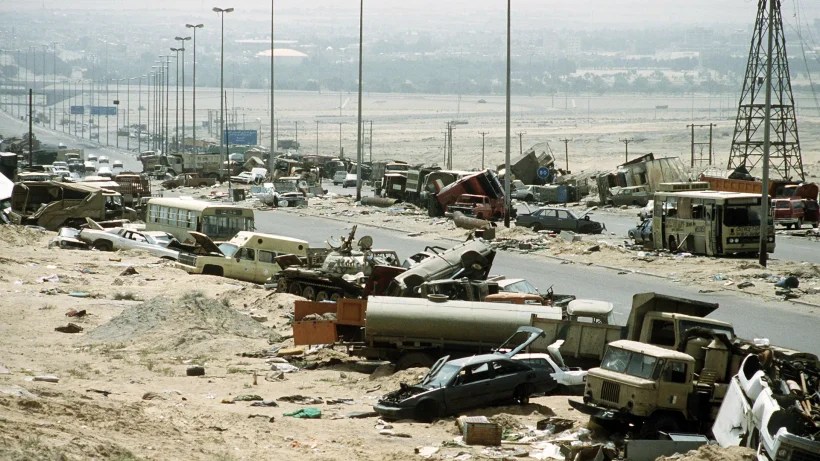
Then he travelled to a site on the border between Kuwait and Iraq, dubbed the “Highway of Death,” where thousands of Iraqi tanks and armored vehicles were pierced and burned by DU munitions fired by US A-10 Warthogs. There, he got readings of about 100-120 counts per minute on the holes of the damaged tanks. Lopez also collected small pieces of metal as samples that showed a reading of 600 counts per minute.
“And I happened to find several projectiles, 30 millimeters, that had missed the target and hit the ground and bounced. And they were intact. So I checked them out with my detector, thinking I’m going to get 600 counts per minute. I was getting 2,500 per minute on these projectiles, so high that my radiation detector wouldn’t go any higher than in its capabilities. And it would go ‘u-u-u-u,’ could have been higher than 2,400 counts per minute. And the only conclusion I could draw from that is that nuclear waste from nuclear facilities was being mixed with what was so-called depleted uranium. And this became even more alarming.”
DU Weapons are Made of Radioactive Waste
Lopez tried to find out why the US had decided to use depleted uranium for its ammo in the first place.
Damacio’s book Uranium Battlefields Home and Abroad: Depleted Uranium Use by the US Department of Defense explains that DU is a byproduct of the uranium enrichment process by which the fissionable isotope uranium-235 (U235) is extracted from natural uranium for subsequent use as fuel for nuclear reactors.
Natural uranium, a silvery-grey metal, contains 0.7% U235, 99.3% U238, and a small amount of U234 by mass. After producing 85 kilograms of enriched uranium, one would get 915 kg of U238, or depleted uranium.
The Pentagon argues that U238 retains “only” 60% of natural uranium’s radioactivity and emits alpha particles, which have low penetration depth and can be stopped by skin. Inside the body, however, alpha-emitters can be extremely harmful, damaging sensitive living tissue. After the explosion of DU projectiles, microscopic and light uranium dust can travel with the wind, be inhaled, swallowed, or enter the body through a wound, later causing cancer and chromosome damage.
One should bear in mind that depleted uranium is radioactive waste that should be disposed of, Lopez pointed out in his book. However, almost all DU tails have been saved by the US government since the early 1940s. Moreover, they can be purchased for commercial use, according to the researcher. To date, the US has accumulated a massive storage of DU amounting to over 700,000 metric tons.
Why Do Pentagon and Defense Contractors Like DU So Much?
Lopez explained that from a military standpoint, the most important property of DU is its great density, relatively low cost of fabrication, and availability. The material is used for tank armor and projectiles of different sizes.
Highly-dense DU munitions easily pierce tanks and other armored vehicles. While tungsten carbide projectiles are capable of doing the same, DU is cheaper, more accessible, and offers greater margins for US military firms.
On the other hand, turning spent uranium into bullets and shells has become an “ingenious” solution for the US nuclear industry on how to “dispose” of radioactive waste, Lopez said in his book. So, as money talks, the US’ testing and use of DU weapons continue unabated, according to the activist.
But has the Pentagon ever been aware of the long-lasting hazard related to DU projectiles?
The US Department of Defense’s internal memos, leaked to the press in the late 1990s and the beginning of the 2000s, indicate that the Pentagon knew. But why would it use the toxic and radioactive substance nevertheless?
A March 1, 1991 document shows the US DoD’s attitude to DU weapons use in a nutshell. Authored by US Lieutenant Colonel M.V. Ziehmn at the Los Alamos Laboratories in New Mexico, the memo reads:
“There has been and continues to be a concern regarding the impact of DU [sic] on the environment.
Therefore, if no one makes a case for the effectiveness of DU on the battlefield, DU rounds may become politically unacceptable and thus, be deleted from the arsenal.”
The memo went on by saying: “If DU penetrators proved their worth during our recent combat activities, then we should assure their future existence (until something better is developed),” adding “we should keep this sensitive issue at mind when after action reports [sic] are written”; otherwise the US may lose “a valuable combat capability.”
Why Are the Pentagon and White House Keeping DU’s Deadly Effects Secret?
The documentary Uranium 238: The Pentagon´s Dirty Pool (2009), used by Lopez’s International Coalition to Ban Uranium Weapons (ICBUW) as part of its international campaign to prohibit DU, said that the Pentagon is in denial about DU munitions potentially leading to carcinogenic diseases, birth defects, and environmental contamination.
The US Defense Department has even invented a sort of “DU diplomacy” to reassure the world community and American citizens that there is nothing to worry about, according to the ICBUW. Meanwhile, the US has not only failed to inform affected nations – Iraq, Bosnia, Serbia, Syria – about the DU hazard, but also repeatedly exposed American soldiers to the toxic and radioactive waste. Per the documentary, DU weapons in all but name are a “dirty bomb” – a mix of explosives and radioactive material – used by terrorists. Yet somehow DU rounds are still called “conventional weapons.”
One could easily imagine that if the US government admits DU’s hazardous effects, the weapon would be banned, influential defense contractors would be stripped of their profits, and Washington would be slapped with a heap of legal cases with compensation demands.
And the US is not the only country that uses depleted uranium as a weapon, as some of its NATO allies also do, according to Lopez.
“[The US keeps DU’s deadly effect secret], for the same reason all the other countries that have the weapon kept secret, as much as they can keep it secret, it is because they know they’re violating international laws, international conventions on weapons, and they know that they’re going to have to pay the price someday, and they may end up with charges of violations of international laws. And so they’re trying to protect themselves. And at the same time, they want to continue to keep the weapon because they’re afraid other countries have weapons too,” Lopez concluded.
Featured Video

Theodore Postol: Iran’s Missiles & Drones Were Underestimated
or go to
Aletho News Archives – Video-Images
From the Archives
What is the Israeli Lobby in Australia Doing in Interfaith Dialogue?
By Ali Kazak | Dissident Voice | October 11, 2015
For years Israel and its lobby around the world have been trying to normalise their relations with Arabs and Muslims without solving the Palestine Question.
One of the methods they resorted to in the last few years is using human rights and community organizations such as interfaith dialogue and Multiculturalism to achieve this objective and to: isolate the Palestinians, marginalise the Palestine question, end Israel’s isolation, and prevent criticism of Israel, knowing that these organisations will be the first to stand against Israel’s violations, racial and religious discrimination.
The group responsible for this task in Australia is The Australia/Israel & Jewish Affairs Council (AIJAC); its Director of International & Community Affairs, Jeremy Jones is in charge of lobbying religious community organizations, specifically Muslims and Christians. Consequently he convened the Faith Communities for Reconciliation, founding participant in the Australian Partnership of Religious Organisations and the Australian National Dialogue of Christians, Muslims & Jews.
AIJAC is a private political propaganda group. It is recognised as the main Israeli lobby in Australia. It coordinates its activities and works intimately with the Israeli embassy in Canberra and different institutions in Israel. It is privately funded by some Jewish businessmen. It monitors closely Australian politicians, the media, ethnic and religious groups, (especially Arabs and Muslims), unions and academics on their stands towards Israel and the Palestine question. … continue
Blog Roll
 Aletho News
- Iran’s friends are about to make life much more difficult for Israel and the US
- The war of liberation of the Arab and Islamic peoples expands across the Gulf
- Envoy warns UN on Trump’s threat to ‘obliterate’ Iran’s civilian infrastructure
- The Larak Corridor: Iran’s Rial Gate With No US, No Israel, and No Way Around
- ‘Economic terrorism’: Steel facilities hit again in US-Israeli strike
- ‘War Crime’: Iran condemns attacks on Arak, Ardakan nuclear sites
- Two-thirds of Americans want quick end to Iran war even if goals unmet
- Trump to Give “Important Update on Iran” Wednesday in Prime-Time Speech
- Theodore Postol: Iran’s Missiles & Drones Were Underestimated
- Iran To Target Military Industrial-Tech Complex That Facilitated Gaza Genocide
- If Americans Knew
- Israel wants US to bomb more of Iran’s civilian structures (113,000 is not enough) – Not a ceasefire Day 173
- Ann Coulter Rips Into Fox News for Iran War Coverage
- Joe Kent Urges Americans To Call White House and Congress To Object To Sending Troops Into Iran
- DNC Resolution to Reject AIPAC Funding Puts Democratic Leaders in the Hot Seat
- Swedish foundation to build 400 schools as over 650,000 Gaza children remain without education for 2 years
- Israeli army admits photshopping image of slain Lebanese journalist
- This is how Israel is systematically killing health workers under the cover of war in Lebanon
- Carrying life under fire: Israeli invasion of Lebanon leaves pregnant women facing deadly risks
- Champagne all around for the new death penalty (for Palestinians) law – Not a ceasefire Day 172
- Why are Palestinian books struggling to be seen on Amazon?
- No Tricks Zone
- New Study Finds Warming Saves Lives…Cold Temperatures 12 Times More Deadly Than Excess Heat
- German Science Blog Accuses PIK Climate Institute Of Hallucinating Climate Tipping Points
- Devastating Assessment Of Comirnaty Vaccine By Former Senior Pfizer Europe Toxicologist
- New Study: CO2 Is ‘Effectively Negligible’ As An Explanatory Climate Change Factor Since 2000
- Former Pfizer Toxicologist Dr. Helmut Sterz Tells Bundestag Hearing Pfizer Vaccine Should Have Never Been Approved
- Energy Expert: Germany’s Nuclear Phaseout Was A “500 Billion Euro Mistake”
- New Research: South Australia’s Mid-Holocene Sea Surface Temperatures Were 4°C Warmer Than Today
- Storing Green Energy To Last Germany 10 Days Would Require A 60-Million Tonne Battery
- New Studies: UK Sea Levels Were 4 Meters Higher Than Today During The Mid-Holocene
- Destructive Green New Deal: German Energy And Metal Group Warns Of Drastic Crisis
 Aletho News