UK nuclear site ‘leaking’ – The Guardian
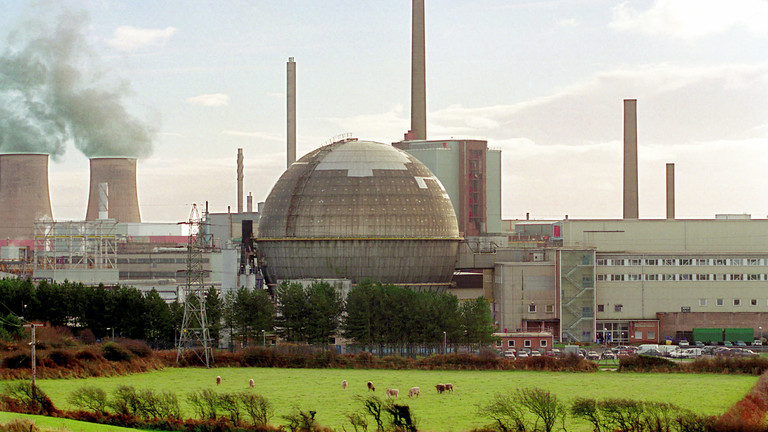
Sellafield nuclear reprocessing facility November 26, 2001 in Cumbria, England © Getty Images / Graham Barclay/BWP Media/Getty Images
RT | December 5, 2023
Sellafield, regarded as the most hazardous nuclear site in Europe, has developed a leak in a massive radioactive waste silo that has prompted concerns about the facility’s safety measures, as well as potential dangers to the public and the environment, The Guardian has reported.
The two-square-mile (6km sq) plant, located in Cumbria in England’s northwest, is responsible for the storage and decommissioning of nuclear waste from nuclear weapons programs and power generation. It was previously used to generate nuclear power from 1956 to 2003.
However, the decades-old facility, Europe’s largest nuclear site, has a catalog of safety issues, the newspaper said, including asbestos and fire hazards. Perhaps more concerningly, though, are cracks in storage silos which have prompted diplomatic squabbles with affected countries, including the US, Norway and Ireland.
Damage to one silo of toxic radioactive waste has caused a leak of “potentially significant consequences,” The Guardian said on Tuesday, citing official documents seen by the outlet. It adds that the leak, which it says is likely to continue until 2050, could contaminate groundwater should the situation worsen further.
Scientists are attempting to assess the full risks of the leak using “ongoing radiological dose assessments” and statistical modeling, the newspaper added. In June, the UK’s Office for Nuclear Regulation (ORR) said in a report that the risk presented by the leak is “as low as reasonably practicable.” However, the nuclear regulator remained concerned by the full impact of the leak and at what rate, if any, it may affect groundwater.
An unnamed expert who sits on a committee that monitors Sellafield and other nuclear sites told The Guardian : “It’s hard to know if transparency is put aside because no one’s brave enough to say ‘we simply don’t know how dangerous this is – other than certainly dangerous.’”
An EU report in 2001 warned that an accident at Sellafield could be more hazardous than that of the Chernobyl disaster in 1986, which exposed about five million people in Europe to radiation. Sellafield contains substantially more radioactive material than the Chernobyl facility did at the time.
Reports of Sellafield’s crumbling facade have sparked US concerns about the safety standards at the site, according to diplomatic cables seen by the publication. It has also led to complaints from the governments of both Ireland and Norway – with Oslo worried about the potential of radioactive particles being carried towards its territory by winds across the North Sea.
Health problems brought on by exposure to nuclear radiation depend on the dose but can range from nausea and vomiting to cardiovascular disease and cancer. Extremely high exposure is, in most cases, fatal.
Ukrainian attack on Russian nuclear facility thwarted – officials
RT | October 27, 2023
A Ukrainian attack involving multiple drones has been stopped in the Russian city of Kurchatov, home to the Kursk nuclear power plant, according to civilian and military officials. Unconfirmed reports claimed that one of the aircraft damaged a nuclear waste storage building at the site.
The spree of incidents happened on Thursday evening in Kursk Region, which borders Ukraine. The Russian Defense Ministry reported intercepting a fixed-wing drone over Russian territory on two occasions, about two hours apart, while the power plant’s press service said it was attacked by three enemy drones. Kurchatov is located some 60 km from the Ukrainian border.
The statement by the civilian authorities reported no damage or casualties on the ground, and said all four units of the facility were operating normally. Three of them are currently online, while one is undergoing a shutdown procedure ahead of being decommissioned, it said. The oldest reactor, which first went operational in 1976, has not been generating power since late 2021.
The news outlet SHOT claimed that the incident was more serious than according to official statements, reporting that the third drone “fell next to a nuclear waste storage and blew up.” The report said the blast caused minor damage to the infrastructure but didn’t hurt anyone.
Another drone incident in Kurchatov that may have been an attempted attack on the plant was previously reported in mid-July. An unmanned aerial vehicle, which was described as home-made and fitted with a Taiwan-manufactured jet engine, exploded several kilometers away from the nuclear site, media reported at the time.
Moscow has accused Kiev of launching multiple attempts to sabotage its crucial energy infrastructure, including nuclear power plants, amid ongoing Russian-Ukrainian hostilities.
Earlier this month, the chief of Ukrainian military intelligence, Kirill Budanov, confirmed three failed commando raids on Energodar, the city where the Zaporozhye nuclear power plant is located.
Energodar is located in the Zaporozhye region, which joined Russia last year after people living there voted for the move in a referendum. Ukraine has dismissed the vote as a “scam,” and Kiev partially controls the contested territory.
The Zaporozhye plant hosts a monitoring mission of the International Atomic Energy Agency, the UN’s nuclear watchdog. It was stationed there last year, amid a string of drone and shelling attacks, which Moscow and Kiev blamed on each other.
Ukraine’s Possible New Counteroffensive: ‘Camouflage’ for Zelensky to ‘Steal More Money From West’
By Oleg Burunov – Sputnik – 01.10.2023
Kiev’s alleged push for another counteroffensive, this time in the autumn, can be perceived as the West’s red herring, Scott Bennett, a former US Army psychological warfare officer and State Department counter-terrorism analyst, told Sputnik.
The Zelensky regime had elaborated a plan for a major offensive in the Kherson and Zaporozhye region in early October, securing the approval of Ukraine’s sponsors in Washington and London, an informed source told Sputnik earlier this week.
According to the source, Kiev’s special forces intend to seize control of the Zaporozhye Nuclear Power Plant (NPP) as part of the blueprint.
All this could be Western countries’ red herring, Scott Bennett suggested, pointing to the Ukrainian Army’s futile attempts to break through Russian defensive lines.
“As a result of the resounding defeat of Ukraine, the West is frantically searching for an opportunity to try and escape the coming judgement and potential crimes against humanity charges for the death and destruction the Biden Administration has recklessly unleashed. And the nearest opportunity for distraction may be the Zaporozhye Nuclear Power Plant,” Bennett argued.
He recalled that many perceive this facility as “a target for destruction in a kind of ‘doomsday’ button that the US might try and push, in an attempt to generate sufficient chaos and destruction to distract the world away from the small scale battles of Ukraine, to the global implications of a nuclear disaster.” According to the former psychological warfare officer, the potential destruction of the Zaporozhye NPP would be the “ultimate expression” of this chaos.
He warned that if the facility is destroyed, “the resulting tsunami of social, political, economic disruption would disorganize opposition parties and protests against the current political elites in Europe and America, and justify a lockdown or martial law and police state mentality which could be endlessly extended.”
Bennett didn’t rule out that “the West will combine its best liars in the CIA, the Mossad, the MI6 to blame the event on Russia, and perhaps also simultaneously initiate some self-inflicted false flag attacks at the same time—such as assassinate Joe Biden and Zelensky at the same time and blame this on Russia in order to justify ‘police action’ and a drafting of Americans into the military for conflict with Russia.”
“We’ve seen it in Vietnam, and the 9/11 war on terror, so they may try and do it again, sad to say. The American media, the most professional liars and propagandists since Germany’s Goebbels, have already planted in the minds of Americans that ‘Trump supporters’ are becoming Russia-sympathizing domestic terrorists who may try and assassinate Biden, so the writing is on the wall,” the former State Department analyst added.
Commenting on how Zelensky’s alleged new advance can be explained, given the failure of Kiev’s summer counteroffensive, Bennett claimed that the Ukrainian president is “a madman, or being told what to do by madmen—or both. I suspect the latter.”
When asked if it’s safe to say that the alleged October counteroffensive plan is an attempt to appease the Ukrainian people and justify Western demands, Bennett said that it is “camouflage for Zelensky’s scheme to steal more money from the West, and show some kind of a “good faith effort” that would invite future ‘re-construction’ donations and investments by the West.
“The military reality is that Ukraine is destroyed, the war is essentially over, and the Russian military and people have prevailed and been victorious. Of course, the West is trying to distract away from this reality and create all kinds of miniature flash-points and terrorist attacks upon innocent civilians in Crimea and Moscow and elsewhere, but this too shall end,” the ex-State Department analyst asserted.
Russian President Vladimir Putin stressed last month that Ukrainian troops had failed to achieve any tangible results on all the frontlines since the beginning of their counteroffensive on June 4, something that he said had claimed the lives of more than 71,000 Ukrainian soldiers by the time.
Moscow Says ‘Anti-Russia’ IAEA Resolution Contains Unsubstantiated Accusations
Sputnik – 30.09.2023
MOSCOW – The resolution adopted at the 67th session of the IAEA General Conference on “nuclear safety, nuclear security and safeguards in Ukraine” contains unfounded attacks and unsubstantiated accusations against Russia, Russian Foreign Ministry spokeswoman Maria Zakharova said on Friday.
The 67th Regular Session of the IAEA General Conference took place from Monday to Friday in Vienna.
“On September 28, the 67th regular session of the IAEA General Conference, under pressure from the United States and its allies, adopted the resolution ‘Nuclear safety, security and safeguards in Ukraine’, containing unfounded attacks and unsubstantiated accusations against Russia, through a vote accompanied by the typical Western blackmail, intrigue and intimidation of countries,” Zakharova said in a statement posted on the Russian Foreign Ministry’s website.
Zakharova accused the United States and its allies of using international mechanisms “to achieve their opportunistic political goals, which are in no way related to the statutory purposes of such mechanisms.”
“The above resolution is non-binding, and Russia is not going to act on its provisions, while citing the resolution in documents will make them politically and legally void to us,” Zakharova added.
The issue of nuclear safety has drawn renewed international attention since the Ukraine conflict started in February 2022. During the hostilities, the Zaporozhye NPP, which is the largest nuclear power plant in Europe by number of units and energy output, came under the control of Russian forces in early March 2022 and has since been repeatedly shelled, raising concerns over a possible nuclear accident. The IAEA established a permanent presence of its experts at the ZNPP in September 2022.
A Concrete Solution for Fukushima
#SolutionsWatch Corbett • 08/30/2023
Podcast: Play in new window | Download | Embed
Last week, TEPCO, in conjunction with the Japanese government, began dumping radioactive Fukushima wastewater into the Pacific Ocean. Joining us today to talk about the consequences of that decision, what it will mean for peoples around the Pacific, and what could be done to mitigate this disaster, is Dr. Robert H. Richmond, Research Professor and Director at the Kewalo Marine Laboratory in the University of Hawaii at Manoa.
Watch on Archive / BitChute / Odysee / Rokfin / Rumble / Substack / Download the mp4
China bars seafood from Japan
RT | August 24, 2023
Chinese customs authorities announced on Thursday an immediate ban on imports of all seafood from Japan as Tokyo begins a contentious release of treated radioactive wastewater from the stricken Fukushima nuclear power plant into the ocean.
China is Japan’s biggest importer of fish, having purchased $496 million worth in 2022. It has also imported $370 million worth of crustaceans and mollusks – such as crabs and scallops – last year, data tracked by the Japanese statistics office shows.
Apart from Japan, China also purchases seafood from other countries including Ecuador, Russia, and Canada.
China had previously banned food imports from ten Japanese prefectures around the Fukushima plant, while earlier this week Hong Kong announced a ban on seafood imports from those same prefectures.
Earlier this week, Japanese Prime Minister Fumio Kishida announced plans to discharge around 1.3 million metric tons of treated wastewater, equivalent in volume to about 500 Olympic-size swimming pools, from Fukushima.
The Japanese authorities scheduled the discharge of the treated water into the Pacific Ocean for 1pm Tokyo time on Thursday, according to state-owned electricity firm TEPCO, adding that the weather and sea conditions were suitable.
Beijing has blasted the plan as “extremely selfish and irresponsible.” The Chinese customs agency said the suspension of imports was intended to prevent radioactive contamination risks.
The Fukushima nuclear power plant experienced a catastrophic meltdown after a 9.0-magnitude earthquake and subsequent devastating tsunami in 2011. It was the worst nuclear disaster since the 1986 Chernobyl accident.
FM says China’s move ‘based on facts and reason’ as Japan complains of China tightening seafood imports due to nuclear-contaminated wastewater dumping plan
By Wang Qi | Global Times | July 20, 2023
The Chinese government puts people first, the Chinese Foreign Ministry said, noting that China’s opposition to Japan’s ocean discharge plan is based on facts and reason, after Japan recently complained that China had tightened radiation testing on its seafood imports, and some Japanese seafood had reportedly been “held up” at China’s customs due to Tokyo’s nuclear-contaminated wastewater dumping plan.
At a press briefing on Thursday, Chinese Foreign Ministry spokesperson Mao Ning urged Japan to “heed the call of the international community, stop pushing through the discharge plan, engage in full, sincere consultations with its neighbors, dispose of the nuclear-contaminated water in a responsible way and accept rigorous international oversight.”
Japan’s chief cabinet secretary Hirokazu Matsuno said on Wednesday that there have been cases of Japanese seafood exports “being held up by China,” along with Japanese media reports saying that China has ramped up efforts to test “all seafood imports from Japan for radiation.”
Earlier on July 7, China’s customs announced a ban on imports of food from Japan’s Fukushima and nine other regions, as Japan makes final preparations to dump nuclear-contaminated wastewater into the ocean.
Mao said Thursday that “Our job is to be responsible for the health of our people and the marine environment. Our opposition to Japan’s ocean discharge plan is based on facts and reason, so are the measures that we have decided to take.”
According to Japanese media outlet Asahi Shimbum, China is Japan’s largest seafood destination, accounting for 87.1 billion yen ($624 million) in imports.
Many people from Japan and most of its neighboring countries, including China, are against Tokyo’s irresponsible plan to dump the nuclear-contaminated water from the Fukushima plant into the Pacific Ocean.
A recent Japanese poll by Kyodo News showed 80.3 percent of respondents said they felt the explanation provided by the Japanese government on dumping nuclear-contaminated wastewater was insufficient.
More than 80 percent of respondents in 11 countries in the Asia-Pacific region except for Japan said Japan’s plan to dump nuclear-contaminated water into the sea is “irresponsible,” a survey conducted by the Global Times Research Center found recently.
A Gallup Korea survey from June shows that 78 percent of those polled said they were very or somewhat worried about contamination of seafood, according to a CNN report.
The obstruction of Japan’s seafood exports is entirely self-inflicted, Lü Chao, the director of Institute of US and East Asian Studies under Liaoning University, told the Global Times on Thursday.
Trying to shift local fishermen’s anger toward the Japanese government to neighboring countries exposed Tokyo as having no sense of decency and its ill intentions, Lü noted.
The Japanese government recently used various multilateral diplomatic occasions, including the NATO summit, to justify its plan, and gave signs that it will not postpone the hazardous dumping.
Mao criticized Tokyo’s move as a global PR campaign. She said that the legitimacy and safety of Japan’s nuclear-contaminated wastewater dumpling plan have been questioned by the international community, and no matter how much the Japanese side tries, it cannot whitewash the plan, and the protests of neighboring countries and the voices of doubt in Japan are clear evidence of this.
“If the Fukushima nuclear-contaminated water is truly safe, Japan wouldn’t have to dump it into the sea—and certainly shouldn’t if it’s not,” Mao said.
Dumping nuclear-contaminated wastewater into the ocean will seriously damage Japan’s national image and its people’s interests, Lü said, “More countries may take more stricter measures or even reject Japanese seafood imports in the future, as it’s very obvious that radioactive elements can cause long-term damage to human.”
What’s the problem regarding radioactive water discharge from the Fukushima Daiichi Nuclear Power Plant? Part 2
A delegation of South Korean scientists visits the NPP
By Konstantin Asmolov – New Eastern Outlook – 12.07.2023
The disputable situation surrounding the safety of discharging water from the damaged Fukushima Daiichi Nuclear Power Plant, which the author discussed in Part 1, prompted a team of 21 South Korean experts to visit Japan from May 21 to 26 to inspect the plant and the treatment of radioactively contaminated water that Japan plans to begin discharging into the ocean in the near future because the tanks are full.
Many Koreans are concerned about this because they believe the waters are still contaminated and will have a negative impact on the environment and health of the population of the area, especially South Korea. A presidential administration official stated that Seoul feels a real inspection of the nuclear disaster by South Korean experts is required in light of the rapprochement between Seoul and Tokyo on May 9, 2023. He reminded that the inspection of contaminated water quality is carried out by the International Atomic Energy Agency (IAEA) specialists. Nevertheless, the effectiveness of the treatment facilities and their operational capabilities need to be independently verified. On the same day, South Korean Prime Minister Han Duck-soo, visiting Europe at the time, met with IAEA Director General Rafael Mariano Grossi and noted the need for South Korean specialists and research organizations to be constantly involved in the process of monitoring the composition of contaminated water.
The idea was also supported in Washington. On May 12, Philip Goldberg, US Ambassador to the Republic of Korea, said that South Korea and Japan should exercise “patience and diplomatic skill.”
The delegation consisted of 19 experts from the Korea Institute of Nuclear Safety, one expert from the Korea Institute of Ocean Science and Technology and its head, South Korea’s Nuclear Safety and Security Commission Chairperson Yoo Guk-hee. Indeed, it was a serious team, but the preparation for the visit was fraught with a number of difficulties.
On the one hand, the parties defined the goals of the trip differently. The visit, the Foreign Ministry anticipated, would provide “opportunity to conduct a multilayered review and evaluation” of the water’s safety independently of the IAEA’s monitoring team. However, Japanese Industry Minister Yasutoshi Nishimura stated that the inspection is intended to “help deepen understanding” about the safety of the release, not to evaluate or certify its safety.
On May 17, South Korea and Japan held further consultations at the working level, but could not elaborate on the details of the upcoming inspection, despite many hours of talks.
On the other hand, the question arose as to whose representatives would go there. On May 12, Park Ku-yeon, the first deputy chief of the Office for Government Policy Coordination, stated that “the inspection team will be composed of top-notch experts in safety regulations,” and “the purpose of inspection activities is to provide an overall review of the safety of the water discharge into the ocean.”
But on May 19, Park Ku-yeon said that in addition to government experts, a separate group of about 10 civilian experts would be formed by Yoo Guk-hee to review and support the inspection team.
As a result, the government formed an advisory group of 10 civilian experts, some of whom strongly raised questions about the safety of radioactive water and called for a thorough review. But members of the advisory group were not included in the on-site inspection team.
This raised the question of objectivity, as the arguments of the critics were worth considering:
- Members of the expert group serve in government agencies; it may be difficult for them to express an opinion different from the government which supports Japan.
- Japan will not allow experts to take radioactive water samples at the power plant site and will not accept the results of the safety assessment of the Korean inspection team, a clear indication that Japan does not want a full objective inspection.
- Japan does not allow Korean journalists to accompany the inspection team. The lack of transparency and openness may cause concern.
However, the Yoon administration and the ruling People Power Party claimed that there is no need for the public to be alarmed because Japan will permit an additional inspection if a problem is discovered at the facility and the Korean delegation will have the chance to examine and assess the advanced cleaning system developed at the Fukushima plant.
On the third hand, the democratic opposition started its resistance right away. On May 10, opposition leader Lee Jae-myung called on the government to reconsider its plan to send an inspection team “that has no power to conduct a substantial and thorough inspection and verification,” saying that the visit could end up approving the planned discharge of contaminated water from the damaged plant. “It appears the government is trying to be a volunteer helper for Japan’s plan to dump contaminated water from the nuclear power plant into the ocean.”
On May 13, the Democratic Party called on the government to withdraw its plan to send an inspection team to Japan, saying it would only justify Japan’s plan. The Democrats pointed out that the Japanese government has no plans to allow the Seoul delegation to verify the safety of the discharge and will proceed with the plan in July, regardless of the team’s actions. This means that the inspection team is just a formality.
On May 21, the experts arrived in Japan. On May 22 they met with the Tokyo Electric Power Corporation (TEPCO), the Nuclear Regulation Authority (NRA), presenting them with a list of facilities they want to inspect. Before the meeting, Yoo Guk-hee noted that the experts will check with their own eyes the K4 tanks intended for storing and measuring the radioactive substance and will ask the Japanese authorities for the necessary data. Yoo also promised to study the ALPS treatment system, and assess whether the treated water is safe enough to discharge into the sea.
In brief, the purification process is as follows: contaminated water goes through the procedure of preliminary purification from suspended solids and then enters the ALPS unit, which removes radionuclides except tritium. Then its samples are evaluated, and if they meet the established safety parameters, the water is diluted with pure seawater in a separate facility to reduce the concentration of tritium. Later, it is supposed to be discharged into the ocean.
On May 23-24, experts inspected the damaged Fukushima Daiichi NPP. As Yoo Guk-hee noted, the main focus was on the radioactive water storage tanks and treatment system.
On May 23, the ALPS equipment, the central control room, the K4 tank for measuring water concentration before discharge, and the transportation equipment were inspected.
On May 24, the experts inspected the first power unit of the plant, including the radiological analysis laboratory. Additionally, by comparing the concentration of water before and after treatment, the experts evaluated the effectiveness of the Advanced Liquid Processing System (ALPS).
The team visited the nuclide analysis facility and inspected the seawater dilution system and discharge facilities, including the capacity of the dilution pumps and how they functioned. The experts took a close look at the shut-off valves that would be triggered if the water contamination level exceeded the norm.
Additionally, Tokyo gave them reports from IAEA officials it had invited to observe the procedure and data it had collected on water control.
After the inspection, Yoo told reporters that “we examined all the facilities we wanted to see … but we need to engage in additional analysis of their function and role.” Although the team was not able to collect water samples on their own, they analyzed those previously collected by the IAEA.
When asked whether the South Korean government would release its security assessment before the IAEA releases its final report, Yoo declined to comment.
On May 25, the delegation held consultations with Japanese counterparts, and Yoo Guk-hee reported that the commission had completed its task by requesting additional data to be sent from Japan and analyzed. Only then will the final report be made public.
On May 26, the group returned home. The opposition and some civil society organizations criticized the visit, calling it “government-led tourism,” saying that the Yoon Seok-yeol government was simply following Japan’s lead and risking the health of Koreans. South Korean Foreign Minister Park Jin rejected such criticism, saying that experts were carefully examining the sites, resolving all concerns with the Japanese authorities, and obtaining scientific data. “It is not right to devalue the work of our team that is working hard (in Japan).”
On May 30, Prime Minister Han Duck-soo asked the group of experts to present the results of their inspection transparently and comprehensively. On May 31, the group held a press conference to announce the main results of the visit.
The specialists spoke in detail about TEPCO’s procedure for cleaning and testing radiation-contaminated water, as well as the sites visited as part of the inspection. They also learned the procedures to stop water discharge in case of emergency and the process of maintaining the machinery used in water treatment. The unique cleaning technique and the equipment for assessing radiation levels received special attention.
In the process of familiarization with the water treatment facilities at the damaged Fukushima Daiichi NPP, the South Korean expert group received data from the Japanese side on the performance of the ALPS for the last four years. This includes data regarding the water’s chemical composition at the ALPS system’s input and exit, which made it possible to assess the system’s effectiveness and gauge the degree of pollution before and after treatment. The experts made sure that all major equipment was installed in accordance with current standards, and that the system for preventing leakage of contaminated water was operating normally. In particular, there are emergency valves to automatically stop water discharge in case of a sudden power and communication failure. In addition, equipment for double-checking the composition of water is in operation. However, there has not been a “yes or no” answer: significant progress has been made during the Fukushima inspection, but further analysis is needed for a more accurate conclusion.
This did not dampen the excitement, and on June 22, Hahn Pil-soo, a South Korean nuclear energy expert who formerly served as director of the IAEA’s radiation, transport and waste safety division, said that IAEA investigation reports have reliable objectivity and credibility. “The credibility of the final report is directly related to the status of the IAEA. Thus lawyers and experts are involved to ensure that not a single word is misspelled,” he said, stressing that the agency works hard to produce professional, objective and reliable results.
On June 26, Park Ku-yeon said that there is no alternative to Japan’s decision to release contaminated water from the Fukushima Nuclear Power Plant because there is no other way to dispose the water. In the mid-2010s, there were extremely complex discussions in Japan, with various options for water disposal (solidifying water in concrete or storing water in massive tanks), but “the current water discharge method was finalized as the most realistic alternative when scientific precedents and safety were fully taken into account.” Therefore, the IAEA approved the method to be implemented, taking into account its safety and based on scientific data.
Park Koo-yeon noted that the NRA would begin trial operation of the water dilution and pumping units on June 28.
On June 27, after a month of his group’s return, Yoo Guk-hee, reported that South Korea is in the final stages of analysis: “We have been scientifically and technologically reviewing Japan’s plan based on the results of the on-site inspection and additional data obtained afterward.” In addition, Yoo said six types of radionuclides have been detected in the water stored in the tanks at concentrations in excess of acceptable limits, even after treatment with ALPS, but most cases occurred before 2019, so “this is the aspect of radionuclide that we need to closely examine.”
The final report will eventually be published in early July. However, in a politicized environment, its meaning becomes a matter of trust, particularly because the opposition prematurely declared the commission’s findings invalid and launched a loud campaign, which the author will discuss in the section after this one.
Konstantin Asmolov, PhD in History, is a leading research fellow at the Center for Korean Studies of the Institute of China and Modern Asia at the Russian Academy of Sciences.
Sweden just scrapped their “Renewable Energy Targets”. Here’s why.
By Kit Knightly | OffGuardian | June 26, 2023
Buried behind the news of the supposed “attempted coup” in Russia this weekend, was the Swedish government’s announcement, last Wednesday, that they will be stepping back from their plans to go 100% renewable energy.
According to finance minister Elisabeth Svantesson, wind and solar power are simply not efficient or reliable enough to be trusted to produce the entire country’s energy supply.
This has been celebrated in some circles as an example of a government taking a logical approach.
But, to be clear, this is not about refuting or rejecting the “climate change” agenda, but purely a question of methodology. Sweden is rejecting “renewable energy” goals, not net zero. Net zero is still very much on the cards… via nuclear power, what some still laughably call “clean energy”.
According to Euractive.com :
Sweden’s parliament on Tuesday (20 June) adopted a new energy target, giving the right-wing government the green light to push forward with plans to build new nuclear plants in a country that voted 40 years ago to phase out atomic power. Changing the target to “100% fossil-free” electricity, from “100% renewable” is key to the government’s plan to […] reach net zero emissions by 2045.”
Sweden has always been at the fore-front of climate messaging, introducing one of the first ever “Carbon Taxes” as early as 1991.
It’s also the case that Sweden recently approved a feasibility study for a massive carbon capture and storage (CCS) plant near Stockholm. CCS is among the bigger scams of the climate change narrative.
And yet this scrapping of renewable goals has been welcomed by some in the alternative sphere as Sweden “seeing sense”.
This is highly reminiscent of Sweden’s role in the Covid narrative – the “voice of reason”. The sensible rejection of the official narrative in favour of a very slightly different version of the official narrative.
Sweden pushed for no lockdowns and “early treatment” and herd immunity, but all of that actually served to underline that there was an actual pandemic that needed dealing with. Reinforcing the official story through carefully orchestrated dissent.
It looks like Sweden is about to cast itself in the same part for the Climate play.
Moving forward, the debate will be about “net zero via renewables” vs “net zero via nuclear”, without ever questioning whether we need to go “net zero” at all, or if it’s even physically possible to do so.
Featured Video

Theodore Postol: Iran’s Missiles & Drones Were Underestimated
or go to
Aletho News Archives – Video-Images
From the Archives
What is the Israeli Lobby in Australia Doing in Interfaith Dialogue?
By Ali Kazak | Dissident Voice | October 11, 2015
For years Israel and its lobby around the world have been trying to normalise their relations with Arabs and Muslims without solving the Palestine Question.
One of the methods they resorted to in the last few years is using human rights and community organizations such as interfaith dialogue and Multiculturalism to achieve this objective and to: isolate the Palestinians, marginalise the Palestine question, end Israel’s isolation, and prevent criticism of Israel, knowing that these organisations will be the first to stand against Israel’s violations, racial and religious discrimination.
The group responsible for this task in Australia is The Australia/Israel & Jewish Affairs Council (AIJAC); its Director of International & Community Affairs, Jeremy Jones is in charge of lobbying religious community organizations, specifically Muslims and Christians. Consequently he convened the Faith Communities for Reconciliation, founding participant in the Australian Partnership of Religious Organisations and the Australian National Dialogue of Christians, Muslims & Jews.
AIJAC is a private political propaganda group. It is recognised as the main Israeli lobby in Australia. It coordinates its activities and works intimately with the Israeli embassy in Canberra and different institutions in Israel. It is privately funded by some Jewish businessmen. It monitors closely Australian politicians, the media, ethnic and religious groups, (especially Arabs and Muslims), unions and academics on their stands towards Israel and the Palestine question. … continue
Blog Roll
 Aletho News
- Iran’s friends are about to make life much more difficult for Israel and the US
- The war of liberation of the Arab and Islamic peoples expands across the Gulf
- Envoy warns UN on Trump’s threat to ‘obliterate’ Iran’s civilian infrastructure
- The Larak Corridor: Iran’s Rial Gate With No US, No Israel, and No Way Around
- ‘Economic terrorism’: Steel facilities hit again in US-Israeli strike
- ‘War Crime’: Iran condemns attacks on Arak, Ardakan nuclear sites
- Two-thirds of Americans want quick end to Iran war even if goals unmet
- Trump to Give “Important Update on Iran” Wednesday in Prime-Time Speech
- Theodore Postol: Iran’s Missiles & Drones Were Underestimated
- Iran To Target Military Industrial-Tech Complex That Facilitated Gaza Genocide
- If Americans Knew
- Israel wants US to bomb more of Iran’s civilian structures (113,000 is not enough) – Not a ceasefire Day 173
- Ann Coulter Rips Into Fox News for Iran War Coverage
- Joe Kent Urges Americans To Call White House and Congress To Object To Sending Troops Into Iran
- DNC Resolution to Reject AIPAC Funding Puts Democratic Leaders in the Hot Seat
- Swedish foundation to build 400 schools as over 650,000 Gaza children remain without education for 2 years
- Israeli army admits photshopping image of slain Lebanese journalist
- This is how Israel is systematically killing health workers under the cover of war in Lebanon
- Carrying life under fire: Israeli invasion of Lebanon leaves pregnant women facing deadly risks
- Champagne all around for the new death penalty (for Palestinians) law – Not a ceasefire Day 172
- Why are Palestinian books struggling to be seen on Amazon?
- No Tricks Zone
- New Study Finds Warming Saves Lives…Cold Temperatures 12 Times More Deadly Than Excess Heat
- German Science Blog Accuses PIK Climate Institute Of Hallucinating Climate Tipping Points
- Devastating Assessment Of Comirnaty Vaccine By Former Senior Pfizer Europe Toxicologist
- New Study: CO2 Is ‘Effectively Negligible’ As An Explanatory Climate Change Factor Since 2000
- Former Pfizer Toxicologist Dr. Helmut Sterz Tells Bundestag Hearing Pfizer Vaccine Should Have Never Been Approved
- Energy Expert: Germany’s Nuclear Phaseout Was A “500 Billion Euro Mistake”
- New Research: South Australia’s Mid-Holocene Sea Surface Temperatures Were 4°C Warmer Than Today
- Storing Green Energy To Last Germany 10 Days Would Require A 60-Million Tonne Battery
- New Studies: UK Sea Levels Were 4 Meters Higher Than Today During The Mid-Holocene
- Destructive Green New Deal: German Energy And Metal Group Warns Of Drastic Crisis
 Aletho News