Worldwide Nuclear Industry Woes Deepen
By John Daly | 27 June 2011
The year 2011 will go down for the nuclear industry worldwide as an annus horribilis.
First came the March Fukushima nuclear disaster, with operator Tokyo Electric Power Co. (TEPCO) belatedly acknowledging that three of the facility’s six reactors did, in fact, suffer core meltdowns.
On 20 June Moody’s Investors Service obligingly cut its credit rating on TEPCO to junk status and kept the operator of Japan’s crippled nuclear power plant on review for possible further downgrade, citing uncertainty over the fate of its bailout plan. TEPCO is Japan’s largest corporate bond issuer and its shares are widely held by financial institutions. TEPCO shares have plummeted 80 percent since March, dragging its market capitalization below $9 billion. Following the Fukushima crisis, including a round of emergency loans from lenders and $64 billion in outstanding bonds, TEPCO now has around $115 billion in debt versus equity of about $35 billion. It’s enough to make any self-respecting Japanese salaryman commit hara-kiri.
Farther to the west, the U.S. Nuclear Regulatory Commission is closely monitoring conditions along the Missouri River, where floodwaters were rising at Nebraska Public Power District’s Cooper Nuclear Station and Omaha Public Power District’s Fort Calhoun nuclear power plant. Flooding could complicate the restart of the Fort Calhoun plant, shut in April for refueling, as the U.S. Army Corps of Engineers expects record water release from the federal dams along the Missouri River to continue until mid-August. The failure on Friday of a Missouri River levee in northwest Missouri offered the imperiled plants a brief reprieve from possible flooding, although Nebraska officials nervously expect the river’s waters to rise again.
Completing the trifecta and adding to the perfect storm is news of a work stoppage at Israel’s secretive Dimona nuclear power station. The only thing that Dimona officials fear more than publicity is bad publicity and Israel’s Channel 10 is reporting that Dimona employees have decided to enact work sanctions after ongoing negotiations have failed to bring an end to a dispute over their work conditions. Beginning Sunday, external workers will not be allowed to work in Dimona, and the union may shut down the core completely in the coming weeks if their demands are not met. The labor dispute is between the Treasury and the reactor’s managers, who are demanding salary reimbursement comparable to that of nuclear researchers.
And the hits just keep on coming.
The Israeli Atomic Energy Commission is preparing to make a presentation to a special session of the International Atomic Energy Agency (IAEA) in Vienna to outline new steps to supervise Israel’s two nuclear reactors, the 24-megawatt Dimona reactor and a 5-megawatt Center for Nuclear Research reactor at Nahal Sorek and the handling of their nuclear waste. Israel’s Atomic Energy Commission head is leading the Israeli delegation.
It is likely to be a contentious meeting. The United States provided the Nahal Sorek reactor to Israel in the 1960s as part of the Atoms for Peace Program. The reactor is under IAEA supervision and is visited by international inspectors twice a year.
Dimona, on the other hand, was supplied to Israel by France in 1958 and is widely believed to provide fissile material for Israel’s nuclear weapons program. Buttressing these concerns is the fact that Israel is not a signatory to the Nuclear Non-Proliferation Treaty and refuses to allow IAEA inspectors to supervise or even visit Dimona. Israel’s protestations over the benign nature of Dimona’s activities received a worldwide blow in 1986 when a technician at Dimona, Mordechai Vanunu, revealed an account of Israeli covert nuclear weapons production there, complete with photographs, to London’s Sunday Times. An infuriated Israeli government subsequently kidnapped him in Rome, returning him to Israel for trial on charges of treason and espionage in a closed court, where he received and served a 18-year sentence, 11 of them in solitary, for having the temerity to reveal Israel’s covert nuclear military program to the world.
According to an Arab diplomatic source speaking to Kuwait’s KUNA news agency, Arab nations are demanding that the IAEA inspect Israel’s nuclear facilities at an international nuclear security conference, which opened at IAEA headquarters in Vienna on Monday. Arab nations maintain that Israel’s unmonitored nuclear program, led by Dimona’s aging reactor, pose an unacceptable risk to Middle Eastern nations without proper IAEA supervision. Further upping the ante, the diplomatic source stated that the participating Arab delegations are renewing calls for Israel to sign to the Nuclear Non-Proliferation Treaty as well opening its nuclear facilities to regular IAEA supervision. In the wake of Fukushima such calls are certain to receive a more sympathetic hearing.
Between Vienna and labor woes, its enough to make an Israeli nuclear official wish for something more manageable, like a plague of locusts.
The Nuclear Gang Regroups
By KARL GROSSMAN | CounterPunch | June 29, 2011
As the disaster at the Fukushima Daiichi nuclear power plant complex continued to unfold, the nuclear gang—principals of the nuclear industry and pro-nuclear members of the U.S. Congress and the Obama administration—held a two-day “summit” in Washington, D.C. last week on pushing for new nuclear plant construction.
The conclusion about the impacts of Fukushima on their drive for a “renaissance” of nuclear power: it will be only a “speed bump,” as participants put it at the Special Summit on New Nuclear Energy.
“The momentum of the renaissance has hit a speed bump,” Ganpat Mani, president and CEO of ConverDyn which produces uranium hexafluoride which is used to produce fuel for nuclear power plants. ConverDyn is a partnership between Honeywell and General Atomics.
Llewelyn King, who hosts “White House Chronicle” on PBS television, and was the summit’s moderator, asked a panel titled “Lessons from Fukushima” whether its four members considered “Fukushima a speed bump, Armageddon or something in between” for the nuclear industry.
The consensus was that it is a speed bump. William Tucker, author of Terrestrial Energy stressed that nuclear power is needed to provide carbon-free energy to counter global warming, and thus despite the Fukushima situation will do well.
A featured speaker at the event held June 21 and 22 was William D. Magwood IV, a member of the U.S. Nuclear Regulatory Commission. Although the commission is supposed to regulate the industry without a pro-nuclear bias, Magwood is a staunch advocate of nuclear power. Indeed, at a similar but pre-Fukushima nuclear summit at Idaho National Laboratory in December, Magwood, then head of the Office of Nuclear Energy in the U.S. Department of Energy, bemoaned that “we in the United States have not seen… a new successful nuclear power plant project, since 1973 and our research, industrial and educational bases have eroded dramatically in the last decade.”
He praised the “new general nuclear technology”—much of which is being developed at the DOE’s Idaho National Laboratory—at that December 7 meeting called the New Millennium Nuclear Energy Summit.
At last week’s Washington affair, Magwood spoke of the reaction at the NRC as “we watched” the television images of Fukishima coming out of Japan. It was hoped that “this would only be an incident” and it would be gotten “under control,” he said.
“We knew the Japanese were prepared for earthquakes,” he said.
But as it became clear that this was going to be “more” in terms of the gravity of the situation: “At the NRC it was like a friend had died,” said Magwood.
The Special Summit on New Nuclear Energy was organized by the U.S. Nuclear Infrastructure Council. Council members include General Electric, the manufacturer of the Fukushima nuclear power plants and, since 2006, in partnership in its nuclear plant business with the Japanese corporation Hitachi.
Other members of the council include the nuclear industry trade group Nuclear Energy Institute; Babcock & Wilcox, manufacturer of the Three Mile Island nuclear plant that underwent a partial meltdown in 1979; Duke Energy, a U.S. utility long a booster of nuclear power; the Tennessee Valley Authority, a U.S. government-created public power company heavily committed to nuclear power; Uranium Producers of America; and AREVA, the French government-financed nuclear power company that has been moving to expand into the U.S. and worldwide.
A running point at the summit was the need to “educate the public” about the benefits of nuclear power despite Fukushima.
There was also much complaining about a series of Associated Press articles on nuclear power by investigative reporter Jeff Dunn that started running a day before the summit began. On June 20, the AP series of expose’s launched with an article about how “federal regulators have been working closely with the nuclear power industry to keep the nation’s aging reactors operating within safety standards by repeatedly weakening those standards, or simply failing to enforce them.” On June 21, the article was on how “the number and severity of the leaks” of radioactive tritium from U.S. nuclear plants “has been escalating, even as federal regulators extend the licenses of more and more reactors across the nation.”
Other speakers at the summit included: John Kelly, an Obama administration Department of Energy deputy assistant for nuclear reactor technologies; Matthew Milazzo representing an entity called the Blue Ribbon Commission on America’s Nuclear Future set up by the Obama administration; and Congressman Ed Whitfield of Kentucky, chairman of the House Energy & Power Subcommittee, a leading nuclear power backer in Congress.
In addition to “Lessons from Fukushima,” there were panels on “China, India & Emerging Global Nuclear Markets,” “Advancing Nuclear Technology” and “State of the Renaissance.”
The gathering was held at the National Guard Association Hall of States.
~
Karl Grossman, professor of journalism at the State University of New York/College at Old Westbury, is the author of Cover Up: What You Are Not Supposed to Know About Nuclear Power and the host of the nationally-aired TV program Enviro Close-Up (www.envirovideo.com).
EPA Halted Extra Testing for Radiation From Japan Weeks Ago
By Mike Ludwig | Truthout | 23 June 2011
Radiation is expected to continue spewing for months from Japan’s Fukushima Daiichi nuclear power plant that suffered a meltdown following an earthquake and tsunami in March, but despite grim reports from Japan, the US Environmental Protection Agency (EPA) has quietly stopped running extra tests for radioactive material in America’s milk, rain and drinking water.
The EPA initially ramped up nationwide testing in the weeks following the disaster in Japan, and radioactive materials like cesium and iodine-131 were detected on US soil. Citing declining levels of radiation, the EPA has abandoned the extra tests, even as reports from Japan indicate that the Fukushima plant continues to emit radiation and the disaster is one of the worst in world history.
The EPA posted a statement online saying it would return to routine testing on May 3, but the agency did not send out a press release. The media widely ignored the change, even as Japanese officials admitted just weeks later that they were battling a full nuclear meltdown.
In March and April, samples of milk, rain and drinking water from across the country tested positive for radiation from the Fukushima plant. The radiation fell in rain across the US and was absorbed by plants and dairy cows.
The EPA insisted that the radiation levels were too low to cause public health concern, but Truthout identified gaps in the agency’s data and nuclear critics said the EPA has failed to acknowledge that even small amounts of radiation could be dangerous.
Now the EPA has returned to routine testing of milk and drinking water once every three months and testing rainwater once a month. The EPA continuously monitors background radiation with more than 100 air filter monitors, but nuclear critics say more testing should be done.
“The Fukushima disaster is unlike any nuclear accident we have ever had,” said Dan Hirsch of the nuclear watchdog group Committee to Bridge the Gap. “We haven’t had anything that has gone on for a year, and that is what the Japanese authorities are predicting – if they’re lucky. It might even take longer. The fuel has melted through, there are breaches at the containment structures, and there are constant radioactive releases.”
Radiation levels in the US have declined, according to the EPA, but the agency has not released data on samples taken after April 30, making the results nearly two months old, according to data sets made public by the agency.
The EPA typically releases test results two to four weeks after a sample is taken, and the EPA has not released new data on milk since May 24. On June 1, the EPA reported that the radionuclide cesium-137 was detected in one sample of drinking water, and two weeks later the same round of samples were clear of radiation.
“The easiest way to not have any concern over data is to have no data at all,” said Hirsch, who is critical of the cozy relationship between the US government and the domestic nuclear industry. “I think the system is there to say they have a system, but not to report any data that would undermine public support for nuclear power.”
The EPA says it’s prepared to accelerate its testing if necessary, but so far, its air monitoring system shows no cause for concern.
Hirsch wants the EPA to broaden its efforts and test food and agricultural products for any bioaccumulation of radioactive material in plants, animals and livestock. Hirsch also said that the EPA did little testing for strontium 90, a dangerous radionuclide with a 20-year half-life and the ability to mimic calcium and accumulate in bones.
The EPA claims that the levels of radiation it did detect in recent months were not high enough to raise public health concerns. But how high do radiation levels have to be before the government takes action?
For food products like milk, the EPA relies on Derived Intervention Levels (DIL) set by the Food and Drug Administration (FDA). DILs provide agencies with guidelines – not mandates – as to when the government should take action to keep food contaminated by radioactive material out of the hands of consumers.
A DIL “does not define a safe or unsafe level of exposure, but instead a level at which protective measures would be recommended to ensure that no one receives a significant dose,” according to the FDA web site. The DIL for iodine-131, one of the radioactive materials released from Japan, in food products like milk is set at 170 becquerels per kilogram. That number is 1,500 times higher than another government standard, the Maximum Containment Level for iodine-131 in drinking water, which is set by the Safe Drinking Water Act.
“[DILs are] a guidance as to when an emergency action should taken to intervene, but these are in no way to be considered safe levels,” Hirsch said.
Hirsch said that DILs are “very inflated” and meant for emergency situations like the detonation of a dirty bomb or a nuclear meltdown. DILs help officials with “triage” during an emergency, but according to the EPA, the only emergency is thousands of miles away in Japan.
Tritium leaks from US nuclear sites
Press TV – June 21, 2011
Radioactive tritium has leaked from at least 48 of 65 sites of commercial nuclear power sites in the United States, investigations have shown.
According to the US Nuclear Regulatory Commission records, tritium — a radioactive form of hydrogen — has leaked through corroded pipes into the ground and that the number and severity of the leaks are escalating, The Washington Post reported.
Leaks from at least 37 of those facilities contained tritium concentrations which sometimes exceeded the federal drinking water standard at hundreds of times.
At three sites — two in Illinois and one in Minnesota — leaks have contaminated drinking wells near homes, but have not reached levels violating the drinking water standard.
At a fourth site, in New Jersey, tritium has leaked into an aquifer and a discharge canal feeding picturesque Barnegat Bay off the Atlantic Ocean.
There have also been numerous reports of tritium leaks into the surface waters across the US over the past years.
Any exposure to radioactivity increases the risk of cancer.
So far, the tritium leaks have not shown any signs of health threat, federal and industry officials say.
But it is hard to know how far some leaks have traveled into groundwater.
Tritium moves through soil quickly and when detected, it often indicates the presence of more powerful radioactive isotopes that are often spilled at the same time.
Fukushima: Strontium levels up to 240 times over legal limit near plant
Uninhabitable land area now the size of 17 Manhattans
By Ethan A. Huff | NaturalNews | June 19, 2011
Representing the first time the substance has been detected at the crippled plant, the Tokyo Electric Power Company (TEPCO) reported on Sunday that seawater and groundwater samples taken near the ravaged Fukushima Daiichi nuclear power facility in Japan have tested positive for radioactive strontium. And according to a recent report in The Japan Times, levels of strontium detected were up to 240 times over the legal limit, indicating a serious environmental and health threat.
Radioactive strontium, which is known to accumulate in bones and eventually lead to diseases like cancer and leukemia, is one of at least three “hot particles” being continually released by the damaged plant, according to experts. The others include radioactive cesium and plutonium, both of which are implicated in causing birth defects, cancer, and death.
“We are discovering hot particles everywhere in Japan, even in Tokyo,” said Arnold Gundersen, a former nuclear industry senior vice president with 39 years of nuclear engineering experience, to Al Jazeera. “Scientists are finding these everywhere. Over the last 90 days these hot particles have continued to fall and are being deposited in high concentrations. A lot of people are picking these up in car engine air filters.”
TEPCO has allegedly installed a new water decontamination system that it claims will eventually help filter dangerous radioactive isotopes from polluted water, and thus limit environmental and human exposure to the poisons. But that system has already run into several problems as flow rates have been lower than intended.
“Fukushima has three nuclear reactors exposed and four fuel cores exposed,” added Gundersen. “You probably have the equivalent of 20 nuclear reactor cores because of the fuel cores, and they are all in desperate need of being cooled, and there is no means to cool them effectively.”
Al Jazeeraalso reports that a nuclear waste advisor to the Japanese government recently explained that roughly 966 square kilometers (km), or 600 square miles, around Fukushima are now uninhabitable due to the unfolding disaster. This massive dead zone area is the equivalent size of 17 Manhattans placed next to each other.
Berlusconi suffers defeat in referendum
Press TV – June 13, 2011
 The majority of Italians have backed an opposition-proposed referendum which calls for abolishing immunity for Prime Minister Silvio Berlusconi and banning nuclear power production.
The government worked hard to keep the turnout below 50 percent to be able to scrap the vote, but Italians flocked the polls to vote in opposition to the government.
With the turnout of 57 percent, over 90 percent voted against the government, since the majority of voters were opponents.
The opposition has already begun calling on the government to step down.
“At this point they should resign,” Pier Luigi Bersani, the leader of Italy’s main opposition Democratic Party, told reporters.
During the two-day referendum, Italians voted against legislation that allows the country’s ministers to avoid attending corruption trials. They further opposed an existing law that forces the privatization of local water utilities, as well as a plan to resume nuclear power production.
The Italians’ main concern was voting on whether their country should resume nuclear power production, following Japan’s Fukushima Daiichi nuclear plant disaster triggered by a powerful earthquake and an ensuing tsunami in March.
The nuclear vote aimed at putting an end to Berlusconi’s plans to restart Italy’s atomic energy program by 2014.
Most of those who participated in the referendums were reportedly supporters of the center-left opposition. Berlusconi, on the other hand, had urged his supporters to boycott the ballot.
The referendum is widely viewed as a test measuring Berlusconi’s popularity and power base. The Italian premier is currently involved in four corruption trials.
The 74-year-old has had an extensive history of criminal allegations, including mafia involvement, corruption, and bribery of police officers, lawyers, and judges.
The vote comes after Berlusconi’s party suffered a humiliating defeat in mayoral elections in Milan and Naples last month.
Preface Nuclear Toxicity Syndrome
Dr. Sircus’ Blog | 09 June 2011
Arnie Gundersen, widely-regarded to be the best nuclear analyst covering Japan’s Fukushima disaster, indicates that the situation on the ground at the crippled reactors remains precarious and at a minimum it will be years before it can be hoped to be truly contained. “I have said it’s worse than Chernobyl and I’ll stand by that. There was an enormous amount of radiation given out in the first two to three weeks of the event. And add the wind blowing inland, it could very well have brought the nation of Japan to its knees. I mean, there is so much contamination that luckily wound up in the Pacific Ocean rather than across the nation of Japan—it could have cut Japan in half. But now the winds have turned, so they are heading to the south toward Tokyo and now my concern and my advice to friends is, if there is a severe aftershock and the unit four building collapses, leave. We are well beyond where any science has ever gone at that point and nuclear fuel lying on the ground and getting hot is not a condition that anyone has ever analyzed.”
As the crippled reactors in Japan continue to emit radiation into the environment it will appear in greater and greater concentrations in our food. Radiation has already been detected in trace amounts in milk across the U.S., and in strawberries, kale and other vegetables in California.
Tokyo Electric Power Co. (TEPCO) sent a robot into the building of reactor one on the 3rd of June and detected up to 4,000 millisieverts per hour at the southeast corner of the building. That means staying in that area for four minutes exposes a worker to the maximum annual limit of 250 millisieverts per year.
In Europe they are feeling the fallout and it is scaring the wits out of them because after Chernobyl they learned what nuclear hardship and sickness is all about. First Germany and now the Swiss government have deciding to exit nuclear energy, each phasing out their country’s existing nuclear plants and seeking alternative energy sources to meet their energy needs, following widespread security concerns in the wake of the Fukushima nuclear disaster in Japan.
The emerging reality of the ongoing nuclear reactor crisis in Fukushima, Japan—now in its third month after a devastating earthquake and tsunami caused nuclear explosions at the plant 150 miles north of Tokyo—is that it is not under control at all. Three of the six reactors are in meltdown. The crippled reactors are acting like a huge dirty bomb, emitting significant quantities of radioactive isotopes that are, in fact, contaminating our air, water, soil and food in a steady stream that will continue for a long time to come.
Arnie Gundersen says, “I am telling friends in Tokyo to keep their eyes on unit four. If there is an earthquake and unit four topples, don’t believe the authorities. You are well beyond where science has ever imagined and it is time to get on a flight and get out of there.” If unit four goes down it’s not just Tokyo; the entire northern hemisphere will be in for increasing radiation showers.
Since the accident on March 11, radioactive fallout from Fukushima has been spreading to the U.S. and across the northern hemisphere. Elevated levels of radiation caused by the meltdowns in Japan have been detected in drinking water across the United States, in rainwater, in soil, and in food grown on U.S. farms. The below video presents an early warning of what the Japanese and perhaps people all over the northern hemisphere and eventually the south will have to deal with.
Highly toxic radioactive iodine, cesium, strontium, plutonium and other toxic man-made radionuclides have leaked unabated since March 12 into the ocean and atmosphere. The radiation is contaminating large areas of Japan. Monitoring the ocean around the Fukushima plant, Greenpeace reported on May 26 that the contamination is spreading over a wide area and accumulating in sea life, rather than simply dispersing like the Japanese authorities claimed would happen.
Radiation continues to blow in a steady stream across the Pacific Ocean toward North America, following the course of the jet stream in the atmosphere and major currents in the ocean that flow from Japan to America. It took less than a month for radioactive iodine and cesium from the Fukushima nuclear accident to first show up in U.S. milk, and it continues to be detected in trace amounts in milk produced in California, one of the only states conducting any kind of testing for radiation in food.
The mainstream media is not reporting on this. Since the initial weeks of the accident, there has been a disturbing silence. Fukushima has faded from the news even though the site has not become any less dangerous. And the site is unprepared for another earthquake or tsunami, and unprepared for any typhoon activity. In the 53 years from 1951 to 2004, Japan averaged 2.6 typhoons making landfall each year. The place is a danger to us all.
West Coast Contamination
All radioactive exposures are cumulative for each human, animal and plant.
People on the west coast of the United States and Canada, Hawaii and Alaska are bearing some of the worst of the radiation and people are not taking evasive action. Gunderson said in an exclusive interview with Chris Martenson that, “I am in touch with some scientists now who have been monitoring the air on the West Coast and in Seattle for instance, in April, the average person in Seattle breathed in 10 hot particles a day. The average human being breathes about 10 meters a day of air, cubic meters of air. And the air out in the Seattle area, [they] are detecting when they pull 10 cubic meters through them, this is in April now, so we are in the end of May so it is a better situation now. That air filter will have 10 hot particles on it. And that was before the unit four issue. What I am advising is keep your windows closed. I would definitely wear some sort of a filter if I was outside.”
He is speaking about further worst-case scenarios saying, “I certainly wouldn’t run and exercise until I was sure the plume had dissipated. This isn’t now. This is, as you were saying, this is worst case. If unit four were to topple, I would close my windows, turn the air conditioner on, replace the filters frequently, damp mop, put a HEPA filter in the house and try to avoid as much of the hot particles as possible.”
Radioactivity is all over the Northern Hemisphere and each and every one is already contaminated.
The Japanese are not buying the spin about the dangers of the radiation that continue to flood Japan. A poll showed in early June that more than 80 percent of Japanese voters do not trust government information about the country’s nuclear crisis. Eighty-one percent of respondents to the survey said they did not trust government information about the crisis, Fuji TV said. Seventy-eight percent said Prime Minister Naoto Kan lacked leadership in handling the disasters.
If you feel like your life and your children’s lives are expendable then there is no need to pay attention to what is going on—no need to take evasive medical action and no reason to read my upcoming book Nuclear Toxicity Syndrome.
Fukushima Equals 3,000 Billion Lethal Doses
Dr. Michio Kaku pointed out on CNN March 18, 2011, Chernobyl involved one reactor and only 57.6 Tons of the reactor core went into the atmosphere. In dramatic contrast, the Fukushima Daiichi disaster immediately involved six reactors and IAEA (International Atomic Energy Agency, a UN Agency) documented 2,800 Tons of highly radioactive old reactor cores.
Looking at the current Japanese meltdown as more than 50 Chernobyls is one way some people are beginning to estimate the disaster. Simple division tells us there are at least 48.6 Chernobyls in the burning old reactor cores pumping fiery isotopes into the Earth’s atmosphere. Some are calculating that this all adds up to three thousand billion (3,000,000,000,000) Lethal Doses of Radiation means there are 429 Lethal Doses chasing each and every one of us on the planet, to put it in a nutshell.
“Those who deny or deceptively play down the catastrophic threats to public health from all phases of the nuclear power cycle, from mining to the lack of any proven solution to permanent and safe disposal of very long-term deadly spent nuclear fuel, recklessly ignore the medical/scientific lessons we should have learned from current and previous nuclear accidents,” writes Rudi H. Nussbaum who is a Professor emeritus of Physics and Environmental Sciences at Portland State University.
French people back nuclear exodus
Press TV – June 6, 2011
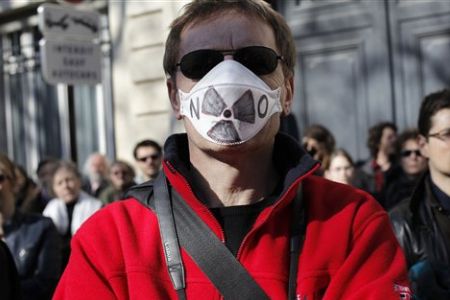 Protesters in France demand the shutdown of the country’s nuclear plants (file photo)
Over three quarters of the French population support a gradual shutdown of all of France’s nuclear power plants, a recent survey has shown.
The IFOP poll of 1,005 adults commissioned by the Journal du Dimanche found that 77 percent of the French people believe the country should follow Germany and abandon nuclear energy over a 30-year period. About 25 percent of the participants believed the transition should take place sooner.
Last month, the German government announced plans to phase out all nuclear power plants in the country. On Monday, the German cabinet formally approved a bill to abolish nuclear power by 2022.
It made Germany the single largest industrialized nation to plan to give up nuclear energy altogether.
The seven oldest of Germany’s 17 reactors as well as the reactor in Kruemmel, which were taken off the grid after the nuclear disaster in Japan, were shut down immediately. … Full article
The nuclear lobby in trouble as Germany exits nuclear power
By Andrew McKillop – VHeadline – June 5, 2011
Chancellor Angela Merkel surprised many, and stunned the nuclear lobby in other countries with her May 30th announcement of a complete shut down of all Germany’s reactors by January 1st, 2022. This includes the early shutdown of 14 among Germany’s total of 17 reactors, well before that date. At present, nuclear power covers around 22 percent of German electricity consumption.
The German chancellor has, in nine months, gone from calling nuclear power plants a safe, reliable and economical “bridge” to renewable energy, with her coalition government easing regulatory constraints on extending reactor lifetimes, to pushing the biggest and fastest nuclear exit strategy in any country using nuclear power. The international nuclear lobby, already easing off in its constant PR and advertising effort because of the Fukushima disaster, has reacted in sometimes strange ways to Germany’s historic and courageous decision.
To be sure, critics of the decision can claim it is ‘only political’: Merkel has political rivals among the Social Democrats and the anti-nuclear Greens, and cynics can say her ‘atomic epiphany’ following the Fukushima disaster is simple opportunism…
French reaction to the German decision has verged on the hysterical. German-French relations were already at a low point because of Germany’s refusal to join president Sarkozy’s war initiative in Libya and German trade surpluses with France, which continue to mount. At the highest level, including spokespersons of Sarkozy’s ruling UMP political party, the German decision has been called “betrayal” of France’s claimed leading role in the fight against climate change by massive use of supposedly low-carbon, safe and economical nuclear power.
Critics are however forced to move along to technical, economic and industrial factors which, they claim, will make the Merkel plan both technically difficult and a grave economic handicap for Germany, whose export-oriented, trade surplus economic status is the envy of most other G8 countries, except Japan, envied by the USA, France, UK and Italy. Of these, three are still committed to nuclear power, but Italy has recently decided to abandon any restart or relaunch of nuclear power, and obtains zero percent of its electricity from the atom.
CABLES AND ALTERNATIVE SUPPLIES
The ‘technological challenge’ claim is that Germany must rapidly carry out expansion of Germany’s electricity-delivery network costing at least 10 billion-euro ($14.4 billion), and start work on an even more expensive Smart Grid, as well as import more nuclear electricity from France. While the first two needs are rational, and existed before any decision to exit nuclear power, the need – or even the possibility – of importing more nuclear electricity from France is in fact zero. The reason is simple: French electric power exports are steadily shrinking as France itself imports more and more power. On a year-round basis, France imports slightly more electricity from Germany, than vice versa.
In winter 2010-2011, French net imports of electricity attained 9,600 MW, the output of nearly 10 of its 58 reactors when able to fully deliver their design capacity. This itself is decreasingly possible. EDF’s attempt, in early winter 2010 to operate all 58 reactors simultaneously, under full media coverage, was a failure because several reactors were unable to reach their design capacity. With ever increasing French national power needs to meet air conditioning and cooling energy demand in summer, the country’s ability to export power will continue to decline for years ahead, making it for the least unlikely, and risky for Germany to count on French nuclear electricity to plug the gap in power supplies.
The main claim of non-German critics of the exit plan is that very heavy spending is needed on cables to connect proposed but not planned or funded, new large-scale offshore wind farms, with per-kiloWatt capital costs as high as 5,000 euro ($7,000) excluding power cables. This is of course a very high level of initial capital cost – but is also the same as French nuclear power plants, called ‘new generation’ such as the French EPR being built, very slowly and at extreme high cost, in Finland.
Germany’s large-size offshore windfarms, if they are built, would be located in the North Sea, delivering power to Germany’s ‘manufacturing belt’, located in the south. As the nuclear lobby never fails to mention, offshore windfarms are ‘leading edge technology’ and expensive, therefore making the German exit strategy uneconomic and unworkable, but offshore wind is most surely not the only non-nuclear power supply alternative available to Germany.
Others notably include natural gas-fueled power plants, typically costing less than 600 euro per kiloWatt ($850 per kW), and around $ 1,000 per kW with full carbon sequestration, able to utilise cheap shale and fracture gas and coal seam gas extracted ‘in situ’ without any coal mining operations. Gas turbine plants can also utilise pipeline gas, the costs of which will tend to fall as shale and “frac’ gas, and coalseam gas supplies rise in Europe. Interestingly, French political opposition to shale and ‘frac’ gas development in France, which has very large resources of this gas, is extreme high. The environmental case is showcased, but the rationale is also advanced that cheap gas supplies would menace the credibility and apparent low cost of French nuclear power, by providing a serious alternative.
In Germany, this alternative supply can be drawn on, if necessary by importing gas from neighboring Poland, which has prioritized the national development of shale and coalseam gas. The environmental impacts of shale gas can be compared with those of Fukushima, and presented to the general public.
SUBSIDIZED POWER
Large subsidies or power price support for German industrial users is claimed to be necessary, following the exit decision. If not, this claim goes on, Merkel’s decision to exit nuclear power will stunt growth in Europe’s largest economy, can tilt Germany into trade deficit, raise inflation and trigger a retreat into further debt that will make the euro more certain to collapse. Ironically, it is Germany’s relative economic strength due to its large trade surpluses that presently ‘defends the euro’, far more than fiscal deficit-riddled France with its aging and increasingly dangerous nuclear power plants.
Importing French nuclear power, when or if it might be available would also be expensive. French electric power prices, although well behind German prices, are officially set to rise at least 30 percent by 2014.
The reason is simple: nuclear power plant costs, especially the vast dismantling and decommissioning costs of its increasingly aged – and therefore dangerous – reactor fleet. No firm cost figures are supplied by the French government or its nuclear corporate elite on this subject, but several billion euro per reactor, and a timespan of at least 10 years per reactor, are likely. During this extended period and with no surprise, decommissioning cost will most certainly rise further – inevitably raising electricity prices and/or taxes paid by French consumers, and the price for any consumers of imported French power.
What pro-nuclear critics of Merkel’s decision call her ‘atomic epiphany’ was on one hand driven by the entirely democratic and largely spontaneous wave of opposition to nuclear power, following the Fukushima disaster. In Germany, where 250,000-person anti-nuclear demonstrations are commonplace, ignoring this would be electoral suicide, completely unlike the tepid and ambivalent reaction from France’s supine general public, subjected to constant pro-nuclear bias in all French media, especially the State-owned TV channels and radio stations.
Merkel’s exit strategy was on the other hand also driven by far less-evident and obvious factors, including the 180-degree turn on nuclear power by “Corporate Germany”, or ‘Germany AG’.
German corporate reaction was another surprise to non-German critics. Corporate response to the decision was almost euphoric. Following the Merkel announcement, Germany’s DAX stock market index showed its biggest one-day rise in weeks, May 31st. Explanations may seem complex, because as recently as Autumn 2010 German corporate chiefs were heavily insisting that nuclear reactor operating lifetime extensions must be provided more easily by Merkel’s coalition government. In particular the CEOs of the two largest nuclear power using utilities, E.On and RWE, and the Deutsche Bank president publicly threatened a probable complete halt to corporate investment in alternative energy, if Merkel did not extend nuclear plant lifetimes, and at least as important, if she continued with her government’s plan to impose special new nuclear plant operating taxes.
Merkel’s coalition government had made it clear that in return for longer operating lifetimes, nuclear plant operators would pay new taxes designed to help Germany fight its massive fiscal deficits. These taxes, or nuclear special levy, was set on a base able to reach as high as 2 billion euro per year, which would almost wipe out the overall subsidies received from government, by the nuclear sector. Other than making any increase of the reactor fleet impossible, the sector would also have to shoulder the almost open-ended, but coming costs of reactor dismantling and decommissioning.
By late 2010, the calculations and the negotiating stances of German corporate leaders had therefore changed – well before the Fukushima disaster. This, and rising German popular protests, only triggered the 180-degree changes that were coming.
In brief and like anyplace else, nuclear power is so expensive that Corporate Germany or ‘Germany AG’ seeks any way to get consumers and taxpayers to share the burden of decommissioning and dismantling the country’s aging plants. These are aging in the exact same way as those of France, USA, Japan and UK – the ‘old nuclear nations’ with nuclear plants dating back in some cases to the 1960s. Corporate Germany had already accepted that an improved power network to avoid potential blackouts was needed, especially due to Germany’s burgeoning windfarm capacity and aging power transport infrastructures. Paying for this, and for reactor decommissioning became at least as important to Corporate Germany as power price subsidies to the largest users, especially the very profitable car makers in the south, notably Daimler AG and Bayerische Motoren Werke (BMW) AG, and their equipment suppliers including Siemens AG (SIE) and Swiss ABB Ltd.
For Merkel, the nuclear exit strategy will be a test case on whether an export based industrialized nation can rely far more on clean energy without eroding corporate production and profit. To be sure, the exporter nation called China with the world’s biggest trade surplus, although busily building nuclear plants, presently obtains an unimpressive 2 percent of its electricity from the atom, proving that nuclear energy is in no way critical and basic to achieving the status of ‘industrial exporter country’
NUCLEAR POWER PROTECTS THE CLIMATE AND SAVES OIL
Especially in France, but not the USA where shale and “frac” gas and coalseam gas already cover about 40 percent of national gas supply, the gas-alternative to nuclear power is especially criticized. Well-known and exaggerated claims for ‘low carbon’ nuclear, versus ‘dirty gas’ are wheeled out on France’s 5 State-owned TV channels almost daily.
Compared with nuclear power which is intensely dependent on oil for mining uranium, shipping and processing uranium into fuel rods, transporting and storing nuclear wastes, building and servicing nuclear plants, and dismantling them, natural gas-fueled electricity produces about the same overall CO2 emission per unit kWh output. The data and analyses provided by defenders of “low carbon nuclear” theses carefully omit the large oil-energy subsidies, and therefore CO2 emissions produced by nuclear power when “full cycle” analysis is made. They of course never mention the open-ended costs, and enduring risks of decommissioned nuclear plants.
Critics of Germany’s exit strategy fail to mention the “cheap gas” alternative to nuclear power, except to claim it is environmentally and climatically dangerous, simply because it is the biggest and cheapest available alternative.
Defenders of nuclear power also make a point of ignoring the drastic environmental damage caused by nuclear power ‘over the horizon’, in low-income African countries, such as Niger, where France sources a large part of its uranium needs. The French semi-private nuclear corporation Areva’s uranium mines in Niger are a copybook example of destroying the environment and exploiting low-paid workers “out of sight – out of mind” in a faraway developing country, with disastrous mine worker health and safety conditions, while claiming this “protects the environment and climate”.
Critics claim Germany must build new and costly high-volume lines to France, to raise imports of nuclear-origin electricity from France’s 58 nuclear reactors. Doing this, Germany would only import unsafe, unreliable, uneconomic, inadequate and environmentally dirty nuclear power supplies from a country that is increasingly unable to satisfy its own national peak power demands, due to its over-reliance on nuclear power.
Critics of the environmental impact of fossil-based electric power (imagining of course that uranium is somehow not a fossil mineral), who loudly defend “clean” nuclear power, like James Hansen, or James ‘Gaia’ Lovelock will of course not be giving their well-paid nuclear pep talks at the edge of Fukushima’s total exclusion zone. This is now being extended due to deadly radiation extending at least 50 – 70 kilometres from the ruined power plants which will spew as much as 50 – 250 times the radiation released by the Hiroshima atom bomb of 1945, making forced evacuation needed far beyond the initially hoped-for 20 kilometres.
Already, some 90,000 to 125,000 Japanese have been forcibly evicted from their homes, farms and places of work due to “clean, cheap and safe” nuclear power. These Japanese victims of nuclear power can be asked if they think nuclear power ‘protects the environment and mitigates climate change’, in the same way as mass protestors against nuclear power in Germany. The fight against nuclear power has scored a massive victory in Germany.
Background:
German people in unprecedented rebellion against government
By Jane Burgermeister – November 8, 2010
Clinging to the Nuclear Option
A Reckless Denial of Reality
By RUDI H. NUSSBAUM | CounterPunch | May 30, 2011
The national organization Physicians for Social Responsibility (PSR), committed to protecting public health, demands the de-commissioning of all currently operating nuclear plants in the US and urges members of Congress to refuse to subsidize the construction of new ones with loan guarantees and liability insurance. Why? Here is the scientific/common sense justification for such an uncompromising position:
1. After the accident at the Three Mile Island (TMI) plant, the official Columbia U. study found no increased health effects among the surrounding population, consistent with the officially accepted exposure levels as estimated by the TMI plant operators and applying the internationally accepted radiation risk factors, derived from the long-term follow-up of the externally exposed A-bomb survivors. Contradicting these findings, a subsequent study by Wing et al found statistically significant excess cancers. These cancers have affected the lives of real persons. Yet, Wing’s results were angrily dismissed by the radiation establishment and government health agencies because risk assessments, based on “current radiological science,” precluded that the officially accepted, very low levels of population exposures (doses) released from the TMI reactor could induce the observed excess cancers. The possibility that combining flawed dose estimates with flawed risk models could predict flawed numbers of cancers that might be off by several orders of magnitude (factors of ten), was never considered by the Columbia U. investigators.
Following a tradition illustrated nearly 400 years ago by Gallileo’s fate, accepted beliefs and supporting theoretical models, combined with vested interests, trumped observation. Questioning assumptions in adopted radiobiological models and radiation risk assessments would be equivalent to heresy.
2. All over the former Soviet Union increased incidence of cancers and a multiplicity of other serious health detriment, associated with varying levels of environmental radioactivity from the Chernobyl disaster, have been documented by clinical reports and public health statistics. Until recently, the majority of those studies, however, could only be published in Russian scientific/medical journals and these were arrogantly ignored by the Western radiation health establishment. Instead, the nuclear technology promoting United Nation’s (UN) agency: International Atomic Energy Agency (IAEA) (the World Health Organization (WHO) is not permitted to conduct independent studies on radiation health) published report after report with estimated numbers of Chernobyl radiation victims that are orders of magnitude smaller than those observed and documented in the recently published compendium of the Russian data in English (Yablokov et al., Annals of the NY Academy of Sciences, 2009, usefully summarized by the German equivalent of PSR). The UN Scientific Committee on the Effects of Atomic Radiation (UNSCEAR) (and the WHO) had accepted IAEA assertions of very low numbers of radiation victims, purportedly based on the world’s most reliable current radiobiological and radiation risk models. Thus, mainstream radiation health scientists proclaim that the variously documented large numbers of radiation-associated health effects after the Chernobyl catastrophe in the former Soviet Union “cannot be caused” by radiation, rather they must be the result of psychosomatic traumas.
Similarly, in far away Western European countries for which UNSCEAR had estimated very low fallout doses after the Chernobyl explosion, a multitude of excess health effects have been reported in refereed medical/scientific journals, such as neo-natal mortality, Down’s syndrome or lowering of child IQ. However, mainstream radiation regulating and protection agencies, quoting the IAEA/WHO reports, deny any causal relationship between Chernobyl fallout and most of those observations. Vested political and financial interests, cherished theoretical models, mixed with intolerable arrogance, again trump reality.
3. Several years ago, the German government commissioned a team of prestigious government-employed health scientists to design a state-of-the-art study of children <5 years who lived in the proximity of any of the 16 German normally operating nuclear power reactors. Presumably, the study was meant to assuage with maximum credibility the continuing citizens’ concerns about observed childhood leukemia clusters around some of these reactors. Therefore, to my knowledge, it is the only government-sponsored radiation study ever that was designed with full input from and oversight by an independent scientific commission, including several members who had publicly supported the citizens’ concerns. Contrary to their expectations, the government scientists found irrefutable evidence that for <5 year old children there exists an association between residence within 10 km of any of these reactors and a more than doubling of risk for contracting leukemia or other cancers. This amazing finding caused quite a stir in the German media (and remains underreported and unacknowledged in the US), but it has never been credibly refuted. Some defensive (“ecologic”) studies with negative outcomes around power reactors in France and England claim to have cast doubt on the German results, but critical analysis of their data shows them to lack the necessary statistical power (i.e. sensitivity to detect an effect) to invalidate the German findings. Desperate for an “out,” the government researchers, the health agencies involved and the German government then declared these excess cases of early childhood leukemia and cancers in the proximity of nuclear plants to be “inexplicable” at this time. They claim that according to “currently accepted radiobiological models” the initiation of these excess malignancies would require levels of radioactive emissions to be three orders of magnitude larger (1,000 times) than what the reactor operators claimed to have been released. However, (1) officially accepted radiation risk factors do not take into account the extreme radio-sensitivity of the developing fetus and of very young children (R.H. Nussbaum and I. Fairlie).
Also, (2) the officially assumed levels of radioactive emissions ignored, e.g., large releases of radioactive Noble Gases (e.g. Krypton) and of Tritium (radioactive hydrogen). Both of these radioisotopes can easily enter the human body via the food chain. Equally important is the fact (3) that the traditional measure of radiation exposure, the concept of dose (absorbed energy averaged over a unit mass of exposed human tissue), which is a fundamental macroscopic concept in current radiation risk estimates, is clearly inadequate to describe a variety of known injurious microscopic cellular/molecular mechanisms that can be triggered, in particular, by internally lodged radioactivity.
Those who deny or deceptively play down the catastrophic threats to public health from all phases of the nuclear power cycle, from mining to the lack of any proven solution to permanent and safe disposal of very long-term deadly spent nuclear fuel, recklessly ignore the medical/scientific lessons we should have learned from current and previous nuclear accidents. The international radiation health science establishments, such as IAEA or ICRP, many of whose members are solidly enmeshed with nuclear arms and nuclear energy production, have for decades deliberately ignored observed detriment from radioactive emissions. Their estimates of the public health impact from environmental radioactivity are based on partially outdated and flawed theoretical models that had been developed decades ago to quantify the effects of exposures to external radiation, such as those suffered by the Japanese A-bomb survivors. In agencies that are mandated to protect public health a mindset that denies reality is intolerable.
In addition to unacceptable long lasting effects on public health, even if operating normally (see section 3), nuclear energy technology can only be financed by taxpayers worldwide because private capital considers it too risky and refuses to underwrite it. The nuclear power industry holds citizens hostage to protect its profits. The industry’s safety claims and its new marketing gimmick of modular design reactors are largely deceptive, since it has nothing to offer in terms of safe disposal of spent nuclear fuel rods.
It is particularly tragic that the current Japanese population is again a study cohort for the devastating effects of a very different mix of environmental radioactive contamination.
Rudi H. Nussbaum is a Professor emeritus of Physics and Environmental Sciences at Portland State University.
Is Fukushima now ten Chernobyls into the sea?
By Harvey Wasserman | May 26, 2011
New readings show levels of radioisotopes found up to 30 kilometers offshore from the on-going crisis at Fukushima are ten times higher than those measured in the Baltic and Black Seas during Chernobyl.
“When it comes to the oceans, says Ken Buesseler, a chemical oceonographer at the Woods Hole Oceanographic Institution, “the impact of Fukushima exceeds Chernobyl.”
The news comes amidst a tsunami of devastating revelations about the Fukushima disaster and the crumbling future of atomic power, along with a critical Senate funding vote today:
Fukushima’s owner, the Tokyo Electric Power Company, has confirmed that fuel at Unit One melted BEFORE the arrival of the March 11 tsunami.
This critical revelation confirms that the early stages of that melt-down were set in motion by the earthquake that sent tremors into Japan from a relatively far distance out to sea.
Virtually all of Japan’s 55 reactors sit on or near earthquake faults. A 2007 earthquake forced seven reactors to shut at Kashiwazaki. Japan has ordered shut at least two more at Hamaoka because of their seismic vulnerability.
Numerous reactors in the United States sit on or near major earthquake faults. Two each at Diablo Canyon and San Onofre, California, are within three miles of major fault lines. So is Indian Point, less than 40 miles from Manhattan. Millions of people live within 50 miles of both San Onofre and Indian Point.
On January 31, 1986, the Perry reactor, 35 miles east of Cleveland on Lake Erie, was damaged by an earthquake rated between 5.0 and 5.5 on the Richter Scale—orders of magnitude weaker than the one that struck Fukushima, and that could hit the sites in California, New York and elsewhere around the globe.
TEPCO has confirmed that at least three of the Fukushima reactors—Units One, Two and Three—have suffered at least partial fuel melts. In at least one case, the fuel has melted through part of the inner containment system, with molten radioactive metal melting through to the reactor floor. A wide range of sources confirm the likelihood that fission may still be proceeding in at least one Fukushima core. The danger level is disputed. But it clearly requires still more commitment to some kind of cooling regime that will send vast quantities of water into ocean.
At least one spent fuel pool—in Unit Four—may have been entirely exposed to air and caught fire. Reactor fuel cladding is made with a zirconium alloy that ignites when uncovered, emitting very large quantities of radiation. The high level radioactive waste pool in Unit Four may no longer be burning, though it may still be general. Some Fukushima fuel pools (like many in the United States) are perched high in the air, meaning that their vulnerability remains a serious concern. But a new report by Robert Alvarez indicates the problem in the US may be more serious that generally believed.
Unit Four is tilting and may be sinking, with potentially devastating consequences. At least three explosions at the site have weakened critical structures there. Massive leakages may have softened the earth and undermined some of the buildings’ foundations. Further explosions or aftershocks—or a fresh earthquake—could bring on structural collapses with catastrophic fallout.
TEPCO has now confirmed that there are numerous holes in the containment covering Unit Two, and at least one at Unit One. The global nuclear industry has long argued that containments are virtually impenetrable. The domes at Fukushima are of very similar design and strength as many in the US.
The health impacts on workers at Fukushima are certain to be devastating.
After Chernobyl, the Soviet government sent more than 800,000 draftees through the seething wreckage. Many stayed a matter of 90 seconds or less, running in to perform a menial task and then running out as quickly as possible.
Despite their brief exposure, these “liquidators” have suffered an epidemic of health effects, with an escalating death toll. Angry and embittered, they played a significant role in bringing down the Soviet Union that doomed them.
At Fukushima, a core of several hundred workers essentially sacrificed themselves in the early stages of the disaster. They courageously entered highly contaminated areas to perform tasks that almost certainly prevented an even worse catastrophe.
David Brenner, the director of the Center for Radiological Research at Columbia University Medical Center, said of the workers: “Those are pretty brave people. There are going to be some martyrs among them’.”
“I don’t know of any other way to say it, but this is like suicide fighters in a war,” said University of Tokyo radiology professor Keiichi Nakaga.
Unfortunately, the toll among Fukushima’s workers is certain to escalate. As few as two in five being sent into the Fukushima complex are being monitored for radiation exposure. According the Mainichi Shimbun, just 1,400 workers at Fukushima had been given thorough checkups, with just 40 getting their results confirmed.
Even at that, Japanese officials have raised the allowable dosages for nuclear workers from 100 millisieverts to 250, five times what’s allowed for US workers, and 125 times what reactor workers typically receive in a year.
Some 88% of Japan’s reactor work force are part-timers, sparsely trained and often paid extra money to race into highly radioactive areas and then run out.
But Nobuaki Terasaka, head of the Nuclear and Industrial Safety Agency, May 16 confirmed some 4,956 cases of internal exposure to radiation among workers at reactors around the country. Of those, 4,766 were originally from Fukushima and had moved to other sites, but had re-visited the prefecture after the 3/11 disaster.
Some of the stricken workers believe they were contaminated when they returned home for their families, even though they may have stayed only briefly.
Workers at Fukushima itself report spotty testing and dangerous facilities, including a leaky earthquake-resistant building where they took their breaks. “We had our meals there, so I think radioactive substances came into our bodies,” says one male worker. “We just drink beer and wash them down.”
A “dead zone” around Fukushima similar to the one surrounding Chernobyl is likely in the making. According to a report published in the Japan Times, levels of contamination in areas around Fukushima are at least comparable to some around Chernobyl.
But people outside the official evacuation zone are also vulnerable. Radiation detected in Tokyo, nearly 200 miles away, at one point prompted the Japanese government to recommend mothers not use tap water to mix formula for their infants.
Nonetheless children have been observed attending schools while bulldozers were removing the radioactive soil from their playgrounds outside. Amidst global protests, the Japanese government has weakened the limits of allowable radiation exposures to children.
In the midst of the disaster, the owners of the Indian Point reactors have announced their refusal to upgrade fire protection systems. New York Attorney-General Eric Schneiderman says more than 70% of the plant remains unprotected, which he says is a “reckless” practice. Schneiderman accuses federal regulators of being too cozy with the plant’s owners. Schneiderman and New York Governor Andrew Cuomo want the two IP reactors shut.
Over the weekend only four of Germany’s seventeen reactors were operating, but the country suffered no apparent energy shortages. Prime Minister Angela Merkel has ordered seven older reactors shut, and the rest to be closed by 2011. But six of the newer ten closed for various technical reasons.
More than 20,000 Swiss citizens rallied todemand an end to plans to build new reactors there. The Swiss government has now confirmed it will not build new reactors, another major blow to the industry, this time resulting in the cancellation of plans for at least three projects.
Japan is standing by its decision to build no more reactors, while China has put some 28 proposed projects on hold. China’s reaction to Fukushima will be crucial to the future of nuclear power, as it is by far the largest potential market for new reactors. Though prevailing winds head the other way, Fukushima is relatively close to China, and some fallout has been detected there.
The Obama Administration has still produced no comprehensive monitoring of radioactive fallout coming to the United States and has provided no guidance as to how American citizens can protect themselves, except to say not to worry. Polls now show more Americans opposing new reactors than favoring them, and grassroots opposition is fierce.
But the industry is pushing ahead with demands for $36 billion in loan guarantees for new reactors, with a preliminary vote expected soon in a House Appropriations Subcommittee. Nuclear opponents are asked to call the White House and Congress steadily through the 2012 budget process.
Also, today (May 26) may see a vote in a Senate committee on a CEDA plan that would provide still more money for new nukes. Safe energy advocates are urged to call their Senators asap.
The International Atomic Energy Agency of the United Nations, has announced it sees no health effects at Fukushima. The pronouncement comes as no surprise from an agency whose mandate is focused on promoting atomic energy.
The IAEA has consistently low-balled death toll estimates at Chernobyl and regularly ignores industry critics. The pronouncement comes as the agency begins a long-term study of Fukushima’s health effects. Meanwhile, a French watchdog agency has urged that 70,000 more people be evacuated from the Fukushima area. Coming from France, among the world’s pro-nuclear nations, the warning is a grim reminded of how deadly the contamination surrounding Fukushima must be.
But for all the focus on land-based contamination, the continuing flood of radioactive materials into the ocean at Fukushima could have the most problematic long-term impacts. Long-term studies of radiological impacts on the seas are few and far between. Though some heavy isotopes may drop to the sea bottom, others could travel long distances through their lengthy half-lives. Some also worry that those contaminants that do fall to the bottom could be washed back on land by future tsunamis.
Tokyo Electric has now admitted that on May 10-11, at least 250 tons of radioactive liquid leaked into the sea from a pit near the intake at Unit 3, whose fuel was spiked with plutonium. According to the Japanese government, the leak contained about 100 times the annual allowable contamination.
About 500 tons leaked from Unit 2 from April 1 to April 6. Other leaks have been steady and virtually impossible to trace. “After Chernobyl, fallout was measured,” says Buesseler, “from as far afield as the north Pacific Ocean.”
A quarter-century later the international community is still trying to install a massive, hugely expensive containment structure to suppress further radiation releases in the wake of Chernobyl’s explosion.
Such a containment would be extremely difficult to sustain at seaside Fukushima, which is still vulnerable to earthquakes and tsunamis. To be of any real use, all six reactors and all seven spent fuel pools would have to be covered.
But avenues to the sea would also have to be contained. Fukushima is much closer to the ocean than Chernobyl, so more intense contamination might be expected. But the high radiation levels being measured indicate Fukushima’s most important impacts may be on marine life.
The US has ceased measuring contamination in Pacific seafood. But for centuries to come, at least some radioactive materials dumped into the sea at Fukushima will find their way into the creatures of the sea and the humans that depend on them.
Featured Video

Seyed M. Marandi: U.S. Military DIVIDED? Iran’s Secret Defense EXPOSED
or go to
Aletho News Archives – Video-Images
From the Archives
‘Israel sees Iran as obstacle to its policies’

Press TV – August 25, 2017
Prime Minister Benjamin Netanyahu has said that Israel felt threatened by Iran’s growing influence in the Middle East. Netanyahu expressed his Iranophobic view in a meeting with Russian President Vladimir Putin in Russia’s Black Sea resort of Sochi on Wednesday. Press TV has asked Scott Rickard, former American intelligence linguist from Tampa, Florida, and Brent Budowsky, a columnist at The Hill from Washington, to give their thoughts on the issue.
Rickard said Tel Aviv is concerned about the fact that the regime could not carry out its old project to spread sectarian divisions and pave the way for dismemberment of the countries in the Middle East region because of the Iranian-led resistance against Israeli policies, not only in the occupied territories of Palestine but also in the whole region.
“Iran is not a threat to Israel whatsoever. The threat that Israel sees is the fact that their Oded Yinon Plan is being put to a hold by Iran,” the intelligence linguist said on Thursday night.
“They (the Israelis) look at Iran as a threat only because they have no influence on their governments and Iran is autonomous and is not under the Zionist influence,” he added.
Since the victory of the Islamic Republic of Iran in 1979, Tehran has been critical of Israel’s policies in the region, whereas “no leaders [of other states] even dared to speak out against Zionism,” Rickard argued. … continue
Blog Roll
 Aletho News
- Iran declares ‘historic victory’ over US, says enemy forced to accept its proposal
- Trump Claims Ceasefire, Reopening of Strait of Hormuz Agreement with Iran
- Israeli tank fire killed UN peacekeeper in Lebanon, UNIFIL investigation finds
- Russia, China block Bahrain-sponsored UN resolution on Strait of Hormuz
- The US-Israeli War on Science is an Assault on our Future
- Trump’s Promise to Bomb Iran ‘Like Never Before’ Faces Brutal Logistics — Expert
- Germany seeks to restrict stays abroad for men of fighting age – Berliner Zeitung
- Evidence points to Ukraine being behind TurkStream attempted sabotage, but that should come as no surprise
- Sri Lanka secures supplies of Russia oil – minister
- Nations across Asia strike direct deals with Iran for Hormuz passage
- If Americans Knew
- Thousands dead and neighborhoods razed to the ground: Aid agencies fear southern Lebanon is becoming the new Gaza
- The war the US is fighting for Israel could cost trillions
- ‘Cigarette Burns, Nail Wounds’: Toddler Tortured in Gaza to Coerce Father
- Trump Says US Sent ‘a Lot of Guns’ to Protesters in Iran
- Israeli forces destroy 17 UN peacekeeper cameras in south Lebanon
- US-Israeli strikes ‘completely destroy’ synagogue in Tehran
- Archbishop for US Military Says Iran War Is Unjust Under Catholic Teaching
- Iranian leaders’ Open Letters to the American People
- Trump says Iranians appreciate bombs, WHO warns of nuclear risks – Daily Update
- U.N. experts demand Israel release prominent Gaza doctor after reports of ‘severe torture’
- No Tricks Zone
- An Inconvenient Tree: Uncovered In Alps… Europe Much Warmer Than Today 6000 Years Ago
- New Study Reports A 60% Slowdown In Greenland’s Ice Loss Rate In The Last Decade
- Low Intensity Tornado Wrecks Major Solar Farm, Creating A Potential Toxic Dump
- New Study Finds Warming Saves Lives…Cold Temperatures 12 Times More Deadly Than Excess Heat
- German Science Blog Accuses PIK Climate Institute Of Hallucinating Climate Tipping Points
- Devastating Assessment Of Comirnaty Vaccine By Former Senior Pfizer Europe Toxicologist
- New Study: CO2 Is ‘Effectively Negligible’ As An Explanatory Climate Change Factor Since 2000
- Former Pfizer Toxicologist Dr. Helmut Sterz Tells Bundestag Hearing Pfizer Vaccine Should Have Never Been Approved
- Energy Expert: Germany’s Nuclear Phaseout Was A “500 Billion Euro Mistake”
- New Research: South Australia’s Mid-Holocene Sea Surface Temperatures Were 4°C Warmer Than Today
 Aletho News