Fewer than one third of Americans agree that Russia is responsible for US election hacks
Sputnik – 20.12.2016
Almost half of American voters do not agree with the conclusion of US intelligence agencies that the government of Russia is responsible for cyberattacks related to the 2016 election, a new Morning Consult/Politico poll revealed on Tuesday.
When asked which statement came closest to their views, 46 percent said, “We cannot be sure about who is primarily responsible for hacking and cyber-attacks that may have impacted the US election.”
Respondents said tracing cyber-attacks is complicated and the intelligence groups now claiming Russian meddling “are the same ones that said Saddam Hussein had weapons of mass destruction in Iraq.”
Twenty-nine percent of respondents agreed with the statement, “We know with near certainty that Russia is responsible for hacking and cyber-attacks that impacted the US election.”
Those respondents said that US intelligence agencies have used advanced techniques to determine who is responsible for the cyberattacks “and we are only playing into an unfriendly country’s hand when we deny this.
A quarter of respondents said they were not sure or had no opinion on the election hacking.
In general, the responses followed opinions along party lines, with 63 percent of Republicans and 28 percent of Democrats saying the United States cannot be sure about the origin of the attacks, according to the poll.
Outgoing President Barack Obama suggested during his last news conference on Friday that the cyberattacks were likely initiated at the highest levels of the Russian government.
Russian officials have repeatedly denied Washington’s claims of election-meddling, characterizing them as absurd and an attempt to distract Americans from domestic issues.
Bitter in Aleppo Defeat, US and EU Seek to Further Demonize Russia
By Finian CUNNINGHAM | Strategic Culture Foundation | 17.12.2016
As Russian forces help liberate the Syrian city of Aleppo this week from a four-year terrorist siege, Washington and Europe step up threats of cyber war and economic aggression with sanctions. That’s no coincidence. It is the response of accomplices bitter in defeat.
Perverse isn’t it? Instead of celebrating with the people of Syria over the liberation of Aleppo from terrorists; instead of sending massive humanitarian aid to the tens of thousands of civilians freed after being held under siege for four years by terrorist gangs; instead of commending Russia for its decisive role in restoring peace to Syria’s second biggest city, the US and European Union turn reality on its head and further demonize Moscow.
The perverse behavior by Washington and its European satraps is simply a case of sour grapes. Very sour grapes.
They have been proven spectacularly wrong about Syria. The liberation of Aleppo this week exposes the Western governments and media in their unrelenting falsehoods and systematic complicity in the Syrian war. This was never a pro-democracy uprising. It was a Western-backed criminal regime-change operation that was unleashed in March 2011, and which is now staring at ignominious defeat.
The blood of up to half a million people and many more maimed is on the hands of American and European governments.
It is no coincidence that Barack Obama this week invoked his putative presidential authority to double down on US intelligence claims that Russia hacked into the American elections to get Donald Trump into the White House. The stakes were raised to new unwieldy heights with White House claims that Russian President Vladimir Putin personally sanctioned the alleged hacking of Hillary Clinton’s emails. And Obama is now recklessly warning that his country will respond with cyber-warfare «at a place and time of our choosing».
Meanwhile, European Union leaders this week decreed that economic and diplomatic sanctions on Russia would be extended for another six months. The official reason for the measures was the ongoing conflict in Ukraine, but it is obvious that the dramatic developments in Syria were the real motivating factor behind the EU’s decision to further penalize Russia.
Addressing the EU summit, German Chancellor Angela Merkel deplored atrocities allegedly committed in the northern city of Aleppo by Syrian state forces and their Russian and Iranian allies. European Council President Donald Tusk lamented that the EU was not «indifferent to the suffering of civilians in Aleppo».
But where is the evidence either from Obama on alleged Russian cyberattacks to subvert the American presidential election or from the EU on alleged Russian (and Syrian) atrocities in Aleppo. There is, glaringly, no evidence. Yet on the back of breathless assertions, Washington is threatening to «retaliate», and European leaders are slapping more damaging sanctions on Russia. This is an insane policy of unjustified aggression.
It is especially insane considering that present and former members of US intelligence agencies do not support the White House’s assertions about Russian cyberattacks. Indeed respected former US intelligence experts have cogently argued that Washington’s claims of Russian hacking are completely spurious. Moreover, two polls reported by the Washington Times and Washington Post this week also show that the majority of American people do not believe that Russia interfered in the US election.
As for the American and European claims about «massacres» in Aleppo, amplified by the dutiful mainstream media all week, there is neither evidence nor testimonies from the tens of thousands of civilians pouring out of the former terror enclaves. The reckless claims are merely propaganda rumors put out by terrorist apologists and recycled by Western media. Perversely unreported in the Western media are the real stories of civilians having lived under horror imposed by the Western-backed so-called «rebels». Largely unreported by the Western media is the dominant mood of celebration and relief among civilians for having been liberated by the combined efforts of the Syrian army and its Russian, Iranian and Lebanese allies.
Where are the «moderate rebels» now that the veil of secrecy has finally been lifted from eastern Aleppo? Where are the so-called neutral rescuers belonging to the White Helmets, who only a few weeks ago Western media were championing for a Nobel peace prize? They are all piling on to the same buses with the jihadi terrorists to be evacuated to nearby Idlib city as part of a surrender deal. In other words, the West has been all along backing terrorists, and now their terrorist proxies are seen by the whole world as being routed from Aleppo after four years of holding the eastern side of the city hostage.
Liberated civilians tell of a reign of terror, how their family members were threatened by the Western-backed jihadis with execution if any of them dared to escape from the captive terror enclaves. Buildings recovered by the Syrian army have shown humanitarian aid, medicines and food stockpiled by the terrorists which they used to extort the civilian population. None of this is broadcast by the Western news media of course. Instead, they indulged in gory fantasies about the Syrian army committing summary executions and other atrocities against women and children. Stories, it should be noted, which have since petered out because there is no evidence to back them up.
CNN’s self-important journalist Christiane Amanpour this week gave a platform to an alleged doctor, Hamza al-Khatib, who made unsubstantiated claims that children were being massacred in a basement by Syrian forces. Amanpour expressed horror as if the allegation was fact. The same «fact» was then reiterated by US ambassador to the UN Samantha Power. Turns out that Hamza al-Khatib is not even a doctor, according the Aleppo University records, where he once studied.

CNN’s alleged doctor Hamza Al Khatib with head-chopping jihadi friends
In the past, he has been photographed in the company of the jihadi terrorists who were were responsible for the beheading of a 12-year-old Palestinian refugee boy Abdullah Issa near Aleppo. Reliable sources dispute that Hamza al-Khatib is even residing in east Aleppo where he claims to be. It is believed he is hiding out in neighboring Turkey, from where he gives interviews to gullible hacks like Amanpour. (Notice his smirk in the linked interview video when Amanpour naively asks how he remains safe in Aleppo.)
Western lies and fake narratives about Syria were torn asunder this week. Sanctimonious Washington and European lackeys are exposed in their responsibility for fueling the war in Syria by giving cover to terrorist gangs as supposed «moderate rebels».
Western governments, UN diplomats and media organizations are shown to be complicit in a state-sponsored terrorist conspiracy against the Syrian nation.
Russia has played a vital and truly heroic role in saving Syria from a Western-imposed charnel house.
And so, with the bitter taste of defeat over the historic battle for Aleppo, Washington and Europe are lashing out irrationally to further demonize Russia. Cyber war threats and economic aggression through sanctions are the Western response to bitter defeat.
Obama vows ‘action’ in response to alleged Russian hacking
RT | December 16, 2016
Barack Obama has vowed to take retaliatory measures against Russia, both public and covert, accusing Moscow of compromising the “integrity” of the US elections through the DNC email hacks. US intelligence has yet to provide any evidence of Russian involvement.
“I think there is no doubt that when any foreign government tries to impact the integrity of our elections … we need to take action. And we will — at a time and place of our own choosing,” President Obama said in an interview with NPR on Friday.
The US leader did not elaborate on whether the steps would be taken in the five weeks he has left in office.
Neither did he specify what type of action might be taken, saying only that “some of it may be explicit and publicized; some of it may not be.”
While Obama spoke of the Russian government’s alleged role in the hacking of Democratic National Committee (DNC) communications as a proven fact, he fell short of accusing Moscow of purposefully aiding US President-elect Donald Trump without a “final report” from US intelligence agencies.
“And so when I receive a final report, you know, we’ll be able to, I think, give us a comprehensive and best guess as to those motivations,” he said.
Obama argued, however, that even without a comprehensive report it should be obvious that “what the Russian hack had done was create more problems for the [Hillary] Clinton campaign than it had for the Trump campaign.”
At the same time, the outgoing president admitted that although the scandal that ensued from the leaks – and the subsequent way it was reported in the media – “had some impact” on the election campaign, “you never know which factors are going to make a difference.”
Earlier, Trump dismissed as a “conspiracy theory” claims made by anonymous CIA officials, and reported by the Washington Post, that Russian intelligence hacked the DNC emails to propel him to the presidency.
Obama was also wary of accusing the Trump campaign of having anything to do with the leaks, refusing to feed into conspiracy theories, while saying that the Republican candidate’s camp had simply exploited the incident to its maximum benefit.
“They understood what everybody else understood, which was that this was not good for Hillary Clinton’s campaign,” Obama said.
Obama is not the first senior US official to threaten Russia with countermeasures to avenge the alleged hack, involvement in which the Russian government vehemently denies.
Back in October, US Vice President Joe Biden told NBC that Washington would be “sending a message to [Russian President Vladimir] Putin” that “will be executed at the time of our choosing, and under the circumstances that will have the greatest impact.”
At the time, NBC also cited intelligence officials with “direct knowledge of the situation” as saying that the CIA had been ordered to devise a plan for a “clandestine” cyber strike against Russia in order to “embarrass” Moscow. The outlet reported that the agents had already embarked on preparations for a large-scale attack.
On Thursday, “anonymous CIA officials with direct access to information” went as far as to claim that the Russian president himself might have authorized the alleged hacks.
Obama’s deputy national security adviser, Ban Rhodes, reiterated the claims to MSNBC, saying he doesn’t think “things happen in the Russian government of this consequence without Vladimir Putin knowing about it.”
These latest allegations were dismissed by Russian Foreign Minister Sergey Lavrov as nonsensical.
“I think that the stupidity and hopelessness of such an attempt to convince people of this is obvious,” he said on Thursday.
Veteran Intelligence Professionals for Sanity (VIPS), a group of former CIA and NSA agents, doubt the credibility of this version, adding that “harder evidence of a technical nature” suggests it was an inside job and not a hack by “Russians or anyone else.”
VIPS signed a memorandum published by Consortium News on Thursday. One of the letter’s authors, former NSA technician and whistleblower Bill Binney, told RT that “all points point to leaking, not hacking,” noting that if it was indeed a hack, the NSA would have long ago found a trace route.
Taking into account the scope of the NSA’s “extensive domestic data-collection network” uncovered in Edward Snowden’s revelations, “it beggars belief that NSA would be unable to identify anyone – Russian or not – attempting to interfere in a US election by hacking,” the veterans wrote, adding that such proof, if it existed, could be presented by the NSA “without any danger to sources or methods.”
Binney recalled that on a similar occasion with Chinese hackers, the NSA was able to trace the route of the hack to the specific building from which it was launched, which made him think that the accusations against Russia put forward by military intelligence were politically motivated.
Former UK ambassador to Uzbekistan-turned-WikiLeaks operative Craig Murray also challenged the official US version of events, claiming the source of the hacks was an insider who “had legal access to information.”
“The documents came from inside leaks, not hacks,” he told the Daily Mail, claiming that he himself took part in the handover operation in the woods in northwest Washington DC, where a representative of the source of the leaks allegedly gave him a package with the data.
Read more:
Media reporting on hacked DNC emails acted as ‘arms of Russian intelligence’ – White House
US troops rushed to Poland before Trump’s inauguration
RT | December 14, 2016
More than 4,000 US troops are presently on their way to Poland, as part of a test deployment intended to “deter” Russia. Citing “Russian aggression” in Ukraine, NATO has planned to station four battalions in Poland and the Baltic states by May 2017.
Polish Defense Minister Antoni Macierewicz made the announcement on Wednesday in the Silesian town of Zagan, where he met with Lieutenant-General Ben Hodges, commander of US land forces in Europe, according to AP.
The unit was identified as the 3rd Brigade Combat Team, part of the 4th Infantry Division stationed at Fort Carson, Colorado. The armor-heavy team is also known as the “Iron Brigade” and recently celebrated its centenary.
Hodges said that the unit has already moved out of Fort Carson and its equipment is being loaded onto ships. The troops will arrive to the German port of Bremerhaven on January 6 and immediately deploy to Poland, the Baltic states and Romania, in a test of “how fast the force can move from port to field.”
“I’m confident in the very powerful signal, the message it will send [that] the United States, along with the rest of NATO, is committed to deterrence,” Hodges said.
With the Iron Brigade headed for Zagan, it appears its deployment will be in addition to the four battalions NATO had decided to permanently station in member states bordering Russia. According to the decision reached at the alliance’s Warsaw summit in July, some 1,000 US soldiers currently stationed in Germany would be moved to Poland. AP has identified their location as Orzysz, a town in eastern Poland close to Russia’s Kaliningrad Region.
Some 2,000 British and Canadian troops would be stationed in Estonia and Latvia, respectively, while a 1,000-strong German-led armored battalion would be deployed in Lithuania, for the first time since WWII. The reinforcements were supposed to be in place by April 2017.
“I am very happy that a decision has been taken by the US side for an earlier deployment,” Macierewicz said, according to AP.
No reason was given for the extraordinary deployment by either Hodges or Macierewicz. President-elect Donald Trump, who has criticized NATO for being obsolete and voiced intentions to mend relations between the US and Russia, is scheduled to take the oath of office on January 20.
White House Claims Trump Aides Bankrolled by Kremlin
Sputnik – 13.12.2016
White House spokesman Josh Earnest accused Donald Trump and his top aides of enjoying lucrative connections with Russia, effectively implying a conflict of interests.
The White House appears to be dedicated to its stalwart campaign to ferret out any traces of Donald Trump and his team secretly conspiring with Russia, no matter how imaginary they are.
During his daily briefing on Monday, December 12, White House spokesman Josh Earnest insisted that Donald Trump and some of his top aides allegedly enjoy lucrative ties with Russia or even directly receive money from a “Russian propaganda outlet.”
“It was the president-elect who refused to disclose his financial connections to Russia. It was the president-elect who hired a campaign chairman with extensive, lucrative, personal financial ties to Russia. It was the president-elect who had a national security adviser on the campaign that had been a paid contributor to RT, the Russian propaganda outlet,” Earnest declared.
While the spokesman opted not to name any names in his accusatory speech, it is not hard to deduce that the “campaign chairman” in question is Paul Manafort, a one-time advisor to the former Ukrainian president Victor Yanukovich, while the “national security adviser” is Ret. Lt. Gen. Michael Flynn, former head of the Defense Intelligence Agency.
It should be noted that Manafort was earlier accused by Ukraine’s National Anti-Corruption Bureau of pocketing some $12.7 million worth of ‘black cash’ supplied by corrupt Ukrainian oligarchs. However, the agency was subsequently unable to provide any evidence of these alleged wrongdoings, and Nazar Kholodnytskiy, head of the Ukraine’s Specialized Anti-Corruption Prosecutor’s Office, had to admit that so far no reason has been found to hand Manafort a notice of suspicion, RIA Novosti points out.
Meanwhile, Michael Flynn did indeed appear as a guest on RT and even attended the RT anniversary event in Moscow, where he was seated next to Russia’s President Vladimir Putin. Nevertheless, Kremlin spokesman Dmitry Peskov made it clear that Putin and Flynn did not engage in lengthy conversations of any kind.
RT was less than amused by the accusations brought forward by Earnest against both Flynn and the news agency, and decided to clarify the issue in no uncertain terms. “We are rather amazed at the misinformation peddled by White House press secretary Josh Earnest. At no time has General Michael Flynn ever been a paid contributor to RT. General Flynn has appeared as a guest on our award-winning news network, alongside many international experts who respond to our invitation to share their views,” the news channel’s press office stated.
It remains to be seen whether the Obama administration will continue to push forward these claims.
New Tempest Erupts over ‘Russian Hacking’… plus a suggestion for Donald Trump
By Richard Edmondson | Fig Trees and Vineyards | December 10, 2016
The Obama administration has ordered a full intelligence review into alleged efforts by Russian hackers to influence the outcome of the presidential election, with the president, according to media reports, requesting that a report on the matter to be completed before he leaves office on January 20.
Deputy White House Press Secretary Eric Schultz says he wants “to be clear” that this is not in any way an effort to undermine Trump’s legitimacy to hold office, only that there is a need to look at possible “malicious activity” carried out by the Russians.
“I think this is going to be a deep dive,” Schultz said, taking pains to clarify that the investigation will examine not only putative Russian manipulation of the most recent election, but also alleged tampering of the elections of 2012 and 2008.
I have a suggestion for Donald Trump. He probably won’t heed it, but I will offer it anyway: that immediately upon assuming office, he order the Office of Management and Budget to investigate how much tax money was squandered by the Obama administration in nearly six years of efforts to overthrow the government in Syria. Maybe Trump could order a ‘deep dive’ and ask the OMB to have the report completed within his first 60 days in office.
Many people, naturally, would see such a call as a retaliation for the investigation now being ordered by Obama–and certainly the media would report it that way–but the results of an investigation of this sort would be at least as beneficial, and probably a whole lot more interesting, than anything that might be turned up about Russians hacking into the computer systems of two thoroughly corrupt political parties.
We could find out, for instance, how much the US spent training and equipping Nour al-Din al-Zenki, the “moderate rebel” group which beheaded a 12-year-old Syrian child on video last July.
Yes, it would be nice if Trump were to order such an investigation… but I’m not going to hold my breath. In any event, we seem to be entering a new phase of anti-Russian propaganda in the media. The call for the intelligence review was made by an Obama administration official on Friday–the same day the Washington Post, in a report based almost solely on anonymous, unnamed “officials,” published allegations about a “secret CIA assessment” whose conclusion is that Russia sought to throw the election to Trump.
“The CIA has concluded in a secret assessment that Russia intervened in the 2016 election to help Donald Trump win the presidency, rather than just to undermine confidence in the U.S. electoral system, according to officials briefed on the matter,” reports the Post.
Repeat: it wasn’t just a case of Russia trying to undermine faith in America’s wonderful, spectacular democracy where office is generally for sale to the highest bidder. No, it was Russia deliberately trying to put Trump into the White House, according to the Post–which is a short step away from accusing Trump of being a Russian agent.
There is also the claim that the Russians hacked into the files of both the Republican Party and the DNC, but that they (the Russians) deliberately sat on the material stolen from the Republicans, choosing instead only to release material embarrassing to the Democrats.
Could any of this be credible? Hard to say, but it seems the vote recount effort has fizzled out, and the new call for an investigation could be a “plan B” aimed either at getting Hillary in the White House or at least weakening Trump to the point where he will essentially be unable to govern or pursue his own independent foreign policy. That’s one way of looking at it anyway.
It also could be designed to create a schism within the Republican Party in the sense that many Republicans could end up finding themselves faced with the difficult choice of having to avow loyalty to their president or loyalty to America. As the Post puts it:
On the other hand, if Republicans downplay the issue, they risk giving a pass to an antagonistic foreign power whom significant majorities of Americans and members of Congress don’t trust and who, if the evidence is accurate, wields significant power to wage successful cyber warfare with the United States.
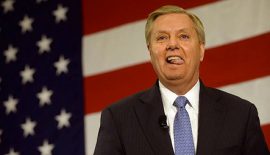 Two prominent Republicans in the Senate, Lindsey Graham and John McCain, have jumped on the bandwagon in support of a Senate probe into Russian hacking.
“I’m going after Russia in every way you can go after Russia,” said Graham. “I think they’re one of the most destabilizing influences on the world stage. I think they did interfere with our elections, and I want Putin personally to pay the price.”
It isn’t the US–a country that has been involved in one war or regime change after another for the last 25 years–that is “the most destabilizing influence on the world stage,” in Graham’s opinion; it is Russia.
Trump’s response has been to dismiss the allegations of Russian hacking, while also recalling lies of the past:
These are the same people that said Saddam Hussein had weapons of mass destruction. The election ended a long time ago in one of the biggest Electoral College victories in history. It’s now time to move on and ‘Make America Great Again.
How all this will play out remains to be seen, but it looks like the political divisions in America are widening rather than narrowing…and it also looks like the propaganda war against Russia will continue to be used to the advantage of one side–beyond the November election and on into the new administration.
If the Russians thought sanity would prevail after the transition of power in January, they’re probably in for a disappointment.
Pentagon to deploy 2,300 more US troops to Afghanistan
Press TV – December 9, 2016
The United States military says it will deploy an armor brigade and an aviation brigade totaling about 2,300 soldiers to Afghanistan this winter.
The Pentagon made the announcement in a statement released on Thursday, saying 1,500 soldiers will be sent to Afghanistan this winter, in addition to another 800 troops that will be deployed in support of a training mission known as Operation Freedom’s Sentinel.
“This deployment is part of a regular rotation of forces in support of Operation Freedom’s Sentinel,” the press release stated, adding that the soldiers were “well-trained, well-led and fully prepared for the challenges this mission will bring.”
No exact date was given in the announcement for when the US troops will leave for the deployment to Afghanistan.
The United States — under Republican George W. Bush’s presidency — and its allies invaded Afghanistan on October 7, 2001 as part of Washington’s so-called war on terror. The offensive removed the Taliban regime from power, but after about one and-a-half-decade, the foreign troops are still deployed to the country.
After becoming the president in 2008, President Barack Obama, a Democrat, vowed to end the Afghan war — one of the longest conflicts in US history – but he failed to keep his promise.
US President-elect Donald Trump, who speaks against the Afghan war, has dubbed the 2001 invasion and following occupation of Afghanistan as “Obama’s war”.
Obama has ordered the military to take on the Taliban more directly and enable Afghan forces battling the militant group.
In October last year, Obama announced plans to keep 9,800 US troops in Afghanistan through 2016 and 5,500 in 2017, reneging on his promise to end the war there and bring home most American forces from the Asian country before he leaves office.
According to US officials, Washington would also maintain a large counter-terrorism capability of terror drones and Special Operations Forces to fight militants in Afghanistan.
There are now about 10,000 American troops in Afghanistan, as well as some 6,000 NATO service members, to “train and advise” Afghan security forces fighting Taliban.
Over the past several months, Taliban militants have intensified their pressure with numerous offensives on other key Afghan provinces, including Kunduz and Takhar.
To err is Human, to Intervene and Destroy is Policy
By Salman Rafi Sheikh | New Eastern Outlook | 09.12.2016
The nature of international politics is often considered to be such that it continuously defies clear and absolute judgement; however, notwithstanding the complexity of inter-state relations, very often we come across such instances where understanding of the policy of a state, or of an alliance, does not defy understanding and judgement. From the very beginning of the crisis, it has been absolutely clear that the US and its allies are pursuing a regime-change policy in Syria—a policy that not only is still valid but also continues to define their strategy. Materialization of this objective pits the US against Syria and its allies and engages both parties in war—and in war soldiers are killed. Therefore, the US clarification about striking Syrian soldiers due to the so-called “human error” is only an attempt on its part to mystify the actual nature of its objectives in Syria. Nothing else can better explain the strike that killed around 80 soldiers than the fundamental reason for the US’ military engagement in Syria i.e., execution of regime change policy in Syria.
While one strike in itself was, and always is, far from sufficient to achieve this objective, a strike, however, does convey to its targets and to those who observe it the objective being pursued. In this case, the immediate objective was to inflict heavy damage on the Syrian army and render it vulnerable to attacks by other, western supported, militant groups. The objective was, to an extent, achieved. This is evident from the developments taking place immediately after the US-led strike. A weakened Syrian army unit enabled an ISIS advance on a hill overlooking the air base, which was specifically targeted by the US-led coalition. While the objective of this co-ordinated operation was to quickly capture the base, it was thwarted by timely action on the part of Russian warplanes that were called in to hit ISIS positions.
Had the attack been successful, it might have caused massive destruction. ISIS had, prior to the attack by the coalition, repeatedly attacked and failed to capture the government-held air base, which is an isolated enclave deep in extremist-held territory. The government controls the air base and parts of Dayr az Zawr city, while ISIS controls the entire province by the same name. An ISIS advance in Dayr az Zawr would have, and would still, endanger the lives of tens of thousands of civilians living in government-held areas and force the Syrian army out of the territory.
What would have such a scenario implied for the over-all situation of Syria is not so difficult to grasp. While the US has now stated it “regrets” the bombing, it has not, in any way, apologized to Syria for this wanton act of mayhem, thus confirming its unchanged position vis-à-vis Syria, which continues to remain a clear cut target of the regime-change conspiracy—a policy that has been applied by NATO in many countries since the end of the Second World War. The most recent cases of Afghanistan, Iraq, Libya and Syria confirm that this policy has remained unchanged.
The latest confirmation to the unabated continuation of this policy has come from one of the most important NATO allies, Turkey. On November 29, Turkey’s self-styled “caliph” said, reiterating NATO’s long held objective, that the Turkish military had launched its operations in Syria to end the rule of (the cruel) Syrian President Bashar al-Assad.
He further said, “Why did we enter? We do not have an eye on Syrian soil. The issue is to provide lands to their real owners. That is to say we are there for the establishment of justice. We entered there to end the rule of the tyrant al-Assad who terrorizes with state terror. [We didn’t enter] for any other reason.”
While this statement has come as a surprise to Russia, leading Kremlin spokesman Dmitry Peskov to say that they were hoping “our Turkish partners will provide us with some kind of explanation about this”, the move itself not only largely reflects the dual game Turkey is playing in Syria but also shows how the former fundamentally continues to adhere to NATO’s central objective in Syria, thus debunking the myth of Turkey’ estrangement with the US or the EU or the NATO itself.
The tacit continuity of co-operation between Turkey and the US is not limited to the perusal of identical objectives. On the contrary, it is co-operation on the ground that speaks volumes about Turkey’s actual position and policy vis-à-vis Syria. For instance, Turkey’s operation Euphrates Shield, which begun in August and which is supposedly aimed at rolling back ISIS from the Syrian region bordering Turkey, had actually begun, succeeded and territorially spread under the protection, assistance and advice provided by the US military. The US advisers assisted the operation from inside Turkey, while US warplanes conducted airstrikes alongside Turkish ones in support of the offensive. Could we still say that Turkey and the US were, or are, on a collision course since the failed coup attempt in Turkey in July 2016?
This co-ordinated attack was followed, in September, by a welcome note by the NATO chief about Turkey’s enhanced role in Syria against “terrorism” and attacks of all kinds.
The continued co-operation between Turkey, which had initially officially sent troops to Syria to fight ISIS, and the US and Erdogan’s recent claim that they are in Syria to send Assad home unambiguously show the way this alliance is working in the region. With Turkey’s operation Euphrates Shield expanding into operation occupation, and with Turkey equally seeking to enlist US support to capture al-Bab, there remains hardly any room to doubt that the US and Turkey are seeking to achieve what the ISIS had earlier achieved, and then lost, in terms of capturing Syrian territory.
With ISIS being itself unable to withhold the Syrian offensive being backed the Russian forces and Iran backed militias, Turkey and the US, as also their Arab and Western allies, were left with no other choice but to directly intervene in Syria to deny the Syrian army the opportunity to have the whole of Syria under its control.
This being the case-scenario of Syria, the Pentagon’s clarification about the September strike being a result of “human error” is erroneous. What, on the contrary, perfectly corresponds with the US policy and objectives it is pursuing in Syria is not this clarification but the strike itself—something that, had it been successful, might have allowed IS to bring an entire province under its sole control and considerably damage the Syrian army.
What this scenario reveals is that the earlier policy of bringing regime change in Syria through proxy groups is now being replaced by a policy of direct intervention and gradual insertion of NATO in the conflict via Turkey. Conflict in Syria is therefore not ending, only its dynamics are changing from in-direct to direct intervention.
Obama grants waiver for military support of foreign fighters in Syria – White House
RT | December 8, 2016
President Barack Obama has ordered a waiver of restrictions on military aid for foreign forces in Syria, deeming it “essential to the national security interests” of the US to allow exceptions from provisions in the four-decades-old Arms Export Control Act.
A White House press release Thursday announced that foreign fighters in Syria supporting US special operations “to combat terrorism in Syria” would be excused from restrictions on military assistance.
“I hereby determine that the transaction, encompassing the provision of defense articles and services to foreign forces, irregular forces, groups, or individuals engaged in supporting or facilitating ongoing U.S. military operations to counter terrorism in Syria, is essential to the national security interests of the United States,” President Obama affirmed in the presidential determination and waiver.
The order delegates responsibility to the US secretary of state to work with and report to Congress on weapons export proposals, requiring 15 days of notice before they are authorized.
Obama announced a similar waiver of the Arms Export Control Act in September 2013, following the Ghouta chemical attack in August of that year. That order facilitated the transfer of US military weaponry to “select vetted members” of opposition forces battling Syrian President Bashar al-Assad, while Thursday’s order appears less narrow in scope.
The challenge of differentiating between terrorist forces, such as Al-Nusra, and more moderate forces in Syria has been acknowledged by press secretaries in recent State Department briefings.
Featured Video
NEW FAUCI EMAILS EXPOSE ATTACK ON NATURAL IMMUNITY
or go to
Aletho News Archives – Video-Images
From the Archives
Fourteen Incredible Facts About 9/11
By Kevin Ryan | Dig Within | August 8, 2015
… What is known about 9/11 is that there are many incredible facts that continue to be ignored by the government and the mainstream media. Here are fourteen.
- An outline of what was to become the 9/11 Commission Report was produced before the investigation began. The outline was kept secret from the Commission’s staff and appears to have determined the outcome of the investigation.
- The 9/11 Commission claimed sixty-three (63) times in its Report that it could find “no evidence” related to important aspects of the crimes.
- One person, Shayna Steiger, issued 12 visas to the alleged hijackers in Saudi Arabia. Steiger issued some of the visas without interviewing the applicants and fought with another employee at the embassy who tried to prevent her lax approach.
Blog Roll
Recent Comments
eddieb on Fourteen Incredible Facts Abou… Bill Francis on European leaders’ shift in the… seversonebcfb985d9 on Villains of Judea: Philip Esfo… loongtip on Report warns that ‘Jewish terr… Craig Nelms on New study shows that toxic gas… loongtip on A Funny Thing Happened on the… loongtip on EU free trade pact on hold as… John Edward Kendrick on Regime Change In Iran Is The F… Bill Francis on Australia Passes New Hate Spee… seversonebcfb985d9 on Australia Passes New Hate Spee… Bill Francis on Britain’s AI Policing Plan Tur… loongtip on Miami Beach Resident Questione…


 Aletho News
- Israel moves to restrict Palestinian re-entry to Gaza, ‘encourage outflow’: Report
- Trump aims to create new UN and own it, Brazil’s Lula warns
- UN rapporteur says Israeli demolition of UNRWA compound reflects broader attack on UN system
- From Proxy to Disposable: The US Betrayal of the Syrian Kurds
- Six injured in stabbing spree at Kurdish rally in Antwerp, victims stabbed ‘indiscriminately’
- US pledges to ‘starve’ Iraq of oil revenue if pro-Iran parties join new government
- Is China a threat to Greenland?
- South Korea’s Prime Minister Proposes US Send Special Envoy to North Korea — Report
- Pentagon downgrades China threat, shifts focus to homeland, hemisphere
- Ireland Moves to Legalize Spyware Use by Police
- If Americans Knew
- Another Gaza baby freezes to death on Netanyahu’s watch – Not a ceasefire Day 106
- Oppose Israel’s Abuses While You Still Can
- UNRWA Heads Tell Ha’aretz: ‘We Don’t Radicalize Palestinians – Their Lived Existence Does’
- Plans Call for “New Rafah” Built in Israel’s Image — Without Palestinians
- Posing as priest, reporter is spat at many times, highlighting anti-Christian sentiment in Israel
- Leaked Documents: “Planned Community” in Rafah Would Force Palestinians Into Israeli Panopticon
- ‘Permits of Humiliation’: How Israel Strangles Christian Education in Jerusalem
- “The world sees death, destruction and injustice – and they see dollar signs” – Not a ceasefire Day 105
- War criminal Netanyahu kills 11 in Gaza, joins Board of Peace – Not a ceasefire Day 104
- Another baby dies of cold in Gaza, as Rafah crossing remains locked down – Not a ceasefire Day 103
- No Tricks Zone
- Polar Colding…Antarctica Saw Its Coldest October In 44 Years!
- New Study: Sea Levels Rose 20 Times The Modern Rate During The Roman Warm Period
- As German Gas Storage Dips Dangerously Low…Shortage Hardly Avoidable
- New Study: Brazil’s Relative Sea Level Was 2+ Meters Higher And SSTs 3-4°C Warmer 6000 Years Ago
- Philosopher Schopenhauer: Climate Science Certainty Stems From Stupidity, Ignorance
- New Study: Species Extinction Rates Declining Since 1980 – ‘Climate Change Is Not An Important Threat’
- Denmark Places Climate Protection Above Animal Welfare, Poisoning And Culling Cows
- New Study: Greenland Was 3-7°C Warmer And Far Less Glaciated Than Today 6000-8000 Years Ago
- German Media Report That Current Frigid Weather Can Be Explained By Arctic Warming!
- Berlin Blackout Shows Germany’s $5 Trillion Green Scheme Is “Left-Green Ideological Pipe Dream”
 Aletho News