America’s ‘Democratic’ Allies Are Becoming More Authoritarian
By Ted Galen Carpenter | The Libertarian Institute | February 17, 2025
U.S. officials have a long history of portraying Washington’s allies and clients as democratic, even when their behavior is blatantly authoritarian. Such cynical hypocrisy was at its zenith during the Cold War, but it is surging again.
A similar trend is evident with respect to U.S. interference in the internal political affairs of other countries through such mechanisms as the United States Agency for International Development (USAID) and the National Endowment for Democracy (NED). Such agencies fund regimes and political movements that are deemed obedient to Washington’s wishes and supportive of American foreign policy objectives. Conversely, U.S. administrations actively undermine governments or movements that they consider hostile or even just insufficiently cooperative. The actual nature of U.S. clients often is a far cry from the carefully crafted democratic image of them that Washington circulates.
A recent example of American meddling in the internal affairs of another democratic country appears to have taken place in the Republic of Georgia. According to Parliament Speaker Shalva Papuashvili, USAID spent $41.7 million to support its preferred candidates in the country’s recent parliamentary elections. Adjusted for the size of Georgia’s population, such an expenditure in the United States would amount to $3.78 billion,
The U.S. track record in Georgia since the dissolution of the Soviet Union lends credibility to the speaker’s accusation that Washington is meddling in his country’s internal political affairs. President George W. Bush fawned with praise for Mikheil Saakashvili, the leader of Georgia’s “rose revolution” in 2003. Under Saakashvili, Georgia had become a “beacon of liberty,” Bush crowed. Generous flows of aid from Washington ensued. However, massive corruption soon characterized Saakashvili’s rule, as did his growing repression of political opponents. Ultimately, Saakashvili’s adversaries ousted Washington’s beloved “democratic” client from power.
The contrast between the laudatory American portrayal of Saakashvili as a paragon of democratic reform and the reality of his conduct was stark. However, Washington’s role in Ukraine over the years has been even more pervasive and dishonest. Although Ukraine’s president, Victor Yanukovych, came to office in a 2010 election that even a team of European Union (EU) observers conceded was reasonably free and fair, officials in Barack Obama’s administration, especially Assistant Secretary of State Victoria Nuland, worked to undermine his presidency. Yanukovych’s preference for closer economic ties with Russia instead of the EU and the United States apparently was intolerable to Western policymakers.
In 2014, the United States and key NATO partners helped Ukrainian demonstrators (primarily in Kiev’s Maidan Square) force Yanukovych to flee. An intercepted telephone call between Nuland and the U.S. ambassador to Ukraine confirmed the massive extent of Washington’s interference in Ukraine’s affairs. Nuland herself later admitted that the United States had poured more than $5 billion to Ukrainian groups in the years before the Maidan uprising. Supposedly, the purpose was to “promote democracy,” but as usual, the funds went almost entirely to groups Washington considered supportive of U.S. policies. It would be hard to identify a more flagrant case of outside interference in the affairs of another country.
Even if U.S. leaders sincerely intended their largesse to bring a stronger, healthier democracy to Ukraine—which is extremely doubtful—Washington did not achieve that goal. Corruption and blatant repression have become increasingly bad under the post-Maidan governments. Even though U.S. leaders invariably portray Ukraine’s current president, Volodymyr Zelensky, as a democratic champion, his record proves the opposite. Under his rule, Ukraine has outlawed opposition parties, muzzled the press, harassed uncooperative churches, and amassed a record of arbitrary imprisonment and torture. Much of that abuse was evident before the outbreak of war between Ukraine and Russia. Confirming that any attempt to portray Zelensky’s rule as democratic is a hypocritical farce, Ukraine has now postponed elections indefinitely.
The rot of hypocrisy and covert authoritarianism has infected even governments in NATO and the European Union. A grotesque example occurred earlier this month in Romania when an election commission dominated by the two governing parties, the Social Democratic Party (PSD and the National Liberal Party (PNL), annulled the first round of the presidential election held on November 24. Instead of the candidates of those two parties advancing to the second round runoff as expected, neither one did so. Instead, Caliin Georgescu, the candidate of a right-wing populist party led the field. Elena Lasconi, a reformer representing another “minor” party took the other runoff spot.
That outcome apparently was intolerable to Romania’s political establishment or its supporters in the EU and the United States. They viewed Georgescu as especially unacceptable, since he openly criticized NATO and opposed continuing to aid Ukraine. The country’s election commission nullified the voting results and rescheduled the first round balloting for May 4, 2025. Commissioners charged that, wait for it… Russia had illegally tampered with the election! Moscow’s horrid offense was its alleged support of a Tik Tok campaign that seemed to benefit Georgescu. Tangible evidence regarding Russian involvement was noticeably absent. Despite the lack of evidence, U.S. and EU officials denounced Russia and praised the Romanian government for trashing the election.
Eugene Doyle, a reporter for New Zealand’s Solidarity.com, noted the menacing significance of this episode. “To save democracy, the US and the European elites appear to have found it necessary to destroy democracy. For the first time ever an election was overturned in an EU/NATO country. Ever,” he wrote. Doyle also cites evidence that Russia was not even the likely culprit. The Tik Tok effort apparently originated with a botched PNL scheme to siphon off votes to Georgescu from other mainstream competitors.
Moreover, as Doyle points out, “Even if the Russians did it, in what crazy world would you wipe an election for a Tik Tok campaign, particularly one that was at best a few hundred thousands of dollars’ worth of advertising/messaging/ chatting—in contrast to the millions of dollars the U.S. State Department and various branches of the U.S. government spent on the same campaign?”
The answer is that it would happen in a world where political elites in the United States and its principal allies have never really been committed to democracy. Not as a domestic governing principle and definitely not as a foreign policy objective. Instead, the alleged commitment is a propaganda tool that is discarded whenever it becomes inconvenient. We live in such a world, and have done so for many years.
Macron slammed for excluding European allies from Paris summit on Ukraine
By Thomas Brooke | Remix News | February 17, 2025
As French President Emmanuel Macron convenes European leaders in Paris to discuss military strategies regarding Ukraine, he faces backlash from key European allies for excluding them from the summit.
The gathering, aimed at formulating a unified European stance amid ongoing U.S.-Russia peace discussions, has sparked controversy for leaving out crucial partners in the region.
Czechia was among the first to express its discontent, criticizing Macron’s decision to exclude them from the summit. A Czech government source told French newspaper Le Monde : “In addition to Poland, there is no country that is closer to the war.”
The source further condemned Macron’s “arrogance,” emphasizing that no country hosts more Ukrainian refugees in relative terms.
“No country has more Ukrainian refugees per capita than the Czech Republic, and we manage one of the most effective weapon supply systems,” they added.
Romania also found itself omitted from the summit guest list. Ilie Bolojan, presidential advisor for defense and security, acknowledged the exclusion, stating that despite Romania’s substantial contributions — including overseeing more than 600 kilometers of Ukraine’s border — it had not been invited to Paris “despite his efforts” to get Bucharest in the room.
Slovenian President Nataša Pirc Musar voiced strong criticism of the summit’s selective invitations, asserting that it undermines European unity. “On a symbolic level, the organizers of the Paris summit show the world that, even within the EU, not all states are treated on an equal footing,” Musar declared. “This does not correspond to the spirit of European integration. This is not the Europe we aspire to, nor a Europe that commands global respect.”
Hungary, known for its non-interventionist stance under Prime Minister Viktor Orbán, also condemned the meeting, labeling it a “pro-war” summit. The Hungarian government accused participating European leaders of fueling escalation rather than seeking diplomatic resolutions. Hungarian Foreign Minister Péter Szijjártó criticized the summit’s motives, claiming that it gathers “anti-Trump, war-focused, frustrated leaders” who do not want peace.
“Those who have continued to throw oil on the fire for three years now meet in Paris,” Szijjártó asserted, denouncing what he called “an erroneous strategy” of continued military escalation.
He reiterated Hungary’s alignment with U.S. President Donald Trump’s vision for peace negotiations between the U.S. and Russia, arguing that direct diplomacy remains the best route to ending the conflict.
Around a dozen European leaders are expected to meet at the Elysée Palace later on Monday for talks chaired by Macron.
Medvedev applauds Vance’s ‘humiliating rebuke’ of Europe
RT | February 15, 2025
The deputy chairman of Russia’s Security Council, Dmitry Medvedev, has hailed US Vice President J.D. Vance’s speech at the Munich Security Conference, calling it a rare moment of American honesty about Europe’s weaknesses and Vance himself “a brave guy.”
In his speech on Friday, Vance touched on the migration crisis, security, freedom of speech, and apparent democratic backsliding on the continent.
Medvedev said Vance “unexpectedly lit up” the conference, calling his remarks a harsh but truthful indictment of modern Europe.
“Everyone expected to hear the usual partner-like curtseys to Europe and comments on Donald Trump’s words about the end of the Ukrainian conflict. But he went and harshly scolded the Europeans who have completely lost themselves in recent years: your democracy is weak, your elections are crap, your rules that violate normal human morality are crap,” Medvedev wrote.
He added that the Europeans would retaliate against him if he did not hold such a high post. “However, they will forgive him; they will begrudgingly accept the humiliating rebuke from their senior partner with resentment,” Medvedev concluded.
Vance was particularly severe in his indictment of European democracy. He voiced concerns over the erosion of democratic values in Europe, drawing attention to the annulment of the presidential election in Romania. The first round in November saw right-wing anti-establishment candidate Calin Georgescu come out on top with 22.94%, beating liberal leftist and social democrat candidates. Romania’s top court cited intelligence documents alleging “irregularities” in his campaign performance in making their ruling, although the validity of that evidence has been questioned.
The US vice president also cautioned against rising censorship in the region, told European member-states to take greater responsibility for their own defense, and raised the alarm over mass migration.
US President Donald Trump praised Vance’s speech as “brilliant.” However, some European officials were not so keen on the address. Estonian Prime Minister Kaja Kallas warned that it signaled growing transatlantic tension. German Defense Minister Boris Pistorius meanwhile, blasted the remarks, calling them “not acceptable.”
On the other hand, Russian Senator Alexander Shenderyuk-Zhidkov described Vance’s statements as a “cold shower” for European Russophobes.
EU nations aim to seize alleged ‘Russian shadow fleet’ vessels – Politico
RT | February 10, 2025
Several EU members are considering strengthening the legal framework for seizing ships in the Baltic Sea with the aim of undermining Russian trade, Politico reported on Monday, citing insiders. Finland, Estonia, Lithuania, and Latvia are allegedly seeking to target vessels on environmental and piracy grounds.
Western nations, which have been seeking to find ways to curb Russian energy exports, have accused Moscow of employing a “shadow fleet” to evade sanctions. In recent months, officials have also accused Moscow of sabotaging undersea cables in the Baltic, though no evidence has been provided to substantiate these allegations.
According to Politico’s sources, the four states intend to seize suspected shadow fleet ships based on the alleged threat they pose to the environment and to infrastructure, and are seeking EU backing for the initiative. They could amend national legislation to “make it easier to grab ships further out at sea,” including by mandating a list of insurers for maritime operations in the Baltic. Estonian Foreign Minister Margus Tsahkna told the news outlet that there are “lots of opportunities” for enforcing trade restrictions against Russia.
Last December, Finland seized the tanker ‘Eagle S’ amid an investigation into the damage to the Estlink 2 power cable. The vessel remains impounded despite the Finnish authorities reportedly finding no evidence of wrongdoing.
Conversely, a Norwegian cargo ship with an all-Russian crew was released in late January after Norwegian police concluded there were no grounds to continue its detention. The Latvian authorities had requested the seizure of the Silver Dania over an incident involving an optic cable owned by the national broadcaster LVRTC earlier the same month.
Moscow has accused Western nations of peddling a false narrative that frames routine accidents as evidence of a Russian sabotage campaign. Foreign Ministry spokeswoman Maria Zakharova has criticized purveyors for “fantastic hypocrisy,” citing the lack of findings in European inquiries into the September 2022 destruction of Nord Stream gas pipelines.
The “non-investigation” of that incident suggests that EU nations deem Joe Biden’s threat against Russian-German infrastructure “proper,” Zakharova said last month, referring to remarks made by the then-US president months before the attack.
President Vladimir Putin has characterized Western sanctions as tools of non-economic pressure wielded by countries unable to compete with Russia on an equal footing. He views them as a challenge to make the national economy better.
“No blackmail or attempts to impose anything on us will ever yield results. Russia is confident in its rightness and strength,” he said in a recent speech.
France freezes accounts of ‘Russian House’ – ambassador
RT | February 7, 2025
France has frozen the bank accounts of the Russian House cultural center in Paris, effectively blocking its operations, Russian Ambassador Aleksey Meshkov has told RIA Novosti.
Russian House, which promotes Russian language, culture and traditions, operates under Rossotrudnichestvo, a government agency. Moscow has argued that closing the center violates bilateral agreements.
“Attempts are being made to completely freeze the work of the Russian House due to the fact that accounts have been frozen. We are having difficult negotiations with the French on this issue, especially since the Russian House exists here legally, on the basis of a bilateral agreement, and a French cultural center operates in Russia. This is a negative development of events in recent weeks,” Meshkov said.
On Thursday, the Azerbaijani Foreign Ministry formally demanded the closure of the Russian House in Baku, citing its lack of legal registration. Rossotrudnichestvo head Evgeny Primakov confirmed that despite multiple requests from the Russian Embassy and the agency for compliance assistance, Azerbaijani authorities had not responded.
In January, Azerbaijani TV aired a report alleging that the Russian House in Baku was engaging in espionage under the guise of cultural promotion. Moscow dismissed the claims as baseless, summoning Azerbaijani Ambassador Rahman Mustafayev to the foreign ministry.
Primakov announced plans to file a defamation lawsuit against Baku TV, demanding either evidence or a retraction and apology. Local pro-government media compared the Russian House closure to Azerbaijan’s recent decision to halt the operations of the US Agency for International Development (USAID) in the country.
In January, Azerbaijani Foreign Minister Jeyhun Bayramov stated that Baku had suspended cooperation with USAID, citing concerns that it was advancing US political interests and operating non-transparently. He insisted that any US assistance should be provided officially and with full transparency.
Primakov rejected comparisons between Russian House and USAID, emphasizing that Rossotrudnichestvo focuses solely on humanitarian and cultural cooperation.
“The comparison of the activities of the Russian House in Baku and the US Agency for International Development does not hold up to any criticism, as Rossotrudnichestvo does not engage in political matters, unlike the American organization,” he said.
Despite diplomatic efforts, the Russian House in Baku faces immediate challenges. Moscow has received official notification about its closure and expressed willingness to complete the registration process under Azerbaijani law. However, Primakov revealed that the center must vacate its premises within six weeks, as the property owner has decided to sell the building.
Russian Houses operate in dozens of countries worldwide. Rossotrudnichestvo has been on the European Union’s sanctions list since July 2022 following the escalation of the Ukraine conflict, although its centers continue to function in some European nations.
The institutions support regional artistic and cultural communities, organize events, language courses, poetry competitions, children’s activities, and theatrical performances.
‘This is NPR’: America’s Public Media Faces Reckoning on What it is
By Jonathan Turley | February 2, 2025
“This is NPR.” That tagline has long been used for National Public Radio, but what it is remains remarkably in doubt. NPR remains something of a curiosity. It is a state-subsidized media outlet in a country that rejects state media. It is a site that routinely pitches for its sponsors while insisting that it does not have commercials. That confusion may be on the way to a final resolution after the election. NPR is about to have a reckoning with precisely what it is and what it represents.
While I once appeared regularly on NPR, I grew more critical of the outlet as it became overtly political in its coverage and intolerant of opposing views.
Even after a respected editor, Uri Berliner, wrote a scathing account of the political bias at NPR, the outlet has doubled down on its one-sided coverage and commentary. Indeed, while tacking aggressively to the left and openly supporting narratives (including some false stories) from Democratic sources, NPR has dismissed the criticism. When many of us called on NPR to pick a more politically neutral CEO, it instead picked NPR CEO Katherine Maher, who was previously criticized for her strident political views.
Some have long questioned the federal government’s subsidization of a media organization. NPR itself continues to maintain that “federal funding is essential” to its work. However, this country has long rejected state media models as undermining democratic values.
This funding is likely more important given NPR’s cratering audience and revenue. NPR’s audience has been declining for years. As a result, NPR has been forced to make deep staff cuts.
Ironically, NPR has one of the least diverse audiences. Its audience is overwhelmingly white, liberal, and more affluent than the rest of the country. Yet, while serving fewer and fewer people, it still expects most of the country to subsidize its programming.
Many of us have argued that NPR should compete with other radio companies in the free market. Notably, some Democratic members pushed to get Fox News dropped by cable carriers despite not being subsidized and ranking as the most-watched cable news network. (For full disclosure, I am a legal analyst at Fox.)
NPR and PBS are facing calls to remove the subsidy at long last. However, at the same time, pressure is coming from the Federal Communications Commission (FCC). FCC Chair Brendan Carr is inquiring about NPR’s claim that it does not do commercial advertising.
Many of us have noticed that NPR has ramped up its sponsor statements with taglines about the products or firm’s clientele. Carr wrote, “I am concerned that NPR and PBS broadcasts could be violating federal law by airing commercials. In particular, it is possible that NPR and PBS member stations are broadcasting underwriting announcements that cross the line into prohibited commercial advertisements.”
The support for noncommercial radio and television stations fell under different regulations. It is hard to see the sponsor acknowledgments not as commercial advertising. It is common for for-profit outlets to have hosts read commercial sponsors.
Noncommercial educational broadcast stations-or NCEs are prohibited under Section399B of the Communications Act from airing commercials or other promotional announcements on behalf of for-profit entities.
What is interesting is that NPR stresses that the “NPR way” is actually better to reach consumers:
Across platforms, NPR sponsor messages are governed by slightly different regulations, but the guiding spirit is the same: guidelines are less about what’s ‘allowed’ and more about the approach that works best for brands to craft sponsor recognition messages that connect with people in ‘the NPR way.
It is common for law firms or companies to have hosts herald their work in given areas. It is also common to have product references.
The thrust of NPR’s pitch to advertisers is that this is a different type of pitch to attract more customers. However, the federal government long ignored the obvious commercial advertisement.
There is little discernible difference between NPR and competitors beyond pretense when it comes to bias or promotions. What is striking is how NPR’s shrinking audience righteously opposes any effort to withdraw public subsidies. While dismissing the values or views of half the country, they expect those citizens to support its programming. What would the reaction be if Congress ordered the same subsidy for more popular competitors like Fox Radio?
I would oppose a subsidy for Fox as I do NPR. Each outlet should depend on its viewership for support. Notably, many liberal outlets continue to maintain their biased coverage despite falling ratings and revenues. The Washington Post has had to again lay off employees and has lost roughly half of its readership.
After being called in to right the ship, Washington Post publisher and CEO William Lewis delivered a truth bomb in the middle of the newsroom by telling the staff, “Let’s not sugarcoat it… We are losing large amounts of money. Your audience has halved in recent years. People are not reading your stuff. Right? I can’t sugarcoat it anymore.”
Nevertheless, writers at the LA Times and other outlets continue to argue against balanced coverage. They would rather lose readers and revenue than their bias. So be it. These outlets have every right to offer their own slanted viewpoints or coverage. They do not have a right to a federal subsidy to insulate them from the response of consumers.
It is time to establish a bright-line rule against government subsidies for favored media outlets. “This is NPR” but it is not who we should be as a nation.
Forty Years Bashing the National Endowment for Democracy
By Jim Bovard | The Libertarian Institute | February 4, 2025
In a November 29, 1985 piece in the Oakland Tribune, I hailed NED as “one of the newest, most prestigious boondoggles on the Potomac.” But there were plenty of scoffers early on: “NED has been called many things—an International Political Action Committee, the Taxpayer Funding of Foreign Elections Program, and a slush fund for political hacks who like to travel to warm climates in cold weather. In less than two years, NED has lived up to all these epithets.” My op-ed concluded, “The sooner NED is abolished, the cleaner our foreign policy will be.”
The following year, after fresh NED scandals, Senator Ernest Hollings (D-SC) howled, “This thing is not the National Endowment for Democracy but the National Endowment for Embarrassment.” Rep. John Conyers (D-MI) complained, “From its very inception, the National Endowment for Democracy has been riddled with scandal and impropriety.”
But it was a “jobs for the boys” program that enabled politicians to launder money to plenty of their aides and donors, so it survived one pratfall after another.
In 2006, in “Defining Democracy Down” in The American Conservative, I wrote:
“In 2001, NED quadrupled its aid to Venezuelan opponents of elected president Hugo Chavez, and NED heavily funded some organizations involved in a bloody military coup that temporarily removed Chavez from power in April 2002. After Chavez retook control, NED and the State Department responded by pouring even more money into groups seeking his ouster.
The International Republican Institute, one of the largest NED grant recipients, played a key role both in the Chavez coup and also in the overthrow of Haiti’s elected president, Jean-Bertrand Aristide. In February 2004, an array of NED-aided groups and individuals helped spur an uprising that left 100 people dead and toppled Aristide. Brian Dean Curran, the U.S. ambassador to Haiti, warned Washington that the International Republican Institute’s actions ‘risked us being accused of attempting to destabilize the government.’
The U.S. pulled out all the stops to help our favored candidate win a ‘free and fair’ election in 2004 in the Ukraine. In the two years prior to the election, the United States spent over $65 million ‘to aid political organizations in Ukraine, paying to bring opposition leader Viktor Yushchenko to meet U.S. leaders and helping to underwrite exit polls indicating he won a disputed runoff election,’ according to the Associated Press. Congressman Ron Paul (R-Texas) complained that “much of that money was targeted to assist one particular candidate, and… millions of dollars ended up in support of the presidential candidate, Viktor Yushchenko.’ Yet with boundless hypocrisy, Bush had proclaimed that “any [Ukrainian] election… ought to be free from any foreign influence.”
In a 2009 piece for the Future of Freedom Foundation, I wrote, “NED is based on the notion that its meddling in foreign elections is automatically pro-democracy because the U.S. government is the incarnation of democracy. NED has always operated on the principle that ‘what’s good for the U.S. government is good for democracy.’”
In 2017, Donald Trump’s first administration dropped “democracy promotion” from the list of official goals of U.S. foreign policy. In a USA Today op-ed with the headline, “End Democracy Promotion Balderdash,” I wrote that the reform “could sharply reduce America’s piety exports… It is time to recognize the carnage the U.S. has sown abroad in the name of democracy.” I warned:
“Democracy promotion gives U.S. policymakers a license to meddle almost anywhere on Earth. The National Endowment for Democracy, created in 1983, has been caught interfering in elections in France, Panama, Costa Rica, Ukraine, Venezuela, Nicaragua, Russia, Czechoslovakia, Poland, Haiti and many other nations… Rather than delivering political salvation, U.S. interventions abroad more often produce ‘no-fault carnage’ (no one in Washington is ever held liable).”
In a 2018 op-ed headlined “Time for the US to end democracy promotion flim-flams” in The Hill, I wrote:
“Democracy promotion has long been one of the U.S. government’s favorite foreign charades. The Trump administration’s proposal to slash funding for democratic evangelism is being denounced as if it were the dawn of a new Dark Age. But this is a welcome step to draining a noxious swath of the Washington swamp…
Unfortunately, many Washingtonians are blinded by self-serving sanctimony. National Democratic Institute president Kenneth Wollack claims that equating U.S. and Russian interventions in foreign elections is like ‘comparing someone who delivers lifesaving medicine to someone who brings deadly poison.’ But the opiate crisis illustrates how easily therapeutic concoctions can produce vast carnage…
Democracy often provides a vast improvement in governance in foreign lands but bribery, finagling, and bombing are poor ways to export freedom. Can Washington politicians and policy wonks explain why the U.S. government deserves veto power over elections everywhere else on Earth?”
Since that 2018 op-ed, NED became a top funder of the worldwide Censorship Industrial Complex. It has also continued trying to rig foreign elections. NED tacitly justifies itself because “God wants democracy to win.” The U.S. government is simply doing God’s work—or doing what God would do if he knew as much as U.S. government agencies.
In 1984, Congressman Hank Brown (R-CO) provided a single sentence that should have nullified NED’s right to exist: “It is a contradiction to try to promote free elections by interfering in them.” But contradictions never stopped the growth of Leviathan. NED’s continued existence is a testament to the perpetual perfidy of U.S. foreign policy. With pressure from Musk and from the Trump administration, Americans may soon learn of far more NED scandals.
Iran’s hard choice on FATF conundrum
Press TV – January 26, 2025
The issue of Iran’s membership in Paris-based Financial Action Taskforce (FATF) is one of the hotly disputed topics, with proponents and opponents each ardently sticking to their respective positions.
Supporters argue that Iran’s continued inclusion in the FATF blacklist has become a major challenge for the economy and a problem for the Iranian policy-making system for many years.
For years, economic and trade activists and entrepreneurs have accused decision-makers of indifference to financial transaction problems resulting from Iran’s disconnection from the global payments network SWIFT.
They cite the high cost of trade, economic and financial transactions due to the use of unconventional and obsolete methods such as exchange offices and commodity barter which has led the growth of dealership and rent-seeking activity, corruption, and a shadow economy, calling for legal and policy measures to remove Iran from the FATF blacklist.
In 2016, Iran under the administration of president Hassan Rouhani agreed to an FATF action plan to move from the blacklist to the gray list, accepting 37 of the Western watchdog’s 41 recommendations and introducing relevant legislation to implement them.
By 2020, however, the FATF reinstated the country on its blacklist due to what it called Iran’s failure to complete the process.
The dispute centers around the Palermo Convention on combating transnational organized crime and the CFT Act on fighting the financing of terrorism, which the Iranian parliament approved in 2018, but the Guardian Council rejected due to their conflicts with “resistance economy guidelines”, national security policies, and “contradiction with the Sharia”.
Opponents of the FATF membership believe that with multiple US sanctions imposed on Iran over the years, the approval of Palermo Convention and the CFT Act and a subsequent removal from the blacklist would not improve trade and transaction for the Islamic Republic.
The 39-nation FATF, established by the Group of Seven (G7) largest developed economies at a Paris summit in 1989, is billed as a global body that aims to develop policies to combat money laundering and terrorist financing, thus protecting the integrity of the international financial system.
Its founders praise it for its global standards. However, global standards consist of a standard setter and a standard user. The standard setter influences independent organizations and standard users to adopt standards based on the expert knowledge that is suitable for the standard setters’ logic of appropriateness.
Scholars say FATF primarily reflects the preferences of power countries and is a tool for the US and Europeans to force those preferences on other jurisdictions.
FATF’s core agenda reflects consensus among the US and EU member states to paint non-compliant jurisdictions as rogue, unreliable players, thereby scaring off would-be investors.
According to IMF data, the world economy had a gross domestic product (GDP) of $105 trillion in 2023, some $90 trillion of which belonged to FATF members. The sum included about $5.2 trillion in laundered money, most of which belong to major economies.
As for terrorist financing, the FATF has never subjected the US and the Europeans to its anti-terrorism standards for supporting the Mujahedin Khalq Organization (MKO) which until recently was on their list of terrorist organizations. Ironically, Paris hosts the annual meetings of the MKO which has a history of bombings, terrorist attacks, horrific murders like burning, decapitation, dismemberment, as well as money laundering and heist from banks.
The proponents of the FAFT still have a case. They argue that without membership, the development of economic relations with neighbors will face serious challenges and costs since they are all members of the group.
The dossier is before the Guardian Council amid fears and hopes since the country’s national interests are at stake. Ultimately, maximum care should be taken to ensure that any decision would improve the country’s situation and not lead to any self-imposed sanctions and not shoot the country in the foot.
Biden Family Corruption Laid Bare
By Brad Pearce | The Libertarian Institute | January 23, 2025
For many years, Joe Biden’s corruption has been as well known as his dementia to anyone remotely out of the Democrat Party and MSNBC messaging zone. Throughout his half-century career as an unimpressive politician, his family has accumulated enormous wealth through influence peddling.
This, of course, came to the fore with his son Hunter’s laptop whose authenticity was denied by “51 former intelligence agents,” claiming it was a Russian operation. The truth is Hunter Biden’s corruption is fairly routine. It’s just that other family members of politicians aren’t whoremongering crackheads and are thus able to avoid notice. Despite this, we were constantly demanded to believe that Joe Biden was a portrait of public service who believed deeply in the rule of law. This was also supposed to present a contrast between the entire Democrat and Republican machines, including Donald Trump.
Then, shortly before leaving office, following his legally dubious blanket amnesty granted to Hunter in December, Biden granted amnesty to Dr. Anthony Fauci, General Mark Milley, the January 6 Committee, and worst of all, the rest of his own family. All of this was done with a professed beleif in a fair justice system, claiming none of them had done anything wrong. As I like to say, we live in unsubtle times.
The history of heads of state holding the power of pardon is ancient. The most famous example in Western culture is of course Pontius Pilate—as Augustus Caesar’s representative—freeing Barabbas while condemning Jesus (notably, after getting feedback from the people).
While the public generally loves to see justice, they also like to see mercy from their leaders. It’s something which makes a king beloved. In the United States, it is technically the people who have the power to convict and execute while the executive, both federally and in states, has the power to overturn these convictions for any reason. This is also a “check” on corruption within the judiciary, and the risk that this may itself be used corruptly to assist family members or other cronies was well known. However, the concept of amnesty is also ancient, and if the president had the power to grant amnesty, as opposed to pardons for convictions, this would have been made clear in the Constitution.
It was expected, among those not brain-broken by the Democrats, that Joe Biden would pardon his son. On a human level, one can’t fault him. While I wouldn’t destroy my son’s character by making him earn corrupt profits for my family, had it come to that point and had I the power, I would pardon my son without hesitation. As president, Biden’s power to pardon Hunter’s convictions was absolute; whether or not he should do it was simply a moral and political question. However, his grant of amnesty had no legal justification. But, it being his son people were willing to let it lie. The only prior modern example was President Gerald Ford’s pardon of Richard Nixon, which was controversial at the time but had a much stronger justification as a necessity to move forward with the nation’s political life.
Though modern Democrats are a profoundly shameless political faction, I did not imagine that Biden would take his amnesties as far as he did, and thought the whole thing was idle speculation. Biden only acknowledged that his son had problems with drugs and generally irresponsible behavior, not that he was engaging in corrupt political activities. It should be noted that while Biden’s brother James was deeply involved in the corruption business, the other Biden family members he felt compelled to grant amnesty were not even known to be “in the mix.” We are left wondering what guilt Biden is admitting with these pardons, and it is imperative to find out.
More concerning than the dangerous corruption of what can fairly be called the “Biden Crime Family,” are the pardons of those engaged in official government work. With people like Anthony Fauci and Mark Milley, we are supposed to believe these selfless public servants have done no wrong. This is also true of the January 6 Committee, who were ostensibly only taking part in legally protected political activities within Congress.
I may hate Liz Cheney, but it’s not clear what prosecutable activities she would have taken part in. The choice of a retroactive ten year amnesty for all of these people probably has less to do with any specific activities they were engaging in, and more to do with that being the maximum statute of limitations for almost all non-violent crimes. That said, it sure seems convenient that it covers anything any of them would have done since the beginning of Donald Trump’s rise to power, and also the beginning of Hunter Biden’s work in Ukraine. This covers, of course, not only any laws Fauci broke during COVID, but the entire process of funding labs doing dangerous research. Granting amnesty to the January 6 Committee is meant to prevent uncovering any anti-democratic conspiracies to keep Trump from returning to power.
January 20, 2025 was an incredible day in American political life in that the January 6 Committee was granted amnesty while the January 6 protesters were mass pardoned. It is inspiring because it shows elections do matter. But at the same time, this is all very “Banana Republic” and not the way things would ideally work in a mature, free country. Eight years of using every anti-democratic means to remove Trump and keep him out of power seem to be over, but in attempting to amnesty all of the worst participants—as well as his own family—Joe Biden has has set an insane precedent for protecting every type of corruption. These amnesties must be challenged in the courts and by Congress, because this is completely unacceptable and it’s likely this precedent will haunt our country for decades or even centuries.
On the bright side, with the ultimate, “respectable” Democrat establishmentarian behaving this way, the mask has been pulled back for all to see. Further, we can and should tell the people who write op-eds about “democratic norms” to shut up.
Behind ‘Salt Typhoon’ – US intelligence agencies’ mass surveillance of its citizens
Global Times | January 17, 2025
Following the US hype of the so-called “Volt Typhoon” false narrative to discredit China in the first half of 2024, by the end of 2024, the US fabricated another so-called “hacker group associated with the Chinese government” – the “Salt Typhoon,” promoting the narrative of “Chinese cyber threats.” However, professionals in the field of cyberspace told the Global Times that the so-called “Salt Typhoon” not only lacks any substantial evidence but also exposes the fact that US intelligence agencies are conducting large-scale surveillance and espionage against their own citizens.
On Friday, the Global Times learned from a source that during discussions with their American counterparts, China’s diplomats on cyber affairs firmly rejected the US accusations against China regarding the individual cases such as “Salt Typhoon” and “Volt Typhoon” in the absence of evidence. They also expressed concerns about the US large-scale cyber espionage activities targeting China and the threats posed to China’s critical information infrastructure.
On the same day, China’s National Computer Network Emergency Response Technical Team Center of China (known as CNCERT) released two investigative reports, exposing two recent cyberattacks by US intelligence agencies targeting major Chinese technology firms to steal trade secrets.
‘Salt Typhoon’ – new farce to smear China
On September 25, 2024, an “exclusive” report by Wall Street Journal claimed that “hackers linked to the Chinese government have broken into a handful of US internet-service providers in recent months in pursuit of sensitive information” for preparation of future cyberattacks.
Then on October 25, the FBI and the Cybersecurity and Infrastructure Security Agency (CISA) sent a joint statement, claiming that the US government is investigating the unauthorized access to commercial telecommunications infrastructure by actors affiliated with China.
However, a separate report by American media on October 27 denied the aforementioned hype and revealed the underlying motives behind the US media’s sensationalism regarding “Salt Typhoon.” A report by The Washington Post said, “the Salt Typhoon group is also thought to have targeted the system that tracks lawful requests for wiretaps made by the federal government of carriers. The motive there could be to figure out who the FBI and other federal agencies have under surveillance.”
It is not difficult to see that the key behind the “Salt Typhoon” is the “private eavesdropping and surveillance system” that American telecommunications companies have specifically established for federal law enforcement agencies, Li Yan, director of Institute of Technology and Cybersecurity, China Institutes of Contemporary International Relations, told the Global Times.
The essence of the so-called “Salt Typhoon” is the large-scale wiretapping and intelligence-gathering activities conducted by US intelligence agencies on its own citizens, including political figures. The breadth and scale of the surveillance targets are astonishing, Li Yan said.
Ironically, the US government has never been able to provide solid and credible evidence linking the “Salt Typhoon” to the Chinese government, and the various pieces of information in the media are vague, Li Yan noted.
The expert said that it is not difficult to see that their goal is to muddle the public discourse and divert attention because once the accusation is substantiated, the US government cannot escape responsibility. The key issue is that the authorization and legality of domestic surveillance by US intelligence agencies would provoke backlash both domestically and internationally.
Li Yan added that in this context, diverting attention and shifting blame is of utmost urgency for the perpetrators. Moreover, US intelligence agencies could continue to hype the so-called national security threats under the pretext of “Chinese hackers,” carry out large-scale surveillance, and seek to gain more departmental interests.
Zuo Xiaodong, a professor at the School of Cybersecurity at the University of Science and Technology of China, told a Global Times that the so-called “Salt Typhoon” incident is a complete fabrication with no substantial evidence, and it is suspected to be a self-directed and self-performed operation by the US.
In simple terms, “Salt Typhoon” refers to claims made by US media that hackers have stolen data from US telecommunications agencies regarding surveillance on American citizens, which precisely exposes “the tip of the iceberg” of the large-scale surveillance conducted by US intelligence agencies, Zuo Xiaodong said.
The expert believed the US fabricating and sensationalizing the “Salt Typhoon” is to elevate the “China threat theory” to the “China cyber threat theory,” attempting to isolate China globally and create momentum for establishing international rules in cyberspace that are favorable to the US.
Latest reports: US cyberattacks China’s tech firms
Despite the US’ ongoing efforts to smear China by accusing it of “cyberattacks,” the fact is that the US is the largest source of cyberattacks in the world. According to media reports, on December 18, 2024, China’s National Computer Network Emergency Response Technical Team Center of China (known as CNCERT) reported two incidents of cyber espionage by US intelligence agencies targeting large technology enterprises in our country. On Friday, the CNCERT released detailed investigation findings regarding these incidents.
In one case, it said that starting from August 2024, a certain advanced materials design research unit in China was suspected to have been targeted by a cyberattack from US intelligence agencies. Analysis revealed that the attackers exploited a vulnerability in a domestic electronic document security management system to infiltrate the company’s software upgrade management server. Through the software upgrade service, they delivered control trojans to over 270 host machines of the company, stealing a large amount of commercial secrets and intellectual property.
“The attacks mainly occurred from Monday to Friday US time, with no attacks reported during major US holidays,” the report stated. “The five proxy IPs used by the attackers were completely unique and located in Germany, Romania, and other places, reflecting their high awareness of anti-tracing and a rich reserve of attack resources.”
In addition, starting from May 2023, a large high-tech enterprise in China specializing in smart energy and digital information was suspected to have been attacked by US intelligence agencies. Analysis revealed that the attackers used multiple overseas proxies to exploit vulnerabilities in Microsoft Exchange, infiltrating and taking control of the company’s email server and implanting backdoor programs to continuously steal email data. At the same time, the attackers used the email server as a springboard to attack and control more than 30 devices belonging to the company and its subsidiaries, stealing a large amount of the company’s trade secrets.
Multiple facts indicate that documents previously disclosed by Snowden further reveal that the US has conducted the broadest range of cyber espionage and surveillance operations against China and the entire world to date. According to reports from Chinese security agencies and enterprises, the US has been conducting cyberattacks and espionage globally, including against China and the US’ own allies. Furthermore, it has deliberately inserted strings in Chinese and other languages to mislead attribution analysis and frame other countries, Zuo Xiaodong said.
‘US should maintain cybersecurity with responsible attitude’
Chinese Foreign Ministry spokesperson Guo Jiakun stated at Friday’s press briefing that the report by CNCERT brought to light again the attempts by the US government to conduct cyberattacks and theft of trade secrets and intellectual property targeting China.
Guo expressed serious concerns about such attempts, and urged the US to immediately stop the malicious activities. China will take necessary measures to safeguard its own cyber security and interests, Guo said.
Cyberspace bears on national security and economic prosperity of all countries. The US should reflect on what it’s doing, and stop its political smears. The US should live up to its standards first before asking other countries to do the same, responsibly observe the same international rules respected by other countries, and work with the international community to maintain peace and security in cyberspace, Guo said.
Biden warns of tech oligarchs’ power in farewell speech, ignoring his own role in expanding censorship
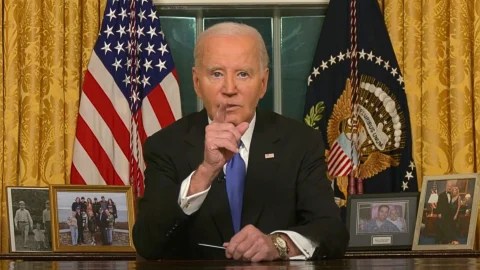
By Didi Rankovic | Reclaim The Net | January 16, 2025
Outgoing President Joe Biden concluded his presidency with a farewell address on Wednesday night, sharply criticizing what he termed the “tech-industrial complex” while urging tighter accountability for social media platforms. Ironically, Biden’s remarks highlighted the decline of free press and the dangers of “misinformation,” even as his administration has often been linked to censorship efforts and suppression of dissenting viewpoints.
During his speech, Biden drew parallels to President Dwight Eisenhower’s famous warning about the “military-industrial complex.” He stated, “Six decades later, I’m equally concerned about the potential rise of a tech-industrial complex that could pose real dangers for our country as well.” His comments painted a picture of concentrated power in the hands of tech oligarchs, whom he accused of enabling an “avalanche of misinformation and disinformation” to flourish unchecked.
The president, leaving office with historically low approval ratings, accused social media platforms of abandoning fact-checking efforts and contributing to the erosion of public trust. “The free press is crumbling. Editors are disappearing. Social media is giving up on fact-checking,” Biden said.
Biden’s condemnation of social media fact-checking policies appeared aimed directly at Meta CEO Mark Zuckerberg, whose platform recently transitioned away from third-party fact-checking to a “community notes” model reminiscent of the system employed by Elon Musk’s X.
Throughout his presidency, Biden frequently championed tighter controls on digital platforms under the guise of protecting democracy and public health. However, critics argue his administration’s push for censorship often targeted dissenting views and stifled legitimate debate.
Biden also lamented the decline of legacy media, suggesting that unchecked misinformation on digital platforms undermines democracy. “We must hold the social platforms accountable to protect our children, our families, and our very democracy from the abuse of power,” he declared.
The president’s rhetoric on misinformation is not without controversy. He has faced repeated accusations of spreading false or unverifiable claims himself, such as recent remarks regarding Los Angeles utilities during wildfire discussions that local officials disputed.
Regarding Covid vaccines, Biden also famously said: “You’re not going to get COVID if you have these vaccinations,” and added, “If you’re vaccinated, you’re not going to be hospitalized, you’re not going to be in the IC unit, and you’re not going to die.” Those who challenged this idea found themselves banned on several social media platforms.
Meta’s recently abandoned fact-checking model, which involved junior writers downgrading posts based on often-disputed analyses, has faced criticism for censoring accurate information that reflected poorly on Biden. The new community-based approach on X and Meta allows users to collaboratively evaluate content, signaling a move away from centralized content moderation.
Featured Video

Theodore Postol: Iran’s Missiles & Drones Were Underestimated
or go to
Aletho News Archives – Video-Images
From the Archives
What is the Israeli Lobby in Australia Doing in Interfaith Dialogue?
By Ali Kazak | Dissident Voice | October 11, 2015
For years Israel and its lobby around the world have been trying to normalise their relations with Arabs and Muslims without solving the Palestine Question.
One of the methods they resorted to in the last few years is using human rights and community organizations such as interfaith dialogue and Multiculturalism to achieve this objective and to: isolate the Palestinians, marginalise the Palestine question, end Israel’s isolation, and prevent criticism of Israel, knowing that these organisations will be the first to stand against Israel’s violations, racial and religious discrimination.
The group responsible for this task in Australia is The Australia/Israel & Jewish Affairs Council (AIJAC); its Director of International & Community Affairs, Jeremy Jones is in charge of lobbying religious community organizations, specifically Muslims and Christians. Consequently he convened the Faith Communities for Reconciliation, founding participant in the Australian Partnership of Religious Organisations and the Australian National Dialogue of Christians, Muslims & Jews.
AIJAC is a private political propaganda group. It is recognised as the main Israeli lobby in Australia. It coordinates its activities and works intimately with the Israeli embassy in Canberra and different institutions in Israel. It is privately funded by some Jewish businessmen. It monitors closely Australian politicians, the media, ethnic and religious groups, (especially Arabs and Muslims), unions and academics on their stands towards Israel and the Palestine question. … continue
Blog Roll
 Aletho News
- The killing of three Indonesian soldiers in Lebanon should remind Jakarta that Israel does not want peace
- Defeated and delusional: Netanyahu’s remarks reveal $80bn war failure, says analyst
- Iran’s friends are about to make life much more difficult for Israel and the US
- The war of liberation of the Arab and Islamic peoples expands across the Gulf
- Envoy warns UN on Trump’s threat to ‘obliterate’ Iran’s civilian infrastructure
- The Larak Corridor: Iran’s Rial Gate With No US, No Israel, and No Way Around
- ‘Economic terrorism’: Steel facilities hit again in US-Israeli strike
- ‘War Crime’: Iran condemns attacks on Arak, Ardakan nuclear sites
- Two-thirds of Americans want quick end to Iran war even if goals unmet
- Trump to Give “Important Update on Iran” Wednesday in Prime-Time Speech
- If Americans Knew
- Gaza families reunite years after babies evacuated amid Israel’s war
- International Rescue Committee warns Gaza’s children face grave protection risks
- Iran’s Alleged 47-Year War on America: Debunking the 1,050 American Deaths Canard
- Israel wants US to bomb more of Iran’s civilian structures (113,000 is not enough) – Not a ceasefire Day 173
- Ann Coulter Rips Into Fox News for Iran War Coverage
- Joe Kent Urges Americans To Call White House and Congress To Object To Sending Troops Into Iran
- DNC Resolution to Reject AIPAC Funding Puts Democratic Leaders in the Hot Seat
- Swedish foundation to build 400 schools as over 650,000 Gaza children remain without education for 2 years
- Israeli army admits photshopping image of slain Lebanese journalist
- This is how Israel is systematically killing health workers under the cover of war in Lebanon
- No Tricks Zone
- New Study Finds Warming Saves Lives…Cold Temperatures 12 Times More Deadly Than Excess Heat
- German Science Blog Accuses PIK Climate Institute Of Hallucinating Climate Tipping Points
- Devastating Assessment Of Comirnaty Vaccine By Former Senior Pfizer Europe Toxicologist
- New Study: CO2 Is ‘Effectively Negligible’ As An Explanatory Climate Change Factor Since 2000
- Former Pfizer Toxicologist Dr. Helmut Sterz Tells Bundestag Hearing Pfizer Vaccine Should Have Never Been Approved
- Energy Expert: Germany’s Nuclear Phaseout Was A “500 Billion Euro Mistake”
- New Research: South Australia’s Mid-Holocene Sea Surface Temperatures Were 4°C Warmer Than Today
- Storing Green Energy To Last Germany 10 Days Would Require A 60-Million Tonne Battery
- New Studies: UK Sea Levels Were 4 Meters Higher Than Today During The Mid-Holocene
- Destructive Green New Deal: German Energy And Metal Group Warns Of Drastic Crisis
 Aletho News