Loretta Lynch: She’s Black, and That’s All the Black Caucus Cares About
A Black Agenda Radio commentary by Glen Ford
An important aspect of the Age of Obama will soon come to a close with the departure of Eric Holder, the first Black U.S. attorney general. Holder’s record in office makes up a great part of the Obama legacy – which, after six years turns out to be scarcely any different than what could have been expected from any center-right white corporate Democrat. Like former president Bill Clinton, whose Wall Street dominated administration deregulated the banks and set the stage for the economic meltdown, eight years later. Obama’s first act in office was to bring back Bill Clinton’s Wall Street wrecking crew. So, in a sense, Obama is actually a protégé of Bill Clinton, and will likely be succeeded in office by Hillary Clinton.
Obama’s and Eric Holder’s most singular contribution to American political economy is having articulated the concept of banks being Too Big to Fail, or to jail. Back in the late Eighties and early Nineties, one-third of the nation’s savings and loan institutions did fail, and over a thousand individual executives were prosecuted, with a large proportion of them sent to prison. But, Eric Holder’s Justice Department has specialized in protecting big banks and defending the Lords of Capital.
At this late date, with his exit probably only weeks away, Eric Holder is trying to put a final spin on his legacy by demanding that some of the world’s biggest banks, including JP Morgan Chase and Citigroup, plead guilty to a felony for manipulating foreign currency prices. Of course, not a single living, breathing banking executive would be branded a felon. Rather, the banks, as institutions would bear the shame. But, institutions have no shame, and cannot be jailed, and the banks will not be prevented from continuing to deal in foreign currency trading and all the other money streams they have manipulated, with impunity. However, Eric Holder will ride off into the sunset of a multi-million dollar corporate law practice claiming that he finally busted a bank for felonious conduct.
The Pavlovian Black Caucus
Meanwhile, the ridiculously ineffectual Congressional Black Caucus is circling its wagons around Holder’s replacement, Black New York federal prosecutor Loretta Lynch. Lynch last month told a Senate committee that she fully supports the practice of civil forfeiture, which allows police to confiscate people’s money and property on mere suspicion of involvement in illegal activity. Even Eric Holder has advanced some very limited reforms to civil forfeiture, but Loretta Lynch appeared gung ho about the seizures. The Black Caucus, in an uproar, denounced Republican libertarian Senator Rand Paul for saying he’d vote against confirming Lynch because of her position on civil forfeiture, and he sniped that Lynch ought to be a little more concerned about poor people, who are more likely to have their cash seized by the cops. Black Caucus chairman G.K. Butterfield, one of the most pro-corporate members of the Caucus, fumed that Rand Paul was using civil forfeiture as an excuse to “keep an African American legal scholar” from heading the Justice Department. But, of course, the Congressional Black Caucus has adopted no position at all on the pros and cons of civil forfeiture. They have no opinion. All they care about is that a Black Democrat get the attorney general’s job – and that they get to hold on to theirs.
See also:
Loretta Lynch is Condoleeza Rice With A Law Degree
By Bruce A. Dixon
In private practice Loretta Lynch was a “white collar crime specialist” keeping banksters, tax evaders and money launderers out of jail. She did exactly that at Obama’s Justice Department, passing get out of jail cards in the biggest money laundering cases in history. She’s pro-death penalty, against legalizing weed or demilitarizing cops, sees no evil in drone murder, war crimes or runaway surveillance. And she’s the next Attorney General.
Obama Announces New Privacy Rules for the World. World Not Impressed.
By Rainey Reitman | EFF | February 10, 2015
President Obama recently announced slight changes to NSA data collection practices. The recent tweaks mean two new privacy protections for those that U.S. law considers foreigners (in this case, people who are outside of the United States borders who are neither U.S. citizens nor legal U.S. residents).
Perhaps you’re thinking Obama is using his executive authority to stop the mass surveillance of all Internet traffic of people worldwide? Nope, not quite. The new protections are:
- If the U.S. government collects information about a foreigner, it will consider the privacy ramifications before disseminating that information, such as to other governments;1 and
- If the U.S. government collects information on innocent foreigners not connected to any crime or investigation and the information has no national security value, it will dispose of that information after five years.2
That’s right, the world’s personal information will only be retained for five short years. And that’s if the U.S. government decides you’re not under suspicion.
David Medine, the chairman of the Privacy and Civil Liberties Oversight Board, has said that “There’s no country on the planet that has gone this far to improve the treatment of non-citizens in government surveillance.”
That’s certainly laudable. However, a critic might also note that there’s no country on earth extending such enormous resources into surveilling all the people on the planet, so the United States has more room for “improvement” than most countries. (That’s certainly what President Obama implied when he spoke of his country’s “unique” capabilities in his speech defending the new rules.)
We wondered if people worldwide would be excited about these new privacy protections, and so we reached out to a few of our global partners to solicit their feedback.
Here’s what they thought of Obama’s protections for the privacy rights on non-US citizens:
“This decision is not only a confirmation of the disregard the United States has for its international human rights obligations, but given the fact that the US is treating our privacy worse than our own governments, it sends a terrible message for human rights defenders fighting against unchecked surveillance in our own country,” said Luis Fernando García, a lawyer at Network for Digital Rights in Mexico.
“Deleting is no comfort at all because it can never be confirmed,” said Professor K.S. Park of Korea University Law School, “Korea also allows warrantless wiretapping of overseas people for national security purposes. The United States should not set a bad precedent for the whole world to follow.”
And Carolina Botero, a Colombian researcher and blogger with Fundacion Karisma, said, “Mass surveillance is unacceptable in democratic societies because of the threat it poses to human rights. Obama’s reforms to NSA practices fail to address this situation for his citizens and continue the obnoxious violation of the privacy rights of foreigners. A data retention period of 5 years is a clear example of an illegal measure that can be seen abroad as justification for similar laws in other countries.”
If Obama wants to make good on his promise to uphold the privacy of innocent people outside the United States, he’s going to have to do better than this.
And he should start by ending mass surveillance under Executive Order 12333, the primary legal authority for mass surveillance of people outside U.S. borders. Sign our petition and tell Obama to rein in mass spying of people worldwide.
- 1. The exact language from IC on the Record is: “All agency policies implementing PPD-28 now explicitly require that information about a person may not be disseminated solely because he or she is a non-U.S. person and the Office of the Director of National Intelligence has issued a revised directive to all Intelligence Community elements to reflect this requirement. Intelligence Community personnel are now specifically required to consider the privacy interests of non-U.S. persons when drafting and disseminating intelligence reports.”
- 2. IC on the Record explains: “We have imposed new limitations on the retention of personal information about non-U.S. persons. Before PPD-28, Intelligence Community elements had disparate restrictions on how long information about non-U.S. persons could be retained. PPD-28 changes these retention practices in significant ways to afford strengthen privacy protections. Now Intelligence Community elements must delete non-U.S. person information collected through SIGINT five years after collection unless the information has been determined to be relevant to, among other things, an authorized foreign intelligence requirement, or if the Director of National Intelligence determines, after considering the views of the Office of the Director of National Intelligence Civil Liberties Protection Officer and agency privacy and civil liberties officials, that continued retention is in the interest of national security.”
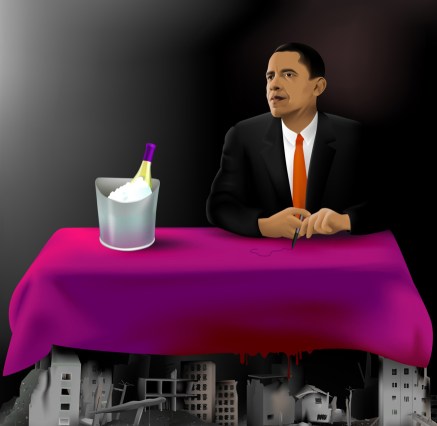
Obama the War President
By Dave Lindorff | This Can’t Be Happening! | February 6, 2015
The Nobel Peace Laureate President Barack Obama, the guy who once campaigned claiming one US war — the one against Iraq — was a “bad” one, and the other — against Afghanistan — was a “good” one, turns out to be a man who, once anointed commander-in-chief, can’t seem to find a war he doesn’t consider to be a “good” idea.
Obama turned out, on taking office, to have a hard time saying good-bye to the occupation of Iraq, only leaving when he was forced out by an Iraqi government that refused to continue giving US forces legal immunity for killing Iraqi civilians. In Afghanistan, he decided to copy the same “surge” — a massive increase in targeted assassinations and violence — that he had once condemned in Iraq. Then he stepped up drone-launched rocket attacks and bombings in seven other countries.
More recently he has begun an air war against Syria (okay, he says it’s against the so-called Islamic State, but the whole world, with the exception of a lot of ill-informed US citizens, knows it’s ultimately against the Syrian government), and now his Secretary of Defense (sic) Ashton Carter and his Secretary of State John Kerry are pushing for sending heavy arms and, inevitably, US “advisors” to Ukraine to escalate US involvement in the civil war there. What makes that latest war particularly dangerous is that all the while, Peace Laureate Obama makes it clear that the “enemy” is Russian President Vladimir Putin and the Russian military.
Never mind that it is the US that originally orchestrated and encouraged the fascist coup that overthrew the elected government of Ukraine, setting in motion a huge pogrom against ethnic Russians in the east of that country and provoking the current armed conflict, and never mind that Russian concern about the Ukraine stems from a decades long history of the US pushing NATO ever closer to Russia’s western border, with Ukraine kind of the last straw.
Anyone looking objectively at the warmaking and war-promotion of this administration would have to conclude that President Obama is one of the most bellicose Chief Executives in the history of the United States.
If you don’t believe me, just look at the US military budget President Obama has proposed for FY2016. At $585.3 billion, it would if approved by Congress represent an increase in spending of $24.9 billion, or about 4%, over the 2015 budget, and that is despite a decline in what, since the Bush/Cheney years, has euphemistically been called Overseas Contingency Operations spending, or spending on actual wars. The proposed OCO budget for 2016 in this “peace” president’s budget is “just” $50.9 billion, down about $13.3 billion from 2015 thanks to what the president, in one whopper offered during his State of the Union address, called the “end of combat” in Afghanistan (that war is actually continuing, with some 12,000 US troops expected to remain stationed in that country indefinitely).
The thing about OCO funding is that it is really not predictive of anything. It could soar way beyond that $50.9-billion level, for example, in a flash if the US follows through and escalates the war in Ukraine — especially if Russian troops are drawn directly into that conflict and the US responds by upping its own involvement.
In fact, the OCO part of the budget has been used by the Pentagon and the administration over the last few years to get around the constraints of an ongoing Congressional “sequestration” requirement that cuts so-called discretionary spending, both military and non-military. Congress, ever mindful and solicitous of the country’s imperial ambitions, provided an exemption for ongoing military conflicts, and the Pentagon has since been deceptively slipping all kinds of other spending under the OCO heading now ever since the loophole was created.
But the Obama administration’s warmongering stance, in terms of the budget, isn’t told just by looking at the official Pentagon budget. There is much more spending that is really all about war. Not included in that $585.3 billion figure is $70.2 billion in discretionary spending for Veterans Affairs (that’s in addition to $90 billion in mandated spending). This is money to pay for the damages of the nation’s warmaking — the injured or ailing veterans who served or are now serving in the nation’s armed forces. Then there’s the intelligence agencies’ budgets — the CIA, the NSA, the FBI, the DIA, the DEA, the ATF and Homeland Security, etc. — most of which is really part of part of the war machine, thanks to the so-called “War on Terror,” which has re-defined the US itself as part of a global war zone. While much of that intelligence budget is concealed from the public on the spurious grounds of “national security,” it is known to exceed $100 billion a year. Add to that the $24-billion share of the Department of Energy budget that is weapons and war related, and you have a real military budget for 2016 of $707 billion. That’s out of a $1.2 trillion total discretionary spending budget (the rest of the $4 trillion proposed 2016 budget is called mandatory because it is debt repayment or spending on mandated things like Social Security and Medicare, which are funded by dedicated payroll taxes, not income taxes and other federal taxes, and which are promised to recipients like retirees and the sick.
What this means is that when you look closely, some 59% of the entire discretionary budget of the federal government – things that are funded each year by money that Congress has to appropriate — is being spent on the military. Given that the total amount of taxes collected by the federal government (income, corporate profits, exist, inheritance, etc.) also comes in at about $1.2 trillion, we’re saying that taxpayers this coming year will be pouring not just $707 billion, but 59 cents of every tax dollar in to war, planning for war, or paying for war. But it’s actually worse than that because actually the US government operates at a deficit, and doesn’t ever finance its wars on a pay-as-you-go basis. Instead, it borrows the money and then pays interest on that debt. Every year that interest comes to about $240 billion, and roughly half that is for borrowing to pay for past wars and past and current military spending. So add $120 billion to the $707 total and it become $827 billion.
In other words, it’s really 68.9% of every tax dollar you pay this April 15 that’s going to pay for America’s wars and its obsession with militarism.
No wonder our schools and universities, our parks, our roads, our once-vaunted global scientific leadership, our environment, our health and safety, our family budgets and even our life expectancy, have been going to hell! The only thing that’s really getting funded in this country is war.
By the way, the reason you may not have realized how much you are paying for war out of your taxes is that the government, and the corporate media, carefully avoid letting you know. They do this by sleight of hand. You see, they never really break out just the “discretionary” budget, or point out the parts of the budget that are outside the Pentagon but that are still really military-related, like spending on nuclear weapons and weapons development, nuclear research and cleanup, decommissioning of nuclear processing plants, and of course veterans affairs and benefits. They also do it by lumping the huge outlays for Social Security benefits and Medicare into the overall spending budget, though actually those benefits are funded not by income taxes but by a Trust fund of some $1.7 trillion that was created over the years by specially-dedicated payroll taxes separately paid by workers and their employers over the working life of each person. Adding those items into the national budget, while leaving out things like spending on veterans, nukes and war debt, appears to reduce military spending to a much less troubling 6.8% of the budget.
But it’s a fraud.
If we want to revitalize the US, the only way to do it is to end militarism and war, and to generously fund human needs.
To do that, we need a real peace president and a peace congress, not the Nobel Laureate warmonger we have now in the White House, and the bi-partisan war chorus we have in the Congress.
Non-Aligned Movement Backs Venezuela against US Sanctions
teleSUR | February 8, 2015
The Non-Aligned Movement issued a statement Saturday rejecting the latest set of sanctions imposed by the United States against Venezuelan officials.
The 120-nation body described the sanctions as “intended to undermine Venezuela’s sovereignty, its political independence and its right to self-determination.”
The U.S. government announced a new set of sanctions last week which target former and current Venezuelan officials. The U.S. has justified various rounds of sanctions by claiming corruption and that human rights abuses occurred in the oil-rich county during a wave of opposition violence last year that left 43 dead.
However, the Venezuelan government has pointed out the sanctions are politically motivated and that they form part of U.S. plans to oust the country’s elected government, given that the overwhelming majority of the 43 fatalities were caused by right-wing extremists.
The Non-Aligned Movement considers the unilateral sanctions a “violation of international law, including the United Nations Charter and the basic principles of international law of relations between states.”
Furthermore, the group of nations considered the measure “coercive” and manifested its solidarity with the Venezuelan people and their government.
The UNASUR group of South American nations also rejected the sanctions and will launch a probe to evaluate Venezuela’s evidence of U.S. meddling in the country’s internal affairs.
Nuclear War and Clashing Ukraine Narratives
By Robert Parry | Consortium News | February 6, 2015
The U.S. government and mainstream media are swaggering toward a possible nuclear confrontation with Russia over Ukraine without any of the seriousness that has informed this sort of decision-making throughout the nuclear age. Instead, Official Washington seems possessed by a self-righteous goofiness that could be the prelude to the end of life on this planet.
Nearly across the U.S. political spectrum, there is a pugnacious “group think” which has transformed what should have been a manageable political dispute in Ukraine into some morality play where U.S. politicians and pundits blather on about how the nearly year-old coup regime in Kiev “shares our values” and how America must be prepared to defend this regime militarily.

Jaanika Merilo, an Estonian brought into the Ukrainian government to oversee foreign investments. (A photo released on the Internet by Merilo via DanceswithBears)
Though I’m told that President Barack Obama personally recognizes how foolhardy this attitude is, he has made no significant move to head off the craziness and, indeed, has tolerated provocative actions by his underlings, such as neocon Assistant Secretary of State Victoria Nuland’s scheming with coup plotters to overthrow Ukraine’s elected President Viktor Yanukovych last February.
Obama also has withheld from the American people intelligence information that undercuts some of the more extreme claims that his administration has made. For instance, I’m told that he has detailed intelligence reporting on both the mysterious sniper attack that preceded the putsch nearly a year ago and the shoot-down of the Malaysia Airlines Flights 17 that deepened the crisis last summer. But he won’t release the findings.
More broadly over the last year, Obama’s behavior – ranging from his initial neglect of the Ukraine issue, as Nuland’s coup plotting unfolded, to his own participation in the tough talk, such as boasting during his State of the Union address that he had helped put the Russian economy “in tatters” – ranks as one of the most irresponsible performances by a U.S. president.
Given the potential stakes of nuclear war, none of the post-World War II presidents behaved as recklessly as Obama has, which now includes allowing his administration officials to talk loosely about sending military support to an unstable regime in Kiev that includes neo-Nazis who have undertaken death-squad operations against ethnic Russians in eastern Ukraine.
U.S. Gen. Philip Breedlove, who is commander of NATO, declared last November that – regarding supplying military support for the Kiev government – “nothing at this time is off the table.” Breedlove is now pushing actively to send lethal U.S. military equipment to fend off an offensive by ethnic Russian rebels in the east.
I’m told that the Russians fear that U.S. officials are contemplating placing Cruise missiles in Ukraine or otherwise introducing advanced weaponry that Moscow regards as a direct threat to its national security. Whether or not the Russians are being alarmist, these fears are affecting their own decision-making.
None of the nuclear-age presidents – not Harry Truman, Dwight Eisenhower, John F. Kennedy, Lyndon Johnson, Richard Nixon, Gerald Ford, Jimmy Carter, Ronald Reagan, George H.W. Bush, Bill Clinton or even George W. Bush – would have engaged in such provocative actions on Russia’s borders, though some surely behaved aggressively in overthrowing governments and starting wars farther away.
Even Ronald Reagan, an aggressive Cold Warrior, kept his challenges to the Soviet Union in areas that were far less sensitive to its national security than Ukraine. He may have supported the slaughter of leftists in Central America and Africa or armed Islamic fundamentalists fighting a Soviet-backed government in Afghanistan, but he recognized the insanity of a military showdown with Moscow in Eastern Europe.
After the Soviet Union’s collapse in 1991, U.S. presidents became more assertive, pushing NATO into the former Warsaw Pact nations and, under President Clinton, bombing a Russian ally in Serbia, but that came at a time when Russia was essentially flat on its back geopolitically.
Perhaps the triumphalism of that period is still alive especially among neocons who reject President Vladimir Putin’s reassertion of Russia’s national pride. These Washington hardliners still feel that they can treat Moscow with disdain, ignoring the fact that Russia maintains a formidable nuclear arsenal and is not willing to return to the supine position of the 1990s.
In 2008, President George W. Bush – arguably one of the most reckless presidents of the era – backed away from a confrontation with Russia when Georgian President Mikheil Saakashvili, a neocon favorite, drew the Russians into a border conflict over South Ossetia. Despite some war talk from the likes of Vice President Dick Cheney and Sen. John McCain, President Bush showed relative restraint.
Imbalanced Narrative
But Obama has failed to rein in his administration’s war hawks and has done nothing to correct the biased narrative that his State Department has fed to the equally irresponsible mainstream U.S. news media. Since the Ukraine crisis began in fall of 2013, the New York Times and other major U.S. news outlets have provided only one side of the story, openly supporting the interests of the pro-European western Ukrainians over the ethnic Russian eastern Ukrainians.
The bias is so strong that the mainstream media has largely ignored the remarkable story of the Kiev regime willfully dispatching Nazi storm troopers to kill ethnic Russians in the east, something that hasn’t happened in Europe since World War II.
For Western news organizations that are quick to note the slightest uptick in neo-Nazism in Europe, there has been a willful blindness to Kiev’s premeditated use of what amount to Nazi death squads undertaking house-to-house killings in eastern Ukraine. [See Consortiumnews.com’s “Seeing No Neo-Nazi Militias in Ukraine.”]
The Russian government has repeatedly protested these death-squad operations and other crimes committed by the Kiev regime, but the U.S. mainstream media is so in the tank for the western Ukrainians that it has suppressed this aspect of the crisis, typically burying references to the neo-Nazi militias at the end of stories or dismissing these accounts as “Russian propaganda.”
With this ugly reality hidden from the U.S. public, Obama’s State Department has been able to present a white-hat-vs.-black-hat narrative to the crisis. So, while Russians saw a constitutionally elected government on their border overthrown by a U.S.-backed coup last February – and then human rights atrocities inflicted on ethnic Russians in eastern Ukraine – the American people heard only about wonderful pro-American “reformers” in Kiev and the evil pro-Russian “minions” trying to destroy “democracy” at Putin’s bidding.
This distorted American narrative has represented one of the most unprofessional and dangerous performances in the history of modern U.S. journalism, rivaling the false conventional wisdom about Iraq’s WMD except in this case the media propaganda is aimed at a country that really does have weapons of mass destruction.
The Russians also have noted the arrival of financially self-interested Americans, including Vice President Joe Biden’s son Hunter Biden and Ukraine’s new Finance Minister Natalie Jaresko, reminding the Russians of the American financial experts who descended on Moscow with their “shock therapy” in the 1990s, “reforms” that enriched a few well-connected oligarchs but impoverished millions of average Russians.
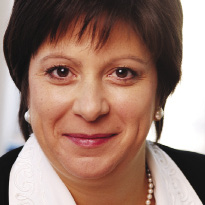
Ukraine’s Finance Minister Natalie Jaresko.
Jaresko, a former U.S. diplomat who took Ukrainian citizenship in December 2014 to become Finance Minister, had been in charge of a U.S.-taxpayer-financed $150 million Ukrainian investment fund which involved substantial insider dealings, including paying a management firm that Jaresko created more than $1 million a year in fees, even as the $150 million apparently dwindled to less than $100 million.
Jaresko also has been involved in a two-year-long legal battle with her ex-husband to gag him from releasing information about apparent irregularities in the handling of the U.S. money. Jaresko went into Chancery Court in Delaware to enforce a non-disclosure clause against her ex-husband, Ihor Figlus, and got a court order to silence him.
This week, when I contacted George Pazuniak, Figlus’s lawyer about Jaresko’s aggressive enforcement of the non-disclosure agreement, he told me that “at this point, it’s very difficult for me to say very much without having a detrimental effect on my client.”
With Jaresko now being hailed as a Ukrainian “reformer” who – in the words of New York Times’ columnist Thomas L. Friedman – “shares our values,” one has to wonder why she has fought so hard to shut up her ex-husband regarding possible revelations about improper handling of U.S. taxpayer money. [See Consortiumnews.com’s “Ukraine’s Made-in-USA Finance Minister.”]
More Interested Parties
The Russians also looked askance at the appointment of Estonian Jaanika Merilo as the latest foreigner to be brought inside the Ukrainian government as a “reformer.” Merilo, a Jaresko associate, is being put in charge of attracting foreign investments but her photo spreads look more like someone interested in some rather kinky partying.

Jaanika Merilo, the Estonian being put in charge of arranging foreign investments in Ukraine. (A photo released by Merilo on the Internet via DanceswithBears)
The Russians are aware, too, of prominent Americans circling around the potential plunder of Ukraine. For instance, Hunter Biden was named to the board of directors of Burisma Holdings, which is a shadowy Cyprus-based company linked to Privat Bank.
Privat Bank is controlled by the thuggish billionaire oligarch Ihor Kolomoysky, who was appointed by the Kiev regime to be governor of Dnipropetrovsk Oblast, a south-central province of Ukraine. Kolomoysky has helped finance the paramilitary forces killing ethnic Russians in eastern Ukraine.
And, Burisma has been lining up well-connected lobbyists, some with ties to Secretary of State John Kerry, including Kerry’s former Senate chief of staff David Leiter, according to lobbying disclosures. As Time magazine reported, “Leiter’s involvement in the firm rounds out a power-packed team of politically-connected Americans that also includes a second new board member, Devon Archer, a Democratic bundler and former adviser to John Kerry’s 2004 presidential campaign. Both Archer and Hunter Biden have worked as business partners with Kerry’s son-in-law, Christopher Heinz, the founding partner of Rosemont Capital, a private-equity company.” [See Consortiumnews.com’s “The Whys Behind the Ukraine Crisis.”]
So, the Russians have a decidedly different view of the Ukrainian “reforms” than much of the U.S. media does. But I’m told that the Russians would be willing to tolerate these well-connected Americans enriching themselves in Ukraine and even having Ukraine expand its economic relations with the European Union.
But the Russians have drawn a red line at the prospect for the expansion of NATO forces into Ukraine and the continued killing of ethnic Russians at the hands of neo-Nazi death squads. Putin is demanding that those paramilitary forces be disarmed.
Besides unleashing these right-wing militias on the ethnic Russians, the Kiev government has moved to punish the people living in the eastern sectors by cutting off access to banks and other financial services. It also has become harder and more dangerous for ethnic Russians to cross into territory controlled by the Kiev authorities. Many are turned back and those who do get through face the risk of being taken and killed by the neo-Nazi militias.
These conditions have left the people in the Donetsk and Luhansk areas – the so-called Donbass region on Russia’s border – dependent on relief supplies from Russia. Meanwhile, the Kiev regime — pumped up by prospects of weapons from Washington as well as more money — has toughened its tone with vows to crush the eastern rebellion once and for all.
Russia’s Hardening Line
The worsening situation in the east and the fear of U.S. military weapons arriving in the west have prompted a shift in Moscow’s view of the Ukraine crisis, including a readiness to resupply the ethnic Russian forces in eastern Ukraine and even provide military advisers.
These developments have alarmed European leaders who find themselves caught in the middle of a possible conflict between the United States and Russia. German Chancellor Angela Merkel and French President Francois Hollande rushed to Kiev and then Moscow this week to discuss possible ways to defuse the crisis.
The hardening Russian position now seeks, in effect, a division of Ukraine into two autonomous zones, the east and the west with a central government that maintains the currency and handles other national concerns. But I’m told that Moscow might still accept the earlier idea of a federated Ukraine with greater self-governance by the different regions.
Putin also does not object to Ukraine building closer economic ties to Europe and he offered a new referendum in Crimea on whether the voters still want to secede from Ukraine and join Russia, said a source familiar with the Kremlin’s thinking. But Putin’s red lines include no NATO expansion into Ukraine and protection for ethnic Russians by disarming the neo-Nazi militias, the source said.
If such an arrangement or something similar isn’t acceptable and if the killing of ethnic Russians continues, the Kremlin would support a large-scale military offensive from the east that would involve “taking Kiev,” according to the source.
A Russian escalation of that magnitude would likely invite a vigorous U.S. response, with leading American politicians and pundits sure to ratchet up demands for a military counterstrike against Russia. If Obama were to acquiesce to such bellicosity – to avoid being called “weak” – the world could be pushed to the brink of nuclear war.
Who’s to Blame?
Though the State Department and the mainstream U.S. media continue to put all the blame on Russia, the fact that the Ukraine crisis has reach such a dangerous crossroads reveals how reckless the behavior of Official Washington has been over the past year.
Nuland and other U.S. officials took an internal Ukrainian disagreement over how quickly it should expand ties to Europe – while seeking to retain its historic relations with Russia – and turned that fairly pedestrian political dispute into a possible flashpoint for a nuclear war.
At no time, as this crisis has evolved over the past year, did anyone of significance in Official Washington, whether in government or media, stop and contemplate whether this issue was worth risking the end of life on the planet. Instead, all the American people have been given is a steady diet of anti-Yanukovych and anti-Putin propaganda.
Though constitutionally elected, Yanukovych was depicted as a corrupt tyrant who had a pricy sauna in his official mansion. Though Putin had just staged the Winter Olympics in Sochi, signaling his desire for Russia to integrate more with the West, he was portrayed as either a new-age imperial czar or the second coming of Hitler – if not worse because he occasionally would ride on a horse while not wearing a shirt.
Further, the U.S. news media refused to conduct a serious investigation into the evidence that Nuland and other U.S. officials had helped destabilize Yanukovych’s government with the goal of achieving another neocon “regime change.”
Nuland, who personally urged on anti-Yanukovych protests in Kiev, discussed with U.S. Ambassador to Ukraine Geoffrey Pyatt in early February 2014 who should lead the new government – “Yats is the guy,” she said, referring to Arseniy Yatsenyuk – and how to “glue this thing.”
After weeks of mounting tensions and worsening violence, the coup occurred on Feb. 22, 2014, when well-organized neo-Nazi and other right-wing militias from western Ukraine overran presidential buildings forcing officials to flee for their lives. With Yanukovych ousted, Yatsenyuk soon became Prime Minister. [See Consortiumnews.com’s “When Is a Putsch a Putsch.” ]
Many ethnic Russians in southern and eastern Ukraine, who had strongly supported Yanukovych, refused to accept the new U.S.-backed order in Kiev. Crimean officials and voters moved to secede from Ukraine and rejoin Russia, a move that Putin accepted because of Crimea’s historic ties to Russia and his fear that the Russian naval base at Sevastopol might be handed to NATO.
The resistance spread to eastern Ukraine where other ethnic Russians took up arms against the coup regime in Kiev, which responded with that it called an “anti-terrorist operation” against the east. To bolster the weak Ukrainian army, Internal Affairs Minister Arsen Avakov dispatched neo-Nazi and other “volunteer” militias to spearhead the attacks.
After the deaths of more than 5,000 people, a shaky cease-fire was announced in September, but — amid complaints about neo-Nazi death squads operating in government-controlled areas and with life deteriorating in rebel-controlled towns and cities — the ethnic Russians launched an offensive in January, using Russian-supplied weapons to expand their control of territory.
In reaction, U.S. pundits, including columnists and editors of the New York Times and the Washington Post, called for dispatching U.S. aid to the Kiev forces, including proposals for lethal weaponry to deter Putin’s “aggression.” Members of Congress and members of the Obama administration have joined the chorus.
On Feb. 2, the New York Times reported “With Russian-backed separatists pressing their attacks in Ukraine, NATO’s military commander, Gen. Philip M. Breedlove, now supports providing defensive weapons and equipment to Kiev’s beleaguered forces, and an array of administration and military officials appear to be edging toward that position, American officials said. … President Obama has made no decisions on providing such lethal assistance.”
That same day, the lead Times editorial was entitled “Mr. Putin Resumes His War” and continued with the theme about “Russian aggression” and the need “to increase the cost” if Russia demands “a permanent rebel-held enclave.”
On Feb. 3, the Washington Post ran an editorial entitled “Help for Ukraine. Defensive weapons could deter Russia in a way sanctions won’t.” The editorial concluded that Putin “will stop only if the cost to his regime is sharply raised – and quickly.”
A new war fever gripped Washington and no one wanted to be viewed as “soft” or to be denounced as a “Putin apologist.” Amid this combination of propaganda, confusion and tough-guy-ism – and lacking the tempering wisdom about war and nuclear weapons that restrained earlier U.S. presidents – a momentum lurched toward a nuclear showdown over Ukraine that could put all life on earth in jeopardy.
~
Investigative reporter Robert Parry broke many of the Iran-Contra stories for The Associated Press and Newsweek in the 1980s. You can buy his latest book, America’s Stolen Narrative, either in print here or as an e-book (from Amazon and barnesandnoble.com). You also can order Robert Parry’s trilogy on the Bush Family and its connections to various right-wing operatives for only $34. The trilogy includes America’s Stolen Narrative. For details on this offer, click here.
Did North Korea Really Hack Sony?
By James DiEugenio | Consortium News | February 3, 2015
One of the major problems with modern American democracy is the fact that the U.S. government has a serious credibility problem. This is not new of course. In its contemporary strain, it goes back at least to 1964 when two events focused and magnified the problem. The first was the Gulf of Tonkin incident, which was used to launch the Vietnam War. The second was the issuance of the Warren Report, the widely doubted official account of John F. Kennedy’s assassination.
As Kevin Phillips demonstrated with polling results in his book Arrogant Capital, that year marked the beginning of a long decline in the public’s trust in the government’s ability to do what is right most of the time. Prior to that year, the number hovered in the mid-70 percentile. After that, the figure began to drop steeply. It bottomed out at 19 percent in 1992. (This was clearly a large factor in boosting the presidential candidacy of Ross Perot that year.) It has failed to recover in any significant way since.
Historically speaking, it’s easy to name some of the causes for this headlong slide into skepticism and disbelief: the escalation in Vietnam, the assassinations of key leaders during the 1960s, Watergate, the Iran/Contra affair, the exposure of CIA drug-running during wars in Southeast Asia and Central America.
As Nicolas JS Davies has pointed out, some more recent examples would be the false reasons for the invasion of Iraq, the dubious attribution of imminent nuclear weaponry for Iran, the attempt to accuse President Bashar al-Assad of Syria of using sarin gas against civilians, and the attempt to blame Russia for the shoot-down of Malaysia Airlines Flight 17.
As the reader can see, many of these instances involve the effort of certain reactionary members of the Executive Branch in Washington and their allies in the media to use the American military abroad. One would have thought that after the disastrous results of the Tonkin Gulf Resolution, the major media would investigate more carefully what now seems to be a recurrent pattern of ersatz attribution to provoke American intervention. But, by and large, the doubts about these events have been expressed only in the alternative media.
The final incident Davies (briefly) mentioned was last year’s computer hacking of Sony/Columbia studios, which the FBI blamed on North Korea. The ostensible reason for this cyber-attack was the upcoming release of the comedy film, The Interview, which depicted an interview by a fictional American TV personality with Kim Jong-un, the actual leader of North Korea.
This interview becomes a pretext for an assassination attempt that goes awry. But, as the movie unfolds, the interview does happen and Kim does not come off well in it. This causes him to try to kill the Americans responsible. It backfires and he is killed instead.
Perhaps no film since Oliver Stone’s JFK generated as much pre-release controversy as The Interview. But unlike Stone’s picture, which created a sensation over its contrary-to-the-Establishment view of President Kennedy’s assassination, this particular brouhaha is largely based upon the alleged cyber-attack by North Korea.
When the FBI pointed the finger at Pyongyang, Sony/Columbia decided not to release the film, citing security concerns. Both people in the film colony and in the media met that decision with much derision. Therefore, Columbia reconsidered and did a limited theatrical run for the film, combined with a large online release. Due to the massive coverage of the controversy, the latter has been a big success. In fact, it has set records in that category.
‘The Interview’ as a Movie
The movie was co-directed by Seth Rogen and Evan Goldberg, who also had a hand in writing the story. Along with James Franco, Rogen also stars in the film. Rogen and Goldberg have been friends since childhood in Vancouver, Canada. Rogen’s career took off after he moved to Los Angeles and met writer-director Judd Apatow, who produced Anchorman: The Legend of Ron Burgundy and directed The 40 Year Old Virgin.
After first using Rogen in a TV series called Freaks and Geeks, Rogen starred in Apatow’s 2007 film Knocked Up. Apatow then produced two films written by Rogen and Goldberg, Pineapple Express and Superbad. Franco was also in Freaks and Geeks, and Pineapple Express with Rogen. Rogen and Goldberg then scripted The Green Hornet in 2011; they wrote and co-directed This Is the End in 2013.
Reportedly, Rogen once advised Apatow to make his work more “outrageously dirty.” [Los Angeles Times, May 13, 2007] And Apatow once said he wanted to include a penis in each of his films. [The Guardian. Aug. 26, 2008]
Well, we get those kinds of jokes in The Interview. The premise of the film revolves around Franco as a TV personality named Dave Skylark, the host of a rather lowbrow interview show titled Skylark Tonight. Rogen plays the producer-director of the program and has ambitions of doing something more socially and politically significant, a la 60 Minutes.
In one of the several unfathomable plot twists in the film, Kim likes Skylark Tonight so much that he wants to be a guest on the show and to arrange the guest spot through Rogen. But, in another hard to buy plot twist, Kim wants to arrange the interview in some sparsely populated rural area in China. (I think this segment was designed to generate laughs — which it does not.)
The visit to North Korea is now set up with a female military representative of Kim’s. Upon Rogen’s return, he and Franco celebrate and they announce the upcoming event on the air.
Now, another rather hard to believe strophe occurs. The CIA visits the two men and asks them to assassinate Kim. No specific reason is given as to why (though Kim is widely viewed in the West as a clownish and unstable dictator), or why they chose these two utter amateurs for such a daring, high-risk scheme.
The CIA wants them to kill Kim with a toxic poison attached to the palm of their hands. This strip is hidden in a pack of gum. But when they arrive in North Korea, one of their military guards takes out the pack and chews the strip. He spits it out, and in a rather unfunny follow-up, we later watch him die from the poison at a dinner.
Franco now meets Kim. The North Korean is on his best behavior and the two hit it off for a couple of days playing basketball and partying with some scantily clad girls.
Twisting the Plot
But now, another rather weird plot twist occurs. Franco wanders out of the presidential palace, going to what he thought was a grocery store nearby. He goes inside and discovers that the store is really a Potemkin village. That is, things like fruit and vegetables are really painted props.
Obviously, this scene is intended to highlight the shortage of food supplies in North Korea, but why the North Koreans would plant the store so close to the palace, why they would leave it unattended, and why they could not import real goods to stock it at this crucial time, these kinds of questions make this episode another head-scratcher. But the plot device explains why Franco turns on his new friend, Kim Jong-un.
In the meantime, Rogen has fallen for the female military attaché. It turns out she secretly hates Kim and now allies herself with the Americans. She says they cannot just kill him; they must humiliate him on TV so the Korean people will see him as a pretentious buffoon and charlatan.
So, Franco/Skylark decides to structure the interview to expose Kim. But the station technicians cut the feed. Rogen and his girlfriend then pull out firearms, touching off a bloody fight in the control room also involving Korean troops. Somehow, the amateur Americans kill all the Koreans. Franco is shot at, but he survives because he had a bulletproof vest on.
The trio manages to escape in a tank (no, I won’t explain how that happened) and are pursued by Kim and some soldiers in a helicopter. Kim orders preparations for a nuclear launch. But the tank fires a heat-seeking missile that takes out the chopper. Some CIA double agents then help Rogen and Franco escape the country.
At the end, we see Franco at a book reading about the whole affair as Rogen talks to his North Korean girlfriend via Skype. She stayed behind to democratize the country.
As the reader can see, the story is pretty much escapist, goofball fiction with a plot focused on murdering a real-life leader. But as bad as the script is, the direction by Rogen and Goldberg is even worse.
The Decline of Comedy
In 1965, before he retired from the field, illustrious film critic Dwight MacDonald wrote an essay entitled “Whatever Happened to Hollywood Comedy?” There, he lamented how low the genre had fallen from the Alpine peaks attained by the likes of Keaton, Chaplin, Lloyd and Langdon. Or even from the hills of Preston Sturges, Billy Wilder, Ernst Lubitsch and Howard Hawks.
MacDonald outlined three rules that comic films he was reviewing broke almost systematically. First, he wrote that most of the films had no appealing comic protagonists, which he felt was necessary in the genre. Second, he said they were overproduced and too Rube Goldberg-like in their construction and depiction. (Rogen and Goldberg shoot the helicopter exploding at the end in super-slow-motion.)
Finally, according to MacDonald, the sadism inherent in comedy could not be shown realistically, i.e., if the comic actually broke his back while slipping on a banana peel, that would not be funny.
Well, in the fight in the control room in The Interview, we watch as not one, but two fingers get bitten off. Apparently, no one on the set said to Rogen, “Uh Seth, is that really funny?” Rogen is an even worse director than he is an actor. And the man can’t act.
If MacDonald felt gloomy about the state of film comedy in 1965, one can imagine what he would have written in later years, which leads us to the first question about the hacking mystery: Unless the North Koreans are as imbecilic as the people depicted in the film, could they really have thought that such a frivolous production somehow imperiled the security or image of their country – and to such an extent that they went ahead and risked retaliation by hacking into a private company’s computer system?
To me, the risk simply does not equate with whatever reward was to be had. But there are other indications that the case against North Korea is not nearly as conclusive as the FBI wants us to think. President Barack Obama may have compounded the problem by announcing retaliatory sanctions on Jan. 2. Further, White House Press Secretary Josh Earnest implied there would be more of this because he called it “the U.S. government’s first action…”
The Facts of the Case
The controversy actually began to take shape last June when the North Korean ambassador to the United Nations — without seeing the movie in all of its silliness — condemned the film and urged the United States to cancel its distribution. Clearly, making light of assassinating a nation’s leader is problematic, whatever one may think of the leader, and the North Koreans made their disgust clear.
Then, on Nov. 24, 2014, Columbia discovered that its computers had been hacked. Their employees were locked out and an ugly caricature of a bright red skeleton popped up on their screens that morning. A message appeared which said, “Hacked by #GOP.” Later, personal information, e-mails and unreleased films were leaked online. The films included Still Alice, Annie and To Write Love on Her Arms.
In this context, GOP does not refer to the Republican Party but to a hacking group that calls themselves the Guardians of Peace. It’s interesting to note that although North Korea denies the attack, Guardians of Peace takes credit for it. In fact, the Guardians actually called the FBI a bunch of idiots because of the stupidity of their investigation.
As Kim Zetter pointed out in Wired, nation-states usually don’t announce themselves with images of blazing skeletons or criticize their victims for having poor cyber security, nor do they post stolen data to Pastebin, which is sort of the unofficial warehouse for heisted files on the cloud.
As Zetter writes, “These are all hallmarks of hacktivists — groups like Anonymous and LulzSec, who thrive on targeting large corporations for ideological reasons … or by hackers sympathetic to a political cause” (Wired, Dec. 17, 2014)
Cyber-security expert Marc Rogers agreed that the operation did not look like it was from a nation-state, and he criticized the FBI’s case on specific grounds, noting that because the malware was written in Korean means little, since programs exist to translate that code.
Rogers also said that whoever wrote the malware had extensive knowledge of hard-coded paths and passwords. This would suggest that whoever did the attack was somehow watching Sony/Columbia’s computer architecture for a long time or was a company insider because not only did the hackers know where certain files were located but they knew the access codes on them.
Third, Rogers wrote that when a hacker simply dumps this amount of material onto a public site, that has the earmarks of a hack job from some ideologically motivated group. There was much information North Korea could have garnered from the huge access they allegedly had. And this could have served them well in their intelligence files. Why make it public? (See Roger’s blog, “Marc’s Security Ramblings” entry dated Dec. 18, 2014)
More Skepticism
Rogers is backed up on his first point by Kurt Stammberger, senior vice-president of Norse, a company that provides computer intelligence systems and technology to both private corporations and the government.
Stammberger has been in possession of the specific malware used in the Sony hack as far back as last July, which can be secured by interested parties on the black market. His sample of the program is totally in English, not a trace of Korean.
The executive noted that specific Sony credentials, server address and digital codes and certificates were then written into the malware. As another authority in the field noted, certain malware behaves erratically. It just dives into a system, shuffles around the computer and spirals around looking for things to link to randomly. The Sony hack was more like a cruise missile.
“This stuff was incredibly targeted. That is a very strong signal that an insider was involved,” said Stammberger. (New York Post, Dec. 30, 2014) Thus, he concluded that “It’s virtually impossible to get that information unless you are an insider, were an insider, or have been working with an insider. That’s why we and so many other security professionals are convinced an insider played an important role.”
Furthering this belief is the fact that, last spring, Sony issued layoff notices to hundreds of employees. A private Facebook group made up of former Sony employees voted by a large majority that the hack was an inside job. An ex-employee said what makes this even more possible is that Sony’s security was not very tight or sophisticated, a point that was echoed by Rogers. (Dana Liebelson, Huffington Post, Jan. 6, 2015)
In fact, Norse, Stammberger’s computer-intelligence company, went even further. They named a former employee as a suspect, along with five accomplices. They did this by going through hacked personnel files and then locating a disgruntled employee online. (The Security Ledger Dec. 18, 2014)
In one message, for instance, one of Stammberger’s suspects identified as “lena” wrote :“Sony doesn’t lock their doors, physically, so we worked with other staff with similar interests to get in. I’m sorry I can’t say more, safety for our team is important.” (The Wrap, Dec. 30, 2014)
From this and other evidence, Stammberger deduces that the conspiracy was a collaboration between an employee or employees terminated early last summer and a hacking group involved in distributing pirated movies online, a group that has been pursued by Sony.
The FBI visited Norse to hear this presentation and seemed suitably impressed. But Stammberger said the FBI didn’t reveal anything from its inquiry to Norse.
Chronology Problems
What makes the whole operation even more puzzling is the fact that an e-mail was sent to Sony executives three days before the hack became public, on Nov. 21, 2014, addressed to top executives such as CEO Michael Lynton and Chairperson Amy Pascal (among others). It reads:
“Monetary compensation we want. Pay the damages, or Sony Pictures will be bombarded as a whole. You know us very well. We never wait long. You’d better behave wisely.”
Clearly, the fact that this was sent in advance indicates that whoever sent it knew what was about to happen. But the warning contains no mention, not even a hint, about censoring an about-to-be-released movie. The message appears to be pure and simple extortion, as is clearly denoted in the first sentence about money.
But what makes this piece of evidence ultimately confusing is that it was signed by “God’sApstls,” a rubric that also was in one of the malicious files used in the cyber attack. (ibid)
As Wired’s Zetter points out, it was only on Dec. 8, a week after a logjam of media stories appeared linking the attack to North Korea, that the attackers made a reference to the film in one of their announcements. And after this, the hackers made oblique terrorist threats against the film’s premiere in New York on Christmas Day.
In other words, it was after the finger-waving at North Korea had begun that “the GOP” began to explicitly link the film to the crime. To top that, as Sam Biddle noted in The Gawker on Dec. 22, the self-declared attackers — “the GOP” — then released a message declaring that Sony/Columbia had their permission to release The Interview anyway, which certainly implies that whoever did the hacking was simply bluffing about any terrorist attacks if the film were shown.
Lessons Not Learned
This points out another interesting aspect of the case, which Peter Singer, another security expert, expounded on at Motherboard. In an interview, he said: “This is not just now a case study in how not to react to cyber threats and a case study in how not to defend your networks; it’s now also a case study in how not to respond to terrorism threats.
“We have just communicated to any would-be attacker that we will do whatever they want. It’s mind-boggling to me, particularly when you compare it to real things that have actually happened. Someone killed 12 people and shot another 70 people at the opening night of Batman: The Dark Knight Rises. They kept that movie in the theater. You issue an anonymous cyber threat that you do not have the capability to carry out: We pulled a movie from 18,000 theaters.” (Sic, that number is exaggerated.)
Singer said whoever conducted the attack understood the American psyche and culture to the point of knowing that politicians like John McCain and Newt Gingrich would call it an attack of “cyber terrorism” and demand retaliation and that no one would ask: Why?
Would North Korea really commit its scarce resources and take this geopolitical risk over a witless, very bad comedy and think that a fitting retaliation would be to publicize how much money Sony executives make or that producer Scott Rudin thinks Angelina Jolie is only marginally talented?
Gauging by the U.S. overreaction, one is reminded of what Orson Welles did with a radio microphone, four actors, and some mood music in 1938 with his broadcast of H. G. Wells’ War of the Worlds.
Singer added that this image of Sony/Columbia as a frightened and intimidated victim benefits the company because it conceals the fact that it has been hacked before, going back to 2005, and more than once.
Yet, their whole computer architecture has been relatively unchanged, even though the previous hacks were not labeled as attacks from a nation-state. It’s fairly clear that Sony did not take the attacks seriously enough to do a major upgrade on their security system or to change passwords and pass codes every few months. Obviously, they could afford the financial outlay to do such things.
Obama’s Hypocrisy
On the day the FBI announced North Korea as the culprit, President Obama criticized Sony’s initial decision to pull the film from theaters. Echoing what Singer said, the President commented: “We cannot have a society in which some dictator in some place can start imposing censorship here in the USA. If somebody can intimidate folks out of releasing a satirical comedy, imagine what they’ll do when they see a documentary or political film they don’t like.”
He continued in this vein, “That’s not what we are, that’s not what America is about. I’m sympathetic that some private company was worried about liabilities. I wish they’d spoken to me first. Do not get into a pattern in which we’re intimidated by these kinds of criminal attacks.”
Obama did not seem aware of the irony, either in regards to his own participation in actual assassinations, i.e., “targeted killings” via drone attacks, or his administration’s aggressive effort to silence U.S. government whistleblowers through criminal prosecutions, examples of real censorship.
In response to Obama’s expressed disappointed that Sony had not come to him for help, Sony CEO Michael Lynton contradicted this observation the same day it was made on Dec. 19. In a statement made on CNN, the executive said, “We definitely spoke to a senior advisor in the White House … about the situation. The White House was certainly aware of the situation.”
Lynton added that Sony consulted with the State Department before the hacking to anticipate any political controversy the film could provoke. But Lynton went even further, saying Sony went to think tanks, foreign policy authorities, and the State Department “to get an understanding of whether or not there was a problem” with the film. The CEO said he was told by all that there was no problem, so they proceeded with the advertising rollout of the film.
Lynton said it really was not Sony that pulled the film from theatrical release but rather too many major exhibitors refused to show the film for fear of possible terrorist attacks. He concluded that he “had no alternative but to not proceed with the theatrical release on the 25th of December.” (Deadline, Dec. 19, 2014)
Weighing the Evidence
Of course, it is possible that these accusations against North Korea are correct. However, as of today, there is a large body of expert opinion that says the evidence so far is lacking. In fact, another expert, Robert Graham of Errata Security, was even more unimpressed than Rogers, calling the FBI’s evidence “nonsense.” (New York Post, Dec. 30, 2014)
If that is so, then the Sony hack may end up joining the long line of instances in which the U.S. government either jumped to misguided conclusions or intentionally misled the American people. Meanwhile, the real culprits escape and the real facts become harder to ascertain since the U.S. government hates to admit mistakes especially when the falsely accused have been thoroughly demonized and have few defenders.
If the truth is discovered many years down the line, the major news media usually ignores it or, in the rare case that the truth is acknowledged and accepted, it is way past the time for avoiding dangerous actions rationalized by the false allegations.
It took Professor Edwin Moise three decades to produce the definitive book on the Tonkin Gulf incident, showing that just about everything President Lyndon Johnson said about what happened there was wrong. By then, millions of Vietnamese and 58,000 Americans were dead.
~
James DiEugenio is a researcher and writer on the assassination of President John F. Kennedy and other mysteries of that era. His most recent book is Reclaiming Parkland.
Cuba Détente
By ROBERT SANDELS and NELSON P. VALDÉS | CounterPunch | January 28, 2015
“I do not expect the changes I am announcing today to bring about a transformation of Cuban society overnight.”
— Barack Obama, Dec. 17, 2014
President Obama’s Dec. 17 statement announcing changes in U.S. Cuba policy was a mixture of historical truths and catch phrases drawn from the catalog of myths about Cuba and U.S. policy goals.
The first round of rule changes, announced by Jan. 16 by the Office of Foreign Assets Control (OFAC), was significant in the areas of trade and banking. At the same time, much of the language is drawn from the old justifications for regime change. (Let us put aside the hypocrisies in Obama’s speech such as the instruction — coming from a country where labor unions have been systematically destroyed — that “Cuban workers should be free to form unions.”)
In his speech, Obama reworked Einstein’s famous definition of insanity to support his partial abandonment of the half-century attempts to destroy the Cuban revolution. “I do not believe we can keep doing the same thing for over five decades and expect a different result,” said Obama. (If he means that the policy he has supported for six years is insane, what does that say about him?)
Nowhere in the speech did Obama renounce the longstanding U.S. commitment to regime change in Cuba or even acknowledge that it ever existed. While implicitly recognizing that the use of sanctions to achieve political results had failed, he continues to pursue them in Korea, Russia and elsewhere. One day after making the Cuba speech, he signed a bill imposing sanctions on Venezuela alleging that the government of President Nicolas Maduro had violated the human rights of protestors during violent anti-government demonstrations last February. The demonstrations were led by right-wing representatives of the Venezuelan elite who have long been backed by the United States.
We should note that the phrase about doing the same thing for over five decades and expecting a different result is incorrect. True, five decades ago the Eisenhower administration broke diplomatic relations with Cuba, but since then his 10 successors, who account for 14 presidential terms, tried a variety of other “things” besides cutting diplomatic relations. There were the commando raid things launched from U.S. territory by Cuban exiles burning cane fields and sugar mills and the CIA-trained underground blowing up movie theaters and shopping centers. Then of course, there was the Bay of Pigs invasion thing by an exile expeditionary force landing in a swamp. That was a really big thing. With that failure came Bobby Kennedy’s Operation Mongoose thing, which was expected to be a let’s-get- it-right-this-time do-over of the Bay of Pigs disaster.
Since the 1962 Missile Crisis, there have been endless “democracy promotion” things financed by CIA front organizations. There have been clandestine anti-Cuban shortwave things broadcast from all manner of conveyances — yachts, balloons, zeppelins, airplanes. Leaflets, books and pamphlets of every kind were surreptitiously sent to Cuba in tourist luggage, in diplomatic pouches, hidden in hollow trees and even dropped from airplanes. Then there were the hit-and-run attacks from speedboats shooting up Russian ships, Cuban fishing boats, coastal hotels and hamlets.
Alan Gross, pretending to bring computer equipment to synagogues in Cuba that didn’t need them, is only a recent and not the last example of the often ludicrous plotting of various U.S. government agencies. Currently, the U.S. Agency for International Development (USAID) is at the forefront of the regime-change program. Obama did not mention the Gross thing but revealed that he would have proposed détente earlier had Cuba not imprisoned him.
Obama has it backwards. It’s not the “thing” that needs to be changed but the desired “result.” His new policy direction does not promise to end imperial bullying or to accept Cuban independence and sovereignty. Why else would he say the new thing he has in mind “will promote our values through engagement”?
Making the crime fit the punishment
To justify the long hostility toward Cuba, the United States has created a Cuba that never existed; a tropical gulag of indiscriminate terror where hordes of political prisoners rot while a cartoon dictator recites hours of his political poetry to a captive audience.
It is not surprising that the external and domestic opponents of the Cuban government, whether or not they are paid by the United States or its European partners, do not have their own vision of what a post-Castro society would look like. They and Obama are bound by the official blueprint drawn up by Congress in the Helms-Burton law of 1996, which essentially calls for a non-Cuban Cuba.
What would happen to employment, housing, health care and education in the new Cuba of Washington and Miami invention? Why is it that regime change is couched in fuzzy terms like “freedom” devoid of any economic, social or cultural content? And why is it that Obama criticizes the old policy because it “failed to advance our interests” without acknowledging what those interests really are?
Nothing in Obama’s speech corrects the half-century assault on truth. Many of the media commentaries on the Obama speech recite from the fantasies concocted over the years to mask the insanity of the policy. Here is just a sampling:
-Seventy-five Cubans dissidents were arrested in April 2003 in what is called the Black Spring. Ever since then they have been referred to as political prisoners or freedom fighters.
Actually, they were tried and convicted in a Cuban court for operating as paid agents of the pretend dissident movement funded by the United States. Roger Noriega, former assistant secretary of state for Western Hemisphere Affairs, conspired with James Cason, then head of the U.S. Interest Section in Havana, to openly encourage local dissidents hoping that the Cuban government would kick Cason out and give George W. Bush an excuse for closing the Cuban Interest Section in Washington and worsening bilateral relations. The scheme is what got the 75 arrested.
Among the 75 were journalists, few of whom ever practiced journalism. There also were pretend independent librarians paid by the United States to pose as part of a pretend grassroots defiance of a pretend Cuban control of what people could read.
A report to the American Library Association in 2001 described how one of the “independent” libraries in Cuba “consisted of four or five dusty shelves of books.” A woman in one of these libraries said, “No books had ever been confiscated [and] that she was not being intimidated or threatened by the government as a result of having this collection….The woman receives many of her books as well as payment for her activities from the U.S. and Mexico but would not identify individual sources. She said she was asked to operate the library because she is a dissident.”
-Cuba always blocks U.S. efforts to improve relations.
The example often cited is the shooting down in 1996 of two private exile planes near the Cuban coast. But Fidel Castro did not plot with well-known terrorist José Basulto, founder of Brothers to the Rescue, to have him organize provocative flights over the Cuban capital; Basulto did that on his own. It was the shootdown that led to enactment of the Helms-Burton law, which now prevents Obama from lifting the blockade. So, was it Fidel Castro or Helms, Burton and Basulto who torpedoed some supposed improvement in bilateral relations?
– The Cuban Five were spies.
Nearly every news outlet continues to refer to the five Cuban agents imprisoned in 1998 as “spies.” (The last three were released as part of the Obama opening.)
Actually, they were Cuban agents who infiltrated Brothers to the Rescue and other counterrevolutionary groups in Florida and then alerted the FBI to their plans for attacks against Cuba from the United States in violation of U.S. law.
– Alan Gross, who, was released from prison on “humanitarian grounds” as part of the Obama opening, was unjustly imprisoned in Cuba.
Actually, he was a sub-contractor working under a USAID grant and sent on five trips to Cuba to set up clandestine electronic networks as part of the U.S. subversion obsession and therefore correctly imprisoned. People who do that sort of thing in the United States can be tried as unregistered agents of a foreign power and sent to prison, just like Alan Gross.
Where did all those doctors come from?
The president’s positive comment on Cuba’s contribution to fighting Ebola in Africa has been noted as one of the inducements for change. Good, but Obama needs to explore what Cuba’s worldwide medical missionary program says about the island.
Imagine what it would take for the mythical Cuba the United States created, with its tiny population of the impoverished and the oppressed, to produce such quantities of surplus doctors, nurses and medical technicians who are now working in 66 countries. If Obama could admit that his mythical Cuba could never have done that, he might start setting the historical record straight and maybe ask the Cubans to advise him on Obamacare.
Today Cuba has 75,000 physicians or one per 160 inhabitants. Approximately 132,000 medical/health professionals have provided medical and dental attention to poor people abroad. At present, there are over 50,000 medical workers and no less than 25,000 doctors working outside of Cuba. In 2013, the health sector had 322,627 health professionals and technicians – that is, 28.9 per 1000 inhabitants — 76,836 physicians and 14,964 dentists as well as 88,364 nurses.
All of these accomplishments at home and abroad have taken place while the U.S. government persisted in enticing doctors, nurses and other professionals to leave Cuba. Remember, it was the people of Cuba who, we are incessantly told, make only $20 a month, who paid for their education even as Cuba confronted relentless U.S. financial and economic obstruction. Does Obama intend to reimburse the Cubans?
The United States calls the maze of economic and commercial sanctions an embargo. (The Cubans, referencing international law, call it a blockade.) Obama cannot unilaterally put an end to this kind of warfare but must wait for Congress to act. While the executive branch has the constitutional power to define foreign policy, Bill Clinton signed the Helms-Burton bill transferring control of Cuba policy to Congress. This was the second time he relinquished executive power over Cuba policy. The first was in 1992 when, running against George H.W. Bush, he announced his support for the Torricelli Act, which severely tightened trade restrictions. Obama’s Democratic predecessor made it necessary for him to go before Congress in his recent State of the Union message and ask Republicans to give back his foreign policy powers.
New rules
Clearly, the old rules lacked consistency. For example, when OFAC travel and remittance rules affecting Cuban-Americas were relaxed in the past, the justification was always to promote democracy and to separate Cubans from dependence on their government. But, when the same rules were made more severe, as under George W. Bush, the justifications were the same.
OFAC’s new regulations will materially ease the sanctions. Some of the changes sound like attempts through administrative regulations, to overturn fundamental sanctions in the Helms-Burton law. These include new rules allowing direct interbank transfers with the U.S. banking system, the use of U.S.-issued credit and debit cards and the elimination of “cash and carry,” which was a burdensome requirement for Cuba in paying for imports in convertible currencies.
Nevertheless, other changes may conflict with old practices. For example, will the U.S. Treasury Department protect credit/debit card companies from lawsuits by U.S. nationals seeking compensation from the Cuban government? The logistics of these transactions remains to be clarified.
Travel to Cuba can now be insured by U.S. companies and U.S. airlines could fly to Cuba from any city if market demand is sufficient instead of from a few government-selected cities. The major airlines could then reduce the advantage that the smaller companies enjoyed until now.
The travel ban has been relaxed even as OFAC preserves the principle of controlling travel for political purposes. The 12 categories of allowable travel remain in place although now without requiring a written specific license and organized travel and tours will be opened to more players.
Still, restrictions remain. Those who will be able to travel more freely are prohibited by a watchful government from having fun. New categories of travel are authorized under the new rules, “provided that the traveler’s schedule of activities does not include free time or recreation in excess of that consistent with a full-time schedule.”
Picking winners for a Cuban market economy
Trade sanctions have always had the effect of indirectly “managing” the Cuba economy. The new rules can determine who gets to invest in or trade with Cuba and which Cuban sectors will receive the most benefit. The majority of U.S. firms will be left out of the great Cuban market economy as envisioned in Washington.
Until now only agricultural and some medical and educational materials could be sold to Cuba. The new regulations allow for an increase in the kinds of goods that Cuba can import from the United States such as construction and agricultural tools and machinery. However, these can only be sold to non-state sectors such as co-ops and private entrepreneurs. Thus, certain sectors of the U.S. corporate world will be given preferential treatment.
OFAC is also giving Cuban entrepreneurs in the private sector an advantage over the state, but the Obama administration also wants U.S. information technology corporations to invest in Cuba’s telecommunications infrastructure, which means selling services, software and equipment to the Cuban government.
Rules applied to the banking sector raise significant questions. Financial institutions will be allowed to open accounts in Cuban banks to simplify transactions that are authorized by the United States and Cuba. But will Cuban banks be allowed to do the same in the United States?
Are these U.S. banks going to open dollar accounts in Cuban banks? Are they going to be held liable for breaking the restrictions that the United States Treasury Department imposed on dozens of banks for doing the same thing? Less than 24 months, ago the Bank of Nova Scotia, Commerzbak, Credit Suisse and many others were charged with billions of dollars in fines. Will the new rules be retroactively applied or is this a case of sorry — bad timing?
Since 1962, any ship that called on a Cuban port was prohibited from entering a U.S. port for at least six months. Now, ships transporting food, medicine, medical equipment and other materials may, in case of some emergency in Cuba, go to Cuba and then enter any U.S. port without prejudice as can any other ship owned by the same company. But Cuba is still not permitted to use U.S. currency in international transactions or purchase of technologies that might have more than 10 percent of U.S. components.
Some U.S. companies shall not suffer
Obama appears to have come around to where former Secretary of State Henry Kissinger was in 1972 when he limited the scope of economic sanctions to protect the interests of selected U.S. corporations. In April of that year, Kissinger approved export licenses for three U.S. automakers with subsidiaries in Argentina permitting them to sell cars to Cuba. The State Department issued a statement that read in part, “Our policy toward Cuba is unchanged. We did not wish to see these U.S. companies suffer as a result of U.S. policy.”
Stifling trade and financial transactions in Cuba by withholding all the utilities of capitalism was inconsistent with promoting a free market, which is mentioned 13 times in Helms-Burton.
Do the new regulations show that Obama is rejecting the old insanity and striking out toward true respect for Cuban sovereignty? While there is symbolic importance in resuming formal diplomatic relations, there is nothing in normal diplomacy that prevents Obama from carrying on regime change schemes by other means. As he said Dec. 17, “we can do more to support the Cuban people and promote our values through engagement.”
Relaxing the restrictions on travel is fine but does anyone find Obama’s reasoning for doing so a little suspicious? “Nobody represents America’s values better,” said Obama, “than the American people, and I believe this contact will ultimately do more to empower the Cuban people.”
Obama wants to transfer information technology to Cuba. Good. He could also transfer to dissidents the supplies of military-grade microchips that Alan Gross was imprisoned for doing.
The day for celebration should be postponed until we see whether the true potential of Cuba’s social and political experiment can proceed unobstructed by an enraged superpower and whether the United States is ready to work with Cuba in bringing a more constructive future to both countries. Maybe by then Cuba can show the United States how to form labor unions.
Robert Sandels lives in Mexico and writes on Cuba and Mexico.
Nelson P. Valdés is Professor Emeritus, University of New Mexico. For more information on Cuba visit: http://www.cuba-l.com
Illegal Occupation, the Elephant In The Room
The Origin of Modern Terror and Crumbling Western Values
By John Chuckman | Aletho News | January 26, 2015
Do you ever solve problems by ignoring them? Most of us would say that is not possible, yet that is precisely what western governments do in their efforts to counteract what is called “Islamic terror.” Yes, there are vast and costly efforts to suppress the symptoms of what western governments regard as a modern plague, including killing many people presumed to be infected with it, fomenting rebellion and destruction in places presumed to be prone to it, secretly returning to barbaric practices such as torture, things we thought had been left behind centuries ago, to fight it, and violating rights of their own citizens we thought were as firmly established as the need for food and shelter. Governments ignore, in all these destructive efforts, what in private they know very well is the origin of the problem.
Have Islamic radicals always existed? Yes, we have records through the history of British and French empire-building of strange and fearsome groups. It appears every large religion has a spectrum of believers, always including at one end of the spectrum extreme fundamentalists. They are not a new phenomenon anywhere, so why has one group of them, in the sands of the Middle East, become part of our everyday awareness?
It is also nothing new that young men become hot-blooded and disturbed over what they regard as attacks upon their kind. Western society’s record of crusades, religious wars, colonial wars, and revolts, all total likely having no equal in the histories of the world’s peoples, offers countless examples of young men being angered by this or that circumstance and joining up or running off to fight.
George Bush told us today’s terrorists hate our freedom and democratic values, but like virtually every utterance of George Bush, that one was fatuous, explaining nothing. Nevertheless, his is the explanation pounded into public consciousness because governments and the corporate press never stop repeating versions of it, the Charlie Hebdo affair and its theatrical posturing over free speech being only the latest. Theatrical? Yes, when we know perfectly well that most of those who marched at the front of the parade in Paris are anything but friends of free speech.
All backward peoples are uncomfortable with certain western values, that being the nature of backwardness, and backwardness is a defining characteristic of all fundamentalist religious groups – Hasidic or ultra-Orthodox Jews, Mennonites, Roman Catholic Cardinals, cloistered nuns, Sikhs, and many others – who typically choose modes of dress, rules to obey, and even foods to eat having little or no relationship with the contemporary world and science. Of course, that is their right so long as they are peaceful and law-abiding.
Any fundamentalist group, pushed by more powerful people from outside their community, is entirely capable of, and even prone to, violence, and all human beings are capable of violence when faced with abuse and injustice. Centuries of religious wars and terrors in Europe about such matters as how the Mass is celebrated prove the proposition and should be held as a warning, but they are forgotten by most, if they were ever known. The tendency towards violence continues today amongst many fundamentalist faiths. In so relatively small and seemingly homogeneous a society as Israel, there are regular attacks from ultra-Orthodox Jews against the country’s worldly citizens or against fair-minded rules about such pedestrian matters as women riding buses or walking on a street. The attacks become quite violent – punching, spitting, burning down homes, and killing sometimes – and all go against what we call western values, but because the scale is fairly small, and our press also has a constant protective bias concerning all things Israeli, these events rarely make our mainline news. They must be found on the Internet.
It took Western Europe literally centuries to leave behind such recurrent and violent themes as witches and the need to burn them alive, the Evil Eye, casting out demons, execution for differences of belief, and countless other stupidities which characterized whole societies and destroyed lives. And if you want to go still further back, go to the Old Testament, a collection of ancient writing packed with violence, superstition, prejudice, and just plain ignorance, which Christians and others even today regard as containing important truths for contemporary life. Human progress, at least in some matters, takes a very long time indeed.
Our world has more backward people than most of us can imagine. The news does not feature their extremes and savageries because it serves no political purpose. In Africa, for example, we find practices and beliefs utterly repellent to modern minds: the practice of senior village men raping young girls as an accepted right, the genital mutilation of 3 million girls annually (an African, not an Islamic, practice), the hunting down and butchering such “strange” people as albinos, their parts to be eaten as medicine, and many others. In India, a country well on its way to becoming modern yet one with a huge backward population, we have practices such as marrying off mere girls to old men rich enough to pay dowries to poor parents. At one stroke this enriches the parents and relieves them of the burden of a child, a female child too, always viewed less favorably. The practice generates a large population of widows when the old husbands of girls married at, say, twelve die. These women are then condemned to entire lives as widows, never allowed to remarry, required to dress and eat in certain ways, and basically shunned to live in squalid equivalents of old folks homes, living entirely meaningless lives. India also has the practice of “bride burning” where new brides who are deemed unacceptable for various reasons become the prey of the groom’s family, literally being burned alive. There are many other barbarities in that society too, including “honor killing” and young women who are made inmates in certain temples to serve as glorified prostitutes.
Our press assiduously avoids much of the world’s horrors as it focuses on “Islamic extremism,” and politics are the only explanation for the bias. The press theme of Islamic terror and indeed real incidents of terror grow from a reality always taken for granted, never debated, and certainly never criticised: the elephant in the room, as it were, is Israel’s illegal and agonizingly long occupation of the Palestinians.
It may be not be important to our press and governments that Israel holds millions as prisoners, crippling the lives of generation after generation, or that Israel periodically strikes out in every direction – Gaza, Lebanon, Syria, the West Bank – causing the deaths of many thousands, or that Israel is seen to bulldoze people’s homes and sacred monuments with complete impunity, but it very much matters to many millions of Muslims in the world, and some of them, fundamentalist men, strike out against it just as young men everywhere have sometimes struck out against keenly-felt hurts and injustice.
In western countries, under the hard influence of America, a country in turn under the hard influence of the world’s best organized and financed lobby, the Israel Lobby, we have come to regard Israel’s behavior as normal, but it is, of course, not normal, not in any detail. What is normal about holding several million people prisoner for half a century? What is normal about bulldozing homes and literally stealing the land upon which they stood? What is normal about declaring an honestly elected government as criminal and treating its people as though they were criminals? What is normal about limiting people’s opportunity to earn a living or to import some of the needs of life? What is normal about killing nearly a thousand children, as Israel has done just in Gaza, since 2008?
Pretending that Israel’s behavior is not the major cause of what screams from our headlines and news broadcasts has reached absurd levels. America has only vastly compounded the problem of Israel’s organized abuse of a people: it and its silent partners have destroyed Iraq, destroyed Libya, are working hard to destroy Syria, have seen to it that Egypt’s tens of millions again live under absolute government, ignore countless inequities and barbarities in secretly-helpful countries like Saudi Arabia, and carry out extra-judicial killings through much of the region. All of it is carried out on Israel’s behalf and with Israel’s cooperation. Can any reasonable person not see that this vast factory of death also manufactures countless grievances and vendettas? The stupidity is on a colossal scale, rooted in the notion that you can kill your way out of the terrible consequences of terrible policies.
In America, paid political shills (Newt Gingrich was one) have campaigned about there being no such thing as a Palestinian. Others (Dick Armey was one) have said that millions of Palestinians should be removed, all their land left conveniently to Israel. That last is an odd thing to say, isn’t it, considering there are supposed to be no such thing as Palestinians? And just what country would take millions of “non-existent” Palestinians? Obviously no politician with even pretence of integrity would say such things, and how can intelligent and successful people like America’s Jews take satisfaction in hearing politicians reciting such embarrassing scripts? But this is a good measure of the way intelligence and sound thinking are scorned in American politics. How can you achieve anything worth achieving without intelligence and sound thinking? You cannot, but that doesn’t stop American Presidents and Secretaries of State from carrying on the world’s longest-running dumb show, something called the “peace process.” The sombre, moose-like figure of John Kerry is photographed playacting at statesmanship while American-supplied arms just keep killing thousands of innocent people.
Obama’s Childish Climate Claims
By Judith Curry | Climate Etc. | January 21, 2015
I would like to address this statement made by the President:
Well, I’m not a scientist, either. But you know what — I know a lot of really good scientists at NASA, and NOAA, and at our major universities. The best scientists in the world are all telling us that our activities are changing the climate, and if we do not act forcefully, we’ll continue to see rising oceans, longer, hotter heat waves, dangerous droughts and floods, and massive disruptions that can trigger greater migration, conflict, and hunger around the globe. The Pentagon says that climate change poses immediate risks to our national security. We should act like it.
And also his tweet:
97% of climate scientists agree: Climate change is real. Denial from Congress is dangerous.
The problem is that President Obama is listening to scientists that are either playing politics with their expertise, or responding to a political mandate from the administration (probably a combination of both). Not just administrators in government labs (e.g. Schmidt, Karl), but think of the scientist networks of John Holdren and John Podesta: to me the scariest one one is Mann to Romm to Podesta.
So what is wrong with President Obama’s statements as cited above?
- His statement about humans having exacerbated extreme weather events is not supported by the IPCC
- The Pentagon is confusing climate change with extreme weather (see above)
- ‘Climate change is real’ is almost a tautology; climate has always changed and always will, independently of anything humans do.
- His tweet about ‘97%’ is based on an erroneous and discredited paper [link]
- As for ‘Denial from Congress is dangerous’, I doubt that anyone in Congress denies that climate changes. The issue of ‘dangerous’ is a hypothetical, and relates to values (not science).
And speaking of the ‘deniers’ in Congress, did anyone spot any errors in the actual science from Senator Inhofe’s rebuttal?
The apparent ‘contract’ between Obama and his administrators to play politics with climate science seems to be a recipe for anti science and premature policies with negative economic consequences that have little to no impact on the climate.
Maybe some day, in a future administration, we can have a grown up conversation about climate change (natural and human caused), the potential risks, and a broad range of policy responses.
What is the Real Reason Behind Obama’s New Cuba Policy?
By Pascal Robert | Black Agenda Report | January 21, 2015
On December 17, 2014 president Barack Obama made a public statement announcing a change in America’s over fifty year-old Cold War strategy of isolating The Republic of Cuba. Since the Cuban Revolution of 1959, and the Island’s turn to Communism under the leadership of Fidel Castro, the United States has made a consistent effort to choke the life out of the Cuban nation through economic embargo. In a seemingly drastic change of that policy, President Obama stated he would further loosen travel restrictions to Cuba, open limited financial interaction with the country, and eventually move to building a U.S. embassy in Havana. Due to the 1996 Helms-Burton Act signed by President Clinton, Obama would still need Congressional approval to get much of this accomplished.
Obama’s statement was greeted with joy by many Americans who viewed this Cold War policy as antiquated and redundant. In a world where the Communist Soviet Union has long since collapsed, what sense does it make to keep punishing the Cuban people? Obama supporters used the president’s initiative as evidence of his superior statecraft in the face of Republican opposition by Cuba hard-liners like Florida Senator Marco Rubio.
What most Americans do not realize is that Obama’s change in policy is not the product of some enlightened awakening concerning foreign policy. Obama is reacting to occurrences that pose a significant geopolitical challenge to American hegemony in the Western hemisphere. The Russians and the Chinese have come knocking on America’s back door. From July 11 to 17, 2014, Russian President Vladimir Putin traveled through a multi nation Latin American tour ending with a summit of the BRICS nations (Brazil, Russia, India, China, and South Africa) in Fortaleza, Brazil. These nations are among the fastest developing economies in the world, and their combined efforts have been posing significant geopolitical challenge to America and its European allies all over the globe. This is particularly the case since the 2008 economic crash.
The first stop on Russian president Putin’s tour was the Republic of Cuba. It was announced by the Russian Kremlin’s news service that Putin agreed to absolve 90% of Cuba’s 32 billion dollar debt to Russia and, according to the Russian Times, the remaining 10% of Cuba’s debt would be re-invested back into Cuban infrastructure. For a relatively poor country like Cuba to have 90% of the debt to its once greatest economic benefactor forgiven is of epic importance to the Island nation. Furthermore, the Russians announced plans to develop infrastructure to build oil rigs for the valuable resource discovered off the coast of Cuba.
“The Latin America tour started with the visit to Cuba, where Putin signed a new agreement on oil exploration in Caribbean waters which contain most of the estimated 124 million barrels of the Island’s crude. The exploration will take place a few dozen miles from the US coast.”
Of even more strategic concern to the United States, Russia stated a desire to re-open a spying outpost once used by the Soviet Union to intercept American communication. The move by Russia to reoccupy that spy station, as well as modernize it, could open Russian access to American intelligence less than 200 miles away from U.S. shores.
“Russia has quietly reached an agreement with Cuba to reopen a Soviet-era spy base on America’s doorstep, amid souring relations between Moscow and Washington.
“The deal to reopen the signals intelligence facility in Lourdes, south of Havana, was agreed in principle during president Vladimir Putin’s visit to the island as part of a Latin American tour last week, according to the newspaper Kommersant.”
“Opened in 1967, the Lourdes facility was the Soviet Union’s largest foreign base, a mere 155 miles from the US coast. It employed up to 3,000 military and intelligence personnel to intercept a wide array of American telephone and radio communications, but Putin announced its closure in 2001 because it was too expensive – Russia had been paying $200m (£117m) a year in rent – and in response to US demands.
“After Putin visited Cuba on Friday, the Kremlin press service said the president had forgiven 90% of Cuba’s unpaid Soviet-era debts, which totaled $32bn (£18.6bn) – a concession that now appears to be tied to the agreement to reopen the base.”
Though Putin’s actions in Cuba were most significant to the change in American policy, his dealings in other Latin Countries were quite bold as well. On his visit to Argentina, Putin executed an agreement with the nation’s president Cristina Fernandez to construct two nuclear power plants in the face of that country’s frigid relations with the United States as a result of American hedge fund managers demanding Argentina satisfy all of its debt. Furthermore, in Brazil, Putin executed a memorandum of understanding to commence development of nuclear power plants as well as a spent fuel storage facility. What is most humiliating for the United States in all this is that these agreements are being executed at a time in which America has been trying to force international co-operation to isolate Russia resulting from the political crisis in the Ukraine. Putin’s actions in Cuba, combined with other Latin countries, illustrates that not only is Russia far from isolated, it is planting its geopolitical footprint directly in America’s back yard. As the The UK Guardian article above states:
“During Putin’s Latin American tour, he also signed agreements to establish positioning stations in Argentina, Brazil and Cuba for Glonass, Russia’s answer to the United States’ global positioning system (GPS). He also made a surprise stop to discuss placing a Glonass station in Nicaragua, where president Daniel Ortega called Putin’s first visit to the country a ‘ray of light.’ ‘The goal of Putin’s visit to Cuba, Nicaragua and Argentina was to strengthen geopolitical connections with Latin America in response to the United States’ attempts to isolate Russia,’ Alexei Pushkov, the chairman of the foreign affairs committee in Russia’s parliament, tweeted after the trip.”
Yet that alone is not the degree to which the Russians are making a strategic pivot to Latin and South America. At the BRICS summit the member nations of Brazil, Russia, India, China and South Africa agreed to dedicate over 100 billion dollars to start a Central Bank among the nations with 100 billion in reserves as well. The ultimate goal of this Central Bank is to deleverage the BRICS nations from the U.S. dollar as the world’s reserve currency. This could pose a great threat to America’s position in the world.
Compounded with Russia’s geopolitical pivot, China has now strongly entered the Latin nations with its plan to build a canal through Nicaragua to rival the Panama Canal. This move would also greatly challenge American hegemony in the region.
Contrary to popular belief, Obama’s change in Cuba policy is not an indication of his foreign policy brilliance; it is a product of America’s foreign policy desperation. The Russians have been making serious power moves in Latin and South America while American policies have been alienating countries like Argentina and Brazil. Over the weekend a delegation of Democratic Party senators lead by Pat Leahy met with Raul Castro to ascertain how to improve relations with the two Countries. This is not the action of a United States negotiating from a position of strength, but the behavior of a nation trying to catch up with its geopolitical challenger, the Russians. As stated in a recent article on the trip in the New York Times titled: “U.S. Lawmakers in Cuba for Three Day Visit”:
“In the statement, Mr. Leahy’s office said the trip was intended to ‘seek clarity from Cubans on what they envision normalization to look like, going beyond past rote responses such as ‘end the embargo.’ ‘The office said that the trip would “help develop a sense of what Cuba and the United States are prepared to do to make a constructive relationship possible.’”
By Leahy’s own admission, the Cuban’s are calling the shots and the United States is being forced to play catch up. Now the Cubans are in the old Cold War position many Third World countries found themselves in by being able to play the Russians against the Americans and ask one simple question: Which one of you is willing to offer more? It looks more and more like the Cold War all over again.
Exonerating the CIA
When the Establishment Investigates Itself
By BINOY KAMPMARK | CounterPunch | January 21, 2015
Exonerating spooks for improper conduct is a regular feature of the establishment. After all, you don’t convict your own, turning your nose at activities pursued under the grand, catch-all term of national security. From the start, the CIA review, established to investigate its own activities into spying on the Senate Select Committee on Intelligence, was always predictably constituted, with predictable outcomes.
The “accountability board” was chaired by former Sen. Evan Bayh (D-Indiana), along with former Obama White House attorney Bob Bauer and, as anticipated, three senior CIA officers. The originating source of its convening was yet another predictable feature: the CIA itself. (The board was convened in August 2014 by CIA Director John Brennan.)
Its task: to investigate alleged misconduct of five CIA employees who improperly accessed computer data belonging to the SSCI under the Computer Fraud and Abuse Act and the Wiretap Act, and make recommendations that “future instances of the miscommunication and confusion that led to this controversy” do not occur again.
The background to the review proved acrimonious. The SSCI had an issue over the CIA prying into its material on the agency’s rendition and torture program. The CIA, in turn, felt that the senators and their staff had obtained unauthorised access to agency documents and improperly dealt with classified material. The Department of Justice, sensing trouble, evaded the issue.
Last March, Sen. Dianne Feinstein (D-CA) suggested that the CIA search may have violated a range of legal provisions, citing the Fourth Amendment, the Computer Fraud and Abuse Act, and Executive Order 12333 prohibiting the agency from conducting domestic searches or surveillance.
The CIA, according to Feinstein, had become a power onto its own, effectively subverting the constitution. From the start, it hired “a team of outside contractors – who otherwise would not have had access to these sensitive documents – to read, multiple times, each of the 6.2 million pages of documents produced, before providing them to a fully-cleared committee staff conducting the committee’s oversight work.” Naturally, it “proved to be a slow and very expensive process” (Truthdig, Mar 12, 2014).
Wednesday’s redacted report by the review board, termed the “Final Report of the Rendition, Detention and Interrogation Network Agency Accountability Board”, concluded in rather bland fashion that the entire affair had been a misunderstanding. That blandness also involved a good deal of hair splitting, riddled by legal dissembling. “The Board determined that while an informal understanding existed that SSCI work product should be protected, no common understanding existed about the roles and responsibilities in the case of a suspected security incident.”
It found that the “core” of that misguided understanding centred on “the establishment of SSCI shared drives that would be walled-off but also accessible to CIA IT staff for the purpose of IT network administration.” While “SSCI work product was often cited as protected… these were not clearly defined or agreed to by both parties.”
Evidently, areas of cognition vary in relationships between the intelligence community and the community that oversees it – understanding differs on whether it is informal, which can lead to breaches of trust, or “common”, in which case, it is assumed to be firmer. Truth be told, the CIA did not particularly like senatorial staff digging in a rather dirty intelligence backyard.
Accordingly, the board found that “none of the five individuals under review by the board was responsible for this mistake, and two of them – the most senior – had expressly counselled that care be taken to avoid accessing [SSCI] work product.”
Read between the lines, and you can only deduce that the senators and staff had to assume that they would be spied upon. (The names of who authorised such conduct have been redacted.) In the pecking order of the Republic, political figures investigating a body for alleged criminal conduct were the ones to be monitored. This attitude is outlined in so far as the CIA had “obligations under the National Security Act”, with a pressing legal duty to search the computers “for the presence of Agency documents to which SSCI staff should not have access.”
Various recommendations were made regarding the use of shared computer networks having classified material, though the agency retains the prerogative to define how those boundaries are to be charted. Expect more misunderstandings in due course. A specific omission from the review is the failure to explain the disappearance of material off the system, including the now famed Internal Panetta Review.
A standout feature that somehow undermines the constitutionally motivated anger of SSCI committee members lies in its inconsistent attitude to surveillance. Bulk gathering of data on US citizens, and non-citizens, has its uses, but keeping an eye on Congress, a body which has also taken its eye off constitutional erosions, doesn’t. The question is one of degree: who are the greater rogues?
The exoneration of CIA employees may well sting, but it has its own institutionalised justifications. Even the president agrees. According to Barack Obama’s spokesman, Jay Carney, the president expressed “great confidence in John Brennan and confidence in our intelligence community and in our professionals at the CIA” (Truthdig, Mar 12, 2014). The establishment simply got off the hook, again.
Dr. Binoy Kampmark was a Commonwealth Scholar at Selwyn College, Cambridge. He lectures at RMIT University, Melbourne. Email: bkampmark@gmail.com
Featured Video
Epidemic of fake videos
or go to
Aletho News Archives – Video-Images
From the Archives
Inside Job? Inside What?
By Prof. Tony Hall | American Herald Tribune | July 28, 2016
The Kevin Barrett-Chomsky Dispute in Historical Perspective – Sixth part of the series titled “9/11 and the Zionist Question”
In his chapter on “Left Gatekeepers” and the “Shame of Noam Chomsky,” Barrie Zwicker refers to the the “New World Order” as the “diaboligarchy’s” directing agency. Less compelling is Zwicker’s reference to the “New World Order” as the “diaboligarchy’s” directing agency. To me this unfortunate choice of words is much too closely associated with the often crude and chauvinistic populism of Alex Jones and his Infowars media network. Many have come to see Jones’ lucrative media operation as a limited hangout set in place by handlers trying to hold the activities of the 9/11 Truth Movement within manageable constraints.
Due to the important findings over fifteen years of the citizens’ investigation into 9/11, the culprits most deeply implicated in the crime can be identified with much more specificity than an entity vaguely described as a “New World Order.” As Kevin Barrett and many others insist, the time has come to name the names of the probable culprits, Noam Chomsky prominent among them.
While Alex Jones ultimately serves the same masters as Chomsky, the former’s media product is often much closer to the mark of what is really going on than the content of Noam Chomsky’s more magisterial pronouncements. Jones goes at least part of the way into realities of the deep state politics of the twenty-first century. Chomsky, however, sacrificed his capacity to contribute cogently to sensible discourse on contemporary geopolitics by making himself a primary instrument of the most consequential deep state deception of recent times. As a leading agent of disinformation in the psychological trenches of the ongoing Global War of False Flag Terrorism, Chomsky has reduced himself to the level of skeptic pretender Michael Shermer. In the style of Shermer, the elder Chomsky has become an establishment TV professor readily available on Netflix. … continue
Blog Roll
Recent Comments
Coronistan on EU member to sue bloc over ‘su… loongtip on Vicious loongtip on EU turns to India for defense… Coronistan on Donald Trump Is No Peace … seversonebcfb985d9 on French court jails pro-Palesti… eddieb on Fourteen Incredible Facts Abou… Bill Francis on European leaders’ shift in the… seversonebcfb985d9 on Villains of Judea: Philip Esfo… loongtip on Report warns that ‘Jewish terr… Craig Nelms on New study shows that toxic gas… loongtip on A Funny Thing Happened on the… loongtip on EU free trade pact on hold as…


 Aletho News
- Trump wanted to play peacemaker, Netanyahu made sure he failed
- Idea of limited, fast strike on Iran misjudges our capabilities: IRGC
- US Military Buildup on Land, Air, and Sea Raises Fears of Imminent Attack on Iran – Expert
- Russia reiterates demand to Germany over Nazi crimes
- France and EU clash over UK missiles for Ukraine – Telegraph
- EU member to sue bloc over ‘suicidal’ ban on Russian gas
- WEF Calls for ‘Cultural Revolution’ to Promote Lab-Grown Meat
- The Board For Peace – Whitewashing Ethnic Cleansing and Genocide
- Scientists accuse Cochrane Reviews of using biased studies to claim HPV vaccine prevents cancer
- Spain Opens Probe Into Israeli Tourism Firms
- If Americans Knew
- An error has occurred; the feed is probably down. Try again later.
- No Tricks Zone
- New Study Affirms Rising CO2’s Greening Impact Across India – A Region With No Net Warming In 75 Years
- Germany’s Natural Gas Crisis Escalates … One Storage Site Near Empty …Government Silent
- Polar Colding…Antarctica Saw Its Coldest October In 44 Years!
- New Study: Sea Levels Rose 20 Times The Modern Rate During The Roman Warm Period
- As German Gas Storage Dips Dangerously Low…Shortage Hardly Avoidable
- New Study: Brazil’s Relative Sea Level Was 2+ Meters Higher And SSTs 3-4°C Warmer 6000 Years Ago
- Philosopher Schopenhauer: Climate Science Certainty Stems From Stupidity, Ignorance
- New Study: Species Extinction Rates Declining Since 1980 – ‘Climate Change Is Not An Important Threat’
- Denmark Places Climate Protection Above Animal Welfare, Poisoning And Culling Cows
- New Study: Greenland Was 3-7°C Warmer And Far Less Glaciated Than Today 6000-8000 Years Ago
 Aletho News