EU accuses Russia of ‘unprecedented’ referendum interference
RT | October 21, 2024
Brussels has accused Moscow of pressuring Moldova over its EU integration referendum and presidential election on Sunday.
A constitutional amendment which sets the goal of eventually joining the European Union is poised to pass by a razor-thin margin. Russia has called the vote unfree and described it as suspicious.
On Monday, EU spokesman Peter Stano said, “We noted that this vote took place under unprecedented interference and intimidation by Russia and its proxies aiming to destabilize the democratic processes.”
Early results reported by Moldovan election officials indicated a slight majority of votes cast against the constitutional amendment proposed by pro-Western President Maia Sandu, who is running for a second term in office. During counting overnight, the pro-integration vote pulled into the lead.
Sandu declared victory on the issue after 98.6% of the votes were counted, with preliminary results showing 50.27% of the vote cast in favor and 49.73% against. Moldovan citizens residing in Western nations, whose ballots were counted last, reportedly tipped the balance in favor of the initiative.
Kremlin spokesman Dmitry Peskov said on Monday that the dynamics of the tally were “difficult to explain.”
“Any observers with basic understanding of political processes can attest to those anomalies with the vote count,” Peskov said. He added that considering Chisinau’s crackdown on the opposition, the reported outcome was significant.
Moscow previously claimed that the Moldovan government restricted the ability of citizens living in Russia to participate in the vote. Only two polling stations worked in the country, with 5,000 ballots available at each, while an estimated 500,000 Moldovan citizens live in Russia, Foreign Ministry spokeswoman Maria Zakharova said earlier this month.
The Organization for Security and Cooperation in Europe (OSCE) praised Moldovan officials for the organization of the election, but acknowledged that it had issues with opposition representation. The conditions “did not provide the contestants with a level playing field,” Urszula Gacek, the head of the body’s observer mission, said on Monday.
European Commission President Ursula von der Leyen visited Moldova earlier this month to meet with Sandu and announce an EU plan to invest €1.8 billion ($1.95bn) in the country’s economy between 2025 and 2027. She urged Moldovans to vote for the president’s proposal.
Genocidal Jewish chaplains at UK universities

Press TV – October 20, 2024
The British Education Secretary, Bridget Phillipson, has announced a £7 million procurement process for anti-semitism training in schools, colleges and universities, where she claims there’s been a huge increase in anti-semitic incidents.
However, the statistics on which she’s relying have been provided by the Community Security Trust (CST), which has links to Israel’s overseas spy agency, Mossad.
The British government has announced that its response to the ongoing genocide in Palestine is that it will spend £7 million on tackling anti-semitism in education.
Meanwhile, the government has failed to earmark any money at all to tackle the epidemic of anti-Palestinian and Islamophobic racism whipped up by the Zionist movement.
َ£500,000 of the £7 million funding has been awarded to the University Jewish Chaplaincy, or UJC, for ‘welfare support’ for Jewish students in universities.
But what is the UJC, a kindly Jewish religious organization devoted to the welfare and spiritual needs of their students?
Unfortunately not, in fact, it’s a fully signed up Zionist organization with direct links to illegal settlements and to the genocidal occupation forces.
The UJC is a charity that is also a member of the Board of Deputies and the Jewish Leadership Council, JLC.
One of the directors of the UJC, Yuri Goldberg, was appointed a director of the JLC in August 2024.
Both groups are advocates of the genocidal ideology of Zionism, but perhaps the UJC is best known for its chaplain at Leeds University who was involved in the genocide in Gaza as a member of the occupation forces.
In October 2023 it emerged that he had been circulating videos of himself to Jewish students in Israeli occupation forces uniform, claiming: “No one could deny that Israel is dealing with this war with the utmost morality and good ethics”.
“What Israel is trying to do is destroy the evil, which is the most moral thing possible.”
It seems unlikely that this was conducive to the welfare of Jewish students at Leeds or elsewhere.
Zechariah Deutsch and his wife, Nava, the chaplaincy couple, had both trained for two years at Ohr Torah Stone’s Straus-Amiel Institute.
The Institute is located in Migdal Oz in the Gush Etzion settlement block in the West Bank. Ohr Torah Stone is an educational Zionist venture founded by Rabbi Shlomo Riskin in New York. He later became a settler colonist.
In November 2023, the president of Ohr Torah Stone, Riskin’s successor, Rabbi Kenneth Brander, visited the Zionist Northern Front. He was asked by the company commander to write a message to our enemies on one of the rockets used to retaliate to their attacks. In indelible black marker Brander wrote “To fulfill the mitzvah and mission of obliterating Amalek”.
Ohr Torah Stone is, in other words, a genocidal propaganda and indoctrination operation.
How the government imagines it will increase the welfare of Jewish students by giving money to genocidal Zionist extremists is unclear.
University Jewish Chaplaincy, links to illegal settlements and Israeli Occupation Forces
Leeds University is again the subject of outrage as the new chaplaincy couple are withdrawn from campus after shocking anti-Palestinian and Islamophobic posts were found on social media. The posts, mostly made by Sonia Pariente, included her view that Israeli lives were more valuable than those of Palestinians, referred to Palestinian women wearing black bags and to the Arabs of darkness.
“After October 7th I don’t differentiate between Hamas and so called Palestinians”, she wrote going on to say that “for the next 10 to 20 years, the Palestinian people will pay the bill that Hamas set today, and this bill will be paid in blood.”
Under pressure from pro-Palestine groups, the University Jewish Chaplaincy sacked them and removed their internet profile page.
The University Jewish Chaplaincy operates as a charity in the UK. It provides Jewish chaplains to universities up and down the country. Our investigations reveal that many have direct connections to illegal settlement and the occupation forces.
There are currently 17 individuals appointed in the UK, six couples and five individuals.
At Bristol, Asaf and Atara Forges are said to come from Israel, though both trained in the Straus Emil Institute of Ohr Torah Stone. This is the Gush Etzion settlement block run by an openly genocidal organization.
The Glasgow and Edinburgh chaplain, Eliran, trained at a yeshiva that is also run by Torah stone and included service in the occupation forces. His wife, Ayala Shabo, is from the illegal settlement of Efrat and attended Shalem College, in the occupied territory.
The chaplain at Nottingham, Uriya Dvir, attended two Yeshivas for a total of six years. Both were in illegal settlements. The Yeshivas combined Torah study and service in the occupation forces.
Rabbi Fishel Cohen at Birmingham is part of the genocidal Chabad cult, which believes it is justified to kill Palestinian children.
Unsurprisingly, the UJC is funded by a slew of hardline genocidal Zionists such as the convicted fraudster and founder of the Community Security Trust, Gerald Ronson, property developer David Dangoor, whose money is channeled via the Exilarch’s Foundation.
It also donates to the Islamophobic Henry Jackson society as does the Wolfson family, which owns the retailer ‘NEXT’.
The family has donated to Islamophobic think tanks, including Policy Exchange, and the Jerusalem Foundation which is directly involved in ethnic cleansing in Palestine.
The University Jewish Chaplaincy is a charity so these connections must raise questions about its ability to provide public benefit as required by law.
American Killed By Israeli Bombardment of Lebanon
By Kyle Anzalone | The Libertarian Institute | October 6, 2024
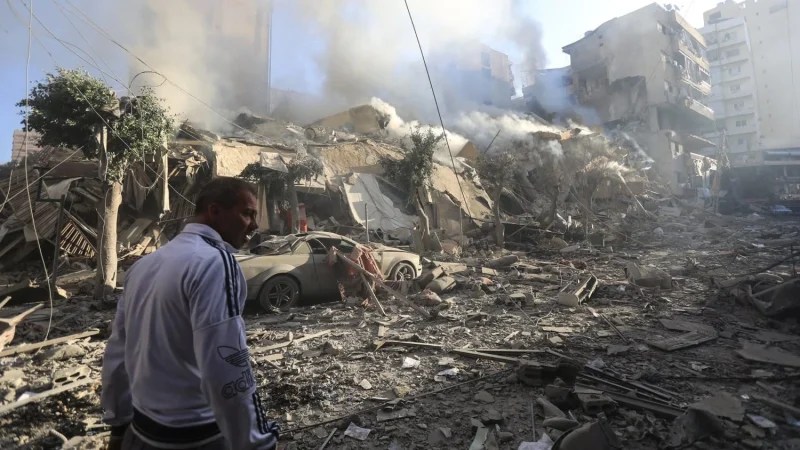
A Michigan man is one of more than one thousand people in southern Lebanon killed by Israel over the past two weeks. Israel has conducted massive bombardments of its northern neighbor, often using American weapons to perform the operations.
Kamel Ahmad Jawad was killed in southern Lebanon Tuesday morning, according to his family. He frequently made trips where he provided financial support and other assistance to the people of southern Lebanon.
Israel has ramped up its attacks in Lebanon over the past several weeks. Last month, Tel Aviv conducted multiple widespread terror attacks by planting explosives in small electric devices. Then, Israel killed Hezbollah leader Hassan Nasrallah after he accepted a ceasefire deal.
The assassination of Nasrallah kicked off a large-scale bombing campaign and a ground invasion of southern Lebanon. Israel has hit a number of civilian targets, often claiming some kind of Hezbollah assets were hidden in homes and other structures.
The State Department said it was “aware and alarmed” regarding Jawad’s death, but did not go on to condemn or threaten Tel Aviv for the murder.
Throughout the Joe Biden administration, there has been a distinct difference in reaction compared to when Americans are killed by Israel or if they are killed by a militant in a resistance group.
For example, the State Department regularly mentions the Americans who were killed and captured by Hamas on October 7 to justify the unlimited US support for Israel. However, when Israeli forces kill Americans, the White House allows Tel Aviv to investigate itself and accepts the often dubious results of the inquiry that absolves Israeli forces of any wrongdoing.
Reporters Without Borders’ Attack on Sputnik and RT Highlights NGO’s Status as ‘Media Wing of NATO’
By Ilya Tsukanov – Sputnik – 30.09.2024
Reporters Without Borders has published a sensationalist report on Russian media’s work in the Balkans as part of a new project known as ‘The Propaganda Monitor’, accusing Sputnik and RT of spreading “disinformation” and demanding a crackdown by the EU. Balkan affairs expert Stevan Gajic tells Sputnik why such fearmongering doesn’t work on Serbs.
Reporters Without Borders’ (French acronym RSF) new ‘Propaganda Monitoring’ multimedia minisite promises to “promote reliable journalism” by exposing “the many faces and tactics behind propaganda worldwide, bolstering the public’s understanding of the information space and helping them navigate it more safely.”
Russian media, including Sputnik and RT, have become the self-anointed Paris-headquartered media watchdog’s first target, with RSF rolling out a series of articles on Russian media’s ability to find evade censorship, custom-tailor content, and in Serbia’s case, transmit so-called “Kremlin propaganda in the Balkans despite EU sanctions.”
RSF wants the European Union and its members to “hold Serbia accountable for hosting Vladimir Putin’s factory of lies,” spending much of its investigation complaining about Russian media’s refusal to answer its loaded questions, whining about its successes captivating local audiences, and crying about Serbia’s receptiveness to hosting Russian outlets.
“Reporters Without Borders cannot be regarded as a reliable source because every line in this report is soaked with biased language,” Belgrade-based Balkan affairs expert and Institute of European Studies research associate Stevan Gajic told Sputnik, commenting on RSF’s report.
“The motivation” behind RSF’s demands for a crackdown comes down to its status as “a media wing of NATO, a media wing of the collective West. This is a pure Freudian projection. They are accusing others of what they are doing themselves,” Gajic stressed.
“Where were Reporters Without Borders when Radio Television of Serbia was bombed in 1999 and when 16 TV staff were murdered in cold blood?” the observer asked, referencing the 78-day NATO bombing of Yugoslavia in the spring of 1999. There is no credibility from people like this who did not act when they should have,” the observer recalled.
Narratives by RSF and others about Sputnik and RT being threats that need to be silenced have a clear end goal: “to nullify any kind of information coming from the other side to hush, to silence everybody who is not playing along NATO’s narrative. And this is especially a problem for NATO and for these puppet organizations, such as journalists with Reporters Without Borders, during times of war,” Gajic said.
As for RSF claims about RT’s spreading of “Kremlin narratives” in Serbia, Gajic emphasized that “pro-Russian sentiment amongst the Serbs has nothing to with the Kremlin, and everything to do with Washington and NATO.”
“Serbs are now more militantly pro-Russian because we were in a war against NATO and actually NATO was conducting and still is conducting hybrid aggression against us. I think that this speaks volumes about the falsehood of the presumptions and of the conclusions [made by RSF, ed.]. You can see how unrealistic and completely detached these people are from the reality, and how they are not really conducting deep research to see what is going on and how come,” Gajic said.
RSF’s conclusions are patently ridiculous, the observer suggested, highlighting the absurdity of “the presumption… that if it weren’t for RT and Sputnik, everybody, I guess in the Balkans and in Serbia and amongst the Serbs especially would be thrilled with the EU and NATO and so forth.”
“The new wave of the pro-Russian sentiment in Serbia was primarily created by the West. It was created by the West systematically targeting the Serbs for the last 30 years, since the moment of the breakdown of the bipolar global system” in place during the Cold War. Serbs became “the prime target,” a “Voodoo doll” for the West to “sting the Serbs in order for the Russians to feel pain,” according to Gajic.
“They were always demonstrating on us what they would like to do with Russia. That’s why many Serbs in the past said that all the wars we had with NATO and their proxies in the Balkans were actually just a preparation for a war that we are now seeing against Russia. That’s why I think the conclusion [of the RSF’s report, ed.] is false, because it comes from the presumption that if there were no ‘Russian propaganda’, quote-unquote, somehow people would feel different toward NATO.”
Joe Biden Is Responsible for Burning Lebanon
By Daniel Larison | The Libertarian Institute | September 30, 2024
The Joe Biden administration claims to be pushing for a “temporary ceasefire” between Israel and Hezbollah to avert a larger conflict, but this is very late in the day and it is not a serious effort to prevent a new war in Lebanon. It is at best a desperate, last-minute exercise in going through the motions of diplomacy. The administration would like to pretend that it is a passive bystander pleading from the sidelines instead of the chief patron and arms supplier of the main belligerent in the conflict, and it designs its entreaties to be toothless so that Israel can safely ignore them.
The United States has refused to exert any pressure on Prime Minister Benjamin Netanyahu’s government for the last eleven months, and it has continued supplying Israel with weapons no matter how those weapons have been used to commit war crimes against Palestinians. Now American officials say that they don’t want further escalation in Lebanon, but once again the administration won’t back up those words with action. The U.S. could use its leverage to rein Israel in and insist on the de-escalation that the administration says that it wants, but the president has shown that he has no interest in doing that.
The empty Gaza ceasefire negotiations prove as much. The ceasefire talks have become an interminable process designed to lead nowhere. The administration has catered to the Netanyahu government’s preferences at every turn. Each time that Netanyahu adds new deal-breakers or otherwise seeks to derail negotiations with new attacks, the administration has dutifully taken his side and pretended that Hamas is the sole obstacle to securing an agreement. The United States cannot be a credible diplomatic actor in the region when its primary role is acting as Netanyahu’s PR agent.
The Israeli government assumes that the U.S. won’t withhold weapons, diplomatic support, or military protection under any circumstances, and that has encouraged Netanyahu to pursue increasingly aggressive goals. Because the U.S. shields Israel from military reprisals, as it did earlier this year during Iran’s missile and drone strikes, it has given Netanyahu free rein to lash out whenever and wherever he wants. The administration has dressed all of this up as preventing a wider regional war, but the reality is that they have simply delayed the conflagration while making it more likely that it will be even more destructive when it occurs.
The total failure of the administration’s policy is there for all to see. The region is likely facing a new Israeli invasion of Lebanon, and that invasion will have serious destabilizing effects on the wider region. This is the disaster that the United States has claimed to oppose all along, but in practice it has done nothing to stop it. Had the U.S. truly wanted the war in Gaza not to spread, it would have demanded a lasting ceasefire months ago. Had the U.S. wanted to prevent escalation in Lebanon, it would be cutting off arms transfers and pulling back its forces from the region rather than rushing more troops to the Middle East. Instead the United States has done everything that one would expect it to do if it wished to set the region ablaze.
The U.S. is at great risk of being ensnared in this larger war. It is imperative that our country avoid direct involvement in Israel’s conflicts. The U.S. has no vital interests at stake in these fights. The president has no authority to involve American forces directly. It is not the responsibility of the United States to bail out a reckless client state when it gets in over its head. The quickest way to force the Israeli government to deescalate is to deprive it of the support and protection that it takes for granted.
Once the current crisis is over, U.S. foreign policy in the region has to be radically overhauled. To avoid future entanglements in the wars of client states, the U.S. should downgrade its relationships with the Middle Eastern governments that rely heavily on American weapons supplies and protection. The United States has no formal commitments to defend these states, and it should not extend security guarantees to any of them. The U.S. also needs to reduce its military presence in the region to the bare minimum required to secure our embassies. Decades of extensive American military involvement in this part of the world have been ruinous for the countries of the region and for American interests, and it is in the best interests of all concerned for the United States to get out.
What’s Wrong with Boris Johnson’s Plan to “Save” Ukraine?
Johnson’s “three-fold plan for Ukrainian victory”
By Brian Berletic – New Eastern Outlook – September 29, 2024
A September 21, 2024 article published in The Spectator written by former British Prime Minister Boris Johnson titled, “It’s time to let Ukraine join NATO,” attempts to formulate a theory of victory for Ukraine as war with Russia continues to grind on.
Johnson demands that the collective West “end the delays” and that the West “get it done and get it won.” By this, he means lifting all restrictions on the use of Western long-range weapons on pre-2014 Russian territory.
Next, he demands the US and Europe provide a “package of loans on the scale of Lend-Lease: half a trillion dollars,” or “even a trillion.” Johnson claims such support will send a message to the Kremlin that, “we are going to out-gun you financially and back Ukraine on a scale you cannot hope to match.”
Western personnel have already been operating in Ukraine since 2014 and have continued to do so throughout Russia’s Special Military Operation
Finally, he demands Ukraine be allowed membership into NATO immediately, even as the conflict rages on. In respect to NATO’s Article 5 regarding “collective defense,” Johnson proposes that:
… we could extend the Article 5 security guarantee to all the Ukrainian territory currently controlled by Ukraine (or at the end of this fighting season), while reaffirming the absolute right of the Ukrainians to the whole of their 1991 nation. We could protect most of Ukraine, while simultaneously supporting the Ukrainian right to recapture the rest.
While Johnson points out the political implications of this policy, meaning all of NATO would, “have to commit to the defence of that Ukrainian territory,” he falls far short of considering the practical implications.
NATO Intervention in Ukraine: Political vs. Practical Considerations
Far from a lack of political will or financial resources, the collective West has fallen short supplying Ukraine with the military equipment, vehicles, weapons, and ammunition required to match or exceed Russian military capabilities because its collective military industrial base itself is incapable of physically producing the quantities required, regardless of the money allotted to do so.
Military industrial production requires several fundamental factors in order to be expanded – financial resources being only one of many. Expanding production also requires the physical enlargement of existing facilities, the building of new facilities, the expansion of trained workforces which includes reforming and expanding primary, secondary, and specialized education, as well as the expansion of downstream suppliers and the acquisition of additional raw materials required for production across the entire industrial base.
Any one of these measures could take years to implement. Implementing them all would take longer still.
Then there is the very structure of the collective West’s military industrial base. Consisting of corporations prioritizing the maximization of profits, not performance, the collective West’s military industrial base has for years focused on low quantities of highly-sophisticated (and very expensive) weapons systems and munitions.
For the duration of the so-called “Global War on Terror” these weapon systems were adequate, if inefficient. They enabled US-led forces to roll over the antiquated, poorly-trained, poorly-equipped Iraqi army in 1991 and again in 2003, as well as the Taliban in Afghanistan in 2001. Such weapon systems also proved effective in the destruction of Libya in 2011.
But as the global balance of military and economic power has shifted throughout the 21st century, limits to this military industrial approach became apparent. In 2006, Israel’s vast Western-backed military machine categorically failed in its invasion of southern Lebanon, confounded by Hezbollah leveraging modern anti-tank weapons.
The US intervention in Syria from 2011 to present day also revealed the growing limitations of expensive Western military hardware, with 100s of cruise missiles fired at targets across Syria with limited success due to vastly better air and missile defenses than previous US adversaries possessed.
The Western media now admits waning US military support for Ukraine stems from dwindling stockpiles and an inability to quickly expand production.
CNN in its September 17, 2024 article titled, “US military aid packages to Ukraine shrink amid concerns over Pentagon stockpiles,” would admit:
US military aid packages for Ukraine have been smaller in recent months, as the stockpiles of weapons and equipment that the Pentagon is willing to send Kyiv from its own inventory have dwindled. The shift comes amid concerns about US military readiness being impacted as US arms manufacturers play catchup to the huge demand created by the war against Russia.
Nothing took place between September 17, 2024 when CNN published this report and September 21, 2024 when The Spectator published Boris Johnson’s article to change this reality. Johnson simply chose to ignore it.
NATO committing to the defense of Ukrainian-held territory would require sufficient quantities of artillery, armor, air and missile defense systems, and trained manpower – all of which the collective West, not just Ukraine, has in short supply.
In many ways, the collective West is already waging war against Russian forces. Western personnel have already been operating in Ukraine since 2014 and have continued to do so throughout Russia’s Special Military Operation (SMO) from 2022 onward. Russia has not hesitated to target and destroy Western equipment or the Western personnel operating it, though Russia has managed escalation very carefully in the process.
Were NATO to more openly intervene in what is already a NATO proxy war against Russia, Russian forces would likely continue targeting all of Ukraine’s territory while continuing to manage escalation carefully. NATO itself could escalate, using its long-range missiles and air power against Russian forces both within Ukraine and within pre-2014 Russian borders, but this would present two major problems.
First, if the West is already out of long-range weapons to transfer to Ukraine, its stockpiles having dwindled to critical levels, and having failed to expand production to reconstitute to them should any contingency of any kind fully deplete them, a more direct role in Ukraine would consume what arms and ammunition the West has left with no means of replacing them in the near-term.
Second, whatever impact the collective West imagines using the remnants of its arms and ammunition on Russia directly will have, it will leave the West far short of any material capabilities to conduct large scale war anywhere else in the world, including in the Middle East against Iran and its allies and across the Asia-Pacific region against China – two areas of concern Johnson himself mentions in his article.
Boris Johnson claims:
If you are truly worried about ‘escalation’, then imagine what happens if Ukraine loses this war – because that is when things really would begin to escalate. Ukraine won’t lose but if it did, we would have the risk of escalation across the whole periphery of the former Soviet empire, including the border with Poland, wherever Putin thought that aggression would pay off.
We would probably see escalation in the South China seas and in the Middle East. We would see a general escalation of global tension and violence because a Ukrainian defeat, and a victory for Putin, would be not only a tragedy for a young, brave and beautiful country; it would mean the global collapse of western credibility.
What Johnson means by “western credibility,” is Western primacy. By “escalation in the South China seas and in the Middle East,” Johnson means regional players displacing unwarranted US-led occupation and interference. Johnson’s plan to commit the West’s waning military power to Ukraine means forfeiting the means to cling to primacy elsewhere around the globe.
Johnson’s plan to incorporate Ukraine into NATO would not be a master stroke up-ending Russia’s escalation dominance, it would be the forfeiture of NATO’s own escalatory leverage regarding Article 5. Success for NATO would depend entirely on Russia failing to call the West’s bluff and avoiding the targeting of Ukrainian territory once NATO intervenes directly.
A very similar strategy was used in Syria by the United States as a means to reverse the flagging fortunes of its proxies there. The US, instead, at most managed to create a stalemate. Over the past nearly 10 years the US has occupied eastern Syria, its position in Syria as well as in the rest of the region has waned.
Part of this stems from the US’ inability to field a large enough military force, armed with sufficient numbers of arms and munitions. US air and missile defense systems in particular are in short supply and have opened up US forces in Syria and Iraq to regular drone, rocket, and missile strikes, compromising US military supremacy in the region.
By stretching US and European military power out even thinner by committing large numbers of troops and equipment to a direct intervention in Ukraine only means accelerating the decline of US-led Western primacy around the globe even faster.
Johnson’s plan to “save” Ukraine is borne of desperation, predicated on either a poor understanding of the fundamental factors required for its success, or deliberately ignoring these factors.
It is also a plan born of a lack of imagination. For Boris Johnson and the Western special interests he represents, the only possible future for humanity is one dominated by the West, just as it has done for the past several centuries.
The ultimate irony, however, is Johnson’s mention of a “Soviet empire” he claims Russian President Vladimir Putin is intent on rebuilding. At one point, Johnson claims:
The message is: that’s it. It’s over. You don’t have an empire anymore. You don’t have a ‘near abroad’ or a ‘sphere of influence’. You don’t have the right to tell the Ukrainians what to do, any more than we British have the right to tell our former colonies what to do. It is time for Putin to understand that Russia can have a happy and glorious future, but that like Rome and like Britain, the Russians have decisively joined the ranks of the post-imperial powers, and a good thing, too.
Yet, the conflict in Ukraine stems directly from NATO expansion toward Russia’s borders. It was never a matter of Russia telling Ukraine what to do – it was always a matter of the US politically capturing Ukraine in 2014 and transforming it into a national security threat to Russia from 2014 onward.
Russia is responding to the expansion of a modern-day empire – not in any sort of effort to create its own empire. The empire Russia opposes in Ukraine [Zionist globalism] is the same empire Johnson fears will be challenged in the Middle East and the South China Sea should its proxy war fail in Ukraine. While Johnson accuses Russia of being out of touch with reality regarding imagined imperial ambitions in Moscow, his plan reflects very real delusions associated with a desperate desire to perpetuate the US-led “international order” the UK itself is so deeply invested in.
Boris Johnson’s attempt to build policy regarding the West’s proxy war in Ukraine without a sufficient foundation is a recipe for disaster – the same sort of disaster this proxy war in Ukraine has precipitated that Johnson’s desperate plans are meant to address in the first place.
Brian Berletic is a Bangkok-based geopolitical researcher and writer.
As the West tries to silence RT, the Global South speaks out
The US-led “diplomatic campaign” to suppress RT worldwide is not getting the warm reception Washington hoped for
By Anna Belkina | RT | September 28, 2024
The United States government has recently issued new sanctions against RT, with the State Department announcing a new “diplomatic campaign” whereby – via US, Canadian, and UK diplomats – they promise to “rally allies and partners around the world to join us in addressing the threat posed by RT.”
In other words, the plan is to bully countries outside of the Collective West into shutting off their populations’ access to RT content in order to restore the West’s almost global monopoly on information. Latin America, the Middle East, and Africa appear to be of particular concern to the State Department’s James Rubin, as it is in those regions where US foreign policy has failed to find universal purchase.
As Rubin said during a press conference, “one of the reasons… why so much of the world has not been as fully supportive of Ukraine as you would think they would be… is because of the broad scope and reach of RT.”
Clearly not trusting anyone outside of the Western elite circles to think and decide for themselves which news sources people should or should not have access to, Rubin promised that the US will be “helping other governments come to their own decisions about how to treat” RT.
The statement reeks of patronizing and neo-colonialist attitudes, especially when you consider the countries that are being targeted.
Therefore, it has been reassuring to observe over the past couple of weeks the diversity of voices that have spoken out against this latest US-led crusade.
The Hindu, one of India’s newspapers of record, was among the first, reporting that while “US officials have spoken to [India’s] Ministry of External Affairs about joining their actions” against RT, “government officials said that the debate on sanctions is not relevant to India, while a former diplomat said that banning media organizations showed ‘double standards’ by Western countries.”
This position was seconded by Indian business newspaper Financial Express : “India is unlikely to act on this request [to ban RT], given its longstanding friendly relations with Russia and its own position on media censorship… In India, RT enjoys significant viewership, with its content reaching a large number of English-speaking audiences and also expanding its reach through a Hindi-language social media platform. RT has grown in popularity in India and other parts of the world, claiming that its main mission is to counter the Western narrative and offer Russia’s perspective on global affairs.”
In the Middle East, Saudi Arabia’s Okaz paper said, “it is paradoxical, that when [free] speech becomes a threat to the US and the West, they impose restrictions on it, as it happened with the ban on RT under the pretext of lack of transparency, spreading false information, interfering in internal affairs and inciting hatred – something that Washington and the West themselves do in relation to other countries.”
Leading Lebanese daily Al Akhbar wrote: “despite all the attempts to ban it… RT continues to broadcast and causes concern among supporters of imperial wars. These efforts also demonstrate the hypocrisy of their authors and their false claims about ‘freedom of speech’ and ‘freedom of the press,’ among their other loud proclamations. They claim that RT is a ‘mouthpiece of disinformation,’ but if this is so, then why is there such fear of it? If the channel really is spreading lies, won’t the viewers be able to notice? [This only works] if Western rulers view their citizens as simple-minded and easily deceived, which in turn explains the misinformation coming from every side of the Western media.”
It is safe to say that “Western rulers” view with such disregard and distrust not only their own citizens, but most of the world’s population… But I digress.
In Latin America, Uruguay-based current affairs magazine Caras y Caretas praised RT for “maintain[ing] a truthful editorial line, beyond being a state media outlet, and [it] has increased its popularity and credibility by exposing a perspective that makes it creative, original and authentic… RT has helped open the eyes of a very large part of the world’s population and of increasingly numerous governments and countries. That is the reason for the sanctions that the US and hegemonic media conglomerates such as Meta and Facebook have imposed on RT and its directors, adjudicating against them with the charges that are not believable, and are ridiculous. The statements of top US administration officials claiming to be defenders of press freedom and accusing RT of being a front for Russian intelligence is only an expression of impotence in the face of an alternative narrative to the hegemonic imperialist story.”
Rosario Murillo, the vice president of Nicaragua, sent RT a letter of support. In it, she berated the US authorities for their actions against the network, asking when they will “learn that the aggressions that they shamelessly call Sanctions, (as if they had divine powers to dispense punishments)… have no more sense than establishing their claims to the position [of] dictators of the World.” She praised RT’s “work and the creative, thoughtful, illustrative, sensitive and moving way” that RT “manage[s] to communicate.”
A number of African outlets have also spoken out about the hypocrisy of America’s global censorship. Nigerian newspaper The Whistler summarized the latest Western media diktat and its colonialist undertones thusly: “The Americans got into some quarrel with Russia and then shut down this Russian news channel. An order signed by some American politician in Washington got the European company supplying Multichoice to stop streaming RT… The result? We in Nigeria woke up one day to find we could no longer watch RT on TV or stream them on Facebook because of some drama happening in Washington and Moscow. Imagine the audacity! It was a decision made by Americans and Europeans without asking anybody here in Africa how we felt about it. They decided what we could and could not watch on our own TVs.”
It is heartening to see that so many different countries, with incredibly varied politics, societies, and cultures, speaking out against Washington’s imposing its world order on them. They prove that RT’s voice continues to be not just necessary, but welcomed and sought after.
Last night, as part of RT’s response to the actions of the US government, the bright green RT logo lit up the facade of the US Embassy building in Moscow with the message: “We’re not going away.”
Not in the US, not in the West at large, not in other parts of the world.
See you around!
We need to call out the hypocrisy of the humanitarian paradigm
By Ramona Wadi | MEMO | September 26, 2024
Israeli Prime Minister Benjamin Netanyahu’s address to the Lebanese people before bombing their country was eerily similar to the rhetoric usually associated with Gaza. Hezbollah, he told the Lebanese, are using them as human shields and hiding weapons in their homes; the latter was made to sound more familiar by mentioning specific family rooms: “Rockets in your living rooms and missiles in your garage.” To seal Israel’s impunity in Lebanon after telling the Lebanese population to flee from his army’s bombs, Netanyahu added, “Don’t let Hezbollah endanger your lives.” As Israel’s kill toll rises in Lebanon, almost 500,000 Lebanese have been forcibly displaced from their homes in a matter of two days. This can be added to the 1.9 million Palestinian civilians who have been forcibly displaced from their homes in Gaza by Israel.
Meanwhile, the US reached for its playbook on Gaza and endorsed Israel’s right to defend itself, this time allegedly from Hezbollah. “No nation should have to live with these threats right across their border, right next door,” said US White House National Security Spokesperson John Kirby.
How about people not having to live with Israel’s threats at their border or in their homes, Mr Kirby?
Israel has invaded Lebanon on at least five occasions since the late seventies, remember, not including numerous air strikes.
Now diplomats are revealing that the genocide in Gaza is only the beginning of the chaos in the Middle East and the humanitarian paradigm is the only way for them to feign political concern. So blatantly is the world supporting Israel’s actions, that it has come to the point where a failed humanitarian paradigm remains at the forefront of the international agenda, and the discrepancy is rarely called out.
The international community sustains this discrepancy between colonial violence, war, genocide and humanitarian aid. The former reigns supreme and yields profits. Humanitarian aid, on the other hand, works like a defunct charity to make sure that the displaced remain too busy trying to survive to do anything untoward against those responsible for their situation. They face a daily struggle to survive Israeli aggression, bombs and the international community’s collaboration allowing Israel to eliminate who it chooses for territorial gain. “Greater Israel” is the Zionist objective.
We now see that speaking out against breaches of international law is being criminalised, and being taught not to speak out is normalised; in turn, the normalisation of complicity in genocide and forced displacement completes the cycle. World leaders, we are told, must be allowed to talk and lead uninterrupted, and they will decide which nation is to be massacred, displaced, forced to live in temporary shelters while foraging for food, waiting for a temporary pause in the slaughter to receive polio vaccines and be killed later; letting Israel control the lives and deaths of civilians, and all because the international community offers humanitarian aid in return for silence. For the victims, the humanitarian paradigm is a failure on so many levels, a licence to silence criticism and an open invitation to perpetual displacement and premeditated murder.
What do we make out of humanitarian aid as a political paradigm? How is a bare minimum of shelter against biting cold an acceptable measure, when tents provide no shelter against bombs and bullets? Why is it acceptable that countries bolstering Israel’s genocide in Gaza and its war in Lebanon get to dictate who gets humanitarian aid, and when?
The Norwegian Refugee Council-led Shelter Cluster has estimated that it would take aid agencies more than two years to deliver 25,000 sealing kits to Gaza at the current rate of two truckloads per week. In the face of humanitarian aid being weaponised — US Secretary of State Antony Blinken misled Congress about Israel blocking aid to Gaza, for example — leading to the slow death of its intended recipients, why is the world keeping silent? We need to call out the hypocrisy of the humanitarian paradigm.
Open Letter to Dr. Jill Stein
Dear Dr. Stein,
Up to last week, you graciously provided US voters with a clear, viable, electoral alternative to the twin war parties, namely, Democrats and Republicans. Regrettably, last Thursday, September 19th, your campaign issued a statement undermining your status as the “peace candidate.”
The statement called Russian President Putin and Syrian President Assad “war criminals” for their roles resisting a US-orchestrated regime-change operation, begun in 2011 and continuing to this day, in Syria. That operation, illegal under international law, was initiated under the Obama Administration and led by his Secretary of State, Hilary Clinton. Under Clinton, the US created a government-in-waiting, called the Syrian National Council, which it recognized as the legitimate government of Syria, and marshalled its allies in Europe and among Arab countries, to recruit, finance, train, arm, insert, and coordinate armies of terrorist mercenaries (from Al Qaeda, the Muslim Brotherhood, and, later, ISIS) into Syria where they illegally invaded and occupied large swaths of Syrian territory. Through their barbaric war crimes, those de facto US foot soldiers caused terror among the Syrian population, causing millions to flee their homeland as refugees and even more to be displaced within Syria.
The US end game was to destroy an enemy of Israel and a state that opposed US hegemonic initiatives in the region. The US strategy was to balkanize the country of Syria into tiny, warring, confessional statelets and leave the country as a failed state, in the same manner that the US and NATO destroyed the Libyan government at precisely the same time and left it as a failed state.
Presidents Putin and Assad were and are not the problem. Russia was and is an ally of Syria. It long maintained a naval base in Syria at Tartus. At the official request of the Syrian government, Russia was invited to help Syria, in accordance with international law, to defend the national sovereignty and territorial integrity of Syria. With Russian help, along with support from Iran and Hezbollah (likewise allies of Syria), the Syrian Arab Army was able to liberate most of the country from terrorist control.
During his Administration, following the strategic defeat of ISIS, Trump decided to leave US troops (who were never invited into Syria in the first place) in occupation of the eastern third of Syria, where, to this day, they (along with their Kurdish militia) continue to steal Syria’s oil and wheat resources, thus preventing the legitimate government in Damascus from using these funds for reconstruction.
And, in addition to all these flagrant violations of international law, the US, its NATO partners, and various Arab countries joined the US in imposing extremely brutal coercive economic measures against Syria, devaluing the country’s currency and destroying its economy. These economic sanctions are unilateral and illegal (not having the approval of the UN Security Council). But they reduced 80% of the Syrian population today to food insecurity and to reliance on a meager hour or two of electricity per day.
Dr. Stein, your September 19th statement has disappointed many people in the USA and around the world. You cannot be the “peace candidate” on the one hand, and support criminal enterprises, (waged by both Democrats and Republicans) such as the war which continues today in Syria, on the other. We hope you will do the right thing, which would be for you to call for the US to end its unlawful occupation of eastern Syria and to drop its brutal sanctions regime against the country. Finally, you have certainly noted that Syria has been readmitted to the Arab League and that many countries of the world have re-established diplomatic relations as well as trade and communication links with the country. We hope that you, too, will champion the ending of US hostilities against Syria and call for the re-establishment of full diplomatic relations.
Suggested Resources:
- The War Against Alternative Information, by Rick Sterling
- Attacks on Academic Freedom, The Times of London and MI6
- Syria Crucified: Stories of Modern Martyrdom in an Ancient Christian Land by Zachary Wingerd and Brad Hoff
Biden’s ‘Performative’ Lecture on Democracy at UN Belies True US Role in World
By John Miles – Sputnik – 25.09.2024
Biden has made his claimed struggle for democracy a primary argument for the Democratic Party’s campaign against former President Donald Trump, but a closer look reveals the malign role of the United States in preserving countries’ sovereignty and self-rule.
US President Joe Biden spoke before the United Nations General Assembly Tuesday, taking the opportunity to deliver what is likely one of the final major speeches of his political career.
The yearly gathering of world leaders and diplomats, which takes place each September in New York City, has served as the backdrop for several significant moments throughout its almost 80-year history. Cuban revolutionary Ché Guevara addressed the assembly in 1964, touting Havana’s literacy campaign and assailing US intervention in Latin America. Former Libyan leader Muammar Gaddafi delivered a highly memorable speech in 2009, as did ex-Venezuelan President Hugo Chávez, who blasted George Bush, neoliberalism, and the US War on Terror in a 2006 broadside.
The week-long event provides an important forum for developing nations, who are briefly granted equal footing with great world powers. But the General Assembly is often criticized as a “talk shop” by those who claim the recognition granted to countries is more symbolic than tangible. Author and analyst Caleb Maupin joined Sputnik’s The Final Countdown program Tuesday to discuss the 78th session of the annual event and break down Biden’s address before the international audience.
“He talked about democracy and how he’s committed to democracy,” said Maupin, noting that Biden touched on themes he has frequently spoken about during the 2024 presidential election season. “He talked against Russia. He talked against Venezuela. He talked against the Palestinians. He talked up support for Israel. Joe Biden made a series of remarks going over standard US foreign policy.”
“Joe Biden really likes to do these kinds of performative, ideological shows, and that’s what his summit for democracy that he bragged about in his UN speech was,” the analyst claimed. “He loves to do these little performances where he talks about how he’s sticking up for democracy and democratic ideals.”
Biden has made his claimed struggle for democracy a primary argument for the Democratic Party’s campaign against former President Donald Trump, but a closer look reveals the malign role of the United States in preserving countries’ sovereignty and self-rule. A 2015 study found the US provides military support to 73% of nations labeled “dictatorships,” with Saudi Arabia and Juan Orlando Hernández’s oppressive former regime in Honduras providing perhaps the most prominent examples.
Former US Secretary of State Henry Kissinger, still lauded as one of America’s most admired and consequential statesmen, made his contempt for democracy clear in 1970, when he vowed to intervene in Chile if the country elected an anti-imperialist leader. “I don’t see why we need to stand by and watch a country go communist due to the irresponsibility of its own people,” said the controversial figure, who spearheaded a campaign of social and economic subversion of the Latin American country after the election of Salvador Allende.
Three years later Chile’s democratically-elected president would be removed in a bloody US-backed military putsch, ushering in almost two decades of bloody dictatorship resulting in the death and torture of tens of thousands. The model was duplicated in Bolivia, Brazil, Peru, Uruguay, Paraguay, and Argentina in a campaign of state terror and repression known as Plan Cóndor.
The US has worked to support coups and subvert democracy in dozens of countries around the globe, but its role in Palestine has generated perhaps the most attention in recent years. The United States has frequently undermined the influence of the UN and the force of international law in the name of defending Israel from criticism, recently downplaying the importance of a vote by the UN Security Council that called on the country to end its campaign in Gaza. The US has also led a group of Western countries in defunding the UN Relief and Works Agency for Palestine Refugees in the Near East (UNRWA), a crucial lifeline for refugees facing hunger and displacement that Israel has long viewed as an impediment.
“There is a lot of criticism that can be leveled at the United Nations Relief and Works Agency,” noted Maupin. “[With] Israel though, in particular, there is a political issue there, which is the UN frequently criticizes Israel and calls out Israel for its treatment of the Palestinians.”
“Israel considers any connection with the legitimate elected government of Gaza, which is Hamas… support for terrorism,” he continued. “If the UN set up a health care clinic and an elected official who’s part of the government in Gaza – that would be a member of Hamas – showed up and got health care, that would be considered aid to terrorism.”
Former US Secretary of State Hillary Clinton revealed the country’s actual views on democracy in leaked audio of comments from 2006, in which she demonstrated that the United States’ support for democratic elections is highly contingent upon voters choosing candidates in line with views and policies supported by Washington.
“I do not think we should have pushed for an election in the Palestinian territories. I think that was a big mistake,” Clinton said of the ballot that brought Hamas’s armed resistance movement to power in Gaza.
“If we were going to push for an election then we should have made sure that we did something to determine who was going to win,” she claimed, appearing to suggest the United States should have intervened to rig the outcome.
Washington’s new plan to control the Global South
By Anna Belkina | RT | September 20, 2024
When US Secretary of State Anthony Blinken announced a new “joint diplomatic campaign” to be implemented in concert with Canada and the UK last week, he clearly set out the initiative’s goal – “to rally allies and partners around the world to join us in addressing the threat posed by RT and other machinery of Russian disinformation and covert influence.”
Make no mistake: there is nothing diplomatic in this latest US effort to silence any voice that does not adhere to the Washington- and London-dictated narratives about the world.
The point of all news media is to inform. Any information has the potential to influence people. Thus, the collective West has set out to curtail all potential influence that is not theirs.
Helping hand
James Rubin, the coordinator for the US State Department’s Global Engagement Center, elaborated on how this plan would work in an interview with his ex-wife, Christiane Amanpour, on CNN.
“Other countries will make decisions for themselves,” of course, but the charitable, the always-benevolent, the never self-interested American hand will be “helping other governments come to their own decisions about how to treat” RT.
Ah, all those poor, hapless “other governments” that clearly cannot read, watch, think, and decide for themselves. They were just waiting for Big Brother to help them.
What Rubin was really doing was scapegoating RT – and by extension, all other independent voices in what is supposed to be a free and diverse global information space, reflecting a diverse, very complicated, multipolar world – for the increasingly diminishing buy-in of much of the world into Washington’s foreign policies, and propaganda campaigns that accompany them.
As Rubin admitted during his press conference, “one of the reasons […] why so much of the world has not been as fully supportive of Ukraine as you would think they would be […] is because of the broad scope and reach of RT – where propaganda, disinformation, and lies are spread to millions if not billions of people around the world.”
Which countries refused to jump on board with the US and NATO support of the Kiev regime and the continuous escalation of the conflict? In reality, it is most of the world, including such geopolitical giants as India and China, who preferred to leave regional issues to the region in question.
Where official positions are concerned, it’s mostly NATO and its cohorts’ one billion vs our planet’s other seven. And while in those seven not everyone in the general population is of the same mind, neither is everyone in the US and other NATO countries.
Yet, due to the decades-long domination of the international information space by American and European mainstream news media (can you believe the BBC is over 100 years old?), many have been conditioned to think of the world – in the sense of who defines the global order, its rights and its wrongs – as the US and its vassal-state allies.
Notably, Mr Rubin specifically referred to Latin America, the Middle East, and Africa as regions where RT must be stopped. In other words, the so-called Global South. What’s got the US State Department so worried there?
RT’s success is Western media’s loss
Western military, political, and media establishments have been panicked over their loss of monopoly on global information in general, and about RT’s growing reach and influence in particular, for a while now. The self-proclaimed champions of free press, speech and thought cannot handle any of that free-thinkin’ they campaigned for.
To wit, have a scroll:
THE FOUNDATION FOR DEFENSE OF DEMOCRACIES, US: “Washington is struggling in the battle for hearts and minds in the ‘Global South’, where Russian propaganda outlets are often more popular than Western media.”
NEWSWEEK : “… it’s in the Global South that Russia has reaped the most significant rewards. The popularity of the Kremlin-controlled TV station Russia Today is high…”
POLITICO : “… many of the Kremlin-backed accounts – especially those from sanctioned media outlets like RT and Sputnik – have an oversized digital reach. Collectively, these companies boast millions of followers in Europe, Latin America and Africa…”
ROYAL UNITED SERVICES INSTITUTE, UK: “Latin America has witnessed a growth in Russian information efforts. Just like in the Middle East, Russia is operating a number of popular media channels, such as RT en Espanol, Sputnik Mundo and Sputnik Brasil, with substantial followings.”
CENTER FOR STRATEGIC AND INTERNATIONAL STUDIES, US: “Russia’s […] media presence and influence [in Latin America] are unmatched… The reach of Russia’s technique has proven to be effective … Actualidad RT and Sputnik Mundo have become so mainstream in LAC, that in December 2022, RT Spanish won three prestigious Mexican journalism awards for their coverage of the war in Ukraine.”
WILSON CENTER, US: “Russia has successfully implemented long-term strategies to capture and influence intellectual elites in Latin America.”
ATLANTIC COUNCIL: “Russia has established a significant media and information footprint throughout the [Latin American] region with Russia Today and Sputnik News.”
EL MUNDO, SPAIN: “In addition to hybrid channels, [Russia] uses public companies such as Russia Today, whose propaganda is triumphing in Latin America – the Spanish-speaking version of RT […] is integrated into family daily life from Venezuela to Bolivia.”
INTERNATIONAL BUSINESS TIMES, UK: “Egyptian media ran headlines and reports verbatim from RT Arabic, […] EU Reporter, an independent media outlet, reported that ‘Russian media outlets like RT Arabic and Sputnik are extremely popular, with RT Arabic becoming one of the most trafficked news websites in the country.’”
FOREIGN POLICY : “RT Arabic and Sputnik Arabic emerged as major sources of legitimate regional news in the Middle East.”
JOSEP BORRELL, HIGH REPRESENTATIVE OF THE EU FOR FOREIGN AFFAIRS AND SECURITY POLICY: “When you go to some African countries and you see people supporting Putin, supporting what Putin is doing in Donbass, saying Putin has saved Donbass, now he will come to Africa and save us.”
ABC, SPAIN: “The Kremlin has tried to increase its influence in the media using Russia Today and Sputnik News. And there have also been collaboration agreements with local media, hiring African journalists and African activists, and at the same time generating news in Arabic, English or French to gain the support of the African population.”
Thank you, thank you very much.
Exporting censorship
Since RT’s launch in 2005, our journalists have brought to light countless stories and points of view disallowed in the Western mainstream. We have built a massive global audience and won the trust of viewers and readers worldwide.
But, despite Western elites’ declarations to the contrary, any voice that fails to fit into the rather cramped echo-chamber they have set up to accommodate supposedly free discourse, is inherently seen as illegitimate. Therefore, it must be silenced.
Which is why, having pushed out official RT channels from Western airwaves and digital platforms, they now want – nay, need and ought – to export their particular brand of censorship globally. They pledge to wage a coordinated campaign to force other nations into following their example, all so that the West can recover its information monopoly. They must “disrupt [RT] activities” everywhere. It is not enough for them to silo off their own people from inconvenient facts and alternative viewpoints. They have the megalomania and the audacity to say that no one in the world should hear them either.
This is especially so in the Global South countries – the ones that the US has gotten accustomed to patronizing, manipulating, dominating, undermining and overthrowing unsuitable-to-them regimes, and outright controlling in any way they could, over the last century.
Welcome to neocolonialism, Taylor’s 2024 Version.
Government folks have also already lined up Silicon Valley wunderkinds – the tech giants that are ever so eager to curry political favor in order to stay on the lax side of corporate regulation – in this endeavor. Meta, which blocked access to RT’s Facebook and Instagram accounts in the EU in 2022, has overnight removed RT from its platforms – entirely and worldwide.
YouTube removed RT’s record-breaking channels everywhere that same year, but Google’s parent company, Alphabet, had already worked to “de-rank” RT and Sputnik in Google searches back in 2017.
After all, “RT is the top recommended source for news concerning Douma’s chemical weapons attack, Skripal poisoning and the Syrian White Helmets,” wrote the Atlantic Council in 2018. In 2019, “Bild conducted a test and entered the query ‘Ukraine’ into Google News. Again, among the top ten articles were three from RT Deutsch and Contra Magazin.” When people looked for news, they came to RT.
This could not stand.
A quick aside: despite all the claims by the Americans and the Brits about RT’s supposed attempts to “sow discord” in their societies, the network really should be lauded for bringing people together instead. In the US, where political bipartisanship is a near-extinct species, the Biden administration’s present-day efforts are fully endorsed by Fiona Hill, of Donald Trump’s National Security Council, who argued that “there has to be concerted action against RT.” In the UK, the recently elected Labor leadership has fully adopted their Tory predecessors’ anti-RT playbook.
Not going away
Let me be clear: RT is not going anywhere, in the West nor in the Global South. Our journalists will continue to do their jobs. We will continue to find ways to have our voice heard. Our audiences “of millions if not billions of people around the world” expect nothing less of us. This is our duty to the global community.
As for the global community, where does it stand, in the face of this new US-led campaign?
The Hindu, one of India’s newspapers of record, reported that already “US officials have spoken to [India’s] Ministry of External Affairs about joining their actions against what they call ‘Russian disinformation’, by revoking accreditations and designating [RT] journalists under the ‘Foreign Missions Act’. However, while the ministry has been silent on the issue, government officials said that the debate on sanctions is not relevant to India, while a former diplomat said that banning media organizations showed ‘double standards’ by Western countries… An official said that the matter ‘does not pertain’ to India and pointed out that India does not follow unilateral sanctions that are not approved by the United Nations.”
We are confident that the rest of the truly independent world will follow suit.
Anna Belkina is RT’s deputy editor in chief and head of communications, marketing and strategic development.
Featured Video
Theodore Postol: Iran’s Missiles & Drones Were Underestimated
or go to
Aletho News Archives – Video-Images
From the Archives
What is the Israeli Lobby in Australia Doing in Interfaith Dialogue?
By Ali Kazak | Dissident Voice | October 11, 2015
For years Israel and its lobby around the world have been trying to normalise their relations with Arabs and Muslims without solving the Palestine Question.
One of the methods they resorted to in the last few years is using human rights and community organizations such as interfaith dialogue and Multiculturalism to achieve this objective and to: isolate the Palestinians, marginalise the Palestine question, end Israel’s isolation, and prevent criticism of Israel, knowing that these organisations will be the first to stand against Israel’s violations, racial and religious discrimination.
The group responsible for this task in Australia is The Australia/Israel & Jewish Affairs Council (AIJAC); its Director of International & Community Affairs, Jeremy Jones is in charge of lobbying religious community organizations, specifically Muslims and Christians. Consequently he convened the Faith Communities for Reconciliation, founding participant in the Australian Partnership of Religious Organisations and the Australian National Dialogue of Christians, Muslims & Jews.
AIJAC is a private political propaganda group. It is recognised as the main Israeli lobby in Australia. It coordinates its activities and works intimately with the Israeli embassy in Canberra and different institutions in Israel. It is privately funded by some Jewish businessmen. It monitors closely Australian politicians, the media, ethnic and religious groups, (especially Arabs and Muslims), unions and academics on their stands towards Israel and the Palestine question. … continue
Blog Roll
 Aletho News
- The Most Important Bet You’ve Never Heard Of
- The killing of three Indonesian soldiers in Lebanon should remind Jakarta that Israel does not want peace
- Defeated and delusional: Netanyahu’s remarks reveal $80bn war failure, says analyst
- Iran’s friends are about to make life much more difficult for Israel and the US
- The war of liberation of the Arab and Islamic peoples expands across the Gulf
- Envoy warns UN on Trump’s threat to ‘obliterate’ Iran’s civilian infrastructure
- The Larak Corridor: Iran’s Rial Gate With No US, No Israel, and No Way Around
- ‘Economic terrorism’: Steel facilities hit again in US-Israeli strike
- ‘War Crime’: Iran condemns attacks on Arak, Ardakan nuclear sites
- Two-thirds of Americans want quick end to Iran war even if goals unmet
- If Americans Knew
- Gaza families reunite years after babies evacuated amid Israel’s war
- International Rescue Committee warns Gaza’s children face grave protection risks
- Iran’s Alleged 47-Year War on America: Debunking the 1,050 American Deaths Canard
- Israel wants US to bomb more of Iran’s civilian structures (113,000 is not enough) – Not a ceasefire Day 173
- Ann Coulter Rips Into Fox News for Iran War Coverage
- Joe Kent Urges Americans To Call White House and Congress To Object To Sending Troops Into Iran
- DNC Resolution to Reject AIPAC Funding Puts Democratic Leaders in the Hot Seat
- Swedish foundation to build 400 schools as over 650,000 Gaza children remain without education for 2 years
- Israeli army admits photshopping image of slain Lebanese journalist
- This is how Israel is systematically killing health workers under the cover of war in Lebanon
- No Tricks Zone
- New Study Finds Warming Saves Lives…Cold Temperatures 12 Times More Deadly Than Excess Heat
- German Science Blog Accuses PIK Climate Institute Of Hallucinating Climate Tipping Points
- Devastating Assessment Of Comirnaty Vaccine By Former Senior Pfizer Europe Toxicologist
- New Study: CO2 Is ‘Effectively Negligible’ As An Explanatory Climate Change Factor Since 2000
- Former Pfizer Toxicologist Dr. Helmut Sterz Tells Bundestag Hearing Pfizer Vaccine Should Have Never Been Approved
- Energy Expert: Germany’s Nuclear Phaseout Was A “500 Billion Euro Mistake”
- New Research: South Australia’s Mid-Holocene Sea Surface Temperatures Were 4°C Warmer Than Today
- Storing Green Energy To Last Germany 10 Days Would Require A 60-Million Tonne Battery
- New Studies: UK Sea Levels Were 4 Meters Higher Than Today During The Mid-Holocene
- Destructive Green New Deal: German Energy And Metal Group Warns Of Drastic Crisis
 Aletho News