The Nobel Peace Prize should be renamed the Nobel Propaganda Prize, after this year’s ever-so contrived award to the UN-approved chemical weapons team sent to disarm Syria.
Other dubious winners of the “illustrious” prize include the accused war criminal, former US Secretary of State Henry Kissinger, who oversaw the genocidal carpet-bombing of Indochina during the 1970s.
More recently, another accused war criminal, US President Barack Obama, is among the honorees of the award despite his ongoing use of assassination and murderous aggression in multiple countries, including Iran, Libya, North Korea, Somalia, Yemen and Syria.
A Norwegian-based committee of seemingly Scandinavian neutrality makes the award every year as it has done for more than a century ever since 1901. The prize was the creation of Alfred Nobel, a major armaments manufacturer. That in itself speaks volumes on the institution’s contradictory nature.
Last year, the winner of the Nobel Prize was yet another disgrace to morals and commonsense in the form of the European Union. How can a bloc of governments be remotely considered peaceful when it is wiping out basic social welfare for millions of its citizens in the service of criminal banks and elite private wealth? Or when it is lifting a weapons embargo on extremists running amok in Syria? Or colluding in the enforcement of crippling economic sanctions on Iran – based on nuclear calumnies cooked up by Western military intelligence – sanctions that are killing women and children from the lack of basic imported medicines?
While there have been a few deserving winners of the Nobel Peace Prize down through the years, nevertheless it is best to treat this institution with skepticism, if not derision. The meritorious aspects of the award can serve to give credence to the dubious and deplorable associates. In that way, it is more Propaganda Prize than Peace Prize.
This year’s recipient, the inspection team belonging to the Organization for the Prohibition of Chemical Weapons, have only begun their work last week to dismantle stockpiles in Syria. This is part of the arrangement that Russia proposed last month to avert an illegal war of aggression being planned by the Nobel Peace Laureate Barack Obama. The Syrian government of President Bashar al-Assad has fully signed up to the disarmament process.
However, it is precocious, to say the least, to award the OPCW with the Nobel prize, just like it was for the Oslo-based committee to give the award to Obama in 2009, only within months of his first election and before he went on to prove himself one of America’s most warmongering presidents since World War II.
How do we know that the OPCW will be effective in disarming the chemical weapons of the Western-backed mercenary groups fighting to overthrow the Assad government? How do we know that the OPCW will not mischievously misuse its remit and Nobel Laureate status to advance the Western propaganda narrative against the Syrian government?
The awarding of a peace prize based on no track record conjures suspicion that the institution and its benign connotations are being used to inculcate a reprehensible political agenda.
The same insidious propaganda formula of supposed virtue concealing vice can also be seen in the report this week by the New York-based Human Rights Watch group on massacres carried out by foreign-backed militants in Syria.
That report accuses up to 20 Al Qaeda-linked groups, including Al Nusra and the Islamic State of Iraq and Shams, of killing scores of civilians in Syria’s western Latakia Province during early August.
Such apparently damning testimony from a Western human rights organization may seem like a positive development.
But, as with the Nobel Peace Prize, there is a very real danger that the HRW report is merely acting as a whitewash of Western government crimes.
For a start, the HRW report claims that it has found the “first evidence of crimes against humanity by opposition forces”. That infers that previous atrocities are attributable to the Syrian government forces. This is simply false. Many reliable sources have found that most, if not all, major massacres in villages and towns across Syria over the past two and half years have been committed by the anti-government mercenary groups.
Western media and human rights groups, including HRW and Amnesty International, have deliberately or incompetently misattributed those crimes to Syrian government forces, which then serve to bestow a false moral authority on Western governments for their illicit interference in Syria.
For example, both HRW and Britain’s state-run media outlet, the BBC, as well as the US government’s Voice of America, have run reports that Syrian state forces carried out napalm bombings of schools in Raqqa and Aleppo in the north of the country. These reports are based on unverified amateur video released by so-called opposition groups, such as Ahrar al-Sham, which themselves have been involved in carrying out atrocities, as in Latakia Province during August.
HRW and the Western media continue to blame the chemical weapons incident on 21 August near Damascus on the Syrian government. HRW has openly attacked other credible sources, which have reported that that incident was a heinous fabrication, very possibly perpetrated by Western-backed militants as a calculated provocation.
There is strong suspicion, backed up by circumstantial and testimonial evidence, that the children portrayed as poisoned in the opposition-released videos of the 21 August incident in East Ghouta near Damascus were kidnapped by militants during their terror raids on villages in Latakia during the previous weeks. Their deaths were therefore staged for vile propaganda purpose, with which the Western governments, media and human rights industry have subsequently lashed Bashar al-Assad, eventually leading to the appointment of the OPCW inspection team and, bizarrely, their Nobel award.
The latest report by HRW on the massacres in Latakia notes that there are still over 200 people, mainly women and children, missing from those attacks. But HRW does not address the glaring connection to the anonymous child victims filmed in the East Ghouta incident.
A further insidious propaganda effect of the HRW report into the massacres by militants in Latakia is that it reinforces the illusion that the militants in Syria are divided between the “bad extremists” and the “good moderates”, whom the Western governments support. HRW says that it found no evidence linking the supposedly Western-backed Free Syrian Army to the Latakia atrocities.
However, this is contradicted by earlier reports that the leader of the FSA, General Salim Idris, and the moderate “darling” of Western governments, was in Latakia during the murderous rampages. Not only was Idris present in Latakia, he was videoed celebrating “the success” of operations.
On 11 August, the New York Times reported: “The visit by the Free Syrian Army commander, Gen. Salim Idris, appeared intended to show that he and his fighters were also involved in the Latakia seizures [sic] as part of a new front in the civil war.” That report added that Idris crowed about “accomplishments” in a released video.
The Human Rights Watch group is therefore not a positive contribution to clear the fog of war that the West has been pumping out relentlessly over Syria – far from it. HRW is a deep and insidious part of the problem. In fact, it is whitewashing the very real criminal involvement of Western governments and media in the covert war of aggression against Syria.
Nobel Peace Prizes and Western human rights groups may sound innocuous. But they are a central part of the Western propaganda machine, as much as MI6, CIA, Mossad, the Pentagon, Whitehall and the panoply of Western news media outlets with august titles, such as BBC and New York Times.
~
Finian Cunningham, originally from Belfast, Ireland, was born in 1963. He is a prominent expert in international affairs. The author and media commentator was expelled from Bahrain in June 2011 for his critical journalism in which he highlighted human rights violations by the Western-backed regime.
Obama’s rhetorical exercise in ‘peace talk’ at the United Nations General Assembly impressed few delegations and even fewer Americans: Far more eloquent are his five years of wars, military interventions, cyber-spying, drone murders, military coups and the merciless prosecution of patriotic truth tellers.
If his ‘peace message’ fell flat, the explicit affirmations of imperial prerogatives, threats of military interventions and over two dozen (25) references to Israel as a ‘strategic ally’, confirmed the suspicions and fears that Obama was preparing for even more deadly wars.
Playing the ‘War Card’ in the Face of Massive Opposition
Obama’s UN speech took place at a time when his war policies have hit rock bottom both at home and abroad. After suffering at least two major diplomatic defeats and a string of negative polls, which revealed that a strong majority of Americans rejected his entire approach to foreign policy, Obama made an overture to Iran. Up to that point few delegates or citizens were impressed or entertained by his ‘new vision for US diplomacy’. According to many experts, it was vintage Obama, the con-man: talking peace while preparing new wars.
Nothing in the past six years warranted any hope that Obama would respond to new overtures for peace emanating from Iran, Syria, or Palestine; his habitual obedience to Israel would push for new wars on behalf of the Jewish State. At no point did Obama even acknowledge the sharp and outraged criticism by leading heads of state regarding his policy of cyber colonialism (massive spying) and his pursuit of imperial wars.
Obama’s Double Discourse: Talking Peace While Making War
At his 2009 inauguration, Barak Obama proclaimed, “We are going to have to take a new approach with a new emphasis on respect and a new willingness to talk.” And then he proceeded to launch more wars, armed interventions, clandestine operations and assassination campaigns in more countries than any US President in the last fifty years.
Obama’s record over the past five years reads:
(1) Continued war, slaughter, and military bases in Iraq.
(2) A 40,000 plus US “troop surge” in Afghanistan.
(3) An unprovoked assault against Libya, devastating the country, reducing oil production by 90%, throwing millions into chaos and poverty. and allowing a multitude of terrorist groups to divide the country and distribute its huge arsenal of weapons.
(4) Over 400 un-manned aerial drone attacks, murdering over 4,000 civilians in Pakistan, Yemen, Afghanistan, and Somalia.
(5) Cross-border ground and air attacks in Pakistan and counter-insurgency warfare that forcing over 1.5 million refugees to flee the war zones.
(6) The arming and financing of ‘African Union’ mercenaries to invade and occupy Somalia, sending hundreds of thousands of Somalis into refugee camps.
(7) Unconditional support for Israel, including the ‘sale’ of advanced weapons and an annual $3 billion dollars ‘aid’ package to a racist regime intent on more land grabs in the occupied West Bank and East Jerusalem, as well as the displacing, killing, arresting and torturing of thousands of Palestinians and Bedouins.
(8) The sending of the US Naval armada to the Persian Gulf while imposing even more brutal economic sanctions drafted by Israeli-Firsters in order to strangle the Iranian economy and starve its over 70 million citizens into submission.
(9) Maintaining the notorious Guantanamo torture camp where hundreds of prisoners languish without trail (despite early promises to close it).
(10) Arming and training Islamist terrorists and ‘pro-Western’ mercenaries to invade Syria, killing over 100,000 Syrians and driving over one million refugees from their homes. Obama’s plans to bomb Syria are on hold, as of October 2013, thanks to Russian President Putin’s peace initiative.
(11) Engaging in grotesque global cyber-spying and the massive theft of highly confidential military, economic and political communications within allied nations (from Germany to Brazil) at the highest levels.
(12) Unleashing a violent destabilization campaign in democratic Venezuela, following the defeat of the US candidate; Obama was the only leader in the world to refuse to recognize the election.
Altogether, Obama’s five years in office have been marked by his relentless pursuit of imperial power through arms and domination; This has come at enormous economic cost to the American people in the form of huge fiscal deficits and significant overseas and domestic political losses.
As a result, Obama’s rising tide of militarism has had the opposite effect of provoking a countercurrent of peace initiatives to challenge the assumptions and prerogatives of the war-mongers in the White House. The dynamics of this immense clash between the global war and peace forces will be played out in the next several months.
The Dynamics of Obama’s Foreign Policy
Obama’s future policy reflects the interplay between a highly militarized past and the tremendous current pressure for peace and diplomacy. The changes emerging from these powerful conflicting forces will have a decisive impact on the global configuration of power, as well as on the trajectory of the US economy for the foreseeable future.
We have proceeded by outlining in telegraphic form the principle events and policies defining Obama’s embrace of a militarist policy over the past five years. We will now proceed to highlight the current countervailing forces and events pressuring the White House to adopt a diplomatic and peaceful resolution of conflicts. We will identify the leading pro-war power configuration acting as an obstacle to peace. In the final section we will spell out the policy resulting from these conflicting forces.
The Dynamics of Peace against the Legacy of War
By the early fall 2013, powerful tendencies emerged which seemed to undermine or, at least, neutralize Washington’s drive to new and more deadly wars. Eight major events constrained Washington’s empire builders to temporarily rethink their immediate steps to war.
These include: (1) President Vladimir Putin’s proposal for Syria to destroy its chemical weapons, under UN supervision, denying the US its current pretext for bombing Damascus. The subsequent UN Security Council resolution, which was unanimously approved, did not contain the ‘war clause’ (Chapter 7) – thereby removing Washington’s pretext to bomb Syria for ‘non-compliance’ to the tight time-table for disarming its chemical arsenal.
(2) Iran’s President Rohani’s calls for peace and reconciliation, his offer to start prompt and consequential negotiations regarding Iran’s nuclear program has isolated Israel and its Zionist agents in the international arena and forced Obama to reciprocate, resulting in a move toward US-Iranian negotiations.
(3) Brazil’s President Dilma Rousseff’s, powerful denunciation of US cyber spying against her government, economy and citizens before the General Assembly resonated with the vast majority of political leaders. Coming from the most powerful economy in Latin America, the sixth largest economy in the world and a leading member of BRICS, Rousseff’s rejection of US cyber-colonialism and its IT and telecommunication corporations and her call for national development, control and ownership of these communication networks, set a clear anti-colonial tone to the proceedings. Washington’s response, its affirmation of its ‘right’ to spy on allies and their private citizens, as well as foes, has isolated Washington and found few supporters for such global cyber-imperial pretensions. To accommodate Brazil, Washington will be forced to enter into negotiations and acknowledge (if not comply with) Brazil’s demands.
(4) US domestic public opinion, in the run-up to Putin’s diplomatic solution of the Syrian crisis, was overwhelmingly opposed to Obama’s moves to bomb Syria. By a margin of two to one, the American electorate opposed any new war; and Congress was prepared to heed its constituents, as letters were running nine to one against war. In other words, Obama lacked domestic support for attacking Syria and was under strong pressure to accept Putin’s diplomatic solution. The mass involvement of American citizens, at least temporarily, pushed back the war-mongers among Israel’s wealthy and influential backers in Washington.
(5) Obama’s militarist foreign policy faces pressure from the Congressional deadlock over the budget and debt ceilings. Lacking a federal budget and with government offices closing, the White House has been forced to lay-off millions of military and civilian employees. Obama is not in a position to launch a costly new war, even if his Zionist patrons are “storming” Congress and clambering for one. The ‘fiscal crisis of the state’, which exploded in September 2013, is turning into a powerful political antidote to the policy of serial wars Obama undertook during his first five years in office. The debt-ceiling crisis and its aftermath further weaken the White House’s capacity and willingness to pursue an extended war agenda in the Middle East. Congress’s refusal to raise the debt ceiling, without budget reductions, could foreshadow a crisis in financial markets spreading to the world economy and leading to profound recession. The White House has its hands full trying to stabilize the domestic economy and placate Wall Street, thus weakening its willingness to engage in a new war.
One caveat: It is possible that, facing political divisions and an economic crisis, political adventurers and pro-Israel advisers might convince Obama to launch a war to ‘unify the country’ and ‘divert attention’ from his domestic debacle. A military distraction, of course, could backfire; it could be seen as a partisan ploy and deepen domestic divisions, especially if a US attack on Iran or Syria led to a wider war.
(6) The Snowden revelations of the National Security Agency’s (NSA) global spying have weakened the White House’s ties to its allies and heightened antagonism with its adversaries. Trust and co-operation, especially with regard to intelligence, have been weakened in Asia, Latin America and, to a lesser degree, in Europe. Several countries are discontinuing the use of US-IT companies which had collaborated with the NSA. By losing access to the communications of top officials in targeted countries, these revelations may have undermined Washington’s global reach. Obama and Kerry’s outrageous justifications for spying on their allies and private citizens and their defense of intervention in cyber space have stirred up powerful political currents of anti-imperialism among major trade partners. At the UN General Assembly Bolivian President Evo Morales asserted, ‘The US is mistaken if it thinks it is the owner of the world’. His attack on US military imperialism, “…terrorism is combatted through social policy not with military bases”… resonated among the vast majority of UN delegates. In stark contrast, Prime Minister Netanyahu’s bellicose speech received a hostile reception among those heads of state who didn’t simply walk out in disgust.
The Snowden disclosures of cyber-imperialism has seriously weakened the US capacity for war by exposing its intelligence operations and discrediting the war mongers associated with the NSA, making war planning more difficult.
The domestic and foreign forces, as well as world conditions for peace, would be overwhelming in any normal imperial system. But there is a ‘special factor’, a powerful ‘undertow’, which opposes the forces for peace, i.e. Israel and its US-based billionaire funded, 300,000 member-strong national and local Zionist Power Configuration (ZPC) deeply embedded in government and civil society.
Against the Winds of Peace: The Zionist Power Configuration
On September 29, 2013, Israeli Prime Minister Netanyahu landed in New York, as part of an Israeli campaign to undermine world-wide support for a peaceful resolution of the war against Syria and the US-Iranian conflict. On September 30, Netayanhu met with President Obama and addressed the United Nations General Assembly the next day. Israel and Netanyahu represent the biggest and most powerful obstacle to the growing “tide of peace”. Given its status as a pariah state and the global community’s negative view of Israel and its bullying Prime Minister, Netanyahu has to rely almost exclusively on the US to maintain its monopoly of nuclear weapons in the region, its vast stockpile of chemical weapons and its military supremacy in the Middle East. The White House and the US Congress are crucial institutions backing Israel’s ambition for uncontested hegemony in the Middle East. And the Zionist Power Configuration is decisive in setting US policy throughout the region.
The ZPC operates on several levels: (1) dozens of Zionist billionaires and millionaires fund Washington-based propaganda mills (so-called ‘think tanks’), an army of pro-Israel Middle East ‘experts’ and Ivy League publicists, the 52 major American Zionist organizations and their 300,00 zealous militants. They pour tens of millions of dollars into electoral campaigns throughout the country, rewarding compliant politicians who support any legislation or resolution submitted by Zionist politicos and lobbyists (while brutally punishing any congressional ‘dissenters)’.
(2) Dozens of Zionist zealots occupy key positions within the Administration, especially as appointees dealing with the Middle East and Treasury, ensuring that US policymakers impose economic sanctions on Israel’s enemies and pursue wars in Israel’s interests. They unconditionally back Israel in its attacks on its neighbors and block any sanctioning vote in the UN. They make sure that Israel receives the most advanced weapons and the US Treasury pays its annual $3 billion-plus dollar tribute to the Jewish State.
(3)The Presidents of the 52 Major American Jewish Organizations and their militants ensure local and national support for Israel, even at the expense of domestic US interests and priorities. The zealots actively intervene to ban, censor or threaten the employment of any critic of Israel or the ZPC – extending to the most mundane local level of harassment. They successfully limit the content and participants in the mass media, world affairs forums and university programs with their threats and bullying.
The mass media are controlled by pro-Israel moguls, news reporters, and commentators who mold public perception of Israel claiming it to be a ‘bastion of democracy’ while labelling Iran a “terrorist Islamist dictatorship”. Media analyst Steve Lendman describes, in his article entitled, “Israel Launches Anti-Rohani Media Blitz,” Netanyahu’s repeated lies on questions pertaining to Iran’s nuclear program and how the major US news media parrot Israel’s bellicose propaganda. The New York Times, Washington Post, Wall Street Journal, and Bloomberg back Netanyahu’s demand for harsh economic sanctions and threats of aggression against Iran. The Daily Alert, mouthpiece of the 52 Presidents of the Major American Jewish Organization, reproduces and circulates scores of libelous polemical diatribes denigrating President Rohani, and slavishly praise each and every bellicose eruption out from the mouths of Israeli politicians and generals. For example, leading Zionist propagandist, Jeffrey Goldberg calls President Rohani a “dishonest war monger,” dismissing his peace overtures because he is not “ready to shut down his country’s nuclear program”. Aaron David Miller, another one of Israel’s Washington intellectuals, echoes Netanyahu’s “concerns about wily Iranian mullahs bearing gifts” while demanding that the US government “take care of Israel’s concerns”. The Zionist demand that the US “secure Israel’s concerns” is a no-brainer because the Jewish state is determined to strip Iran of its sovereignty, surrender its entire medical and civilian nuclear program, and submit to Israeli regional hegemony…
The US and British press reported that the American Israel Public Affairs Committee (AIPAC) has launched their own ‘full-scale invasion’ of the US Congress, sending over 300 full-time lobbyists to sabotage any form of rapprochement between the US and Iran. Just prior to the UN General Assembly meeting, AIPAC militants were writing legislation for the US Congress, which imposed new additional sanctions to further undermine Iranian oil exports; their efforts secured “bi-partisan” support of over 300 members of Congress. While President Obama faces a divided Congress, the Israel-Firsters from AIPAC easily secure a near unanimous vote to scupper any diplomatic dialog between Washington and Teheran. These new extremist sanctions were dictated by the Israeli Foreign Office and are designed to sabotage any White House negotiations.
While some corporate newspapers, like the Financial Times, describe the “suspicions in Congress which raise the bar for a deal”, they fail to mention the extraordinary intervention and influence of AIPAC in sowing these “suspicions” and authoring all anti-Iran legislation over the past two years! The mass media covers up the central role of the ZPC in opposing a US dialogue with Iran, and in subverting the push for peace favored by the vast majority of war-weary and economically-battered Americans. Even ‘progressive and leftist’ weeklies, monthlies and quarterlies are silent on the overwhelming role of the ZPC. Leading left journalists systematically skirt around any in- depth discussion of the AIPAC and the 52 pro-Israel Jewish organizations in manipulating the US Congress, the mass media and the Executive branch.
Any writer who attends US legislative committee hearings on the Middle East or observes Congressional debates, or interviews Congressional staff-members and lobbyists, or reads AIPAC reports, can compile ample public documentation of the major role that Israel, through it US Zionist organizations and agents, plays in dictating US-Iran relations. Nothing illustrates the extreme power the ZPC exercises over US policy toward Iran than the thundering silence of ‘progressives’ over the central ZPC role in policymaking. Is it simply cowardice or fear of being slandered as an ‘anti-Semite’? Or is it fear of being excluded or blacklisted by major media and publications? Or is it complicity: Being ‘critical of privileges and power’ while selectively excluding mention of Zionist access and influence?
So we have the situation in the US today where the Israeli Prime Minister Netanyahu dictates the ‘negotiating terms’ to the Presidents of the 52 Major American Jewish Organizations. According to Netanyahu’s dictates, the Islamic Republic of Iran must stop all uranium enrichment – including that for medical, research and energy use, close the enrichment facilities at Qom, remove all enriched uranium and halt the production of plutonium. Having set these ridiculous, sovereignty-killing conditions on Iran and having the unconditional support of the entire ZPC, Netanyahu proceeds to sabotage the peaceful, diplomatic process via the lap-puppies in the US Congress. As one Washington pundit noted the Obama regime “is very conscious of the fact that Israeli views on Iran have a large influence (sic) on opinion in the US Congress”.
No country on any continent would or could accept the terms dictated by Israel and its Fifth Column in the US – terms that undermine national sovereignty. In fact, all countries with nuclear power facilities and advanced medical and research institutions engage in some or all of these activities. By setting these extremist terms, Netanyahu is in effect dooming the negotiations from the start and setting the stage for war, the so-called “military option” that both he and Obama agree would follow from a collapse in negotiations.
In a rational democratic world, most experts would argue that the new alignment of forces for peace, including the vast and growing domestic opposition to new wars and world public opinion in favor of President Rohani’s overtures for negotiations, the US could easily ignore Israel’s war mongering. But a more realistic and reflective analysis, however, would argue that the negotiations will only proceed with great difficulty, especially in the face of ZPC sabotage in adding new sanctions rather than a good-faith act of cutting or reducing the current sanctions.
The Israeli-ZPC ‘war offensive’ went into high gear precisely at the moment when world public opinion, the UN and even the White House enthusiastically welcomed the peace overtures from newly elected Iranian President Rohani.
The purpose was to sabotage any dialogue with Iran before they even began. The ZPC took the following measures:
1. AIPAC and its clients in the US Congress have circulated new harsh sanctions and rapidly signed up dozens of Congressional supporters. The entire Zionist apparatus, led by the 52 Presidents of the Major Jewish American Organizations, backed the latest and most severe sanctions against the Iranian oil industry. They followed Netanyahu’s dictate to make the Iranian economy collapse. The purpose of the ZPC is to create the worst possible conditions for negotiations – undermining the ‘goodwill’ following Obama’s gestures (the phone conversation with Rohani) and sure to provoke widespread opposition among the sanction-weary Iranian population against a US-Iran dialogue.
2. The notorious Israeli spy outfit, Mossad, was most probably involved in the brutal assassination of Iran’s official in charge of cyber-defense, Mojtaba Ahmadi. Most experts agree that, since 2007, Israel’s intelligence agency has been behind the horrific assassinations of five Iranian nuclear engineers and scientists, as well as the head of their ballistic missile program. The timing of the current Mossad outrage is designed to further poison the climate for US-Iranian negotiations, even though the victim this time is not directly linked to Iran’s nuclear program.
3. Netanyahu’s speech to the General Assembly was pure corrosive vitriol, character assassination and fabrication. He made constant reference to Iran’s ‘nuclear weapons program’, although on-site reports from the International Atomic Energy Agency and sixteen US intelligence agencies have repeatedly shown that no such program exists. Nevertheless, thanks to the power and influence of the ZPC, Netanyahu’s venomous message was relayed by all the major media and picked up and repeated by influential pro-Israel think tanks, academics and pundits. Netanyahu unleashed the Zionist pro-war propaganda machine to energize Jewish powerbrokers to ‘put the squeeze’ on the White House. The effect was immediate: Obama rushed out to parrot Netanyahu’s lies that Iran had a nuclear weapons program. Secretary of State Kerry obediently pledged to keep ‘the military option’ for dealing with Iran ‘on the table’ – in other words, the threat of a unilateral attack. UN Ambassador Samantha Power demanded the newly elected President Rohani make immediate concessions in order to prove his “seriousness.”
Conclusion: World Peace or Zionist War?
Recent political and diplomatic changes provide the world community with a measure of optimism regarding the prospects for peace. Under intense pressure from US public opinion, Obama temporarily went along with Russian President Putin’s diplomatic approach over chemical weapons in Syria.
The UN General Assembly’s favorable response to Iranian President Rohani’s call for dialogue has compelled Obama to openly consider direct negotiations with Teheran over its nuclear program.
World public opinion, favorable interlocutors in Iran, bold diplomatic initiatives from Russia, and cooperative behavior from Damascus, all events pointing to a peaceful resolution of current Middle East conflicts, face a formidable enemy embedded in the very centers of power in the United States, the ZPC, which acts on behalf of the ultra-militarist Israeli state.
Over the years, the ZPC has successfully pushed for crippling sanctions and wars against a number of Israel’s regional opponents. Leading Zionists in the Bush regime fabricated the myth of Saddam Hussein’s ‘weapons of mass destruction’ leading the US to invade, occupy and destroy Iraq, despite massive opposition from the US public on the eve of the invasion. Zionists in the US Treasury Department and in the White House slapped broad economic sanctions on Iraq, Iran and Syria — preventing the biggest US oil companies from investing and trading with these resource-rich nations, which cost Big Oil close to $500 billion in lost revenues. An empirical study of congressional committees, legislative debates, resolutions and voting behavior demonstrates that the ZPC co-authored the sanction legislation and administrators, linked to the ZPC, implemented the measures.
The popular notion that Big Oil was responsible for these wars and sanctions, as part of some scheme to take over the oil production facilities of Iraq and Iran, lacks empirical basis. The ZPC defeated Big Oil: Exon, Mobil, and Chevron were no match for the ZPC when it came to penetrating Congress, authoring legislation, mobilizing billionaires to fund Congressional campaigns, organizing thousands of zealous militants or influencing the mass media — including the Wall Street Journal. The governments of billions of poor people in Africa, Asia, and Latin America can only dream of the annual $3 billion dollar tribute that the ZPC secures for Israel from the American tax-payers for the past 30-plus years.
The UN Security Council and its Human Rights Commission are powerless to sanction Israel for its war crimes because the ZPC guarantees a US veto of any resolution. Despite the opposition of the entire Muslim world, the ZPC ensures that Washington will continue to support Israel’s colonial expansion and land grabs in the occupied Palestinian territory, and its bombing of Gaza, Lebanon, Syria, Iraq, and Sudan. In other words, the ZPC has successfully undermined the interests of the biggest US multi-national corporations, the position of the UN Security Council and the needs of billions of poor in the Third World. The ZPC induces the US to start prolonged brutal wars costing the US economy over a trillion dollars and totally destroying six sovereign countries (Iraq, Libya, Syria, Afghanistan, Yemen, and Somalia). Today Israel and the ZPC set the terms for US-Iran negotiations — dooming them to failure. The mass media echo Netanyahu’s scurrilous (and infantile) characterization of President Rohani as ‘untrustworthy’, and a ‘wolf in sheep’s clothing.’ And US Secretary of State John Kerry parrots Netanyahu’s lies about Iran’s nuclear arms program. Shortly after his talk with Rohani, US President Obama dutifully made his report of the entire conversation to Netanyahu – seeking Israel’s approval. Obama then met with his Israeli ‘handlers’ and pledged fealty to the interests of Israel, bleating out that ‘military option (to attack Iran) is still on the table.’ For the one hundred and ninety-first time (over the past year) President Obama pledged the US’ unconditional support to defend Israel. Like a broken record (or broken political hack), Obama repeated that “Israel must (sic) reserve the right to take military action against Iran it if feels threatened by Iran.”
The Zionist propaganda apparatus has set the terms for the US government with regard to Iran. Tel Aviv orders and the ZPC demands that Obama ‘negotiate’ under Israeli terms. Iran, the ZPC insists, must provide detailed information on its military bases and defenses, end its legal enrichment of uranium for civilian use, turn over its existing stockpiles, end the production of plutonium at the Arak facility, dismantle the underground research facilities at Fordow and cease the conversion of first generation centrifuges to more efficient second generation ones.
President Obama might then permit the Iranians to enrich uranium to about 3.5 percent, operate a few primitive centrifuges and maintain a tiny stock of enriched uranium – for medical purposes…. These are conditions which Israel and the ZPC know that no free and independent country or national leader would ever accept. The Zionists seek to sabotage diplomacy in order to push the US into another Gulf war which they believe will establish Israel as the un-challenged regional hegemon.
It is essential for the peace camp in the United States to expose the role of the ZPC in dictating the US negotiating terms with Iran and publicly repudiate its control over the US Congress and the White House. Otherwise the majority of Americans who favor peace and diplomacy will have no influence in shaping US-Iran relations. The problem is that the majority of anti-war Americans and the international community cannot match the billionaire Jewish Zionists in buying and controlling the members of the US Congress. AIPAC has no rival among Christians, Muslims, or even anti-Zionist Jews. The pro-peace Pope Francis from his pulpit in the Vatican cannot match the power of the Presidents of the 52 Major Jewish American Organizations whose militants can literally “storm Washington” and push the US into war!
Until the 99% of non-Zionist Americans (of all ethnicities and persuasions) organize as a coherent force to push back the tiny 1% — Israel’s Fifth Column — all the hopes for peace awakened by President Putin’s initiative on Syria and President Rohani’s diplomatic opening at the United Nation, will collapse. Worse, Israeli Prime Minister Netanyahu will again lead an American President, Obama, by the nose, from sabotaged diplomacy into another costly Gulf War, one in which thousands of US soldiers (not a single Zionist among them) and tens (if not hundreds) of thousands of Iranians will perish!
“Had I been in Congress, I would have unequivocally voted against Obamacare,” Young writes. “It’s a bad bill. Whether it’s worse than what we have now could be argued. We rather think because of its ability to enshrine and solidify the corporate domination of the health system, it’s worse than what we have now. But whether it is somewhat better or a lot worse is immaterial. The health system isn’t working in this country — fiscally, medically, socially, morally.”
Young rejects the idea that President Obama should have compromised on single payer in the face of industry opposition.
“I don’t have any sympathy for the idea that the president had to compromise because his opposition was strong,” Young writes. “Winning is not always winning the election. Winning is making a huge fight and then taking the fight to the people — re-electing people who are supporting your program and defeating those who aren’t.”
Young first met the young Barack Obama in the mid-1990s at social gatherings.
At the time, Obama was lecturing at the University of Chicago Law School and practicing law.
“We did not become bosom buddies after a few of these social gatherings — I just viewed him as a nice, bright guy living in the neighborhood,” Young says.
When Obama ran for the Illinois Senate, Young supported him.
“I was happy with his views on health care,” Young writes. “He recognized that major reform was necessary and indicated support for a single-payer approach. No blushing friend, I took every opportunity to solidify his position. While not an official adviser, I tried to influence him as much as I could. My colleagues and I sent him notes touting the advantages of single-payer and the form it might take and talked with him and his staff about it whenever I had the chance.”
“I felt I did influence him,” Young said.
When Obama ran for the Senate in 2003, Obama told the Illinois AFL-CIO:
“I happen to be a proponent of a single payer universal health care program. I see no reason why the United States of America, the wealthiest country in the history of the world, spending 14 percent of its Gross National Product on health care cannot provide basic health insurance to everybody. And that’s what Jim is talking about when he says everybody in, nobody out. A single payer health care plan, a universal health care plan. And that’s what I’d like to see. But as all of you know, we may not get there immediately. Because first we have to take back the White House, we have to take back the Senate, and we have to take back the House.”
But just a year later, Obama had flipped and came out against single payer in Illinois.
“I was very disappointed by his move to the right to keep the insurance companies in command,” Young told the Springfield State Journal Register in 2004. “I’m not accusing him of lying or misconduct. I’m accusing him of a lack of courage.”
But despite Obama’s “lack of courage,” Young supported Obama in his run for U.S. Senate and later for president. Young was just setting himself up for more disappointment.
At a town hall meeting in Portsmouth, New Hampshire in August 2009, Obama was asked whether he supported a universal health care plan.
“First of all, I want to make a distinction between a universal plan versus a single-payer plan, because those are two different things,” Obama said.
“A single-payer plan would be a plan like Medicare for all, or the kind of plan that they have in Canada, where basically government is the only person — is the only entity that pays for all health care. Everybody has a government-paid-for plan, even though in, depending on which country, the doctors are still private or the hospitals might still be private. In some countries, the doctors work for the government and the hospitals are owned by the government. But the point is, is that government pays for everything, like Medicare for all. That is a single-payer plan.”
“I have not said that I was a single-payer supporter because, frankly, we historically have had a employer-based system in this country with private insurers, and for us to transition to a system like that I believe would be too disruptive. So what would end up happening would be, a lot of people who currently have employer-based health care would suddenly find themselves dropped, and they would have to go into an entirely new system that had not been fully set up yet. And I would be concerned about the potential destructiveness of that kind of transition.”
“All right? So I’m not promoting a single-payer plan,” Obama said.
In March 2010, Congress passed the Affordable Care Act — Obamacare — by a narrow margin.
“PNHP’s policy experts did a line-by-line examination of the bill and, while acknowledging that it contains some modest benefits that make changes around the edges of our existing system, basically gave it two thumbs down,” Young writes. “To this day, much to the chagrin of many of our friends who wanted reform, I remain adamant in my rejection of Obamacare.”
“Why? We want a system that excludes the private insurance companies,” Young writes. “ We demand such exclusion not because these companies are good or evil (although we think they’re pretty evil). Rather, the reason to exclude them is that they don’t address the needs of the American people.”
Young also rejects the idea of a “public option,” pushed by Democrats such as Howard Dean. A public option “would not have made any significant difference on the overall impact” of Obamacare “contrary to the view of many progressive who believed that it would,” Young says.
“Since WWII, we have learned a lot about disease and certainly have had dramatic improvements in what we can do,” Young writes. “I’m talking about surgery of the heart, vaccination, nutrition issues. All these things have been largely defined in the last half-century. We’ve had something approaching a 12-year life expectancy rise just from scientific intervention.”
“We have all this knowledge, all these options, but we have a very backward financing and delivery system and the result is a great deal of human suffering,” Young says. “And that’s why we remain opposed to the Affordable Care Act. We think we have a winning proposition despite the reality in Congress. Polls repeatedly vindicate our position. A solid majority of the public and 59 percent of doctors support the single payer approach.”
“President Obama could have made it happen,” Young says. “He could have stuck to all the virtues of single payer. And I won’t deny he may have been defeated in the first round. There’s no question that this fight has been dirty and it’s going to get dirtier.”
Questions have arisen after the German author Ilija Trojanow was denied entry to the United States, apparently without reason. A colleague of the writer claims his call for clarity about US spying activity is the answer.
The 48-year-old Trojanow had been invited to a German language convention in the US city of Denver. However, he was left stranded at Salvador da Bahia airport, in Brazil.
“The woman told me curtly and without emotion that entry to the United States was being denied to me – without giving any reason,” Trojanow told the German newspaper the Frankfurter Allgemeine Zeitung on Tuesday.
Trojanow and co-author Juli Zeh had been behind an open letter to Chancellor Angela Merkel that demanded the German government “tell the nation the full truth about the spying offensive.” The document was written in light of former US intelligence operative Edward Snowden’s revelations about far-reaching and unsupervised electronic spying operations by the National Security Agency (NSA).
The letter was signed by some 70,000 people and handed to Merkel ahead of Germany’s general election. It stated that there was a growing impression that Berlin had approved the methods of US and British authorities in spying on German citizens.
“For this reason we ask you, is it politically desirable that the NSA monitors German citizens in a way that the German authorities are forbidden from doing by the constitution and the German Constitutional Court?” the authors wrote.
German election campaigns have rarely been so spiritless – only the issue of data protection has been able to drive intellectuals to lift their pens in protest. Have polarizing debates become a thing of the past? (19.09.2013)
Zeh now claims there was a connection between Trojanow’s being denied entry to the US and his criticism of the spying operations of the NSA and other government agencies.
“It is more than ironic that an author who raises his voice against the dangers of surveillance and the secret state within a state over the years could be denied entry to the ‘land of the free and the home of the brave,'” Zeh wrote on her Facebook page.
“To look at it in a positive way – everything we are doing is having an effect; It is being brought to public attention,” Zeh observed. “To look at it negatively, it is a farce, pure paranoia. People who stand up for civil rights are being treated as enemies of the state.”
“It may only be an individual case, but it illustrates the consequences of a disastrous development and exposes the naïve attitude of many citizens who reassure themselves with the mantra that this does not affect them,” Zeh said.
A spokeswoman for Trojanow’s publisher said he was on the on way back to Germany on Tuesday, the news agency DPA reported.
Zeh and Trojanow co-authored a 2009 book in German: “Attack on Freedom: Security Paranoia, the Surveillance State and the Dismantling of Civil Rights.”
Jeebus, it’s like they’re doing everything possible so that you don’t make it under the wire to 65, isn’t it? Here’s the text of a 2010 letter on NJ letterhead (“MEDICAID COMMUNICATION NO. 10-08”):
The Division of Medical Assistance and Health Services (DMAHS) is reinforcing and updating guidelines that were issued in Medicaid Communication No. 00-16, dated August 10, 2000, governing the recovery of correctly paid Medicaid benefits from the estates of deceased Medicaid clients or former Medicaid clients. The following is a list of important points to remember when determining eligibility and discussing this topic with applicants, clients, authorized representatives and families:
• Medicaid benefits received on or after age 55 are subject to estate recovery. This is specifically stated and acknowledged on the authorization page of the PA-1G Medicaid Application Form.
• DMAHS has an immediate right to recover from the estate unless there is a surviving spouse or child(ren) who is under age 21 or who is blind or permanently and totally disabled. Should any of these exceptions to DMAHS’ right to recover from an estate no longer apply (e.g., death of surviving spouse, attainment of age 21 by surviving child, or death or termination of disability of blind or permanently and totally disabled child), DMAHS has a right to recover from any remaining estate assets at that time.
• Estate recovery in New Jersey includes payments for ALL services, not merely services for institutionalized clients. There is no limitation on the type of service for which DMAHS can recover its payments from estates including managed care (HMO) capitation fees. However, effective January 1, 2010, Medicare cost-sharing benefits paid under the Medicare Savings Programs such as “Buy-in”, Specified Low-Income Medicare Beneficiaries (“SLMB”) or Qualified Individuals (“QI-1”) are not subject to estate recovery.
• The estates of deceased clients who were enrolled in various Title XIX Waiver Programs (such as ACCAP, GLOBAL Options, CCW, etc.) ARE subject to recovery. The only current exceptions are HCEP and JACC, which are State- funded programs through other State Departments.
• The client’s primary residence, while exempt for eligibility purposes, is considered part of the client’s estate, and therefore is subject to recovery. It is also important to reinforce with applicants, clients and families that any interest that the client had in any property at the time of death will be considered part of the decedent’s estate, and therefore subject to recovery.
• Annuities are required to be disclosed upon application and recertification for Medicaid. For those annuities which are determined not to be subject to asset liquidation, the State of New Jersey must be named as the remainder beneficiary in the first/primary position for the total amount of medical assistance paid on their behalf. In the case where there is a community spouse and/or a minor or disabled child, the State must be named in the second/secondary position as remainder beneficiary. The State or its eligibility agencies shall require verification of the State being irrevocably named as the remainder beneficiary in the correct position and the State needs to be notified of any contractual changes in the annuities’ income or principal. The remaining benefits of an annuity not subject to liquidation prior to eligibility determination are payable to the State (primary or secondary position) regardless of the age of provided services
• “Estate” for Medicaid recovery purposes is now defined by law to include any real or personal property and any assets in which the client had any legal title or interest at the time of death. Included for your reference is a copy of the pertinent regulation. Please note that the definition of “estate” appears at N.J.A.C. 10:49-14.1(e)2 and is quite comprehensive; also note that the term “other arrangements” used in that subsection includes testamentary trusts and annuities.
• Please remember that in the process of estate recovery, DMAHS will file a lien against the estate to recover all payments for services received on or after age 55 (except for annuities).
• No distribution can be made to heirs or creditors from the estate other than for reasonable funeral expenses, costs associated with the administration of the estate, debts owed to the Office of the Public Guardian for Elderly Adults, and claims with preference under federal or state law (e.g., IRS liens) that may be superior to Medicaid’s (e.g. filed prior in time) without first satisfying the Medicaid program’s lien.
And what’s so reprehensible about ObamaCare is that they force you into Medicaid. No options if that’s how the eligibility plays out; if you want to risk a piece-of-crap policy so you can pass on your house to your kids, you can’t do that. Yet another path to downward mobility! Of course, this only applies to the poorest, ObamaCare being ObamaCare.
NOTE Yet one more reason why single payer Medicare for All is the only fair solution.
Although this PDF is from NJ, it reads to me like they are passing along a Federal policy. Key words to research are “Medicaid estate recovery” +your favorite of the 50 states.
Aletho News recommends perusing the comment thread at the source for more information.
Baker: At the end of the day. if we do not get it done the way the administration is working on it now, which we totally agree with, we ought to take em out.
By Margaret Flowers and Kevin Zeese | Truthout | October 2, 2013
This week, President Obama will attend the Asia-Pacific Economic Coordination (APEC) meeting in Bali, Indonesia, where he is expected to announce his goal of having the Trans-Pacific Partnership (TPP) signed into law by the end of 2013. Obama will host a meeting of the leaders of the TPP nations during the APEC conference.
The Obama administration has been negotiating the TPP in secret for more than three years. Unlike past trade agreements, the text of the TPP is classified, and members of Congress have restricted access to it. If they do read the text, they are not allowed to copy it or discuss any specifics of it. However, more than 600 corporate advisers have direct access to the text on their computers.
The final formal round of negotiations was held in Brunei this August, and since then, there have been informal meetings to try and finalize sections of the agreement. As far as the president is concerned, the TPP is entering the home stretch. All he needs now is for Congress to vote to grant him fast track, also known as trade promotion authority, and it’s a done deal. The facts show that the president may be deluding himself or trying to fool everyone else.
This is because the TPP goes far beyond a trade deal. Only five of the 29 chapters contain provisions related to trade. The other chapters consist of provisions related to patent protections, investor state rights and finance deregulation, among others. The TPP is a backdoor corporate power grab to advance the stalled WTO agenda. Or as Sachie Mizohata writes in Asia Times, “The TPP is a Trojan horse, branded as a ‘free trade’ agreement, but having nothing to do with fair and equitable treatment. In reality, it is precisely ‘a wish list of the 1% – a worldwide corporate power’.”
We expect the president to return from Bali with increased enthusiasm to push for fast track. To accompany this push will be the usual misinformation campaign coming from supporters of the TPP. To prepare the public for the expected propaganda, we will look at what is being said and provide facts to counter their arguments.
As far as some members of Congress are concerned, as well as hundreds of civil society groups and a growing number of US residents, fast track and the TPP are not going to slide through Congress smoothly. Opposition to the TPP is growing as more people come to understand that the TPP is a rigged corporate trade deal and not fair trade that respects the needs of people and the planet.
What’s Wrong with Fast Track?
For most of the past 200 years, Congress negotiated trade policy and wrote the laws to oversee trade, as required in the Constitution’s Commerce Clause. This power was first transferred to the executive office when Nixon was granted fast track in 1974 as part of his consolidation of presidential power. Fast track expired in 2007. Only 16 trade agreements have been passed using fast track, and some of these were the most unpopular and controversial pacts such as the WTO and NAFTA, signed by President Clinton.
The previous fast track legislation required the president to submit both the trade agreement and implementing legislation to Congress for approval. According to a 2011 report by the Congressional Research Services, “The fast-track authority provides that Congress will consider trade agreement implementing bills within mandatory deadlines, with a limitation on debate and without amendment. . .” In other words, fast track permits the president to negotiate an entire trade agreement over many years and then present it to Congress for an up or down vote within a short time period (60 to 90 days), with debate limited to 20 hours and no amendments.
Fast track severely undermines the transparent and democratic process required to ensure that the full implications of the agreement are understood and are acceptable. Trade agreements require that laws, even down to the local level, be changed to be in compliance with provisions in them. For example, when the WTO was passed, which was fast tracked despite having been negotiated for over 10 years and containing thousands of pages, most members of Congress did not read or understand it.
Great Recession Connection
One of the requirements of the WTO was that Glass-Steagall had to be repealed. This removed the wall that protected traditional banking from risky investments and is partially responsible for the current economic crisis, which started in 2008. Similarly, NAFTA was 1,700 pages, including annexes and footnotes. NAFTA involved only three countries, the TPP includes 12. Congress cannot digest all of this information and consider its implications in such a short time.
Passage of the Trans-Pacific Partnership and its sister, the Trans-Atlantic Trade and Investment Partnership (known as TAFTA), for which negotiations began in July, will require fast track to become law. Supporters of the TPP such as the US Chamber of Commerce and, of course, the office of the US Trade Representative (USTR) are promoting fast rack with flimsy and false arguments. Basically, they boil down to these points:
1. The president should have fast track so he can negotiate job-creating agreements and boost trade and the economy.
2. It’s OK to give the president fast track because Congress is going to include negotiating objectives within the fast track law, and Congress must vote on the agreement.
3. The president should have fast track because other presidents have had it.
So, let’s examine the facts. First, despite promises of American jobs, past free trade agreements have actually been huge job losers. NAFTA is responsible for the loss of nearly 700,000 jobs. The recent Korea Free Trade Agreement was promised to bring 70,000 new jobs, but lost 40,000 jobs in the first year alone instead, and Public Citizen estimates that nearly 160,000 jobs will be lost over the first seven years. In total, US free trade agreements over the past two decades have netted a loss of nearly 5 million American jobs.
In addition to the loss of jobs, free trade agreements have contributed to the stagnation of wages in the United States. American workers cannot compete with extremely low wages in countries like China, Malaysia and Vietnam. A recent study predicts that the TPP will cause wages for 90 percent of American workers to decrease while wealth of the top 1% will soar. How can US workers compete with workers in Malaysia, where the minimum wage is $1.24; Peru, where it is $1.37; or Vietnam, where it is 30 cents? The TPP will increase the race to the bottom that will further impoverish US workers.
The same study predicts that the TPP will only boost US Gross Domestic Product (GDP) by 0.1 percent. In fact, free trade agreements do not seem to work at all when it comes to expanding US exports. According to the data, overall the US trade deficit has increased by 440 percent with countries with which we have free trade agreements and has declined by 7 percent with countries with which we do not have agreements. If we look at the outcome of a “21st century trade agreement,” which is how the office of the USTR describes the TPP, like the Korea Free Trade Agreement, we find that “average monthly exports to Korea since the FTA have sunk 11 percent below the average monthly level before the FTA.” TAFTA is expected to increase US GDP by a mere 0.2 to 0.4 percent, which Public Citizen reports, is “a smaller contribution to GDP than was delivered by the latest version of the iPhone.”
Second, let’s look at Congressional oversight under fast track. Carol Guthrie from the office of the US Trade Representative recently wrote an email response to the producer of a video interview of Margaret Flowers in which she said:
“Checking in on your story on TPP – afraid there seems to be some misunderstanding about trade promotion authority, sometimes known as ‘fast track.’ Under such a law, which lays out just how the administration should consult with Congress on trade agreements, and in which Congress sets out negotiating objectives for the United States, there are indeed hearings and an up or down vote in Congress before the agreement can be implemented in law and enter into force. There are rules in TPA about whether or not the implementing legislation for an agreement can be amended, but it does not allow an agreement to become law or enter into force without Congressional approval. Glad to share more information as it’s helpful to you.”
Flowers wrote back immediately and asked if there was fast track legislation available for review; whether there would be full hearings on the content of the TPP and its implications; and whether amendments would be allowed. That was on September 20 and no response has been received.
In the past, fast track has limited hearings and debate and has not allowed amendments. There have also been negotiating objectives in the past, and these have often been ignored. For example, labor rights were required under the WTO, but still were not included. Even when provisions such as worker protections are included in trade agreements, they are not enforced, as is recently demonstrated in Colombia, where deaths of worker advocates have increased and there are massive strikes and protests since passage of the Colombian FTA.
In the case of the TPP, negotiating objectives enacted now, when the negotiation of the entire agreement is concluding, will have absolutely no effect. The negotiating objectives are merely window dressing designed to confuse labor unions, environmental groups and others into supporting the TPP, when in reality, protections will not be enforced.
Members of Congress are overruled by the agreements when they do try to change the provisions. Ray Rogers writes that trade agreements “have nullified the efforts of political leaders like Senator Tom Harkin (D-Iowa), who introduced legislation in 1994 to ban the imports of products produced by brutal child labor. President Clinton’s US Trade Representative informed him that his bill would violate the General Agreement on Tariffs and Trade (GATT), which the United States is obliged to obey.” Thus, trade agreements tie the hands of Congress and undermine US sovereignty.
What is Oversight?
The definition of Congressional oversight by the office of the US Trade Representative falls far short of the degree of oversight necessary if Congress and the public are to have the ability to fully understand what is in the secret TPP and what the economic impact will be on the United States and nations around the world, as well as how it will impact protection of workers, consumers and the environment. What we expect to see under the fast track process are limited hearings in which supporters of the TPP praise it and Congress members are not able to fully question or amend it. How could it be anything else when members of Congress will not even have time to read the agreements?
Lastly, the idea that other presidents had fast track, so President Obama should too, is embarrassing in its lack of logic. Most presidents have not had fast track. And the agreements passed by fast track have caused the loss of US jobs, lowered wages and created higher trade deficits. Congress must serve its Constitutional function as a check and balance to the power of the President and the branch of government responsible for regulating trade and passing legislation. Fast track undermines the constitutional power of Congress and creates an imperial presidency.
Fortunately, the process to grant fast track trade authority this time around has slowed significantly. In February, 2012, then US Trade Representative Ron Kirk, in his testimony before the House Ways and Means Committee, included a request for fast track by the end of 2012 to complete TPP negotiations. Senators Max Baucus and Orrin Hatch urged the White House to request fast track trade authority last April. They expected to have a fast track bill passed in Congress by last June.
President Obama waited until August of this year to formally request fast track and, as of the writing of this article, no fast track bill has been introduced in Congress. A recent report in Politico stated, “Efforts by leaders of Senate Finance and House Ways and Means to craft a bipartisan TPA [Trade Promotion Authority] bill have taken longer than expected, prompting speculation the two panels may not be able to produce a package.”
Bipartisan opposition to fast track has already appeared in Congress. Alan Grayson (D-Florida) voiced opposition and Rosa DeLauro (D-Connecticut) is gathering signatures from other members on a letter to the president opposing fast track. Michelle Bachman (R-Minnesota) and Walter Jones (R-North Carolina) have a similar letter to the president. Many groups are lobbying against fast track, including Public Citizen, environmental groups and labor. We are organizing Fair Trade Brigades to track congressional support for fast track through our Flush the TPP campaign. Everyone is encouraged to participate in that effort.
Don’t Fast Track this Train Wreck
As Mizohata wrote in Asia Times, the TPP is Trojan horse that is not about trade. We know this because only five of its 29 chapters are about trade. Ben Beachy reports that “of the 11 countries negotiating the TPP with the United States, six already have FTAs with the US.”
So, if we already have trade agreements with these countries, and we know that trade deals don’t reduce our trade deficit, what is the reason for the TPP? It looks like a backdoor to the neoliberal economic agenda that has been stalled under the WTO since the Battle of Seattle in 1999. The tremendous secrecy surrounding the TPP is because the policies that are being pushed through are both harmful to – and unpopular with – the American public. Fast track is necessary to protect this secrecy because the TPP would not survive the light of day.
Senator Elizabeth Warren (D-Massachusetts) has been one of the most outspoken members of Congress on the need for transparency. She wrote a letter to the president requesting that the text be made available to the public. Even members of Congress have restricted access to the text. Zach Carter writes that “Some [members of Congress] have said they were insulted by the complex administrative procedures the office of the U. Trade Representative, or USTR, imposed to actually access the texts – barriers not imposed on unelected corporate advisers.”
And, it is not only texts, when Rep. Darrell Issa (R-California) sought to observe negotiations being held near his California Congressional District, the US Trade Representative would not allow it. While corporations have been allowed to participate throughout the process, a member of Congress who serves on committees dealing with energy, small businesses, foreign policy and government oversight – which would all be impacted by the TPP – was blocked from merely observing. As Rep. Issa wrote: “Congress has a constitutional duty to oversee trade negotiations and not simply act as a rubber stamp to deals about which they were kept in the dark. While I had hoped the TPP would permit me to observe this round of the negotiation process firsthand, our efforts to open TPP negotiations up to transparency will continue.”
Looking at the office of the USTR website, one would think that the process of negotiating the TPP has been open and broad, rather than closed and exclusive as it has been. Negotiators write that they are reaching out to a “broad cross-section of stakeholders” and they want to “set the stage for a deeper level of engagement with these and other stakeholders in the weeks and months ahead.” But these are empty promises and misleading statements as both members of Congress and stakeholders know.
The actions of the USTR are designed to give the illusion of engagement while the needs and interests of those affected by the TPP will be ignored. One of the authors of this piece, Kevin Zeese, participated in a stakeholder briefing last September. He found that questions from the stakeholders in attendance were not answered by the representatives and the entire event felt like a charade.
That is why last week, we decided to expose the secret TPP and make the public’s demands for democracy and transparency more visible through spectacle protests. On Monday, September 23, eight of us wore work coveralls and hard hats and climbed scaffolding next to the USTR building. We draped the outside of their building with four large banners calling for democracy and transparency and calling the TPP what it is in reality, a global corporate coup against people and the planet. Our effort to raise awareness was successful as the Washington Post reported on the protest, calling it “one of the best ever.” The next day we spread the news by conducting a march featuring a 32-foot fast track train, going back to the US Trade Rep. office, then to the World Bank, White House, Chamber of Commerce, business district, Pennsylvania Ave. and Congress.
It is up to the public and their representatives in Congress to demand that the full text of the TPP be released and that there be a democratic process of review. We must fully understand the effects of the TPP on employment, wages, the environment, Internet freedom, public health and safety, and more. Jim Hightower outlines some of the major concerns in his newsletter, The Lowdown.
We cannot blindly accept the information coming from the USTR, President Obama and Big Business supporters of the TPP. They have misled the public before, and they are doing it again to advance an agenda that puts profits before the needs of people and protection of the planet. The TPP will force smaller countries like Vietnam to change their entire economy by eliminating their publicly supported enterprises and services and opening them up to the private sector and foreign investors. This will increase poverty and suffering while lining the pockets of the wealthy.
Countries negotiating with the United States need to realize that if the TPP becomes law, they will be under the thumb of Monsanto, JPMorgan, Bank of America, Wal-Mart and other US-based transnational corporations. Rodrigo Contreras, Chile’s lead TPP negotiator recently quit to warn people of the dangers of the TPP – highlighting how big financial institutions will dominate their governments and how the TPP “will become a threat for our countries: It will restrict our development options in health and education, in biological and cultural diversity, and in the design of public policies and the transformation of our economies. It will also generate pressures from increasingly active social movements, who are not willing to grant a pass to governments that accept an outcome of the TPP negotiations that limits possibilities to increase the prosperity and well-being of our countries.” The TPP will destroy the sovereignty of the nations who agree to its terms.
The destruction of sovereignty includes the United States. One of the most egregious outcomes of the TPP, if it passes, is the way it will undermine our national sovereignty as well as the ability of state and local governments to pass laws. All laws will have to be brought into compliance with the TPP. This means that public institutions like schools and hospitals can no longer give preference to buying local products, and consumers may be barred from knowing whether foods contain GMOs. It means the “Buy America” laws will be illegal, so Americans will be forced to spend their money on foreign products that create a massive trade deficit.
And if we pass laws that interfere with expected corporate profits, those laws can be challenged in a special court, an international trade tribunal that operates outside of our legal system and that is staffed largely by corporate lawyers on leave from their corporate jobs. There will be no appeal to traditional courts from these rigged trade tribunals.
The TPP Unites Us and We can Stop It
The TPP will affect everything we care about. It is a cause that unites us, and if we work together to stop it, we will have won against the behemoth of transnational corporate power. A broad range of groups across the political spectrum are involved in stopping the TPP from becoming law. This includes Internet freedom, anti-GMO, health care, labor, faith, immigrant rights and environmental groups, among others.
We can stop the TPP. Indeed, 14 trade agreements have been prevented in the last dozen years. As more people know about it, the less popular it will become among politicians who will be held accountable for the TPP’s failures. It is up to the public to demand that our representatives put the interests of their constituents before the profits of their corporate campaign financiers. They must know that they will be held accountable for the detrimental consequences that are being predicted.
Public awareness and pressure are already having an effect. The media is starting to cover the TPP more, and the process of granting fast track has been slowed. We can expect more propaganda to appear as the TPP falters and so we must prepare ourselves to repel it with the truth. And we must remember that no matter what we are told about it, no matter what protections we are told are included in it, we must have access to the text before it is signed and we must review and fully understand what its impacts will be.
Other countries are taking steps to demand transparency and democracy. Recently, the Parliament of Peru passed a resolution “requesting that the government open a ‘public, political, and technical debate’ on the binding rules being negotiated in the TPP.” Protests in Japan have been widespread. The more we are visible in our concerns about the TPP, the more people in other nations will be emboldened to stand up to US imperialism and domination.
It is time to end the era of rigged corporate trade and begin fair trade that respects all people and the planet, and that is developed in an open and transparent manner. Join the Fair Trade Brigade either in Congress or where you live. Tell your member of Congress to vote “no” on fast track and pass a resolution locally that declares your community to be a TPP-free zone. Visit FlushtheTPP.org for more information on what you can do.
In a stunning blow to the “humanitarian interventionists” of the Obama administration and another boost for Russian diplomatic efforts, the five permanent Members of the UN Security Council appear to have agreed to a resolution governing the destruction of Syria’s chemical weapons that rejects each point the US administration not long ago deemed essential to such an agreement.
Secretary of State John Kerry as recently as last week “insisted” that any UN resolution dealing with Syrian chemical disarmament must be filed under Chapter 7 of the UN charter, which provides for the use of force if the agreement is not satisfactorily implemented. Russia, which had been tricked by the Obama administration over its Chapter 7 demands on Libya that ended in a disastrous war, refused to fall again for the ruse. Even as Kerry lied last week to the US media that Russian Foreign Minister Lavrov had agreed to a Chapter 7 resolution, the Russians denied Kerry’s claims. Now we see that Chapter 7 is dead in the water.
Earlier this week, President Obama held firm to his position that the Syrian government was responsible for the Sarin gas attack near Damascus on August 21. Said Obama:
“on August 21st, the [Syrian] regime used chemical weapons in an attack that killed more than 1,000 people, including hundreds of children.”
The administration has yet to offer proof of its claims, and a highly skeptical US population and US Congress categorically rejected earlier this month the administration’s request to go to war over these unproven claims. It seems Iraq was not that long ago after all.
The Russians continue to maintain that not only is there no evidence that the Syrian government carried out the attacks, there is plenty of evidence from a multiplicity of sources that the rebels in fact carried out the vicious act. And indeed careful analysis of the videos released by the US government to “prove” Syrian government responsibility appear to have been manipulated.
Whatever the case, most of the world believed the Russian position. As a result, the agreed-upon UN Security Council resolution contains no language ascribing blame to the Syrian government for the August 21 gas attacks. Defeat.
Obama’s warmongering “humanitarians” were desperate to save face, with US Ambassador to the UN Samantha Power Tweeting that the resolution was “legally obligating Syria to give up CW they used on their people.” This was more rhetorical flourish and wishful thinking than a slam dunk, as “legally binding” is virtually meaningless at the UN.
Ambassador Power further covered up her defeat by obfuscating the fact that the UNSC resolution had no force to back it up. “Wrapping up meeting of UNSC which is finally ready to impose measures under Chapter VII if Syria does not comply,” she Tweeted.
Ah, but there is no Chapter 7 language in the resolution. That would require a completely new and separate resolution and would require a positive Russian and Chinese response. Power is working herself into a lather over not much more than thin air. It must be frustrating.
The defeat of the Obama administration hawks in the UN and the victory of the Russian position should not be misinterpreted, however. Those interested in peace should view it as a positive sign that armed American exceptionalism cannot without check export destruction willy-nilly where it wishes. More than a victory for Russian diplomacy, it is a victory for the American people and for the emerging super-coalition of progressives, conservatives, and libertarians against aggressive war overseas and resulting poverty back home. And a victory for every reader of this website devoted to peace and prosperity. Perhaps we might even get lucky and see the repeatedly defeated and out-maneuvered Samantha Power, Susan Rice, and John Kerry sent packing along with their war-mad underlings like Ben Rhodes and Tony Blinken.
American President Barack Obama once again repeats Washington’s warmongering rhetoric against Tehran over its nuclear energy program, saying the US will take no options off the table with regard to Iran.
“We take no options off the table, including military options,” Obama said during a meeting at the White House with visiting Israeli Prime Minister Benjamin Netanyahu on Monday.
He added that words are not sufficient to resolve Iran’s nuclear issue, adding Tehran must give confidence to the international community “through actions.”
“We agreed it is paramount that Iran doesn’t get nuclear weapons,” Obama said.
“Because of the sanctions Iran is ready to talk and we have to test their willingness in good faith,” the US president added.
Obama assured that Washington will enter negotiations with Tehran with a “clear eye” and emphasized that it will be in “close consultation” with Israel and other friends and allies in the region during the process.
The Israeli premier, for his part, said Israel wants Iran to fully dismantle its nuclear energy program and claimed credible military threat and sanctions have brought Iran to the negotiating table.
Netanyahu called on Obama to tighten economic sanctions on Iran if it continues its nuclear advances during a coming round of talks with the West, saying, “Those pressures must be kept in place.”
The meeting between Obama and Netanyahu comes only days after Iran President Hassan Rouhani and his US counterpart had a landmark phone conversation on September 27 mainly focusing on Iran’s nuclear energy program.
It was the first direct communication between an Iranian and a US president since the victory of Iran’s Islamic Revolution more than three decades ago.
The two presidents stressed Tehran and Washington’s political will to swiftly resolve the dispute over Iran’s nuclear energy program which the United States, Israel and some of their allies claim to include a military component.
Iran has categorically rejected the allegation, stressing that as a committed member of the International Atomic Energy Agency and a signatory to the Non-Proliferation Treaty, it is entitled to develop nuclear technology for peaceful purposes.
This week can be a turning point in the troubled history of relations between the United States and Iran. It is greatly to be hoped that President Obama will take the chance of meeting President Rouhani when they both attend the UN General Assembly in New York this week and that this will set the scene for a diplomatic breakthrough between the US and Iran.*
Significantly, President Rouhani was the head of Iran’s nuclear negotiating team in 2003-5 at a time when Iran was actively engaged in negotiations with Britain, France and Germany (aka EU3) about a range of issues including its nuclear programme.
Then Rouhani made a series of proposals that could, and should have led to a settlement – were a deal not blocked by George W Bush.
We know this because, as Britain’s Foreign Minister at the time, Jack Straw took part in these negotiations. Here’s what he said on the Today programme on 3 August 2013, the day that Hassan Rouhani was inaugurated as president:
“I’m absolutely convinced that we can do business with Dr Rouhani, because we did do business with Dr Rouhani, and had it not been for major problems within the US administration under President Bush, we could have actually settled the whole Iran nuclear dossier back in 2005, and we probably wouldn’t have had President Ahmadinejad as a consequence of the failure as well.”
So, according to Jack Straw, these talks could have been successful “had it not been for major problems within the US administration under President Bush”. In other words, the intransigence which stood in the way of a settlement in 2005 lay in Washington and not in Tehran.
This isn’t news to anybody with a passing familiarity with these negotiations – the blunt truth is that they foundered because the US insisted that Iran must not have uranium enrichment facilities on its own soil in any circumstances, and the EU3 bowed to this diktat from Washington.
What is news is that the leading British player in these negotiations, Jack Straw, has now acknowledged publicly that the intransigence that caused the negotiations to founder lay in Washington and not in Tehran. The message we have continually heard from the US and its allies, including Britain, is that Iran was intransigent then on the nuclear issue and continues to be intransigent today – and that is what is standing in the way of a settlement. What Jack Straw is saying is that this message pumped out from Washington and London for the past decade is not the whole truth.
This is a staggering assertion coming from the leading British player in these negotiations. The failure to take advantage of Iran’s flexibility in 2005 and reach a settlement on the nuclear issue (and perhaps a great deal more besides) has had enormous consequences. The conflict between the US and its allies and Iran, ostensibly over Iran’s nuclear activities, has cast a dark shadow over the world for the past decade, with persistent threats of military action against Iran by Israel and the US. This has ended up with ferocious economic sanctions being imposed on Iran by the US and the EU and Iranians dying for want of lifesaving drugs. All this despite the fact that it is universally acknowledged that Iran doesn’t possess any nuclear weapons and, according to US intelligence, hasn’t got an active nuclear weapons programme.
Ostensibly, the US and its allies are opposed to Iran having enrichment facilities on their own soil because of concern that Iran would use these facilities to produce high enriched uranium for nuclear weapons.
Almost unknown today because of the woeful reporting of these matters by the mainstream media is that Iran’s nuclear facilities, including its enrichment facilities, operate under IAEA supervision in accordance with Iran’s safeguards agreement with the IAEA, as required by the NPT of which Iran is a signatory.
This makes it virtually impossible for these enrichment facilities to be used to produce weapons grade uranium for even one bomb without the IAEA becoming aware of Iran attempting to do so. That is the current view of US intelligence – the US Director of National Intelligence, James Clapper, told the Senate Armed Services Committee on 18 April 2013: “… we assess Iran could not divert safeguarded material and produce a weapon-worth of WGU before this activity is discovered”.
Also unknown today is that in 2005 Iran offered to put in place unprecedented measures, in addition to the requirements in its safeguards agreement with the IAEA, to reassure the outside world that its nuclear activities were exclusively for peaceful purposes.
These measures were contained in a comprehensive set of proposals presented to EU3 representatives in the Quai D’Orsay in Paris on 23 March 2005 [2] by Javad Zarif, (whom President Rouhani has recently appointed Minister of Foreign Affairs). The proposals envisaged the continuation of Iran’s enrichment programme, but under arrangements that would have greatly reduced the possibility that Iran could produce either high enriched uranium or plutonium, the fissile material for nuclear weapons. In particular:
Immediate conversion of all low enriched uranium to fuel rods for power reactors, to make further enrichment to high enriched uranium more difficult;
No reprocessing of spent fuel rods, thereby precluding the production of plutonium;
The proposals also provided for continuous on-site presence of IAEA inspectors at Iran’s conversion and enrichment facilities.
There is no doubt that in 2005 Iran went out of its way to address international concerns that its enrichment facilities might be used for weapons purposes. Nevertheless, the EU3 negotiators refused to accept the plan even as a basis for negotiation – because it involved Iran continuing to enrich uranium on its own soil.
When the EU3 eventually made proposals in August 2005[3], they required Iran to cease enrichment and related activities permanently and to make arrangements for the supply of reactor fuel from abroad, which could be cut off at any time.
Voluntary suspension of nuclear activities
Under the Paris Agreement of November 2004, which established the framework for the 2005 negotiations, Iran had consented to suspend its nuclear activities “while negotiations proceed on a mutually acceptable agreement on long-term arrangements”. This was a voluntary act – Iran was under no legal obligation under the NPT or any other international agreement to do so. Significantly, the EU3 themselves recognised this in the Paris Agreement saying that “this suspension is a voluntary confidence building measure and not a legal obligation”.
Iran had agreed to this suspension with great reluctance fearing that the real objective of the US and its allies, who were pushing for suspension, was to have most or all of Iran’s nuclear activities halted permanently. That turned out to be the case.
What happened next was inevitable: over the following six months or so Iran gradually restarted its nuclear activities. The resumption began just before Mahmoud Ahmadinejad took over from Mohammed Khatami as Iranian president on 3 August 2005.
Iran referred to the Security Council
Iran came under fierce criticism for resuming its nuclear activities, even though the suspension had been a voluntary confidence building measure and not a legal obligation, recognised as such by the EU3. And France and Britain took the lead in persuading the IAEA Board to pass a resolution in September 2005[4], which for the first time mentioned the word “non-compliance” in connection with Iran’s nuclear activities.
The word is important because Article XII.C of the IAEA statute requires any “non-compliance” to be reported to the Security Council – and Iran was referred to the Security Council in March 2006.
To be precise, the resolution said:
“Iran’s many failures and breaches of its obligations to comply with its NPT Safeguards Agreement, as detailed in GOV/2003/75, constitute non-compliance in the context of Article XII.C of the Agency’s Statute”.
GOV/2003/75 is a report by IAEA Director General, Mohamed El Baradei, to the IAEA Board in November 2003 [5] (that is, nearly two years earlier). In other words, the resolution stated that Iran had been in “non-compliance” in November 2003. However, it also stated that, “the Director General in his report to the Board on 2 September 2005 noted that good progress has been made in Iran’s correction of the breaches and in the Agency’s ability to confirm certain aspects of Iran’s current declarations”.
So, Iran was referred to the Security Council, not because of current “non-compliance” that needed to be corrected, but because of past “non-compliance”, which had largely been corrected.
In fact, as Mohammed El Baradei wrote in his book, The Age of Deception, it was referred in order to get the Security Council to stop Iran’s perfectly legitimate uranium enrichment programme:
“What made Iran’s eventual referral a cause for cynicism was that there was nothing new in its ‘non-compliance’, which had essentially been known about for two years. Recent developments had been positive: the agency had made substantial progress in verifying Iran’s nuclear program. The eventual referral, when it came, was primarily an attempt to induce the Security Council to stop Iran’s enrichment program, using Chapter VII of the UN Charter to characterise Iran’s enrichment – legal under the NPT – as “a threat to international peace and security”. (p146-7)
Chapter VII Security Council resolutions
Beginning on 31 July 2006, the Security Council passed six Chapter VII resolutions on Iran’s nuclear programme, demanding, inter alia, that Iran suspend its uranium enrichment.
In theory, before passing a Chapter VII resolution, the Security Council has to decide that a “threat to the peace” exists (or that a “breach of the peace, or act of aggression” has taken place) and that action is required by the Council to “maintain or restore international peace and security” (UN Charter, Article 39). The action may be to impose economic sanctions on a malefactor under Article 41 of the Charter.
But what possible basis can there be for saying that Iran’s nuclear activity constituted even a “threat to the peace” in 2006? Iran had no nuclear weapons and its nuclear facilities were under IAEA safeguards. And the IAEA hadn’t uncovered any attempt to divert nuclear material for military use or any evidence of a nuclear weapons programme.
Furthermore, a couple of months earlier, in May 2006, speaking about Iran’s nuclear activities at the Monterey Institute for International Studies [6],Mohamed El Baradei said: “Our assessment is that there is no imminent threat”.
Can there be any doubt that the Security Council has acted outside UN Charter in passing Chapter VII resolutions imposing economic sanctions on Iran?
War in Lebanon ignored
Ironically, when the first Chapter VII resolution was passed on 31 July 2006, Israel’s military assault on Lebanon had been going on for almost three weeks. Hundreds of Lebanese civilians had been killed and Lebanon’s civilian infrastructure had suffered billions of dollars worth of damage. The previous day a large number of civilians, many of them children, had been killed by Israeli bombing in Qana.
From 12 July 2006, when the Israeli assault began, the US and the UK blocked the Security Council even calling for an immediate ceasefire. They did so because they wanted the hostilities to continue – because they supported the Israeli action, hoping that it would seriously damage Hezbollah.
But, on 31 July 2006, having remained silent for three weeks about Israel’s ongoing assault on Lebanon as the death toll rose, the Security Council declared Iran, not Israel, a threat to the peace – because of its nuclear activities.
(A final point: if Iran is a “threat to the peace” even though it has no nuclear weapons and no hard evidence of a nuclear weapons programme, surely Israel with perhaps as many as 400 nuclear warheads must be a “threat to the peace” and deserve to be sanctioned?)
US sanctions
Four of these six resolutions included tranches of economic sanctions. These UN-approved sanctions were rather limited, because Russia and China would have blocked harsher ones. They were directed primarily at individuals and entities allegedly involved in the Iranian nuclear and missile programmes. They didn’t have much impact on the Iranian economy as a whole and therefore didn’t hurt ordinary Iranians.
The US used to make a virtue of this – in January 2010, Secretary of State,Hillary Clinton said:
“Our goal is to pressure the Iranian government, particularly the Revolutionary Guard elements, without contributing to the suffering of the ordinary [people], who deserve better than what they currently are receiving.” [7]
Times have changed. Sanctions imposed by the US beginning in July 2012 have done, and continue to do, real damage to the Iranian economy. President Obama boasted of this success during his re-election campaign: in a debate with Mitt Romney on 22 October 2012, he said:
“We … organized the strongest coalition and the strongest sanctions against Iran in history, and it is crippling their economy. Their currency has dropped 80 percent. Their oil production has plunged to the lowest level since they were fighting a war with Iraq 20 years ago. So their economy is in a shambles.” [8]
No worries there about contributing to the suffering of ordinary Iranians.
These are not UN sanctions – they were not prescribed by the Security Council in a resolution under Article 41 of the UN Charter.
They owe their existence to legislation passed by the US Congress in December 2011 at the behest of the Israeli lobby in the US. The legislation was accepted by President Obama, who was loath to offend the lobby in the upcoming election year.
The legislation requires the US administration to bully other states around the world to stop (or at least reduce) purchases of Iranian oil, by threatening to cut off foreign financial institutions from the US financial system, if they conduct transactions with the Central Bank of Iran or other Iranian financial institutions. Additional sanctions have been imposed since. None of this affects US trade with Iran since it has been negligible since the Islamic Revolution in 1979.
As usual, the EU (including Britain) didn’t need to be bullied – they imposed a total ban on oil imports from Iran beginning in July 2012.
At the time of writing, ordinary Iranians are suffering considerable hardship as a result of these sanctions. It is now difficult for Iran to make payments for imports of any kind, because it is cut off from the international banking system. As a result, although pharmaceuticals are not included in the sanctions regime, some life-saving drugs are unobtainable and patients are dying.
“Hundreds of thousands of Iranians with serious illnesses have been put at imminent risk by the unintended consequences of international sanctions, which have led to dire shortages of life-saving medicines such as chemotherapy drugs for cancer and bloodclotting agents for haemophiliacs.”
Iran doesn’t deserve to be the subject of economic sanctions – it hasn’t attacked another country in the past two hundred years, it isn’t occupying territory not its own, it hasn’t got any nuclear weapons and by no stretch of the imagination can it be regarded as a “threat to the peace” and deserving of economic sanctions.
Britain shares in the responsibility for this appalling state of affairs whereby patients are dying in Iran because of the unavailability of life-saving drugs. To cause the deaths of innocent civilians in a country that has engaged in aggression, and deserves to be sanctioned, is difficult to justify. To cause the deaths of innocent civilians in Iran today is impossible to justify.
Deal breaker
All of this could have been avoided. A deal could have been reached in 2005, which would have provided unprecedented measures to reassure the outside world that Iran’s nuclear activities were for exclusively peaceful purposes – if the US and its allies had been prepared to concede that Iran had a right to enrichment.
So, what are the prospects of a deal now? Seyed Hossein Mousavian was the spokesman for the Iranian negotiating team while Rouhani headed it. In his book The Iranian Nuclear Crisis, he reports that at a meeting in Geneva on 25 May 2005, Rouhani warned the EU3 negotiators three times that “any proposal that excluded enrichment would be rejected in advance” (p171).
That was the deal breaker in 2005, when the reformist Khatami was President. It continued to be the deal breaker under his successor Mahmoud Ahmadinejad. It remains the deal breaker today under President Rouhani.
The US Government has, for a second time, failed to grant a visa to Pakistani lawyer Shahzad Akbar, preventing him from speaking in congress on the CIA drone programme next week.
The hearing will be chaired by Congressman Grayson of Florida who has encouarged the US to immediately issue Mr Akbar with a visa. Scheduled for October 1st the hearing will feature testimony from Rafiq ur Rehman, a primary school teacher whose 67 year old mother was killed in the same October 2012 drone attack that hospitalized his children Nabila and Zubair.
Before 2010 Mr Akbar travelled regularly to the US. It was not until 2011, when he began representing victims of CIA drone strikes, that Mr Akbar began having significant difficulty getting a US visa. This current instance is the second time that the US has failed to grant Mr Akbar a visa to speak at a U.S. event.
Mr Akbar, who founded the Islamabad-based human rights group the Foundation for Fundamental Rights, and is a fellow of legal human rights charity Reprieve, filed the first ever case in Pakistan on behalf of civilian drones victims. Should Mr Akbar get a visa to accompany them, the October Congressional hearing will be the first time that drone victims have travelled to the US to speak with lawmakers.
Congressman Grayson (FL-09), said: “Congress would like to conduct an ad hoc hearing on drones, and it is very important for us to hear from victims of drone strikes. Rafiq ur Rehman, a school teacher in Pakistan, lost his 67-year old mother in a drone strike, and two of his children also suffered drone-strike-related injuries. The State Department has granted the visas of Rafiq and his children to allow them to travel to the U.S. and share their stories with Congress. However, it has not yet issued a visa for the family’s lawyer and translator, Shahzad Akbar. Without Mr. Akbar, Rafiq and his children will not be able to travel to the U.S. I encourage the State Department to approve Mr. Akbar’s visa immediately, so that Rafiq and his family can share their stories with Congress and the American public.”
Shahzad Akbar, Reprieve fellow and director of the Foundation for Fundamental Rights, said: “Once again I find myself being denied entry to the U.S. This time to stop me talking to American lawmakers who have invited me to speak about what I have witnessed. I hope to tell them about the impact of drone strikes on civilians in Pakistan, and to shed light on the fact that rather than keeping the US safe, counterterrorism policies like drone strikes are instead a threat to America’s national security.
“Failing to grant me a visa silences the 156 civilian drone strike victims and families that I represent. These families, who have lost children, parents, and siblings, are now trying through legal means to achieve justice. They have powerful stories to tell in their own voices, but will not travel without me, their legal representative.”
Robert Greenwald, director of the forthcoming documentary Unmanned which includes interviews with Mr. Akbar and Mr. Rehman, said:
“While filming Unmanned in Pakistan, I saw first-hand the critical role Mr. Akbar is playing in reaching, protecting, and encouraging those, like Rafiq and his family, affected by tragic drone attacks to use the legal system – not violence. This man should be welcomed and celebrated, not silenced.
“I also met and interviewed Rafiq and his family and know that if Mr. Akbar were allowed into America by the State Department, Congress and the American people would be as moved as I was about the plight of these survivors in a covert war.”
President Obama went to the United Nations this week and declared war against the UN’s most fundamental founding principles, all the while claiming the U.S. is the world’s one indispensable, unique and exceptional nation.
The speech was a reminder of the reason rich people in America financed and sponsored Obama’s rise to the presidency in the first place, as the new, non-white face of U.S. imperial power. Obama’s foreign policy mission was to subvert United Nations prohibitions against the use of force except in self-defense, and to substitute a so-called “humanitarian” rationale justifying aggression by Washington and its allies. This constitutes a fundamental break with the UN Charter, signifying that the U.S. realizes it can no longer dominate the world by economic and other “soft power” and must, therefore, sweep away the accumulated structures of international law that inhibit America’s ability to smash its adversaries with raw military force.
Obama’s speech was one long threat against world order and the rule of law. He baldly stated that the U.S. is prepared to “use all elements of [its] power, including military force, to secure [its] core interests in the region” – a statement that is, on its face, a violation of the UN’s prohibition against the threat of the use of force against other nations. International law forbids the powerful from rattling their sabers over perceived challenges to their “interests” in other people’s countries. Obama, like the honey badger, doesn’t give a damn about international law.
He says that, “wherever possible” he will try to “respect the sovereignty of nations,” but will “take direct action” – meaning, military force – “when it is necessary to defend the United States against terrorist attacks.” That’s another way of saying the U.S. reserves the right to send drones anywhere in the world to kill whoever it wants, whenever it wants, for its own reasons that are nobody else’s business – which is the behavior of an outlaw, rogue state.
Among the “interests” that the U.S. sees as just cause for going to war, is the promotion of what Obama calls “democracy, human rights, and open markets” in the Middle East and North Africa. “These objectives,” says Obama, “are best achieved when we partner with the international community and with countries and people of the region.” Translation: The U.S. will continue to form “coalitions of the willing” to use military force for regime change or to preserve the status quo, circumventing the United Nations – a gross violation of international law.
Obama claims that “America is exceptional” precisely because it will go to war for so-called “humanitarian” reasons in order to prevent violence to civilians before it has occurred – that is, wars based on Washington’s readings of its own crystal balls, such as NATO’s war against Libya. This is actually the doctrine of pre-emptive war, which is a blatant violation of the UN Charter whether the rationale is “humanitarian” or some other excuse.
In a final obscenity, Obama concludes with a shameless reference to Dr. Martin Luther King’s “dream.” Forty-six years ago, Dr. King declared that the U.S. was the “greatest purveyor of violence in the world.” That is what is so exceptional about America: its relentless quest for military domination of the planet and utter disregard for the norms of law and civilization. Barack Obama is the planetary Warmonger-in-Chief. His breath smells of sulfur, just as George Bush’s did when he addressed the UN, seven years ago.
In honour of Michael Parenti (1933–2026), who passed away on 24 January 2026 at the age of 92. He spent his life naming what power prefers to leave unnamed.
In 1837, Abraham Lincoln remarked: “These capitalists generally act harmoniously, and in concert, to fleece the people.”
Today, he would be dismissed as a conspiracy theorist.
That dismissal—reflexive, automatic, requiring no engagement with evidence—is not a mark of sophistication. It is a tell. The question worth asking is not whether conspiracies exist (they are a matter of public record and a recognised concept in law) but why acknowledging their existence provokes such reliable hostility. What work does the label “conspiracy theorist” actually do?
The late political scientist Michael Parenti spent decades answering that question. His conclusion was blunt: “’Conspiracy’ refers to something more than just illegal acts. It serves as a dismissive label applied to any acknowledgment of ruling-class power, both its legal and illegal operations.” The term functions not as a descriptor but as a weapon—a thought-terminating cliché that protects the powerful from scrutiny by pathologising those who scrutinise them.
Conspiracy denial, in Parenti’s analysis, is not skepticism. It is the opposite of skepticism. It is credulity toward power dressed up as critical thinking. As he wrote in Dirty Truths: “Just because some people have fantasies of conspiracies does not mean all conspiracies are imaginary.” … continue
This site is provided as a research and reference tool. Although we make every reasonable effort to ensure that the information and data provided at this site are useful, accurate, and current, we cannot guarantee that the information and data provided here will be error-free. By using this site, you assume all responsibility for and risk arising from your use of and reliance upon the contents of this site.
This site and the information available through it do not, and are not intended to constitute legal advice. Should you require legal advice, you should consult your own attorney.
Nothing within this site or linked to by this site constitutes investment advice or medical advice.
Materials accessible from or added to this site by third parties, such as comments posted, are strictly the responsibility of the third party who added such materials or made them accessible and we neither endorse nor undertake to control, monitor, edit or assume responsibility for any such third-party material.
The posting of stories, commentaries, reports, documents and links (embedded or otherwise) on this site does not in any way, shape or form, implied or otherwise, necessarily express or suggest endorsement or support of any of such posted material or parts therein.
The word “alleged” is deemed to occur before the word “fraud.” Since the rule of law still applies. To peasants, at least.
Fair Use
This site contains copyrighted material the use of which has not always been specifically authorized by the copyright owner. We are making such material available in our efforts to advance understanding of environmental, political, human rights, economic, democracy, scientific, and social justice issues, etc. We believe this constitutes a ‘fair use’ of any such copyrighted material as provided for in section 107 of the US Copyright Law. In accordance with Title 17 U.S.C. Section 107, the material on this site is distributed without profit to those who have expressed a prior interest in receiving the included information for research and educational purposes. For more info go to: http://www.law.cornell.edu/uscode/17/107.shtml. If you wish to use copyrighted material from this site for purposes of your own that go beyond ‘fair use’, you must obtain permission from the copyright owner.
DMCA Contact
This is information for anyone that wishes to challenge our “fair use” of copyrighted material.
If you are a legal copyright holder or a designated agent for such and you believe that content residing on or accessible through our website infringes a copyright and falls outside the boundaries of “Fair Use”, please send a notice of infringement by contacting atheonews@gmail.com.
We will respond and take necessary action immediately.
If notice is given of an alleged copyright violation we will act expeditiously to remove or disable access to the material(s) in question.
All 3rd party material posted on this website is copyright the respective owners / authors. Aletho News makes no claim of copyright on such material.

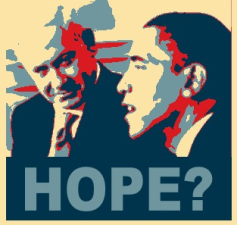 American President Barack Obama once again repeats Washington’s warmongering rhetoric against Tehran over its nuclear energy program, saying the US will take no options off the table with regard to Iran.


 Aletho News
 Aletho News