The endless arms race
By Lawrence Wittner | International Physicians for the Prevention of Nuclear War | January 21, 2014
It’s heartening to see that an agreement has been reached to ensure that Iran honors its commitment, made when it signed the 1970 nuclear Non-Proliferation Treaty (NPT), to forgo developing nuclear weapons.
But what about the other key part of the NPT, Article VI, which commits nuclear-armed nations to “cessation of the nuclear arms race at an early date and to nuclear disarmament,” as well as to “a treaty on general and complete disarmament”? Here we find that, 44 years after the NPT went into force, the United States and other nuclear powers continue to pursue their nuclear weapons buildups, with no end in sight.
On January 8, 2014, U.S. Defense Secretary Chuck Hagel announced what Reuters termed “ambitious plans to upgrade [U.S.] nuclear weapons systems by modernizing weapons and building new submarines, missiles and bombers to deliver them.” The Pentagon intends to build a dozen new ballistic missile submarines, a new fleet of long-range nuclear bombers, and new intercontinental ballistic missiles. The Congressional Budget Office estimated in late December that implementing the plans would cost $355 billion over the next decade, while an analysis by the independent Center for Nonproliferation Studies reported that this upgrade of U.S. nuclear forces would cost $1 trillion over the next 30 years. If the higher estimate proves correct, the submarines alone would cost over $29 billion each.
Of course, the United States already has a massive nuclear weapons capability — approximately 7,700 nuclear weapons, with more than enough explosive power to destroy the world. Together with Russia, it possesses about 95 percent of the more than 17,000 nuclear weapons that comprise the global nuclear arsenal.
Nor is the United States the only nation with grand nuclear ambitions. Although China currently has only about 250 nuclear weapons, including 75 intercontinental ballistic missiles (ICBMs), it recently flight-tested a hypersonic nuclear missile delivery vehicle capable of penetrating any existing defense system. The weapon, dubbed the Wu-14 by U.S. officials, was detected flying at ten times the speed of sound during a test flight over China during early January 2014. According to Chinese scientists, their government had put an “enormous investment” into the project, with more than a hundred teams from leading research institutes and universities working on it. Professor Wang Yuhui, a researcher on hypersonic flight control at Nanjing University, stated that “many more tests will be carried out” to solve the remaining technical problems. “It’s just the beginning.” Ni Lexiong, a Shanghai-based naval expert, commented approvingly that “missiles will play a dominant role in warfare, and China has a very clear idea of what is important.”
Other nations are engaged in this arms race, as well. Russia, the other dominant nuclear power, seems determined to keep pace with the United States through modernization of its nuclear forces. The development of new, updated Russian ICBMs is proceeding rapidly, while new nuclear submarines are already being produced. Also, the Russian government has started work on a new strategic bomber, known as the PAK DA, which reportedly will become operational in 2025. Both Russia and India are known to be working on their own versions of a hypersonic nuclear missile carrier. But, thus far, these two nuclear nations lag behind the United States and China in its development. Israel is also proceeding with modernization of its nuclear weapons, and apparently played the key role in scuttling the proposed U.N. conference on a nuclear weapons-free zone in the Middle East in 2012.
This nuclear weapons buildup certainly contradicts the official rhetoric. On April 5, 2009, in his first major foreign policy address, President Barack Obama proclaimed “America’s commitment to seek the peace and security of a world without nuclear weapons.” That fall, the UN Security Council — including Russia, China, Britain, France, and the United States, all of them nuclear powers — unanimously passed Resolution 1887, which reiterated the point that the NPT required the “disarmament of countries currently possessing nuclear weapons.” But rhetoric, it seems, is one thing and action quite another.
Thus, although the Iranian government’s willingness to forgo the development of nuclear weapons is cause for encouragement, the failure of the nuclear nations to fulfill their own NPT obligations is appalling. Given these nations’ enhanced preparations for nuclear war — a war that would be nothing short of catastrophic — their evasion of responsibility should be condemned by everyone seeking a safer, saner world.
Lawrence S. Wittner (http://lawrenceswittner.com) is Professor of History emeritus at SUNY/Albany. His latest book is a satirical novel about university corporatization, What’s Going On at UAardvark?
Related articles


Iran, Syria and the Tragicomedy of U.S. Foreign Policy
By Flynt Leverett and Hillary Mann Leverett | Going to Tehran | January 20, 2014
Today is Martin Luther King Day in the United States and we urge our readers to re-read a piece we wrote previously honoring his extraordinary insight. It is also the day on which implementation of the Joint Plan of Action that the P5+1 and Iran announced on November 24 formally commences. And, of course, two days from now, the Geneva II conference on the Syrian conflict is scheduled to take place.
In anticipation of the beginning of implementation of the Joint Plan of Action, negotiations on prospective “final” nuclear deal, and the Geneva II conference, Hillary taped an interview with Scott Horton for Pacifica Radio. It was broadcast/posted yesterday; click here to listen.
Regarding President Obama’s ongoing struggle with the Senate over Iran policy, Hillary cautions against premature claims of “victory” for the Obama administration’s efforts to avert new sanctions legislation while the Joint Plan of Action is being implemented. She points out that “the foes of the Iran nuclear deal, of any kind of peace and conflict resolution in the Middle East writ large, are still very strong and formidable. For example, the annual AIPAC policy conference—a gathering here in Washington of over 10,000 people from all over the country, where they come to lobby congressmen and senators, especially on the Iran issue—that will be taking place in very early March. There’s still a lot that can be pushed and played here.”
To be sure, President Obama and Secretary of State John Kerry “have put a lot of political capital on the line.” No other administration has so openly staked out its opposition to a piece of legislation or policy initiative favored by AIPAC and backed by a bipartisan majority on Capitol Hill since the 1980s, when the Reagan administration successfully defended its decision to sell AWACs planes to Saudi Arabia. But, Hillary notes, if the pro-Israel lobby is able to secure a vote on the new sanctions bill, and to sustain the promised veto of said bill by President Obama, “that would be such a dramatic blow to President Obama, and not just on his foreign policy agenda, but it would be devastating to his domestic agenda.” So Obama “has a tremendous amount to lose, and by no means is the fight anywhere near over.”
Of course, to say that Obama has put a lot of political capital on the line over the sanctions issue begs the question of whether he is really prepared to spend the far larger amounts of capital that will be required to close a final nuclear deal with Tehran. As Hillary points out, if Obama were “really trying to lead this country on a much more constructive, positive trajectory after failed wars and invasions in Iraq and Afghanistan and Libya—Libya entirely on President Obama’s watch—[he] would be doing a lot more, rather than just giving these lukewarm talks, basically trying to continue to kiss up to major pro-Israel constituencies, and then trying to bring in some of political favors” on Capitol Hill.
Compare Obama’s handling of Iran and other Middle East challenges to President Nixon’s orchestration of the American opening to China—including Nixon’s willingness to “break the crockery” of the pro-Taiwan lobby—and the inadequacy of Obama’s approach become glaringly apparent. And that, Hillary underscores, is why we wrote our book, Going to Tehran—because “we think it’s absolutely essential for President Obama to do what Nixon did and go to Tehran, as Nixon went to China,” for “the Middle East is the make-or-break point for the United States, not just in our foreign affairs but in our global economic power and what we’re able to do here at home. If we can’t get what we’re doing in the Middle East on a much better, more positive trajectory, not only will we see the loss of our power, credibility, and prestige in the Middle East, but we will see it globally.”
Getting the nuclear issue right is, arguably, just one piece of the project of realigning U.S.-Iranian relations—but it is a uniquely critical piece. As Hillary notes, in Iran, “they see reaching a nuclear deal with the United States as absolutely essential [to any prospect of broader realignment]—even though they absolutely believe it is a ‘show’ issue. For if they could get the United States to accept the Islamic Republic of Iran with nuclear capability, this is the essential step to getting it to accept Iran as an independent, sovereign power.” Of course, that is something Western governments have been manifestly unwilling to do for decades, going back even decades before the 1979 Iranian Revolution. For the Iranians, “if they can get the United States to recognize their independence and sovereignty through this nuclear deal, recognizing Iran’s right to nuclear capability, that’s [how] you can open the way to go forward.”
But, “if negotiations with the United States fail, the thinking in Iran—and I was just there a couple of months ago—is that this will show both Iranians inside Iran and (this is critically important) countries like China, in other emerging markets…that Iran was the rational actor here. Iran tried its best to work within a framework of international law, the Nuclear Non-Proliferation Treaty, but it was the United States, as it has treated key countries in the Middle East for decades, that was unwilling to work within the parameters of international law and to recognize basic sovereign and treaty rights. That’s their Plan B—if the United States can’t do the deal, they still come out ahead in terms of important actors both at home and abroad.”
On Syria, Hillary suggests that the growing Western focus on al-Qa’ida-like jihadis in opposition ranks obscures a much more important point—even if al-Qa’ida-like elements had not permeated the opposition, why does the United States think it should be supporting armed rebels to overthrow the recognized government of a UN member state? As Hillary recounts, “This didn’t work in Iraq (before al-Qa’ida was there; of course, now al-Qa’ida is there, after we said we had a dog in that fight), it didn’t work in Libya, it didn’t work in Afghanistan. The idea that when we choose to become involved in a fight, it’s going to turn out to help us is just not borne out by history, but we continue to make the mistake.”
As for an appropriate American approach to the Syrian conflict and other Middle Eastern challenges, Hillary says that the United States shouldn’t just “go home and essentially be isolationist. I believe very much in free trade, and I believe very much in diplomacy and conflict resolution. And there does need to be real conflict resolution in Syria.” In this regard,
“We have a real asset in Lakhdar Brahimi, the UN envoy. He has worked on exactly these kinds of problems in Iraq, in Lebanon, in Somalia, in Haiti, and in Afghanistan, where I worked with him personally for about two years. And in each of those situations, he didn’t come up with a fantastic, Pollyanna government for each of these places. But he has a core formula [that] would really help to stop the destabilization and killing that we see in Syria, which is: you work with the sitting government, and you work with forces on the ground to gradually bring them into not a liberal democracy, but into a much more representative and inclusive power-sharing arrangement…You’re not going to get great ‘good governance,’ with no corruption and fantastic human rights treatment—but you will, over time, have a much more stable environment, where far fewer people are killed, and the opportunity for that country to politically reconstitute itself along its own lines, its own values, and its own position in the world.”
Hillary’s interview preceded the tragicomic antics surrounding UN Secretary-General Ban Ki-moon’s invitation to Iran to participate in Geneva II—which Ban spinelessly rescinded less than 24 hours later after tantrum-like outbursts from the Syrian National Council and (more consequentially) strategically witless (and utterly predictable) pressure from the Obama administration. Clearly, the Brahimi formula is not going to be given a chance to work in Syria anytime soon—but something like it will probably prove critical to any eventual political settlement to the conflict there.
In the interview, Hillary also discusses Iran’s internal political dynamics regarding a possible improvement in relations with the United States, the strategic incoherence of Israeli and Saudi opposition to any U.S. opening to the Islamic Republic, continuing Western mythmaking about Iran’s “nuclear weapons” program, and more.
Finally, as the Joint Plan of Action formally goes into effect, we want to call attention to two recent posts on Dan Joyner’s Arms Control Law that do an excellent job criticizing some of the more egregious distortions of the Nuclear Non-Proliferation Treaty (NPT) and international law more generally that various American pundits have advanced in their bloviations about the Joint Plan. One, see here, lambastes Orde Kittrie’s assertion that the implementing agreement for the Joint Plan—not the Joint Plan itself, mind you, but the implementing agreement—is actually a secret treaty; the other, see here, takes on the chronically wrong Ray Takeyh. His latest missive, misrepresenting the Additional Protocol to the NPT, is co-authored by Mitchell Reiss, who appeared in advertisements publicly advocating for the MEK—many of whose advocates acknowledge receiving at least $20,000 per endorsement—while the U.S. government still designated it as a foreign terrorist organization.
The Missing Quote from the King Memorial
By Don DeBar | Black Agenda Report | January 17, 2012
“The greatest purveyor of violence in the world today: my own Government… I cannot be silent.” – Rev. Dr. Martin Luther King, Jr.
While the insiders in Washington parse the meaning of the paraphrased words of Dr. Martin Luther King, Jr. regarding his own epitaph, his true legacy – the one that many believe led to his murder – has been whitewashed from the King Memorial entirely.
Speaking at the Riverside Church in New York City, exactly one year – to the day – before he was shot and killed in Memphis, Dr. King announced that he was expanding his focus on America’s national shame of segregation to include its international crime of war on the people of Vietnam:
“(I)n the ghettoes of the North over the last three years — especially the last three summers, (a)s I have walked among the desperate, rejected, and angry young men, I have told them that Molotov cocktails and rifles would not solve their problems. I have tried to offer them my deepest compassion while maintaining my conviction that social change comes most meaningfully through nonviolent action. But they ask — and rightly so — ‘what about Vietnam?’ They ask if our own nation wasn’t using massive doses of violence to solve its problems, to bring about the changes it wanted. Their questions hit home, and I knew that I could never again raise my voice against the violence of the oppressed in the ghettos without having first spoken clearly to the greatest purveyor of violence in the world today — my own government. For the sake of those boys, for the sake of this government, for the sake of the hundreds of thousands trembling under our violence, I cannot be silent.”
The King Memorial lists a total of 15 direct quotes and a paraphrase (currently in controversy) from Dr. King’s words; yet, curiously, this particular quote – which ties together the struggle for social and economic justice at home with the actions of the government abroad in an elegant and profound way – did not make the list.
Here are the quotes that appear on the Inscription Wall of the Memorial:
“We shall overcome because the arc of the moral universe is long, but it bends towards justice.” (16 August 1967, Atlanta, GA)
“Darkness cannot drive out darkness, only light can do that. Hate cannot drive out hate, only love can do that.” (1963, Strength to Love)
“I believe that unarmed truth and unconditional love will have the final word in reality. This is why right, temporarily defeated, is stronger than evil triumphant.” (10 December 1964, Oslo, Norway)
“Make a career of humanity. Commit yourself to the noble struggle for equal rights. You will make a greater person of yourself, a greater nation of your country, and a finer world to live in.” (18 April 1959, Washington, DC)
“I oppose the war in Vietnam because I love America. I speak out against it not in anger but with anxiety and sorrow in my heart, and above all with a passionate desire to see our beloved country stand as a moral example of the world.” (25 February 1967, Los Angeles, CA)
“If we are to have peace on earth, our loyalties must become ecumenical rather than sectional. Our loyalties must transcend our race, our tribe, our class, and our nation; and this means we must develop a world perspective.” (24 December 1967, Atlanta, GA)
“Injustice anywhere is a threat to justice everywhere. We are caught in an inescapable network of mutuality, tied in a single garment of destiny. Whatever affects one directly, affects all indirectly.” (16 April 1963, Birmingham, AL)
“I have the audacity to believe that peoples everywhere can have three meals a day for their bodies, education and culture for their minds, and dignity, equality and freedom for their spirits.” (10 December 1964, Oslo, Norway)
“It is not enough to say ‘We must not wage war.’ It is necessary to love peace and sacrifice for it. We must concentrate not merely on the negative expulsion of war, but on the positive affirmation of peace.” (24 December 1967, Atlanta, GA)
“The ultimate measure of a man is not where he stands in moments of comfort and convenience, but where he stands at times of challenge and controversy.” (25 February 1967, Los Angeles, CA)
“Every nation must now develop an overriding loyalty to mankind as a whole in order to preserve the best in their individual societies.” (4 April 1967, Riverside Church, New York, NY)
“We are determined here in Montgomery to work and fight until justice runs ‘down like water, and righteousness like a mighty stream.'” (5 December 1955, Montgomery, AL)
“We must come to see that the end we seek is a society at peace with itself, a society that can live with its conscience.” (16 April 1963, Birmingham, AL)
“True peace is not merely the absence of tension: it is the presence of justice.” (16 April 1963, Birmingham, AL)
Within the list, there is one quote which deals directly with the Vietnam war, two that deal directly with war, and others that deal, in one way or another, with issues of war and peace in general. One is lifted from the Riverside speech.
Inscribed on the Stone of Hope are two statements – one, a direct quote, the other, the paraphrase of his words that is at the center of the present controversy:
The first, from the “I Have a Dream” speech, is “Out of the Mountain of Despair, a Stone of Hope” – the quotation that serves as the basis for the monument’s design. The words on the other side of the stone read, “I Was a Drum Major for Justice, Peace, and Righteousness,” which is a paraphrased version of a longer quote by King: “If you want to say that I was a drum major, say that I was a drum major for justice. Say that I was a drum major for peace. I was a drum major for righteousness. And all of the other shallow things will not matter.” The memorial’s use of the paraphrased version of the quote has been criticized (Wikipedia).
Nowhere on the monument is there any mention of Dr. King’s clearly-stated indictment of American foreign policy as being intrinsically evil (above); nor is there any mention that America’s wars are the cause of economic hardship at home:
“There is at the outset a very obvious and almost facile connection between the war in Vietnam and the struggle I, and others, have been waging in America. A few years ago there was a shining moment in that struggle. It seemed as if there was a real promise of hope for the poor — both black and white — through the poverty program. There were experiments, hopes, new beginnings. Then came the buildup in Vietnam, and I watched this program broken and eviscerated, as if it were some idle political plaything of a society gone mad on war, and I knew that America would never invest the necessary funds or energies in rehabilitation of its poor so long as adventures like Vietnam continued to draw men and skills and money like some demonic destructive suction tube. So, I was increasingly compelled to see the war as an enemy of the poor and to attack it as such.”
At the dedication of the King Monument last October, President Barack Obama invoked the words of Dr. King – some of them – without even mentioning war:
“When met with hardship, when confronting disappointment, Dr. King refused to accept what he called the ‘is-ness’ of today. He kept pushing towards the ‘ought-ness’ of tomorrow.
“And so, as we think about all the work that we must do –- rebuilding an economy that can compete on a global stage, and fixing our schools so that every child — not just some, but every child — gets a world-class education, and making sure that our health care system is affordable and accessible to all, and that our economic system is one in which everybody gets a fair shake and everybody does their fair share, let us not be trapped by what is. We can’t be discouraged by what is. We’ve got to keep pushing for what ought to be, the America we ought to leave to our children, mindful that the hardships we face are nothing compared to those Dr. King and his fellow marchers faced 50 years ago, and that if we maintain our faith, in ourselves and in the possibilities of this nation, there is no challenge we cannot surmount.”
Obama even went so far as to impute to Dr. King words that, if the record is any indication, are mere sterile parodies of the words of this Nobel Peace Prize winning minister:
“If he were alive today, I believe he would remind us that the unemployed worker can rightly challenge the excesses of Wall Street without demonizing all who work there; that the businessman can enter tough negotiations with his company’s union without vilifying the right to collectively bargain. He would want us to know we can argue fiercely about the proper size and role of government without questioning each other’s love for this country — with the knowledge that in this democracy, government is no distant object but is rather an expression of our common commitments to one another. He would call on us to assume the best in each other rather than the worst, and challenge one another in ways that ultimately heal rather than wound.”
Not a word about “the greatest purveyor of violence in the world today” – this is particularly odd when one considers that the US is now currently involved in more war and destruction, in more places and involving more people, weaponry and expense, than at the time Dr. King uttered those words in 1967.
As to the shared status with the President as a fellow Nobel Peace Prize winner, in contrast to the Commander-in-Chief’s actions over the past three years, Dr. King said:
“I cannot forget that the Nobel Peace Prize was also a commission, a commission to work harder than I had ever worked before for ‘the brotherhood of man.’ This is a calling that takes me beyond national allegiances, but even if it were not present I would yet have to live with the meaning of my commitment to the ministry of Jesus Christ. To me the relationship of this ministry to the making of peace is so obvious that I sometimes marvel at those who ask me why I’m speaking against the war. Could it be that they do not know that the good news was meant for all men — for Communist and capitalist, for their children and ours, for black and for white, for revolutionary and conservative? Have they forgotten that my ministry is in obedience to the One who loved his enemies so fully that he died for them? What then can I say to the Vietcong or to Castro or to Mao as a faithful minister of this One? Can I threaten them with death or must I not share with them my life?”
Quite a different interpretation of the charge that comes with joining the company of other Nobel Peace Prize winners than that demonstrated by the man who sat silent during the siege of Gaza (“Only one President at a time”), expanded the wars in Iraq and Afghanistan into Pakistan, Libya, Bahrain, Syria and, soon, Iran. Could we imagine Dr. King conducting – or sanctioning – a six-month bombing campaign for “humanitarian reasons”? Or might he instead feel compelled to speak out:
“And as I ponder the madness of Vietnam and search within myself for ways to understand and respond in compassion, my mind goes constantly to the people of that peninsula. I speak now not of the soldiers of each side, not of the ideologies of the Liberation Front, not of the junta in Saigon, but simply of the people who have been living under the curse of war for almost three continuous decades now. I think of them, too, because it is clear to me that there will be no meaningful solution there until some attempt is made to know them and hear their broken cries.
“They must see Americans as strange liberators.”
“Strange liberators,” indeed…
Don DeBar is a journalist and political activist residing in Ossining, NY. He currently serves as senior producer for WBAIX.org, an internet news and public events outlet featuring progressive producers who were purged from Pacifica Radio.
Rejecting the Rule of Law
The US Now Backs a “Code of Conduct” for Space, Instead of a Legally Binding Treaty to Ban Space Weapons
By ALICE SLATER | CounterPunch | January 17, 2014
The most important lesson one can acquire about US foreign policy is the understanding that our leaders do not mean well. They do not have any noble goals of democracy and freedom and all that jazz. They aim to dominate the world by any means necessary. And as long as an American believes that the intentions are noble and honorable, it’s very difficult to penetrate that wall. That wall surrounds the thinking and blocks any attempt to make them realize the harm being done by US foreign policy.
– William Blum, former member of the US State Department, author of Killing Hope: US Military and CIA Interventions since World War II[i]
More than 5,000 satellites have been launched into orbit since the space age began[ii]. Today, eleven countries have space launch capability, with over sixty countries operating about 1,100 active satellites orbiting the earth providing a constant stream of data and information relied upon for critical civilian communications as well as for military operations by some.[iii] As we grow ever more dependent on the ability of these satellites to perform their essential functions without interruption, there are growing concerns that this useful technology is giving rise to a new battleground in space for the purpose of sabotaging or destroying the vital services our space-based communications now provide.
The US and Russia have been testing anti-satellite technology (ASAT) since the space age began, and have even contemplated using nuclear tipped ballistic missiles to destroy space assets. In 1967, the US and Russia realized it would be in their interest to support the 1967 Outer Space Treaty, which banned the placement of nuclear weapons or other weapons of mass destruction in space, although they failed to ban the use of conventional weapons in space. And in 1972 they agreed to sign the Anti-Ballistic Missile Treaty (ABM) to slow down the space race and the ability to harm each other’s assets in space. Unfortunately, George Bush walked out of the ABM treaty in 2002, and the race to weaponize space was on once again in full force. China is getting into the act too, having launched, in 2007, a device which destroyed one of its aging weather satellites orbiting in space. The US followed suit in 2008, destroying a non-functioning satellite, while both nations denied any military mission for their acts, claiming they were merely trying to destroy outdated satellites that no longer functioned.
With the proliferation of military spacecraft such as imaging and communications satellites and ballistic missile and anti- missiles systems which often pass through outer space, there have been numerous efforts in the UN Committee on Disarmament (CD) to outlaw the weaponization of space through a legally binding treaty. But the United States is having none of it. In the CD, which requires consensus to take action, the US has been the only nation to block every vote to begin negotiations on such a treaty, with Israel generally abstaining in support. Russia and China actually prepared a draft treaty to ban weapons in space in 2008, but the US blocked the proposal, voting against it each year thereafter when it was reintroduced for consideration, saying the proposal was “a diplomatic ploy by the two nations to gain a military advantage”.[iv]
While continuing to block a legally binding treaty to ban weapons in space, the US has recently begun to work with a group of nations in a new initiative that began in the European Union in 2008, proposing a “Code of Conduct for Outer Space Activities“ which would lay out a non-binding set of rules of the road for a safer and more responsible environment in space. Some of its key objectives are to mitigate damage to satellites that could be caused by space debris orbiting the earth, to avoid the potential of destructive collisions, and to manage the crowding of satellites and the saturation of the radio-frequency spectrum, as well as to address direct threats of hostility to assets in space. [v] At first, the US rejected any support for the Code, but has now agreed to participate in drafting a new version based on the third iteration from the European Union. Obama’s Under Secretary of State for Arms Control and International Security, Rose Gottemoeller, acknowledged in 2012 the necessity for a Code to deal with orbital debris and “other irresponsible actions in space”, while at the same time, noting that,
It is important to clarify several points with respect to the code. It is still under development, we would not subscribe to any code unless it protects and enhances our national security, and the code would not be legally binding. [vi]
In addition, the US is insisting on a provision in this third version of the Code of Conduct that, while making a voluntary promise to “refrain from any action which brings about, directly or indirectly, damage, or destruction, of space objects”, qualifies that directive with the language “unless such action is justified”. One justification given for destructive action is “the Charter of the United Nations including the inherent right of individual or collective self-defense”, thus lending legitimacy and codifying the possibility for warfare in space as part of the Code’s established norm. And while the Charter of the United Nations prohibits aggressive action by any nation without Security Council approval unless a nation acts in self-defense, we know there have been numerous occasions where nations have by-passed the Security Council to take aggressive action, often protesting they were acting in self-defense. Instead of banning ASAT development and warfare, this Code justifies such warfare as long as it’s done, individually and collectively, under the guise of “self-defense”. Thus despite lacking the force of law that would be established with a legally binding treaty, this new US version of the Code creates, as the norm it is proposing, a possibility for space warfare.
Our world deserves better!
Alice Slater is NY Director of the Nuclear Age Peace Foundation and serves on the Council of the Global Network Against Weapons and Nuclear Power in Space
Major Political Donors Have Access to TPP Documents. Everyone Else? Not So Much
By Mike Masnick | Techdirt | January 17, 2014
The good folks over at MapLight have taken a look at the members of the Industry Trade Advisory Committee on Intellectual Property Rights (ITAC-15). As we’ve discussed in the past ITAC 15 is a committee of high powered corporate representatives who are basically the only ones with full access to the text of the intellectual property chapter of the TPP. Those on ITAC 15 are allowed to see the latest text by logging into a system from the comfort of their desks. If Congress wants to see it? No luck. Members of Congress are allowed only to visit the USTR offices, where they’ll be shown a copy of the document in a sealed room. They’re not allowed to bring staff (such as the experts who would understand this stuff). They’re not allowed to take notes or make any copies. Basically, the corporate interests have a lot more oversight over the whole process than Congress does.
So how does one get onto ITAC 15? It’s not easy. Lawyer Andrew Bridges (whose name you might recognize) sought to get onto ITAC 15 as one of the country’s foremost experts on copyright law and its impact on innovation and startups. He was nominated… but denied. But who does get on there? According to MapLight’s analysis, it helps to be a major corporate donor to political campaigns:
- The 18 organizations represented by ITAC-15 gave nearly $24 million to current members of Congress from Jan. 1, 2003 – Dec. 31, 2012.
- AT&T has given more than $8 million to current members of Congress, more than any other organization represented by ITAC-15.
- House Speaker John Boehner, R-Ohio, has received $433,350 from organizations represented by ITAC-15, more than any other member of Congress.
- Democrats in Congress have received $11.4 million from organizations represented by ITAC-15, while Republicans in Congress have received $12.6 million.
- The members of Congress sponsoring fast-track legislation, which would allow the President to block Congress from submitting amendments to the TPP, have received a combined $758,295 from organizations represented by ITAC-15. They include Senate Finance Committee Chairman Max Baucus ($140,601), Senate Finance Committee Ranking Members Orrin Hatch ($178,850), House Ways and Means Committee Chairman David Camp ($216,250), House Ways and Means Subcommittee on Trade Chairman Devin Nunes ($86,000), and House Rules Committee Chairman Pete Sessions ($136,594).
I’m sure that’s all just a coincidence, right? If the USTR was really seeking to convince the world that the TPP isn’t just a corporatist power grab to give political crony’s a leg up against innovators, it’s doing a piss poor job of convincing anyone that’s the case.
Related articles


US to Expand Military, Intelligence Presence in Bahrain

Al-Manar | January 17, 2014
The US military plans to establish an intelligence center in Bahrain in a bid to compensate for its dwindling presence in Afghanistan.
A senior US military official told a Senate hearing that the planned espionage center in the Arab state, home to the US Navy’s 5th Fleet, will be an “integral part” of the Pentagon’s post-2014 strategy in Afghanistan, the Washington Post reported on Thursday.
The official, Erin Logan, who oversees the Pentagon’s “counter-narcotics efforts,” claimed during a US Senate hearing on narcotics on Wednesday that the plan is part of Washington’s efforts to “continue fighting” Afghanistan’s “booming drug industry.”
“The center,” she added, “will help fill the gap where space for personnel on the ground in Afghanistan is no longer available.”
The US move to expand its military and intelligence presence in Bahrain comes, however, despite the grave human rights record of the ruling Al Khalifa regime for its brutal crackdown on a popular uprising that has left scores shot and tortured to death and many more injured and prosecuted for taking part and even sympathizing with the continuing anti-regime protests in the country.
The United States has long been suspected by regional countries, particularly Iran and Russia, of promoting the growth of the narcotics trade in Afghanistan ever since American and NATO military forces invaded the country in 2001 under the pretext of fighting terror and bringing stability to Afghanistan.
There have been numerous press accounts over the past years pointing to the involvement of US troops and CIA operatives in Afghanistan’s expanding drug trade that largely finances the al-Qaeda-linked Taliban militants in the country.
The US military aims to establish an intelligence center in the Persian Gulf kingdom of Bahrain in a bid to compensate for its dwindling presence in the war-torn Afghanistan.
MIT study of Ghouta chemical attack challenges US intelligence
RT | January 16, 2014
A new MIT report is challenging the US claim that Assad forces used chemical weapons in an attack last August, highlighting that the range of the improvised rocket was way too short to have been launched from government controlled areas.
In the report titled “Possible Implications of Faulty US Technical Intelligence,” Richard Lloyd, a former UN weapons inspector, and Theodore Postol, a professor at the Massachusetts Institute of Technology (MIT), examined the delivery rocket’s design and calculated possible trajectories based on the payload of the cargo.
The authors concluded that sarin gas “could not possibly have been fired at East Ghouta from the ‘heart’, or from the Eastern edge, of the Syrian government controlled area shown in the intelligence map published by the White House on August 30, 2013.”
Based on mathematical calculations, Lloyd and Postol estimate the rocket with such aerodynamics could not travel more than 2 kilometers. To illustrate their conclusion, the authors included the original White House map that depicted areas under Assad control and those held by the opposition. Based on the firing range and troop locations on August 21, the authors conclude that all possible launching points within the 2 km radius were in rebel-held areas.
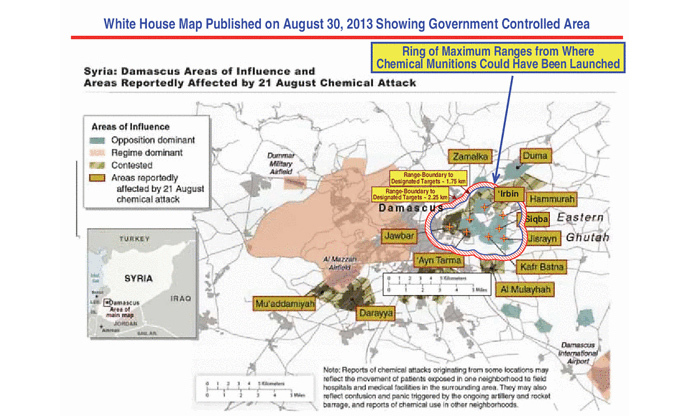
“This mistaken intelligence could have led to an unjustified US military action based on false intelligence. A proper vetting of the fact that the munition was of such short range would have led to a completely different assessment of the situation from the gathered data,” the report states.
The authors emphasize that the UN independent assessment of the range of the chemical munition is in “exact agreement” with their findings.
The report goes on to challenge the US Secretary of State’s key assessments of the chemical attack that he presented to the American people on August 30th and to the Foreign Relations Committee on September 3rd in an effort to muster a military attack on Syria.
“My view when I started this process was that it couldn’t be anything but the Syrian government behind the attack. But now I’m not sure of anything. The administration narrative was not even close to reality. Our intelligence cannot possibly be correct,” Postol told McClatchy news.

“The Syrian rebels most definitely have the ability to make these weapons,” he said. “I think they might have more ability than the Syrian government.”
It also remains a mystery why the particular type of rocket that was used in the attack was not declared by the Syrian government as part of its chemical weapons arsenal when it agreed to destroy its chemical weapons and their delivery methods. OPCW inspectors charged with implementing the agreement also did not discover such a rocket in possession of government forces.
Syria agreed to the destruction of its chemical weapons through a deal brokered by Russia and the US after a sarin gas attack on August 21. Western nations blamed the deadly attack on President Bashar Assad’s forces, while Damascus accused the rebels for the incident. The UN fact-finding mission had no mandate to find out who carried out the attack.
Under the UN-backed plan, all of the country’s declared 1,290 tons of toxic agents should be destroyed by June 30. Initially, the first batch of the most dangerous materials was to be moved out of Syria on December 31.
However, the deadline was missed because of the ongoing war in Syria and technical issues. It was only on January 7 that “priority chemical materials” left the Syrian port of Latakia on a Danish ship for international waters.
Related article

Israel, Pentagon ‘big winners’ in US spending bill
Press TV – January 15, 2014
The Pentagon, defense industry and Israel came out as big winners in a bipartisan $1.1 trillion omnibus spending bill that would pay for government operations through October, a report says.
The massive measure, unveiled Monday night, fleshes out the details of the budget deal that US Congress passed last month.
The spending bill provides about $497 billion for the Pentagon in 2014 — about the same as in 2013. In addition, it allocates $85.2 billion for the war in Afghanistan as part of the Pentagon’s overseas contingency operations (OCO), $5 billion more than requested.
“The big winner is the Defense Department. They should be breaking out champagne in the Pentagon,” said Gordon Adams, a defense budget expert and former US official, as quoted by the Hill.
Before last month’s budget deal that relieved $22.4 billion in sequestration cuts, the Pentagon budget for 2014 would have been around $475 billion.
Fiscal watchdog and antiwar groups criticized the $5 billion increase from the Pentagon’s request in overseas contingency funding as a “slush fund to pad the department’s budget and avoid spending reductions,” the Hill said.
“There is no excuse for a $5 billion increase to OCO especially in a time of belt tightening throughout the federal government,” David Williams, president of Taxpayers Protection Alliance, said in a statement Tuesday.
The defense industry was also a winner in the omnibus spending bill, Adams said.
The bill largely fulfills the Pentagon’s procurement request for ships, aircraft, tanks, helicopters and other war-fighting equipment, including 29 new F-35 Joint Strike Fighters, eight new warships as requested by the Navy, and a variety of other aircraft like the V-22 Osprey, new and improved F-18 fighters and new Army helicopters.
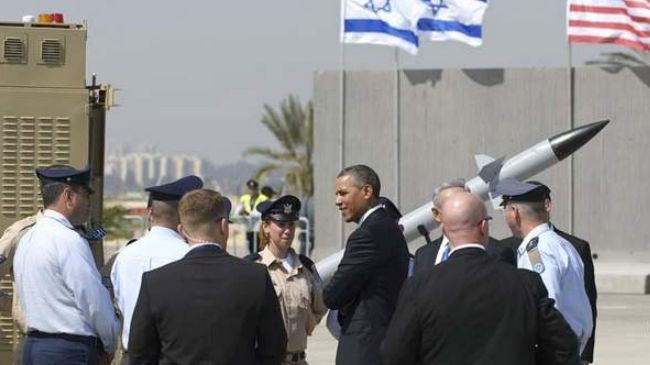
Israel is also a “winner” in the spending measure, as it fully funds the Arrow, David’s Sling, and the Iron Dome rocket systems, the Hill said.
The spending bill authorizes $173 million in added funding for Israel’s missile systems, including nearly $34 million to improve the Arrow weapon system and $117.2 million for development of the David’s Sling short-range ballistic missile system and $22 million for an upper-tier interceptor.
The US provides $3.1 billion in annual military aid to Israel, making the Zionist regime the largest recipient of US aid in the world.
US President Barack Obama has pledged to extend annual military aid to Tel Aviv through 2027.
The pending 10-year military aid package would commit the United States to give up to $40 billion in military grant assistance to Israel. It would automatically kick in after the current 10-year, $30 billion agreement expires in 2017.
Democrats plead with Obama to abandon Social Security cut
By Alexander Bolton – The Hill – 01/11/14
Democratic senators are pleading with President Obama to abandon his proposal to trim Social Security benefits before it becomes a liability for them in the midterm elections.
The president proposed a new formula for calculating benefits in his budget last year, in hopes that the olive branch to Republicans would persuade them to back tax increases in a broader fiscal deal. But Democratic lawmakers say Obama should shelve the idea now that they are facing a difficult midterm election where they need to turn out the liberal base to preserve their Senate majority.
“I’m not sure why we should be making concessions when the Republicans show absolutely no willingness to do the same,” said Sen. Chris Murphy (D-Conn.).
Democrats acknowledge it may be awkward for Obama to rescind his proposal, but say it would unwise of him to repeat the offer in the budget that is due out next month.
“I think it’s difficult for the president to pull it back after he already floated it but I would love to see it shelved until Republicans show they’re actually going to do something on their side of the ledger,” Murphy said.
Obama proposed nearly $1 trillion in spending cuts in his budget, including a switch to using the Chained Consumer Price Index (CPI), which liberal policy experts estimate could cost seniors thousands of dollars in benefits over their lifetimes.
The Center on Budget and Policy Priorities, a liberal think tank, projected that most future beneficiaries would see a 2 percent reduction in benefits during the course of retirement.
Supporters of chained CPI argue it is a more accurate measure of inflation, and say the reduction in federal spending would ease the deficit over time.
Obama said he made the proposal to get Republicans to the negotiating table, but the move rankled Democrats on both sides of the Capitol.
Sen. Bernie Sanders (Vt.), a liberal independent who caucuses with Democrats, said lawmakers have told White House chief of staff Denis McDonough to drop chained CPI from this year’s budget proposal.
“We have talked to his chief of staff and made that very clear,” said Sanders, who is co-founder of the Defending Social Security Caucus.
Congressional Democrats grumbled last year that Republicans never seriously entertained the thought of ending tax breaks for wealthy individuals and corporations.
“I certainly hope that the president has learned a lesson from this whole process,” Sanders said. “To be honest with you, I just can’t imagine what staff people gave him the disastrous advice to propose a chain CPI, which from both a public policy point of view and political point of view is totally absurd.”
“He should recognize that was a mistake. It should not be in his budget at all,” said Sen. Tom Harkin (D-Iowa), chairman of the Health, Education, Labor and Pensions Committee.
Harkin said some centrists in the caucus support chained CPI, but they are in the distinct minority.
One of those centrists is Sen. Mark Warner (D-Va.), who is running for reelection this year and facing a possible challenge from Ed Gillespie, the former chairman of the Republican National Committee.
Warner said in an interview that he is still hopeful of a broader deal to reduce the deficit. He said Democrats should keep chained CPI on the table if they expect Republicans to compromise on taxes.
Liberal Democrats say cutting Social Security benefits, even what centrists view as moderate cuts, is broadly unpopular across age groups. They say there mere proposal of reductions would amount to a self-inflicted political wound that would come back to haunt their party in the midterm election.
“It’s a very controversial issue at a difficult time for the senior community,” said Sen. Dianne Feinstein (D-Calif.), who declined to express support or opposition to the proposal.
A Pew Research poll released this month showed Republican voters are more enthusiastic than Democrats about the November election.
The survey found 63 percent of Republicans were looking forward to the election, while only 53 percent of Democrats felt the same way. Pollsters found a similar enthusiasm gap in January of 2010, before Republicans captured control of the House and picked up Senate seats.
In recent weeks, political handicappers have upped the chances of Republicans capturing the Senate in November.
White House and Senate Democratic strategists have tried to rekindle the enthusiasm of Democratic base voters by focusing on income inequality. Senate Democrats have made extending unemployment benefits and raising minimum wage two of their top agenda items this year.
Robert Borosage, co-director of Campaign for America’s Future, a liberal advocacy group, said it would be a serious blunder if Obama gave Republicans an opening to accuse his party of pushing Social Security cuts.
“I think it’s very counterproductive and not just with the base,” Borosage said.
Borosage noted that Republicans reaped a disproportionate share of the senior vote in the 2010 GOP wave election but have steadily lost their edge among that age group in recent years.
He noted that Republicans bashed Obama and Democrats in 2012 for cutting Medicare to raise money for the Affordable Care Act, even though House GOP Chairman Paul Ryan (R-Wis.) kept those cuts in his own budget proposals.
“The last thing you want to do in terms of the politics is allow Republicans to go across the country and say the president wants to cut Social Security before the election,” he said.
Obama is officially scheduled to release his budget next month, but is likely to delay the fiscal blueprint until March or April, as he did last year.
Is Obama Trying to Resolve or Prolong the Conflict in Syria?
By Flynt Leverett and Hillary Mann Leverett | Going to Tehran | January 10, 2014
Suppose a great power declares that it supports a peace process aimed at finding a political solution to a terrible, ongoing conflict. Then suppose that this great power makes such declarations after it has already proclaimed its strong interest in the defeat of one of the main parties to said conflict. And then suppose that this great power insists on preconditions for a peace process—preconditions effectively boiling down to a demand for pre-emptive surrender by the party whose defeat the great power has already identified as its major goal—which render such a process impossible. Is it not reasonable to conclude that the great power in question is (how to put this gently) lying about its purported support for peace?
That, in a nutshell, is the Obama administration’s posture toward the ongoing conflict in Syria.
Earlier this week, United Nations Secretary General Ban Ki-moon began sending out invitations for the Geneva II conference on Syria scheduled for January 22. And, as Ban’s spokesperson acknowledged, the Islamic Republic of Iran was not among the “first round” of nations asked to take part.
According to the spokesperson, invitations to the talks are subject to the approval—or veto—of the two “initiating states,” Russia and the United States. The Islamic Republic has said repeatedly that it is prepared to attend and to contribute constructively to the search for a political settlement. Of course, Russia supports Iran’s participation in Geneva II—as does China, Germany, Turkey, every other state seriously interested in resolving the conflict in Syria, and the United Nations itself. (Ban’s spokesperson publicly stated this week, “The secretary-general is in favor of inviting Iran.”)
It is the United States—whose leader, President Obama has demanded for more than two years that Syrian President Bashar al-Assad relinquish his position—that is blocking Iranian participation in Geneva II. And it is attempting to justify this position by continuing to insist on Assad’s pre-emptive surrender as part of the Geneva II agenda. Moreover, Washington is couching its demand for Assad’s pre-emptive surrender in a shamelessly dishonest reading of the 2012 Geneva I communique, which is supposed to set the terms of reference for Geneva II.
On this last point, Secretary of State John Kerry earlier this week (before Ban started sending out invitations) reiterated the Obama administration’s opposition to Iran’s participation in Geneva II as a “ministerial partner.” In the administration’s view, Iran can’t come to the meeting because it has not signed on to the Geneva I document—in particular, the passage positing that a “transitional governing body” for Syria “shall be formed on the basis of mutual consent” among “the present government and the opposition and other groups.”
Since Iran (at Washington’s insistence) was not invited to Geneva I, it is not clear exactly how or why Tehran should sign up to a communique it had no part in producing. But the most shamelessly dishonest aspect of the Obama administration’s posturing on the matter is its insistence that Iran accept the administration’s warped reading of the passage from Geneva I just cited, which Team Obama (including Kerry) interprets as a requirement that Assad leave office and play no future political role—whether as part of a transitional government or as Syria’s first president elected after a settlement is negotiated.
We suspect that Assad would, in all likelihood, win another national mandate—even in the “free and fair multi-party elections” envisioned in Geneva I. But Washington doesn’t want Syrians to have the chance to make that choice. And so Washington continues to block Iranian participation in Geneva II—save perhaps, as Kerry pompously suggested earlier this week, “from the sidelines” (a proposition that Iran has roundly rejected).
What is so appallingly arrogant about the Obama administration’s position is that it was explicitly rejected at Geneva I. Then-UN envoy Kofi Annan’s draft communique originally contained U.S.-backed language barring figures from the conflict resolution process whose participation would block creation of a national unity government—language that the United States, Britain, and France crafted to exclude Assad. Russia and China insisted that this language be removed from the final communique. But the Obama administration has disingenuously continued asserting that the language in Geneva I bans Assad from any future political role—even though it is as clear as day that Geneva I, as actually adopted, does not do any such thing.
Kerry and Russian Foreign Minister Sergei Lavrov are supposed to discuss the question of Iranian participation in Geneva II on January 13. Let’s see if the Obama administration can actually decide that it wants to resolve the conflict in Syria, rather than prolonging it further.
Harsh Prosecution for the Little People and the Big Guys Skate
By Dave Lindorff | This Can’t Be Happening! | January 9, 2014
The US Department of “Justice” has a distinctly nuanced concept of that term, taking a tough, no-holds-barred stance when it comes to individuals — especially little people without much power or influence — and trying at all costs to avoid prosecution when it comes to the powerful, and to big corporations — especially big financial corporations. That schizoid approach to prosecution is personified in the recent actions–and inaction–of the DOJ’s man in Manhattan, US Attorney for the Southern District of New York Preet Bharara.
You remember Preet. He’s the guy who came down so hard on a deputy consul general of the Indian Consulate in New York who was accused by his office of “human trafficking.” Specifically, 39-year-old Devyani Khobragade stands accused of lying to US visa officials in New Delhi when she applied for a visa to bring an Indian maid to the US to work in her home, allegedly claiming to them that she would be paying the woman some $4500 a month, when the maid, who left the job, claimed she was paid just $573 monthly. The US prosecutor (himself a naturalized citizen and native of India who grew up in the US) had Khobragade arrested as she dropped her two children off at school, brought her to the federal lock-up in Manhattan, where she claims she was strip searched and cavity searched several times, and finally released her on $250,000 bond, to face felony charges that could potentially result in 10 years’ jail time. (Khobragade has denied the charges and claims that the maid in question was extorting her family.)
Explaining his tough approach to the case, Bharara has stated that Khobragade’s treatment under arrest was not harsh, and that she was simply subjected to “routine procedures of the US Marshal’s Service” for persons being placed in detention following arrest. In fact, he claimed she had been extended “special courtesies” such as being allowed to make multiple phone calls to assure that her children would be cared for in her absence, and being offered coffee by her arresting officers. Bharara also defended his department’s tough approach in this case saying that human trafficking is a serious crime and that “Foreign nationals brought to the United States to serve as domestic workers are entitled to the same protections against exploitation as those afforded to United States citizens.” He went on to declare that the alleged lying to visa officials and the alleged “exploitation of an individual” were something that “will not be tolerated.”
Some might immediately point out that exploitation of low-paid American workers is rampant — including in Bharara’s jurisdiction of New York–and that the Justice Department largely ignores it. (US workers routinely are defrauded out of overtime, get paid below minimum wage, are denied unemployment benefits they are owed, are forced to work in dangerous conditions, and are abused on the job and the “Justice” Department does nothing.) But even putting that huge hypocrisy aside, there’s the matter of Jamie Dimon and JPMorgan Chase.
This past week, Preet Bharara also announced that his office had reached an agreement with the nation’s largest “too-big-to-fail” bank on a fine and penalties of $2.5 billion for violating the Bank Secrecy Act. Specifically, JPMorganChase was accused of turning a blind eye to the record-breaking pyramid scheme of Wall Street scammer extraordinaire Bernie Madoff, who bilked clients out of a staggering $65 billion over two decades, largely working through one account he had at JPMorganChase.
Now, you’d think that for a crime that large and egregious, someone — and ideally it would be bank head Jamie Dimon — ought to have been frog-marched in cuffs out of JPMorganChase headquarters, and then brought down to the same lock-up Bharara had Khobragade taken to, there to be similarly given the “routine” treatment of strip searches and cavity searches that she got. (After all, Dimon became the bank’s president and chief operating officer back in July 2004, later becoming chairman and CEO too, and over that period the bank concedes there had been plenty of internal warnings about Madoff, who was essentially using the bank to execute his massive fraud.)
Nope. Didn’t happen.
In fact, while the the US Attorney’s Office claims Bharara and his prosecution team technically “filed” criminal charges against the bank (though not against any bank officials), when they met in a “congenial” setting with Dimon and his attorneys, it was agreed that there would be no criminal prosecution at all. Instead, the bank agrees to a fine of $1.7 million plus a payment of $350 million to the Comptroller of the Currency as well as some $500 million in compensation to victims, and said it would accept a “deferred prosecution agreement,” giving the bank two years to “overhaul its controls against money laundering.” After that time, all is to be forgotten, and the charges will be dropped. Under this sweetheart agreement, the bank did not have to plead guilty to anything as part of this deal, but was allowed instead to “stipulate to the facts of the case.” This is even though JPMorganChase admitted that its own office in the UK, in 2008, sent a detailed warning explaining to senior managers that Madoff’s whole operation appeared to be a scam. (Wouldn’t you get a deal like that after an arrest for pot possession or for DWI!)
Bharara insisted, at a press conference announcing the settlement and the agreement to drop any criminal prosecution against the bank, that it was a good deal. He went to great lengths to insist that the bank’s failure was “institutional,” implying that it would not be appropriate to prosecute individuals. He refused to comment on the suitability of Dimon to continue running the bank, though his office could easily have insisted on Dimon’s departure as part of any non-prosecution settlement. He also several times repeated that there were “concerns” about possible “collateral consequences” of a criminal prosecution. At one point, when questioned by a reporter, he explained that those “consequences” might include “employees being laid off, the bank failing, or shareholders losing money.” Of course, JPMorganChase failing would merely mean that the institution would be broken up, with the pieces being taken over by other institutions under supervision of the Office of Comptroller. Lost jobs? What about all the jobs lost because of Madoff’s scams? And as for shareholders, aren’t they the owners of the bank, who are supposed to be insisting that it is well run and acting in accordance with the law, not to mention looking out for fraud? If they weren’t doing that, then they deserve to lose money!
What’s really going on, though Bharara struggled mightily to avoid having to admit it, is that if you’re big enough and powerful enough, you don’t get criminally prosecuted by the DOJ.
Remember that phrase “Equal justice under the law”? It’s engraved on the front facade of the US Supreme Court an is supposed to be a fundamental American principle. Apparently it’s just a slogan though. If you’re the nation’s largest bank, or the boss of that bank, it doesn’t apply to you. Just ask US Attorney for the Southern District of New York Preet Bharara.
Maybe we should just change the name of Bharara’s parent agency to US Department of Injustice. At least that would be honest.
Related article
Average Wait Time For A Response At Administration’s ‘We The People’ Petition Site At 298 Days
By Tim Cushing | Techdirt | January 9, 2014
The We the People site set up by the Obama administration gave American citizens a more direct way to petition their government. The ideal propelling it was noble, but it has failed spectacularly in execution. As we’ve noted before, various petitions have gone unanswered for months after hitting the signature threshold.
The threshold itself has been raised a handful of times as well (from 5,000 to 25,000 to 100,000 as the site increased in popularity), ostensibly to weed out petitions that weren’t truly representative of the population. This should have made the administration’s job easier. A higher threshold means fewer petitions requiring an answer, and those that surpass the threshold should (although it’s not always the case) be of higher quality.
Counterintuitively, as the threshold has increased, so has the response time.
Of the 30 unanswered petitions currently posted to We the People, 11 were posted after the threshold was raised to 100,000 signatures and 19 were posted before the threshold was raised to that level.
Unanswered petitions posted after the threshold hike have been waiting 103 days for a response on average.
Unanswered petitions posted before and after the threshold hike have been waiting 298 days, on average, for a response.
What the site was supposed to be (responsive) and what it’s turned out to be (a mostly empty gesture) tracks with the administration’s continual failure to uphold its own stated ideals. The “most transparent administration in history” has advanced and expanded Bush-era policies that added layers of opacity to the government’s inner workings in order to further subvert the notion that a government should be accountable to its constituents. The administration has also prosecuted more whistleblowers than all other administrations combined, further widening the gap between those who govern and those that are governed.
It appears that any petition not deemed a “softball” or that can’t be handled by a canned policy statement is backburnered. One of the first petitions to gather enough signatures (requiring labeling of genetically modified foods) has been waiting since September 2011 for an answer. More recent petitions appear to headed down that same road.
The unanswered petitions include one asking the president to fire the U.S. Attorney who led the prosecution of Internet activist Aaron Swartz and one to pardon the National Security Agency documents leaker Edward Snowden.
The Swartz petition will hit a year of being ignored within a month. The Snowden petition is headed into its seventh month without an answer.
It’s not as though it’s impossible for the administration to answer these in a timely fashion. While the answers given to each of these petitions would probably be unpopular, the point of the site is not for the administration to “look good” but rather to increase its direct communication with the public. The administration also needs to keep in mind that canned policy statements that ignore or only very indirectly address the petitions’ subject matter is not “communication.”
When petitioners are waiting nearly a year to have their issues addressed, the “offer” of a direct line to the government is effectively empty.
Related article

Featured Video

AIDS Inc. by Gary Null (2007)
or go to
Aletho News Archives – Video-Images
From the Archives
Clash of Civilization, Iran Part II
By Jamal Kanj – Intifada-Palestine.com – January 14, 2011
Israel’s survival kit is: perpetuate conflict, insecurity to rationalize collective hate and finally playing victim.
Devoid of conflict, Israel implodes internally; without hate, Zionism loses its justification; and playing eternal victim to continue blackmailing the West. Absence of this holy trinity, Israel ceases to exist.
From its inception, the house of Zion has mastered exploiting adversarial powers to advance Israel’s cause. For instance, their influence over the Democratic Party in the US began with President Truman’s bid for 2nd term election in 1948.
Responding to strong opposition from Secretary of State General George Marshall and Department experts urging against recognition of Israel, President Truman replied: “I’m sorry gentlemen but I have to answer to hundreds of thousands [Jewish voters] who are anxious for the success of Zionism. I do not have hundreds of thousands of [voting] Arabs among my constituents”
Zionists influence over liberal American politics was matched with the doctrinal school of Conservative theoreticians aligning the Republican Party’s platform with Israel’s objectives. The Neoconservative Zionists, coined Zioncons, invented the “Clash of Civilization” concept to fight Israel’s wars. … continue
Blog Roll
 Aletho News
- 12 Things Your Psychiatrist Was Trained Not to Tell You
- From Unipolar Universalism to Multipolar Civilizational Distinctiveness
- RSF military group defects, joins Sudanese army: State media
- Ireland goalkeeper refuses to play ‘Israel’ as squad weighs boycott
- China pushes back against US on Cuba, Iran
- Ukrainian Soldiers, Potential Mercenaries: Have Gun, Will Travel!
- Burnham’s UN debut… A masterclass in British disinformation
- Iran flights continue despite US aviation sanctions
- Global Tipping Points Lead the World Into a State of Entropy
- The day-after at the White House: USA and Xi Jinping
- If Americans Knew
- Israel forces Gazans to live in constant peril – Daily Update
- Deconstructing Netanyahu’s pants-on-fire UN rant – Daily Update
- Trump betrayed voters with his campaign lies and prioritized a foreign country once he took office
- Netanyahu calls Israel’s war in Gaza ‘opposite of genocide’ in UN speech to near-empty hall
- Settler Kidnappings: Torture, Sexual Abuse and Terrorisation of Palestinian Abductees as Israel Deepens Annexation of West Bank
- Gaza winter nears as 162,000 tents become unusable, raising fears of humanitarian crisis
- Netanyahu says, “It’s the opposite of genocide”; UN says Gaza economy is world’s ‘most severe crisis on record’ – Daily Update
- Israel’s US-Backed Assault on Gaza Has Created the ‘World’s Most Severe Economic Crisis on Record’: UN
- ‘Protecting U.S. Citizens’… From Israel
- ‘This is where I live now, the back of a truck’: a day in the life of a grandmother in Gaza
- No Tricks Zone
- New Study: Earth And Venus Surface Warmth Largely Explained By Convection And Lapse Rate, Not CO2 Or Radiation
- 2025 Nature Paper Claiming Worsening Global Drought Gets RETRACTED …Heavily Flawed
- New Study: ‘Global Drought Shows No Detectable Recent Acceleration Under Climate Warming’
- Economic Masterminds: German Socialists Suggest Taxing Productivity Gains Stemming From Using AI
- The South China Sea Has Not Been Cooperating With The Climate Change Narrative
- Energy Crisis: Germany Enters Heating Season With Historically Low Gas Reserve Fill Levels
- New Study: The Antarctic Ice Sheet Gained Mass From 2020-2024 Due To Staggering Snow And Ice Accumulation
- Study: Ocean Heating Rates From Thousands Of Years Ago ‘Dwarf’ Modern Ocean Heating Rates
- Climate Extremists Target, Attack Large-Scale Power Grid Infrastructure In Germany!
- New Study: Antarctic Ice Melt Has Contributed Less Than 1 Centimeter To Sea Level Rise In The Last 30 Years

