With Israel Becoming A Pariah State, It’s Seeking To Turn Latin America Into Its Base Of Influence.
By Justin K.P. | The Dissident | August 13, 2026
Becoming more of an international pariah, Israel has been quietly but rapidly expanding its influence across South America, hoping to use it as its new base of international influence and diplomatic protection.
The Israeli newspaper Ynet late last year quoted Israeli foreign minister Gideon Saar saying that “2026 will be ‘the year of Latin America’” for Israel.
The article quoted Amir Ofek, deputy director general for Latin America and the Caribbean at the Foreign Ministry of Israel, saying, “We hope and believe that 2026 will be the year of Latin America, a year that will look different diplomatically, one in which we see a positive change in the relations of the continent’s countries with Israel”.
This was in reference to Israel normalizing ties with the new U.S. backed Bolivian President Rodrigo Paz, a country which under the MAS-led government cut ties with Israel in 2009 over its bombardment of Gaza .
Under the new U.S. backed president Rodrigo Paz, Ynet noted, “Bolivia announced it was canceling its visa requirement for Israelis, a move expected to put the country back on the map for Israeli travelers in the region. After intensive talks … the two foreign ministries agreed on the text of an accord and a joint statement.”
This is just a part of a far larger U.S. backed Israeli plan to turn every South American government into Israeli puppet states.
Using the one million dollars he was given from the Zionist “Genesis Prize for his unwavering support of Israel”, the Israeli-aligned president of Argentina, Javier Milei launched the “Issac Accords”, an initiative “aimed at strengthening political, economic and cultural cooperation between Israel and Latin America”.
The project was launched alongside Genesis Prize Foundation Co-Founder and Chairman Stan Polovets and former US Ambassador to Costa Rica, Fitz Haney.
Hanley boasted to the Jerusalem Post that “Our goals are ambitious but clear: create frameworks for trade, tourism, education, and technology that connect Israel and Latin America’s leading democracies in practical, mutually beneficial ways”.
With Israel becoming more and more of a pariah state internationally, the Isaac Accords are designed to turn South America into Israel’s base of influence.
Hanley and Polovets told the Jerusalem Post, “Unfortunately, too many traditional allies are dealing with internal divisions and rising public antisemitism that make open support for Israel politically difficult. Meanwhile, Latin America is part of the emerging Global South, which is demanding a stronger voice internationally. It represents a quarter of that bloc’s countries and 10 per cent of its population. Engaging Latin America isn’t about replacing Europe – it’s about expanding Israel’s circle of friends. These are democracies that admire Israel’s innovation and resilience”.
The initiative did not simply include making inroads with governments in South America, but overthrowing governments in solidarity with Palestine, and replacing them with pro-Israel ones.
Ynet boasted that in Honduras, President Nasry ‘Tito’ Asfura has “declared an intention to warm relations with Israel”.
Nasry ‘Tito’ Asfura was effectively installed as president of Honduras by Donald Trump shortly after he pardoned the former president of Honduras and convicted drug trafficker, Juan Orlando Hernández.
As the outlet Canal RED reported:
Hours before the November 30, 2025 elections, President Donald Trump announced through his social network that he would pardon Juan Orlando Hernández, sentenced in 2024 to 45 years in prison for conspiring to import cocaine to the United States and for having received money from ‘Chapo’ Guzmán to finance electoral fraud. New York prosecutors had described Honduras as a “narco-state” during his term, while Juan Orlando was syndicated for accepting millions in bribes from cartels to protect them from the law.
In that same announcement, Trump explicitly supported the candidate of the National Party of Honduras, Nasry “Tito” Asfura, threatening to cut off aid if he was not elected. What seemed like political support covered up a more sinister agreement: the return of Juan Orlando for economic and military control of Honduras
Leaked phone calls show that this was all part of an organized plot, with financing from Israel, to eventually have Nasry Asfura, give power over to Juan Orlando Hernández.
Juan Orlando Hernández is heard on a leaked phone call telling Nasry Asfura “The pardon money … came out of a council of rabbis, and of a people who supported Israel,” adding, “I want to think that you are not going to make a side of me because, thanks to me, you are sitting in that chair. President, it will be me. And I look forward to your support. Because that’s what we talked about with President Trump”.
He added, “The Prime Minister of Israel is going to give us support. We are very grateful to him, they had a lot to do with them. They had everything to do, in fact, they with my departure and negotiation”.
Last week, Honduras “restored full ambassadorial representation with Israel, marking a major diplomatic”.
In April of this year, Israel, the United States, and Argentina officially announced the Issac Accords long planned by Javier Milei, in an official announcement calling to “strengthening cooperation between Argentina, Israel and like-minded partners in the Western Hemisphere”.
Like in Honduras, the Issac Accords include running propaganda campaigns against governments in South America that do not go along with Israeli demands.
Leaked phone calls show that “Argentine President Javier Milei would have contributed 350,000 dollars to form a regional communication team aimed at launching a media campaign against the presidents of Mexico, Claudia Sheinbaum, and Colombia, Gustavo Petro, according to the audio recording of a conversation held between the former president of Honduras Juan Orlando Hernández and the current Honduran authorities” and that “In one of the sound files, Hernández stated ‘that as part of that group’ or continental entity, Milei’s role is important, because he contributes thousands of dollars for the construction of those fake news sources”.
Along with Javier Milei, Trump also openly interfered in the Colombian election, openly favouring current president Abelardo de la Espriella, openly saying that he “would be tremendously successful in leading Colombia to grow the Economy, Create Jobs, Promote Trade, Stop Illegal Immigration, Crack Down on Crime and Drugs, and Restore LAW AND ORDER.”
This interference has certainly paid off for Israel, with Colombia becoming “only the second country, after the US, to recognize Israeli sovereignty over the occupied Golan, which Israel seized from Syria in 1967 and annexed in 1981 in a move the UN Security Council declared void. The reversal came from Colombia’s new right-wing president Abelardo de la Espriella, backed by Trump, who is rapidly undoing the pro-Palestinian policies of leftist predecessor Gustavo Petro: restoring ties, planning a Jerusalem embassy, and quitting South Africa’s ICJ genocide case”, as Drop Site News reported.
This context, as well as other recent developments, adds new context to Trump’s kidnapping of Venezuelan president Nicholas Maduro.
Israel wanted regime change in Venezuela because, as the Miriam Adelson-funded Israel Hayom newspaper explained, “Since Hugo Chávez’s rise to power, Venezuela has become one of the most hostile countries to Israel and Zionism in Latin America. Chávez … severed diplomatic relations with Israel during Operation Cast Lead in 2009, accused Israel of ‘genocide against the Palestinian people’ and compared its policies to Nazi conduct. His successor (Maudro) continued the anti-Israeli line with even more intensity. Thus, Venezuela, which previously maintained warm relations with Israel and even purchased security technologies from it, became a center of hostile propaganda toward Zionism and the Jewish state”.
The U.S. installed successor to Nicolas Maduro, Delcy Rodriguez, has reversed this after Israel sent IDF militants to Venezuela under the guise of helping with recovering from the earthquake.
Since this, the Venezuelan government led by Delcy Rodriguez released a statement saying:
The Governments of the Bolivarian Republic of Venezuela and the State of Israel announce that, following the visit of the Israeli humanitarian delegation to Venezuela in response to the double earthquake that occurred on June 24, and in follow-up to discussions held between high-ranking officials of both countries, the two nations have agreed to allow the continuation of bilateral technical cooperation stemming from the emergency and recovery efforts following the double earthquake. Furthermore, the two nations agree to establish a coordination mechanism to facilitate the provision of consular services to their respective citizens residing in the other country, as needed. Both governments recognize the importance of the bond between the State of Israel and the Jewish community residing in Venezuela, which constitutes a significant historical bridge of friendship between the two countries.
Israel, along with the United States and Argentina, will continue to support right- wing Zionist governments in South America to expand Israel’s influence.
The Right-Wing Zionist Wave Sweeping Latin America
José Niño Unfiltered | June 30, 2026
Abelardo de la Espriella’s razor-thin victory over leftist Iván Cepeda on June 21, 2026 represented the most recent rightward shift in Latin America’s politics. The defense attorney from Barranquilla captured 49.66 percent of the vote against Cepeda’s 48.7 percent—a margin of roughly 250,000 votes in what Al Jazeera called one of Colombia’s closest elections. Within hours, Israeli Foreign Minister Gideon Sa’ar called to congratulate him, and de la Espriella posted his response publicly.
“Colombia will restore and strengthen its relationship with the State of Israel like never before. Israel can count on Colombia as a loyal friend and steadfast ally,” de la Espriella declared. Sa’ar called him “a true friend of the Jewish people and the State of Israel,” adding that he looked forward to “revitalizing relations between Israel and Colombia and taking them to their highest level ever” and that he had already invited the incoming president to visit Israel.
Israeli Prime Minister Benjamin Netanyahu offered his own congratulations, saying he looked forward to “working with you to strengthen the bond between Israel and Colombia.” De la Espriella has pledged to reverse Petro’s 2024 decision to cut ties with Israel and has promised to relocate the Colombian embassy to Jerusalem.
No figure looms larger in this transformation of Latin American politics than Argentine President Javier Milei. The libertarian economist who took office in December 2023 has positioned himself as Israel’s most devoted ally anywhere on earth.
“I am sincerely proud to be the most Zionist president in the world,” Milei declared at Yeshiva University in March 2026. At the Western Wall in June 2025, he proclaimed that “My support for Israel comes from the heart, because I believe this is a just cause—the cause of the West. I will always stand by your side.”
Milei personally studies Torah with Rabbi Shimon Axel Wahnish from the Moroccan Jewish community in Argentina and has said he intends to convert to Judaism after leaving office. In June 2025, he became the first non-Jewish head of state to receive Israel’s Genesis Prize, known as the “Jewish Nobel,” awarded for his “unequivocal support” of Israel.
He directed his entire $1 million prize toward creating the American Friends of Isaac Accords, the vehicle through which Argentina and Israel formally signed the Isaac Accords on April 19, 2026 in Jerusalem. The framework explicitly mirrors the Abraham Accords that normalized relations between Israel and several Arab states, but targets the Western Hemisphere instead.
The goals are clear. Partner countries should move their embassies to Jerusalem, designate Hamas and Hezbollah as terrorist organizations, shift anti-Israel voting patterns at the United Nations, and create frameworks for trade in technology, agriculture, water, health, and cybersecurity.
At least one nation had embraced the embassy mandate well ahead of the Accords. Paraguay’s Santiago Peña reopened his country’s embassy in Jerusalem on December 12, 2024, making Paraguay the sixth country in the world—after the United States, Guatemala, Honduras, Kosovo, and Papua New Guinea—and the first since the October 7 attacks to establish diplomatic presence in the contested city.
“Mr. prime minister, on behalf of all the Paraguayan people, we were with you, we are with you, we will stay with the people of Israel forever,” Peña declared at the ceremony with Netanyahu present. He called the move “a tipping point in our own history” and “a moral obligation that the Paraguayan people have asked us to fulfill.”
Paraguay was not alone in courting Tel Aviv. Ecuador’s Daniel Noboa, the banana fortune heir who won re-election in 2025, traveled to Jerusalem in May of that year for meetings with Netanyahu, at which Noboa declared that “Israel and Ecuador have the same enemies” and pledged to fight poverty, terrorism, and suffering “until the end.” Israeli diplomatic sources confirmed to Jewish Insider that both Ecuador and Paraguay are expected to formally join the Isaac Accords framework.
Nowhere did the shift register more dramatically than in Chile. José Antonio Kast’s victory in Chile’s December 2025 election delivered perhaps the most symbolically significant prize. Kast overturned four years of Gabriel Boric’s more pro-Palestinian governance. After Iran’s 2024 drone attack on Israel, Kast had warned that “Iran launches a drone and missile attack on Israel. They could be the same drones that it gifted to Bolivia to monitor our borders. Chile has a serious national security problem.”
In May 2026, Kast met with Israeli President Isaac Herzog and pledged to return Chile’s ambassador to Israel, ending a lengthy vacancy by naming Gabriel Zaliasnik as ambassador. He promised expanded cooperation in agriculture, health, artificial intelligence, technology, and security. Notably, Kast achieved this while governing a country home to the largest Palestinian diaspora outside the Arab world, estimated at 500,000 people.
The same paradox surfaced again, more sharply still, in Central America. Nasry “Tito” Asfura won Honduras’s late 2025 election with Trump’s endorsement, becoming president on January 27, 2026. Despite his Palestinian Christian ancestry, the conservative former mayor of Tegucigalpa made Israel one of his first international destinations after being elected, traveling there alongside the United States.
“It is a great honor for me to be in Israel again and to strengthen the ties which have been in existence over the last 77 years,” Asfura stated in Jerusalem. “I hope we are entering a new era where we can improve our relations, relations of brotherhood, and prosperity, of investment.” Israeli Foreign Minister Sa’ar told the Jerusalem Post Magazine that Asfura “has a clear worldview that is pro-Western, pro-American, and pro-Israeli,” and characterized the broader regional shift as a “Blue Wave” of right-wing governments aligning with the United States and Israel.
Bolivia’s Rodrigo Paz ended nearly 20 years of socialist MAS party rule by winning the October 2025 election. Within weeks, he restored diplomatic relations with Israel—ties the prior government had severed in 2023. Netanyahu congratulated Paz personally, and the two agreed to “promote cooperation in various fields, with an emphasis on security, and to restore the vibrant tourism of many Israeli travelers to Bolivia’s natural landscapes and rich cultures.”
Not every convert to the cause fits the expected profile. Nayib Bukele represents the most curious figure in this constellation. The Salvadoran president, who has Palestinian ancestry on his father’s side, has become an ardent Israel supporter despite his Palestinian Christian heritage. After October 7, 2023, Bukele posted that “As a Salvadoran with Palestinian ancestry, I’m sure the best thing that could happen to the Palestinian people is for Hamas to completely disappear. Those savage beasts do not represent the Palestinians.” El Salvador voted against the UN General Assembly resolution calling for a humanitarian ceasefire in Gaza in December 2023.
To the south, another government moved along the same axis. José Raúl Mulino, Panama’s security-focused former defense minister, won the 2024 elections and tilted the country firmly toward Washington and Jerusalem. In May 2026, Israeli President Herzog made the first official visit by an Israeli head of state to Panama. Mulino issued a joint declaration pledging expanded cooperation in security, commerce, technology, agriculture, and water management. Panama remains the only Latin American country that has never recognized a Palestinian state.
The October 2026 Brazilian presidential election represents the next battleground. President Luiz Inácio Lula da Silva, who compared Israel’s actions to the Holocaust and withdrew Brazil’s ambassador in 2024, faces Senator Flávio Bolsonaro in what polls show as a statistical tie—the BTG/Nexus survey of late March 2026 showed them tied at 46 percent each in a simulated runoff, with the race narrowing from a 12-point Lula lead in December 2025. The first round is scheduled for October 4, 2026, with a runoff on October 25 if no candidate clears 50 percent.
Flávio Bolsonaro, whose father Jair Bolsonaro was imprisoned for the January 8, 2023 coup attempt and barred from office, has positioned himself as the conservative consolidation candidate. A Bolsonaro victory would add the hemisphere’s largest country to the pro-Israel bloc. The Brazil-Israel Parliamentary Caucus signed the Isaac Accords “Declaration of Shared Principles” in April 2026, demonstrating legislative support even while Lula governs.
Behind each of these realignments lay forces larger than any single election. Trump’s return to the presidency in 2025 directly tied American financial and political backing to right-wing candidates. The region’s growing evangelical Christian population, with its theologically driven support for Israel, has provided an important voting base. As the Jerusalem Post observed, Israeli officials have declared 2026 “the year of Latin America.” With more than a dozen countries having restored or strengthened ties with Israel, the Isaac Accords and the broader rightward shift have fundamentally redrawn the hemisphere’s diplomatic map with direct implications for Israel’s global standing, American regional strategy, and the future of Palestinian diplomacy in the Western Hemisphere.
The latest boondoggles in Eurasia—from the Russo-Ukrainian war to the Iran war—have forced the Judeo-American project to seek softer targets. Latin America, with its fractured polities, corrupt elites, and vast resources, is the obvious prize. The so-called right-wing resurgence is not a recovery of national pride but rather a vassalage dressed in conservative robes. Each new president who rushes to Tel Aviv is a tool, not a leader. Pace some naive nationalist minds in the West, Zionism is not nationalist in nature, but rather an expansionist movement with global ambitions. The illusion that it respects sovereignty must be shattered by serious political movements. A coordinated multi-national resistance is the only force that can stop this hemispheric takeover and other Jewish supremacist endeavors from consolidating across the globe.
Villains of Judea: Samuel Zemurray
Inside the life of the ruthless businessman who financed coups in Central America and shaped Israeli statehood
José Niño Unfiltered | May 7, 2026
Leftist commentators consistently push a shallow and economically reductive narrative that frames American foreign policy as the sole domain of greedy White capitalists while choosing to ignore the obvious Jewish power structure directing these events. When the veneer of this supposed corporate imperialism is stripped away, it becomes clear that the United States has often served as a vehicle for the specific goals of organized Jewry. The life of Samuel Zemurray stands as prime evidence of this hidden mechanism.
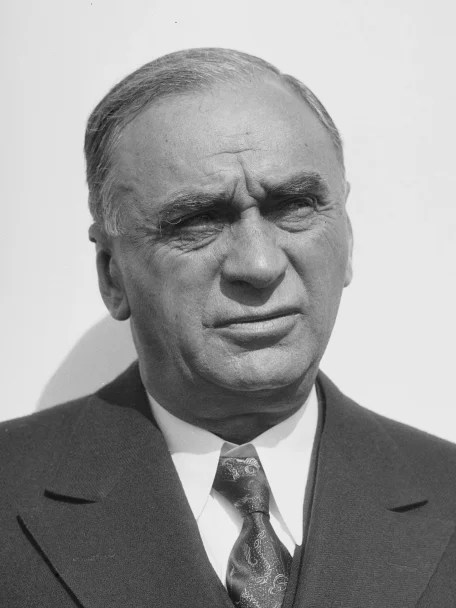
Few figures in American business history wielded power as ruthlessly or as secretly as Zemurray. Born Schmiel Zmurri on January 18, 1877, to a poor Jewish family in Imperial Russia, this teenage immigrant would rise from peddling rotting bananas off railroad cars in Alabama to become the controlling force behind the United Fruit Company, the most powerful agricultural corporation on earth. Along the way he overthrew governments, bribed presidents, hired mercenaries, and played a pivotal behind-the-scenes role in the creation of the State of Israel.
The man who would topple presidents arrived with nothing but a steamer ticket and family connections in the Deep South. After his father died, the 14-year-old Zemurray emigrated to the United States in 1892, traveling in steerage class and landing in New York before making his way to Selma, Alabama, where relatives had settled. He worked as a chicken catcher, carpenter’s assistant, delivery boy, traveling merchant, and housecleaner, eventually saving enough to bring his mother and 6 siblings over from Europe. Standing approximately 6 feet 3 inches tall with enormous energy and hustle, Zemurray was described as a man who could swear fluently in 5 languages. He encountered his first banana around 1893 in Selma, at that time an exotic and expensive delicacy in the United States, and the fruit became his life’s obsession.
Zemurray brought to the banana trade the same scrappy, rule-bending hustle that had carried him from steerage to a Selma general store. In 1895, at age 18, Zemurray traveled to the docks of Mobile, Alabama, and built a niche specializing in what the industry called “ripes” — bananas that were nearly overripe and being discarded by importers. He bought them for pennies and rushed them inland by rail before they spoiled, famously bribing Western Union telegraph operators to wire ahead with sales offers to towns along the route. Starting with just $150, he had saved $100,000 by age 21 and earned the lifelong nickname “Sam the Banana Man.” By selling bananas directly off moving trains, Zemurray turned minimal investments into substantial profits and was soon selling over one million bananas annually.
In 1903, Zemurray signed a contract with United Fruit giving him rights to distribute the company’s ripest bananas. He partnered with Ashbell Hubbard to form the Hubbard-Zemurray Company and by 1905 had moved to New Orleans, acquired the Thatcher Brothers Steamship Company, and taken control of the Cuyamel Fruit Company. By 1910, he had bought 5,000 acres along the Cuyamel River in Honduras near Omoa and borrowed aggressively to expand into plantations, railroads, and bridges. Unlike the patrician executives of United Fruit who ran operations from their offices in Boston, Zemurray spent months each year working directly on his Central American plantations, learning conversational Spanish, mapping land, clearing fields with a machete, killing snakes, and supervising construction in person.
Zemurray’s appetite for direct action soon extended far beyond plantation supervision. The most audacious act of Zemurray’s early career was his personal financing and orchestration of a coup d’état in Honduras in 1910 and 1911. The crisis arose when U.S. Secretary of State Philander C. Knox attempted to resolve Honduras’s large debt to British banks by having J.P. Morgan buy the bonds, in exchange for which a Morgan bank official would collect customs duties on Honduran imports. This arrangement would have obliterated the tax concessions Zemurray had privately negotiated with Honduran officials, effectively threatening to destroy his business. After lobbying the State Department unsuccessfully and being told directly to “butt out” of U.S.-Honduras relations, Zemurray devised an alternative.
While under surveillance by U.S. Secret Service agents enforcing neutrality laws, Zemurray recruited mercenaries in the French Quarter of New Orleans, hired the flamboyant soldier of fortune Lee Christmas and the notorious mercenary Guy “Machine Gun” Molony, and purchased a former U.S. Navy vessel called the Hornet. The conspirators evaded Secret Service surveillance, slipped away from New Orleans, and sailed to Honduras with rifles and ammunition Zemurray had stashed on Ship Island. They joined forces with Manuel Bonilla, the former Honduran president whom Zemurray supported as the preferred replacement. Through a combination of military action, bluffing, and recruiting local rebel forces, the coup succeeded. Bonilla was inaugurated as president of Honduras on February 1, 1912, and immediately rewarded Zemurray with extensive land concessions, duty-free import privileges, and favorable tax arrangements.
The spoils of that intervention elevated Zemurray from ambitious importer to regional kingmaker. Zemurray became known as “the uncrowned king of Central America.” After Bonilla’s death in 1913, he controlled a string of Honduran presidents and in 1925 secured exclusive lumber rights to 1/10 of Honduran territory. The episode established the template for what came to be called “banana republic” politics.
In 1929, Zemurray sold Cuyamel to United Fruit for $31.5 million in stock, becoming one of the wealthiest men in America and the single largest individual stockholder in the company. He nominally retired and moved to an estate outside New Orleans. But the Great Depression devastated United Fruit. The company’s stock collapsed by roughly 90 percent, wiping out most of Zemurray’s fortune. After his written suggestions were dismissed and his proposals ignored at board meetings, Zemurray took extraordinary action — traveling personally to visit individual shareholders and collecting their proxy votes. At a dramatic board meeting in 1932 or 1933, Zemurray placed the collected proxies on the table and reportedly declared to the assembled executives, “You’ve been fucking up this business long enough. I’m going to straighten it out.” He became managing director immediately and then formally president of United Fruit in 1938, serving until 1951.
Under Zemurray’s leadership, United Fruit became a behemoth. It owned rail transportation monopolies, radio communications infrastructure, steamship lines, and port facilities across 13 nations. In some Central American countries, the company operated as what critics described as “a state within a state.” Zemurray openly admitted that bribery was the foundation of his operations.
The most historically catastrophic action tied to Zemurray and United Fruit was the 1954 CIA-backed coup that overthrew Guatemalan President Jacobo Árbenz, a democratically elected leader who had introduced agrarian land reforms. Árbenz’s land reform law, Decree 900, expropriated uncultivated United Fruit land for redistribution to landless peasants. Under Zemurray’s influence, United Fruit launched one of history’s most consequential corporate lobbying campaigns.
Edward Bernays, known as “the father of public relations,” orchestrated press tours, planted stories, and produced films painting Guatemala as a Soviet beachhead in the Western Hemisphere. Both Secretary of State John Foster Dulles and CIA Director Allen Dulles had prior connections to United Fruit as former partners at Sullivan and Cromwell, the company’s main law firm. President Eisenhower authorized Operation PBSUCCESS with a $2.7 million budget. The CIA armed and trained a force under Carlos Castillo Armas, conducted psychological warfare operations, and engineered Árbenz’s resignation on June 27, 1954. Castillo Armas installed a military dictatorship that reversed land reforms, eliminated labor rights, and initiated decades of U.S.-backed military rule that led to over 200,000 deaths in a decades-long civil war.
While Zemurray built his banana empire in public view, he pursued another project almost entirely in the shadows. Beginning in the 1920s, he became personally close with Chaim Weizmann, the leader of the World Zionist Organization and Israel’s eventual first president. At the end of World War II, Zemurray was approached by Zionist leaders and asked to help procure ships for the clandestine network transporting Jews from displaced persons camps in postwar Europe to British Mandate Palestine. Working entirely behind the scenes, he raised money and used his connections to facilitate logistics.
The Jewish corporate magnate was instrumental in obtaining the ship that became the Exodus 1947 for the Haganah, which would explain its Honduran registration — Zemurray’s United Fruit Company effectively controlled much of Honduras. The Exodus carried over 4,500 Jewish refugees toward Palestine in 1947 before being intercepted by the British Royal Navy. The incident became an international cause célèbre and accelerated international support for Jewish statehood.
Zemurray’s most consequential contribution to the founding of Israel was his behind-the-scenes lobbying effort that helped secure passage of UN Resolution 181 on November 29, 1947, the Partition Plan that divided Mandatory Palestine into Jewish and Arab states. The resolution required a 2/3 majority to pass. According to author Rich Cohen, Zemurray made calls from his New Orleans home to Latin American heads of state, pressing for affirmative votes or abstentions. Haiti switched from a “no” vote to an abstention. Nicaragua switched from an abstention to a “yes.” In total, 13 of the 33 “yes” votes came from Latin America, including countries where United Fruit operated.
Samuel Zemurray died in New Orleans on November 30, 1961, at age 84. His philanthropy included major donations to Tulane University, the New Orleans Museum of Art, the Audubon Nature Institute, and Jewish refugee relief efforts. He also contributed financially to The Nation magazine.
If we look closely at the history of 20th century American interventionism, the shadow of the Jewish hand becomes impossible to ignore. Zemurray was not an outlier but a precursor to the modern reality where the United States operates as a private military company for the advancement of Jewish interests abroad.
The multitude of seemingly perpetual interventions of the past century were not driven by the abstract greed of villainous, White American billionaires but by the deliberate orchestration of a distinct group with its own tribal loyalties. We are destined to remain powerless subjects in our own land as long as we fail to unmask the true masters of our state and break free from the suffocating grasp of Jewish supremacy.
Recognizing the crimes of devious figures like Samuel Zemurray is a necessary first step in this process to reclaim our polities from the machinations of organized Jewry.
Leaked audios reveal pro-Israel groups ‘paid’ for US pardon of convicted drug trafficker Juan Orlando Hernandez
The Cradle | April 30, 2026
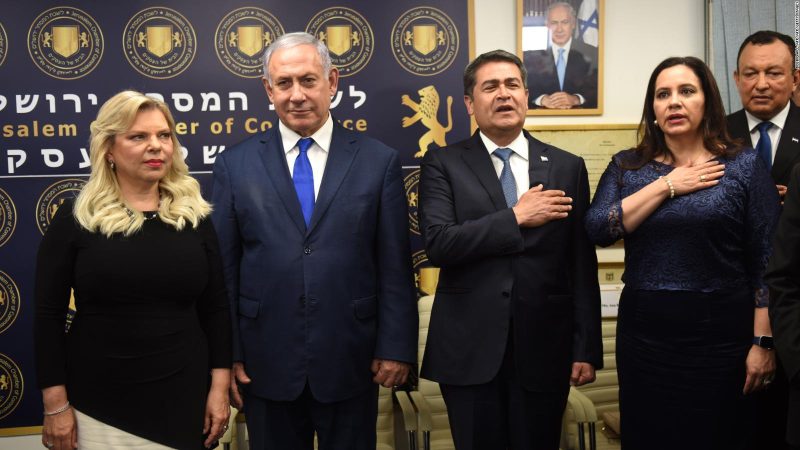
WhatsApp, Signal, and Telegram audio messages published by Canal RED and Hondurasgate on 29 April reveal pro-Israel groups “paid” for the release of former Honduran president and convicted drug trafficker Juan Orlando Hernandez (JOH) from US federal prison last year.
“The pardon money … came from a board of rabbis and people who supported Israel, and they had previously supported Yani Rosenthal,” JOH is heard saying in the leaked audios.
Yani Rosenthal is the former president of the right-wing Liberal Party of Honduras. He was convicted in December 2017 of laundering drug proceeds for a prominent Honduran drug cartel.
In 2024, JOH was convicted in a US federal court of three counts of drug trafficking and weapons conspiracy and received a 45-year prison sentence. He was also found guilty of receiving money from the former leader of the Sinaloa Cartel, Joaquin Archivaldo “El Chapo” Guzman, to finance electoral fraud.
JOH was pardoned late last year by US President Donald Trump, who called the DEA investigation into Hernández a “Biden administration set up.” Trump announced the pardon hours before Honduras’s presidential elections.
In that same social media post, Trump endorsed the current President Nasry “Tito” Asfura and threatened to cut aid to Honduras if he was not elected.
“The Prime Minister of Israel is going to give us his support. They had everything to do with my departure and negotiations,” JOH says in one of the audios released on Wednesday.
According to Canal RED, the leaked audios show that Trump’s pardon for JOH “was secured through intense lobbying led by Roger Stone and the Republican caucus … with the support of Israeli Prime Minister Benjamin Netanyahu.”
The audios also suggest that Hernandez’s return to Honduras and his upcoming presidential run are being financed by Israel.
“Mr. President, I’m here asking about my case, if there’s any resolution, if you have anything to share with me to see if there’s been any progress with the Supreme Court. I want to believe that you won’t sideline me because, thanks to me, you’re sitting in that chair … And I hope for your support. Because that’s what we discussed with President Trump,” JOH tells President Asfura in one of the leaked audios.
According to the report, Trump and Netanyahu are “seeking millions in compensation” in exchange for securing Asfura’s election and JOH’s possible reelection.
“The negotiations at the Florida residence included the expansion of Zones for Employment and Economic Development (ZEDEs), the construction of a new military base, a free trade agreement, and a law to incentivize investment in AI, whose contracts would be awarded directly to private American companies such as General Electric,” Canal RED reports.
ZEDEs, or “private states”/’model cities,” permit autonomous courts and foreign legal systems in Honduras, which civil groups say surrender sovereignty.
Additionally, a second set of leaked audios released on Thursday involving JOH, Asfura, and Honduran Vice President Maria Antonieta Mejia indicates the formation of a news outlet funded with more than half a million dollars in Honduran public funds, along with contributions from Javier Milei’s government in Argentina, aimed at ‘attacking’ the left-wing governments of Gustavo Petro in Colombia and Claudia Sheinbaum in Mexico.
Honduras: The Making of a Controlled Democracy

Zionist Organisation of America (ZOA) Praises Honduras’ Opening Diplomatic Mission In Jerusalem & Later Its Embassy. (Source: Zionist Organisation of America | ZOA)
21st Century Wire | December 22, 2025
Tegucigalpa — The streets of Honduras’ capital were tense as the results of the 2025 elections unfolded, a nation holding its breath amid suspicion, polarisation, and uncertainty. Beneath the visible turmoil lies a deeper story: for over a century, foreign powers have shaped Honduran politics, society, and culture, deliberately fracturing communities and weakening democratic institutions. Once a predominantly Catholic country with a cohesive social fabric, Honduras now grapples with divisions along religious, social, and racial lines, leaving its citizens vulnerable to manipulation and its democracy under strain.
Israel’s influence in Honduras extends far beyond diplomacy or military cooperation. Historical ties, dating back to the early 20th century with figures like Samuel Zemurray, established patterns of economic and political leverage to control Honduran leadership while advancing pro-Zionist objectives. In modern times, presidents, including Juan Orlando Hernández, have strengthened these ties through military cooperation, arms purchases, and symbolic gestures, such as relocating the Honduran embassy to Jerusalem in 2021. Israeli influence also penetrates civil society, promoting Zionist ideology, synagogue expansion, and religious conversion programs, including Protestant-to-Judaism conversions, that embed loyalty to Israeli interests within key segments of society. Four figures who held or effectively controlled the Honduran presidency, Juan Lindo, Ricardo Maduro, Juan Orlando Hernández, and Samuel Zemurray, have been Jewish or closely aligned with pro-Zionist interests, highlighting the deep historical roots of Israel’s influence in the country. These interventions reinforced a pro-Israel political bloc, cultivated an environment where dissent is socially penalised, and subtly shaped political allegiances, a dynamic clearly evident in the 2025 elections.
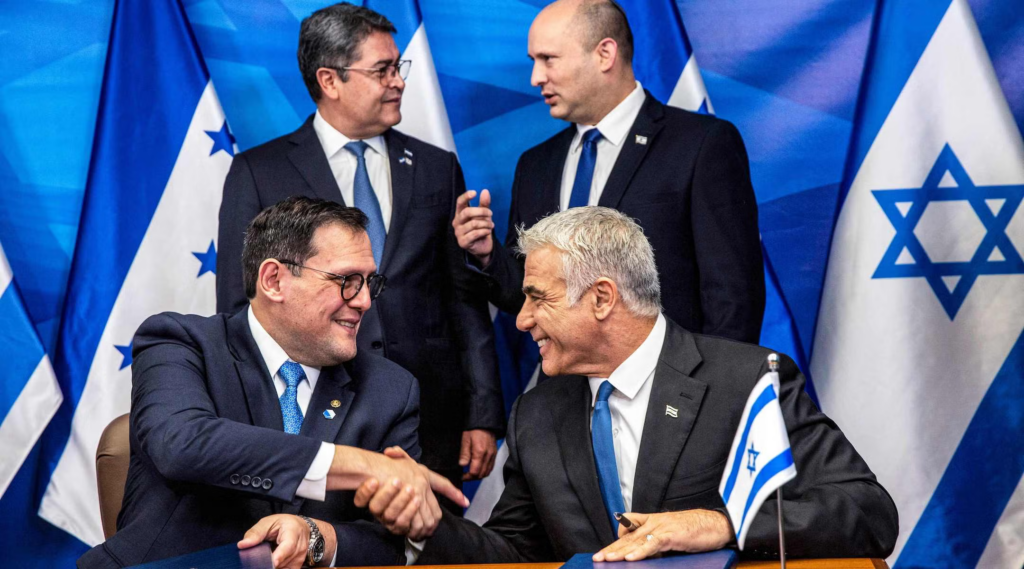
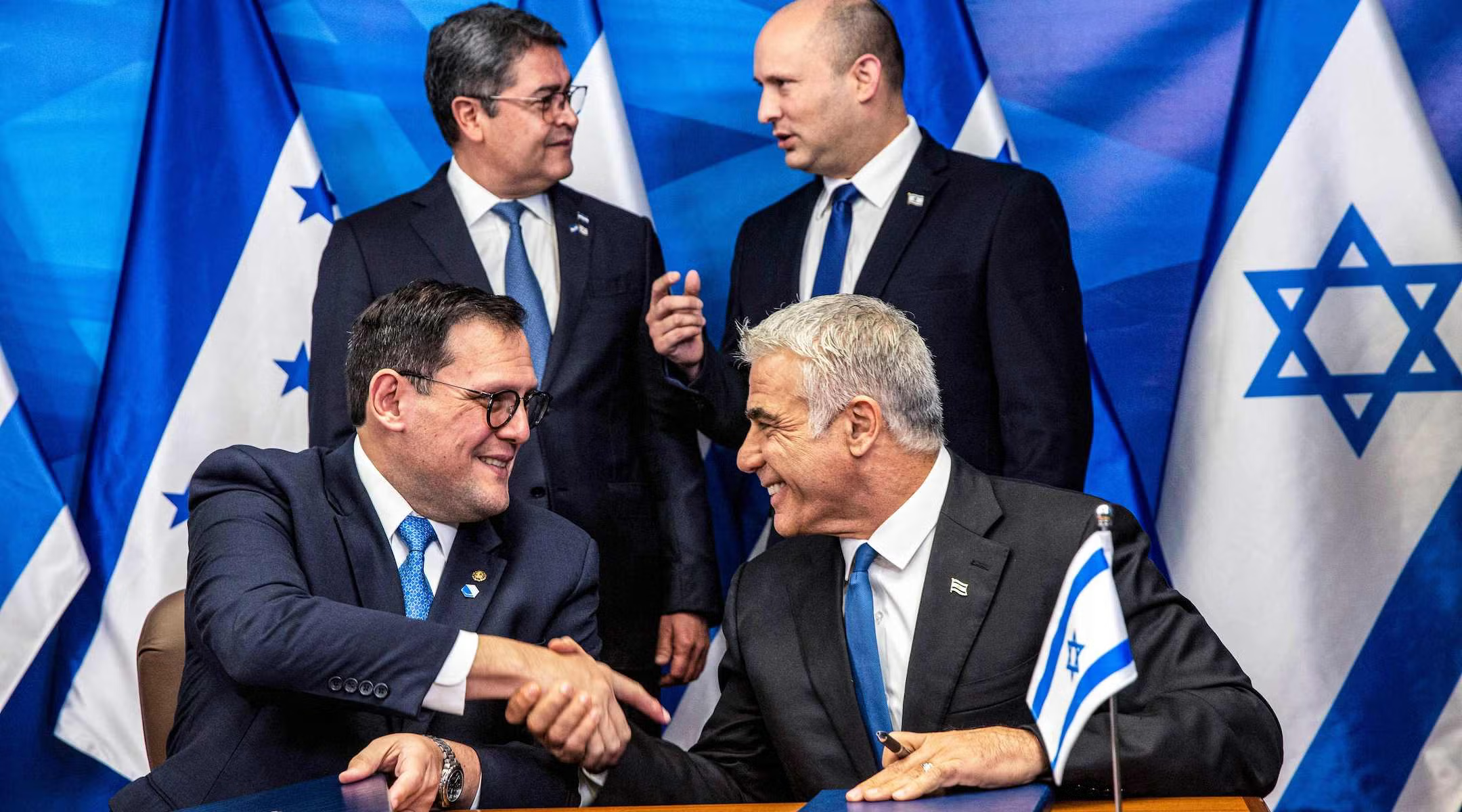
Israeli Foreign Minister Yair Lapid, right, shakes hands with his Honduran counterpart, Lisandro Rosales as Israeli Prime Minister Naftali Bennett, top right, speaks with Honduran President Juan Orlando Hernandez during the signing of bilateral agreements at the prime minister’s office in Jerusalem, June 24, 2021. (Source: Heidi Levine/AFP via Getty Images)
The CIA has complemented Israel’s long-term strategy by employing ostensibly humanitarian or religious NGOs, such as USAID, World Vision, and Church World Service (CWS), to fracture Honduran civil society. By promoting Protestantism over the historically cohesive Catholic majority and supporting programs that exploit divisions along religious, racial, and social lines, including tensions within the Garifuna community influenced by organisations such as OFRANEH, the CIA created fertile ground for ideological manipulation and elite control. Together, the actions of Israel and the CIA have destabilised Honduran society, skewed politics in favour of external interests, and amplified societal divisions. The 2025 elections starkly revealed these dynamics, exposing a democracy heavily shaped by decades of foreign intervention and manipulation.
While Honduras showed some symbolic independence, such as recalling its ambassador from Israel in November 2023, there is a strong case to argue that the deep structural influence of Israel and the U.S, reinforced over decades through military, economic, religious, and civil society channels, created a 2025 electoral landscape strongly favourable to a pro-Israel government, as confirmed by The Times of Israel. Nasry Asfura, promoted by President Trump, embodied this alignment, openly supporting Israeli interests and continuing policies that reinforced the country’s pro-Zionist orientation, making the elections less a contest of domestic politics and more a predictable outcome of long-term foreign influence.
Honduras is a nation under the shadow of powerful foreign influences, where politics, religion, and society have been quietly shaped for decades. The following article investigates how Israeli interests, CIA-backed NGOs, and elite manoeuvring have fractured communities, manipulated loyalties, and set the stage for the tensions that exploded during the 2025 elections…
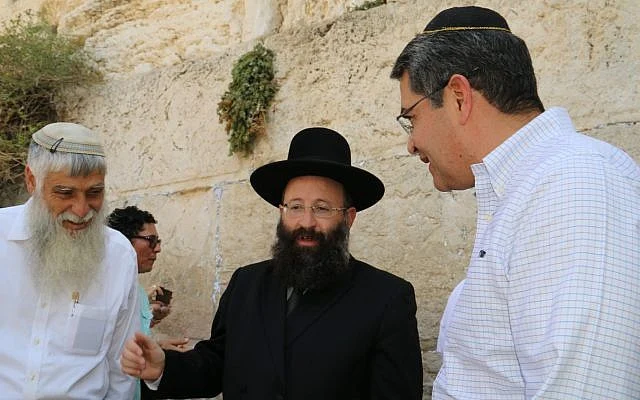
Honduran President Juan Orlando Hernandez visits the Western Wall in Jerusalem, September 1, 2019 (courtesy Western Wall Heritage Foundation)
Hondurans Curiously Ambivalent On Palestinian Genocide
Thomas Tomczyk writes for PÄYÄ Magazine…
Hondurans have been mostly silent regarding the reported genocide taking place in Gaza over the past two years. The question is: Why such silence? Are Hondurans unaware of the massacres and starvation used against Palestinians in the occupied territories? Do they not care, or are they perhaps afraid of something? “To learn who rules over you, simply find out whom you are not allowed to criticise,” the saying goes.
There was one example of Hondurans protesting Israeli crimes against Palestinians during the Gaza war after the Hamas attack and Israeli stand-down operation of October 7. On October 23, 2023, dozens of Honduran Palestinians demonstrated in front of the Israeli Embassy in Tegucigalpa. Since then, the long-established and influential Arab Palestinian community has been mostly silent about the plight of their Palestinian relatives amid Israel’s escalating atrocities in Gaza and the West Bank.
There is certainly a disconnect, as the 300,000 members of Honduras’ Christian Palestinian community are the third and fourth generations to be born outside of Palestine. Their ancestors began arriving in Honduras from Palestine in the 1890s, and today their connection to and knowledge of Palestine and Israel is mostly superficial. Most Honduran Palestinians don’t know the full scale or nature of the barbarism inflicted on their compatriots who stayed behind and continue to face Israeli oppression, violence, discrimination and now genocide. A Honduran Palestinian businessman told me that many in his community are afraid of being accused of anti-Semitism and facing potential consequences. Simply acknowledging that a systematic genocide may be occurring in Gaza is viewed by some as anti-Semitic.
It is hard not to notice. Since October 2023, Israeli military actions have resulted in the deaths of many Christian civilians in Gaza who have nothing to do with Hamas. In October 2023 Israeli military bombed a Christian orthodox church and murdered 18 Christians. In December 2023, Israeli snipers executed two Palestinian women on the Gaza Holy Family Catholic church property. In July 2025, Israeli soldiers fired a tank shell at a cross of the same church, killing three and wounding a catholic priest. While this all fell on deaf ears in Honduras, it does seem that the Israelis don’t like Christians very much.
One person who spoke with concern about the plight of Palestinians was President Xiomara Castro. In November 2023, the Honduran government recalled its ambassador to Israel for consultations due to escalating massacres of Palestinian civilians in Gaza. President Castro described Israel’s actions in Gaza as genocide during a U.N. speech in September 2024. Still, words have not turned into actions. Honduras is nowhere near recognising Palestine as an independent state or moving its embassy from Jerusalem back to Tel Aviv. In fact, Honduras remains firmly in the pro-Zionist camp as it continues to support Israel’s military by purchasing 15 Black Mamba military vehicles. Pro-Zionist sentiment is strong in Honduras. Israeli flags are flown throughout the country. Hondurans increasingly wear the Star of David around their necks, and taxi drivers display the Israeli emblem on their vehicles. Honduran roots of Zionism and Judeophilia run deep, well over a century.
The country now counts three of its presidents to be Jewish: Juan Lindo, Ricardo Maduro and Juan Orlando Hernández. In fact, you could argue that there was a fourth Jewish president of Honduras who ruled the country from 1911 well into the 1950s. Samuel Zemurray, the Banana King, was responsible for the 1911 Honduran presidential coup that secured land and concessions for his United Fruit banana company. American mercenaries hired by Zemurray deposed President Miguel Dávila and made Honduras his “banana republic.” Zemurray installed his puppet, Manuel Bonilla, as president and received 20,000 acres of land in return. After President Bonilla’s death in 1913, Zemurray continued to be a virtual puppet master of several other Honduran presidents.
In 1947, the World Zionist Organisation tasked Zemurray with delivering Honduras’ U.N. vote in support of the creation of the state of Israel. Reportedly, in a personal phone call, Zemurray tried to bribe then-Honduran President Tiburcio Carías Andino. Because of pressure from the Honduran Palestinian community, Honduras abstained from voting for Israel. Since then, and with plenty of CIA help, Christian Zionism has made many inroads in Honduras. CIA fronts such as World Vision, USAID and Protestant Church World Service for many decades worked to undermine the cohesiveness of Honduran society.
Since the 1950s, the CIA, which some critics considered an Israeli-captured agency, promoted the establishment and expansion of Protestant churches in Latin America. The excuse given was that Protestants were more anti communist and a good alternative to the Liberation Theology preached in many Catholic parishes.
The percentage of Catholics in the country fell from 97% in the 1960s to 47% today. Protestant denominations undermined the Catholic cohesion of Honduran society. Religiously divided Honduras is much easier to manipulate, with one denomination pitted against another. Sixty years later, those Catholic-to-Protestant converts have not only become Zionists, but they are also actually converting to Judaism. According to El Heraldo, 37 families converted to Judaism and, in 2022, established Honduras’ first synagogue. The San Pedro Sula Mishkan Shlomo synagogue members advertise their plans to Judaise and convert thousands of Hondurans.
“The plan is for the expanded synagogue to be a six-story, shaped like a Star of David building and be able to accommodate 456 people. This would make it the biggest synagogue in Latin America.”
Ex-President Juan Orlando Hernández was key in the expansion of Judeophilia and Zionism in Honduras. Just in terms of economy, according School of the Americas, between 2013 and 2019, Honduras purchased $342 million in military and surveillance equipment from Israel. Basically, Honduras has been supporting Israel to the tune of around $5 million a month for that period. Road to conversion of Juan Orlando Hernández began in the early 1990s when he completed a one-year Mashav leaders course in Israel. Israel’s investment in JOH obviously paid off as he learned Hebrew, moved Honduras’ embassy to Jerusalem in 2021, and converted to Judaism with his entire family in 2021. The last one, right before going to a US jail for 45 years, was convicted of decade’s long drug and arms smuggling operation.
Honduras is likely getting set up for a rough ride. Israel funded military dictatorships where even the CIA would not venture. Israel trained and supplied arms to many bad actors that destabilised the region: the genocidal regime in Guatemala in the 1980s, Colombian drug smuggling death squads, Los Zetas drug lord Heriberto Lazcano. “Israel has given its soldiers practical training in the art of oppression and in methods of collective punishment. Some of those officers choose to make use of their knowledge in the service of dictators,” said Israeli general Mattityahu Peled.
“Honduras will likely become an increasingly polarized and violent society.”
There is also a growing Israeli pressure on the Honduran public by co-opting its anti-Gaza genocide sentiment into nebulous movements. The normally restrained Honduran Ministry of Foreign Affairs complained that Israeli Ambassador Nadav Goren meddled in internal Honduran affairs by meeting with Protestant church leaders preparing for the August 16 March for Peace and Democracy. “We express to the Honduran people our deep discomfort at their participation in said public event. The involvement of a diplomat not only ignores his limitations,” stated the Honduran ministry. There are plenty of other players seeking discord. Until its recent defunding by the Trump administration, San Pedro Sula was also home to the Hebrew Immigrant Aid Society (HIAS). The worldwide HIAS organisation does not assist Palestinians, Arabs or Christians in moving to Israel, but uses U.S. tax dollars to help move undocumented migrants through Honduras to the United States.
For decades, certain interest groups have promoted racial resentment —particularly among Black communities— while fostering a sense of guilt among white, European and Christian populations. In Honduras, this strategy is reflected in the 23-year-old movement known as the Fraternal Organisation of Honduran Blacks (OFRANEH), which has received funding from organisations such as American Jewish World Service and the Open Society Foundations, founded by George Soros. These groups have been involved in fermenting revolutions, protests and underhanded political activism around the world. Just as with organisations such as Black Lives Matter and ANTIFA, which were recently designated by the U.S. as a terrorist organisation, OFRANEH fosters division, racial tension, grievances and expectations of compensation in the historically well-integrated Garifuna community. Honduras, in the second quarter of the 21st century, will likely become an increasingly polarised and violent society. Powerful interest groups are working hard to implement this, and Roatan is increasingly a party to those tensions. In September 2025, OFRANEH conducted demonstrations in Cayos Cochinos, and in March 2025, there were protests in Diamond Rock. Tensions on Roatan are just starting to heat up.
Honduran president accuses Trump of ‘election manipulation’
Al Mayadeen | December 10, 2025
Honduran President Xiomara Castro accused US President Donald Trump of direct interference in her country’s presidential elections, condemning what she termed election manipulation in Honduras’s disputed presidential race.
The controversy centers on the November 30 presidential election, where vote counting has been plagued by repeated computer system failures that have delayed final results. Trump-backed conservative Nasry Asfura currently holds 40.53 percent of votes, followed closely by right-wing candidate Salvador Nasralla with 39.16 percent, according to the National Electoral Council. Both candidates significantly outpace Castro’s left-wing Libre party candidate, Rixi Moncada.
Nasralla has challenged the results as fraudulent, claiming he actually leads by 20 percent and demanding a comprehensive recount. Speaking at a rally, Castro praised voters’ determination but alleged the election was marred by threats, coercion, manipulation of the preliminary results system, and tampering with voter intentions.
Castro specifically accused Trump of interference, noting his threats of consequences if Hondurans voted for Moncada. Trump openly endorsed Asfura as a “friend of freedom” while dismissing Nasralla as merely “pretending to be an anti-communist.”
In a stunning move, Trump also pardoned former Honduran President Juan Orlando Hernández, who was serving a 45-year US prison sentence for facilitating the trafficking of hundreds of tons of cocaine.
More than a week after voting concluded, thousands of ballots with irregularities await review. The Libre party has called for total election annulment and urged protests, while election officials have until December 30 to declare a winner under Honduran law. The Trump administration maintains the election was fair and rejects calls for annulment.
Trump’s unprecedented election meddling
Trump’s involvement in Honduras represents an extraordinary breach of diplomatic norms. Days before the election, he issued explicit warnings that the United States would cut off financial support if Asfura lost, stating on Truth Social that the US would not throw “good money after bad” if a candidate he deemed “communist” took power.
The Trump administration employed Cold War rhetoric, labeling Moncada and Nasralla as “communists” or “borderline communists” allied with Venezuela’s Nicolas Maduro. Beyond aid threats, Trump leveraged the possibility of mass deportations and blocking remittances, which constitute approximately 25 percent of Honduras’ GDP.
Moncada noted that text messages were circulated warning voters that December remittances would not arrive if the wrong candidate won, creating panic in a population heavily dependent on these funds.
The impact proved measurable. Ricardo Romero Gonzales, who runs an independent polling company, reported that Nasralla held a nine-point lead before Trump’s endorsement. After Trump intervened, the candidates reached a virtual tie. Roughly one-third of Hondurans have family in the United States, making Trump’s threats particularly potent.
José Ignacio Cerrato López, a 62-year-old retiree, told the New York Times that he initially planned to vote for Nasralla but switched to Asfura after Trump’s statement. “Trump said he was going to make things worse,” Cerrato López explained, citing fears about deteriorating bilateral relations.
The Trump corollary: A new doctrine of hemispheric control
Trump’s Honduras intervention exemplifies what his 2025 National Security Strategy terms the “Trump Corollary” to the Monroe Doctrine. Unlike the original 1823 doctrine preventing European colonization, Trump’s version asserts US rights to intervene directly in Latin American domestic politics to prevent influence by “non-Hemispheric competitors,” specifically China, or ideologies deemed hostile to US interests.
Under Castro, Honduras severed ties with Taiwan and established relations with China in 2023, opening the door for Chinese infrastructure investment. By backing Asfura, Trump aims to install a government that will reverse or freeze these projects, viewing Asfura as the “checkmate” to Beijing’s regional influence.
A pattern of historical intervention
Trump’s interference continues a century-long pattern of US meddling in Honduras, often called the quintessential “Banana Republic” due to historical dominance by US fruit companies.
During the 1980s Reagan administration, Honduras became known as “USS Honduras,” serving as the staging ground for the proxy war against Nicaragua’s Sandinista government. The CIA trained Battalion 316, a death squad responsible for kidnapping, torturing, and disappearing nearly 200 activists.
More recently, the 2009 military coup against President Manuel Zelaya, who had moved closer to Venezuela’s Hugo Chavez, received tacit US support. While the Obama administration officially condemned the coup, Secretary of State Hillary Clinton refused to designate it a “military coup,” allowing aid to continue.
The Real Story Behind Trump’s Pardon of Juan Orlando Hernández
José Niño Unfiltered | December 6, 2025
The news came in quietly from a federal prison in West Virginia. Juan Orlando Hernández, the former president of Honduras once sentenced to spend most of the rest of his life behind bars, had walked out of Hazelton penitentiary a free man.
According to an AP report, Hernández had received a presidential pardon from Donald Trump after a conviction that tied him to hundreds of tons of cocaine shipped into the United States. On paper, this was a spectacular reversal of fortune for a man whom federal prosecutors had branded the head of a Central American narco state. In practice, it looked like something else. It looked like a reward for loyalty to the one cause that towers above all others in Washington and in Trump world.
Hernández did not rise overnight. He entered Congress in the late 1990s, representing the rural department of Lempira, and spent more than a decade climbing inside the National Party machine. He then became president of the National Congress and finally president of Honduras from 2014 to 2022. While he projected the image of a tough conservative modernizer at home, another storyline unfolded in U.S. courtrooms.
Federal prosecutors charged him with a vast cocaine conspiracy involving the movement of multi-ton loads into the United States and with the possession of machine guns and other weapons in support of that network. The Justice Department later described his administration as a narco state fueled by millions in cartel bribes. Testimony and media investigations painted an even darker picture. According to Democracy Now, Hernández allegedly used Honduran security forces to protect drug shipments, partnered with major traffickers including the Sinaloa cartel, and used drug money to build his own political power. His brother Tony Hernández ended up with a life sentence in a U.S. prison on similar charges.
Court filings and investigative reports in outlets like CNN repeatedly tied the sitting Honduran president to drug traffickers. U.S. prosecutors said he took payoffs from drug networks as early as 2004. Hernández’s story also intersected with one of Honduras’s most prominent Jewish families. Prosecutors alleged that he received bribe payments and other favors from the Rosenthal family, a powerful clan of Romanian-Jewish origin led by Jaime Rosenthal, whose Grupo Continental controlled Banco Continental, a soccer club, and auto import businesses, as reported by Reuters.
The Rosenthal patriarch, a frequent Liberal Party presidential hopeful of Romanian Jewish extraction, stood near the top of the Honduran economic and political pyramid for decades. For his part, Hernández treated that network as another source of money and influence. A Univision investigation detailed allegations that he used drug money to finance political campaigns. After his arrest, Honduran authorities seized dozens of properties, vehicles, businesses, and other assets linked to his family.
The saga culminated in extradition to the United States in 2022. A New York jury convicted Hernández in March 2024, and a federal judge handed down a 45-year sentence plus supervised release in June of that year. By any normal standard, this was the end of the story. A disgraced former head of state, proven in court to have worked hand in glove with traffickers, destined to spend the rest of his days in prison.
However, Hernández did not bet his future on normal standards. For decades, he had invested in a different kind of protection. That protection wore a blue and white flag with a Star of David at the center.
His relationship with Israel began long before he held national office. As a young man in the early 1990s Hernández traveled to Israel under the auspices of Mashav, the Israeli Agency for International Development Cooperation. The Jewish Telegraphic Agency noted that he completed a Mashav enrichment course in 1992, at the beginning of his diplomatic career.
Three decades later, at the opening of the Honduran embassy in Jerusalem, Hernández stood before an audience and called that first visit to Israel a “life-changing” experience. He said the trip had shaped his view of security, agriculture, and innovation.
Once he entered the presidential palace, Hernández turned that personal link into state doctrine. In October 2015, he arrived in Jerusalem as head of state and told an audience convened by the Israel Council on Foreign Relations and the World Jewish Congress that “As long as I am president, Honduras will stand behind Israel.” The World Jewish Congress described the event in glowing terms and singled out his declaration that ties between the two countries had never been closer.
This was not idle rhetoric. Hernández set out to reposition Honduras as one of the most reliable pro-Israel governments in Latin America. Honduran and Israeli diplomats had initially signed formal relations in the 1950s, and Honduras had allowed Jewish immigration during the Second World War. Under Hernández, those historical connections became the foundation for a new foreign policy.
He adjusted the Honduran voting record at the United Nations so that his country would abstain from or oppose resolutions deemed hostile to Israeli interests. During the 2017 General Assembly vote that condemned the U.S. decision to move its embassy to Jerusalem, Honduras was one of only a tiny group of countries that sided with Washington and Israel against the overwhelming majority.
Hernández also opened a diplomatic and trade office in Jerusalem, signaling recognition of the city as Israel’s capital. He then promised to relocate the full Honduran embassy from Tel Aviv to Jerusalem, issuing joint statements with Israeli and U.S. officials that set public deadlines for that step. In June 2021, he completed the move. At the inauguration, Hernández proclaimed that he was “here today in the eternal capital of Israel” and vowed to work “against antisemitism, often presented as anti Zionism,” as quoted by Israel Hayom.
Israel rewarded this loyalty with gestures of its own. It agreed to reopen its embassy in Tegucigalpa and provided security cooperation, technical assistance and emergency relief after devastating hurricanes and during the early stages of the COVID era.
Furthermore, Hernández pushed Honduras into the orbit of Christian Zionist networks. The Friends of Zion Museum in Jerusalem, an institution that promotes Christian support for Israel and campaigns against antisemitism and BDS, gave him its Friends of Zion Award in 2019 for recognizing Jerusalem as Israel’s capital and for his diplomatic support. The Friends of Zion Museum and the Jerusalem Post emphasized that he now shared an honor roll with figures like Donald Trump and other leaders celebrated for their pro-Israel policies.
In the security arena, Hernández took positions that aligned perfectly with Washington and Tel Aviv. His government designated Hezbollah as a terrorist organization, a move welcomed by major American Jewish groups. This decision mirrored similar steps by other U.S.-aligned governments in the region–such as Argentina under Mauricio Macri–and confirmed that Tegucigalpa had no intention of straying from the Judeo-American consensus on Middle East security.
Even when the walls began to close in, Hernández treated Israel as his ultimate safety net. As his legal exposure increased and the prospect of extradition grew more likely, he reportedly turned to Israeli officials to ask for help in delaying or preventing his transfer to U.S. authorities. The Times of Israel reported that plea and underscored Hernández’s assumption that his years of unwavering support had earned him political capital in Jerusalem.
That calculation looked naïve when he arrived in New York in chains. It looks far more rational now that Donald Trump has delivered a pardon.
Trump himself cultivated a brand as perhaps the most pro-Israel president in U.S. history. He recognized Jerusalem as Israel’s capital, moved the U.S embassy there, backed the annexation of the Golan Heights, and surrounded himself with advisers and donors who made support for Israel a central test of loyalty. The Friends of Zion Museum honored him with the same award it later gave Hernández, presenting both men as partners in a shared historic mission.
So when Trump announced in late 2025 that he would pardon Hernández, it was natural for mainstream outlets to emphasize the legal controversy and the scale of the drug conspiracy. But there is another thread that runs from the Mashav classroom in the early 1990s to the Jerusalem embassy ribbon cutting to the moment the gates opened at Hazelton. That thread is the politics of Zionism in the Americas and the unwritten rule that governs advancement and protection in that world.
Hernández spent his adult life proving that he would stand behind Israel. He did it in the United Nations chamber, in ceremonial torch lighting invitations, in embassy relocations, in his fights against BDS and in his designation of Hezbollah. He did it in speeches where he promised that “as long as I am president, Honduras will stand behind Israel” and in the moment when he described Jerusalem as the “eternal capital of Israel.”
Trump saw that record and recognized a fellow shabbos goy traveler. He understood that this was not just a corrupt Central American politician but a loyal member of a global pro-Israel camp who had delivered meaningful victories in a region where Israel has long worked to secure dependable allies. In a political universe where servility to world jewry carries more weight than any anti-corruption sermon, Hernández did not just have a lawyer. He had a patron.
The pardon of Juan Orlando Hernández is therefore more than a quirky case of presidential clemency. It is a message about the real hierarchy of values in U.S. foreign policy in the Trump era. Flooding American streets with cocaine will not necessarily erase your credit if you have spent years moving embassies to Jerusalem, voting the right way at the United Nations, and branding your small Central American country as an extension of Israel’s diplomatic network.
In that world, a man who helped turn his own nation into a narco playground can still find a way out of a 45-year sentence, as long as his record on Zionism is pure and his friendship with the most pro-Zionist president in modern U.S. history remains intact. For Juan Orlando Hernández, that friendship did not simply buy influence. It bought his freedom.
Electoral Coup: CNE Councilor Denounces Serious Irregularities in Honduras
teleSUR – December 2, 2025
Marlon Ochoa, a member of Honduras’ National Electoral Council (CNE), denounced serious irregularities on Tuesday following the general elections held on November 30. He highlighted biometric failures, the withholding of 16,708 tally sheets, the complete lack of processing of physical tally sheets, and the lack of public access to the results.
Ochoa emphasized that the information provided by the TREP (Preliminary Electoral Results Transmission) system “lacks certainty and consistency,” something that Honduran citizens “have been able to verify.” He stated that the country is facing an election with “terrible technological results, profound inconsistencies, and irregularities,” evidenced by the lack of public access to the preliminary results on December 2.
During a session of the National Electoral Council (CNE) that extended until 3:00 AM this Tuesday, the company ASD verbally reported that 16,708 closing tally sheets had been withheld and not released to the public. These are broken down as follows: 3,880 presidential tally sheets, 6,387 for members of parliament, and 6,441 for municipal corporations.
The council member explained in a social media post that, across the country’s 7,669 transmission centers, the Preliminary Results Transmission System (TREP) has experienced inconsistencies in assigning votes. He illustrated that, when transcribing a tally sheet, the system can display the image of one polling station but assign the votes to a different one without the transcriber noticing.
In addition, the results publication website has been down, and there has been no official explanation for the outage, despite requests for information from the companies involved.
On the other hand, Ochoa opposed the decision, made by a majority in the National Electoral Council (CNE), to grant privileged access to the results dissemination rooms only to media outlets and political parties starting at 7:00 AM. The council member insists that the results dissemination website should be activated for the entire population, in accordance with the law and the approved guidelines.
Furthermore, he criticized the fact that as of 1:15 PM (local time) on December 2nd, none of the physical closing tally sheets returned from the polling stations had been processed, which he described as a “highly irregular act” that sows “doubts and uncertainty” about electoral transparency.
The presidential candidate for the LIBRE party, Rixi Moncada, denounced on Monday night an “electoral scheme” that allowed for the falsification of results with inflated tally sheets after the elimination of biometric validation in the elections.
Moncada presented a compelling technical analysis, highlighting the responsibility of the two-party system in an electoral fraud scheme. The candidate revealed that the “elimination of biometric verification of tally sheets was approved” by the National Electoral Council (CNE) “the night before the elections.” This controversial decision, according to Moncada, “enables the inclusion of inflated tally sheets, especially at the presidential level.”
Moncada’s technical team has identified 2,859 tally sheets without biometric verification, representing 25.35 percent of the total. These tally sheets, with an average of 217 votes each, present extreme cases with up to 100 additional votes beyond the legitimate ones.
The National Party accounts for 1,588 of these tally sheets, totaling 326,285 irregular votes, while the Liberal Party has 1,041 tally sheets without biometric verification, equivalent to 217,193 irregular votes.
Moncada stated: “We are going to demand during this 30-day period of the final general count that these tally sheets be reviewed, and we are going to make use of legal resources.”
4 Shocking Ties Between Rubio, Lobbyists, and Hernández Narcotics Indictment

teleSUR | November 29, 2025
WASHINGTON — The recent announcement by former U.S. President Donald Trump that he will grant a “full and complete pardon” to Juan Orlando Hernández, the former Honduran president currently serving a U.S. federal sentence for drug trafficking, has reignited scrutiny over a long-documented web of political and financial connections linking Hernández, Republican lobbying powerhouse BGR Group, and U.S. Secretary of State Marco Rubio.
Far from an isolated act of clemency, Trump’s pledge appears deeply entangled with a system of influence-peddling that has shaped U.S. policy toward Central America for years. At the center stands Rubio—a figure who, as a Florida senator, once publicly praised Hernández for “taking on drug traffickers,” even as evidence mounted that the Honduran leader was personally profiting from the very cartels he claimed to fight.
Now, with Rubio overseeing U.S. diplomacy from the State Department, critics warn that the Rubio Hernández lobbying scandal reveals how foreign actors can exploit the U.S. lobbying system to buy legitimacy, evade justice, and ultimately secure political favors—including presidential pardons.
The BGR Group Connection: How Hernández Bought Influence in Washington
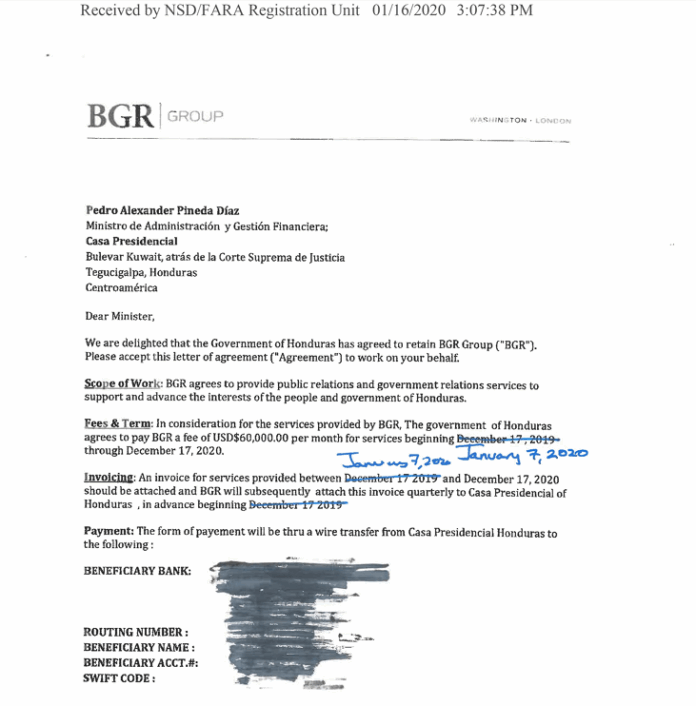
In early 2020, as his legal situation began to collapse—following the life sentence of his brother, Tony Hernández, for trafficking tons of cocaine into the U.S.—Juan Orlando Hernández signed a $660,000 contract with BGR Group, a Washington-based lobbying firm founded by former Republican Governor Haley Barbour.
The goal was clear: rehabilitate Hernández’s image in the U.S. capital as a “trusted ally” and “anti-narcotics partner,” despite mounting evidence that he had accepted millions in bribes from cartels to fund his presidential campaigns.
According to a detailed investigation by VICE News, BGR Group went to work immediately:
- It contacted 11 congressional staffers, three of whom had previously worked directly for Marco Rubio.
- It distributed press releases portraying Hernández as a bulwark against organized crime.
- It arranged meetings with U.S. officials to reinforce the narrative of Honduras as a cooperative security partner.
All this occurred while U.S. prosecutors were building their case against Hernández himself—culminating in his 2024 conviction for conspiring to import over 500 tons of cocaine into the United States.
Critically, BGR Group was not just any firm—it was a major Republican donor network with deep ties to Rubio’s political career. Records show the firm hosted fundraising events for Rubio’s 2010 and 2016 Senate campaigns, as well as his short-lived 2016 presidential bid.
This means that the same lobbying apparatus paid by a convicted narco-president helped finance the rise of the man now shaping U.S. policy toward Latin America.
Explore FEC records on BGR’s political contributions to Rubio (Federal Election Commission)
Trump’s Pardon as Political Payback—Not Justice
Trump’s announcement—made via Truth Social on Friday—comes amid his open support for Nasry “Tito” Asfura, Hernández’s political protégé and the National Party’s 2025 presidential candidate in Honduras. Trump has explicitly tied future U.S. aid to Asfura’s victory, signaling that Washington’s backing is conditional on political alignment.
In this context, the pardon of Hernández appears less like mercy and more like a strategic signal: loyalty to U.S. Republican interests—even when demonstrated through illicit means—will be rewarded.
Hernández, after all, was once Washington’s favorite Central American strongman. He allowed the U.S. to maintain military bases in Honduras, cracked down on migrant caravans, and supported U.S. regional agendas—all while allegedly running a state-sponsored drug enterprise.
Now, with Rubio at the State Department and Trump eyeing a 2028 comeback, the Rubio Hernández lobbying scandal underscores a troubling reality: foreign leaders can launder their reputations through U.S. lobbying firms, gain access to top policymakers, and ultimately escape accountability—even after federal conviction.
As one Latin American diplomat put it: “This isn’t diplomacy. It’s transactional impunity.”
Geopolitical Context: Undermining Rule of Law in the Americas
The fallout from the Rubio Hernández lobbying scandal extends far beyond bilateral relations. It strikes at the credibility of the entire U.S. “war on drugs” and its claims of promoting democracy and rule of law in Latin America.
If a president convicted of trafficking cocaine can secure a presidential pardon through backroom lobbying and partisan loyalty, what message does that send to reformers in Guatemala, El Salvador, or Colombia?
Moreover, it deepens regional distrust of U.S. intentions. For years, progressive governments in the region have argued that Washington prioritizes compliance over justice—backing authoritarian but cooperative leaders while condemning leftist governments for lesser offenses. The Hernández case validates that critique.
Cuba, Nicaragua, and Venezuela have long denounced this “selective morality” in U.S. foreign policy. Now, even centrist allies are questioning whether the U.S. system can be gamed by those with enough money and the right lobbyists.
In a hemisphere increasingly seeking multipolar partnerships, such scandals fuel the narrative that U.S. democracy is for sale—and that sovereignty is secondary to political convenience.
US Seizes Venezuelan Jet Plane Confirming who is the Rogue Nation
By Rick Sterling | Dissident Voice | September 7, 2024
The Biden/Harris administration is renewing its attacks on Venezuela. On Monday, September 2, US officials seized a jet plane belonging to the Venezuelan government when it was in the Dominican Republic for servicing, then flew it to Florida.
Contrary to a false report in the NY Times, the plane was not “owned by Venezuela’s Nicolas Maduro”. It is owned by the Venezuelan government and used for travel by various Venezuelan officials in addition to the president.
The NYT article claims, “The Biden administration is trying to put more pressure on Mr. Maduro because of his attempts to undermine the results of the recent presidential election.” This is another inversion of reality. The US government is trying to undermine the results determined by the Venezuelan National Election Council (CNE) and ratified by their Supreme Court.
Contrary to Western claims, the Supreme Court and Election Council are not synonymous with the government. They are approved by Venezuela’s elected national assembly. While one opposition member of the Election Council criticized the results, he did not attend the count or meetings. He does not ordinarily live in Venezuela and has returned to his home in the USA. Meanwhile, another opposition member of the Election Council, Aime Nogal, participated and approved the council’s decision.
Before the election, polls showed vastly different predictions. The US-funded polling company, Edison Research, showed the Gonzalez/ Machado opposition winning. Other polls showed the opposite. Polls are notoriously unreliable, especially when the poll is funded by an interested party. A better indication was the street demonstrations where the crowd in support of the coalition led by Maduro was near one million people. In contrast, the crowd for Gonzalez was a small fraction of that.
Increasingly, countries throughout the Global South are rejecting and criticizing Washington’s intervention in other nations’ internal affairs. On August 28, the president of Honduras, Xiomara Castro Zelaya, terminated the long standing extradition treaty with the United States and denounced US meddling after the US Ambassador commented negatively on Honduran – Venezuelan discussions. Along with many other Latin American countries but to the dismay of the US, Honduras recognized the results of the Venezuelan election.
For over twenty years, the US has been trying to overturn the Bolivarian revolution. In 2002, the US government and elite media supported a coup attempt against President Hugo Chavez. To their chagrin, the attempt collapsed due to popular outrage. Since then, there have been repeated efforts with the US supporting street violence, assassination attempts, and invasions. Under Obama, Venezuela was absurdly declared to be a “threat to US national security”. This was the bogus rationale for the economic warfare which the US has waged ever since. Multiple reports confirm that tens of thousands of Venezuelans have died as a result of hunger and sickness due to US strangulation of the economy. Again, the truth is the opposite of what Washington claims: the US is a threat to Venezuela’s national security.
Unknown to most U.S. residents, in December 2020 the U.N. General Assembly declared US unilateral coercive measures (sanctions) are “contrary to international law, international humanitarian law, the Charter of the United Nations and the norms and principles governing peaceful relations among States.”
Illegal U.S. measures were used to justify the kidnapping and imprisonment of Venezuelan diplomat, Alex Saab. They have now been used to justify the theft of a jet plane needed by Venezuelan officials.
Previously, sanctions were used to justify the seizure of Venezuela’s CITGO gas stations and freezing gold reserves in London. It comes after the U.S. and allies pretended for several years that an almost unknown politician, Juan Guaido, was the president of Venezuela.
The reasons for Washington’s repeated efforts to overturn the Bolivarian revolution are clear: Venezuela has huge oil reserves and insists on its sovereignty. Under Chavez and Maduro, the Bolivarian revolution has sought to benefit the vast majority of Venezuela’s people instead of a small elite of Venezuelans and foreigners. Washington cannot tolerate the idea that those resources are used to benefit the Venezuelan people instead of billionaires like the Rockefeller clan, which made much of its wealth from Venezuela.
Under the Bolivarian revolution, Venezuela insists on having its own foreign policy. In 2006, Venezuelan President Hugo Chavez denounced the U.S. invasion of Iraq and compared U.S. President Bush to the devil. In May this year, Venezuelan President Maduro denounced Israel’s genocide in Gaza and accused the West of being “accomplices.”
The cost of seizing Venezuela’s plane on foreign soil was probably greater than the $13 million value of the plane. So why did the Biden administration do this now? Perhaps it is to garner the votes of right-wing Cubans and Venezuelans in Florida. Perhaps it is to distract from their foreign policy failures in Gaza and Ukraine.
Whatever the reason, the theft of the Venezuelan jet plane is an example of U.S. foreign policy based on self-serving “rules” in violation of international law. It shows who is the rogue state.
President Xiomara Castro of Honduras is representative of the wave of disgust with US interference, crimes, and arrogance. In the past, Honduras was called a “banana republic” and known as “USS Honduras”. Now its president says, “The interference and interventionism of the United States … is intolerable. They attack, disregard and violate with impunity the principles and practices of international law, which promote respect for the sovereignty and self-determination of peoples, non-intervention and universal peace. Enough.”
Honduras recalls envoy from occupied territories citing Israeli violations in Gaza
Press TV – November 3, 2023
Honduras has recalled its ambassador from the occupied territories for consultations amid the Israeli regime’s hugely deadly and devastating war against the Gaza Strip.
The Honduran foreign ministry announced the development on Friday, citing Tel Aviv’s violations of the international humanitarian law in Gaza.
The country’s top diplomat confirmed the development in a post on X, formerly known as Twitter.
“Amid the grave humanitarian situation, the Palestinian civilian population suffers in the Gaza Strip, the government of President Xiomara Castro has decided to immediately call Mr. Roberto Martinez, ambassador of the Republic of Honduras in Israel, to consultations in Tegucigalpa,” read the post by Enrique Reina.
On Friday, the 28th day of Israel’s genocidal attacks on the coastal territory, the death toll reached at least 9,227 people, including 3,826 children and more than 2,405 women. At least 23,516 people have been wounded.
The regime launched the war after Gaza’s resistance groups conducted Operation al-Aqsa Storm, their biggest operation against the occupying entity in years.
So far, Chile and Colombia have similarly recalled their envoys from the occupied territories, while Bolivia has moved to sever its diplomatic ties with the occupying entity.
On Thursday, Bahrain’s lower house of parliament said the country had halted its economic relations with the Israeli regime over the war.
The chamber also confirmed that the Israeli ambassador to the kingdom had left Bahrain, and that Manama had decided to return the Bahraini ambassador from the occupied territories.
Featured Video
The Search for Truth: Charlie Kirk’s Assassination One Year Later
or go to
Aletho News Archives – Video-Images
From the Archives
The 9/11 “Double-Cross” Conspiracy Theory
BY LAURENT GUYÉNOT • UNZ REVIEW • SEPTEMBER 6, 2022
Is it true that “9/11 was an inside job”? Yes, insofar as Israel is “inside” the U.S. But for the 9/11 truthers who have identified Israel as the main perpetrators, “9/11 was an inside job” is at best a half-truth, and at worst an integral part of the Zionist operation, like a secondary flag sewn as a lining under the false flag of Islamism. Victor Thorn (1963-2017) wrote in his book 9/11 made in Israel: The Plot Against America (2011): “In essence, the ‘9-11 truth movement’ was created prior to Sept. 11, 2001 as a means of suppressing news relating to Israeli complicity. . . . The slogan ‘9-11 was an inside job’ was quite possibly the greatest example of Israeli propaganda ever devised.” In milder terms, it is “controlled opposition”.
A genuine truth movement would have pointed to Israel as the prime suspect from the start. From day one, it was obvious who would benefit. … continue
Blog Roll
 Aletho News
- Europe’s mounting social chaos… chickens coming home to roost for proxy war against Russia
- US-Russia Diesel Deal Becomes Massive Defeat for Ukraine
- Hormuz and the Looming Economic Catastrophe
- Dhubab offensive, media blitz and the rapid unraveling of Saudi-backed coalition’s new gambit
- Putin Conveys to Trump Iran’s Vision on Possible Conflict Resolution – Kremlin
- The Search for Truth: Charlie Kirk’s Assassination One Year Later
- ‘Harsh reality’: Iran says France seeks monopoly on power and intimidation, not peace for all
- When Will This White House Madness End?
- Huckabee aide goes to ‘unusual lengths’ to portray ‘Israel’ positively
- Trump Announces Diesel Supply Deal With Putin Following Phone Call
- If Americans Knew
- Israeli forces kill another child in Gaza – Daily Update
- Gaza ceasefire exists in name only, say more than 100 organizations
- Nearly 2 Million in Gaza Need Urgent Shelter Assistance as Winter Looms: IOM Chief Warns
- Suppressing Palestinian resistance: US charity under fire for AI monitoring of Gaza classrooms
- Thousands Are Held in Israeli Torture Camps. This Is What Happens Inside
- Israel puts Gaza’s sick, injured, newborn in peril – Daily Update
- Report claimed Mark Levin used by Israeli government to influence Trump
- Over 2,000 Gazans have died awaiting medical evacuation amid Israel’s continued siege
- How a U.S. Diplomat Suppressed and Altered Reports Critical of Israel
- 5 Palestinians Die from Israeli Strikes in Gaza as Relentless Attacks Continue
- No Tricks Zone
- New Study: 50 Years Of The Most Aggressive ‘Net Zero’ Policies Can Only Affect The Global Climate By 0.03°C
- US September “Heat” Was No Record…Many Records Set Decades Ago
- Latest European Green Energy Debacle; Portugal’s Largest Flagship Solar Park Insolvent!
- Green Energy Debacle: German Expert Professor Fritz Vahrenholt Warns Of Severe Economic And Social Consequences
- Two More Paleo Reconstructions Affirm Meters-Higher Sea Levels Across Ireland, Brazil 7000-6000 Years Ago
- New Study: Earth And Venus Surface Warmth Largely Explained By Convection And Lapse Rate, Not CO2 Or Radiation
- 2025 Nature Paper Claiming Worsening Global Drought Gets RETRACTED …Heavily Flawed
- New Study: ‘Global Drought Shows No Detectable Recent Acceleration Under Climate Warming’
- Economic Masterminds: German Socialists Suggest Taxing Productivity Gains Stemming From Using AI
- The South China Sea Has Not Been Cooperating With The Climate Change Narrative

