The Right-Wing Zionist Wave Sweeping Latin America
José Niño Unfiltered | June 30, 2026
Abelardo de la Espriella’s razor-thin victory over leftist Iván Cepeda on June 21, 2026 represented the most recent rightward shift in Latin America’s politics. The defense attorney from Barranquilla captured 49.66 percent of the vote against Cepeda’s 48.7 percent—a margin of roughly 250,000 votes in what Al Jazeera called one of Colombia’s closest elections. Within hours, Israeli Foreign Minister Gideon Sa’ar called to congratulate him, and de la Espriella posted his response publicly.
“Colombia will restore and strengthen its relationship with the State of Israel like never before. Israel can count on Colombia as a loyal friend and steadfast ally,” de la Espriella declared. Sa’ar called him “a true friend of the Jewish people and the State of Israel,” adding that he looked forward to “revitalizing relations between Israel and Colombia and taking them to their highest level ever” and that he had already invited the incoming president to visit Israel.
Israeli Prime Minister Benjamin Netanyahu offered his own congratulations, saying he looked forward to “working with you to strengthen the bond between Israel and Colombia.” De la Espriella has pledged to reverse Petro’s 2024 decision to cut ties with Israel and has promised to relocate the Colombian embassy to Jerusalem.
No figure looms larger in this transformation of Latin American politics than Argentine President Javier Milei. The libertarian economist who took office in December 2023 has positioned himself as Israel’s most devoted ally anywhere on earth.
“I am sincerely proud to be the most Zionist president in the world,” Milei declared at Yeshiva University in March 2026. At the Western Wall in June 2025, he proclaimed that “My support for Israel comes from the heart, because I believe this is a just cause—the cause of the West. I will always stand by your side.”
Milei personally studies Torah with Rabbi Shimon Axel Wahnish from the Moroccan Jewish community in Argentina and has said he intends to convert to Judaism after leaving office. In June 2025, he became the first non-Jewish head of state to receive Israel’s Genesis Prize, known as the “Jewish Nobel,” awarded for his “unequivocal support” of Israel.
He directed his entire $1 million prize toward creating the American Friends of Isaac Accords, the vehicle through which Argentina and Israel formally signed the Isaac Accords on April 19, 2026 in Jerusalem. The framework explicitly mirrors the Abraham Accords that normalized relations between Israel and several Arab states, but targets the Western Hemisphere instead.
The goals are clear. Partner countries should move their embassies to Jerusalem, designate Hamas and Hezbollah as terrorist organizations, shift anti-Israel voting patterns at the United Nations, and create frameworks for trade in technology, agriculture, water, health, and cybersecurity.
At least one nation had embraced the embassy mandate well ahead of the Accords. Paraguay’s Santiago Peña reopened his country’s embassy in Jerusalem on December 12, 2024, making Paraguay the sixth country in the world—after the United States, Guatemala, Honduras, Kosovo, and Papua New Guinea—and the first since the October 7 attacks to establish diplomatic presence in the contested city.
“Mr. prime minister, on behalf of all the Paraguayan people, we were with you, we are with you, we will stay with the people of Israel forever,” Peña declared at the ceremony with Netanyahu present. He called the move “a tipping point in our own history” and “a moral obligation that the Paraguayan people have asked us to fulfill.”
Paraguay was not alone in courting Tel Aviv. Ecuador’s Daniel Noboa, the banana fortune heir who won re-election in 2025, traveled to Jerusalem in May of that year for meetings with Netanyahu, at which Noboa declared that “Israel and Ecuador have the same enemies” and pledged to fight poverty, terrorism, and suffering “until the end.” Israeli diplomatic sources confirmed to Jewish Insider that both Ecuador and Paraguay are expected to formally join the Isaac Accords framework.
Nowhere did the shift register more dramatically than in Chile. José Antonio Kast’s victory in Chile’s December 2025 election delivered perhaps the most symbolically significant prize. Kast overturned four years of Gabriel Boric’s more pro-Palestinian governance. After Iran’s 2024 drone attack on Israel, Kast had warned that “Iran launches a drone and missile attack on Israel. They could be the same drones that it gifted to Bolivia to monitor our borders. Chile has a serious national security problem.”
In May 2026, Kast met with Israeli President Isaac Herzog and pledged to return Chile’s ambassador to Israel, ending a lengthy vacancy by naming Gabriel Zaliasnik as ambassador. He promised expanded cooperation in agriculture, health, artificial intelligence, technology, and security. Notably, Kast achieved this while governing a country home to the largest Palestinian diaspora outside the Arab world, estimated at 500,000 people.
The same paradox surfaced again, more sharply still, in Central America. Nasry “Tito” Asfura won Honduras’s late 2025 election with Trump’s endorsement, becoming president on January 27, 2026. Despite his Palestinian Christian ancestry, the conservative former mayor of Tegucigalpa made Israel one of his first international destinations after being elected, traveling there alongside the United States.
“It is a great honor for me to be in Israel again and to strengthen the ties which have been in existence over the last 77 years,” Asfura stated in Jerusalem. “I hope we are entering a new era where we can improve our relations, relations of brotherhood, and prosperity, of investment.” Israeli Foreign Minister Sa’ar told the Jerusalem Post Magazine that Asfura “has a clear worldview that is pro-Western, pro-American, and pro-Israeli,” and characterized the broader regional shift as a “Blue Wave” of right-wing governments aligning with the United States and Israel.
Bolivia’s Rodrigo Paz ended nearly 20 years of socialist MAS party rule by winning the October 2025 election. Within weeks, he restored diplomatic relations with Israel—ties the prior government had severed in 2023. Netanyahu congratulated Paz personally, and the two agreed to “promote cooperation in various fields, with an emphasis on security, and to restore the vibrant tourism of many Israeli travelers to Bolivia’s natural landscapes and rich cultures.”
Not every convert to the cause fits the expected profile. Nayib Bukele represents the most curious figure in this constellation. The Salvadoran president, who has Palestinian ancestry on his father’s side, has become an ardent Israel supporter despite his Palestinian Christian heritage. After October 7, 2023, Bukele posted that “As a Salvadoran with Palestinian ancestry, I’m sure the best thing that could happen to the Palestinian people is for Hamas to completely disappear. Those savage beasts do not represent the Palestinians.” El Salvador voted against the UN General Assembly resolution calling for a humanitarian ceasefire in Gaza in December 2023.
To the south, another government moved along the same axis. José Raúl Mulino, Panama’s security-focused former defense minister, won the 2024 elections and tilted the country firmly toward Washington and Jerusalem. In May 2026, Israeli President Herzog made the first official visit by an Israeli head of state to Panama. Mulino issued a joint declaration pledging expanded cooperation in security, commerce, technology, agriculture, and water management. Panama remains the only Latin American country that has never recognized a Palestinian state.
The October 2026 Brazilian presidential election represents the next battleground. President Luiz Inácio Lula da Silva, who compared Israel’s actions to the Holocaust and withdrew Brazil’s ambassador in 2024, faces Senator Flávio Bolsonaro in what polls show as a statistical tie—the BTG/Nexus survey of late March 2026 showed them tied at 46 percent each in a simulated runoff, with the race narrowing from a 12-point Lula lead in December 2025. The first round is scheduled for October 4, 2026, with a runoff on October 25 if no candidate clears 50 percent.
Flávio Bolsonaro, whose father Jair Bolsonaro was imprisoned for the January 8, 2023 coup attempt and barred from office, has positioned himself as the conservative consolidation candidate. A Bolsonaro victory would add the hemisphere’s largest country to the pro-Israel bloc. The Brazil-Israel Parliamentary Caucus signed the Isaac Accords “Declaration of Shared Principles” in April 2026, demonstrating legislative support even while Lula governs.
Behind each of these realignments lay forces larger than any single election. Trump’s return to the presidency in 2025 directly tied American financial and political backing to right-wing candidates. The region’s growing evangelical Christian population, with its theologically driven support for Israel, has provided an important voting base. As the Jerusalem Post observed, Israeli officials have declared 2026 “the year of Latin America.” With more than a dozen countries having restored or strengthened ties with Israel, the Isaac Accords and the broader rightward shift have fundamentally redrawn the hemisphere’s diplomatic map with direct implications for Israel’s global standing, American regional strategy, and the future of Palestinian diplomacy in the Western Hemisphere.
The latest boondoggles in Eurasia—from the Russo-Ukrainian war to the Iran war—have forced the Judeo-American project to seek softer targets. Latin America, with its fractured polities, corrupt elites, and vast resources, is the obvious prize. The so-called right-wing resurgence is not a recovery of national pride but rather a vassalage dressed in conservative robes. Each new president who rushes to Tel Aviv is a tool, not a leader. Pace some naive nationalist minds in the West, Zionism is not nationalist in nature, but rather an expansionist movement with global ambitions. The illusion that it respects sovereignty must be shattered by serious political movements. A coordinated multi-national resistance is the only force that can stop this hemispheric takeover and other Jewish supremacist endeavors from consolidating across the globe.
EU free trade pact on hold as farmers revolt
RT | January 21, 2026
The European Parliament has voted to refer a trade agreement with the South American bloc Mercosur to the EU Court of Justice (CJEU). The move comes amid criticism of Commission President Ursula von der Leyen for bypassing normal EU procedures and widespread protests from farmers across the bloc.
On Saturday, the EU signed a trade pact with Mercosur members Argentina, Brazil, Paraguay, and Uruguay. The agreement that was projected to create the world’s biggest free trade zone still requires approval before it can take effect.
On Wednesday, the EU Parliament voted 334 in favor to 324 against, with 11 abstentions, to ask the CJEU to determine whether the deal is compatible with the bloc’s rules. The move now significantly delays the pact that had been negotiated for 25 years, and could potentially derail final approval.
The vote took place against the backdrop of criticism of von der Leyen for handling the Mercosur deal in a non-transparent way, splitting it into separate agreements to bypass national parliaments and reduce the European Parliament’s role to a formal opinion.
The deal has also faced widespread resistance from the agricultural sector, with farmers across the bloc staging mass protests over concerns that cheap imports could undercut their livelihoods. The latest rally began on Tuesday outside the European Parliament in Strasbourg and drew support from some lawmakers, continued overnight, and ended on Wednesday.
Von der Leyen had pushed the deal, describing it as a “clear and deliberate choice,” highlighting that the EU opts for “fair trade over tariffs” and “a productive long-term partnership over isolation.” The pact came just six months after she signed an agreement with US President Donald Trump that imposed a 15% tariff on most EU exports. The EC president faced strong pushback over the US deal from current and former EU officials and heads of member states.
The EU is Mercosur’s second-largest trading partner, accounting for nearly 17% of the bloc’s total trade in 2024, at €111 billion.
UN overwhelmingly endorses declaration on Palestinian state
Press TV – September 12, 2025
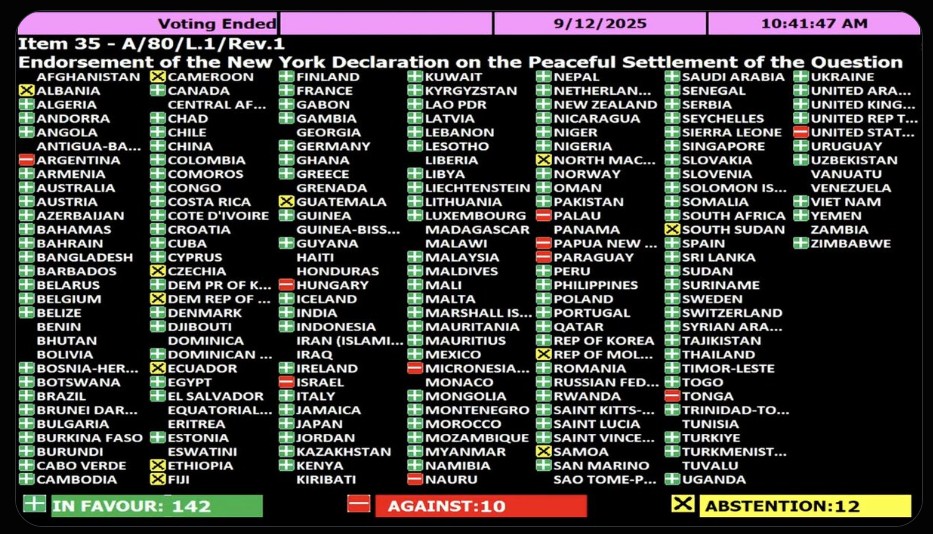
The United Nations General Assembly has overwhelmingly voted to endorse a declaration outlining “tangible, timebound, and irreversible steps” towards the establishment of a Palestinian state.
The 142-10 vote on Friday was to endorse the so-called New York declaration, a statement calling for a two-state solution, crafted by France and Saudi Arabia in July.
Joining Israel and the United States in opposing the resolution were Argentina, Hungary, Micronesia, Nauru, Palau, Papua New Guinea, Paraguay and Tonga. Twelve countries abstained.
Israel, US isolated
The seven-page declaration is the result of an international conference at the UN on the decades-long Israeli occupation. The United States and Israel boycotted the event.
The declaration, which excludes Hamas, also calls for “collective action to end the Israeli war in Gaza and effective implementation of the two-state solution.”
The declaration, was endorsed by the Arab League and co-signed in July by 17 UN member states, including several Arab countries
Long-time Western allies of Israel, including Belgium, France, the UK, Canada, and Australia, had earlier announced plans to recognize Palestinian statehood during the upcoming UN General Assembly sessions from September 8–23. They would join 147 nations that already formally recognize Palestine.
Around three-quarters of the 193 UN member states recognize the Palestinian state proclaimed in 1988 by the exiled Palestinian leadership.
Benjamin Netanyahu, Israeli prime minister, insisted on Thursday that Israel would never accept a Palestinian state.
Gideon Saar, the Israeli foreign minister, recently threatened that the Europeans’ recognition of Palestinian statehood would push Tel Aviv into “unilateral decisions”.
Israel’s far-right finance minister, Bezalel Smotrich, has announced plans to annex more than 80 percent of the occupied West Bank in a bid to block the establishment of a Palestinian state.
On August 14, Smotrich announced his intention to move forward with the highly contentious settlement project across the occupied West Bank that “buries the concept of a Palestinian state”.
In July 2024, the International Court of Justice (ICJ) declared Israel’s occupation of the Palestinian territory illegal and called for the evacuation of all settlements in the West Bank and East al-Quds. All mere words.
The recognition of a Palestinian state comes as international pressure was mounting on the regime over its genocidal war in the besieged Gaza Strip.
Since the Israeli genocide began in October 2023, the death toll has surpassed 64,700, with more than 164,000 others wounded.
Coups and Neo-Coups in Latin America
By Juan Paz y Miño Cepeda |Venezuelanalysis | September 15, 2020
I recently received an article entitled “Coups and neo-coups in Latin America. Violence and political conflict in the twenty-first century” by Carlos Alberto Figueroa Ibarra, a long-time friend and academic at the University of Puebla, Mexico, and Octavio Humberto Moreno Velador, a professor at the same university.
The authors say that since the 1980s, democracy in Latin America has asserted itself across the continent, so much so that the topic has become recurrent in the political sciences. However, during the first seventeen years of the 21st century, new coups resurfaced, which they describe as “neo-coups.”
During the twentieth century, the authors identified 87 coups in South America and the Caribbean, with Bolivia and Ecuador being the most hit countries, while Mexico has only suffered once. The greatest concentration of coups occurred in four decades: 1930-1939 with 18; 1940-1949 with 12; 1960-1969 with 16 and 1970-1979 with 13. Between 1900-1909 and 1990-1999, the fewest coups occurred (3 and 1, respectively). Finally, 63 coups were deemed as military-led; 7 civilian; 8 civic-military; 6 presidential self-coups and three military self-coups. 77 percent of coups had a marked influence of right-wing ideology and party participation, and since the 1960s US intervention has been observed in several coups.
The neo-coups of the 21st century, however, are different from the coups of the twentieth century and with distinct characteristics. Of the seven studied, four have been carried out by the military/police (two which failed in Venezuela/2002 and Ecuador/2010 and two which were successful in Haiti/2004 and Honduras/2009). Likewise, two were parliamentary coups (Paraguay/2012 and Brazil/2016, both successful) and one was a civilian-state-led coup (Bolivia/2008, failed). In three of them, there is evidence of US intervention (Haiti, Bolivia and Honduras).
The intervention of the military or police took place in Venezuela, Haiti, Honduras and Ecuador. In Haiti, Bolivia and Brazil, large-scale concentrations of opposition citizen groups preceded the coups, exerting political pressure. There were also other cases of subsequent concentrations in support of Presidents Hugo Chávez and Rafael Correa, which prevented the success of the coups against them.
In three cases there was clear intervention by the judiciary (Honduras, against Manuel Zelaya; Paraguay, against Fernando Lugo; and Brazil, against Dilma Rousseff), and also of the legislative powers.
In addition, regional and supranational institutions have intervened in defence of democracy, specifically MERCOSUR, UNASUR, CELAC and even the Rio Group.
The authors conclude that “The new coups have sought to evade their cruder military expression in order to seek success. In this sense, the intervention of judicial and parliamentary institutions have represented a viable alternative to maintaining democratic continuity, despite the breakdown of constitutional and institutional pacts.”
To the analysis carried out by the two professors, and which I summarise without going into too many details, some considerations may be added.
All the coups of the 21st century have been directed against rulers of the Latin American progressive cycle: Hugo Chávez, Evo Morales, Manuel Zelaya, Rafael Correa, Fernando Lugo, Dilma Rousseff, and Haiti, where the case is particular because of the turbulence that the country has experienced where the military coup was against Jean-Bertrand Aristide, who had won the election with 91.69 percent of the vote.
Progressive governments aroused furious enemies: business elites, traditional oligarchies, military sectors of old “McCarthyism” anti-communism, the political right, “corporate” media, and, no doubt, imperialism.
There is not a single coup d’état led by “leftist” forces, which reveals an equally new phenomenon: the entire left has accepted democracy as a political system and elections as an instrument through which they may come to power. Historically speaking, this phenomenon represents a continuation of Salvador Allende’s and the Chilean Popular Unity’s thesis, which trusted in the possibility of building socialism through a peaceful path. It is the political and economic right, which have turned to neo-coup mongering, with their discourse of defending “democracy.”
Those same right-wing sectors have not only sponsored “soft coups,” but also promoted the use of two mechanisms that have been tremendously successful to them. Firstly, lawfare, or “legal war,” used to pursue, in appearance of legality, those who have served or identified with progressive governments. Secondly, the use of the most influential media (but also of social media and their “trolls”), which were put at the service of combating “populists” and “progressives,” and defend the interests of persecuting governments, business elites, rich sectors and transnational capital. These phenomena have been clearly expressed in Brazil against Inácio Lula da Silva, Dilma Roussef and the PT Workers’ Party, but also in Bolivia, against Evo Morales and the MAS Movement to Socialism and in Ecuador, where righting forces have achieved the prosecution of Rafael Correa, of figures of his government and of the “correístas.” In Argentina Alberto Fernández’s triumph stopped the legal persecution against Cristina Fernández and “Kirchnerismo”.
But there is, finally, a new element to be added to the neo-coup mongering of the 21st century, which is the anticipated coup d’état. This has been inaugurated in Bolivia and Ecuador.
In Bolivia, not only was the vote count suspended and Evo Morales forced to take refuge outside the country, but [he and his party] have been politically outlawed, and every effort has been made to marginalise them from future elections.
In Ecuador, all kinds of legal ruse have been used to prevent Rafael Correa’s vice-presidential candidacy (he was ultimately not admitted), to not recognise his party and other forces that could sponsor him, as well as to make it difficult for the [Correa-backed] Andrés Araúz team to run for the presidency.
It also has an equally unique characteristic of what happened in Chile. In Chile, despite the protests and social mobilisations, as well as domestic and international political pressure, the political plot was finally manipulated in such a way that the plebiscite convened for October/2020 will not be for a Constituent Assembly (which could dictate a new constitution), but for a Constitutional Convention, which allows traditional forces to preserve their hegemony, according to the analysis carried out by renowned researcher Manuel Cabieses Donoso.
As a result, neo-coup mongering has shown that, while institutional and representative democracy has become a commonplace value and a line of action for the social and progressive lefts, it has also become an instrument that allows access to government and, with it, the orientation of state policies for the popular benefit and not at the service of economic elites.
On the other hand, it has become an increasingly “dangerous” instrument for the same bourgeoisie and internal oligarchy, as well as imperialism, to such an extent that they no longer hold back from breaking with their own rules, legalities, institutions or constitutional principles, using new forms of carrying out coups.
It is, however, an otherwise obvious lesson in Latin American history: when popular processes advance, the forces willing to liquidate them are also prepared. And finally, for these forces, democracy doesn’t matter at all, only saving businesses, private accumulation, wealth and the social exclusiveness of the elites.
Juan J. Paz y Miño Cepeda is an Ecuadorian historian from the PUCE Catholic University of Quito. He is also the former vice-president of the Latin-American and Caribbean Historian’s Association (ADHILAC).
Translation by Paul Dobson for Venezuelanalysis.
Brazil is adopting Israel’s terror narrative, which is anything but democratic
By Ramona Wadi | MEMO | March 5, 2020
Brazilian federal deputy Eduardo Bolsonaro, the son of right-wing dictatorship fanatic President Jair Bolsonaro, announced recently that the country will be moving to designate Hezbollah as a terrorist organisation. “Inside the government, we are debating the ways to stop terrorist groups from coming to Brazil,” Bolsonaro stated. “We are going to follow Argentina, declaring that Hezbollah is a terrorist group.”
Not only Hezbollah is being targeted with this designation. Bolsonaro’s son has also declared that the Brazilian government will be “considering a harsher stance on terrorist groups Hamas, Al-Qaeda, and Boko Haram.” Israel praised Brazil’s decision as part of the fight against “Iranian-sponsored terrorism”. Since the US declared its war on terror following September 11, Israel has appropriated the narrative and used it to gain diplomatic leverage for its murderous colonial policies, while strangling Palestinian resistance in the process. Unsurprisingly, Brazil will be joining other countries supportive of Israel’s security narrative in blurring the distinction between legitimate resistance movements and terrorist groups. That narrative is anything but democratic.
For the right wing Israeli and Brazilian governments, resistance movements such as Hamas and Hezbollah on one hand, and the Landless Workers’ Movement (MST) are terrorists, as Bolsonaro declared recently in one of his usual tirades. In defence of Israel’s purported security narrative, Brazil will be employing a designation on Hezbollah and Hamas which has nothing to do with terrorism and everything with how state terror seeks to delegitimise anti-colonial struggle.
As democracy moves even further away from its principles, becoming a label utilised by the right-wing in its quest to annihilate opposition, resistance movements become even more marginalised politically. Needless to say, Brazil’s move will endear it to the US and Washington’s own dissemination of Israel’s security versus terror narrative. Criminalising resistance movements has one main aim, to delegitimise resistance and, as a result, alter the understanding of what constitutes “terrorism”.
Categorising Hamas, the Palestinian Islamic Resistance Movement, alongside terror groups such as Al-Qaeda and Boko Haram builds upon the US-Israeli narrative of seeking to undermine Iranian influence in Latin America. Paraguay, Colombia and Honduras have already adopted this narrative since last year. It ignores the simple fact that Hamas has never carried the struggle for freedom from Israeli occupation beyond the borders of historical Palestine.
The right-wing surge in the region is not conducive to diplomatic support for Palestine, let alone Palestinian resistance. Hamas is already ostracised politically, but the US-Israeli scheming will continue to seek unanimous support for the narrative which allows the far-right to define terror at the expense of the occupied and oppressed.
Bolsonaro has stated on occasions that he seeks further alignment with the US in terms of policy. The latest decision strikes at the heart of Palestinian resistance at a time when Palestinians are in need of diplomatic support due to Trump’s deal of the century versus the two-state compromise dead ends in terms of opportunity. The more that Palestinians are obscured from the political process, the easier it is to simplify, albeit erroneously, the Palestinian cause into an issue between a “democratic state” and “terror”. This is part of the strategy that the US and Israel are pursuing, which is to have a monopoly over who decides that the definition of state-sponsored terror of the kind practiced by Israel and other right-wing governments is somehow “democratic”. That is far from the truth.
Israel to build ‘Embassy Quarter’ in occupied Jerusalem
MEMO | December 12, 2018
Israel is to build an embassy complex in occupied Jerusalem, a year after US President Donald Trump announced his plans to relocate the American Embassy to the city. Israel’s Construction and Housing Ministry announced today that it plans to build a complex with space for nine separate embassies in occupied East Jerusalem, in the belief that more countries will follow the US lead and move their diplomatic missions from Tel Aviv, Arutz Sheva reported.
The complex is to be built on a 25-acre plot of land in East Talpiot, a southern neighbourhood of Jerusalem. Following the Nakba of 1948, East Talpiot became part of no man’s land, next to the 1949 Armistice Line – sometimes known as the Green Line – observed by Israel and Jordan. During the Six Day War of 1967 Israel occupied the neighbourhood, establishing an illegal settlement there in 1973.
The plan to build the complex in East Talpiot is therefore in contravention of international law. As such, any country which chooses to move its embassy into the complex upon its completion would also be violating international law.
The intended construction is being pushed by Israel’s Construction and Housing Minister, Yoav Galant, who said of the plan: “I am convinced that many more countries will relocate their embassies to Jerusalem, which is why I instructed experts in the ministry to come up with an appropriate solution for the embassies in the future, including construction of a special ‘Embassy Quarter’.”
Galant urged the international community to relocate their embassies to Jerusalem. “It is our eternal capital. It is the right thing to do. Make the move quickly; the best places are going to be taken quickly.”
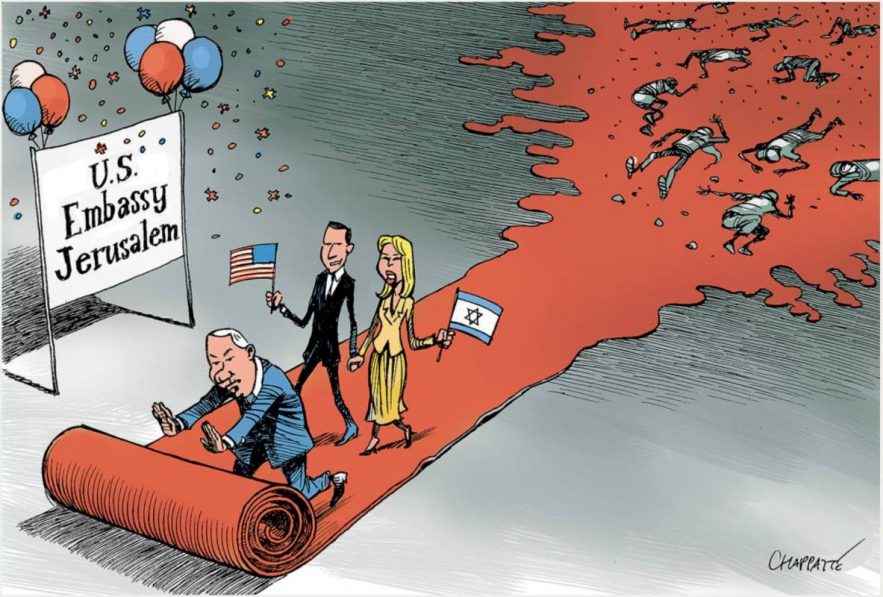
US embassy moved to Jerusalem – Cartoon [Chappatte/Twitter]
Since Trump announced that he would move the US embassy to Jerusalem last December, only Guatemala and Paraguay have followed suit. However, within months of relocating its mission, Paraguay reversed the decision and moved the embassy back to Tel Aviv, citing a desire to support “broad, lasting and just peace” among Israelis and Palestinians.
Other countries have toyed with the idea of moving their embassies to Jerusalem but have been hesitant to follow through with the move. In October, it emerged that Australia was contemplating relocating its embassy, with Prime Minister Scott Morrison saying that he was “open-minded” about it. “No decision has been made regarding the recognition of a capital or the movement of an embassy […] but at the same time, what we are simply doing is being open to that suggestion,” he explained.
This prompted a furious backlash from Malaysia and Indonesia, two countries that have historically been supportive of the Palestinian cause. Australia has not yet acted on any such plans, with reports emerging yesterday that a decision is “still pending”.
Paraguay cancels embassy move to Jerusalem, Israel responds by closing its embassy in Paraguay
RT | September 5, 2018
Paraguay will return its embassy in Israel to Tel Aviv, after the country’s previous government relocated it to Jerusalem in May. In a tit-for-tat response, Israel announced it would close its embassy in Paraguay.
National chancellor Luis Alberto Castiglioni announced the move on Wednesday, calling the decision by former President Horacio Cartes “visceral and without justification.” Cartes, a right-winger, made the decision to move the embassy to Jerusalem in May, and was present for its inauguration.
It was one of the last decisions Cartes made before President Mario Abdo Benitez took office last month, and followed the controversial decisions of the US and Guatemala to move their embassies to Jerusalem.
Benitez, the grandson of a Lebanese immigrant, said that he was not consulted about the move.
“Paraguay wants to contribute to an intensification of regional diplomatic efforts to achieve a broad, fair and lasting peace in the Middle East,” said Castiglioni on Wednesday.
The recognition of Jerusalem as Israel’s capital is a controversial one. East Jerusalem has been claimed as the capital of the Palestinian state, and Palestinian President Mahmoud Abbas described the US embassy there as “an American settlement outpost in East Jerusalem.”
Palestinian foreign minister Riyad al-Maliki claimed on Wednesday that he pushed President Benitez to reverse the move to Jerusalem.
Israel responded to Paraguay’s decision by recalling its ambassador to Paraguay and closing its embassy in the Latin American country’s capital, Asuncion. Before the diplomatic spat erupted, the Israeli ambassador, Zeev Harel, had been meeting with the Paraguayan minister for education, discussing cooperation between the two countries.
Parliamentary Coups: the New Strategy of Latin America’s Right
By Pablo Vivanco – teleSUR – May 12, 2016
Like Honduras and Paraguay, Brazil’s elites used the legislature against Dilma Rousseff. Is Venezuela next?
For most, the decades of the 1970’s and 1980’s are regarded as a dark period for Latin America.
The majority of South American nations were taken over by brutal military juntas, while in Central America civil wars claimed the lives of hundreds of thousands. The armed forces in the region, often trained and financed by the United States, ruled through force and where civilian governments didn’t heed their agendas, these were ignored or overthrown.
Despite entailing the onslaught of disastrous neoliberal economic policies that exacerbated poverty and inequality, the 1990’s also ushered in an end to the military dictatorships in Latin America. Elected governments returned to Chile, Argentina, Brazil, Uruguay and Paraguay, while peace accords in Guatemala and El Salvador also meant that the militaries would see a diminished role in the politics of those countries (at least in theory).
Latin America did not solve its numerous problems, but a general consensus was arrived at — no coups or military regimes should be permitted again in the region.
Of course, this consensus began to break with the resurgence of Latin America’s left, beginning with the Bolivarian movement and Hugo Chavez in Venezuela. Even though he initially harbored very modest proposals for reforms, Venezuela’s ruling class almost immediately sought to topple Chavez’s government. In April 2002 they acted as Latin American elites had done in previous decades and enlisted the upper echelons of the military to stage a coup to remove Chavez. The results were predictable — Venezuelans revolted against the coup and its leaders and the region (except for the U.S. government led by George W. Bush), rejected the move.
The lesson: military coups make for bad PR.
As the decade and Latin America’s left advanced, the regional right adopted a different strategy to counter the trend. While in many countries the left was winning presidencies, in these countries the legislative branches remained largely under the control of traditional (and generally right-wing) parties. Far from providing checks and balances on the authority of the executive branch, opposition-controlled legislatures began to be used as the instrument to overthrow elected presidents.
The first test came in 2009, when Honduran President Manuel Zelaya was removed from office after calling for a non-binding referendum on changing the country’s constitution. The Honduran Congress had voted to remove Zelaya from office, and the country’s Supreme Court — dominated by figures connected to the previous military government — ordered his arrest. The Honduran military dutifully complied with their order, kidnapping Zelaya and forcing him onto a plane to Costa Rica.
Three years later, Paraguay’s parliament impeached President Fernando Lugo, a former bishop who ended 61 years of one-party rule in the country. The charges and process against Lugo were met with skepticism in Paraguay as well as in the region, prompting Paraguay to be suspended from the Mercosur pact.
The impeachment process against the president of Latin America’s largest nation mirrors the intentions of the coups of the 70’s and 80’s and the methods of those in the last decade. Despite the absence of evidence that could justify an impeach against Dilma Rousseff, a majority of Brazilian legislators — many of whom are implicated or being investigated in a massive corruption scandal — have approved removing her from the office she was elected to. The man who will fill the seat is one of those being investigated, but he faces no repercussions from his colleagues.
In neighboring Venezuela, the opposition-led National Assembly has the same objective and has initiated the “recall” clause in the country’s constitution in an attempt to oust Nicolas Maduro from the Miraflores presidential palace.
In all of these cases, the objective is not merely power, but what power facilitates. Since 1998, numerous left-leaning governments have been elected to redistribute wealth and decision-making power. Not only has this led to inequality and poverty being slashed, but the political dynamics in those countries have shifted and the region has become more unified and independent.
The new strategy to stem the Pink Tide builds from the same objectives as those employed by the dictatorships of Pinochet, Videla and others: stop the left from being able to implement its program. But while it uses one elected institution to subvert another, it should be clear that these maneuvers are no less undemocratic than their military predecessors.
Pablo Vivanco is Director of teleSUR English.
A ‘Silent Coup’ for Brazil?
By Ted Snider | Consortium News | March 30, 2016
Brazil keeps its coups quiet (or at least quieter than many other Latin American countries). During the Cold War, there was much more attention to overt military regime changes often backed by the CIA, such as the overthrow of Guatemala’s Jacobo Arbenz in 1954, the ouster of Chile’s Salvador Allende in 1973 and even Argentina’s “dirty war” coup in 1976, than to Brazil’s 1964 coup that removed President João Goulart from power.
Noam Chomsky has called Goulart’s government “mildly social democratic.” Its replacement was a brutal military dictatorship.
In more modern times, Latin American coups have shed their image of overt military takeovers or covert CIA actions. Rather than tanks in the streets and grim-looking generals rounding up political opponents – today’s coups are more like the “color revolutions” used in Eastern Europe and the Mideast in which leftist, socialist or perceived anti-American governments were targeted with “soft power” tactics, such as economic dislocation, sophisticated propaganda, and political disorder often financed by “pro-democracy” non-governmental organizations (or NGOs).
This strategy began to take shape in the latter days of the Cold War as the CIA program of arming Nicaraguan Contra rebels gave way to a U.S. economic strategy of driving Sandinista-led Nicaragua into abject poverty, combined with a political strategy of spending on election-related NGOs by the U.S.-funded National Endowment for Democracy, setting the stage for the Sandinistas’ political defeat in 1990.
During the Obama administration, this strategy of non-violent “regime change” in Latin America has gained increasing favor, as with Secretary of State Hillary Clinton’s decisive support for the 2009 ouster of Honduran President Manuel Zelaya who had pursued a moderately progressive domestic policy that threatened the interests of the Central American nation’s traditional oligarchy and foreign investors.
Unlike the earlier military-style coups, the “silent coups” never take off their masks and reveal themselves as coups. They are coups disguised as domestic popular uprisings which are blamed on the misrule of the targeted government. Indeed, the U.S. mainstream media will go to great lengths to deny that these coups are even coups.
The new coups are cloaked in one of two disguises. In the first, a rightist minority that lost at the polls will allege “fraud” and move its message to the streets as an expression of “democracy”; in the second type, the minority cloaks its power grab behind the legal or constitutional workings of the legislature or the courts, such as was the case in ousting President Zelaya in Honduras in 2009.
Both strategies usually deploy accusations of corruption or dictatorial intent against the sitting government, charges that are trumpeted by rightist-owned news outlets and U.S.-funded NGOs that portray themselves as “promoting democracy,” seeking “good government” or defending “human rights.” Brazil today is showing signs of both strategies.
Brazil’s Boom
First, some background: In 2002, the Workers’ Party’s (PT) Luiz Inacio Lula da Silva came to power with 61.3 percent of the vote. Four years later, he was returned to power with a still overwhelming 60.83 percent. Lula da Silva’s presidency was marked by extraordinary growth in Brazil’s economy and by landmark social reforms and domestic infrastructure investments.
In 2010, at the end of Lula da Silva’s presidency, the BBC provided a typical account of his successes: “Number-crunchers say rising incomes have catapulted more than 29 million Brazilians into the middle class during the eight-year presidency of Luiz Inacio Lula da Silva, a former trade unionist elected in 2002. Some of these people are beneficiaries of government handouts and others of a steadily improving education system. Brazilians are staying in school longer, which secures them higher wages, which drives consumption, which in turn fuels a booming domestic economy.”
However, in Brazil, a two-term president must sit out a full term before running again. So, in 2010, Dilma Rousseff ran as Lula da Silva’s chosen successor. She won a majority 56.05 percent of the vote. When, in 2014, Rousseff won re-election with 52 percent of the vote, the right-wing opposition Brazilian Social Democratic Party (PSDB) went into a panic.
This panic was not just because democracy was failing as a method for advancing right-wing goals, nor was the panic just over the fourth consecutive victory by the more left-wing PT. The panic became desperation when it became clear that, after the PT had succeeded in holding onto power while Lula da Silva was constitutionally sidelined, he was likely returning as the PT’s presidential candidate in 2018.
After all, Lula da Silva left office with an 80 percent approval rating. Democracy, it seemed, might never work for the PSDB. So, the “silent coup” playbook was opened. As the prescribed first play, the opposition refused to accept the 2014 electoral results despite never proffering a credible complaint. The second move was taking to the streets.
A well-organized and well-funded minority whose numbers were too small to prevail at the polls can still create lots of noise and disruption in the streets, manufacturing the appearance of a powerful democratic movement. Plus, these protests received sympathetic coverage from the corporate media of both Brazil and the United States.
The next step was to cite corruption and begin the process for a constitutional coup in the form of impeachment proceedings against President Rousseff. Corruption, of course, is a reliable weapon in this arsenal because there is always some corruption in government which can be exaggerated or ignored as political interests dictate.
Allegations of corruption also can be useful in dirtying up popular politicians by making them appear to be only interested in lining their pockets, a particularly effective line of attack against leaders who appear to be working to benefit the people. Meanwhile, the corruption of U.S.-favored politicians who are lining their own pockets much more egregiously is often ignored by the same media and NGOs.
Removing Leaders
In recent years, this type of “constitutional” coup was used in Honduras to get rid of democratically elected President Zelaya. He was whisked out of Honduras through a kidnapping at gunpoint that was dressed up as a constitutional obligation mandated by a court after Zelaya announced a plebiscite to determine whether Hondurans wanted to draft a new constitution.
The hostile political establishment in Honduras falsely translated his announcement into an unconstitutional intention to seek reelection, i.e., the abuse-of-power ruse. The ability to stand for a second term would be considered in the constitutional discussions, but was never announced as an intention by Zelaya.
Nevertheless, the Supreme Court declared the President’s plebiscite unconstitutional and the military kidnapped Zelaya. The Supreme Court charged Zelaya with treason and declared a new president: a coup in constitutional disguise, one that was condemned by many Latin American nations but was embraced by then-Secretary of State Hillary Clinton.
This coup pattern reoccurred in Paraguay when right-wing Frederico Franco took the presidency from democratically elected, left-leaning Fernando Lugo in what has been called a parliamentary coup. As in Honduras, the coup was made to look like a constitutional transition. In the Paraguay case, the right-wing opposition opportunistically capitalized on a skirmish over disputed land that left at least 11 people dead to unfairly blame the deaths on President Lugo. It then impeached him after giving him only 24 hours to prepare his defense and only two hours to deliver it.
Brazil is manifesting what could be the third example of this sort of coup in Latin America during the Obama administration.
Operation Lava Jato began in Brazil in March of 2014 as a judicial and police investigation into government corruption. Lava Jato is usually translated as “Car Wash” but, apparently, is better captured as “speed laundering” with the connotation of corruption and money laundering.
Operation Lava Jato began as the uncovering of political bribery and misuse of money, revolving around Brazil’s massive oil company Petrobras. The dirt – or political influence-buying – that needed washing stuck to all major political parties in a corrupt system, according to Alfredo Saad Filho, Professor of Political Economy at the SAOS University of London.
But Brazil’s political Right hijacked the investigation and turned a legitimate judicial investigation into a political coup attempt.
According to Boaventura de Sousa Santos, Professor of Sociology at the University of Coimbra in Portugal and Distinguished Legal Scholar at the University of Wisconsin-Madison, although Operation Lava Jato “involves the leaders of various parties, the fact is that Operation Lava Jato – and its media accomplices – have shown to be majorly inclined towards implicating the leaders of PT (the Workers’ Party), with the by now unmistakable purpose of bringing about the political assassination of President Dilma Rousseff and former President Lula da Silva.”
De Sousa Santos called the political repurposing of the judicial investigation “glaringly” and “crassly selective,” and he indicts the entire operation in its refitted form as “blatantly illegal and unconstitutional.” Alfredo Saad Filho said the goal is to “inflict maximum damage” on the PT “while shielding other parties.”
Neutralizing Lula
The ultimate goal of the coup in democratic disguise is to neutralize Lula da Silva. Criminal charges — which Filho describes as “stretched” — have been brought against Lula da Silva. On March 4, he was detained for questioning. President Rousseff then appointed Lula da Silva as her Chief of Staff, a move which the opposition represented as an attempt to use ministerial status to protect him from prosecution by any body other than the Supreme Court.
But Filho says this representation is based on an illegally recorded and illegally released conversation between Rousseff and Lula da Silva. The conversation, Filho says, was then “misinterpreted” to allow it to be “presented as ‘proof’ of a conspiracy to protect Lula.” De Sousa Santos added that “President Dilma Rousseff’s cabinet has decided to include Lula da Silva among its ministers. It is its right to do so and no institution, least of all the judiciary, has the power to prevent it.”
No “presidential crime warranting an impeachment has emerged,” according to Filho.
As in Honduras and Paraguay, an opposition that despairs of its ability to remove the elected government through democratic instruments has turned to undemocratic means that it hopes to disguise as judicial and constitutional. In the case of Brazil, Professor de Sousa Santos calls this coup in democratic disguise a “political-judicial coup.”
In both Honduras and Paraguay, the U.S. government, though publicly insisting that it wasn’t involved, privately knew the machinations were coups. Less than a month after the Honduran coup, the White House, State Department and many others were in receipt of a frank cable from the U.S. embassy in Honduras calling the coup a coup.
Entitled “Open and Shut: the Case of the Honduran Coup,” the embassy said, “There is no doubt that the military, Supreme Court and National Congress conspired on June 28 in what constituted an illegal and unconstitutional coup.” The cable added, “none of the . . . arguments [of the coup defenders] has any substantive validity under the Honduran constitution.”
As for Paraguay, U.S. embassy cables said Lugo’s political opposition had as its goal to “Capitalize on any Lugo missteps” and “impeach Lugo and assure their own political supremacy.” The cable noted that to achieve their goal, they are willing to “legally” impeach Lugo “even if on spurious grounds.”
Professor de Sousa Santos said U.S. imperialism has returned to its Latin American “backyard” in the form of NGO development projects, “organizations whose gestures in defense of democracy are just a front for covert, aggressive attacks and provocations directed at progressive governments.”
He said the U.S. goal is “replacing progressive governments with conservative governments while maintaining the democratic façade.” He claimed that Brazil is awash in financing from American sources, including “CIA-related organizations.” (The National Endowment for Democracy was created in 1983, in part to do somewhat openly what the CIA had previously done covertly, i.e., finance political movements that bent to Washington’s will.)
History will tell whether Brazil’s silent coup will succeed. History may also reveal what the U.S. government’s knowledge and involvement may be.
UN Supports Sovereignty for Palestine and Slams Israel
Resolution severely criticises the “Occupying Power”
By Stuart Littlewood | Dissident Voice | January 1, 2016
Can this be true?
Something important and, freedom lovers may think, rather wonderful seems to have happened at the United Nations, and it went largely unreported in mainstream media. The UN General Assembly approved a draft resolution ‘Permanent sovereignty of the Palestinian people in the Occupied Palestinian Territory, including East Jerusalem, and of the Arab population in the occupied Syrian Golan over their natural resources’ (document A/70/480).
It was adopted by 164 to 5 against (Canada, Israel, Marshall Islands, Federated States of Micronesia, United States), with 10 abstentions (Australia, Cameroon, Côte d’Ivoire, Honduras, Papua New Guinea, Paraguay, South Sudan, Togo, Tonga, Vanuatu).
What’s so wonderful? The draft resolution pulls no punches and must have thoroughly annoyed the insatiable state of Israel, which has evil designs on the natural resources – oil, gas and water – belonging to its neighbours. The resolution is long but nicely crafted, and is reproduced here pretty much in its entirety as an aide-memoire of Israel’s long history of contemptuous disregard for its obligations.
The General Assembly,
Recalling its resolution 69/241 of 19 December 2014, and taking note of Economic and Social Council resolution 2015/17 of 20 July 2015,
Recalling also its resolutions 58/292 of 6 May 2004 and 59/251 of 22 December 2004,
Reaffirming the principle of the permanent sovereignty of peoples under foreign occupation over their natural resources,
Guided by the principles of the Charter of the United Nations, affirming the inadmissibility of the acquisition of territory by force, and recalling relevant Security Council resolutions, including resolutions 242 (1967) of 22 November 1967, 465 (1980) of 1 March 1980 and 497 (1981) of 17 December 1981,
Recalling its resolution 2625 (XXV) of 24 October 1970,
Reaffirming the applicability of the Geneva Convention relative to the Protection of Civilian Persons in Time of War, of 12 August 1949, to the Occupied Palestinian Territory, including East Jerusalem, and other Arab territories occupied by Israel since 1967,
Recalling, in this regard, the International Covenant on Civil and Political Rights and the International Covenant on Economic, Social and Cultural Rights, and affirming that these human rights instruments must be respected in the Occupied Palestinian Territory, including East Jerusalem, as well as in the occupied Syrian Golan,
Recalling also the advisory opinion rendered on 9 July 2004 by the International Court of Justice on the legal consequences of the construction of a wall in the Occupied Palestinian Territory, and recalling further its resolutions ES-10/15 of 20 July 2004 and ES-10/17 of 15 December 2006,
Recalling further its resolution 67/19 of 29 November 2012,
Taking note of the accession by Palestine to several human rights treaties and the core humanitarian law treaties, as well as to other international treaties,
Expressing its concern about the exploitation by Israel, the occupying Power, of the natural resources of the Occupied Palestinian Territory, including East Jerusalem, and other Arab territories occupied by Israel since 1967,
Expressing its grave concern about the extensive destruction by Israel, the occupying Power, of agricultural land and orchards in the Occupied Palestinian Territory, including the uprooting of a vast number of fruit-bearing trees and the destruction of farms and greenhouses, and the grave environmental and economic impact in this regard,
Expressing its grave concern also about the widespread destruction caused by Israel, the occupying Power, to vital infrastructure, including water pipelines, sewage networks and electricity networks, in the Occupied Palestinian Territory, in particular in the Gaza Strip during the military operations of July and August 2014, which, inter alia, has polluted the environment and negatively affect the functioning of water and sanitation systems and the water supply and other natural resources of the Palestinian people, and stressing the urgency of the reconstruction and development of water and other vital civilian infrastructure, including the project for the desalination facility for the Gaza Strip,
Expressing its grave concern further about the negative impact on the environment and on reconstruction and development efforts of the thousands of items of unexploded ordnance that remain in the Gaza Strip as a result of the conflict in July and August 2014,
Recalling the 2009 report by the United Nations Environment Programme regarding the grave environmental situation in the Gaza Strip, and the 2012 report, “Gaza in 2020: A liveable place?”, by the United Nations country team in the Occupied Palestinian Territory, and stressing the need for follow-up to the recommendations contained therein,
Deploring the detrimental impact of the Israeli settlements on Palestinian and other Arab natural resources, especially as a result of the confiscation of land and the forced diversion of water resources, including the destruction of orchards and crops and the seizure of water well by Israeli settlers, and of the dire socioeconomic consequences in this regard,
Recalling the report of the independent international fact-finding mission to investigate the implications of the Israeli settlements on the civil, political, economic, social and cultural rights of the Palestinian people throughout the Occupied Palestinian Territory, including East Jerusalem,
Aware of the detrimental impact on Palestinian natural resources being caused by the unlawful construction of the wall by Israel, the occupying Power, in the Occupied Palestinian Territory, including in and around East Jerusalem, and of its grave effect as well on the economic and social conditions of the Palestinian people,
Stressing the urgency of achieving without delay an end to the Israeli occupation that began in 1967 and a just, lasting and comprehensive peace settlement on all tracks, on the basis of Security Council resolutions 242 (1967), 338 (1973) of 22 October 1973, 425 (1978) of 19 March 1978 and 1397 (2002) of 12 March 2002, the principle of land for peace, the Arab Peace Initiative and the Quartet performance-based road map to a permanent two-State solution to the Israeli-Palestinian conflict, as endorsed by the Security Council in its resolution 1515 (2003) of 19 November 2003 and supported by the Council in its resolution 1850 (2008) of 16 December 2008,
Stressing also, in this regard, the need for respect for the obligation upon Israel under the road map to freeze settlement activity, including so-called “natural growth”, and to dismantle all settlement outposts erected since March 2001,
Stressing further the need for respect and preservation of the territorial unity, contiguity and integrity of all of the Occupied Palestinian Territory, including East Jerusalem,
Recalling the need to end all acts of violence, including acts of terror, provocation, incitement and destruction,
Taking note of the report prepared by the Economic and Social Commission for Western Asia on the economic and social repercussions of the Israeli occupation on the living conditions of the Palestinian people in the Occupied Palestinian Territory, including East Jerusalem, and of the Arab population in the occupied Syrian Golan, as transmitted by the Secretary-General,
-
Reaffirms the inalienable rights of the Palestinian people and of the population of the occupied Syrian Golan over their natural resources, including land, water and energy resources;
-
Demands that Israel, the occupying Power, cease the exploitation, damage, cause of loss or depletion and endangerment of the natural resources in the Occupied Palestinian Territory, including East Jerusalem, and in the occupied Syrian Golan;
-
Recognizes the right of the Palestinian people to claim restitution as a result of any exploitation, damage, loss or depletion or endangerment of their natural resources resulting from illegal measures taken by Israel, the occupying Power, and Israeli settlers in the Occupied Palestinian Territory, including East Jerusalem, and expresses the hope that this issue will be dealt with within the framework of the final status negotiations between the Palestinian and Israeli sides;
-
Stresses that the wall and settlements being constructed by Israel in the Occupied Palestinian Territory, including in and around East Jerusalem, are contrary to international law and are seriously depriving the Palestinian people of their natural resources, and calls in this regard for full compliance with the legal obligations affirmed in the 9 July 2004 advisory opinion of the International Court of Justice and in relevant United Nations resolutions, including General Assembly resolution ES-10/15;
-
Calls upon Israel, the occupying Power, to comply strictly with its obligations under international law, including international humanitarian law, and to cease immediately and completely all policies and measures aimed at the alteration of the character and status of the Occupied Palestinian Territory, including East Jerusalem;
-
Also calls upon Israel, the occupying Power, to bring a halt to all actions, including those perpetrated by Israeli settlers, harming the environment, including the dumping of all kinds of waste materials, in the Occupied Palestinian Territory, including East Jerusalem, and in the occupied Syrian Golan, which gravely threaten their natural resources, namely water and land resources, and which pose an environmental, sanitation and health threat to the civilian populations;
-
Further calls upon Israel to cease its destruction of vital infrastructure, including water pipelines, sewage networks and electricity networks, which, inter alia, has a negative impact on the natural resources of the Palestinian people, stresses the urgent need to advance reconstruction and development projects in this regard, including in the Gaza Strip, and calls for support for the necessary efforts in this regard, in line with the commitments made at, inter alia, the Cairo International Conference on Palestine: Reconstructing Gaza, held on 12 October 2014;
-
Calls upon Israel, the occupying Power, to remove all obstacles to the implementation of critical environmental projects, including sewage treatment plants in the Gaza Strip and the reconstruction and development of water infrastructure, including the project for the desalination facility for the Gaza Strip;
-
Calls for the immediate and safe removal of all unexploded ordnance in the Gaza Strip and for support for the efforts of the United Nations Mine Action Service in this regard, and welcomes the efforts exerted by the Service to date;
-
Encourages all States and international organizations to continue to actively pursue policies to ensure respect for their obligations under international law with regard to all illegal Israeli practices and measures in the Occupied Palestinian Territory, including East Jerusalem, particularly Israeli settlement activities and the exploitation of natural resources;
-
Requests the Secretary-General to report to the General Assembly at its seventy-first session on the implementation of the present resolution, including with regard to the cumulative impact of the exploitation, damage and depletion by Israel of natural resources in the Occupied Palestinian Territory, including East Jerusalem, and in the occupied Syrian Golan, and decides to include in the provisional agenda of its seventy-first session the item entitled “Permanent sovereignty of the Palestinian people in the Occupied Palestinian Territory, including East Jerusalem, and of the Arab population in the occupied Syrian Golan over their natural resources”.
This is strong stuff. But given the UN’s record will the action ever suit the words?
Astonishingly, the Israel-adoring UK government voted for it. Let us make a mental note of those 5 countries – Canada, Israel, Marshall Islands, Federated States of Micronesia, United States – which claim to be freedom loving but are evidently bent on denying the poor Palestinians theirs. And the birdbrained 10 – Australia, Cameroon, Côte d’Ivoire, Honduras, Papua New Guinea, Paraguay, South Sudan, Togo, Tonga, Vanuatu – which are so lackadaisically uncommitted to the principle of universal human rights that they sat on the fence. Maybe international civil society would like to prod them with a sharp BDS stick to concentrate their minds.
At least one country, happily, is taking a tough line – Brazil, which, says the BBC, has yet to approve the appointment four months ago of Israel’s new ambassador. Not only is the new man, Dani Dayan, a former chairman of the Yesha Council which promotes illegal Israeli settlements on stolen Palestinian lands, but Israeli prime minister Netanyahu broke the news of the appointment on Twitter before telling Brazil, according to reports.
As even Netanyahu must know, the transfer by an occupier of part of its own population into territory it occupies is considered a war crime, so why should Brazil play host to a foreigner with such a vile record? Israel is threatening to downgrade relations to “secondary level” if Brazil does not give approval to the appointment. And Israeli deputy foreign minister Tzipi Hotovely says that Dayan would not be replaced if his appointment isn’t accepted.
Since Brazil is Israel’s largest trading partner in South America you’d think the Israelis would watch their manners. The Brazilians, hopefully, won’t allow themselves to pushed around by Tel Aviv’s insufferable thugs.
Venezuela Tops Latin America in Military Spending Cuts, Slashes Arms Budget by 34%
By Lucas Koerner | Venezuelanalysis | April 16, 2015
Caracas – According to a new report by the Stockholm International Peace Research Institute (SIPRI), Venezuela reduced its military budget by 34 percent in 2014, leading the the region in arms spending cuts.
Venezuela is followed by Uruguay, which decreased its military spending by 11 percent over the past year.
In contrast, United States political allies Paraguay and Mexico led the region in upping military spending, raising their military budgets by 13 and 11 percent, respectively.
Brazil, which is the largest arms spender in Latin America and the tenth largest in the world, cut its military budget by 1.7 percent due to economic difficulties.
The Americas remains the region with the highest military spending, a fact undoubtedly attributable to the presence of the United States, which, despite a modest budget cut of 6.5 percent, retains its spot as the world’s top arms spender.
With an annual military budget of $610 billion, the US accounts for one-third of global spending, amounting to more than triple the budget of the second highest spender, China.
Nonetheless, this enormous disparity in spending has not prevented the US from branding Venezuela a menace to its neighbors, on numerous occasions.
In 2009, then US Secretary of State Hilary Clinton accused Venezuela of fomenting an “arms race” with its purchase of Russian weapons. That same year, Venezuela led the region in cutting military spending, slashing its arms budget by one-quarter.
Last month, President Barack Obama issued an Executive Order labeling Venezuela a “national security threat”, a move which has been vociferously condemned by a host of countries and multilateral blocs across the globe.
Featured Video
Dan Dicks with James Corbett on Solutions Watch
or go to
Aletho News Archives – Video-Images
From the Archives
MMR (Measles, Mumps and Rubella) – Vaccine Risk Statement
MMR Vaccine (Measles, Mumps, and Rubella) Is It Safer Than Measles, Mumps and Rubella?
Physicians for Informed Consent | December 2024
… It has not been proven that the MMR vaccine is safer than measles, mumps, and rubella. The vaccine package insert raises questions about safety testing for cancer, genetic mutations, and impaired fertility. Although VAERS tracks some adverse events, it is too inaccurate to measure against the risk of measles, mumps, and rubella. Clinical trials do not have the ability to detect less common adverse reactions, and epidemiological studies are limited by the effects of chance and possible confounders. Safety studies of the MMR vaccine are particularly lacking in statistical power. A review of more than 60 MMR vaccine studies conducted for the Cochrane Library states, “The design and reporting of safety outcomes in MMR vaccine studies, both pre- and post-marketing, are largely inadequate.”19 Because permanent sequelae (aftereffects) from measles, mumps, and rubella are so rare (especially in children with normal levels of vitamin A and infected after birth),6,15-17 the level of accuracy of the research studies available is insufficient to rule out the possibility that the MMR vaccine causes greater death or permanent disability than measles, mumps, and rubella. – Read full article
Blog Roll
 Aletho News
- Yes, the Iran war has destroyed Trump’s presidency
- The fallacy of US delusions about Iran’s economic collapse
- Hezbollah denies Syria cell link, warns of Israeli plan to sow discord
- The legacy of US sanctions, war, and occupation in Iraq
- Iraqi resistance group rejects disarmament, vows to maintain support for Lebanon
- Sheikh al-Asadi warns of Iraqi government compliance with US demands
- How to MAKE THE CONSPIRATORS PAY for their crimes! Dan Dicks with James Corbett on Solutions Watch
- There’s a drought in academia: A drought in honest research on the subject of drought and other weather extremes
- Department of War Awards $20.7 Billion Contract to Raytheon for Air-to-Air Missiles
- ‘Distance yourselves from Israel’: IRGC urges US population to question govt policies
- If Americans Knew
- As settlers ravage West Bank, Israeli forces kill 10 in Gaza – Daily Update
- New Report: “Scholasticide and Genocide in Gaza: Assessment, Testimonies and Legal Analysis”
- Ex-Biden officials are desperate for a Gaza scapegoat
- Israeli “settlers” Invade Al-Aqsa; Pour Boiling Water on 75-Year-Old
- Israel Has Kidnapped Another American Teenager
- US arms sales to Israel worth $21.6 billion in 20 months
- Three Palestinians Killed in Israeli Attacks on Gaza
- Revealed: German “Anti-Semitism Expert” Driving Crackdown on Palestine Solidarity is Former Israeli Spy
- Egypt’s Warning to Israel Before Oct 7
- Israel’s siege signals another cruel winter for 1.8 million Gazans – Daily Update
- No Tricks Zone
- Two More Paleo Reconstructions Affirm Meters-Higher Sea Levels Across Ireland, Brazil 7000-6000 Years Ago
- New Study: Earth And Venus Surface Warmth Largely Explained By Convection And Lapse Rate, Not CO2 Or Radiation
- 2025 Nature Paper Claiming Worsening Global Drought Gets RETRACTED …Heavily Flawed
- New Study: ‘Global Drought Shows No Detectable Recent Acceleration Under Climate Warming’
- Economic Masterminds: German Socialists Suggest Taxing Productivity Gains Stemming From Using AI
- The South China Sea Has Not Been Cooperating With The Climate Change Narrative
- Energy Crisis: Germany Enters Heating Season With Historically Low Gas Reserve Fill Levels
- New Study: The Antarctic Ice Sheet Gained Mass From 2020-2024 Due To Staggering Snow And Ice Accumulation
- Study: Ocean Heating Rates From Thousands Of Years Ago ‘Dwarf’ Modern Ocean Heating Rates
- Climate Extremists Target, Attack Large-Scale Power Grid Infrastructure In Germany!

