“Historic Russia”: The Land Putin Will Not Give Back
Daniel Davis / Deep Dive – October 23, 2026
How the Cambridge Analytica scandal still haunts Mark Zuckerberg
RT | October 23, 2026
‘Cambridge Analytica’ is by now a byword for the social media Wild West of 2016, when regulations were non-existent and unscrupulous brokers sold personal user data to advertisers and political operatives. RT explores the scandal that Meta CEO Mark Zuckerberg still can’t dodge.
On October 22, Meta was ordered by a New Mexico judge to pay $25 billion in civil penalties over the collection of personal data from 44 million Facebook users by Cambridge Analytica more than a decade earlier.
The judge concluded that Meta’s misconduct warranted a penalty exceeding $219 billion under state law, but reduced the amount to $25 billion, making it one of the largest fines ever imposed on an American corporation.
Meta, operating at the time as Facebook, knowingly and systematically deceived users about how it managed their personal data and allowed its harvesting by third-party companies like Cambridge Analytica. The jury also found Meta’s senior executive team knew of, and lied about, deceiving users about how it planned to investigate data-harvesting companies after the Cambridge Analytica scandal became public.
To understand how Meta ended up owing an eighth of its annual revenue in just one judgment, it’s necessary to go back to 2013, when Cambridge Analytica emerged from Britain’s shadowy private intelligence sector.
What was Cambridge Analytica?
Cambridge Analytica was founded in 2013 as a subsidiary of SCL Group, a London-based private intelligence firm that has provided data analytics and “behavioural analysis” services to the British Defense Ministry and Foreign Office.
Cambridge Analytica CEO and SCL Group Director Alexander Nix has admitted under oath that his companies worked with American and British intelligence agencies, provided psychological warfare training to several Western militaries, employed multiple staff with security clearances in the UK and US, and hired former Israeli spies.
SCL Group’s work for NATO, Israel, Ukraine, and other governments and militaries was extensive, and Cambridge Analytica drew on its parent company’s experience in military psyops to become one of the world’s most effective election influence operations, according to whistleblower Christopher Wylie. On the other hand, SCL insists that its military and political wings were separate entities. Whichever account is true, Cambridge Analytica had been hired by political candidates in 200 elections by 2018, according to company documents. These included parliamentary elections in the Czech Republic, India, and Italy, the Brexit referendum in the UK, and most infamously, the 2016 presidential election in the US.
What did Cambridge Analytica do in 2016?
Cambridge Analytica was paid nearly $6 million by then-candidate Donald Trump’s campaign in the runup to the 2016 election. The company used its unprecedented access to Facebook user data to identify persuadable voters and potential donors, select effective markets for television ads, and target certain Hillary Clinton supporters for “deterrence” – adverts discouraging them from going to the polls on election day.
How did this become a scandal?
Cambridge Analytica did not break any laws to obtain this data. It was scraped from tens of millions of Facebook users who had, unbeknownst to themselves, given a third-party Facebook quiz application access to their messages, their profile data, and that of their friends.
Cambridge Analytica hired a Cambridge University professor, Aleksandr Kogan, to develop a personality quiz app, named ‘This is Your Digital Life’. Between 250,000 and 270,000 American Facebook users took the quiz in 2015, and by accessing their data, but crucially, under Facebook terms, accessing the data of all of their friends on the platform, Cambridge Analytica was able to compile detailed psychological profiles on roughly 87 million users.
Cambridge Analytica employee Christopher Wylie revealed the workings of the scheme to The Observer in 2018, telling the British newspaper that “we exploited Facebook to harvest millions of people’s profiles, and built models to exploit what we knew about them and target their inner demons. That was the basis the entire company was built on.”
Was Cambridge Analytica the only data-scraper doing this?
“Facebook never cared,” Kogan told NBC News in 2018, explaining that “tens of thousands” of developers created apps like his quiz, and sold user data to companies like Cambridge Analytica. Among the developers were CubeYou, which used a “one-click personality test” app to gather information for commercial use, and LocalBlox, which scraped data from 48 million users, which it then sold to marketers.
AggregateIQ, Global Science Research, and Eunoia Technologies all used data gleaned by Kogan for political ends. However, long before these companies existed, Blue State Digital, an American political consultancy, surreptitiously harvested Facebook data, including friends’ data, for use by Barack Obama’s 2012 campaign.
Cambridge Analytica, however, had its work for the Trump campaign exposed at the height of the ‘Russiagate’ hoax, at a time when Democrats and liberal media outlets were convinced that Russia intervened in the election on behalf of Trump. Cambridge Analytica’s data-scraping dovetailed neatly into a narrative of “Facebook bots” and “Russian military hackers” working with the Trump campaign, and the company became a whipping boy for an industry that transcended partisan lines.
US Special Counsel Robert Mueller and the Senate Intelligence Committee eventually investigated claims that Cambridge Analytica helped the Russian government target political ads at American voters, but both determined that these claims were untrue, and neither investigation found any proof of “collusion” between the Trump campaign and the Kremlin.
Has Facebook been punished?
At the time that the information was collected, Facebook had stopped allowing third-party apps to access friends’ data. However, a loophole allowed apps active on the platform before this change to continue harvesting information through 2015. Within days of Wylie’s revelations hitting the headlines, SCL Group and Cambridge Analytica were suspended from Facebook. Two months later, both companies ceased operations, leaving Facebook to handle the fallout.
Facebook initially went into damage control mode, insisting that “People knowingly provided their information” to Kogan’s app, and that “everyone involved gave their consent.”
However, the US Federal Trade Commission determined that Facebook made its privacy settings deliberately opaque, spreading them out over 20 separate screens and opting users into sharing data with third-parties by default. Facebook settled with the FTC for $5 billion in 2019, setting the stage for a series of similar payouts in the following years.
In 2018, Zuckerberg told lawmakers on Capitol Hill that Facebook was aware that user data had been transferred from Kogan to Cambridge Analytica (this transfer was in breach of its policies) since 2015, but opted not to inform users. He said that Facebook asked Cambridge Analytica to delete the data, but never followed up and made sure the company did. “We considered it a closed case,” he told Congress.
The following year, the US Securities and Exchange Commission accused Facebook of misleading investors by presenting “the risk of misuse of user data as merely hypothetical,” when it knew since 2015 that “a third-party developer had actually misused Facebook user data.” Facebook settled the case with the SEC for $100 million.
In 2022, Meta settled a $725 million class-action lawsuit brought by a group of Facebook users, who alleged that the company violated privacy and consumer protection laws by misrepresenting its data-sharing laws and failing to protect their personal information.
Meta attempted to shut down further legal action over the Cambridge Analytica scandal this August, when it reached an $18 billion settlement with 51 attorneys general across US states, territories, and the District of Columbia. Although the cases concerned the addictive design of Meta’s platforms and their effect on children’s mental health, the settlement included a clause resolving a multistate investigation into Facebook’s sharing of user data with third parties “whether known or unknown,” including Cambridge Analytica.
Even if participating states were to discover new facts about the data sharing, they have now waived their right to sue Meta. New Mexico was one of two states that was not party to this agreement, hence the $25 billion penalty.
Did Cambridge Analytica get Trump elected?
Ten years after the fact, it remains unclear how prominent a role Cambridge Analytica played in Trump’s victory over Clinton. The Trump campaign’s use of Facebook and X (then called Twitter) is widely cited as instrumental in his win, but the campaign’s digital director, Brad Parscale, has since said that he stopped using the company’s data several months before election day, considering it inaccurate.
What about Brexit?
Cambridge Analytica worked with Nigel Farage’s Leave.EU organization in late 2015 and early 2016, and carried out some preliminary data analysis for the campaign. However, the data was never used, and the UK Information Commissioner’s (ICO) office concluded in 2020 that the company had no impact on the referendum. As in the US, the ICO found no links between Cambridge Analytica and Russia, and no evidence that Russia interfered in the vote.
Is Zuckerberg in the clear?
The $25 billion judgement handed down on October 22 may be the largest fine ever imposed on Meta, but it does not mark the end of Zuckerberg’s legal woes. In addition to a Washington DC lawsuit holding him personally responsible for the Cambridge Analytica debacle, Zuckerberg’s company is being sued by investors in California over Facebook’s alleged efforts to conceal the misuse of user data by the company.
Meta will likely settle the latter case, just as it did with the similar SEC case in 2019. However, should Zuckerberg fight the lawsuit, he could find himself in the dock, as the plaintiffs have sought recorded depositions from him, former COO Sheryl Sandberg, and former CFO David Wehner – all of whom could be forced to shed more light on just how much Facebook knew about the scandal, and when.
The Ongoing Cancellation Campaign Against a Dissenting Academic in Norway
By Glenn Diesen | October 23, 2026
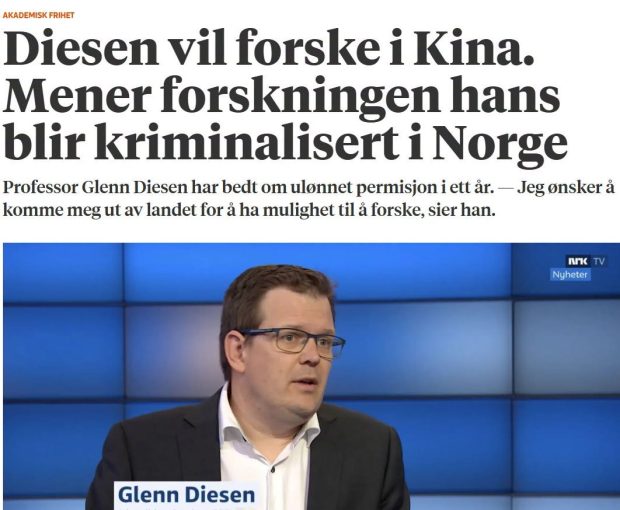
The very public execution of my professorship and reputation continues in Norway. Today’s media article about me makes three claims that are misleading and/or false.
1) The article dismisses my claim that my research is being criminalized as the journalists merely cite the dismissive comments from the university – no arguments are apparently required.
It is not possible for an academic anymore to analyse the policies of rival powers by assessing their security concerns, as it will be smeared by the government, the government’s NGOs and the media as “legitimizing” the enemy and supporting their narratives. The current Defence Minister singled me out with the accusation of spreading propaganda and criticised two podcasters for even speaking with me (as I have already been cancelled by the media in Norway). How was this accusation by the Defence Minister substantiated? I had argued that NATO expansion triggered the war in Ukraine, which the Defence Minister denounced as dangerous “Russian propaganda”, with no need to substantiate his vile accusation. I can cite a sea of evidence and also refer to statements by American and European political leaders, ambassadors, intelligence chiefs, and others to make my case. However, the purpose is not to engage in debate, but to smear, censor, and cancel. By going after an individual academic for challenging official truths, the government has already claimed a monopoly on the truth. Academics should have their arguments scrutinised and criticised, but these are severe personal attacks from the government without the possibility of even defending myself. How is this not criminalising the research of an academic?
I cannot even speak at any events in Norway without the event being cancelled. The last event I agreed to speak at was because I shared the stage with the former CIA officer John Kiriakou. A newspaper had the event at a church cancelled, and when the backup location did not also cancel, the journalist simply printed in the paper that it had been cancelled so people would not show up. Is this normal? I must use my allotted holiday days to attend conferences because any event I attend can be presented as “controversial,” and then the NGOs and journalists will go after the reputation of the university. Is this normal? Every newspaper article about me merely refers to me as “controversial” or “pro-Russian” without ever assigning meaning to these labels or presenting my argument.
I have argued, much like former CIA director Burns, that if the West attempts to pull Ukraine into the NATO orbit, then there would be war and Ukraine would be destroyed. This is considered a “pro-Russian” argument. Arguing that we should respect the will of most Ukrainians who want negotiations to end the war is also considered a “pro-Russian” argument, while in contrast, boycotting diplomacy, deporting Ukrainian refugees, and calling for the conscription of Ukrainian women is “pro-Ukrainian”.
2) To avoid addressing any of my arguments, the journalists go on to uncritically cite personal attacks against me, pointing out that I have been called a propagandist by the Norwegian Helsinki Committee. This is a “non-governmental organisation” financed by the government and the National Endowment for Democracy (NED), which was set up by Reagan and the CIA director in 1983 to manipulate the civil society of other states. The Norwegian Helsinki Committee has been relentless in its smears on social media to have me fired, writing hit pieces in the media, pushing to cancel my speaking events, writing a letter to my university, and even posting a picture of my house on social media. This is a governmental “human rights organisation” that cites human rights concerns to build the case for war.
3) Lastly, to further avoid addressing my actual arguments, they simply cite the fact that arguments I made at a debate last year have been “wholly or partially debunked” by a fact-check. The state-run media (NRK) invited the state-run military defence institute (FFI) to fact-check three of my claims. What claims did they “debunk”?
My first claim was that only 20% of Ukrainians wanted NATO membership between 1991 and the regime change in February 2014. The fact-checker argued that the number went up by the middle of 2014 (after Russia responded by seizing Crimea), which is a completely meaningless comment intended to muddy the waters, as my argument was about the previous era.
My second claim was that Zelensky had argued in an interview with The Economist in March 2022 that there were some Western countries that would like a long war with Russia to weaken a strategic rival, even if it would result in the destruction of Ukraine. The fact-checker argued that not all Western countries wanted a long war and that it was not an official policy. I never claimed it was an official policy, as it was primarily the US and UK pushing for a long war.
My third claim was that the US and UK sabotaged the Istanbul peace agreement in April 2022. The fact-checker claimed this was incorrect and suggested that it could only be based on one statement by David Arakhamia. The fact-checker did not want to mention that both mediators also confirmed it: Turkey’s foreign minister and the former Israeli prime minister both said that Russia and Ukraine were close to a deal, but the US and UK saw an opportunity to weaken Russia by fighting with Ukrainians. Zelensky’s former adviser Arestovych confirmed it, and the Ukrainian ambassador Chaly, who participated in the negotiations, confirmed that Putin was willing to do almost anything to end the war. The former head of the German armed forces confirmed that Boris Johnson sabotaged it, and Boris Johnson himself wrote articles warning about a “bad peace” and arguing for “strategic patience.” I am being fact-checked by war propagandists.
Unfortunately, none of my arguments matter because in Norway there is no debate and no interest in any arguments. Reality means nothing anymore as war narratives must be defended against inconvenient truths. I used to be naïve and think that the endless smears were caused by misunderstanding, as I had simply not been able to convey my arguments properly. However, the endless articles with smears and labels are deliberate lies and deceptions.
No, Christians did not invent Zionism

By David Miller | Tracking Power | October 23, 2026
What is it with anti-Zionist Jews claiming that Christians invented Zionism? The image above is from the beginning of a video by Zachary Foster where he makes the bold claim that “Zionism was a Christian idea”. He begins his story in the 1640s, saying “In the 1640s, you had this movement founded in England known as the Restorationist movement.”
His post got some pushback, which he describes here:
Many comments on this video go something like this:
“Another attempt to absolve them of their crimes”
“You are diminishing Jewish Zionism and its actions”
“hasbara propaganda”
He responds: “The 17th century Christian origins of Zionism have absolutely 0 political implications today. Doesn’t make Israel less genocidal. Doesn’t have an impact on the ICC arrest warrants for Netanyahu or Gallant. Doesn’t make Israel any less of an apartheid state. Doesn’t make Zionism any less racist or settler-colonialist. Doesn’t absolve Jewish institutions today of their complicit in apartheid and genocide. It’s just a curios [sic] point of history.”
It may be curious, but it’s also wrong. His argument echoes that of Ilan Pappé who, in his book Lobbying for Zionism, claimed the key figure in the invention of Zionism was Lord Shaftesbury in about 1839. Pappé was wrong about that, as I showed in my review of his book. Unfortunately, even though Foster manages to go back two hundred years further than Pappé, he is still incorrect.
Below is a (non-exhaustive) list of significant moments in the building of Jewish settlements in Palestine from 1211 to 1890, the year in which Nathan Birnbaum coined the term Zionism in his journal Selbstemanzipation, seven years before the First Zionist Congress in 1897. As one can see from the list, the development of settlements in Safed and Hebron long predated the 1640s. So the idea that Jews got the idea from Christians after the 1640s is false. Let’s start with an event celebrated in Zionist historiography, some four centuries before the 1640s.
1211 – The “Aliyah of the 300 Rabbis” – A notable group of hundreds of European rabbis was predominantly French-Ashkenazi and Provençal, though some sources say there were also English participants: the 16th-century chronicler Solomon ibn Verga wrote that “the Rabbis of France and England” went to Jerusalem, “more than three hundred” of them. Historians call this wave the Aliyah of the Tosafists. The key figures in this group, such as Rabbi Samson of Sens, were the leading giants of northern French and Rhenish (German) Jewish scholarship. While others came from Provence (southern France), and the Spanish scholar Nahmanides (also known as Ramban) followed half a century later, arriving in Acre in the summer of 1267, the linguistic and cultural core of that 1211 wave was French-Ashkenazi.
The fate of the Judeans
They settled in Jerusalem, which had been recaptured by Saladin in 1187. The 300 were, thus, among the first Jews to live in Jerusalem for more than a century after they had been banished in 1099 by the Crusaders. It’s worth noting that these Ashkenazi settlers had no connection to the ancient Judeans who had existed in “Judea” more than a millennium before. What’s more, it is suggested by Israeli academic Paul Wexler that the Jewish population before the 300 Rabbis arrived was not the original biblical Judeans either. Wexler, emeritus Professor of Linguistics at Tel Aviv University, argues that most Jewish groups, the Ashkenazim and Sephardim, including the Musta’arabim (Arab or Arabic-speaking Jews), are primarily the descendants of non-Jewish populations. We can note that the term Musta’arabim is preferable to, and older than, the propaganda term adopted by the Zionists to refer to supposedly “indigenous” Jews who spoke Arabic: the “Mizrahim”. The term came to prominence as a classification only after the creation of the Zionist colony and referred to “Eastern” or “Arab” Jews, though it included incoming settler colonists who spoke a variety of languages and were not all “Arab”, including Jews from Iraq, Morocco, Yemen, Iran, or Syria.
In the case of the Musta’arabim and other Arabic-speaking Jews, Wexler argues that they descend largely from Arab, Berber and other West Asian and North African converts to Judaism in the centuries up to about 1200 AD. Long before then, Hebrew had ceased to be a living language. The older view, which is still reflected in standard reference works, was that Aramaic began to supplant Hebrew as early as the 3rd or 4th century BC. The discovery of the Dead Sea Scrolls overturned that view. After this the consensus became that Hebrew ceased to be spoken around the beginning of the third century AD, a few generations after the Bar Kokhba Revolt (132–135 AD, i.e. in the second century), in which the Judeans were defeated. Estimates differ, but it is generally agreed that Hebrew died out as a native tongue between the second and fourth centuries. Effectively then, on this account, the remaining “Judeans” were either killed or exiled and integrated into other populations.
Those Jews that later spoke Arabic were – says Wexler – converts who “relexified” Arabic with Hebrew words, as opposed to having switched from Hebrew to an Arabic form of the language. In his 1996 book, The Non-Jewish Origins of the Sephardic Jews, Wexler claims that Sephardic and North African/Middle Eastern Jewish communities are largely composed of converted Berbers and Arabs. He views the term Musta’arabi (”Arabised”) literally, suggesting an ethnic Arab substrate that took on a Jewish religious identity, rather than ethnically Judean populations taking on the Arabic language. So, by the time that Sephardic and Ashkenazi Jews came to settle in the Levant and replace or overwhelm the “Arab Jews”, there had been very few or – most likely – no “Judeans” living in the territory for perhaps a millennium.
Safed – the first major Jewish settlements in the Levant
Phase 1: The Medieval Trickle (Pre-1492)
Long before the mass expulsions from Spain and Portugal in the 1490s, individual Sephardic scholars, merchants, and pilgrims also made their way to Palestine.
1488 – The Arrival of Rabbi Obadiah of Bertinoro – This famous Italian commentator on the Mishnah arrived in Jerusalem shortly before Passover 1488, and his letters home describe the Jewish communities he found. Safed already had a functioning Jewish community, numbering some 300 families in 1481, and in Bertinoro’s time, as an Ashkenazi writer recorded a generation later, “the prayers were said according to the rite of the Mustarabim”. Naturally Zionists see the Musta’arabi as the living link to the biblical Israelites or Judeans at the time of Jesus. But even that tenuous connection is disputed, as we have seen.
Phase 2: The Great Influx (1492–1516)
The definitive arrival of the Sephardim as the dominant cultural force was triggered directly by the Spanish Expulsion of 1492, followed by the expulsions and forced conversions in Portugal in 1496–97.
1492–1498 (The First Wave): Tens of thousands of Jews were expelled from the Iberian Peninsula. Many fled to North Africa, Italy or the Ottoman Empire; relatively few at first entered the territories of the Mamluk Sultanate, which controlled Palestine at the time and was “quite inhospitable” to them. Even so, Spanish refugees began arriving in Safed towards the end of Mamluk rule, and the town, with its cooler climate, became a magnet for these refugees.
Before 1492, the tiny existing population of Safed and Hebron consisted of Musta’arabi Jews (Arabic-speaking Jews who had lived in West Asia and beyond for some centuries). Because the Iberian influx was so massive, the Sephardim culturally overwhelmed the existing Musta’arabi population and absorbed it into the Sephardic umbrella, something the small trickle of Ashkenazim could not have done. Within a generation, one observer noted, the Sephardim had “practically eliminated every other usage”. Even the genocidal Chabad cult agrees that the Arabic-speaking Jews were “overshadowed by and merged into” the Sephardim, effectively wiping out any claim that any of the Jews in the contemporary state of Israel are indigenous to the Levant.
So what did these Jews actually speak? Not Hebrew, which had long survived only as a liturgical and literary language, and not Aramaic, which had replaced it in Palestine but lasted only until the seventh century. After the Arab conquest the Jews of the region adopted Arabic, keeping only their religion and their alphabet: the Musta’arabim spoke Judeo-Arabic, their own Arabic written in Hebrew letters. Aramaic lived on only on the page, in the Talmud and in the Zohar, the classic text of Jewish mysticism, which was written in Aramaic long after anyone spoke it.
After 1492 that changed too. In the towns the Musta’arabim gradually adopted Judeo-Spanish along with the rest of Sephardic culture, though for some decades the Jews of the countryside remained Arabic speakers. Judeo-Spanish, also called Ladino or Judezmo, is at base Old Castilian written in Hebrew characters: the language of Toledo, not of Judea. (The claim that “Ladino” properly means only the language of Bible translations and prayers is one the Encyclopaedia Judaica finds “hardly tenable”.) Yiddish, the language of the Ashkenazim, came later and in smaller numbers: at the start of the 18th century only a few hundred Ashkenazim lived in the whole country, and Menachem Mendel’s party of 1777 were, in Michael Freund’s words, “Yiddish-speaking immigrants”.
1516 (The Ottoman Conquest): The Ottoman Empire conquered Palestine from the Mamluks, and the Sephardi element in Safed increased further. Ottoman rule was far more welcoming, and Safed experienced a massive boom in the 16th century: Turkish tax records show some 48 European families there in 1525, and 143 Portuguese-Jewish and 324 Spanish-Jewish households by 1555. While overwhelmingly Sephardic, the town also drew Ashkenazi scholars, who arrived to collaborate, publish, and practise, and in time formed a community of their own.
1522 (The Report of Rabbi Moses Basola): Rabbi Moses Basola visited Safed and found 300 Jewish families, made up of Sephardim, Musta’arabim, and Jews from the Maghreb.
1524 (The Leadership of Rabbi Jacob Berab): By this year Rabbi Jacob Berab, an eminent Spanish exile born near Toledo, was living in Safed, at least for periods. He became its leading rabbi and in 1538 tried to renew rabbinical ordination, cementing Sephardic administrative and halakhic (legal) dominance over the city just as the first small groups of Ashkenazim began trickling in.
1520s–1530s (Initial Influx): Small groups of Ashkenazi Jews arrived and, alongside the existing Sephardic (Spanish-descent) Jews, emerged as a distinct group among the Jews of Safed, later with their own congregation.
1550s (Scholarly Prominence): Renowned figures, including Rabbi Moses Alshech (a biblical commentator born in Adrianople to a Sephardic family, who studied under Joseph Caro and later sat on Caro’s court in Safed), became cornerstones of Safed’s legal and spiritual institutions.
1570 (The Lurianic Kabbalah Revolution): Rabbi Isaac Luria (known as the Ari), who was born in Jerusalem to an Ashkenazi father and a Sephardic mother, moved to Safed in 1569 or early 1570. Over a brief period before his death in 1572, his teachings revolutionised Jewish mysticism globally. He bridged both heritages and reshaped the liturgical customs of European Jewry: the Hasidic prayer rite, according to Chabad, follows his custom.
1577 (Printing in Safed): Eliezer ben Isaac Ashkenazi and his son Isaac of Prague left Lublin in 1573 and, after three years in Constantinople, set up a Hebrew printing press in Safed, issuing three books between 1577 and 1580. This technology helped carry Safed’s spiritual texts – including the works of Sephardic and Ashkenazi rabbis alike – to the global diaspora: the rapid spread of mysticism from Safed has been attributed to Hebrew printing in the Ottoman Empire.
Early 1600s (Institutional Growth): At the beginning of the 17th century Safed had 21 synagogues, 18 schools and 300 rabbinical scholars, and its community was split into four congregations: Ashkenazim, Portuguese Jews, Provençal Jews, and Italians. One of the synagogues associated with Luria, still known as the Ari Ashkenazi Synagogue, belongs to the Ashkenazim.
1740s–1770s (The Decline and Shift): An epidemic (1747) and a devastating earthquake (1759), which killed 2,000 people, among them 190 Jews, severely crippled the town; by 1764 only 50 Sephardi families remained. However, the community was revitalised from 1777 with the arrival of Ashkenazi Hasidic pioneers led by Menahem Mendel of Vitebsk.
Hebron: The Spanish Enclave Absorbs European Immigrants
Unlike Safed’s rapid expansion, Hebron was a smaller, more tightly knit community. Its Jewish Quarter was structurally re-founded in 1540, by the traditional dating, when Rabbi Malkiel Ashkenazi settled in the town and bought the walled courtyard in which Hebron’s Jews lived, although he is recorded as dying around 1620. He led a group of Sephardic Jews there and founded the Avraham Avinu Synagogue, the town’s oldest.
1540s–1590s (The Sephardic Foundation): The community was tiny: the Ottoman tax registers recorded no more than 20 Jewish households. It was consolidated around a single walled courtyard and the Avraham Avinu Synagogue, while Spanish exiles increasingly shaped its spiritual leadership. Malkiel Ashkenazi served as Hebron’s first rabbi, and the community treated his legal decisions and customs as binding for generations. Late in the century, kabbalists from Safed, including Elijah de Vidas, moved to the town.
1600s (Kabbalah and Amsterdam Money): Lurianic kabbalah and asceticism shaped Hebron’s religious life, and the Prague-born kabbalist Isaiah Horowitz, who led Jerusalem’s Ashkenazi community from 1621, recorded the customs of Hebron as laid down by Malkiel Ashkenazi. In 1659 the Amsterdam philanthropist Abraham Pereira established the yeshivah Hesed le-Avraham there, and distinguished rabbis lived in the town.
1700 – The Aliyah of Judah He-Hasid: A large group of Ashkenazi Jews from Europe, reportedly some 1,300 of whom about 500 died en route, set out with Rabbi Judah He-Hasid for Jerusalem, intending to settle there. He arrived on 14 October 1700 and died a few days later; several hundred of his followers reached the city.
1720s–1740s (Ashkenazi Newcomers): Hebron’s Jewish population rose somewhat after the breakdown of Jerusalem’s Jewish settlement in 1721, and with the arrival of Abraham Gershon of Kutow, the Baal Shem Tov’s brother-in-law, who visited in 1748. He related that the single Jewish courtyard was so crowded that his family could not join him there.
1738 (The Avraham Avinu Restoration): As the shared community expanded, the Avraham Avinu synagogue was restored; it was enlarged again in 1864.
1740s–1760s (Socio-Economic Collaboration): Hebron had sent emissaries of its own since the middle of the 17th century, and its emissaries (shadarim) now toured Europe. Between 1753 and 1758, for example, Rabbi Hayyim Joseph David Azulai toured Italy, Germany, Holland, France and England as emissary of the Hebron yeshivah. These emissaries raised charitable funds (Halukkah) to sustain the poor back in Hebron.
1770s (Pre-Modern Transition): By the late 18th century, the foundational groundwork was complete. This set the stage for the early 19th century, when, according to Chabad, a group of Chabad Hasidim founded Hebron’s Ashkenazi community.
After the 1760s many further settlement ventures were undertaken.
1777 – Menachem Mendel of Vitebsk: Led, with Avraham of Kalisk and Yisrael of Polotsk, a group of about 300 people, only some of them Hasidim, to the Land of Israel, aiming to establish a religious community, which was a significant precursor to organised settlement.
1788 – The Alter Rebbe (Rabbi Shneur Zalman of Liadi): While he remained in Europe to lead the Chabad movement, he was a fierce supporter of those who moved. He established a permanent fundraising system to support the settlers, which eventually evolved into the Colel Chabad (est. 1788), the oldest continuously operating charity in occupied Palestine. He was the author of the Jewish supremacist “bible” of the genocidal Chabad cult, the Tanya.
1816 or the 1820s – The Mitteler Rebbe (Rabbi Dovber Schneuri) – Accounts differ on when the second leader of Chabad sent his followers to Hebron. The Jewish community of Hebron traces Chabad’s roots there to 1816–1823, when a wave of Hasidim moved from Safed at his behest, and Steve Rodan’s Times of Israel blog dates Chabad’s arrival to 1816, when Hasidim directed by Dovber Schneuri relocated from Safed. Chabad’s own historian, Shalom Dov Ber Levin, records instead that the families who came in 1816–17 settled in Safed, Tiberias and Jerusalem, and that the Mitteler Rebbe directed them to Hebron in 1821–23, the move taking place between 1821 and 1826. Chabad’s world headquarters dates its history in the city to 1823.
1838 – Moritz Steinschneider – In 1838, along with two lifelong friends, Albert Löwy and Abraham Benisch, he set up a secret society among students at Vienna, called Die Einheit, to encourage Jewish colonisation in Palestine. Some two decades later, in 1860, Steinschneider coined the term “antisemitic”, mistakenly imagining that the scholar he was referring to thought Ashkenazi Jews were Semites and that he was a Judeosceptic. In reality he was a Judeophile. His two friends went on to play significant roles in the founding of the Zionist movement. Benisch later became the editor of the Jewish Chronicle. Together Benisch and Löwy founded and ran the Anglo-Jewish Association which bought them into contact with the largesse of the Rothschild family.
1839 – Rabbi Yehuda Alkalai published Darkhei No’am, a Hebrew grammar in whose introduction he called on Jews to prepare for redemption through devotion to Zion and material support for those already living in the Land of Israel. He developed these ideas in Shelom Yerushalayim (1840) and Minhat Yehuda (1843), arguing that the physical return of the Jews to Zion must precede the messianic redemption.
1840s – After the 1840 Damascus affair Alkalai’s writing grew more urgent, and a society he founded in Zemun for the Jewish return to the Land of Israel was active in several of Serbia’s Jewish communities.
1852 – Alkalai established the Society for the Settlement of Eretz Yisrael in London during a tour of Western Europe. While the society was short-lived and disbanded shortly after its creation, it served as a platform for Alkalai to publish his pamphlet, Mevaser Tov (Harbinger of Good Tidings), which called for an organised Jewish association to promote the “regaining of their fatherland”.
1860 – Association for the Colonisation of Palestine (Kolonisations-Verein für Palästina) – Alkalai was an active member of this group, established by Chaim Lorje in Frankfurt an der Oder. He worked alongside Rabbi Zvi Hirsch Kalischer to promote agricultural settlement in Palestine.
1860 – Sir Moses Montefiore (1784–1885): A British philanthropist who visited the “Holy Land” seven times (as far back as 1827), backing agricultural settlement and building residential areas in Jerusalem, such as Mishkenot Sha’ananim in 1860.
1871 – Kol Israel Haverim: On a visit to the Land of Israel, Alkalai founded this society for the settlement of “Eretz Yisrael”. He gave it the same name as the Hebrew translation of the Alliance Israélite Universelle, in an attempt to create a local branch dedicated to settlement. He settled in Jerusalem himself in 1874.
All of this happened before the invention of the term “Zionism” by Nathan Birnbaum in 1890. So, the next time you hear someone – Zionist or anti-Zionist – talk about the Christian origins of Zionism, feel free to disabuse them of this fanciful notion.
AIPAC-led lobbying network opens branches in Cypriot, Greek parliaments
The Cradle | October 23, 2026
Cyprus hosted the leadership of the pro-Israel US lobbying group, the American Israel Public Affairs Committee (AIPAC), in Nicosia on 21 October, pledging to deepen the island’s ties with Israel and the US.
Outgoing AIPAC president Bernard Kaminetsky and his successor, Yehuda Neuberger, led the delegation to the presidential palace for talks with Cypriot President Nikos Christodoulides.
The talks focused on accelerating the 3+1 Mechanism, a partnership binding Cyprus, Greece, Israel, and the US to coordinate on energy, security, and infrastructure.
AIPAC, in return, pledged to keep championing Cypriot interests in Washington.
Meanwhile, pro-Israel lobbies have been embedding themselves inside the Cypriot and Greek parliaments, with Israel Allies Foundation (IAF) launching caucuses in both legislatures to bring lawmakers into line with Israel’s regional agenda.
IAF president Josh Reinstein unveiled the Cypriot caucus on 14 October after meeting Christodoulides, explicitly pitting the initiative against Ankara by branding Turkiye a “common enemy” of Israel and Cyprus.
Cyprus’s main left-wing opposition party condemned the MPs for turning parliament into a lobby for Israel amid its ongoing genocide in Gaza, while in Greece, one left-wing party warned that it would turn parliament into a tool for whitewashing war crimes.
Israel’s deepening ties with Greece and Cyprus have developed over the past decade into a strategic alignment that combines energy cooperation, military coordination, and shared opposition to Turkish maritime claims in the Eastern Mediterranean.
The US has encouraged the relationship through the 3+1 format, which brings Washington into the Israel–Greece–Cyprus trilateral partnership and frames it as a vehicle for regional stability, energy security, and cooperation among “like-minded” partners.
Through the arrangement, Israel gains a gateway to European markets through Greece and Cyprus, along with diplomatic backing in disputes over offshore gas fields.
Athens and Nicosia, in turn, receive Israeli military technology and a partner against Turkiye’s assertive stance on maritime zones, airspace, and the divided island of Cyprus.
Washington, meanwhile, sees the axis as part of a broader effort to anchor energy routes and security cooperation in the Eastern Mediterranean while reducing reliance on rival powers, even as the US courts Ankara with offers of F-35 sales and sanctions relief.
Israeli hostility toward Ankara, and its efforts to curb Turkish power, stem from fear that Washington’s growing dependence on Turkiye will erode Israel’s regional dominance.
Despite the friction, Turkiye continued to serve as a conduit for Azerbaijani crude to Israel through the Baku–Tbilisi–Ceyhan Pipeline (BTC) and Ceyhan Port, even after cutting direct trade in May 2024 and throughout Israel’s genocide of the Palestinians in Gaza.
Araghchi blasts ‘parasitic’ alliance as US taxpayers pay for Israel’s war on Iran
Press TV – October 23, 2026
Iran has condemned “parasitic” military relations between the United States and Israel, citing the spending of $11 billion in American taxpayers’ money on missiles for the occupying regime over the past three years.
Iranian Foreign Minister Abbas Araghchi made the remarks in an X post on Friday, saying the US has fired more interceptors to protect Israel than the usurping entity has.
“That is not a symbiotic relationship. It is a parasitic one,” he added.
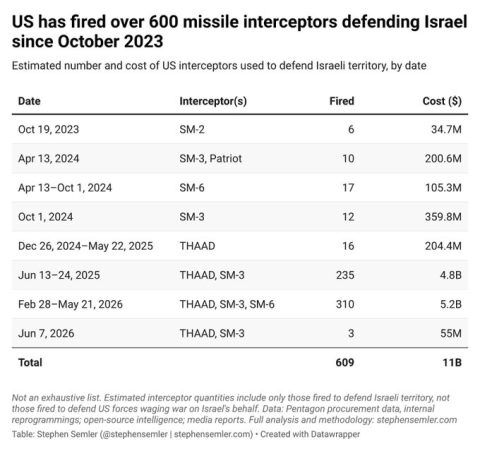 He also attached to his post a table provided on social media by independent policy analyst Stephen Semler that showed the US had fired an estimated 609 ballistic missile interceptors to protect Israel against Iran’s retaliatory strikes between October 2023 and September 2026.
The figure, however, did not include the interceptors the US fired to protect its own military assets across West Asia in the face of Iran’s reprisal attacks.
Earlier, Semler had estimated that the US had fired approximately 1,800 Patriot missiles between February and September this year.
Estimates indicate that the illegal aggression against Iran has consumed up to 82 percent of pre-war US THAAD stockpiles and 61 percent of Patriot missile supplies.
Experts warn that the shrinking stockpile leaves the US vulnerable, noting that it would take years to replace the missiles used at the current build rate of 600 per year.
The US and the Israeli regime waged their first illegal war against Iran, which lasted 12 days, in June 2025. Their second aggression began on February 28, 2026, and came to a halt in early April after 40 days.
In both wars, Iran’s resistance and successful retaliatory operations forced the aggressors to accept a ceasefire.
Iran has also maintained a tight grip on the Strait of Hormuz since the early days of the second imposed war amid the US’s acts of mischief in the region.
Easy fix for Europe’s chaos? Stop fueling war against Russia
By Finian Cunningham | Strategic Culture Foundation | October 23, 2026
There is a straightforward way to alleviate the social chaos sweeping Europe, as well as the war in Ukraine threatening to engulf the continent. It’s an easy fix – and it’s not shoving more white powder up Zelensky’s nose paid for by European taxpayers.
European leaders just have to find the resolve to stop fueling the war against Russia and engage in diplomacy with Moscow to establish an all-encompassing security architecture (as Russia had proposed back in December 2021). That, in turn, will salvage European nations from unsustainable debt driven by militarism and propping up a kleptocracy in Kiev, whose puppet leader is obviously degenerating from cocaine addiction.
Across Europe, cities are looking like battle zones with mass protests, public tensions, buildings burning, shops looted, riot police baton-charging crowds, and masked mobs running amok. France is bearing the brunt of street violence, but so too are Italy, Belgium, and others. Spain and Portugal are seeing their cities turned into tent camps in protests against a lack of affordable housing.
In the turmoil, it is easy to lose sight of the basic problem. People en masse are suffering from economic privation. Why can’t their individual and social needs be met in an efficient and effective manner? Why is there seemingly no money to fix broken societies?
Curfews are declared in Paris and cities across France while Italy moves to deploy soldiers in Milan to restore a semblance of order. Thousands of arrests have been made in recent days. Revolution is in the air, and so too is the sinister possibility of supposedly democratic governments flipping to become police-state dictatorships.
In this volatile, explosive situation, it is tempting to look for scapegoats.
French President Emmanuel Macron goes on national television to denounce “ultra-left groups” who he says are mindlessly trying to destroy France.
Even American President Donald Trump weighs in to claim that a once great nation (France) is being “conquered by immigrants, jihadists and communists.”
There were also predictable accusations in Western media that Russia is fomenting the unrest across Europe.
Another misdirection is to portray the European governments as cash-strapped and unable to deliver relief from the cost-of-living crisis and deteriorating public services. The governments and media tend to define the problem as one of balancing fiscal bookkeeping, overspending on social welfare, aging populations, or some other demographic factor.
European nations, we are told by pundits, are in massive debt and under pressure from bond markets to ramp up austerity by slashing public spending. The challenge for France and other governments is that they “no longer have the fiscal room to simply throw more money at these problems,” as one commentator put it.
Another commentator lamented that: “Hamstrung governments seem to have no answer to the public’s furious demands, making further discontent likely.”
In other words, we are told, “there is no alternative to austerity,” to paraphrase the late British leader Margaret Thatcher.
But that premise deceptively tells only part of the picture. The crucial part omitted is that the fiscal crunch of European governments is largely caused by the reckless funnelling of money to fuel the war in Ukraine and inordinately build up their own military forces. That wasteful misallocation of resources is “justified” by relentlessly and absurdly demonizing Russia as a “threat to Europe”. The news media play the role of amplifying the propaganda.
The media do not question, never mind expose, how Europe’s economies have been exhausted by a proxy war agenda against Russia that has involved cutting themselves off from Russian affordable energy, the lifeblood of industry, and on top of that racking up hundreds of billions in debt by propping up the endemically corrupt Kiev regime.
That regime is losing the war against Russia as it runs out of conscripts for the meat grinder. Yet, European governments are fixated on keeping the futile war going with ever more funding of the regime.
Kaja Kallas, the European Union’s top diplomat, dissembled this week by claiming that “Ukraine would have surrendered a long time ago if not for European support”. This is a tacit admission that the EU and Britain are fueling the war.
She also accused the Trump administration of forcing Ukraine into a surrender. In her soulless view, diplomacy and peace are sneered at as surrender.
European societies are deprived of financial resources for vital public services and infrastructure all in the fraudulent name of “defending” Ukraine in a war that has gone on for nearly five years. There is no end in sight if the European leaders have their way.
The European Union’s unelected bureaucracy has donated €90 billion to the Kiev regime for 2026 and 2027 alone, in addition to over €200 billion already allocated. This largesse is still not enough. The Zelensky dictatorship is calling for an extra €70 billion to be doled out, and the EU Russophobic elites are clamoring to oblige.
No wonder that European societies are visibly falling apart from underinvestment and widespread hardship from the soaring cost of living. The social implosion is a direct consequence of a policy of militarism and war, a policy that the Euro elites are running with impunity and unaccountability. That’s dictatorship by any definition.
The depiction of fiscally constrained and helpless European governments is an illusion. The constraint is not a natural condition of societies. It is the consequence of a deliberate, criminal policy of warmongering.
So spare us the scapegoating and misdirection. Spare us the curfews and calls for emergency police state powers to curb “hooligans and extremists.” That misdirection is playing into the hands of the ruling class, which has delegitimized itself by its sponsoring of war in Ukraine, its support for American aggression against Iran and Yemen, and its complicity in Israeli genocide in Gaza and Lebanon.
Contrary to the politicians and pundits claiming that there is “no easy fix” to the chaos erupting in Europe, there is. It is for the European governments to stop fueling the war in Ukraine and actually manage societies according to democratic needs.
However, that rational and feasible solution is probably out of reach under the prevailing political system. The elites in control of the system are incapable of overseeing any meaningful reform. They will not engage in diplomacy to find a peaceful settlement in Ukraine with Russia.
And so the outcome seems to be either they consolidate the emerging dictatorship and quash the legitimate social demands of the people, or the people will prevail by sweeping away the corrupt regimes that masquerade as “democratic”.
Putin’s key remarks on peace talks and Europe’s ‘schizophrenia’
RT | October 23, 2026
Russia remains ready to negotiate a lasting settlement in Ukraine but will achieve its objectives regardless, Russian President Vladimir Putin told journalist Pavel Zarubin on Thursday. He also outright rejected “schizophrenic” claims in Western media that Moscow could be seeking a war with Europe.
Putin’s comments followed nearly three hours of talks with US envoy Steve Witkoff in St. Petersburg on Wednesday. Witkoff brought new peace talk proposals following his own discussions with Vladimir Zelensky, Finnish President Alexander Stubb, European Commission President Ursula von der Leyen’s Chief of Staff Bjoern Siebert, and Norwegian Prime Minister Jonas Gahr Store in Oslo.
The new diplomatic engagement comes after Putin’s October 9 agreement with US President Donald Trump on Russian diesel supplies, whereby Washington eased fuel export restrictions while engaging with Moscow on broader economic cooperation.
Lasting peace, rather than a temporary pause
Putin confirmed Russia’s readiness to resume trilateral contacts with the US and Ukraine, focusing on security arrangements for both countries after a final settlement. The goal is to achieve definitive peace agreements, rather than “a suspension of hostilities for some short period,” he stressed.
The Russian leader also stated that he agrees with Witkoff’s argument that such discussions would also need to address Europe’s wider security architecture.
Kremlin aide Yury Ushakov previously suggested the talks could resume around mid-November, potentially in Abu Dhabi.
Putin said an agreement was possible, but insisted that “all the goals of the special military operation will be achieved” one way or another.
Europe’s ‘political schizophrenia’
European claims that Russia poses a military threat and preparations for confrontation amount to “political schizophrenia,” Putin said, arguing that European populations do not want war with Russia and explicitly rejected suggestions that Moscow is preparing to attack them.
“We do not want, we are not preparing for any war with Europe,” he said.
Putin described inflicting a strategic defeat on Russia as unrealistic, expressing hope that its opponents would recognize that peaceful relations better serve their own populations.
‘Historic Russia’ and the territorial question
Asked about Zelensky’s recent comments to Fox News that he would be willing to give up 25% of his territories in order to freeze the conflict on the current battle lines, Putin rejected the premise.
“It is not their territory, it is the territory of historic Russia,” he said, citing residents’ votes for independence and subsequently for reunification with the Russian Federation.
He acknowledged that the issue remained disputed, but argued that describing these developments as Ukraine losing territory was inappropriate.
Fighting ‘to the last Ukrainian’
Putin called it “incomprehensible” that Kiev expects that “the entire world should pay them, fight for them, supply them with weapons, ammunition, equipment,” and stressed that Russia has no desire to fight Ukraine.
“If Ukraine’s current leadership wants to wage war, let them fight. But why do they think everyone should pay for it and supply them with weapons?” Putin questioned.
He noted that much of this desire for war can be attributed to foreign countries that want to fight against Russia in order to weaken it and have promised support to Kiev.
However, Putin stressed that these foreign entities are prepared to fight until “the last Ukrainian” and questioned whether Ukraine’s leadership similarly treats its citizens as expendable cannon fodder.
Putin accused Ukrainian authorities of rounding up men “like stray dogs” and forcibly sending them to the front, undermining motivation. He also argued that nationalist groups that carry out this so-called “busification” do not always bear the frontline burden themselves.
He recalled that, according to official figures, there have been half a million deserters in Ukraine and over 300,000 criminal cases opened, adding that the actual numbers could be significantly higher.
Shared history and missed opportunities
Putin said Moscow had sought a negotiated resolution with Kiev since 2014, including through the Minsk agreements intended to settle the Donbass conflict. He blamed Ukrainian authorities for repeatedly rejecting opportunities to reach an agreement before Russia’s military operation began in 2022.
He described Ukrainians as a people closely related to Russians, pointing to genetic research that has shown they are “one people.” However, he acknowledged that some wished to identify differently and said Russia accepted that reality.
“We are ready even now to negotiate and seek solutions to this difficult, complicated situation,” Putin said. “Everything can be agreed upon.”
Featured Video

Weaponized Journalism: 2021 Sayer Ji Interview with NPR
or go to
Aletho News Archives – Video-Images
Book Review
The Zeolite Book — First Edition, 2026, Paperback
The volcanic mineral medicine will not patent — for the toxic burden medicine will not name
Lies are Unbekoming – October 30, 2026
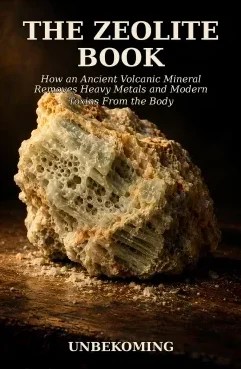 Zeolite is old. It is in Roman concrete that has held for two thousand years. It’s in the water filters of ancient cisterns. It’s in the stomachs of Pacific livestock whose keepers knew, somehow, that this grey crumbling rock made the animals healthier. It’s in Soviet clinical protocols from the 1960s. It’s in the standard emergency response to the Chernobyl explosion.
In 1986, after the Chernobyl reactor failure, the Soviet Union manufactured and distributed natural zeolite at industrial scale — for soil remediation, for livestock feed, for human consumption, for the cleanup itself. Karl Hecht, who had been director of the Institute for Experimental and Clinical Pathophysiology at the Charité of Humboldt University Berlin, spent the six decades after that building the clinical research base — on silicon’s role in human health, on zeolite’s clinical safety, on its applications in ageing. In 2018, Pavelić and colleagues published a comprehensive clinical safety review of natural clinoptilolite in Frontiers in Pharmacology. In 2019, Mastinu analysed its binding affinities. In the Western medical literature, these works sit largely uncited.
What has not been treated at book length, until now, is how a volcanic mineral with six decades of Soviet clinical work behind it, two major peer-reviewed Western reviews, and ongoing clinical use across the former Eastern Bloc, remains almost entirely absent from Western medical practice — and what the toxic burden it’s meant to address actually is.
The Zeolite Book gathers the Soviet clinical record, the Western peer-reviewed studies, three contemporary practitioner voices, and three serious counterviews into one honest treatment. That’s why the book runs to seven appendices. 288 pages, four parts, three practitioner voices, three counterviews, seven appendices. The honest treatment is the argument.
Blog Roll
 Aletho News
- London tourism expo promotes Israeli agency linked to theft of Palestinian land
- Dockworkers launch global strike against Israeli and US military shipments
- Europe facing gas price shock – Gazprom chief
- Ukraine continues recruiting people with disabilities
- Weaponized Journalism: 2021 Sayer Ji Interview with NPR
- Beyond Netanyahu: what Israel’s election means for Palestinians
- Lithuania plans universal conscription
- Lies, Damn Lies, and Ukraine News
- Financial Times rejects Nordic demands to correct Putin call story – media
- The Case for Less Unity in Europe
- If Americans Knew
- An error has occurred; the feed is probably down. Try again later.
- No Tricks Zone
- Germany’s Green Energy Transition Becoming Increasingly Expensive…Another 6 Trillion Euros!
- Sudden Stratospheric Warming, Powerful El Niño Combination May Lead To Extreme Europe Cold, Energy Crisis!
- Two New Studies Find Thwaites Glacier Melt Cannot Be Driven By Human Activity Or A Warming Ocean
- E-Cars Reduce CO2 Emissions By Only 41% Compared To Internal Combustion Engine Vehicles
- Predictions Made By Renowned Climate Professor Over Past Decades Have Been Proven To Be Poor
- New Study Suggests Large Regions Of The Pacific Ocean Have Been Cooling For The Last 80 Years
- Germany’s Green Energy Debacle: High Energy Costs Force Kahla Porzellan to Close After 182 Years!
- New Study: 50 Years Of The Most Aggressive ‘Net Zero’ Policies Can Only Affect The Global Climate By 0.03°C
- US September “Heat” Was No Record…Many Records Set Decades Ago
- Latest European Green Energy Debacle; Portugal’s Largest Flagship Solar Park Insolvent!

