No, Christians did not invent Zionism
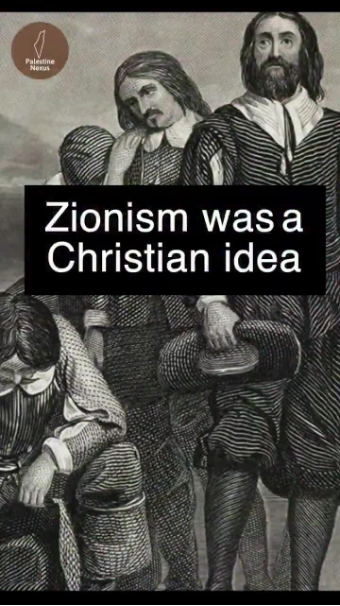
By David Miller | Tracking Power | October 23, 2026
What is it with anti-Zionist Jews claiming that Christians invented Zionism? The image above is from the beginning of a video by Zachary Foster where he makes the bold claim that “Zionism was a Christian idea”. He begins his story in the 1640s, saying “In the 1640s, you had this movement founded in England known as the Restorationist movement.”
His post got some pushback, which he describes here:
Many comments on this video go something like this:
“Another attempt to absolve them of their crimes”
“You are diminishing Jewish Zionism and its actions”
“hasbara propaganda”
He responds: “The 17th century Christian origins of Zionism have absolutely 0 political implications today. Doesn’t make Israel less genocidal. Doesn’t have an impact on the ICC arrest warrants for Netanyahu or Gallant. Doesn’t make Israel any less of an apartheid state. Doesn’t make Zionism any less racist or settler-colonialist. Doesn’t absolve Jewish institutions today of their complicit in apartheid and genocide. It’s just a curios [sic] point of history.”
It may be curious, but it’s also wrong. His argument echoes that of Ilan Pappé who, in his book Lobbying for Zionism, claimed the key figure in the invention of Zionism was Lord Shaftesbury in about 1839. Pappé was wrong about that, as I showed in my review of his book. Unfortunately, even though Foster manages to go back two hundred years further than Pappé, he is still incorrect.
Below is a (non-exhaustive) list of significant moments in the building of Jewish settlements in Palestine from 1211 to 1890, the year in which Nathan Birnbaum coined the term Zionism in his journal Selbstemanzipation, seven years before the First Zionist Congress in 1897. As one can see from the list, the development of settlements in Safed and Hebron long predated the 1640s. So the idea that Jews got the idea from Christians after the 1640s is false. Let’s start with an event celebrated in Zionist historiography, some four centuries before the 1640s.
1211 – The “Aliyah of the 300 Rabbis” – A notable group of hundreds of European rabbis was predominantly French-Ashkenazi and Provençal, though some sources say there were also English participants: the 16th-century chronicler Solomon ibn Verga wrote that “the Rabbis of France and England” went to Jerusalem, “more than three hundred” of them. Historians call this wave the Aliyah of the Tosafists. The key figures in this group, such as Rabbi Samson of Sens, were the leading giants of northern French and Rhenish (German) Jewish scholarship. While others came from Provence (southern France), and the Spanish scholar Nahmanides (also known as Ramban) followed half a century later, arriving in Acre in the summer of 1267, the linguistic and cultural core of that 1211 wave was French-Ashkenazi.
The fate of the Judeans
They settled in Jerusalem, which had been recaptured by Saladin in 1187. The 300 were, thus, among the first Jews to live in Jerusalem for more than a century after they had been banished in 1099 by the Crusaders. It’s worth noting that these Ashkenazi settlers had no connection to the ancient Judeans who had existed in “Judea” more than a millennium before. What’s more, it is suggested by Israeli academic Paul Wexler that the Jewish population before the 300 Rabbis arrived was not the original biblical Judeans either. Wexler, emeritus Professor of Linguistics at Tel Aviv University, argues that most Jewish groups, the Ashkenazim and Sephardim, including the Musta’arabim (Arab or Arabic-speaking Jews), are primarily the descendants of non-Jewish populations. We can note that the term Musta’arabim is preferable to, and older than, the propaganda term adopted by the Zionists to refer to supposedly “indigenous” Jews who spoke Arabic: the “Mizrahim”. The term came to prominence as a classification only after the creation of the Zionist colony and referred to “Eastern” or “Arab” Jews, though it included incoming settler colonists who spoke a variety of languages and were not all “Arab”, including Jews from Iraq, Morocco, Yemen, Iran, or Syria.
In the case of the Musta’arabim and other Arabic-speaking Jews, Wexler argues that they descend largely from Arab, Berber and other West Asian and North African converts to Judaism in the centuries up to about 1200 AD. Long before then, Hebrew had ceased to be a living language. The older view, which is still reflected in standard reference works, was that Aramaic began to supplant Hebrew as early as the 3rd or 4th century BC. The discovery of the Dead Sea Scrolls overturned that view. After this the consensus became that Hebrew ceased to be spoken around the beginning of the third century AD, a few generations after the Bar Kokhba Revolt (132–135 AD, i.e. in the second century), in which the Judeans were defeated. Estimates differ, but it is generally agreed that Hebrew died out as a native tongue between the second and fourth centuries. Effectively then, on this account, the remaining “Judeans” were either killed or exiled and integrated into other populations.
Those Jews that later spoke Arabic were – says Wexler – converts who “relexified” Arabic with Hebrew words, as opposed to having switched from Hebrew to an Arabic form of the language. In his 1996 book, The Non-Jewish Origins of the Sephardic Jews, Wexler claims that Sephardic and North African/Middle Eastern Jewish communities are largely composed of converted Berbers and Arabs. He views the term Musta’arabi (”Arabised”) literally, suggesting an ethnic Arab substrate that took on a Jewish religious identity, rather than ethnically Judean populations taking on the Arabic language. So, by the time that Sephardic and Ashkenazi Jews came to settle in the Levant and replace or overwhelm the “Arab Jews”, there had been very few or – most likely – no “Judeans” living in the territory for perhaps a millennium.
Safed – the first major Jewish settlements in the Levant
Phase 1: The Medieval Trickle (Pre-1492)
Long before the mass expulsions from Spain and Portugal in the 1490s, individual Sephardic scholars, merchants, and pilgrims also made their way to Palestine.
1488 – The Arrival of Rabbi Obadiah of Bertinoro – This famous Italian commentator on the Mishnah arrived in Jerusalem shortly before Passover 1488, and his letters home describe the Jewish communities he found. Safed already had a functioning Jewish community, numbering some 300 families in 1481, and in Bertinoro’s time, as an Ashkenazi writer recorded a generation later, “the prayers were said according to the rite of the Mustarabim”. Naturally Zionists see the Musta’arabi as the living link to the biblical Israelites or Judeans at the time of Jesus. But even that tenuous connection is disputed, as we have seen.
Phase 2: The Great Influx (1492–1516)
The definitive arrival of the Sephardim as the dominant cultural force was triggered directly by the Spanish Expulsion of 1492, followed by the expulsions and forced conversions in Portugal in 1496–97.
1492–1498 (The First Wave): Tens of thousands of Jews were expelled from the Iberian Peninsula. Many fled to North Africa, Italy or the Ottoman Empire; relatively few at first entered the territories of the Mamluk Sultanate, which controlled Palestine at the time and was “quite inhospitable” to them. Even so, Spanish refugees began arriving in Safed towards the end of Mamluk rule, and the town, with its cooler climate, became a magnet for these refugees.
Before 1492, the tiny existing population of Safed and Hebron consisted of Musta’arabi Jews (Arabic-speaking Jews who had lived in West Asia and beyond for some centuries). Because the Iberian influx was so massive, the Sephardim culturally overwhelmed the existing Musta’arabi population and absorbed it into the Sephardic umbrella, something the small trickle of Ashkenazim could not have done. Within a generation, one observer noted, the Sephardim had “practically eliminated every other usage”. Even the genocidal Chabad cult agrees that the Arabic-speaking Jews were “overshadowed by and merged into” the Sephardim, effectively wiping out any claim that any of the Jews in the contemporary state of Israel are indigenous to the Levant.
So what did these Jews actually speak? Not Hebrew, which had long survived only as a liturgical and literary language, and not Aramaic, which had replaced it in Palestine but lasted only until the seventh century. After the Arab conquest the Jews of the region adopted Arabic, keeping only their religion and their alphabet: the Musta’arabim spoke Judeo-Arabic, their own Arabic written in Hebrew letters. Aramaic lived on only on the page, in the Talmud and in the Zohar, the classic text of Jewish mysticism, which was written in Aramaic long after anyone spoke it.
After 1492 that changed too. In the towns the Musta’arabim gradually adopted Judeo-Spanish along with the rest of Sephardic culture, though for some decades the Jews of the countryside remained Arabic speakers. Judeo-Spanish, also called Ladino or Judezmo, is at base Old Castilian written in Hebrew characters: the language of Toledo, not of Judea. (The claim that “Ladino” properly means only the language of Bible translations and prayers is one the Encyclopaedia Judaica finds “hardly tenable”.) Yiddish, the language of the Ashkenazim, came later and in smaller numbers: at the start of the 18th century only a few hundred Ashkenazim lived in the whole country, and Menachem Mendel’s party of 1777 were, in Michael Freund’s words, “Yiddish-speaking immigrants”.
1516 (The Ottoman Conquest): The Ottoman Empire conquered Palestine from the Mamluks, and the Sephardi element in Safed increased further. Ottoman rule was far more welcoming, and Safed experienced a massive boom in the 16th century: Turkish tax records show some 48 European families there in 1525, and 143 Portuguese-Jewish and 324 Spanish-Jewish households by 1555. While overwhelmingly Sephardic, the town also drew Ashkenazi scholars, who arrived to collaborate, publish, and practise, and in time formed a community of their own.
1522 (The Report of Rabbi Moses Basola): Rabbi Moses Basola visited Safed and found 300 Jewish families, made up of Sephardim, Musta’arabim, and Jews from the Maghreb.
1524 (The Leadership of Rabbi Jacob Berab): By this year Rabbi Jacob Berab, an eminent Spanish exile born near Toledo, was living in Safed, at least for periods. He became its leading rabbi and in 1538 tried to renew rabbinical ordination, cementing Sephardic administrative and halakhic (legal) dominance over the city just as the first small groups of Ashkenazim began trickling in.
1520s–1530s (Initial Influx): Small groups of Ashkenazi Jews arrived and, alongside the existing Sephardic (Spanish-descent) Jews, emerged as a distinct group among the Jews of Safed, later with their own congregation.
1550s (Scholarly Prominence): Renowned figures, including Rabbi Moses Alshech (a biblical commentator born in Adrianople to a Sephardic family, who studied under Joseph Caro and later sat on Caro’s court in Safed), became cornerstones of Safed’s legal and spiritual institutions.
1570 (The Lurianic Kabbalah Revolution): Rabbi Isaac Luria (known as the Ari), who was born in Jerusalem to an Ashkenazi father and a Sephardic mother, moved to Safed in 1569 or early 1570. Over a brief period before his death in 1572, his teachings revolutionised Jewish mysticism globally. He bridged both heritages and reshaped the liturgical customs of European Jewry: the Hasidic prayer rite, according to Chabad, follows his custom.
1577 (Printing in Safed): Eliezer ben Isaac Ashkenazi and his son Isaac of Prague left Lublin in 1573 and, after three years in Constantinople, set up a Hebrew printing press in Safed, issuing three books between 1577 and 1580. This technology helped carry Safed’s spiritual texts – including the works of Sephardic and Ashkenazi rabbis alike – to the global diaspora: the rapid spread of mysticism from Safed has been attributed to Hebrew printing in the Ottoman Empire.
Early 1600s (Institutional Growth): At the beginning of the 17th century Safed had 21 synagogues, 18 schools and 300 rabbinical scholars, and its community was split into four congregations: Ashkenazim, Portuguese Jews, Provençal Jews, and Italians. One of the synagogues associated with Luria, still known as the Ari Ashkenazi Synagogue, belongs to the Ashkenazim.
1740s–1770s (The Decline and Shift): An epidemic (1747) and a devastating earthquake (1759), which killed 2,000 people, among them 190 Jews, severely crippled the town; by 1764 only 50 Sephardi families remained. However, the community was revitalised from 1777 with the arrival of Ashkenazi Hasidic pioneers led by Menahem Mendel of Vitebsk.
Hebron: The Spanish Enclave Absorbs European Immigrants
Unlike Safed’s rapid expansion, Hebron was a smaller, more tightly knit community. Its Jewish Quarter was structurally re-founded in 1540, by the traditional dating, when Rabbi Malkiel Ashkenazi settled in the town and bought the walled courtyard in which Hebron’s Jews lived, although he is recorded as dying around 1620. He led a group of Sephardic Jews there and founded the Avraham Avinu Synagogue, the town’s oldest.
1540s–1590s (The Sephardic Foundation): The community was tiny: the Ottoman tax registers recorded no more than 20 Jewish households. It was consolidated around a single walled courtyard and the Avraham Avinu Synagogue, while Spanish exiles increasingly shaped its spiritual leadership. Malkiel Ashkenazi served as Hebron’s first rabbi, and the community treated his legal decisions and customs as binding for generations. Late in the century, kabbalists from Safed, including Elijah de Vidas, moved to the town.
1600s (Kabbalah and Amsterdam Money): Lurianic kabbalah and asceticism shaped Hebron’s religious life, and the Prague-born kabbalist Isaiah Horowitz, who led Jerusalem’s Ashkenazi community from 1621, recorded the customs of Hebron as laid down by Malkiel Ashkenazi. In 1659 the Amsterdam philanthropist Abraham Pereira established the yeshivah Hesed le-Avraham there, and distinguished rabbis lived in the town.
1700 – The Aliyah of Judah He-Hasid: A large group of Ashkenazi Jews from Europe, reportedly some 1,300 of whom about 500 died en route, set out with Rabbi Judah He-Hasid for Jerusalem, intending to settle there. He arrived on 14 October 1700 and died a few days later; several hundred of his followers reached the city.
1720s–1740s (Ashkenazi Newcomers): Hebron’s Jewish population rose somewhat after the breakdown of Jerusalem’s Jewish settlement in 1721, and with the arrival of Abraham Gershon of Kutow, the Baal Shem Tov’s brother-in-law, who visited in 1748. He related that the single Jewish courtyard was so crowded that his family could not join him there.
1738 (The Avraham Avinu Restoration): As the shared community expanded, the Avraham Avinu synagogue was restored; it was enlarged again in 1864.
1740s–1760s (Socio-Economic Collaboration): Hebron had sent emissaries of its own since the middle of the 17th century, and its emissaries (shadarim) now toured Europe. Between 1753 and 1758, for example, Rabbi Hayyim Joseph David Azulai toured Italy, Germany, Holland, France and England as emissary of the Hebron yeshivah. These emissaries raised charitable funds (Halukkah) to sustain the poor back in Hebron.
1770s (Pre-Modern Transition): By the late 18th century, the foundational groundwork was complete. This set the stage for the early 19th century, when, according to Chabad, a group of Chabad Hasidim founded Hebron’s Ashkenazi community.
After the 1760s many further settlement ventures were undertaken.
1777 – Menachem Mendel of Vitebsk: Led, with Avraham of Kalisk and Yisrael of Polotsk, a group of about 300 people, only some of them Hasidim, to the Land of Israel, aiming to establish a religious community, which was a significant precursor to organised settlement.
1788 – The Alter Rebbe (Rabbi Shneur Zalman of Liadi): While he remained in Europe to lead the Chabad movement, he was a fierce supporter of those who moved. He established a permanent fundraising system to support the settlers, which eventually evolved into the Colel Chabad (est. 1788), the oldest continuously operating charity in occupied Palestine. He was the author of the Jewish supremacist “bible” of the genocidal Chabad cult, the Tanya.
1816 or the 1820s – The Mitteler Rebbe (Rabbi Dovber Schneuri) – Accounts differ on when the second leader of Chabad sent his followers to Hebron. The Jewish community of Hebron traces Chabad’s roots there to 1816–1823, when a wave of Hasidim moved from Safed at his behest, and Steve Rodan’s Times of Israel blog dates Chabad’s arrival to 1816, when Hasidim directed by Dovber Schneuri relocated from Safed. Chabad’s own historian, Shalom Dov Ber Levin, records instead that the families who came in 1816–17 settled in Safed, Tiberias and Jerusalem, and that the Mitteler Rebbe directed them to Hebron in 1821–23, the move taking place between 1821 and 1826. Chabad’s world headquarters dates its history in the city to 1823.
1838 – Moritz Steinschneider – In 1838, along with two lifelong friends, Albert Löwy and Abraham Benisch, he set up a secret society among students at Vienna, called Die Einheit, to encourage Jewish colonisation in Palestine. Some two decades later, in 1860, Steinschneider coined the term “antisemitic”, mistakenly imagining that the scholar he was referring to thought Ashkenazi Jews were Semites and that he was a Judeosceptic. In reality he was a Judeophile. His two friends went on to play significant roles in the founding of the Zionist movement. Benisch later became the editor of the Jewish Chronicle. Together Benisch and Löwy founded and ran the Anglo-Jewish Association which bought them into contact with the largesse of the Rothschild family.
1839 – Rabbi Yehuda Alkalai published Darkhei No’am, a Hebrew grammar in whose introduction he called on Jews to prepare for redemption through devotion to Zion and material support for those already living in the Land of Israel. He developed these ideas in Shelom Yerushalayim (1840) and Minhat Yehuda (1843), arguing that the physical return of the Jews to Zion must precede the messianic redemption.
1840s – After the 1840 Damascus affair Alkalai’s writing grew more urgent, and a society he founded in Zemun for the Jewish return to the Land of Israel was active in several of Serbia’s Jewish communities.
1852 – Alkalai established the Society for the Settlement of Eretz Yisrael in London during a tour of Western Europe. While the society was short-lived and disbanded shortly after its creation, it served as a platform for Alkalai to publish his pamphlet, Mevaser Tov (Harbinger of Good Tidings), which called for an organised Jewish association to promote the “regaining of their fatherland”.
1860 – Association for the Colonisation of Palestine (Kolonisations-Verein für Palästina) – Alkalai was an active member of this group, established by Chaim Lorje in Frankfurt an der Oder. He worked alongside Rabbi Zvi Hirsch Kalischer to promote agricultural settlement in Palestine.
1860 – Sir Moses Montefiore (1784–1885): A British philanthropist who visited the “Holy Land” seven times (as far back as 1827), backing agricultural settlement and building residential areas in Jerusalem, such as Mishkenot Sha’ananim in 1860.
1871 – Kol Israel Haverim: On a visit to the Land of Israel, Alkalai founded this society for the settlement of “Eretz Yisrael”. He gave it the same name as the Hebrew translation of the Alliance Israélite Universelle, in an attempt to create a local branch dedicated to settlement. He settled in Jerusalem himself in 1874.
All of this happened before the invention of the term “Zionism” by Nathan Birnbaum in 1890. So, the next time you hear someone – Zionist or anti-Zionist – talk about the Christian origins of Zionism, feel free to disabuse them of this fanciful notion.
Sorry, the comment form is closed at this time.
Featured Video

Trita Parsi: Israel Set a Trap for Total War in the Region
or go to
Aletho News Archives – Video-Images
Book Review
Why the War on Conspiracy Theories Is Bad Public Policy
By Kevin Barrett • Unz Review • February 1, 2019
 A Review of Conspiracy Theories and Other Dangerous Ideas by Cass Sunstein (based on an earlier paper co-authored with Adrian Vermeule); In Defense of Troublemakers: The Power of Dissent in Life and Business by Charlan Nemeth; and Conspiracy Theories and the People Who Believe Them, edited by Joseph E. Uscinski
On January 25 2018 YouTube unleashed the latest salvo in the war on conspiracy theories, saying “we’ll begin reducing recommendations of borderline content and content that could misinform users in harmful ways—such as videos promoting a phony miracle cure for a serious illness, claiming the earth is flat, or making blatantly false claims about historic events like 9/11.”
At first glance that sounds reasonable. Nobody wants YouTube or anyone else to recommend bad information. And almost everyone agrees that phony miracle cures, flat earthism, and blatantly false claims about 9/11 and other historical events are undesirable.
But if we stop and seriously consider those words, we notice a couple of problems. First, the word “recommend” is not just misleading but mendacious. YouTube obviously doesn’t really recommend anything. When it says it does, it is lying. … continue
Blog Roll
 Aletho News
- No, Christians did not invent Zionism
- AIPAC-led lobbying network opens branches in Cypriot, Greek parliaments
- Araghchi blasts ‘parasitic’ alliance as US taxpayers pay for Israel’s war on Iran
- Easy fix for Europe’s chaos? Stop fueling war against Russia
- Putin’s key remarks on peace talks and Europe’s ‘schizophrenia’
- Trita Parsi: Israel Set a Trap for Total War in the Region
- Trump’s Iran war is on an Israeli leash
- Saudi oil boss issues global supply warning
- Riyadh Says Its Oil System Is Intact. The Numbers Say Otherwise.
- Trump and Netanyahu Want to “Finish the Job” on Iran
- If Americans Knew
- Damning report shows the media must confront its failures on Gaza
- BBC senior broadcaster speaks out on Gaza coverage
- Netanyahu vows vast West Bank invasion in response to 20-minute skirmish that left 2 Israeli soldiers and 2 Palestinian fighters dead
- Tied up and tortured: Israel using US-made electroshock weapons on Palestinian detainees
- The outsourced risk: how newsrooms rely on Gaza’s freelancers without protecting them
- Gaza bakeries forced to shut as Israel blocks flour shipments
- Gaza’s breast cancer patients face a deadly wait for treatment amid Israel’s genocide
- DAILY UPDATE: Latest essential news on Palestine, Israel, & region
- The Israel Lobby’s Changing Fortunes
- AIPAC has become such a political liability that it’s shifting to a more “nimble” approach to buying politicians
- No Tricks Zone
- E-Cars Reduce CO2 Emissions By Only 41% Compared To Internal Combustion Engine Vehicles
- Predictions Made By Renowned Climate Professor Over Past Decades Have Been Proven To Be Poor
- New Study Suggests Large Regions Of The Pacific Ocean Have Been Cooling For The Last 80 Years
- Germany’s Green Energy Debacle: High Energy Costs Force Kahla Porzellan to Close After 182 Years!
- New Study: 50 Years Of The Most Aggressive ‘Net Zero’ Policies Can Only Affect The Global Climate By 0.03°C
- US September “Heat” Was No Record…Many Records Set Decades Ago
- Latest European Green Energy Debacle; Portugal’s Largest Flagship Solar Park Insolvent!
- Green Energy Debacle: German Expert Professor Fritz Vahrenholt Warns Of Severe Economic And Social Consequences
- Two More Paleo Reconstructions Affirm Meters-Higher Sea Levels Across Ireland, Brazil 7000-6000 Years Ago
- New Study: Earth And Venus Surface Warmth Largely Explained By Convection And Lapse Rate, Not CO2 Or Radiation

