Armando Mema: Finland Used as New Frontline Against Russia
Glenn Diesen | November 13, 2026
Gestapo 2.0? Germany grants spy agencies sweeping new powers
RT | November 13, 2026
The German parliament has passed sweeping legislation granting the country’s intelligence agencies unprecedented powers to conduct sabotage, secretly enter homes, and expand surveillance. The controversial law has prompted comparisons with the Gestapo and Stasi, the notorious secret police organizations of Nazi Germany and Communist East Germany.
The legislation, championed by Chancellor Friedrich Merz’s governing coalition, was approved on Friday by 300 votes to 190, with 71 abstentions. Only the ruling CDU/CSU bloc and Social Democrats backed the reform. The right-wing Alternative for Germany (AfD) and The Left opposed it, while the Greens abstained.
Interior Minister Alexander Dobrindt hailed the overhaul as a “reform of the century,” declaring a “new era” for German intelligence agencies that would put them on an “equal footing with our European partners.”
He defended the measures by citing alleged threats from espionage, sabotage, cyberattacks and other hostile activities aimed at destabilizing Germany.
From surveillance to sabotage
The legislation fundamentally changes the role of Germany’s two principal intelligence agencies: the foreign intelligence service (BND) and the domestic Federal Office for the Protection of the Constitution (BfV).
Previously focused primarily on gathering and analyzing intelligence, both agencies would gain powers to actively intervene against perceived threats.
The BND would be authorized to penetrate foreign computer networks, disable servers used by suspected hackers and delete data. Its new powers could extend to sabotaging foreign chemical laboratories and drone production facilities or disrupting supply chains by introducing defective components into shipments linked to potential threats.
The domestic intelligence agency would gain extensive surveillance and intervention powers, including covert access to smartphones and computers, interception of encrypted communications and examination of stored data.
BfV operatives could also secretly enter private homes to install surveillance software or neutralize suspected weapons.
The agency would additionally be able to obtain information from payment providers, online platforms, and vehicle manufacturers, while deploying AI-assisted facial recognition and biometric searches to identify potential suspects.
Oversight of the expanded powers would be consolidated under the Independent Oversight Council, a 12-member body established in 2021 and appointed by the Bundestag’s Parliamentary Oversight Panel.
Previously focused largely on the legality of BND surveillance, the council would gain authority to approve intervention operations by both agencies, including proactive sabotage abroad.
It would also be required to report to parliamentary overseers at least annually and publish public reports excluding classified information.
Return of the secret police?
The overhaul has triggered fierce criticism from opposition lawmakers, who warn that it threatens constitutional protections and dismantles safeguards established after the fall of Nazi Germany.
AfD lawmaker Christian Wirth condemned the reform as an “attack on the rule of law with truly totalitarian characteristics.”
He particularly criticized provisions allowing the BfV to exclude regional intelligence offices from information-sharing networks, warning that they could be used against politically “undesirable” state authorities.
In September, fellow AfD lawmaker Gottfried Curio accused Merz’s government of preparing to systematically violate fundamental rights, invoking Germany’s history under the Gestapo and East Germany’s Stasi.
“Manipulating, sabotaging, deceiving – with these subversive measures, the [BfV] is being transformed into Stasi 2.0,” he warned.
The criticism has extended beyond the AfD.
Green lawmaker Konstantin von Notz supported strengthening the BND but accused the government of lacking “any sensitivity to civil rights” in its domestic intelligence overhaul. He warned that the legislation could face “serious problems” before Germany’s Constitutional Court.
The Left’s Clara Buenger went further, accusing Dobrindt of undermining democracy through nationwide AI-powered mass surveillance and laying the groundwork for a “new German secret police.”
At the heart of the controversy is Germany’s longstanding separation principle, designed to prevent intelligence agencies from acquiring police powers.
The safeguard traces its origins to the Allied powers’ 1949 ‘Police Letter,’ which sought to prevent the re-emergence of an organization resembling the Gestapo. The distinction between intelligence gathering and law enforcement was subsequently incorporated into legislation governing Germany’s security services.
Critics argue that allowing intelligence operatives to secretly enter homes, interfere with property and conduct sabotage erodes that historical barrier.
Dobrindt has dismissed accusations that the reform threatens democracy as “madness.”
Russian threat narrative
The intelligence overhaul comes as Berlin accelerates its military buildup, with Merz’s government repeatedly invoking an alleged Russian threat to justify increased defense spending and expanded security capabilities.
German officials have increasingly warned of a possible military confrontation with Moscow, while accusing Russia of conducting espionage, sabotage, and other hostile operations across Europe.
Last month, BND chief Martin Jaeger warned that Germany could become “embroiled in a violent conflict with Russia,” accusing Moscow of waging a “shadow war” against Berlin.
Defense Minister Boris Pistorius and senior-most military commander General Christian Freuding have likewise warned that Russia could attack NATO before the end of the decade.
Moscow has repeatedly rejected claims that it intends to attack NATO members, dismissing such speculation as “nonsense” and “political schizophrenia.” Russian officials have instead accused Berlin of pursuing further escalation.
The controversy also has a domestic political dimension.
Merz has described the AfD as “Russia-backed” without publicly substantiating the allegation, while his Social Democratic coalition partners have pushed for a ban on the opposition party.
The AfD, which advocates stricter immigration controls and opposes German military assistance to Ukraine and sanctions against Russia, has become a major target of political scrutiny.
Defending the intelligence overhaul on Friday, Chancellor’s Office official Nina Warken argued that Germany faces daily threats from foreign powers that “disguise sabotage as an accident, espionage as business dealings, and propaganda as an opinion.”
Franco-Palestinian group seeks court ban on Israeli real estate fair in Paris
MEMO | November 13, 2026
A Franco-Palestinian association has asked a Paris court to ban an Israeli real estate fair scheduled for Sunday in the French capital, alleging that it promotes properties in occupied Palestinian territories, broadcaster FranceInfo reported.
The NIDAL association filed an emergency petition with the Paris Administrative Court seeking to prohibit the ninth Icube real estate and investment fair or, alternatively, bar exhibitors from promoting properties in the occupied West Bank and East Jerusalem.
The group pointed to the participation of Israeli real estate company BH Nadlan, which advertises apartments in both areas, and alleged that the event’s promotional materials offer financial incentives to people seeking to settle in the West Bank.
The association said it had previously requested intervention from the Paris police prefecture but received no response.
The fair is scheduled for Nov. 15 at the European Center for Judaism in Paris.
A court hearing was held Thursday, with a ruling expected before the event.
EU risks investor exodus over Russian assets – Euroclear chief
RT | November 13, 2026
The EU risks driving investors and their money out of Europe over plans to use frozen Russian assets to fund Ukraine, Euroclear CEO Valerie Urbain has warned.
The bloc has frozen around €210 billion ($232 billion) in Russian central bank assets since 2022, most of it held at Belgian-based Euroclear. While the EU has already diverted profits from the funds to Ukraine, it has stopped short of seizing the assets outright over legal concerns. Moscow has condemned both measures as theft.
In an interview with Belgian newspaper Le Soir published on Friday, Urbain said previous debates over the assets had already unsettled international investors.
“I have noticed that many investors followed last year’s debates and are now wondering whether Europe is still capable of respecting the rule of law,” she said.
Urbain warned of a “reputational risk” that could lead to “some deposits leaving Europe,” stressing that investor confidence depends on legal certainty and the protection of assets.
She also rejected proposals to transfer the frozen funds to the EU or another entity without accounting for Euroclear’s obligations.
“You cannot simply ‘transfer’ the assets and forget about the liabilities. That would create an enormous imbalance and lead to Euroclear’s bankruptcy,” she said.
Urbain explained that Russian securities had matured into cash under sanctions, leaving Euroclear liable to repay Moscow around €185 billion – more than 80% of its balance sheet. Transferring both assets and liabilities would still carry legal risks, she added.
Belgium has repeatedly resisted confiscation proposals. Last month, Prime Minister Bart De Wever said he did not expect the European Commission to revive the plan, although individual member states could still push for it. EU leaders instead agreed last December to borrow €90 billion jointly to support Ukraine.
In May, a Moscow court awarded the Russian central bank around €200 billion in damages in a lawsuit against Euroclear. Earlier this month, Belgian newspaper L’Echo reported that the bank had sought a court order to seize documents from Euroclear’s Brussels headquarters over alleged coordination with EU institutions on sanctions.
Urbain also warned of possible retaliation, including the confiscation of Euroclear assets in Russia and countries friendly to Moscow.
The European Central Bank and International Monetary Fund have previously raised concerns that seizing Russian assets could undermine financial stability and confidence in the euro.
Russia’s Foreign Intelligence Service (SVR) issued a similar warning in September, saying confiscation would damage Europe’s standing among major investors, including China, India, Saudi Arabia, the UAE, and Singapore.
Russian Foreign Minister Sergey Lavrov has accused Western nations of “outright robbery,” declaring that trust in them has been “completely lost.”
Moscow warns NATO over troop buildup
RT | November 13, 2026
Russia will not sit by idly as NATO builds up a military presence near its borders and prepares to send troops into Ukraine, Moscow’s envoy to the OSCE, Dmitry Polyansky, has warned.
Speaking at the organization’s Permanent Council in Vienna on Thursday, Polyansky said European powers were laying the groundwork for a direct military confrontation with Russia by putting industries on a war footing, upgrading troop transport infrastructure and expanding weapons production near its territory.
He said plans by the Western-backed “coalition of the willing” to station troops in Ukraine amounted to preparations for an intervention and an inevitable clash with Russia.
“Why do European politicians believe that we will watch all this and sit idly by?” he asked.
Polyansky pointed to drone factories being built in the Baltic states, including a plant in Latvia near the Russian and Belarusian borders, and new military transport corridors in Scandinavia.
NATO is also developing an automated defense network along its eastern flank, equipped with surveillance systems, robotic platforms and counter-drone weapons. The network, which he said will use technology from Palantir, a US surveillance and data analytics company with major military and intelligence contracts, is due to be completed by late 2027.
The diplomat also cited Western military plans to strike targets deep inside Russia, including bases, weapons factories and infrastructure. He also mentioned statements by Polish and Finnish commanders about attacking Russian territory.
Responding to German Chancellor Friedrich Merz’s claim that Russia understands only the “language of force,” Polyansky warned that such an approach would “inevitably rebound in the other direction.”
He also warned Poland against “playing with fire” after Prime Minister Donald Tusk declared that “the Baltic Sea is becoming a Polish sea.”
“I hope Europe remembers that threats to our border regions, as well as the appearance of foreign troops in Ukraine, will receive the most decisive military response,” Polyansky said.
Beyond plans to send troops, the envoy said European governments were prolonging the Ukraine conflict by continuing to arm Kiev. He argued that Vladimir Zelensky and his European backers wanted a ceasefire to “catch their breath, lick their wounds, rearm and resume the war against Russia.”
Polyansky contrasted Europe’s position with the latest Russian-US talks in Abu Dhabi, where the two sides discussed both the Ukraine conflict and the wider European security order.
Moscow remains ready to negotiate a new security framework based on “equal and indivisible security” and mutual respect for national interests, including those of Russia and Ukraine, Polyansky said. However, he stressed that Russia would accept no “breathing spaces” or “ceasefires” designed to give Kiev time to rearm.
EU leaders prolonging Ukraine conflict to stay in power – Swiss journalist
RT | November 13, 2026
EU leaders want to prolong the Ukraine conflict because they stand to lose their jobs if peace is achieved, Swiss journalist and Forum Geopolitica founder Peter Hansler has told RT.
During the two-day Russia-Ukraine-US talks in Abu Dhabi earlier this week, European officials held separate consultations with the US and Ukrainian delegations but were not included in the main negotiations. On Thursday, US President Donald Trump’s envoy Jared Kushner said Moscow agreed to expand the next round of negotiations to include “our European partners.”
Russia has not, however, confirmed that it agreed to direct European participation. Kremlin spokesman Dmitry Peskov has accused European governments of sending mixed signals, with their calls for peace contrasting with plans to deploy troops to Ukraine in the event of a ceasefire. Moscow has consistently said it would oppose any such move.
“All the leaders in Europe, they will lose their job if there is peace. So does [Ukraine’s Vladimir] Zelensky,” Hansler told RT, arguing that the involvement of European governments in negotiations would be “highly problematic.”
“They will block any peace. This is my personal opinion,” the journalist added.
Hansler claimed that European leaders are not interested in negotiating an end to the conflict. “They will prolong the war. That’s their interest. Because all the European leaders, they are dependent on this war,” he said.
He also pointed to divisions within the EU over further financial support for Kiev, saying European governments are “running out of money” and lack unity on whether to continue financing Ukraine.
Hansler argued that there would be no meaningful negotiations or prospect of peace if German Chancellor Friedrich Merz, French President Emmanuel Macron, and British Prime Minister Andy Burnham took part, accusing them of being “pro-war against Russia.” He also noted that European governments have thus far failed to name a negotiator to represent them in any potential talks.
Watch the full interview.
Moscow car bombing injures former aide to Ukraine’s ex-PM Azarov
Al Mayadeen | November 13, 2026
A car exploded on a Moscow street while the official spokesperson for a former Ukrainian prime minister was inside, Al Mayadeen’s Moscow bureau chief reported on Friday.
The bureau chief said the incident appeared to be an [attempted] assassination targeting Ukrainians who oppose the current Ukrainian government’s policies, adding that suspicion would fall on Ukrainian intelligence services.
The Kommersant newspaper reported that Sergei Zavorotniy, once a top aide of Mykola Azarov, who served as Ukraine’s prime minister from 2010 to 2014, was hospitalized after a car exploded on a street in Chertanovo, a district of the Russian capital.
It was the second car bombing in Russia in successive days. Moscow has blamed Ukraine for previous assassinations of senior military officials and people linked to Russia’s war effort. There was no immediate comment from Ukraine on Friday.
Ren TV and the 112 Telegram channel both reported that Zavorotniy had lost his left arm in the attack, and that he was in hospital with a concussion, rib fractures and other injuries. The Baza Telegram channel published a photograph of a black four-door car with a smashed windshield, doors and front bumper on a city street.
Russia’s Investigative Committee, which handles serious crimes, said it had opened an investigation into the incident.
Zavorotniy’s former boss Azarov fled to Russia in 2014, when Ukraine’s Maidan Coup ousted pro-Russian president Viktor Yanukovych after he broke a promise to develop closer ties with the European Union.
Azarov told Russia’s TASS state news agency on Friday that he had no information about the car bomb, except that Zavorotniy had survived.
The explosion was the latest in a series of apparent assassination attempts inside Russia. On November 12, 2026, a Russian Air Force colonel was killed when an explosive device detonated beneath his car in Shushary, near St. Petersburg. The incident came less than three months after another Russian serviceman, Major Sergei Sechkov, was killed in a car explosion in the same area on August 27.
In February 2026, Lieutenant General Vladimir Alekseyev, deputy head of Russia’s military intelligence agency, was shot and wounded inside his residential building in Moscow. Russian investigators opened an investigation into the attack, while Moscow accused Ukraine of involvement.
Yemeni forces make major advances, complete Aden encirclement
Press TV · November 13, 2026
Yemen’s Armed Forces have managed to make major advances against Saudi-backed militants south of the Bab el-Mandeb Strait, officially completing the encirclement of Aden Province.
Reports said on Friday that the Yemeni forces reached the coastal strip connecting Aden to Lahij Province.
Saudi-sponsored mercenaries in the areas of al-Suqiya and Ras al-Ara were given two options, surrender and face capture, or withdraw without their weapons, the reports added.
The advances come as Saudi fighter jets have carried out dozens of airstrikes to prevent the Yemeni forces from cementing their gains.
On Thursday, fierce clashes erupted along several fronts near Kharaz Camp, which is considered one of the main military support bases for Saudi-backed militants and houses a large number of warehouses containing various types of weapons.
Mohammad al-Farah, a member of the Ansarullah political bureau, announced that the Yemeni forces continue to advance in Lahij while Saudi-sponsored elements are experiencing confusion and disarray in their ranks.
Major General Ahmed al-Turki, a commander of Saudi-backed militants left the frontline without coordination, according to recent reports. Mahmoud al-Subaihi, a member of the so-called presidential leadership council, departed Aden for Riyadh.
Saudi Arabia waged a devastating war on Yemen in March 2015, but it failed to reinstall a Riyadh-friendly regime there. In 2022, the kingdom agreed to a ceasefire with Ansarullah, but maintained its land, sea, and air blockade of the country.
A few months ago, Yemen launched operations in response to illegal Saudi airstrikes and announced a maritime blockade in retaliation for the 12-year inhumane siege of the country by the kingdom.
Since then, Yemen’s Armed Forces have pushed back Saudi-backed militants and taken control of several areas, strengthening control over the Bab el-Mandeb Strait, a strategic maritime passage between the Red Sea and the Gulf of Aden.
Trita Parsi: Trump’s Swiss Cheese Iran Plan & U.S. Break with Israel?
Glenn Diesen | November 12, 2026
Trita Parsi is the co-founder and Executive Vice President of the Quincy Institute for Responsible Statecraft. Follow his excellent Substack: https://tritaparsi.substack.com/
Follow Prof. Glenn Diesen:
Substack: https://glenndiesen.substack.com/
X/Twitter: https://x.com/Glenn_Diesen
Patreon:  / glenndiesen
Support the research by Prof. Glenn Diesen:
PayPal: https://www.paypal.com/paypalme/glenn…
Buy me a Coffee: buymeacoffee.com/gdieseng
Go Fund Me: https://gofund.me/09ea012f
Buy Diesen merchandise: https://diesen-shop.fourthwall.com/en…
00:00 The Current State of the Iran War
02:55 Escalation Risks and Political Dynamics
06:11 The Swiss Cheese Scenario
08:54 Iran’s Response and Regional Implications
11:51 The Dilemma of U.S. Sanctions
15:06 The Future of U.S.-Iran Relations
18:08 The Multipolar World and Sanctions Efficacy
20:56 Israel’s Position and Regional Stability
23:49 The Saudi-Yemen Conflict and U.S. Involvement
26:58 The Shift in U.S. Foreign Policy
29:50 Conclusion and Future Outlook
Mainstream Israeli Media Celebrates Deadly Floods In Gaza
By Justin K.P. | The Dissident | November 12, 2026
One of the main reasons Israel’s “Hasbara” has been so easy to debunk is the fact that Israelis in Hebrew widely showcase their genocidal hatred towards the Palestinian people for the world to see.
The latest example, uncovered by historian Zachary Foster, shows two hosts on the mainstream Israeli outlet Channel 14- the Channel most closely connected with the ruling Likud party- laughing at and celebrating the deadly floods in Gaza that have killed four children in the past few days.
In the clip, the sadistic Israeli hosts play a song with the lyrics “rain, rain is dripping, rain rain how fun”, over images of displaced Palestinians civilians dealing with flooding in refugee camps.
The hosts sadistically laugh at footage of a Palestinian woman desperately scooping water out of her flooded tent with a cup, saying “within six years you’ll get it all out of the tent”, while laughing hysterically at her suffering.
The two evil hosts continue to laugh and mock Palestinian suffering, suggesting that Palestinians “open a water park”, while displaying a superimposed image of a water park over the ruins of Gaza, caused by Israel’s ongoing genocide.

The two hosts continue to dance and sing as they speculate what to call this “water park”.
This sadistic display of mocking and celebrating Palestinian suffering is not an isolated incident and is just another example of the sadism broadcast daily on Israeli TV.
Channel 14, where this genocidal screed was broadcast, is not a fringe network within Israel either, and actually emerged as one of Israel’s “most-watched news sources” in 2024, even beating the more mainstream Channel 12 in ratings.
Indeed, it is exactly this sort of genocidal barbarism that makes the channel popular with the Israeli public, which overwhelmingly supports genocide of the Palestinian people.
Featured Video
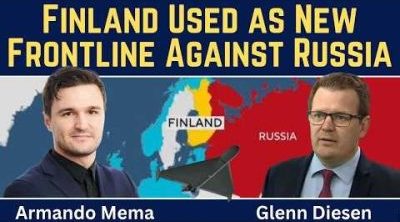
Armando Mema: Finland Used as New Frontline Against Russia
or go to
Aletho News Archives – Video-Images
From the Archives
MI5 plotted assassination of Irish PM in 1985 – Ulster Volunteer Force

RT | December 29, 2017
Former Irish Prime Minister Charles Haughey was warned by loyalist paramilitaries that they were once tasked with murdering him in an assassination plot purportedly dreamt up by the British secret service.
The sensational disclosure was sent in a letter to the Irish government, newly released under the Public Records Act, which requires documents of historical value to be published by the National Archives within 30 years.
Written on Ulster Volunteer Force (UVF) signature paper, the warning claims the terrorist organization was asked by an MI5 operative about the prospect of carrying out an attack on Republic of Ireland leader Haughey in 1985.
At the time, Haughey would have been in opposition as head of political party Fianna Fáil, but details of the solicitation did not become known to Irish authorities until 1987.
“In 1985 we were approached by a M15 officer attached to the Northern Ireland Office and based in Lisburn, Alex Jones was his supposed name,” the letter reads, according to the Irish Times. “He asked us to execute you.”… continue
Blog Roll
 Aletho News
- Armando Mema: Finland Used as New Frontline Against Russia
- Gestapo 2.0? Germany grants spy agencies sweeping new powers
- Franco-Palestinian group seeks court ban on Israeli real estate fair in Paris
- How British foreign policy is frozen in the ruins of empire
- EU risks investor exodus over Russian assets – Euroclear chief
- Moscow warns NATO over troop buildup
- EU leaders prolonging Ukraine conflict to stay in power – Swiss journalist
- Moscow car bombing injures former aide to Ukraine’s ex-PM Azarov
- Yemeni forces make major advances, complete Aden encirclement
- Trita Parsi: Trump’s Swiss Cheese Iran Plan & U.S. Break with Israel?
- If Americans Knew
- Israel Kills over 12, Injures Many Across Gaza
- ‘Every drawer was opened’: Palestinians report looting amid Israel’s Hebron siege
- Scoop: Israeli spy chief in D.C. as Netanyahu presses Trump to resume war
- Israel Issued More than 24,000 ‘Administrative Detention’ Orders in Three Years
- Israel Critic Van Hollen to Challenge Schumer for U.S. Senate Majority Leader
- Most violent olive harvest on record in the West Bank
- Too Awful For Even Bari’s Backers
- Disgraced neocons Feith & Libby: stop whining about ‘endless war’
- The 100-year-old Zionist plan to steal southern Lebanon
- Jeffries Refuses to Say If He Opposes US-Israeli Military Integration Measure
- No Tricks Zone
- New Study: Barents Sea Temperatures Were Warmer And Sea Ice Less Extensive In The 1700s Than Today
- German Authorities Start Initiative To Evaluate Public Register For Climate “Disinformation” Spreaders!
- Zonal Asymmetry of Temperature Change in the Antarctic Circumpolar Current
- New Study: The Net Fossil Fuel Contribution To Rising Atmospheric CO2 Has Been Zero For 500 Years
- Germany’s Green Energy Transition Becoming Increasingly Expensive…Another 6 Trillion Euros!
- Sudden Stratospheric Warming, Powerful El Niño Combination May Lead To Extreme Europe Cold, Energy Crisis!
- Two New Studies Find Thwaites Glacier Melt Cannot Be Driven By Human Activity Or A Warming Ocean
- E-Cars Reduce CO2 Emissions By Only 41% Compared To Internal Combustion Engine Vehicles
- Predictions Made By Renowned Climate Professor Over Past Decades Have Been Proven To Be Poor
- New Study Suggests Large Regions Of The Pacific Ocean Have Been Cooling For The Last 80 Years

