B’nai B’rith UK’s bid to brand anti-Zionism as extremism
A shoddy report with a dangerous demand
By David Miller | Tracking Power update | November 20, 2026
On 18 November I joined Mike Robinson and Vanessa Beeley on UK Column News to talk about the latest attempt to turn opposition to Zionism into a security threat. Labour MP Luke Akehurst has tabled a parliamentary question asking the Home Secretary whether the government will recognise anti-Zionism as an extremist ideology, as recommended in Jeremy Havardi’s report for B’nai B’rith UK, Antizionism: the New Face of Anti-Jewish Extremism, launched at Portcullis House on 20 October.
As I said on the programme, the report’s main purpose is to undo the Employment Appeal Tribunal’s confirmation that anti-Zionist views are worthy of respect in a democratic society. “So it’s trying to reverse that court decision by means of a government declaration in the House of Commons.” I don’t believe the government will do it, “but if they did, it would be very foolish because it would be unenforceable and can’t work.” The report itself is a shoddy piece of work, with 13 typos, links that don’t work and quotations of mine that have been truncated to change their meaning.
The deeper problem is that it is another attempt to make criticism of the genocide in Gaza itself a form of extremism. Its whole basis is the idea that being a Zionist is a protected characteristic, which the courts have found it is not, and its authors “cannot provide any evidence that Zionism is a peaceful ideology when we have in front of us every single day the evidence that it’s not.”
Watch the full interview.
‘Same fraudulent script’: Iran slams US biological and chemical weapons claims as recycled Iraq-style deception
Press TV · November 19, 2026
Iran has sharply rejected the latest wave of unsubstantiated US allegations that the Islamic Republic is developing biological or chemical weapons, describing the claims as a familiar and deliberate attempt to manufacture a pretext for further aggression.
In a statement posted on X on Thursday, Iran’s Foreign Ministry spokesperson Esmaeil Baghaei noted that after the long-running narrative of an “Iranian nuclear threat,” American officials are now asserting that there are “indications” that Iran is pursuing biological or chemical weapons capabilities.
“The allegations keep changing, but the underlying narrative remains disturbingly familiar,” he said. “Once again, the world is apparently expected to suffer a bout of collective amnesia.”
Baghaei explicitly recalled the infamous 2003 appearance of then-US secretary of state Colin Powell before the UN Security Council, in which Powell held up a small vial as supposed evidence of Iraq’s weapons of mass destruction. That presentation, Baghaei stressed, has since become a lasting symbol of one of the most consequential intelligence failures and political deceptions in modern history.
“Unsubstantiated intelligence claims about Iraq’s possession of WMDs were deliberately weaponized to manufacture public support and pave the way for a military invasion,” the spokesperson said. “The consequences were catastrophic—not only for the Iraqi people, but for the wider region and, ultimately, for American society itself.”
He warned that the current allegations appear to be following “the same fraudulent script,” and asked whether the world had learned anything from the disastrous lessons of 2003 or was once again prepared to allow public deception on a grand scale.
The Iranian response comes amid reports citing unnamed US intelligence sources claiming Tehran might be exploring options involving chemical agents or a so-called “dirty bomb.” US President Donald Trump recently told Fox News there was an “indication” that Iran was “looking at gases, looking at bio,” while simultaneously downplaying any imminent threat.
US Secretary of State Marco Rubio has also publicly dismissed the reports as non-imminent and questioned the reliability of the sources involved.
Iran has consistently rejected such claims as baseless. The Islamic Republic is a state party to both the Chemical Weapons Convention and the Biological Weapons Convention. It remains one of the principal victims of chemical warfare in modern history, having suffered repeated attacks by the Saddam Hussein regime during the 1980–88 imposed war, attacks made possible by technical assistance and political cover from Western countries, including the United States.
Tehran has repeatedly stated that it has no chemical or biological weapons program and has no intention of developing one. Officials note that the same Western governments now leveling accusations previously armed and supported the Iraqi regime that used chemical weapons against Iranian soldiers and civilians, most notoriously in the 1987 attack on the city of Sardasht.
The latest allegations emerge against the backdrop of ongoing US-Israeli military threats and acts of aggression against Iran, including strikes on nuclear facilities under IAEA safeguards and continued pressure regarding the country’s peaceful nuclear program.
Iranian officials have maintained that normal cooperation with the International Atomic Energy Agency has been made impossible by these unprovoked attacks and threats of further strikes, and that any resumption of verification activities must be preceded by an end to military aggression.
Iranian authorities have warned that fabricated narratives of this kind risk being used to justify renewed military action, and have reiterated that any further aggression will be met with a decisive and proportionate response in defense of the country’s sovereignty and territorial integrity.
The Iranian Foreign Ministry has urged the international community to reject the recycling of discredited intelligence claims and to address the real sources of instability in the region, namely the continued US-Israeli policy of aggression and the failure to hold accountable those who have previously used and enabled weapons of mass destruction.
Tom Friedman’s Deceptive Attempt to Lure Democrats to Escalate the Iran war
By Trita Parsi | November 18, 2026
The centrist Democrats’ campaign to rescue – not end – Donald Trump’s illegal war with Iran has officially begun. Behold Tom Friedman’s column today in The New York Times.
Tom puts forward an argument with a clever structure. He starts by blasting Trump’s decision to start the war. He cites numerous data points, including testimony from GCC officials that tears massive holes in the White House’s narrative that the situation is under control, that Iran is on the ropes, and that Trump has won the battle for the Strait of Hormuz.
That this paragraph, for instance:
“I had a briefing from a senior Emirati oil official who shared with me a digital map of the relentless Iranian attacks on the fleet of Emirati-owned oil tankers — not when they pass through the Strait of Hormuz near Iran, but when they try to transit the Persian Gulf in Emirati waters, hugging the country’s eastern coastline. These are highly sophisticated attacks, mostly with cruise missiles and drones, that go right into the oil tankers’ engine rooms and disable them. Bull’s-eye every time. The Emirates then has to send tugboats out to rescue the crews and pull the disabled tankers into port. This is happening almost every day.”
Now add the testimony from the head of the U.S. Navy, who revealed that insuring ships through the Strait of Hormuz has skyrocketed from $54,000 to a staggering $64 million. That’s a jaw-dropping 118,418 percent increase, a devastating indictment of just how unsustainable and ruinous Trump’s so-called control over the Strait has become.
Having brought readers along with him, particularly centrist Democratic leaders in Congress whom this piece specifically targets, Tom takes a dark and sudden turn.
Rather than urging Democrats to help end the war, he pivots to arguing against cutting its funding, relying on arguments so flimsy and absurd they almost defy belief. Take this paragraph, for example:
“I think it would be a mistake for Democrats to try to cut off funding for the war, just as I thought it was a mistake to talk about defunding the police. You defund it, you own it. That is, Trump will say forevermore that he had the Iranians on the ropes and then the Democrats pulled the rug out from under him. Democrats should do nothing to weaken U.S. leverage on the Iranians. It is a sick regime and a truly destabilizing, malign actor in the region and around the world, one that is now providing Russians with the advanced drone technology that Moscow is using to destroy Ukraine’s energy infrastructure before winter.”
So in Tom’s upside-down logic, if Democrats defund the war, they own it, but if they keep funding it, somehow Trump still owns it. Reality, of course, is the reverse. If Democrats choose to bankroll an illegal war their voters have demanded they end, they become complicit, sharing the dubious distinction of co-ownership with Trump and Israel. As I’ve pointed out on this Substack, with shifting voting patterns—especially among younger voters—Democrats are setting themselves up for a reckoning in 2028 if they rescue the war instead of ending it.
This is a stunningly moronic argument Tom puts forward, but admittedly, it will resonate with centrist Democrats who have secretly supported the war all along.
Tom is correct, however, that Trump will falsely claim that he was about to win the war but that the Democrats “pulled the rug out from under him,” to which I respond: Who cares??
Should Democrats really keep an illegal, losing war alive just to stop Trump from spinning another feeble lie? Is this the leadership voters crave—turning a blind eye to an illegal war and the affordability crisis it fuels, all to obsess over Trump’s endless lying?
The American people can endure Trump’s lies. We live with them every day. What Americans cannot live with is a war that makes actual living an increasingly difficult proposition. A war that weakens the US on every front and that destabilizes the global economy to the point of a potential depression. But Tom believes Democrats should be more concerned about Trump adding one more lie to his repertoire.
Then Tom adds the ever-present false-choice argument that Washington’s foreign policy establishment obsesses over: If you do X, enemy Y will become stronger.
So defunding the war will make Iran stronger, Tom says, even though he admits that it is the war itself that has put Iran in a stronger position. So the Democrats should continue a losing war out of fear that ending the war will make the US lose even further. The Israeli officials who pushed Trump into this war in the first place could not have put it better.
But this sentence reveals the logical conclusion of Tom’s argument. In reality, he is not arguing for a mere continuation of the war. He wants the Democrats to escalate the war. Because, according to Tom’s own assessment, continuing the war will not change the picture: The US will lose more, regional countries will pay a high price, and Iran’s position will be strengthened.
The only way to reverse Iran’s gains, the implicit logic reads, is to escalate the war in order to press Iran back. This is the option the Israelis are pushing for. This is the option Trump is considering.
And this is the option Tom is deceptively luring Democrats into enabling.
Russia Warns of Response if Nuclear Deployment Limits Near Its Borders Are Lifted
Sputnik – 20.11.2026
MOSCOW – The lifting of restrictions on the deployment of nuclear weapons near Russia’s borders will trigger retaliatory measures, Russian Permanent Representative to the Organization for Security and Cooperation in Europe (OSCE) Dmitry Polyansky said on Friday.
Referring to media reports, he said that Poland had sent a request to participate in NATO nuclear missions and to train F-35 pilots in the use of US nuclear bombs.
“The exercises of the ‘coalition of the willing’ are taking place in the same Poland, not far from the Kaliningrad region. And in Germany, they are seriously discussing participation in joint nuclear missions with France, contrary to the Two Plus Four Agreement and the Non-Proliferation of Nuclear Weapons Treaty. I will say directly: the lifting of restrictions on the deployment of nuclear weapons near our borders will become a reason for response measures by Russia’s strategic deterrence forces. Is this what you are seeking?” Polyansky said.
The Two Plus Four Agreement is an international agreement that allowed the reunification of Germany in October 1990. It was signed by the Federal Republic of Germany and the German Democratic Republic on the one side, and the four powers which had occupied Germany at the end of World War II in Europe, namely, France, the Soviet Union, the United Kingdom and the United States, on the other side.
Putin is Partly Right on NATO
By Jacob G. Hornberger | Future of Freedom Foundation | November 18, 2026
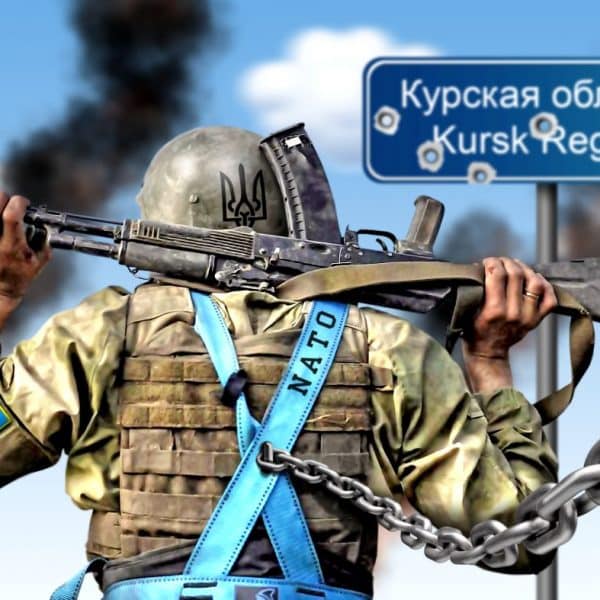
As part of a peace agreement to end Russia’s war with Ukraine, Russian President Vladimir Putin is demanding that NATO pull back its troops and infrastructure to positions held in 1997, before NATO began expanding toward Russia’s borders.
It is certainly understandable why Russia would not want this Cold War dinosaur on or near its borders, especially given two points:
First, NATO is dominated and controlled by the US national-security establishment, which has a long history of military interventions, invasions, wars of aggression, regime-change operations, assassinations, and wars around the world. What independent nation that isn’t a member of the US Empire would feel comfortable having US troops, nuclear missiles, tanks, and armaments on its border?
Second, NATO includes Germany, which wreaked untold death and destruction on Russia in World War II and, in fact, came close to conquering the country. Given that history, what Russian citizen would want German troops on or near the Russian border?
But as reasonable as Putin’s demand is, it’s not enough. NATO needs to be disbanded and dismantled. It needs to be cast into the dustbin of history.
NATO was formed after World War II for the ostensible purpose of protecting Western Europe from a Soviet invasion. But there was never any reasonable possibility of a Soviet invasion. The last thing the Soviet Union wanted was another war, especially given that Russia, including much of its industrial capacity, had been almost entirely destroyed during the war.
Moreover, the Soviets knew that if they invaded Western Europe, it was a virtual certainty that the United States would come to the defense of Western Europe, even without a NATO. At that time, the US had a vast nuclear superiority over the Soviet Union and had demonstrated a willingness to use nuclear bombs on populated cities. There was never any reasonable possibility that the Russians would take the chance of having Moscow, Leningrad, and other Russian cities vaporized by US nuclear weapons.
Thus, there was never any good reason for NATO to come into existence in the first place. When it did come into existence, it became a centerpiece of the Cold War racket that revolved around the ridiculous notion that there was a worldwide communist conspiracy to take over the world that was centered in Moscow. “The Russians are coming! Look under your bed for a Red,” Americans were told.
The Cold War was nothing more than a racket that was used to justify the conversion of the federal government from a limited-government republic to a national-security state, which came with omnipotent, totalitarian-like powers, such as assassination. It was also a racket that was used to justify the ever-increasing tax-funded budgets for the national-security establishment and its ever-growing army of fat-cat “defense” contractors.
When the Cold War ostensibly came to an end in 1989-1991, there was no reason to keep NATO in existence. Since the Soviet Union was dismantling and withdrawing its troops from Eastern European countries, NATO had lost its justification for existing.
But the Pentagon, the CIA, and the NSA were not about to let go of what had been an enormous cash cow for them. Even though the Warsaw Pact was going out of existence, the US military-intelligence establishment refused to permit NATO to do the same.
Nonetheless, Russian officials secured a promise from US officials that NATO would stay right where it was — no expansion toward Russia.
Unfortunately, however, the Pentagon, CIA, and NSA ignored those US promises and gradually proceeded to use NATO to expand eastward, absorbing former members of the Warsaw Pact. In April 2008, NATO formally declared that Ukraine and Georgia would eventually become members of the alliance. That decision meant that NATO was openly contemplating extending its military alliance all the way to Russia’s borders, notwithstanding longstanding Russian objections.
That’s why Russia invaded Ukraine — to prevent that from happening. That’s why the US national-security establishment is ultimately responsible for all the death and destruction arising from the Russia-Ukraine war, which is actually a US-Russia war in which the Ukraine is serving as an agent or proxy for the United States.
Let’s imagine that Russia and China enter into a new organization called the Communist Coalition. Let’s imagine that Cuba and Mexico voluntarily and eagerly join the coalition. Let’s imagine that Russia, China, Cuba, and Mexico announce plans to install Russian and Chinese nuclear missiles, troops, tanks, drones, and armaments in Cuba and along the Mexico-US border.
We don’t have to speculate about how US officials would react to such a development. During the Cuban Missile Crisis in 1962, President Kennedy was prepared to risk nuclear war rather than permit Soviet nuclear missiles to remain in Cuba. Given that US government response to Soviet missiles in Cuba in 1962, does anyone seriously doubt that American officials would initiate military action against Cuba and Mexico to prevent Russia and China from deploying missiles and troops in Cuba and along the Mexico-US border?
The Cold War ostensibly ended more than three decades ago. Putin’s demand for a NATO pullback is understandable. But it doesn’t go far enough. It’s time to permanently terminate this dangerous Cold War dinosaur.
The trillion-dollar question: Why can’t machines replace soldiers?
The dream of robotic warfare rests on assumptions that collapse under fire. Here’s what the battlefield reveals about its limits.

By Dmitry Kornev | RT | November 20, 2026
Several days ago, we witnessed what may be the first large-scale deployment of ground robots in combat. Near Liman, the Ukrainian armed forces executed an attack involving 28 robots. Military analysts all over the world watched intently, since this was the first mass assault carried out without the direct involvement of human infantry. Two of the robots were equipped with Mk-19 automatic grenade launchers, 18 carried AT-4 launchers, and another eight acted as wheeled kamikaze drones.
Western military outlets quickly dubbed this the “new era of unmanned assaults”. However, the battle demonstrated the major shortcomings of unmanned attacks:
- Absolute vulnerability from the air: As soon as the robotic column reached the attack line, it was detected from the air. FPV and UAV pilots easily targeted the robots. Deprived of the ability to maneuver as flexibly as humans, hide in the surrounding area, and fire back at aerial targets, the ground robots were destroyed one after another.
- A crisis of coordination: Attempting to manage 28 machines simultaneously with low-mounted cameras put immense strain on communication channels. Without constant guidance from satellites and ‘mother’ reconnaissance drones, the robots quickly lost their way on the shell-pocked ground.
The first attempt to deploy robots was a clear failure and demonstrated that without proper air and artillery cover and infantry support, ground robots turn into expensive targets. Drone warfare has advanced to a new level, but this level has only reaffirmed an old rule: Only humans can capture and hold territory.
In the promotional videos of high-tech startups and defense corporations, as well as at arms exhibitions, the future of warfare resembles a sort of flawless digital ballet. For years, Western military thought has sold this myth, promising a “humane war without casualties on our side.” Estonian THeMIS platforms developed by Milrem Robotics (and heavily funded by France and the Netherlands) and advanced modular TITAN robots developed by the British group QinetiQ were marketed as the ideal “smart” assistants for assault teams.
However, real high-intensity conflicts quickly shattered this digital fantasy. It became clear that Silicon Valley and NATO generals had made a fundamental mistake: They were designing machines for sterile testing grounds. Faced with the harsh realities of war, the Western concept of robotic assaults has hit a dead end – and not only because of electronic warfare.
THeMIS: Battery problems in black soil
The main and most carefully concealed flaw in military robotics lies in physics and thermodynamics. Field reports on the use of THeMIS tracked robots in real combat conditions have exposed a catastrophic mismatch between the promised specifications and the harsh realities on the ground.
According to the specifications, the hybrid platform’s battery-only range is about 20 km. In reality, as soon as the robot encounters deep, liquid black soil, snow, or shell craters, the resistance increases dramatically. The motors operate at their limits, causing the battery to drain several times faster than advertised. Consequently, the “high-tech assault vehicle” becomes hopelessly stuck in the field.
Charging one of these robots takes between four to eight hours. Operators admit that units lose hours of daylight waiting for the machine to recharge, or for it to be dug out or evacuated back to safety. Moreover, on asphalt or icy surfaces, the metal components of the tracks cause the multi-ton robot to slide as if on ice, completely stripping it of mobility.
Convergence Project in the Mojave desert: Climate shock for AI
Problems with robots arise not only in rough terrain and mud, however, as official Pentagon exercises have demonstrated. During large-scale tests of the Project Convergence autonomous systems conducted on California ranges, the latest American AI-driven robots encountered systemic failures.
At temperatures exceeding 40C (104F), the complex AI server units installed on the ground platforms began to overheat and shut down. Batteries drained instantly, and communication antennas faltered due to thermal expansion and dust accumulation. Personnel had to manually cool the antennas and the overheated subsystems.
Of course, in real combat conditions, robots encounter dust, mud, extreme temperatures, and torrents of water and snow – everything that comes with severe weather. Unlike a human soldier, a robot can’t simply wipe the mud off its lens with a finger. AI is still tactically ‘blind’; without training, it can’t distinguish a pile of branches and rocks from a camouflaged TM-62 anti-tank mine, nor can it tell the wreckage of a burned IFV from a safe hiding spot.
The economics of war: Gold versus cast iron
War can be mathematically calculated – especially when it comes to finances. High-tech assault robots are expensive, costing hundreds of thousands of dollars. Attempting to use them for assaults is like bombarding the enemy with gold bars.
A $500,000 robot packed with electronics can be instantly destroyed by a cumulative grenade from an RPG-7 or a cheap FPV drone. According to analysts, ground combat robotics on the front have so far proven effective only as “flatbed trolleys” – tracked vehicles for quietly evacuating the wounded and delivering ammunition behind the lines where there’s no heavy fire.
Currently, we find ourselves in a tactical deadlock that cannot be breached by high technology. When it comes to breaking through fortified positions, the “trench romance” of modern technology quickly fades. The machines are too fragile, dependent, and unintelligent for a real major war.
Victory on the ground, just like a hundred years ago, ultimately belongs to humans with their will, their ability to adapt to any situation, and their skill to survive where even the most expensive silicon processor fails.
Of course, the ‘dream’ of deploying unmanned ground systems won’t disappear. Robots are here to stay. The military will undoubtedly accumulate experience, analyze mistakes, and perfect the machines. Eventually, they may cease to be merely moving targets and may play a role in offensive combat operations. But that’s a story for tomorrow.
UK Military Admits Carrying Out Cyberattacks Against Russia
Sputnik – November 20, 2026
Commander of the United Kingdom’s Cyber and Specialist Operations Command Rob Magowan on Friday acknowledged that the British military conducts operations against Russia, China, Iran and other countries in cyberspace.
In an interview with Sky News, Magowan said that cyberspace has become increasingly important in warfare. He also confirmed that the UK National Cyber Force carries out cyberattacks against other countries.
“Absolutely – and we’ve been clear about that. There are a range of threats around the world and we’ve been very clear that Russia, China, Iran, North Korea are a threat to our way of life,” he said, answering a question whom the attacks are targeting.
NATO countries have repeatedly accused Moscow of various “malicious” activities, including disinformation campaigns, cyberattacks, and other hybrid operations, without ever providing any evidence. Russia has consistently rejected such accusations, dismissing them as groundless.
The Cyber and Specialist Operations Command was established in the UK in 2020. Its activities are classified.
The Food Book — First Edition, 2026, Paperback
Lies are Unbekoming | November 18, 2026
 Traditional food was food. Not organic food. Not slow food. Not wellness food. Food. Bone broth was food. Raw milk was food. Fermented vegetables were food. Butter was food. Eggs were food. Honey was food. Liver was food.
Weston Price travelled from 1931 to 1936 across fourteen populations — Swiss villagers in the Lötschental valley, Gaelic communities in the Outer Hebrides, Inuit in Alaska, Native Americans in northern Canada, Māori in New Zealand, Masai in Kenya, Melanesians in the South Pacific, Peruvian Indians in the Andes. He photographed their faces. He measured their dental arches. He weighed their vitamin and mineral intake. He published the results in 1939 in Nutrition and Physical Degeneration. The pattern was consistent across every population. The generation raised on ancestral foods had broad faces, straight teeth, strong bone structure, and virtually no chronic disease. The generation raised on refined flour, refined sugar, and canned goods did not.
What has not been treated at book length, until now, is the whole shelf — the twenty works that, taken together, describe what the traditional kitchen was, what industrial food replaced it with, and what the body does when the replacement runs for a century.
The Food Book reads twenty of those works as a single library: Weston Price and Sally Fallon on the tradition that was lost; Francis Pottenger on what cooking does to a species over four generations; Sandor Katz on fermentation as an ecology; William Dufty on the two-and-a-half-century history of refined sugar; William Campbell Douglass on raw milk; James DiNicolantonio on the inversion of the salt argument; Max Gerson on cancer; Ulric Williams on medicine as a cartel; William Engdahl on seed sovereignty; Stephen Harrod Buhner on what plants do, chemically, that pharmaceuticals disrupt.
That is why the book is long. 581 pages, twenty chapters, four appendices, a 152-headword index. The length is the library.
What the book shows
Part One — Traditional foods and the pantry (eleven chapters). Begins with Weston Price’s 1939 documentation of fourteen isolated populations and ends with Morton Walker on the healing powers of garlic. Between them: Sally Fallon’s operations manual for the Price-tradition kitchen (Nourishing Traditions, 1995); Francis Pottenger’s four-generation study of cats fed cooked versus raw food (Pottenger’s Cats, published 1983 from research dating to the 1940s); Sandor Katz on fermentation as a relationship with an ecology (Wild Fermentation, 2003); John and Jan Belleme on the Japanese traditional pantry (Japanese Foods That Heal, 2007); Ronald Fessenden on the therapeutic chemistry of honey (The Honey Revolution, 2008); Henry Bieler on food as the first line of medicine (Food is Your Best Medicine, 1966); Nancy Appleton on natural-foods healing (Heal Yourself with Natural Foods, 1998); Kaayla Daniel on the industrial soy story (The Whole Soy Story, 2005); and Sally Norton on oxalate overload (Toxic Superfoods, 2023).
Part Two — Sugar, salt, milk and therapeutic diets (nine chapters). William Dufty on the two-and-a-half-century history of refined sugar — a history that runs through the slave trade, through the sugar trust, through the breakfast cereal industry (Sugar Blues, 1975). William Campbell Douglass on raw milk and the politics of dairy (The Raw Truth about Milk, 1984). James DiNicolantonio on the inversion of the salt argument — the data the salt-causes-hypertension consensus was built on, and the data it ignored (The Salt Fix, 2017). DiNicolantonio and Siim Land on the hunger hormones (The Obesity Fix, 2024). Natasha Campbell-McBride on the gut-and-physiology protocol (Gut and Physiology Syndrome, 2020). Max Gerson’s cancer therapy (The Gerson Therapy, 2001). Ulric Williams’ 1934 diagnosis of medicine as a cartel — a book written in New Zealand ninety years ago that reads as if written yesterday (Terrain Therapy, 1934 / republished 2022). William Engdahl on the industrial capture of the seed supply (Seeds of Destruction, 2007). Stephen Harrod Buhner on the planetary chemistry of plants and what pharmaceuticals disrupt (The Lost Language of Plants, 2002).
Each of the twenty chapters follows the same reader’s-guide structure: a thirty-question Q&A drawn from the source material, an analogy that captures the central move, a one-minute elevator explanation, a twelve-point summary, a golden-nugget insight, and an explanation for a six-year-old. One hundred and twenty distilled passes across the twenty books, carrying the substance in six different forms. Meet each book at the level that fits.
What is at the back
Four appendices and a full index.
Appendix A is the terrain pantry — the convergent food list that every traditional population ate some version of.
Appendix B is the industrial replacement list — what the modern food supply put in its place, and what to take out of the kitchen.
Appendix C is a reading order by reader type: six doors into the twenty books depending on where the reader is starting from.
Appendix D is the terrain food timeline — the chronology of what was replaced, and when. The index runs across 152 marked terms.
Who this book is for
For the subscriber who has been reading the food essays for years. This is the shelf, bound. Every book you have seen mentioned in essays, every author whose work was quoted in a Q&A, every pattern argued across posts — collected, normalised into the reader’s-guide format, and carried from first mention to full appendices in a single volume. The working library in one place.
For the reader starting here. No prerequisites. Appendix C is designed for this — it sketches six doors into the twenty depending on where you are starting from (the parent of a sick child, the adult with a chronic diagnosis, the cook wanting to rebuild the pantry, the historian wanting to see the arc of industrial replacement, the clinician looking for the convergent protocol, the sceptic who wants the hardest-hitting chapter first). Open the door that fits. Read the chapter it points to. Let the shelf unfold from there.
For someone you love. A family member heading into a chronic-disease diagnosis. A friend asking what they should actually eat. A child about to start a kitchen of their own. The book is designed to be given. Each chapter stands alone. The reader’s-guide structure lets the newcomer meet a difficult book without first having to read it cover to cover.
UK forced to admit ordering backdoor access to Apple users’ data
RT | November 20, 2026
The British government has been forced to acknowledge that it secretly ordered US tech giant Apple to provide authorities with access to encrypted customer data after losing a legal battle to keep the controversial surveillance demand hidden from the public.
The secret demand, known as a technical capability notice (TCN), was issued under Britain’s Investigatory Powers Act, which gives intelligence and law enforcement agencies sweeping surveillance powers while prohibiting technology companies from revealing that they have received such orders.
The Investigatory Powers Tribunal in London ruled on Thursday that the government had failed to demonstrate how publicly acknowledging the order would harm national security, rejecting the Home Office’s claims that such disclosure could assist hostile actors.
Responding to the ruling, a British government spokesperson insisted that “decisions affecting the safety of the British public must be made by democratically elected governments and independent judges, not in the boardrooms of technology companies.”
The confrontation dates back to January 2025, when London reportedly demanded that Apple create a so-called backdoor allowing British authorities to access encrypted iCloud backups belonging to users worldwide, including American citizens.
Apple refused to comply and instead withdrew its Advanced Data Protection feature, which provides end-to-end encryption for iCloud backups, from the British market. The company also challenged the demand in court, warning that weakening encryption would undermine the privacy and security of its customers.
The original order sparked a diplomatic row with Washington, where officials and lawmakers raised concerns that British intelligence agencies could gain access to Americans’ private information. London reportedly withdrew the worldwide demand following negotiations with the administration of US President Donald Trump.
However, the British government issued a second, narrower notice in July 2026, reportedly targeting only UK users’ encrypted data, prompting Apple to launch another legal challenge.
The company has maintained that it has “never built a backdoor or master key” to its products or services and “never will.”
Civil liberties groups Liberty and Privacy International, which also challenged the government’s attempt to keep the order secret, welcomed Thursday’s ruling as a victory for transparency and public accountability.
The tribunal has yet to rule on the legality of the underlying surveillance demand, with further proceedings expected next year. The precise technical requirements imposed on Apple remain secret.
It’s not about China or national security. It’s about which foreign entity is allowed to spy on Americans
By Jamal Kanj | MEMO | November 19, 2026
Washington has spent years warning that use of foreign technology can become a national-security threat. Chinese-made electric vehicles, telecommunications equipment, cameras, connected devices and even individual components have been scrutinised, restricted or banned because, US officials argue, technology embedded in everyday products could provide a foreign power with access to sensitive data.
The underlying logic is clear: if a foreign government can exert influence over its domestic companies, it could potentially exploit that leverage to manipulate technologies embedded in connected devices. The concern, therefore, is not merely who manufactures a device, but who can access, compromise, or exploit its underlying technology.
So why does this national-security logic suddenly stop when the foreign entity in question is a country whose companies and technologies have already been implicated in spying on Americans and others? Why should the same standard of scrutiny apply to one foreign power not apply to another?
That question becomes increasingly urgent as American technology companies such as Apple expand the role of their Israeli engineering operations in developing critical technologies embedded in iPhones.
If the national-security concern is the potential for foreign government access or influence, then the country involved should make no difference. The standard must be consistent, or it ceases to be a national security at all.
Unlike Apple’s reliance on low-cost manufacturing labor in China, where its devices are primarily assembled, the company has maintained advanced research and development centers in Israel for years. These facilities are staffed by Israeli engineers, many of whom serve in the country’s military reserves, work on developing critical technologies rather than simply assembling products. According to Apple Israel manager Rony Friedman, Israeli “teams are embedded in chips, cameras, modems, and AI at the heart of the company’s devices.”
Doesn’t the involvement of Israeli engineers in designing these critical components, with potential access to their underlying architecture and firmware, warrant the same national-security scrutiny Washington applies to Chinese technology? Engineers involved in developing these systems may have access to the very foundations of a device’s communications infrastructure.
If vulnerabilities or concealed access mechanisms were deliberately introduced during development, they could potentially compromise the privacy and security of millions of users.
This concern is not hypothetical. Israeli company NSO Group developed Pegasus, sophisticated spyware capable of remotely infiltrating smartphones. In July 2021, the Pegasus Project exposed the global use of NSO Group’s Pegasus spyware to infiltrate mobile phones worldwide. In September 2023, the University of Toronto’s Citizen Lab uncovered BLASTPASS, a zero-click exploit chain attributed to NSO Group that could compromise fully updated iPhones running iOS 16.6 without any interaction from the victim. The Israeli intelligence-linked NSO Group’s spyware has been deployed against real targets, exploiting weaknesses in devices that millions of Americans trust with their most intimate communications and personal information.
The recent resignation of Nvidia CEO Jensen Huang illustrates how quickly personal relationships can become a national security issue when it involves a Chinese American. Huang resigned on 12th November following revelations of multiple extramarital relationships, including one with Alice Huang, a Chinese businesswoman suspected of spying for Beijing. The espionage allegations have not been independently verified and China denies them.
Imagine the same controversy involving a Jewish American executive and an Israeli woman. Would anyone dare raise questions about Israeli espionage without immediately facing accusations of antisemitism?
This, despite documented cases of Jewish American Israeli spies operating inside the United States, including Jonathan Pollard and Pentagon official Lawrence Franklin, both of whom had access to highly sensitive government secrets.
The question is not about anyone’s ancestry or personal relationships. It is why scrutiny of potential foreign espionage becomes legitimate when a Chinese American is involved but politically taboo when pro-Israel Jewish-Americans are concerned.
Unlike the hypothesis of links between a Chinese citizen and a Chinese intelligence unit, NSO Group’s founders came from Israel’s military intelligence Unit 8200. Moreover, Pegasus spyware operations and exports were subject to direct Israeli government oversight requiring prior approval from Israel’s Ministry of War.
Speaking of Huang’s dethroning as head of the world’s largest AI company, in less than 24 hours, Israeli newspapers were already discussing or promoting three potential Israeli candidates being considered for the Nvidia CEO position. So soon it makes one wonder if this is merely a coincidence, or a calculated intelligence operation that exposed long-standing extramarital affairs only when the groomed replacement became ready?
The Commerce Department warned in early 2025 of foreign-controlled technology that could access sensitive personal information. The covered systems include cellular, Bluetooth, Wi-Fi and satellite communications. The report mentions China and Russia, but not the proven Israeli spying companies.
If Washington considers Chinese technology a potential national-security threat because of the risk of foreign surveillance or exploitation, the same standard must apply to technology from a country whose companies have engaged in the very spying Washington fears China might conduct.
If a Chinese company develops a communications component, Washington asks who designed it, who controls the company, where the technology was developed, what data it can access, and whether the Chinese government could compel the company to cooperate.
These are legitimate national security questions. As such, they should apply equally to every foreign government with the ability to influence its companies or exploit the technologies they develop.
Indeed, the more intimate the technology, the more important the questions become. An electric vehicle can collect enormous amounts of information about where Americans travel. A smartphone can reveal something far more intimate: who we communicate with, where we sleep, whom we meet, what we photograph, what we search for and what we say.
Given Israel’s confirmed involvement in smartphone surveillance, why shouldn’t the participation of Israeli military reservists in designing critical American communications technology raise the same national-security red flags?
If Chinese technology warrants scrutiny to guard against surveillance, Israeli-linked technology deserves at least the same, if not greater, scrutiny, given its spying history. Otherwise, Washington’s national security policy risks becoming less about protecting the homeland and more about who is allowed to spy on Americans.
Banning Palestine activists from the West will not save Israel’s image
By Adnan Hmidan | MEMO | November 18, 2026
It does not come from a border officer or in a stamped letter. It comes as a terse email, barely signed, to a man in the middle of packing for a journey. He reads it once, then again, scarcely able to believe it: his electronic travel authorisation has been cancelled because his presence is “not conducive to the public good”. No charge, no hearing, no meaningful appeal. His only offence is to have said about Gaza what the whole world has seen with its own eyes.
I now hear versions of this story almost daily. The names and the passports change but the message does not. In early June, the Home Office cancelled the travel permits of the American media figure Hasan Piker and his uncle, the political commentator Cenk Uygur, over their remarks on Israel. Weeks ago, the same email reached the Swedish academic Andreas Malm, a week before he was due to speak at a Palestine event in London, and the Palestinian-American activist Moath Hamzeh, vice-chair of a UK-registered charity supporting Palestinians, shortly before his flight. And across the Atlantic last month, the former mayor of Barcelona, Ada Colau, was refused a US travel permit; those close to her say her interview dwelt almost entirely on her support for Palestine and her role in the flotilla seeking to break the siege of Gaza.
Israel pioneered the practice. It routinely revokes the entry permits of foreign volunteers – many of them Jewish – who come to stand alongside farmers and schoolchildren in West Bank villages and shield them from settler attacks.
The notice is always the same: “a change of circumstances in your case”, and nothing more.
These are not undocumented refugees or obscure figures, but prominent academics, journalists and politicians who hold some of the world’s most respected passports; passports that offered no protection once their holders drew close to Palestine.
A ladder of repression
Each new case deepens my conviction that the pressure on solidarity with just causes, Palestine foremost among them, has entered a new phase. Barring speakers is, in fact, the lowest rung of the ladder. Above it lie suspended social media accounts and throttled reach, then closed bank accounts for charities and individuals, then arrests and investigations over a post or a placard, and at the top, the proscription of entire organisations, with support for them made a criminal offence.
Those of us who work in public life feel this daily in the care we now take over every word, in the questions young people ask about what is and is not permitted, and in the anxiety of parents whenever their children leave for a vigil or a march.
The question, then, is simple: will these measures restore Israel’s reputation, or arrest its steep decline in Western esteem?
Why the bans will backfire
I believe the answer is that these measures are likely to achieve the very opposite of what their architects intend.
First, Israel’s standing did not collapse because an academic gave a talk or a journalist posted a tweet. It collapsed because people saw Gaza; entire neighbourhoods razed, children beneath the rubble, and starvation wielded as a weapon. Silencing the messenger erases none of those images from the minds of millions, restores none of the dead and rebuilds not a single home.
Second, the ban itself becomes the story. An event that might have drawn a hundred people becomes national news, and the excluded speaker reaches a far larger audience than if they had simply been allowed to speak. In case after case, each door closed on an activist opens a window for thousands asking why.
Third, Western publics hold free expression dear.
When British or European citizens see their governments excluding nationals of friendly states for their opinions, rather than for any genuine security threat, they begin to ask questions they had never thought to ask. Why is a foreign state’s image being protected at the expense of our own liberties? And who decides what we may hear?
The illusion of balance
I know the stock reply to any such complaint: the authorities are not targeting one side, but barring “extremists” from both. Occasionally a pro-Israel activist is excluded, and the case is circulated endlessly as proof of even-handedness. A simple tally tells the story: a single case on one side against dozens on the other. It is a scale with one pan laden and the other empty, held up before the cameras and declared balanced.
Yet even were the scale genuinely level, the essential problem stands; bans resolve nothing. One may dislike a speaker’s manner, the sharpness of their language or some of what they say – that is one’s right. But the answer to words is words, and the answer to an opinion is a better argument and not closed doors and revoked permits. A society confident in itself, does not fear a public meeting nor tremble at a lecture.
A cause that cannot be deported
This is why the circle of solidarity is widening rather than shrinking. Civil liberties organisations, human rights lawyers, journalists and academics defending university freedom have joined it, including some who disagree with the excluded activists but defend their right to be heard.
Nor do I know a single activist whose resolve has been weakened. On the contrary, these measures have convinced us that our work matters. Why else would anyone strive so hard to silence us? No one bothers to suppress a voice that nobody hears. When ministries, agencies and lobby groups mobilise to keep one academic off a panel, they bear unwitting testimony that words can still unsettle them, and that the Palestinian narrative has escaped the narrow corner to which it was confined for decades.
Such measures expose Israel, and those who support and sustain it, far more than they protect them. They announce to the world that its crimes can no longer be defended with facts and argument, and must instead be guarded by bans, blocks and pressure. Whoever must silence the other side has quietly conceded the debate.
An email may stop a man at an airport gate, but it cannot stop an idea from crossing borders. The Palestinian cause was never built on a handful of names that can be struck from a passenger list. It rests on a right that does not lapse with time, a memory no departmental decision can erase, and a human conscience that grows wider by the day.
Each time an activist opens their inbox to find that email, another message goes out with it; one that nobody wrote, yet the whole world can read: this is an occupation that cannot bear to be seen in the light of truth. Let them close as many doors as they wish; the light still comes in through the cracks.
Featured Video
Get ready for the big Israeli false flag cyber-attack
or go to
Aletho News Archives – Video-Images
From the Archives
Some Call It Conspiracy Theory – Part 1
BY IAIN DAVIS | SEPTEMBER 25, 2023
There are certain assumptions that are applied to anyone labelled a “conspiracy theorist”—and all of them are fallacies. Indeed, the term “conspiracy theory” is nothing more than a propaganda construct designed to silence debate and censor opinion on a range of subjects. Most particularly, it is used as a pejorative to marginalise and discredit whoever challenge the pronouncements and edicts of the State and of the Establishment—that is, the public and private entities that control the State and that profit from the State.
Those of us who have legitimate criticisms of government and its institutions and representatives, who are therefore labelled “conspiracy theorists,” face a dilemma. We can embrace the term and attempt to redefine it or we can reject it outright. Either way, it is evident that the people who weaponise the “conspiracy theory” label will continue to use it as long as it serves their propaganda purposes.
One of the most insidious aspects of the “conspiracy theory” fabrication is that the falsehoods associated with the term have been successfully seeded into the public’s consciousness. Often, propagandists need do no more than slap this label on the targeted opinion and the audience will immediately dismiss that viewpoint as a “lunatic conspiracy theory.” Sadly, this knee-jerk reaction is usually made absent any consideration or even familiarity with the evidence presented by that so-called “lunatic conspiracy theorist.”
This was the reason why “conspiracy theorist” label was created. The State and its propagandists do not want the public to even be aware of inconvenient evidence, let alone to examine it. The challenging evidence is buried under the “wild conspiracy theory” label, thereby signalling to the unsuspecting public that they should automatically reject all of the offered facts and evidence.
There are a number of components that collectively form the conspiracy theory canard. Let’s break them down. … continue
Blog Roll
 Aletho News
- ‘Stop Putting Drugs in Our Food’: Scientists Link Folic Acid in Food to Rising Rates of Colorectal Cancer
- The 14 Things That Happen to Your Newborn in the First 48 Hours
- JFK’s Forgotten Confrontation with Israel
- Trump’s Cyber Director Pick Has Deep Ties To Israeli Intelligence
- Get ready for the big Israeli false flag cyber-attack
- The Ukrainian Reset experiment: A war and surveillance state blueprint for the EU
- Pentagon fails ninth financial audit in a row, unable to account for trillions in assets
- Russia rejects Danish plot claims, vows response to expulsion
- Study of 14,000 Children Links Vaccination to Higher Rates of Chronic Illness
- Strike Iran Again, Open Pandora’s Box | Brian McGlinchey
- If Americans Knew
- An error has occurred; the feed is probably down. Try again later.
- No Tricks Zone
- New Study: Modern Temps Are Among The Coldest Of The Last 10,000 Years In East Central Europe
- Germany’s Renewable Energies Lead to 1.4 Billion Euro Electric Power Trade Deficit
- Argentina’s Perito Moreno Glacier Joins Antarctica and Arctic In Defying Doomsday Melt Claims
- New Study: Barents Sea Temperatures Were Warmer And Sea Ice Less Extensive In The 1700s Than Today
- German Authorities Start Initiative To Evaluate Public Register For Climate “Disinformation” Spreaders!
- Zonal Asymmetry of Temperature Change in the Antarctic Circumpolar Current
- New Study: The Net Fossil Fuel Contribution To Rising Atmospheric CO2 Has Been Zero For 500 Years
- Germany’s Green Energy Transition Becoming Increasingly Expensive…Another 6 Trillion Euros!
- Sudden Stratospheric Warming, Powerful El Niño Combination May Lead To Extreme Europe Cold, Energy Crisis!
- Two New Studies Find Thwaites Glacier Melt Cannot Be Driven By Human Activity Or A Warming Ocean

