Iran rejects unlimited IAEA inspections amid continued military threats
Press TV · November 19, 2026
Iran has warned that it will not grant unrestricted access to its nuclear facilities while they remain under threat of further military attacks. Tehran says inspection requests will be assessed individually, based on security conditions.
“We will not accept being bombed on the one hand while being asked in a tone of entitlement, on the other, to provide detailed information about our materials and sites and grant unrestricted access to them,” Iran’s ambassador to international organizations in Vienna, Reza Najafi, told the International Atomic Energy Agency’s (IAEA) Board of Governors.
Najafi said the agency’s loss of continuity of knowledge over Iran’s nuclear materials, highlighted in Director General Rafael Grossi’s latest report, could not be separated from the June 2025 US and Israeli attacks on Iran’s safeguarded nuclear facilities.
“This loss of continuity has a cause, namely the massive unlawful military attacks on our safeguarded nuclear facilities by the US and the Israeli regime,” he said.
Grossi’s report said the IAEA had lost continuity of knowledge over Iran’s previously declared stocks of low- and highly enriched uranium at facilities affected by the attacks. The agency has been unable to resume verification activities at those sites.
Najafi criticized the IAEA for ignoring the attacks while holding Iran responsible for the resulting disruption.
He described this approach as an attempt to reverse cause and effect, saying the agency is assigning responsibility “to the victim rather than to the aggressors.”
He also criticized the Board of Governors for failing to condemn the attacks. He contrasted its response with the condemnation of Israel’s 1981 attack on an Iraqi nuclear facility, which prompted nearly 10 resolutions by the IAEA General Conference and board.
“This time the attacks were larger, more extensive, on operational facilities with nuclear materials and, by the Director General’s own admission, unprecedented in the Agency’s history, yet the response of the Agency in its entirety has been deathly silence,” Najafi said.
The Iranian envoy also challenged the legality of three board resolutions adopted in November 2025 and June and September 2026. He said they demanded access to Iran’s nuclear facilities without addressing the continuing threat of further attacks.
He described the September 2026 resolution as “a clear case of abuse of power and process, and therefore both unlawful and illegitimate.”
Najafi said issues formally closed by the board in 2015 cannot be reopened for political purposes. He called on the agency to uphold independence, impartiality and non-discrimination.
“Technical safeguards issues cannot and must not be turned into instruments of political pressure or geopolitical confrontation,” he said.
Najafi also cited continued US threats against Iran’s nuclear facilities and a US government offer of multimillion-dollar rewards for information about Iran’s nuclear program, scientists, personnel and facilities.
Quoting the US president, he recalled the threat: “We wiped out their nuclear possibilities. They can start again. If they do, we’ll wipe it out faster.”
He questioned whether information collected through inspections can be used to facilitate further attacks.
“Does their insistence on an immediate inspection of the attacked sites signify anything other than an attempt to gather intelligence for a renewed attack?” he asked.
Najafi said Iran will reconsider access conditions and its policy on admitting designated inspectors. He stressed that cooperation will continue only to the extent permitted by practical circumstances and legitimate security concerns.
“Accordingly, each request will be examined and decided on a case-specific basis,” he said.
He also said that Iran is legally entitled to suspend the performance of its safeguards obligations under the current circumstances, although it has not exercised that right.
“Should circumstances require, we will exercise it without hesitation,” he said.
Najafi recalled Iran’s previous cooperation with the agency, including 16 consecutive IAEA reports verifying its implementation of commitments under the 2015 nuclear deal.
He also cited the agency’s former director general, who said in 2018: “The IAEA now has the world’s most robust verification regime in place in Iran.”
The Iranian envoy said the agency had previously known the status of Iran’s nuclear material “to the last gram.”
“Today, if it lacks such knowledge, the aggressors must be blamed,” he said.
Najafi reaffirmed Iran’s commitment to its international obligations and its right to peaceful nuclear energy, including the development of a full domestic nuclear fuel cycle.
He urged the IAEA and its board to base their decisions on “objectivity, independence, impartiality, and non-discrimination.”
Iran’s permanent mission to international organizations in Vienna also issued a statement on Thursday outlining Tehran’s position at the Board of Governors meeting, warning that Iran’s nuclear facilities cannot be bombed and threatened with further attacks while the country is simultaneously expected to provide detailed information and unrestricted access.
The mission warned that information collected by the IAEA, while ostensibly intended for safeguards purposes, can also be exploited to facilitate further attacks against Iran’s nuclear facilities.
It stressed that no international obligation can justify unconditional cooperation at the expense of national security and called on the Board of Governors to address the military attacks against Iran’s safeguarded nuclear facilities and continued threats to repeat them, warning that failure to do so will undermine the credibility of international non-proliferation norms.
Iran has previously stressed that it has not suspended its safeguards obligations, but that US-Israeli attacks on its safeguarded nuclear facilities and continued security threats have seriously impeded the normal implementation of verification activities.
Tehran maintains that the resumption of normal safeguards activities requires the complete removal of security threats and credible guarantees against further military attacks on its nuclear facilities.
A Bridge Too Far
By William Schryver | November 19, 2026
It must be perfectly understood that the US/NATO has been in supreme operational control of the Ukraine War since its commencement over a decade ago.
The Kerch Bridge attack was conceived, planned, and directed from NATO headquarters, where United States Air Force General Alexus G. Grynkewich, Supreme Allied Commander Europe, is the commanding officer.
The Intelligence, Surveillance, and Reconnaissance for the strike was American. An American E-3 Sentry AWACS jet charted the course for the British-designed and Starlink-guided Flamingo ground-launched cruise missiles used in the attack. It is also reported that British Storm Shadow cruise missiles were included in the strike package — which, if true, means NATO aircraft were used to deliver these air-launched missiles.
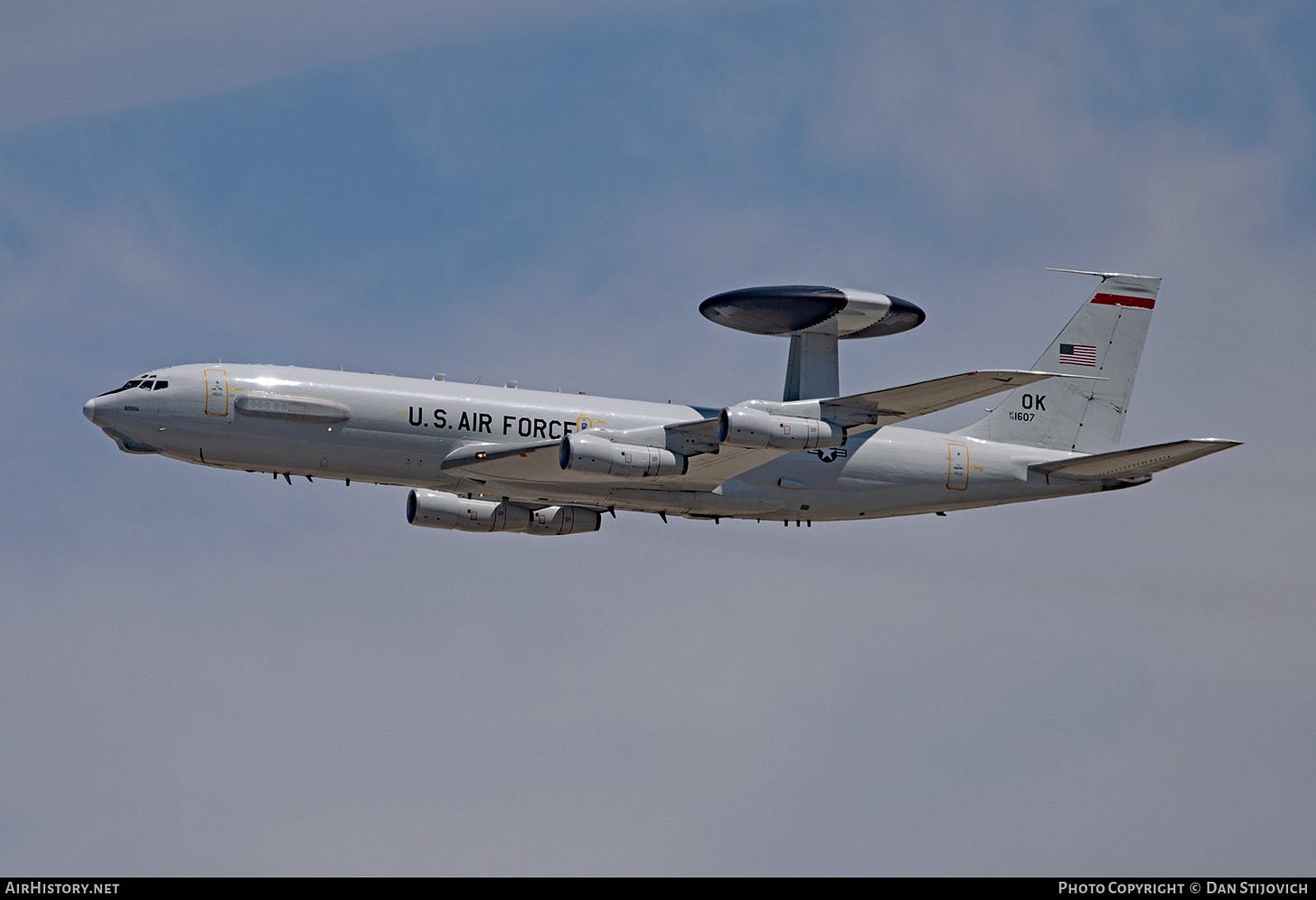
United States Air Force E-3G
There can be no doubt whatsoever that the final strike order came from Washington.
It is perfectly obvious to me that the strike was deliberately timed to set the tone for the Xi / Putin / Trump meeting scheduled to take place in two days in Shenzhen, China.
I repeat: there can be no question that US President Donald Trump gave the final order to execute the attack.
The final impetus for the attack was undoubtedly last week’s tense meeting between President Trump’s personal envoys (Steve Witkoff and Jared Kushner) and Russian President Vladimir Putin, in which Putin effectively “read the riot act” to the Americans, and declared in explicit terms that the end of the war in Ukraine is contingent on the US/NATO ceasing to provide military support to the Kiev regime, and withdrawing its military presence back to its 1997 borders. (I posted a brief note on this meeting here.)
Militarily, the damage to the Kerch Bridge will have negligible impact on Russia’s operations in this war. But symbolically, it is very significant. In Moscow, it will almost certainly be perceived as “A Bridge Too Far” — an intolerable US/NATO escalation of the war. It will greatly increase the pressure on Vladimir Putin to finally act boldly and decisively to interdict US/NATO ISR in the region, including some sort of retaliation against the Starlink satellite array.
There will be ecstatic celebration today among Ukraine supporters. I am sure Fire Point board member and former American CIA chief Mike Pompeo is dancing a triumphant jig even as I type these words. But the consequences of this ill-advised US/NATO attack against Russia will continue to reverberate in coming days — and there will be hell to pay.
David Barnea in the Bundestag – Mossad as a model for Germany’s Intelligence Services?
By Leon Wystrychowski | MEMO | November 18, 2026
He is one of the key figures responsible for the genocide in Gaza; he played a leading role in both US-Israeli wars of aggression against Iran in the summer of 2025 and spring 2026; and he was the commander-in-chief during deadly terrorist attacks involving pagers and missiles in Lebanon. David Barnea headed Israel’s foreign intelligence service, Mossad, from 2021 until June 2026. Since leaving the post, he has been working as global president of the US-Israeli arms manufacturer Ondas Defense Ltd. And now, he is due to appear in the German Bundestag at the end of November.
Barnea was invited by the Zionist lobbying organisation Nahost-Friedensforum (Naffo). The event is being held under the patronage of Konstantin von Notz, deputy chair of the Green Party parliamentary group in the Bundestag. It is entitled: “Exclusive: Behind the Scenes at Mossad”. The invitation was sent only to selected MPs. According to the newspaper Neues Deutschland, which has seen the letter, it states: “Take advantage of this extraordinary opportunity to hear first-hand, in a confidential setting, how the former head of Mossad assesses the situation and future of the Middle East, and what this means for Germany.”
Human rights advocates call for his arrest
Barnea’s entry into Germany, given that he is suspected of war crimes, presents the German government with a legal problem.
Human rights lawyer Andreas Schüller of the European Center for Constitutional and Human Rights (ECCHR) is calling on the German government and the German authorities to arrest Barnea upon his arrival, in order to conduct further investigations and potentially prepare an indictment.
Clearly, however, Germany’s political leaders and authorities have little interest in pursuing such a case. They themselves supply weapons for the genocide and are therefore facing charges before the International Criminal Court. Shortly after taking office last year, German Chancellor Friedrich Merz (CDU) even publicly announced that he would find ways and means of allowing Benjamin Netanyahu, who is internationally wanted as a war criminal, to enter Germany without having to be arrested. That plan was subsequently abandoned. However, Arye Shalicar, an IDF spokesman with German-Israeli dual nationality and a former petty criminal, was repeatedly able to enter Germany without hindrance. At one point, he had been the subject of a manhunt in Germany because he had regularly publicly played down, denied and justified the killing of civilians in Gaza. The authorities had dropped the proceedings against the German citizen on the grounds that they would damage relations with Israel.
Barnea’s appearance is not the first of its kind, either. Exchanges and meetings between German and Israeli military and security personnel have been taking place for years, even decades. Israeli lobbying activities have also increased dramatically in recent years.
Zionist lobbying organisations are investing considerable effort in courting senior German politicians. And as recently as early November, the German subsidiary of Israel’s largest private arms manufacturer, Elbit Systems, held a lobbying event in the German Bundestag.
Mossad as a model?
The invitation to the former Mossad chief, however, also has a highly topical and alarming domestic political dimension. Just a few days ago, Germany’s intelligence services were granted new and far-reaching powers: they are now permitted to break into people’s homes, tamper with evidence, monitor conversations that enjoy particular legal protection, such as those between doctors and patients, and use violence, up to and including killing people. While critics warn that this amounts to the creation of a new kind of “Staatspolizei“ (Secret State Police), modelled on the Nazi-era Gestapo, supporters of the “reform” point to “proper intelligence services” such as the FBI and CIA.
At the same time, it is claimed that Germany’s intelligence services will continue to be overseen by MPs – something critics dispute. What is particularly noteworthy here is that von Notz himself, the host of the “Mossad breakfast” in the Bundestag, is deputy chair of precisely that Parliamentary Oversight Committee which is supposed to monitor whether Germany’s intelligence services comply with the law. It would seem, then, that the models are not just the FBI and CIA, but also Mossad, with its assassination operations and abductions.
Rome blasts Kiev after Italian lawmakers added to ‘kill list’
RT | November 19, 2026
Rome has formally rebuked Kiev over the blacklisting of Italian lawmakers by the Ukrainian Mirotvorets website, which doxxes alleged “enemies of Ukraine,” some of whom were murdered following their addition to the site.
Foreign Minister Antonio Tajani instructed Italy’s ambassador to Kiev, Carlo Formosa, to contact the Ukrainian government over the inclusion of members of the Five Star Movement in the database. The Italian Foreign Ministry said on Wednesday that targeting elected officials in this manner raised concerns about fundamental democratic principles, including political pluralism and freedom of expression.
The populist Five Star Movement is represented in both the Italian Parliament and the European Parliament. All eight of its serving MEPs have been added to the Mirotvorets database, most reportedly this week, prompting scrutiny from Italian media and a diplomatic intervention by Rome.
MEPs from several other EU countries, including Bulgaria, Greece, Poland, and Cyprus, were also added to the database in November, although their respective governments have not publicly protested the listings.
Mirotvorets was launched in 2014 with apparent backing from elements of the Ukrainian government. Its anonymous administrators publish personal information about individuals they consider enemies of the state and advocate for violent retribution against them.
Several prominent figures were murdered after their personal information appeared on the website. Ukrainian journalist and author Oles Buzina, a vocal critic of Ukrainian ultranationalism, was shot dead in April 2015, one day after former MP Oleg Kalashnikov, an opponent of the Western-backed Maidan coup in which far-right militants played a prominent role, was killed in a similar attack.
Neither murder has been conclusively solved. Two nationalist activists, including a member of the radical C14 group, were charged in Buzina’s killing, but no verdict has been reached. In May, the European Court of Human Rights ordered Ukraine to pay damages to Buzina’s family after finding serious shortcomings and delays in the criminal proceedings.
The Mirotvorets database contains tens of thousands of profiles, including those of children as young as three who traveled with their parents to Russian territories claimed by Kiev. Western journalists covering the Ukraine conflict and Ukrainian performers who defied Kiev’s policies mandating the use of the Ukrainian language in public have also been targeted.
The website marks the profiles of blacklisted individuals who have died with a stamp reading “liquidated,” regardless of the circumstances of their deaths.
One such individual was Italian photocorrespondent Andrea Rocchelli. He was killed in 2014 while covering the post-coup military crackdown on Donbass rebels, after a car carrying him and two other journalists was shelled by Kiev’s forces.
Fernand Kartheiser, an MEP from Luxembourg, told RT that the continued operation of the website is outrageous and called into question the EU’s commitment to the bloc’s stated values.
“The European Union granted candidate status to Ukraine,” he said. “It’s one of the fundamental rules that a candidate country has to observe the rule of law.”
Kartheiser pointed to mounting evidence of serious abuses in Ukraine, including a recent scandal involving a secret military prison operated by the National Guard’s ultranationalist Azov unit near Kiev.
Despite such incidents, “we don’t hear much criticism of Ukraine in European institutions,” the lawmaker said.
“This must change. We have to treat Ukraine exactly the same way as we treat other countries in order to be credible in our engagement for human rights,” Kartheiser urged.
Another €45 bn down the drain: Why the EU is desperate to waste more cash on Zelensky
By Tarik Cyril Amar | RT | November 19, 2026
Oops, they are doing it again, to paraphrase pop icon Britney Spears. After last year’s “loan” – really, gift – of €90 billion to one of the most brazenly corrupt as well as totally bankrupt crony regimes on Earth, the EU is gearing up to throw yet another €45 billion at Kiev, saving the latter from imminent budgetary cardiac arrest. Not, mind you, to be confused with a different €45 billion still due as the second tranche of the €90 billion shelled out, basically, yesterday.
When that €90 billion came through, some observers called it the EU’s Plan B because the bloc’s German leadership – Friedrich Merz in Berlin and Ursula von der Leyen holding the bunker in Brussels – really wanted to confiscate Russian sovereign assets to the tune of over €200 billion instead. But thwarted by Belgium (a country Berlin should long have learned not to try to march through) and Italy (that old German ally and headache), Fritz and Uschi had to settle for the capital markets instead.
Adding yet another €45 billion – while urging non-EU states to cough up more, too – is Plan C. But let’s note that this time at least we have been spared long, obstinate, and very German attempts to first plunder Russia. That may be a sign of growing realism or of a sense that asking to be included in peace negotiations with Moscow while carrying out a great sovereign asset heist would be too absurd even by the often Kafkaesque standards of the EU.
Meanwhile, make no mistake, that’s about the only positive guess one can, at a stretch, make about this operation. Western mainstream media won’t stop mislabeling these giant hand-outs as “credits,” but, in reality, EU taxpayers will foot the bill. Formally, Ukraine is supposed to repay the EU, but only once Russia pays “reparations” to Kiev. That won’t happen and, thus, the EU’s budget, against which the loans are secured, will be charged.
In short, what the EU establishment is about to do, again, is hand over a very large pile of its subjects’ money to the Zelensky regime, while the latter – almost as if in return – keeps hunting down its subjects for the West’s meatgrinder proxy war against Russia. It’s a deal of some kind all right. Calling it “fair” would be rather perverse.
It is deeply unfair not only to those ordinary Ukrainians who pay with their lives and limbs for this very un-gentlemanly agreement. Not yet asked – or forcibly recruited Ukraine-style – to sacrifice their lives, EU citizens as well are getting a raw deal. Not only will they be in hock for a total – as of now – of €135 billion, but they will also have the grim satisfaction of knowing that these gazillions were definitely not spent on them.
And the timing is less than fortunate. For one thing, while the EU is currently hyping the news that its economy is doing better than expected, its growth forecasts are still very modest. Key indicators such as inflation, the high and rising level of public debt, budget deficits, and – nota bene – the high costs of public borrowing (for instance, to make gifts to Kiev) remain inauspicious.
And then, there is the fact that the mood is darkening on bankrolling Ukraine. Marine Le Pen, the new-right frontrunner for France’s 2027 presidential elections, for instance, has ruled out pouring more money down the Ukrainian chute if she wins.
Up until now, Paris has been Ukraine’s biggest financial supporter inside the EU after Berlin. Several smaller states – by now, Bulgaria, the Czech Republic, Hungary, and Slovakia – have already opted out of tributes to Germany’s favorite Zelensky regime. A last-ditch attempt by Berlin to blackmail them into submission has, for now at least, failed to break their resistance.
And even in Merz’s very own Germany – where he is, admittedly, the most unpopular chancellor ever – the ground is shifting, if slowly; there, aid for Ukraine has overtaken migration as the single most polarizing issue because, as even Spiegel – a radical-Centrist party organ gung-ho on the Ukraine war – had to admit, “the solidarity with Ukraine is dwindling,” creating “one problem more” for the government in Berlin. How delicately put.
For now, the EU establishment is virtually certain to get its way. Indeed, the dissident governments daring to resist may well find themselves punished one way or the other. Yet, if that same EU establishment had any capacity for foresight, it would not celebrate. Zoom out and what you see is a desperate attempt to make up with money what the EU lacks in political weight due to its own catastrophically misguided choice to unreservedly side with the Western proxy war against Russia.
Struggling to even be included into peace talks, its leaders turn, in essence, on their own subjects and fleece them yet a little – actually, a lot – more. Keeping the Zelensky regime afloat and alive, the same EU quietly accepts its horrendous level of corruption and embezzlement, not to speak of its widespread criminal activities, at home and abroad, and its authoritarianism and brutalization of ordinary Ukrainians.
One not-so-far-off day, both ordinary EU citizens and Ukrainians may well wake up to how insane, unjust, and, last but not least, wasteful this policy is. Then, there’ll be some genuine payback.
Tarik Cyril Amar, a historian from Germany working at Koç University, Istanbul, on Russia, Ukraine, and Eastern Europe, the history of World War II, the cultural Cold War, and the politics of memory
In Europe, Anxiety Is Mounting—EU Unity Is Cracking at Every Seam
By Veniamin Popov – New Eastern Outlook – November 19, 2026
The largest cities on the continent have been overwhelmed by a wave of mass protests—from France, Belgium, and Spain to Portugal, Greece, and Albania.
There is no single movement, but discontent is driven by the rising cost of living: expensive fuel, energy, and food amid stagnant wages. Military conflicts in Iran and Ukraine have sharply pushed up prices for energy products. The housing crisis and unaffordable housing due to rising rents and real estate prices are accompanied by a deterioration in the quality of state services, school and university education, teacher shortages, dilapidated school and university buildings, and so on. To this must be added huge public debts and budget deficits.
Europe has buckled under nearly five years of the most severe and multidimensional confrontation with Russia. Sanctions on Russian goods and markets proved incompatible with the normal life of European society.
The American New York Times concluded on October 20 that protests, riots, and looting stem from a state of hopelessness; young people understand that they have no hope for a better future.
Alarming notes are coming from Poland, where irreconcilable differences between the president and the prime minister have put the country on the brink of civil conflict.
Amidst these growing disorders, EU leaders simply cannot agree on approving a seven-year budget: the legislative proposal put forward by the European Commission is regarded by most donor states, including Germany and the Netherlands, as unrealistic, and they demand cuts—these countries want to freeze or reduce contributions, while recipient countries want increased transfers for modernizing infrastructure and the economy. Austrian Chancellor K. Stocker threatened to veto the seven-year budget unless it is cut; Hungary is ready to block the draft at the December EU summit, and Greece is in solidarity with it. Ireland, holding the presidency of the EU Council, proposed cutting spending by EUR 160 billion.
Amid growing protest sentiment and funding shortages, the EU’s unified position on supporting Ukraine and condemning Russia is crumbling. Leaders of certain Western European states are increasingly clearly aware of the need to seek real ways to settle the Ukrainian conflict and, in this connection, to establish dialogue with Russia. The initiative in this matter was taken by Norwegian Prime Minister Støre and Finnish President Stubb (Norway is not a member of the EU and has declared its readiness to maintain healthy neighborly relations with Russia; Finland has a 1,300-kilometer border with Russia, and because of its closure, the regions neighboring Russia are falling into decline). That is why these two leaders decided to call V. V. Putin directly and talk with him; this caused consternation among many other EU figures: Danish Prime Minister Frederiksen hastened to accuse them of betrayal, the Swedish prime minister practically lined up with her, and the rest chose to remain silent. However, it is clear that the process of establishing ties with Moscow has begun, and those displeased by this will apparently remain in the minority: sober-minded figures understand that Ukraine cannot win and that Russia will in any case achieve the goals set by its president. The EU split will gather strength in the future.
The American publication Responsible Statecraft emphasized that “the more moderate rhetoric of Finland and Norway is an essential step toward a common European understanding that continuing the war in its current form is doomed to failure.” The author of this article, Matthew Blackburn, believes that such an approach is a sign of a gradual revision of European policy toward Russia.
The Contradictions and Divergent Approaches of Many Western European States
On November 5, 2026, Italian Prime Minister Giorgia Meloni assailed what she called “confusion in Europe” in the negotiations on Ukraine and demanded to determine who speaks on behalf of the EU.
Meloni herself is coming under growing criticism in Italy, where a new radical right force has emerged: the National Future party opposes the prime minister, accusing her of changing positions on economic, international, and migration policy. The leader of this party, Italian army general R. Vannacci, has become a leading media figure in the country, and he accuses the government of acting “too timidly on immigration and the defense of the traditional family.”
The current actions of EU leaders raise more and more questions among ordinary citizens: sharp increases in energy and electricity prices force people to spend far larger sums than before. The rejection of relatively cheap Russian energy resources and the termination of short-term contracts deals a serious blow to the industry of the European Union and to the social sphere. The current authorities are trying in every way to avoid publishing data in this area: five years ago, European states paid four times less for energy, while now 1,000 cubic meters of natural gas costs almost EUR 1,200.
As Russian President V. V. Putin noted on October 27, speaking at the eighth summit of gas-exporting countries, there is a Russian saying: “He who digs a pit for another will fall into it himself”—and that is exactly what has now happened in the EU countries.
On November 3, European Commission President Ursula von der Leyen stated that the total damage sustained by the EU from January to the end of October because of fuel price increases amounted to EUR 127 billion, while in just one week this figure rose by EUR 21 billion.
Saudi Princess Maha Al-Saud, head of the Institute for Future Investment Initiatives, asserts that according to polls conducted by her, across Europe three-quarters of the population believe their country is moving in the wrong direction, while fewer than one in five respondents trust politicians to act in the public interest: 56% of respondents ranked the cost of living among the three most pressing problems; in the United Kingdom this figure was 74%. An overwhelming number of respondents (9 out of 10) reported that they choose cheaper and less nutritious food because of rising prices—food and housing prices are of particular concern.
Current EU leaders are trying with all their might to muscle their way into the American-Russian dialogue on the Ukrainian settlement: the head of the European Commission even appointed her chief of staff as head of the delegation to the American-Russian-Ukrainian negotiations in Abu Dhabi, scheduled for early November of this year. Ursula von der Leyen had to endure some uncomfortable moments when Russia refused to accept European representatives at this meeting in the UAE; she was further disappointed by Kyiv’s position, which was forced to align itself with the Russian approach.
Alongside this, the main European powers, as well as the EU, sent their representatives to Abu Dhabi in order to somehow influence the position of the United States and Ukraine, clearly understanding that at the current stage, they will not be allowed to the negotiating table.
Moscow has said repeatedly that a new architecture of European security, of course, cannot be created without the countries of the region; however, the dialogue must be conducted by sober-minded figures who must proceed not from their own wishes but from the realistic balance of power on Earth.
Some Russian political scientists note the contradictory nature of the EU’s position—on the one hand, it says it wants to participate in negotiations and strives for this with all its might; on the other, it constantly promotes the idea that without ceasing military operations negotiations are of no use.
In current conditions, the EU acts as if it was a kind of geopolitical dwarf that is increasingly finding itself on the outskirts of the world politics—not by chance do European media often present the upcoming November 18–19 meeting of the leaders of China, Russia, and the United States at the APEC summit in Shenzhen almost as a conspiracy of the great powers for a new division of the world, similar to what happened in Yalta back in February 1945.
The Dead-End Character of the Policies of the Main Western European Powers
The ruling elites in Britain and on the European continent are vaguely aware that the current course has led them into a dead end: they do not know whom to confront first—Russia, America, or China—but they still cannot work out a coherent strategic line.
The situation in France is of particular concern, where more and more people are taking to the streets in protest marches. As Al Jazeera noted on November 8, 2026, since mid-September more than 1,700 demonstrations demanding a higher standard of living have taken place in 31 European countries, with France leading in this indicator—hundreds of thousands of people took part in them.
All this is happening against the backdrop of a deteriorating economic situation: France’s GDP fell by 0.1%, and the budget draft presented by the government was categorically rejected by the National Assembly.
An article by Guy Millière, a professor at a Paris university and author of 27 books on France and Europe, received a wide response in various European press outlets—it was published on November 8 of this year under the telling headline “Is It Too Late to Save France?” In it, in particular, it is asserted that a pervasive sense of pessimism reigns in France: according to polls, 83% describe their country’s future as hopeless, and 65% believe that Western civilization itself may be approaching its end. The author believes that the current authorities have no recipe for correcting the situation: chaos in the country is growing, and French police have received orders that no participant in the unrest should be harmed, even those who directly threaten an officer’s life: if a rioter is killed, the authorities will regard this as a major catastrophe.
According to Millière, the collection of statistical data on ethnic and religious issues in France is prohibited, but studies show that 10 million Muslims live in the country, and in the last two years 25% of newborn children have received Muslim names: the phrase “Muslim France” is gaining ever greater currency.
The British weekly The Economist, on November 3, 2026, analyzing the situation that has developed in Europe, concluded that “nationalism could tear it apart.”
Veniamin Popov, Ambassador Extraordinary and Plenipotentiary, PhD in History
Follow new articles on our Telegram channel
European Commission proposes new loan for Kiev
RT | November 18, 2026
The European Commission has officially presented its plan to borrow €45 billion ($49.5 billion) in a new loan guaranteed by the EU budget to provide additional funding to Kiev through 2027.
The new loan would come on top of another one worth €90 billion. The previous support package agreed by the block late last year was initially designed to cover Kiev’s needs through 2026 and 2027. In August, Zelensky said that Kiev had already spent the funds originally intended to last to the end of the year and faced a shortfall of €27 billion.
Now, Brussels estimates that the Ukrainian budget gap would grow to €70 billion next year. The proposed loan is designed to fill around two thirds of this gap. The proposed loan includes up to €25 billion allocated to military assistance and up to €20 billion to be provided as general budget support.
“Continued support from international partners will be essential to meet the remaining needs,” the Commission stated. According to the proposal, the loan would be financed through EU joint borrowing on capital markets. The bloc plans to use any future profits generated by the immobilized Russian sovereign assets to repay the future EU and G7 loans as well as the existing ones.
Brussels also “reserves its right to use immobilized Russian assets to repay the loans,” the statement read, claiming that Moscow should be held accountable for the damage inflicted in the Ukraine conflict.
The EU had already attempted to seize €210 billion worth of Russian assets currently frozen in Euroclear’s vaults in Brussels but abandoned the idea amid Belgian resistance and legal concerns. It had previously already diverted profits from the funds to Ukraine. Moscow has repeatedly condemned both measures as theft.
Under the Wednesday proposal, Ukraine would only owe the principal and would only be required to repay it once Moscow agrees to pay reparations to Kiev.
“Europe will continue to ensure maximum support to Ukraine and maximum pressure on Russia,” European Commission President Ursula von der Leyen said, commenting on the proposal. She also vowed to “strengthen Ukraine” for “as long as it takes.”
The commission head also said she was confident all EU members would back the new loan, even though several EU nations, including Hungary, the Czech Republic and Slovakia, had opted out of the previous one and already expressed their opposition to providing more funding to Kiev.
Last week, Bulgarian Prime Minister Rumen Radev ruled out Sofia’s participation in the new funding package, citing the country’s own budget deficit. He also warned that continued spending on the Ukraine conflict at the expense of EU citizens was fueling tensions across the bloc.
Earlier, the prime ministers of Hungary, the Czech Republic and Slovakia also slammed German Chancellor Friedrich Merz’s demand to link the adoption of the next EU budget to long-term Ukraine funding commitments binding on all member states “without exception.”
Under the current proposal, interest on the loan is expected to be paid from the Multiannual Financial Framework (MFF), the EU’s seven-year budget, ultimately placing the financial burden on EU taxpayers.
How Many More Gulf States Get Dragged Into Trump’s Iran War? | Matt Bracken
Daniel Davis / Deep Dive – November 18, 2026
US-Iran escalation: The side effects and benefits of low intensity war
By Robert Inlakesh | Al Mayadeen | November 18, 2026
The US war on Iran recently escalated into direct strikes between the two sides, yet managed to remain a low-intensity conflict. However, this kind of conflict ultimately favours Tehran and will inevitably leave the United States with no other options but to resume a large-scale bombing campaign.
Despite US President Donald Trump’s frequent claims to have already defeated the Iranian military and that he personally owns the Strait of Hormuz, the consequences of the disastrous war on the Islamic Republic have continued to pile up over the months. Politically, Trump experienced a total wipeout in the mid-term elections, as US voters registered a protest vote against his leadership.
Gas prices skyrocketed, only calming down temporarily due to enormous releases of Washington’s Strategic Petroleum Reserves – which now sit at low levels not seen since the early 1980s – putting pressure on populations across the collective West, not just the United States. At the helm of the war’s decision making has been the Israeli leadership, a fact that is now well known around the world, that this costly war is being fought solely for the interests of Tel Aviv.
Since July, when Riyadh made the decision to bomb Sanaa International Airport and reopen the conflict in Yemen, Saudi Arabia’s economy and overall stability has taken an enormous hit. This has meant that the stable supply of around 6 million barrels of oil per day, exported by Saudi through the Red Sea, has been cut off from the global market.
Despite the counter-blockade imposed on Iran in the Strait of Hormuz, Tehran’s leadership has continued to export gas and increased rail trade at ten times its pre-war rate. In October, Kpler published an investigation in which it estimated that the Islamic Republic was charging tolls in exchange for allowing the passage of select vessels through the Strait of Hormuz, estimating that they had been taking between 10-20 percent of the cargo’s worth. If true, this means that Iran has earned billions in profits, off of ships that are being granted US military escorts to leave the Strait. Meanwhile, it is estimated that the blockade on Iran is costing the US taxpayer around $1 billion per month.
When the US engages in any trade of fire with Iran, a low intensity conflict massively favours the Iranians. They are capable of using all their bases at full capacity, to hit any targets of their choosing, while the US are restricted to hitting less consequential targets along the southern Iranian coastline.
In contrast, when a full-scale war is in effect, the US and Israelis working together are able to fire on Iranian missile bases frequently. The intensity of the war means that Iran’s ability to fire is suppressed to an extent and forces it to use less launchers at any given site. Missile bases during the war were struck dozens of times, and although no significant structural damage was done to the IRGC’s underground facilities, the entrance and exits were often bombed with bunker-buster munitions. Logistically, this created a temporary issue, as the area had to be dug out in order to allow for missiles and drones to be extracted safely.
Also, during an all out war period, it is far more dangerous for Iran to line up large groupings of missile launchers in single locations, as they are more prone to being pre-emptively struck. As long as the war is being fought at a lower intensity, no significant blows are likely dealt to the IRGC or Iranian regular army.
Since April 8, the United States has attempted a whole range of tactics in order to make their Iranian opponents suffer and come to the negotiating table offering surrender. The closest that either side came to a deal was the Memorandum of Understanding, which Trump ultimately betrayed, but was in essence a US surrender agreement.
The US is incapable of ending the war, because this requires them to force the Israelis to withdraw from Lebanon and to end its aggressions on all fronts, a task which has proven too tall for the decision makers in Washington.
It has not only been the United States that has suffered as a result of this war, the economic fall out has been felt around the globe; in shockwaves that haven’t even reached their projected peak. Washington’s standing amongst its allies has been greatly diminished, its power projection has been ruined, its military bases blown to pieces across West Asia, its Arab partners left battered and betrayed.
Iran on the other hand has emerged more powerful and confident than ever before, it has been granted time to resupply its arsenal of missiles and drones, even making technological advancements. Economically it knows how to survive, and has experienced worse impacts from US sanctions before. Although the multi-polar moment on the global stage may not have yet arrived in the way many were predicting, in the economic sphere, that multi-polarity very much exists today and Tehran is benefitting from this new system.
Gone is the era where the Americans are able to bully any nation they choose. Now they face a decision, the Trump administration must either take on his Israeli backers or escalate the war against Iran once again at their behest. In the likely event that he chooses more war, then Tehran is fighting a conflict against the Israelis, because victory can only come when Tel Aviv waves the white flag.
Lebanon on the Brink: How Washington and Tel Aviv Turned the “Peace Process” into an Instrument of Pressure
By Muhammad Hamid ad-Din – New Eastern Outlook – November 18, 2026
The trilateral meetings in the United States did not give Lebanon what it needed most: guarantees of sovereignty.
While Lebanese families count the days until they can return home, Washington and Tel Aviv are deciding whether they should return at all. At the talks, Israel got what it was after: a veto right over any real progress.
What Actually Happened at the Talks
If the trilateral meeting in Washington was pressure at the political level, the military talks held in late October in Tampa, Florida, were the technical continuation of that pressure. From October 20 to 22, military representatives of Lebanon, Israel, and the United States held two days of closed consultations in Tampa, where the headquarters of U.S. Central Command is located. It was the first return of the three sides to military-level contacts since August, when the talks were held in Rome, a gap of nearly two and a half months.
But the result of the meeting, in the words of Lebanese media, was “no breakthrough.” The key disagreement between the sides still comes down to the same question: who does the monitoring, and how. Israel insists on creating a direct coordination mechanism between the two countries’ militaries or a joint operations room to monitor in real time whether southern Lebanon has been “cleared” of armed individuals and facilities. Lebanon categorically refuses, insisting that any verification mechanism must involve a third party, the United States or the UN, rather than direct contacts between the Lebanese and Israeli militaries. The position of the Lebanese army and President Aoun is the same: as long as Israel continues to occupy Lebanese territory and carry out daily strikes, discussing “direct coordination” means forcing the Lebanese army to sign off on the occupation.
What is even more ironic: during the Tampa talks, the Israeli delegation showed a video claiming that “coordination and connection” exist between Hezbollah and the Lebanese army, trying to prove that the Lebanese army cannot be trusted and that only a direct mechanism can work. The Lebanese army immediately refuted this with a detailed statement, calling the accusation a questioning of its mission and role. At the same time, Israeli aircraft, at the very moment the talks were underway, bombed Kafra Tebnit and Brashit in southern Lebanon, sending another signal at the negotiating table.
No joint statement was issued after the meeting. American officials said the purpose of this round was only to “reactivate” the talks, not to reach an agreement. But sources in Lebanese diplomatic circles see the picture more clearly: the real meaning of Tampa is not what was or was not discussed there, but that it laid bare the transformation of America’s role. Washington has gone from “mediator” to “guarantor of Israel’s security.” When the mediator is itself the representative of one side’s interests, the negotiating table stops being a place where interests are balanced and becomes a podium from which one side hands the other a homework assignment. Tampa did not bring peace into the world. It produced only a souvenir photo in Florida and the bombs that keep falling on southern Lebanon.
Beirut’s position is simple and logical: what coordination can there be while Israeli troops remain on Lebanese territory and continue to strike? President Joseph Aoun backed the military, saying Israel’s proposal can only be considered after the occupation and daily attacks end.
But the most telling thing is not even the refusal itself. What is telling is that Washington passed along this Israeli demand as part of the “peace process.” The United States, acting as mediator, relays one side’s position as the basis for negotiations. This is not mediation. This is advocacy.
“Conditioned Withdrawal”: How the Agreement Became a Trap
The framework agreement that American diplomats talk about so much was signed in late June. Its key point: the withdrawal of Israeli troops from southern Lebanon is conditioned on the disarmament of Hezbollah. It sounds like a formula for peace. In reality, it is a formula for permanent presence.
Why? Because Israel itself determines whether Hezbollah has been disarmed enough. It itself assesses “security conditions.” It itself decides when and how much to withdraw. The Lebanese side is stripped of agency in this scheme. It is assigned the role of supplicant, who must complete a homework assignment to earn the right to its own land.
Since the agreement was signed, the Lebanese army has recorded more than 7,700 Israeli violations. Israeli bulldozers cut roads deeper into Lebanese territory. Engineering units blow up houses. Artillery hits the outskirts of villages. Military patrols drive farmers off their own olive groves, and those who resist are detained.
This is not a “transitional period.” This is annexation in slow motion.
What Washington Says When It Thinks No One Is Listening
Secretary of State Marco Rubio, on the sidelines of the G7 in Paris, was blunt. “Everything happening in Lebanon is because of Hezbollah. Iran must stop supporting and financing Hezbollah,” he said. Rubio also mentioned a “monitoring mechanism” for southern Lebanon that “does not necessarily have to be military and could be civilian.”
Note the logic. The United States wants to establish control over southern Lebanon but does not want to send its own soldiers there. It wants someone else, Europeans, perhaps the French, to carry the risks while American policymakers run the process from Washington. At the same time, Israel, according to diplomatic sources, has vetoed France’s participation in any mechanisms in the south.
So: the United States demands a mechanism. Israel demands that the mechanism exclude anyone who might be even slightly inconvenient. Lebanon demands that the mechanism not entrench the occupation. The result is a deadlock that Washington calls “active consultations” and Lebanese call another year without peace.
The Humanitarian Catastrophe No One Wants to Notice
Behind the negotiating numbers are people. According to the UN, about 1.3 million people have been affected by the escalation. Up to a million are displaced inside Lebanon. Nearly one hundred thousand have crossed into Syria. As of October, more than 304,000 people remained outside their homes. According to the International Committee of the Red Cross at the end of August, more than 334,000 could not return because of security problems and destruction.
Only 4 percent of households in southern Lebanon and the southern suburbs of Beirut reported full access to medical care after dozens of primary centers and several hospitals closed. Seventy-two percent of farmers reported lost income and a sharp drop in production.
Lebanon’s Ministry of Health reports that since March 2, Israeli strikes have killed 4,390 people and wounded 12,429. The overall count since October 2023 is nearly 9,000 dead and more than 30,000 wounded. More than a million civilians remain displaced.
Lebanon’s Environment Minister Tamara el-Zein said Israeli operations have burned more than 16,000 hectares of farmland and ancient forests using phosphorus munitions. More than 2,000 hectares of soil have been treated with glyphosate-based herbicides. Three controlled detonations in Majdal Zoun, at Beaufort Castle, and on the Ali al-Tahir hill generated seismic shocks of magnitude up to 4.2, artificial earthquakes that destroyed entire mountain ridges and damaged underground aquifers.
“Who will take responsibility for this destruction?” el-Zein asked, demanding an independent international mechanism to hold Israel financially and legally accountable. There is no answer. Washington is discussing “monitoring mechanisms.”
What This Means for Peace
The peace process as Washington understands it is a process in which Lebanon disarms Hezbollah and Israel in return “possibly withdraws troops.” But “possibly” here is not a hedge. It is a construct. Israel gets an indefinite right to decide whether the conditions have been met. Lebanon gets an indefinite occupation disguised as a “conditioned withdrawal.”
While American diplomats talk about “pilot zones” and “verification mechanisms,” Israeli bulldozers widen roads to military positions no one intends to dismantle. While Rubio calls to “stop the support,” Lebanese farmers receive warnings from Israeli patrols: do not approach your own land.
Southern Lebanon has been turned into a laboratory for a new kind of war: destructive enough to make life impossible, but not enough of a “war” for the world to see in it a reason to intervene. And in this laboratory, Washington plays the role not of peacemaker but of the arsonist’s lawyer.
Lebanese in the south understand this. They see who arrives with “peace initiatives” and who, a week after the next round of talks, bulldozes their home.
No one in Lebanon believes that a “conditioned withdrawal” is the path to peace. Or is it the path to permanent occupation under diplomatic cover? They simply call it occupation.
Muhammad Hamid ad-Din is a well-known Palestinian journalist.
Follow new articles on our Telegram channel.
Before Laundering The Iran Dirty Bomb Hoax, Jake Tapper Was Israel’s Chief Propagandist For Genocide.
By Justin K.P. | The Dissident | November 18, 2026
CNN’s Jake Tapper has been in the news a lot recently for his report spreading the absurd deception that Iran plans to detonate a “dirty bomb” in Washington.
This absurd piece of propaganda from Tapper, however, is not out of character, and fits closely with Tapper’s long history of laundering Israel’s propaganda on American TV.
As journalist Max Blumenthal noted, Tapper was one of the lead cheerleaders for Israel’s 2014 bombing of Gaza, the test run for the eventual full-scale genocide in October of 2023.
Blumenthal noted:
During Israel’s devastating 2014 assault on the Gaza Strip, an angry Tapper took issue with a Twitter user’s description of Israeli military spokesmen as “lying war criminals.” Noting that his critic identified as queer in a Twitter bio, Tapper tossed out one of the most hackneyed talking points of pro-Israel pinkwashing: “just read your bio. How is life for LGBT community under Hamas?”
During that same period, Tapper badgered Palestinian lawyer Diana Buttu to answer for what he called “the culture of martyrdom” in Gaza, a suggestion that Palestinians were deliberately sacrificing their children to Israeli missiles.
Once the genocide started, Tapper again functioned as Israel’s mouthpiece in laundering Israel’s propaganda used to secure American funding for the mass slaughter of civilians.
As journalist Belén Fernández documented in Al Jazeera, Tapper in November of 2023, did a CNN segment explicitly opposing a ceasefire in Gaza.
While Tapper acknowledged that “innocent civilians in Gaza continue to be killed by Israeli strikes”, he went on to justify the slaughter of civilians, asking “condescendingly whether it did not occur to Hamas, when the organisation undertook its operation on October 7, that Israel would ‘retaliate in a way that would cause innocent Palestinians in Gaza to die’”.
As Fernandez noted, Tapper continued to cheer on the slaughter of civilians in Gaza by going on to play “a clip of former US Secretary of State Hillary Clinton, who is evidently unsatisfied with the quantity of blood she already has on her hands and requires more: ‘People who are calling for a ceasefire now do not understand Hamas. That is not possible. It would be such a gift to Hamas.’”
To further this end, Tapper led the way in laundering every Israeli deception used to justify the Holocaust in Gaza.
Tapper ran an entire segment in December of 2023 where he laundered the Israeli mass rape hoax.
The independent outlet Mondoweiss writing about Tapper’s report, noted, “The most concerning aspect of the report is the fact that every single witness and ‘expert’ in the CNN report proves to either be lacking in credibility or have ties to Israeli government officials and institutions. A deeper examination of the CNN report shows a series of manipulations and professional failures, including the fact that all witnesses that CNN claims to have ‘found’ were featured in previous reports pitched and coordinated by the Israeli government, calling into question how much original reporting or fact-finding went into the CNN report.”
Tapper’s report was done in coordination with Cochav Elkayam-Lev, one of the chief propagandists laundering the mass rape hoax, who even the Israeli outlet Ynet documented as “not credible” for spreading misinformation “For example, the story about the pregnant woman who had her stomach ripped open – a story that was proven to be untrue, and she spread it in the international press”, as well as when she “tried to pass off an old photo of a deceased Kurdish female fighter in another country as a victim of the 7 October violence.”
In his report, Tapper blatantly lied, claiming that experts at the “Shura” Israeli military base found that bodies “show trauma consistent with rape”.
In reality, as the Israeli newspaper Haaretz reported, “at Shura Base, to which most of the bodies were taken for purposes of identification, there were five forensic pathologists at work. In that capacity, they also examined bodies that arrived completely or partially naked in order to examine the possibility of rape. According to a source knowledgeable about the details, there were no signs on any of those bodies attesting to sexual relations having taken place or of mutilation of genitalia”.
Tapper’s fake report appears to have been part of a coordinated Israeli government campaign to launder the mass rape hoax.
Mondoweiss wrote, “The CNN story ends with Tapper and Elkayam-Levy castigating the international community for ignoring these acts of violence against women. It is difficult to separate this framing from the very framing the Israeli government itself was also promoting at this time”.
The most vile part of this campaign – which Tapper aided – was that it was used by Israel not only to justify the genocide in Gaza, but also actual mass rape against Palestinian men, women and children in Israeli torture chambers.
The UN documented how the mass rape deception caused a “sharp increase in sexual violence against Palestinian women and men, seemingly fueled by similar desire to retaliate”.
Jake Tapper was also one of the lead propagandists spreading the Al Shifa hospital hoax, the false claim that there was a “Hamas command centre” under Gaza’s Al Shifa hospital.
Before the Israeli destruction of the hospital, Tapper wrote an “exclusive” anonymously sourced report laundering the false claim.
After investigating the claim, the UN found no evidence to back it up, and found that Israel put out fabricated evidence to back up the claim, writing, “the IDF has not released sufficient evidence to enable independent verification of these claims (of Al Shifa being a Hamas command centre), and in some cases, statements from the IDF have not been supported by information it subsequently released. For example, before the operation between 3 and 24 November on Al Shifa hospital, the IDF published animations and infographics claiming to show extensive tunnels and other infrastructure under the hospital as justification for the operation, but the two videos it released in January 2024 did not confirm these statements and instead showed much more limited tunnels in the grounds and vicinity of the hospital”.
The UN report noted that the Israeli attack on Al Shifa hospital set the stage for a systemic attack on all of Gaza’s hospitals, which included:
(a) airstrikes or shelling on the hospitals and/or in the hospital’s vicinity, often resulting in serious damage to the hospitals’ premises and equipment;
(b) besieging the hospitals with ground troops, preventing Palestinians from accessing the hospital and blocking medical supplies;
(c) raiding the hospital with the assistance of heavy machinery, including tanks and bulldozers;
(d) detaining medical staff, patients and their companions, as well as the IDPs sheltering inside the hospital;
(e) forcing remaining patients, IDPs and others to leave the hospital; and finally;
(f) withdrawing troops from the hospital, leaving in their wake severe damage to the structures, buildings and equipment inside, effectively rendering the hospital non-functional.
After laundering every Israeli lie used to justify the slaughter of Palestinians civilians, the mass rape of Palestinian hostages, and the endless attacks on Gaza’s hospitals, it is no surprise that Tapper has gone on to launder yet another pro-war deception for Israel.
Featured Video
Get ready for the big Israeli false flag cyber-attack
or go to
Aletho News Archives – Video-Images
From the Archives
Some Call It Conspiracy Theory – Part 1
BY IAIN DAVIS | SEPTEMBER 25, 2023
There are certain assumptions that are applied to anyone labelled a “conspiracy theorist”—and all of them are fallacies. Indeed, the term “conspiracy theory” is nothing more than a propaganda construct designed to silence debate and censor opinion on a range of subjects. Most particularly, it is used as a pejorative to marginalise and discredit whoever challenge the pronouncements and edicts of the State and of the Establishment—that is, the public and private entities that control the State and that profit from the State.
Those of us who have legitimate criticisms of government and its institutions and representatives, who are therefore labelled “conspiracy theorists,” face a dilemma. We can embrace the term and attempt to redefine it or we can reject it outright. Either way, it is evident that the people who weaponise the “conspiracy theory” label will continue to use it as long as it serves their propaganda purposes.
One of the most insidious aspects of the “conspiracy theory” fabrication is that the falsehoods associated with the term have been successfully seeded into the public’s consciousness. Often, propagandists need do no more than slap this label on the targeted opinion and the audience will immediately dismiss that viewpoint as a “lunatic conspiracy theory.” Sadly, this knee-jerk reaction is usually made absent any consideration or even familiarity with the evidence presented by that so-called “lunatic conspiracy theorist.”
This was the reason why “conspiracy theorist” label was created. The State and its propagandists do not want the public to even be aware of inconvenient evidence, let alone to examine it. The challenging evidence is buried under the “wild conspiracy theory” label, thereby signalling to the unsuspecting public that they should automatically reject all of the offered facts and evidence.
There are a number of components that collectively form the conspiracy theory canard. Let’s break them down. … continue
Blog Roll
 Aletho News
- ‘Stop Putting Drugs in Our Food’: Scientists Link Folic Acid in Food to Rising Rates of Colorectal Cancer
- The 14 Things That Happen to Your Newborn in the First 48 Hours
- JFK’s Forgotten Confrontation with Israel
- Trump’s Cyber Director Pick Has Deep Ties To Israeli Intelligence
- Get ready for the big Israeli false flag cyber-attack
- The Ukrainian Reset experiment: A war and surveillance state blueprint for the EU
- Pentagon fails ninth financial audit in a row, unable to account for trillions in assets
- Russia rejects Danish plot claims, vows response to expulsion
- Study of 14,000 Children Links Vaccination to Higher Rates of Chronic Illness
- Strike Iran Again, Open Pandora’s Box | Brian McGlinchey
- If Americans Knew
- An error has occurred; the feed is probably down. Try again later.
- No Tricks Zone
- New Study: Modern Temps Are Among The Coldest Of The Last 10,000 Years In East Central Europe
- Germany’s Renewable Energies Lead to 1.4 Billion Euro Electric Power Trade Deficit
- Argentina’s Perito Moreno Glacier Joins Antarctica and Arctic In Defying Doomsday Melt Claims
- New Study: Barents Sea Temperatures Were Warmer And Sea Ice Less Extensive In The 1700s Than Today
- German Authorities Start Initiative To Evaluate Public Register For Climate “Disinformation” Spreaders!
- Zonal Asymmetry of Temperature Change in the Antarctic Circumpolar Current
- New Study: The Net Fossil Fuel Contribution To Rising Atmospheric CO2 Has Been Zero For 500 Years
- Germany’s Green Energy Transition Becoming Increasingly Expensive…Another 6 Trillion Euros!
- Sudden Stratospheric Warming, Powerful El Niño Combination May Lead To Extreme Europe Cold, Energy Crisis!
- Two New Studies Find Thwaites Glacier Melt Cannot Be Driven By Human Activity Or A Warming Ocean

