The Food Book — First Edition, 2026, Paperback
Lies are Unbekoming | November 18, 2026
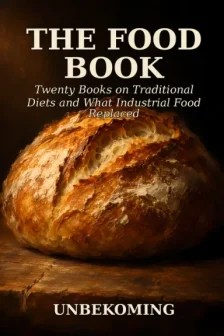 Traditional food was food. Not organic food. Not slow food. Not wellness food. Food. Bone broth was food. Raw milk was food. Fermented vegetables were food. Butter was food. Eggs were food. Honey was food. Liver was food.
Weston Price travelled from 1931 to 1936 across fourteen populations — Swiss villagers in the Lötschental valley, Gaelic communities in the Outer Hebrides, Inuit in Alaska, Native Americans in northern Canada, Māori in New Zealand, Masai in Kenya, Melanesians in the South Pacific, Peruvian Indians in the Andes. He photographed their faces. He measured their dental arches. He weighed their vitamin and mineral intake. He published the results in 1939 in Nutrition and Physical Degeneration. The pattern was consistent across every population. The generation raised on ancestral foods had broad faces, straight teeth, strong bone structure, and virtually no chronic disease. The generation raised on refined flour, refined sugar, and canned goods did not.
What has not been treated at book length, until now, is the whole shelf — the twenty works that, taken together, describe what the traditional kitchen was, what industrial food replaced it with, and what the body does when the replacement runs for a century.
The Food Book reads twenty of those works as a single library: Weston Price and Sally Fallon on the tradition that was lost; Francis Pottenger on what cooking does to a species over four generations; Sandor Katz on fermentation as an ecology; William Dufty on the two-and-a-half-century history of refined sugar; William Campbell Douglass on raw milk; James DiNicolantonio on the inversion of the salt argument; Max Gerson on cancer; Ulric Williams on medicine as a cartel; William Engdahl on seed sovereignty; Stephen Harrod Buhner on what plants do, chemically, that pharmaceuticals disrupt.
That is why the book is long. 581 pages, twenty chapters, four appendices, a 152-headword index. The length is the library.
What the book shows
Part One — Traditional foods and the pantry (eleven chapters). Begins with Weston Price’s 1939 documentation of fourteen isolated populations and ends with Morton Walker on the healing powers of garlic. Between them: Sally Fallon’s operations manual for the Price-tradition kitchen (Nourishing Traditions, 1995); Francis Pottenger’s four-generation study of cats fed cooked versus raw food (Pottenger’s Cats, published 1983 from research dating to the 1940s); Sandor Katz on fermentation as a relationship with an ecology (Wild Fermentation, 2003); John and Jan Belleme on the Japanese traditional pantry (Japanese Foods That Heal, 2007); Ronald Fessenden on the therapeutic chemistry of honey (The Honey Revolution, 2008); Henry Bieler on food as the first line of medicine (Food is Your Best Medicine, 1966); Nancy Appleton on natural-foods healing (Heal Yourself with Natural Foods, 1998); Kaayla Daniel on the industrial soy story (The Whole Soy Story, 2005); and Sally Norton on oxalate overload (Toxic Superfoods, 2023).
Part Two — Sugar, salt, milk and therapeutic diets (nine chapters). William Dufty on the two-and-a-half-century history of refined sugar — a history that runs through the slave trade, through the sugar trust, through the breakfast cereal industry (Sugar Blues, 1975). William Campbell Douglass on raw milk and the politics of dairy (The Raw Truth about Milk, 1984). James DiNicolantonio on the inversion of the salt argument — the data the salt-causes-hypertension consensus was built on, and the data it ignored (The Salt Fix, 2017). DiNicolantonio and Siim Land on the hunger hormones (The Obesity Fix, 2024). Natasha Campbell-McBride on the gut-and-physiology protocol (Gut and Physiology Syndrome, 2020). Max Gerson’s cancer therapy (The Gerson Therapy, 2001). Ulric Williams’ 1934 diagnosis of medicine as a cartel — a book written in New Zealand ninety years ago that reads as if written yesterday (Terrain Therapy, 1934 / republished 2022). William Engdahl on the industrial capture of the seed supply (Seeds of Destruction, 2007). Stephen Harrod Buhner on the planetary chemistry of plants and what pharmaceuticals disrupt (The Lost Language of Plants, 2002).
Each of the twenty chapters follows the same reader’s-guide structure: a thirty-question Q&A drawn from the source material, an analogy that captures the central move, a one-minute elevator explanation, a twelve-point summary, a golden-nugget insight, and an explanation for a six-year-old. One hundred and twenty distilled passes across the twenty books, carrying the substance in six different forms. Meet each book at the level that fits.
What is at the back
Four appendices and a full index.
Appendix A is the terrain pantry — the convergent food list that every traditional population ate some version of.
Appendix B is the industrial replacement list — what the modern food supply put in its place, and what to take out of the kitchen.
Appendix C is a reading order by reader type: six doors into the twenty books depending on where the reader is starting from.
Appendix D is the terrain food timeline — the chronology of what was replaced, and when. The index runs across 152 marked terms.
Who this book is for
For the subscriber who has been reading the food essays for years. This is the shelf, bound. Every book you have seen mentioned in essays, every author whose work was quoted in a Q&A, every pattern argued across posts — collected, normalised into the reader’s-guide format, and carried from first mention to full appendices in a single volume. The working library in one place.
For the reader starting here. No prerequisites. Appendix C is designed for this — it sketches six doors into the twenty depending on where you are starting from (the parent of a sick child, the adult with a chronic diagnosis, the cook wanting to rebuild the pantry, the historian wanting to see the arc of industrial replacement, the clinician looking for the convergent protocol, the sceptic who wants the hardest-hitting chapter first). Open the door that fits. Read the chapter it points to. Let the shelf unfold from there.
For someone you love. A family member heading into a chronic-disease diagnosis. A friend asking what they should actually eat. A child about to start a kitchen of their own. The book is designed to be given. Each chapter stands alone. The reader’s-guide structure lets the newcomer meet a difficult book without first having to read it cover to cover.
Sorry, the comment form is closed at this time.
Featured Video

Benoit Paré: OSCE Whistleblower: The Ukraine War – Narratives vs. Reality
or go to
Aletho News Archives – Video-Images
Book Excerpt
How CIA used Ukraine as a platform for covert war against Russia
By Stephen KINZER | Responsible Statecraft | November 17, 2026
The following is an excerpt from Stephen Kinzer’s new book: Boiling Point: How America Brought War to Ukraine (Henry Holt and Company, November 2026)
Huddled beside an airstrip in southern Germany, a handful of anti-Communist warriors prepared to fire the first shots of the Cold War. A CIA officer from the Munich Operations Base was in charge. The Hungarian crewmen he had recruited stood nearby in flight suits. With them were two Ukrainian exiles who had volunteered to parachute into their homeland. They were code-named Apostle 1 and Apostle 2. Each carried forged identity papers, a miniature radio transmitter, a pistol, a machine gun, hand grenades, a purse full of gold coins, and a poison pill to be taken in case of capture. An unmarked C-47 transport plane was waiting.
The CIA officer overseeing this operation, a twenty-six-year-old Yale graduate named Stephen Tanner, watched the plane take off and disappear into the night. It flew over East Germany and Poland, then crossed into Soviet airspace. As it approached the Ukrainian city of Lviv, a cargo bay swung open. The two Ukrainians jumped into the darkness. Their mission was to link up with partisan fighters, seize territory, and establish a clandestine base through which the CIA could send them weapons.
That flight, on September 5, 1949, was the first American act of covert war in Ukraine. … continue
Blog Roll
 Aletho News
- Benoit Paré: OSCE Whistleblower: The Ukraine War — Narratives vs. Reality
- UK forced to admit ordering backdoor access to Apple users’ data
- It’s not about China or national security. It’s about which foreign entity is allowed to spy on Americans
- Banning Palestine activists from the West will not save Israel’s image
- Iran rejects unlimited IAEA inspections amid continued military threats
- A Bridge Too Far
- David Barnea in the Bundestag – Mossad as a model for Germany’s Intelligence Services?
- Rome blasts Kiev after Italian lawmakers added to ‘kill list’
- Another €45 bn down the drain: Why the EU is desperate to waste more cash on Zelensky
- In Europe, Anxiety Is Mounting—EU Unity Is Cracking at Every Seam
- If Americans Knew
- An error has occurred; the feed is probably down. Try again later.
- No Tricks Zone
- Argentina’s Perito Moreno Glacier Joins Antarctica and Arctic In Defying Doomsday Melt Claims
- New Study: Barents Sea Temperatures Were Warmer And Sea Ice Less Extensive In The 1700s Than Today
- German Authorities Start Initiative To Evaluate Public Register For Climate “Disinformation” Spreaders!
- Zonal Asymmetry of Temperature Change in the Antarctic Circumpolar Current
- New Study: The Net Fossil Fuel Contribution To Rising Atmospheric CO2 Has Been Zero For 500 Years
- Germany’s Green Energy Transition Becoming Increasingly Expensive…Another 6 Trillion Euros!
- Sudden Stratospheric Warming, Powerful El Niño Combination May Lead To Extreme Europe Cold, Energy Crisis!
- Two New Studies Find Thwaites Glacier Melt Cannot Be Driven By Human Activity Or A Warming Ocean
- E-Cars Reduce CO2 Emissions By Only 41% Compared To Internal Combustion Engine Vehicles
- Predictions Made By Renowned Climate Professor Over Past Decades Have Been Proven To Be Poor

