President Obama’s recent closed-door sessions with Republican congressmen to reach a “grand bargain” has roused suspiciously little attention in the mainstream media. What scant reporting has occurred presents the following narrative: President Obama is a “middle ground” politician attempting to breach political divides with erstwhile Republican opponents. In reality these meetings are not between political opposites, but kindred spirits; perfectly matched ideologies that differ only in implementation, and only by degrees.
Here’s a summary of the meetings by the conservative Economist magazine:
On March 6th he [Obama] took 12 Republican senators out to dinner at a posh hotel in Washington… The [Republican] guests noted with surprise and delight that he [Obama] listened more than he talked…The next day Mr. Obama invited [Republican] Paul Ryan to lunch at the White House…This week he is paying three visits to Congress on three consecutive days, to make his pitch for a grand bargain to each party’s caucus in both chambers.
The article fails to remind us what the definition of a “Grand Bargain” is, nor its political/historical significance. Essentially the Grand Bargain is a bi-partisan plan that does two things: 1) reduces the national deficit by cutting so-called “entitlement programs” (Social Security, Medicare, Medicaid, education, etc.) and 2) raises revenue via taxation (not necessarily from the wealthy and corporations).
Does this make Obama a treacherous renegade of the Democratic Party? Not quite.
Many Democrats are leading the attack on popular “entitlement” programs erected under Franklin Delano Roosevelt’s New Deal (Social Security) and enhanced by Lyndon Johnson’s Great Society programs (Medicare). These are the bedrock social programs of the modern Democratic Party. But even bedrock turns into quicksand over time. The Democrats of today have been radically transformed, thanks to a monsoon of corporate cash that has eroded the parties affiliation to its past.
The corporate Democrats in the Senate have been so complicit in the Grand Bargaining that the pro-Democrat New York Times recently congratulated them for putting forth their own proposed budget, in an attempt to separate them from the political fallout that would come if a Grand Bargain actually came to fruition. The New York Times reports:
It’s been four years since the Democrats who control the Senate produced a budget. That has meant four missed opportunities to demonstrate what they stand for, in hard numbers and clear spending priorities. On Wednesday, the chamber’s leaders stiffened their spines and issued a 2014 budget.
In reality it’s not about stiff spines but saved faces. This Grand Bargain conversation has been happening in the media since Obama was elected in 2008, and only now, when the chapter’s final paragraph is being written, do Senate Democrats put forward an alternative ending they know won’t pass.
But what about the progressive caucus Democrats in the House of Representatives? They too are complicit in the crimes of the corporate Blue Dog Democrats. For example, you would be hard pressed to find even the most progressive Democrat publicly denounce Obama’s scheming to cut Social Security and Medicare; instead, these progressive Democrats spend their time pointing out the obvious — that Republicans would like to cut these popular programs.
This type of distraction provides vital political cover for Obama to continue his right wing policies. The progressive caucus thus minimizes or ignores the sins of its leadership, guaranteeing that the rightward drift of the Democrats will continue.
It’s true that the progressive caucus released a progressive budget as an alternative to the Republican’s — and Obama’s — budget. But this budget has no chance of being passed, and progressive caucus Democrats have no intention of building a movement that might give life to such a budget, since it would make their leadership look bad and divide their party.
At the end of the day the progressive Democrats will fall in line with the Democratic leadership, as they typically do. If Obama needs the votes, the progressives will cough them up. One of the first “progressive” Democrats to jump on the Grand Bargain bandwagon is Congressmen Sheldon Whitehouse, who, in speaking about the President’s Grand Bargain hunting said:
We will have your [Obama’s] back, you will have ours, together we will give President Obama all the support he needs during these [Grand Bargain] negotiations.
This progressive caucus complicity was also noted recently by Norman Solomon, (a longtime associate of the media watch group Fairness & Accuracy In Reporting) who noticed that curiously few progressive caucus members had signed onto a letter that pledged to vote against any budget that included cuts to Social Security and Medicare. The political winds have shifted to the right, and the progressives would like to stay Democrats, which now means supporting cuts to Social Security and Medicare.
This wouldn’t be a surprise to anyone who had read the recent article by John Stauber, who traced the origins of the “Progressive Movement,” which was set up by the rich Democrats who lead the party, as a way to counteract the Republicans media savvy. The point of the Progressive Movement and progressive Democrats is not to change society, but to beat Republicans in elections by creating the appearance of a groundswell of support for Democratic Party policies.
At the end of the day a so-called progressive Democrat is still a Democrat, and the Democratic Party has re-made its image to reflect the interests of its new big donors from Wall Street, who now feel as comfortable buying Democrats as they do purchasing a Republican politician.
Both Republicans and Democrats know that a Grand Bargain comes with gigantic political risks, most notably political suicide, since the party that cuts Social Security and Medicare will earn the hatred of 99% of Americans. Their ingenious answer is to blame each other. The progressive Democrats and Tea Party Republicans who stand on the sidelines during this fiasco — without taking any real action to stop it — stand to benefit from the outcome, and will loudly denounce the treachery post-treachery, their own names remaining unbesmirched.
But the majority of people in the U.S. will see through such blatant opportunism, and will trust neither party again. The far right will thus rush to organize a new political party, while the labor and community groups supporting the Democrats will either do the same or continue hitching their fortunes to a flagship sinking to the bottom of the ocean.
March 20, 2013
Posted by aletho |
Deception, Progressive Hypocrite | Democrat, Grand Bargain, Medicare, Obama, Sheldon Whitehouse, Social Security, Wall Street |
Leave a comment
BETHLEHEM – Palestinians on Wednesday erected a new “village” encampment in Eizariya to stake their sovereignty and claims to return to their towns and villages.
Activists said they set up 15 tents on a hillside near the original “Bab al-Shams” village that Israeli forces tore down two months earlier.
In a statement, the activists described the initiative as “first, to claim our right as Palestinians to return to our lands and villages, second, to claim our sovereignty over our lands without permission from anyone.”
The action coincided with US President Barack Obama’s arrival at Ben Gurion International Airport.
The activists said it aimed to highlight their opposition to the Obama administration’s policies in the region, saying in the statement that it has been “complicit in Israeli occupation and colonialism.”
“An administration that used the veto 43 times … in support of Israel and against Palestinian rights, an administration that grants military aid to Israel of over three billion dollars annually, can’t have any positive contribution to achieve justice,” the statement said.
March 20, 2013
Posted by aletho |
Ethnic Cleansing, Racism, Zionism, Illegal Occupation, Progressive Hypocrite, Solidarity and Activism | Al-Eizariya, Bab Al-Shams, Israel, Obama, Palestine, Zionism |
Leave a comment
From talk of “red lines” and cartoon bombs to having “all options on the table”, an undeniably delusional logic emanates from leadership in Washington and Tel Aviv regarding the alleged threat posted by Iran’s nuclear program. When Israeli Prime Minister Benjamin Netanyahu famously took to the stage of the UN General Assembly with his doodled explosive, he claimed that Iran would soon have the capability to enrich uranium to 90 percent, allowing them to construct a nuclear weapon by early-mid 2013. In his second administration, Obama, who recently said a nuclear-Iran would represent a danger to Israel and the world, appears to be seeing eye-to-eye with Netanyahu, despite previous reports of the two not being on the same page. For whatever its worth, these two world leaders have taken the conscious decision to entirely ignore evidence brought forward by the US intelligence community, as well as appeals from nuclear scientists, policy-advisers, and IAEA personnel who claim that the “threat” posed by Iran is exaggerated and politicized.
It’s common knowledge that Washington’s own National Intelligence Estimate (NIE) on Iran, which reflects the intelligence assessments of America’s 16 spy agencies, confirmed that whatever nuclear weapons program Iran once had was dismantled in 2003. Mr. Netanyahu has not corrected his statements insinuating that Iran was nearing the red line of 90 percent enrichment, even when recent UN reports that show Tehran has in fact decreased its stockpiles of 20 percent fissile material, far below the enrichment level required to weaponize uranium. Hans Blix, former chief of the International Atomic Energy Agency (IAEA), has challenged previous IAEA reports on Iran’s nuclear activities, accusing the agency of relying on unverified intelligence from the US and Israel. Flynt Leverett and Hillary Mann Leverett, former Washington insiders and analysts in the Clinton and Bush administrations, recently authored a book titled “Going to Tehran”, arguing that Iran is a coherent actor and that evidence for the bomb is simply not there.
Clinton Bastin, former director of US nuclear weapons production programs, has commented on the status of Iran’s capacity to produce nuclear weapons, stating:
“The ultimate product of Iran’s gas centrifuge facilities would be highly enriched uranium hexafluoride, a gas that cannot be used to make a weapon. Converting the gas to metal, fabricating components and assembling them with high explosives using dangerous and difficult technology that has never been used in Iran would take many years after a diversion of three tons of low enriched uranium gas from fully safeguarded inventories. The resulting weapon, if intended for delivery by missile, would have a yield equivalent to that of a kiloton of conventional high explosives”.
Bastin’s assessments corroborate reports that show Iran’s nuclear program is for civilian purposes; he further emphasizes the impracticality of weaponizing the hexafluoride product of Tehran’s gas-centrifuges, as the resulting deterrent would yield a highly inefficient nuclear weapon.
The fact that Iran’s Supreme Leader Ayatollah Ali Khamenei issued several fatwas (a religious prohibition) against the production of nuclear weapons doesn’t seem to have helped much either. An unceasing combination of Islamophobia-propaganda, a repetitive insistence that Tehran is edging closer to the threshold, and devastatingly negligent misreporting of Iran and its pursuit of domestic nuclear power has created a situation where the country is viewed as an irrational actor. In the court of Western mainstream opinion, Iran is grouped in the same category as bellicose North Korea, despite the fact that it is a law-abiding signatory to the Nuclear non-Proliferation Treaty (NPT) that has consistently cooperated with the IAEA while publically renouncing the use of nuclear weapons. This leads to the current scenario, where Iran and its people are punished under an unethical barrage of economic sanctions for possessing a weapon that they do not possess.
The severity of economic sanctions against Iran and the fabricated allegations of it possessing nuclear weapons serve as a disturbing parallel to the invasion and destruction of Iraq during the Bush administration. From the perspective of this observer, the US does not actually want to go to war with Iran – such an ordeal would bring about an array of overwhelmingly negative ramifications that Obama would probably want to avoid. What the US does want to do however, is to dismantle the foundations of the Islamic Republic by completely destroying its economy through sanctions, prompting the population to rise up and overthrow the regime – so basically, Obama is happy to conduct war by other means. Ayatollah Khamenei’s recent proclamations of the US holding a gun to the head of the Iranian nation can only be perceived as entirely accurate.
Its easy to see why the Supreme Leader has doubts over the prospect of negotiations with the US; the deal put forward at the most recent meeting of the P5+1 essentially argued that the US would roll back sanctions that prevent Iran from trading gold and precious metals in exchange for Iran completely shutting down its uranium enrichment plant at Fordo. The substance of this offer appears like it was deliberately drafted to be rejected by the Iranian side, given the fact that it would mandate Iran to shutdown one of its main facilities while keeping in place the most punishing sanctions that have destroyed the Iranian currency and made life-saving medications unaffordable for most – its more of an insult than an offer. For the average Iranian business owner and worker, US-led sanctions and currency devaluation have affected everyday transactions that provide paychecks and economic viability for millions of people.
From urban shopkeepers to rural restaurant owners, many have been forced to close their businesses because they are unable to profit from reselling imported goods purchased with dollars. Isolation from the global banking system has made it increasingly more difficult for Iranian students studying abroad to receive money from their families. Sanctions targeting Iran’s central bank aim to devastate the Iranian export economy, affecting everyone from oil exporters to carpet weavers and pistachio cultivators. By crippling Iranian people’s livelihoods and hindering their ability to pursue education and afford necessities, the Obama administration believes such measures will erode public confidence in the government and challenge its legitimacy. It is important to recognize that these sanctions are not only aimed against Iran’s government, but at its entire population, especially to the poor and merchant population. An unnamed US intelligence source cited by the Washington Post elaborates, “In addition to the direct pressure sanctions exert on the regime’s ability to finance its priorities, another option here is that they will create hate and discontent at the street level so that the Iranian leaders realize that they need to change their ways.”
These sanctions, which are Obama’s throwback to ham-fisted Bush-Cheney era policies, must be seen as part of a series of measures taken to coax widespread social discontent and unrest. US sanctions have broadened their focus, targeting large swaths of the country’s industrial infrastructure, causing the domestic automobile production to plummet by 40 percent, while many essential medical treatments have more than doubled in price. Patients suffering from hemophilia, thalassemia, and cancer have been adversely affected, as the foreign-made medicines they depend on are increasingly more difficult to get ahold of. Over the past two years, general supermarket goods have seen a price hike between 100 to 300 percent. For the first time in the world, a media ban has been imposed, on PressTV, Iran’s state-funded English language international news service. Ofcom, a UK-based communications regulator linked to the British government, spearheaded the prohibition. The European Union has also imposed a travel ban on Press TV CEO Mohammad Sarafraz and eight other officials.
While editorials and commentators in the New York Times and Washington Post regularly accuse Iran of violating international law, the editors of these papers have shown no willingness to scrutinize the US and Israel by holding them accountable when they violate international law, namely, a prohibition of “the threat or use of force” in international relations unless a nation is attacked or such force is authorized by the UNSC, as embodied in the United Nations Charter. It is undeniable that by failing to question the brutal tactics meted out by Washington and Tel Aviv, these papers and the commentators affiliated with them, endorse policies that intimidate and coerce civilian populations in addition to employing terrorist tactics such as targeted cyber-strikes and extrajudicial assassinations – all of which the Iranian nation has been subjected to in utter defiance of the standards and rules of international law and their fundamental bedrock of protecting civilians.
The facts have been proven time and time again, Iran seeks economic development, technological advancement, and energy independence – it wants domestic nuclear power and the freedom to enrich uranium to 20 percent for the medical development of radiopharmaceuticals and industrial isotopes, as it is entitled to as an NPT signatory. Washington’s threats to impose “secondary” sanctions against third-country entities doing business with the Islamic Republic represents a mafia-mentality so characteristic of the unipolar reality in which the US sees itself. Washington has recently threatened energy-hungry Pakistan with sanctions over its partnership with Tehran in a $7.5-billion gas pipeline between the two nations, a project that would do infinite good by promoting regional stability and delivering energy to poverty stricken regions in Pakistan. Washington’s sanctions regime will collapse if the US Congress insists that China sharply cut its energy trade and relations with Iran. China will not adhere to such stringent foreign interference into its trade relationships, and Washington is in no position to sanction China because it buys oil from Iran.
If Beijing calls Washington’s bluff, other growth-focused non-Western economies like India, Malaysia, and South Korea will be less fearful of conducting business and buying oil from Tehran. Obama has taken some cues from the revolutionary students of 1979 and his administration has come up with a hostage crisis of its own, involving holding captive the civilian population of Iran – and Washington looks keen to let the sanctions bite until either the regime bows down, or the people rise up. One of the best examples of the perverted logic behind the US position on Iran comes from Vice President Joe Biden, who recently stated, “We have also made clear that Iran’s leaders need not sentence their people to economic deprivation”. Such a statement embodies the upside-down logic of Washington policy-makers who claim the moral high ground while enabling terrorism and engaging in unethical campaigns of economic and military warfare – the present state of affairs simply cannot continue.
Nile Bowie is an independent political analyst and photographer based in Kuala Lumpur, Malaysia. He can be reached at nilebowie@gmail.com
March 19, 2013
Posted by aletho |
Economics, Progressive Hypocrite, Timeless or most popular, War Crimes | Benjamin Netanyahu, International Atomic Energy Agency, Iran, Israel, National Intelligence Estimate, Obama |
Leave a comment

According to official estimates, the Islamic Republic of Iran is now roughly a year away from acquiring a nuclear bomb. Well, that is, if it were actually building a nuclear bomb. Which it’s not.
“Right now, we think it would take over a year or so for Iran to actually develop a nuclear weapon, but obviously we don’t want to cut it too close,” President Barack Obama told an Israeli television station on March 14, 2013. In order to stop Iran, Obama vowed to “continue to keep all options on the table,” a euphemism for engaging in an unprovoked military attack, thus initiating a war of aggression, the “supreme international crime.”
Obama’s statement came just two days after his own Director of National Intelligence told a Senate committee that the Iranian government had not made a decision to weaponize its legal, safeguarded civilian nuclear energy program. “We do not know if Iran will eventually decide to build nuclear weapons,” DNI James Clapper said. Even if it did, he added, Iran wouldn’t be able to secretly divert any of its stockpiled and safeguarded enrichment uranium to a weapons program.
The American president failed to make this distinction in his interview, instead saying only that a nuclear-armed Iran would be “dangerous for the world. It would be dangerous for U.S. national security interests.”
Repeating his administration’s main talking point, Obama told his Israeli interviewer, “What I have also said is that there is a window, not an infinite period of time, but a window of time where we can resolve this diplomatically and it is in all of our interests.”
But this window has already been open for decades and Iran has supposedly been only a year away from a bomb for the past ten years.
In November 2003, then Mossad chief Meir Dagan told the Knesset Foreign Affairs and Defense Committee that Iran’s nuclear program would be at a “point of no return” within the next year and would then “have the potential to produce 10 nuclear bombs a year.” Israeli Defense Minster Shaul Mofaz repeated the one year “point of no return” timeline in early 2005, a claim reinforced by other Israeli officials throughout that year.
Similar estimates were made in 2006, 2007 and 2008. Oh, and 2009.
In April 2010, Ronald Burgess, director of the U.S. Defense Intelligence Agency, told the Senate Armed Services Committee that the “general consensus” was that Iran could develop a single nuclear bomb within a year if the leadership decided to do so, despite maintaining that Iran didn’t have an active nuclear weapons program.
As the years have passed, this assessment has held fast.
In late January 2011, Aviv Kochavi, director of Israeli Military Intelligence, admitted Iran was not actively working on a nuclear weapon, but claimed it could build one in “a year or two” once “the leader decides to begin enriching at 90 percent.”
A year later, in January 2012, Defense Secretary Leon Panetta told 60 Minutes, “The consensus is that, if they decided to do it, it would probably take them about a year to be able to produce a bomb.”
Just few days later, Kochavi told a panel at the Herzliya security conference that “Iran has enough nuclear material for four bombs,” adding, “We have conclusive evidence that they are after nuclear weapons. When Khamenei gives the order to produce the first nuclear weapon – it will be done, we believe, within one year.”
Last week, addressing the very same conference, Kochavi was back with a new prediction – actually, it was the same one as before. He claimed that, in the coming year, the Iranian “leadership would like to find itself in the position of being able to break out to an atomic weapon stage in a short period of time, according to the IDF’s intelligence assessments. However, he said that Iran has not yet decided to build the bomb.”
Greg Thielmann, a former U.S. intelligence analyst now with the Arms Control Association, recently explained that “calculating such a time line involves a complicated set of likely and unlikely assumptions,” telling journalist Laura Rozen, “If Iran decided today to build nuclear weapons, it would require years, not weeks or months, to deploy a credible nuclear arsenal.”
Meanwhile, with Obama set to visit Israel this week, Reuters now notes that “Netanyahu has not publicly revised the spring-to-summer 2013 dating for his ‘red line’,” the stated point at which the Iranian nuclear program advances far enough to automatically trigger an Israeli attack, a threat laid down by the Israeli Prime Minister last September. “But several Israeli officials privately acknowledged it had been deferred, maybe indefinitely,” Reuters adds before quoting an anonymous official: “The red line was never a deadline,” he said.
Clearly, when it comes to propagandistic prognostications about the imminence of an Iranian bomb, they never really are.
March 19, 2013
Posted by aletho |
Militarism, Progressive Hypocrite, Timeless or most popular, Wars for Israel | Iran, Israel, Meir Dagan, Obama, United States, United States Senate Committee on Armed Services |
1 Comment
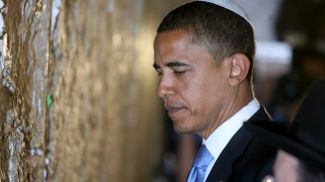 In his upcoming Israel visit, US President Barack Obama will spend just a few hours in Palestinian Ramallah and the rest of the 3-day tour visiting grave of Zionism founder Theodor Herzl, a Holocaust memorial and an anti-missile system, among other Israeli sites.
During the visit that begins on Wednesday, Obama will spend “just a few hours” in the Palestinian Authority base of Ramallah, and the rest of his three-day stay in al-Quds (Jerusalem), where he plans to visit an “official” so-called Holocaust memorial, a partially US-built Israeli Iron Dome anti-missile site and Herzl’s grave, The Los Angele Times reports on Friday.
In visiting the grave site of the Zionism founder and the Holocaust spot, Obama intends to highlight the point he made during his widely publicized Cairo speech in 2009, when he urged his Egyptian audience to accept the Zionist regime’s right to exist while denouncing efforts to deny the increasingly suspicious Holocaust story, the report states, citing US and Israeli officials. … Full article
March 17, 2013
Posted by aletho |
Deception, False Flag Terrorism, Progressive Hypocrite | Holocaust, Obama, Theodor Herzl, Zionism |
4 Comments
Moshe Ya’alon, an ex-Israeli Chief of Staff and now Member of the Knesset, has been appointed Israel’s Minister of Defence in Netanyahu’s latest government coalition. Ya’alon replaces Ehud Barak.
Ya’alon was Chief of Staff of the IDF in July 2002 when Palestinian activist Salah Shehade was murdered in the Gaza Strip by a one tonne bomb dropped by an Israeli Air Force F-15 jet. Fourteen Palestinian civilians were also killed in the attack.
In 2005 a group of relatives of victims of the 1996 Israeli shelling of the Lebanese town of Qana, where some 106 civilians died, filed a suit demanding a jury trial against Ya’alon in Washington DC. Predictably, the case went no further. A year later in 2006 Ya’alon was visiting New Zealand on a fund-raising trip when an Auckland court issued a warrant for his arrest on charges relating to the Gaza Strip deaths. The warrant was over-ruled by New Zealand’s Attorney-General and Ya’alon was able to return to Israel. Then in October 2009 Ya’alon was forced to cancel a trip to the UK for fear of being arrested on war crime charges, again relating to the 2002 killings in the Gaza.
This man, who is pro-settlement, stridently anti-Iran, and fervently against the existence of any kind of Palestinian state, will be Israel’s next Defence Minister. This war criminal will probably be shaking President Obama’s hand when the President visits Israel next week.
No doubt more crimes will be planned when they meet.
March 15, 2013
Posted by aletho |
Ethnic Cleansing, Racism, Zionism, Progressive Hypocrite, War Crimes | Ehud Barak, Israel, Israeli Air Force, Moshe Ya'alon, Obama, Palestine, Salah Shehade, Zionism |
1 Comment
When President Obama campaigned in 2008 in Portland, Oregon over 70,000 people came to hear his speech. And although I missed the event, I was intrigued by the raw emotion that the candidate’s words inspired in my community. Obama re-visited Oregon during his 2012 campaign, but the inspiration had faded from his voice, and the audience had drastically changed. The Oregonian explains:
“The Obama campaign said about 950 tickets, costing $500 to $1,000 were sold for the main fundraiser at the Oregon Convention Center. The president also spoke, out of view of the press, to about 25 donors who bought $30,000 tickets.”
The late President Chavez, on the other hand, steadily increased the crowds of people who came to hear him speak, year after year, election after election, rally after rally. The secret? Whereas President Obama could only speak about “hope” and “change,” President Chavez actually delivered.
It was this delivery that earned Chavez the hatred of both Bush Jr. and Obama. Chavez humiliated Bush Jr. by surviving the U.S.-sponsored military coup against him and humiliated the entire U.S. media by winning election after election by large margins, elections that former President Jimmy Carter said were the fairest in the world. Meanwhile, the U.S. media tied itself into knots trying to explain how a “would be dictator” easily won elections that nobody disputed.
Chavez won elections because he was loved by the working and poor people of Venezuela. Chavez was loved by his people because he was a politician like none they had ever experienced. He was “their” politician, and he loved them.
And one doesn’t become the official politician of working people, the poor and downtrodden in an extremely poor country by using fancy words. Chavez backed up his big talk time after time, consistently overcoming barriers erected by the wealthy by taking bold action that benefited the majority of Venezuelans. Their hope in him was repeatedly renewed by action.
Inequality shrank under Chavez, poverty was dramatically reduced, education and health care improved, and illiteracy was eliminated. When the economy reeled from the 2008 global crisis, Chavez didn’t bail out the banks and pander to the wealthy, but increased social spending for the most vulnerable. When cataclysmic landslides threw hundreds of thousands of Venezuelans into homelessness, Chavez housed them all.
President Obama has nearly the exact opposite track record. The big banks remain the big winners in the Obama Administration, having been bailed out and then given an endless supply of cheap money via the Federal Reserve that has boosted their profits. All of this takes place while the job crisis grinds on for working people, creating an endless supply of austerity budgets on the city, state, and national level. When new jobs become available they are below a living wage.
Although Obama’s speeches are masterful renditions of a watered-down Chavez speech, the action component of the English version was always left un-translated.
Whereas Chavez confronted the wealthy and corporations, Obama succumbed to them. Ultimately, these are their respective legacies. Obama, via action, has chosen a path in support of his corporate sponsors, whereas Chavez’s path went in the opposite direction — a much rockier, conflict-laden path, made all the more difficult by U.S. foreign policy in support of Venezuela’s anti-Chavez top 1%. Above all, Chavez insured that the oil wealth of his country did not stay in the hands of Venezuela’s oligarchy, which had previously kept a tight grip on it. Chavez used it to raise millions of Venezuelans out of poverty.
Chavez’s legacy will live and breathe in those who will continue his fight for a better world, still inspired by his words and actions. Obama’s legacy, however, was stillborn after the 2008 elections, with “hope” never delivered alongside “change” never attempted.
Obama’s 2008 campaign slogans now only inspire feelings of betrayal to those who believed in him, while the corporations and wealthy will celebrate Obama’s legacy, a tribute to his pro-corporate policies. In the final analysis, Chavez will be remembered for boldly taking action against the same inhuman inequality that is growing in most countries in the world. In so doing, Chavez earned the hatred of the elite who benefit from this system-wide inequality, while the rest of us on the bottom of the inequality-spectrum owe him our appreciation, since Chavez’s fight was our fight too.
- Chavez in the Crosshairs (alethonews.wordpress.com)
March 14, 2013
Posted by aletho |
Economics, Progressive Hypocrite, Timeless or most popular | Chavez, Obama, United States, Venezuela |
Leave a comment
Damascus – Students everywhere are special people and this observer has discovered that Syrian students are among the very best.
Meeting and interviewing students again this past week, before and following a frank and enlightening discussion with Prof. Dr. Mohammad Amer Al-Mardini, the indefatigable President of Damascus University, about the situation of the students and current instruction at the University, one cannot, even as a foreigner, fail to feel pride in Syrian students.
Good meeting places, among others on campus, include “outdoor cafes” — a ‘street student union’ of sorts — consisting of a few chairs and portable tables. They are scattered among the dozens of vendor stalls that line “DU Boulevard” outside the main DU campus in central Damascus. Here students can buy everything from school supplies to mobile phones to snacks. It’s a perfect place to meet and chat with students.
One learns from them about the many effects on the education system in Syria of the US-led sanctions. Some argue that the Obama administration actually fuels the current crisis with its sanctions and achieves the opposite result of what the White House and its allies claim they are seeking.
These freewheeling discussions leave a foreigner with a reminder why this student body ranks among the best in the World. How Damascus University has to date reacted to this crisis evidences the same status.
Currently there are more than 200,000 full-time and ‘open-learning’ students at Damascus University, the 6th largest in the World. The core institutes of the University were established in 1901; they were the medicine and law institutes that formed the basis of the Syrian University that was established in 1923. In 1958, it got its current name, Damascus University when Aleppo University was established.
All of the students are feeling the effects of the Obama Administration’s harsh civilian-targeting sanctions and many are increasingly in the cross-hairs of the “humanitarian sanctions which Washington and Brussels claim “exempt food, medicines and medical supplies” and therefore “should be considered humane.”
Among DU Faculties most severely affected by the US-led sanctions are the Science Departments and the Medical and Nursing schools according to administration and student sources. Chemicals used in various science classes, medicines and medical equipment cannot be found as before and if some are brought in from Europe or elsewhere, the University often has to pay four times the normal price.
Utah’s Brigham Young University gained the respect and appreciation of many in Syria for its shipments to DU’s nursing school of medicines and equipment and even “model doll babies” which in Syria use in baby care classes. All are now banned by the US sanctions which claim to exempt medical equipment and medicines.
Damascus University, with its 36 specialized faculties and five higher institutes is no banking-hours institution and its proven commitment is to give the highest possible quality education to as many students as possible. Syria’s largest university is now open for classes 365 days a year minus a few holidays and a few short breaks for her professors and overworked staff, partly due to the increased number of students arriving from across Syria. The DU administration and faculty work with faculties in war zones to guarantee students can continue their studies without missing key exams required for semester advancement. Still, about 20% of college level students are unable to attend due to transportation and displacement problems.
One direct and predictable severe impact of the US-led civilian-targeting sanctions in Syria is that they have essentially stranded approximately 700 Damascus University students in Europe and half a dozen in the US, forcing some to take leaves of absence and find jobs to survive. This is because, as is well known among the US Treasury Department “craftsmen” who devise the sanctions, these students are no longer able to receive funds for Damascus University to pay for their foreign tuition or living expenses because the banking system has been essentially shut down. More than 1500 Syrian students from other institution of higher learning are similarly stranded as a direct result of the US-led sanctions.
Never the less, Damascus University keeps its commitment to pay the students their tuition fees and their living cost as they are on full scholarships. Currently, parents must pick up the funds from the University accountant and find a way to transfer them. Should they decide to send it via Western Union, for example, a new “sanctions surcharge” of 70 euros for every 1,000 euros sent, is demanded by WU and other money transfer agencies, suggesting another form of war profiteering.
To make things even more difficult for the students, foreign universities which might consider lending their stranded Syrian students tuition money or might even consider aiding them with scholarships or a grant have been “chilled” and are backing-off because these institutions do not want to be accused of “sanction-busting” by the US Treasury hound dogs.
Few food or medicine suppliers — given the sanctions’ language, the meanings of which is uncertain even for their own lawyers, some of whom have declared it incomprehensible — want to risk the wrath of the US Treasury Department and be slapped with severe penalties including very expensive fines by dealing with anyone in Syria.
One of the US Treasury hound dogs is David Cohen, Under-Secretary for Terrorism and Financial Intelligence. Late last month, Mr. Cohen made a trip to the region (including Israel) to brief allies and businesses as well as NGO’s “to be sure the sanctions were biting hard” to use a favorite phase of UN Ambassador Susan Rice. The Obama administration, reportedly frustrated by the fact that its multi-tiered sanctions have failed to topple the governments of Syria and Iran, has been attempting to find and plug loopholes in the sanctions and are intensifying warnings to the international community not to mess with the US Office of Terrorism and Financial Intelligence (TFI) or the Office of Financial Assets Control (OFAC) by getting all wobbly-kneed and going soft on full sanction enforcement.
Meanwhile, Syria’s Department of Education is joining the struggle to shield Syria’s education institutions and is being joined by various student associations. To date, the Ministry of Education and Higher Education have not cut their substantial disbursements to schools and faculties. Tuition remains among the lowest in the world (almost free; 5 US $ a year with the current exchange rate) at Damascus University, which also provides housing for 15,000 students. The DU administration is currently under pressure to find more dormitory space for those needing housing.
Still, despite the conflict, even in Deraa near the Jordanian border where the current crisis started, DU’s campus continues to function.
Many DU students are also volunteering with assisting Syrian primary schools which urgently need their help. According to a December 2012 UNICEF education assessment of primary schools in Syria — at least 2,400 schools have been damaged or destroyed, including 772 in Idlib (50 per cent of the total), 300 in Aleppo and another 300 in Deraa. Over 1,500 schools are being used as shelters for displaced persons. The Damascus University community has also taken on the humanitarian challenge of assisting sister educational institutions that have been affected by the current crisis including campuses in Homs, Deir al Zur and Aleppo, among others.
This observer has met several Damascus University students among the 9,000 volunteers, including Palestinian refugees, who are donating their time working with the Syria Red Crescent Society (SARCS). Many DU students are also volunteering by assisting at primary schools.
The grim reality for Syrian families, hospitals, health care facilities and now university students and educational institutions across the country is that the claimed “humanitarian” exemptions for food, medicine and medical equipment is little more than News-Speak.
Rather than target the people who represent Syria’s future leaders, the White House would do better to cancel its sanctions and send Secretary Kerry to Damascus to meet face-to-face with the Syrian people and government and demonstrate a real American interest in stopping the bloodshed. Armored vehicles and assorted “non-lethal aid” to one side in this conflict will only prolong the killing, as any student here will attest.
Franklin Lamb is doing research in Syria and can be reached c/o fplamb@gmail.com
March 13, 2013
Posted by aletho |
Progressive Hypocrite, War Crimes | Damascus, Damascus University, Human rights, Obama, Office of Terrorism and Financial Intelligence, Syria, Under Secretary of the Treasury for Terrorism and Financial Intelligence, United States Department of the Treasury |
Leave a comment
NEW YORK – The American Civil Liberties Union and the Center for Constitutional Rights issued the following statement in response to The New York Times article today detailing the U.S. government’s killings of three U.S. citizens:
“In anonymous assertions to The New York Times, current and former Obama administration officials seek to justify the killings of three U.S. citizens even as the administration fights hard to prevent any transparency or accountability for those killings in court. This is the latest in a series of one-sided, selective disclosures that prevent meaningful public debate and legal or even political accountability for the government’s killing program, including its use against citizens.
“Government officials have made serious allegations against Anwar al-Aulaqi, but allegations are not evidence, and the whole point of the Constitution’s due process clause is that a court must distinguish between the two. If the government has evidence that Al-Aulaqi posed an imminent threat at the time it killed him, it should present that evidence to a court. Officials now also anonymously assert that Samir Khan’s killing was unintended and that the killing of 16-year-old Abdulrahman al-Aulaqi was a mistake, even though in court filings the Obama administration refuses to acknowledge any role in those killings. In court filings made just last week, the government in essence argued, wrongly, that it has the authority to kill these three Americans without ever having to justify its actions under the Constitution in any courtroom.”
The ACLU and CCR are challenging the legality of the drone strike that killed Al-Aulaqi and Khan, as well as the separate strike that killed Al-Aulaqi’s 16-year-old son, Abdulrahman, in Yemen in September and October 2011.
The ACLU is also seeking disclosure of the legal memoranda written by the Department of Justice Office of Legal Counsel that provided justifications for the targeted killing of Al-Aulaqi, as well as records describing the factual basis for the killings of all three Americans, in a separate Freedom of Information Act lawsuit.
More information is at: www.aclu.org/targetedkilling and http://ccrjustice.org/targetedkillings
March 11, 2013
Posted by aletho |
Civil Liberties, Progressive Hypocrite, Timeless or most popular, War Crimes | Abdulrahman al-Aulaqi, Al-Aulaqi, American Civil Liberties Union, Anwar al-Aulaqi, New York Times, Samir Khan, United States |
Leave a comment
The funeral for Venezuelan president, Hugo Rafaél Chávez Frías, was held the morning of Friday March 8th, at the Military Academy in Caracas, Venezuela. 55 countries sent delegations to the funeral. 33 of them were headed by presidents or heads of government. In a strong show of unity and support, every single one of Latin America’s presidents, and most of the Caribbean’s heads of state were present at Chávez’s funeral (though the presidents of Brazil and Argentina left early).
This is a turnout with few precedents. The death of U.S. President John F. Kennedy in 1963 brought together a total of 19 heads of state. The funeral of President Ronald Reagan in 2004 gathered 36 former and current heads of state. The death of Hugo Chávez brought together at least 38 former and current heads of state.
The governments of Spain, France, Portugal, Lebanon, Finland, Sri Lanka, Vietnam, Australia, Syria, Greece, Ukraine, Croatia, Jordan, Slovenia, Turkey, Gambia, China, and Russia sent fairly high level delegations to represent their governments at the funeral. Spain’s royal heir, the prince of Asturias, attended, as did the General Secretary of the Organization of American States José Miguel Insulza, the Reverend Jesse Jackson –who spoke at the funeral, actor Sean Penn, and the much celebrated Venezuelan orchestra director Gustavo Dudamel, who missed one of his shows at the Los Angeles Philharmonic to direct the Simón Bolívar Symphonic Orchestra at the funeral.
Though much of the major media has ignored this international show of recognition for the government of Hugo Chávez, these responses to his death are a clear affirmation of respect and acknowledgement for his legacy, from Latin America and around the world.
Again in contrast with the rest of the region, the United States sent no representative of the Obama administration to the funeral. James Derham, an official from the U.S. embassy in Venezuela attended the ceremony along with Congressman Gregory Meeks (D-NY) and former Congressman William Delahunt (D-MA). The morning of Chávez’s death, Vice President Nicolás Maduro expelled two U.S. embassy officials that he accused of violating diplomatic protocol, possibly contributing to the U.S.’s reluctance to send any administration official from Washington to the funeral.
Instead of giving the public a sense of the broad and historic show of international recognition of Chávez from so many countries, much of the major media focused on the attendance of U.S. “foe” President Mahmoud Ahmadinejad of Iran. For an interesting, balanced analysis of the relations between Iran and Venezuela this blog post by David Smilde is worth a read.
Days of Mourning
In another unprecedented show of acknowledgment for the legacy of Hugo Chávez, an astonishing number of countries – a total of 14 – decreed official days of mourning in response to President Chávez’s death. Nine Latin American countries declared three days of mourning (Argentina, Brazil, Chile, Cuba, the Dominican Republic, Ecuador, Haiti, Peru and Uruguay), while two more, Bolivia and Nicaragua, like Venezuela, declared seven days each. From other regions of the world, Belarus, Nigeria and Iran declared three, seven and one day of mourning, respectively.
The Response from the Venezuelan Public
In addition to the strong reaction from around the world, the response from Chávez supporters in Venezuela was also unprecedented. From Thursday, when Chávez’s casket was put on display for public viewing until the time of the funeral, reportedly 2 million people had already paid their respects and bade farewell to their president, many of them waiting up to 12 hours in line for the opportunity to pass by his coffin. An 8 kilometer-long march, with hundreds of thousands of Chávez’s supporters, dressed in red, and pouring onto the streets, accompanied the procession of Chávez’s coffin from the hospital to the Military Academy where the funeral was held. Multitudes then viewed the funeral from outside of its location, watching on large screens as they waited for another opportunity to bid their president farewell.
March 11, 2013
Posted by aletho |
Progressive Hypocrite, Solidarity and Activism, Timeless or most popular | Hugo Chávez, Latin America, Nicolás Maduro, Obama, United States, Venezuela |
Leave a comment
Efforts to determine the health and environmental risks of depleted uranium (DU) weaponry in Iraq have been hampered by the Obama administration. DU, which makes shell and bullet casings harder and more capable of piercing armor, can contaminate the environment and contribute to health problems, including cancer and birth defects.
The Dutch peace group IKV Pax Christi complained in a new report that “Coalition Forces” (read: the United States) have refused to provide information on when and where invading forces fired DU weaponry.
Due to a “lack of transparency” by the U.S., “there is an absence of crucial information on firing coordinates, the quantities and types of DU munitions used; data gaps relating to the efforts undertaken to clean up contaminated sites and material are hindering efforts to assess risks and implement remediation work,” the report reads.
There are reportedly more than 300 sites in Iraq that were contaminated by DU weapons, many of them located in populated areas.
It is estimated that 400 tons of DU ammunition were fired in Iraq, mostly by American units, during the Gulf War and the 2003 invasion. Although the United States continues to use depleted uranium munitions, the report notes that “over the last couple of years the US Army has invested in research into replacing DU rounds in the A-10 with tungsten alloy based munitions, as well as non-DU 105 and 120mm munitions for the M1A2 Abrams tank, referring in their rationale for this move to DU’s potential environmental impact.”
To Learn More:
In a State of Uncertainty: Impact and Implications of the Use of Depleted Uranium in Iraq (IKV Pax Christi) (pdf)
March 10, 2013
Posted by aletho |
Deception, Militarism, Progressive Hypocrite, War Crimes | Depleted uranium, Gulf War, Iraq, Iraq War, Obama, Pax Christi, United States |
2 Comments

Can you threaten to start a war to stop something that doesn’t exist? Open the March 11 issue of Time magazine and you’ll see the headline “The Path to War: Inside Barack Obama’s Struggle to Stop an Iranian Nuke.”
The piece is a behind-the-scenes peek at the debate inside the government about the steps the United States is willing to take to “keep Iran from getting a nuclear weapon.” The idea that Iran is after a weapon is repeated numerous times–”the global effort to prevent Tehran from getting a weapon,” and the United States perhaps “using military force to prevent Iran from getting a nuclear weapon.” We’re even told that Obama “offered to let Iran keep a peaceful nuclear program. But Iran’s leaders rebuffed Obama’s efforts.”
Nowhere does Time‘s Massimo Calabresi mention one rather inconvenient fact: There is no evidence that Iran is actually pursuing a nuclear weapon. Regular inspections have failed to turn up any evidence of that. Instead, we read things like this: “Iran itself has slowed down its efforts, converting some enriched uranium to a form that can be used only in research, not in weapons.” This is treated as evidence that Iran is heading towards its nuclear weapons more slowly.
This is alarming, especially since the article is about whether the U.S. will launch a military attack on Iran. Time ominously warns that soon “time will run out,” and tells us that “the Pentagon has launched the largest buildup of forces in the Gulf since the run-up to the 2003 Iraq war.” It closes by noting that “Obama will soon face the hardest decision of his presidency.”
Time faces a decision too–whether or not it wants to repeat the mistake of the Iraq War by treating allegations about another country’s weapons as if they are facts.
March 9, 2013
Posted by aletho |
Mainstream Media, Warmongering, Militarism, Progressive Hypocrite, Timeless or most popular, War Crimes, Wars for Israel | Iran, Iraq War, Obama, Peter Hart, United States |
3 Comments
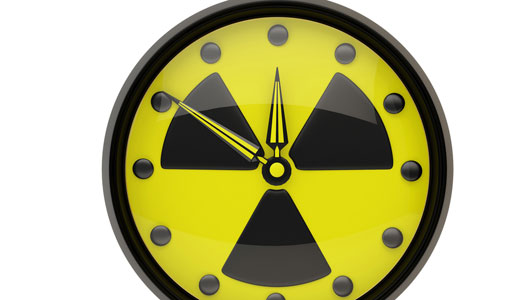
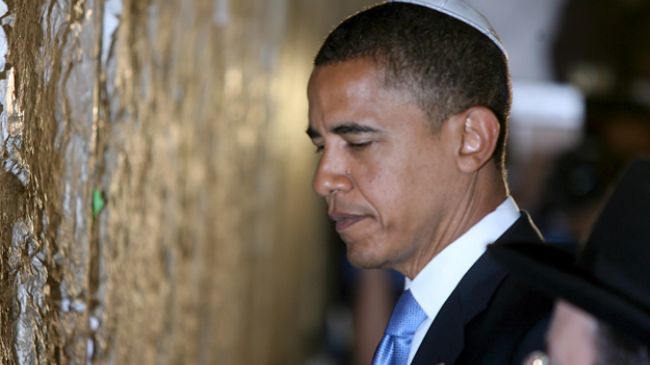 In his upcoming Israel visit, US President Barack Obama will spend just a few hours in Palestinian Ramallah and the rest of the 3-day tour visiting grave of Zionism founder Theodor Herzl, a Holocaust memorial and an anti-missile system, among other Israeli sites.




 Aletho News
 Aletho News