Where Will the U.S. Strike Next in Africa?
A Black Agenda Radio commentary by Glen Ford | August 8, 2012
Under the direction of the United States, the UN Security Council recently extended sanctions for another year against the northeast African nation of Eritrea. The country of 6 million people, nestled against the Red Sea, is on America’s hit list. In the imperial double-speak of Washington, Eritrea is described as a “destabilizing” force in the region – which simply means the government in Asmara has refused to buckle under to U.S. military domination of the Horn of Africa.
Back in 2009, Secretary of State Hillary Clinton threatened to “take action” – and, by that, she meant make war – against Eritrea if it did not stop supporting the Shabab resistance fighters in Somalia. There was no evidence that Eritrea was, in fact, arming the Shabab, and there is no evidence that Eritrea is doing so, now – as the UN Monitoring Group on Eritrea and Somalia admits.
The monitors, who are, in effect, tools of U.S. policy, reported that they found “no evidence” of Eritrean aid to Somali fighters over the past year, and concluded that, if such assistance exists at all, it is “negligible.” Yet, the UN Security Council, under U.S. pressure, extended the sanctions, anyway. Washington claims that Eritrea’s alleged support for the Shabab has only halted because of the sanctions, and it’s, therefore, too early to lift them – which amounts to punishing Eritrea for having the wrong intentions, whether it acts on them or not.
It is, of course, not little Eritrea that is destabilizing the Horn of Africa, but the United States, which has made the region a front line in its so-called War on Terror. Washington’s closest ally in the neighborhood is Ethiopia, from which Eritrea won its independence in 1993, after a 30-year war. The U.S. instigated, armed, financed and gave logistical support to Ethiopia’s invasion of Somalia, in 2006, plunging that country into what United Nations observers called “the worst humanitarian crisis in Africa.” Under American direction, Kenya also invaded Somalia, in the midst of a great famine, last year. The U.S. bankrolls, arms and trains the nominally African Union force that occupies Somalia’s capital, and has turned neighboring Djibouti into the main base for the U.S. Africa Command, AFRICOM.
And there sits Eritrea, surrounded by warring American puppets, interfering in no one’s affairs, yet determined to defend her sovereignty – accused by the world’s biggest and most aggressive power of destabilizing the region.
Eritrea’s real sin is to be one of the very few nations in Africa that do not have military relations with AFRICOM, the U.S. war machine. That puts a bulls-eye on her back, along with Zimbabwe and Sudan, which U.S. Ambassador to the UN Susan Rice demanded be blockaded and bombed back in the George Bush administration. Barack Obama’s Africa policy is an extension and expansion of Bush’s aim to militarize the continent, and the much older U.S. policy to create chaos and horrific human suffering in those regions it cannot directly control. In practice, Obama’s doctrine is the same as Bush’s: “You are either with us or against us.”
Eritrea rejects that doctrine; that’s why it is a target. For Black Agenda Radio, I’m Glen Ford. On the web, go to BlackAgendaReport.com.
Glen Ford can be contacted at Glen.Ford@BlackAgendaReport.com.
Related articles
- U.S. Breaks Somalia Arms Embargo It Helped Establish (alethonews.wordpress.com)
Obama fights ban on indefinite detention of Americans
RT | August 7, 2012
The White House has filed an appeal in hopes of reversing a federal judge’s ruling that bans the indefinite military detention of Americans because attorneys for the president say they are justified to imprison alleged terrorists without charge.
Manhattan federal court Judge Katherine Forrest ruled in May that the indefinite detention provisions signed into law late last year by US President Barack Obama failed to “pass constitutional muster” and ordered a temporary injunction to keep the military from locking up any person, American or other, over allegations of terrorist ties. On Monday, however, federal prosecutors representing President Obama and Defense Secretary Leon Panetta filed a claim with the 2nd US Circuit Court of Appeals in hopes of eliminating that ban.
The plaintiffs “cannot point to a single example of the military’s detaining anyone for engaging in conduct even remotely similar to the type of expressive activities they allege could lead to detention,” Obama’s attorneys insist. With that, the White House is arguing that as long as the indefinite detention law hasn’t be enforced yet, there is no reason for a judge to invalidate it.
Reuters reports this week that the government believes they are justified to have the authorization to lock alleged belligerents up indefinitely because cases involving militants directly aligned against the good of the US government warrants such punishment. Separate from Judge Forrest’s injunction, nine states have attempted to, at least in part, remove themselves from the indefinite detention provisions of included in the National Defense Authorization Act for Fiscal Year 2012, or NDAA.
In section 1021 of the NDAA, the president’s authority to hold a terrorism suspect “without trial, until the end of the hostilities” is reaffirmed by Congress. Despite an accompanying signing statement voicing his opposition to that provision, President Obama quietly inked his name to the NDAA on December 31, 2011. In May, however, a group of plaintiffs including notable journalists and civil liberty proponents challenged section 1021 in court, leading to Justice Forrest to find it unconstitutional one month later.
“There is a strong public interest in protecting rights guaranteed by the First Amendment,” Forrest wrote in her 68-page ruling. “There is also a strong public interest in ensuring that due process rights guaranteed by the Fifth Amendment are protected by ensuring that ordinary citizens are able to understand the scope of conduct that could subject them to indefinite military detention.”
At the time Justice Forrest made her injunction, attorney Carl Mayer told RT on behalf of the plaintiffs that, although he expected the White House to appeal, “It may not be in their best interest.”
“[T]here are so many people from all sides of the political spectrum opposed to this law that they ought to just say, ‘We’re not going to appeal,’” Mayer said. “The NDAA cannot be used to pick up Americans in a proverbial black van or in any other way that the administration might decide to try to get people into the military justice system. It means that the government is foreclosed now from engaging in this type of action against the civil liberties of Americans.”
The original plaintiffs, who include Pulitzer Prize-winner Chris Hedges, have asked Justice Forrest to make her injunction permanent. Oral arguments in the case are expected to begin this week.
Related articles
The Employment Rate In The United States Is Lower Than It Was During The Last Recession
By Michael Snyder | BlackListedNews | August 4, 2012
Did you know that a smaller percentage of Americans are working today than when the last recession supposedly ended? But you won’t hear about this on the mainstream news. Instead, the mainstream media obsesses over the highly politicized and highly manipulated “unemployment rate”. The media is buzzing about how “163,000 new jobs” were added in July but the unemployment rate went up to “8.254%.” Sadly, those numbers are quite misleading. According to the Bureau of Labor Statistics, in June 142,415,000 people had jobs in the United States. In July, that number declined to 142,220,000. That means that 195,000 fewer Americans were working in July than in June. But somehow that works out to “163,000 new jobs” in July. I am not exactly sure how they get that math to add up. Perhaps someone out there can explain it to me. Personally, I find that the “employment rate” gives a much clearer picture of what is actually going on in the economy. The employment to population ratio is a measure of the percentage of working age Americans that actually have jobs. When it goes up that is good. When it goes down, that is bad. In July, the employment to population ratio dropped from 58.6 percent to 58.4 percent. Overall, the percentage of working age Americans that have jobs has now been under 59 percent for 35 months in a row.
The following is a chart of the employment to population ratio in the United States over the past 10 years:

The gray shaded bar in the chart represents the last recession as defined by the Federal Reserve. As you can see, the percentage of working age Americans with a job dropped sharply from nearly 63 percent at the start of 2008 to a little above 59 percent when the recession ended.
But the “employment rate” kept on dropping even further.
It finally bottomed out at 58.2 percent in December of 2009.
Since that time, it has stayed very steady. It has not fallen below 58 percent and it has not risen back above 59 percent.
This is very odd, because after ever other recession since World War II this number has always bounced back strongly.
But this has not happened this time.
In essence, it is starting to look like 4 percent of the working age population of the United States has been removed from the workforce permanently.
The good news in all of this is that things have at least not been getting any worse over the last couple of years. Even though things have been bad, at least we have had a period of relative stability.
The bad news is that the employment rate has not rebounded despite unprecedented borrowing and spending by the federal government and despite reckless money printing by the Federal Reserve.
Considering how desperately the federal government and the Federal Reserve have been trying to stimulate the economy, I truly did expect to see the employment rate bounce back at least a little bit by now.
Unfortunately it has not and now the U.S. economy is rapidly heading for another recession.
But Barack Obama is going to prance around over the next few days and talk about how wonderful it is that the economy created “163,000 new jobs” in July. … Full article
Related articles
- We’re Still 12 Million Jobs Away From Normal – Bloomberg (bloomberg.com)
- July Jobs Report Is Clear As Mud – Bloomberg (bloomberg.com)
Is Iran “The Most Destabilizing Nation in the World”?
By Flynt Leverett and Hillary Mann Leverett | The Race for Iran | August 1st, 2012
Standing reality on its head—at least in the eyes of most Middle Easterners—presumptive Republican presidential nominee Mitt Romney declared during his recent visit to Israel that the Islamic Republic is “the most destabilizing nation in the world.” In fact, reputable surveys conducted by international and regional polling groups—see here and here—show that, by orders of magnitude, largely Sunni Arab populations see Israel and the United States as much bigger threats to their security and interests than Iran. Al Jazeera asked our colleague, Seyed Mohammad Marandi of the University of Tehran, to comment on Governor Romney’s remark; to see the segment, click here or on the embedded video above.
Mohammad’s observations that, given the record of American policy in the Middle East (and all the death and destruction it has caused), the United States is hardly in a position to “complain very much about Iran” and that, from an Iranian perspective, there is not a lot of difference between Romney and President Obama are well presented. His explanation why the “soft war” that the Obama Administration is currently conducting against the Islamic Republic is not that different from a “hot war” is especially eloquent. We, though, want to pick up on Mohammad’s response to the interviewer’s suggestion that it is Iranian intransigence which is blocking progress in the nuclear talks and prompting tougher sanctions:
“The Iranians have been talking. The Iranians are basically saying that ‘we are willing to negotiate.’ But the Western position is ‘you give up everything and then we’ll start talking.’ The Iranian right to enriching uranium is a right that all sovereign countries have. And the Iranian Revolution itself was partially about dignity and independence. The Iranians are not going to accept being a second-rate country. This is not the Saudi regime or the Jordanian regime. This is a country that is fiercely independent. So the Iranians will continue to enrich uranium within the framework of the NPT and international law. The United States cannot stop Iran from doing so. If the United States was reasonable and rational, if the Europeans were rational, then the Iranians would be willing to give further assurances to ease tensions. But the United States isn’t really after that, in the eyes of Iranians.”
We think that is an important statement, both of the Iranian position and of reality. We have long argued that, if Washington accepted the principle and reality of internationally safeguarded enrichment in Iran, it would become eminently possible—not to say relatively easy—to negotiate a satisfactory resolution to the Iranian nuclear issue. But the United States—even under the Obama Administration—does not want to do that, for recognizing Iran’s right to enrich implies recognizing the Islamic Republic as a legitimate political entity representing legitimate national interests. We think that is unlikely to change after the U.S. presidential election in November, regardless of whether Romney or Obama wins. … Full article
Related articles
- US Sanctions Policy on a Collision Course against Iran; Increasing Tensions with China (alethonews.wordpress.com)
- How the Obama Administration Is Stalling Its Way to War with Iran (alethonews.wordpress.com)
- Ron Paul: US obsessed with ‘act of war’ on Iran (presstv.ir)
Obama signs $70 million Israel military aid bill
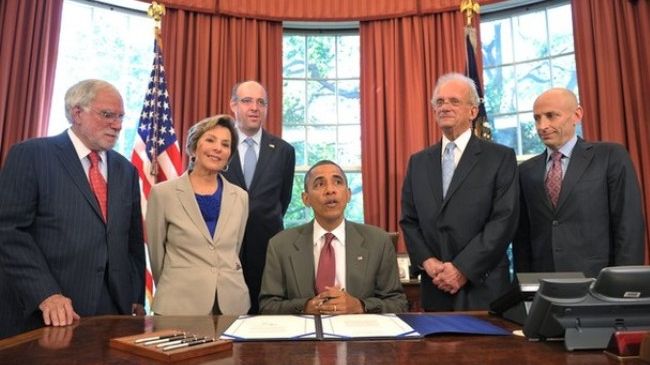
US President Barack Obama signs the US-Israel Enhanced Security Cooperation Act in the Oval Office on July 27, 2012.
Press TV – July 28, 2012
US President Barack Obama has signed a piece of legislation ratified by Congress that gives Israel another $70 million in military assistance, on top of the $3 billion the United States had already pledged to provide to the Israeli military this year.
On Friday, Obama signed the United States-Israel Enhanced Security Cooperation Act of 2012, which provides more US taxpayer dollars to help Israel expand its Iron Dome short-range rocket defense system, Xinhua reported.
The Iron Dome is a short-range rocket defense system designed to intercept rockets and artillery shells fired from a range of between four and 70 kilometers.
Representatives of the pro-Israeli lobby, the American Israel Public Affairs Committee (AIPAC), and Israeli journalists were invited to the signing ceremony, which was held at the White House.
“I have made it a top priority for my administration to deepen cooperation with Israel across the whole spectrum of security issues — intelligence, military, technology,” Obama said before signing the bill in the Oval Office.
“And, in many ways, what this legislation does is bring together all the outstanding cooperation that we have seen, really, at an unprecedented level between our two countries that underscores our unshakeable commitment to Israel security,” he added.
According to a White House fact sheet published on Friday, Obama said that “despite tough fiscal times” he “fought for and secured full funding for Israel” in fiscal year 2012, including $3 billion in Foreign Military Financing.
The fact sheet also said that Obama secured an additional $205 million in 2011 to set up the Iron Dome system.
Related articles
- US Gives Israel an Immediate $70 million for “Iron Dome” Systems (alethonews.wordpress.com)
- Israel Lobby Always Believes More Is Better (alethonews.wordpress.com)
Solyndra scandal’s key players pay big bucks to attend Obama fundraiser
RT | July 24, 2012
US President Barack Obama shook hands with some of his wealthiest supporters Tuesday night at a fundraising shindig in San Francisco. Also on hand, though, was a matter the commander-in-chief just can’t seem to shake: his failed deal with Solyndra.
Around sixty patrons paid $35,800 a piece to attend a party in honor of President Obama this week, including a pair of gentlemen who have become central figures in an energy debacle that has haunted the Oval Office since last year. Among those in attendance were two key players in the Solyndra scandal.
President Obama touted Solyndra, a California solar-panel start-up, as an example of perfect American entrepreneurship early on in his presidency. Last year, however, the infant green energy company filed for bankruptcy, despite the president earlier approving a gigantic loan guarantee worth $535 million for the Silicon Valley start-up. The company had borrowed all but $8 million of the massive loan before calling it quits late last year, a move that prompted Obama’s opponents to ridicule the president over what some said was “a dubious investment” and even initiated an investigated by the FBI.
Nearly a year after Solyndra first filed for bankruptcy, the scandal took center stage again this week after Monday’s fundraiser funneled in donations from Matt Rogers, a former adviser at the Department of Energy that helped approve the loan as part of the stimulus plan, and Steve Westly, a venture capitalist that warned the White House against offering a deal to Solyndra before the president offered his own endorsement. Darren Samuelsohn of Politico was on-hand at Monday’s fundraiser and writes that it appears that the president isn’t exactly distancing himself from one of the most costly scandals of his administration.
Officials within the campaign to elect Massachusetts Governor Mitt Romney for president have already attacked the administration for still maintaining ties with people privy to the Solyndra deal. In a statement addressing the latest news, Romney spokesman Ryan Williams writes, “The Obama Administration betrayed American taxpayers when it dumped hundreds of millions of public dollars into Solyndra while ignoring clear warnings about the company’s dire financial situation.”
“President Obama’s first term worked out well for his donors who got special access and taxpayer money for their failed ventures. It hasn’t worked as well for the 23 million Americans struggling for work in the worst economic recovery our country has ever had,” Williams adds.
Obama’s Media Takeover Powers: The Infrastructure of a Police State
A Black Agenda Radio commentary by Glen Ford | July 18, 2012
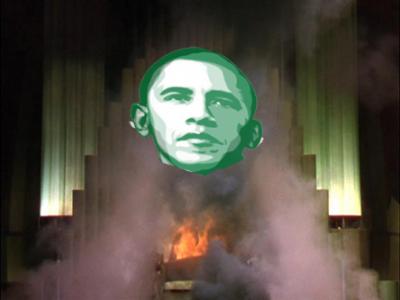
Earlier this month, on a Friday evening after most of the White House press corps had gone home, President Obama gave himself the power to take over, or shut down, all of the nation’s communications systems – including the Internet. The executive order is supposedly designed to preserve “survivable, resilient, enduring” and effective communications so that the government can speak to the people in the event of some emergency. But what he has authorized is the imposition of total silence except for the sound of his own voice.
Clearly, in a legitimate emergency, the government needs ways to communicate – but that does not require a monopoly. So, why is Obama giving himself – and any president that follows him into the Oval Office – a total communications on-and-off switch?
The administration claims it is authorized to bring all communications under its control by the 1934 Communications Act, which allows the takeover of broadcast stations and other wireless media if there exists a state of war, or the threat of war. Back then, of course, the public was fairly sure that they knew what “war” was: Congresses declared it. The “threat” of war was pretty self-evident, too: it was when other nations were threatening to attack the United States, or vice-versa.
However, we are now in what both Presidents Bush and Obama have made clear is a perpetual war, a war that is not defined by any legal norms or foundational statutes, a war against whoever the president decides is the enemy – which can include American citizens. Both of these War Presidents have told us in multitudinous ways that we are on a war footing – and have not been off it since 9/11, and will not be on any other kind of footing until some future president gives the “all clear” sign.
Obama’s executive order has nothing to do with getting out an effective distress call to the nation during a crisis. The “emergency” he has in mind is a State of Emergency – martial law. He is methodically preparing the infrastructure for a police state. Obama already has in place his preventive detention legislation, which he signed into law in the news-less hours of last New Year’s Eve. It empowers the president to lock up whomever he chooses, without charges or trial, and to keep them for as long as the executive sees fit. Based on the near-limitless powers Obama already claims to possess, he can also kill such enemies of the state if that is in the interests of national security in this time of war. There is nothing that he recognizes as law that says he can’t take such drastic executive action against thousands, or tens of thousands of Americans in one sweep.
And now, with his new executive order, if the president finds it convenient, he can take over the national communications network – down to the last, feeble Internet voice – to explain why it was necessary for all those people to disappear.
Or maybe he’ll say nothing at all. And nobody else will dare to say anything, either.
BAR executive editor Glen Ford can be contacted at Glen.Ford@BlackAgendaReport.com.
Related articles
- White House Seizes Control of Internet by Executive Order (blacklistednews.com)
Obama’s Justice Department Rushes to the Rescue of LIBOR Criminals
A Black Agenda Radio commentary by Glen Ford | July 18, 2012
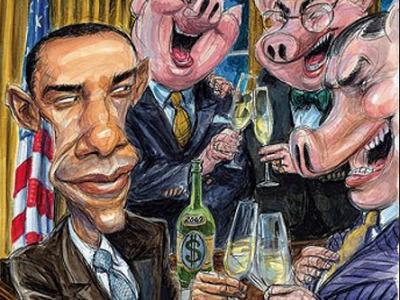
The Obama Justice Department is in theater mode, again, pretending to threaten the bankster class with criminal penalties – prison time! – for their manipulation of the global economy’s benchmark interest rates. The Justice Department claims to be building criminal and civil cases in the LIBOR scandal, which in sheer scope is the biggest fraud by international capital in history. But that’s all a front, a farce. Barack Obama has spent his entire presidency protecting Wall Street, starting with his rescue of George Bush’s bank bailout bill after it’s initial defeat in Congress, in the last days of Obama’s candidacy. He packed his administration with banksters, passed his own bailout and, in collaboration with the Federal Reserve, channeled at least $16 trillion dollars into the accounts of U.S. and even European banks – by far the greatest transfer of capital in the history of the world. Obama has reminded the banksters that it was he who saved them from the “pitchforks” of an outraged public. He pushed through Congress so-called financial reform legislation that left derivatives – the deadly instruments of mass financial destruction that were at the heart of the meltdown – untouched.
Wall Street may or may not remain loyal to Obama, but Obama has been loyal to Wall Street, the guys who gave him the campaign cash to become a viable candidate. His Attorney General, Eric Holder, a corporate lawyer to the core, is busily staging a pre-emptive LIBOR prosecution of bankers in order to shield them from legal action by a host of other government agencies and, ultimately, from the global universe of parties that have been harmed by the bankster’s schemes– a list that stretches to infinity. Holder’s job is to monopolize the LIBOR case, to the extent legally and humanly possible, grabbing jurisdiction and consolidating the cases against the banks with the aim of reaching a settlement that does not further destabilize the financial system.
Holder and his boss already pulled that trick earlier this year with settlement of the bank “robo-signing” scandal – a scheme that would have ranked as the “crime of the century” until LIBOR came along. A small group of state attorney generals were holding up an administration-brokered settlement that effectively gave the banksters immunity from prosecution, in return for a measly $25 billion payout. Obama used every power of his office to pressure the state law officers into line. The last one capitulated with a promise from Obama that a “special unit of prosecutors” would expand the investigation into abusive mortgages practices. You haven’t heard a peep about it, since.
Now Obama and Holder are playing the same diversionary game, making tough noises about criminal investigations of the LIBOR conspirators. But the Justice Department has already given immunity to Barclay’s Bank, of Britain, and to the Swiss banking giant UBS. More immunities will follow. The reason Eric Holder is staging criminal investigations is because that’s the only way he can protect the bankers, through immunities and by gradually narrowing the scope of the case. In the end, there will be settlements all around, and the banksters will move on to even more fantastic heights of criminality – thanks to the loyal, protective hands of President Obama.
BAR executive editor Glen Ford can be contacted at Glen.Ford@BlackAgendaReport.com.
Related articles
- Richard (RJ) Eskow: Crooked Bankers Are Corrupting Government: The Real LIBOR Story (huffingtonpost.com)
Featured Video

More Bombs, More Talks Zelensky Rejects Trump’s Plan
or go to
Aletho News Archives – Video-Images
Book Review
In 2007, Michael Parenti Called Out The Greater Israel Project

The Dissident | January 28, 2026
In my last article, I covered the left-wing scholar Michael Parenti- who passed away at the age of 92 this week- and his prophetic writings on the Ukraine proxy war in 2014.
Parenti’s writings on the Israel lobby and the greater Israel project were equally prophetic.
In his 2007 book “Contrary Notions” Parenti called out “Israel First” Neo-cons and Israel’s role in the Iraq war, and predicted to a tee the future Israeli/American wars in the Middle East in service of Greater Israel and the ethnic cleansing of Palestine.
In a section of the book aptly titled “Israel First”, Parenti wrote… continue
Blog Roll
Recent Comments
loongtip on Hamas never agreed to lay down… eddieb on Conspiracy Denial eddieb on WEF Calls for ‘Cultural Revolu… loongtip on Trump wanted to play peacemake… Coronistan on EU member to sue bloc over ‘su… loongtip on Vicious loongtip on EU turns to India for defense… Coronistan on Donald Trump Is No Peace … seversonebcfb985d9 on French court jails pro-Palesti… eddieb on Fourteen Incredible Facts Abou… Bill Francis on European leaders’ shift in the… seversonebcfb985d9 on Villains of Judea: Philip Esfo…


 Aletho News
- Israeli Merkava tank invades outskirts of Yaroun in southern Lebanon
- Europeans oppose Brussels’ Russian energy ban, survey finds
- Russia Vows to Protect Its Oil Tankers
- In 2007, Michael Parenti Called Out The Greater Israel Project
- Hamas never agreed to lay down arms in truce talks: Official
- Iran, China and Russia sign trilateral strategic pact
- After Years Of Denial, The IDF Admits The Gaza Health Ministry’s Numbers Are Accurate
- Riyadh and Hezbollah: A rapprochement forged in fire
- Criminal Conspiracy: How the U.S. and Israel Turned Iran into a Proving Ground for Bloody Experiments
- EU labels Iran’s Revolutionary Guard ‘terrorist organization’
- If Americans Knew
- Is Israel finished with war? Is more aid entering Gaza? No, and no – Not a ceasefire Day 112
- Playful Post on Tel Aviv Park Omits That It Was Built on Ruins of Palestinian Neighborhood
- Palestinian developer gains massive user support for app challenging censorship claims criticising US and Israel after losing over 60 relatives in Gaza
- Gaza’s ‘Board of Peace’ – A New Phase of Palestinian Dispossession and Genocide
- Mike Huckabee is interfering with the work and witness of churches in the Holy Land with a goal of silencing Palestinian Christians
- “Hey ChatGPT, is Israel building a concentration camp?” (spoiler: yes) – Not a ceasefire Day 111
- “The Gaza ceasefire is a minefield” – Not a ceasefire Day 110
- Israel to seek new security deal from US, official says
- Leaked “Board of Peace” Resolution Outlines U.S.-Led Plan to Rule Over Gaza
- Jonathan Greenblatt Rolls Out Plan to Activate Hispanic Evangelical Golems
- No Tricks Zone
- 130 Years Later: The CO2 Greenhouse Effect Is Still Only An Imaginary-World Thought Experiment
- New Study Affirms Rising CO2’s Greening Impact Across India – A Region With No Net Warming In 75 Years
- Germany’s Natural Gas Crisis Escalates … One Storage Site Near Empty …Government Silent
- Polar Colding…Antarctica Saw Its Coldest October In 44 Years!
- New Study: Sea Levels Rose 20 Times The Modern Rate During The Roman Warm Period
- As German Gas Storage Dips Dangerously Low…Shortage Hardly Avoidable
- New Study: Brazil’s Relative Sea Level Was 2+ Meters Higher And SSTs 3-4°C Warmer 6000 Years Ago
- Philosopher Schopenhauer: Climate Science Certainty Stems From Stupidity, Ignorance
- New Study: Species Extinction Rates Declining Since 1980 – ‘Climate Change Is Not An Important Threat’
- Denmark Places Climate Protection Above Animal Welfare, Poisoning And Culling Cows
 Aletho News