Taiwan in the age of Neo-McCarthyism
By Drago Bosnic | April 10, 2023
McCarthyism, otherwise known as the so-called (Second) “Red Scare”, is officially defined as “the repression and persecution of left-wing individuals and a campaign spreading fear of alleged communist and socialist influence on American institutions and of Soviet espionage in the United States during the late 1940s through the 1950s”. The policy was spearheaded by a Republican US Senator Joseph McCarthy, but while he was the most prominent proponent of this internal (and foreign) policy approach, he most certainly wasn’t the only one. And although the term McCarthyism is largely considered obsolete and/or outdated nowadays, as the role of one individual in such a massive nationwide policy framework is obviously overstated, it stuck and now even includes additional definitions and changes.
The McCarthyism of our age can certainly be dubbed Neo-McCarthyism, as it includes more than just the ideological rejection of non-Western ideas and is now targeting anything remotely connected to countries such as China, Russia, Iran, Venezuela, Syria, etc. This is especially true when it comes to Beijing, which Neo-McCarthyists see as the “source of all evil”, turning their emotional reaction into disastrous policies that make the geopolitical situation a lot worse.
One particularly obvious example of this is Taiwan, China’s breakaway island province currently under US patronage. However, Beijing is actively pushing back against threats from the US and its numerous vassals and satellite states in the region, despite Washington DC’s constant attempts of a crawling invasion so as to undermine China’s national interests and security in seas surrounding the country.
On April 5, Taiwanese president Tsai Ing-wen made a stopover visit to Los Angeles after a tour to Latin America to visit Guatemala and Belize, its only remaining official allies in an attempt to stop the repeat of the recent episode when Honduras finally cut ties with Taipei and opted for Beijing instead. Tsai also met with senior security officials on Tuesday to discuss the “regional situation” ahead of her meeting with US House Speaker Kevin McCarthy in California, which China had once again warned against.
“China is strongly opposed to the US arranging for Tsai Ing-wen to transit through its territory, and is strongly opposed to the meeting between House Speaker Kevin McCarthy, the third-ranking US official, and Tsai Ing-wen,” Foreign Ministry spokesperson Mao Ning stated, adding: “It seriously violates the One-China principle and the three China-US joint communiques, and seriously undermines China’s sovereignty and territorial integrity.”
And yet, Taipei enjoys strong bipartisan support in the US, one of the very few unifying factors in Congress as Washington DC increasingly sees China as its primary adversary. McCarthy had originally even planned to visit Taiwan himself, but has opted instead to meet Tsai in the US. Some analysts saw this as sort of a “compromise” that wouldn’t be seen as escalatory as a direct visit to Taipei. However, McCarthy’s comments on a future visit to Taiwan effectively invalidated this view, while China slammed it as yet another form of US meddling in its internal affairs.
The behind-closed-doors meeting makes McCarthy the highest-ranking US official to have met a Taiwanese president on US soil since 1979 when America officially established diplomatic relations with China, effectively recognizing Beijing’s “One-China policy”. China’s strong reaction to the meeting is certainly expected, as it has repeatedly warned against such high-profile visits, stressing that they aren’t just against international law, but are also deeply destabilizing and harmful to Beijing’s national interests in the Asia-Pacific.
However, while the US officially doesn’t maintain diplomatic relations with Taiwan, it de facto does. Worse yet, Washington DC has been actively arming Taipei for decades and has even recently escalated this with promised deliveries of advanced weapons, including SAM (surface-to-air missile) systems and anti-ship missiles, obviously aimed against China’s potential amphibious combined arms operation to restore its full sovereignty.
For his part, Kevin McCarthy, a Republican, has been outspoken in his criticism of China. True to his last name, in December he stated that “the greatest threat to the United States is the Chinese Communist Party”. Considering the fact that he’s the third highest ranking US official and second in line for the US presidency, such statements are a borderline declaration of war, to say nothing of McCarthy’s continued support for additional arms sales to Taipei.
As previously mentioned, he also reiterated the strong possibility of visiting Taipei and stressed the need for arming China’s breakaway island province by saying: “I don’t have any current plans, but that doesn’t mean I will not go… …Based on our conversations, it’s clear that several actions are necessary. First, we must continue the arms sales to Taiwan and make sure such sales reach Taiwan on a very timely basis. Second, we must strengthen our economic cooperation, particularly with trade and technology. Third, we must continue to promote our shared values on the world stage.”
Strangely enough, while insisting on further arms deliveries, McCarthy also stated that “tensions in this world are at their highest point since the end of the Cold War, as authoritarian leaders seek to use violence and fear to provoke needless conflict”. This is an obvious reference to Russian President Vladimir Putin and his Chinese colleague Xi Jinping, who recently held a historic meeting in Moscow, something the US wasn’t too happy about, which somewhat explains Washington DC’s frustrations.
Drago Bosnic is an independent geopolitical and military analyst.
BBC ‘government-funded’ Twitter tag triggers journalists
RT | April 10, 2023
Twitter CEO Elon Musk has ignited a feud with the BBC by labeling the British broadcaster a “government funded media” organization. The BBC denies taking state money and its defenders claim that being funded by the British government differs from being funded by the British public.
Twitter applied the label to the BBC’s main account earlier this week, after slapping US broadcaster NPR with a similar tag describing it as “US state-affiliated media.” While Twitter previously reserved such labels for foreign media outlets – like RT and China’s CGTN, Musk said that applying it to NPR “seems accurate.”
NPR’s tag was changed to read “government-funded media” after an outcry from US liberals.
The BBC bristled at receiving the tag. “We are speaking to Twitter to resolve this issue as soon as possible,” the broadcaster said in a statement on Sunday. “The BBC is, and always has been, independent. We are funded by the British public through the licence fee.”
On Twitter, the BBC’s defenders pointed to the license fee as proof of the network’s independence. The BBC, Deadline reporter Jake Kanter argued, “is funded by the British public through a system known as the licence fee. The BBC’s operations and editorial decision-making are entirely independent of the government.”
However, commenters pointed out that the license fee “is a government tax in all but name.”
Set by the government, the fee is an annual payment of £159 ($197) owed by any household with a television or device capable of receiving television broadcasts. The BBC hires contractors to visit the homes of suspected evaders, and those who refuse to pay can be prosecuted by the broadcaster. Around 45,000 people per year are prosecuted for failing to pay the license, the Telegraph reported last month.
The UK’s Office for National Statistics classifies the fee as a tax, and the BBC as part of the “central government sector” of the UK economy.
Additionally, the broadcaster does actually receive direct government funding for BBC World Service. The TV license covers 75% of the service’s operational costs while the rest is directly paid for by the UK government to the tune of some £90 million ($111 million) per year. Last month, the service was also awarded a £20 million ($24 million) one-time payment to help “fight against the spread of disinformation around the world.” BBC World Service is predominantly aimed at non-UK audiences and broadcasts in over 40 languages.
The UK Foreign and Commonwealth Office is also the biggest funder of the BBC’s Media Action service, which additionally receives funding from the governments of the US, Canada, Norway, Sweden, the EU, the UN, as well as donors like the Bill and Melinda Gates Foundation. The service supplies two dozen developing countries with “information they can trust,” per the BBC’s own website.
While the BBC stated that it is editorially independent, internal communications published by the Guardian last month showed that its editors asked reporters to avoid using the term “lockdown” when talking about the government’s response to the Coviid-19 pandemic, under direct order from the government. Furthermore, journalists were instructed to be more critical of the opposition Labour Party due to complaints from the government.
US efforts to ban TikTok are pure projection by the world’s biggest spy power
By Timur Fomenko | RT | April 4, 2023
As the United States contemplates a possible ban on TikTok, it relentlessly accuses Beijing of using the popular Chinese-owned social media application as a means of espionage, claiming that the Communist Party has access to user data.
Ironically, Washington itself is known to be doing exactly what US politicians are accusing China of doing. Using the unique advantage of having jurisdiction over the world’s top internet companies, the US has given itself the right to look into the private communications of foreign citizens anywhere in the world. Combine that data-sharing between intelligence agencies of the US and its allies, and you get the most comprehensive espionage regime in the world.
While American politicians and media constantly talk about fears of Chinese espionage, the near-absence of coverage of Washington’s own spying efforts ought to be a reminder of where the true power lies. When it comes to the shady activities of the CIA and the NSA, the public tends to only learn what they did years later from declassified documents, or what they “have been doing all along” from rare whistleblowers like Edward Snowden. All discussion and speculation about what they “may be doing right now” tends to be dismissed as conspiracy theories. Conversely, allegations of Chinese spying activities are constantly explained as “we all know they’re doing it” in the public eye, despite the lack of solid proof.
These warning signs remind us that the most cryptic source of all spying in the world is not China, but the US. Since the Second World War, the US has, in conjunction with Australia, Canada, New Zealand and the United Kingdom, maintained a worldwide spying regime known as the ‘Five Eyes’ which, in the age of mass communications, has been designed so that each government can bypass its own privacy laws and judicial restraints in order to spy on each other’s citizens, while supplying information within the group. In doing so, they have created a number of communication interception and surveillance programs, as revealed by Snowden, such as PRISM, ECHELON, XKEYSCORE, etc.
Of course, the US nearly holds a monopoly over the means of information and data gathering – definitely more so than any other country. This is because it has the privilege of having the world’s most dominant internet companies located on its own soil, such as Google, Microsoft, Twitter and Meta. These organizations are required by law to share data with the US government and authorities should they request it. But the US has also gone even further, as revealed by the Washington Post in 2020, the CIA had secretly acquired a Swiss cryptography company and used it to rig those machines to be able to spy on all who used them.
In pursuing its comprehensive spying regime, the US has been keeping an eye on friend and foe alike. This has included wiretapping the chancellor of Germany, coordinating with the intelligence services of other countries to undermine their commercial interests, such as Denmark and the Eurofighter program, and the list goes on.
And yet, American lawmakers suggest that you should truly be scared of TikTok, even as they prepare to reauthorize Section 702 of the Foreign Intelligence Surveillance Act (FISA), which allows US intelligence agencies to spy on foreign citizens’ phones and online communications without a warrant. Legalized in 2008, Section 702 needs to be reauthorized every few years lest it lapses under a sunset clause. Congress extended it in 2012 and again in 2018 and there’s little reason to believe it will fail to do so again before the next deadline, set for December this year.
The real problem Washington has with TikTok is not the alleged spying for Beijing’s benefit – it’s the fact that TikTok is the first global-spanning social media network of its magnitude that isn’t under US control – and thus, cannot be weaponized by the US for its own espionage. As such, it weakens the global surveillance regime built up by the US, which is, perhaps, the principal motivation behind Washington’s obsession with keeping control of “the future of the internet” out of Beijing’s hands. It’s more than a matter of spy games – it’s a matter of hegemony, and as such, it’s pure projection on Washington’s part to sound the alarm over TikTok’s alleged breaches of privacy.
As it stands, the US has an unrivaled digital spying network and is the greatest single threat to individual privacy online. If major internet companies are not owned or controlled by Washington or its closest allies, then the privacy of individuals around the world is increased, not decreased. The US has never been apologetic or open about how it monitors the communications of billions of people. Even if one has their suspicions about China, how can Washington’s claims about TikTok, and the motives behind the mounting pressure on the social media platform, be taken at face value?
China warns US seeking cyber ‘hegemony’
RT | April 8, 2023
China has dismissed US moves to control spyware and accused Washington of seeking to maintain “hegemony in cyberspace” under the false pretext of “national security.”
Foreign Ministry spokesperson Mao Ning said the recent White House order to crack down on certain surveillance tech would not change the fact that Washington is the “biggest threat to global cybersecurity.” US agencies have targeted foreign states and companies “under the pretexts of national security and human rights without any evidence,” Ning claimed.
“The US government, in an attempt to maintain its hegemony in cyberspace, knowingly abuses technology for cyber surveillance and theft of secrets,” she told reporters on Friday, urging the US to “stop its global hacking operations.”
While US president Joe Biden’s new executive order called to ban “commercial spyware that poses risks to national security or has been misused by foreign actors,” a reporter at Friday’s press briefing noted the move was at odds with the administration’s previous work with the Israeli cyber surveillance firm NSO Group.
According to a report in the New York Times earlier this week, the US government signed a “secret contract” with the firm through a front company in 2021, which allowed officials to use NSO Group’s ‘Landmark’ geolocation tool to covertly track “thousands” of phone users in Mexico. The deal also “allows for Landmark to be used against mobile numbers in the United States,” though the outlet said it had no evidence that had happened yet.
Despite language in the executive order urging federal agencies to stop employing tools that have been “misused” by governments abroad, the deal with NSO Group “still appears to be active,” the NYT reported.
The Israeli firm has previously come under fire for allegedly working with more than a dozen foreign states to target lawyers, journalists and human rights activists using its powerful ‘Pegasus’ spyware program, including in Saudi Arabia, the United Arab Emirates and Mexico. Other media reports have also claimed the FBI bought the tech under a secret agreement and tested ways to hack into American cell phones, though it remains unclear to what extent the program was deployed against US citizens.
The West sets a disturbing new precedent over murdered Russian military blogger

By Rachel Marsden | RT | April 6, 2023
Apparently terrorism and murdering reporters get a free pass if the Western establishment doesn’t like the target’s profile – or if the perpetrator risks being linked to an ally.
The radio silence from the West is deafening in the wake of the murder of military blogger Vladlen Tatarsky at a cafe in St. Petersburg. Tatarsky was killed after being handed a statue by a young woman, Darya Trepova, that subsequently blew up the entire venue.
For all of the Western officials’ differences with Russia, can they really not at least bring themselves to condemn a blatant act of terrorism in the middle of a major city center? We’re talking here about the same folks who spent two decades kicking down doors around the world under the guise of fighting a “Global War on Terrorism.”
Just a few years ago, cartoonists and writers for the French satirical magazine Charlie Hebdo were gunned down in broad daylight at their Paris office by jihadists who objected to the publication’s portrayal of Islam and the Prophet Mohammed. Western leaders roundly condemned that terrorist act, standing firmly on the principle that you couldn’t just go around murdering people who conveyed thoughts and views that you didn’t like. Many of these leaders even traveled to Paris to march alongside a massive crowd in defense of freedom of expression and the press.
Now, however, they can’t even bother to muster the most meager defense of the same principles in the wake of Tatarsky’s murder in an attack that investigators claim is linked to Ukraine.
It seems that whenever there’s any alleged involvement of Ukraine, the West conveniently turns a blind eye. The automobile explosion that killed Russian journalist and activist, Darya Dugina, near Moscow comes to mind. “American officials said they were not aware of the plan ahead of time for the attack that killed Daria Dugina and that they had admonished Ukraine over it,” reported the New York Times last October. Similarly, the Washington Post reported this week that the “unwritten rule” among Western officials is “don’t talk about Nord Stream” – the pipeline network carrying gas from Russia to Europe that was mysteriously blown up last year – since they “would rather not have to deal with the possibility that Ukraine or its allies were involved.”
Then there is the “Mirotvorets” list of journalists and activists maintained by Kiev-based NGO, the Mirotvorets Center, which names people “whose actions have signs of crimes against the national security of Ukraine, peace, human security, and the international law.” It has yet to either be shut down by the Ukrainian government or denounced by Western allies, despite a 2017 United Nations report on human rights in Ukraine urging Ukrainian authorities to address it.
Acts of terrorism and affronts to free speech are clearly in the eye of the Western beholder, which would explain why much of the media rhetoric focuses on Tatarsky’s pro-Russia stance. The void left by the lack of official reaction from Western officials is being filled with Western press articles focusing on the Ukrainian-born blogger’s prior involvement with Russian-backed separatist forces in 2014 in the Donbass. There, he got his start in covering events through his Telegram channel, which grew to become wildly popular, with CNN noting his “ardent pro-war commentary.” But if prior military experience of some kind, and taking sides in one’s coverage of armed conflict, was justification for murdering journalists, then every Western veteran who started a blog, and every opinion journalist, would be fair game.
There was no shortage of Western outrage over the murder of Washington Post columnist Jamal Khashoggi inside the Saudi embassy in Istanbul a few years ago, despite his longstanding activism against the Saudi leadership. Why should the death of this Russian blogger be treated any differently?
Bulgarian investigative journalist, Cristo Grozev, who was heavily featured in the Academy Award-winning feature documentary film about Russian opposition figure Alexey Navalny, apparently thinks that some people are just “legitimate targets” for terrorism, and argues that the cafe may not have been a “purely civilian location.” Although it was previously owned by Yevgeny Prigozhin, the head of Russian private military enterprise, Wagner Group, that doesn’t magically transform a dining establishment, which welcomes anyone right off the street in the middle of a major city, into some kind of a military base. If an American general walks into the Ritz-Carlton hotel in Pentagon City, Virginia, it doesn’t suddenly turn the hotel or its bar into a legitimate military target for bombing by some entity that has a score to settle with Washington.
And what about every journalist who has been embedded as the guest of Western troops in conflicts like Iraq and Afghanistan and has promoted the talking points of their hosts while siding with their own country? Are they fair game for picking off now, too?
The prominent Washington Institute for the Study of War think tank, whose board members include American generals Jack Keane and David Petraeus, as well as Washington’s former ambassador to the UN, Kelly Craft, previously and routinely qualified Tatarsky as a prominent Russian military blogger whose work they apparently considered worthy of informing their research.
It seems like there’s an effort underway by some members of the Western establishment to reframe this egregious act of terrorism and murder as something trivial, all because the target was a Russian whose views they don’t like – and that’s an awfully slippery slope.
Rachel Marsden is a columnist, political strategist, and host of independently produced talk-shows in French and English.
Zelensky’s Senior Advisor Brazenly Admitted To Kiev’s Genocidal Intentions
By Andrew Korybko | April 7, 2023
Senior Ukrainian presidential advisor Mikhail Podolyak brazenly admitted to Kiev’s genocidal intentions in the NATO-Russian proxy war that’s presently being fought in his former Soviet Republic during an interview with US Government-controlled “Radio Free Europe/Radio Liberty” (RFERL). The relevant excerpt will now be shared in order to raise awareness of his words, which can be read in their original Ukrainian at that outlet’s website here for those skeptics who doubt that he truly said them:
“We have to completely close everything related to the Russian cultural space [in Crimea after its reconquest]. We have to eradicate everything Russian. There should be only Ukrainian cultural space or global cultural space. We should not have a dialogue about whether a person has the right to use the Russian language or not. At home, please use it, but it is not a tool of pressure, it is not a tool of protest, it is not a tool of blackmail.”
Podolyak admitted to precisely what Moscow has always accused Kiev of intending since the Western-backed fascist coup of early 2014 popularly known as “EuroMaidan”, namely the ethnic cleansing and genocide of Crimea’s indigenous Russian population. He therefore inadvertently justified its democratic reunification with Russia that was carried out for the purpose of defending its people’s UN-enshrined human rights, thus discrediting his side’s and its foreign patrons’ moral stance in this conflict.
Not only that, but the so-called “rules-based order” that’s aggressively being promoted by the US-led West’s Golden Billion was exposed as a hypocritical sham. That de facto New Cold War bloc isn’t waging their proxy war against Russia in order to defend “democracy” and “human rights” like its propagandists claim, but to advance Kiev’s publicly confirmed goals that stand in direct contradiction to those two concepts.
Any political force in the West that agitates for literally eradicating another culture and prohibiting its people from speaking their native language outside of their homes would rightly be condemned by society as fascist, yet there’s no chance that the US or EU will ever normalize describing Kiev in that way. These double standards speak to the ulterior motives connected to the previously mentioned “rules-based order”, which has always been about advancing American hegemony on any given pretext.
Returning to Podolyak’s candid admission, nobody can credibly claim that funding Kiev isn’t equivalent to funding fascism. There’s no other way to describe that side’s intention to eradicate Russian culture in its entirety and prohibit its people from speaking their native language in public. This bonafide fascism is being funded by the West in violation of its own self-proclaimed “values”, which reveals that everything it’s claimed about wanting to defend “democracy” and “human rights” across the world was simply a lie.
China issues correction to US and NATO over Ukraine
RT | April 6, 2023
NATO, not China, is responsible for the crisis in Ukraine and has no moral standing from which to criticize Beijing, foreign ministry spokesperson Mao Ning said during a press conference on Thursday.
“The US and the military bloc of NATO shoulder unshirkable responsibilities on the Ukraine crisis,” Mao continued, arguing that NATO “is in no position to criticize or pressure China” to take its side.
“On the Ukraine crisis, China upholds an objective and just position. We have been advocating a political settlement of the crisis and working for talks for peace,” she explained, claiming that this was a strategy “supported by the vast majority of countries in the world.”
“History will tell who is truly standing on the right side upholding justice.”
On Wednesday, NATO Secretary General Jens Stoltenberg warned China to curtail its “growing alignment” with Moscow, accusing Beijing of “prop[ping] up Russia’s economy” and “refus[ing] to condemn Russia’s aggression.”
Supplying weapons to NATO’s arch-nemesis, Stoltenberg added, “would be a historic mistake, with profound implications.”
Beijing has repeatedly denied having any plans to provide lethal aid to Russia, which has likewise denied reports that it has requested military equipment from the Chinese.
The two nations have grown closer over the past year, vowing to “further deepen mutual military trust” after last month’s meeting between Russian President Vladimir Putin and Chinese Premier Xi Jinping at the Kremlin.
However, Putin more recently clarified that there was no “military alliance with China” on the horizon, merely “cooperation in the sphere of military-technical interaction.” The West, he argued, was merely projecting its fantasy of a new axis similar to the fascist enemy of World War II onto its chief geopolitical rivals.
The US has nevertheless sanctioned several Chinese companies for allegedly supplying parts used in Iranian drones, which Washington claims are being used by Russia in Ukraine.
The US Treasury announced new sanctions on five Chinese companies and one individual said to be “responsible for the sale and shipment of thousands of aerospace components” to Iran, including parts that could be used to make drones. Iran, too, has denied providing weapons to Russia for use in the Ukrainian conflict.
Will Zelensky Take Back Crimea?
By Rick Sterling | Global Research | April 3, 2023
Seventeen months ago the US State Department officially declared the US will “NEVER” recognize Crimea as part of Russia. Three months ago Ukrainian President Zelensky vowed to “take back” Crimea. Is this possible?
In June 2016 I visited Crimea with a delegation from the Center for Citizen Initiatives (CCI). This is a US organization which has conducted people to people exchanges with Russia for decades. They have never received financial support from Russia but did receive some grants from USAID in the 1990’s. CCI especially promotes exchanges with Rotary clubs.
In Crimea, we were based in Yalta, a small city on the Black Sea. From Yalta we did trips to the capitol Simferopol, the naval port at Sebastopol, the “valley of death” and many other destinations.
Crimea is beautiful and the people were very friendly and happy to see us. At that time, they had been under Western sanctions for two years because of their decision to secede from Ukraine in March 2014. Tourist ships that previously visited their ports no longer stopped because of sanctions. Students who graduated from Crimean universities no longer had their academic achievements recognized in the Europe. Visa and Mastercard could not be used. The sanctions caused a myriad of problems.
We met with many groups including the elected city council of the capital Simferopol, college students, high school students, Armenian and Tatar ethnic groups, a Rotary business group and more. They all said the decision to secede from Ukraine was overwhelmingly popular. The official referendum results confirmed what they said: with 83% of the voting public participating, 97% of voters said they wanted to “re-unify” with the Russian Federation.
When we asked why they preferred to be part of Russia, there were various explanations. Everyone referred to the Feb 2014 coup which overthrew President Yanukovich. Over 75% of the Crimean population voted for Yanukovich in the 2010 election which was deemed to free and fair by European monitors. They did not like the violent coup which ousted their elected president.
Another reason was because the coup government immediately repealed legislation that the Russian language could be used in schools and institutions. The majority of the population in eastern Ukraine and Crimea have Russian as their native language. The hostility of the coup government was unmistakable.
A third reason was because of the violence and thuggery of the forces which drove the coup. Over a few days almost 100 people were killed on the Maidan plaza. There is overwhelming evidence the killing was done by snipers shooting from rooms and the roofs of opposition controlled buildings. The fact that BOTH protesters and police were killed indicates purposeful intent to exacerbate and ignite the crisis which is exactly what happened.
A fourth reason for the Crimean decision was because of an incident on the night of Feb 20. Hundreds of Crimeans had gone to Kyiv to peacefully demonstrate in favor of the government and against the increasingly violent mob. When the killing peaked on Feb 20, they realized it was too dangerous and peaceful protests were hopeless. They headed home in an 8 bus convoy. One hundred miles south of Kyiv the bus convoy was stopped by ultra-nationalist thugs. All the passengers were terrorized, many were beaten and seven killed. News of this violence rapidly spread and shocked the people of Crimea. The referendum was quickly organized and held without violence on March 16. Turnout was huge and the results decisive. Two days later, Russia welcomed Crimea into the Russian Federation.
When we visited, just two years after the coup, we learned there were no regrets about the decision to leave Ukraine despite the problems caused by western sanctions. People told us that Crimea had been neglected under Ukraine. Now, as part of the Russian Federation, all sorts of infrastructure improvements were being made. We saw this first hand at the new Simferopol airport. We heard about the coming Kerch Straight bridge, which was completed a few years later. We saw the remodeling and rebuilding of the famous Artek youth summer camp.
It was very interesting to meet with young Tatars. This is an Muslim indigenous ethnic group in Crimea. When asked if western NGOs were active in promoting opposition, they smiled and said “Yes … Soros”. Looking it up later, I learned that the US billionaire gave grants of $230 million to influence Ukraine.
On our trip we also learned about Crimea’s long history as part of Russia. The Crimea peninsula and naval port at Sebastopol has been Russian ever since 1783. It has been the Russian Navy’s only southern freshwater port for 240 years.
In 1954 Crimea was designated to the Ukrainian republic by Soviet Premier Krushchev. There was no consultation but it was not critical because they were all part of a centralized Soviet Union. When the Soviet Union broke up, 94% of Crimean voters wanted to leave Ukraine and re-establish the Crimean Soviet Socialist Republic. Those wishes were ignored by Kyiv.
The 2014 coup was the last straw. The Maidan violence, coup government decisions on language, and attacks on civilians made it imperative to quickly secede. Russia already had soldiers in Crimea at the leased naval base at Sebastapol. The referendum proceeded quickly and peacefully.
Western hypocrisy and double standards are breathtaking. The West actively promoted the breakup of Yugoslavia, the secession of Kosovo from Serbia and South Sudan from Sudan. The right and popular will of Crimeans to secede from Ukraine and re-unify with Russia is clear. Yet the West continues to falsely claim that Russia “occupies” Crimea.
In November 2021 the US signed a “Charter on Strategic Partnership” with Ukraine. It declares, “The United States does not and will never recognize Russia’s attempted annexation of Crimea.” Evidently it does not matter what the Crimeans think and want. What kind of “democracy” is this?
Any attempt by a Ukrainian government to “take back” Crimea would be met with firm opposition and resistance from the people who live there. The chance of this happening is near zero.
The misinformation about Crimea shows how distorted media coverage of the entire Ukraine conflict is.
Biden’s Sham Summit Won’t Save World Democracy
By Jim Bovard | The Libertarian Institute | April 3, 2023
President Joe Biden triumphantly saved world democracy last week (at least according to the White House scorecard). Biden co-hosted another Summit for Democracy, a repeat performance after the December 2021 test run. Biden sounded like a Quaalude Savior as he recycled his “inflection point of history” cliché. But the summit proved again that politicians are perils to freedom regardless of their prattle.
Biden promised that “we are seeing real indications that we are turning the tide” in favor of democracy around the globe. Practically no one who’s not on Biden’s payroll agrees. The president’s boast was like taking a victory lap around the deck of the Titanic.
Last year democracy “declined around the world for the 17th consecutive year,” according to Freedom House. Twice as many nations are veering “toward authoritarianism” as towards democracy, according to The Economist. Most shocking: the United States is now categorized as a less free nation than Mongolia, Mauritius, and 56 other nations says Freedom House (funded by the U.S. government, so they must be trustworthy).
Team Biden believes a big problem with democracy is that politicians don’t have enough power: “Weak state capacity.” In reality, elected rulers around the globe are turning themselves into dictators who increasingly repress their citizens. Rather than representative governments, elected regimes have turned into Leviathan Democracies far superior to the citizenry.
Consider Biden’s record in the Oval Office. Federal judges and/or the Supreme Court have struck down Biden’s eviction moratorium for deadbeat renters, his $400 billion cancellation of federal student debt, his “climate change” decree shutting down power plants, his mask mandate for airline passengers, and his edict compelling all employees of large companies and all federal employees to get COVID vaccine injections. But all of Biden’s decrees are supposedly “pro-democracy” because he won the 2020 election.
“Democracy delivers” was a key talking point for Team Biden at the summit. Presumably, any increase in government handouts automatically increased government legitimacy. Unfortunately, “leashing politicians” is not on the Biden Bingo Card for Saving Democracy™. The American Bar Association recently warned that “the Rule of Law is in Decline Globally” but it is “not a central focus of the U.S. Government’s approach” on democracy. A top ABA official warned, “Discussing sustainable development in the absence of rule of law…is at best delusional and at worst dishonest.” Three-quarters of nations representing almost 85% of the world’s population recently “experienced declines in rule of law,” according to the World Justice Project. In lieu of “government under the law,” Team Biden offers “the People Centered Justice Multistakeholder Cohort’s Declaration and Call to Action.” Sloshing out more government handouts to activist groups who score media headlines was “close enough for government work” to the rule of law.
Rather than a system of informed consent, democracy is degenerating into regimes which blindfold citizens and demand unlimited submission. At the summit, government officials made it clear that freedom of speech is a luxury that democracy can no longer afford. Secretary of Anthony State Blinken declared, “The misuse of technology and the spread of digital authoritarianism must end. We must stand for an affirmative, values-driven, and rights-respecting vision of democracy in the digital era.” “Affirmative” and “values-driven” become code words to legitimize pervasive government censorship. Blinken “proposed a ‘delicate balance’ between ‘openness and security,’ ‘protecting speech and preventing incitement,’ and ‘fostering innovation and limiting the power of Big Tech,’” as Tom Parker observed for Reclaim the Net.
Homeland Security Secretary Alejandro Mayorkas sermonized on a “Countering the Rise of Digital Authoritarianism” panel. He was joined by YouTube CEO Neil Mohan, who could have boasted of how Washington censors his channel. An internal DHS document reveals plans to crack down on “inaccurate” information on “the efficacy of COVID-19 vaccines, racial justice, U.S. withdrawal from Afghanistan, and the nature of U.S. support to Ukraine.” Any facts which embarrass Team Biden are automatically “inaccurate’ and ripe for suppression. Federally-funded entities spearheaded the censorship of true information on COVID vaccine side effects to bolster Biden’s effort to inject every American.
Eight governments, including Ukraine and Poland, issued a call for more censorship on the first day of the summit. They called for tech companies to take action “against disinformation that undermines our peace and stability” and to suppress posts that “weaken our support to Ukraine amid Russia’s war of aggression.” The letter asserted that “hostile foreign powers are using [social media] to spread false narratives that contradict reporting from fact-based news outlets,” especially the endless reports on the glorious victories of the Ukrainian army. Facebook responded by promising to ramp up its censorship, including relying on “a third-party fact-checking service to determine if posts contain false claims.” Some “third-party fact checking services” have been government fronts. As journalist Aaron Maté scoffed, “We are fueling a proxy war in Ukraine in order to defend freedom, such as the freedom to censor dissenting views on our proxy war in Ukraine.”
Is the “will of the people” so fragile that it can no longer survive exposure to any thoughts that officialdom disapproves? Does winning an election automatically convert tinhorn politicians into minor deities entitled to control the thoughts of any voter? Nullifying freedom of speech converts citizens into vassals that politicians can use and abuse as they please.
Throughout the summit proceedings, piety was thicker than hog slop at an Iowa slaughterhouse. Secretary Blinken declared on March 28, “No woman or girl should face harassment and abuse in-person or online.” The State Department’s effort on this score was propelled by its Global Engagement Center, which previously pressured Twitter to cancel hundreds of thousands of accounts, including vast numbers of hapless Americans. That Center is leading the fight against “gendered disinformation” and whooped up a report on “the need for more research to tackle this scourge.” According to the United Nations, a prime example of this “scourge” is “Zoom Bombing.” That atrocity occurs when uninvited people crash a Zoom meeting and make rude comments. Is it an international human rights crisis because boneheaded Zoom organizers fail to require pass codes to attend a meeting?
As part of its summit festivities, the Biden administration announced new crackdowns to make it “more difficult for corrupt actors to conceal their identities, assets, and criminal activities.” Despite reform promises at the first summit, there has been no worldwide progress. The U.S. ranks #24 on the international corruption index—even worse than France, according to Transparency International. And that score was calculated before the latest revelations of the Biden family pocketing vast sums from smarmy foreign companies.
Biden boasted that his administration plans to spend more than $9 billion to support democracy worldwide by the end of next year. But U.S. foreign aid programs obliterate the anti-corruption initiatives of the U.S. government. An American Economic Review analysis concluded that “increases in [foreign] aid are associated with contemporaneous increases in corruption,” and that “corruption is positively correlated with aid received from the United States.” As a Brookings Institution analysis observed, “The history of U.S. assistance is littered with tales of corrupt foreign officials using aid to line their own pockets, support military buildups, and pursue vanity projects.” Torrents of U.S. “aid” helped make Afghanistan one of the most corrupt places on Earth. John Sopko, the Special Inspector General for Afghan Reconstruction (SIGAR), observed, “We need to understand how U.S. policies and practices unintentionally aided and abetted corruption.” The U.S. has been “fighting corruption” in Ukraine since the end of the Cold War, and in those decades Ukraine became one of the most corrupt nations in Europe. Biden administration officials helped defeat a congressional proposal to create an Inspector General to audit and oversee the $100 billion the U.S. government has pledged to the government of Ukraine.
But another handout will fix that problem. The Biden administration is bankrolling foreign journalists to fight “kleptocracy”—government of thieves. There is even an aid program entitled “Empowering the Truth Tellers.” (Julian Assange need not apply.) The Biden administration claims to support “independent media” by effectively putting foreign journalists on the U.S. payroll. Those journalists are “independent” because the U.S. government says so, and anyone who disagrees will be labeled an enemy of democracy. Besides, the United States is no role model: it ranks a pathetic #42 in the World Press Freedom Index, worse than Moldova and Guyana, according to Reporters Without Borders.
Biden is “saving” democracy” with buckets of goofy new acronyms: SHE PERSISTS, one of the rallying cries for Hillary Clinton’s 2016 presidential campaign, now stands for Supporting Her Empowerment: Political Engagement, Rights, Safety, and Inclusion Strategies to Succeed Investing. And then there was SHE WINS (Support Her Empowerment: Women’s Inclusion for New Security). The Agency for International Development is whooping up PxP—Powered by the People. Did the White House believe acronyms should look like drug prescriptions? ADD stands for Advancing Digital Democracy but policymakers should have worked in an ‘H’ to reflect their cluelessness. ACRF stands for the Anti-Corruption Response Fund. They should have tweaked that one to make it ARF-ARF, to symbolize officialdom’s cravenness to the powers that be.
To safeguard democracy, the Biden administration is creating “the Global Network for Securing Election Integrity [GNSEI], to align on standards and practices for supporting clean elections.” On that score, the Biden administration touts its ballot expanding efforts here at home. The White House “fact sheet” detailing progress on democracy touts the Biden proposal to spend $5 billion on the Postal Service to “support for vote-by-mail, including making ballots postage-free and reducing the cost of other election-related mail for jurisdictions and voters.” Ballot harvesting and unverified absentee ballots will save democracy everywhere! Who knew that the “will of the people” was so fragile that it could be blighted by requiring citizens to purchase one first-class stamp to send in their ballot?
Comic relief failed to redeem the summit. The State Department wanted Americans to make short videos with the hashtag #SummitForDemocracy whooping up “What has democracy made possible in your own life?” Such as falling living standards, soaring inflation, sporadic financial panic, and a befuddled commander-in-chief who doesn’t know if he is in Canada or China? A search on Twitter indicates that almost all the videos made with #SummitforDemocracy hashtags were done by governments or by government-funded entities. Biden’s democracy spiel can’t compete with cat videos.
Revealing all the levels of hypocrisy at the summit would be on par with peeling an onion. Mexico President López Obrador declared at the gathering, “Many of the great crimes against humanity have been committed in the name of God, or in the name of democracy.” Many of the nations showcased at the summit are dutiful U.S. allies, meaning that Washington ignores their oppression.
In his speech last Wednesday, Biden declared that “the power of these summits” is “not just to speak high-minded words.” But even U.S. government officials feared the summit would be an “inconsequential talk shop,” according to The Washington Post. Council on Foreign Relations President Richard Haass scoffed, “The summit for democracy is a bad idea that won’t go away… American democracy is hardly a model for others.”
Unfortunately, the Pentagon missed the memo on democracy. Since 2008, foreign soldiers who received training from the U.S. military “attempted at least nine coups (and succeeded in at least eight) across five West African countries,” as journalist Nick Turse reported. The Pentagon denies responsibility for the debacles. But, as Antiwar.com reported, Rep. Matt Gaetz (R-FL) declared at a recent congressional hearing, “I think we should at least know how many countries we train the coup plotters.”
Biden concluded his spiel to the Summit, “The great strength of democracy is that it gives us all the tools we need for self-government and self-improvement.” But the tools are controlled by politicians who equate ever greater submission with the triumph of the “will of the people.” Self-government is being defined down to little more than coronating whichever of the rascal’s political parties can offer voters more stuff. With politicians openly championing censorship, Leviathan Democracy is dropping its mask and no longer pretending to give a damn about freedom.
Jim Bovard is the Junior Fellow for The Libertarian Institute. He is the author of Public Policy Hooligan (2012), Attention Deficit Democracy (2006), Lost Rights: The Destruction of American Liberty (1994), and 7 other books.
Moscow: International Organizations Ignore Kiev’s Threats to Russian Journalists
Sputnik – 02.04.2023
Russian war correspondent Vladlen Tatarsky was killed in a blast at a cafe in St. Petersburg on Sunday.
Kiev continues to threaten Russian journalists with reprisals while international organizations turn a blind eye to the situation, Russian Foreign Ministry spokeswoman Maria Zakharova stated just hours after war correspondent Vladlen Tatarsky was killed in an explosion in St. Petersburg.
Zakharova stressed that Russian journalists are being intimidated by Kiev and its Western sponsors, “literally marked with special labels” on US social media platforms, and subjected to a witch hunt in Western media.
According to the diplomat, the fact that relevant international organizations ignore this can easily be interpreted as tacit approval if not complicity.
The Russian Foreign Ministry emphasized that Western countries have not investigated any case of violent death of a Russian journalist that was “assessed by the Kiev regime and its thugs as a ‘success’.”
“Not a single case of the violent death of a Russian journalist, assessed by the Kiev regime and its thugs as a ‘success’ has been investigated, or even treated with elementary human sympathy by Western countries, international organizations or foreign professional communities.”
“Up until recently, the West fought extremism and terrorism, marched as a united front in Paris in defense of journalists against whom terrorist attacks were committed. Today, the lack of reaction in the White House, Downing Street, the Elysee Palace, etc., given their alleged concern for the well-being of journalists and freedom of journalism, speaks volumes. The reaction in Kiev is striking, where recipients of Western grants demonstrate undisguised delight over what happened,” Zakharova said.
The spokeswoman added that it is thanks to the Russian war correspondents that the world sees the truth and learns information about what is happening in Ukraine.
“The professional activities of Vladlen Tatarsky, his service to the Fatherland caused hatred with the Kiev regime. He was dangerous for them, but courageously went all the way, fulfilling his duty,” the diplomat added, expressing condolences to Tatarsky’s family.
The 40-year-old Donetsk-born blogger, journalist and war correspondent, whose real name was Maxim Fomin, was killed in an explosion at a cafe in St. Petersburg on Sunday, April 2. The Russian Investigative Committee has launched an investigation into the explosion to establish the circumstances of the blast. Twenty-five people were injured in the explosion. Authorities are yet to determine as to who was behind the blast.
No More Double Standards and Impunity. West Provokes Russia. Result: Nukes in Belarus on NATO’s Borders
Strategic Culture Foundation | March 31, 2023
The historic – and unacceptable – deployment of U.S. nuclear weapons in several European NATO states as well as the recent announcement by Britain of supplying depleted uranium weapons to Ukraine is the prologue to Russia’s decision to place tactical nukes in Belarus. The Western outcry following Russia’s decision is absurd and hypocritical.
The pattern is familiar and speaks of incorrigible arrogance. The United States and its NATO allies make reckless escalatory moves that are unprecedented in their aggression toward Russia; then Moscow makes a reciprocal move, and yet the Western governments and their dutiful news media become apoplectic with rage over Russia’s “threatening conduct” and nuclear blackmail.
Maybe one day, Western leaders will eventually choke on their own illogical apoplexy.
This week there was frothing and fuming in the West about Moscow’s decision to deploy tactical nuclear weapons in Belarus, despite the move being fully in accord with the Minsk government, a longtime ally of Russia and fellow member of the Collective Security Treaty Organization. The CSTO is organically comparable with the North Atlantic Treaty Organization (NATO), having a shared defense commitment between allied states that were formerly members of the Soviet Union.
In ratifying the deployment, Russian President Vladimir Putin was accused by Western powers of jeopardizing international security, threatening European neighbors and violating the Non-Proliferation Treaty. Belarus borders three NATO members: Poland, Lithuania and Latvia.
But the decision by Russia to install tactical nuclear weapons in Belarus (which Moscow would reportedly retain control over) was in response to the NATO move to supply its anti-Russian Kiev proxy with depleted uranium (DU) weapons. Britain announced last week that Challenger 2 battlefield tanks sent to Ukraine would be equipped with DU shells. It is understood that the United States is also ready to supply depleted uranium armor-piercing munitions to Ukraine with its Abrams tanks. Video footage from London’s Ministry of Defence shows Ukrainian troops being trained by British and American officers in handling DU shells.
Depleted uranium is a high-density metal – much denser than lead – which can penetrate modern armor. It ignites after penetration and turns into vapor at extreme temperature. While DU shells are not explosively fissile and do not cause nuclear blasts, they do release harmful radioactive contamination into the environment. Arguably, the munitions are therefore a form of nuclear weapon in the same manner as a low-yield “dirty bomb”.
The United States and Britain fired tonnes of depleted uranium shells during their decade-long illegal war in Iraq. NATO forces also used DU weapons in their war of aggression against former Yugoslavia. In both cases, the resultant radioactive contamination was correlated with high rates of cancer and birth defects in the civilian populations.
The Americans and British have never been held to account for their war crimes. That impunity partly explains their arrogance in regard to pumping weapons into Ukraine against Russia and in particular the latest iteration of radioactive uranium shells.
For the British regime to claim that DU weapons are “normal” munitions and acceptable to deploy potentially for hitting Russian territory is a demonstration of its depraved deception and utter lawlessness. It also shows that London and its NATO partners are willing to recklessly escalate the conflict in Ukraine against Russia by breaching a dangerous threshold regarding nuclear weapons.
Under Russia’s defense doctrine, it may use nuclear weapons if its national security is threatened by either nuclear forces or conventional forces. The U.S.-led NATO alliance is pushing the envelope in a way that is seemingly incorrigible, or tantamount to psychopathic behavior.
Perversely, this abysmal situation is distorted as somehow Russia taking a provocative step in placing tactical nuclear weapons in Belarus.
What Moscow is demonstrating is that the Anglo-American-led NATO alliance has no longer the presumption of impunity. The decades of unchecked aggression from NATO expansionism and criminal Anglo-American subterfuges in foreign countries are over. Moscow offered a diplomatic channel to create a security treaty in Europe, but that was haughtily dismissed by the arrogant imperialist powers. The result was the military-technical measures that Russia undertook with its intervention in Ukraine on February 24, 2022.
Arguably, Russia could take additional reciprocal measures that go further. The involvement of NATO members in massively arming the NeoNazi Kiev regime should, it could be contended, be met with military defensive action to destroy supply chains entering Ukraine.
This is the perspective for a proper understanding of the deployment of tactical nuclear weapons in Belarus. It is not Russia upping the ante to jeopardize security and peace. It is NATO powers that are erasing the boundaries in a way that they are accustomed to doing for several decades.
Let’s recall that it is the United States that has rescinded several arms-control treaties including the Anti-Ballistic Missile treaty, the Intermediate-range Nuclear Forces treaty, and the Open Skies treaty, and it is Washington that has chronically undermined the last-existing one, the New START governing strategic weapons.
There is also the existing anomaly of the United States storing nuclear weapons on the territory of five NATO members. They are Belgium, Germany, Italy, Netherlands and Turkey. These countries are signatories to the Non-Proliferation Treaty, so arguably the basing of nuclear weapons in these states is a gross violation of the NPT, which is what the West is accusing Russia of in regard to Belarus.
Last year, too, Poland offered to house American nuclear weapons on its soil. That offer was not taken up but is presumably still on the table. Why is there not an outcry over that egregious destabilizing of arms control?
As usual there is a surfeit of Western double-think to go along with rank hypocrisy. The illogical mentality is a product of arrogance and hubris.
Furthermore, two NATO members Britain and France have their own national nuclear arsenals supposedly separate from Washington’s command. These two powers are actively hostile toward Russia through their arming of the Kiev regime.
Additionally, all 30 members of the NATO alliance are committed to assisting the United States in deploying nuclear forces with their conventional militaries under the alliance’s provision called Support of Nuclear Operations With Conventional Air Tactics (SNOWCAT).
In sum, clearly, the issue of arms control and security is badly out of balance, but it is the conduct of the United States and its NATO partners that has led to the imbalance. The arrogant presumption of impunity held by Washington and London in particular is a destabilizing factor that creates double standards that are completely unacceptable in a world supposedly under the rule of international law and the United Nations Charter.
The conflict in Ukraine can be solved if Western powers were to abide by international law and halt the weaponizing of the Kiev regime. Going forward, Ukraine must be a neutral state and NATO must halt its aggressive expansion. A serious policy of nuclear arms control must involve the withdrawal of such weapons from European NATO member states and the inclusion of British and French arsenals as part of a wider detente framework. Note, however, that the conditionalities for peace are in large part an onus on Washington and its Western allies to do the right and reasonable things. The disturbing question is though, can Washington and its imperialist lackeys be reasonable?
Until enlightened conduct prevails, Russia is quite correct to be intolerant of any double standards that the Americans, British and their NATO minions presume. Every aggressive move must be boldly and smartly reciprocated. Without that countervailing action, there is impunity, which is even more dangerous.
Holding Western powers to account is a powerful weapon of attrition because it exposes their corruption and fraud, their duplicity, and their fatal arrogance. Increasingly, the Western public is seeing the endemic bankruptcy of their supposed rulers.
China Urges US to Stop Interfering in Other Countries’ Affairs Under Pretext of Democracy
Sputnik – 28.03.2023
China urges the United States to stop interfering in other countries’ internal affairs under the pretext of democracy and creating divisions in today’s world, the spokeswoman for the Chinese Foreign Ministry, Mao Ning, said on Tuesday.
“We advise the US to stop pointing fingers at other countries and stop interfering in their internal affairs in the name of promoting democracy,” Mao said at a briefing.
She noted that today’s world does not need creation of divisions in the name of democracy and promote a policy of unilateral action, but to strengthen solidarity and cooperation based on the purposes and principles of the UN Charter, advocating true multilateralism.
“What our world needs today is not to interfere in other countries’ internal affairs under the guise of democracy, but to advocate genuine democracy, reject pseudo-democracy and jointly promote greater democracy in international relations,” the diplomat said.
She added that the world today needs not summits that create confrontation, but solidarity and cooperation that can really solve the problems faced by the international community.
“We have stated our position on the so-called ‘Summit for Democracy’ on multiple occasions. Despite the many problems at home, the US is hosting another ‘Summit for Democracy’ in the name of promoting democracy, an event that blatantly draws an ideological line between countries and creates division in the world. The act violates the spirit of democracy and further reveals the US’ pursuit of primacy behind the façade of democracy,” Mao added.
Earlier in the day, the Russian Foreign Ministry said Moscow regrets the participation of UN Secretary-General Antonio Guterres in the Summit for Democracy, an “unworthy show” staged by the United States, adding that it is the second attempt to form a coalition of so-called “democratic states” with Washington in the leading role.
The first Summit for Democracy, also organized by the United States, was held in December 2021. The second summit is scheduled for March 28-30.
Featured Video
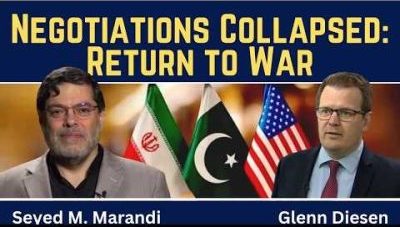
Seyed M. Marandi: Negotiations Collapsed – Return to War
or go to
Aletho News Archives – Video-Images
From the Archives
The US-Iran Scenario That Most Scares Israel
By Ali Haydar | Al-Akhbar | October 9, 2013
Israeli Prime Minister Benjamin Netanyahu issued a series of threats toward Iran and its interlocutors in the West, including the US, as serious negotiations on Iran’s nuclear program seem more plausible.
As a possible rapprochement looms between the US and Iran, Netanyahu has attempted to impose impossible Israeli conditions on the negotiators, such as the full dismantling of Iran’s nuclear program, not to mention threatening military force.
Whatever the deal that could materialize between Iran and the West, Israel is going to find itself before an open-ended path. One can foresee three possible scenarios… continue
Blog Roll
 Aletho News
- UK, Spain reject Trump’s new scheme to blockade Hormuz Strait
- Russian frigate ‘resurfaces’, chases off NATO pirates days after Kiev ‘sank’ it
- Ukraine Targets Russian Merchant Fleet With NATO Intel Support – Presidential Aide
- Russia’s ‘shadow fleet’ makes mockery of UK naval power
- Ukraine plans to attack Russian ships with Norwegian support
- US’s ‘Very Foolish’ Double Blockade of Hormuz Strait Makes Absolutely No Sense: Here’s Why
- China issues rules on countermeasures against foreign states’ unlawful extraterritorial jurisdiction
- Seyed M. Marandi: Negotiations Collapsed – Return to War
- Tomorrow’s naval blockade showdown
- ‘Israel’ attacks civilians to hide its embarrassing military failures & out of pure sadism
- If Americans Knew
- Critical shortages in Gaza, Lebanon in ruins, “piracy” in Iran – Daily Update
- US-Iran ceasefire negotiations make zero progress – Daily Update
- Pro-Israel ‘Thinktanks’ and Individuals who Influence U.S. Foreign Policy
- Mearsheimer reveals how Israel dictates US policies on Iran, Gaza – video
- After killing 350+, Israel still has a “score to settle” with Lebanon before ceasefire – Daily Update
- Military aid to Israel emerges as the latest political litmus test for Democrats
- The only Palestinian children’s rights organization closes following years-long Israeli campaign against it
- ‘I Can’t Forget the Smell’: Lebanese Reel After Israel Kills Over 300 in Single Day
- DNC Shoots Down Resolutions Calling Out AIPAC and Limiting Arms to Israel
- TCN: Is Israel Blackmailing President Trump?
- No Tricks Zone
- Cave Discovery Reveals Today’s Desert Climates Were Recently Far Warmer, Wetter, Teeming With Life
- German Expert: Heat Dome Led To Record Temps In Western USA…Warmer In 1934, 1936
- New Study: No Linear Warming Or Glacier Retreat Along Northern Antarctic Peninsula Since 1980s
- An Inconvenient Tree: Uncovered In Alps… Europe Much Warmer Than Today 6000 Years Ago
- New Study Reports A 60% Slowdown In Greenland’s Ice Loss Rate In The Last Decade
- Low Intensity Tornado Wrecks Major Solar Farm, Creating A Potential Toxic Dump
- New Study Finds Warming Saves Lives…Cold Temperatures 12 Times More Deadly Than Excess Heat
- German Science Blog Accuses PIK Climate Institute Of Hallucinating Climate Tipping Points
- Devastating Assessment Of Comirnaty Vaccine By Former Senior Pfizer Europe Toxicologist
- New Study: CO2 Is ‘Effectively Negligible’ As An Explanatory Climate Change Factor Since 2000
 Aletho News