Politics in bad faith: Alexandria Ocasio-Cortez campaigns in Michigan
By Andre Damon | WSWS | July 31, 2018
Alexandria Ocasio-Cortez, a member of the Democratic Socialists of America, visited Southeast Michigan this past weekend. Her primary victory last month over New York Congressman Joe Crowley has made her, virtually overnight, a leading spokesperson for the Democratic Party.
Ocasio-Cortez appeared at rallies in Detroit, Flint and Ypsilanti, as part of a statewide tour in support of Abdul El-Sayed, a former Detroit health department official running for governor of Michigan.

Ocasio-Cortez speaks at Wayne State University in Detroit
Ocasio-Cortez has been lionized in the press as the leader of a radical wave sweeping over the Democratic Party. Given the location of her events—including Detroit, the poorest large city in America, and Flint, which has been devastated by a lead water crisis—anyone taking her and the DSA’s pretenses to “socialism” seriously might have expected to hear bold proposals for tackling America’s rampant social inequality.
But when it came time for her to speak, what followed was a torrent of evasive and dishonest platitudes. She began her remarks at Wayne State University in Detroit:
My fingers are tingling right now because I know that this room is not just a rally, not just an audience, or even just a community; this is movement. Movement cannot be stopped, movement is like a wave; that energy cannot be contained, and Abdul, like many others, is just the crest, is just the foam at the tip of that wave. This is a movement so much bigger than just one person, there is no one person that is the future, there is a people that is the future.
To see such statements in print is to confirm the impression they produce on the listener: So much hot air.
America needs a “salt of the earth government,” Ocasio-Cortez went on, because, “We know that what is right in one place is what is right in all places.” And so on and so forth.
Like Barack Obama, whom she acknowledges as an inspiration, Ocasio-Cortez revels in seemingly profound motivational statements that are, upon the slightest examination, shown to be devoid of content. Her speeches are a variant of Obama’s slogan: “Yes we can.” She makes no effort to explain why Obama’s “Yes we can” was turned into eight years of “No we can’t.”
She continued, “The future of this nation and the future of this party is working class, the future of this party is working people, the future of this party is the marginalized, it is women, it is gender-extended people, it is people of color, it is the affirmation of justice, that is the future of this party.”
This invocation of the working class, mixed with appeals to other “identities,” is in bad faith, because the entire purpose of her campaign, and of the existence of the DSA, is to promote the Democratic Party, which, along with the Republicans, is a party of the corporate and financial oligarchy.
The Democrats are currently in the midst of a ferociously right-wing campaign centered on denunciations of Trump for “betraying” the country to Russia. In the midterm elections, the Democrats are fielding an unprecedented number of former members of the CIA and the military, which reflects their position as the preferred party of dominant sections of the military-intelligence apparatus.
Ocasio-Cortez’s inability to say anything genuinely oppositional, let alone radical, is bound up with her political role. She has quickly been absorbed into the Democratic Party establishment, and her rhetoric conforms to its politics. In promoting a right-wing party, her “left-wing” gloss is reduced to empty slogans.
Only a few sentences of her speech touched on actual policy. “The future of this party is improved and expanded Medicare for all,” she declared. For Abdul El-Sayed, “Medicare for all” means a statewide health care system paid for by workers from their own paychecks, one which his website boasts will exempt a substantial number of businesses from health care contributions.

Abdul El-Sayed
Such campaign promises are meaningless anyway. Obama declared himself a “proponent of a single payer universal health care program” in 2003, before going on to implement the “Affordable Care Act,” a reactionary attack on health care that shifts the burden from corporations and the state to workers by requiring individuals to purchase private insurance. This was cynically packaged as a major social “reform.”
Of particular note in the rallies to which Ocasio-Cortez spoke was the absence of any reference to foreign policy or the slightest hint of opposition to war. In fact, it was as if the rest of the world did not exist.
When a WSWS reporter asked the candidates at the post-rally press briefing in Detroit, “Do both of you support withdrawing all US troops from the Middle East and Africa?” El-Sayed gave an evasive non-answer: “We’ve got to make sure that we are focused on a foreign policy that articulates what we all can do when we come together around a more peaceful world.”
A staffer immediately attempted to conclude the briefing. When the reporter restated the question, “Ms. Ocasio-Cortez, are you anti-war? Do you support withdrawing all US troops from the Middle East?”
She replied, “I’m sorry, I’m here to support Abdul.”
The press conference immediately concluded, and the candidates were whisked away. (The next day, another WSWS reporter asked Ocasio-Cortez the same question at a rally in Ypsilanti, Michigan. She gave the same rehearsed answer.)
After the conclusion of the press conference, a WSWS reporter asked a high-level Ocasio-Cortez staffer, “What does she think the tax rate on the top income bracket should be?” He said he could not answer that question, because “She’s just focused on getting candidates with a similar program elected right now.”
In other words, Ocasio-Cortez can’t even commit to an explicit policy of raising taxes on the wealthiest section of society. In the spectrum of traditional American politics, this places her “democratic socialism” somewhere on the left wing of the 1960s-era Republican Party. Her inability to make any statement in opposition to war likewise put her to the right of both major Democratic nominees in the 1968 presidential primaries, who ran on an anti-war program.
The events make clear the political function of the Democratic Socialists of America. Far from creating a politically independent socialist movement, the DSA functions as an adjunct of the Democratic Party, providing candidates whose programs are largely indistinguishable from the rest of the party and are compatible with the agenda of the “CIA Democrats.”
The political role of Ocasio-Cortez and a slew of similar, DSA-backed candidates is to put a “left-wing,” “progressive,” youth-oriented, and multicultural gloss on a right-wing, pro-war party.
Moon-Strzok No More, Lisa Page Spills the Beans
By Ray McGovern | Consortium News | July 23, 2018
Former FBI attorney Lisa Page has reportedly told a joint committee of the House of Representatives that when FBI counterintelligence official Peter Strzok texted her on May 19, 2017 saying there was “no big there there,” he meant there was no evidence of collusion between the Trump campaign and Russia.
It was clearly a bad-luck day for Strzok, when on Friday the 13th this month Page gave her explanation of the text to the House Judiciary and Oversight/Government Reform Committees and in effect threw her lover, Strzok, under the bus.
Strzok’s apparent admission to Page about there being “no big there there” was reported on Friday by John Solomon in The Hill based on multiple sources who he said were present during Page’s closed door interview.
Strzok’s text did not come out of the blue. For the previous ten months he and his FBI subordinates had been trying every-which-way to ferret out some “there” — preferably a big “there” — but had failed miserably. It is appearing more and more likely that there was nothing left for them to do but to make it up out of whole cloth, with the baton then passed to special counsel Robert Mueller.
The “no there there” text came just two days after former FBI Director James Comey succeeded in getting his friend Mueller appointed to investigate the alleged collusion that Strzok was all but certain wasn’t there.
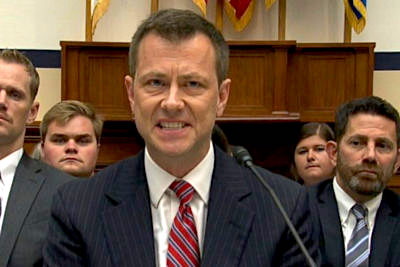
Strzok during his public testimony earlier this month.
Robert Parry, the late founder and editor of Consortium News whom Solomon described to me last year as his model for journalistic courage and professionalism, was already able to discern as early as March 2017 the outlines of what is now Deep State-gate, and, typically, was the first to dare report on its implications.
Parry’s article, written two and a half months before Strzok texted the self-incriminating comment to Page on there being “no big there there,” is a case study in professional journalism. His very first sentence entirely anticipated Strzok’s text: “The hysteria over ‘Russia-gate’ continues to grow … but at its core there may be no there there.”(Emphasis added.)
As for “witch-hunts,” Bob and others at Consortiumnews.com, who didn’t succumb to the virulent HWHW (Hillary Would Have Won) virus, and refused to slurp the Kool-Aid offered at the deep Deep State trough, have come close to being burned at the stake — virtually. Typically, Bob stuck to his guns: he ran an organ (now vestigial in most Establishment publications) that sifted through and digested actual evidence and expelled drivel out the other end.
Those of us following the example set by Bob Parry are still taking a lot of incoming fire — including from folks on formerly serious — even progressive — websites. Nor do we expect a cease-fire now, even with Page’s statement (about which, ten days after her interview, the Establishment media keep a timorous silence). Far too much is at stake.
As Mark Twain put it, “It is easier to fool people than to convince them that they have been fooled.” And, as we have seen over the past couple of years, that goes in spades for “Russia-gate.” For many of us who have looked into it objectively and written about it dispassionately, we are aware, that on this issue, we are looked upon as being in sync with President Donald Trump.
Blind hatred for the man seems to thwart any acknowledgment that he could ever be right about something—anything. This brings considerable awkwardness. Chalk it up to the price of pursuing the truth, no matter what bedfellows you end up with.
Courage at The Hill
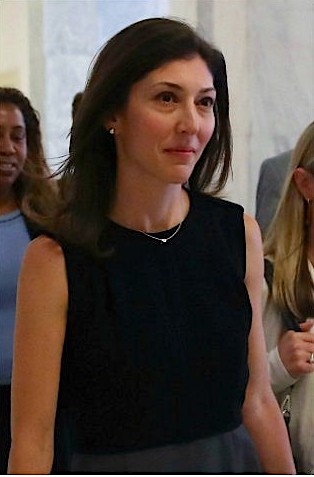
Page: Coughs up the meaning of ‘there.’
Solomon’s article merits a careful read, in toto. Here are the most germane paragraphs:
“It turns out that what Strzok and Lisa Page were really doing that day [May 19, 2017] was debating whether they should stay with the FBI and try to rise through the ranks to the level of an assistant director (AD) or join Mueller’s special counsel team. [Page has since left the FBI.]
“‘Who gives a f*ck, one more AD [Assistant Director] like [redacted] or whoever?’” Strzok wrote, weighing the merits of promotion, before apparently suggesting what would be a more attractive role: ‘An investigation leading to impeachment?’ …
“A few minutes later Strzok texted his own handicap of the Russia evidence: ‘You and I both know the odds are nothing. If I thought it was likely, I’d be there no question. I hesitate in part because of my gut sense and concern there’s no big there there.’
“So the FBI agents who helped drive the Russia collusion narrative — as well as Rosenstein’s decision to appoint Mueller — apparently knew all along that the evidence was going to lead to ‘nothing’ and, yet, they proceeded because they thought there was still a possibility of impeachment.”
Solomon adds: “How concerned you are by this conduct is almost certainly affected by your love or hatred for Trump. But put yourself for a second in the hot seat of an investigation by the same FBI cast of characters: You are under investigation for a crime the agents don’t think occurred, but the investigation still advances because the desired outcome is to get you fired from your job. Is that an FBI you can live with?”
The Timing
As noted, Strzok’s text was written two days after Mueller was appointed on May 17, 2016. The day before, on May 16, The New York Times published a story that Comey leaked to it through an intermediary that was expressly designed (as Comey admitted in Congressional testimony three weeks later) to lead to the appointment of a special prosecutor to investigate collusion between the Trump campaign and Russia. Hmmmmm.
Had Strzok forgotten to tell his boss that after ten months of his best investigative efforts — legal and other—he could find no “there there”?
Comey’s leak, by the way, was about alleged pressure from Trump on Comey to go easy on Gen. Michael Flynn for lying at an impromptu interrogation led by — you guessed it — the ubiquitous, indispensable Peter Strzok.
In any event, the operation worked like a charm — at least at first. And — absent revelation of the Strzok-Page texts — it might well have continued to succeed. After Deputy Attorney General Rod Rosenstein named Mueller, one of Comey’s best buddies, to be special counsel, Mueller, in turn, picked Strzok to lead the Russia-gate team, until the summer, when the Department of Justice Inspector General was given the Strzok-Page texts and refused to sit on them.
A Timeline
Here’s a timeline, which might be helpful:
2017
May 16: Comey leak to NY Times to get a special counsel appointed
May 17: Special counsel appointed — namely, Robert Mueller.
May 19: Strzok confides to girlfriend Page, “No big there there.”
July: Mueller appoints Strzok lead FBI Agent on collusion investigation.
August: Mueller removes Strzok after learning of his anti-Trump texts to Page.
Dec. 12: DOJ IG releases some, but by no means all, relevant Strzok-Page texts to Congress and the media, which first reports on Strzok’s removal in August.
2018
June 14: DOJ IG Report Published.
June 15; Strzok escorted out of FBI Headquarters.
June 21: Attorney General Jeff Sessions announces Strzok has lost his security clearances.
July 12: Strzok testifies to House committees. Solomon reports he refused to answer question about the “there there” text.
July 13: Lisa Page interviewed by same committees. Answers the question.
Earlier: Bob Parry in Action

Journalist Robert Parry
On December 12, 2017, as soon as first news broke of the Strzok-Page texts, Bob Parry and I compared notes by phone. We agreed that this was quite big and that, clearly, Russia-gate had begun to morph into something like FBI-gate. It was rare for Bob to call me before he wrote; in retrospect, it seemed to have been merely a sanity check.
The piece Bob posted early the following morning was typical Bob. Many of those who click on the link will be surprised that, last December, he already had pieced together most of the story. Sadly, it turned out to be Bob’s last substantive piece before he fell seriously ill. Earlier last year he had successfully shot downother Russia-gate-related canards on which he found Establishment media sorely lacking — “Facebook-gate,” for example.
Remarkably, it has taken another half-year for Congress and the media to address — haltingly — the significance of Deep State-gate — however easy it has become to dissect the plot, and identify the main plotters. With Bob having prepared the way with his Dec.13 article, I followed up a few weeks later with “The FBI Hand Behind Russia-gate,” in the process winning no friends among those still suffering from the highly resistant HWHW virus.
VIPS
Parry also deserves credit for his recognition and appreciation of the unique expertise and analytical integrity among Veteran Intelligence Professionals for Sanity (VIPS) and giving us a secure, well respected home at Consortium News.
It is almost exactly a year since Bob took a whole lot of flak for publishing what quickly became VIPS’ most controversial, and at the same time perhaps most important, Memorandum For the President; namely, “Intelligence Veterans Challenge ‘Russia Hack’ Evidence.”
Critics have landed no serious blows on the key judgments of that Memorandum, which rely largely on the type of forensic evidence that Comey failed to ensure was done by his FBI because the Bureau never seized the DNC server. Still more forensic evidence has become available over recent months to be soon revealed on Consortium News, confirming our conclusions.
Ray McGovern works with Tell the Word, a publishing arm of the ecumenical Church of the Saviour in inner-city Washington. He was a CIA analyst for 27 years and, in retirement, co-founded Veteran Intelligence Professionals for Sanity.
US will not let Americans be questioned by Moscow, but demands extradition of 12 Russians
RT | July 19, 2018
Donald Trump has turned down Vladimir Putin’s proposal to allow Russian investigators interview Americans suspected of crimes, but still expects 12 Russians blamed of election meddling to arrive in the US, the White House said.
“It is a proposal that was made in sincerity by President Putin, but President Trump disagrees with it. Hopefully President Putin will have the 12 identified Russians come to the United States to prove their innocence or guilt, ” Sarah Sanders, White House spokeswoman, said in a statement on Thursday.
In case the White House may change its mind, the Senate unanimously approved the resolution, proposed by Minority Leader Chuck Schumer (D-New York) expressing the sense that the “United States should refuse to make available any current or former diplomat, civil servant, political appointee, law enforcement official or member of the Armed Forces of the United States for questioning by the government or Vladimir Putin.”
Following the summit with Trump in Finland’s capital in Helsinki earlier this week, the Russian President said Moscow may consider allowing the US Justice Department investigators to question the Russian citizens, who were charged with meddling in the US election in 2016.
However, Putin specified that such interaction may only take place if the Washington greenlights Moscow to interrogate American citizens, who are suspected of committing crimes in Russia. The list of those wanted by Russian law enforcement includes US ambassador to the country, Michael McFaul, and financier, Bill Browder, according to Russia’s Prosecutor Generals’ Office.
The treaty between Moscow and Washington, signed in the 1990-ies and allowing the interrogation of the suspects from the other country, was brought up by Putin during the media conference in Helsinki.
Earlier on Thursday, Rep. Eliot Engel (D-New York), the ranking member of the House Foreign Affairs Committee, and four other Democratic congressmen sent an open letter to Trump, urging the president to publically reject the Russian offer. “You must make clear that you will not allow American citizens or anyone on American soil to endure interrogation or harassment at the hands of Putin’s thugs,” they wrote.
The idea of Trump allowing the Americans to be interrogated by Russian investigators has been slammed by Trump’s opponents in both Democratic and Republican camps in the past few days. He was warned that even thinking about fulfilling Putin’s “outrageous” offer would amount to “an abuse of power” and threatened him with impeachment.
What did Trump promise Putin? Bring his interpreter to Congress & find out, Democrats insist
RT | July 18, 2018
Did Donald Trump secretly surrender America to Vladimir Putin in Helsinki? Suspicious Democrats want to know the truth by bringing the State Department interpreter to testify before Congress.
The first direct Trump-Putin talks on Monday were savaged by the critics. The US president was branded a “traitor” and “Putin’s poodle,” with political opponents and some members of his own party accusing him of “siding with the enemy.”
Trump predictably took a lot of flak for the statements he made during the press conference after the talks ended. But what did he and Putin actually discuss at their two-hour meeting? Some Democrats are keen to find out, and suggest his interpreter should clear things up.
The idea was initially voiced by Congressman Joe Kennedy III. “Trump’s translator should come before Congress and testify as to what was said privately immediately,” he tweeted shortly after the president parted ways with Putin in Helsinki.
The call to subpoena the interpreter was picked up by Senator Jeanne Shaheen, who said the State Department official will “uncover” what Putin and Trump discussed privately and help determine what the US president “shared with or promised Putin on our behalf.”
Congressman Bill Pascrell penned a letter to the leadership of the House Committee on Oversight and Government Reform, urging it to hold a public hearing with the US interpreter present at the Helsinki talks. This will reveal what was agreed “behind closed doors,” he wrote.
The State Department interpreter in question is Marina Gross who has been accompanying US delegations overseas since the days of the George W. Bush administration. If subpoenaed to appear before Congress, she would be required to testify under oath. It means Gross can be tried for perjury if she lies or otherwise willingly misleads the public.
The disclosure of private conversations by interpreters usually goes against codes of conduct adopted by professional organizations.
“In general, any information that’s confidential has to remain confidential even if you’re an interpreter. For example, attorney-client confidentiality extends to the interpreter,” American Translators Association spokeswoman Judy Jenner told The Hill. “But as a diplomatic interpreter, you are probably aware of how precarious things could possibly be.”
The notion that Trump might be having shady talks with Putin behind everybody’s back was floated by several prominent Democrats, such as House Minority Leader Nancy Pelosi and the head of the CIA under Barack Obama, John Brennan. “Why did Trump meet 1 on 1 with Putin? What might he be hiding from Bolton, Pompeo, Kelly, & the American public?” Brennan tweeted as the Helsinki talks were commencing.
READ MORE:
Lost in translation: CNN claims Putin admitted to election-meddling. He did not.
The Helsinki Summit: Trying to Turn the Page on the New Cold War
By Max Forte | Zero Anthropology | July 17, 2018
Finally, on Monday, July 16, 2018, the Helsinki Summit bringing together Russian President Vladimir Putin and US President Donald Trump took place, despite shrill demands that it be stopped, canceled, or turned into a platform for more aggression. “President Trump should cancel his meeting with Vladimir Putin until Russia takes demonstrable and transparent steps to prove that they won’t interfere in future elections. Glad-handing with Vladimir Putin on the heels of these indictments would be an insult to our democracy,” Senate Minority Leader Chuck Schumer said. Yet there could never be any “proof” of someone not doing something in the future, and to implement the conditions for this specific case would require turning off all the electricity in Russia and seizing all computers everywhere on its territory. It is thus plainly an absurd, irrational, and unrealistic statement that is meant to satisfy partisan emotional needs. As a recipe for international relations, it would be a disaster of a policy. In a desperate effort to maintain the interests vested in the new Cold War, Democrats tried to elbow their way into the summit, to no avail. In the US today, “resistance” means continuing, even escalating, the fabricated Cold War against Russia—resistance has become the catchy buzzword for what Eisenhower called the military-industrial complex, updated to include billionaire tycoons funding “social movements” operating as part of “civil society”.
Thus days before the event, President Trump pointed critically at the shrill media and Democrats for firing up the new Cold War:
“Heading to Helsinki, Finland – looking forward to meeting with President Putin tomorrow. Unfortunately, no matter how well I do at the Summit, if I was given the great city of Moscow as retribution for all of the sins and evils committed by Russia… … over the years, I would return to criticism that it wasn’t good enough – that I should have gotten Saint Petersburg in addition! Much of our news media is indeed the enemy of the people and all the Dems… … know how to do is resist and obstruct! This is why there is such hatred and dissension in our country – but at some point, it will heal!” (Twitter 1, Twitter 2, Twitter 3).
What united all of the US media, from Fox News to CNN and right across to MSNBC, was the dominance of the America-the-innocent-victim narrative. Joining them was an established band of encrusted “neocons” such as Senator John McCain who asserted, in the usual evidence-free fashion of the kind that brought the US to Iraq, that Putin was guilty of “ongoing aggression towards the United States”. The “no blame” narrative (that permanently shields Americans from the consequences of their actions) was joined by the insistence that the secret police and espionage agencies should just be believed, without doubt, and that such agencies should have primacy over democratically elected representatives. Funny that this is what should issue from the same mouths that claim to warn us against “fascism”.
However, in an amazing press conference featuring Putin and Trump at the close of the summit, virtually everything the Democrats, their neocon associates, the media, and the military-intelligence establishment did not want to hear, is what they were instead forced to hear. Allegations of “collusion” between Trump and Russia faced thorough embarrassment as utter idiocy. Putin tossed back allegations of Russian interference in US elections, and essentially laughed at the bogus “assessment” that has been treated as if it were sacrosanct truth in the US media, such that Trump was expected to perform an auto da fé in front of the new Cold War media’s Grand Inquisition. There was no hint of Russia withdrawing from Syria (there at the Syrian government’s request)—though Trump reiterated the near total defeat of ISIS that had been achieved, which also eliminates the US’ rationale for its illegal intervention in Syria. Russia refused to accept that Crimea did not legally, peacefully, and democratically choose to join Russia, to which it belonged for the majority of its history. On these and other issues, it was as if a stake had been driven through the heart of the new Cold War. Of course, it was also just a beginning, and not an end. In an interview with Fox News’ Chris Wallace, Putin said that the Helsinki Summit was simply “a good start” to ending a revived Cold War that significantly endangered the world. Trump also said that US-Russia relations had reached a disastrously low point, without precedent, and that had ended with the Helsinki Summit. This was an important diplomatic breakthrough, and a legitimate success. Then how was it turned into a moment of infamy in the US? Just how deep is the addiction to empire?
Misunderstanding the Previews
Any student of international relations will know that such summits leave as little room as possible to spontaneity and chance. Instead, they are preceded by officials meeting and corresponding behind the scenes, in planning the event weeks and months in advance. They collaborate in drafting an agenda, and preparing the process of formulating and articulating what could become points of agreement, to be ironed out when the leaders meet in person. That was true of the Helsinki Summit as it was true of the Singapore Summit, as it has been true of all other major summits in the last three centuries of international diplomacy. The notion that Donald Trump would somehow be “winging” this and that the meeting could produce a “surprise” is something entertained by either those who do not know better, or those who pretend to be ignorant. The fact of months of preparation was confirmed by Vladimir Putin himself, at the opening of his interview with Chris Wallace of Fox News on the evening of the summit, July 16. Unfortunately the media completely missed the significance of these statements.
As such, what Trump did in the lead up to the summit was to begin to widen the path for his point of departure. Speaking of trade relationships with “allies,” days before the Helsinki Summit Trump stated: “Sometimes our friends, when it comes to trade, are treating us worse than the enemies”. A day before the Helsinki Summit, Trump told a journalist that, “I think we have a lot of foes. I think the European Union is a foe, what they do to us in trade. Now, you wouldn’t think of the European Union, but they’re a foe”.
Trump’s European counterparts seemed to understand what was coming too: some officials confessed that, as the NATO gathering approached, they were “scared shitless” by Trump. Leon Panetta claimed that the Europeans were “scared to death” that Trump would seriously act on his “America First” strategy. Being “absolutely worried” seemed justified, as NATO members had no good arguments for maintaining NATO and for perpetuating what some astute analyses saw as an obsolete and abusive relationship. On his way to the NATO gathering in Belgium, President Trump said this about the alliance and how it benefited allies: “Frankly it helps them a lot more than it helps us”. The divisions dominating NATO, since Trump took office, were now apparent to anyone willing to pay some attention.
Predictably, The Economist voiced the outcry of liberal imperialist elites for the waning NATO alliance, astonishingly touting it as an anchor for democracy—this, despite all evidence to the contrary, particularly NATO’s disastrous intervention in Libya, and the corrupt and rigged elections which it supervised in Afghanistan. The argument one could not credibly make, is the one about NATO as a support system for democracy. Moreover, the manner in which NATO is upheld, against the wishes of citizens in its member states, who are tired of NATO’s incessant war agenda, and the way NATO leaders try to delegitimize democratically-elected leaders, blasts more holes into the democracy illusion advanced by NATO’s elitist apologists. Indeed, democracy is in decline even among NATO members themselves, albeit according to some questionable analyses. Either way, democracy is the last argument one should ever make in defense of NATO, and is easily one of the worst arguments. As for the notion that the military is the supreme guardian and supervisor of democracy, that is better left with the likes of General Augusto Pinochet and other legitimate “fascists”.
The really significant moment, misinterpreted and misunderstood in every article I have read, concerned Trump’s comments on Germany. Trump expressed acute condemnation of Germany, going as far as calling it a “captive” of Russia, in language evocative of Russiagate conspiracy theories. For those who would use Russiagate conspiracy theories against Trump, provoking a new Cold War, Trump seized on their contrived fears and turned them against the fear-mongers. Some argued, with considerable merit, that NATO itself has helped to cause a new Cold War. Trump’s harangue against Germany’s agreement to be connected via a gas pipeline to Russia, pointed to the German government’s hypocrisy—in demanding the US remain committed to the defense of Germany, presumably against Russia, while doing business with Russia. Implausibly, the German response was that the two matters were separate. Seizing on this contradiction, and using it for his own purposes, Trump himself said this: “I am meeting with President Putin next week and getting along—let me tell you, getting along with Russia and getting along with China and getting along with other countries is a good thing. It’s not a bad thing. It’s a good thing”. Indeed, Trump later altered his message, saying the pipeline deal would not be so bad, if NATO states improved their relations with Russia—which seems to have been his larger point, one that both undermined the new Cold War and NATO’s very own reason for being. As for why Trump is doing all of this, right now, so far the lone genius in the story who has correctly discerned the forces producing the pattern, is the eccentric and entertaining Max Keiser.
How Trump used the new Cold War and its Russiagate conspiracy theory rhetoric against its own purveyors, calling out their hypocrisy and then attaching a price to it, seems to have been missed in most analyses. It was a particularly deft move, similar to his holding neoliberals hostage to their own free trade rhetoric (while they practiced less-than-free trade). In this as in other instances, Trump proved to be more clever than many of his professional critics.
What cannot be said, with any justification, is that “nobody saw this coming”. Trump’s messaging has been consistent in recent weeks and months, taking aim at the European Union, at NATO, at Canada (now a “national security threat”), and even at the UK over Brexit as in his “explosive” interview with The Sun. Finally, Trump also denounced the “foolishness” that prevailed in the US around Russia (as displayed in the reactions in the next section):
“Our relationship with Russia has NEVER been worse thanks to many years of U.S. foolishness and stupidity and now, the Rigged Witch Hunt!”—Donald J. Trump: @realDonaldTrump
Taken together, all of these positions are united by their divergence from the status quo ante, the neoliberals’ dream of a New World Order, of a “transatlanticism” that married Europe and the US in an imperial alliance that sought to command, and thus exploit, the rest of the planet. In the US, it repaired the apparent belief among neoliberals of the right and left that the political system is one where the FBI/CIA rule at the top, and the President is second.
The Alarmists: Addicted to Imperialism
The US’ foreign policy establishment, and specifically the military-industrial-complex, had been alarmed at least since 2016 that Trump, in seeking to improve relations with Russia, would yank the rug out from underneath their lucrative anti-Russia scare-mongering. True to form, just three days before Trump would meet with Putin and in an obvious attempt to “pressure” Trump, Deputy Attorney General Rod Rosenstein issued an indictment alleging 12 Russian operatives had attempted to interfere with the US election of 2016. Not facing a realistic prospect that these 12 individuals would ever appear in a US court, the alleged evidence against them would never be tested—the easiest indictment to make, as Glenn Greenwald put it. Under the rules of due process, it also means such operatives were innocent, simply because they had yet to be proven guilty. One can also wonder, if one wants to pretend being naïve, whether the US would ever fork over its intelligence agents if they were indicted by a foreign state.
Of course an onslaught of alarmist, anti-Russia and anti-Trump hyperbole vented from the US media once more, as if oblivious not only to popular distrust of the same media, but the incredible fatigue over everything constantly being likened to Pearl Harbor. Absurdly irrational contradictions continued—the Russians apparently stole DNC emails, and then spread “fake news”…except both of those statements cannot be true at the same time. Either the news was fake, or the emails were real and thus dissemination of their contents was real. Clearly Rosenstein, with the aid of the FBI’s Bob Mueller, was intent on destabilizing Trump’s government and specifically its authority to conduct foreign policy, employing a transparently cheap political stunt that casts Mueller in the worst possible light. (The move backfired somewhat: almost immediately it was announced that Rosenstein would face impeachment, while Trump pointed out that the alleged Russian interference occurred under Obama, which did nothing to stop it.) The indictment also came just one day after a scandalous performance by the FBI’s Peter Strzok in front of cameras in an open Congressional hearing, revealing the level of corruption, bigotry and bias permeating the highest levels of the FBI. Strzok successfully caricatured himself as the classic fascist secret policeman. Meanwhile, Rosenstein’s opportunistic and futile indictment not only failed to present any new information, it left out a great deal about how Republicans were also allegedly targeted.
If the Democrats and the media only suggested opposition to Donald Trump’s summit with Kim Jong-un a month before, they both came out openly against any meeting with Vladimir Putin. In the two days leading up to the event, there were shrill demands that the meeting be canceled outright. As such, the Democrats and their media were sealing their fate as the party of imperialism, the party of the Cold War, and the party of the past. Their denunciations of diplomacy served as a reminder of why they deserved to lose the 2016 elections.
Witness the reactions that came from Democrats:
“Every single day, I find myself asking: what do the Russians have on @realDonaldTrump personally, financially, & politically? The answer to that question is that only thing that explains his behavior & his refusal to stand up to Putin.”—Nancy Pelosi: @NancyPelosi
“In the entire history of our country, Americans have never seen a president of the United States support an American adversary the way @realDonaldTrump has supported President Putin.”—Senator Chuck Schumer: @SenSchumer
“Donald Trump’s press conference performance in Helsinki rises to & exceeds the threshold of ‘high crimes & misdemeanors.’ It was nothing short of treasonous. Not only were Trump’s comments imbecilic, he is wholly in the pocket of Putin. Republican Patriots: Where are you???”—John Brennan, CIA Director under Obama: @JohnBrennan
“For the President to side with Putin over his own intelligence officials and blame the United States for Russia’s attack on our democracy is a complete disgrace.”—Senator Mark Warner, in just one message among a torrent of similar denunciations: @MarkWarner
“Once again, @realDonaldTrump takes to the international stage to embarrass America, undermine our institutions, weaken our alliances, & embrace a dictator. Russia interfered in our elections & attacked our democracy. Putin must be held accountable – not rewarded. Disgraceful.”—Elizabeth Warren: @SenWarren
“Today is a good day for Putin and the oligarchs in Russia. It is a bad day for people in the United States and all over the world who believe in democracy and who are trying to understand what world our idiot president lives in.”—Bernie Sanders: @SenSanders
Also, here are some reactions from liberal imperialist Republicans:
“Today’s press conference in #Helsinki was one of the most disgraceful performances by an American president in memory.”—Senator John McCain: @SenJohnMcCain
“I never thought I would see the day when our American President would stand on the stage with the Russian President and place blame on the United States for Russian aggression. This is shameful.”—Senator Jeff Flake: @JeffFlake
“Missed opportunity by President Trump to firmly hold Russia accountable for 2016 meddling and deliver a strong warning regarding future elections. This answer by President Trump will be seen by Russia as a sign of weakness and create far more problems than it solves.”—Senator Lindsey Graham: @LindseyGrahamSC
“President Trump must clarify his statements in Helsinki on our intelligence system and Putin. It is the most serious mistake of his presidency and must be corrected—-immediately.”—Former House Speaker Newt Gingrich: @newtgingrich
The Reactionary Resistance and its Struggle with Reality
Most of the Republicans quoted above are “never Trump” has beens, on their way out of electoral politics because they became so unpopular with constituents, or are no longer involved in elections. The never Trumpers are boiling at their collective failure, having been driven from the Republican Party and thus no longer in a position to dictate its agenda. Like other exiles the US has hosted, they are determined to carry out regime change from another shore.
As for the Democrats, and specifically Bernie Sanders, we have known for years that Sanders is the perfect example of a “progressive” who is an imperialist half-head. Bernie Sanders, whose greatest political acts of courage these days involve pushing for a higher wage for Walmart workers, was already on the record as a supporter of NATO and taking an aggressive stance toward Russia. Had the imperial left seen its dream of a Sanders presidency come true, we already know that it would have just been more of the same. On NATO Sanders himself stated in the Democratic debate in Wisconsin on February 11, 2016:
“Russia’s aggressive actions in the Crimea and Ukraine have brought about a situation where President Obama and NATO—correctly, I believe—are saying we’re going to beef up our troop level in that part of the world to tell Putin that his aggressiveness is not going to go unmatched. We have to work with NATO to protect Eastern Europe against any kind of Russian aggression”.
But what did these people seriously expect of Donald Trump? Did they imagine that President Trump would essentially invalidate his own electoral victory, stripping it of all legitimacy, by affirming that the “Russian collusion” stories were what they are patently not, i.e., serious, credible, evidence-based, truthful representations of reality? Apparently the “logic” at work among his critics is that if Trump fails to agree that his election was the result of a Russian conspiracy, then that means he is the agent of a Russian conspiracy.
Otherwise Trump’s “failures” at Helsinki appear to have been that, (a) he was critical of American spies and secret police, and, (b) that he was diplomatic toward Putin. By criticizing American agencies, Trump diminished the American claim to perpetual victimhood. The US is in the grips of a generalized fever, ruled by a panic that privileges “victims” and which constructs victims everywhere one looks. Trump thus challenged the prevailing fiction that America was without any blame—and here Trump was making a major break with his own narratives. His critics denounced the “moral equivalency” implicit in his remarks at the Helsinki press conference, which is a familiar complaint of American exceptionalists who have long been trained in the arts of hypocrisy and decontextualized self-representation.
Speaking of hypocrisy, Trump’s Democratic critics persisted in their failure to explain what their “reset” with Russia would have looked like, if the little that Trump did so offended them. What exactly did Obama mean in 2012 by his otherwise clever retort to the hawkish Mitt Romney, “the 1980s called and they want their foreign policy back”? Worse yet is the glaring contradiction between opposing an economic Cold War with China, played out on the field of trade, while proposing to escalate a Cold War with Russia. What sort of globalism is that? “Globalization has transformed American universities into a front line for espionage,” argues Daniel Golden, author of the recently published book, Spy Schools. However, The New York Times, having energetically fanned the flames of anti-Russian hysteria and xenophobic paranoia, it now accuses the Trump administration of doing just that, only with reference to China and Chinese researchers on US campuses who may soon face tighter restrictions in gaining access. What media elites obfuscate, of course, is that deglobalization is increasingly a fact. Whether the favourite target is Russia (for Democrats) or China (for Trump’s Republicans), either way the logic, means, and outcomes are the same: diminished international cooperation at the heart of the globalist ethos.
On the other hand, whether they admit it or not, the Democrats (and the EU) are fully on Russia’s side in defending the Iran nuclear agreement, which Russia upholds and which Trump abrogated. How do the Democrats explain this rather strange overlap in interests? Are they secretly colluding with the Kremlin to support Tehran? Would not the Uranium One deal exposed by the New York Times be further evidence of such collusion? When one lowers the threshold for rational thought, the way critics of Trump have done, then any old crazy talk should suddenly sound plausible.
Trump’s critics also expected him to shame and berate Putin, escalating tensions to the breaking point, in what would have been an unprecedented scene of personal aggression on the diplomatic stage. Yet recall how utterly charming and amiable Vice President Richard M. Nixon, an arch anti-communist, was when he publicly met with Soviet Premier Nikita Khrushchev during the famous “kitchen debate”. Trump was hectored for merely shaking hands with Kim Jong-un, taken as a sure sign that he “loves dictators”. The question then becomes: with a domestic opposition so ostensibly debased and pathological, who wouldn’t love foreign dictators instead?
Demonizing Russia: Inventing Fictions to Boost Faith in a Defunct World Order
In an interview with Larry King, Russia’s Foreign Minister, Sergei Lavrov, outlined the issues of importance to Russia—these ranged from a strong critique of the West’s humanitarian imperialism, to its double-standards on the popular referendum in Crimea that saw its Russian majority choose to join Russia (there was no “invasion”), to the continued threat of NATO expansion. Lavrov specifically cited NATO as an “atavism of Cold War times” and criticized the “inertia of Cold War thinking” that dominates the West. As for the much touted “rules based international order,” Lavrov correctly pointed out that it was built on Western double-standards that allowed the US to flout international law with impunity and live by a separate set of norms. Separately, the Kremlin spokesperson, Dmitri Peskov, pointed out that it was not Russia that was responsible for initiating the deterioration in relations, and that the US seemed to particularly resent that Russia would not simply bend to its will like a dependent puppet state. In advance of the summit, Peskov made some very reasonable and basic observations on the need for peaceful cooperation, while each state should safeguard the interests of its own citizens. There was nothing here indicative of the fabled Russian “aggression” that seems to preoccupy the shrill, imperialist “resistance” in the US.
But then rational, critical, independent-minded thought is not allowed. We are instead plunged into a free fall to new depths of distortion, exaggeration, and outright invention.
Thus in the US media and political circles (the two being virtually indistinguishable), it has become a matter of fact that “Russia invaded Crimea”. Do they mean like the US invaded Iraq? Fine. Then it should be a very simple matter for the reader to find us photographs and videos of Russian columns pouring into Crimea, seizing buildings, and engaged in gunfire. Also, remind us of the body count resulting from Russia’s “invasion”. The actual reality is that Russia neither invaded nor annexed Crimea, not if words are to have any meaning at all. Acceptance of the notion that Russia invaded Crimea indicates that one is already prepared to accept any sort of fabrication as if it were fact. Nothing has apparently been learned from the great WMDs myth of 2003, except how to repeat it and amplify it. This involves a deeply perverse commitment, and there is no point railing against “alternative facts” when all you do is recite alternatives to facts.
And what exactly is “the solution” to Crimea? Is it about forcing the majority of Crimeans to subjugate themselves to rule by a government that has resolutely persecuted Russian communities within its borders? What sort of idea of justice is this exactly? Let us not forget how that government came into being in Ukraine, which was through a Western-backed coup and violence in the streets, and which has also witnessed the rise to power of actual neo-Nazis.
Then there is the assertion and easy acceptance of the fabrication that Russia aided “the Syrian regime” in its “chemical weapons” attacks on civilians. What chemical attacks? Has the reader noticed the almost total silence in the media about the facts actually found on the ground? After the US, France, and the UK used a “chemical attack” as a justification for attacking Syria, Western media largely ignored the facts that were revealed by the Organization for the Prohibition of Chemical Weapons, tasked by the UN to conduct an investigation. In a July report, the OPCW stated that it had found “no organophosphorous nerve agents or their degradation products were detected in the environmental samples or in the plasma samples taken from alleged casualties”. That it called the casualties “alleged,” meant it also found none. No nerve agents, no casualties. Again, let me ask: what chemical attacks? Like the Iraq WMD myth, once again Western governments and media perpetrated egregious lies against their own citizens, to justify acts of unlawful military aggression. How many more times do we need to repeat this before you finally learn the lesson? This is a very serious question, because what is being challenged here is your human capacity to learn, and to remember what you learned.
We are also told that Russians subverted US elections. If it had been true, how would you have been able to spot their subversion among all the other subversion? Here I am referring to the persistent subversion of American politics by giant corporations and oligarchic financiers, and of the pervasive influence of the military-industrial complex, to the point that US elections risked degenerating into mere demonstration elections staged by the corporate imperial state, not to mention an impressive array of foreign donors (recall the Clinton Foundation). Logically, the only way one can “subvert” something that is already corrupted, is by fixing it.
Repeatedly we have been instructed that all of the US’ intelligence agencies concluded that there was significant Russian interference in the US elections of 2016. First, it would be useful to consult the resources on Russiagate compiled on Fabius Maximus. Second, it is important to remember that: “The intelligence community as a whole has not been tasked to make a judgment and some key members of that community did not participate in the report that is routinely cited as ‘proof’ of ‘Russian interference’,” as explained in careful detail by Jack Matlock, a veteran of government service with experience on national security matters at the highest levels. Next, remember that US media such as the New York Times have been forced to withdraw statements that all of the US intelligence agencies reached these so-called conclusions about Russian interference, not to mention all of the other “fake news” actually produced by CNN, The Washington Post and others on Russiagate. Third, recall that veterans of US intelligence agencies openly challenged claims that Russians hacked the emails of the DNC. Even this short list should, in the mind of any reasonable adult, provoke at least some misgivings.
Finally, in what became an all too obvious and predictable pattern, shortly before Donald Trump was to finally meet with Vladimir Putin—worrying the globalists and interventionist establishment—another chemical hoax emerged, this time involving a random couple being poisoned not far from the site of the Skirpal attack in the UK. The only thing that was apparent about this attack, according even to The Guardian which usually lusts after anti-Russia conspiracy theories, is that “someone is out to embarrass Vladmir Putin”:
“all we can see are the devious tools of the new international politics. We see the rush to judgment at the bidding of the news agenda. We see murders and terrorist incidents hijacked for political gain or military advantage. Ministers plunge into Cobra bunkers. Social media and false news are weaponised. So too are sporting events”.
That Vladimir Putin should publicly assert, as he did on July 16, that the Russian state has no compromising information about Donald Trump, should have put an end to that story. Why? Simply because if in the future the Russian government should purport to have any such information, it will have been contradicted and thus invalidated by Putin’s prior statement. There is no point in having compromising information, if you challenge its very existence at the outset. Case closed.
Yet, we are instructed that Russia is “untrustworthy”. What makes it so unworthy of trust? The real problem about Russia is twofold. One is that Russia has been cynically exploited by Americans which have used Russia as a cheap political football in their domestic conflicts. The second problem is that Russia is the kind of state that does not immediately bend its knee to Western demands. What Americans describe as “trustworthy” is exactly what describes a puppet, an instrument that bends to the American will. It is thus not terribly flattering to have an American call you a “trusted partner”.
What especially irks Americans in the foreign policy establishment is that Vladimir Putin is an obviously brilliant statesman, and that Russian diplomats have bested their Western counterparts for decades, both in their expertise and professionalism, and in their deep appreciation of international law, sovereignty, and self-determination. These are all qualities to be detested.
In the interview with Wallace, Putin provided a short list of Russian complaints, that rarely get aired by the US media: NATO’s relentless expansion eastward, even after the Cold War had ended, and in violation of promises to Russia in return for its agreement to allow the reunification of Germany. Added to this is the US’ unilateral withdrawal from the ABM Treaty. Then added to that was the US and European intervention in Yugoslavia, participating in its illegal breakup, and then backing a coup in Ukraine. While freaking out about some emails and Facebook ads, compare it to that list and see which side weighs more.
That Putin should end his interview with Wallace by pointing how US sanctions on Russia have backfired, producing only opportunity for the US’ competitors, is not a simple demonstration of his concern for Americans. It is a reminder to the viewer of just how stupid we have become.
A Bad Day? For Whom?
Probably the single most important achievement for Donald Trump arising from the Helsinki Summit, is that he forced fellow Americans to begin to debate what was previously treated as unquestionable, to debate that faith which has been masked as “facts” and which are used to create a sacred aura around the upholders of empire. Trump’s supporters will be divided between those who supported Trump while they thought they could use him, and his genuine supporters who elected him because of the principles he advanced in the 2016 campaign.
We can look forward to some interesting and embarrassing contradictions. Fox News has a privileged relationship with Donald Trump, but also an ambiguous and contradictory one that contains a lot of latent conflict (hopefully an intelligent study by a calm media analysis scholar will eventually bring this out better). Emblematic of this privilege, Fox News monopolized all of the key interviews arising from the summit: Chris Wallace was granted an exclusive interview with Vladimir Putin; at the same time that was happening, Sean Hannity was interviewing Donald Trump; thirdly, this was to to be followed up by Tucker Carlson’s interview with Trump, to be aired on July 17. Sean Hannity, who until now has been an unquestioning supporter of President Trump, never expressing even the mildest of reservations, is also a close friend of Newt Gingrich who appears frequently on Hannity’s show. Gingrich condemned Trump’s statements in Helsinki. Hannity was apparently unaware of this when he scorched all of Trump’s Republican critics. Hannity’s “Opening Monologue” for July 16, just hours after the summit ended, seemed to show someone who was unable or unwilling to digest what had just happened. Hannity was full of contradictions; he continued, like a broken record, to repeat content that is now many months old; and he praised Trump, but in the way that a neoconservative would, touting Trump’s “toughness” on Russia and belligerence toward Iran, North Korea, etc. Meanwhile, people commenting under Fox News’ reports on the summit are for the most part firmly in support of Trump’s stance at the summit, condemning the neocon elites ousted from the Republican Party. Fox, for its part, has largely tilted against Trump—they risk bringing the relationship with Trump back to what it was in late 2015, when Trump’s arch enemy in the media was not CNN, but Fox News. How some have forgotten already. Trump went as far as boycotting and then upstaging a Fox News Republican primary debate. Since Fox decided to repair relations with Trump, it has tried to use him as an instrument: knowing they have his ear, their commentary has consistently pushed the old neoliberal imperialist orthodoxy, trying to preserve the interests of the status quo ante, while reducing Trump’s ascendancy from a structural shift to a mere partisan switch. All of Fox’s contributors, virtually without a single exception, all presumed to advise Trump from a distance, to treat the meeting with Putin as something like a boxing match and to make sure to bloody Putin’s face. Fox failed. It is actually worth relishing how solidly and totally they have been ignored.
Trump is definitely not a politician, or he would not show this much courage. Seemingly aware of this himself, Trump’s opening comments at the joint press conference with Putin at the summit indicated as much, saying: “I would rather take a political risk in pursuit of peace, than to risk peace in pursuit of politics”. By politics he clearly meant partisan status and security.
What was especially significant about the Helsinki Summit was not so much anything either Vladimir Putin or Donald Trump said, as much as the hyperbole of knee-jerk reactions—excessive even by American standards—involving a growing, collective, high-pitched scream coming especially from displaced liberal imperialist elites who have still not come to grips with their loss of the US presidency. Witnessing the reactions to the press conference that closed the summit afforded a special, rich, and just pleasure to those of us who just a few years ago saw today’s screamers pompously preside over the razing of Iraq, the military colonization of Afghanistan, the destruction of Libya, and the dismantling of Syria, all while cheerfully preaching the virtues of a neoliberal world “order” that saw the biggest wealth transfer ever recorded in human history. What they did not steal abroad they robbed at home. It was about time that they had (another) bad day.
And it was indeed a very bad day—a bad day for the conspiracy theories pushed by the Democrats, their neoconservative bed partners, and the corporate media who are the instruments of power. It was also a bad day for the interests vested in the way things were before, who had poured hundreds of millions of dollars into the failed campaign of their would-be stewardess, Hillary Clinton. And, it was an especially bad day for orthodox, imperialist reactionaries who in the US gesture as progressives and garb themselves as “the resistance”. These are the same forces that would claim monopoly ownership over “respectability,” “reason,” and “decency,” assuming in turn that the rest of us suffer from a collective amnesia as deep as our generous credulity. If one could rewind and replay a day, then July 16, 2018, was the day worth recording.
To better understand what happened at Helsinki, it is useful to follow the trail of tears to its sources. What took a big blow were the interests of self-styled “transatlanticists,” the elites of a transnational capitalist class that has ardently preached the virtuous necessity of neoliberal empire. This is the class, with all its “responsibility to protect,” its “humanitarian intervention,” and its projects of regime change. We are speaking here of the stalwarts of failure, the abiding defenders of the New World Order which has collapsed in front of their eyes. Keeping this in mind, one sees the pattern that joins the seemingly disparate dots that have dared, in the face of their popular repudiation at the polls, to condemn Trump for moving toward what he promised.
How the imperial national security state will let this stand, is to be seen.
Rescue Our Children: They Are Trapped Too

By Sondoss Al Asaad | American Herald Tribune | July 9, 2018
The entire world is fearfully following the latest updates regarding the 12 boys and their coach who are trapped in a cave in Thailand. Definitely, we wish them urgent and safe rescue and to shortly return to their families. A case that has stimulated scores of international activist and volunteers to rush and evacuate the trapped football team. BBC, CNN, France 24, etc. have all been covering the case all over the past two weeks.
These mainstream media are much concerned about the case’s aftermath psychological impacts on those children. They are focusing on the impacts on both the children and their parents. Absolutely, it is quite important to care for others and to offer every possible means of help but without double standards or hypocrisy!!
During the prolonged imposed war on Syria and particularly back in April, the same series of Western Capitalist spoke-channels and Imperialist trumpets have shown the same concern over the Syrian children after the alleged “Chemical Attacks.” Ongoing tears were released and many condemned a fallacious incident, merely because it was a Western promoted propaganda.
For instance, Banna al-Abed; a Syrian “ISIS-wood” star has emerged since the onset of the Syrian war to play an outstanding role in such fake “Chemical Attacks” comedies. The whole world has shown an unusual sympathetic interest in Banna’s case. She and her mother have gotten unprecedented coverage as she has been predicted as the legitimate regiem’s “target” along with other children.
Unequivocally, children have the right to safety, protection, health, nutrition, education, etc., regardless their identity, gender, religion, race or ethnicity. How come the West turns blind eyes and deaf ears to the heinous violations of children’s rights in our ravaged, colonised and impoverished countries? The question too is whether these mainstream media regard the innocent Yemeni children as children or as in accordance to its double standards “Terrorists”?
The same question applies to the Palestinian children who are purposelessly murdered on daily basis. Have these channels and the #Metoo campaigners heard about the 17 years old Ahed al-Tamimi, who has been trapped in the Zionist prisons since November 2017, unfairly tried and sexually harassed?
In Bahrain as well many children are trapped in prisons, denied the right to education, to access parents, to religious rituals or to fair trials. They are severely beaten and detained along with criminals and thieves.
The Western media must deal with our children as equals to as its other “beloved” children. Many of our children are also trapped in the imposed imperialist caves and thus haunted by terrible memories, suffocating and enduring psychological problems. They constantly witness atrocities, bombardments, inhumane treatment. Consequently, they are psychologically torn, disparate and broken.
Let the devoted activists all over the world exert effective and efficient efforts to immediately and urgently rescue the Yemeni and Palestinian children who are trapped inside the aggressive wars’ caves. Let them urge their governments to stop selling weapons which are used to end our children’s lives. Let them awaken the arrogant West in order to save our hopeless children and to deal with them as equals.
No Trump, No Clinton, No NATO
By Craig Murray | July 7, 2018
Marina Hyde’s vicious and spiteful attack on Susan Sarandon and the Green Party points to the real danger of anti-Trump protest next week being hijacked by the neo-con warmonger franchise. The idea that those of us who do not want arch warmonger Clinton in power are therefore supporters of Trump is intellectually risible and politically dishonest.
Yesterday the OPCW reported that, contrary to US and UK assertions in the UN security council, there was no nerve agent attack on jihadist-held Douma by the Syrian government, precisely as Robert Fisk was execrated by the entire media establishment for pointing out. The OPCW did find some traces of chlorine compounds, but chlorine is a very commonly used element and you have traces of it all over your house. The US wants your chicken chlorinated. The OPCW said it was “Not clear” if the chlorine was weaponised, and it is plain to me from a career in diplomacy that the almost incidental mention is a diplomatic sop to the UK, US and France, which are important members of the OPCW.
Trump’s reaction to yet more lying claims by the UK government funded White Helmets and Syrian Observatory, a reaction of missile strikes on alleged Syrian facilities producing the non-existent nerve agent, was foolish. May’s leap for British participation was unwise, and the usual queue of Blairites who stood up as always in Parliament to support any bombing action, stand yet again exposed as evil tools of the military industrial complex.
Hillary Clinton, true to form, wanted more aggressive military action than was undertaken by Trump. Hillary has been itching to destroy Syria as she destroyed Libya. Libya was very much Hillary’s war and – almost unreported by the mainstream media – NATO bombers carried out almost 14,000 bombing sorties on Libya and devastated entire cities.
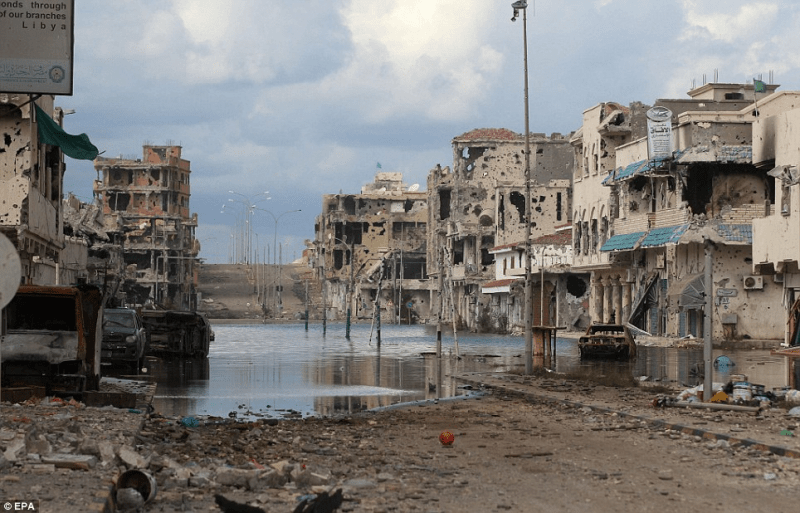
Sirte, Libya, after NATO bombing
The destruction of Libya’s government and infrastructure directly caused the Mediterranean boat migrant crisis, which has poisoned the politics of much of the European Union.
Donald Trump has not started any major war. He has been more restrained in military action than any US President since Jimmy Carter. My own view is (and of course it is impossible to know for sure) that, had Hillary been in power, Syria would already have been totally destroyed, the Cold War with Russia would be at mankind threatening levels, and nuclear tension with North Korea would be escalating.
“He hasn’t destroyed mankind yet” is faint praise for anyone. Being less of an existential danger to mankind than Hillary Clinton is a level achieved by virtually the entire population of the planet. I am not supporting Trump. I am condemning Clinton. I too, like Susan Sarandon, would have voted for Jill Stein were I an American.
So do protest against Trump. But do so under the banner No Trump! No Clinton! No NATO! And if any Clintonite or Blairite gets up to address you, tell them very loudly where to get off. I remember the hijacking of the Make Poverty History campaign by Brown, Darling and Campbell on behalf of their banker friends. Don’t let that happen again.
Or here is an even better idea.
Escape the Trump visit completely. Rather than stand penned in and shouting slogans at a police van parked right in front of you, turn your back on all of that and come join me at the Doune the Rabbit Hole Festival from 13 to 15 July. As our regulars know, this blog has been intimately connected with running the Festival from the start. This year is much bigger, with the Levellers, Akala, Atari Teenage Riot, Peatbog Faeries, and literally scores of other bands, and a great array of other festival activities too, including for kids, who come free and get free drinks.
DTRH has no sponsorship, no advertising, no government money and no rip-offs – beer and cider from £3.50 a pint at the bars. It is very much an alternative lifestyle gathering, and I find spiritual renewal there in the glorious Stirlingshire countryside. (I know that sounds corny, but I do). Tickets are £90 for full weekend including camping, which I think makes it the cheapest festival on this level around. Or you can buy a cheaper day ticket and drop in just for the day. If tickets are too expensive or you fancy a different kind of fun, you can volunteer, including to come and work with me in the bar, though there are a whole range of other tasks to be done if you don’t fancy that. Volunteers get in free and get fed in return for one six hour shift a day.
I really do hope I will see some of you there – it looks set to be a glorious weekend. Forget stress, forget Trump and hang out with nice people!
Atrocity Porn and Hitler Memes Target Trump for Regime Change
By James George JATRAS | Strategic Culture Foundation | 23.06.2018
American and global audiences have been bombarded with media images of wailing children in holding facilities, having been separated from adults (maybe their parents, maybe not) detained for illegal entry into the United States. The images have been accompanied by “gut-wrenching” audio of distraught toddlers screaming the Spanish equivalents of “Mommy!” and “Daddy!” – since, as any parent knows, small children never cry or call for their parents except in the most horrifying, life-threatening circumstances.
American and world media have provided helpful color commentary, condemning the caging of children as openly racist atrocities and state terrorism comparable to Nazi concentration camps and worse than FDR’s internment of Japanese and Japanese-Americans. Indeed, just having voted for Trump is now reason enough for Americans to be labeled as Nazis.
Finally, the presumptive Hitler himself, also known as President Donald Trump, citing the pleas of First Lady Melania and First Daughter Ivanka, signed an Executive Order to provide for adults and (their?) children to be detained together. However, the order is unlikely to hold up in court, with sanctuary-minded states aiming to obstruct border enforcement the way Trump’s earlier order on vetting arrivals from terrorism-prone countries has been crippled by the federal judiciary. His media and bipartisan political opposition will be happy only when all border violation detentions cease and America has gone full Merkel, starting with ending Trump’s declared zero tolerance for illegal crossings and restoration of Barack Obama’s catch-and-release policy.
Even then, Trump will be vilified for taking so long to do it. Whether or how Trump may yield further is not clear, but rather than slaking the hate campaign against him, his attempted effort at appeasement has put the smell of political blood in the water with the November 2018 Congressional midterm elections looming.
Some images of small children have become veritable icons of Trumpian brutality. One photo, reportedly of a two-year-old Honduran girl (who in fact had not been separated from her mother), graced the cover of Time magazine, confronting the black-hearted tyrant himself. Another, of a little boy in a cage, went viral before it was revealed that this kid had nothing to do with the border but rather was briefly inside a staged pen as part of a protest in Dallas.
The reality behind the pictures doesn’t matter, though. More important are the images themselves and their power, along with dishonest media spin, to produce an emotional response that short-circuits critical thinking. Never mind what the facts are! Children are suffering! Trump is guilty! We need to “do something”!
On point of comparison, let’s remember the saturation media distribution given in 2016 to a picture of a little boy, Omran Daqneesh, said to have been pulled from the rubble of Aleppo after what was dubiously reported as a Russian airstrike. Promptly dubbed “Aleppo Boy,” his pathetic dusty image immediately went viral in every prestige outlet in the United States and Europe. The underlying message: we – the “international community,” “the Free World,” the United States, you and I – must “do something” to stop Syrian President Bashar al-Assad and his main backer and fellow Hitler clone Vladimir Putin.
(Not long before, another little boy, also in the area of Aleppo, was beheaded on video by the “moderate” US-supported jihad terror group Harakat Nour al-Din al-Zenki. The images of his grisly demise received far less media attention than those of official Aleppo Boy. This other youngster received no catchy moniker. No one called for anyone in power to “do something.” In fact, western support for the al-Zenki murderers – which the Obama administration refused to disavow even after the beheading and allegations of chlorine gas use by al-Zenki – can itself be seen as part of “doing something” about the evil, evil Assad. (Reportedly Trump’s viewing the beheading video led to a cutoff of CIA aid to some jihad groups.) Another small detail readily available in alternative media but almost invisible in the major outlets: Mahmoud Raslan, the photographer who took the picture of Aleppo Boy and disseminated it to world acclaim, also took a smiling selfie with the beaming al-Zenki beheaders of the other kid. But, hey, says Raslan, I barely know those guys. Now let’s move on . . . )
For those who have been paying attention for the past couple of decades, the Trump border crisis kids, like Aleppo Boy before them, are human props in what is known as “atrocity porn” designed to titillate the viewers through horror and incite them to hatred of the presumed perpetrators. Atrocity propaganda has long been a part of warfare – think World War I claims of Belgian babies impaled on German bayonets – but with modern digital technology and social media the impact is immediate and universal.
It’s irrelevant whether what is identified in images corresponds to reality. What matters is their ability to evoke mindless, maudlin emotionalism, like MSNBC’s Rachel Maddow choking up in tears over the border children or the similar weepy display in 2016 by CNN’s Kate Bolduan over Aleppo Boy.
Now being deployed in an American domestic context over whether or not the US should be allowed to control its borders, for decades atrocity porn has been essential for selling military action in wars of choice unconnected to the actual defense of the US: incubator babies (Kuwait/Iraq); the Racak massacre (Kosovo); the Markale marketplace bombings, Omarska “living skeletons,” and the Srebrenica massacre (Bosnia); rape as calculated instrument of war (Bosnia, Libya); and false flag poison gas attacks in Ghouta and Douma (Syria). Never mind that the facts, to the extent they eventually become known, may later turn out to be very different from the categorical black-and-white accusations on the lips of western officials and given banner exposure within hours if not minutes of the event in question.
Atrocity porn dovetails closely with another key meme, that of Hitler-of-the-month. In painting Trump as der Führer on the border, we see coming home to America a ploy that has been an essential element to justify foreign regime change operation, each of which has been spelled out in terms of black-and-white, good-versus-evil Manichaean imperatives, with the side targeted for destruction or replacement having absolutely no redeeming qualities. This entails first of all absolute demonization of the evil leader in what is called reductio ad Hitlerum, a concept attributed to philosopher Leo Strauss in 1951. Russia’s Vladimir Putin has been characterized by name as another Hitler by Hillary Clinton and others. Among the prominent “Hitlers” since 1991 have been Saddam Hussein (Iraq), Slobodan Milosevic (Yugoslavia/Serbia), Radovan Karadzic (Republika Srpska), Moammar Qaddafi (Libya), and Bashar al-Assad (Syria), with less imposing Führer figures to be found in Mohamed Farrah Aidid (Somalia), Manuel Noriega (Panama), Mahmoud Ahmadinejad (Iran), and Omar al-Bashir (Sudan).
With apologies to Voltaire, if Hitler had not existed it would be necessary for the US-UK Deep State to invent him . . .
Today the atrocity porn and Hitler memes that have been so useful in justifying regime change in other countries are being directed with increasing intensity against America’s own duly elected president. This is at a time when the original conspiracy to discredit and unseat him, the phony “Russian collusion” story, is in the process of unraveling and being turned back on its originators. Horror of horrors, Trump is now feeling free enough to move forward on a meeting with Putin.
Keep in mind that Putin is, according to Hillary Clinton, leader of the worldwide “authoritarian, white-supremacist, and xenophobic movement” who is “emboldening right-wing nationalists, separatists, racists, and even neo-Nazis.” So he and Hitler-Trump should get on famously! The prospect of any warming of ties between Washington and Moscow has elements of the US intelligence agencies, together with their British coconspirators in MI6 and GCHQ, in an absolute panic.
That’s why desperate measures are in order. As noted earlier, when confronted with a reincarnation of the most evil personage in history, even the most extreme actions cannot be ruled out. Demonizing the intended target neutralizes objections to his removal – by any means necessary.
After all, how can any decent person oppose getting rid of Hitler?
‘Forget sanctions, G7 & Assad – Trump-Putin summit should focus on America’s Ukraine interference’
RT | June 22, 2018
Ukraine, not Syria, is going to be in the spotlight at the potential meeting between Donald Trump and Vladimir Putin after the US supplied Kiev with Javelin missiles and imposed sanctions on Russia, former US diplomat told RT.
The NATO summit set for July is already being upstaged by rumors of a separate meeting between Trump and Putin – and news that National Security Advisor John Bolton will be heading to Moscow this month has only increased speculation. RT America’s Natasha Sweatte discussed this latest development with former US diplomat Jim Jatras.
RT: What are your thoughts on Bolton going to Russia? Do you think this is going to be a similar matter to how Mike Pompeo set things up for the president with Kim Jong-un?
Jim Jatras: I think in some ways, yes. I understand that ambassador (Jon) Huntsman, our ambassador in Moscow, was here not too long ago to begin some of the prep, Bolton is supposed to be in Moscow next week and then three Republican senators are supposed to be in Moscow the week after that. I think there’s some of the groundwork being prepared for this meeting.
RT: What do you think is the most important thing for them to discuss, if they do indeed meet. Do you think something like Syria?
JJ: Certainly, Syria. But to tell the truth, I think the mere fact of the meeting, like the meeting between Trump and Kim Jong-un, is the most important thing. The fact that they meet. Let’s remember, there has been a full-blown campaign of hysteria on so-called “Russian collusion” from not only the US deep state, but their friends in the United Kingdom, in MI6 and GCHQ, trying to try to sink this thing. And I think coming off of the summit with Kim and also some of the economic news, some of his domestic successes, Trump now feels he has the ability to go ahead with something he said he wanted to do during the campaign and has been frustrated from doing so.
RT: Do you think a positive meeting between the two will have any impact on Mueller’s investigation or do you see it as an important thing for Trump to block all of that out, if he does indeed meet with Putin?
JJ: I think it is going to be in the eye of the beholder. Obviously, the Trump-haters who actually believe all the nonsense about Russian collusion, they’ll just see this: “He is reporting to Moscow, he is reporting to headquarters. This proves everything we’ve been alleging.”
Of course, that’ll be total nonsense. I think just as a lot of people aimed potshots at him over North Korea, the fact that he comes back with something that looks like we’re making progress on a peaceful settlement, I think will resonate with a lot more people than the naysayers.
RT: Now to the G7 summit: do you think there is a seat at the table for Russia? Do you think maybe these talks with the US is the first step in that direction?
JJ: It could be. But to tell the truth, G7 isn’t all that important. And certainly not for the Russians. The Russians are looking more toward Eurasian integration with the, One Belt, One Road, initiative with the Chinese, with the Eurasian Economic Union. Sure, they’d like a seat at the table. But they’re not going to sit there and beg for it. And they’re not going to look at it as some kind of a cookie to be thrown to them.
RT: And what’s the ultimate outcome? Do you think just the meeting itself speaks volumes?
JJ: I think, the meeting itself speaks volumes. But I think, the question of sanctions, for example, is way in the background. You’ll never get that through Congress anytime soon. Although, I think we could look at some positive action in Europe in the very near future. I think that actually the thorniest question isn’t really Syria so much. Look, Assad has won, he is going to stay in power. The real issue is going to be what to do about Ukraine. During the campaign, Trump said that is a European issue. But, of course, you know, we’ve provided the Javelin missiles, we’ve added new sanctions to the Russians. We’ve got to find some way to get the US out of the driver’s seat on aggravating the situation in Ukraine.
RT: And maybe, if (Robert) Mueller’s investigation does wrap up sometime soon, maybe Congress’s outlook would change on sanctions?
JJ: No, I don’t think so. I think, unfortunately, there are just so many people who have planted their feet in concrete in an extreme, I would say, hysterical anti-Russian position, that just isn’t going to change. I think Trump basically has to move beyond them somehow and not really focus on the sanctions, which to tell the truth, do not have the same devastating impact on Russia that a lot of people here would like to think they have.
Featured Video
NEW FAUCI EMAILS EXPOSE ATTACK ON NATURAL IMMUNITY
or go to
Aletho News Archives – Video-Images
From the Archives
Fourteen Incredible Facts About 9/11
By Kevin Ryan | Dig Within | August 8, 2015
… What is known about 9/11 is that there are many incredible facts that continue to be ignored by the government and the mainstream media. Here are fourteen.
- An outline of what was to become the 9/11 Commission Report was produced before the investigation began. The outline was kept secret from the Commission’s staff and appears to have determined the outcome of the investigation.
- The 9/11 Commission claimed sixty-three (63) times in its Report that it could find “no evidence” related to important aspects of the crimes.
- One person, Shayna Steiger, issued 12 visas to the alleged hijackers in Saudi Arabia. Steiger issued some of the visas without interviewing the applicants and fought with another employee at the embassy who tried to prevent her lax approach.
Blog Roll
Recent Comments
Bill Francis on European leaders’ shift in the… seversonebcfb985d9 on Villains of Judea: Philip Esfo… loongtip on Report warns that ‘Jewish terr… Craig Nelms on New study shows that toxic gas… loongtip on A Funny Thing Happened on the… loongtip on EU free trade pact on hold as… John Edward Kendrick on Regime Change In Iran Is The F… Bill Francis on Australia Passes New Hate Spee… seversonebcfb985d9 on Australia Passes New Hate Spee… Bill Francis on Britain’s AI Policing Plan Tur… loongtip on Miami Beach Resident Questione… loongtip on Israeli agricultural export co…


 Aletho News
- US pledges to ‘starve’ Iraq of oil revenue if pro-Iran parties join new government
- Is China a threat to Greenland?
- South Korea’s Prime Minister Proposes US Send Special Envoy to North Korea — Report
- Pentagon downgrades China threat, shifts focus to homeland, hemisphere
- Ireland Moves to Legalize Spyware Use by Police
- NEW FAUCI EMAILS EXPOSE ATTACK ON NATURAL IMMUNITY
- Why is the US using Jordan as the main base in possible Iran attack?
- American Academy of Pediatrics Hit With Federal RICO Lawsuit for Vaccine Safety Fraud
- Mom Tells Trump: Dumping Sewage Sludge on Farmland Won’t Make America Healthy Again
- NIAID Funds Gain-of-Function Study Engineering Novel Influenza Viruses
- If Americans Knew
- Another Gaza baby freezes to death on Netanyahu’s watch – Not a ceasefire Day 106
- Oppose Israel’s Abuses While You Still Can
- UNRWA Heads Tell Ha’aretz: ‘We Don’t Radicalize Palestinians – Their Lived Existence Does’
- Plans Call for “New Rafah” Built in Israel’s Image — Without Palestinians
- Posing as priest, reporter is spat at many times, highlighting anti-Christian sentiment in Israel
- Leaked Documents: “Planned Community” in Rafah Would Force Palestinians Into Israeli Panopticon
- ‘Permits of Humiliation’: How Israel Strangles Christian Education in Jerusalem
- “The world sees death, destruction and injustice – and they see dollar signs” – Not a ceasefire Day 105
- War criminal Netanyahu kills 11 in Gaza, joins Board of Peace – Not a ceasefire Day 104
- Another baby dies of cold in Gaza, as Rafah crossing remains locked down – Not a ceasefire Day 103
- No Tricks Zone
- Polar Colding…Antarctica Saw Its Coldest October In 44 Years!
- New Study: Sea Levels Rose 20 Times The Modern Rate During The Roman Warm Period
- As German Gas Storage Dips Dangerously Low…Shortage Hardly Avoidable
- New Study: Brazil’s Relative Sea Level Was 2+ Meters Higher And SSTs 3-4°C Warmer 6000 Years Ago
- Philosopher Schopenhauer: Climate Science Certainty Stems From Stupidity, Ignorance
- New Study: Species Extinction Rates Declining Since 1980 – ‘Climate Change Is Not An Important Threat’
- Denmark Places Climate Protection Above Animal Welfare, Poisoning And Culling Cows
- New Study: Greenland Was 3-7°C Warmer And Far Less Glaciated Than Today 6000-8000 Years Ago
- German Media Report That Current Frigid Weather Can Be Explained By Arctic Warming!
- Berlin Blackout Shows Germany’s $5 Trillion Green Scheme Is “Left-Green Ideological Pipe Dream”
 Aletho News