Donald Trump has just signed an executive order reversing the Clinton era policy of separating children from their illegal migrant parents at the southern border of the United States. While this policy has been in operation since the 1990s, it was only in the last month that it caught the attention of American media and the political class.
Ultimately, the issue is one for the leaders of the US to decide and under immense media and political pressure, the US President has taken the matter into his own hands and changed a policy based entirely on a public pressure campaign rather than his own apparent line of thinking which favours an increasingly tough border policy.
What this proves is that on issues effecting the well being of humans who happen not to be US citizens, public pressure campaigns can in fact get policies changed, especially in an election year. When one thinks that George W. Bush illegally invaded Iraq just over a year before facing re-election while Tony Blair did the same only two short years before facing the UK electorate, it beggars belief that anti-war campaigns have been so ineffective at reversing policies that slaughter millions, destroy entire regions and all the while unleashing the most barbaric forms of terrorism in places where there once was little or none.
Irrespective of one’s views of America’s border policy, even those who believe it to be inhumane must admit that it did not result in the deaths, terrorism and destruction of the US led wars on Yugoslavia, Iraq, Libya and the hybrid war against Syria.
While millions of people marched against the Iraq war throughout the world in 2003, far more than have gone on demonstrations against the controversial child separation policy of the US border authorities, it nevertheless had no effect on US policy in the Middle East. In fact, the amount of wars and number of troops committed across the Middle East by the US and its partners only increased since 2003.
Why then did the anti-war marches fail while the pro-migrant movement accomplished its goal? The reason is simple. While masses of protesters can control the streets and non-corporate air waves, the corporate media in the United States that is willing to take a side on issues like migration is unwilling, unable or not wanting to go up against the pro-war factions of Washington. The same is true even for most so-called independent minded politicians in the US, almost all of whom lose their independent streak when it comes to war, with retired Congressman Dr. Ron Paul, his son Senator Rand Paul and Senator Bernie Sanders being exceptions in the wilderness.
While corporate media is losing viewership at a rapid pace among the wider public and the young in particular, among the policy making class, there is still a tendency to literally view the world through a bubble and refuse to look at non-corporate or non-western originated media for any other purpose than to mock, sneer and at times, attempt to censor.
It is because of this, that the kind of invisible connection between the narrative of mainstream media pundits and politicians can lead to meaningful policy change while this is not the case when it comes to anti-war issues that the mainstream media in the US tends to either ignore or berate (before ignoring).
In this sense, the political-media complex has worked to insure that the issues that are important to the boardrooms of CNN and MSNBC are those which are important to the politicians who can then pressure a reluctant President to change a policy he previously appeared to support.
It is only when politicians begin to take non-corporate western media sources at face value rather than look for conspiracies (aka Russian meddling) which do not exist, that the growing number of people opposed to war might be able to affect policy change. Until then, the anti-war voices of millions will be ignored, while the loud but comparatively quieter thousands of voices raised against America’s border policies will be heeded.
The solution for anti-war protesters is to not give up but to shame the part-time humanitarians who cried at the thought of strangers in a strange land being separated from their families, yet who say nothing when families living in their ancestral homes are separated from one another by the force of a bomb – never to be reunited. If you think that America’s long standing border policy was inhumane but do not feel similar things towards the families America’s military slaughters in their own home – then you do not have a heart after all… but you probably have a high definition television.
Over the past month, two mainstream news outlets have done in-depth reporting on the grip that Sheldon Adelson, President Donald Trump’s and the GOP’s biggest donor, holds over U.S. foreign policy in the Middle East. LobeLog has closely followed this important story, so it’s heartening to see The Guardian and CBC highlighting the apparent capture of U.S. foreign-policy decision-making by a billionaire donor.
But there’s a noticeable gap in the coverage of this topic. U.S. news outlets, which routinely “follow the money” when it comes to domestic issues, are almost completely avoiding any reporting on the clear link between Adelson’s campaign contributions and the administration’s pursuit of policies that hew closely to positions espoused by the billionaire casino magnate.
Adelson’s influence over the Trump administration’s foreign policy is hard to overlook. The Las Vegas-based billionaire, and currently the fourteenth wealthiest American, is outspoken about his political views. He has suggested using nuclear weapons against Iran, declared the “purpose of the existence of Palestinians is to destroy Israel,” promoted John Bolton for a senior foreign-policy post, directly lobbied Trump about moving the U.S. embassy from Tel Aviv to Jerusalem. Newt Gingrich, himself a recipient of Adelson’s financial support during his failed 2012 presidential big, said that his benefactor’s “central value” is Israel.
Mainstream Media Coverage
Deep in Adam Entous’s excellent New Yorker feature in this week’s issue, he briefly grapples with Adelson’s influence on U.S. Mideast policy. Entous writes:
No Republican candidate can easily afford to ignore him. Adelson considered Obama an enemy of Israel, and, in the 2012 election, he and his wife, Miriam, contributed at least ninety-three million dollars to groups supporting the G.O.P. Officials in the U.S. and Israel said that they learned from American Jewish leaders that Adelson had vowed to spend “whatever it takes” to prevent Obama from securing a peace agreement while in office.
Entous then returns to the thesis of his article—that Israel, Saudi Arabia and the United Arab Emirates are manipulating Trump’s foreign policy team. But the brief acknowledgement that one donor has leveraged legal political spending to control the foreign policy positions of the Republican Party deserves more attention.
Indeed, there’s ample evidence that Trump, who received $35 million in outside election spending from Adelson and his wife, Miriam, listens to what his biggest campaign supporter has to say.
Before winning the GOP’s nomination, Trump quipped that Adelson was seeking to “mold [Marco Rubio] into the perfect little puppet,” but he quickly came around and echoed Adelson’s hawkish positions on the Israeli-Palestinian peace process and moving the U.S. embassy to Jerusalem after winning the Republican nomination and securing Adelson’s financial backing.
Politico reported that the most threatening line in Trump’s October UN speech—that he would cancel Washington’s participation in the JCPOA if Congress and U.S. allies did not bend to his efforts to renegotiate it—came directly from John Bolton, now Trump’s national security advisor, and with the full weight of Trump’s biggest donor. The hawkish language was not in the original text prepared by Trump’s staff. Politico reported:
The line was added to Trump’s speech after Bolton, despite Kelly’s recent edict [restricting Bolton’s access to Trump], reached the president by phone on Thursday afternoon from Las Vegas, where Bolton was visiting with Republican megadonor Sheldon Adelson. Bolton urged Trump to include a line in his remarks noting that he reserved the right to scrap the agreement entirely, according to two sources familiar with the conversation.
That was the only mention of Adelson’s influence in the article.
The day after Trump’s violation of the Joint Comprehensive Plan of Action (JCPOA) last month, Adelson visited Trump in the White House. The week before, Adelson cut a $30 million check to the Congressional Leadership Fund, a super PAC exclusively dedicated to securing a GOP majority in the House of Representatives. That contribution made Adelson, again, the biggest contributor to the Republican Party in an election cycle.
Politicobroke the story of the $30 million contribution but didn’t mention Adelson’s possible foreign policy motivations. In the mainstream news media, only McClatchy’s Peter Stone, reporting on May 14, dedicated an entire article to the obvious influence that the president’s biggest donor appears to hold over U.S. foreign policy. He wrote:
These are heady days for casino billionaire and megadonor Sheldon Adelson.
A passionate and hawkish advocate for Israel with close ties to its prime minister, Benjamin Netanyahu, Adelson was in Jerusalem today for a celebration of the U.S. embassy’s relocation to that city, a longstanding priority for the mogul. Similarly, Adelson had pushed hard for President Donald Trump to pull out of the Iran nuclear deal, which happened last week.
Stone went on to report on Adelson’s White House meeting the day after the JCPOA announcement.
And The New York Times only briefly touched on this issue in a February 23 article on the moving of the U.S. embassy from Tel Aviv to Jerusalem and Adelson’s controversial offer to pay for the new facility:
For years, Mr. Adelson, a Las Vegas casino mogul, has pushed the United States government to move its embassy to Jerusalem, the disputed capital that both Israelis and Palestinians claim as their own. With an estimated net worth of $40 billion, Mr. Adelson donated heavily to Mr. Trump’s campaign and gave $5 million to the committee organizing the president’s inauguration festivities, the largest such contribution ever.
Progressive Media Coverage
Progressive and left-leaning media have been equally silent about the special interest control over U.S. foreign policy decision-making.
Two days after Trump violated the JCPOA, MSNBC’s Chris Hayes devoted more than eight minutes to the $30 million contribution in which his panelists decried the outsized role of money in politics. Two minutes into the segment, they speculated about how much Adelson’s heirs might benefit from estate-tax reductions in the Republican tax bill, suggesting that Adelson’s contribution might be an investment in influencing tax policy in ways that would personally benefit him and his family.
At the end of the segment, with only two minutes remaining, Hayes said:
There’s also a foreign policy component here. The rich donors might have different foreign policy priorities. Sheldon Adelson has very intense foreign policy priorities as relate to Israel. You can imagine people having intense foreign policy priorities as to Brexit or NATO or Ukraine… You get a US foreign policy where you have to wonder what is guiding it.
None of Hayes’s panelists engaged with that explanation and Hayes did not return to it.
Vox’s Matt Yglesias also speculated about Adelson’s desire to reduce the estate tax and concluded:
Throw in the benefits of the other tax cut provisions and Adelson’s interest in maintaining a business-friendly National Labor Relations Board and the investment is very small and sensible. The same goes for even richer people like the Koch brothers, who are planning to spend even larger sums in the midterms.
There’s no actual evidence that Adelson feels particularly strongly about the estate tax. He hasn’t given public remarks about the estate tax, and he hasn’t contributed large sums of money to think tanks with an anti-estate tax agenda. In other words, Hayes and Yglesias are guessing about Adelson’s motives without acknowledging what Adelson publicly talks about as motivating his political and civic engagement.
ThinkProgress, a site for which I used to work, offers another insight into the progressive media landscape’s refusal to acknowledge Adelson’s capture of Washington’s Mideast policy. Adelson’s name hasn’t appeared in a TP headline for over two years. Housed at the Democratic-Party-aligned Center for American Progress, TP doesn’t shy away from writing about certain other right-wing donors. But it hasn’t put the Republican Party’s biggest donor’s name in a headline since five months before the 2016 presidential election.
It’s not as if mainstream, let alone left-wing, journalists and pundits don’t understand what’s happening. Half of the CBC’s May 20 segment is taken up by Wendy Mesley’s interview with Ken Vogel, a money-in-politics reporter for TheNew York Times.
Mesley: Why is Adelson so driven on these causes, these mostly Israeli causes?
Vogel: Yeah, he is a cause donor. It’s been really his animating political issue behind his donations for some time. People I’ve talked to trace it to his marriage to his wife Miriam Adelson in the early 1990s. Her parents fled the Holocaust, ended up in Israel where she was raised and so far that reason and others he’s really become a leading donor and a leading figure in this hawkish pro-Israel conservative sort of circle that is so influential in American politics.
Later, Vogel added:
I think what [Adelson] does is act as an enforcer. People are scared, to some extent, to cross him because they fear that if they anger him and fall out of favor with him that his funding, not only funding from him will dry up, funding from this larger circle of Jewish-American donors who give a lot of money in Republican politics.
Vogel’s description of Adelson’s influence was succinct and clearly backed up by Adelson’s own statements, his choice of causes and candidates to support, and the policy positions embraced by candidates who owe their political careers to Adelson’s largesse.
But this explanation was delivered to a Canadian television network instead of The New York Times.
Phil Weiss of the Mondoweiss blog writes that acknowledging Adelson’s motives and influence “smacks of assertions of outsize Jewish influence that were a hallmark of murderous, anti-Semitic campaigns in Europe.” Indeed, Weiss is accurate that discussing Adelson’s influence can often feed anti-Semitic tropes with no basis in facts.
If he’s correct, journalists are actively censoring themselves from discussing how an individual donor, whose views are shared by only a small minority of Jewish Americans, is advocating for foreign policy positions that isolate the U.S. from allies, such as those that supported the agreement to curb Iran’s nuclear program, in favor of a hawkish U.S. agenda in the Middle East.
At the bare minimum, news outlets are expected to report on the facts. In this case, the facts are that U.S. foreign policy is starting to look an awful lot like what Sheldon Adelson has encouraged over the past several years.
Perhaps it’s all a coincidence and Adelson is really engaged in a stealth campaign to reduce the estate tax and pass his $40-billion-plus fortune on to his children.
It makes more sense, however, to take the GOP’s biggest donor at his word. Foreign news outlets have done just that. But the U.S. media appears incapable of wrestling with the new role money is playing in steering Washington’s policy abroad.
Both leaders arrived in Singapore, with significant excitement greeting them. Trump, arriving from a bitter G7 meeting, after which he attacked Justin Trudeau personally, flew into Singapore on Sunday, June 10, as did Kim Jong-un, who took serious precautions in his travel arrangements. By this point Trump had already significantly lowered expectations, saying that it would just be a meeting where the two leaders got to start a dialogue: “at least we’ll have met each other, we’ll have seen each other; hopefully, we’ll have liked each other. We’ll start that process….But I think it will take a little bit of time”. The lowered expectations might have been well advised. The usual appeal to authority that is the now customary wail of panic-striken, discredited elites, was evidenced by the scorn heaped on the work of Dennis Rodman, for not being a “professional”—when his work was fundamental to laying the groundwork for the peace talks. Others, with a longer and more considered view of history, pointed out that, “The history of U.S. foreign policy is littered with unsuccessful presidential summits, even when they have been preceded by months of careful preparation and infused by a coherent strategy and clear objectives set by a well-informed and experienced president”.
An Historic Encounter
Just the fact of meeting and talking was significant enough: already there was evidence that the campaign of “maximum pressure” was over and not likely to come back. Sanctions on North Korea were already being loosened, tested, and plans made for a future after the talks. In the meantime, clearly in a deep, quiet panic over the summit, Fox News saturated its coverage with talking heads offering Trump advice from a distance, hoping to pressure him—including advising flatly undiplomatic and plainly rude tactics such as not shaking Kim Jong-un’s hand, or preventing photographs of the two leaders together.
The Summit, televised live around the planet, wrapped up in the the afternoon on Tuesday, June 12 (Singapore time), with the final event being an extended press conference by Donald Trump, and the release of the text of the agreement jointly signed by Kim Jong-un and Donald Trump. Also released was the video, “A Story of Opportunity,” prepared by the US side and shown in person to Kim Jong-un, which offered the progressivist American vision of the future.
(See Trump’s 12 tweets on the summit here: 1, 2, 3, 4, 5, 6, 7, 8, 9, 10, 11, 12.)
Early reactions, including one from a former CIA expert, was that “denuclearization,” the way the US envisaged, is not what the Summit agreement affirmed. Others held that at the very least the Summit was a real turning point, that averted war and began a peace process; also set to rest was the trope that Kim and Trump are “madmen”.
“The joint declaration specifies no timeline for denuclearization nor it does have steps to verify disarmament. It also refers to denuclearization on the entire Korean Peninsula—Pyongyang’s preferred phrasing—and does not include the words ‘verifiable’ and ‘irreversible’ despite months of U.S. statements. Trump also agreed to something North Korea has sought for years: the suspension of joint U.S.-South Korean military exercises”.
In some key respects, Trump’s concessions matched what had long been the position of Russia and China (both of which were keen to formally rejoin negotiations on Korea): that the US freeze war games in return for North Korea suspending testing nuclear weapons. The double-freeze approach finally won. In addition, one outcome of the Summit was that China was now pressing for sanctions to be eased, almost immediately, with Trump acknowledging—without criticism on his part—that China had already eroded sanctions enforcement over the last few months. Kim and Trump also promised to personally visit each other’s capitals in the near future.
Another assessment saw the Summit as a victory for all of Korea, and the signed document as simply an aspirational declaration and not an agreement on denuclearization as such:
“The North Korean side played its cards exceptionally well. It built its capabilities under enormous pressure and used it to elevate the country to a real player on the international stage. The ‘maximum pressure’ sanction campaign against it is now defused. China, Russia and South Korea will again trade with North Korea. In pressing for an early summit Trump defused a conflict that otherwise might have ruined his presidency. The losers, for now, are the hawks in Japan, South Korea and Washington who tried their best to prevent this to happen. The winners are the people of Korea, Kim Jong-un and Donald Trump. Special prizes go to President Moon Jae-in of South Korea and to Dennis Rodman who did their best to make this happen”.
Others offered well-informed analysis by individuals who were intimately involved in negotiations with North Korea and who argue that North Korea is not intending to “get away” with keeping its nuclear weapons, but that the North instead has real reasons for wanting to denuclearize. The argument here is that North Korea developed nuclear weapons to entice the US to the negotiating table, in order to end the Korean War, remove all sanctions, offer diplomatic recognition, and ending the US military threat to North Korea. In addition, a rapprochement with the US would allow North Korea to diversify its foreign relations, not remaining exclusively dependent on China, when North Korea has traditionally preferred independence. Another view is that the Summit simply resulted in a momentary stabilization. Yet, as Pepe Escobar noted, “by reaffirming the Panmunjom Declaration, the US President has committed to bringing its military back from South Korea and thus a complete denuclearization of the South as well as the North”. The accusation by liberal media was that, somehow, Trump managed to get nothing at all from the summit with Kim Jong-un—though even within this line of attack, there were some thoughtful pieces that at least addressed the facts of the summit in detail, with some showing how one could still take a Democratic, anti-Trump line and yet concede the significant value of the Summit.
US Domestic Politics and Trump’s Foreign Policy
In terms of domestic politics, it became evident that for any country to deal with the US—whether friend or foe—it would enter into a dangerously unreliable relationship: the pattern has now been set where one party’s international agreements are automatically decried, and then rescinded, by the opposing party. While many Republicans praised Trump on North Korea, they viscerally rejected Obama’s similar advances with Cuba and Iran. Likewise, while all for peace with Iran and good relations with Cuba, Democrats reacted as belligerently imperialist war hawks on North Korea, with liberals validating neconservatives and war-mongers. For both parties then, imperialism remains a tool to be used in domestic competition, and it is thus continually reproduced and validated.
Within just 12 hours of the close of the Summit, mainstream media in the US began to move the event off the front pages of their sites (most notably Reuters, where one had to dig to find any report on the event). This fact alone suggested that the anti-Trump opposition itself saw the event as a success, or there would be little to begrudge Trump. However, the opposition was much more serious than that. While only four months earlier much of the media celebrated the role played by Kim Jong-un’s sister at the Winter Olympics in South Korea, and how she diplomatically bested Mike Pence—now the media gave vent to denunciations of North Korea’s “brutality” and “human rights atrocities”. This was an opportunistic use of “human rights,” instrumentalizing allegations of human suffering to score political points at home. This was also domestically-driven virtue signalling at the expense of North Korea—when historically the number one killer of North Koreans has been the US itself, having destroyed every city in the North during the Korean War, while killing at least one out of every nine persons. Current sanctions have also exacted a toll on ordinary North Koreans—so much for the “human rights” lobby. The position was also bizarre for excluding the danger of nuclear war from the scope of “human rights”. If “human rights” do not include the right not to suffer a catastrophic nuclear apocalypse, then surely the concept is of little weight and even less merit, and should probably not be a significant concern. Opposition to Trump was also expressed in terms of resentment of parity shown to North Korea at the Summit, as if anything short of the public humiliation of North Korea on the world stage was somehow a sign of American “weakness,” of “unilateral concessions,” and of course, of Trump’s personal failure. Anything that might show North Korea in a more dignified light than the usual barbarian, torture state, was depicted as mere propaganda.
Similar reasoning could be found in articles such as one in The New Yorker, which reacted with alarm at rumours of Trump wanting a summit with Vladmir Putin. First, why the resort to rumours? Trump has always been very public and very explicit about his desire to meet Putin for a full one-on-one dialogue. There is no mystery about it, and any attempt to make it sound mysterious is an attempt to make it appear sinister. Second, the underlying tone of the article is that Trump is “unbound,” manifesting the continued disregard for the legitimate election of Donald Trump to office, such that he should not be allowed to command—like a president would do. Third, The New Yorker’s Susan B. Glasser is clearly projecting her faction’s anti-Russian hysteria onto Europe—forgetting that it was the US which pressured Europe into anti-Russian sanctions that hurt European economies, and which few European nations want to continue.
One charitable way to look at this situation would follow these lines: “Washington is a liberal town and the media rush to defend the status quo when it’s threatened by an interloper. When outsiders intervene, their influence declines”. Another approach would be a critique of how accusations that Trump is in “bonding sessions” with “brutal dictators,” are the liberal-left’s way of extending, translating, and reinforcing its inherent racism, by maximizing such racist attitudes on the world stage while pretending to challenge racism in discrete social pockets at home.
Rubbing Their Faces In It
On the other hand, Trump really succeeded in taking neoconservatives, professionals in the corporate-funded and government-backed human rights industry, the liberal imperialist media, and vigorously rubbing their faces with his foreign policy. Though many in the corporate media had—just in February—produced articles laced with praise for Kim Yo-jong (the sister of North Korea’s Kim Jong-un) because she had diplomatically upended Mike Pence—now that Trump’s relations with North Korea turned in a positive direction, the media reversed polarity and switched to denunciations of the “brutality” of the North Korean “dictator,” in terms as shrill as they were opportunistic. To add more context to this, Trump declared that it was not North Korea that was the enemy of the US, instead: “Our Country’s biggest enemy is the Fake News”. Remember that within the media some wanted Trump to avoid even shaking hands with Kim Jong-un, at the Summit itself of all places and times—when he did, some called it “disconcerting”. In their faces, Trump rubbed the following admiration for Kim Jong-un: “he is the strong head….He speaks, and his people sit up at attention”. Trump praised Kim Jong-un in no uncertain terms: “He’s smart, loves his people, he loves his country” and that, “really, he’s got a great personality”. On his own relationship with Kim Jong-un, Trump affirmed: “I think we have a very good relationship. We understand each other” and “I think he trusts me and I trust him”. From the start of the Summit, Trump said he and Kim, “got along very well”. In response to charges that Kim Jong-un is a “human rights violator,” Trump’s responses included: “Look, he’s doing what he’s seen done….He’s a tough guy,” adding in another interview, “he has to be a rough guy or he has to be a rough person,” and in another, “he’s a strong guy”. Kim Jong-un, charged by an interviewer with doing some “really bad things,” got this response from Trump: “Yeah, but so have a lot of other people have done some really bad things”. On Kim’s stance regarding his fellow citizens, Trump stated: “I think you have somebody that has a great feeling for them”. Trump added: “He’s a funny guy, he’s very smart, he’s a great negotiator. He loves his people, not that I’m surprised by that, but he loves his people”. In return, the North Korean people love Kim: “His country does love him—his people, you see…the fervor, they have a great fervor”. About saluting a North Korean general at the summit, Trump stated simply: “I met a general. He saluted me. I saluted him back. I guess they’re using that as another sound bite. I think I’m being respectful to the general”. To top it all off, Trump added to his statement about ceasing war games with South Korea, saying he would like to also withdraw all US troops from South Korea: “I would love to get the military out as soon as we can because it costs a lot of money and a lot of money for us. I would like to get them home. I would like to”. Then Trump cheerfully assessed the outcome of his own efforts: “I did a great job this weekend”.
WASHINGTON – Donald Trump’s own National Security Adviser John Bolton, the Democratic Party and the US mainstream media were all trying to derail the US president’s new agreement with North Korean leader Kim Jong-un, analysts told Sputnik.
On June 12, Trump and Kim met on the Singaporean island of Sentosa and signed a document showing their commitment to establish new bilateral relations and build a lasting peace on the Korean Peninsula. Trump also agreed to halt US-South Korea military exercises near the Korean peninsula, while Kim reiterated his country’s commitment to denuclearization.
The Democratic Party in the United States and the media establishment that supported them were cooperating closely to try and discredit Trump’s peace initiative in Korea, University of Illinois Professor of International Law Francis Boyle said.
“As the ancient Chinese proverb says, a journey of 1,000 miles begins with a single step, a very positive and encouraging step,” Boyle said. “Regretfully, it [the Singapore agreement] has pretty much been trashed by the Democrats and the mainstream US media who are in cahoots with them.”
The Democrats’ hostility to the new dialogue with Pyongyang flowed directly from their strategy in trying to discredit Trump over the past two years, Boyle pointed out.
“The Democratic strategy has been to bash Trump from the right. That goes back two years now to the conventions that nominated Trump and Hillary Clinton as their parties’ candidates,” he said.
The spectacle of the US media ganging up against the president when he was trying to resolve a potentially dangerous conflict was a depressing one, Boyle commented.
“All these newspapers condemning President Trump, it’s just unimaginably sad,” he said.
The media and the Democrats were misrepresenting Trump’s talks with Kim by falsely alleging that the US president had caved in by agreeing to talk to him when in fact Trump was just fulfilling the obligations placed upon him by the United Nations Charter which the US has signed, Boyle explained.
“Trump did not give Kim Jong-un an unnecessary concession. All he did was fulfill the commitment required of him or any US leader to hold such negotiations that is in the United Nations Charter,” he said.
Under Article 23 of the UN Charter there is a requirement for President Trump to have negotiations with North Korea which he did, Boyle recalled.
“Article 33 clearly requires ‘negotiations’ to maintain international peace and security,” he added.
Far from failing to make any progress, Trump had succeeded in getting Kim’s assent to giving the new negotiating process a promising beginning, Boyle observed.
“Trump did get a commitment on complete denuclearization of the Korean peninsula so that’s a good start. It incorporates the Panmunjom Declaration between Chairman Kim and President Moon. It’s a good start. I’m moderately encouraged,” he said.
Trump Rejected Bolton’s Parallel Between Libya, North Korea Talks
Boyle warned that the talks faced another major threat because National Security Adviser John Bolton was likely to try and undermine them.
“Bolton is a hard-line neoconservative (neocon) who publicly bragged about having sabotaged the process [of negotiations] with North Korea. He tried to sabotage these negotiations by going public and saying we are going to go the Libya route,” he said.
Last month, Bolton commented that the US denuclearization talks with North Korea would follow the pattern of previous talks to eliminate weapons of mass destruction in Libya. However, several years after Libya agreed to scrap such programs, its ruler Muammar Gaddafi was overthrown in a West-backed rebellion and murdered.
Trump contradicted Bolton and said that model of negotiations with Libya would not apply to North Korea.
Boyle said Bolton was highly intelligent and knew what he was doing when he made such remarks or and when he had encouraged Vice President Mike Pence to make similar ones.
“Bolton is a smart guy. He is a very cunning operator in the bureaucracy. I’m afraid Bolton will try to sabotage the negotiations. He has brought his own hardline people on to the National Security Council. I’m afraid that he will do what he can behind the scenes to sabotage this thing,” he said.
Boyle said he believed Trump needed to fire Bolton and select a new national security adviser who was committed to trying to make the negotiations with North Korea succeed.
“If Trump were smart I think he would fire Bolton and bring in a realpolitik-er,” he said.
Even if the talks with North Korea went well, they would take many months and several years, Boyle cautioned.
“This is going to be a long process. The administration people have conceded to the New York Times that it will take at least two years… However, following the summit, there is momentum,” Boyle concluded.
Military Establishment Tries to Hold on to US Bases in Asia-Pacific
Retired US Army Colonel and historian Doug Macgregor agreed that the Washington establishment opposed Trump’s efforts to achieve a lasting peace agreement with North Korea.
“The swamp [the establishment] will now fight the inevitable withdrawal of US ground troops from Korea because it will lead to the removal of the Marines from Okinawa as well,” Macgregor said.
Trump had made the mistake of surrounding himself with super-hawk figures like Bolton when he needed other kinds of officials who would support his peace plans, Macgregor cautioned.
“President Trump’s current defense [national security] team won’t help him! To achieve his aims the President will need to make new appointments,” he said.
However, the US public felt no commitment to running risks of full-scale war on the Korean peninsula and would support an agreement that could end the US military presence there, Macgregor advised.
“The mood and attitude of the political class in Washington is reminiscent of London’s attitude toward leaving India after World War II,” Macgregor said.
Like the British people then, the American people support the departure, Macgregor added.
Donald Trump’s praise this week of North Korean leader Kim Jong-un has been presented by much of the Washington political class and US corporate media as an anomaly in history and a stark deviation from political norms.
It is not normal or right, they tell us, for US presidents to meet with and applaud dictators of brutal regimes. This kind of phony virtue-signaling was all over the airwaves and the Twittersphere on Tuesday. It was like a competition with the winner being the person who could publicly register their disgust and dismay in the most dramatic fashion possible.
One former Republican lawmaker tweeted that “never before” in history had a US president “spoken this way of a dictator accused of crimes against his own people” — an outright lie, as pointed out by journalist Glenn Greenwald, who detailed a number of occasions when American presidents and top ranking officials had indeed heaped praise on dictators — from Barack Obama’s praise of the late King Abdullah of Saudi Arabia as a man who had “the courage of his convictions” and who was “dedicated” to his people, to Ronald Reagan’s praise of former Guatemalan dictator Efraín Ríos Montt as “a man of great integrity” — to Hillary Clinton’s description of Hosni Mubarak as a “friend of my family.”
In the real world, even the most mildly politically-aware person knows that meeting with and praising dictators is par for the course in US foreign policy. The United States has a long history of befriending, praising and propping up brutal dictators all over the world — and flattering Kim with a few meaningless comments designed to foster goodwill is absolutely mild in comparison with the tangible support the US lends to other dictatorships.
Curiously though, many of those shouting loudly in protest at Trump’s praise of Kim are unbothered when American presidents — Trump included — lavish praise on those friendly dictators that Washington relies on to help serve its geopolitical interests. While they breathlessly condemn Trump for cozying up to Kim for a few hours in Singapore, they are nonchalant about US support for brutal regimes like Saudi Arabia.
Last year, peace activist and former Green Party candidate for Illinois governor Rich Whitney, compiled research in an effort to dispel the myth that the US opposes dictatorships and champions democracy around the world. What he found would not come as a surprise to any rational observer of global affairs, but would surely shock heavily propagandized Americans who have been led to believe that their country promotes freedom and democracy since they were waddling around in diapers.
Analyzing publicly available data, Whitney found that the US provides military assistance to 36 out of 49 nations that democracy watchdog Freedom House classifies as dictatorships. In other words, the US provides military support to a whopping 73 percent the world’s dictatorships while simultaneously claiming to be the most virtuous and well-intentioned nation on earth.
There is one determining factor when it comes to the decision to lend US support to a foreign government or regime — and it is a simple one: If that government or regime is sufficiently subservient to Washington and serves US global interests in any meaningful way, it will be protected and propped up at almost any cost. Its crimes will be swept under the rug and human rights concerns, along with freedom and democracy, will go straight out the window. Every now and then, some US official may pay lip service to its supposed moral values by expressing “deep concern” over some heinous incident or other before swiftly moving on.
This is the reality, yet we are still told to believe Trump is some kind of historical anomaly and subjected to endless think-pieces and on-air pearl-clutching over his “problematic” affinity for some questionable characters. The narrative goes, that before Trump, US leaders were all going around crushing dictatorships and delivering peace and prosperity to oppressed peoples everywhere. This kind of revisionist commentary is completely disingenuous and utterly at odds with reality and history — yet it is spewed unquestioningly from the mouths of journalists, analysts, various “experts” and regular Americans without so much as a pause to consider whether it has any basis in fact. It would take far too long to list every instance of the US supporting — and indeed installing — brutal dictatorships around the world, but there are some that stand out as particularly shameful moments in American history.
In 1973, the CIA engineered and financed a bloody coup in Chile which installed Augusto Pinochet for a 17-year reign of terror. Declassified documents show that while the Pinochet regime was torturing and murdering its opponents, the US actively sought to downplay and whitewash Chile’s human rights violations — and even put the head of the Chilean secret police, Manuel Contreras, on the CIA payroll.
In the 1960s, the US actively supported the extermination of up to one million suspected communist sympathizers in Indonesia under the leadership of General Suharto. Washington supplied Suharto with financial support, military equipment and lists of communists. Suharto then ruled as a dictator for 35 years until 1998 — with Washington’s support.
Propping up and providing material support for dictatorships has been a central theme of US foreign policy. Trump’s kind words for Kim are not a worrying departure from the norm. In fact, they barely even register in the history of American support for brutality and corruption.
Unfortunately, the notion that the White House supports democracy and crushes dictatorships is a belief system so ingrained in the American psyche that when confronted with reality, rather than admit they’ve been lied to, its adherents instead begin to look for ways to rationalize the inexcusable. At that point, we’re told that even if America does bad things sometimes, it’s all with good intention — or as Hillary Clinton would say, “America is great because America is good”.
The level of delusion required to believe something so demonstrably false and easily debunked is astounding. Then again, it must be difficult to come to terms with the fact that something which made you feel righteous and good for so long was only ever a nonsense fairytale.
Danielle Ryan is an Irish freelance journalist. Having lived and worked in the US, Germany and Russia, she is currently based in Budapest, Hungary. Her work has been featured by Salon, The Nation, Rethinking Russia, Russia Direct, teleSUR, The BRICS Post and others. Follow her on Twitter @DanielleRyanJ, check out her Facebook page, or visit her website: danielle-ryan.com
Is it appropriate for NDP Members of Parliament to be working for “greater friendship” with a country that is killing and maiming thousands of non-violent protestors?
Would it have been appropriate for any elected member of the party to be a “friend” with South Africa’s government during the apartheid era?
Victoria area MPs Randall Garrison (left) and Murray Rankin are members of the Canada Israel Interparliamentary Group (previously named Canada-Israel Friendship Group).
Garrison is vice-chair of a group designed to promote “greater friendship” and “cooperation” between the two countries’ parliaments.
The chair of the group is York Centre MP Michael Levitt, a former board member of the explicitly racist Jewish National Fund, who issued a statement blaming “Hamas incitement” for Israeli forces shooting thousands of peaceful protesters, including Canadian doctor Tarek Loubani.
The Interparliamentary Group is one of many pro-Israel lobbying organizations in Canada. In conjunction with the Centre for Israel and Jewish Affairs (CIJA) and Canadian Jewish Political Affairs Committee, the Interparliamentary Group has hosted wine and cheese lobbying events on Parliament Hill. Three hundred parliamentarians and parliamentary staff attended their 2014 “Israeli Wine Meets Canadian Cheese” gathering in the East Block courtyard.
The group regularly meets the Israeli Ambassador and that country’s other diplomats. Representatives of the Group also regularly visit Israel on sponsored trips. For their part, Garrison and Rankin both participated in CIJA-organized trips to Israel in 2016.
The Interparliamentary Group works with its Israeli counterpart the Israel-Canada Inter-Parliamentary Friendship Group. In 2016 the Group sent a delegation to the Israeli Knesset and last year they organized a joint teleconference with Israel-Canada Inter-Parliamentary Friendship Group co-chairs Yoel Hasson and Anat Berko.
Last month Hasson responded to Meretz party Chairwoman Tamar Zandberg’s call for an investigation into the Israel Defense Forces’ killing of non-violent Palestinian protesters by tweeting, “there was nothing to investigate, the IDF is doing what’s necessary to defend the Gaza border.”
Chairman of the Zionist Union Knesset faction, Hasson opposed the UN resolution on a Palestinian state. When the Knesset voted to strip Arab MK Hanin Zoabi of parliamentary privileges for participating in the 2010 Gaza flotilla Hasson and MK Carmel Shama “nearly came to blows” with Zoabi and her fellow Balad party MK Jamal Zahalka. Hasson later called Zoabi a “terrorist”.
Berko is even more openly racist and anti-Palestinian. A Lieutenant-Colonel in the IDF reserves prior to her election with Likud, Berko openly disparaged African refugees. In February Israel National News reported, “Berko said that the MKs should see the suffering that African migrants have caused South Tel Aviv residents before jetting off to Rwanda” to oppose an effort to deport mostly Eritrean and Sudanese refugees to the small East African nation.
In January Berko co-sponsored a bill to bypass a High Court ruling that Israeli forces cannot use the bodies of dead Palestinian protesters as bargaining chips. The aim of the bill was to make it harder for the bodies to be given over for burial, which should happen as soon as possible under Muslim ritual, in the hopes of preventing high profile funerals. In a 2016 Knesset debate Berko make the ridiculous claim that the absence of the letter “P” in the Arabic alphabet meant Palestine did not exist since “no people would give itself a name it couldn’t pronounce.”
In response Richard Silverstein noted, “Apparently, the fact that the word is spelled and pronounced with an ‘F’ (Falastin) in Arabic seems to have escaped her. It’s worth noting, too, that according to her logic, Israeli Jews do not exist either, since there is no letter ‘J’ in Hebrew.”
Garrison and Rankin must immediately withdraw from the Canada–Israel Interparliamentary Group. If the NDP MPs refuse to disassociate themselves from the pro-Israel lobby organization, party leader Jagmeet Singh should replace them as (respectively) NDP defence and justice critics.
Israel’s slaughter in Gaza should lead to an end of the NDP’s anti-Palestinian past.
Six weeks after Israeli snipers started killing and maiming Palestinians, including children, journalists, and medical workers, Canada’s PM Justin Trudeau finally released a carefully worded statement regarding the situation. The statement came only after the wounding of a Canadian doctor on the ground in Gaza, Tarek Loubani.
Activists familiar with the long history of complicity and duplicity of successive Canadian governments cautioned that the statement missed the mark on two main points.
Firstly, it studiously avoided any mention of the culpability of the Israeli government by name, anywhere in the statement.
Secondly, although there was a call for an independent investigation, it was worded this way:
“Canada calls for an immediate independent investigation to thoroughly examine the facts on the ground – including any incitement, violence, and the excessive use of force…We will work closely with our international partners and through international institutions to address this serious situation.”
Calling for investigations is usually diplomatic code for stalling and not taking action. But note also the wording and the ordering of possible facts on the ground, “including any incitement, violence and the excessive use of force”.
However, no-one had to wait long to have the hypocrisy of the Canadian government revealed. Two days after the statement, on May 18, Canada stated it would not support the resolution that was then passed by an overwhelming majority at the UN Human Rights Council. This is what Canada had to say:
“Canada was gravely concerned about the numerous deaths and countless injuries in the Gaza Strip over the past several weeks. However, it could not support the draft resolution because it prejudged the outcome of an international investigation. The resolution was one-sided and did not advance the prospects for a peaceful, negotiated settlement to the Israeli-Palestinian conflict. The resolution singled out Israel, without making reference to other actors.”
So, there we have it. Either the UNHRC is not an “international institution” that the Trudeau government wants to work closely with or the resolution made the serious error of actually naming who was firing the shots and dropping the tear gas on unarmed protestors.
Or the Trudeau government was just playing politics from the beginning, and after realizing that the issue of Israel slaughtering Palestinians was becoming very unpopular and the Liberal Party was losing support for its deafening silence, decided to issue a statement that said little and achieved less.
This way, they (and their supporters) could claim they have indeed responded and stood up to the pro-Israel lobby. Actually, it is a sad tradition in Canada that most of the major political parties play “political football” with the lives and struggles of Palestinians. One eye always on the win/loss column to decide when and how to speak out.
We say enough, over 100 Palestinians have not died in the last 6 weeks just so the Canadian government can shed crocodile tears while still defending Israel. We need to focus less of our resources and time on what politicians have to say and more on developing concrete and grassroots work, like BDS campaigns, that have a long-term benefit to the Palestinian people.
– Marion Kawas is a member of the Canada Palestine Association and co-host of Voice of Palestine.
As tensions in relations between the United States and China continue to rise, former US presidential hopeful Hillary Clinton publicly speaks against what she describes as Beijing’s political interference in Australia and New Zealand.
During her tour of Australia and New Zealand, former US Secretary of State and ex-presidential candidate Hillary Clinton claimed that China seeks to interfere with political processes in the region, according to Business Insider.
“In Australia and here in New Zealand experts are sounding the alarm about Chinese efforts to gain political power and influence policy decisions,” Clinton declared.
She also praised the efforts of Anne-Marie Brady, a New Zealand scholar who studies the workings of the United Front Work Department – an agency of the Communist Party of China primarily tasked with managing relations with the non-Communist Party elite, and which reportedly “tries to promote the party’s policies overseas”, according to the newspaper.
“Anne-Marie Brady of the University of Canterbury has rightly called this a new global battle, and it’s just getting started. We need to take it seriously,” the former secretary of state said.
Earlier the White House criticized China for what the former described as “Orwellian nonsense” after Beijing told US airlines to remove any references from their websites or other material that may suggest that Taiwan, Hong Kong and Macau are part of entities independent from China, The Guardian reports, citing US government and airline officials.
According to a statement delivered by White House press secretary Sarah Sanders, US President Donald Trump would “stand up for Americans resisting efforts by the Chinese Communist Party to impose Chinese political correctness on American companies and citizens.”
However, last week the famous American investor Warren Buffett predicted that despite the current tensions in relations between the United States and China, the probability of an all-out trade war between the two countries is very low.
Reporter Pearson Sharp, who visited Douma, Syria, about 10 days after a chemical attack allegedly took place there, spoke with Sputnik Radio’s Fault Lines with Garland Nixon and Lee Stranahan on Monday after he was smeared by ThinkProgress.
Pearson said that after the Khan Shaykhun chemical attack that spurred US President Donald Trump to fire almost five dozen Tomahawk missiles at the Shayrat Air Base in Syria in April 2017, he was motivated to find out if it was really true that there was evidence that Syrian President Bashar al-Assad had used chemical weapons to kill Syrian civilian targets in Douma, as London, Washington and France have alleged.
When visiting Douma, Pearson explained that instead of describing what he personally saw, he wanted to put the camera on people in the town instead and let them tell the story. After interviewing dozens of Douma residents, Sharp found that “consistently, not one person in the town said they heard anything about an attack.”
ThinkProgress tried to diminish the journalist’s integrity by impugning his employer, One America News Network (OANN), as a “far-right, pro-Trump media outlet.” However, that accusation has little traction, since if Sharp had wanted to parrot the Republican US president, he wouldn’t have reported that there was no evidence of a chemical attack in Douma — the opposite of what the White House continuously claims.
ThinkProgress accused OANN on April 18 of “defending the Syrian government against claims that it had used chemical weapons on its citizens,” which is clearly a made-up claim with no evidence, Sharp told Fault Lines. Sharp noted that he would not have hesitated to report that Assad did use chemical weapons if that’s where the evidence pointed.
“That was the whole point. In a way, it wasn’t me reporting; it was the people reporting and I was just giving them the camera. Whatever they said would have gone on camera, regardless” of whether the accounts he heard aligned with a political stance, the journalist told Sputnik.
ThinkProgress tried to make a crime out of Sharp’s decision not to manipulate the accounts he was receiving, writing, “at no point does OANN try to mask the pro-Assad language peppering the report.” They complain that Sharp offers no evidence for their “wild claims” — though of course, the US, UK and France have also failed to demonstrate the truth of their allegations that a chemical attack did take place, let alone what agents were used and by whom.
Before the Western coalition carried out their retaliatory attack on Syria, the head of the Pentagon literally told Congress the US had no evidence of an attack other than social media reports — truly bulletproof reporting worthy of a response by the full force and might of NATO forces.
“OANN and Sharp’s reporting falls short in many respects, but perhaps most glaring is its apparent inability to provide concrete evidence to support any of its wild claims,” ThinkProgress said in its April 16 report, “Far-right website claims it found no evidence of a chemical attack in Syria: The latest instance of far-right media pushing a ‘false flag’ conspiracy theory.”
The outlet, on the other hand, confidently claims that “The April 7 attack left at least 70 people dead and around 500 others exposed to deadly nerve agents. The Syrian Army is suspected to be behind the attack, which targeted rebel forces who had recently agreed to hand over the territory to the government,” without citing any evidence of its own.
Former British Ambassador to Syria Peter Ford told Sputnik that the “rebel” militants from Jaysh al-Islam had pre-arranged buses to take them out of Douma to the northern city of Idlib; there was absolutely zero military reason for Assad to use chemical weapons and a whole list of reasons why Assad would be leery of using chemical weapons, not the least of which being that it would provoke the militaries of the US, UK and France to launch airstrikes on the country.
“The idea that Assad would — having virtually reconquered Eastern Ghouta — wait until the end of this very successful recovery operation to launch a completely unnecessary attack on a bunch of civilians… really, you have to be totally naïve to believe Assad would see any advantage in this,” Ford told Sputnik in April.
ThinkProgress took issue with the fact that Sharp reported from Syria with the permission of the country’s government. Pearson contends this didn’t impact his reporting in the least in terms of who he was able to interview.
“We were brought in, the government just sort of dropped us off in these neighborhoods and hung back and let us go where we wanted to go. A lot of the reporters stayed around the cars, talking to people in that area. I tried to wander as far as I could, talk to as many people as I could, and get away from that area. I literally walked blocks away — out of sight of the government cars we were with — and talked to random people on the street with an interpreter,” Sharp said.
“Not one person had seen or heard anything” about a chemical attack, Sharp emphasized.
“The point to make here, to emphasize is, I’m not a weapons expert, I’m not a chemical munitions expert. I don’t know for a fact that there was or wasn’t [a chemical attack]. But I did go there and I did talk to everybody who was there when it was supposed to happen and none of them saw anything,” he added.
And while ThinkProgress contends that the “ultra-right” OANN is a Trump propaganda outlet, in fact, OANN reported that it’s not at all clear or obvious that the pretext for Trump’s “smart” missile attack on Syrian targets is on the level. It seems strange to degrade the reporting of another journalist for allegedly being pro-Trump when that journalist is reporting information that stands in stark contrast with the official White House narrative — particularly as you yourself actually repeat the Trump administration’s version of events. But that’s what ThinkProgress has done.
ThinkProgress is apparently convinced by the White House’s secretive “evidence” that a chemical attack took place in Douma. It’s a remarkable about-face for ThinkProgress, which reported, “No, there are still no WMDS in Iraq” in 2014, to now become a lapdog of the powerful and disseminate the US government’s bold speculative claims as the ubiquitous background story on Douma and smear reporters who don’t obediently echo the same perspective.
Over the past half-century, I have been engaged in research, lectured and worked with social movements and leftist governments in Latin America. I interviewed US officials and think tanks in Washington and New York. I have written scores of books, hundreds of professional articles and presented numerous papers at professional meetings.
In the course, of my activity I have discovered that many academics frequently engage in what government officials dub ‘de-briefing’! Academics meet and discuss their field-work, data collection, research finding, observations and personal contacts over lunch at the Embassy with US government officials or in Washington with State Department officials.
US government officials look forward to these ‘debriefings’; the academic provided useful access to information which they otherwise could not obtain from paid, intelligence agents or local collaborators.
Not all academic informants are very well placed or competent investigators. However, many provide useful insights and information especially on leftist movements, parties and leaders who are real or potential anti-imperialist adversaries.
US empire builders whether engaged in political or military activities depend on information especially regarding who to back and who to subvert; who should receive diplomatic support and who to receive financial and to military resources.
De-briefed academics identify ‘moderate’ and ‘radical’ adversaries, as well as personal and political vulnerabilities. Officials frequently exploit health problems or family needs to ‘turn’ leftists into imperial stool pigeons.
US officials are especially interested in academic gate-keepers who exclude ‘anti-imperialist’ critics, activists , politicians and government officials.
At times, US State Department officials claim to be sympathetic ‘progressives’ who oppose ‘Neanderthals’ in their institution, in order to elicit inside information from leftist academic informants.
Debriefing is a widespread practice and involves numerous academics from major universities and research centers, as well as non-governmental ‘activists’ and editors of academic journals and publications.
Academic participates in debriefing frequently do not publicize their reporting to the government. Most likely they share their reports with other academic informers. All claim they are merely sharing research and diffusing information for ‘science’ and to further ‘humane values’.
Academic informers always justify their collaboration as providing a clear and more balanced picture to ‘our’ policymakers, ignoring the predictable destructive outcomes likely to ensue.
Academics in the Service of Empire
Academic informants never study, collect research and publicize reports on US covert, overt and clandestine policies in defense of multi-nationals and Latin American elite which collaborate with empire builders.
US officials have no interest in ‘debriefing’ academics conducting anti-imperialist research.
US officials are keen to know any and all reports on ‘movements from below’: who they are, how much influence they have, their susceptibility to bribes, blackmail and invitations to the State Department, Disneyland, or the Wilson Center in D.C.
US officials fund academic research on militant trade unions, agrarian social movements, feminist and ethnic minorities engaged in class struggle, and anti-imperialist activists and leaders, as they all serve as targets for imperial repression.
The officials are also keen on academic reports on so-called ‘moderate’ collaborators who can be funded, advised and recruited to defend the empire, undermine the class struggle and split movements.
Academic informants are especially useful in providing personal and political information on Latin American leftwing intellectuals, academics, journalists, writers and critics which allows US officials to isolate, slander and boycott anti-imperialists, as well as those intellectuals who can be recruited and seduced with foundation grants and invitations to the Kennedy Center at Harvard.
When US officials have a difficult time understanding the intricacies and consequences of ideological debates and factional divisions within leftist parties or regimes, ex-leftist academic informers, who collect documents and interviews, provide detailed explanations and provide officials with a political roadmap to exploit and exacerbate divisions and to guide repressive policies, which undermine adversaries engaged in anti-imperialist and class struggle.
The State Department works hand and glove with research centers and foundations in promoting journals which eschew all mention of imperialism and ruling class exploitation; they promote ‘special issues’ on ‘class-less’ identity politics, post-modern theorizing and ethnic-racial conflicts and conciliation.
In a study of the two leading political science and sociological journals over a period of fifty years they published less than .01% on class struggle and US imperialism
Academic informants have never reported on US government links to narco-political rulers.
Academic informants do not research widespread long term Israeli collaboration with death squads in Colombia, Guatemala, Argentina and El Salvador, in cases because of their loyalties to Tel Aviv and in most cases because the State Department is not interested in debriefings which expose their allies and their joint complicity.
Academic Informants: What do they want and what do they get?
Academic informers engage in debriefing for various reasons. A few do so simply because they share the politics and ideology of the empire builders and feel it is their ‘duty’ to serve.
The great majority are established academics with ties to research centers who inform because it fattens their CV– which helps secure grants, prestigious appointments and awards.
Progressive academics who collaborate have a Janus face approach; they speak at Leftist public conferences, especially to students and in private they report to the State Department.
Many academics believe they can influence and change government policy. They seek to impress self-identified ‘progressive’ officials with their inside knowledge on how to ‘turn’ Latin critics into moderate collaborators. They invent innocuous academic categories and concepts to attract graduate students to further collaboration with imperial colleagues.
The Consequence of Academic Debriefing
Former leftist academic informers are frequently cited by the mass media as reliable and knowledgeable ‘experts’ in order to slander anti-imperialist governments, academics and critics.
Ex-leftist academics pressure rising scholars with a critical perspective to adopt ‘moderate’ reasonable critiques, to denounce and avoid anti-imperialist ‘extremists’ and to disparage them as ‘polemical ideologues’!
Academic informants in Chile helped the US Embassy identify neighborhood militants who were handed over to the secret police (DINA) during the Pinochet dictatorship.
US academic informants in Peru and Brazil provided the Embassy with research projects which identified nationalist military officials and leftist students who were subsequently purged, arrested and tortured.
In Colombia, US academic informers were active in providing reports on rural insurgent movements which led to massive repression. Academic collaborators provided detailed reports to the [US] embassy in Venezuela on the grass roots movements and political divisions among Chavista government and military officials with command of troops.
The State Department financed academics working with NGOs who identified and recruited middle class youth as street fighters, drug gangsters and the destitute to engage in violent struggles to overthrow the elected government by paralyzing the economy.
Academic reports on regime ‘violence’ and ‘authoritarianism’ served as propaganda fodder for the State Department to impose economic sanctions, impoverishing people, to foment a coup. US academic collaboraters enlisted their Latin colleagues to sign petitions urging rightwing regimes in the region to boycott Venezuela.
When academic informers are confronted with the destructive consequences of imperial advances they argue that it was not their ‘intention’; that it was not their State Department contacts who carried out the regressive policies. The more cynical claim that the government was going to do their dirty work regardless of the debriefing.
Conclusion
What is clear in virtually all known experiences is that academic informers’ de-briefings strengthened the empire-builders and complemented the deadly work of the paid professional operatives of the CIA, DEA and the National Security Agency.
On Monday, the New York Review of Books published an open letter and petition aimed at securing Western support for putting pressure on Turkey to end its occupation of Afrin, opposing further Turkish incursions into Syria, and backing autonomy for Rojava — the region of Northern Syria that has functioned autonomously since 2012 after its administration was taken over by U.S-allied Kurdish factions. Authored by the Emergency Committee for Rojava, it has since been signed by well-known progressive figures such as Noam Chomsky and Judith Butler in its bid to organize efforts for the fulfillment of the group’s demands.
Those demands are entirely focused on U.S. government policy. The petition asks the government to “impose economic and political sanctions on Turkey’s leadership, . . . embargo sales and delivery of weapons from NATO countries to Turkey, . . . insist upon Rojava’s representation in Syrian peace negotiations,” and – most paradoxically of all — “continue military support for the SDF [Syrian Democratic Forces],” the Kurdish-majority group that has acted as a U.S. proxy and has been accused of ethnic cleansing in its bid to construct a Kurdish ethnostate in Northern Syria.
The group’s first three demands are reasonable, in the sense of seeking to punish Turkey for its illegal invasion of Syrian territory. However, they are also rather fanciful, in the sense that the U.S. government is highly unlikely to stop weapons sales or to sanction Turkey, which it needs to court in order to prevent Ankara from pivoting towards Russia. Indeed, the U.S. — by refusing to support the Kurds during the battle for Afrin – made it clear that its “alliance” with Syrian Kurds is opportunistic and very much secondary to the U.S.’ relationship with Turkey.
The third demand is equally unlikely to come about, as Turkey has previously called the involvement of Syrian Kurds in peace talks unacceptable and has essentially issued an “it’s either us or them” ultimatum. In addition, past attempts to invite the Kurds to participate in the peace talks have been rejected by Western nations, including the United States, in order to please Turkey.
More recently, Kurds themselves refused to attend peace talks earlier this year over the Turkish occupation of Afrin in light of the lack of international response to that event. However, even prior to the occupation of Afrin, Syrian Kurds had declared they were “not bound” by any decisions made during Syrian peace talks, thereby weakening the peace process.
Yet, beyond the impractical nature of the petition’s first three demands, the final demand – that the U.S. continue military support for the Syrian Democratic Forces – is by far the most unusual, in the sense that well-known progressive figures, in signing this petition, are asking for the continued U.S. occupation of Syria and for increased military and financial support for the U.S. proxy forces, the SDF.
While most progressive figures, likely including those who signed the petition, would never publicly call for extending a U.S.-led military occupation, this petition shows that the war propaganda in Syria – particularly as it relates to the Kurds – has been highly effective in subverting the progressive anti-war left as it relates to the Syrian conflict.
Indeed, the Kurds in Syria have long been romanticized by Western media for having built “the world’s most progressive democracy” and for being trailblazers for gender equality and gay rights. While the Kurds have incorporated some progressive policies, the realities on the ground are more nuanced. Furthermore, the U.S.’ “support” for Rojava, which the petition seeks to extend, is hardly helping progressive or even Kurdish causes.
Distinguishing the Kurds and the SDF
Since the rise of Daesh (ISIS) in the Syrian conflict, Western media has placed the Kurds on a pedestal and has long treated them as the only “effective” fighters against the terrorist group. However, praising the local Kurdish militias for their fighting prowess has since given way to praising the Syrian Democratic Forces (SDF), even though the two could not be more different.
While the SDF does boast a significant portion of Kurds among its ranks, it is not expressly Kurdish and is an umbrella group of several militias. Though this itself is not concerning, the identities of many of its Arab fighters do give cause for concern. For instance, one of the groups operating under the SDF’s banner is the Deir Ezzor Military Council (DMC) — a group whose fighters were former members of Daesh and al-Nusra (Syria’s Al-Qaeda affiliate), who were “retrained” by U.S. forces in Northern Syria after surrendering to the SDF and U.S.-backed forces in Raqqa. In addition, tribes that were formerly allied with Daesh have joined forces with the SDF over the past year.
The loosely-knit coalition of Syrian rebel groups, including Kurdish factions, known as the Syrian Democratic Forces (SDF), are armed, trained and backed by the U.S. (SDF Photo)
In addition to hosting former members of Daesh and other terror organizations among its ranks, the SDF also regularly collaborates with Daesh in Northeastern Syria in targeting Syrian and Russian forces. Though the Kurds and Daesh are ostensible “enemies,” they have been shown to move amongst each other like allies, and Kurds have even worked alongside Daesh in coordination with U.S. special forces. Perhaps, then, it is little surprise that the SDF allowed Daesh terrorists to leave Raqqa peacefully last June as they took the city.
This collaboration with groups like Daesh, which the SDF has been praised in the West for fighting, has led to major defections of Kurds from the SDF — including SDF’s former spokesman Talal Silo, who accused the group of making secret deals with terrorists.
Along with their troubling ties and collaboration with Daesh, the SDF have participated in war crimes in Syria, in tandem with U.S. forces, and have been accused of ethnic cleansing in order to justify the establishment of a Kurdish ethnostate in Arab-majority areas of Northern Syria.
For instance, in the battle for Raqqa, the SDF — along with the U.S.-led coalition — committed war crimes, such as using chemical weapons and cutting off water supplies to Raqqa, which is still without water nearly a year after its “liberation.” The SDF also played a key role in the operation that left, by some estimates, as many as 8,000 dead and 160,000 more driven from their homes. The operation also left 80 percent of the city completely uninhabitable, and as many as 6,000 bodies are still believed to be buried in the rubble six months after the joint U.S-led coalition/SDF operation concluded.
Some journalists, such as Andrew Korybko, asserted that Raqqa’s civilian population was directly targeted because it was highly unlikely that any Arab, or non-Kurd for that matter, living in Arab-majority Raqqa would freely choose to live in a “Kurdish-dominated statelet” as a second-class citizen instead of choosing to have equal standing within the Syrian Arab Republic. In other words, the operation was, in part, targeting civilians who could resist Raqqa’s annexation by the U.S.-backed Kurds instead of Daesh forces, who were allowed to escape and were later re-assimilated into the SDF. The UN, however, has claimed that the SDF’s removal of Arab populations from Raqqa was done out of “military necessity” and thus did not constitute “ethnic cleansing.”
Have progressives thought through what they’re asking for?
Aside from the SDF, asking the U.S. to maintain its support of the group also means asking the U.S. to continue its illegal occupation of Syria. As MintPress has previously reported, the U.S.’ occupation of Syria is aimed at partitioning the country and preventing Syria’s Northeast from again coming under the control of the Syrian government.
Though partition has also been a goal of some U.S.-allied Kurdish nationalists, who have sought to use the division of Syria as a launching pad for an independent “Kurdistan,” the U.S. in recent months has made it clear that the partition of Northeastern Syria will not benefit the Kurds as much as Wahhabi Sunnis whose ideology is virtually indistinguishable from that of Daesh.
Early last week, the Wall Street Journal reported that Trump’s new National Security Advisor John Bolton was working with U.S.-allied Middle Eastern nations to form an “Islamic coalition” that would replace the U.S. troops currently present in Northeastern Syria with an army composed of soldiers from nations like Saudi Arabia, Qatar and Egypt. This coalition would be a permanent military “stabilizing force” in the region.
In addition to pushing for foreign Arab soldiers to police Rojava, the Trump administration has also sought Saudi commitment to funding the reconstruction of the region. Saudi Arabia — known for its deplorable treatment of religious and ethnic minorities, and funding terror groups like Daesh — and its Gulf allies are highly unlikely to support the Kurds’ nationalist aims as well as their “progressive” direct democracy and promotion of gender equality and gay rights. Indeed, Saudi Arabia is the complete opposite of the Western progressive view of the Kurds, as it is a dictatorial monarchy well known for its repression of women and minorities and execution of members of the LGBT community. However, it is also the country that the U.S. is seeking to give the leading role in governing the area of Syria it currently occupies.
In effect, by asking for the continuation of U.S. military presence in Syria in order to aid the SDF, the Emergency Committee for Rojava is actually undermining the “progressive” Kurds they seek to support — and aiding yet another U.S. government attempt at nation-building, which is likely to result in a Wahhabist enclave that would differ little from a Daesh-led “caliphate.”
The Emergency Committee for Rojava’s efforts come amid major attempts aimed at defending and extending the U.S.’ illegal involvement in Syria. However, this petition is aimed at Western progressives, the group that has historically opposed illegal U.S. military occupations and wars in the past. Given how it has enticed well-known members of the progressive community, the petition shows that the push for Western “humanitarian” intervention in Syria is stronger than ever.
Though the House Intelligence Committee report exonerated President Donald Trump of ‘collusion’ with Russia, it still accused Moscow, and RT specifically, of meddling in the 2016 US presidential election.
The report released on Friday says the committee “found no evidence that the Trump campaign colluded, coordinated, or conspired with the Russian government,” but it accepted the US intelligence community’s claims from the January 2017 report that said Russia used ‘active measures’ to meddle in the elections.
How did that happen? That’s classified. Much of Chapter two, suggestively titled ‘Russia attacks the United States,’ was entirely redacted at the request of the US intelligence community, according to Rep. Mike Conaway (R-Texas). The few tidbits that the public was allowed to see defined spear phishing and credential harvesting and admitted that “attribution is a bear.”
The report then goes full tinfoil hat, claiming that WikiLeaks is a Russian intelligence outlet and accusing RT of serving some dark agenda of the Kremlin. According to the US spy community, RT produces content which appeals to “skeptics of both the mainstream media and the establishment.” Points for honesty on that, Langley, that is literally what “Question More” means.
During the election campaign, the report says (see page 32), RT engaged in “wide-ranging” attacks on Hillary Clinton, “including the insinuation that the Clinton family were criminals,” and “used advertising to promote material leaked by Russian intelligence.” To illustrate this point, the committee offered screenshots of two promoted RT tweets.
You read right. Two tweets. Which, if the screenshots can be trusted, got but a handful of retweets and even fewer replies.
“We spent $30 for two tweets, and those two tweets destroyed their democracy,” RT’s editor-in-chief Margarita Simonyan quipped on Twitter, summarizing the report. “And we criticized both Hillary and Trump, but Hillary more often. And that’s offensive.”
Understandable bewilderment aside, let’s look at the two stories in question. The first one was a five-point listicle about affairs, such as Whitewater, Travelgate, Benghazi and Hillary’s emails – all of which have been reported on by the mainstream US media. In each instance, the Clintons were not charged. Did the headline read a bit like Fox News? Sure. Was it also true? Yes.
The second promoted tweet was on a Sunday before the election, reporting about the 33rd batch of emails from Clinton campaign chair John Podesta’s personal account, which were being released by WikiLeaks. And no, RT did not get advance warning on any of the drops, despite some serious tinfoil-ruffling by various US media and Clinton campaign officials. We just watched out for them very hard, because that’s journalism.
That particular batch of emails contained no bombshells, though. One message accused Chelsea Clinton of using her parents’ foundation funds for her wedding. Another included Hillary’s aide Philippe Reines urging staff not to joke about the private server emails, “because email retention = Benghazi.”
Then there was a 2008 message addressed to Podesta, David Brock of Media Matters and Tom Matzzie of MoveOn.org, saying that Arianna Huffington was “enthusiastic” about Progressive Media USA, but that it would be more useful if HuffPo would “echo our message without any perceived conflicts.”
Yet Congress would have you believe that RT promoting these two stories to the tune of $30 (and getting very little for the money) somehow broke American democracy.
To get away from that sort of heat, ahead of facing the committee in October 2017, Twitter announced that it would “off-board” all RT advertising. The company neglected to mention it was Twitter that pitched an election-related advertising campaign to RT, or that RT declined the offer.
… What is known about 9/11 is that there are many incredible facts that continue to be ignored by the government and the mainstream media. Here are fourteen.
An outline of what was to become the 9/11 Commission Report was produced before the investigation began. The outline was kept secret from the Commission’s staff and appears to have determined the outcome of the investigation.
The 9/11 Commission claimed sixty-three (63) times in its Report that it could find “no evidence” related to important aspects of the crimes.
One person, Shayna Steiger, issued 12 visas to the alleged hijackers in Saudi Arabia. Steiger issued some of the visas without interviewing the applicants and fought with another employee at the embassy who tried to prevent her lax approach.
This site is provided as a research and reference tool. Although we make every reasonable effort to ensure that the information and data provided at this site are useful, accurate, and current, we cannot guarantee that the information and data provided here will be error-free. By using this site, you assume all responsibility for and risk arising from your use of and reliance upon the contents of this site.
This site and the information available through it do not, and are not intended to constitute legal advice. Should you require legal advice, you should consult your own attorney.
Nothing within this site or linked to by this site constitutes investment advice or medical advice.
Materials accessible from or added to this site by third parties, such as comments posted, are strictly the responsibility of the third party who added such materials or made them accessible and we neither endorse nor undertake to control, monitor, edit or assume responsibility for any such third-party material.
The posting of stories, commentaries, reports, documents and links (embedded or otherwise) on this site does not in any way, shape or form, implied or otherwise, necessarily express or suggest endorsement or support of any of such posted material or parts therein.
The word “alleged” is deemed to occur before the word “fraud.” Since the rule of law still applies. To peasants, at least.
Fair Use
This site contains copyrighted material the use of which has not always been specifically authorized by the copyright owner. We are making such material available in our efforts to advance understanding of environmental, political, human rights, economic, democracy, scientific, and social justice issues, etc. We believe this constitutes a ‘fair use’ of any such copyrighted material as provided for in section 107 of the US Copyright Law. In accordance with Title 17 U.S.C. Section 107, the material on this site is distributed without profit to those who have expressed a prior interest in receiving the included information for research and educational purposes. For more info go to: http://www.law.cornell.edu/uscode/17/107.shtml. If you wish to use copyrighted material from this site for purposes of your own that go beyond ‘fair use’, you must obtain permission from the copyright owner.
DMCA Contact
This is information for anyone that wishes to challenge our “fair use” of copyrighted material.
If you are a legal copyright holder or a designated agent for such and you believe that content residing on or accessible through our website infringes a copyright and falls outside the boundaries of “Fair Use”, please send a notice of infringement by contacting atheonews@gmail.com.
We will respond and take necessary action immediately.
If notice is given of an alleged copyright violation we will act expeditiously to remove or disable access to the material(s) in question.
All 3rd party material posted on this website is copyright the respective owners / authors. Aletho News makes no claim of copyright on such material.

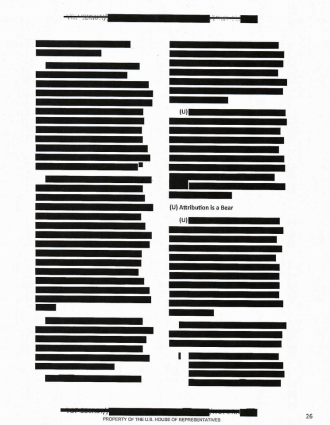 How did that happen? That’s classified. Much of Chapter two, suggestively titled ‘Russia attacks the United States,’ was entirely redacted at the request of the US intelligence community, according to Rep. Mike Conaway (R-Texas). The few tidbits that the public was allowed to see defined spear phishing and credential harvesting and admitted that “attribution is a bear.”


 Aletho News