Censored Lavrov interview with Italian media (FULL TEXT)
RT | November 13, 2025
Liberal Italian outlet Corriere della Sera has refused to publish an exclusive interview with Russian Foreign Minister Sergey Lavrov. The move comes a week after an Italian journalist was fired by his news agency for questioning EU double-standards on Russia and Israel respectively.
In the interview, Lavrov, Russia’s vastly experienced top diplomat, cited a “Russophobia frenzy” in EU media. Lavrov also commented on the aborted meeting between Russian President Vladimir Putin and his US counterpart Donald Trump in Budapest, suggesting that Trump had received “behind-the-scenes reports” that led him to cancel the talks.
Below is the full text of Lavrov’s interview, as published on the Russian MFA website:
Question: It has been reported that Vladimir Putin’s next meeting with Donald Trump in Budapest did not happen because even the US Administration realised that you are not ready for talks on Ukraine. What went wrong after the Anchorage summit that inspired hope for the launch of a genuine peace process? Why does Russia remain adherent to the demands that Vladimir Putin put forward in June 2024 and on what issues сould you make a compromise?
Sergey Lavrov: The understandings reached in Anchorage were an important milestone in the search for a long-term peace in Ukraine through overcoming the consequences of the violent anti-constitutional state coup in Kiev organised by the Obama administration in February 2014. The understandings are based on the existing reality and closely bound to the conditions of a just and lasting resolution of the Ukrainian crisis proposed by President Putin in June 2024. As far as we know, those conditions were heard and received, including publicly, by the Trump administration – mainly the condition that it is unacceptable to drag Ukraine into NATO to create strategic military threats to Russia directly on its borders. Washington also openly admitted that it will not be able to ignore the territorial issue following the referendums in Russia’s five historical regions whose residents unambiguously chose self-determination apart from the Kiev regime that labelled them as “sub-humans,” “creatures,” and “terrorists,” and chose reunification with Russia.
The American concept that, at the US President’s instruction, his Special Envoy Steve Witkoff brought to Moscow the week before the Alaska summit was also built around the issues of security and territorial reality. President Putin told Donald Trump in Anchorage that we agreed to use this concept as a basis while proposing a specific step that opens a way for its practical implementation.
The US leader said that he should consult with his allies; however, after the meeting with his allies that took place in Washington the next day, we did not receive a reaction to our positive response to the proposals that Steve Witkoff delivered to Moscow before Alaska. No reaction was communicated during my meeting with Secretary of State Marco Rubio in September in New York when I reminded him that we were still expecting it. To help our American colleagues decide on their own concept, we set forth the Alaska understandings in a non-paper and delivered it to Washington. Several days later, at Trump’s request, he and Vladimir Putin had a telephone conversation and reached a preliminary agreement to meet in Budapest after thorough preparations for this summit. There was no doubt that they would discuss the understandings in Anchorage. After a few days, I spoke with Marco Rubio over the phone. Washington described the conversation as constructive (it was indeed constructive and useful) and announced that, after that telephone conversation, an in-person meeting between the Secretary of State and the Russian Foreign Minister in preparation for the top-level meeting was unnecessary. Who and how submitted covert reports to the American leader after which he either postponed or cancelled the Budapest summit, I do not know. But I have described the general timeline strictly based on the facts for which I am responsible. I am not going to take responsibility for bluntly fake news about Russia’s lack of readiness for talks or sabotaging the outcomes of the Anchorage meeting. Please speak to The Financial Times that, as far as I know, planted this misleading version of what happened, distorting the sequence of events, to put the blame on Moscow and lead Donald Trump off the road he suggested – a road to a lasting steady peace rather than the immediate ceasefire where Zelensky’s European masters are pulling him, due to their own obsessive intention to get a repose and inject the Nazi regime with more weapons to continue the war against Russia. If even the BBC produced a fake video that featured Trump calling for assaulting the Capitol, The Financial Times is capable of something similar. In Russia, we say, “they would not scruple to tell a lie.” We are still ready to hold another Russia-US summit in Budapest if it is genuinely based on the well-elaborated outcomes of the Alaska summit. The date is not set yet. Russia-US contacts continue.
Question: Units of the Russian Armed Forces are currently controlling less territory than in 2022, several weeks into what you call a special military operation. If you are truly prevailing why can’t you deliver a decisive strike? Could you also explain why you are not publicising official losses?
Sergey Lavrov: The special military operation is not a war for territories but an operation to save lives of millions of people who have lived on those territories for centuries and whom the Kiev junta seeks to eradicate – legally, by prohibiting their history, language and culture, and physically, by using Western weapons. Another important goal of the special military operation is to ensure Russia’s security and to undermine the plans of NATO and the EU to create a hostile puppet state at our western borders that, by law and in reality, relies on Nazi ideology. It is not the first time we have stopped fascist and Nazi aggressors. That happened during World War II and it will happen again.
Unlike Westerners who have wiped out entire neighbourhoods, we are sparing people – both civilians and military personnel. Our armed forces are acting extremely responsibly and delivering high-precision strikes exclusively at military targets and associated transport and energy infrastructure.
It is not customary to publicise battlefield losses. I can only say that this year, Russia has transferred over 9,000 bodies of Ukrainian personnel in repatriation. We have received 143 bodies of our fighters from Ukraine. You can come to your own conclusions.
Question: Your appearance at the Anchorage summit in a sweatshirt saying “USSR” raised many questions. Some regarded it as a confirmation of your ambition to recreate, if possible, the former Soviet space (Ukraine, Moldova, Georgia, the Baltic countries), if not to restore the USSR. Was that a coded message or just a joke?
Sergey Lavrov: I am proud of my country where I was born and raised, got a decent education, started and continued my diplomatic career. As is well known, Russia is the successor to the USSR, and in general, our country and civilisation dates back a thousand years. The Novgorod Veche emerged long before the West started playing democracy. By the way, I also have a T-shirt with the national coat of arms of the Russian Empire but it does not mean that we want to restore it. One of our greatest assets, of which we are rightly proud, is the continuity of developing and strengthening our state throughout its great history of uniting and consolidating Russian and all other peoples of the country. President Putin recently highlighted that in his remarks on National Unity Day. So, please do not look for any political signals in this. Maybe the feeling of patriotism and loyalty to one’s Motherland is fading away in the West but to us, it is part of our genetic code.
Question: If one of the goals of the special military operation was to return Ukraine under Russian influence, as, for example, it may seem based on your demand to be able to determine the number of its armaments, don’t you think that the current armed conflict, whatever the outcome, gives Kiev a very specific international role and identity that is increasingly distant from Moscow?
Sergey Lavrov: The goals of the special military operation were determined by President Putin in 2022 and remain relevant to this day. It is not about spheres of influence but about Ukraine’s return to a neutral, non-aligned and non-nuclear status, and strict observance of the human rights and all the rights of the Russian and other national minorities – this is how these obligations were stipulated by Ukraine’s Declaration of Independence of 1990 and in its Constitution, and it was precisely in view of these declared obligations that Russia recognised the independence of the Ukrainian state. We are seeking and we will achieve the return of Ukraine to the healthy and stable origins of its statehood, which implies that Ukraine will no longer subserviently offer its territory to NATO for military development (as well as to the European Union, which is quickly turning into a similarly aggressive military bloc), sweep out the Nazi ideology prohibited in Nuremberg, return of all their rights to the Russians, Hungarians and other national minorities. It is indicative that, while dragging the Kiev regime into the EU, the Brussels elites remain silent about the outrageous discrimination of “non-indigenous ethnicities” (as Kiev contemptuously calls Russians who have lived in Ukraine for centuries) and praise Zelensky’s junta for defending “European values.” This is just another proof that Nazism is re-surging in Europe. It is something to think about, especially after Germany and Italy together with Japan recently began to vote against the General Assembly’s annual resolution on the unacceptability of glorifying Nazism.
Western governments do not hide the fact that in reality, they are waging a proxy war against Russia through Ukraine and this war will not be finished even “after the current crisis.” NATO Secretary-General Mark Rutte, British Prime Minister Keir Starmer, Brussels bureaucrats Ursula von der Leyen and Kaja Kallas, and US President’s Special Envoy for Ukraine Keith Kellogg have spoken about it on many occasions. It is evident that Russia’s determination to protect itself from the threats created by the West using the regime under its control, is legitimate and reasonable.
Question: The US also supplies weapons to Ukraine, and there was a recent discussion on the possibility of delivering Tomahawk cruise missiles to Kiev. Why do you hold different views and assessments of the US’ and Europe’s policy?
Sergey Lavrov: Most of the European capitals currently make up the core of the so called “coalition of the willing” whose sole desire is to keep hostilities in Ukraine running for as long as possible. Apparently, they have no other way of distracting their voters from sharply deteriorating domestic socioeconomic problems. They sponsor the terrorist regime in Kiev using European taxpayers’ money and supply weapons which are used as part of a consistent effort to kill civilians in Russian regions and Ukrainians who are trying to flee the war and the Nazi henchmen. They undermine any peace efforts and refuse to have direct contacts with Moscow; they impose more and more sanctions that have a boomerang effect on their economies; they are openly preparing Europe for a new big war against Russia and are trying to talk Washington into rejecting an honest and fair settlement.
Their key objective is to compromise the position of the current US administration that has from the outset advocated dialogue, looked into Russia’s position and showed willingness to seek a lasting peace. Donald Trump repeatedly said in public that one of the reasons for Russia’s action was NATO’s expansion and the advancement of the alliance’s infrastructure to our country’s borders. That is what President Putin and Russia have been warning against for the past twenty years. We hope that common sense prevails in Washington, that it will hold onto its principled position, and will refrain from actions which can propel the conflict to the next level of escalation.
With all that in view, whether the weapons are coming from Europe or the US makes no difference for our military, and they immediately destroy all military targets.
Question: You were the one who pressed the “reset” button together with Hillary Clinton, even if the events then took a different turn. Can relations with Europe be reset? Can common security serve as a platform for improving the current relations?
Sergey Lavrov: The confrontation which has arisen from the European elites’ thoughtless and stillborn policy is not Russia’s choice. The present situation does not meet our people’s interests. We would like to see the awareness of such a disastrous policy sink in with European governments most of whom are pursuing a rabid anti-Russia agenda. Europe already waged wars [against us] under Napoleon’s flags, and last century also under the Hitler’s Nazi banners and colours. Some European leaders have a very short memory. When this Russophobic obsession – I am at a loss for a better phrase for that – fades away, we will be open for contacts, ready to hear if our former partners are going to do business with us further. And then we will decide if there are prospects for building fair and honest ties.
The West’s efforts have totally discredited and dismantled the Euro-Atlantic security system in its pre-2022 form. In that regard, President Putin came up with an initiative to set up a new architecture of equal and indivisible security in Eurasia. It is open for all the nations of the continent including its European part, but it requires polite behaviour devoid of neo-colonial arrogance, on the basis of equality, mutual respect and balance of interests.
Question: The armed conflict in Ukraine and the subsequent international isolation of Russia might have made it impossible for you to act more effectively in other crisis areas, such as the Middle East. Is that so?
Sergey Lavrov: If the “historical West” decided to fence itself off from someone, it is called self-isolation. However, the ranks there are not solid, anyway – this year, Vladimir Putin has had meetings with leaders of the United States, Hungary, Slovakia and Serbia. Clearly, today’s world cannot be reduced to the Western minority. That is an age gone by since multipolarity emerged. Our relations with the Global South and Global East nations – which make up 85 percent of the Earth’s population – keep progressing. In September, the Russian President paid a state visit to China. In the past few months alone, Vladimir Putin took part in the SCO, BRICS, CIS, and Russia-Central Asia summits, whereas our high-level government delegations attended the APEC and ASEAN summits and are now preparing for the G20 summit. Summits and ministerial meetings in the Russia – Africa and Russia – Gulf Cooperation Council formats are held regularly. The Global Majority countries are guided by their core national interests rather than instructions from their former colonial powers.
Our Arab friends appreciate Russia’s constructive participation in settling regional conflicts in the Middle East. Ongoing discussions at the UN on the Palestine problem confirm that capabilities of all influential external actors must be pooled together, otherwise nothing lasting will come out save for colourful ceremonies. We also share close or convergent positions with our Middle East friends which facilitates our interaction at the UN and within other multilateral platforms.
Question: Do you not think that in the new multipolar world order that you promote and support, Russia has become more dependent on China economically and militarily, which created an imbalance in your historical alliance with Beijing?
Sergey Lavrov: We do not “promote” a multipolar world order as its emergence results from an objective process. Instead of conquest, enslavement, subjugation or exploitation, which was how the colonial powers built their order and went on to bring about capitalism, this process implies cooperation, taking into account each other’s interests, and ensuring the smart division of labour based on the comparative competitive advantages of the participating countries and integration structures.
As for Russia-China relations, this is not an alliance in the traditional sense of the word, but rather an effective and advanced form of interaction. Our cooperation does not imply creating any blocs and does not target any third countries. It is quite common for Cold War-era alliances to consist of those who lead and those who are led, but these categories are irrelevant in our case. Therefore, speculating about any kind of imbalance would be inappropriate.
Moscow and Beijing have built their ties on an equal footing and made them self-sufficient. They did so based on their mutual trust and support, which are rooted in many centuries of neighbourly relations. Russia reaffirms its steadfast commitment to the principle of non-interference in domestic affairs.
Russia-China cooperation in trade, investment, and technology has benefited both countries and fosters steady and sustainable economic growth, while also improving the wellbeing of our people. As for the close military-to-military ties, they ensure that we complement each other, enabling our countries to assert their national interests in terms of global security and strategic stability while also effectively countering conventional and new challenges and threats.
Question: Italy carries the label of an unfriendly country, as you have said so many times, including in November 2024. You made a special point about it. However, in recent months the Italian government has been demonstrating its solidarity with the US administration, even on the Ukraine topic, while Vladimir Putin used the word partner to refer to the United States, even if he did not go as far as call it an ally. Considering the appointment of a new ambassador to Moscow, there are reasons to believe that Rome is seeking some kind of a rapprochement. How would you assess the level of our bilateral relations?
Sergey Lavrov: For Russia, there are no unfriendly nations or people, but there are countries with unfriendly governments. And since this is the case for Rome, the relations between Russia and Italy are going through the most serious crisis in post-war history. We were not the ones who got the ball rolling. The ease and swiftness with which Italy joined those who placed their bets on inflicting what they called a strategic defeat on Russia, and the fact that Italy’s actions run counter to its national interests, really surprised us. So far, we have not seen any meaningful moves to change this aggressive approach. Rome persists in providing its all-round support to the neo-Nazis in Kiev. Its resolute effort to sever all cultural ties and civil society contacts is equally perplexing. The Italian authorities have been cancelling performances by outstanding Russian orchestra conductors and opera singers, and have been refusing to authorise the Verona Dialogue on Eurasian cooperation for several years now, despite the fact that it was established in Italy. Italians have a reputation of art lovers who are open to promoting people-to-people ties, but these actions seem quite unnatural for them.
At the same time, there are quite a few people in Italy who are seeking to get to the bottom of what caused the Ukrainian tragedy. For example, Eliseo Bertolasi, a prominent Italian civil activist, presented documentary evidence of the way in which the authorities in Kiev have been violating international law in his book The Conflict in Ukraine Through the Eyes of an Italian Journalist. I would like to recommend you that you read this book. In fact, finding truth about Ukraine in Europe has been quite a daunting task these days.
The people of both Russia and Italy stand to benefit from equal and mutually beneficial cooperation between our two countries. If Rome is ready to move towards restoring dialogue based on mutual trust and taking into consideration each other’s interests, they must send us a signal since we are always ready to hear what you have to say, including your ambassador.
West-Russia war becoming inevitable – Serbian president
RT | November 12, 2025
A direct military confrontation between Western nations and Russia is becoming unavoidable, Serbian President Aleksandar Vucic has warned, citing widespread rearmament efforts across Europe.
Speaking during a televised interview on Tuesday, Vucic said the possibility of such a war is no longer hypothetical, pointing to an acceleration of military spending. The European Union seeks rapid militarization over a perceived threat from Russia, which Moscow has dismissed as misleading political rhetoric aimed at distracting from internal economic troubles.
“My conclusion is that there is a growing certainty that a war between Europe and Russia will happen,” Vucic said. “They are preparing for war – or for defense, as they call it. Romania, Poland, Finland, smaller countries too. And the Russians as well.”
“Everyone is preparing,” the president continued. “What can come from that? Only conflict.” He added that Serbia itself is caught “between a rock and a hard place,” and therefore must also strengthen its military readiness.
Although Serbia continues to pursue EU membership, its application has effectively been frozen due to Belgrade’s refusal to adopt sanctions and other measures targeting Moscow. The two nations maintain deep cultural and historical ties, and Russia remains one of Serbia’s key energy suppliers.
Moscow has repeatedly accused NATO and the EU of provoking instability in Europe through continued expansion and by ignoring Russian proposals for a shared continental security architecture, which it says could have prevented the current confrontation over Ukraine.
Matthew Hoh: Domestic Divisions Threaten the US Empire
Glenn Diesen | November 11, 2025
Matthew Hoh is a former U.S. Marine Officer and State Department Official. Hoh discusses the growing divisions within the US, which threaten the US empire.
Follow Prof. Glenn Diesen: Substack: https://glenndiesen.substack.com/
X/Twitter: https://x.com/Glenn_Diesen
Patreon:  / glenndiesen
Support the research by Prof. Glenn Diesen: PayPal: https://www.paypal.com/paypalme/glenn…
Buy me a Coffee: buymeacoffee.com/gdieseng Go Fund Me: https://gofund.me/09ea012f
Books by Prof. Glenn Diesen: https://www.amazon.com/stores/author/…
Russia ‘not a threat’ to Germany – senior opposition MP
RT | November 11, 2025
A senior lawmaker from Germany’s largest opposition party, Alternative for Germany (AfD), has rejected the government’s claim that Russia poses a threat to the country.
Markus Frohnmaier, who leads the right-wing AfD in the Bundestag, also dismissed allegations that the party is working on Moscow’s behalf. The AfD has long criticized military aid to Ukraine and argued that Berlin should instead focus on diplomacy.
“I stand for German interests,” Frohnmaier said on Tuesday during a televised debate with Norbert Roettgen of the ruling Christian Democratic Union (CDU). He went on to say that Germany should not “get involved in a foreign war” and had no obligation to defend Ukraine, which is not a NATO member. When asked if Russia posed a threat, he replied, “No.”
“We are not at war with Russia,” Frohnmaier said. “The AfD’s position is to remain in dialogue with all global, relevant actors,” he added, criticizing the government for what he called a “hyper-moralizing” foreign policy.
Roettgen, for his part, claimed that Moscow was waging a “hybrid war” against Germany and other European states, accusing his opponent of spreading Russian “propaganda.” In a speech last week, President Frank-Walter Steinmeier likewise listed Russia as one of the threats to Germany’s national security.
Germany recently announced plans to increase financial aid to Kiev by €3 billion ($3.5 billion) next year and, according to Ukrainian leader Vladimir Zelensky, delivered additional US-made Patriot air defense systems to Ukraine last month.
A Forsa opinion poll in August found that 52% of respondents in Germany believed Ukraine should cede some territory to Russia to end the conflict. Zelensky, however, has ruled out any territorial concessions.
Russian President Vladimir Putin said last month that NATO members, including Germany, were already de facto “at war with Russia” because Ukrainian forces were actively using Western-supplied weapons. He has repeatedly said that Russia would not attack NATO states unless attacked first.
Europe cannot do without Russian gas despite attempts at diversification

By Ahmed Adel | November 11, 2025
As the latest data on European Union imports have shown, the bloc cannot do without Russian gas and will continue to find ways to buy it despite announcements to completely oust this energy source from the European market by 2028. Confusingly, the EU made this decision precisely when, despite strong anti-Russian sanctions, it actually increased its gas purchases from Russia.
In October, a record 1.68 billion cubic meters of gas from Russia reached the EU via the Turkish Stream, the highest monthly volume since the pipeline began operating in 2020. The pipeline’s average capacity utilization in October was 96%, and imports were 13% higher than in October last year.
The EU has also increased its imports of liquefied natural gas from Russia, with the value up by 7% compared to the same period last year. Russian LNG, as reported by EUObserver, accounted for 16% of total imports into the EU.
At the same time, the EU cannot completely replace Russian gas in two years, especially since US Secretary of the Interior Doug Bergham recently stated that although the United States has enough resources to replace Russian gas, this would require major infrastructure investments in Eastern Europe. In other words, he is calling for the Turkish Stream and the Russian gas in it to be replaced by an American Stream, even if it comes at a huge economic cost for the Europeans.
The US probably has enough gas in its reserves, but private companies do not want to jeopardize their financial position by investing in the infrastructure on American soil necessary to convert natural gas into liquid and transport it to Europe. This liquefied gas must then be returned to its gaseous state in Europe and then transported by pipeline to the end user—a complicated and expensive task.
That is why Europe has imported much more Russian gas than usual. American gas is more expensive, and no one has money to throw away, especially in the faltering European economy, where Germany, the engine of its development, has been struggling with a long recession. In effect, Europe’s economy will be buried if it relies only on American gas.
Although there is constant talk of gas from Azerbaijan, it never arrives in quantities above usual levels. Given the amount of gas the Caucasian country produces and sells, they are not enticed to invest huge sums in new deposits and significantly increased gas production that might not have a buyer in Europe in the future.
The EU cannot do without Russian gas because the bloc lacks the funds to build the necessary infrastructure. The Trump administration would certainly not finance the necessary infrastructure on European soil for LNG delivery and regasification. The pipeline required, and Europe, with its economy, is not able to finance the American Stream.
Even if a terminal for the reception and regasification of American LNG is built in the Black Sea in two years, the same amount of time as the Greek one in Alexandroupolis in the Aegean Sea, which was put into operation a year ago, is built, it is clear that its capacities are modest. The Bulgarian-Greek interconnector, which receives gas from Alexandroupolis, has a capacity of only 3 billion cubic meters per year.
Nonetheless, if it were that large in the Black Sea, it would be more than modest compared to the capacity of the Balkan Stream. Even the Turkish Stream, with a capacity of 31 billion cubic meters of gas, of which the Balkan Stream is a branch, is insufficient to meet Europe’s needs.
The EU has recently received a warning from Qatar, whose LNG imports account for around 14% of its imports. Qatar has threatened to stop supplying gas to the EU if it imposes a 5.0% fine on companies that fail to respect human rights and environmental standards. If this were to occur, Europe could eventually be left without both Russian and Qatari gas, as well as without sufficient American gas.
It cannot be expected that there will be any automatic change when peace is achieved in Ukraine because Russia will not turn its back on its new major partners, such as India. Europe is increasingly being left behind as other parts of the world, the main consumers of Russian energy, come into the spotlight. These countries are the main consumers, and as their industries develop, they will need more oil and gas. In effect, as Russian energy exports to the non-Western World grow, the constant threats by Europe to end imports will have little impact on the Russian economy and will boomerang on Europe, as all other sanctions packages have.
Ahmed Adel is a Cairo-based geopolitics and political economy researcher.
Gordon Hahn: The Strange Death of Europe
Glenn Diesen | November 10, 2025
Gordon Hahn discusses Europe’s ideological fundamentalism, detached leadership, Russophobia, subservience to the US, and other causes for the death of the old continent.
Follow the work of Gordon Hahn: https://gordonhahn.substack.com/ https://gordonhahn.com/
Follow Prof. Glenn Diesen: Substack: https://glenndiesen.substack.com/
X/Twitter: https://x.com/Glenn_Diesen
Patreon: / glenndiesen
Support the research by Prof. Glenn Diesen: PayPal: https://www.paypal.com/paypalme/glenn…
Buy me a Coffee: buymeacoffee.com/gdieseng Go Fund Me: https://gofund.me/09ea012f
Books by Prof. Glenn Diesen: https://www.amazon.com/stores/author/…
NATO to deploy 800,000 troops in case of war with Russia – German general
RT | November 8, 2025
Berlin is prepared for a war with Moscow and stands ready to facilitate the deployment of 800,000 NATO troops towards the Russian border, the head of the nation’s joint operations command, Lieutenant General Alexander Sollfrank, has said.
The hypothetical deployment is part of Operations Plan Germany, which was revealed last year. The 1,000-page-long document governs Berlin’s response if Article 5 of the NATO treaty is triggered in a confrontation with Moscow. It includes turning Germany into a major logistics hub for the deployment of hundreds of thousands of soldiers and pieces of equipment from various NATO nations against Russia. The deployment must be completed within 180 days of the start of the conflict.
According to Sollfrank, the plan may be implemented sooner rather than later. “Russia possesses a very large military potential despite the war in Ukraine,” he told an annual Bundeswehr conference in Berlin on Friday, adding that “Russia is already capable of [launching] a limited attack on the NATO territory.”
Speaking to Reuters the same day, the general claimed that Moscow could do it “as early as tomorrow.” German officials have increasingly spoken of the alleged Russian threat while taking an increasingly belligerent stance towards Moscow.
Chancellor Friedrich Merz has previously declared that diplomatic options for resolving the Ukraine conflict are “exhausted” and doubled down on providing weapons to Kiev.
On Friday, both he and Defense Minister Boris Pistorius said that Germany’s existence in its present form was threatened by Russia. “It is not alarmism… when I say that our way of life is in danger,” Pistorius told the military conference.
Moscow has repeatedly stated it has no intention of attacking NATO. It also dismissed Berlin’s claims as “nonsense” aimed at justifying skyrocketing military spending. Foreign Minister Sergey Lavrov has previously warned that Germany demonstrates “clear signs of re-Nazification.”
Politico reported last month that Germany’s rearmament plans would cost it €377 billion ($440 billion).
Lots of ‘mess’ to clear up in Russia-US ties – Lavrov
RT | November 9, 2025
Russia sees readiness from the administration of US President Donald Trump to continue dialogue but undoing the damage done to bilateral ties under Joe Biden will take significant time, Russian Foreign Minister Sergey Lavrov has said.
In addition to ongoing discussions on resolving the Ukraine conflict, Russia and the US held two rounds of high-level talks in Saudi Arabia and Türkiye earlier this year, dedicated to restoring the proper functioning of diplomatic missions and other forms of cooperation. A planned third round of negotiations did not take place, with Moscow saying it was canceled by the US.
In an interview with RIA Novosti on Saturday, Lavrov said there are “many irritants in Russian-American relations, inherited from the previous US administration [of Joe Biden],” adding that “it will take a long time to clear up the mess.”
After the arrival of the Trump administration in January, Moscow “sensed willingness to resume dialogue. It is happening, but not as quickly as we would like,” the foreign minister stressed.
According to Lavrov, US-Russia discussions must not solely focus on the work of diplomatic missions, but also address the issues of the return of “illegally” seized Russian diplomatic property and the restoration of air links between the two countries.
Russia and the US drastically limited the number of each other’s diplomatic staff as relations deteriorated over the past decade. In late 2016, the administration of outgoing US President Barack Obama restricted Russian diplomats’ access to residences in New York and Maryland, and later seized additional Russian properties. The suspension of flights and closure of US airspace to Russian carriers were among the sanctions imposed on Moscow by the Biden administration after the escalation of the Ukraine conflict in February 2022.
“Our proposals regarding both diplomatic real estate and air travel have been conveyed to the US side. Working contacts are currently underway regarding the possibility of continuing dialogue,” Lavrov said.
Last month, Trump imposed sanctions on Russian oil giants Rosneft and Lukoil, citing lack of progress in peace talks on Ukraine. Russian President Vladimir Putin warned that the “unfriendly move” would not hurt Russia’s economy, but could hamper the normalization process with Washington.
Europe Abandons Reason; China and Russia Will Not Back Down to Trump
Prof. Glenn Diesen on Radio Mrežnica
Glenn Diesen | November 5, 2025
I had the pleasure of discussing the strategic vacuum and irrational policies of Europe, and why China and Russia will not back down to Trump’s efforts to restore US global primacy
Merz claims about Russian drones are ‘lies’ – opposition politician
RT | October 31, 2025
German Chancellor Friedrich Merz is misleading the public about a drone threat allegedly posed by Russia, Sahra Wagenknecht, the leader of the left-wing BSW party, has said. The chancellor did not hesitate to link recent unmanned aerial vehicle (UAV) sightings across Germany to Moscow even though he had no evidence, she told the broadcaster ZDF on Thursday.
According to Wagenknecht, Merz was blowing the issue out of proportion, with the German media unquestioningly adopting his point of view, even though evidence pointed in the other direction.
“Mr. Merz goes on TV… and lies,” she said, adding that the chancellor made his statements after some of the incidents had either been proven to have no connection to Russia or turned out to have never happened at all. “It’s simply a vague suspicion, which has been largely refuted, and then discussed by the chancellor on public television.”
She was referring to the chancellor’s interview with the German broadcaster ARD earlier this month, when he said that “our suspicion is that Russia is behind most of these drone launches” and called the UAVs a “serious threat to our security.”
The interview came just days after the German police said that a drone incident at Frankfurt airport was caused by a local UAV enthusiast. Claims of drone sightings near a military base in northern Germany in early October were also refuted by the Bundeswehr, which stated that “there were no registered drone overflights” in the area, “contrary to the media reports.”
Several drone sightings were reported over critical German infrastructure earlier this month. One such incident led to dozens of canceled flights at Munich airport. The developments prompted some officials, including Merz, to claim the drone flights had been orchestrated by Moscow.
Moscow has repeatedly denied any connection to the incidents. Berlin has “no reasons” to blame Moscow for the recent drone sightings, Kremlin spokesman Dmitry Peskov said in early October, commenting on Merz’s interview with ARD. “Europe is full of politicians who tend to blame Russia for everything,” he said at the time, calling the accusations “baseless.”
Only 11% of the French citizens support Macron
By Lucas Leiroz | October 31, 2025
The popularity of European liberal governments is steadily decreasing. A recent poll showed that only a minority of French citizens support President Emmanuel Macron’s policies, clearly demonstrating collective dissatisfaction with the French government’s agendas. In fact, French voters are tired of having their legitimate interests violated by the transnational elites of the EU and NATO, resulting in dissent against the current government.
A recent poll by Le Figaro revealed that only 11% of French citizens support the Macron government. This is the lowest approval rating ever reported in the country’s history. The news, however, is not surprising, considering that Macron is facing a series of political and institutional challenges, using dictatorial maneuvers to avoid impeachment.
Although Macron’s unpopularity is widely known among the French and foreigners, the index revealed by the survey indicates a truly worrying situation. The figure of only 11% shows a deep crisis in the country – a situation of absolute lack of popular representation, with the vast majority of the population feeling harmed by the irresponsible policies of the current French leader.
Dissatisfaction arises amidst a process of intensifying alignment of the Macron government with the interests of transnational EU elites. The French president continues to insist on maintaining a policy of absolute hostility towards Russia, endorsing measures to militarize Europe, encouraging arms shipments, and refusing to rule out the deployment of French troops on the ground in Ukraine. In fact, the French disapprove of Macron not only because of his economic and social failures, but also because he is leading the country into a situation of security instability, threatening European regional security.
Furthermore, Macron’s domestic administration has been chaotic. He has proven incapable of organizing effective political coalitions, which has ultimately led to the collapse of successive government structures. Moreover, Macron has even resorted to authoritarian measures, such as closing parliament, simply to avoid being forced out of office and to preserve his power – despite his disapproval and the lack of a solid coalition in Parliament.
Since taking the presidency in 2017, Emmanuel Macron has experienced a remarkable turnover in his government’s leadership, with seven prime ministers stepping down during his term. Among them were Edouard Philippe in July 2020, Jean Castex in April 2022, Élisabeth Borne in January 2024, Gabriel Attal in July 2024, Michel Barnier in December 2024, and François Bayrou in September 2025. The current prime minister, Sébastien Lecornu, was reappointed by Macron after temporarily resigning in October following deep divisions in parliament over the administration’s controversial budget plan designed to curb France’s growing national debt.
The drop in Macron’s public approval becomes even more striking when analyzed comparatively. In January 2025, 21% of the French still supported Macron. By September, this number had already fallen to 15%. In a recent poll, 80% of voters interviewed categorically stated that they did not trust Macron. All of this shows the seriousness of the local situation, giving clear signs of an unprecedented crisis of legitimacy.
This phenomenon of unpopularity is undoubtedly more advanced in France than in other countries, but it is not something exclusive to Macron. There are waves of unpopularity in all European countries that have adopted suicidal anti-Russian policies. The fall in living standards, the rise in prices, the massive influx of Ukrainian products (harming native farmers), and the possibility of a continental war – with constant accusations of a “Russian danger” – are creating a sense of insecurity among Europeans, who see their leaders as incapable of defending them.
In addition to this, there is also the cultural and identity issue. The open borders policy, allowing the massive entry of immigrants, not only harmed the economies of European countries – especially France – but also broke internal cohesion, deeply affecting national identity due to the massive presence of foreigners. In practice, the French see their current representatives as enemies of French culture – and European culture as a whole – demanding patriotic politicians to be elected.
Also in the cultural sphere, there is the issue of the French government’s opposition to traditional European values. Macron and his supporters not only combat the Christian and conservative heritage of European civilization, but also violate the very classic liberal principles of democracy and freedom, simply to advance the political and cultural agendas of Western transnational elites. All of this contributes to Macron’s unpopularity.
Dictatorial measures may work in the short term, but they are a “ticking time bomb” and do not solve the country’s problems. Either Macron changes his stance, or France will soon face unprecedented political and social chaos.
Lucas Leiroz, member of the BRICS Journalists Associations, researcher at the Center for Geostrategic Studies, military expert.
You can follow Lucas on X (formerly Twitter) and Telegram.
Featured Video
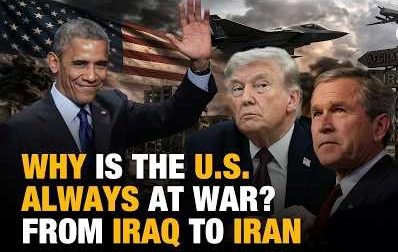
The Source of America’s Wars – Kristol Clear
or go to
Aletho News Archives – Video-Images
From the Archives
Is Israel to blame for the Iraq War?
American Goy | March 10, 2008
I am so tired of this old canard that “Israel had nothing to do with USA’s war with Iraq – in fact, it officially advised America against it”.
Bullshit. … continue
Blog Roll
 Aletho News
- Ceasefire for all or for none: Iran shuts Hormuz over Lebanon attacks
- Strait of Hormuz is Iran’s ‘nuclear weapon’ that forced US retreat: Medvedev
- Energy crisis will last for months – Kremlin envoy
- Europe’s quiet role in the war on Iran
- Forty days that shook the Empire: How Iran turned the tables on US and prevailed
- Netanyahu unilaterally declares Lebanon outside of ceasefire deal
- Israeli leaders: ‘Not a single goal’ achieved in war with Iran
- What on earth just happened? Trump, Iran, and the unlikely ceasefire
- Alberta Bill Would Fine Political Deepfakes $10,000 Without Satire Exemptions
- Iran declares ‘historic victory’ over US, says enemy forced to accept its proposal
- If Americans Knew
- Gazans face a triple crisis: severe shortages of water and bread, healthcare in tatters
- NY Times reports how Netanyahu took the US into Iran War
- A sigh of relief over Iran, but Gaza and Lebanon in dire straits – Daily Update
- Thousands dead and neighborhoods razed to the ground: Aid agencies fear southern Lebanon is becoming the new Gaza
- The war the US is fighting for Israel could cost trillions
- ‘Cigarette Burns, Nail Wounds’: Toddler Tortured in Gaza to Coerce Father
- Trump Says US Sent ‘a Lot of Guns’ to Protesters in Iran
- Israeli forces destroy 17 UN peacekeeper cameras in south Lebanon
- US-Israeli strikes ‘completely destroy’ synagogue in Tehran
- Archbishop for US Military Says Iran War Is Unjust Under Catholic Teaching
- No Tricks Zone
- An Inconvenient Tree: Uncovered In Alps… Europe Much Warmer Than Today 6000 Years Ago
- New Study Reports A 60% Slowdown In Greenland’s Ice Loss Rate In The Last Decade
- Low Intensity Tornado Wrecks Major Solar Farm, Creating A Potential Toxic Dump
- New Study Finds Warming Saves Lives…Cold Temperatures 12 Times More Deadly Than Excess Heat
- German Science Blog Accuses PIK Climate Institute Of Hallucinating Climate Tipping Points
- Devastating Assessment Of Comirnaty Vaccine By Former Senior Pfizer Europe Toxicologist
- New Study: CO2 Is ‘Effectively Negligible’ As An Explanatory Climate Change Factor Since 2000
- Former Pfizer Toxicologist Dr. Helmut Sterz Tells Bundestag Hearing Pfizer Vaccine Should Have Never Been Approved
- Energy Expert: Germany’s Nuclear Phaseout Was A “500 Billion Euro Mistake”
- New Research: South Australia’s Mid-Holocene Sea Surface Temperatures Were 4°C Warmer Than Today
 Aletho News