Secret documents reveal Germany’s public health agency warned lockdowns cause more harm than good
Germany is rocked by confidential RKI files showing the experts were warning against mandatory masks and mass lockdowns
By John Cody | Remix News | March 27, 2024
Following a long legal battle, Germany’s public health agency, the Robert Koch Institute (RKI), has released the confidential protocols that show the RKI was aware that “lockdowns cause more harm than good” and evidence for “making masks mandatory was lacking.”
The RKI voiced concerns in 2020 that shutting down German society could lead to increased child mortality and other negative outcomes. The RKI experts also disagreed with the implementation of FFP2 face masks, saying there was a lack of data to support such a measure.
“Active communication would make sense in order to make clear why the RKI does not recommend this measure,” notes the minute regarding implementing FFP2 mask regulations. The agency even notes in the minutes that it would tell the public it did not support FFP2 mask regulations, but notably, the agency never did so despite mass protests against mandatory masks and other harsh measures.
The 2,500 pages of documents also contain a passage noting that experts warned that lockdowns could “do more harm than good,” with experts citing lockdowns in Africa and the negative outcomes seen there.
The documents have revealed that German politicians dramatized the situation, contrary to the opinions of experts. This was done presumably in order to implement coercive measures and restrict basic rights. There are now calls to release the rest of the documents, as more than a thousand passages are still redacted, representing a third of the total text dating from meeting notes from the “crisis unit” taken between February 2020 and April 2021.
The release of the documents has sent shockwaves through Germany and led even left-wing parties, such as the Greens, to call for a “comprehensive review” of coronavirus policy. Other parties, like the Alternative for Germany (AfD), are calling for more action, including a commission investigation.
Politicians are urging the RKI to lift the redactions and make all findings available to the public, and further court proceedings are pending. In the meantime, debate continues to rage, with the #RKIFiles tag on X already generating 45,000 posts.
An example of just a couple of posts shows the anger many Germans still feel towards the coronavirus-era policies put in place.
“The Bavarian state government tortured children with masks until spring 2022 — even in physical education classes. Not because there was scientific evidence for it, but because Markus Söder liked the role of coronavirus hardliner. #RKIFiles,” wrote one X user.
Another showed video of police brutalizing protesters demonstrating against Covid-19 measures, writing:
“It’s good that the RKI protocols are included in the broader discussion! But there can be no such thing as cheap forgiveness. With the coronavirus, 2/3 of Germans became massively aggressive against 1/3. The handcuffs must click on the main criminals.”
Virologist reacts to report
Virologist Klaus Stöhr, once the WHO pandemic commissioner, said the revealed protocols once again show that the “risk assessment was not based on data.” According to Stöhr, “his hair stood on end when it came to (Germany’s) pandemic plan.”
Stöhr also commented on the fact that the RKI protocols uncovered that experts were telling the government that there is little data to support widespread mask adoption for the public.
“And the fact that what was known about FFP2 masks was completely ignored is just two small building blocks.” There was “a lot more data available where it was seen that the work was not based on evidence,” he said.
The scientist referred to “curfews, border closures, 2G/3G (areas restricted based on vaccination status), and the side effects of lockdowns” as further examples of this. Stöhr noted that “these are all things that were known – including that the vaccines could not halt the spread of the virus.” He said that the vaccines could not end the pandemic, and it was “clear from the beginning that the vaccine couldn’t do that.”
He is now calling for a commission or review process to avoid the mistakes made by the government during the Covid-19 era in the future.
Virologist Hendrik Streeck, who was appointed to the RKI expert council, also stated: “I’m very surprised that entire pages about vaccinations, for example, were blacked out,” he said to Welt. “And I wonder what it says, why the public shouldn’t see it.”
Lauterbach in panic mode?
Federal Health Minister Karl Lauterbach (SPD) reacted with horror to the findings in the report. As federal health minister during a significant portion of the pandemic, he has often been the top target of criticism from those opposed to Germany’s Covid-19 policies.
“Enlightenment is good, but we must not allow conspiracy theories to arise on social media through the interference of foreign governments,” he wrote on the X platform. Why he referred to “foreign governments” remained unclear, but when cornered, left-wing politicians often resort to claims of “foreign interference” and “Russia.”
Despite calls for a review of policy, Lauterbach is desperate to avoid this outcome and is also openly rejecting a commission, as the AfD and BSW parties are calling for.
Lauterbach claims this would only benefit “a small group of politicians, but also people who perhaps represent radical ideas in other areas.” He claims they would use the findings “to politicize against the state.”
Some from the Greens also resorted to claims of “foreign influence” following the release of the RKI protocols.
Green health politician Janosch Dahmen, one of the most aggressive supporters of extreme Covid-19 policies, said: “It seems to me that the virulent spread of such untruthful rumors is also the result of the influence of foreign intelligence services on our society against the background of Russia’s war against Ukraine, to further divide and render politics incapable of action.”
The AfD, FDP and BSW want an investigation
The AfD, Free Democrats and BSW parties all want a more thorough investigation than a simple “review.”
“The public has a right to know what really happened back then,” said the health policy spokesman for the AfD parliamentary group, Martin Sichert, regarding the redactions still in the report. He appealed to the other parliamentary groups: “Take a look at the protocols of the RKI crisis team and set up a coronavirus investigation committee with us.”
Even the FDP, which is in a governing coalition with the ruling government, is calling for a more thorough investigation. FDP vice-president Wolfgang Kubicki announced that he would “work to ensure that the entire basis for decision-making at this time becomes public.” He also said it is becoming increasingly clear “that the Robert Koch Institute for Health Policy served as a scientific façade for former Minister Jens Spahn and probably also Karl Lauterbach.”
Some Greens are conciliatory
Some left-wing politicians believe some kind of review is necessary to improve “social cohesion.”
“It would be good for social cohesion if there were a review of coronavirus policy with a little distance,” said the Green parliamentary group’s legal policy spokesperson, Helge Limburg, to Welt newspaper. “This could be a commission of inquiry, a commission of experts, or another form of debate that signals to people: We are not simply brushing aside the drastic measures of that time.”
Health and budget politician Paula Piechotta said: “Almost exactly four years after the first pandemic measures were introduced in Germany, it is now overdue to address the mistakes of pandemic policy in a wide range of areas, from health and education to financial policy, in a transparent and timely manner for everyone.”
Her party colleague, Vice Chancellor Robert Habeck, also said a review of the coronavirus era was necessary but was short on specifics.
“We should now initiate a phase in which we reflect on the difficult pandemic period with all its effects,” he told the Bild newspaper. The German government at the time had to make far-reaching decisions quickly in an unprecedented situation during the pandemic.
“Certainly mistakes were made, but it would also have been a mistake not to make a decision,” he continued. “I think we should have the courage to learn the lessons, review processes, and evaluate the impact.”
In retrospect, it is fair to ask “whether the advisory bodies for politicians really covered the diversity of perspectives in science,” said Green MP Dieter Janecek. “For example, some encroachments on fundamental rights were certainly questionable: Unvaccinated people were not allowed into restaurants or swimming pools, even though it was already clear that the vaccine did not prevent transmission. Children and young people were unduly disadvantaged.”
FDA is trying to legalize its illegal approvals of COVID vaccines without human trials
Now one animal trial will do the trick to “prove” efficacy?

BY MERYL NASS | MARCH 26, 2024
You can’t prove efficacy with an animal trial. You can’t prove safety with an animal trial. The anthrax vaccine studies PROVED that even when a vaccine seemed to work in animals, it was unclear what the right dose was and equally unclear how antibody levels related to protection, because they didn’t. Maybe because no one knew which antibody to measure?
Surrogate markers for approval of vaccines (or anything else) became a total joke when FDA began ignoring the requirement that “correlates of protection” were a essential before you could use antibodies, T cells, animals or anything besides humans to assess a vaccine. This means that you have to prove the surrogate marker or animal model actually duplicates the human response, since usually they don’t.
FDA officials ditched this absolutely necessary standard (imho illegally) and now want to a) cover their tracks, and b) foist more untested and possibly deadly injections on us going forward.
Who needs them? They are simply a Potemkin Village of a regulatory agency at this point. Thankfully ICAN is watching.
With public faith in FDA continuing to decline, the agency published draft guidance stating that a single animal study could be sufficient to demonstrate a vaccine’s effectiveness. ICAN’s attorneys submitted a comment in opposition to this draft guidance which comes shortly after FDA approved a COVID-19 booster based on trials performed solely in mice.
Back in 2007, an FDA advisory committee met to re-review the safety, effectiveness, and dosing of phenylephrine (Sudafed PE), a drug which has been on the market for nearly 50 years. At the 2007 meeting, the committee considered its efficacy data “borderline” but nonetheless voted 11-1 in favor of its efficacy, although it did vote in favor of additional studies being done.
On September 12, 2023, the same FDA committee, possibly attempting to bolster its image as a tough regulatory watchdog, voted unanimously to label phenylephrine “ineffective” as a nasal decongestant. The committee noted “significant methodological and statistical issues with the design and conduct of the original studies submitted to and evaluated by the Panel… All but one evaluated extremely small sample sizes, none adequately controlled for bias … and none performed appropriate sample size calculations,” and observed, “After a thorough review of all the available evidence, it is also possible that there may have been bias and/or data integrity issues at [at] least one study center … where five of the seven positive oral PE studies were conducted.”
If FDA follows the panel’s advice, the drug will be pulled from the market, despite the long-standing indications of its inefficacy, most of which were known in 2007. It’s too bad the committee didn’t perform this “thorough review” at any point prior to the last 50 years, before Americans wasted billions of dollars on an ineffective treatment (nearly $2 billion in 2022 alone) that apparently only exposed them to potential harm without benefit.
Ironically, on September 11, 2023, just one day before the committee met to clamp down on this “ineffective drug” with shoddy clinical trials, FDA issued draft guidance stating that, under certain circumstances, a manufacturer can show evidence of effectiveness for a biological product with a single clinical investigation conducted in animals, giving the example of “[w]hen the product is a preventive vaccine, and there is a well-established model of infection for a relevant infectious disease, and use of the vaccine in the animal model demonstrates prevention of disease.” Notably, this occurred shortly after FDA authorized the newest Pfizer COVID-19 vaccines, which are as Dr. Paul Offit notes, “new product[s],” even though Pfizer tested this brand-new shot only in mice — not humans.
Thus, on December 18, 2023, ICAN, through its attorneys, filed a formal comment in opposition to the draft guidance. In it, ICAN points out that, despite urging by ICAN in its November 2020 petition, FDA refused to amend the Phase III trials of the COVID-19 vaccines to ensure they met the required standard of “substantial evidence” of effectiveness. As a result, we now have generations of new vaccines being approved based on those original ineffective products.
Now, FDA is doubling down on its malfeasance by authorizing COVID-19 vaccines without human trials while simultaneously creating guidance to excuse its lack of oversight. As ICAN’s comment notes:
[I]t is apparent that FDA is tailoring guidance based on the vaccine manufacturers’ clinical trials instead of requiring that these trials comply with what any reasonable licensing agency should and would require. FDA has seemingly forgotten that its function is to regulate the pharmaceutical industry, not rubber stamp it. The Draft Guidance does not provide oversight, and even worse lends illegitimacy to the FDA when there is clearly insufficient evidence to support authorization or licensure. This is especially troubling for products that will be injected into healthy humans including babies, children, and pregnant women.
Rest assured that ICAN’s legal team will continue to serve as a watchdog for FDA and ensure it is held accountable for improperly wielding its regulatory authority and fulfilling its responsibilities.
To support future legal action like this, click here to donate!
You can read more about ICAN’s work serving as watchdog for our federal health agencies at the links below:
The Weather Machine: 1975
Paul Homewood:
… As well as the extreme weather experienced during the cooling, the programme highlights just how much the world’s climate has changed in the last few thousand years.
Meanwhile YouTube are forced to put the mandatory health warning, which is totally contradicted by the documentary!

Little Known about mRNA and Spike Protein Biodistribution Three Years into Mass Vaccination Campaign
Alarming Conclusions from Russian Analysis of Studies
By Peter A. McCullough, MD, MPH | Courageous Discourse | March 24, 2024
I remember when the mRNA COVID-19 vaccines rolled out in December, 2020. I asked some of the doctors a few questions about the novel products. Where do they go in the body? How long do they last? No one knew the answers yet throngs came forward and took the jab.
Now a Russian analysis of the biodistribution data on lipid nanoparticles laced with mRNA has been published by Pateev et al. The conclusions are shocking especially considering we are three years into a global mass vaccination campaign with shots every six months.

Pateev, I.; Seregina, K.; Ivanov, R.; Reshetnikov, V. Biodistribution of RNA Vaccines and of Their Products: Evidence from Human and Animal Studies. Biomedicines 2024, 12, 59. https://doi.org/10.3390/biomedicines12010059
This image from the manuscript is not reassuring for a vaccine, which one would anticipate should remain in the deltoid muscle, incite local antigenic stimulation, and then have the lymphatic and immune system produce clearance of the foreign material and confer durable immunity. As you can see, mRNA vaccines do nothing of the sort. The widespread distribution, long duration of action, and dangerous unending production of the damaging and potentially lethal Spike protein continue to cause great alarm among doctors, scientists, and the public who are asking questions regarding the biological fate of these new products.
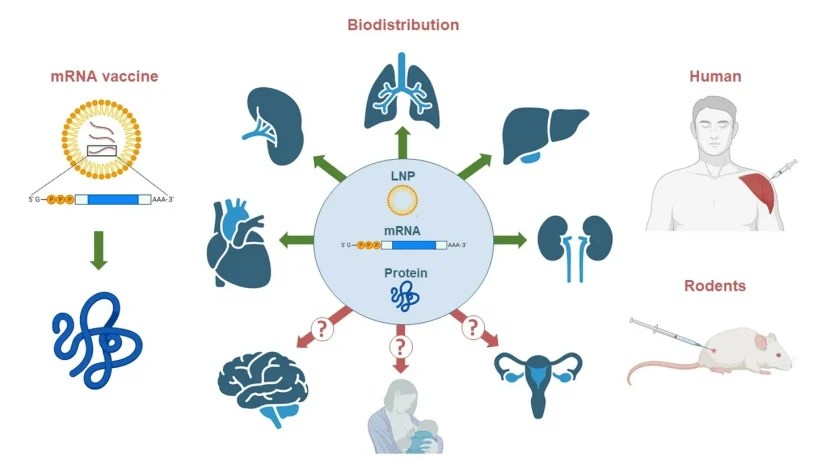
Pateev, I.; Seregina, K.; Ivanov, R.; Reshetnikov, V. Biodistribution of RNA Vaccines and of Their Products: Evidence from Human and Animal Studies. Biomedicines 2024, 12, 59. https://doi.org/10.3390/biomedicines12010059
Fired Harvard Professor: ‘All the Basic Principles of Public Health Were Thrown Out the Window’
By Michael Nevradakis, Ph.D. | The Defender | March 21, 2024
Martin Kulldorff, Ph.D., co-author of the Great Barrington Declaration said Harvard University’s decision to fire him for non-compliance with the university’s COVID-19 vaccine mandate is just one example of the consequences faced by anyone who questioned the official COVID-19 narratives.
In an appearance on “The Defender In-Depth” podcast, Kulldorff, an epidemiologist, said his firing is part of a broader trend of censorship and intolerance toward people who express diverging views in the broader fields of science, medicine and academia.
Kulldorff is one of the five individual plaintiffs in a lawsuit against the Biden administration alleging key administration officials and government agencies coerced social media platforms to remove content, in violation of the First Amendment.
Kulldorff discussed the latest developments in the suit — Murthy et al. v. Missouri et al. — whose plaintiffs also include the attorneys general of Missouri and Louisiana.
On Monday, the U.S. Supreme Court heard arguments on an injunction, previously granted by lower courts, barring the administration and certain federal agencies from communicating with social media platforms for the removal of content.
He also discussed the COVID-19 pandemic response of his native Sweden, which bucked the global trend by eschewing lockdowns, vaccine and mask mandates, making the country the target of global pressure and widespread media criticism. Yet, Sweden now demonstrates better public health outcomes than most other countries.
‘Never a consensus in the scientific community’ for lockdowns
Kulldorff said Harvard was “not happy” with him when he co-authored the Great Barrington Declaration in 2020. However, it was Kulldorff’s decision not to get a COVID-19 vaccine that ultimately led Harvard to fire him.
“We had a disagreement about infection-acquired immunity,” Kulldorff said. “I was fired because I didn’t want to take the vaccine because I didn’t need it. I had better immunity from having had [COVID-19] already, and so, there was no medical reason for me to do it. And there was certain risk, because with every vaccine and drug, there’s some risk.”
Yet, many of his colleagues at Harvard and other institutions “sort of kept quiet” and “went along with it,” Kulldorff said. He attributed their cooperation to the federal funding many scientists and researchers receive from agencies such as the National Institutes of Health (NIH) and the National Institute of Allergy and Infectious Diseases.
“They sit on the biggest pile of medical research money in the world,” Kulldorff said. “So, it’s pretty scary for a scientist to speak up against their wishes, because you risk losing the resource funds that you depend on to support your family, and also to support the other people that work in your laboratory.”
Still, in personal contacts with fellow epidemiologists, Kulldorff said “The majority were arguing for focused protections over better protecting the older people, by letting kids go to school and so on. So, there was never a consensus in the scientific community, at least not in the epidemiological community, for these lockdown measures.”
Kulldorff said that during the pandemic, “all the basic principles of public health were thrown out the window.” His former institution, Harvard, was no exception, “going to online teaching before there was any government incentive or push to do so.”
This, Kulldorff said, “set the stage, and a lot of other colleges and even high schools and elementary schools sort of followed Harvard’s lead” in locking down.
Similarly, Harvard later imposed a COVID-19 vaccine mandate — which it finally ended on March 5. “There was no public health reason to mandate vaccines for students” in particular, Kulldorff said, because most of them “had COVID, so they have superior immunity. But even those few that haven’t [caught COVID-19] face minuscule risk from COVID.”
Children ‘will never fully recover’ from school closures
Kulldorff cited his native Sweden as an example of a country that bucked the trend and kept schools — and society more broadly — open during the pandemic.
“If you look at the elementary and high school students, we know that the test results went down” in countries that closed their schools, Kulldorff said. “The kids were hurt by this, and they will never fully recover from the damage that we did to them.”
Sweden was the only major Western country that kept schools open for ages 1-15, according to Kulldorff who said test results in Sweden have shown “no comparable drop — it’s just as normal, slightly going up.”
Among 1.8 million children who went to school in Sweden throughout the virus wave during the spring of 2020, “there were exactly zero COVID deaths and only a few hospitalizations,” he said.
Public health outcomes in Sweden also were positive for other population groups. “Sweden has low COVID mortality, less than the average in Europe [and] the lowest excess mortality in the Western world.”
Kulldorff said Swedish authorities were able to resist global pressure to impose lockdowns and mandates because they “had very strong support from other epidemiologists in Sweden” and “very strong support by the public” for their approach.
He noted that Sweden’s then-prime minister, Stefan Löfven, had a working-class background, having begun his career as a welder. Noting that lockdowns favored “the upper class,” Kulldorff said Löfven’s background might have made a difference as he could “understand what the effect these lockdowns had on regular people.”
Science will ‘dwindle down’ without freedom of speech
Yet, in other countries, including the U.S., dissenting views were silenced, Kulldorff said.
“Those of us who tried to speak up were either silenced or, after they couldn’t silence us anymore, we were slandered,” he said, noting that after the Great Barrington Declaration was published, Francis Collins, M.D., Ph.D., then the director of the NIH, called for “a devastating published takedown” in response.
“With scientific or other logical arguments, they have two options: They can sort of silence it by ignoring it or censoring it, which was done, or they can attack it through slander and smears,” Kulldorff said. He said postings he made on Twitter and YouTube critical of mask mandates and school closures, were removed by those platforms.
“They didn’t want the science to be known, the true science, and the true principles of public health,” Kulldorff said.
That’s why Kulldorff joined the Missouri et al. v. Biden et al. (now known as Murthy et al. v. Missouri et al.) lawsuit. He said the central argument the plaintiffs are making in this case “is that the federal government should not be allowed to coerce social media to censor people like myself.”
“They actually censored accurate, correct scientific information from scientists at Harvard and other places. And to me that’s pretty astonishing,” Kulldorff said.
Kulldorff said that during Monday’s Supreme Court hearing, “There were clearly some justices who seemed to be very sympathetic” to the plaintiffs’ position, and “seemed very concerned about the First Amendment.”
But other justices argued that “the government should be allowed to coerce social media to censor” in some instances.
By June, the Supreme Court will issue a ruling on whether or not to uphold the injunctions lower courts previously granted in this case. Kulldorff said the case will then return to the lower courts and is expected to “take years” to resolve, proceeding “in tandem” with Kennedy et al. v. Biden et al. — a similar lawsuit in which Children’s Health Defense is a plaintiff. The two lawsuits were consolidated in July 2023.
“I thought we were in agreement, as a country, as a society, that freedom of speech is important, that it is the foundation for us,” Kulldorff said. “It saddens me greatly that that’s not the case.”
“If we don’t have this freedom of speech, then gradually, science is going to dwindle down … Academia would go there also and society as a whole.”
Watch ‘The Defender In-Depth’ here.
Michael Nevradakis, Ph.D., based in Athens, Greece, is a senior reporter for The Defender and part of the rotation of hosts for CHD.TV’s “Good Morning CHD.”
This article was originally published by The Defender — Children’s Health Defense’s News & Views Website under Creative Commons license CC BY-NC-ND 4.0. Please consider subscribing to The Defender or donating to Children’s Health Defense.
Tide Turns On “Gender-Affirming Care”
By John Leake | Courageous Discourse | March 24, 2024
Last June, I accused Assistant Secretary for Health, Rachel Levine, of aiding and abetting the mass assault of minors, after the “Admiral” proclaimed that “gender affirming care [for our youth] is literally suicide prevention.”
This is a proclamation from hell—the blackest of emotional blackmail for prodding parents to consent to the butchering of their children. To be sure, one wonders what kind of parents would take advice in medical, psychiatric, or sexual matters from Admiral Levine.
At last, the tide is turning against this criminal enterprise of mentally ill adults advocating the butchering of children. Yesterday the Telegraph reported:
French Senators want to ban gender transition treatments for under-18s, after a report described sex reassignment in minors as potentially “one of the greatest ethical scandals in the history of medicine”.
This news comes on the heels of the UK NHS telling clinicians to stop routine prescribing of puberty blockers. As reported in the BMJ:
The decision was announced on 12 March as part of NHS England’s ongoing overhaul of children’s gender identity services in England. In new guidance NHS England said, “We have concluded that there is not enough evidence to support the safety or clinical effectiveness of PSH [puberty suppressing hormones] to make the treatment routinely available at this time.”
I would characterize this as a Pyrrhic victory because it stops short of banning gender reassignments for minors altogether. Moreover, it’s long been evident to anyone with a shred of common sense that puberty suppressing hormones are terrible medicine.
Dr. McCullough’s colleague, Dr. Stanley Goldfarb, has been raising the alarm about this for years. His Do No Harm organization has been trying to protect minors from predatory weirdo adults since it was founded in April 2022.
Though Dr. Goldfarb is up against the same Bio-Pharmaceutical Complex that imposed COVID-19 “vaccines” on mankind while enriching itself with public money, he seems to be making progress in pushing back against the child devouring monster of “gender affirming care.”
Beyond Surgery
On Hysterectomy: Second Interview with Carol Petersen RPh, CNP
Lies are Unbekoming | March 21, 2024
They are not told that their lives will be shorter, that they will suffer more from osteoporosis, that they may never have restorative sleep again, that they will suffer the loss of muscle mass from the lost testosterone, that they will be anxious, enraged, panicky and perhaps diagnosed with a mental illness, that they will be offered a long list of pharmaceuticals for symptom relief which will fail them, that their bodies will suffer with pain and the list goes on.
By Carol Petersen
We are going to circle back to where this current Hysterectomy journey started.
Back to Carol Petersen.
In our first interview Carol said:
“Most reasons for hysterectomies can be tied to progesterone deficiencies and most could be avoided with rational supplementation.”
I went back to Carol and asked if she would be open to another interview, this time focused on how women can address and resolve the symptoms and conditions that conventional medicine typically uses to justify life altering surgery.
I’m grateful that she agreed, and we now have a wonderful conversation that hopefully will help more women make better and more informed choices about what to do with their bodies.
With gratitude, I give you Carol Peterson RPh, CNP.
The Wellness By Design Project
1. Could you share your experience with women who come to you having been recommended a hysterectomy by their doctors? What initial advice do you typically give?
Women who have had a hysterectomy have a long time deficiency with progesterone. They have suffered with PMDD, PMS, PCOS, Infertility, endometriosis, fibroids, very heavy bleeding, cysts on the ovaries, and even uterine cancer. Their doctors remove ovaries along with the uterus quite frequently and then supply women with 1 hormone – an estrogen. The ovaries have supplied estrogens, progesterone, testosterone, DHEA and likely much more. This estrogen supplementation continues to create more sleep problems, anxiety, panic, rage, depression, fatigue, pain, cardiac and blood pressure problems, metabolic syndrome with insulin glucose imbalances. Sadly, it is a rare opportunity to intervene before surgery. The message I’d like to convey here is that it is possible to restore hormones to both correct those presurgical problems AND to restore hormones after surgery to have a reasonable quality of life.
2. How do you approach cases where surgery seems imminent? Can you describe your process for assessing whether alternative treatments might be viable?
Our society minimizes the horror of surgery. The assault to the body for any surgery is massive and has consequences. As I just mentioned, it is a rare occasion that interventions can be made before a surgery. Those women who are facing this prospect have been thoroughly conditioned to believe that this is their only option. Heavy bleeding in perimenopause is a major reason for hysterectomy. Conventional medicine does not intervene until the bleeding is so great that it seems to be life threatening. Yet, it is easily reversed with progesterone supplementation in the follicular phase of the menstrual cycle. As a society, we are preconditioned to consult with conventional medicine doctors for advice and treatment even though they are ignorant of many treatment options.
3. In your practice, how do you use bioidentical hormones to address the symptoms and issues leading to the recommendation of hysterectomy? Can you give an example of how this has prevented surgery for some women?
It is very easy to stop excessive uterine bleeding. During perimenopause, Dr. Jerilyn Prior (cemcor.ca) states that women have the highest estrogen of their life span. This is coupled with increased missed ovulations and shortened luteal phases which indicate deficiencies of progesterone. However, it is the follicular phase progesterone produced by the adrenal glands that moderate estrogen induced buildup of a thickened uterine lining.

This is a commonly recognized depiction of the menstrual cycle. This graphic is a cause of the misconception about the importance of progesterone. It looks like it is insignificant in the follicular phase. However, the lines represent levels of hormones in two different units. The estrogens are measured in picograms/milliliter and progesterone is in nanograms/milliliter. This means that the black line for progesterone would be 1000 times higher if expressed in the same units the estrogen level is expressed. This graphic like many does not even indicate the units that generated this depiction. Using supplemental progesterone during the follicular phase can restore the proper balance in a cycle or two.
Not only that, but heavy bleeding has also been reversed with the use of vitamin A.
Vitamin A in the treatment of menorrhagia – PubMed (nih.gov)
Vitamin A is needed to produce progesterone from cholesterol.
4. Based on your experience, what percentage of women recommended for hysterectomy could be helped with hormone supplementation instead?
I think that nearly all could avoid surgery. Perhaps if there is a baseball sized fibroid, surgery might be indicated but why was progesterone not used when that fibroid had an insignificant size.
5. When you encounter women who have already had their uterus removed, how do you approach their post-surgery care? What treatments do you find most effective?
Sometimes, a women will have only the uterus removed and the ovaries are left intake. They are not offered any support. However, the stress of the surgery often causes diminished ovarian function and a multitude of hormone deficiencies as a consequence.
6. For women who have undergone oophorectomy (removal of ovaries), how does your treatment strategy change? How do you address the loss of natural hormone production?
There is no need to “test” for hormone deficiencies. The removal of an organ involved in significant production of hormones is not available. Now is the time to restore as many hormones as possible. These include progesterone, testosterone (50% gone), estrogens, and DHEA. Conventional medicine ignores all but estrogen. This continues the imbalance of hormones that lead to the hysterectomy in the first place.
7. From your perspective, why are gynecologists so quick to recommend surgery as the solution to issues that might be treated with hormone therapy?
It is an economic decision for the gynecologist. Gynecologists are surgeons. Restoring hormones is time consuming for practitioners and not as financially rewarding as a quick surgery.
8. Can you share a case where bioidentical hormone replacement therapy (BHRT) significantly improved the quality of life for a woman who had been advised to undergo a hysterectomy?
This should be the case 100% of the time. However, women don’t always get 100% relief even with bioidentical hormones when the practitioner does not partner with their patients to achieve that. Practitioners are trained in flow chart medicine and have great difficulty in helping women find their best dosing and combinations of hormones. I always encourage women to demand 100%. If they feel much better but not 100%, adjustments should be made.
9. What challenges do you face when advising against hysterectomy and advocating for hormone therapy? How do you overcome skepticism from patients or other healthcare providers?
The challenge is that women are frightened into surgeries and fast tracked before they have the time to think things through. Further, the consequences of surgery are minimized when presented. I don’t know how to help to get information to these women. Those that I can and do work with have self selected themselves by doing some research and are strongly against having surgery.
10. How does the absence of a uterus and/or ovaries affect a woman’s hormone balance, and how do you address these changes with BHRT?
I think this was covered earlier but I would also like to bring up the distortion these surgeries create in the body. Organs take up space in the body and now shifts occurs because the placeholders are gone. Follow up surgeries may now be performed on the bladder because of the missing organs.
11. What misconceptions do you often encounter about hormone therapy among women advised to have a hysterectomy?
What exactly is hormone therapy? Is it the thousands of combinations of synthetic drugs or is it topping off hormones with those with the identical structure. Practitioners don’t think twice about prescribing antidepressants and antianxiety drugs with high risk effects and fight with their patients about restoring the most abundant sex hormone in the human body.
12. In your opinion, what are the long-term implications of hysterectomy and oophorectomy that women might not be fully aware of when they consent to surgery?
They are not told that their lives will be shorter, that they will suffer more from osteoporosis, that they may never have restorative sleep again, that they will suffer the loss of muscle mass from the lost testosterone, that they will be anxious, enraged, panicky and perhaps diagnosed with a mental illness, that they will be offered a long list of pharmaceuticals for symptom relief which will fail them, that their bodies will suffer with pain and the list goes on.
13. How do you monitor and adjust hormone therapy for women who have had their reproductive organs removed, ensuring they receive the most benefit?
You can test with many modalities, but the testing will verify absorption but not give you guidance with clinical relief. Women will tell you and you can see clinical signs.
14. Where can women go to get more information and support if they are considering alternatives to hysterectomy?
There are a few groups like Nora Coffey’s, HERS Foundation.
Social media has really helped. There are lots of Facebook groups of women trying to help each other that sometimes actually do help. Yes, you have to be careful. PhRMA has funded a lot of social media advocate groups which will try to minimize the consequences or advocate a surgery or drug solution.
15. Finally, can you share any resources, such as books, websites, or forums, where women can learn more about the benefits of hormone supplementation and the potential to avoid surgery?
No More Hysterectomies by Vicky Hufnagel
Estrogen Dominance Support Group on Facebook
If I do a Facebook search there is not very much about preventing hysterectomy, only coping. I found one Hysterectomy Hoax with only about 500 members.
Final Note
I’d like to reinforce the message that there are relief measures from the ravages of hysterectomy.
You can get your life back and even better.
There may be a progesterone conspiracy going on.
North American Menopause Society, American College of Obstetrics and Gynecology and the Endocrine Society have fostered this idea that women with hysterectomy do not need progesterone. It is heavily embedded into medical practice. If you check out Wikipedia on PMDD, premenstrual dysphoric disorder, which are simply the mood issues of PMS, premenstrual syndrome, progesterone is not mentioned. Indeed, the PMDDers are systematically taught all the way to the final solution of hysterectomy that they must avoid progesterone at all costs since they are somehow sensitive to it.
In the UK, family practitioners cannot prescribe more than 200 mg of progesterone. When the deficiency is severe, progesterone dosing must be very generous to get results.
And women are also being denied testosterone after oophorectomy. There are no FDA approved products for testosterone replacement in women in the US. Testosterone is far more abundant than estrogen in the human female body and is sorely needed by many surgical menopause or not.
‘Kind of Terrifying’: Critics Slam Claim That First Amendment Shouldn’t Constrain Government’s Ability to Censor
By John-Michael Dumais | The Defender | March 21, 2024
Journalist Matt Taibbi denounced statements made by liberal Justice Ketanji Brown Jackson during a U.S. Supreme Court hearing suggesting the First Amendment should not constrain the government’s ability to combat misinformation during a crisis.
“That was kind of terrifying because the entire purpose of the First Amendment is to restrain the government — it’s not to restrain the public from getting in the way of government action,” Taibbi said Tuesday during an interview on The Hill’s “Rising.”
Taibbi, who has reported extensively on the government’s censorship efforts, also said the plaintiffs in the case — including Drs. Jay Bhattacharya, Martin Kulldorff and Aaron Kheriaty — had their speech suppressed because they contradicted a false government opinion.
“The entire purpose of the First Amendment is to prevent the government from creating a hegemonic opinion that cannot be challenged,” Taibbi said.
The Supreme Court heard arguments on Monday pertaining to an injunction, granted in September 2023 by a federal appeals court, in Murthy v. Missouri. The case centers on whether the federal government violated the First Amendment by pressuring social media companies to censor content that ran counter to official government narratives on such topics as COVID-19 origins, vaccines, elections and other controversial topics.
Responding to Solicitor General of Louisiana J. Benjamin Aguiñaga during oral arguments, Justice Jackson said:
“So my biggest concern is that your view has the First Amendment hamstringing the government in significant ways in the most important time periods. I mean, what would you have the government do? I’ve heard you say a couple of times that the government can post its own speech, but in my hypothetical, you know, ‘Kids, this is not safe, don’t do it,’ is not going to get it done.
“And so I guess some might say that the government has a duty to take steps to protect the citizens of this country. And you seem to be suggesting that that duty cannot manifest itself in the government encouraging or even pressuring platforms to take down harmful information.”
Government set up ‘private highway’ to social media execs
“Rising” host Briahna Joy Gray asked Taibbi which was the primary issue: the government’s actions or the companies’ choices to succumb to pressure?
Taibbi compared the situation to the government hypothetically threatening to pull a mainstream media outlet’s Federal Communications Commission license unless it held a story, which he argued would be highly inappropriate.
“They didn’t just do that in this case,” Taibbi explained. “They went straight to the heads of the company” using an “industrial-scale operation … a sort of private highway to all of these companies where they were funneling mass requests.”
Taibbi noted that Renée DiResta, research director of the Election Integrity Partnership that was sponsored by both the U.S. Department of State and the U.S. Department of Homeland Security, “talked about using Section 230 to bring these companies to heel.”
“This was an overt threat,” Taibbi said.
Taibbi suggested it would be appropriate for the government to use its bully pulpit to say, “I don’t like what’s on Facebook. They made a mistake here, here and here. Here’s what I think the truth is, and we see these posts that say something else.”
“The president has an enormous megaphone to counter” what it considers misinformation, Tabbi said. “What’s not appropriate is doing it in private and coupling it with a threat.”
Justices missed the point on First Amendment
On his Racket News Substack Tuesday, Taibbi provided further context on the government’s pressure on social media companies.
During oral arguments, Principal Deputy Solicitor General Brian Fletcher — referring to instances where government officials publicly criticized social media platforms and called for changes to Section 230 protections — said, “I think it’s really troubling, the idea that those sorts of classic bully pulpit exhortations, public statements urging actors to behave in different ways, might be deemed to violate the First Amendment.”
Taibbi lamented the lack of a strong response from the other eight justices.
“That a line about ‘the First Amendment hamstringing the government’ was uttered by one Supreme Court Justice is astonishing enough,” he wrote. “[But] listening as none of the other eight pointed out that the entire purpose of the First Amendment is to ‘hamstring’ government from interfering in speech was like watching someone drive a tank back and forth over Old Yeller.”
As evidence of the justices’ confusion over First Amendment rights, Taibbi pointed to Justice Elena Kagan’s statement that the government intervening in news organizations’ activities “happened all the time” decades ago, especially when issues of national security were at stake.
As to her question, “Was that coercion?” Taibbi wrote:
“The situations aren’t remotely analogous. What’s happening now is a wide-scale partnership agreement between intelligence/enforcement agencies and media distributors, not media outlets themselves.”
Rep. Jordan: ‘That is scary where we’re headed’
Some Congress members were quick to criticize Justice Jackson’s statements from the Murthy v. Missouri hearing.
Rep. Jim Jordan (R-Ohio), in an interview with Fox News Monday, said, “The big takeaway today was Katanji Brown Jackson, when she said to the Solicitor General from Louisiana, ‘You’ve got the First Amendment hamstringing the government’ — well, that’s what it’s supposed to do, for goodness sake!”
“That is frightening because she really believes that,” Jordan added. “That is scary where we’re headed.”
Rep. Dan Bishop (R-N.C.) suggested that if the Supreme Court does not intervene, it could allow the FBI to “embed itself with social media companies” and “take down” issues like “the Hunter Biden laptop in election after election after election.”
Bishop argued that the government should not be able to suppress legal, protected speech on public platforms. “I just don’t think the government ever has a valid interest in doing that,” he said.
“[The government] can … come out publicly and say, ‘We don’t agree that there could have been a lab leak, that we think that’s a ridiculous theory,’” said Bishop. But he argued it was a “bad idea” to allow the government to pressure social media because “We see from what has happened afterward … they were wrong.”
Jordan also alleged that the Biden administration abused its power by censoring political opponents, citing its pressure to remove a tweet by Robert F. Kennedy Jr., Children’s Health Defense chairman on leave, despite the tweet containing true statements about Hank Aaron’s vaccination and passing.
“Oh, by the way, who was that individual [requesting the censorship]?” Jordan asked, before answering, “The guy running against him in the [Democratic] primary [at the time]. That is as scary as it gets, but that’s what this White House was doing.”
Will ‘traceability’ derail free speech case?
One of the central questions before the Supreme Court in Murthy v. Missouri is whether the government’s actions, including vague threats and pressure on social media companies, constitute illegal coercion.
Taibbi pointed out in the “Rising” interview that the “Twitter Files” showed “both overt and less obvious evidence” of correspondence among Twitter’s executives describing how they understood proposed regulatory changes as a threat they must answer to get the government off their back.
“That’s not missing from the case — that’s a feature of the case,” Taibbi said, adding that he thought the government publicly airing those threats “was sending a very strong message so that not only the companies would hear it, but the public would hear it.”
Taibbi acknowledged the difficulty of establishing “traceability” — a direct causal relationship between government pressure and the censorship of individual plaintiffs’ posts — saying their evidence “didn’t show a soup-to-nuts progression.”
However, he noted that shortly after the government told social media companies, ‘We don’t want anybody who is creating content that would promote vaccine hesitancy,’” people like Dr. Bhattacharya and Dr. Kulldorff were “deamplified or removed from platforms.”
Taibbi highlighted the lower court rulings that established or upheld injunctions against the government’s use of coercive tactics with social media companies.
“Two judges compared it to a mob movie,” he said. Characterizing the government in this metaphor, the judges said, ‘Hey, it’s a nice tech company you’ve got there. Be a shame if something happened to it,” Taibbi said.
“Rising” host Robby Soave asked Taibbi whether a legislative remedy could prevent government censorship. Taibbi said that while he felt there was ample evidence that what the government engaged in was already against the law, he thought it would be “difficult” to get a new law passed “absent a judicial ruling that this kind of behavior is illegal.”
But even if such a law were passed, “The problem is the enforcement mechanism is absent here,” he said.
In his Racket News article, Taibbi said the Supreme Court hearing “felt like a gut punch.” He expressed concern that if the court rules against the plaintiffs based on “traceability” issues, it could be interpreted as an endorsement of the government’s “plainly abusive” surveillance and censorship programs.
He wrote:
“Murthy [v. Missouri] already represents a major public relations victory for the Executive Branch.
“After roughly two years in which momentum for shutting down government censorship programs seemed to be gaining, and episodes like Bhattacharya’s punctured the myth that such bureaucracies only targeted ‘misinformation,’ yesterday’s hearing will help restore the basic narrative that the activities revealed earlier in this suit and in the Twitter Files was little more than good-faith efforts by a concerned government trying to stop ‘harm’ in a unique historical emergency.
“As Brown Jackson put it, ‘What would you have the government do?’”
John-Michael Dumais is a news editor for The Defender. He has been a writer and community organizer on a variety of issues, including the death penalty, war, health freedom and all things related to the COVID-19 pandemic.
This article was originally published by The Defender — Children’s Health Defense’s News & Views Website under Creative Commons license CC BY-NC-ND 4.0. Please consider subscribing to The Defender or donating to Children’s Health Defense.
Major Studies Find No Evidence of Brain Injury in Alleged ‘Havana Syndrome’ Patients
By Kyle Anzalone | The Libertarian Institute | March 18, 2024
Two studies conducted by the National Institute of Health (NIH) on scores of people claiming to have Havana Syndrome did not find any evidence of brain damage. Purported victims of Havana Syndrome claim they were targeted by a foreign power with a mysterious weapon that caused undetectable neurological issues.
Havana Syndrome was first reported among American diplomats in Cuba in 2016 who claimed to be exposed to a sonic weapon that caused headaches. An investigation published by JASON, a group of scientists who advise the US government, concluded that crickets native to Cuba were making the noise, causing neurological symptoms among American officials in Havana.
Since, scores of diplomats have reported symptoms in a range of countries including Vietnam, Russia, and China. The self-identified victims claim they were targeted with some form of microwave, sonic, or direct energy weapon that caused a myriad of symptoms, including headaches, as well as problems with sleep, vision, and hearing.
On Monday, NIH published two studies that concluded Havana Syndrome was not caused by directed energy weapons. Additionally, in both investigations, researchers were unable to detect any signs to indicate the patients had suffered neurological damage.
“In this exploratory neuroimaging study, there was no significant MRI-detectable evidence of brain injury among the group of participants who experienced [anomalous health incidents] compared with a group of matched control participants,” the authors wrote. However, researchers did not dismiss the possibility that somehow the claimed victims were actually targeted with a mysterious weapon.
Robert E. Bartholomew and Dr. Adam Gaffney argued that Havana Syndrome, rather than being caused by weapons, is a mass psychogenic illness. In an essay published in the Journal of the Royal Society of Medicine, Bartholomew explains, “As is typical in mass psychogenic illness outbreaks, as news of the ‘attacks’ spread among the diplomatic community, more US Embassy staff were affected, including members of the Canadian Embassy.”
He continues, “The irregular patterning of the ‘attacks’ is not typical of an infectious agent. Many ‘incidents’ were said to have occurred in homes and hotels. Why were some people affected, while others either standing or sleeping next to the ‘victim,’ were not?”
Still, allegations of attacks causing Havana syndrome continued to impact American officials around the world into the first years of the Joe Biden administration. The claims of attacks have led to the demonization of Russia, the breakdown of diplomatic relations with Cuba, and the delay of high-level visits to foreign nations.
Featured Video

More Iran War fallout: Maritime insurance industry shifts from London to China
or go to
Aletho News Archives – Video-Images
From the Archives
Allies Don’t Need Lobbies
By Jay Knott | Dissident Voice | September 24, 2013
In a recent article on Counterpunch, Rob Urie defended the traditional Marxist analysis of US policy in the Middle East. He argues that support for Israel is driven primarily by economic interest, not the Jewish lobby.
He starts by paying tribute to the idea that Western societies are uniquely racist. He says that the “Western narrative” claims there is an “Arab character”, and that this is “antique racist blather”. He gives no definition of these terms. Further, he establishes his credentials as part of the dominant current in the American left by claiming that “over a million people in Iraq died so ‘we’ in the West can drive SUVs.”1
When he tries to criticize bourgeois economics, he makes it clear he doesn’t understand the developments it has made since Marx’s day, using the mathematical discipline known as “game theory”. He dismisses the basic abstraction of economic theory, the idea of the rational individual, on the grounds that it is “devoid of history, culture and political context”. But abstractions are always devoid of something.
He defends a more concrete economic theory, mostly Marxist, with some input from another theorist of capitalist crisis, Hyman Minsky. This concrete theory leads him to the view that US activity in the Middle East is primarily driven by rational capitalist motives, the need to secure a supply of oil.
“Taking the totality of circumstance — former oil company executives launching war on an oil rich nation on a pretext they publicly proclaimed they didn’t believe shortly before taking office — and that upon launching their war proved to be non-existent, requires a willingness to overlook the obvious — that the war on Iraq was for oil, that is difficult to support.”1
Perhaps I’ve misunderstood him, but based on what he says in the rest of the article, this convoluted sentence seems to argue that, because president Bush and vice-president Cheney attacked Iraq on false premises, and they also said it was all about oil, and they are former oil executives, and Iraq has a lot of oil, it’s difficult to deny US attacks on Iraq are all about oil.
In fact, it’s not hard at all. As Urie points out, at times Bush and co. said that attacking Iraq was “protecting the world’s supply of oil.”1 But, as he also points out, they are congenital liars. Why should we believe them when they say they are trying to “protect” the oil supply? Protect it against what? When politicians “admit” attacks on Middle Eastern countries are wars for oil, they are parroting the neo-con party line, feeding the public, both left and right, with a plausible-sounding pretext. For right-wingers, “it’s a war for oil” is a reason to support war, and for leftists, it’s a way to feel better by complaining impotently about corporate greed. Both approaches help the war drive. … continue
Blog Roll
 Aletho News
- More Iran War fallout: Maritime insurance industry shifts from London to China
- US-Israeli aggression on Iran triggers review of GCC countries’ investment pledges to Washington
- Russia slams UK plan to seize tankers suspected of carrying its oil
- Pakistan ramps up food exports to Persian Gulf nations as war deepens food insecurity
- Iran submits response to US plan, sets terms for war’s end: Tasnim
- US vs Iran: Kharg Island Talk — Bluff or Escalation? Ex-Military Officer Weighs In
- Zelensky unnecessarily involves Ukraine in the Middle East crisis
- Turkish tanker blacklisted by Ukraine hit in drone attack – media
- Canada, the U.S., and NATO: the inescapable trap
- Villains of Judea: Leonid Radvinsky
- If Americans Knew
- ‘No Innocent Children’: Far-right Israeli Lawmaker Defends Killing of Palestinian Family
- Mossad’s promises helped Netanyahu convince Trump that Iran could be toppled
- US Arms Control Official Refuses To Comment When Asked If Israel Has Nuclear Weapons
- Veterans warn US landing could be ‘more Gallipoli than Vietnam’
- Israel may be committing war crimes in Lebanon – Not a ceasefire Day 167
- In the West Bank, life is a constant battle – 3 articles
- Jacob Reses, one of the most powerful pro-Israel operatives in Trump’s Washington
- Israeli-US assaults kill or injure 87 children a day – Not a ceasefire Day 166
- ‘Forever live by the sword’: Understanding Israelis’ massive support for Iran war
- UN’s special rapporteur on human rights says Israel is systematically torturing Palestinians
- No Tricks Zone
- Devastating Assessment Of Comirnaty Vaccine By Former Senior Pfizer Europe Toxicologist
- New Study: CO2 Is ‘Effectively Negligible’ As An Explanatory Climate Change Factor Since 2000
- Former Pfizer Toxicologist Dr. Helmut Sterz Tells Bundestag Hearing Pfizer Vaccine Should Have Never Been Approved
- Energy Expert: Germany’s Nuclear Phaseout Was A “500 Billion Euro Mistake”
- New Research: South Australia’s Mid-Holocene Sea Surface Temperatures Were 4°C Warmer Than Today
- Storing Green Energy To Last Germany 10 Days Would Require A 60-Million Tonne Battery
- New Studies: UK Sea Levels Were 4 Meters Higher Than Today During The Mid-Holocene
- Destructive Green New Deal: German Energy And Metal Group Warns Of Drastic Crisis
- New Study Documents A 20-Year Pause In Arctic Sea Ice Decline – Driven By Internal Variability
- Wake-up Call: Survey Shows Majority Of Germans Now Favor Postponing Climate Targets!
 Aletho News