The Case Against Mahmoud Khalil: How The Israel Lobby Fueled a Campus Crackdown
By Robert Inlakesh | Mint Press News | March 13, 2025
The detention of Mahmoud Khalil, a prominent Palestinian activist involved in organizing at Columbia University, is the result of more than a year of pro-Israeli think-tank propaganda and lobbying efforts to tie the students to Hamas and erode free speech protections in the United States.
Since the first anti-war encampment at Columbia University last April, a network of pro-Israel organizations—including lobby groups, think tanks, and private security firms—has worked to dismantle the student protest movement. Their influence has been evident in the rapid and coordinated response to suppress demonstrations.
Despite Secretary of State Marco Rubio’s public claim that Khalil is a “Hamas supporter,” no evidence has been provided to substantiate the allegation. In fact, a White House official admitted in an interview with The Free Press that “the allegation here is not that [Khalil] was breaking the law.”
The Trump administration has offered no evidence of illegal or violent activity to justify its efforts to deport Khalil, a Green Card holder. Instead, his removal appears rooted in political disagreement. Washington has made clear that any speech critical of Israel can be labeled as “pro-Hamas” and “antisemitic” without the need to substantiate such claims.
This absence of evidence has been a defining characteristic of the broader campaign—driven by the Israel Lobby—to curtail First Amendment rights on college campuses. While Jewish student groups were among those leading last year’s anti-war encampments, the Students for Justice in Palestine (SJP) chapters became a particular focus of political scrutiny.
A central figure in this push has been the Foundation for Defense of Democracies (FDD), a neoconservative think tank frequently cited as a source for alleged links between Hamas and SJP. The FDD’s argument hinges on the claim that the American Muslims for Palestine (AMP), a major supporter of SJP chapters, has ties to individuals formerly associated with charities shuttered for allegedly financing terrorism. One such case, the Holy Land Foundation, resulted in convictions that have since been widely criticized as politically motivated.
The FDD first presented its claims publicly in 2016, but they failed to gain traction, mainly due to a lack of substantive proof. Among its chief concerns was that “AMP does not have to file an IRS 990 form that would make its finances more transparent.” That critique is striking, given that the Quincy Institute recently revealed the FDD itself operates with “dark money” funding and holds a zero transparency rating.
In May 2024, the Washington-based Atlantic Council suggested in an article that Iran was involved in the student protest movement. Corporate media quickly picked up on the claim and attempted to build a case around it. Yet, despite the steady stream of coverage, none of the reports were able to muster any real evidence to back up their accusation.
Alex Karp, the CEO of Palantir Technologies—a company with deep ties to the CIA—has taken up a public crusade to reshape discourse on college campuses. His rationale for urgency is blunt: “If we lose the intellectual debate, you will not be able to deploy any army in the West, ever.”
Safra Catz, the Israeli-American CEO of Oracle and one of the highest-earning women in global business has also weighed in on the protests. When asked about the wave of student demonstrations, she framed the issue in starkly militaristic terms:
The reason, in my personal opinion, why they’re out there is because they think Israel is weak. They think the Jews are weak, so they stand up strong. If Israel regains its deterrence capability and America regains their deterrence capability and is strong, they will disperse like they always do. We’ve seen this pattern here in Israel—when the terrorists feel strong, they’re out in the streets. And when Israel comes in hard, they’re hiding under the floor.”
Not only did Catz compare student actions in the United States, framed as part of a “resurgence of antisemitism,” to “terrorists,” but the Israeli-American businesswoman has also contributed to both Donald Trump and Marco Rubio’s political bids in the past. As CEO of Oracle, which owns OpenAI, Catz doubled her company’s investment in Israel following October 7, 2023.
The Anti-Defamation League (ADL), which has repeatedly accused the U.S. student movement of antisemitism and supporting Hamas, has openly called for the deportation of Mahmoud Khalil.
Pro-Israel groups insist that Khalil has ties to Hamas, yet even the Canary Mission—a site notorious for doxxing pro-Palestine university students—could not produce evidence beyond his participation in a protest chant. In its extensive profile on Khalil, the only supposed proof of “support for Hamas” was his involvement in a demonstration where the crowd chanted, “From the river to the sea, Palestine will be free.” The site argues that the phrase is pro-Hamas solely because Hamas leader Khaled Mashal has used it in the past.
One of the loudest voices behind the crackdown on campus protests is Trump’s UN ambassador, Elise Stefanik, who has openly boasted about her role in forcing the resignations of five university presidents. Even Columbia University’s decision to give in to pressure from pro-Israel lobbying groups did not shield it from White House retaliation. The administration still moved to strip $400 million in federal funding from the university, sending a clear warning to other institutions.
This multi-pronged assault on free speech—built on baseless accusations of Hamas ties and antisemitism—is now being used to justify the deportation of a permanent U.S. resident whose wife and future child are American citizens. The campaign is part of a broader effort to erode First Amendment protections under the guise of national security.
Robert Inlakesh is a political analyst, journalist and documentary filmmaker currently based in London, UK. He has reported from and lived in the occupied Palestinian territories and hosts the show ‘Palestine Files’. Director of ‘Steal of the Century: Trump’s Palestine-Israel Catastrophe’. Follow him on Twitter @falasteen47
US arrests Georgetown University student for criticizing Israel
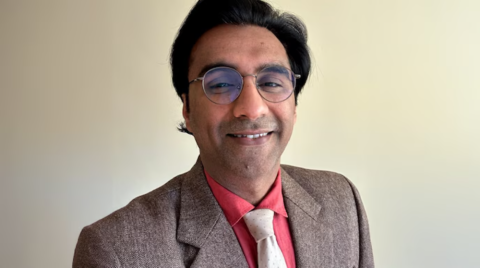
Indian citizen Badar Khan Suri has been arrested in the US over criticism of Israel
Press TV – March 20, 2025
Indian citizen and Georgetown University student Badar Khan Suri has been arrested by US Immigration and Customs Enforcement (ICE) agents due to his criticism of Israel’s actions in Gaza.
Sari, who is a post-doctorate fellow in peace and conflict studies at Georgetown University in Washington, is currently being held at an ICE detention facility in Virginia without contact with lawyers and family.
ICE has detained Sari even though he is a US permanent resident.
After his arrest, the dean of Georgetown University made a statement that Sari had not engaged in any illegal activities or posed a threat to campus security.
In a statement, the University Board of Georgetown Law SJP has called his arrest to be for expressing “constitutionally protected speech,” warning that if such arrests continue “higher education will crumble.”
Sari is believed to have been specifically targeted because of the anti-genocide activism of his wife Mapheze Saleh.
Saleh, a US citizen, is a prominent pro-Palestine activist who has come under attack by pro-Israel political organizations.
Jenin Younes, a lawyer and civil liberties expert, believes that Sari’s arrest is a case of citizens being held guilty by association.
“If they can’t target a Palestinian activist for deportation because they’re a citizen, they’ll target their spouse instead,” Younes said in an interview.
Imprisoning and punishing family members of political dissidents is a common repression tactic used by dictatorial regimes.
Demonstrations in American, European cities condemning Israeli crimes in Gaza
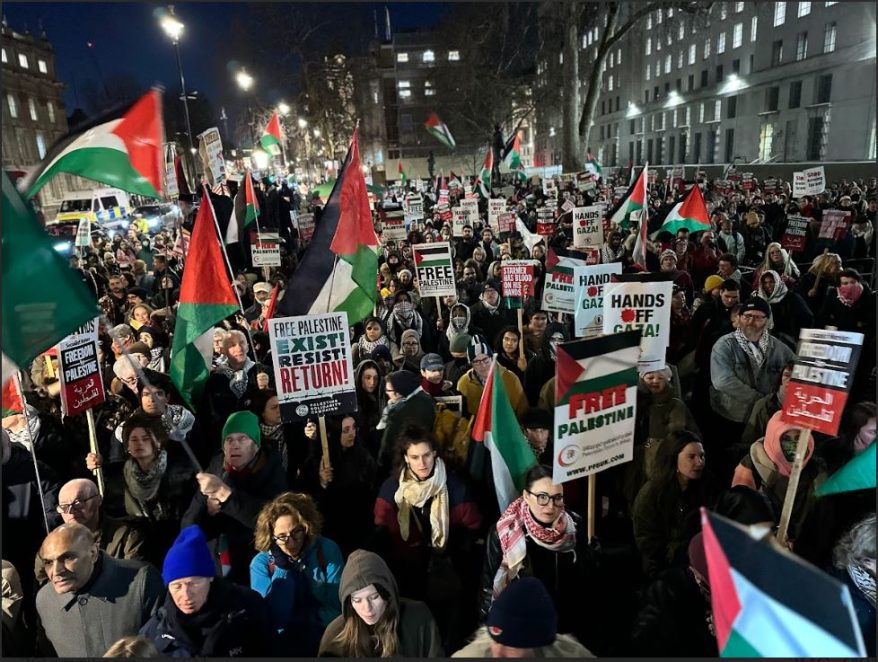
Thousands gathered outside the British government headquarters in London on Tuesday evening
Palestinian Information Center – March 19, 2025
Thousands of pro-Palestinian activists marched through the streets of American and European cities to condemn the resumption of the Israeli occupation’s war of extermination against the Gaza Strip that resulted in the martyrdom and injury of hundreds, most of whom children and women.
The marches began in cities like Seattle in Washington State, San Francisco in California, and Milwaukee in Wisconsin, protesting the U.S. administration’s approval of violating the ceasefire agreement, as shown in footage shared by pro-Palestinian pages on social media.
Participants in the protests demanded a ban on arming Israel while it commits genocide in Gaza, as well as the release of Palestinian student Mahmoud Khalil.
In Minneapolis, dozens of pro-Palestinian demonstrators gathered outside the Israeli consulate, holding signs demanding an end to the genocide in the Gaza Strip.
The Minneapolis demonstration, announced just four hours prior to its gathering, garnered significant attention as it coincided with rush hour in the city.
In France, demonstrators in Place de la République in Paris condemned Israel’s breach of the ceasefire agreement and the resumption of attacks on the Gaza Strip.
The protesters called for an end to the war on Gaza, an immediate end to the blockade of the Strip, halting Israeli genocide in Gaza, holding Netanyahu and occupation leaders accountable, and boycotting Israel.
In Italy, clashes erupted between police and pro-Palestinian demonstrators in Milan, where hundreds called for a permanent ceasefire in Gaza amidst stalled ceasefire talks between Israel and Hamas.
Footage shows columns of red smoke filling the air, while the sounds of explosions echoed through the Italian city’s streets. Protesters were seen marching, raising Palestinian flags and signs that read “Hands off the West Bank” and “Glory to the martyrs, freedom for the prisoners,” before being attacked by police forces.
In the Dutch capital Amsterdam, another demonstration was held in support of Gaza and against the genocide being committed by Israel against Palestinians.
Cities like Ankara, Istanbul, Diyarbakır, and other Turkish cities also witnessed demonstrations condemning the Israeli massacres against residents of the Gaza Strip.
Protesters accused Israel of committing genocidal crimes through its ongoing aggression against the Gaza Strip and called on the international community to hold it accountable for these crimes.
Turkish organizations, including the Anadolu Youth Association, the Humanitarian Relief Organization, and the Turkish Institutions Coalition for Jerusalem, called for organizing supportive demonstrations for the Gaza Strip in various Turkish cities and for the continuation of the boycott against Israel and products from supporting companies.
Yemen Will Stand with Gaza, Even if it Means War with the US: Abdul-Malik al-Houthi
Full speech of Abdul-Malik Badr al-Din al-Houthi, leader of Ansar Allah, about Trump’s latest aggression against Yemen – March 16, 2025
Yesterday, the American enemy announced a new wave of aggression against our country, launching a series of airstrikes and naval bombardments targeting homes and residential neighborhoods in the capital, Sana’a, and several other Yemeni governorates. These attacks resulted in dozens of martyrs and wounded, including women and children.
This brutal and unjust assault is yet another example of US tyranny and arrogance toward our (Islamic) Nation. Its objective is clear: to support the Israeli enemy after our country took a firm stand in support of the Palestinian people against Israel’s starvation campaign in Gaza. Israel has not only blocked the entry of humanitarian aid but has also completely prevented the flow of goods into the besieged strip.
The starvation of two million Palestinians is an immense crime—an unequivocal crime against humanity. No one with a human conscience, no one with sincere Islamic faith, can remain silent in the face of such an atrocity. Yet, it is deeply unfortunate that most Muslim and Arab regimes have responded with indifference. There has been no serious effort to prevent Israel’s deliberate starvation of Gaza’s people. In fact, the situation has escalated to the point where Israel is now actively depriving them of water as well.
The suffering of the Palestinian people in Gaza is an immense tragedy, yet many choose to ignore it. Israeli conditioning has set the bar for global outrage so high that only large-scale massacres by bombs and weapons seem to provoke attention. As a result, when suffering takes the form of starvation and deprivation rather than immediate mass killing, many fail to even follow the events unfolding there.
However, the deliberate starvation of Gaza’s people—the complete blockade of aid and goods—is no less than a method of extermination. For fifteen days now, the Israeli enemy has kept Gaza’s crossings closed, intensifying the suffering of its people. Anyone who observes the magnitude of this humanitarian crisis can recognize it as a catastrophe.
In contrast, the responsibility to act falls first and foremost upon our own (Islamic) Nation—upon all Muslims, upon every people and country within our Ummah. Yet, where is the serious action? Where is the political effort beyond empty statements? Where is the economic pressure? Most regimes have taken no real position in any meaningful way. Worse still, they influence their people, suppressing their ability to act, leaving them paralyzed as mere spectators.
This failure to uphold our great religious, moral, and humanitarian obligations poses a grave danger to our entire Nation. The root cause? Fear of America. That is the reality. Fear of America, which stands as a direct accomplice to all Israel’s crimes—protecting it, enabling it, and ensuring it carries out its atrocities without consequence.
This is what has driven much of our Nation—both its governments and its people—into failure and neglect of its duties, whether dictated by faith, morality, or basic humanity. In the holy month of Ramadan, as Muslims increase their recitation of the Quran, they must also reflect on their human, moral, religious, and faith-based responsibilities. At the same time, they must recognize the grave danger of a world where fear of America outweighs fear of divine punishment—where whole countries and peoples abandon their sacred duties to the Ummah out of submission to foreign powers.
What is happening to the Palestinian people—extermination, starvation, killing, displacement, and oppression—without any meaningful reaction from the Muslim world, sets a dangerous precedent. It opens the door for similar horrors elsewhere. Any other Arab or Muslim country could be next. Wherever the Americans and Israelis choose to repeat their crimes—whether in Palestine’s neighboring countries or beyond—the result will be the same. Others will remain passive, shackled by fear, humiliation, and inaction. It is a great danger for the whole Ummah, as it emboldens the American enemy and the Israeli oppressor. Neither of them has a conscience. Neither considers the silence, passivity and inaction of other nations as a deterrent—only as an encouragement to commit further crimes. They have great (hegemonic and expansionist) ambitions and agressive projects against our (Islamic) Nation, as well as ideological foundations (supremacism) as well as foundations rooted in their colonialist inclination and tyrannical behavior.
That’s why Yemen’s stance has been clear. Our decision to support the Palestinian people, including our move to block Israeli maritime navigation, that clearly targets the Israeli enemy and no one else, is aimed solely at pressuring Israel to open the crossings, allow the entry of humanitarian aid, and put an end to the starvation of Gaza.
What is happening in Gaza is outright starvation, compounded by imposed thirst, amid the immense Nakba (catastrophe) the Palestinian people are enduring. After 15 months of relentless annihilation and mass destruction, every aspect of life in Gaza has been systematically erased. This is not a situation where a decision to block aid and goods has a minimal impact—it is devastating. The conditions were already dire; there are no food reserves, no agricultural activity, and no remaining essentials for survival. The entire Gaza Strip has been utterly destroyed.
The reality is evident to anyone paying attention—conditions there are beyond desperate. From the very first moment the Israeli enemy took this step, it inflicted immense harm and suffering on the Palestinian people. And now, after 15 more days, that suffering has only worsened. Yet, as we have said before, there has been no serious response from Arab regimes, nor even from the broader Islamic world—no true action in the full sense of the word.
As for us, a people, our faith compels us. The Messenger of God ﷺ said: “Faith is Yemeni, and wisdom is Yemeni.” Guided by this faith and our human conscience, we cannot simply stand by. Our country has stood with the Palestinian people for 15 months, supporting them in the battle of Al-Aqsa Flood, resisting the genocide committed by the Israeli enemy in partnership with the United States.
Throughout this period, our people have also withstood American aggression—intended to bolster the Israeli enemy—and will remain unwavering in their active support for Palestine, especially as the threat of extermination persists. There are red lines in the Palestinian situation. When the Israeli enemy, with full American backing and protection, perpetrates genocide, that is a red line. We cannot stand idly by. There are legal and humanitarian obligations in this regard—obligations that extend beyond Muslims, enshrined in international law and the UN Charter. Yet all have abandoned them: the international community, other nations—they have forsaken these humanitarian duties. And in our Islamic world, they abandon their humanitarian, religious, and moral responsibilities, even when their own national security and interests are at stake. They forsake everything. It is a total abdication. This emboldens the Israeli enemy, just as it emboldens the American enemy—a full partner in these crimes. This inaction offers no solution to the Ummah, nor does it avert the looming danger, nor does it provide any real solution to the ongoing crisis..
Our nation’s decision to support the Palestinian people—by blocking Israeli navigation and enforcing restrictions against the enemy—comes from this humanitarian, moral, religious, and faith-driven commitment. It is a means to press for the entry of aid and to end the starvation of two million Palestinians in Gaza. This is not a minor issue that can be ignored; it is a grave humanitarian crime against millions of people.
Thus, when the American enemy escalates its aggression through airstrikes, it will not achieve its goal of pressuring us into retreating from our position. The only real solution is ensuring the entry of humanitarian aid, putting an end to the starvation and dehydration of the Palestinian people in Gaza. The situation is beyond catastrophic.
What the Israeli enemy is doing on top of that—targeting Al-Aqsa Mosque, seeking to seize or demolish it, and attempting to forcibly displace the Palestinian people—must be considered as firm red lines by our entire (Islamic) Nation. If the enemy sees that, regardless of his actions, the Ummah takes no decisive steps, makes no real decisions, and adopts no serious stance, he will be emboldened to escalate further. His Zionist agenda is well known, and every major act of aggression and escalation he commits without consequences only paves the way for even greater crimes.
Indeed, his goal is full control over the Palestinian people—erasing their existence and liquidating their cause. This is the shared objective of both the Israeli and American enemies, who fully embrace Zionist ideology, champion its project, and act accordingly.
That is why it is impossible for us to forsake our duties towards these red lines. Even if all remain silent, we will not remain silent. We will do everything we can, considering our resources and capabilities, along with our possibilities. This is a sacred responsibility before God Almighty, and neglecting it invites divine punishment, both in this world and the next. It is far easier for us to stand in opposition to the tyrants of our time, to face their threats, and to sacrifice for the sake of God, than to face the wrath of God Himself. We will not bring upon ourselves His displeasure, anger, and Hellfire—neither in this world nor in the Hereafter.
We are certain that when we take the right stance—one fully aligned with our humanitarian, moral, and religious obligations, as well as the national security interests of our Ummah in —God will be our ultimate supporter. “He is the best of helpers.” We place our trust in God. We believe in His true promise. We rely on God, the Almighty, and He is the best of protectors.
The United States, in their statements and declarations, claim that one of the reasons for their latest wave of brutal, unjust, and criminal aggression against our country is our people’s unwavering support for the Palestinian cause over the past 15 months. This support has been in direct opposition to the genocidal aggression carried out by the Israeli enemy with American partnership and protection. The US frames its assault as punishment for our people’s honorable, courageous, and steadfast stance alongside the Palestinian people in resisting genocide.
We say this: That honorable stance—taken for the sake of Almighty God and in fulfillment of these faith-based, humanitarian, moral, and religious obligations—is one our people will never regret. It is a noble position, a great position, a position that brings us closer to God. It has strengthened our people on all fronts, including militarily.
It is a stance of dignity, taken by our dear people with faith and insight. Thus, no matter the extent of American and Israeli tyranny, our people will not waver from their Quranic, faith-driven, moral, and humanitarian course. We will stand firm against this oppression. This American aggression will fail—by God’s will—just as it has failed before. It will not succeed in pressuring our people or our people and country to abandon their principles. This is a fundamental, unwavering commitment, rooted in faith, morality, and necessity in every sense of the word, as we will explain in more detail.
The US will not achieve its goal of weakening our country’s military capabilities—by God’s will—because we are engaged in a jihadist struggle and have been resisting American aggression for many years. This is merely another chapter in that battle. And as in previous confrontations, this new round of aggression will only contribute to further strengthening and developing our military capabilities, God willing.
We will meet escalation with escalation—that is our approach. Yesterday, our armed forces responded immediately to US attacks, launching (18) missiles and drones in retaliation for the American airstrikes and bombings on our land. This is our choice, our decision, our path. As long as the American enemy persists in its aggression, its warships, aircraft carriers, and naval vessels will be targeted by our missiles and drones.
Furthermore, maritime restrictions will extend to US vessels as long as the aggression continues. The US is the one turning the sea into a battlefield, thereby directly impacting maritime navigation and global trade. Our decision was only targeting Israeli ships, and will now extend to US ships, but they are the ones who turn the sea into a battlefield and threaten maritime navigation. It is essential that all nations recognize who truly threatens international waters and the movement of ships.
The United States and Israel are the sources of evil and instability—globally and across the region. They are responsible for aggression, crimes, and chaos. They undermine peace in every sense of the word, plunging the world into crisis and conflict, East and West alike. They are arrogant, oppressive, and hostile.
We have additional escalation options at our disposal. We will respond to American escalation by escalation. We will retaliate to aggression with missile strikes targeting its aircraft carriers, battleships, and naval forces, and target its commercial ships. If the U.S. continues its hostilities, we will escalate further, by God’s will.
Our dear people will mobilize in full force—through general mobilization and across all sectors—just as they have done with strength and honor over the past 15 months in opposing the Israeli genocidal aggression against the Palestinian people, which has been carried out with U.S. partnership and protection. Now, in the face of this aggression against our country and the deliberate starvation and deprivation of the Palestinian people in Gaza, our country will rise once again in a widespread movement to confront tyranny.
We are not acting recklessly or seeking conflict. We are standing on a foundation of faith, morality, humanity, and jihad for the sake of Almighty God. We resist oppression, injustice, and the criminal arrogance of the U.S. and Israel. The US strives to submit the region as a whole to Israel, and it is clear to everybody.
Although the United States is a partner in the agreement to halt the aggression against the Gaza Strip, deliver aid, and end the starvation of the Palestinian people there, and has commitments in this regard, clear commitments. What are the obligations between states, between people for? Agreements are signed with clear obligations, but the United States disregards its commitments by failing to honor its obligations and breaking agreements. The Israeli side, too, violates every covenant and pact, denying any agreement. What the Israeli enemy is doing in Palestine, particularly in the West Bank, are continuous crimes. In the Jenin refugee camp, for example, they continue daily killings, forced displacement, and destruction, as well as in other camps like Tulkarm and others.
What the enemy also does, with regard to the repeated incursions into Al-Aqsa Mosque, these are steps, as we said, that are not the end, not the final ceiling of what the Israeli enemy is doing. These are steps within the Israeli enemy’s plan. And every time the Ummah remains silent, it dares to do more. See what Israel does against the Palestinian people in the Gaza Strip—continuing daily killings, even if not at the pace it was during the daily genocidal extermination. But these are crimes, crimes that the (Islamic) nation must not remain silent about. And the American side is complicit in this; they kill journalists, they kill citizens, they kill those working in humanitarian fields, as if it were a normal issue. These are clear crimes, clear attacks, violations of everything—treaties, laws, ethics, values, and everything.
The enemy’s aggression against the Lebanese people continues. It has failed to honor its agreements, even those guaranteed by the US. It has completely disregarded guarantees concerning South Lebanon and didn’t retreat its forces, and persists in its violations—killing Lebanese civilians and committing countless transgressions. It wages attacks in Syria as well, invading, expanding, and launching relentless airstrikes—40 raids in a single night just days ago! Across many regions, it destroys, kills, occupies, and expands in a blatant display of aggression.
These crimes are flagrant violations with no justification whatsoever, yet much of the world remains silent. This silence only confirms what we have long stated: The US., alongside Israel, seeks to impose a doctrine of domination over our (Islamic) Nation and our peoples. This, by God, is their ultimate objective. They seek absolute freedom in their aggression and crimes—to kill, destroy, occupy, and do as they please without facing any response or serious opposition. This is an extremely dangerous matter, and accepting it carries profound consequences.
If silence were effective, if alternative approaches that refrain from taking a stance against American and Israeli tyranny and aggression had worked, it would have succeeded in Syria. The stance of the groups in Syria is clear: they confirm in all clarity that they do not consider Israel an enemy and will take no action against it. They refuse to respond in any way. It has even been mandated in media circles that the term “Israeli enemy” should not be used in reporting. Yet, this approach has failed. It did not work to declare, “We are not hostile, we will not respond, we are not targeting you.” Reality proves their commitment to this stance. They refuse to adopt any position against Israel, they don’t retaliate (nor condemn). They do not want conflict, confrontation, or any kind of problem. Their only request is that Israel stops its occupation of Syria—not as a firm position, but merely as a plea. They appeal, they beg, they turn to other nations and to the Americans, but to no avail.
Meanwhile, Israel expands its occupation, consolidates its control, and continues to destroy Syria’s resources. It tightens its grip on the territories it has seized in southern Syria—coveting three provinces: Quneitra, large areas of Daraa, and Sweida. It extends its reach to the outskirts of Damascus, nearing the capital itself. There is no justification for this in Syria—no ties to Iran, as the stance of these groups toward Iran is well known. They openly declare Iran as the enemy, not Israel. They have no issue with normalization (with Israel). Yet, none of these strategies have succeeded.
The Palestinian Authority in the West Bank has made its position clear. The agreements it signed with Israel are well-documented. Yet, Israel disregards them entirely, fails to honor any commitments, openly expresses its ambitions, and continues its daily crimes against the Palestinian people in the West Bank. This confirms an undeniable truth: a firm and deterrent stance against Israel is necessary to deter it.
We are not in a futile position; we are in an essential, just, and moral position—one rooted in humanitarian, ethical, and religious obligations. The American agenda in the region is clear: the total subjugation of this land to Israel and the imposition of an equation of permissiveness. Neither of these can ever be accepted. We will never accept the subjugation of this region to Israel, nor will we accept the normalization of permissiveness—neither in our country nor anywhere else. To accept this is to betray the principles of Islam. To accept it is humiliation. And God says: “To God belongs all honor, and to His Messenger, and to the believers.” (Quranic verse)
Submission does not protect the Ummah from killing, occupation, or oppression. It does not shield them from the dangers posed by America and Israel. On the contrary, it enables these enemies to implement their agendas and carry out their aggressive and destructive plans against our Umma.
Our position is one of honor and righteousness—a response to God’s command and a fulfillment of our faith-based, humanitarian, and moral duties. It is inner and authentic, and not dictated by any external force, nor is it an extension of any foreign agenda. Our alliance, cooperation, and coordination with the free people of our (Islamic) Nation within the Axis of Resistance are part of our collective duty as an Umma.
If some fulfill their obligations, it does not mean they are acting on behalf of others, nor does it imply subordination of one group to another. It is a shared responsibility, a duty upon all. Those who fail to uphold this responsibility—that is their choice. But as for us, our stance is in the most noble cause, an honorable position that brings dignity before God, and an essential duty.
We stand against American and Israeli tyranny. We stand against their crimes and their aggression. We are the continuation of the great march of Islam, led by the Messenger of God—may peace and blessings be upon him and his family.
As we commemorate the anniversary of the Great Battle of Badr on the seventeenth of the blessed month of Ramadan, we recall how the Messenger of God (peace be upon him and his family) advanced with divine permission and guidance. As the Almighty says:
“Permission is given to those who fight because they have been wronged, and indeed, God is capable of granting them victory.”
And as He says:
“Just as thy Lord brought thee out of thy home in truth, though a party of the Believers were unwilling, disputing with thee concerning the truth after it had become manifest, as if they were being driven to death while they looked on.”
With unwavering faith, the Messenger of God (peace be upon him) rose in the Battle of Badr against tyranny, confronting the forces of oppression. At that time, the Quraysh embodied tyranny—through their hostility, aggression, ignorance, injustice, and enmity toward Islam and the Muslims.
Today, the front of tyranny has changed, but its essence remains the same. In this era, it is America and Israel—an alliance of evil, disbelief, injustice, and criminality, waging war against Islam and Muslims. Is there any doubt about this? Who else inflicts upon the Ummah what they do? Their objectives are evident, their crimes undeniable, their ambitions exposed, and their Zionist project—aggressive, destructive, and criminal—laid bare for all to see. They are the front of disbelief in our time.
We stand in defiance of this oppression, of this aggression, of the systematic criminality targeting our lands and our Ummah. We move forward in continuation of Islam’s righteous struggle, following the example of the Messenger of God (peace be upon him and his family). He marched forward with only a few in number and limited provisions, yet he relied upon God. He advanced with faith, and those who followed him did so with conviction, responding to the call of belief, placing their trust in God, and in His true promise.
God granted them a decisive victory at Badr—a victory that marked a turning point, distinguishing it from the battles before and after. It ushered in a new era—an era of honor, triumph, and strength for Islam and the Muslims. It was a victory that established truth through both struggle and steadfastness in the field of battle. And we are the continuation of that movement, just as the Ansar (Helpers) stood with the Messenger of God (peace be upon him and his family) when he first consulted them: their words echoed faith, loyalty, courage, honor, and unwavering resolve. This spirit was demonstrated by their stance and jihad in the path of God.
Our dear people follow in the footsteps of those mujahideen ancestors who bore the banner of Islam against tyranny—whether the tyranny of Quraysh or the tyranny of the global oppressors of their time. We are patient in the face of war, and firm in the encounter with the enemy. I swear by God, O Messenger of God, we will not say to you as the Children of Israel said to Moses: ‘Go, you and your Lord, and fight while we remain behind.’ Rather, we say: ‘Go, you and your Lord, and we shall fight alongside you.’”
Our model is the Messenger of God (peace be upon him and his family), who never remained silent in the face of oppression, nor did he submit. So how can it be acceptable to God that the Ummah of Islam—the nation of two billion Muslims—the Arab world with its 300 million people—chooses silence, surrender, and inaction? Can entire countries and peoples resign themselves to this collective choice? This is nothing less than suicide for the Ummah, invoking the wrath of God and empowering its enemies.
Surrender is not an option for a great Ummah. It is not permissible in the religion of God. The Messenger of Allah, whom God described:
“Indeed, in the Messenger of God, you have an excellent example for those who hope in God and the Last Day and remember God often,”
rose with just 300 mujahideen—perhaps a few more or less, depending on different narrations. Yet with this small force, he carried the banner of Islam and advanced in the path of God.
The dangers of submission are immense. The threats facing our Ummah today demand serious action—reliance on God, trust in Him, and unwavering faith in His promise.
We, the Yemeni people, refuse to bow to the enemy or allow them to achieve their aggressive objectives. We march forward, relying on God. We have the greatest source of strength—God Almighty. We trust in Him and place our reliance upon Him. Our choices and decisions are rooted in our faith, our dignity—both as Muslims and as human beings. We stand firm, confronting oppression and aggression with broad and decisive action.
Therefore, I call upon our dear people to take to the streets tomorrow by the millions, on the anniversary of the Great Battle of Badr, in the capital, Sana’a, and across the provinces, in a massive show of solidarity—to reaffirm their steadfastness, their just stance, their faith-driven commitment, and their jihadist resolve in support of the Palestinian people and in confronting American aggression.
The specific time and locations will be determined by the organizing committee and its branches, God willing. However, what truly matters is that the popular turnout is vast—an expression of unwavering determination and deep-rooted belonging on this significant occasion. Because our stance is a continuation of that historic position. Our role model is the Messenger of God. Just as our fathers and grandfathers stood with loyalty, faith, perseverance, dignity, and sincerity alongside him in the Great Battle of Badr and in other struggles against the tyranny of the first Jahiliyya (Age of Ignorance), we, too, move forward as an extension of that legacy—carrying the banner of the Messenger of God, of Islam, upholding the march of Islam, embodying the position of Islam, and engaging in jihad for the sake of God in our time, in this stage of history.
We will never accept the violation of this Ummah, nor will we allow our country or others to be subjugated by the Israelis. We will not remain silent in the face of the arrogance, tyranny, aggression, and crimes of the Israeli and American enemies.
I urge you, dear people—you who are known for your loyalty, who have marched in honor for over 15 months in a manner unmatched anywhere in the world—to make tomorrow’s gathering vast and powerful, a testament to your faith, your unwavering loyalty, your dignity, your resilience, and your steadfastness, all of which stem from your deep belief and your response to God Almighty. You are the true extension of this Ummah, standing firm amidst a sea of submission, weakness, and surrender.
You are the heirs of the authentic Islamic path, the bearers of Islam’s banner, and the upholders of the just stance that God Almighty commands—a stance that brings goodness, honor and adheres to divine law.
Rest assured, dear people, that no matter how circumstances evolve, our position remains strong and unshaken, thanks to our reliance on God. With our trust in Him and our accumulated experience in confronting this enemy—its aggression, its military tactics—we stand firm, fully dependent on God Almighty, and absolutely confident in His promise.
He is the One who says: “If God grants you victory, none can overcome you.” He is the One who says: “If you support God, He will support you and make your steps firm.” We trust in Him, for He never breaks His promise. “He is the best of helpers.” “Sufficient is Allah for us, and He is the best disposer of affairs.” There is no power and no strength except with the Most High, the Almighty.
We ask God, the Almighty, to grant us His victory against the tyrants, criminals and oppressors of our time—America, Israel, and those allied with them—to have mercy on our righteous martyrs, to heal our wounded, and to grant freedom to our prisoners. Indeed, He is the One who hears all prayers.
May God’s peace, mercy, and blessings be upon you.
Source: Al-Araby TV
Translation: resistancenews.org
Harvard Law School moves closer to divestment from Israel following referendum
Press TV – March 15, 2025
In the latest move by pro-Palestinian students at US universities, the Harvard Law School (HLS) student body has successfully passed a referendum urging the university to divest from the occupying Tel Aviv regime.
The resolution, which called on Harvard to “divest from weapons, surveillance technology, and other companies aiding violations of international humanitarian law, including Israel’s genocide in Gaza and its ongoing illegal occupation of Palestine,” passed with 72.7 percent of votes in favor, with 842 students participating.
Nearly 2,000 students attend Harvard Law School, according to the university’s newspaper, The Harvard Crimson.
The university’s Palestine Solidarity Committee celebrated the move, calling it a landslide victory that took place “despite federal crackdown and admin’s repression on student activism for Palestine.”
“[US President Donald] Trump cannot repress the student movement for Palestine,” the group said in a statement amid the US president’s crackdown on pro-Palestinian protests across American universities
“The university must answer our call and divest from companies that profit from Palestinian annihilation,” it added.
The referendum was first proposed in a petition by student group Law Students for a Free Palestine (LSFP), which passed the 300-signature threshold needed to trigger a Student Government referendum in February.
In a press release, HLS LSFP organizer Irene Ameena commended the result as a rebuke of Trump.
“The Trump administration’s threats are meant to scare us into submission, but this referendum shows that those efforts only strengthen our solidarity with Palestine,” she said.
Thursday night’s results mark the second time a Harvard student body has voted in favor of divesting from Israel.
The call for divestment generally entails calling on institutions to cut economic and any other relevant ties with Israel as a form of protest against its occupation of the Palestinian territories, and more recently its bloody onslaught in Gaza which has killed over 61,000 Palestinians since October 7, 2023.
In June last year, students at the Harvard School of Public Health voted to demand that Harvard divest from Israel, and governments at the Law School, Harvard Divinity School, and the Graduate School of Design have all made similar calls too.
Yemen resumes naval blockade against Israeli ships in support of Gaza
Al Mayadeen | March 11, 2025
The Yemeni Armed Forces announced the resumption of their naval blockade on all Israeli ships in the Red Sea, the Arabian Sea, the Bab al-Mandab Strait, and the Gulf of Aden.
Sanaa’s decision comes after the expiration of the deadline set by Ansar Allah leader Abdul-Malik al-Houthi for mediators to pressure the Israeli occupation into reopening Gaza’s border crossings and allowing humanitarian aid into the besieged territory.
In a statement issued on Tuesday, the Yemeni Armed Forces declared the immediate enforcement of the blockade, warning that any Israeli vessel attempting to breach the restriction would be targeted within the designated operational zones.
The military stressed that the blockade would remain in place until the Israeli occupation complies with the demand to reopen Gaza’s border crossings and facilitate the entry of essential food and medical supplies.
The statement reaffirmed Yemen’s unwavering solidarity with the Palestinian people, particularly in Gaza and the occupied West Bank, and reiterated its commitment to standing alongside the Palestinian resistance.
Famine looming over Gaza
Hamas spokesperson Hazem Qassem warned Tuesday that Gaza is facing the early stages of a real famine due to the Israeli occupation’s continued blockade on the entry of food supplies for the tenth consecutive day. He stressed that the humanitarian situation has been dire since the beginning of the Israeli aggression.
In a statement, Qassem highlighted the severe food crisis gripping the besieged enclave, where essential supplies are running out under the ongoing blockade. He noted that the closure of border crossings constitutes a blatant violation of the ceasefire agreement, which stipulates the unrestricted flow of humanitarian aid.
Hamas condemned the Israeli occupation’s actions, calling the blockade a flagrant violation of international humanitarian law and the Geneva Conventions.
The movement described it as a flagrant war crime and collective punishment against civilians, warning that the siege has led to soaring food prices and a severe shortage of medical supplies amid an escalating humanitarian catastrophe.
The group also pointed out that the closure of crossings was hindering recovery and reconstruction efforts in Gaza. The ban on the entry of heavy equipment has obstructed relief teams from carrying out their duties.
Yemen pledges to resume operations
Previously, Sayyed al-Houthi said Sanaa was continuously monitoring and observing developments in Gaza amid the Israeli occupation’s complete evasion of its commitments to the ceasefire agreement.
In a late February speech, Sayyed al-Houthi also revealed that Yemen was prepared to intervene militarily had Trump carried out his threat to restart the war on Gaza if Hamas did not release the Israeli captives.
“Yemen remains steadfast in its support for the Palestinian people and Resistance factions in confronting Israel’s attempts to evade the ceasefire agreement and its second phase,” al-Houthi emphasized, warning that if the war is reignited in Gaza, “the entire Zionist entity, starting with occupied Yafa, will come under fire,” amid the Yemeni support and military intervention.
Sayyed al-Houthi reiterated his stance on Friday, giving mediators a four-day deadline to ensure the entry of humanitarian aid into Gaza, warning that if the Israeli occupation continues to block aid deliveries, naval operations against Israeli-linked vessels will resume.
Al-Houthi accused the Israeli occupation of delaying its commitments under the Gaza ceasefire agreement, particularly concerning humanitarian provisions. He stated that while Hamas had fully honored its obligations, the occupation had failed to uphold its side of the deal.
“The humanitarian aspect of the agreement includes clear obligations with guarantees from mediators, yet Israel is trying to evade them,” he said.
Al-Houthi also condemned intensified Israeli attacks in the occupied West Bank and al-Quds, highlighting the role of Israeli settlers in escalating violence against Palestinians. He criticized US support for the Israeli occupation under President Donald Trump, saying Washington’s backing had emboldened the regime’s policies of displacement and aggression against Palestinians.
Thousands protest in Paris against Macron’s defense policies
RT | March 9, 2025
Thousands of protesters marched through Paris on Saturday to oppose what they see as French President Emmanuel Macron’s militaristic approach to foreign policy and his lack of interest in achieving peace in the Ukraine conflict.
The demonstration was organized by Florian Philippot and his party, The Patriots. Chanting slogans and carrying signs such as “We don’t want to die for Ukraine,” and “Macron, we don’t want your war,” the crowd moved from the Place du Palais Royal to the Place Pierre Laroque.
Macron on Wednesday proposed expanding France’s nuclear deterrent to protect EU nations and urged European members of NATO to take more responsibility for their own defense. He cited uncertainty over Washington’s commitment to Ukraine, especially as relations between Kiev and US President Donald Trump’s administration experienced a setback after Vladimir Zelensky rejected calls to negotiate peace with Russia.
Macron has argued that continued aid to Ukraine was crucial, warning that if Russian President Vladimir Putin succeeded in Ukraine, he wouldn’t stop there – a claim that Moscow has repeatedly dismissed as nonsense. Russia has identified NATO’s expansion toward its borders and the US-led bloc’s promise of eventual membership for Ukraine as being among the key reasons for the conflict.
Many demonstrators at the Paris rally criticized Macron for prioritizing military matters over domestic issues. “When you declare war, it’s to erase all the other failures,” one protester said. Another accused Macron of pursuing conflict while leaders such as Trump and Putin are talking about peace.
Addressing the crowd, Philippot condemned Macron’s approach, declaring that the president “absolutely does not want peace.” Philippot, formerly a member of the National Front, has been a vocal critic of Macron’s administration and EU’s policies. His party opposes what it perceives as unnecessary military interventions and advocates for a more independent French foreign policy.
Macron’s push for increased defense spending faces hurdles as France grapples with a budget deficit and pressure to rein in spending. Approval of the 2025 budget has been delayed due to a divided parliament. In January, Budget Minister Amelie de Montchalin announced plans to cut €32 billion ($34.6 billion) in public spending while raising taxes by €21 billion.
Critics argue that these measures would burden middle-class families, small business owners, and retirees already struggling with rising costs. Meanwhile, Prime Minister Francois Bayrou has rejected calls for public consultation on major defense policies, insisting such decisions are the government’s responsibility. When asked on Friday whether the French people should have a say in increased military spending and a shift toward a “war economy,” Bayrou was firm: “The government’s responsibility is to say, no, we can’t let the country be disarmed. It’s vital.”
German ministry dismisses lawyer for supporting Gaza, rejecting genocide
MEMO | March 4, 2025
https://twitter.com/Melaniebelizi/status/1895904365225058324
Restoring Palestine to its rightful owners by decolonising solidarity
By Ramzy Baroud | MEMO | February 25, 2025
Osasuna fans call for expelling ‘Israel’ from FIFA, UEFA

Al Mayadeen | February 16, 2025
Fans of Spain’s La Liga joined the wave of pro-Palestine protests sweeping European football stadiums during Saturday night’s match between Osasuna and Real Madrid.
During the game, Osasuna supporters displayed a banner reading, “Show ‘Israel’ the red card,” mirroring a similar sign waved by Scotland Celtic’s fans during Wednesday’s Champions League match against Bayern Munich. Both messages called for “Israel’s” suspension from FIFA and UEFA over its war on the Gaza Strip.
Attention now turns to the Spanish League and how it will respond to the Osasuna supporters.
The Green Brigade, a prominent Celtic fan organization, urged football supporters worldwide to demand “Israel’s” exclusion from international competitions. In a statement on the X platform, the group announced: “At the start of the second half we will wave the sign calling on UEFA and FIFA to suspend Israel from all activity. We call on you to do the right thing, and join soccer fans around the world who support this message.”
“‘Israel’ is committing genocide, ethnic cleansing and apartheid. In the last 15 months, at least 382 Palestinian footballers and 235 other athletes have been killed, including 96 children and 286 youths. The Israeli occupation has destroyed 147 football facilities and 140 other sports venues across Palestine. These crimes have no place in our beautiful game,” the Celtic fans wrote.
The Union of European Football Associations (UEFA) is expected to launch an investigation and impose sanctions on Celtic over its fans’ actions, likely including a financial penalty, as it has done in similar cases in the past.
House panel seeks Columbia Palestine protesters’ disciplinary records

Al Mayadeen | February 14, 2025
The US House Committee on Education and the Workforce demanded Columbia University turn over disciplinary records by the end of this month for students who participated in anti-“Israel” protests between April and January 2024, denouncing the Ivy League University’s handling of the students.
The House panel sent a six-page letter to the university leadership saying that the university failed to deliver its promise to students, faculty, and Congress that it’d address “anti-semitism”, saying that “Columbia’s continued failure to address the pervasive anti-semitism that persists on campus is untenable, particularly given that the university receives billions in federal funding.”
The letter cites the protesters taking over the campus last year, and students disrupting an Israeli professor’s lecture this semester. The letter adds that Columbia failed to properly discipline those responsible, which created a “hostile environment for members of Columbia’s Jewish communities.”
Trump cracks down on student protesters
Students across major universities in the US launched anti-war, pro-Palestine protests across the country, setting up solidarity encampments, with some students calling for their universities to cut ties with “Israel.”
Trump signed an executive order that allows the US government to use “all available and appropriate legal tools to combat anti-semitism, including prosecuting and deporting those accused of anti-Semitic harassment,” with the order targeting pro-Palestine student protesters.
The current US president vowed to expel student protesters from the United States and get rid of pro-Palestine protests to a group of donors saying, “One thing I do is, any student that protests, I throw them out of the country. You know, there are a lot of foreign students. As soon as they hear that, they’re going to behave.”
American-Zionist group World Betar compiled a list of names of students on Visas to send to Trump to deport them for joining in anti-“Israel” protests after the group launched a campaign to identify these students.
Columbia professor, NYU students persecuted over pro-Palestine activism
Earlier last month, Katherine Franke, a law professor and outspoken supporter of pro-Palestine students, parted ways with Columbia University on January 11, following an investigation into comments she made about Israeli students. This marked the consequence of activism surrounding Gaza on a major university campus amid the ongoing Israeli genocide.
Franke, a tenured professor, had supported pro-Palestine students amid protests at the university last year. She was one of several faculty members investigated for alleged anti-semitism.
She described her departure as “a termination dressed up in more palatable terms,” stating in a Friday statement that she agreed to leave due to Columbia becoming a “toxic and hostile environment.” Columbia University spokesperson Samantha Slater confirmed that a complaint had been filed accusing Franke of discriminatory harassment in violation of university policies, leading to an investigation.
The Center for Constitutional Rights, a nonprofit legal group, condemned the end of Franke’s career at Columbia as an “egregious attack on both academic freedom and Palestinian rights advocacy.”
In a related context, more than a dozen NYU students and faculty distributed flyers and hung banners throughout the Bobst Library, while 13 individuals staged a sit-in on the library’s administrative floor.
The protesters were demanding a meeting with university administrators, who had previously promised to reveal details of the university’s endowment, including investments in weapons manufacturers and companies linked to “Israel” and its occupation of Palestine, during the spring Gaza solidarity encampment movement.
Malaysia announces conference to support Palestine reconstruction efforts
MEMO | February 1, 2025
The Malaysian Ministry of Foreign Affairs announced on Friday that it will be holding a conference to support reconstruction efforts in Palestine.
The Malaysian Foreign Ministry explained that it is coordinating with Japan to hold the fourth session of the Conference on Cooperation among East Asian Countries for Palestinian Development (CEAPAD) in Malaysia this year. It noted that the initiative reflects Malaysia’s proactive role in securing international support and strengthening cooperation to ensure the sustainability and impact of reconstruction efforts in Palestine.
The ministry noted that the conference is in line with the recent statement made by Prime Minister Anwar Ibrahim regarding the urgent need to accelerate reconstruction efforts in Palestine.
It also indicated that it is: “Fully committed to working side by side with Japan within the framework of the Conference on Cooperation among East Asian Countries for Palestinian Development to respond to the Palestinians’ clear call for assistance.”
The Malaysian Foreign Ministry pointed out that within the framework of these efforts, it aims to contribute to the reconstruction of basic infrastructure, including a school, a hospital and a mosque, as a sign of the collective commitment of the government, the private sector and the people of Malaysia.
It said that it will seek, along with Japan, to engage CEAPAD participants in securing the necessary commitments for the success of the group’s efforts to redevelop Gaza. This includes a series of coordination meetings before the conference to guarantee that aid and contributions to Palestine are provided more efficiently and sustainably for long-term development.
The Malaysian Foreign Ministry stressed its steadfast support for the Palestinian cause and its continued work closely with its regional and international partners to assure that the fourth CEAPAD conference is translated into concrete actions.
Featured Video

Theodore Postol: Iran’s Missiles & Drones Were Underestimated
or go to
Aletho News Archives – Video-Images
From the Archives
Wars for Israel: A reminder of who’s giving the marching orders
By Damian Lataan | February 7, 2012
As the West prepares to march off to yet another war in the Middle East, we should perhaps remind ourselves of who is giving the West their marching orders.
In February 2003, just weeks before the US and their allies launched their attack on Iraq and her peoples, a delegation of US congressmen, together with the US Ambassador to the United Nations, John Bolton, a well known pro-Zionist and neoconservative war-hawk, were in Israel at the invitation of the Israeli government then led by Israeli Prime Minister Ariel Sharon.
Addressing the congressmen, Sharon told them ‘that Iran, Libya and Syria should be stripped of weapons of mass destruction after Iraq’. Later, Sharon told John Bolton ‘that Israel was concerned about the security threat posed by Iran, and stressed that it was important to deal with Iran even while American attention was focused on Iraq’. … continue
Blog Roll
 Aletho News
- UAE rejects report claiming it is ready to join war on Iran to reopen Hormuz
- A New Resistance Front: How Does Syria Factor into the Regional War?
- Gulf states weigh pipeline expansion plans, hoping to bypass Hormuz
- Iran sets up ‘tollbooth’ system in Strait of Hormuz
- Wave 90: IRGC strikes US-linked industrial sites in Gulf
- Iran Says US-Israeli Claims of Its Military Strength Are Wrong
- Trump’s April Fools’ Address to the nation
- The Most Important Bet You’ve Never Heard Of
- The killing of three Indonesian soldiers in Lebanon should remind Jakarta that Israel does not want peace
- Defeated and delusional: Netanyahu’s remarks reveal $80bn war failure, says analyst
- If Americans Knew
- Trump says the quiet part out loud: (Israel’s) war on Iran > Americans’ health – Daily Update
- Gaza families reunite years after babies evacuated amid Israel’s war
- International Rescue Committee warns Gaza’s children face grave protection risks
- Iran’s Alleged 47-Year War on America: Debunking the 1,050 American Deaths Canard
- Israel wants US to bomb more of Iran’s civilian structures (113,000 is not enough) – Not a ceasefire Day 173
- Ann Coulter Rips Into Fox News for Iran War Coverage
- Joe Kent Urges Americans To Call White House and Congress To Object To Sending Troops Into Iran
- DNC Resolution to Reject AIPAC Funding Puts Democratic Leaders in the Hot Seat
- Swedish foundation to build 400 schools as over 650,000 Gaza children remain without education for 2 years
- Israeli army admits photshopping image of slain Lebanese journalist
- No Tricks Zone
- Low Intensity Tornado Wrecks Major Solar Farm, Creating A Potential Toxic Dump
- New Study Finds Warming Saves Lives…Cold Temperatures 12 Times More Deadly Than Excess Heat
- German Science Blog Accuses PIK Climate Institute Of Hallucinating Climate Tipping Points
- Devastating Assessment Of Comirnaty Vaccine By Former Senior Pfizer Europe Toxicologist
- New Study: CO2 Is ‘Effectively Negligible’ As An Explanatory Climate Change Factor Since 2000
- Former Pfizer Toxicologist Dr. Helmut Sterz Tells Bundestag Hearing Pfizer Vaccine Should Have Never Been Approved
- Energy Expert: Germany’s Nuclear Phaseout Was A “500 Billion Euro Mistake”
- New Research: South Australia’s Mid-Holocene Sea Surface Temperatures Were 4°C Warmer Than Today
- Storing Green Energy To Last Germany 10 Days Would Require A 60-Million Tonne Battery
- New Studies: UK Sea Levels Were 4 Meters Higher Than Today During The Mid-Holocene
 Aletho News