Scottish lawmaker demands European sporting bodies ban Israel
MEMO | September 11, 2025
A Scottish lawmaker tabled a motion at parliament Thursday condemning Israel’s membership in European sporting associations, urging organizations to revoke its participation, Anadolu reports.
The motion, lodged at Holyrood by James Dornan, said Israel should not be permitted to compete under European banners as it is geographically situated in the Asian continent, not Europe.
It cited reported views that Israeli state policy is one of genocide against the people of Gaza. The motion views “the relentless and barbaric implementation of this policy are grounds for the rescinding of Israel’s membership from European sporting associations.”
Dornan’s motion urged European bodies such as the European football governing body (UEFA), the Federation of International Basketball Association Europe, the European Handball Association and the European Athletic Association to dispel Israel’s membership forthwith.
Last month, Francesca Albanese, the UN special rapporteur for human rights in the Palestinian territories, demanded UEFA expel Israel from competitions for war crimes and crimes against humanity in the Gaza Strip.
It was after UEFA’s farewell to former Palestinian footballer Suleiman al-Obeid, whom it called the “Palestinian Pele.”
The Israeli army has continued a brutal offensive on Gaza, killing at least 64,700 Palestinians since October 2023. The military campaign has devastated the enclave, which is facing famine.
Last November, the International Criminal Court issued arrest warrants for Israeli Prime Minister Benjamin Netanyahu and his former Defense Minister Yoav Gallant for war crimes and crimes against humanity in Gaza.
Israel also faces a genocide case at the International Court of Justice for its war on the enclave.
Mass arrests as ‘Block Everything’ movement shuts down France
Al Mayadeen | September 10, 2025
At least 83 people have been arrested across France as the “Block Everything” movement launched its first wave of nationwide protests on Wednesday, September 10, in opposition to austerity measures and government budget proposals.
According to police reports cited by BFM TV, 75 individuals were detained in Paris, while another eight were arrested in cities across the country.
The movement, which originated as a grassroots campaign online, is aimed at halting daily life in France in protest of the national budget plan proposed by outgoing Prime Minister Francois Bayrou.
More than 1,000 [?] people joined protests across France, with over 30 separate gatherings reported in cities including Marseille and Lyon, where protesters overturned trash bins and blocked major roads.
Several high schools in Paris were also shut down by student demonstrations.
Organizers expect over 100,000 people to participate in the protest actions throughout the day, marking a significant escalation in public resistance to the government’s proposed austerity measures.
The “Block Everything” movement was initiated by a small online group called Les Essentiels, which declared, “On September 10, we stop everything, not to escape, to say no.” The movement has since gained backing from the leftist France Unbowed (LFI) party.
Political crisis deepens as Macron names new prime minister
The protests come amid growing political instability. On Monday, Bayrou lost a vote of confidence in the National Assembly, following opposition to his 2026 budget framework aimed at cutting €44 billion in public spending. France’s public debt currently stands at 113% of GDP, one of the highest in the European Union.
In response to the crisis, French President Emmanuel Macron appointed Defense Minister Sebastien Lecornu as the new prime minister on Tuesday. Lecornu has been tasked with consulting political parties before forming a new government.
Budget-related political infighting has become a persistent issue in French politics. Last year, the failure to pass the 2025 budget led to the collapse of Michel Barnier’s government after a no-confidence motion united both far-left and far-right parties.
In parallel with the grassroots movement, France’s major trade unions have announced a national day of mobilization on September 18, signaling a broader, more coordinated wave of resistance to the government’s economic policies.
As tensions mount, the coming weeks are expected to test both the resilience of the protest movement and the ability of the Macron administration to restore political and economic stability.
Spanish PM reveals 9 measures to halt genocide in Gaza
Al Mayadeen | September 8, 2025
Spanish Prime Minister Pedro Sanchez on Monday announced nine new measures aimed at stopping the “genocide in Gaza,” stating, in a televised address, “What Israel is doing is not defending itself, it is exterminating a defenseless population.”
He said that although Spain has de facto been applying an export ban on weapons to “Israel” since 2023, the government will now urgently legislate a “permanent” ban, a measure that will be joined by prohibiting ships transporting fuel to Israeli forces from using Spanish ports and banning aircraft carrying defense material from Spanish airspace.
The Spanish Premier added that individuals “directly involved in the genocide, violating human rights and war crimes in Gaza” will be prohibited from entering Spain.
Other measures include banning imports from illegal Israeli settlements in the occupied West Bank and Gaza, limiting Spanish consular services to Spanish citizens living in the occupied territories to the bare minimum, and increasing Spain’s presence in Rafah with additional troops and new joint projects with the Palestinian Authority to provide food and medicine.
Spain will also increase its contribution to the UN agency for Palestinian refugees (UNRWA) by €10 million ($11.7 million) and commit €150 million in additional humanitarian aid for Gaza in 2026.
“We know these measures will not be enough to put an end to the war crimes, but we hope they serve to apply pressure to Prime Minister Benjamin Netanyahu and alleviate the suffering of the Palestinian people,” Sanchez stated, adding that “Spain alone cannot stop the war, but that doesn’t mean we can’t try.”
UK arrests nearly 900 over support for Palestine Action activist group
Al Mayadeen | September 7, 2025
Nearly 900 people were arrested in the United Kingdom over the weekend during a protest in London in support of the banned pro-Palestinian group Palestine Action, according to the Metropolitan Police.
Authorities confirmed that 857 individuals were arrested under the Terrorism Act of 2000 for supporting a proscribed organization, with another 33 detained for separate offences, including alleged assaults on police officers.
Solidarity with Gaza targeted in crackdown
The protest, described by organizers as an expression of solidarity with Gaza, was held outside the UK Parliament and drew around 1,500 participants.
Many demonstrators carried signs condemning “Israel’s” aggression and genocide in Gaza and expressing support for Palestine.
This comes as “Israel” intensified its bombardment of Gaza and launched new strikes with the stated aim of seizing Gaza City to defeat the Palestinian resistance.
Critics have accused the UK government of using counterterrorism laws to suppress peaceful activism.
The United Nations and other human rights groups have condemned the July decision to designate Palestine Action as a terrorist organization, citing threats to civil liberties and free speech.
Police claim violence; organizers insist protest was peaceful
Of the 33 non-terrorism-related arrests, 17 were allegedly for assaults on officers. The police claimed their officers faced “intolerable” abuse. However, organizers from Defend Our Juries (DOJ), who coordinated the “Lift the Ban” rally, described it as “the picture of peaceful protest.”
Reports noted that many of those arrested were older individuals, some holding signs like “I oppose genocide. I support Palestine Action.”
If convicted, the majority face up to six months in prison, while organizers could face sentences of up to 14 years.
Public figures, UN slam ban as legal overreach
The ban on Palestine Action was pushed by former interior minister Yvette Cooper, who accused the group of engaging in “aggressive and intimidatory attacks” against public and private institutions.
She also claimed that court-imposed reporting restrictions have limited public understanding of the group’s actions.
Nonetheless, public support for Palestine Action has grown since the group’s proscription, with many viewing the UK’s actions as an attempt to silence those who speak out against the war on Gaza and stand in solidarity with Palestine.
Elbit Systems shuts down UK site targeted by Palestine Action
Al Mayadeen | September 6, 2025
Elbit Systems UK’s arms factory in Bristol has gone quiet after years of determined resistance by Palestine Action, according to The Guardian, marking what campaigners see as a major victory against “Israel’s” largest weapons producer.
The Aztec West facility, repeatedly targeted by direct actions, now sits deserted save for a lone security guard at the gate. Although Elbit had a lease lasting until 2029, the company has offered no explanation for the site’s status.
Factory Silence
Palestine Action staged dozens of disruptive actions against the site, ranging from rooftop occupations and blockades to smashing windows and covering the premises in red paint to symbolize Palestinian blood. The latest protest, on July 1, came just days before the UK government banned the group under the Terrorism Act.
Campaigners argue that their actions have exacted a tangible toll. Elbit Systems UK swung from a £3.8 million profit in 2023 to a £4.7 million loss last year, with rising security costs and repeated shutdowns cited as key factors.
“This closure is extremely significant,” arms trade expert Andrew Feinstein told The Guardian. “We need to remind ourselves that Elbit (Systems) is one of the two most important Israeli arms firms, along with IAI, that is it is obviously a key component of Israel’s military industrial complex.”
Elbit Retreat
The closure in Bristol fits a broader pattern of Elbit’s retrenchment in Britain. In Oldham, an 18-month wave of roof occupations and blockades led to the sale of Ferranti P&C in 2022. In Tamworth, the company’s Elite KL subsidiary, targeted repeatedly by Palestine Action, was sold in 2024 after profits collapsed; its new owners, rebranding as Calatherm, pledged to scrap all defense contracts with Elbit.
Long-running campaigns at Shenstone in Staffordshire and at Instro Precision in Kent have also seen repeated shutdowns, rooftop occupations, and trials of activists, showing the breadth of pressure across Elbit’s UK operations.
Still, the company has not disappeared from Britain, The Guardian noted. Its Filton site in Bristol remains active, and 24 activists face trial for actions carried out there, including charges of criminal damage and aggravated burglary. Meanwhile, Elbit is reportedly close to securing a £2 billion Ministry of Defence contract as a “strategic partner”, a deal that former Labour minister Peter Hain has urged the government to block, citing “the devastation unfolding in Gaza.”
Defiant Resistance
Palestine Action has vowed to continue targeting Elbit and its partners. Though proscribed in July, the group has secured permission for a judicial review of the government’s decision in November. The Home Secretary is set to appeal that ruling later this month.
For campaigners, the deserted Aztec West site stands as proof that sustained action can shake even the most entrenched corporations. It also sends a message: as long as companies profit from “Israel’s” assault on Gaza, they will face resistance on British soil.
Scotland’s parliament votes for boycott of Israel amid Gaza genocide
Press TV – September 5, 2025
Scotland’s Parliament has voted to impose an immediate and comprehensive boycott on Israel and companies connected to its genocide in Gaza.
The decision, which highlights Scotland’s solidarity with the Palestinian people, came on Thursday in response to the ongoing humanitarian crisis in the besieged territory.
The motion to sanction Israel and affiliated entities was spearheaded by the Scottish Greens, who allege that the Israeli military actions in Gaza constitute genocide. Reports indicate that at least 64,231 Palestinians have died due to the genocide, and almost the entire population of Gaza has been displaced.
The amendment passed with 62 votes in favor and 31 against, calling on the Scottish and UK governments to implement a series of boycotts, divestment strategies, and sanctions aimed directly at Israel and companies deemed complicit in its genocide.
Support for the motion came from the Scottish Greens and the Scottish National Party (SNP), alongside a proposal introduced by External Affairs Secretary Angus Robertson that acknowledged the recognition of a Palestinian state. However, the Scottish Conservatives opposed the motion, while most Scottish Labour and Liberal Democrat MSPs chose to abstain. The Liberal Democrats notably shifted their voting stance to oppose the amendment’s language.
Scottish Green MSP Patrick Harvie, who introduced the motion, expressed hope that this vote could signal a change in the conversation surrounding Israel and encourage other European governments to adopt a stronger response to the humanitarian crisis. “Palestinians are being starved and massacred every day as part of a campaign of collective punishment and ethnic cleansing. It is our duty to act,” he stated in an interview with The National.
Harvie emphasized the importance of holding companies accountable for their involvement in the genocide, asserting, “If a company profits from apartheid and genocide, it should not be allowed to profit here in Scotland. This vote sets a precedent for action that I hope will inspire governments across Europe and beyond.”
First Minister John Swinney highlighted the Scottish government’s commitment to humanitarian support, announcing plans to block public funding for firms supplying weapons to Israel. He also pledged £400,000 toward the Children’s Operating Room to aid the Gaza Hope Field Readiness Centre in Scotland and assist in establishing a rapid-deployment field hospital within Gaza.
Additionally, Scotland plans to provide medical support for 20 children injured in Gaza, expected to arrive with their families in September, and to donate £600,000 to the UN’s humanitarian coordination office in Palestine.
Swinney underscored the urgent need for action, stating, “We are witnessing a humanitarian catastrophe of historic proportions. The world cannot wait for a final court ruling to take action. A genocide is unfolding, and recognizing this reality carries with it a responsibility to act. The people of Scotland expect nothing less.”
Utrecht University becomes first in West to boycott Israel over Gaza genocide
Press TV – September 3, 2025
The Netherlands’ Utrecht University has become the first Western academic institution to enact a full academic boycott of Israel in response to the regime’s genocide in Gaza, marking a historic step that shatters a long-standing taboo in Western academia.
The decision, confirmed in a statement from Rector Wilco Hazeleger, comes after sustained pressure from “demonstrating students and staff.”
The university has “effectively stopped or suspended all institutional collaborations with Israeli parties and will not start any new collaborations,” establishing a boycott that will remain “until further notice,” the statement said.
In his statement, Hazeleger described the move as a moral necessity. “The situation in the world, and in Gaza in particular, requires us to act with a moral compass. There is great human suffering,” he said.
While emphasizing the academy’s duty to foster open dialogue and research for peace, Hazeleger stated a clear red line had been crossed. “It is also clear when there is genocidal violence and a line has been crossed.”
The move aligns with the goals of the Palestinian Campaign for the Academic and Cultural Boycott of Israel (PACBI), which considers it the result of strategic, principled work by students and university staff.
The boycott comes amid increasing international condemnation of Israel’s genocidal war on Gaza and its decades-long occupation of Palestinian lands.
Across the world, academic communities and students have intensified their demands for institutions to divest and boycott all entities complicit in apartheid and war crimes.
Academic institutions have come under significant pressure from professors and students to sever ties with Israeli entities that play direct or indirect roles in normalizing apartheid, research for military purposes, or sustaining the occupation.
Israel launched a genocidal war on Gaza on October 7, 2023, after Palestinian resistance fighters carried out the surprise Operation Al-Aqsa Flood against the regime in response to its decades-long campaign of death and destruction against Palestinians.
According to Gaza’s Health Ministry, at least 63,633 Palestinians have been killed and more than 160,914 injured since the beginning of the war.
The SCO Steps in Where UN Has Failed
Sputnik – September 1, 2025
The SCO has condemned Israel and the US for their attack on Iran in June. In a joint statement, they said that such aggressive actions against civilian targets, including nuclear energy infrastructure, which resulted in civilian deaths, constitute a gross violation of the principles and norms of international law and infringe on Iran’s sovereignty.
The SCO’s condemnation of Israeli and US strikes on Iran marks a turning point, Seyed Mohammad Marandi, Tehran University professor and political analyst, told Sputnik. “This is what we should have seen from the United Nations. Instead, the SCO and BRICS are emerging as the real alternative.”
Key takeaways:
- The West’s wars, sanctions, and support for apartheid regimes are pushing nations together and marginalizing the very institutions it built after WWII
- Iran’s membership in the SCO shows its people are not isolated—they have the backing of countries representing the global majority
- Asia’s rise is unstoppable: new trade corridors, Belt & Road, and collective security are shielding nations from Western disruption
- SCO is shifting into a real force: security, economic integration, and independence from Western financial institutions
Marandi: “Thanks to the West’s own foolish behavior, the SCO is becoming a central pillar of peace, security, and prosperity across Asia—and beyond.”
The Global Sumud Flotilla sets sail from Barcelona to break the Gaza siege
Palestinian Information Center – August 31, 2025
BARCELONA – The “Global Sumud (Resilience) Flotilla” set sail from the Spanish city of Barcelona on Sunday in a new humanitarian solidarity initiative aimed at breaking the Israeli blockade imposed on the Gaza Strip for years, which has intensified since last March.
The flotilla groups several international and humanitarian organizations, most notably the Freedom Flotilla Coalition, the Global Gaza Movement, the Convoy of Resilience, and Malaysia’s Nusantara Resilience Organization.
Participants finalized preparations to sail with dozens of ships loaded with humanitarian aid, joined by activists from 44 countries, along with European parliamentarians and public figures, including former Barcelona mayor Ada Colau and Portuguese left-wing MP Mariana Mortágua.
The flotilla’s steering committee said that this step aims to open a safe humanitarian corridor to the besieged enclave and to exert international pressure to stop the ongoing genocide against the Palestinian people.
It confirmed that parallel actions will be launched from Tunisia and other countries on September 4, coinciding with large-scale demonstrations in several countries around the world in support of the flotilla and the demand to end the blockade.
This initiative builds on the efforts of the Freedom Flotilla Coalition since 2010, when the Turkish ship Mavi Marmara came under a deadly attack by Israeli forces while attempting to break the naval blockade on Gaza.
Since then, attempts to break the siege have continued, including the ships al-Dhamir (Conscience), Madleen, and Handala earlier this year, all of which were attacked and seized by Israeli forces.
Since March 2, Israel has continued to close all crossings leading into the Gaza Strip, preventing the entry of humanitarian aid, causing unprecedented levels of famine, according to UN agencies.
Although Israeli authorities have allowed limited quantities of aid to enter in recent weeks, they fall far short of minimum needs, while many aid trucks are looted by armed gangs operating under Israeli protection, according to governmental and human rights sources.
The United Nations recently declared famine officially in Gaza City, warning that it could spread to the central and southern parts of the Strip by September if the international community fails to take concrete action to contain the disaster and protect civilians.
Italians seek Israeli isolation over gaza genocide
Press TV – August 28, 2025
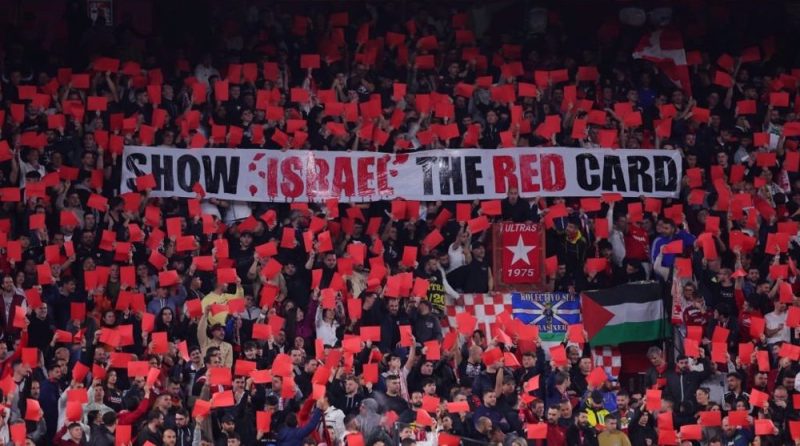
People from all walks of life protested near Rome’s iconic Pantheon temple on Tuesday, August 25, 2025 calling for Israel’s political and commercial isolation.
They rejected what they called Italy’s complicity in Israel’s genocidal operations in Gaza.
The lands occupied by Israel belong to Palestinians, and they will be returned to them. Those who will be living there, either they’re Muslims, Christians or Jews, will be Palestinian people.
We know full well. Italy is a colony of the US Empire, and for this reason, is subjugated to the Zionist regime.
Protestor 01
I don’t know exactly why the Italian government doesn’t uphold international norms when it comes to Israel. It would be interesting asking this question to [sic] our politicians directly. It is quite appalling.
Antonella Moschillo, Pro-Palestine Activist and Psychiatrist
The protesters demanded the cancellation of two FIFA World Cup qualifying matches between Italy and Israel, which are slated for September and October., demanding Israel be expelled from all sporting competitions.
Recently, Italy’s sports minister, Andrea Abodi, when asked by journalists about the debate sparked by an opposition lawmaker over possible punitive measures against the Israeli regime, said the Italy-Israel football match will proceed as scheduled.
He noted Russia was excluded from competitions as an aggressor, but Israel should not be suspended since it was attacked on October 7, 2023.
I pity him, because he’s obviously a hostage of a system, and of a political system that is servile to Israel.
Our country takes instructions from Israel.
We have not passed one sanction we have not passed, but we have passed 18 against Russia.
Anwaar Ahmed. Pro-Palestine Activist
Football, sports in general, must be unifying tools, and those who run football should refuse to pair with violent, genocidal actors like Israel.
Protestor 02
Recently, the Italian association of football coaches have formally called on football’s international and European governing bodies to suspend Israel over its genocidal war on Gaza.
The genocide in Gaza is now destabilising European politics: Dutch FM resigns, shaking his government apart
By Ricardo Martins – New Eastern Outlook – August 29, 2025
The resignation of the Dutch foreign minister over the Gaza genocide exposes Europe’s moral paralysis and highlights the power of conscience against complicity in genocide.
A Crack in Europe’s Wall of Silence and Inaction
On Friday, something extraordinary happened in Europe — something almost unthinkable within the European Commission or across the Atlantic. Caspar Veldkamp, the Dutch Foreign Minister, resigned from office rather than continue serving in a government that refused to sanction Israel for war crimes in Gaza and the West Bank.
Within hours, his entire party — the New Social Contract (NSC), including Deputy Prime Minister Eddy van Hijum, the Interior and Education ministers, the Health minister, and several state secretaries — followed him out of the fragile coalition.
This was no symbolic gesture. Veldkamp is not an unknown backbencher; he is a seasoned diplomat, a former ambassador to Israel itself. Few Europeans know Israel more intimately. He witnessed the apartheid system from inside, and now the genocide in Gaza, all while the international community remains paralysed in action, but with some strong words of condemnation. Confronted with a cabinet unwilling to act, he chose conscience over complicity.
Explaining his decision, Veldkamp told reporters:
“I felt resistance in the cabinet against more measures as a result of what is happening in Gaza City and the occupied West Bank… I saw efforts to meet me halfway, but in the end the concessions were insufficient… I have too little confidence that in the coming weeks and months I could act responsibly if I am restricted from pursuing the policy I deem necessary.”
A sitting European foreign minister walked away, saying he could no longer act “responsibly” while famine raged in Gaza. That is a political earthquake.
Why It Matters
Veldkamp’s resignation matters for three reasons.
First, it exposes what many in power have sought to hide: Western governments know what Israel is doing. They know it bluntly violates international law. And yet, they succumb to pressure and choose paralysis, or even false neutrality. Veldkamp’s break makes that complicity explicit.
Second, his career makes him a devastating witness. He was no enemy of Israel; he was its ambassador, its partner, its friend. If even he resigns, it signals the moral bankruptcy of Europe’s position.
And third, this was not just one man’s choice. It was an entire party withdrawing from government, destabilising an already weakened caretaker coalition. Gaza’s genocide is no longer just a humanitarian catastrophe abroad. It is shaking European politics at home.
The Immediate Trigger: Boycotts, Arms, and Famine
The resignation was sparked by a cabinet debate over boycotting goods from Israel’s illegal West Bank settlements. Veldkamp pushed hard, arguing the Netherlands could not condemn settlements while continuing to import their products. But coalition partners — the centre-right VVD and the populist Farmer-Citizen Movement — blocked him, insisting such a boycott should only be pursued “at the European level.” Others flatly opposed any new measures.
The day before, parliament had also voted down a motion to stop Israeli-linked arms sales to the Dutch military. Even in the face of genocide, even in the week that famine in Gaza was officially declared by UN-backed experts, Veldkamp’s government, led by Dick Schoof, refused to act. For him, that crossed a moral line.
This timing matters. His resignation coincided precisely with the famine declaration — one of only four famines officially recognised in two decades. Children skeletal, mothers unable to breastfeed, families clawing at crumbs. This famine is not a natural disaster. It is solely deliberately provoked by Israel.
When Veldkamp said he was “insufficiently able to take meaningful additional measures,” he was talking about famine and mass starvation. His cabinet refused to treat the deliberate starvation of Palestinians as reason enough to act. So he walked.
The Shadow of The Hague
There is a deeper hypocrisy here. The Netherlands hosts the International Criminal Court in The Hague. This is where global justice is supposed to be enforced. It is also the city where 150,000 Dutch citizens marched in June — the largest protest in two decades — demanding sanctions and accountability.
That contrast is brutal: a government in The Hague refusing to sanction genocide while its people fill the streets, while the world’s top tribunal sits only a few blocks away. The ICC investigates genocide elsewhere — Darfur, Myanmar, and South Sudan. But when genocide is committed by Israel, backed by the U.S., Germany, and other European partners, Europe paralyses itself.
Veldkamp’s resignation exposes that contradiction. The Dutch government now stands, with Berlin and Washington, on the wrong side of history — complicit in crimes against humanity while preaching international law.
Pressure From Below
The protests mattered. Veldkamp himself acknowledged that citizens’ demands for action influenced his decision. About 150,000 people marched in The Hague — the largest mobilisation since the Iraq War. That mattered. It showed politicians that silence is not free.
This is the lesson: protest cannot always stop bombs, but it can break walls of complicity. It can make ministers resign.
Europe’s Geopolitical Paralysis
Meanwhile, Europe as a whole remains paralysed. Ursula von der Leyen, previously Olaf Scholz, and now Friedrich Merz double down on “Israel’s right to defend itself,” even after more than 60,000 Palestinians are dead and famine is officially declared. Coalition partners in the Netherlands — VVD and BBB — blocked sanctions, refusing even a boycott of settlement goods.
This is not neutrality. It is an obstruction of an action against apartheid and genocide. And it is proof of Europe’s impotence. The EU, once a self-proclaimed “normative, moral power,” now reveals itself incapable of defending the very norms it enshrines in law.
Compare with America
Across the Atlantic, silence is even deeper. Congress continues to authorise billions in military aid to Israel, blocks ceasefire resolutions at the UN, and welcomes Netanyahu as an honoured guest. Donald Trump promises to go further, boasting he would let Israel “finish the job.”
No U.S. cabinet minister has resigned. No member of Congress has said what Veldkamp said: that they cannot act responsibly under such conditions. The silence in Washington is bipartisan and total.
Europe is no better — but cracks are now visible. And those cracks matter.
A Former Ambassador Breaks Ranks
Do not underestimate the symbolic power of this break. Veldkamp was once an ambassador to Israel. He knows its system intimately: the apartheid, the settlements, the 2018 supremacist law declaring Israel a “Jewish nation-state.” He cannot be dismissed as naïve or antisemitic.
When he resigns, he carries that credibility with him — leaving his government exposed, discredited, morally bankrupt, and aligned with genocide supporters. It also leaves Europe humiliated: the Netherlands, seat of the ICC, is now complicit in the very crimes its institutions were created to judge.
The Lesson of History
Resignations over Israel’s actions are almost unheard of in Europe. Condemnations, yes. Symbolic motions, yes. But ministers sacrificing office? Rarely. That is why this moment belongs in history.
Years from now, when Gaza’s famine is remembered, when historians count the dead, they will ask, Who spoke? Who resigned? Who refused complicity? Caspar Veldkamp’s name will be among the answers.
Conscience or Complicity?
This story is not just about Dutch politics. It is about the cracks forming in the West’s unconditional defence of Israel. It is about how famine and apartheid, once denied, are now destabilising European governments and credibility. It is about the power of protest to force moral lines.
Veldkamp said it plainly: Israel is violating international law. His government refused to act. So, he left.
The choice is now ours: conscience or complicity. What do we want our children, grandchildren, and students to read about us in the history books?
Bands boycott UK festival after Irish group ‘cut off’ for waving Palestinian flag
Press TV – August 24, 2025
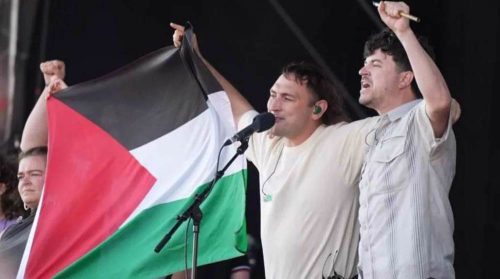
Several bands have pulled out of a major UK music festival after an Irish folk band said organizers cut their set when they displayed a Palestinian flag and chanted “Free Palestine.”
The Mary Wallopers were performing at Victorious Festival in Portsmouth on Friday when organizers accused them of using a chant “widely understood to have a discriminatory context.”
The Mary Wallopers dismissed the allegation as “misleading,” saying, “Our video clearly shows a Victorious crew member coming on stage, interfering with our show, removing the flag from the stage and then the sound being cut following a chant of ‘Free Palestine’.”
Organizers first claimed the set was stopped over a chant, but later admitted the sound was cut after the flag was shown. They apologized “to all concerned” and pledged a “substantial donation” to humanitarian relief for Palestinians.
In protest, The Last Dinner Party, The Academic and Cliffords announced on Saturday that they would boycott the festival over censorship.
“We are outraged by the decision to silence The Mary Wallopers,” The Last Dinner Party wrote on Instagram, calling it “political censorship.”
The Academic said they could not “in good conscience” perform at a festival that silences free speech, while Cliffords said they “refuse to play if we are to be censored for showing our support to the people of Palestine.”
The festival, which continues through Sunday with headliners including Kings of Leon, Bloc Party and Gabrielle, now faces growing backlash over silencing pro-Palestinian protest.
Featured Video

Theodore Postol: Iran’s Missiles & Drones Were Underestimated
or go to
Aletho News Archives – Video-Images
From the Archives
Wars for Israel: A reminder of who’s giving the marching orders
By Damian Lataan | February 7, 2012
As the West prepares to march off to yet another war in the Middle East, we should perhaps remind ourselves of who is giving the West their marching orders.
In February 2003, just weeks before the US and their allies launched their attack on Iraq and her peoples, a delegation of US congressmen, together with the US Ambassador to the United Nations, John Bolton, a well known pro-Zionist and neoconservative war-hawk, were in Israel at the invitation of the Israeli government then led by Israeli Prime Minister Ariel Sharon.
Addressing the congressmen, Sharon told them ‘that Iran, Libya and Syria should be stripped of weapons of mass destruction after Iraq’. Later, Sharon told John Bolton ‘that Israel was concerned about the security threat posed by Iran, and stressed that it was important to deal with Iran even while American attention was focused on Iraq’. … continue
Blog Roll
 Aletho News
- The Most Important Bet You’ve Never Heard Of
- The killing of three Indonesian soldiers in Lebanon should remind Jakarta that Israel does not want peace
- Defeated and delusional: Netanyahu’s remarks reveal $80bn war failure, says analyst
- Iran’s friends are about to make life much more difficult for Israel and the US
- The war of liberation of the Arab and Islamic peoples expands across the Gulf
- Envoy warns UN on Trump’s threat to ‘obliterate’ Iran’s civilian infrastructure
- The Larak Corridor: Iran’s Rial Gate With No US, No Israel, and No Way Around
- ‘Economic terrorism’: Steel facilities hit again in US-Israeli strike
- ‘War Crime’: Iran condemns attacks on Arak, Ardakan nuclear sites
- Two-thirds of Americans want quick end to Iran war even if goals unmet
- If Americans Knew
- Gaza families reunite years after babies evacuated amid Israel’s war
- International Rescue Committee warns Gaza’s children face grave protection risks
- Iran’s Alleged 47-Year War on America: Debunking the 1,050 American Deaths Canard
- Israel wants US to bomb more of Iran’s civilian structures (113,000 is not enough) – Not a ceasefire Day 173
- Ann Coulter Rips Into Fox News for Iran War Coverage
- Joe Kent Urges Americans To Call White House and Congress To Object To Sending Troops Into Iran
- DNC Resolution to Reject AIPAC Funding Puts Democratic Leaders in the Hot Seat
- Swedish foundation to build 400 schools as over 650,000 Gaza children remain without education for 2 years
- Israeli army admits photshopping image of slain Lebanese journalist
- This is how Israel is systematically killing health workers under the cover of war in Lebanon
- No Tricks Zone
- New Study Finds Warming Saves Lives…Cold Temperatures 12 Times More Deadly Than Excess Heat
- German Science Blog Accuses PIK Climate Institute Of Hallucinating Climate Tipping Points
- Devastating Assessment Of Comirnaty Vaccine By Former Senior Pfizer Europe Toxicologist
- New Study: CO2 Is ‘Effectively Negligible’ As An Explanatory Climate Change Factor Since 2000
- Former Pfizer Toxicologist Dr. Helmut Sterz Tells Bundestag Hearing Pfizer Vaccine Should Have Never Been Approved
- Energy Expert: Germany’s Nuclear Phaseout Was A “500 Billion Euro Mistake”
- New Research: South Australia’s Mid-Holocene Sea Surface Temperatures Were 4°C Warmer Than Today
- Storing Green Energy To Last Germany 10 Days Would Require A 60-Million Tonne Battery
- New Studies: UK Sea Levels Were 4 Meters Higher Than Today During The Mid-Holocene
- Destructive Green New Deal: German Energy And Metal Group Warns Of Drastic Crisis
 Aletho News