Israel excluded from upcoming Bari trade fair in Italy
MEMO | August 17, 2025
Organizers of the upcoming Fiera del Levante, an annual international trade exhibition scheduled to take place in Italy’s Bari city from Sept. 13 to 21, have decided not to invite Israel due to concerns raised by the city mayor about the Gaza situation, local media reported on Sunday, Anadolu reports.
According to Italian news agency ANSA, the fair’s organizing body confirmed the decision, following an appeal by Bari Mayor Vito Leccese, who on July 1 had called “not to let Israel participate in the fair activities within the Bari exhibition district, both institutional and economic.”
“For a commonality of ethical and political views, the Nuova Fiera del Levante has from the outset expressed a clear distancing from the atrocities of the ongoing genocide against the Palestinian people and has supported, becoming its promoter, the initiative to propose the 2025 Nobel Peace Prize to the children of Gaza,” the fair organizer body said in a statement.
The note explained that the initiative, launched by the Latiano-based foundation L’isola che non c’e, seeks to nominate children in Gaza for the 2025 Nobel Peace Prize.
The fair described the proposal as “a moral appeal to the international community to recognize the right to peace and life for every child, everywhere in the world.”
‘No relaxation haven for murderers’: Israeli cruise ship triggers pro-Palestine protests in Greece
Press TV – August 16, 2025
An Israeli cruise ship touring the Greek islands has faced repeated protests, culminating in nationwide demonstrations, as activists would denounce the Israeli regime’s war of genocide on the Gaza Strip and oppose provocative behavior by Israeli tourists.
The Crown Iris, making regular trips from the occupied port of Haifa to Athens and the Greek islands, has been met with protests at nearly every stop this summer, Drop Site News, an American investigative outlet, reported on Friday.
The 10-deck vessel, with a capacity of 2,000 passengers, includes a casino, a theater, a waterslide, and a basketball court.
Since late July, protests have targeted its route, with demonstrators waving Palestinian flags, lighting flares, and in some cases attempting to block its docking.
On July 22, more than 300 protesters confronted the ship on the island of Syros, leading to most passengers staying onboard.
Throughout the vessel’s tour around Greece, activists and organizers pointed to growing frustration over “a recurring pattern of Israeli tourist provocations,” sometimes involving off-duty Israeli forces, the website reported.
Locals and activists cited acts of incitement by the tourists, who would gloat over the Israeli regime’s genocidal aggression against Palestinians and its decades-old occupation of Palestinian territories.
Those actions included “tearing down pro-Palestinian posters in streets and shops or verbally and physically harassing people wearing keffiyehs (Palestinian headscarves) or pro-Palestine T-Shirts,” the report said.
‘We can’t have Greece become Israeli forces’ playground’
“What kind of simple, innocent tourist keeps” the Israeli regime’s flag “handy while traveling?” asked Petros, a 30-year-old construction worker.
“We can’t have Greece become a playground for IDF (Israeli military) soldiers… It’s also a matter of dignity,” he added.
Subsequent stops saw escalating confrontations.
On July 28 on the Rodos Island, the police arrested at least eight protesters. The following day in Agios Nikolaos, Crete, demonstrators broke police barricades, unfurled a massive Palestinian flag, and clashed with riot police, who used tear gas against them.
These actions formed part of broader mobilizations culminating on August 10, when organizers said tens of thousands demonstrated in more than 120 locations across Greece in one of the largest pro-Palestinian mobilizations in the country’s history.
March to Gaza, Greece – a pro-Palestinian body – initiated the call, declaring, “As millions of tourists flood the country, let’s make our presence visible and loud. Let’s turn islands, beaches, alleys, mountaintops, and shelters into places of solidarity, not relaxation for murdering IDF soldiers.”
Paris Laftsis, a 33-year-old member of the coordination team, said the turnout “exceeded the most optimistic expectations” and included both the largest demonstrations in decades and entirely new initiatives.
The protests were supported by such pro-Palestinian organizations as BDS (Boycott, Divestment, and Sanctions) Greece and the Palestinian Community in Greece as well as dozens of local groups.
UK to prosecute over 60 people for backing Palestine Action after mass arrests
The Cradle | August 16, 2025
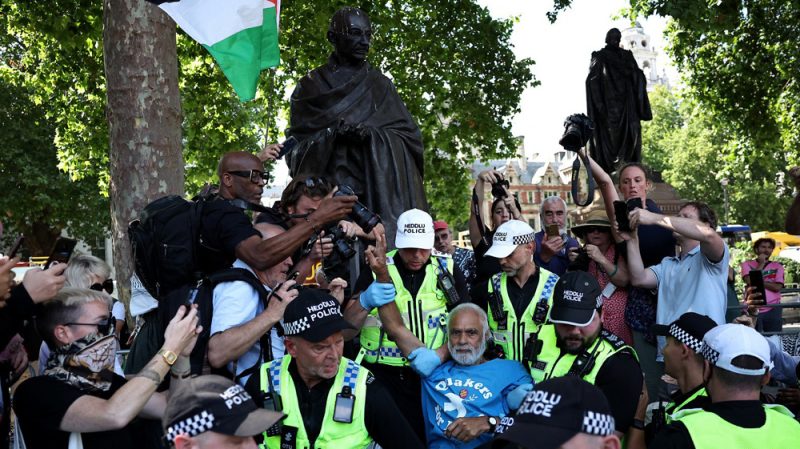
London’s Metropolitan Police announced on 15 August that over 60 people will face prosecution for “showing support” for the banned Palestine Action network, alongside three already charged under the Terrorism Act.
The police confirmed they had “put arrangements in place that will enable us to investigate and prosecute significant numbers each week if necessary,” following more than 700 arrests since the designation took effect in early July.
Among them were 522 demonstrators detained in London last weekend for carrying placards backing the group, a figure described as the highest ever number of arrests at a single protest in the capital.
Director of Public Prosecutions Stephen Parkinson said the charges represent “the first significant numbers to come out of the recent protests, and many more can be expected in the next few weeks.”
He warned that “people should be clear about the real-life consequences for anyone choosing to support Palestine Action.”
The police said those convicted could face up to six months in prison and additional penalties.
British Interior Minister Yvette Cooper defended the Labour government’s decision, declaring that “UK national security and public safety must always be our top priority,” and insisting that “the assessments are very clear – this is not a non-violent organisation.”
Metropolis Police Commissioner Mark Rowley praised the prosecutions as proof that “our police and CPS teams have worked so speedily together to overcome misguided attempts to overwhelm the justice system.”
Palestine Action is a British pro-Palestinian direct action network, established in July 2020, with the stated aim of ending Israeli apartheid.
The movement is known for its overt and disruptive – yet non-violent – actions in their mission for ending Israeli apartheid and halting UK complicity in the arms trade with Israel.
This includes occupying, vandalizing, and destroying properties linked to Israeli arms trade, such as Elbit Systems factories and RAF Brize Norton military infrastructure.
On 20 June, one activist broke into the Royal Air Force (RAF) Brize Norton base in Oxfordshire.
In response to these direct actions, the group was branded a terrorist organization on 5 July under the Terrorism Act 2000 by the UK government, making membership to the group a criminal offence.
Various groups and individuals described the move as “grotesque,” “chilling,” and an “unprecedented legal overreach.”
UN experts had urged the UK not to go through with the ban, saying, “According to international standards, acts of protest that damage property, but are not intended to kill or injure people, should not be treated as terrorism.”
The experts added that the actions of vandalism committed by some protesters should be “properly investigated as ordinary crimes or other security offences” and stressed that the actions of protesters do not constitute terrorism when properly defined.
UN rapporteur calls on European football body to expel Israel from competitions

Press TV – August 10, 2025
The UN special rapporteur for human rights in the occupied Palestinian territories has called on the European football governing body (UEFA) to expel Israel from competitions over its war crimes and crimes against humanity in the besieged Gaza Strip.
Francesca Albanese’s call came following UEFA’s farewell to a former Palestinian player, Suleiman al-Obeid, whom it called the “Palestinian Pelé.”
“Let’s make sport apartheid and genocide free. One ball, one kick at a time,” Francesca Albanese said on her X account on Sunday.
“Time to expel its killers from competitions, @UEFA,” the UN rapporteur said.
Al-Obaid, a former Palestine national team player, was killed earlier this month in an Israeli strike targeting civilians waiting for humanitarian aid in southern Gaza.

Suleiman Ahmed Zaid al-Obaid, the former captain of the Palestinian national football team (Photo via social media)
He left behind his wife and five children.
Obaid is seen as one of the brightest stars in Palestinian football history. He played 24 official matches for the national team.
He also represented the national team during the 2012 Asian Football Confederation (AFC) Challenge Cup qualification and 2014 World Cup qualifying games.
Obeid’s death has sparked widespread outrage across the world, with people urging the international community and the football fraternity in particular to break their silence over the ongoing genocide.
Palestinian footballers have been directly targeted in Israel’s assault on Gaza.
In a statement released on July 29, 2025, the Palestinian Olympic Committee (POC) reported that in July alone, the Israeli regime killed 40 Palestinian athletes in Gaza and the occupied West Bank.
More than 800 athletes have been killed in Gaza since the start of Israel’s genocidal war on Oct. 7, 2023, as the sports community continues to suffer under bombardment, famine, and the collapse of infrastructure.
Last month, the International Federation of Muaythai Associations (IFMA) announced an urgent policy change regarding Israeli representation at its events.
This came following the killing of a young Palestinian teenager athlete and peace ambassador, Ammar Hamayel, by Israeli forces in the occupied West Bank.

Hamayel, 13 years old, was a Thai boxing champion, dreaming of representing Palestine on the world stage. But like many other Palestinian children, his dream was silenced by Israeli bullets.
The IFMA back then said in a statement that the decision represents a peaceful yet firm protest against actions that “endanger children and violate the core values of global sport”.
In May, Spain was reportedly spearheading a coordinated initiative aimed at persuading the European Union to eliminate Israel from all continental sports competitions over its genocidal war on Palestinians in the besieged Gaza Strip.
Calls to exclude Israel from international sports events have indeed increased recently due to its relentless aggression against Gaza.
UK police arrest over 200 people at protest in support of Palestine Action
Press TV – August 9, 2025
British police have arrested more than 200 people in central London at a demonstration in support of the banned pro-Palestinian group Palestine Action.
London’s Metropolitan Police said in a post on X on Saturday that the arrests took place after a “significant number of people” gathered in Westminster’s Parliament Square, where they were seen holding placards in support of the “proscribed group.”
“Officers have moved in and are making arrests,” the Met said, adding that, “It will take time but we will arrest anyone expressing support for Palestine Action.”
Between 600 and 700 people participated in the demonstration, organized by Defend Our Juries, as they displayed signs reading, “I oppose genocide. I support Palestine Action.”
 Video footage from the location depicted officers clashing with the protesters, most of whom were seated on the ground, and engaging in conversations with them before taking them away.
The Metropolitan Police stated that they had mobilized officers from other forces to bolster a “substantial policing presence” in the capital, anticipating a busy weekend of protests.
Deputy Assistant Commissioner Ade Adelekan warned that officers would be ready to arrest anyone showing support for Palestine Action, urging people to “consider the seriousness of that outcome.”
Palestine Action, which targets UK-based Israeli arms factories and their supply chains through direct action—such as splashing red paint and destroying equipment— was officially proscribed on July 5 under the Terrorism Act 2000.
The designation makes it a criminal offence to support or be a member of the group, punishable by up to 14 years in prison.
The Met had threatened to take action against any public displays of support for proscribed organizations, including chanting, clothing, and placards.
The co-founder of Palestine Action, Huda Ammori, won a bid last week to bring a legal challenge against the ban.
Ammori’s lawyers have argued that the ban breaches the right to free speech and is a gag on legitimate protest.
More than 200 people have been arrested across the UK since the ban was implemented by Home Secretary Yvette Cooper last month.
Massive civilian flotilla set to sail for Gaza late August to break Israeli siege

Freedom Flotilla Coalition’s Handala departs from Gallipoli to reach Gaza to deliver humanitarian aid and break the Israeli blockade, July 20, 2025. [Valeria Ferraro – Anadolu]
MEMO | August 4, 2025
A massive civilian flotilla is set to depart for the Gaza Strip at the end of August in a new bid to break Israel’s blockade that has left the territory’s entire population on the verge of famine, Anadolu reports.
Speaking at a press conference in Tunis hosted by the Joint Action Coordination for Palestine, a civil society coordination platform, members of the Global Sumud Flotilla said activists from 44 countries have signed up for the coordinated effort.
“This summer, dozens of boats, both large and small, will set sail from ports across the world, converging on Gaza in the largest civilian flotilla of its kind in history,” said organizer Haifa Mansouri.
The flotilla brings together four initiatives: the Maghreb Sumud Flotilla, the Global Movement to Gaza, the Freedom Flotilla Coalition, and Sumud Nusantara. Their united aim, Mansouri said, is to “break the illegal blockade on Gaza by sea, establish a humanitarian corridor, and confront the ongoing genocide against the Palestinian people.”
The first convoy will leave Spanish ports on Aug. 31, followed by a second from Tunisian ports on Sept. 4.
Seif Abu Keshk, another organizer, said more than 6,000 activists have already registered online to join.
“Participants will undergo training at departure points, with solidarity events and encampments planned along the way,” he added.
“This is a renewed attempt to pressure governments by sending dozens of ships and thousands of activists to break Gaza’s blockade,” Abu Keshk noted.
The announcement comes days after Israeli naval forces intercepted the Handala aid ship on July 26 as it neared Gaza’s shores and escorted it to Ashdod Port. The vessel had reached about 70 nautical miles from Gaza, surpassing the distance covered by the Madleen, which made it 110 miles before being stopped, according to the International Committee to Break the Siege on Gaza.
Rejecting international calls for a ceasefire, the Israeli army has pursued a brutal offensive on Gaza since Oct. 7, 2023, killing nearly 61,000 Palestinians, almost half of them women and children. The military campaign has devastated the enclave and brought it to the verge of famine.
Last November, the International Criminal Court issued arrest warrants for Israeli Prime Minister Benjamin Netanyahu and his former Defense Minister Yoav Gallant for war crimes and crimes against humanity in Gaza.
Israel also faces a genocide case at the International Court of Justice for its war on the enclave.
With Gaza as its compass, Yemen rewrites the rules of naval warfare
By Stasa Salacanin | The Cradle | August 1, 2025
After the Ansarallah-aligned Yemeni Armed Forces (YAF) announced that it would resume attacks on merchant ships linked to companies operating with Israeli ports, tensions in the Red Sea and beyond have reignited, as Tel Aviv’s ongoing genocide in Gaza fuels instability across West Asia.
As part of the fourth phase of the blockade, the Yemeni army sank two commercial vessels earlier this month, showcasing not only its enduring capabilities but also the failure of US-led strikes to curb its maritime campaign.
On 6 May, US President Donald Trump claimed, “The Houthis have declared they no longer want to fight. They simply don’t want to fight anymore. And we will honor that. We will stop the bombings, and they have surrendered.”
Yemeni officials immediately dismissed the claim, reiterating that Sanaa had not negotiated with Washington nor agreed to halt operations in support of Gaza. The Sanaa government’s naval campaign resumed soon after, with fresh attacks targeting Israeli-linked vessels – undermining Trump’s attempt to declare victory.
New red lines in the Red Sea
In a statement on Sunday, explaining the latest phase of the naval operations, YAF spokesman Brigadier General Yahya Saree said:
“This escalation includes targeting all ships belonging to any company that deals with Israeli ports, regardless of their nationality and wherever they may be, within our forces’ reach. We warn all companies to cease their dealings with Israeli ports, starting the hour this statement is issued.”
The new escalation comes just several weeks after the sinking of two Liberian-flagged, Greek-owned bulk carriers – the Magic Seas and the Eternity C. In the latter attack, four sailors were killed and two others wounded, while 11 other crew members were taken captive.
Following the sinking of the two ships, Ansarallah leader Abdul Malik al-Houthi revealed that the YAF had carried out over 1,679 attacks since November 2023 using missiles, drones, and warships in support of Gaza, warning of further escalation if the war does not end.
Although the Sanaa government agreed in May to a ceasefire with Washington, halting attacks on US warships, it maintains that this truce does not apply to vessels linked to the occupation state. These ships, Sanaa argues, continue to serve Israeli ports, part of “occupied Palestine.”
Contrary to western media narratives of indiscriminate aggression, maritime data from Lloyd’s List confirmed that both targeted vessels had routinely docked in Israeli ports over the past year.
The ongoing attacks have prompted international concern. The UN Security Council recently approved continued reporting on Red Sea maritime assaults. Twelve members of the 15-member council voted in favor, while Russia, China, and Algeria abstained over concerns about breaches of Yemen’s sovereignty.
China’s deputy UN Ambassador Geng Shuang called tensions in the Red Sea “a major manifestation of the spillover from the Gaza conflict.” At the same time, the Russian UN representative also stressed the link between normalizing the situation in the Red Sea and the need for a ceasefire in Gaza.
Challenging naval supremacy
Despite the presence of five major foreign military bases in Djibouti – home to US, French, Japanese, Chinese, and Italian forces – the Ansarallah-aligned army has continued to strike commercial vessels with precision. This raises uncomfortable questions about western and allied naval efficacy.
Speaking to The Cradle, Senior Research Fellow at The Soufan Center, Colin P. Clarke – who also teaches at Carnegie Mellon’s Institute for Politics and Strategy – says Yemen ranks among the most potent forces within the Axis of Resistance and shows no sign of retreat:
“Out of all the ‘Axis’ proxies, the Houthis are among the most potent and also have a lot to prove. I don’t expect them to wind down their military campaign at any point soon.”
Nicholas Brumfield, a Washington-based analyst on Yemen and maritime security, concurs. He tells The Cradle that Yemen’s campaign has remained largely undiminished despite nearly two years of US and Israeli airstrikes:
“The Houthi attacks since early July have thus far been limited to areas of the Red Sea where they have attacked before, so it’s unclear if there’s been any increase in their range. As for Trump’s claims of capitulation, that was always viewed by most researchers focused on Yemen as a bit of hot air. The US–Houthi ceasefire was a limited de-escalation between two parties, and the Houthis have more or less been continuing what they were doing before the truce in terms of attacking Israel directly.”
Clarke adds that Trump’s reluctance to escalate against Yemen stemmed from electoral optics and strategic caution against bogging the US down in “endless wars,” which is one of the reasons why the US involvement in bombing Iran was so circumscribed. “Trump believes, perhaps correctly so, that it would be extremely difficult to engage with the Houthis without being sucked into a quagmire from which it would be difficult to escape from. And the results would be hard to measure.”
According to Mohamed Aliriani of the Yemen Policy Center, the May ceasefire secured safe passage for US, UK, Chinese, and Russian vessels – thanks to the latter two’s ties with Iran. But ships from other nations remain exposed. European-led operations, he argues, are largely ineffectual in safeguarding their cargoes.
Aliriani tells The Cradle that “the current situation has created a two-tiered, protectionist system that benefits powerful states while driving up global insurance and shipping costs, setting a dangerous precedent for other strategic chokepoints.”
Persistently high insurance premiums reflect the enduring risk. “Had the threat been perceived as eliminated, traffic would have resumed, and rates would have dropped,” he explains. The Yemeni army’s targeting of oil and chemical carriers has introduced environmental and financial perils that keep insurers wary.
Redefining control at sea
These facts point to a stark reality: The Ansarallah-led naval campaign has largely succeeded in imposing an effective blockade on Israeli-linked maritime traffic.
Still, Aliriani cautions against overstating the extent of Sanaa’s control. “The Houthis do not exercise Sea Control over the Red Sea, as they lack a surface fleet capable of patrolling and commanding the waterways. What they have successfully achieved is Area Denial.” By demonstrating a credible capability to hold any vessel transiting the Bab al-Mandab Strait at risk, they have made passage through this critical chokepoint prohibitively dangerous for any vessel:
“Their strike range has proven to extend for hundreds of kilometers and given the information available about the weapons used, range likely exceeds 1,000 kilometers, effectively denying the use of a vast area without needing to control it physically.”
Independent force, not Iranian proxy
Western narratives often depict Ansarallah as mere Iranian proxies. Yet, there is scant evidence that Tehran directed these maritime attacks.
Brumfield points out that while Iran continues to supply advanced weaponry to its ally – as evidenced by a 750-ton arms shipment intercepted en route to Yemen – there is no indication of Iranian command over Ansarallah operations.
Former UN envoy to Yemen Jamal Benomar has consistently emphasized Sanaa’s autonomous decision-making, noting that they “have their own agendas and decision-making mechanisms.”
Palestine remains the compass
The timing of recent Yemeni operations suggests a clear link to developments in Gaza. Brumfield observes that Sanaa was notably quiet during last month’s 12-day war between Iran and Israel, only to escalate following reports of worsening conditions in the besieged enclave:
“When there was a ceasefire in Gaza, the Houthis completely stopped their maritime attacks. Recent reports of deteriorating humanitarian conditions in Gaza may have contributed to the group’s decision to re-escalate in this file.”
While some analysts suggest that Ansarallah’s pro-Palestinian rhetoric is a political maneuver to boost legitimacy amid domestic challenges, Benomar insists their stance on Palestine is ideologically embedded. “They’re not just being opportunistic as Palestine is a core part of their ideology.”
Although Tel Aviv has urged Washington to relaunch strikes on Yemen, most experts, including Aliriani, believe the US is unlikely to escalate unless the Ansarallah-allied military crosses a significant red line. So far, the YAF has targeted only vessels tied to Israeli trade.
However, Ansarallah’s recent decision to strike all ships linked to Israeli ports, regardless of nationality, may drag new actors – such as Egypt – into the fray. Cairo’s deepening logistical ties to Israeli trade may soon make it a target of Yemen’s expanding campaign.
“The Houthis” may not control the seas, but they have undeniably changed the rules of engagement.
Slovenia bans import, export, transit of Israeli arms over war on Gaza
Al Mayadeen | July 31, 2025
Slovenia announced its decision on Thursday to prohibit all weapons trade with “Israel” due to its ongoing war in Gaza, marking what the country described as the first such move by an EU nation.
In a statement, the Slovenian government said it adopted a decision banning the export and transit of military weapons and equipment from or through the Republic of Slovenia to “Israel”, as well as imports from “Israel” into the Republic of Slovenia.
It added that “Slovenia is the first European country” to make such a decision of full ban, noting that it was taking this step unilaterally since the EU had been “unable to adopt concrete measures” as Slovenia had previously urged.
Slovenia previously warned that it would take independent action, in coordination with like-minded countries, should the European Union fail to implement substantial measures within two weeks to tackle the escalating humanitarian catastrophe in the Gaza Strip.
‘They are dying beneath the rubble’
It blamed the countries’ inaction for the “shameful result” as “people in Gaza are dying because humanitarian aid is being systematically obstructed.”
The Central European country described the unfolding dire situation in Gaza, stating, “They are dying beneath the rubble, without access to drinking water, food, or basic medical care. This is a complete denial of humanitarian access and a deliberate prevention of the basic conditions necessary for survival.”
“In such circumstances, it is the duty of every responsible state to act—even if it means taking a step ahead of others,” it asserted.
During his address at the June 28 EU summit in Brussels, Slovenian Prime Minister Robert Golob expressed increasing dissatisfaction with what he characterized as a disjointed European approach, while alleging that some member states were prioritizing their internal political considerations over the protection of Palestinian rights.
On June 6, 2024, the majority of the Slovenian Parliament voted to recognize the state of Palestine as an independent, sovereign state, a move mirroring actions taken by Spain, Ireland, and Norway at the time.
HRF Files Criminal Complaint in the UK Over Israeli Attack on Handala
Hind Rajab Foundation | July 28, 2025
London – The Hind Rajab Foundation has today filed a formal criminal complaint with the UK Metropolitan Police War Crimes Unit regarding the Israeli military assault on the British-flagged humanitarian vessel Handala in international waters on the night of 26–27 July 2025.
The complaint, lodged under the Geneva Conventions Act 1957 and the International Criminal Court Act 2001, urges UK authorities to open an immediate investigation into grave breaches of international law and war crimes committed by Israeli forces.
The assault was carried out by the Shayetet 13 naval commando unit, under the command structure of the Israeli Navy, whose Commander-in-Chief is Vice Admiral David Saar Salama. The complaint also targets officials within the Israeli military and government who may have authorized, planned, or facilitated the operation. The Hind Rajab Foundation is calling for these individuals to be identified, investigated, and—where evidence permits—prosecuted or arrested under UK jurisdiction.
At the time of the raid, the Handala was sailing approximately 49 nautical miles off the coast of Gaza, carrying 21 unarmed civilians, including:
- Chloé Fiona Ludden, a British humanitarian volunteer
- Emma Fourreau, Member of the European Parliament (France)
- Gabrielle Cathala, Member of the French National Assembly
- Jacob Berger, a Jewish-American activist
- Journalists, lawyers, and aid workers from 12 countries
All were detained without legal basis and forcibly taken to Israel.
The ship’s humanitarian cargo—baby formula, medical supplies, and food—was confiscated, and communications were cut immediately after Israeli forces boaed the vessel.
The Handala is a British-flagged vessel, and as such, constitutes an extension of UK sovereign jurisdiction. The seizure of the ship and arrest of its passengers in international waters constitutes an assault on British legal territory, a violation of the UN Convention on the Law of the Sea (UNCLOS), and a grave breach of the Fourth Geneva Convention. It also directly defies the binding orders of the International Court of Justice, issued in early 2024, which require the unimpeded delivery of humanitarian aid to Gaza.
The Hind Rajab Foundation is requesting the following from UK authorities:
- Immediate opening of a criminal investigation into the operation;
- Identification and questioning of all 21 passengers, especially UK nationals;
- Legal action against Vice Admiral David Saar Salama, Shayetet 13 commanders, and any political or military officials responsible;
- Placement of suspects on watchlists and preparation of arrest warrants for any who may enter the UK;
- Coordination with Interpol, the International Criminal Court, and UN mechanisms to ensure international accountability.
This case follows the pattern of previous illegal interceptions, including the recent attack on the Madleen and the 2010 Mavi Marmara raid. The Handala incident is not isolated—it is part of a systematic campaign to criminalize humanitarian aid and suppress civilian solidarity with Gaza under the guise of military enforcement.
The Hind Rajab Foundation will not relent.
We are committed to exposing and confronting every act of illegality and brutality carried out under the cloak of state power. The attack on the Handala is an attack not only on aid workers and civilians—but on international law, human dignity, and the very principle of accountability.
Justice must be done. The perpetrators must face consequences.
In numbers: Arab people don’t want to normalize with ‘Israel’

Al Mayadeen | July 27, 2025
Almost 80 years after Israeli occupation of Palestine, the great majority of the Arab public refuses to normalise with “Israel”, with fresh polling data revealing a dramatic decline in support for normalization after the Israeli war on Gaza following October 7, 2023.
According to the latest Arab Barometer surveys conducted between 2023 and 2024, support for Arab normalization with the Israeli regime has plummeted to historic lows. In none of the eight surveyed West Asian and North African countries did public backing exceed 13%.
The Arab Barometer’s Wave VIII surveys, which covered Iraq, Jordan, Kuwait, Lebanon, Mauritania, Morocco, Palestine, and Tunisia, showed a consistent regional downturn in normalization sentiment. Morocco saw a drop from 31% in 2022 to 13% post-October 7; Lebanon from 17% to 12%; Iraq from 14% to 13%; Mauritania from 8% to 4%; and Jordan from 5% to 3%.
Prior to the 2020 normalization accords, support for normalization with “Israel” was already limited. In a 2018–2019 survey, Sudan recorded the highest level at 32%, while Yemen had the lowest at 5%.
‘Israel’ is the primary regional threat
Across the region, “Israel” was most frequently cited as the leading threat to regional stability. Lebanon had the highest perception at 79%, followed by Palestine at 63%, Egypt at 54%, Jordan at 42%, and Morocco at 27%.
In Egypt and Jordan, younger respondents were notably less likely to see “Israel” as the main threat, while in Palestine, the younger demographic showed heightened concern.
Protest movements
Public sentiment against normalization translated into protest activity across the region, per Foreign Affairs. In April 2025, Morocco’s largest labor union urged the government to prohibit the entry of such ships into Moroccan waters and organized a series of protests in solidarity with Gaza.
Jordan experienced daily protests since October 7, with authorities recalling their ambassador from “Israel” and enforcing a ban on the Muslim Brotherhood.
In Kuwait, where protests were restricted, 84% of citizens boycotted pro-Israel companies, 62% donated to Gaza, and many shared solidarity messages online.
Low favorability of ‘Israel’s’ allies, too
Public sentiment toward Western allies of “Israel” deteriorated sharply. Approval of the United States dropped by 23 points in Jordan and 19 in Mauritania. France’s favorability fell 20 points in Lebanon and 17 in Mauritania.
The United Kingdom experienced the steepest decline in Morocco, with a 38-point drop. In contrast, China saw a significant boost in public opinion: 16 points in Jordan, 15 in Morocco, 10 in Iraq, and 6 in Lebanon.
The Arab Barometer Wave VIII data was collected across nine countries between September 2023 and July 2024, with most surveys completed by March 2024. This timing means the findings do not capture Arab public opinion following several significant regional developments, including “Israel’s” war on Lebanon and later on Iran, and the Israeli aggression on Syria.
The survey data therefore represents public sentiment during the initial nine months following October 7, 2023, but predates these subsequent escalations that may have further influenced regional attitudes toward “Israel.”
France’s recognition of Palestine risks helping Israel — Indonesia should rethink its applause
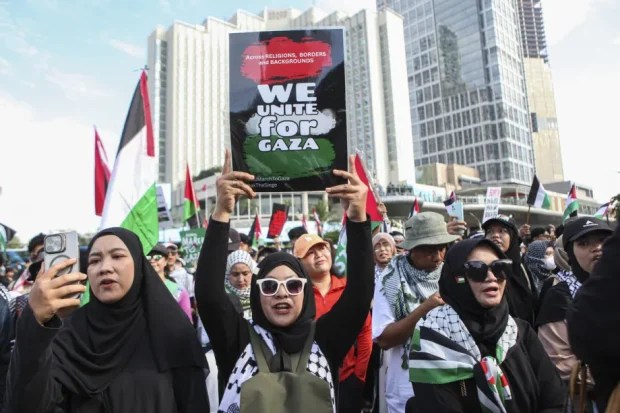
Activists at a solidarity march for the Palestinians in Jakarta, Indonesia, on June 15, 2025. [Agoes Rudianto – Anadolu Agency]
By Dr. Muhammad Zulfikar Rakhmat | MEMO | July 27, 2025
This week, Indonesia welcomed France’s decision to recognise the State of Palestine as a “positive step” toward peace. On its surface, this diplomatic endorsement may appear aligned with Indonesia’s long-standing support for Palestinian self-determination. But behind France’s gesture lies a deeper, more dangerous calculus—one that does not just ignore the reality on the ground, but actively entrenches it.
What France proposes is not justice. It is not freedom. It is an updated version of the same illusion that has kept Palestinians caged and dispossessed for decades: the so-called two-state solution.
In Jakarta’s official statement, the French move was praised for supporting a “sovereign and independent” Palestinian state based on 1967 borders, with East Jerusalem as its capital. But President Emmanuel Macron made clear what kind of state he envisions: a demilitarized Palestine that fully recognizes Israel. No mention of dismantling settlements, no restitution for occupied land, no accountability for war crimes in Gaza. Only submission, in return for a diplomatic label.
This is not a step toward peace—it’s a framework for permanent subjugation.
France’s position not only lacks balance, it weaponizes it. Macron calls for the “demilitarization of Hamas,” the rebuilding of Gaza, and regional stability—but with no demands for Israeli disarmament, no consequences for its mass killing of civilians, no guarantees of actual sovereignty for Palestinians. Instead, Palestinians are asked to disavow resistance, while the occupying power faces no requirement to end its occupation.
Indonesia, by praising this deal without reservation, is endorsing a framework that surrenders Palestinian rights under the language of diplomacy. In doing so, it becomes complicit in a process that allows Israel to continue its long project of expansion and erasure.
Because that is exactly what we are witnessing: not just war, but erasure.
Israel’s leaders have shed any pretense of restraint. Finance Minister Bezalel Smotrich has declared that Gaza should be “completely flattened.” Members of the Knesset and senior military figures have called to “wipe out” the territory. Starvation, siege, and bombing are not incidental—they are deliberate. The goal is not merely to punish, but to depopulate.
And this genocidal ambition is not new. It is part of a larger ideological blueprint long championed by elements of Israel’s far-right: the “Greater Israel” project. This vision seeks to claim not just the full expanse of historic Palestine—from the Jordan River to the Mediterranean Sea—but in some renditions, territory beyond it. It is a dream of exclusive ethnic control over a vast swath of the region. Palestinians, in this model, are not citizens or neighbors—they are obstacles to be removed.
This is the context in which France’s recognition must be understood: not as a bold shift in policy, but as a stabilizing gesture for an apartheid regime facing global criticism. And by embracing it, Indonesia—whether intentionally or not—is lending moral cover to that regime.
It is tempting, in the face of so much suffering, to welcome any sign of progress. But symbolic recognition without structural change only reinforces the status quo. A demilitarized Palestine, hemmed in by Israeli checkpoints, with no right of return and no means of defense, is not a state—it’s an open-air prison with a flag.
What is needed now is not more applause for diplomatic theater, but a refusal to accept false solutions. The two-state framework, as currently constructed, is not a path to justice. It is a political tool that enables colonization while pretending to end it.
Indonesia has long stood as a voice for the oppressed. It must not dilute that legacy by celebrating a plan that leaves Palestinians with a flag and no freedom. Instead of encouraging other nations to follow France’s lead, Indonesia should be demanding accountability: for the destruction of Gaza, for the daily violence in the West Bank, and for the decades of displacement.
This is not a time for symbolic victories. It is a time for moral clarity.
France’s vision, and Indonesia’s uncritical support of it, may win applause in diplomatic circles. But on the ground, in Gaza and the West Bank, it enables a project whose end goal is not peace, but erasure. If Indonesia truly believes in justice for Palestine, it must reject this illusion—and instead, insist on the one thing Palestinians have never been offered: freedom on their own terms.
Voices from the Terror List: Palestine Action Members Speak Out After UK Ban
By Kit Klarenberg | MintPress News | July 25, 2025
On July 1, British Home Secretary Yvette Cooper announced that Palestine Action (PA), a crusading campaign effort, would be proscribed as a terrorist group. Describing the movement as “dangerous,” she charged that its “orchestration and enaction of aggressive and intimidatory attacks against businesses, institutions and the public” had “crossed the thresholds established in the Terrorism Act 2000.” As a result, PA is now the country’s first protest group to be formally branded a terrorist entity, placing it in the same league as al-Qaida and ISIS.
Based on Cooper’s characterization, a typical consumer of mainstream media might conclude PA posed a grave threat to Britain’s public safety and national security. However, other comments by Cooper appeared to undermine her incendiary headline charges. In justifying PA’s proscription, the Home Secretary cited recent actions conducted by the movement. These included “attacks” on factories owned by defense contractors Thales in 2022 and Instro Precision in 2024, each causing more than £1 million in damages.
As hundreds of lawyers and multiple U.N. experts argued in the week before the proscription took effect, the move set an extremely dangerous precedent not only in Britain but for Palestine solidarity efforts worldwide. The group did not engage in activities that could plausibly be categorized as “terrorism”—a highly contentious concept, popularized by Israel for political reasons—in other Western jurisdictions. Average citizens were not in Palestine Action’s crosshairs, and not once did the group’s activism harm a human being.
Instead, PA engaged in multifaceted civil disobedience, targeting firms closely tied to Israel’s slaughter of Palestinians, most prominently the Israeli-owned defense giant Elbit Systems. Entities providing services to those targets—such as companies leasing commercial space to Elbit—were also in the group’s crosshairs. These actions proved devastatingly effective, hitting Elbit’s bottom line at home and abroad. PA’s disruption also brought unwelcome mainstream attention to Elbit’s operations, spotlighting the firm in ways it clearly sought to avoid.
In proscribing Palestine Action, the British government may have been motivated, in part, by a desire to avoid awkward questions and inconvenient disclosures. In one of the group’s final actions, on June 19, several members broke into Royal Air Force base Brize Norton and defaced two military planes parked there. The site is a key hub for refueling and repairing British jets that have conducted hundreds of reconnaissance flights over Gaza since the genocide began in October 2023.
These routine surveillance flights are just one component of London’s active involvement in the genocide, which authorities systematically seek to conceal from public view. Another is the presence of the SAS conducting “counterterrorism” operations in Gaza, which has been covered up via direct state decree. However, the origins of Palestine Action’s proscription stretch back much further. The story behind the ban is a sordid and largely hidden one marked by long-running, opaque collusion between British and Israeli authorities and the global arms industry.
The Legal and Political Fallout
As a result of PA’s proscription, it is now a criminal offense to be a member of, or to express “support” for, the group, punishable by up to 14 years in prison. However, an Actionist who wishes to remain anonymous predicts many will deliberately breach the proscription order, knowing they’ll face legal consequences, to increase pressure on authorities. Already, dozens of British citizens — including an 83-year-old priest — have been arrested for peacefully displaying signs declaring, “I oppose genocide. I support Palestine Action.”

“Things are going to happen, without doubt. The group may be proscribed, but you can’t proscribe ideas, whether that’s opposition to the Holocaust in Gaza, sympathy with Israel’s innocent victims, or a desire to disrupt the network of genocide in Britain to which Elbit and its subsidiaries and suppliers are so central,” the Actionist tells MintPress News. “Still, the chilling effect on Palestine solidarity is obvious, and no doubt deliberate.”
The mass arrest of peaceful demonstrators for simply expressing sympathy for Palestine Action highlights a deeply troubling aspect of British “counterterror” legislation. The term “support” isn’t even clearly defined, and according to legal precedents, can extend far beyond practical or tangible assistance, to “intellectual” support, including “agreement with and approval” or “speaking in favor” of a proscribed group. In December 2024, UN experts expressed immense disquiet over this “vague and overbroad” interpretation, warning that it could “unjustifiably criminalize legitimate expression.”
“The proscription of Palestine Action is unprecedented. It’s the first time Britain has banned as ‘terrorist’ a protest group which has never used guns or bombs,” Asa Winstanley of Electronic Intifada tells MintPress News. “It seems like a massive overreach, and therefore it’s not surprising there’s been lots of civil disobedience in response.”
Surprisingly, even The Times, typically a reliable megaphone for Britain’s intelligence, military and security apparatus, published an editorial on July 7 intensely critical of “the heavy-handed branding of Palestine Action as terrorists,” dubbing the proscription “absurd.” While describing the group as “a malign force” and “antisocial menace,” the outlet argued that activists’ damage to commercial and private property could be “prosecuted into submission” under existing criminal law and the use of “lighter-touch measures” given the level of threat posed by Palestine Action.
Notably absent from The Times editorial was any consideration of the fact that criminal proceedings against Palestine Action frequently ended in failure. In several cases, Actionists who caused mass disruption or damage to Elbit sites walked free even on relatively minor charges, because the company declined to provide police or prosecutors with witnesses or other evidence.
Elbit is extremely wary of advertising the central role its arsenal plays in the killing of Palestinians. The company’s marketing brochures typically omit mention of its Israeli ownership, instead emphasizing the supposed economic and social benefits its operations deliver to British communities. A January 2023 puff piece on UAV Systems, an Elbit subsidiary repeatedly targeted by Palestine Action, even referred to the company as a “little company making repurposed Norton motorbike engines.”
In cases where Elbit did provide evidence, Actionists used the opportunity to turn the tables and place the company and the Israeli state on trial. In November 2022, five of the group’s activists who vandalized Elbit’s London HQ were acquitted. In defending their actions, several of the accused testified to witnessing first-hand atrocities committed by Israeli occupation forces in Gaza and the West Bank. While Elbit argued Palestine Action’s buckets of red paint were “improvised weapons,” the jury was not persuaded.
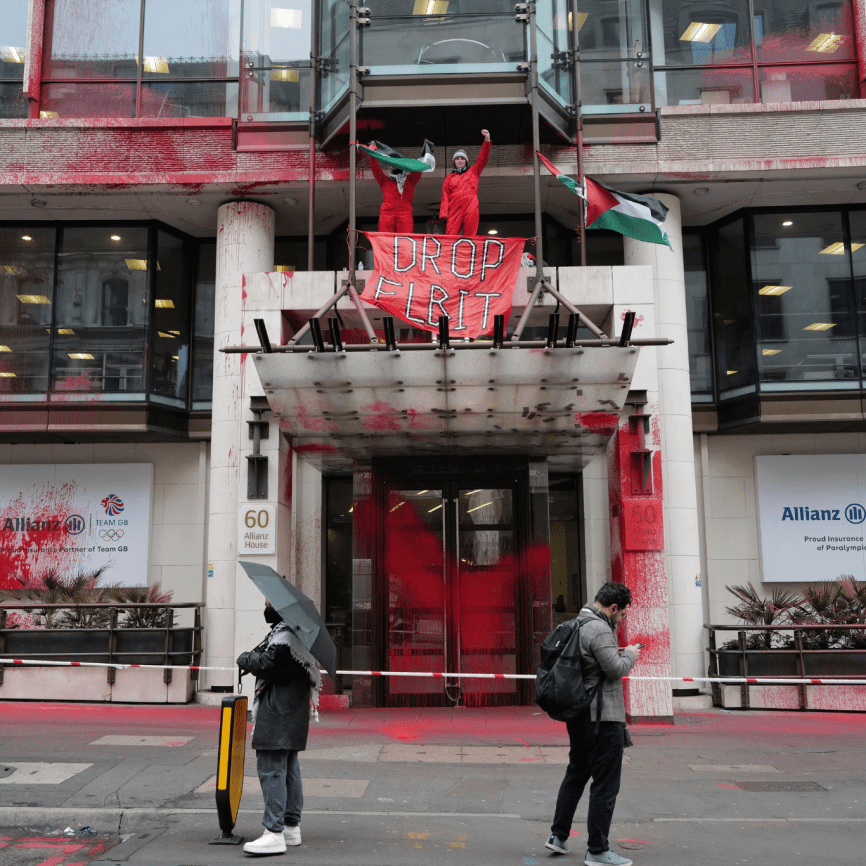
Palestine Action members target Allianz offices in London, demanding it stop insuring Israeli arms maker, Elbit Systems. Joao Daniel Pereira | AP
Judicial Battles and Public Defiance
Fast forward to today, and the anonymous Actionist is under no illusions that the British legal system alone will be enough to reverse Palestine Action’s proscription. “It has to be fought amongst the public, on the streets and in the courts,” they tell MintPress News. The group has applied for a judicial review in an effort to overturn its ban. This follows an application for interim relief to delay the proscription, which was denied after Yvette Cooper’s announcement.
Despite submitting an extensive witness statement outlining the serious implications that Actionists—and ordinary British citizens—could face if the ban took immediate effect, a panel of three judges took less than 90 minutes to reject the request. The justices acknowledged that there would be “serious consequences” from the government’s ban, including the risk that individuals could “unwittingly commit” criminal offenses and that those associated with the group might face “social stigma and other more serious consequences at university or at work.”
Palestine Action had warned the ban would create confusion and chaos. Police responses to pro-PA protests across Britain have varied wildly. Some resulted in no arrests, while in Wales, protesters were not only arrested under terror legislation but also had their homes raided. Videos of interactions between Palestine solidarity protesters and police suggest officers themselves are unsure about what is now lawful. In Scotland, four people were arrested for wearing T-shirts that didn’t even mention the group.
Speaking to MintPress News, the anonymous Actionist expressed frustration over the court’s decision. “A UN Special Rapporteur supported us, warning the proscription breached international standards, but apparently British judges know better. It just shows how corrupt the entire system is. Every part of it is rotten,” they lament. “The government, almost unanimously supported by parliament, rammed through the conscription without warning or any public debate whatsoever, after falsely briefing the media we might be funded by Iran. Who will they target like this next?”
As Declassified UK has documented, nearly every major British outlet ran with the Home Office’s Iran narrative, without offering PA a rebuttal. In a particularly revealing twist, the pro-Israel lobby group We Believe In Israel—which does not disclose its funding sources—openly took credit for the government’s decision. In an X post, the organization called the proscription its “victory,” claiming it was the direct result of months of “sustained research, strategic advocacy, and evidence-based reporting” contained in a report it had published earlier in the year.
Collusion and Israeli Influence
Again, the anonymous Actionist is unsurprised that British policy—if not legislation—is effectively being written by Israeli lobby groups. Yvette Cooper, Foreign Secretary David Lammy, Chancellor Rachel Reeves and Prime Minister Keir Starmer were all named as supporters of Labour Friends of Israel, before the list was scrubbed from the internet ahead of the 2024 general election. LFI, which praised the proscription, maintains a close relationship with Tel Aviv’s London embassy, which is widely believed to be infested with Mossad agents—a connection the group works to obscure.
In recent months, PA and independent journalists have uncovered compelling evidence that the Home Office has been in secret contact with Elbit representatives and Israel’s London embassy almost since the group’s founding in 2020. The full scope of this collusion is still unknown and may never come to light. However, documents released under Freedom of Information laws raise serious concerns about whether this concealed relationship influenced both the prosecution of Actionists and the decision to proscribe the group.
For example, in March 2022, then-Home Secretary Priti Patel met privately with Elbit UK CEO Martin Fausset to reassure the firm—and, by extension, its Israeli handlers—that the British government was taking “criminal protest acts against Elbit Systems UK” seriously. At the time, officials acknowledged that Palestine Action’s activities did “not meet the threshold for proscription” under British law. Before that meeting, no PA members had been successfully prosecuted. In the months that followed, legal actions against the group escalated dramatically.
Still, many Actionists continued to walk free. In December 2023, six members—including co-founders Huda Ammori and Richard Barnard—were acquitted of nine charges by a jury. The following month, internal correspondence revealed Elbit UK’s security director wrote to British officials expressing concern that “a re-trial is not a certainty” and suggesting it was “very much in the public interest” for the trial to be reheard.
Mere days later, a retrial was announced—for 2027. That would mark six years since the alleged offenses took place. One Actionist called the drawn-out process a “form of psychological warfare on defendants,” saying it prevents them from making long-term plans or securing employment. Meanwhile, other PA members are imprisoned awaiting trial, some already incarcerated for extended periods. There are disturbing signs that their detention and prosecution are being coordinated with Israeli authorities.
Among the most alarming revelations are heavily redacted emails showing that, in September 2024, the British Attorney General’s Office shared contact details for the Crown Prosecution Service and counterterrorism units with the Israeli embassy. The timing raises suspicions of Israeli interference in the prosecution of PA members who, earlier that month, broke into Elbit’s Filton factory and destroyed quadcopters—weapons routinely used to maim and kill Palestinians in Gaza.

Source | Kit Klarenberg | The Grayzone
In all, 18 Actionists involved are currently remanded in prison, their pre-trial detention period running to 182 days, well in excess of standard limits for non-terror-related cases. Their contact with the outside world has also been severely restricted, in violation of international legal norms. On July 15, another five PA members were arrested and charged in connection with Filton.
If the Israeli government played any role in these prosecutions, it would represent a flagrant breach of Crown Prosecution Service guidelines, which prohibit “undue pressure or influence from any source.”
In May, British prosecutors announced they would consider “terrorism connections” in the case of 10 Actionists who targeted Instro Precision, an Elbit supplier, in June 2024. While the charges—aggravated burglary, criminal damage and violent disorder—do not qualify as terrorism under British law, prosecutors say those connections may factor into sentencing. If upheld, that designation could lead to significantly harsher penalties than standard criminal charges would normally carry.
Legal Challenges Mount
On July 21, London’s High Court heard arguments from lawyers representing Huda Ammori, seeking permission to challenge Palestine Action’s proscription. In addition to citing devastating figures related to the genocide in Gaza and Elbit’s direct involvement, the legal team also emphasized the legal uncertainty now faced by activists and journalists as a result of the ban.
In response, government lawyers argued that the Proscribed Organisations Appeal Commission—not a judicial review—was the appropriate forum to challenge the designation. At the hearing’s conclusion, the judge stated a full ruling would be issued on July 30.
Earlier, on June 24, Jewish News revealed that British authorities had hesitated to proscribe PA out of concern that a judicial review “could overturn” the decision. That concern reportedly contributed to initial “reticence” from the Home Office. Even if the review is authorized, it could take months for a ruling to be reached.
In the meantime, journalist and legal scholar Leila Hatoum offered a stark assessment of the situation. She told MintPress News that the British state’s targeting of the group “for standing against genocide and oppression” was “nothing short of tyranny.” She added that the ban not only threatens basic rights—particularly freedom of speech and freedom of the press—but also violates international law.
The Convention on the Prevention and Punishment of the Crime of Genocide, which was adopted by the UN in 1948, notes it is the duty of all nations and peoples to act to stop a genocide. By legally pursuing those who are seeking to prevent Israel’s ongoing apartheid, occupation and genocide against the Palestinians in Gaza, especially members and supporters of Palestine Action, the UK has positioned itself against the international law, and alongside the forces of darkness. The country has failed humanity.”
A Legacy of Resistance
Despite this bleak outlook—and the possibility that the group could remain proscribed regardless of any court challenge—Palestine Action’s example remains an inspiration to people across Britain and beyond. A volunteer group of ordinary citizens, spanning every age, ethnicity, faith and gender, without financial or institutional backing, posed such a threat to entrenched power that the British government, for the first time in history, resorted to a legal “nuclear option” to neutralize them.
Civil disobedience aimed at disrupting military operations has a long and established history. Since the early 1980s, the Christian pacifist Plowshares movement has carried out sabotage against U.S. military bases and nuclear installations. In 2003, five activists were prosecuted for damaging American bombers at a British base to prevent their use in the Iraq War. One of the defendants was represented by none other than Keir Starmer, who argued successfully that although their actions were technically illegal, they were justified as an effort to prevent war crimes.
Palestine Action represents the first group to maintain this legacy during an active, ongoing genocide, but ever since its launch, it has achieved major victories. In January 2022, Elbit sold off one of its component factories, and a British government prosecutor acknowledged that PA’s sustained actions against the site “forced the closure.” Two additional Elbit sites targeted by the group have since been shut down. Governments around the world, including Brazil and even Britain, have canceled lucrative contracts with the company.
Had the British state not acted so forcefully, it is likely that Palestine Action’s momentum would have continued building, possibly forcing Elbit out of the UK entirely. Yet despite the risk of arrest or prison, solidarity with Palestine and overt support for Palestine Action show no sign of fading. As Israel’s favorability plummets to historic lows across the West, there are countless individuals around the world ready to follow PA’s example, risking their liberty to stop the ongoing genocide.
After all, it is not just a moral duty. It is a legal one.
Featured Video

Theodore Postol: Iran’s Missiles & Drones Were Underestimated
or go to
Aletho News Archives – Video-Images
From the Archives
Wars for Israel: A reminder of who’s giving the marching orders
By Damian Lataan | February 7, 2012
As the West prepares to march off to yet another war in the Middle East, we should perhaps remind ourselves of who is giving the West their marching orders.
In February 2003, just weeks before the US and their allies launched their attack on Iraq and her peoples, a delegation of US congressmen, together with the US Ambassador to the United Nations, John Bolton, a well known pro-Zionist and neoconservative war-hawk, were in Israel at the invitation of the Israeli government then led by Israeli Prime Minister Ariel Sharon.
Addressing the congressmen, Sharon told them ‘that Iran, Libya and Syria should be stripped of weapons of mass destruction after Iraq’. Later, Sharon told John Bolton ‘that Israel was concerned about the security threat posed by Iran, and stressed that it was important to deal with Iran even while American attention was focused on Iraq’. … continue
Blog Roll
 Aletho News
- Wave 90: IRGC strikes US-linked industrial sites in Gulf
- Iran Says US-Israeli Claims of Its Military Strength Are Wrong
- Trump’s April Fools’ Address to the nation
- The Most Important Bet You’ve Never Heard Of
- The killing of three Indonesian soldiers in Lebanon should remind Jakarta that Israel does not want peace
- Defeated and delusional: Netanyahu’s remarks reveal $80bn war failure, says analyst
- Iran’s friends are about to make life much more difficult for Israel and the US
- The war of liberation of the Arab and Islamic peoples expands across the Gulf
- Envoy warns UN on Trump’s threat to ‘obliterate’ Iran’s civilian infrastructure
- The Larak Corridor: Iran’s Rial Gate With No US, No Israel, and No Way Around
- If Americans Knew
- Gaza families reunite years after babies evacuated amid Israel’s war
- International Rescue Committee warns Gaza’s children face grave protection risks
- Iran’s Alleged 47-Year War on America: Debunking the 1,050 American Deaths Canard
- Israel wants US to bomb more of Iran’s civilian structures (113,000 is not enough) – Not a ceasefire Day 173
- Ann Coulter Rips Into Fox News for Iran War Coverage
- Joe Kent Urges Americans To Call White House and Congress To Object To Sending Troops Into Iran
- DNC Resolution to Reject AIPAC Funding Puts Democratic Leaders in the Hot Seat
- Swedish foundation to build 400 schools as over 650,000 Gaza children remain without education for 2 years
- Israeli army admits photshopping image of slain Lebanese journalist
- This is how Israel is systematically killing health workers under the cover of war in Lebanon
- No Tricks Zone
- New Study Finds Warming Saves Lives…Cold Temperatures 12 Times More Deadly Than Excess Heat
- German Science Blog Accuses PIK Climate Institute Of Hallucinating Climate Tipping Points
- Devastating Assessment Of Comirnaty Vaccine By Former Senior Pfizer Europe Toxicologist
- New Study: CO2 Is ‘Effectively Negligible’ As An Explanatory Climate Change Factor Since 2000
- Former Pfizer Toxicologist Dr. Helmut Sterz Tells Bundestag Hearing Pfizer Vaccine Should Have Never Been Approved
- Energy Expert: Germany’s Nuclear Phaseout Was A “500 Billion Euro Mistake”
- New Research: South Australia’s Mid-Holocene Sea Surface Temperatures Were 4°C Warmer Than Today
- Storing Green Energy To Last Germany 10 Days Would Require A 60-Million Tonne Battery
- New Studies: UK Sea Levels Were 4 Meters Higher Than Today During The Mid-Holocene
- Destructive Green New Deal: German Energy And Metal Group Warns Of Drastic Crisis
 Aletho News