Contact lost with Handala; FFC says flotilla intercepted or attacked

Al Mayadeen | July 25, 2025
The Freedom Flotilla Coalition announced that contact was lost with the Handala flotilla, which was bound for Gaza to break the Israeli siege on humanitarian aid entering the enclave.
“All communications with the Handala’s crew have been jammed,” a statement published on the FCC’s telegram channel read, adding that they lost all contact with the crew while multiple drones hovered over the vessel. The FCC noted that this could mean the Handala could have been intercepted or attacked.
“We need you to pressure for the safety of the crew,” the FCC’s statement added, calling on people to contact their representatives and local media to “pressure Israel to let ‘Handala’ go and guarantee a safe passage to Gaza.”
Handala set sail two days ago from the Italian port of Gallipoli, bound for Gaza, as part of the campaign to break the blockade amid the ongoing war of genocide and starvation in the Strip.
Human rights activist and American actor Jacob Berger, who is participating in the ship’s mission, told Al Mayadeen that 21 people, including six Americans, have joined Handala’s mission, explaining that the goal is to break the illegal blockade on the Gaza Strip and emphasizing that the success of the ship’s mission would inspire other countries and ships to take similar action.
Berger also revealed that the vessel had been targeted in two separate incidents, possibly with the intent to sabotage and disrupt its mission, while stressing that morale remains very high and everyone is fully committed to helping the Palestinian people.
Last June saw a similar campaign when the ship “Madleen” set sail with activists from several countries on board, carrying humanitarian aid in an attempt to break the Israeli blockade on the Gaza Strip.
As the ship approached Gaza, Israeli authorities ordered the military to prevent it from reaching the coastal enclave, prompting naval commandos from the elite “Shayetet 13” unit to storm the vessel, take control of it, and detain the activists on board, and later deport them to their countries.
Historic First: Brussels Court Judge Orders Halt to Arms Transit to Israel
By Marc Vandepitte | Global Research | July 23, 2025
In a landmark ruling, the Brussels Court of First Instance has ordered the Flemish government not only to block a specific container of military equipment bound for Israel, but also to ban any further transit of military material to the country.
The judge ruled that Flanders — a region in the north of Belgium — is systematically failing to meet its obligations under arms legislation and international treaties, and even imposed a penalty for each shipment that goes through despite the ruling.
The four Flemish NGOs that filed the case were granted full victory on all points.
The container at the center of the case is located in the port of Antwerp. It contains so-called tapered roller bearings, produced by Timken via a French branch, and destined for Ashot Ashkelon Industries, an Israeli defense company that supplies components for Merkava tanks and Namer armored vehicles.
According to the organizations, these systems are used daily in the genocide in Gaza.
In its ruling, the court immediately prohibits the Flemish government from authorizing any new arms transit to Israel. Since 2009, there has been an agreement not to export weapons to Israel that could reinforce its armed forces — a policy that has been seriously eroded in practice.
To enforce this, the court has imposed a penalty of 50,000 euros for each shipment that still leaves for Israel.
Containers may only be shipped to Israel if the Flemish government has written proof that the goods are intended for civilian use. According to lawyer Lies Michielsen of Progress Lawyers Network, who pleaded the case, the ruling implies that the government must actively verify the final destination of goods exported to Israel.
Significance
This ruling is highly significant because the court has confirmed that facilitating the delivery of weapons to a state committing war crimes or possible genocide is illegal.
“The court is stating what politics refuses to acknowledge,” says Fien De Meyer from the League for Human Rights.
This means an end to impunity: governments can no longer look away while their weapons are used for atrocities.
The ruling sets a legal precedent that forces European and other governments to take responsibility. Similar lawsuits in other countries are expected to follow.
In any case, it is a victory for peace and solidarity movements, showing that resistance works.
Follow-Up
Around the same time, another lawsuit was filed in Belgium — this time against the federal government. A group of Palestinian claimants and Belgian organizations sent a formal notice to the federal government, accusing Belgium of passive complicity in the genocide in Gaza.
If no satisfactory response is received, they will proceed to court — which would also be a global first.
The action is led by a Palestinian citizen, several Belgian NGOs, and a legal expert. They demand that Belgium halt all military deliveries to Israel, confiscate imports from occupied Palestinian territories, block investments in those areas, and suspend the EU-Israel association agreement.
According to them, Belgium’s passivity is both morally and legally unacceptable. The action is supported by a group of artists and intellectuals who are raising funds for legal costs.
There is also movement at the European level. The legal NGO JURDI is taking both the European Commission and the Council of the European Union to the Court of Justice for their “negligence” regarding the violence in Gaza. For the first time in history, these two powerful institutions are being sued for failing to uphold their own treaty obligations.
JURDI cites Article 265 of the EU Treaty, which makes institutional inaction punishable. According to them, EU institutions are applying double standards: Russia was heavily sanctioned, while Israel remains untouched despite clear human rights violations.
JURDI is demanding, among other things, the suspension of the EU-Israel Association Agreement, the termination of subsidies, and sanctions against Israeli officials. The complaint argues that the EU is both legally and morally obligated to act and warns that even European leaders could be prosecuted for complicity in genocide.
Complicity
At the heart of these cases lies the question: does a country — or by extension, the European Commission — have a legal obligation, as a third party, to prevent genocide elsewhere? According to the Genocide Convention, it does. That treaty obliges every country not only to punish genocide but also to actively prevent it.
In January, the International Court of Justice already called on Israel to take all necessary measures to prevent genocide. But does that obligation also apply to countries like Belgium, which are not directly involved?
According to eighteen top Belgian jurists, the answer is yes. In a letter, they warn that a country like Belgium risks being brought before the International Court of Justice itself if it continues to remain silent about the situation in Gaza. Passivity can be legally interpreted as complicity.
The jurists are demanding sanctions against Israel and consider suspension of the EU-Israel Association Agreement as an absolute minimum. Countries too often hide behind diplomatic caution, but according to them, that attitude is legally and morally untenable. Only concrete actions — not words — can save the credibility of Belgium and the EU.
No Pause
The court victory in Flanders and other ongoing legal proceedings represent a qualitative leap in the fight against genocide. But that fight is far from over. Genocide does not pause. While politicians delay, people in Gaza suffer end die.
Now is the time to maintain and intensify pressure. Legal actions must be brought in other countries as well. Key demands include the immediate enforcement of the ban on arms deliveries, full transparency about the export of military equipment, and prosecution of those complicit in these crimes.
Lawsuits like this are very important, but certainly not sufficient to stop the killing in Gaza. Political leaders worldwide must be pressured through mass protests and acts of solidarity.
That is why the Palestinian resistance movements in Gaza have jointly issued a call for global mobilization starting on 20 July 2025 to save the population in Gaza from genocide, hunger, and thirst caused by the Israeli occupation.
They denounce the international silence and call on countries and citizens around the world to take to the streets and act to halt the genocide.
Marc Vandepitte is a member of the Network of Intellectuals and Artists in Defense of Humanity and was an observer during the presidential elections in Venezuela.
Anti-genocide protesters block hundreds of Israeli tourists from disembarking in Greek port
The Cradle | July 22, 2025
Israeli passengers on a cruise ship arriving in Greece on 22 July were unable to disembark the vessel due to a large crowd of pro-Palestine protesters demonstrating against the Israeli genocide of Palestinians in the Gaza Strip.
The MS Crown Iris, owned by Israeli cruise line Mano Maritime, arrived on Tuesday at the Greek island of Syros in the Aegean Sea. The passengers were supposed to disembark for six hours.
However, they were forced to remain on board due to the protests in support of Palestine.
“The demonstrators posed no danger to us,” an Israeli on board the ship told Hebrew news site Walla.
Between 120 and 300 protesters waved Palestinian flags and held banners reading “stop the genocide” as the ship arrived.
Israeli Foreign Minister Gideon Saar spoke with his Greek counterpart, Giorgos Gerapetritis, to request intervention to resolve the issue.
Yet the cruise ship ended up being redirected to Limassol, Cyprus. Around 1,600 Israelis were traveling on the MS Crown Iris, according to Israel’s Channel 12.
A group of the Greek island’s residents organized the protest and posted on social media that they “raise their fists in solidarity with the Palestinians in Gaza,” adding that “it is unacceptable that tourists from Israel continue to be welcomed here while the Palestinians are suffering in the Strip.”
Israel’s genocidal war has resulted in a significant decline in Tel Aviv’s popularity worldwide.
Israeli soldiers responsible for war crimes, including the destruction of civilian infrastructure in Gaza, are regularly pursued and targeted with criminal complaints issued by pro-Palestine organizations in courts around the world.
Two Israeli soldiers were detained at the Tomorrowland festival in Belgium last week. Belgian police released them after conducting an interview.
The legal complaint was filed by the Hind Rajab Foundation (HRF), which has been leading a global campaign against Israeli soldiers involved in war crimes.
In January, the Israeli army issued restrictions against media coverage of active-duty soldiers due to legal risks they face over war crimes in Gaza while traveling abroad.
This came after an Israeli army reservist’s vacation in Brazil ended abruptly after HRF convinced a federal judge in Brazil to open a war crimes investigation into his participation in the demolition of civilian homes in Gaza.
Italy’s Florence University severs ties with Israel, joins academic boycott
Press TV – July 20, 2025
Five departments at the University of Florence have severed ties with academic institutions in Israel as part of what they described as the “academic boycott” of the Israeli regime.
In a move in line with the growing global campaign for Palestinian rights, and as part of the international academic boycott against Israel, on Sunday, five departments at the University of Florence officially severed their ties with academic institutions in Israel.
The Department of Computer Science and Mathematics has ended its collaboration with Ben-Gurion University of the Negev, an institution with longstanding links to the Israeli military-industrial complex.
Ben-Gurion University is also known for hosting Nobel laureate Dan Shechtman, who supports Zionist academic networks.
The Departments of Agricultural Sciences, Engineering, and Technology have also suspended their partnerships with their Israeli counterparts under the same initiative.
The Department of Architecture has cut ties with Ariel University, which is located in an illegal settlement in the Occupied West Bank, further emphasizing the university’s rejection of institutions complicit in the occupation.
Israeli legal academics have condemned plans by the administration of prime minister Benjamin Netanyahu to set up what it calls a “humanitarian city” in southern Gaza, saying the proposal constitutes a war crime.
The boycott comes amid increasing international condemnation of Israel’s genocidal war on Gaza and its decades-long occupation of Palestinian lands.
Across the world, academic communities and students have intensified their demands for institutions to divest and boycott all entities complicit in apartheid and war crimes.
Academic institutions have come under significant pressure from professors and students to sever ties with Israeli entities that play direct or indirect roles in normalizing apartheid, research for military purposes, or sustaining the occupation.
The Boycott, Divestment, and Sanctions (BDS) movement, inspired by the anti-apartheid struggle in South Africa, has gained renewed momentum globally amid Israel’s ongoing genocide in Gaza, where as many as 59,000 Palestinians, most of whom are children and women, have been killed.
Dozens arrested in London as protests against Palestine Action ban sweep UK

A protester is arrested at a rally in support of Palestine Action in Parliament Square, central London, on July 19, 2025. (AFP)
Press TV – July 19, 2025
British police have arrested more than 50 people in central London during protests against the ban of the pro-Palestinian group Palestine Action.
Similar demonstrations were held across the United Kingdom in Manchester, Edinburgh, Bristol, and Truro on Saturday
In London, protesters gathered in Parliament Square carrying white placards that read: “I oppose genocide, I support Palestine Action.”
The Metropolitan Police said in a post on X: “55 people were arrested in Parliament Square for displaying placards in support of Palestine Action, which is a proscribed group.”
Several protesters were led away in handcuffs, while others were physically carried off by officers.
Eight people were arrested near Truro Cathedral, police said. Another 16 arrests were also reported in Manchester.
Palestine Action, which targets UK-based Israeli arms factories and their supply chains through direct action—such as splashing red paint and destroying equipment— was officially proscribed on July 5 under the Terrorism Act 2000.
The designation makes it a criminal offence to support or be a member of the group, punishable by up to 14 years in prison.
The Met had threatened that it would take action against any public displays of support for proscribed organizations, including chanting, clothing, and placards.
Over the past two weekends, police said they have detained 70 people at demonstrations in Parliament Square alone.
Defend Our Juries, which is coordinating the demonstrations, said a total of 120 people had so far been arrested across the UK.
Saturday’s protests come ahead of a key High Court hearing on Monday, where Huda Ammori, the co-founder of Palestine Action, is seeking to challenge the ban.
Palestine Action says direct action is “necessary in the face of Israel’s ongoing crimes against humanity of genocide, apartheid and occupation, and to end British facilitation of those crimes.”
Bogota Summit launches Global South’s legal intifada against Israel and US impunity
By José Niño | The Cradle | July 17, 2025
From 15–16 July, Bogota became the unlikely capital of a global insurrection against western legal impunity. Over 30 countries – including key powers from the Global South and even some European states – gathered in the Colombian capital for the Hague Group Emergency Summit.
This was the most ambitious multilateral initiative yet to directly confront what participants unflinchingly termed Israel’s genocide in Gaza, and the broader culture of impunity that has shielded the occupation state since 1948.
From steadfast client to anti-imperial spearhead
That the summit was held in Colombia – a long-standing US vassal in Latin America – was not incidental. Once regarded as Washington’s most loyal client in the hemisphere, Colombia’s dramatic pivot under President Gustavo Petro represents the boldest regional defiance of US authority in decades.
Petro, who severed diplomatic ties with Tel Aviv in 2024, has placed Bogota on a collision course with the US over his unwavering opposition to the occupation state’s onslaught in Gaza.
Washington reacted predictably by issuing warnings to allies against the “weaponization of international law,” and sanctioning UN Special Rapporteur Francesca Albanese for her “illegitimate and shameful efforts” to advance the International Criminal Court’s (ICC) prosecutions of Israeli and US officials. Bogota responded with direct defiance. In the run-up to the summit, Petro publicly backed Albanese, declaring that “the multilateral system of states cannot be destroyed,” in a thinly veiled rejection of US diktats.
Over 30 nations participated, including the eight founding members of the Hague Group – Bolivia, Colombia, Cuba, Honduras, Malaysia, Namibia, Senegal, and South Africa, co-chaired by Colombia and South Africa. They were joined by more than 20 additional states spanning Latin America, Africa, Asia, and even Europe.
The participation of European countries such as Portugal and Spain was noteworthy. Both states only established full diplomatic relations with Israel in the latter part of the 20th century: Portugal in 1977 and Spain in 1986, emblematic of their historic caution over Israel’s contested legitimacy.
But since Tel Aviv’s genocidal war on Gaza began in late 2023, Madrid has adopted a string of punitive diplomatic moves.
Spain canceled a €6.6 million (around $7.2 million) ammunition purchase from an Israeli firm, scrapped a €285 million (around $310.7 million) anti-tank missile deal with the Spanish subsidiary of Rafael Advanced Defense Systems, banned Israeli weapons from port entry, formally recognized Palestinian statehood, and pushed to suspend the EU–Israel Association Agreement.
Though neither European state fully endorsed all of Bogota’s proposals, their participation and scathing denunciations of Israeli policy reflect a deeper fracture within Europe over Tel Aviv’s legitimacy and the cost of complicity.
Laying the legal gauntlet
Central to the summit was a blistering legal and moral condemnation of Israel’s conduct in Gaza and the occupied West Bank. The Hague Group issued a detailed catalog of war crimes: the mass killing of over 57,000 civilians, the targeting of hospitals and schools, the weaponization of starvation and siege, and the deliberate use of forced displacement.
The apartheid state in the occupied West Bank, enforced through racial segregation, parallel legal systems, and land confiscations for settlements, was cited as a textbook violation of the Fourth Geneva Convention and, per the International Court of Justice’s (ICJ) 2024 advisory opinion, a breach of international prohibitions against forced territorial acquisition and apartheid.
Francesca Albanese delivered the summit’s keynote, setting the tone with an uncompromising indictment:
“For too long, international law has been treated as optional – applied selectively to those perceived as weak, ignored by those acting as the powerful … That era must end.”
The ICC arrest warrants against Israeli Prime Minister Benjamin Netanyahu and former Defense Minister Yoav Gallant – citing crimes such as starvation as a weapon, indiscriminate civilian targeting, and the murder of Palestinian non-combatants – were repeatedly invoked as a historic turning point.
The Resistance Axis of lawfare
The summit’s ethos was clearly to rupture the impunity enabled by the UN Security Council’s paralysis. The Hague Group, founded in January 2025, framed itself as the Global South’s corrective to a postwar order that protects violators so long as they are shielded by US power.
That paralysis, most attendees argued, was not accidental but structural: The P5 veto system ensures impunity for those, such as Israel and its allies.
Meeting in the San Carlos Palace, delegates from 12 states – Bolivia, Colombia, Cuba, Indonesia, Iraq, Libya, Malaysia, Namibia, Nicaragua, Oman, Saint Vincent and the Grenadines, and South Africa – announced six binding measures. These included a full arms embargo on the occupation state, port bans for Israeli military vessels, contract reviews to terminate commercial complicity with the occupation, and firm support for domestic and international prosecution of Israeli officials.
These policies were anchored in the ICJ’s 2024 opinion declaring Israel’s occupation illegal and the UN General Assembly’s September 2024 resolution urging decisive global action within 12 months.
A global rift – but still an uphill battle
Despite the breakthrough, significant limitations remain. Only 12 states adopted the measures outright. Others were given until the UN General Assembly in September to sign on. Key powers, including China, withheld endorsement – despite supporting the initiative’s aims – likely due to economic entanglements with Israel, including port infrastructure investments.
Organizers acknowledged the uphill road ahead: absent broader UN uptake and stronger alignment from economic powers, Washington’s veto and European hesitation could neuter the Hague Group’s legal insurgency. But the coalition remains adamant that justice is no longer negotiable.
Colombian Vice Minister Mauricio Jaramillo Jassir captured the summit’s urgency:
“The Palestinian genocide threatens the entire international system … The participating states will not only reaffirm their commitment to opposing genocide, but also formulate concrete steps to move from words to collective action.”
A warning – and a promise
The Bogota summit was not just another international conference. It openly challenged the post-1945 legal fiction of a “rules-based order” – a system long exposed as a euphemism for western prerogative.
As South Africa’s International Relations Minister, Roland Lamola, asserted
“No country is above the law, and no crime will go unanswered.”
Yet the struggle remains unfinished. The Hague Group’s bold confrontation with Israeli impunity marks a decisive break, but the future of this legal uprising hinges on whether its momentum can breach the fortified walls of New York and The Hague, and whether powers like China, India, and Brazil shift from quiet endorsement to active alignment.
On 16 July, as thousands gathered in Plaza Bolivar in support, the message was unambiguous: either the era of impunity ends, or the legitimacy of the global order collapses with it.
China Ready to Work With SCO Countries to Restore Peace in Middle East
Sputnik – 17.07.2025
China is ready to cooperate with the Shanghai Cooperation Organization (SCO) member countries and the international community to promote a political settlement and the speedy restoration of peace in the Middle East, the Chinese Foreign Ministry told Sputnik on Thursday.
On Tuesday, Iranian Foreign Minister Abbas Araghchi asked the SCO to promptly consider the situation with Israel’s aggression against the Islamic Republic, as well as to provide Tehran with political support in light of the June conflict with the Jewish state.
“The peoples of China and Iran are bound by traditional friendship. China is committed to maintaining friendly cooperation with Iran in order to benefit the peoples of both countries and bring positive factors to maintaining peace and stability in the Middle East,” the ministry said when asked to comment on Iran’s request to the SCO.
The ministry noted that “the situation in the region currently remains complex and sensitive.”
“China is ready to cooperate with members of the Shanghai Cooperation Organization and the international community to uphold peace, promote a political settlement and quickly restore peace and stability in the Middle East, which meets the common interests of the countries in the region and the international community,” the ministry added.
Yemen’s naval blockade forces closure of Israel’s only Red Sea port
Press TV – July 16, 2025
Israel says its only Red Sea port in Eilat will shut down next week, as a deepening debt crisis—triggered by a months-long naval blockade by Yemen’s Ansarullah movement—brings the strategic facility to a standstill.
The regime’s Ports and Shipping Authority said in a statement Wednesday that the port will permanently close on July 20.
Authorities acknowledged that the crippling blockade by Yemeni forces has effectively paralyzed operations at Eilat, once a key hub for maritime trade.
“Due to the shutdown of the Port of Eilat and its deteriorating financial situation amid the ongoing crisis, the Eilat Municipality has notified port management of the seizure of all bank accounts over unpaid debts,” Israel’s National Emergency Authority said in a memo.
“As a result, the Shipping and Ports Authority announced that the port will cease all operations starting this Sunday.”
Local media described the move as “a dramatic step” that could severely undermine Israel’s maritime logistics in the Red Sea.
Situated at Israel’s southernmost tip, the Port of Eilat has long functioned as a vital alternative to the Suez Canal. But since late last year, after Yemen’s Ansarullah resistance movement imposed a naval blockade in response to Israel’s war on Gaza, commercial activity at the port has come to a halt.
Shortly after the Gaza war began in November 2023, Ansarullah enforced a blockade on key maritime routes—the Red Sea, Gulf of Aden, and Arabian Sea—aimed at disrupting military shipments to Israel.
Yemeni forces have since stepped up drone and missile attacks on Israeli and commercial vessels, vowing that operations will not stop until Israel ends its devastating war on Gaza.
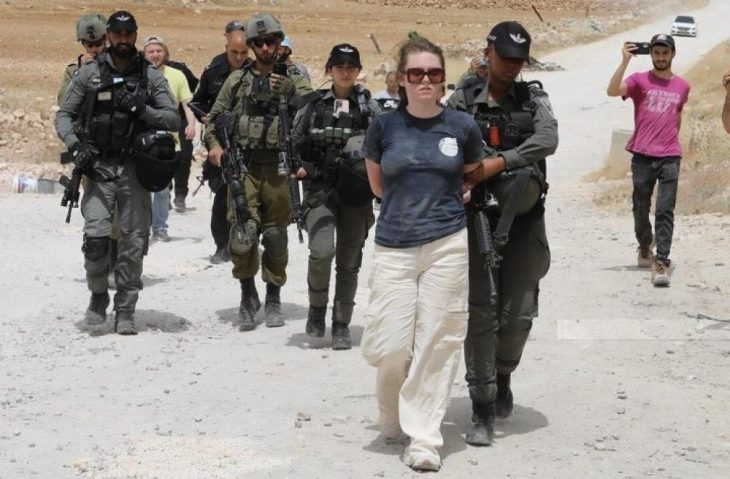
Israeli police arrest foreign activists who tried to confront settler attack in Al-Auja
Palestinian Information Center – July 10, 2025
JERICHO – Israeli occupation police on Wednesday arrested a number of foreign activists who were attempting to confront an attack by settlers on the village of Shallal Al-Auja, north of Jericho city.
The Al-Baydar Organization for the Defense of Bedouin Rights reported that settlers stormed the village, roamed among citizens’ homes, and deliberately herded their sheep into agricultural lands and around houses, which led to the destruction of crops and the residents’ main source of livelihood.
The organization added that local residents and foreign activists tried to drive the sheep away from the homes and prevent the attack, but the occupation police quickly arrived at the scene, provided protection for the settlers, and arrested several of the activists.
It pointed out that this is not the first time that sheep have been used as a means of pressure against the residents; rather, it is part of a systematic policy aimed at harassing the locals and forcing them to leave.
The organization further noted that this scene has become an almost daily occurrence in the Jordan Valley areas, where attacks on residents are increasing alongside the absence of any accountability for settlers—deepening the suffering of the people and threatening the stability of their daily lives.
Protesters in London defy ban to rally in support of Palestine Action

Palestine Action supporters outside London’s High Court in London, July 4, 2025. (Reuters)
Press TV – July 5, 2025
In a direct challenge to the British government’s new ban, protesters have gathered in central London to show solidarity with the pro-Palestinian campaign group, Palestine Action.
The group, which uses direct action against Israeli weapons factories in the UK and their supply chain, was officially designated a “terrorist organization” after a late-night legal bid to delay the move failed on Friday. The proscription came into force on Saturday.
Under the new legislation, membership of or public support for the group is now a criminal offense in the UK, punishable by up to 14 years in prison.
Protesters on Saturday gathered at Parliament Square, defying a warning from the Metropolitan Police, who said expressing support for the group “is a criminal offence.”
The demonstration, organized by campaign group Defend Our Juries, however, saw protesters holding signs and chanting in support of the pro-Palestine group.
Pictures from the rally showed protesters holding placards reading, “I oppose genocide, I support Palestine Action” in Westminster.
Police had warned that chanting slogans, wearing clothing, or displaying flags and signs in support of the group could lead to arrest under the Terrorism Act.
The Met said more than 20 people have been arrested in London.
In a letter addressed to Home Secretary Yvette Cooper, protesters said that they “refuse to be cowed into silence by your order.”
Palestine Action has focused much of its campaign on Elbit Systems UK, which it accuses of manufacturing and supplying weapons to the Israeli military amid the regime’s genocidal war on Gaza.
In its most recent action, activists stormed Guardtech, a subcontractor the group says provides “essential clean room services” to Instro Precision—a subsidiary of Elbit Systems, Israel’s largest arms producer.
Protesters blocked the company’s only entrance on Wednesday and covered it in red paint, symbolizing the blood shed by the Israeli regime in the Gaza Strip.
Palestine Action says Instro Precision cannot operate without Guardtech’s services, which are used to maintain the controlled environments necessary for producing radar kits and targeting systems.
Reacting to the ban on the group, a spokesperson for Palestine Action said, in a statement, “While London is rushing through Parliament absurd legislation to proscribe Palestine Action, the real terrorism is being committed in Gaza.”
It said that the activist group “affirms that direct action is necessary in the face of Israel’s ongoing crimes against humanity of genocide, apartheid and occupation, and to end British facilitation of those crimes.”
The Best-Selling Apps Made By Israeli Spies
A new frontier for the BDS movement
Nate Bear – ¡Do Not Panic! – July 2, 2025
The developers behind hundreds of Android and iPhone apps with billions of downloads are former Israeli spies whose apps are generating significant revenues for Israel’s genocidal war economy.
The apps I’ve identified range from innocuous image and video editing apps to casual games, and most users won’t be aware they’re installing Israeli products on their phones. Many of these app developers operate under the radar, their ownership structures are opaque and the identity of their owners isn’t commonly known.
The identification of these apps should add another frontier to the boycott, divest, sanctions movement, as it provides a straightforward way for ordinary people to avoid Israeli products that contribute to apartheid, genocide and ethnic cleansing.
The proliferation of these apps on Apple’s App Store and the Google Play Store also raises questions over privacy and the harvesting of personal data, given the reputation of Israeli technology and past scandals involving spyware being smuggled onto devices by apps made in Israel.
One of the most significant Israeli app holding companies and developers is ZipoApps, whose model is to buy-out and monetise apps at a large scale. The apps owned by Zipo (which also goes by the name Rounds.com) include a suite of photo and video editing apps that have received hundreds of millions of total installs. Individual apps include Collage Maker Photo Editor and Instasquare Photo Editor: Neon, both of which have received more than 50 million downloads from the Google Play Store. Other ZipoApps products include baby photo editing and retouching tools. In 2022, the founder and CEO of Zipo, Gal Avidor, told an interviewer (in his only interview to date), that all the founders of the company are former Unit 8200 Israeli intelligence personnel. On Reddit, users have complained about ZipoApps approach to privacy and data mining. One popular group of tools known as Simple Gallery went from free and open source to a paid product with ads and trackers just one week after ZipoApps acquired it.
Another Israeli-owned photo editing app on the Play Store is the AI-powered Bazaart, which was founded by Dror Yaffe and Stas Goferman, two former IDF intelligence officers. Goferman far exceeded his mandatory service, spending a decade in the IDF up to 2011.
Facetune, made by the developer Lightricks and available for Android and iPhones, is another Israeli photo editing app with over 50 million installs. Users on the Apple Store have called Facetune, which demands access to unique identifiers and your location, a scam. The co-founder of Lightricks, Yaron Inger, spent five years in Unit 8200.
If you’re into mobile gaming, or if you create mobile games to sell, you will have come across Israeli company Supersonic from Unity, probably without knowing it. With billions of downloads in recent years, Supersonic is one of the largest mobile game publishers in the world with revenues estimated at around $23 million per year. Earlier this year the company reported that they owned three of the top ten most downloaded casual player mobile games in the world: Build a Queen, Going Balls, and Bridge Race. Trash Tycoon is another popular title. The company also has a game called ‘Conquer Countries’ which has been downloaded millions of times and on its advertising tile features a cartoon version of Donald Trump. The founder of Supersonic, Nadav Ashkenazy, spent seven and a half years in the IDF where he rose to become the head of operations for the Israeli air force, managing almost half the full-time staff. You can see all Supersonic’s games here.
A better-known Israeli mobile game app maker whose revenues we don’t have to estimate is Playtika. Listed on the NASDAQ, Playtika brings in revenues of more than $2.5 billion, generating significant taxes for Israel’s mass slaughter machine. Playtika, which builds gambling apps, is firmly enmeshed in the genocidal Israeli war machine. The company was founded by Uri Shahak, son of the former head of the IDF, Amnon Lipkin-Shahak, and last year its annual report revealed that 14% of its staff had been called up as reservists to participate in the genocide in Gaza. Current CEO Robert Antokol says the company has a “responsibility” to Israel and the taxes paid by its staff are “wonderful for the Israeli economy.”
Another Israeli company whose apps have been downloaded billions of times is Crazy Labs. With an estimated company value of around $1 billion and sales estimated at up to $200 million, Crazy Labs is another app maker integral to the Israeli economy. Its best-selling titles are Phone Case DIY, Miraculous Ladybug & Cat Noir, and Sculpt People. You can see the full list of the Crazy Lab apps on the Google Play Store. The founders of Crazy Labs are all ex-IDF, including Sagi Schliesser, who well exceeded his mandatory service by staying in the IDF and helping build the digital architecture of apartheid for eight years.
An app you may have heard of, but not have known is Israeli, is Moovit. The urban transport app was founded by a number of ex-IDF including Nir Erez who spent years at the IDF’s specialist computing centre known as Mamram, which Israeli propaganda says creates ‘cyber warriors.’ As the unit which runs the military’s intranet, Mamram is central to Israel’s genocide of Gaza. Moovit, which has close to one billion users and delivers significant revenues to Israel, has been an official partner of the Olympic Games, the European football championships and also partners with Microsoft.
With hundreds of millions of installs, Call App, which screens phone calls for spam, is another product of Israel’s military economy. The founder and CEO of Call App, Amit On, spent three years in Unit 8200 in the 2000s. The app has over 100 million users.
On the ride-hailing front, Gett, which is focused on corporate passengers and is particularly popular in London as a way to hail black cabs, was founded by ex-Unit 8200 Roi More and Shahar Waiser. A notable mention for GPS navigation app Waze, probably the most famous Israeli app of the last decade, acquired by Google in 2013 for $1.3 billion and also founded by ex-Unit 8200 spies.
Another fast-growing Israeli app which has been featured on Oprah, in the New York Times and on CNN is Fooducate, whose founder, Hemi Weingarten, flew bombing missions for the Israeli air force.
This expose, which follows my investigations into former IDF and Unit 8200 working in AI for the big tech giants, and those working at Meta and Google, further confirms how deeply and insidiously embedded Israel is in our digital lives.
These investigations also reveal how Israel is foundationally reliant on being in a permanent state of dominance over the Palestinians, because the only thing of value the country produces are tech companies founded by ex-IDF. Without being able to train their citizens as spies and soldiers, and butcher Palestinians at will, Israel’s economy would collapse.
Yet most people who use these apps will have downloaded them in good faith with little idea they are contributing to Israel’s occupation-apartheid-genocide economy. In addition, these apps will be gathering information and data, including large amounts of personal images, and delivering them to devotees of Israel committed to maintaining the country as an apartheid state.
So check your phone and please spread the word.
Delegitimising, defunding and deleting Israeli products is one easy step we can all take to help dismantle Israel’s machinery of genocide.
Featured Video

Theodore Postol: Iran’s Missiles & Drones Were Underestimated
or go to
Aletho News Archives – Video-Images
From the Archives
Wars for Israel: A reminder of who’s giving the marching orders
By Damian Lataan | February 7, 2012
As the West prepares to march off to yet another war in the Middle East, we should perhaps remind ourselves of who is giving the West their marching orders.
In February 2003, just weeks before the US and their allies launched their attack on Iraq and her peoples, a delegation of US congressmen, together with the US Ambassador to the United Nations, John Bolton, a well known pro-Zionist and neoconservative war-hawk, were in Israel at the invitation of the Israeli government then led by Israeli Prime Minister Ariel Sharon.
Addressing the congressmen, Sharon told them ‘that Iran, Libya and Syria should be stripped of weapons of mass destruction after Iraq’. Later, Sharon told John Bolton ‘that Israel was concerned about the security threat posed by Iran, and stressed that it was important to deal with Iran even while American attention was focused on Iraq’. … continue
Blog Roll
 Aletho News
- Iran sets up ‘tollbooth’ system in Strait of Hormuz
- Wave 90: IRGC strikes US-linked industrial sites in Gulf
- Iran Says US-Israeli Claims of Its Military Strength Are Wrong
- Trump’s April Fools’ Address to the nation
- The Most Important Bet You’ve Never Heard Of
- The killing of three Indonesian soldiers in Lebanon should remind Jakarta that Israel does not want peace
- Defeated and delusional: Netanyahu’s remarks reveal $80bn war failure, says analyst
- Iran’s friends are about to make life much more difficult for Israel and the US
- The war of liberation of the Arab and Islamic peoples expands across the Gulf
- Envoy warns UN on Trump’s threat to ‘obliterate’ Iran’s civilian infrastructure
- If Americans Knew
- Gaza families reunite years after babies evacuated amid Israel’s war
- International Rescue Committee warns Gaza’s children face grave protection risks
- Iran’s Alleged 47-Year War on America: Debunking the 1,050 American Deaths Canard
- Israel wants US to bomb more of Iran’s civilian structures (113,000 is not enough) – Not a ceasefire Day 173
- Ann Coulter Rips Into Fox News for Iran War Coverage
- Joe Kent Urges Americans To Call White House and Congress To Object To Sending Troops Into Iran
- DNC Resolution to Reject AIPAC Funding Puts Democratic Leaders in the Hot Seat
- Swedish foundation to build 400 schools as over 650,000 Gaza children remain without education for 2 years
- Israeli army admits photshopping image of slain Lebanese journalist
- This is how Israel is systematically killing health workers under the cover of war in Lebanon
- No Tricks Zone
- Low Intensity Tornado Wrecks Major Solar Farm, Creating A Potential Toxic Dump
- New Study Finds Warming Saves Lives…Cold Temperatures 12 Times More Deadly Than Excess Heat
- German Science Blog Accuses PIK Climate Institute Of Hallucinating Climate Tipping Points
- Devastating Assessment Of Comirnaty Vaccine By Former Senior Pfizer Europe Toxicologist
- New Study: CO2 Is ‘Effectively Negligible’ As An Explanatory Climate Change Factor Since 2000
- Former Pfizer Toxicologist Dr. Helmut Sterz Tells Bundestag Hearing Pfizer Vaccine Should Have Never Been Approved
- Energy Expert: Germany’s Nuclear Phaseout Was A “500 Billion Euro Mistake”
- New Research: South Australia’s Mid-Holocene Sea Surface Temperatures Were 4°C Warmer Than Today
- Storing Green Energy To Last Germany 10 Days Would Require A 60-Million Tonne Battery
- New Studies: UK Sea Levels Were 4 Meters Higher Than Today During The Mid-Holocene
 Aletho News