Imprisoned Human Rights Defender in Military Court

International Solidarity Movement | December 6, 2017
Tomorrow, Abdullah Abu Rahmah will be taken once again in front of a military judge. He is being accused of “Causing damage to a military installation,” referring to Israel’s illegal Annexation barrier built on his village’s land.
Abdullah stated, “The occupation has used many methods including killing, injuring, and raiding our homes in order to stop us from exercising our right to protest and struggle against the occupation. But we will not stop struggling until the occupation is dismantled.”
Abdullah, a leading non-violent activist and human rights defender has has been held in military prison since the occupation forces raided his village, Bil’in, and took him from his home in the middle of the night on the 19th of November, 2017. Abdullah was handcuffed, gagged and his hands were tied to the roof of the jeep. Since then, two military judges have conceded that Abdullah is not dangerous and should be released on certain conditions, but the military prosecution is intent on making sure he remains in detention, and has continued to hold him without regard to due process. Tomorrow’s hearing will be to determine if Abdullah has broken conditions set for his release by a military judge after his arrest from the Alwada Cycling Marathon on Nakba Day, the 13th of May, 2016.
Abdullah has been arrested and injured many times in the past for his role in promoting non-violent creative protest in his own village of Bil’in and across the West bank. In 2010, Abdallah served 16 months in prison after being convicted on charges of “incitement” and “organizing and participating in an illegal demonstration.” Abdullah continued to advocate for nonviolent action and Human rights from prison.
In addition to Abdullah, 16 year old Ahmad Abu Rahmah, as well as Ashraf Abu Rahmah, another prominent Bil’in activist, were also taken and are still being held by the military. Ahmad Abu Rahmah was arrested with Abdullah in the raid and accused of throwing stones, as was Ashraf, following his arrest on the 14th of November 2017. Ashraf’s two siblings, Basem and Jawaher, were both killed in separate incidents while nonviolently protesting the illegal wall constructed on their land.
Three Palestinian lawyers seized by Israeli occupation

Samidoun Palestinian Prisoner Solidarity Network – December 4, 2107
Israeli occupation forces seized three Palestinian lawyers well-known for their involvement in defending Palestinian human rights and particularly the rights of Palestinian prisoners in armed, overnight, pre-dawn raids. The three lawyers are:
- Khaled Zabarqa, seized from his home in Lydd in Palestine ’48 and a defense lawyer for imprisoned Sheikh Raed Salah
- Iyad Misk, seized from his home in Kufr Aqab in Jerusalem and legal director of the Prisoners’ Affairs Commission
- Firas al-Sabbah, seized from his home in the city of Jerusalem and director of the al-Meethaq Foundation for Human Rights
All three of the lawyers’ homes was stormed at night by police and intelligence agents who ransacked the home before taking him. The three were taken to the Petah Tikva interrogation center.
Zabarqa is one of the most prominent lawyers defending Palestinian political detainees and prisoners in occupied Palestine ’48. Most recently, his advocacy on behalf of imprisoned Sheikh Raed Salah has highlighted the sheikh’s solitary confinement and political targeting. Zabarqa has been targeted in the past, barred from entering Jerusalem in 2015. Misk is also the former legal director for Defence for Children International – Palestine and, as current director of legal work for the Prisoners’ Affairs Commission, has a leading role in defending many Palestinian prisoners before Israeli occupation courts.
Al-Sabbah is the director of al-Meethaq Foundation, which offers public legal services to the Jerusalemite population, including dealing with Israeli occupation entities like insurance officials, the municipality, and the interior department. The foundation also works together with Physicians for Human Rights to document abuses against child prisoners and support parents in filing complaints about their children’s treatment.
The targeting of the three lawyers comes hand in hand with the ongoing attacks on Palestinian human rights defenders such as Salah Hamouri, new Palestinian lawyer and field researcher for Addameer Prisoner Support and Human Rights Association; Hasan Safadi, Arabic-language media coordinator for Addameer; Issa Amro, al-Khalil organizer against settlements; Khalida Jarrar, Palestinian parliamentarian and Addameer board member; Abdallah Abu Rahma, coordinator of Bil’in’s Popular Committee Against the Wall and Settlements.
“Human rights defender” is a term used to describe people who, individually or with others, act peacefully to promote or protect human rights. These three Palestinian lawyers are human rights defenders who serve as a first line of defense for Palestinian civilians under occupation targeted for arrest, detention and persecution by Israeli occupation forces.
This is also a specific and targeted attack on Palestinian legal work and Palestinian lawyers, in what appears to be an attempt to deprive Palestinian prisoners of even the barest legal representation which is in and of itself frequently barred from providing any meaningful defense in a colonial system meant merely to legitimize the ongoing detention of Palestinians. It also appears to be an attempt to intimidate and suppress Palestinian lawyers from engaging public work to defend Palestinian political prisoners and people under attack.
It’s time the international community stood up for Palestinian children
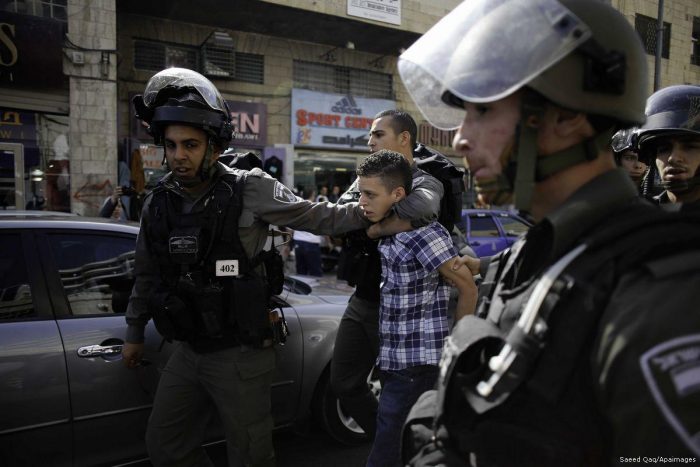
A Palestinian child can be being arrested by Israeli security forces [Saeed Qaq/Apaimages]
By Professor Kamel Hawwash | MEMO | December 4, 2107
Israel’s mistreatment of Palestinian children is not a new development but rather one example of its many breaches of international law and international humanitarian law. While it has in the past faced criticisms for its maltreatment of Palestinian children, particularly in relation to minors that are taken into custody and brought before its military courts, this has not been matched with solid action.
It is therefore encouraging that this may be about to change, and in the United States of all places. The Promoting Human Rights by Ending Israeli Military Detention of Palestinian Children Act requires the Secretary of State to certify annually that funds obligated or expended in the previous year by the United States for assistance to Israel “do not support military detention, interrogation, abuse, or ill-treatment of Palestinian children, and for other purposes”. The legislation leaves financial assistance already committed to Israel in place.
The bill notes that Israel ratified the Convention on the Rights of the Child on 3 October 1991, which states— (A) in article 37(a), that “no child shall be subject to torture or other cruel, inhuman or degrading treatment or punishment”. It states that “In the Israeli-occupied West Bank, there are two separate legal systems, with Israeli military law imposed on Palestinians and Israeli civilian law applied to Israeli settlers”.
It further notes that the Israeli military detains around 500 to 700 Palestinian children between the ages of 12 and 17 each year and prosecutes them before a military court system which the bill says “lacks basic and fundamental guarantees of due process in violation of international standards”.
Defence for Children International Palestine (DCIP) notes that “Israel has the dubious distinction of being the only country in the world that systematically prosecutes an estimated 500 to 700 children each year in military courts that lack fundamental fair trial rights and protections”. It further states that in 590 cases documented by DCIP between 2012 and 2016, 72 per cent of Palestinian child detainees reported physical violence and 66 per cent faced verbal abuse and humiliation.
According to Khaled Quzmar, General Director of DCIP, “despite ongoing engagement with UN bodies and repeated calls to abide by international law, Israeli military and police continue night arrests, physical violence, coercion, and threats against Palestinian children”.
The recent introduction of the bill in the US Congress aims to prevent US tax dollars from paying for human rights violations against Palestinian children during the course of Israeli military detention. It aims to establish, as a minimum safeguard, a US demand for basic due process rights for and an absolute prohibition against torture and ill-treatment of Palestinian children arrested and prosecuted within the Israeli military court system.
In 2012 the UK’s Foreign and Commonwealth Office commissioned a report by nine lawyers on the issue of Palestinian children. Among its conclusions it found that “Israel is in breach of articles 2 (discrimination), 3 (child’s best interests), 37(b) (premature resort to detention), (c) (non-separation from adults) and (d) (prompt access to lawyers) and 40 (use of shackles) 111 of the United Nations Convention on the Rights of the Child”. It further concluded that based on its findings “Israel will also be in breach of the prohibition on cruel, inhuman or degrading treatment in article 37(a) of the Convention. Transportation of child prisoners into Israel is in breach of article 76 of the Fourth Geneva Convention. Failure to translate Military Order 1676 from Hebrew is a violation of article 65 of the Fourth Geneva Convention”.
The report made four core recommendations and 40 specific recommendations. The sheer volume of the recommendations highlights the extent of the breaches that need to be addressed by the Israeli authorities. Rather than work to address the recommendations of the report in 2016, Israel refused to cooperate with a team making a follow-up visit to review the extent to which the recommendations had been addressed. This led to the cancelation of the visit and the British FCO failed to convince the Israelis to reinstate it.
Responding to a question from the Chair of the Britain-Palestine All Party Parliamentary Group, then Foreign Office Minister Tobias Ellwood said: “I expressed my strong disappointment at Israel’s unwillingness to host this follow-up visit with Deputy Foreign Minister Tzipi Hotovely during my visit to Israel on 18 February. Officials from the British Embassy in Tel Aviv, including the ambassador, also lobbied the Israeli Ministry for Foreign Affairs to cooperate with the visit, and will continue to follow up. We remain committed to working with Israel to secure improvements to the practices surrounding children in detention in Israel.”
The UK parliament has recently been considering the issue of Palestinian children and their treatment by Israel. This was initially expressed through a parliamentary instrument called the Early Day Motion (EDM). EDM 563 was issued on 20 November and states that “this House notes with concern that hundreds of Palestinian children continue to be arrested, detained and tried in Israeli military courts, despite the practice involving widespread and systematic violations of international law and being widely condemned”.
The motion “notes the disparity between the treatment of Israeli and Palestinian children by Israeli authorities and calls for those authorities to treat Palestinian children in a way that is not inferior to the way they would any Israeli child”.
EDM 563 notes with concern “that the recommendations of Unicef’s 2013 Children in Israeli Military Detention Report remain largely unmet and calls on the government to urgently engage with the Israeli government to end the widespread and systemic human rights violations suffered by Palestinian children in Israeli military custody”.
At the time of writing 65 members of parliament had signed the motion (out of 650). This includes support from individual MPs from all political parties in England Scotland and Wales.
The recent moves in Congress and the UK parliament to highlight Israel’s abuse of the rights of Palestinian children have been welcomed by Palestinians and their supporters. It has taken decades for the rights of children to gain any real attention. If the bill in the US passes then it would signal a real change in policy in that it will condition some funding to Israel on respect for human rights and specifically for Palestinian children. If it fails then the message to Palestinian children will be that America is willing for the bar to be set lower for them than for Israeli children. A well supported EDM in the UK Parliament will highlight the issue and that will allow its sponsors to seek real action from government to pressure Israel to change its unacceptable treatment of Palestinian children, both morally and legally.
It is time Palestinian children were finally protected from abuse by their occupiers. Israel is comfortable in its abuse and will only change when the international community acts to help them. As for Israel, a state without a moral compass, when it comes to Palestinians it could at least apply the same law and practices of dealing with Palestinian children as it does its own children.
Israel law allows prosecution of those revealing army violations against Palestinians
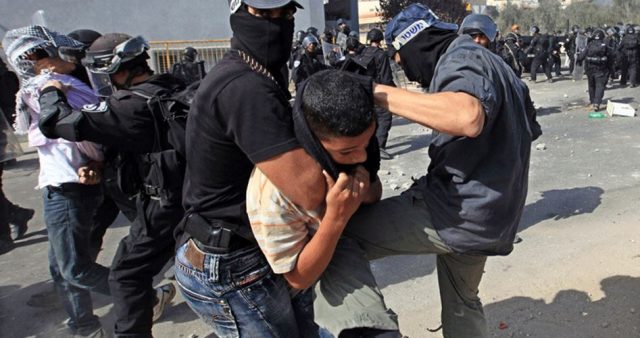
MEMO | December 4, 2017
Israeli media sources revealed that the Israeli Ministerial Committee for Legislation was due to discuss a draft bill yesterday that allows the army to sue anyone who “offends” its soldiers.
The bill, which is aimed at organisations including Breaking the Silence which works to expose the occupation’s violations against Palestinian citizens, has the backing of Justice Minister Ayelet Shaked and Minister Yariv Levin, Israeli newspaper Israel Hayom reported.
According to the bill’s details, the draft law would allow soldiers to file defamation suits against anyone who tried to harm their reputation or spread information harmful to their image.
The newspaper quoted Likud MK Yoav Kish, who presented the draft bill, saying: “After the Ministerial Committee approves the draft bill, it will be presented next Wednesday for approval during a preliminary reading in the Knesset.”
Kish claimed that the “testimonies” published by Breaking the Silence are “lies”.
He added: “Whoever defames the army, whether it is Break the Silence, or any other party, must pay the price.”
Breaking the Silence is an organisation of veteran combatants who have served in the Israeli military since the start of the Second Intifada and who expose the Israeli public to the reality of everyday life in the Occupied Territories.
The death of Atef al Maqousi
Israel-Palestine Timeline
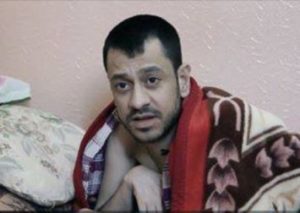 November 8, 2017: Atef al-Maqousi, 37, died from complications resulting from serious wounds he suffered in 1992, after Israeli soldiers shot him in his spine. Atef was 12 years old.
Atef suffered from quadriplegia as a result of his injury, when the soldiers shot him with live fire in Jabalia refugee camp, in the northern part of the Gaza Strip.
Following the shooting, Atef suffered ongoing infections and repeated serious complications that eventually led to his death, medical source said.
To see a list of all Palestinians and Israelis killed by the other side since 2000, go to Israel-Palestine Timeline.
Hamas asks PA government to fulfill its duties or resign
Palestine Information Center – December 2, 2107
GAZA – Islamic Resistance Movement, Hamas, on Saturday urged the Palestinian Authority (PA) government to fully assume its responsibilities, including lifting the unjust sanctions on the Gazan people, or resign and form a national salvation government.
The Movement said in a press statement that the PA government, led by Rami Hamdallah, was handed over all Gaza ministries yet it has not exerted any single effort to alleviate the suffering of the Palestinians people in Gaza and miserably failed in implementing the agreements reached in Cairo.
Hamas accused the PA government of fighting against the resistance and stressed that it has not made any serious step to confront the Israeli Judaization and settlement schemes and defend the Palestinian people in Occupied Jerusalem and the West Bank.
This is the first time that Hamas has openly asked Hamdallah’s government to resign. The request came in response to the government’s procrastination in lifting the sanctions imposed on the Gaza Strip despite having taken over all government institutions in the enclave under Egyptian and international supervision.
PA officials demand that the PA government be fully “empowered” as a condition for lifting sanctions. Palestinian factions and observers see this term as unrealistic, especially that lifting the sanctions was earlier linked to dissolving the administrative committee and handing over Gaza ministries and crossings.
The sanctions imposed on Gaza, which include reducing power and medical supplies and cutting the salaries of PA employees, are still in place despite the reconciliation talks. The humanitarian situation in the territory, meanwhile, keeps worsening in view of the 11-year Israeli blockade.
Argentine ‘death flight’ pilots get life for 100s of junta opponents thrown into ocean
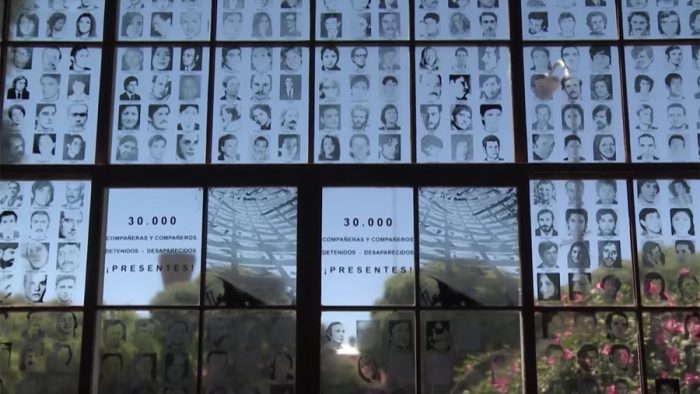
Images of junta victims at ESMA Museum in Buenos Aires © espaciomemoria / YouTube
RT | November 30, 2017
Judges in Argentina have given life sentences to the former ‘death flights’ pilots after hundreds of people opposing the country’s 1976-83 military junta – including a close friend of Pope Francis – were thrown into the ocean.
A major ruling on Wednesday marked the “first” such Argentinian judgment against pilots involved in the notorious ‘death flights,’ local media reports. During the operations, opponents of Argentina’s military regime that ruled the country from 1976 until 1983 were thrown into the waters of the Atlantic.
According to the verdict, the announcement of which lasted almost four hours, 29 former service members were sentenced to life imprisonment, 19 were sentenced to eight to 25 years, and six were acquitted, local media report.
There are 54 defendants in the major trial. It also involves cases of 789 victims of a secret detention center – known as the Navy Mechanics Higher School (ESMA) – where up to 5,000 people opposing the repressive junta regime are believed to have been vanished.
The five-year trial – called the ‘mega cause’ in Argentina – exposed the chilling practices of systematic torture and the killing of thousands of people, including left-wing opponents of the regime and members of Argentina’s urban guerrilla groups, but also human rights activists and relatives of those forcibly disappeared by junta forces.
In a series of hearings, it emerged that numerous victims were drugged, loaded onto ‘death flight’ aircraft, and thrown into the freezing waters of the southern Atlantic Ocean. Among ESMA victims was Esther Careaga, a close friend of Jorge Bergoglio, who later became Pope Francis. Careaga was thrown to her death from a plane one night in December 1977, along with two French nuns and nine others.
“Careaga was a good friend and a great woman,” Beroglio said when the body was identified in 2003. The future pontiff met Careaga, a biochemist and his boss at the time, when he worked as an apprentice at a pharmaceutical laboratory in Buenos Aires in the early 1950s.
Former Palestinian prisoner Omar Nazzal publishing new book
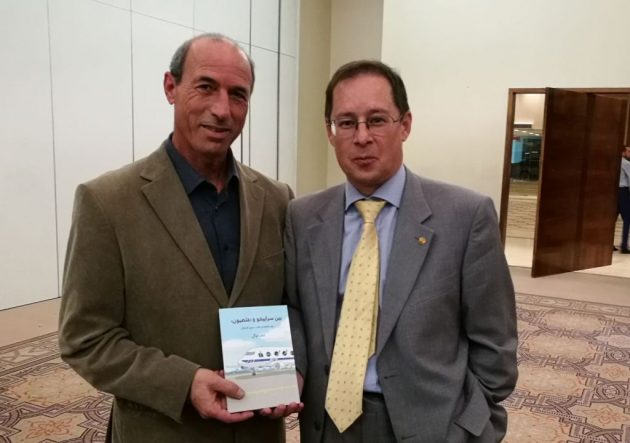
Photo: Omar Nazzal (l)
Samidoun Palestinian Prisoner Solidarity Network – November 23, 2017
Palestinian journalist and former prisoner Omar Nazzal has written a new book, “Between Sarajevo and Etzion,” published by Dar Fafasat under the auspices of the Palestinian Prisoners’ Affairs Commission. The book includes images and stories from Nazzal’s time in administrative detention in 2016; he was imprisoned for 10 months through hunger strikes and protests within the prison after being seized by Israeli occupation forces as he traveled to attend the European Federation of Journalists’ conference in Sarajevo.
The arrest of Nazzal, a member of the General Secretariat of the Palestinian Journalists’ Syndicate and President of the Association of Democratic Journalists, sparked international protest, yet his imprisonment without charge or trial was renewed on multiple occasions. He was previously jailed in 1978 and 1988 and held in administrative detention without charge or trial; in 1986, Nazzal was held under house arrest for six months.
Issa Qaraqe, head of the Prisoners Affairs Commission, said that the book exemplifies the prisoners’ resistance to all attempts to destroy their will, spirit and national identity. A launch for the book will take place in Ramallah on Sunday, 26 November.
The US-Saudi Starvation Blockade
By Pat Buchanan • Unz Review • November 24, 2017
Our aim is to “starve the whole population — men, women, and children, old and young, wounded and sound — into submission,” said First Lord of the Admiralty Winston Churchill.
He was speaking of Germany at the outset of the Great War of 1914-1918. Americans denounced as inhumane this starvation blockade that would eventually take the lives of a million German civilians.
Yet when we went to war in 1917, a U.S. admiral told British Prime Minister Lloyd George, “You will find that it will take us only two months to become as great criminals as you are.”
After the Armistice of Nov. 11, 1918, however, the starvation blockade was not lifted until Germany capitulated to all Allied demands in the Treaty of Versailles.
As late as March 1919, four months after the Germans laid down their arms, Churchill arose in Parliament to exult, “We are enforcing the blockade with rigor, and Germany is very near starvation.”
So grave were conditions in Germany that Gen. Sir Herbert Plumer protested to Lloyd George in Paris that morale among his troops on the Rhine was sinking from seeing “hordes of skinny and bloated children pawing over the offal from British cantonments.”
The starvation blockade was a war crime and a crime against humanity. But the horrors of the Second World War made people forget this milestone on the Western road to barbarism.
A comparable crime is being committed today against the poorest people in the Arab world — and with the complicity of the United States.
Saudi Arabia, which attacked and invaded Yemen in 2015 after Houthi rebels dumped over a pro-Saudi regime in Sanaa and overran much of the country, has imposed a land, sea and air blockade, after the Houthis fired a missile at Riyadh this month that was shot down.
The Saudis say it was an Iranian missile, fired with the aid of Hezbollah, and an “act of war” against the kingdom. The Houthis admit to firing the missile, but all three deny Iran and Hezbollah had any role.
Whatever the facts of the attack, what the Saudis, with U.S. support, are doing today with this total blockade of that impoverished country appears to be both inhumane and indefensible.
Almost 90 percent of Yemen’s food, fuel and medicine is imported, and these imports are being cut off. The largest cities under Houthi control, the port of Hodaida and Sanaa, the capital, have lost access to drinking water because the fuel needed to purify the water is not there.
Thousands have died of cholera. Hundreds of thousands are at risk. Children are in danger from a diphtheria epidemic. Critical drugs and medicines have stopped coming in, a death sentence for diabetics and cancer patients.
If airfields and ports under Houthi control are not allowed to open and the necessities of life and humanitarian aid are not allowed to flow in, the Yemenis face famine and starvation.
What did these people do to deserve this? What did they do to us that we would assist the Saudis in doing this to them?
The Houthis are not al-Qaida or ISIS. Those are Sunni terrorist groups, and the Houthis detest them.
Is this now the American way of war? Are we Americans, this Thanksgiving and Christmas, prepared to collude in a human rights catastrophe that will engender a hatred of us among generations of Yemeni and stain the name of our country?
Saudis argue that the specter of starvation will turn the Yemeni people against the rebels and force the Houthi to submit. But what if the policy fails. What if the Houthis, who have held the northern half of the country for more than two years, do not yield? What then?
Are we willing to play passive observer as thousands and then tens of thousands of innocent civilians — the old, sick, weak, and infants and toddlers first — die from a starvation blockade supported by the mighty United States of America?
Without U.S. targeting and refueling, Saudi planes could not attack the Houthis effectively and Riyadh could not win this war. But when did Congress authorize this war on a nation that never attacked us?
President Obama first approved U.S. support for the Saudi war effort. President Trump has continued the Obama policy, and the war in Yemen has now become his war, and his human rights catastrophe.
Yemen today is arguably the worst humanitarian crisis on earth, and America’s role in it is undeniable and indispensable.
If the United States were to tell Crown Prince Mohammed bin Salman that we were no longer going to support his war in Yemen, the Saudis would have to accept the reality that they have lost this war.
Indeed, given Riyadh’s failure in the Syria civil war, its failure to discipline rebellious Qatar, its stalemated war and human rights disaster in Yemen, Trump might take a hard second look at the Sunni monarchy that is the pillar of U.S. policy in the Persian Gulf.
Copyright 2017 Creators.com
Israeli occupation forces seize Bir Zeit student leader Osama Mafarjeh

Samidoun Palestinian Prisoner Solidarity Network – November 26, 2017
Israeli occupation forces seized Palestinian student leader Osama Mafarjeh, in addition to six more Palestinians taken by occupation forces from their homes in pre-dawn raids. Mafarjeh, 24, is the president of the Islamic Bloc at Bir Zeit University and has been imprisoned before by the Israeli occupation as well as Palestinian Authority security forces.
He was taken away by occupation forces after his vehicle was stopped by an occupation military checkpoint imposed at Beit Ur al-Fuqua southwest of Ramallah.
Palestinian students are frequently subject to arrest and imprisonment on the basis of their student activities; most student blocs are labeled as prohibited organizations by the occupation due to their political affiliations. Over 60 Bir Zeit University students are imprisoned in Israeli jails; just last week a number of students at an-Najah University in Nablus were seized by occupation forces. The Islamic Bloc, which Mafarjeh represents, won the largest share of seats on Bir Zeit’s student council during the annual spring elections.
Remembering Ishaq Maragha: Martyr of the battle of empty stomachs
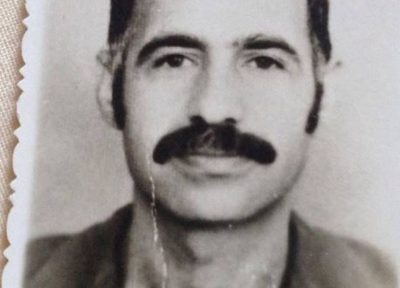
Ishaq Maragha
Samidoun Palestinian Prisoner Solidarity Network – November 19, 2107
16 November 2017 marks the 34th anniversary of the death of Palestinian prisoner Ishaq Maragha, one of four Palestinians whose lives were taken – three through forced-feeding – during a hunger strike for justice inside Israeli prisons. Maragha, who died in 1983, three years after he was grievously wounded by Israeli forced feeding, was not only a martyr but a longtime leader of the Palestinian prisoners’ movement and the Palestinian liberation struggle.
Along with Ali al-Jaafari and Rasim Halawa, he was martyred by Israeli force feeding aimed at breaking the hunger strike of Nafha prison in 1980. Fellow prisoner Anis al-Dawla also lost his life in 1980 from fatigue, malnutrition and disease caused by his solidarity strike in Ashkelon prison in support of the prisoners of Nafha.
Born in the town of Silwan near Jerusalem in 1942, he became a member of the Arab Nationalist Movement – the movement founded by George Habash, Wadie Haddad and other Arab and Palestinian young people looking towards liberation, unity and socialism – and was considered one of the first members of the movement in Palestine, joining in 1959 at the age of 17. He had four children, Jamal, Amal, Amina and Musa.
As a member of the ANM, he traveled to Egypt for military training in 1964. He joined the ranks of the Popular Front for the Liberation of Palestine from the very beginning of its foundation on December 11, 1967 from the Palestine Section of the ANM. Shortly over one year later, in February 1969, he was arrested by Israeli occupation forces on charges of being a leader in the PFLP in the Jerusalem area. After three years in Israeli prison including a period of intense torture under occupation, he was released from prison in August 1972.
As Abdel-Nasser Ferwana, Palestinian researcher on prisoners’ affairs notes, this was only a “fighter’s rest” for Maragha. In February 1975 he was once again seized by occupation forces and accused of participating in the resistance to occupation; he was sentenced to 20 years imprisonment.
Ferwana recalled meeting Maragha several times while visiting his imprisoned father, who would laer be released in the 1985 prisoner exchange with the Palestinian resistance. Maragha said to him as a young man, “The prisons will be destroyed and your father and I will be liberated.”
During his time in prison, he was transferred to Ramle, Beersheba and Nafha prisons; he was well-known among the prisoners as an example of a dedicated worker and a revolutionary leader. Ferwana caled him a “distinguished leader, loved by everyone, a brilliant instigator and a dedicated fighter…one of the pillars of the prisoners’ movement.” He became one of the leaders of the prison organization of the PFLP, responsible for international relations.
In 1980, Nafha prison was opened as an “exile and cemetery for the prisoners’ movement leaders;” Maragha was one of the first to be transferred there. The prisoners began their strike that year, on 14 July 1980. One of the hunger strikers, Abdel-Rahim al-Noubani, chronicled the development of the strike.
The prisoners demanded:
1. The prisoners demand the installation of beds
2. The prisoners demand access to a radio and television
3. The prisoners demand the improvement of the quality and quantity of food
4. The prisoners demand access to Arabic and Hebrew books and newspapers
5. The prisoners demand the expansion of windows, allowing more sun and air into the cell
6. The prisoners demand an end to the policy of collective and individual punishment, solitary confinement, depriving them food during their isolation, and only providing them with bread and water.
7. The prisoners demand the visiting allowance to be prolonged to one hour every two weeks
8. The prisoners demand access to winter and summer clothes, as well as blankets
9. The prisoners demand permission to buy food and vitamins from the prison canteen, which has been hitherto denied
10. The prisoners demand their walk allowance extend from 15 minutes to an hour
As Shahd Abusalama wrote chronicling her own father’s history in the Nafha strike, “Whenever Palestinian prisoners have gone on hunger strike, the Israeli authorities have responded by punishing them collectively. The Nafha hunger strike was no exception.”
After 10 days of hunger strike which drew growing international and Palestinian support, the Israeli occupation attempted a particularly cruel and dangerous form of force-feeding against 26 prisoners in which boiling water and salt were poured down tubes forced down the prisoners’ throats. In the case of Ishaq Maragha, Rasem Halawi and Ali al-Jaafari, the tube was not fully inserted and instead entered their lungs; the boiling water poured into the tube burned and destroyed their lungs. Halawi and Jaafari died almost immediately, killed by Israeli force feeding on their hunger strike.

Ishaq Maragha, Ali al-Jaafari, Rasem Halawa
Maragha later related the experience to al-Noubani:
“When we were put in the waiting room, the three of us collapsed onto a wooden bench, overcome with extreme exhaustion and fatigue. The pain was ripping our chest and gut apart. But it seemed that Ali Jaafari was the suffering the most; he grabbed the bars of the iron door, his drained voice shouting out to the section’s jailer and clinic doctor alternately, asking them to provide us with emergency assistance and treatment. He then turned to me suddenly and said, ‘Abu Jamal, I’m dying, I’m dying!’ I tried to calm him and raise his spirits, and boost his strength – for I had noticed something in him that I myself did not feel, despite the fact that we had both gone through the same torment.
Ali al-Jaafari started shouting again, ‘Abu Jamal, my legs have died, I can no longer feel them, they’re as cold as ice.’ I was helpless, and could do nothing but say to him, ‘Don’t be afraid, Ali, here comes the doctor, don’t worry.’ He suddenly shouted again, for the third and last time: ‘My arms have died, Abu Jamal.’ I was as drained as he was, and as he said this to me, my eyes filled with tears; I saw his last gasp escape from his deteriorated lung to his broken nose by the zonda hose; canals filled with blood and pain opened up inside him. His head was slightly bent over to his right shoulder and his cold hands were still holding onto the bar of that damned iron door. His gracious self slid away, and his pure soul left his body, and all the while he stood there, like a palm tree that had lasted a hundred years drying out. We rested the body of our martyr on the ground, shaking with sobs. In that moment, Rasem and I forgot we shared the same fate as he.”
Maragha also reported that the prison doctor swore that he would not let him die, not out of concern for his life, but because “I will not let them make you a national hero.”
The strike continued after the martyrdom of al-Jaafari and Halawa; Maragha became a key spokesperson for the strike to lawyers and before the world. After 33 days, the prisoners’ ended their strike with a victory in all of their demands.
Maragha was then transferred to Beersheba prison as his health deteriorated further and without the provision of any treatment until he died on 16 November 1983 of his ongoing injuries and wounds caused by his torture under forced feeding during the Nafha strike, leaving a legacy of struggle, sacrifice and commitment above all to the liberation of Palestine, his land and his people.
Ishaq Maragha was a beloved leader of the Palestinian prisoners’ movement and a symbol of the leading role of Palestinian prisoners in the struggle for the liberation of Palestine, whose bodies and lives are on the line on a daily basis in a direct confrontation with occupation. The hunger strikes of Palestinian prisoners are a collective means of struggle and immense self-sacrifice for dignity and freedom.
On the 34th anniversary of the passing of Ishaq Maragha, Samidoun Palestinian Prisoner Solidarity Network remembers him, Ali al-Jaafari, Rasim Halawa and the long legacy of the martyrs of the prisoners’ struggle – and their commitment to Palestinian and global liberation. Their deepest and most precious sacrifice must urge all of us around the world who stand with Palestinian rights, freedom and liberation to intensify and escalate our work for the freedom of the imprisoned leaders of the Palestinian people today. As plans for regional warfare and a so-called “deal of the century” promulgated by the United States and Israel with the backing of Saudi Arabia and reactionary forces threaten the Palestinian people, the people of the region and the world, the legacy of Ishaq Maragha and his fellow Palestinian prisoners can and must inspire us all to struggle at this critical moment to defend the Palestinian cause and struggle to achieve their goals of return and liberation.
Featured Video
Seyed M. Marandi: Negotiations Collapsed – Return to War
or go to
Aletho News Archives – Video-Images
From the Archives
Wartime internment camps in Australia
National Archives of Australia
World War I
During World War I, for security reasons the Australian Government pursued a comprehensive internment policy against enemy aliens living in Australia.
Initially only those born in countries at war with Australia were classed as enemy aliens, but later this was expanded to include people of enemy nations who were naturalised British subjects, Australian-born descendants of migrants born in enemy nations and others who were thought to pose a threat to Australia’s security.
Australia interned almost 7,000 people during World War I, of whom about 4,500 were enemy aliens and British nationals of German ancestry already resident in Australia.
Records of World War I internment camps
World War II
During World War II, Australian authorities established internment camps for three reasons – to prevent residents from assisting Australia’s enemies, to appease public opinion and to house overseas internees sent to Australia for the duration of the war.
Unlike World War I, the initial aim of internment during the later conflict was to identify and intern those who posed a particular threat to the safety or defence of the country. As the war progressed, however, this policy changed and Japanese residents were interned en masse. In the later years of the war, Germans and Italians were also interned on the basis of nationality, particularly those living in the north of Australia. In all, just over 20 per cent of all Italians resident in Australia were interned. … continue
Blog Roll
 Aletho News
- Seyed M. Marandi: Negotiations Collapsed – Return to War
- Tomorrow’s naval blockade showdown
- ‘Israel’ attacks civilians to hide its embarrassing military failures & out of pure sadism
- Any Foreign Military Vessel Approaching Hormuz Under Any Pretext ‘Will Be Dealt With Severely’: IRGC
- Diplomats slam US negotiators’ performance in Iran talks
- Trump Refuses Exit Ramp, War with Iran will Continue
- Trump Says US Naval Blockade in Strait of Hormuz Will Begin Shortly
- US, Iran end 21-hour talks without agreement
- US IRAN TALKS: Who Are the Crazy Ones Here? /Lt Col Daniel Davis
- Talks with the US end without a deal over excessive US demands: Iran
- If Americans Knew
- US-Iran ceasefire negotiations make zero progress – Daily Update
- Pro-Israel ‘Thinktanks’ and Individuals who Influence U.S. Foreign Policy
- Mearsheimer reveals how Israel dictates US policies on Iran, Gaza – video
- After killing 350+, Israel still has a “score to settle” with Lebanon before ceasefire – Daily Update
- Military aid to Israel emerges as the latest political litmus test for Democrats
- The only Palestinian children’s rights organization closes following years-long Israeli campaign against it
- ‘I Can’t Forget the Smell’: Lebanese Reel After Israel Kills Over 300 in Single Day
- DNC Shoots Down Resolutions Calling Out AIPAC and Limiting Arms to Israel
- TCN: Is Israel Blackmailing President Trump?
- Israel killed at least 303 Lebanese yesterday – who were they? Daily Update
- No Tricks Zone
- Cave Discovery Reveals Today’s Desert Climates Were Recently Far Warmer, Wetter, Teeming With Life
- German Expert: Heat Dome Led To Record Temps In Western USA…Warmer In 1934, 1936
- New Study: No Linear Warming Or Glacier Retreat Along Northern Antarctic Peninsula Since 1980s
- An Inconvenient Tree: Uncovered In Alps… Europe Much Warmer Than Today 6000 Years Ago
- New Study Reports A 60% Slowdown In Greenland’s Ice Loss Rate In The Last Decade
- Low Intensity Tornado Wrecks Major Solar Farm, Creating A Potential Toxic Dump
- New Study Finds Warming Saves Lives…Cold Temperatures 12 Times More Deadly Than Excess Heat
- German Science Blog Accuses PIK Climate Institute Of Hallucinating Climate Tipping Points
- Devastating Assessment Of Comirnaty Vaccine By Former Senior Pfizer Europe Toxicologist
- New Study: CO2 Is ‘Effectively Negligible’ As An Explanatory Climate Change Factor Since 2000
 Aletho News