Jordan charges Israel embassy guard with murder
Press TV – July 28, 2017
Jordan’s public prosecutor says murder charges have been filed against an Israeli embassy guard, who recently shot dead two Jordanians in Amman.
State media said Friday that Attorney General Akram Masaadeh charged the guard with two counts of murder and possession of an unlicensed firearm.
The official argued that diplomatic immunity did not mean the “killer” could not be put on trial in his own country.
An Israeli government source, who also spoke on condition of anonymity, said Israel was also “giving preliminary consideration to offering compensation to the family of the second Jordanian (the landlord) killed in the incident.”
The development came after Jordan’s King Abdullah angrily urged Israeli Prime Minister Benjamin Netanyahu to put the guard on trial, warning that the issue jeopardizes Amman-Tel Aviv ties.
“We demand that the Israeli Prime Minister abides by his commitment and takes all measures to ensure the trial of the killer, and not handle this like a political show to achieve personal political gains,” Reuters quoted him as saying.
Abdullah made the remarks when he visited the family of one of the victims, during which he pledged that the state would “do everything within its means”| to get justice for the two men.
King Abdullah lashed out at Netanyahu for giving the guard a hero’s embrace after Israel brought him home under diplomatic immunity, saying the behavior was “provocative on all fronts and enrages us, destabilizes security and fuels extremism.”
On Sunday, the guard shot dead Jordanian teenager Mohammad Jawawdah at Israel’s embassy in Amman as well as the landlord of the house in the compound where the guard lived.
During the funeral procession of Jawawdah on Tuesday, thousands of Jordanians protested against Israel, calling on Jordanian authorities to close the Israeli embassy and scrap the country’s peace treaty with Tel Aviv.
Israel claims that the guard had been defending himself in a “terrorist attack” after Jawawdah attacked him with a screwdriver. It is still unclear how the landlord came to be shot.
However, the Jordanian police, who were unable to question the guard, say the guard shot the teenager, who worked for a furniture company and was delivering an order, after they got into a brawl.
King Abdullah also pointed to a previous incident in March 2014, in which an Israeli soldier shot dead a Jordanian judge at a border crossing. No investigation was ever conducted.
“The way Israel handles the embassy case and the judge’s killing and other cases will have a direct impact on the nature of our relationship,” he said.
Many Jordanians have accused the authorities of abdicating sovereignty by allowing the Israeli guard to leave the country, with lawmakers walking out of parliament in protest.
Jordanians are set to hold another protest on Friday to repeat their demand for closure of the Israeli Embassy and tearing up the unpopular peace treaty.
Seven killed as Saudi forces intensify attacks on besieged Shia town
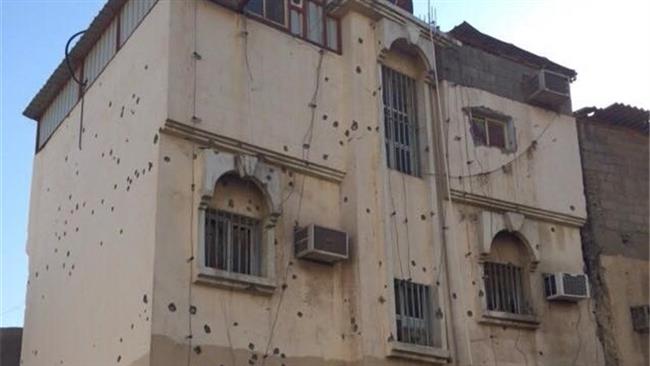
Awamiyah amid an ongoing crackdown by Saudi regime forces
Press TV – July 27, 2017
Saudi forces have waged a fresh wave of attacks against a besieged town in the kingdom’s Shia-populated Eastern Province, killing at least seven people and injuring several others over the past few hours.
The casualties were reported over the past 48 hours after Saudi regime forces, equipped with artillery and heavy weapons, launched a series of fresh attacks against Awamiyah, located some 390 kilometers northeast of the capital Riyadh.
Human rights activists and media outlets confirmed on Thursday that at least seven local Shia residents lost their lives after they were sprayed with bullets by Saudi forces.
There are reportedly several women and children among those injured in the raids. There are also at least two Indian refugee workers among those injured in the attacks.
The death toll is expected to rise as some of the injured are said to be in critical condition.
On Wednesday, a series of video footage circulating on social media websites showed Saudi regime forces shelling homes and buildings in al-Jamima neighborhood and al-Mosara, the old quarter of the town of Awamiyah.
Several homes, business and historical sites have been totally destroyed or partially damaged across the region.
The Saudi regime forces in riot gear have also set up barricades and security checkpoint to prevent people from organizing any gathering or protest rally. Local residents complain that police deployed at the checkpoints are snatching and stealing their personal belongings.
Several main entrances to the region have been closed and the regime forces have imposed heavy restrictions on movement of the citizens.
Saudi authorities also shut down internet and mobile services across the area.
Residents have been forced to stay indoors as the regime has deployed snipers across the entire region.
Reports also indicate that garbage has piled up as Saudi forces continue to prevent relevant authorities from collecting trash across several areas.
The developments come as a fierce crackdown on protesters there enters its 77th day.
Awamiyah has witnessed an increase in anti-regime protests and an ensuing crackdown as Riyadh has insisted to destroy al-Mosara, claiming the neighborhood’s narrow streets have become a hideout for militants believed to be behind attacks on security forces in the region.

Shia activists who were among those killed in fresh attacks by Saudi regime forces in Awamiyah
Saudi authorities intend to turn al-Mosara into a commercial zone, despite warnings both by locals and the United Nations that the controversial plan would ruin the 400-year-old neighborhood’s historical and cultural heritage and could eventually lead to the forced eviction of hundreds of people from their businesses and residence.
Saudi troops equipped with heavy weapons have been deployed in Awamiyah since May 10, following fierce clashes between the regime forces and locals protesting against the destruction.
A large number of civilians have lost their lives in the ongoing heavy-tactic crackdown by the Riyadh regime since then.
A number of human rights groups and activists have expressed deep concern about the living conditions of people in Awamiyah, who are suffering from a severe water shortage and are using private generators to produce electricity.
On May 24, UN experts criticized the ongoing attempts to demolish al-Mosara and accused the Saudi kingdom of erasing cultural heritage, violating human rights, and forcing residents to flee their homes.
Silenced stones mark hard path to Sri Lankan reconciliation
Security forces have erected numerous monuments celebrating their 2009 victory over Tamil Tiger rebels. No such privilege has been accorded to the Tamil insurgents or civilians who died in the fight
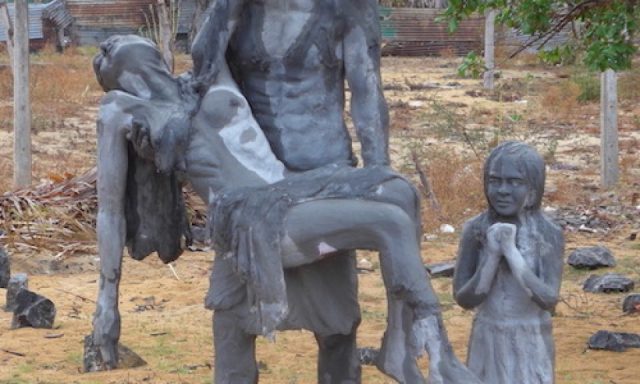
A monument to Sri Lanka’s civil war victims. Photo: Duncan McCargo
By Duncan McCargo | Asia Times | July 26, 2017
An eerie art installation near an idyllic Sri Lankan beach symbolizes many of the contradictions of this post-war society, comprising a sculpture of a man carrying his brutalized daughter, an old suitcase full of clothes and a small ‘graveyard’ punctuated by tiny stones.
The core sculpture was inaugurated on May 18, 2016 – the seventh anniversary of the end of the decades–long civil war, which the Sri Lankan government celebrates as a day of victory over the Tamil insurgent
One year later, police obtained a court order preventing Father Elil Rajendram, the Tamil Jesuit priest behind the project (and an activist and co-spokesperson for the Tamil Civil Society Forum), from presiding over a ceremony to add some stones bearing the names of people who had died during the war.
The following day, after a legal challenge mounted by Kumaravadivel Guruparan, head of the law department at Jaffna University, the court decreed that the ceremony could only take place within the premises of the nearby church. The name-bearing stones have since remained out of public view, while Father Elil was questioned by the authorities on four separate occasions.
The police claimed that some of those memorialized might be members of the banned Liberation Tigers of Tamil Eelam (LTTE) separatist group, better known as the Tamil Tigers, although Guruparan argued that commemorating the names of deceased LTTE members was not banned under any Sri Lankan law.
In the event, the police proved unable to confirm that any of the names were actually those of LTTE members: they were simply acting on suspicion.

A cemetery of stone markers inscribed with the names of victims of Sri Lanka’s civil war. Photo: Duncan McCargo
Mullivaaikaal, the beach in question, lies at the heart of ‘the cage’, a narrow isthmus where the remnants of the Tamil Tigers were slaughtered by the Sri Lankan army in the bloody culmination of a long-running civil war in May 2009. Tens of thousands of people were killed in what the government still refers to as a ‘humanitarian’ operation.
Sri Lankan security forces have erected numerous monuments to celebrate their victory and to recognize their war dead, but no such privilege has been accorded to those from the LTTE, nor to the Tamil civilians who perished during the fighting.
In refusing to allow ordinary families to honor or even to remember their dead, Sri Lankan authorities claim they are responding to pressure from hardline Buddhist groups who insist that brutal terrorists are not entitled to such decencies.
The outspoken Chief Minister of the Northern Province, former Supreme Court Justice Canagasabapathy Visuvalingam Vigneswaran, has been the one of the loudest elected voices for the Tamil cause in recent years.
This writer asked why he couldn’t erect a memorial to the Tamil war dead right in front of his office (there is a handy patch of waste ground right next to the gate), but he answered rather melodramatically that if he pushed too hard on this issue, even he could be taken into custody: the government has made holding meetings about memorials hard enough, let alone building them.
I later had chance to ask a senior military commander why the memorialization issue was so sensitive. While acknowledging that during many years of fighting the army had developed ‘a bit of an arrogant mindset’, he insisted that negative sentiments of people and politicians in the South were now the main obstacle to any memorial to Tamil victims or LTTE fighters, rather than military obstructionism.
Nevertheless, he personally believed such memorials should be possible in the future. Meanwhile, he noted, progress had been made – until recently, even private memorial ceremonies were banned, not just public commemorations.
The 30-year civil war in Sri Lanka remains a subject of intense controversy. But since the more compromising and pragmatic President Maithripala Sirisena assumed power in early 2015 with the support of the country’s Tamil minority, reconciliation has figured prominently in public discourse.
The incoming government established the Office for National Unity and Reconciliation (ONUR), chaired by the redoubtable former president Chandrika Bandaranaike Kumaratunga.
Numerous worthy unity and reconciliation projects have been initiated, focusing on areas such as youth exchanges, vocational training, agricultural livelihoods and the construction of new homes for those displaced during the conflict.
Yet in the Northern Province – an overwhelmingly Tamil region where much of the fighting took place – local people remain skeptical about development-oriented, top-down reconciliation projects that are largely conceived and implemented by the bureaucracy and security forces. Among recurrent local concerns are missing persons, military land occupation and memorialization.
Critical observers, such as human rights activist Ruki Fernando, argue that until these core issues are addressed, token projects will do little to assuage Tamil frustrations with the state. He argues that rather than exercising leadership, the Colombo government has become the captive of the military and Buddhist hardliners.
During the civil war, huge numbers of people were driven out of their homes in the North and East of the country. When they tried to return after 2009, many found their land occupied by the military. In the Jaffna peninsula alone, the military currently holds more than 10,000 acres of land, around half of it used for bases.
The military points to progress in releasing occupied land, but insists that for security reasons the process has to be incremental.
In recent months, there has been a mushrooming of protest encampments by villagers seeking the return of their property from security forces. These round-the-clock vigils illustrate a remarkable opening up of political space in Sri Lanka: they would have been unthinkable during the time of hardline former president Mahinda Rajapaksa.
Yet while they have attracted some attention from the media and Tamil political parties, and in a few cases have won concessions from the military, most of the protests are being quietly ignored. Similar vigils have been established in other locations to demand information about those who went missing during the war.
Since 1994, the government has received more than 65,000 complaints relating to missing persons: in the absence of death certificates, their surviving relatives face serious problems over access to bank accounts, inheritance and re-marriage.
A major government initiative is needed to resolve these issues, but so far efforts to address them have been piecemeal; the president only finally approved the establishment of a long–promised Office of Missing Persons on July 20.
Land, missing persons and monuments are important examples of reconciliation-related issues. All highlight the importance of granting agency and authority to victims in a post-war order like Sri Lanka’s. Similar challenges have dogged other post-conflict societies such as that of Northern Ireland: education and development projects can only go so far, if sensitive core concerns remain unaddressed.
While the international community is now pressing for large-scale transitional justice initiatives in Sri Lanka, neither a hybrid tribunal nor a truth commission will be easy to realize. In the meantime, displaying the names of some Tamil war victims near a Northern beach might be one small place to start.
Duncan McCargo is the author of Tearing Apart the Land (2008), a study of the Southern Thai conflict
Philippines urges US to return church bells
Press TV – July 25, 2017
Philippine President Rodrigo Duterte has demanded the United States return church bells seized by American forces in a bloody campaign more than a century ago, in another blast at his country’s traditional ally.
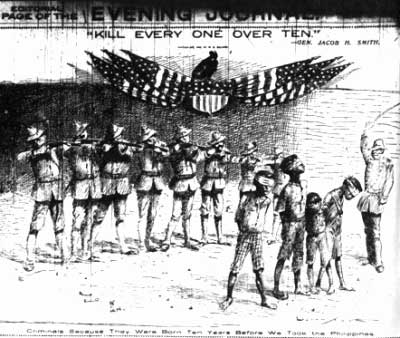
American forces took three bells from the Catholic church of Balangiga town on the eastern island of Samar in 1901 as war booty in what historians said was a particularly brutal military operation in the new US colony.
“Give us back those Balangiga bells. They are not yours. They are ours. They belong to the Philippines. They are part of our national heritage,” Duterte said at his annual State of the Nation Address on Monday.
“Those bells are reminders of the gallantry and heroism of our forebears who resisted the American colonizers and sacrificed their lives in the process.”
Two of the bells are installed at a memorial for US war dead in Wyoming, while the third is with US forces in South Korea.
Some US politicians oppose the dismantling of the memorial.
US embassy spokeswoman Molly Koscina gave a non-committal reply on Tuesday to Duterte’s demands.
“We are aware that the bells of Balangiga have deep significance for a number of people, both in the United States and in the Philippines,” she said in an email to AFP.
Duterte on Monday repeated a Filipino account of the campaign that the commanding general, Jacob Smith, ordered Samar be turned into a “howling wilderness” and that all Filipino males aged 10 or above be killed.
A 1902 US court-martial convicted Smith of a minor offence in relation to the Samar campaign, while 39 other Americans were separately found guilty of torturing and shooting Filipino prisoners there, the US Army War College research paper said.
However none of them were jailed, according to the paper.
The then Philippine president Fidel Ramos first sought but failed to recover the bells during a 1998 Washington trip.
Duterte, a self-described socialist, has since his election last year worked to distance Manila from Washington while building closer ties with China and Russia.
The Philippine islands, a Spanish colony for centuries, were ceded to the United States in 1898 at the end of the Spanish-American War. The Philippines gained independence from the Americans in 1946.
Duterte has repeatedly lashed out at the US as ties have frayed, and last Friday vowed he would never visit the “lousy” country despite an earlier invitation extended by US President Donald Trump.
Palestinian killed, 67 injured in Jerusalem clashes
Palestine Information Center – July 22, 2017
 OCCUPIED JERUSALEM – A Palestinian youth was pronounced dead on Saturday evening after he was injured in clashes with the Israeli police in al-Eizariya town in Jerusalem.
A local source reported that Yousuf Kashour, 24, died of a serious injury to the chest.
Violent confrontations erupted on Saturday evening between the Israeli police and the Jerusalemite worshipers protesting at Bab al-Asbat near al-Aqsa Mosque.
The PIC reporter said that the Israeli police attacked worshipers with sound bombs and putrid water, and added that a cordon was later imposed around the scene after large police reinforcements were summoned in a bid to prevent worshipers from performing evening prayer there.
Earlier, 3 Palestinians were injured with rubber bullets in clashes with the Israeli police at Qalandia checkpoint in Jerusalem.
The Palestinian Red Crescent Society announced that its crews treated 67 injuries this evening in Jerusalem.
Head of the Heritage and Manuscripts Department at al-Aqsa Mosque, Radwan Amr, said that the Israeli police assaulted worshipers and started to force them out of the Old City of Jerusalem, describing what is happening at al-Asbat as a “real massacre against a peaceful sit-in”.
Despite the Israeli attacks, hundreds of Palestinians coming from Jerusalem, the West Bank and the 1948 occupied territories protested for the 9th day in a row at Bab al-Asbat and outside the Old City against closing al-Aqsa Mosque and installing metal detectors at its gates.
On 14th July, the Israeli authorities banned Friday prayer at the Mosque following an anti-occupation shooting attack in which two Israeli police officers were killed.
Later, the Old City was closed and prayer was banned at the shrine until further notice for the first time since 1969, and on 16th July, 9 metal detectors were erected at al-Aqsa gates.
Since then, Palestinian worshipers have refused to enter the Mosque through these metal detectors and decided to perform their prayers at its entrances.
Israel imprisons UN official, again – UN’s Guterres says nothing

If Americans Knew | July 17, 2017
Israel arrested Hamdan Temraz, 61, deputy director of the United Nations Department of Safety and Security in Gaza, while he was on his way to a work meeting. Four days later the UN still had not issued a statement about this.
The UN has recently come under increased pressure from the United States and Israel.
US Ambassador to the UN Nikki Haley announced to an adoring AIPAC audience in March that she had pressured the UN to remove an official report showing that Israel was guilty of ‘apartheid.’
All 100 US Senators signed a letter in April noting that the US is the largest single donor to the UN and demanding that the UN end its allegedly unfair treatment of Israel.
On July 14th UN Secretary-General António Guterres issued a statement condemning the killing of two Israeli policeman by three assailants (who were then killed by Israeli forces), announcing: “This incident has the potential to ignite further violence. All must act responsibly to avoid escalation.”
Yet, Secretary-General Guterres issued no such statement two days earlier when Israeli forces invading the Palestinian city of Jenin killed two young Palestinians.
Now the UN Secretary-General is saying nothing about Israel’s imprisonment of a UN official from Gaza as he tried to travel to a meeting.
Richard Silverstein reports in Tikun Olam:
This is getting old. Israel has once again arrested a United Nations official based in Gaza as he attempted to cross into Israel to attend a work meeting there. An Israeli security source has confirmed to me the linked story above and the Shin Bet arrest. The news is under gag order in Israel and no media there may report the story. This conveniently insulates the Israeli public from the news that their supposedly democratic nation has arrested human rights personnel from the most reputable NGO in the world. It also allows the Shin Bet time to build yet another fraudulent case against yet another Palestinian official doing international humanitarian relief work in Gaza.
Since Israelis can’t know this information, I’m going to tell them here. The arrested man is Hamdan Temraz, 61, who is the deputy director of the United Nations Department of Safety and Security (UNDSS) in Gaza. He was arrested at the Erez crossing on July 12th despite having a valid entry permit.
The Palestinian human rights group, al Mezan released this statement to the Palestine Information Center, protesting the latest Israeli outrage:
The Center explained that such Israeli practices are aimed at blocking the work of the international organizations in the Gaza Strip, pointing out that 8 employees working in these organizations have been arrested since the beginning of 2014.
It affirmed that hundreds of employees are denied the permits required to enter or exit Gaza to be able to follow up their organizations’ work, not to mention the Israeli incitement campaigns they are exposed to.
I find it odd that a UN employee has been in an Israeli prison for four days and there has been no statement from the international body. Is this how they come to the defense of their staff when it’s under threat in a police state? I left a phone message with the UN press office seeking a statement, but have not heard from them so far.
It’s no coincidence that last month, Netanyahu called for the UN to dismantle UNWRA, the major relief organizations in Gaza. He appealed directly to U.S. ambassador, David Friedman aka “The Settler’s Friend.” This rehashes a common Israeli narrative in which evil Hamas co-opts everyone and everything to do its dirty terrorist work in the enclave. The U.S. is far the largest donor supporting UNWRA, providing $350-million annually to support the millions of Gazans who are unemployed and undernourished due to the decade-long Israeli siege. Israel hopes that the new Trump regime will realize its ambitions to restrain or suppress the aid work in Gaza, which serves to remind the world of Israel’s ongoing assault against its innocent civilian population.
Last summer, Israel arrested two Palestinians in Gaza. Waheed Borsh worked for the UN Development Program and Mohammed el-Halabi for the Christian relief group, World Vision. Both were accused of exploiting their NGO status to undertake covert activities on behalf of Hamas. In the latter case, el-Halabi was accused of funneling international relief funds to the Islamist group. In every instance, the NGOs undertook full, comprehensive investigations and uncovered no evidence to support the Israeli charges. But since Israel functions as a police state as far as Palestinians are concerned, guilt and conviction were assured. Therefore, in order not to spend decades behind bars, each copped a plea that offered a lesser sentence.
This charade permits Israel to bolster its fake claim that the international relief organizations aren’t that at all–but rather thinly concealed support groups for militant international terrorists. This, in turn, satisfies the Israeli government’s core far-right constituency, which can tell itself how much the world hates us and how justified it is in utilizing maximum force in “defending” itself from enemies lurking virtually everywhere.
So here’s how it will go with Temraz. He will be accused of taking advantage of his position directing security for the UN agency by permitting Hamas to do something that somehow jeopardizes Israeli security. Perhaps he allowed the militants to build tunnels under UN facilities. Perhaps he offered materials to Hamas to build tunnels. Or even better: he provided the fake IDs the Haram al Sharif attackers used to gain entrance to the Muslim holy site. Who knows what they can devise? The thing is, these Shabak agents aren’t very imaginative. Nor do they need to be. No one reviews the cases they bring for credibility. No judge cares to do so. He or she would rapidly find themselves on the road to career oblivion if they did. So any half-assed concoction can send a man away for a decade or more simply because some agent has to make his quota and throw the fear of god into both Palestinians and the relief agencies servicing Gaza. What a seamy mess of a national security regime this is.
U.N. says Gaza is ‘de-developing’ even faster than expected, but omits main cause
By Kathryn Shihadah | If Americans Knew | July 16, 2017
The United Nations has often provided valuable reports on the situation in the Palestinian Occupied Territories (although in at least one case the UN removed such a report following pressure from Israel and the United States – see this, this, and this).
The UN’s latest report on the region, “Gaza Ten Years Later,” contains much valuable, factual information. However, parts of the report exhibit a troubling lack of proportionality. This flaw is then maintained in quoted comments on the UN report by National Public Radio journalist Daniel Estrin.
Below is the NPR news story on the UN report, with comments in Italics that discuss some of its statements:
U.N. Says Gaza Is ‘De-Developing’ Even Faster Than Expected, by Merrit Kennedy, NPR
Five years ago, the U.N. warned that Gaza is expected to be unlivable by 2020. A new report now says conditions are deteriorating there even faster than it forecast.
“What needed to happen has not happened, and the indicators are accelerating instead of slowing down,” Robert Piper, the U.N. Coordinator for Humanitarian Aid and Development Activities in the Occupied Palestinian Territory, told NPR’s Daniel Estrin.
“In a nutshell, Gaza continues to de-develop in front of our eyes,” Piper adds. “From health care, to unemployment, to energy, to access to water, across all of these fields, Gaza’s 2 million people are seeing faster and faster decline in their living conditions.”
The population of Gaza, a 130-square-mile strip of land on the Mediterranean, is growing faster than projected, while infrastructure and services haven’t been able to keep up. The population is now forecast to reach 2.2 million people in 2020, up from the 2012 projection of 2.13 million.
The UN report, and the NPR discussion, correctly highlight the rapid pace at which Gaza is moving toward humanitarian disaster. However, as the discourse continues, a moral equivalence fallacy begins to emerge. Daniel lists three sources of Gaza’s trouble:
“Many of the problems stem from the Hamas takeover of Gaza 10 years ago, Israel and Egypt’s blockade of Gaza and the Palestinian Authority’s recent reduction of electricity to Gaza to pressure its rival Hamas,” Daniel reports.
What’s wrong with this picture?
Undoubtedly, Hamas’ feud with the PA is part of the problem; so are the electricity shortage and the closed crossing to Egypt. But placing these factors on par with Israel’s now ten-year-long blockade ignores the facts—some of which are spelled out in the UN report:
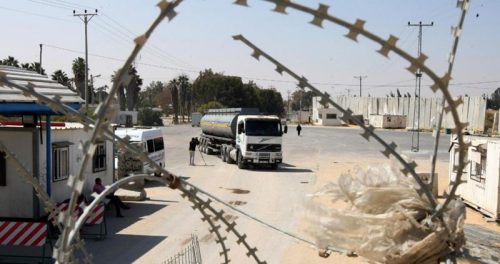
Israel retains full control of all movement of people and goods to and from Gaza by sea, air and land, with the exception of a 12 km strip of border with Egypt…Following the expulsion of the PA by Hamas in the summer of 2007, the Israeli Government declared Gaza “hostile territory” and, again citing security concerns, announced a number of new sanctions and restrictions on the access and movement of people and goods, ultimately amounting to a blockade by sea, air and land. Many of the restrictions imposed then, are still in place. (Italics added)
It is worth taking a moment to discuss the question of Hamas, which continues to be a scapegoat for Gaza’s ongoing crisis. Hamas’ complicated rivalry with, and appropriation of power from, Fatah and the PA–and its reputation as a terrorist organization–need to be challenged.
Hamas won a democratic election in Gaza and the West Bank (in spite of the US spending $2.3 million to support Fatah and Israeli obstruction), and was promptly discredited by the US and the EU. Israel commenced sanctions only 3 days after the election. These reactions were nothing short of collective punishment by world superpowers, simply because the “wrong” party won. The charge that Hamas is nothing but a terrorist group, and Palestinians elected Hamas leaders to destroy Israel, shows a profound misunderstanding of Hamas and its rise to power.
Neve Gordon explained in this excellent 2006 article that “the organization’s popularity in the Occupied Territories actually stems from its being seen as the voice of Palestinian dignity and the symbol of the defense of Palestinian rights at a time of unprecedented hardship, humiliation, and despair…In other words, Hamas was elected not only because it is considered an alternative to the corrupt Palestinian Authority, but also because Israel created the conditions that made it an indispensable social movement.”
Back to the de-development of Gaza. In his discussion of the Gaza crisis, Daniel also neglects to mention the three assaults by Israel in 2008, 2012, and 2014. The UN report does mention them, but the description is problematic:
In addition to the impact of the violent Hamas takeover and ensuing Israeli measures imposed in 2007, three rounds of armed hostilities between Israel and Hamas – with the most devastating round in 2014 – have dealt repeated blows to the Gazan economy and damaged essential infrastructure.
These words may be technically accurate: yes, Hamas took over Gaza amid violence; yes, Israel imposed “measures” in 2007; yes, there have been three rounds of “armed hostilities”—but the statement is egregiously inequitable. It is absurd to suggest that the Hamas takeover was equally as damaging to Gaza as the three deadly assaults by Israel were. And the portrayal of the hostilities as though between two equal, evenly-matched armies when Israel has the latest weaponry and Gaza is essentially unarmed, is patently false. Here is a more precise description of the lopsided outcome of the hostilities, found further along in the UN report:
The first major round of hostilities broke out on 27 December 2008 and lasted for more than three weeks. During this time, nearly 1,400 Palestinians and 13 Israelis18 were killed and some 60,000 homes were damaged or destroyed…The second major escalation of hostilities began on 14 November 2012 and lasted for one week, in which 174 Palestinians, including 107 civilians, and six Israelis, of which three were civilians, were killed, and some 10,000 homes damaged. The latest, and most devastating round of hostilities, took place between 8 July and 26 August 2014. During these 51 days, 2,251 Palestinians, including at least 146 civilians, and 71 Israelis, of whom five were civilians, were killed, and 171,000 homes were damaged.
The death toll after three “rounds of hostilities” was 3,825 Palestinians and 90 Israelis. The total number of homes damaged was 241,000—all Palestinian. In addition, schools, hospitals, and power plants were decimated. This is not a description of the aftermath of “war,” but of blitzkrieg.
The NPR story goes on to mention in passing Israel’s regulation of the border—without acknowledging the seriousness of the closure and how it affects any attempts at reconstruction. He even equates Israel’s meddling with Egyptian actions, although Egypt shares only a 7-mile border vs. Israel’s which is 32 miles long and a much greater object of hostility. Here is the statement:
Israel maintains tight control over the movement of people and goods from all sides of Gaza, aside from the 7-mile-long border Gaza shares with Egypt, which is rarely open.
The UN report describes more fully the impact the closure is having on efforts to rebuild over the last three years. This is not just “tight control”—it is crippling restriction on building materials and other critical supplies:
[Restrictions] imposed on the Strip continue to significantly impact the daily lives of Gaza’s inhabitants and the efforts of the international community to implement humanitarian and development projects. Israel considers many materials needed for these projects to be ‘dual-use’ and posing security concerns, thus subjecting them to severe import restrictions. These include construction materials, raw material for the productive sectors, including wood and pesticides, medical equipment and water pumps necessary to deal with seasonal flooding.
It is worth noting that Israeli limitation of imports included (in 2010, and is mostly still in place) wood for construction, cement, iron, tarps (for roofs on huts), fishing rods, farm animals, many spare parts for farming equipment, notebooks, pens, pencils, and toys.
The NPR report then moves on to the topic of water:
By the end of 2017, the U.N. projects Gaza’s only water aquifer will be depleted. The damage could be irreversible by 2020 due to salt water entering the aquifer. That would be “catastrophic,” the report says, and the “living and health conditions of the people of Gaza can only further deteriorate, exposing the population to water-borne illnesses, and other threats.”
The U.N. had previously said that the aquifer would be depleted by 2016, earlier than the current projection. Piper says this small piece of positive news is more akin to “re-arranging the deck chairs on the Titanic than really having much to celebrate.”
This is objectively true—although the image of “deck chairs on the Titanic” makes the Gaza situation sound more like a movie trailer than a humanitarian crisis. Let’s add some detail from the UN report to shed light on the reality:
Access to safe drinking water in Gaza through the public water network plummeted [after 2000]…As a result, reliance on water tanks, containers and bottled water rose from 1.4% to 89.6%…Having to rely on water trucking comes at a high cost on consumers, as trucked water is 15-20 times more expensive than water from the network. This particularly impacts the most vulnerable who are often poor and unemployed and do not have access to piped network water. Trucked water is also unregulated and unreliable in terms of quality.
This gives us a clearer picture of not only the expense but also the continued risk posed as the public water network becomes unusable. People of Gaza pay a premium for water that may or may not be safe.
Israel has an obligation to the people of Gaza which should be part of any conversation about the crisis. A number of prominent human rights organizations have determined that whether Gaza is considered occupied, in armed conflict with Israel, or under Israel’s control, international law demands that Israel solve the water crisis.
NPR then moves on to waste water, describing the nightmare scenario that is happening today:
At the same time, the amount of poorly treated sewage dumped into the sea is increasing, now equivalent to 43 Olympic size pools daily. That is expected to increase by almost 10 percent by 2020, which could have “significant environmental consequences,” the report warns.
The U.N. says new water treatment facilities need to be constructed to address the water crisis. However, Israel is limiting imports on many of the materials needed for construction because it says they could be used for military purposes.
Electricity is another critical need in Gaza. The NPR report continues:
And any future new [sewage treatment] plants would require a steady electrical supply, which at the moment is highly uncertain.
In fact, “an 11-year-old child has not experienced more than 12 hours of electricity in a single day in his/her lifetime,” according to the report. It says that in the most pessimistic 2020 estimate, only 25 percent of Gaza’s electricity demand would be met.
The economy of Gaza, its employment figures, and health care provisions are also notable. NPR reports:
The economy in Gaza has significantly declined in the last decade, with per capita GDP decreasing by 5.3 percent between 2006 and 2016. The report describes Gaza’s economic trajectory as “de-development,” even as the occupied West Bank has seen 48.5 percent growth in per capita GDP between 2006 and 2016.
Gaza’s unemployment rate is at more than 40 percent, according to the latest figures. It’s particularly severe for 20-24 year olds, at 60.3 percent, and for women, at 64.4 percent.
The number of doctors, nurses and hospital beds has also not been able to keep pace with the growing population. The report says, “while the population has doubled since 2000, the number of functioning primary health care clinics has decreased from 56 to 49.”
Given these “unacceptable” conditions, Piper acknowledges that for some, Gaza would already be deemed unlivable. “For many of us, we’d say that threshold is well and truly passed,” he said. “How do you manage in these sorts of conditions?”
In the report, Piper states: “It is profoundly unjust and inhuman to put Gaza’s civilians through such an ordeal.” He calls them “the victims of various policies by many different actors.”
When there is a victim, there is also a perpetrator. Gaza’s often goes almost unnamed. We must not forget who it is or rest until the humanitarian crisis is averted.
But at least NPR reported on the humanitarian crisis in Gaza, unlike most other mainstream news organizations, including the New York Times, ABC, CBS, NBC, CNN, MSNBC and Fox News.
RELATED:
On 50th Anniversary of Israeli Occupation, Palestinian Opinions Largely Ignored
The Illusion of Balance: NPR’s coverage of Mideast deaths doesn’t match reality
Israel Once Again Reveals Its Disdain for Freedom of the Press
By Richard Hardigan | CounterPunch | July 14, 2017
When Akran Natsheh, a reporter for the Al Quds satellite channel, arrived at his office in Hebron in the morning of Thursday, July 13, he found that several of the doors had been pried open. Shards of wood were everywhere, and papers were strewn about on the floor. It certainly looked like an ordinary robbery, but then he found that several of his hard drives had been removed. His suspicions about the perpetrators were confirmed when one of his co-workers showed him the note he found posted on the front door by the Israeli army. It indicated that the offices had been stormed because “Al Quds serves an illegal organization.”
Natsheh looked at me with exasperation. “What does that even mean?” he complained. “When another news organization was raided, they were told it was because of incitement to violence.”
Israeli Prime Minister Benjamin Netanyahu regularly claims that Israel is the only true democracy in the Middle East, but its commitment to one of democracy’s fundamental tenets – freedom of an independent press – leaves a great deal to be desired.
Mada, the Palestinian Center for Media and Development Freedoms, is an organization that monitors violations in the Palestinian Territories by both the Israeli government and the Palestinian Authority. For example, it states in its annual 2017 report that while “2016 witnessed a relatively significant decrease in total number of violations monitored against media freedoms in Palestine compared to 2015,” there will still 383 violations, including “the murder of a media student at Al-Quds University … by Israeli Occupation Forces, [the] injuring and arresting of dozens of Palestinian journalists, [and the] raiding, confiscating and sabotaging [of] media outlets including the shutdown of 12 Palestinian media outlets and printing houses.”
When I asked Natsheh about the value of the items destroyed by the soldiers, he shrugged.
“Maybe $2000, but the money is not the important part. It is more about the psychological effect. I can buy new hard drives and new doors.” He paused to reflect.
This kind of attack causes self-censorship. Your work becomes something frightening. The challenge becomes bigger and bigger. They may storm this office next week and arrest me, or harass me in the field. Two years ago they shot at journalists during clashes, and so they became afraid to cover them.”
But Natsheh vowed to continue his work.
“We are journalists. We are not inciters. Our mission is to deliver the truth about what happens in Palestine to our audience. This is the mission of all journalists around the world. We all have the same mission, the same values, the same journalistic ethis. If they have anything against any organization, why don’t they go to court? They don’t. They go directly to destroy. If they had a strong narrative, they would not do that. But they don’t. We are just journalists. We just say what we see … You say something they don’t like, and they shut you down. This is the Occupation.”
Richard Hardigan is a university professor based in California. He is currently writing a book entitled “The Other Side of the Wall” based on his experience in the Occupied Territories.
Saudi’s Qatif in Mourning after Regime Killed Four Political Detainees
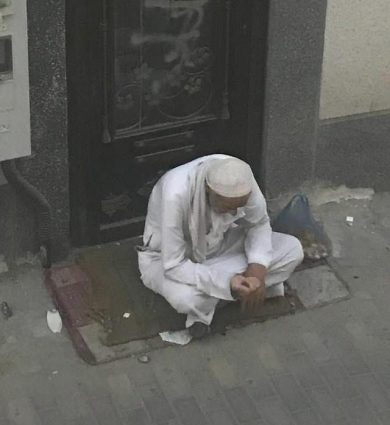
Father of Saudi martyr Yousef Ali Abdullah al-Mishaikhesh, after being informed of his son’s execution.
Al-Manar | July 12, 2017
Saudi Arabia’s Qatif region is in mourning on Wednesday after the ruling regime announced a day earlier it had executed four people over allegations of “conducting terror activities”.
The Saudi Interior Ministry claims that the four, who were executed in Qatif Governorate in Eastern Province, had attacked police stations and petrol officers.
The ministry identified the four men as Zaher Abdulraheem Hussein al-Basri, Yousef Ali Abdullah al-Mishaikhesh, Mahdi Mohammed Hasan al-Sayegh, and Amjad Naji Hasan Al Moaibed.
The Shia-dominated Eastern Province, particularly the Qatif region, has been the scene of peaceful demonstrations since February 2011. Protesters, complaining of marginalization in the Sunni-ruled kingdom, have been demanding reforms, freedom of expression, the release of political prisoners, and an end to economic and religious discrimination against the oil-rich region.
However, the government has responded to the protests with a heavy-handed crackdown, but the rallies have intensified since January 2016 when Saudi Arabia executed respected Shia cleric, Sheikh Nimr al-Nimr, an outspoken critic of the policies of the Riyadh regime.
Saudi Arabia has one of the world’s highest rates of execution. Rights groups last month expressed concern that 14 Saudi Shia individuals face execution for protest-related crimes.
The Saudis Are Bombing Their Own People And Nobody’s Talking About it
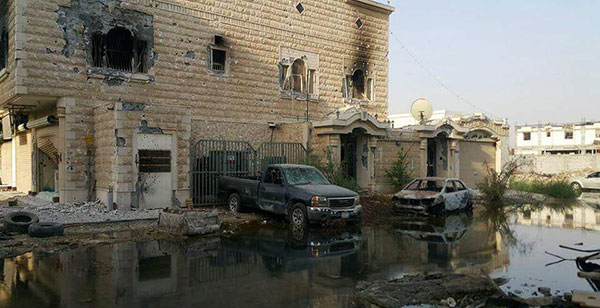
Geopolitics Alert | July 8, 2017
For the past 60 days, the Saudis have imposed a devastating siege on the Shiite town of Awamiya. And of course, mainstream western media remains silent.
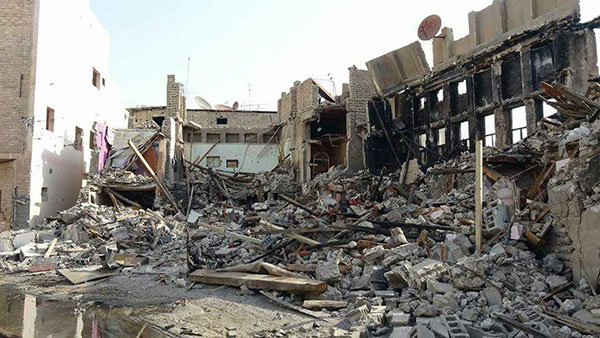
These photos aren’t from Yemen, they’re from the Saudi Arabian eastern town of Awamiya. Where Saudi forces are waging war against an oppressed shia minority. Saudi Arabia adheres to the extreme fundamentalist and intolerant sect of Wahhabism. Making it the country’s religious majority. This ideology is also enforced through state tactics. Which make it illegal to publicly carry out any religious practice or teaching that conflicts with Wahhabism. Even other Muslims (especially Shiites) are considered infidels by the Saudi government. And thus, all religious minorities in Saudi Arabia remain an extremely oppressed group; often lacking the same health care, public services, and wages granted to their Wahhabi counterparts; if not facing death.
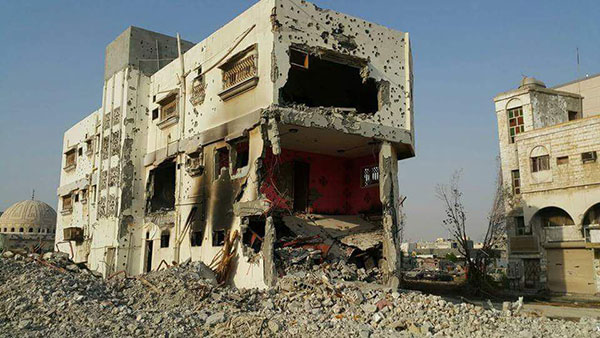
While the majority of Saudi citizens adhere to Wahhabi principles, many towns in the eastern province of Qatif– like Awamiya– hold a Shia majority. Where they’ve been essentially doomed to live in “ghettos” as second class citizens. But the Saudi oppression of Shiites and other religious minorities goes way beyond just economic devastation. In fact for the past two months Saudi forces have held Awamiya under siege, destroyed buildings with bombs and shelling, and set up barricades to control free movement. This is likely a response to Shia citizens calling for basic human rights.
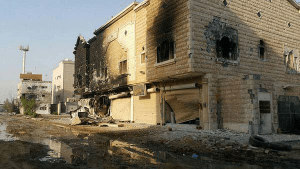
In videos posted to social media, it looks like Saudi security forces are using white phosphorus to drive-out citizens from their homes. Residents also report that Saudi forces are shelling homes and buildings with .50 caliber weapons. In one instance, a building was set on fire and Saudi police refused to allow firetrucks to pass through the barricades.
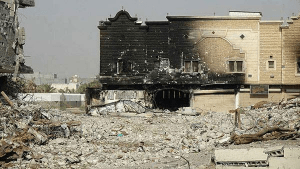
It’s been confirmed that a number of people have died as a result of gunfire. But it’s unclear exactly what the death toll could be since Saudi Arabia severely restricts media access. When the Saudi-run state media are reporting the numbers, they surely can’t be trusted.
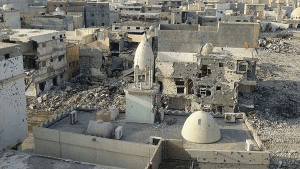
Of course, instead of reporting on the Saudis brutal repression, mainstream media has framed the story (in the few articles available) as though the Saudi security forces are simply clashing with an armed Shiite “militant” uprising. Which ultimately places the Saudi security forces in the “good guy” category just simply trying to keep order.
This however completely whitewashes the fact that the Shiite population in Saudi Arabia has been brutally repressed since the Kingdom’s formation. It also completely ignores the fact that the Saudis are using American-supplied weapons to kill their own people. Which if we look at Syria, this was supposedly the west’s entire reason for their intervention against Bashar al-Assad. “Assad is bombing his own people” the headlines still read to this day.
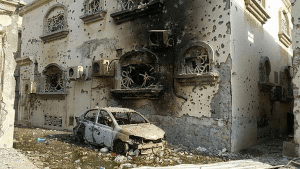
The happenings in Qatif only further demonstrate not only the Saudis’ intolerant disregard for human life, but also their genocidal tendencies as they move further towards an apartheid state within their own borders.
SEE ALSO:
Amid Yemen’s Cholera Outbreak, Saudi Airstrikes Destroy Desalination Plant
Saudis Target Home in Yemen (Again), Killing About a Dozen Civilians
Featured Video
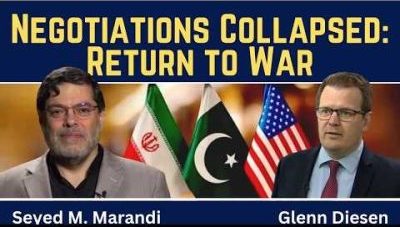
Seyed M. Marandi: Negotiations Collapsed – Return to War
or go to
Aletho News Archives – Video-Images
From the Archives
The US-Iran Scenario That Most Scares Israel
By Ali Haydar | Al-Akhbar | October 9, 2013
Israeli Prime Minister Benjamin Netanyahu issued a series of threats toward Iran and its interlocutors in the West, including the US, as serious negotiations on Iran’s nuclear program seem more plausible.
As a possible rapprochement looms between the US and Iran, Netanyahu has attempted to impose impossible Israeli conditions on the negotiators, such as the full dismantling of Iran’s nuclear program, not to mention threatening military force.
Whatever the deal that could materialize between Iran and the West, Israel is going to find itself before an open-ended path. One can foresee three possible scenarios… continue
Blog Roll
 Aletho News
- Seyed M. Marandi: Negotiations Collapsed – Return to War
- Tomorrow’s naval blockade showdown
- ‘Israel’ attacks civilians to hide its embarrassing military failures & out of pure sadism
- Any Foreign Military Vessel Approaching Hormuz Under Any Pretext ‘Will Be Dealt With Severely’: IRGC
- Diplomats slam US negotiators’ performance in Iran talks
- Trump Refuses Exit Ramp, War with Iran will Continue
- Trump Says US Naval Blockade in Strait of Hormuz Will Begin Shortly
- US, Iran end 21-hour talks without agreement
- US IRAN TALKS: Who Are the Crazy Ones Here? /Lt Col Daniel Davis
- Talks with the US end without a deal over excessive US demands: Iran
- If Americans Knew
- Critical shortages in Gaza, Lebanon in ruins, “piracy” in Iran – Daily Update
- US-Iran ceasefire negotiations make zero progress – Daily Update
- Pro-Israel ‘Thinktanks’ and Individuals who Influence U.S. Foreign Policy
- Mearsheimer reveals how Israel dictates US policies on Iran, Gaza – video
- After killing 350+, Israel still has a “score to settle” with Lebanon before ceasefire – Daily Update
- Military aid to Israel emerges as the latest political litmus test for Democrats
- The only Palestinian children’s rights organization closes following years-long Israeli campaign against it
- ‘I Can’t Forget the Smell’: Lebanese Reel After Israel Kills Over 300 in Single Day
- DNC Shoots Down Resolutions Calling Out AIPAC and Limiting Arms to Israel
- TCN: Is Israel Blackmailing President Trump?
- No Tricks Zone
- Cave Discovery Reveals Today’s Desert Climates Were Recently Far Warmer, Wetter, Teeming With Life
- German Expert: Heat Dome Led To Record Temps In Western USA…Warmer In 1934, 1936
- New Study: No Linear Warming Or Glacier Retreat Along Northern Antarctic Peninsula Since 1980s
- An Inconvenient Tree: Uncovered In Alps… Europe Much Warmer Than Today 6000 Years Ago
- New Study Reports A 60% Slowdown In Greenland’s Ice Loss Rate In The Last Decade
- Low Intensity Tornado Wrecks Major Solar Farm, Creating A Potential Toxic Dump
- New Study Finds Warming Saves Lives…Cold Temperatures 12 Times More Deadly Than Excess Heat
- German Science Blog Accuses PIK Climate Institute Of Hallucinating Climate Tipping Points
- Devastating Assessment Of Comirnaty Vaccine By Former Senior Pfizer Europe Toxicologist
- New Study: CO2 Is ‘Effectively Negligible’ As An Explanatory Climate Change Factor Since 2000
 Aletho News