The global Zionist organ trafficking conspiracy
By Kit Klarenberg | Al Mayadeen | November 15, 2025
In early October, Israeli-Ukrainian Boris Wolfman was arrested in Russia. He is charged with masterminding a criminal organ trafficking scheme. His capture, wholly ignored by the Western media, raises the prospect that at long last, some justice will be served in a number of major organ trafficking scandals, dating back many years. Wolfman’s apprehension also highlights Tel Aviv’s little-scrutinised role as the world’s centre of illegal organ harvesting and trafficking. Grimly, the Gaza genocide may have greatly facilitated this perverse commerce.
Ever since October 7th, credible allegations have widely circulated that Zionist Occupation Forces are illegally harvesting the organs of slain Palestinians. In November 2023, the Euro-Med Monitor published a report documenting how Israeli soldiers confiscated dozens of corpses from major hospitals in Gaza, to the extent of digging up and raiding mass graves built in their grounds to accommodate the never-ending influx of slaughtered civilians. While some bodies were subsequently handed over to the Red Cross, many were and remain withheld.
Euro-Med Monitor records how many corpses exhibited clear indications of organ harvesting, including missing cochleas and corneas, as well as hearts, kidneys, and livers. Since then, the Zionist entity has released token numbers of murdered Palestinians at intermittent intervals to their surviving relatives. Frequently, the bodies are decomposed beyond recognition, making conducting professional autopsies – and identifying whether organs have been stolen – difficult if not impossible. Sometimes, the corpses are frozen solid, again greatly complicating medical examinations, and potentially obscuring organ theft.
The 1949 Fourth Geneva Convention mandates respect for the dignity of dead civilians, and explicitly prohibits the looting or mutilation of their bodies during wartime. However, the Zionist entity has not only failed to ratify the treaty, but expressly rejects its applicability to Gaza and the illegally-occupied West Bank. Moreover, repulsive local laws and legal precedents unique to Tel Aviv grant authorities the power to refuse to release dead Palestinians to their families.
Their bodies can be used as grisly bargaining chips – or their organs looted with impunity. For decades, the Zionist entity has been the illicit organ trade’s international nucleus. While Palestinians have long-raised alarm over Tel Aviv’s theft of their fallen comrades’ organs, it was not until the early 2000s that the practice was officially admitted. Yehuda Hiss, head of “Israel’s” Abu Kabir Institute, openly boasted of harvesting skin, bones, and other human materials during autopsies. He was never punished, suggesting his macabre activities were state-sanctioned.
This interpretation is amply reinforced by former Institute employee Meira Weiss’ 2014 work Over Their Dead Bodies. She reveals how, during the First Intifada 1987 – 1993, ZOF officials directed the centre “to harvest organs from Palestinians using a military regulation that an autopsy must be conducted on every killed Palestinian.” This gave them free rein to seize whatever they wished from bodies in their care. Institute apparatchiks nostalgically referred to these years as the “good days”, as they could pilfer organs “consistently and freely”.
Disturbingly, the Gaza genocide’s catastrophic death toll may represent the dawning of a new era of “good days” for the Zionist entity’s organ trade. Wolfman’s arrest, and the collapse of the conspiracies he oversaw, are unlikely to dent Tel Aviv’s operations in the field. He was but one player in a world-spanning nexus of Israeli traffickers. In the manner of a hydra, Wolfman’s removal will simply lead to others taking his place. After all, the returns are high, and risks mysteriously low.
‘Organ Broker’
In July 2015, the European Parliament issued a landmark report on organ trafficking. Its introduction notes, “before 2000, the problem of trafficking in human organs…was primarily limited to the Indian subcontinent and Southeast Asia.” However, the report noted that following the turn of the millennium, “trafficking in organs has seemingly started to spread globally, to a large extent driven by Israeli doctors.” The document went on to detail a number of high-profile organ trafficking cases.
In all but one, the evidentiary trail led directly back to the Zionist entity. An accompanying map of international organ trade routes places Tel Aviv at the very core, with its citizens both being leading customers, and heading the gangs that supply organs to overseas buyers. One cited case was the exposure in 2003 of a leading South African hospital performing over 100 illegal transplants on overseas patients – “the majority” from “Israel”.
Local law enforcement uncovered how a criminal syndicate led by well-connected Israeli Ilan Perry recruited poor, desperate individuals from Brazil, Romania, and elsewhere who were willing to sell their organs for a token sum, then transported them to South Africa. Customers would pay vast amounts for the transplants – Perry, the “organ broker”, and his associates would pocket the bulk, with the rest paid to ‘donors’ and hospital staff to perform the illegal procedures, then keep quiet about the connivance.
Another cited case is the Medicus Clinic scandal in Pristina, Kosovo. It erupted in October 2008, when a young Turkish man collapsed at the city’s airport. After a fresh surgical scar was found on his abdomen, he explained his kidney had been removed at the clinic, leading to a police raid. Medicus was already on local law enforcement’s radar due to the profusion of foreigners arriving in Pristina with letters of invitation to the clinic for heart treatment, which Medicus was not known to provide.
Subsequent investigations revealed Israeli Moshe Harel and Turkish doctor Yusuf Sonmez – known as “the world’s most renowned organ trafficker” – were responsible for sourcing clientele, who paid in excess of $100,000 for transplants. The surgeries were primarily conducted by local Kosovo Albanian medical professionals. Patients spent a short period in recovery before being discharged, provided with “information on their treatment to present to doctors in their home countries.” Donors did not enjoy such charity.
As the EU report notes, suppliers were forced to sign documents attesting they were donating their organs “voluntarily to a relative or altruistically to a stranger.” These documents were written in Albanian, and not translated to them. While in some cases they were promised fees of up to $30,000, “a number of them received only part of the money and some nothing at all.” Those given a portion were told they’d get the remainder “on condition that they themselves would recruit other ‘donors’.”
‘Notable Price’
Boris Wolfman was also centrally embroiled in Medicus. While a wanted man in multiple jurisdictions and subject to an Interpol red notice, he remained at large in Turkey for years until his recent deportation to Russia. Incredibly, he kickstarted another organ trafficking venture in the meantime, exploiting vulnerable Kenyans for small sums, selling their kidneys et al. to wealthy buyers from Germany and “Israel” for up to $200,000. As in Kosovo, donors were not given the money promised, or provided with appropriate medical care post-procedure.
It remains to be seen what, if any light, his prosecution will shed on the wider criminal network in which he operated, or whether the Zionist entity might be directly implicated in Wolfman’s venture. Still, that he is facing trial at all is somewhat miraculous. His confederates in the Medicus horror have proven suspiciously impervious to legal repercussions for their monstrous activities. Sonmez likewise lived freely and openly in Turkey for some years after the conspiracy’s unravelling, despite facing criminal charges in multiple countries.
Turkish prosecutors sought to jail him for 171 years, but Sonmez never served a day in prison, and appears to have vanished without a trace. Meanwhile, Harel was arrested by Israeli police in 2012, only to be released. He was nabbed again in Cyprus six years later on an Interpol warrant, but demands from Kosovo authorities he be extradited inexplicably appear to have not been acted upon. Whether the pair’s continuing liberty is indicative of state protection is an open, obvious question.
The Zionist entity’s 21st-century Holocaust in Gaza, and disastrously failed wars against Hezbollah and Iran, have “exacted a notable price” on its finances, Focus Economics has recorded. For example, tourism – once a core component of “Israel’s” income – has shrunk from millions of visitors annually to almost literally zero. “A full recovery could take multiple years and is likely dependent on a permanent end to hostilities with Hamas, Hezbollah and Iran,” the outlet forecasts – fantastically, given the Resistance cannot peacefully coexist with Tel Aviv.
Meanwhile, the Zionist entity continues to suffer mass brain drain, foreign investor flight, diplomatic isolation, and a huge drop in confidence among its largest overseas trading partners. Grotesquely, organ trafficking might represent one of Tel Aviv’s few dependable profit sources at this stage. With thousands of Palestinians both dead and alive in its custody, “Israel” certainly has ample resources to fuel the trade. Mainstream blackout on Wolfman’s long-overdue arrest may indicate the entity’s overseas puppet masters are relaxed about the prospect.
Bowing to Zionist lobby pressure, UK medical regulator hounds British-Palestinian medic

By Maryam Qarehgozlou | Press TV | October 26, 2025
Yielding to pressure from pro-Israel lobbying groups, the UK’s General Medical Council (GMC) has reopened a politically motivated case against British-Palestinian doctor Rahmeh Aladwan over her outspoken criticism of UK-backed Israel’s genocidal war on Gaza.
The renewed proceedings aim to suspend the 31-year-old medic from the UK medical register over social media posts condemning the genocide in Gaza and the complicity of the British government.
The move comes less than a month after the Medical Practitioners Tribunal Service (MPTS) ruled that the complaints against her were not “sufficient to establish that there may be a real risk to patients” and refused to impose any restrictions on her licence.
That September 25 decision had appeared to close the case.
However, under pressure from Zionist lobbying groups — led by the so-called Campaign Against Antisemitism (CAA) and the Jewish Medical Association (UK) — the GMC has now reversed course.
Both groups, backed by Labour Health Secretary Wes Streeting, have spearheaded a smear campaign to punish Dr. Aladwan for her vocal and strong pro-Palestine stance.
For nearly two years, she has been the target of online smears and defamation for exposing Israel’s slaughter of more than 68,000 Palestinians and the near-total destruction of Gaza.
Earlier this month, the CAA escalated its rhetoric, claiming that Aladwan was conducting a “campaign of hatred against British Jews” and threatened to legally challenge the MPTS for clearing her name.
Streeting — who has publicly vowed to overhaul the way medical regulators handle so-called “anti-Semitism” cases — has openly pushed for harsher measures against critics of Israel.
In practice, his proposal would mean prosecuting anyone who denounces the Zionist regime’s genocidal actions.
Investigations by Declassified UK revealed that Streeting received almost £30,000 from Britain’s pro-Israel lobby, and in 2022, he became the first member of Keir Starmer’s shadow cabinet to visit the Israeli-occupied territories — in a move designed to signal a break with former Labour leader Jeremy Corbyn’s pro-Palestine position.
Under this political pressure, a GMC case examiner compiled a new dossier of Aladwan’s social-media posts from late September to early October and referred her again to the Interim Orders Tribunal (IOT).
The CAA quickly boasted that its legal threat had forced the regulator to act.
At Thursday’s hearing, the MPTS agreed to convene a second tribunal — a move that could ultimately strip Dr. Aladwan, a National Health Service (NHS) doctor with seven years of service, of her right to practice medicine in the country where she grew up.
Speaking before the hearing, Dr. Aladwan told reporters she had been “summoned by what is now more accurately called the Genocide Medical Council.”
“It is only four weeks since I was summoned here for exactly these allegations, it is my social media postings, it is my support for the Palestinians to resist under international law,” she said.
“Mostly really, it’s the GMC buckling to the pressure of the Israeli lobby and the MPs such as Wesley Streeting who are funded by them and who are making comments.”
She described the ordeal as a coordinated effort to silence voices of dissent.
“There’s been a huge media smear campaign, corruption, and collusions between all these institutions that have been subverted by the Israeli lobby to just take my license away or silence me.”
Inside the tribunal, Aladwan was even denied the right to address the panel directly. Representing the GMC, Emma Gilsenan said that only her legal representative could pose questions — a privilege she had been granted in the earlier hearing.
Her counsel, Kevin Saunders, instructed by Zillur Rahman of Rahman Lowe Solicitors, denounced the proceedings as a response to “external pressure.”
He highlighted Streeting’s public condemnation of the previous tribunal’s ruling, calling it “an attempt to undermine the rule of law and the determination of an independent body.”
Saunders pointed out that the 12-page dossier presented by the GMC contained nothing new to justify reopening the case.
He stressed that Aladwan’s social media posts were separate from her clinical practice, which has been exemplary, noting that she was expressing solidarity with her own people under siege.
No evidence has ever shown that her posts affected patient safety or her duties as a doctor, he said.
When Saunders requested a stay of proceedings on grounds of “abuse of process,” the tribunal rejected the motion.
‘Surrender to political pressure’
On Friday, after the second tribunal, Dr. Aladwan took to X (formerly Twitter) to condemn what she described as the MPTS’s “surrender to political pressure.”
“They chose to trample on their own ruling from the 25th of September and allow the GMC to resubmit the same evidence—effectively perverting our British legal system on behalf of the ‘Israeli’ Jewish lobby and their funded MP Streeting,” she wrote.
“If a foreign lobby can force our panels to backtrack on a ruling, the finality of British justice is dead.”
She called it “a dark day for Britain,” vowing to continue her fight.
“They picked the wrong British Palestinian. I will fight this — not just for me, but for our sovereignty and fundamental rights in Britain. If the process is the punishment, then bring it on.”
Ahead of the hearing, she had warned that the GMC was determined to destroy her livelihood “to please its masters in the Israeli lobby.”
“Let’s be clear,” she posted. “A British Jewish or ‘Israeli’ doctor could … bomb hospitals and kill patients in Palestine — and keep their license and freely treat British patients. I’m being persecuted for speech. They would be protected for murder. This is Jewish supremacy.”
By Tuesday, Aladwan revealed that the GMC was now seeking her suspension for being “unrepentant.”
“The first tribunal found no need for any order. Now, the GMC demands suspension because I refused to ‘moderate’ speech that was already deemed acceptable,” she said.
“This is not about safety. It’s about punishment. They are explicitly seeking what the ‘Israeli’ lobby demanded: my removal from practice for my political views. This is the weaponisation of medical regulation. This is political persecution.”
Arrest before tribunal: A ‘political theatre’
Only two days before facing her second tribunal, Aladwan was arrested by British police — a move many saw as part of a broader campaign to silence and intimidate her.
In a video posted on social media, the British-Palestinian doctor could be seen confronting police officers as they informed her she was under arrest for “three malicious communications and one offence of inciting racial hatred.”
According to the officer, the charges stem from Aladwan’s posts on October 7 — marking the second anniversary of Operation Al-Aqsa Flood, the Hamas-led operation launched in response to over seven decades of Israeli apartheid — and from a July 21 speech at a pro-Palestine rally outside the Foreign Office, where police claimed she had called for “the eradication of Israel.”
Aladwan, who in her posts described the historic resistance operation as the day Israel was “humiliated,” immediately challenged the officer’s motives.
“You are doing this for the Israeli Jewish lobby so you can get an arrest on me before my tribunal on Thursday,” she said in the video. “This is what the UK does to its doctors.”
After her release, Aladwan denounced the arrest as “political theatre, not policing.”
In a detailed social media post, she described harsh and degrading conditions during her detention — denied water for six hours, refused essential medication, left in a freezing cell without a blanket, and isolated with a broken intercom.
“These are not standard procedures. They are punitive measures,” she wrote.
Aladwan also revealed the political motive behind the arrest.
“An officer explicitly informed me the police would be ‘reporting the arrest to the GMC.’ This is a non-reportable event. This admission reveals the direct channel of communication between the police and my regulator,” she said.
She further noted that the arrest was part of a coordinated campaign of intimidation aimed at influencing the medical tribunal and shaping public perception.
“It reveals a seamless network: lobby groups, politicians (Streeting), police, regulator (GMC),” she wrote. “They are not following due process. They are executing a strategy. Our British institutions have become enforcement tools for a foreign, hostile agenda—for the Israeli Jewish lobby—and the entire world can see it.”
Her post ended with a defiant declaration: “Free Britain and Palestine from Jewish supremacy (Zionism).”
Later, Aladwan published her bail conditions, which she said were a form of “house arrest.”
She is banned from attending any public event or protest related to Palestine or the Israeli regime in London, placed under curfew at a specified address, and required to notify police if she leaves home for more than 48 hours.
‘Losing grip over the narrative’
The arrest sparked outrage among pro-Palestine activists and supporters online, who harshly criticized British authorities for weaponizing law enforcement to suppress dissent.
A social media activist, Thomas Keith, wrote that the state’s reaction only exposes its weakness.
“The irony is that every time they try to silence a Rahmeh Aladwan, they just spotlight the hollowness of their so-called freedoms,” he said. “The more aggressive and coordinated the repression, the more obvious it is that the state is panicking, losing its grip over the narrative as more and more people refuse to look away from Gaza.”
“What you’re seeing is Britain showing the world it’s still an empire at heart, propping up colonialism abroad and silencing dissent at home. The cost of speaking the truth has never been higher, but the mask is off, and more people than ever see exactly who benefits from the machinery of state repression.”
Ellen Kriesels, another user on X, highlighted the hypocrisy of reopening a cleared case under lobby pressure and condemned the GMC’s renewed action as a blatant act of political persecution.
“This doctor was cleared by a tribunal three weeks ago. Now she is going back there on Thursday after intense media and political pressure at the behest of pro-Israel lobby groups. No new material. Political persecution is what this is. Shame on the GMC,” she wrote.
Aladwan herself has long maintained that silence is complicity. After her first tribunal in September, she posted a message urging others to resist fear and speak truth.
“We must operate without fear. We must name the root cause and identify the criminals. Palestinians are bravely resisting with their lives. The least we can do is resist with our words, uphold the principles of liberation (thawabet), and speak the full truth.”
She condemned Zionist supremacist structures behind the ongoing genocide in Gaza and the extermination of Palestinians across the occupied territories.
“The Jewish lobby and Jewish supremacists need to have some shame,” she wrote. “While Palestinians are being kidnapped, tortured, murdered, starved, raped, and burned alive by Israeli Jews, they continue to play victim and cry over our words and activism that are rooted in justice, morality, and humanity.”
In her message, she made clear what this struggle is really about.
“This is not about Jewish feelings or tears. This is about genocide caused by Jewish supremacy, extremism, and unadulterated terrorism.”
Tommy Robinson’s HUMILIATING Israel Propaganda Trip
Glenn Greenwald | October 23, 2025
This is a clip from our show SYSTEM UPDATE, now airing every weeknight at 7pm ET on Rumble. You can watch the full episode for FREE here: https://rumble.com/v70nbcm-tuckers-tp…
Lufthansa announces 100+ route cuts
RT | October 20, 2025
Rising German aviation taxes and fees will force national flag carrier Lufthansa to cut about 100 domestic flights from its forthcoming summer schedule, the company’s chief executive, Carsten Spohr has said.
Government-imposed costs for airlines in Germany have roughly doubled over the past six years, he explained.
“Without a reduction in location costs, further cuts will be unavoidable,” Spohr said. “This involves around 100 domestic flights per week, which could be eliminated again next summer.”
Higher taxes and fees on economy ticket costs are accelerating a shift in the airline’s passenger mix towards first, business, and premium economy cabins.
The complaints from Lufthansa echo long-standing grievances from airline executives about Germany’s aviation cost base, which they argue hinders competitiveness.
Last month Lufthansa also announced plans to cut 4,000 administrative jobs by 2030, with the majority of the cuts taking place in Germany.
In the face of strikes, delayed aircraft deliveries, and underperformance at its mainline business, Lufthansa has been forced to slash its financial guidance twice in the last year and has missed medium-term margin targets set in 2021.
The German aviation industry association (BDL) has warned that the country’s viability as a global hub is in crisis, citing state-imposed costs since 2019. Airlines are now avoiding Germany, BDL Chairman Jens Bischof stated in August, with the number of aircraft stationed in the country by European point-to-point carriers falling from 190 to 130.
BDL estimates that the financial burden on the industry will rise by €1.1 billion ($1.2 billion) in 2025 to €4.4 billion, which will result in the loss of 10,000 jobs and €4 billion ($4.3 billion) in annual economic value.
Gaza officials formally accuse Israel of organ theft, demand international probe
The Cradle | October 18, 2025
Gaza’s Government Media Office formally accused Israel on 17 October of stealing organs from Palestinians after Israel returned 120 mutilated bodies following the recent ceasefire, including some who had been tortured to death.
“We formally accuse the Israeli army of stealing organs from the martyrs,” stated Dr. Ismail al-Thawabta, Director General of the Media Office, while demanding an international investigation into Israel’s “torture, mutilation, and organ theft.”
The 120 bodies “arrived in extremely poor and distressing condition,” including blindfolded, bound, crushed under tanks, and missing corneas, livers, and limbs, Thawabta stated.
“The Israeli occupation executed many of them in cold blood. A large number were found blindfolded, with their hands and feet bound, and others showed signs of hanging or close-range gunfire,” he added.
“We also found bodies showing clear evidence of severe torture until death.”
Thawabta explained that Israeli authorities refused to provide the names of the victims, making it extremely difficult for authorities in Gaza to identify them.
After the release of the bodies, families of missing Palestinians rushed to hospitals—especially Nasser Hospital—trying to see if their relatives were among them. But many remain unidentified and will have to be buried anonymously.
“The health system in Gaza is almost completely collapsed. We lack the equipment for DNA testing and forensic analysis. Some families could only identify their loved ones from personal belongings or clothing. If we cannot identify the rest, we will be forced, sadly, to document and bury them anonymously, to preserve human dignity,” Thawabta added.
According to the Media Office’s data, 9,500 Palestinians remain missing, most of them trapped under the rubble of destroyed buildings.
“Entire families—father, mother, children—remain buried for nearly two years,” the Media Office director stated.
The bodies are difficult to locate due to the sheer amount of destruction Israeli bombing has caused, and because Israel has destroyed almost all of Gaza’s heavy machinery, bulldozers, and excavators, preventing rescue operations.
“Even now, despite the ceasefire, all crossings remain closed, and Israel blocks the entry of rescue machinery. This is a humanitarian catastrophe unprecedented in modern history—over 3,000 families completely wiped out, another 6,000 families killed with only one survivor,” Thawabta added.
Authorities in Gaza have reported previous instances of organ theft during the genocide.
In August 2024, Israeli forces returned to Khan Yunis the decomposed bodies of 89 Palestinians in a shipping container.
Authorities were unable to identify the bodies and were forced to bury them in separate body bags in a single large grave near Nasser Hospital.
Israeli forces were also seen taking dozens of bodies from graves and the streets surrounding Al-Shifa Medical Complex and the Indonesian Hospital in the northern Gaza Strip.
Doctors found evidence of organ theft, including missing cochleas and corneas, as well as other vital organs like livers, kidneys, and hearts.
Israel has a long history of stealing the organs of Palestinians.
In 1990, Dr. Hatem Abu Ghazaleh, former chief health official for the West Bank, stated that during the first intifada, “organs, especially eyes and kidneys, were removed from the bodies during the first year or year and a half.”
In 2013, Swedish journalist Donald Bostrom published an article documenting the theft of organs from deceased Palestinians brought to the Israeli National Institute of Forensic Medicine (Abu Kabir) between the First Intifada and the 2012 war in Gaza.
Abu Kabir director and chief pathologist Dr. Yehuda Hiss admitted in a July 2000 interview with US academic Nancy Scheper-Hughes that the institute was secretly taking skin, bones, cardiac valves, corneas, and other human materials from bodies during autopsies.
He described removing not only corneas but whole eyeballs from the bodies of the dead, which would be returned to their families with their eyelids glued shut.
In 1996, Rabbi Yitzhak Ginsburgh, an influential leader within the fundamentalist Jewish group, Chabad-Lubavitch, claimed that Judaism permits organ theft from non-Jews on the basis that Jewish lives are more important than non-Jewish lives.
“If a Jew needs a liver,” he asked, “can you take the liver of an innocent non-Jew passing by to save him? The Torah would probably permit that. Jewish life has infinite value. There is something infinitely more holy and unique about Jewish life than non-Jewish life.”
The Met police chief proves he’s as dishonest and racist as the force he leads
By Jonathan Cook | October 4, 2025
Sir Mark Rowley claims he is worried about rising ‘community tensions’. But the only tensions he cares about are those belonging to an imaginary community he has created of a Jewish hive mind
Once again, the BBC laps up outright disinformation from Sir Mark Rowley, police commissioner of the institutionally racist and corrupt Met. Watch this short clip from the BBC News at Ten last night:
1. Rowley demands supporters of Palestine Action cancel or delay their protest today, after the Manchester synagogue attack, because the timing appears “antisemitic”.
How to untangle this nonsense?
a) The only possible way to interpret Rowley’s argument is that he believes every British Jew identifies and supports Israel’s mass slaughter of children in Gaza and therefore, out of respect for their grief at the Manchester attack, we ought not to protest against the slaughter in Gaza. That undoubtedly makes Rowley the antisemitic one.
b) Even were his deeply antisemitic idea true – that British Jews are an unthinking herd of genocidal monsters – Rowley assumes that we ought to be okay with this: we should just keep quiet about Israel murdering 100 or so Palestinians every day in Gaza, and starving and ethnically cleansing the rest of the population, because it would supposedly offend Britain’s Jewish community to do otherwise.
c) Rowley wants the protesters to take a time-out of a few weeks, even while Israel refuses to take any time-out on murdering Palestinians. Nor is the British government taking a time-out in arming Israel and providing it with intelligence to carry out the genocide. Rowley is suggesting we should simply quieten down for the next few weeks, even as 100 Palestinians are killed each day, before heading back to the streets. He thereby sends an unequivocal message that Palestinian life is worthless – and he does it while claiming we are the racist ones.
2. Rowley claims he wants this weekend’s protests stopped because of the danger they will raise “community tensions, which is my concern”.
And yet from everything he says, the only community’s “tensions” he appears to care about are those of an imaginary one he has created of a Jewish hive mind.
What about the tensions of Palestinian communities, of wider Muslim and Arab communities, of human communities, of those parts of the Jewish community opposed to Israel’s slaughter in Gaza, produced by watching children being torn to shreds by bombs Britain is helping to supply to Israel, by seeing world citizens – including British citizens – being abducted in international waters by Israel as they try to break Israel’s illegal starvation-siege of Gaza?
Does Rowley care about these communities and their tensions, tensions that will only heighten if they are denied their long-established democratic rights to go out on to the streets to protest – rights that have already been aggressively whittled away by successive British governments?
3. Rowley says he finds it “bewildering” why more than 1,000 people would want to get arrested for “supporting a terrorist organisation” – and berates them for taking up police resources at a time when those resources are needed elsewhere.
And yet, Rowley knows there is nothing “bewildering” about their protests. These thousands of British citizens, and millions behind them who are less courageous, are prepared to risk jail, and damage their careers and their futures, with a “terrorism” conviction. They are prepared to do so because they believe the proscription of Palestine Action – the first such proscription in British history for a direct-action group following in the tradition of the Suffragettes – is an assault on our fundamental right to protest, and to protest against the criminality of our own institutions, in this case institutions actively supporting a genocide in Gaza.
If Rowley does not believe he has the resources to arrest the 1,000-plus people who will be sitting quietly in Parliament Square today holding placards opposing the genocide, then he can simply let them be. The sky will not fall in. No one will get hurt. There will be no threat to either public or national security.
The true danger – the danger that Rowley and the government of Sir Keir Starmer really worry about – is that ever more people are beginning to understand that we are ruled by a gang of authoritarian, genocide-assisting criminals.
Will California Zionise K-12 Education?
By Rick Sterling | Global Research | October 2, 2025
Factual information about Israel and Palestine may soon be outlawed in the California K-12 school system. Assembly Bill 715 is currently on Governor Newsom’s desk. The legislation was recently rushed through the California legislature, amended just days before passage, and voted on at 1 a.m. with almost no time for public comment.
The hurry is intentional because opposition grows whenever people learn about it. AB715 is opposed by educators across the spectrum, including the California Teachers Association, California Faculty Association, Association of School Board Administrators, California School Boards Association, and Council of UC Faculty Associations. Civil rights organizations, such as ACLU Action, also oppose the legislation.
What It Purports to Do
Assembly Bill 715 aims to “prevent antisemitism.” It asserts, “Jewish and Israeli pupils are facing a widespread surge in antisemitic discrimination, harassment, and bullying. In many cases, such discrimination, harassment, and bullying has been so severe and pervasive that it has placed Jewish pupils at risk, or completely impeded their ability to learn or engage in school programs or activities.”
The Anti-Defamation League (ADL) is the main source for the claim that there is a “widespread surge” in antisemitism. Their accuracy is widely disputed. As the Jewish Currents publication reports, “A line-by-line reassessment of the organization’s data illuminates the flaws in its methodology.”
There is already protection in the California Education Code for genuine cases of discrimination or bullying. Section 220 of the code specifies that “No person shall be subjected to discrimination on the basis of disability, gender, gender identity, gender expression, nationality, race or ethnicity, religion, sexual orientation, or any other characteristic that is contained in the definition of hate crimes.” Through their ethnicity and religion, Jewish students are clearly a protected group. So are Israeli students. They can file claims of discrimination under existing legislation.
What It Will Actually Do
AB715 aims to expand the definition of “discrimination” and outlaw any textbook, instructional material, or course content that “would subject a pupil to unlawful discrimination.”
But what is “unlawful discrimination”? AB715 specifies that the U.S. National Strategy to Counter Antisemitism is the basis for identifying antisemitism. That report asserts, “Jewish students and educators are targeted for derision and exclusion on college campuses, often because of their real or perceived views about the State of Israel. When Jews are targeted because of their beliefs or their identity, when Israel is singled out because of anti-Jewish hatred, that is antisemitism.” The document claims, “an unshakeable commitment to the State of Israel’s right to exist, its legitimacy, and its security. In addition, we recognize and celebrate the deep historical, religious, cultural, and other ties many American Jews and other Americans have to Israel.”
The U.S. National Strategy to Counter Antisemitism embraces the controversial “working definition” of antisemitism advanced by the International Holocaust Remembrance Alliance (IHRA). This definition has been widely criticized for its conflation of antisemitism with anti-zionism and criticism of the State of Israel. Over 100 human rights and civil society organizations reject the IHRA definition. Yet this is the definition which AB715 is based on.
If passed, AB715 will result in strict regulation of education and educational material that might subject Jewish students to “unlawful discrimination”. Facts and informed opinions about the reality in Israel and Palestine may be considered “antisemitic” or likely to cause discomfort. For example, students will not learn:
- The International Criminal Court has issued an arrest warrant for Israeli PM Netanyahu charging him with crimes against humanity.
- The International Association of Genocide Scholars determined that Israel is committing genocide in Gaza.
- Human Rights Watch, Amnesty International and Israel’s B’Tselem have ALL independently investigated and determined that Israel is an apartheid state.
- The greatest scientist of the 20th century, Albert Einstein, was against the creation a Jewish state and sought a binational Arab Jewish state in Palestine.
- In 1948, Einstein, Hanna Arendt, and other Jewish leaders denounced Menachim Begin as a Nazi and fascist.
- The Israeli newspaper Haaretz documents a Jewish scholar who was zionist but now supports Hamas and considers their armed resistance legitimate and legal.
All of the above are facts and assessments by credible organizations and individuals. AB715 is so vague yet sweeping that such education about Israel and Palestine may be considered “unlawful discrimination” against a pro-Israel student and therefore prohibited.
The Costs of AB715
If passed, AB715 will cost Californians dearly. It mandates the creation of a new Office of Civil Rights with an Antisemitism Prevention Coordinator and staff producing regular reports, investigations, etc. Incredibly, AB715 allows any member of the public to file a complaint, even anonymously. These complaints must be investigated and responded to within time requirements. School boards and superintendents, already busy, will have to spend precious time and resources investigating each and every complaint in a timely manner. The predictable result will be fear or prohibition on saying anything about Israel or Palestine. The Antisemitism Prevention Coordinator is also mandated to provide antisemitism education to teachers, administrators, and school boards.
Under California’s “Golden State Plan to Counter Antisemitism,” millions of dollars are appropriated for education about the genocide which ended 80 years ago. Meanwhile, there is no funding and it appears the California legislature seeks to prevent education about the genocide happening today in Gaza.
Making it even worse, AB715 invites lawsuits which will further burden the education system. The legislation says, “Civil law remedies, including but not limited to injunctions, restraining orders, or other remedies, may also be available to complainants.” Under AB715, as a gift for zionist activists, any member of the public can be a complainant.
AB715 Should Not Be Signed into Law
The organizations representing California teachers, adminstrators, school superintendents and school boards are ALL against this legislation. AB715 will be costly, wasteful, and damaging to K-12 education in California. Where there are genuine cases of discrimination or bullying, existing legislation is adequate. All students are protected against discrimination or bullying under section 220 of the California Education Code. Where Jewish or Israeli students have been victimized, they have the same recourse as all students. They do not need preferential treatment.
Teaching facts and expert opinions about Israel and Palestine is not antisemitic. It is history and current events.
Feeling uncomfortable when learning some facts or opinions is not being a victim; it is being educated. People can disagree and have different perceptions; they should not be prevented from hearing facts and different perspectives.
The intent of AB715 is clear: to restrict factual information about an important region of the world and to punish educators who present the Palestinian and anti-zionist Jewish perspective. Governor Newsom should not sign the legislation. To encourage him to make the right decision, contact him via this link.
This legislation does not prevent antisemitism; it actually promotes it by demonstrating that major Jewish organizations and the Jewish Legislative Caucus have the power to push this legislation which will deny the history and current reality of the Palestinian people. Meanwhile, Jewish Voice for Peace and organizations across the education profession are working hard to stop this assault on the California education system.
Infiltration: A Cardinal Function of the Zionist Movement
By David Miller | MintPress News | September 16, 2025
What is the function of the Zionist movement? Let’s start with four statements that together define what the Zionist movement does by adding its functions cumulatively.
The Zionist movement creates and sustains the “Israel lobby” to extend its ideological and political reach, shaping both foreign and domestic policy in the countries where it operates. It provides material support for ethnic cleansing and genocide, funneling millions each year through charities that aid in land theft and war crimes. It grooms children and youth into ideological loyalists through a vast network of schools, synagogues, youth groups and settler recruitment programs, including Birthright tours, the Masa journey and the Lone Soldier Program. Beyond all this, the movement systematically dispatches its adherents into broader society as lifelong agents of Zionist ideology. This is not a metaphor. It is infiltration.
This concept of infiltration extends beyond the traditional intelligence model of recruiting agents for covert missions—though that, too, remains part of it. It also involves utilizing individuals who are, in a sense, sleeper agents, ready to be activated.
But it is more than that in the sense that, in many cases, the sleepers don’t need an actual tap on the shoulder to partake in a particular mission. They are already primed to act when the interests of the so-called Jewish state are threatened, or even merely imagined to be.
They are primed by their often decades-long experience of radicalization and grooming to become believing ideological Zionists. In other words, this is a multifaceted and profound level of infiltration cultivated from childhood and reinforced throughout every stage of life.
To understand how such a system came into being, we must examine the origins and evolution of the Zionist movement itself.
The Zionist movement
Even the most hardline Zionists and the most revolutionary socialists agree on one point: before 1948, the Zionist movement functioned as a coordinated political force. It organized and executed the Nakba—the ethnic cleansing and mass displacement of Palestinians—in order to establish what it called the state of Israel. Zionists, of course, reject this terminology, but the historical record is clear.
With its primary objective achieved in 1948, the movement briefly considered dissolving. However, at the World Zionist Congress in Jerusalem in 1951, delegates chose to continue and redefine new goals for the future.
This led to the creation of the “Jerusalem Program,” which formally codified the movement’s new objectives. Alongside it, the Israeli parliament enacted the World Zionist Organization–Jewish Agency (Status) Law to govern the relationship between the “state of Israel” and the Zionist movement. That law remains in effect today, shaping the global Zionist movement’s operations and responsibilities.
1951 Congress
At the World Zionist Congress held in Jerusalem on Sept. 24, 1951, the movement faced a crossroads. With the founding of the state of Israel three years earlier, delegates debated whether the Zionist movement had fulfilled its purpose and should dissolve or reconstitute itself with new goals. In practice, by a vote of 286 to 0, with the remaining 438 delegates abstaining, the Congress resolved to continue its proceedings.
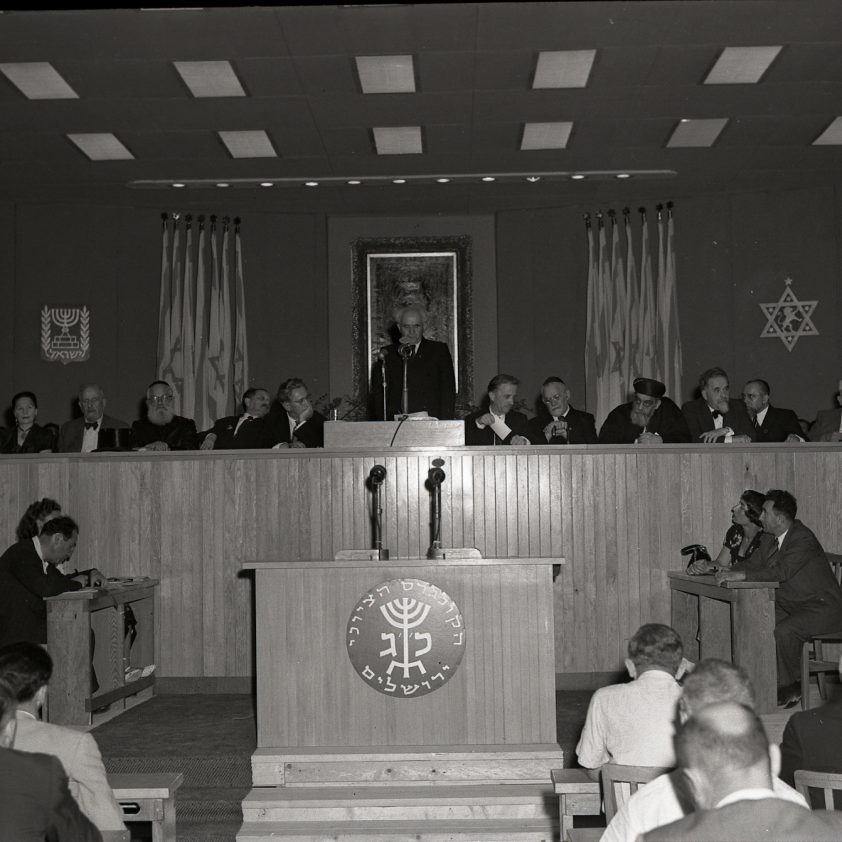
David Ben Gurion speaks at the 1951 World Zionist Congress, 13 August 1951. Source | Wikimedia Commons
It adopted a new set of objectives to reorient the movement. These were defined as: the strengthening of the state of Israel, the ingathering of the exiles in Eretz Yisrael, and the fostering of the unity of the Jewish people.
This moment marked the transformation of Zionism from a settler-colonial movement into a global ideological infrastructure. It was no longer just about building a state; it was about embedding that state into the hearts, minds, and institutions of Jews worldwide.
The status of the Zionist movement
The law passed by the Knesset to formalize the relationship between the Zionist movement and the state of Israel spelled out the obligations of both parties. It designated the World Zionist Organization as the authorized body responsible for developing and settling the land, absorbing immigrants from the diaspora, and coordinating the work of Jewish institutions operating within Israel.
Crucially, the law affirmed that the state of Israel “expects the cooperation of all Jews, as individuals and groups, in building up the State.” It further stipulated that the World Zionist Organization “requires full cooperation and coordination on its part with the state of Israel and its Government, in accordance with the laws of the State.” To that end, the law mandated the creation of a formal committee to coordinate activities between the Israeli government and the Zionist movement’s executive leadership.
In other words, the state of Israel and the World Zionist Organization, as a matter of law, are required to work together, and, also as expressed in law, both bodies expect the cooperation of “all Jews.” The extent to which this expectation is met remains an empirical question.
First established at the 1951 Zionist Congress and enacted in 1953, the Jerusalem Program laid out the operational aims of the World Zionist Organization. This foundational document was later revised in 1968 and again in 2004 to reflect the movement’s evolving priorities. These revisions formalized a series of ideological commitments still in effect today, collectively referred to as the “foundations of Zionism.”
Among these are the preservation of Jewish unity and its enduring bond to Eretz Yisrael, as well as the centrality of the state of Israel, specifically Jerusalem, in Jewish national life. The program affirms support for mass aliyah from all countries and the absorption of Jewish immigrants into Israeli society. It calls for strengthening Israel as a Jewish, Zionist, and democratic state; promoting Jewish, Hebrew, and Zionist education to preserve the distinctiveness of the Jewish people; and defending the rights of Jews globally while combating antisemitism. Most revealingly, it asserts that “settling the country” remains a core expression of practical Zionism.
These principles are intended to guide Zionist activity both within Israel and throughout the world. To make the role of individual Zionists abroad absolutely clear, the movement later published a separate guide detailing their personal responsibilities outside of occupied Palestine.
Duties of the individual Zionist
The duties of the individual Zionist were first codified in a 1972 policy document “approved at the 28th Zionist Congress.” They were later adopted as an integral part of the resolutions of the 29th Congress in 1978. The resolution outlined personal obligations derived from the Jerusalem Program and from formal membership in a Zionist organization.
Among these duties was the call to make aliyah—that is, to become a settler colonist in occupied Palestine. Others included joining local Zionist federations or affiliated groups, actively promoting the movement’s ideological program, and ensuring children received Zionist, Hebrew and Jewish education designed to reinforce loyalty to Israel. Zionists were also expected to donate financially through established channels such as Keren Hayesod, the Jewish National Fund or their local branches, in order to consolidate Israel’s economy and fund its expansionist aims.
With the exception of physically becoming a settler colonist, all of these duties amount to an explicit call for infiltration of host societies. Perhaps the most direct duty, however, is “to strengthen Zionist influence within the community.” This likely refers to the “Jewish community” rather than broader society. Even so, it is still a call to expand the influence of Zionism on society as a whole.
One might reasonably ask how much attention ordinary Zionists pay to such calls. Are these dry, dead words, left to gather dust in the Central Zionist Archives in Al Quds? Or do they still animate the central activities of the movement today? Let us take a look.
Here is a 1961 report from the Jewish Chronicle about a Zionist meeting in Glasgow, which came to hand as I was writing this. I present it as an example of the movement’s thinking and practical activities. The meeting was specifically designed as an educational Zionist event and expounded a particular set of ideas.

A Zionist Federation meeting in Glasgow, reported in the Jewish Chronicle, Oct. 20, 1961, p. 14
The measures which would have to be taken if children in the Diaspora were to remain Jews were discussed by Professor Ernst Simon, of the Hebrew University, when he gave an address at a meeting held in the Central Hotel last week in connection with the Zionist Federation’s Education Fortnight. Mr. Edward Woolfson, President of the Glasgow Zionist Federation, was in the chair. Outlining a practical programme for bringing up children as Jews, Dr. Simon declared that this would have to start with the education of expectant Jewish mothers and fathers at child guidance clinics. As a result, children from their earliest years would be reared in an atmosphere where they would see all the symbols and customs of Jewish life observed. This would then be followed by the children being sent to a Jewish or Hebrew Kindergarten, and then to a Jewish day school. Another important part in the programme, Dr. Simon went on, would be the creation of a Jewish resurgence…
In this view, Zionist education required that children remain Jewish, making “Jewish education” crucial for the movement. A 1961 report reflected this, the year before the British Zionist Federation founded Scotland’s first and only Jewish school, Calderwood Lodge. Is that commitment to inculcating Zionism still present today?
A lifelong commitment to the genocidal ideology
It certainly is. Although Calderwood Lodge was taken over by the local authority in 1982, it remains a Zionist school today. It collaborates with the United Jewish Israel Appeal (UJIA), Maccabi, Mitzvah Day, the Scottish Jewish Youth Alliance (SJYA) and other Zionist groups. (The SJYA is itself a collaboration between Glasgow Maccabi and UJIA Scotland, both Zionist organizations.) The school also marks Israeli Independence Day (Yom Ha’atzmaut) and the “liberation” of Jerusalem (Yom Yerushalayim)—their term for the illegal occupation of East Jerusalem in 1967.
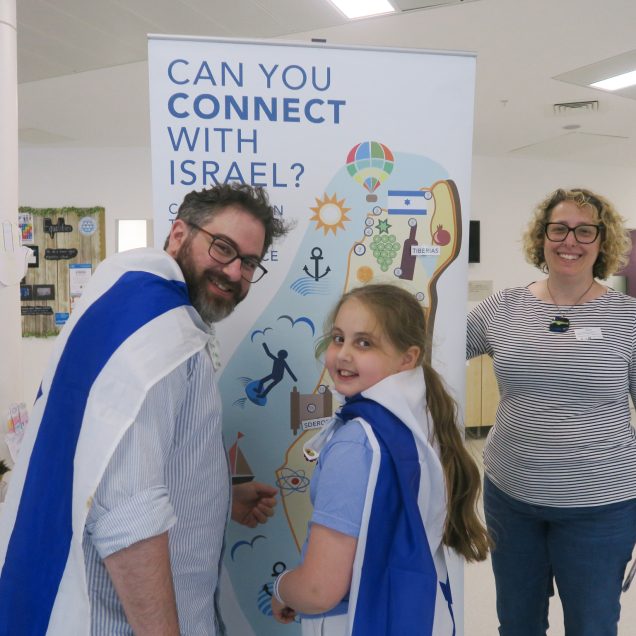
Celebrating the creation of the Zionist entity in Calderwood Primary School, 2025, with Shayna Conn (right) of the Scottish Jewish Youth Alliance. Source | Facebook | Jewish Telegraph
The UJIA is the U.K. outpost of one of Israel’s four “national institutions,” established to create and sustain the state of Israel. It serves as the U.K. affiliate of Keren Hayesod, which raises funds to finance settlement in Palestine. In its 2018–19 annual report, UJIA described its mission as developing a “lifelong connection” between Israel and the “diaspora” community, beginning with children as young as four. Of 12 school programs run by UJIA, nine are in primary schools, reaching thousands of pupils.
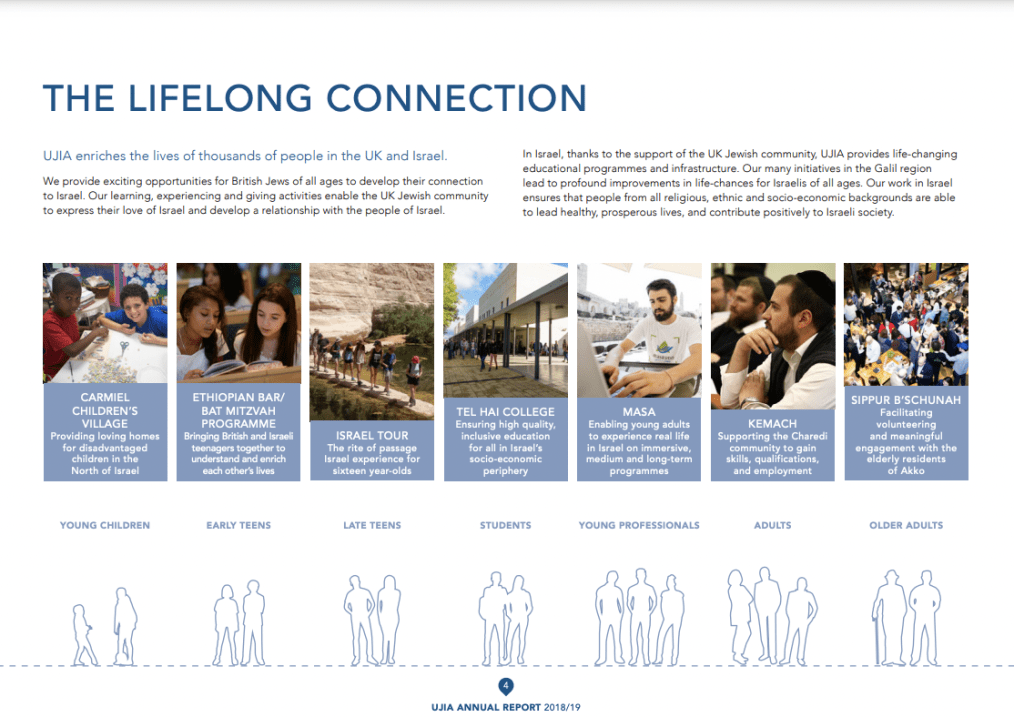
From A Lifetime of Connection: UJIA Annual Report 2018-19. Source | United Jewish Israel Appeal

“Strong British Jewry with a lifelong commitment to Israel.” Source | United Jewish Israel Appeal
Does it work?
Varying statistics suggest that between 60% and 90% of British Jews—or perhaps more—identify as some form of Zionist.
Research by Pew in the United States in 2021 found that “eight in ten U.S. Jews say caring about Israel is an essential or important part of what being Jewish means to them. Nearly six in ten say they personally feel an emotional attachment to Israel.” In the United Kingdom, a 2024 study by the Institute for Jewish Policy Research reported that “73% say they feel very or somewhat attached to the country. However, the proportion identifying as ‘Zionists’ has fallen from 72% to 63% over the past decade.”
Ultra-Zionists often claim that even more Jews identify as Zionist. For example, the so-called Campaign Against Antisemitism conducted a survey in late 2023 that produced even higher figures. It reportedly “revealed that 97% of British Jews feel ‘personally connected’ to events happening in Israel … 80% of respondents considered themselves to be a Zionist.”
It appears that the activities of the UJIA and the wider Zionist movement are proving effective. Yet after two years of livestreamed genocide, there is also growing unrest and dissent within the Jewish community, particularly among the young. A recent poll cited in the Jewish Chronicle found that “only” 57% of Jews in their twenties “identified with Zionism.”
Nevertheless, the extent of Zionist adherence is still far too large. This means there are Zionists throughout the social structure of most advanced nations, even when the Jewish population is very small, as in the United Kingdom, where it has fallen to 0.4%. In the United States, Jews make up about 2.4% of the population.
The uncomfortable truth is that the Zionist movement urges its adherents to infiltrate the societies where they live and to display their commitment to its racist ideology at every possible turn. As the UJIA examples above show, they encourage a lifelong commitment to Israel. But is that the so-called dual loyalty “trope”—the allegedly racist claim that Jews are more loyal to the state of Israel than to the countries in which they reside?
Only if we say it, if they say it, it’s fine—nothing to see here. As Pat Buchanan once remarked in a debate with Ralph Nader, “dual loyalty would be an improvement.”
The fact remains that the Zionist movement promotes commitment to both the ideology and the practice of Zionism, even when this runs counter to the interests of the host nation. In the case of the state, this is true in most instances. In the case of the citizenry, it is true in all.
Meet the Zionist Infiltrators
Some within the movement consider the term “infiltration” outdated, arguing that it implies a deliberate Zionist strategy. Yet this article has shown that such a strategy does exist. The question, however, is how conscious or deliberate it is. The evidence suggests there are different types of infiltration and different kinds of infiltrators.
We can begin with those directly or indirectly engaged in specific forms of infiltration on behalf of agencies of the Zionist entity. Their activities align more closely with the traditional sense of the term. From there, we turn to those with looser ties to the movement as a whole. In what follows, I outline six types of infiltration.
Direct Service to the Zionist Entity
The most obvious form of infiltration is direct service to the Zionist entity through collaboration with its intelligence agencies. One example is the Ofer family, which breached U.S. sanctions to deliver Mossad agents and weapons for subversion and assassination operations in Iran. Another involves activities linked to Jeffrey Epstein, who gathered sexual kompromat for Israeli intelligence.
Mossad also relies on Sayanim, its informal helpers abroad, most famously Robert Maxwell. Beyond this, thousands of Zionists work with the Israeli Ministry of Diaspora Affairs and its predecessor, the Ministry of Strategic Affairs. Their operations range from propaganda and lobbying to trolling, doxxing and lawfare.
One such network is the Combat Antisemitism Movement, which has nearly 1,000 members and operates in a “joint venture” with Voices of Israel, a company run by the Ministry of Diaspora Affairs. In total, many thousands of Zionist groups are engaged in this form of activity.
Tech Start-ups as a Zionist Strategy
Service is also given directly to the Zionist entity through the creation of tech start-ups founded by former intelligence personnel. This has long been a strategy of Unit 8200, Israel’s signals intelligence agency. Today, there are hundreds of such firms in the tech industry. Some have become widely and controversially known, including Cellebrite, NICE, Toka, and the NSO Group, maker of the Pegasus surveillance product. One online listing of 28 such firms records a combined value of $208 billion.
The covert use of this vast surveillance apparatus by the Zionist regime has been widely noted. Investigative reports also show that significant numbers of Zionist infiltrators—including former occupation forces members, intelligence operatives and others—have secured senior positions across mainstream media and Big Tech. These include Google, Apple, Facebook/Meta, Microsoft, TikTok and more.
Emissaries of the Zionist Project
There is also a civilian equivalent of the Sayanim, known as Shlichim, or emissaries. The Jewish Agency—one of the four pillars of the formal Zionist movement—sends Shlichim from occupied Palestine to build what it calls “living bridges to Israel.” These emissaries are placed in schools, synagogues, JCCs, camps, universities, youth movements and Federations across the globe.
In 2021, the Union of Jewish Students, the Zionist student group in the U.K., reported hosting two Shlichim from the Jewish Agency. The recently revealed diary of Israel’s ambassador to the U.K. even records a “goodbye breakfast” she hosted in July 2024 for Shlichim returning to the Zionist entity after completing their tours of duty.
Other Zionist groups also send emissaries. The World Mizrachi Movement, for example, sent about 300 last year. The Haredi sect Chabad—described by critics as a genocidal cult—uses the same term for its global network of emissaries. According to Chabad itself, “Today, 4,900 Chabad-Lubavitch emissary families, or shluchim, operate 3,500 institutions in 100 countries and territories, with activities in many more.
Zionist Family Networks
Another form of service to the genocide comes through Zionist family networks in the West, particularly via philanthropic giving. Family foundations funnel money to Zionist organizations, all of which effectively encourage genocide.
One example is the many millions donated by Sheldon and Miriam Adelson to pro-Zionist political candidates. “I’m a one-issue person. That issue is Israel,” Adelson said in 2017. In the U.K., millions are given by the Lewis family, which owns River Island, and the Wolfson family, which owns Next, to support the genocide. Their contributions directly fund the occupation forces as well as settlement construction and ethnic cleansing in the West Bank.
Millions more are spent by Zionist family foundations to spread Islamophobia—through the Policy Exchange and the Henry Jackson Society in the U.K., and through the so-called Islamophobia network in the U.S. Additional funds go toward indoctrinating Jewish children through nurseries, schools, youth groups, student groups and “Birthright” tours, which promote the racist belief that Jews have a birthright to steal Palestinian land and kill Palestinian children.
Zionist billionaire families dominate this giving, but many thousands of others also contribute through large and small Zionist charities and causes. In the U.K., there are an estimated 3,000 such organizations, and in the U.S., there are likely more than 10,000. A preliminary compilation of data on U.S. Zionist groups is available here.
Defending Zionism Over the Life Course
The final form of infiltration is tied directly to the Zionist strategy of ensuring that all Jews make an enduring, lifelong commitment to Israel. As this article has shown, this has been central to the Zionist movement since at least 1951 and remains so today. Zionists expect all Jews to act on behalf of Israel whenever called upon—or whenever they perceive Zionist interests to be under threat.
Practically, this means service to Zionism through daily professional, political and social activities, wherever Zionists find themselves: in the media, political parties, business, finance, schools, universities and civil society, including left-wing and so-called “anti-racist” organizations.
In other words, Zionists throughout the social structure are engaged in subversion and infiltration. One example is the Jewish network within the U.K. civil service. Although set up by the civil service itself, it is in practice run by and for Zionists rather than Jews. Similar patterns exist in universities, the media, the legal profession, finance, industry and other institutions across society.
When the time comes for the proverbial tap on the shoulder, how many who have passed through Zionist indoctrination will fail to respond “appropriately”? To ask the question is almost to invite disbelief. In many cases, no tap on the shoulder is even required. Across the BBC, the media, the entertainment world, the civil service, politics, finance and other commanding heights of society, there are Zionists who are ideologically committed. For them, it makes perfect sense to “do the right thing” when the moment arrives.
The fact remains that the Zionist movement encourages loyalty to its ideology and its program of action even when these run counter to the interests of the host state—or, in all cases, to the interests of its citizenry.
Can we trust Zionists?
In the end, no Zionist can be trusted. Do we imagine that they are not also infiltrating the left? The Palestine solidarity movement? The anti-war movement?
Zionism is, at its core, a racist ideology. No matter how hard “liberal,” “socialist,” or “leftist” Zionists try to disguise it, that racism always reveals itself—whether in adopting Zionist positions in their professional lives or in subverting and sabotaging pro-Palestine activism in political life.
This has historically meant that the anti-racist movement and the Palestine solidarity movement have been weak on the question of Zionism. It was a major mistake for the “left” in the U.K. and elsewhere not to confront Zionism head-on earlier. Today, we face a significant struggle to cleanse the left and the anti-imperialist movement of both Zionists and Zionist assumptions—ideas that have seeped out of the movement and into the consciousness of many non-Zionist, or even anti-Zionist, socialist activists.
This process has been underway for many decades. However, this is not the place for a detailed analysis of the Jewish left or of Zionist penetration of the non-Jewish left. A fuller exposition will be needed in another article. For now, it is enough to point to the need for a material and maximalist anti-Zionism.
Infiltration today
The traditional forms of infiltration used by intelligence services continue—covert spies, informers and, in the case of the Zionists, the widespread penetration of the tech industry by alumni of Unit 8200. In addition, the Zionist movement makes extensive use of emissaries, both through the mainstream movement and through more marginal elements such as the Chabad-Lubavitch cult, as we have seen.
But in addition to this—as this article has argued—there is an effort to recruit all Jews into a “lifelong connection” to “Israel.” In practical terms, the movement treats all Jews as potential resources. This is why so much effort is devoted to grooming and radicalization through nurseries, schools, synagogues, youth and student groups, and the wide array of Zionist lobby groups and charities.
They attempt to radicalize Jews such that they will put Israel first wherever they end up in the social structure. And given that Jews are systematically advantaged in the social structure across the West, this has the potential to be a very powerful set of relations. I submit that infiltration is a cardinal principle of the Zionist movement, and it helps to explain how Zionist individuals and ideas are so heavily embedded in political, civil, economic and cultural life in Western nations.
Knowing your enemy is the first step toward defeating them—and toward dislodging Zionism from its entrenched status and role in society.
Professor David Miller is a non-resident Senior Research Fellow at the Centre for Islam and Global Affairs at Istanbul Zaim University and a former Professor of Political Sociology at the University of Bristol. He is a broadcaster, writer and investigative researcher; the producer of the weekly show Palestine Declassified on PressTV; and the co-director of Public Interest Investigations, of which spinwatch.org and powerbase.info are projects. He tweets @Tracking_Power.
Exposing Jewish Exceptionalism In Canadian Media
The misguided belief in eternal Jewish victimhood is being weaponized to help allow Israel’s genocide to continue
By Davide Mastracci ∙ The Maple ∙ September 3, 2025
Over the past decade, I’ve written extensively on the pro-Israel bias in Canadian media. This article will focus on something different, but which helps shape the bias: Jewish exceptionalism.
You can find articles about how various -isms and -phobias impact Canadian media: homophobia, Islamophobia, transphobia, xenophobia, classism, racism, sexism, etc. And yet, there’s little out there on Jewish exceptionalism, which is increasingly being analyzed by commentators outside of the country.
Jewish exceptionalism is the belief that Jewish people as a demographic are eternally and ontologically oppressed, no matter the circumstances, and as such should be treated differently. Jewish exceptionalists refer to antisemitism as the “oldest hatred,” and treat it as though it’s the only one powerful enough to make its targets a permanently marginalized group.
This incorrect analysis fails to take into account the status of Jewish people in Canada and elsewhere over at least the past few decades. While Jews remain the targets of alleged hate crimes (though reports on the issue vastly overstate the reality), they face no systemic discrimination and generally fare exceptionally well in Canada and elsewhere on all other markers used to measure oppression. As a point of comparison, few that anyone would take seriously argue that dozens of churches being burned down in acts of arson since 2021 make Christians an oppressed group in Canada.
This article will illustrate how Jewish exceptionalist sentiment underlies much of the discussion in Canadian media involving Jewish Zionists by outlining five tropes, providing examples of them in mainstream publications and explaining how they smuggle in the idea that Jewish people are exceptional and should be treated as such. The tropes are: ‘Jewish-owned business’; ‘blood libel’; ‘Jewish state’; ‘Jewish neighbourhood’; ‘list of Jews.’
While this article could have been written at any point in recent years, I’ve done so now because Israel, the state claiming to represent Jews and which enjoys widespread support from them according to polling, is committing a genocide in the name of Jewish supremacy, the most explicit form of Jewish exceptionalism. Those who defend Israel and seek to undermine the pro-Palestine movement also utilize arguments that rely on Jewish exceptionalism to do so.
As such, these tropes deserve to be identified and refuted because they strengthen narratives defending the worst atrocity of our time: Israel’s genocide in Gaza.
‘Jewish-Owned Business’
The term “Jewish-owned business” appeared in Canadian newspapers 70 times between Oct. 7, 2023, and Aug. 31, 2025, according to the Canadian Newsstream database. This represents about 78 per cent of the times it had ever been used in Canadian newspapers up to that point.
Since October 7, the term has typically been used in reference to businesses that happen to be owned by Jewish people being targeted by pro-Palestine protesters. Those using the term typically employ the following logic in their articles: 1) the owner of a business is Jewish; 2) their business is being protested or boycotted in some form; 3) the action is happening because the owner is Jewish; 4) therefore, the protests are morally wrong and potentially illegal, and should be condemned.
As an example, a March 2024 editorial in The Globe and Mail erroneously stated as a fact that, “An Indigo bookstore in Toronto was vandalized, because the chain’s founder is Jewish,” and then added, “A democratic country cannot let this stand. And yet it is happening right before our eyes.”
There are genuine historical examples of Jewish businesses being protested or boycotted because of their owners’ religious backgrounds, such as in Nazi Germany, and they have justifiably received widespread condemnation. And yet, despite the explicit comparisons to these examples that commentators will make to generate an emotional response and demonize pro-Palestine protesters, the most high-profile instances of this sort of rhetoric being used in Canadian media have been cases where the owner’s religious identity had nothing to do with the protests and/or boycotts of their business.
In the case of Indigo, as I wrote in October 2024, “the store was targeted because Indigo CEO Heather Reisman is behind the HESEG Foundation, which offers a range of perks to so-called ‘lone soldiers’ who travel to Israel from abroad to join the army.” And as I wrote in October 2023, Café Landwer, an Israeli chain of restaurants, has been boycotted because its co-founder and CEO served in the Israeli military and it opened a location in Jerusalem atop the remains of a Muslim cemetery, among other reasons.
If you revisit the logic I outlined above, and remove the claim the business is being targeted because its owner is Jewish (which is clearly not the case with Indigo and Café Landwer), it breaks down to: the owner is Jewish and therefore their business should not be targeted. The implication here is that it’s OK to target businesses owned by other demographic groups, but not ones owned by Jewish people.
There are cases in Canadian media where this point is made explicitly.
In a March 2024 Toronto Star article, columnist Andrew Phillips writes, “It should have been obvious that an event featuring two such controversial leaders would be targeted by protesters, especially since pro-Palestinian demonstrators have been taking every opportunity to go into the streets and make their views known. And in this case it was a legitimate time and place to protest. They weren’t demonstrating outside a Jewish-owned business, a Jewish community centre, Mount Sinai Hospital or a synagogue in Thornhill, as happened on Sunday. All those should be out of bounds for protests about Israel’s war against Hamas in Gaza and the thousands of civilian deaths it’s caused.”
This is an astonishing claim. Others have made the point a bit more subtly.
Former Liberal MP and now Toronto Star columnist and Friends of Simon Wiesenthal Center CEO Michael Levitt wrote in an October 2023 article: “What Jews are now seeing in Canada is reason for serious concern, including for the safety of their children at schools and universities. It’s the source of tremendous anguish and pain. Anguish and pain from seeing demonstrators converge on Café Landwer in downtown Toronto, calling for a boycott of a Jewish-owned business.”
And in a November 2023 National Post article, Liberal MP Anthony Housefather wrote, “The worst massacre of Jews since the Holocaust somehow unleashed a wave of hate in Canada and around the world. Demonstrations have taken place outside an antisemitism conference in Ottawa, as well as a Jewish community centre in Toronto. Some demonstrators have called for the boycott of a Jewish-owned business.”
In both cases, the authors don’t make an attempt to prove the businesses in question are being boycotted because of their owners’ religious backgrounds, or even make that claim. Instead, the simple fact that a Jewish-owned business is being targeted is portrayed as a problem, with the implication being that doing so is out of bounds because the owner is Jewish.
The fact that antisemitic boycotts of Jewish businesses existed in the past when Jews were an oppressed group is used to imply or state that any boycotts of Jewish-owned businesses now must be hateful as well, despite the fact that the boycotts have nothing to do with the owners’ religious identities. This is Jewish exceptionalism.
‘Blood Libel’
The Holocaust Encyclopedia defines “blood libel” as “the false allegation that Jews used the blood of non-Jewish, usually Christian children, for ritual purposes.”
“Blood libel” appeared in Canadian newspapers 123 times between Oct. 7, 2023, and Aug. 31, 2025, according to the Canadian Newsstream database. I came across just two examples among the 123 of a writer arguing a pro-Palestine commentator invoked what could be interpreted as a version of a blood libel in their writing/speech. (One of them happened to be Norman Finkelstein in 2019.) In the vast majority of cases, the term was used to refer to individuals and/or organizations alleging Israel is committing a genocide in Gaza — allegations that don’t include claims of Israel killing Palestinian children to use their blood for ritual purposes.
Blood libel has a historical definition of which these authors are or should be aware. The discourse pointed to by these authors almost never meets this definition, and they do not make any attempt to prove that it does. And yet, they still wield this accusation.
The writers who use the term “blood libel” will argue I’m being disingenuous here, and that the term now means something else: accusing Jews of anything they’re not guilty of, which leads to Jewish people as a whole facing potential retribution. They are partially correct, as this is how they generally use the term now, though writers don’t note this change in their work when doing so. And yet, the fact that this is the case is actually an example of Jewish exceptionalist thought at work.
“Blood libel” was coined to refer to Jewish people in the Middle Ages — a genuinely oppressed group — being blamed for something of which they weren’t guilty. The term is now used freely by pro-Israel commentators as if nothing has changed since then.
In fact, much has: Jewish people are no longer an oppressed group, and are the beneficiaries of Jewish supremacy in Israel; the allegations made against the Jewish people who make up the vast majority of the Israeli army and political system are credible; the people making these allegations don’t argue the aggressors commit their alleged crimes because they’re Jewish. Despite all of this, “blood libel” is constantly used in Canadian media in an attempt to counter serious allegations against Israel.
National Post comment editor Carson Jerema, for example, wrote in a December 2023 article, “Hamas is using its population as a human shield to blame Israel for civilian deaths and to perpetuate the blood libel that the Jewish state is committing genocide, and the nonsense left is eating it up without question.”
Former Conservative MP and Cabinet member Joe Oliver wrote in a May 2024 National Post article: “Many people buy into the hideous blood libel of genocide of which Israel has been accused since October 7.”
And in a May 2024 article in The Globe and Mail, Noah Richler, the son of Mordechai Richler, wrote, “The blood libel of the Middle Ages makes Israelis in Gaza the deliberate, premeditated mass murderers not just of children and babies but, in the wake of the bombing of a fertility clinic, Jews wilfully slaughtering their enemies even before they are born.”
In calling these charges blood libels (a historic, antisemitic trope), the writers seem to believe it’s antisemitic for people to accuse Israel of genocide — not simply wrong on a factual basis, but inherently antisemitic. They do so because they seem to buy into Jewish exceptionalist thought, where Jewish people are always an oppressed victim group, unable to be oppressors in the way others can be.
I’ve never come across this type of claim in mainstream Canadian publications about another group.
A June 2021 article from The Conversation states, “In addition to the February [2021] motion against China’s treatment of its Uyghur population, Canada recognizes seven other genocides: the Holocaust during the Second World War, the Armenian genocide, the Ukrainian famine genocide (Holodomor), the Rwandan genocide, the Srebrenica massacres, the mass killing of the Yazidi people and the mass murder of the Muslim Rohingya in Myanmar.”
There are groups of people for each of these events who allege they don’t meet the criteria for genocide. But I’ve yet to find mainstream discussion that posits the allegations of genocide are in-and-of themselves hateful against the ethnic/religious group whose members are accused of perpetrating the genocide. For example, I haven’t found articles in any mainstream Canadian outlets alleging that it’s hateful against Russians, Hutus or Turkish people to accuse the states and/or forces purporting to represent them of committing genocide, nor any willingness to treat such claims from the fringes seriously.
As such, Israel is clearly treated as an exceptional state: writers see its Jewishness as making it incapable of genocide, and therefore imply it’s inherently antisemitic to make such an accusation regardless of the clear evidence for it and abundant examples of it being made against forces representing other religious and ethnic groups.
‘Jewish State’
The term “Jewish state” appeared in Canadian newspapers 1,514 times between Oct. 7, 2023, and Aug. 31, 2025, according to the Canadian Newsstream database. A review of these usages in the “commentary” category of articles revealed that the phrase was often used by supporters of Israel defending it against heinous crimes.
This type of usage may be disorienting for some readers, who don’t comprehend why those who support Israel and purport to want to defend Jews everywhere continuously bring up the state’s Jewishness in discussions of its atrocities where it’s not relevant. This would intuitively make sense if done by an antisemite, for example, but why would someone — Jewish or otherwise — who claims to want the best for Jewish people do it?
In some cases, the term is used to imply or outright state that Israel is only being accused of crimes because it’s a “Jewish state.” But as the evidence of Israel’s crimes has mounted, and the term continues to be used, it has become clear that it’s often employed to imply that Israel can’t be guilty of its alleged crimes because it is a “Jewish state,” or that its status as a “Jewish state” makes such allegations ridiculous.
For explicit Jewish supremacists, this implication comes from the belief that Jewish people are superior to others or that Israel’s victims aren’t fully human. For Jewish exceptionalists, it stems from the belief that Jews are eternal victims, and therefore Israel can’t be guilty of the crimes of which it is accused because it is a “Jewish state.”
There are hundreds of examples of “Jewish state” being used in Canadian media.
A November 2023 article from National Post deputy comment editor Jesse Kline uses the term four times, each in a sentence where he responds to Israel being accused of a crime:
- “In reality, Al-Ahli was just a test run, a prelude to a concerted Hamas campaign to falsely accuse the Jewish state of committing war crimes against vulnerable civilians while covering up its own violations of international law”;
- “And the same Hamas run health ministry that perpetrated the Al-Ahli fraud to incite violence against Israelis is now using Israel’s attempts to dismantle those terrorist assets to perpetuate the lie that the Jewish state is committing some sort of ‘genocide’ in Gaza”;
- “It then quoted the director of Shifa Hospital, who claimed Israel was ‘launching a war on Gaza City hospitals,’ and accused the Jewish state of targeting a school (even though Gazan schools have been closed for some time)”;
- “It also accuses Israel of committing war crimes – without, of course, providing any evidence – and calls on the media to use false and inflammatory terms such as ‘apartheid,’ ‘ethnic cleansing’ and ‘genocide’ when describing the Jewish state.”
There’s no apparent reason to use the term at all in the article, much less on four separate occasions. So the fact that it’s used, and the specific manner in which it is, is revealing: it’s employed to cast doubt on the idea that Israel committed the crimes of which it’s accused. And, as my search revealed, it’s not merely some tic Kline has in his writing: there are many other examples.
In a January 2024 Toronto Star article, former Israeli diplomat Daniel Taub wrote, “Far from being motivated by any humanitarian concern for the Palestinians, the South African initiative is a brazen attempt to weaponize a term coined to describe the worst crime committed against the Jewish people themselves and use it against the Jewish state in order to deprive it of the ability to defend itself.”
Avi Benlolo, the founder and CEO of the Abraham Global Peace Initiative, claimed in a January 2025 National Post article, “Trudeau’s criticism of Israel’s military response to Hamas, his government’s ban on arms exports to Israel and his tacit support for legal actions against the Jewish state have emboldened antisemitic rhetoric and actions within Canada.”
And Jay Solomon, the chief advancement officer for Hillel Ontario, claimed in a May 2025 National Post article about the BDS movement: “Let’s be clear: targeting the world’s only Jewish state for economic punishment – especially while ignoring or excusing the abuses of countless other nations – is not a principled stand for justice.”
It’s also worth noting that none of the organizations accusing Israel of genocide or other crimes have alleged its Jewishness makes it more likely of such behaviour. Instead, they’ve analyzed the evidence and come to the conclusion that Israel is guilty of the crime, without any irrelevant reference to the state’s Jewishness.
In essence, the organizations accusing Israel of genocide argue that it’s capable (and guilty) of committing crimes any other sort of state could and/or has. Israel’s defenders are the ones that bring up its Jewishness, and they do so to imply that it makes Israel a victim regardless of the circumstances. This is Jewish exceptionalism.
‘Jewish Neighbourhood’
The term “Jewish neighbourhood” appeared in Canadian newspapers 135 times between Oct. 7, 2023, and Aug. 31, 2025, according to the Canadian Newsstream database.
The phrase ‘x neighbourhood’ is not uncommon in Canadian media. However, the way it’s generally used differs in some important ways from how it’s used when referring to areas with what commentators regard as significant Jewish populations.
Generally, when something is referred to as an “x neighbourhood” it is merely descriptive, referring to the demographic makeup of an area. For example, a February 2025 National Post article refers to the Glen Park area in Toronto as once being a “sleepy Italian neighbourhood,” likely because its ethnic makeup in the 2001 Census was nearly 40 per cent Italian. I’m still not a fan of using this sort of language to describe neighbourhoods or countries, but it’s at least a descriptive statement based on a factual finding.
In contrast, “Jewish neighbourhood” is often used in a manner that goes beyond descriptive usages into prescriptive territory, stating or implying that non-Jewish people (including those who live in the neighbourhood) should behave in a certain way when in the area.
Here are several examples of the term being used in this manner.
In a January 2024 National Post article, Joel Kotkin wrote, “The Liberals also seem to worry as much about Islamophobia as the far more widespread problem of antisemitism, as demonstrated by the recent lawsuit filed by Jewish students at McMaster University alleging that they have been subjected to rising levels of hate. Perhaps sharing in this good cheer, Toronto police even brought coffee to pro-Hamas demonstrators blocking an overpass in a predominantly Jewish neighbourhood.”
In a November 2024 Toronto Sun article, columnist Brian Lilley wrote, “Are Jews being treated differently in Canada? Absolutely, and not in a good way. From local police to the federal government, Jews are clearly not the chosen people of Canadian government officials. […] Last Sunday, as a group of pro-Hamas types gathered at Bathurst St. and Sheppard Ave. W. – a predominantly Jewish neighbourhood – it was a Jew who was arrested.”
And in a December 2024 Toronto Sun article, reporter Joe Warmington wrote, “There was more recognition by police of the concern some Jewish residents, including Councillor James Pasternak, had expressed about pro-Hamas demonstrators aggressively coming into a Jewish neighbourhood disrupting a weekly, peaceful vigil for 100 hostages still held in Gaza.”
In all of these examples, “pro-Hamas” is used to demonize the pro-Palestine protesters in question and portray them as a threat. In doing so, and by highlighting what they perceive as the “Jewish” character of the neighbourhoods in question, the writers imply that it’s a problem for pro-Palestine people to exercise their Charter right to protest in certain areas, simply because more Jewish people may live there than in the average Canadian neighbourhood. And in other examples, it’s sometimes stated or implied that them doing so is the equivalent of Kristallnacht, an absurd comparison that can only be made due to Jewish exceptionalism.
This argument is problematic enough on its own, including when you consider that the areas in question are nowhere near majority Jewish anyways (not that this would make it alright). For example, York Centre, the Toronto ward where Pasternak serves as councillor, was 7.5 per cent Jewish as of 2021 (with larger populations of Filipinos at 13.4 per cent and Italians at 9.1 per cent).
It becomes more disturbing when you consider the demographic makeup of pro-Palestine protests, which, anecdotally, often have a disproportionate share of Arabs relative to Canada’s population. With this in mind, it’s difficult to avoid drawing comparisons to how so-called “Jewish neighbourhoods” in occupied Jerusalem are discussed, with the implication being that force should be used to keep undesirable outsiders away from Jews.
In Jerusalem that looks like attacks from the military and settlers, while in Canada it comes in the form of baseless arrests from police (and sometimes violence from others as well). In Jerusalem, the motivation for this violence is that Jews are entitled to the area and as such it should be cleansed for them, while in Canada the implication is that Jewish people’s supposed eternal status as exceptional victims means extraordinary measures need to be taken to prevent what they see as demographic threats from interacting with them.
To expand on this point, and help demonstrate that it’s not merely some abstract situation, consider the implementation of “bubble zones” in Toronto (which received explicit editorial support from The Globe and Mail on at least two occasions).
In May, Toronto city council passed a by-law allowing for protesters to be barred from being within 50 metres of institutions that successfully apply for the status. While the by-law was framed as being something that could protect people belonging to all communities, in reality it was sought after by the Israel lobby to make protests near some venues that have been linked to Israel illegal.
The first bubble zones were announced in July, and unsurprisingly, 19 of the 21 were centred on Jewish institutions. It’s possible the list may expand to include more institutions from other communities in the future, but as it stands, Toronto’s city council passed a motion that the Canadian Civil Liberties Association referred to as an example of “punitive laws that give municipalities and the police the discretion to broadly restrict peaceful expression,” in effect giving privileged status to Jewish institutions. This happened in part due to the prevalent belief in Jewish exceptionalism.
‘List Of Jews’
In February, I released Find IDF Soldiers, a database based entirely on public information that now contains profiles of 163 Canadians who joined the Israeli military at any point in their lives.
In order for someone to be included in the database, three criteria needed to be met: 1) being Canadian; 2) having served in the Israeli military; 3) having this service already be public.
Every single person on the list thus far is at least partially Jewish, and I haven’t refrained from pointing this out where relevant, including an analysis article presenting my findings on what the typical Canadian Israeli military member looks like.
The fact that the list is entirely Jewish should not be a surprise to anyone. As I wrote on the site: “Jews are the only ones able to immigrate to Israel as citizens due solely to their ethnoreligious background. That accounts for all of the soldiers who were born in Canada and immigrated to Israel later on — they could only do so in the way they did because they’re Jewish. As per the few soldiers in the project who were born and raised in Israel and moved to Canada later, all of them happened to be Jewish. This isn’t a surprise given the demographic makeup of Israel, and the fact that only Jews (74 per cent of the population as of 2023), Druze (just under 2 per cent of the population) and Circassians (0.05 per cent of the population as of 2024) are required to serve in its military.”
As I noted in the analysis article accompanying the database, the average Israeli military member from Canada is a white, Jewish man, born and raised in Canada, who grew up in the Greater Toronto Area in a wealthy neighbourhood, attended private Jewish schools for elementary and/or high school (costing as much as $24,000 per year), had white-collar professionals as parents, and chose to become a lone soldier. This is generally an incredibly privileged group of people willingly deciding to join the Israeli military.
And yet, despite all of this, much of the criticism the project received in mainstream media and elsewhere revolved around the false claim that I was somehow reviving Nazi-era tactics against Jews.
For example, a February National Post article contained a quote from one of the military members saying, “I think there’s a pretty dark historical precedent for making lists of Jews. That’s what it immediately reminded me of, a database of Jews.”
A March article from The Canadian Jewish News (CJN), meanwhile, contained multiple quotes to this effect. Another one of the Israeli military members, speaking on the project, said, “It was literally a list of Jews. That’s all it was. Good for you, you put a list of Jews together. That’s what you did. Like the SS.” Later, CJN stated the member said there was “never a good reason to make a list of Jews,” and then quoted them saying, “There’s a very dark history with that. People think it’s only the Holocaust—it’s not only the Holocaust…It was during the Spanish Inquisition, it was any time there was a need to round up Jews, lists were made. So Jews and lists—not a good thing.”
The article also quoted a professor of journalism at Toronto Metropolitan University and a former senior CBC News producer who said the project is “ethical, if abhorrent,” adding, “It’s ethical because it’s deemed to be in the public interest in some quarters. But it’s abhorrent because we’ve seen where lists of Jews have led in the past.”
There are many more examples of this sort of framing being used when discussing the project in international media, which I have compiled. They include headlines such as, “There’s a New ‘Jew List’ in Canada,” “Repackaging of Nazi-era tactics in a modern context” and “‘We Know What Jew Lists Mean’: Canadian Database of IDF Soldiers Sparks Alarm in Jewish Community.”
This whole saga is an incredibly straightforward example of Jewish exceptionalism. People cynically or genuinely alleged that a journalist creating a database of mostly privileged people on the basis of their participation in the Israeli military for journalistic purposes was in any way comparable to the Nazis compiling information on a systemically oppressed group based solely on their ethnoreligious identity with the intent to harm them.
The fact that this allegation has been taken seriously instead of being mocked is only possible thanks to the widespread belief in Jewish exceptionalism among Canada’s media class.
There are various reasons why writers may believe in Jewish exceptionalism and cling on to it in their writing.
A group of former Jewish-school students I spoke with earlier this year recounted being “brainwashed” with the idea of Jewish exceptionalism throughout their time in the institutions.
For some, Israel’s actions may have finally become too abhorrent to attempt to defend with any sort of logic or facts, and so a reliance on a non-material analysis that doesn’t need any correspondence with the real world can be useful.
Some non-Jewish commentators claim to be wracked with a sense of guilt for a time when systemic antisemitism did actually exist, and operate accordingly.
Others may be concerned about the personal consequences of stepping outside the Jewish exceptionalist framework, which applies to a much broader section of the political spectrum than many would like to admit.
Regardless of the reason, the effect of Jewish exceptionalism is to strengthen Zionist arguments and weaken the pro-Palestine movement by getting it to treat Israel’s genocide of Palestinians and alleged antisemitism as if they’re equally dangerous and urgent problems.
They aren’t. The paranoid spectre of antisemitism is being cynically weaponized to help allow the genocide to continue unabated, and it’s doing the people of Gaza a disservice to pretend otherwise.
Tom Barrack’s imperial tantrum in Beirut: When entitlement speaks
By Tala Alayli | Al Mayadeen | August 26, 2025
Thomas Barrack, Washington’s special envoy, breezed into Beirut today oozing of the usual arrogance, condescension, and the smug self-righteousness that American officials have long mistaken for diplomacy. In what he must have thought was a moment of wit, Barrack dismissed the Lebanese press as “uncivilized,” even likening journalists’ actions to those of animals.
It is telling, of course, that the representative of a country responsible for the post-1991 siege that killed half a million Iraqi children, which former US Secretary of State Madeleine Albright described as “worth it”, turning Afghanistan into an endless graveyard, and underwriting the daily massacres in Gaza, would accuse others of lacking civility.
American officials seem to have mastered this peculiar art: bombing entire nations by morning, then lecturing those nations on decorum by afternoon.
Barrack’s performance is not a slip of the tongue, but a look into the imperial psyche. To him, like most of Western society, Lebanon is not a sovereign country with a free press and a tradition of political debate; it is a space to be managed, where we are expected to smile politely while being lectured on democracy and modernity. Arabs are not clever, competent, and equal human beings, but mindless herd societies that must be subjugated.
And what is civility either way? Surely not the baby-killing machine in Gaza, which has been endlessly praised by the United States, the same administration calling us animalistic. Perhaps the definition must be de-Americanized to make sense.
Besides, it is almost comical that Thomas Barrack, a man who once found himself charged with embezzlement and caged in his house on arrest in the United States with a monitor chained to his ankle, now parades around Lebanon as a moral authority. This is the same envoy whose career has been shadowed by allegations of corruption and shady financial dealings.
If anything, Barrack’s legal entanglements reveal a pattern: entitlement is not just a political habit for American officials, it is a personal one. He walks into Lebanon not as a humbled man marked by scandal, but as an imperial messenger who believes that his past sins are irrelevant, that he is owed respect simply because he carries Washington’s seal.
The irony is maddening: an envoy representing an empire that thrives on plunder, brutality, and deceit, scolding journalists for their supposed lack of manners.
Then leave!
Perhaps the most infuriating was Barrack’s sense of self-importance. “Do you think this is fun for us? Do you think it is economically beneficial for Morgan and I to be here, putting up with this insanity? If that’s not how you’d like to operate, we’re gone.”
Does Barrack think it is fun for us to sit and witness his condescension? Or watch “Israel” obliterate our homes with US-made weapons? Or listen to American-Israeli discourse about how to make the region more agreeable to those who want to overtake our resources, our lands, our lives?
Also, if billions in military aid to the mega-maniacal occupiers is economically beneficial, then surely a trip to Beirut at the US’s own discretion is not a bank-shatterer.
If journalists doing their jobs was slightly too overwhelming for a diplomat who is certainly used to press conferences as such, then said diplomat must rethink his competence.
And if decorum and mutual respect are an overload of work, then leave!
What is it about humiliation?
Yet what is most shameful is not only Barrack’s insult. Such condescension is expected from American envoys. His companion, Morgan Ortagus, once strutted into the Baabda Palace and cheerfully applauded the terrorist pager operation that left thousands of citizens, including children, wounded and blind. “Israel”-born Amos Hochstein once got his afternoon coffee from a Starbucks at a moment of peak boycott and gladly allowed a desperate Lebanese bourgeois citizen to pay.
Equally shameful is the silence that followed. A room full of journalists, veterans of a region where press freedom is under constant attack, sat in silence. Not one voice rose to challenge him.
The Lebanese press corps prides itself on resilience. In a country where journalists have been assassinated, bombed, and silenced, surviving in the profession is no small feat. Yet resilience without dignity is hollow.
What good is endurance if it does not sharpen your spine? What meaning does the word “journalist” carry if you cannot call power to account, especially when that power spits in your face?
Thomas Barrack was a temporary guest; he’s on our land, in our home. When the Trump administration leaves office, he will go back to being an irrelevant nobody. He should not have been allowed to shame the people of this country into silence.
By letting his words pass unchecked, today’s journalists failed not only themselves but the very people they claim to represent. Journalism is not stenography. It is not about politely recording the musings of foreign officials, no matter how insulting. It is about holding those officials accountable, about asking uncomfortable questions, about reminding every diplomat and politician that they are guests in this country, not its overlords.
Dignity, unfortunately, cannot be faked. It is not something anyone can claim retroactively, in editorials or late-night debates. It must be demonstrated in the moment. And this is a disease Lebanon has been plagued with. Only a few understand the true meaning of dignity, while others embarrassingly fail to embody it.
Let us be brutally honest: the American envoy insulted Lebanese journalists to their faces and walked away unscathed. Tomorrow, he will fly back to Washington or to whichever embassy compound he calls home, and he will report that Lebanon is pliable, that it can be insulted with impunity, that this country is still a stage for American entitlement.
Potato Potato, Dignity… Delusion
Lebanon is no stranger to foreign interference. From colonial mandates to military occupations to today’s endless meddling, the country has had to endure a parade of foreign “experts” and “envoys” who arrive with prescriptions and leave with nothing but disdain for the very people they claim to advise.
But through it all, Lebanon’s press has often stood as a thorn in the side of power. That tradition is not something to be taken lightly.
Thomas Barrack’s words today were contemptuous, yes, but they were also a test of whether Lebanese journalists still have the fire to defend their dignity, to insist that Lebanon is not an American playground, that its press is not an expendable backdrop for imperial theatrics. That test was failed.
We cannot afford such failures in today’s political climate. With Gaza burning under Israeli bombs, with Western governments spewing propaganda to justify genocide, with Arab sovereignty under constant threat, the role of the press has never been more urgent.
The journalist’s duty is not to play pleasant host to foreign arrogance but to confront it. To expose it. To ridicule it when it deserves ridicule, and to eviscerate it when it crosses the line of civility.
Right now, the people who sat in that room, deluded by a false sense of dignity, instead of protesting the plain enslavement, have become a laughingstock to those who understand true pride. They have become sitting ducks in front of those who play God.
How disappointing.
The Israeli flag just became the only national flag illegal to burn in the United States
When Criticizing Israel Becomes a Hate Crime: How One Ruling Betrayed the First Amendment
By Shaun King | The North Star | August 16, 2025
The Flag America Protects
This week in Washington, D.C., a federal judge made a ruling so shocking, so unprecedented, that it flips the First Amendment on its head. Judge Trevor N. McFadden declared that the Israeli flag — with the Star of David at its center — is not a political symbol at all, but a racial one.
He ruled that tearing it, grabbing it, desecrating it, even in the heat of protest, is not free expression but racial discrimination.
Think about that. In the United States, you can burn the American flag — the Supreme Court has said so for decades. But now, according to this ruling, burning or tearing the Israeli flag could make you guilty of racial hatred. The one national flag protected in American law today isn’t our own. It’s Israel’s.
You can burn the flags of all 50 states. You can torch the American flag all you want. You can burn the flags of the UK or France or Brazil or China.
But not Israel.
The Supreme Court’s Bedrock Principle
The highest court in the land has spoken clearly: you cannot criminalize burning the American flag. In Texas v. Johnson(1989), Justice William Brennan wrote:
“If there is a bedrock principle underlying the First Amendment, it is that the government may not prohibit the expression of an idea simply because society finds the idea offensive or disagreeable.”
The following year, in United States v. Eichman (1990), the Court struck down another attempt to ban flag burning, reminding the country that:
“Punishing desecration of the flag dilutes the very freedom that makes this emblem so revered, and worth revering.”
In America, even the Stars and Stripes — the nation’s own sacred symbol — cannot be placed above criticism or protest. That is what freedom means. And yet in 2025, a federal judge just carved out an exception — for a foreign flag.
How the Israeli Flag Was Elevated
The case came from dueling protests in D.C. last fall. Kimmara Sumrall, a pro-Israel activist, draped the Israeli flag around her shoulders as a cape. A pro-Palestinian demonstrator yanked it. A police officer saw it and arrested the woman.
The criminal court acquitted her. But Sumrall filed a civil rights lawsuit, backed by the National Jewish Advocacy Center, arguing that this wasn’t just an assault — it was racial discrimination.
Judge McFadden agreed. In his ruling, he wrote:
“Purposefully yanking on an Israeli flag tied around a Jewish person’s neck… is direct evidence of racial discrimination. The Star of David — emblazoned upon the Israeli flag — symbolizes the Jewish race.”
With that, he collapsed the line between a political symbol and a people’s identity. He went so far as to compare attacking the Israeli flag to using the N-word against a Black person.
No other flag in the world has been granted this kind of protection in an American courtroom. Not Britain’s. Not Canada’s. Not Mexico’s. Not even our own. Only Israel’s.
Civil Rights Law Twisted
To reach this conclusion, McFadden invoked the Civil Rights Act of 1866, written to protect newly freed Black Americans. Later, in 1987, the Supreme Court held that Jews and Arabs were covered as “races” under this law.
But McFadden went further than any court before him. He declared that the flag of Israel itself is a racial symbol — and therefore protected. And in doing so, he turned what was supposed to be a shield for the oppressed into a shield for an oppressive foreign government.
The Global Contrast
Everywhere else in the democratic world, flag burning is understood as a political expression. The European Court of Human Rights has ruled again and again: desecrating a flag, however offensive, is free speech.
It is only authoritarian regimes that conflate their flags with their people, criminalizing dissent in the name of “unity.” Now, America has imported that same authoritarian logic — not to protect our own flag, but to protect Israel’s. It’s wild to see.
The Stakes for Protest
The implications are chilling. If this ruling stands, tearing down or burning an Israeli flag at a protest could be treated as a federal hate crime. Shouting against Zionism near someone draped in the flag could be called racial harassment.
This isn’t about protecting Jewish people from violence. It’s about shielding Israel from protest while it bombs and starves children in Gaza.
One Flag Above All
Let’s be brutally clear. The Israeli flag is now the only national flag that American courts have declared effectively immune from desecration. The Stars and Stripes itself can be burned in the name of protest. Israel’s flag cannot.
That is not constitutional law. That is political favoritism dressed up as civil rights. And it represents a betrayal of the First Amendment.
Shaun King is an American writer & activist.
Featured Video
Seyed M. Marandi: Negotiations Collapsed – Return to War
or go to
Aletho News Archives – Video-Images
From the Archives
Wartime internment camps in Australia
National Archives of Australia
World War I
During World War I, for security reasons the Australian Government pursued a comprehensive internment policy against enemy aliens living in Australia.
Initially only those born in countries at war with Australia were classed as enemy aliens, but later this was expanded to include people of enemy nations who were naturalised British subjects, Australian-born descendants of migrants born in enemy nations and others who were thought to pose a threat to Australia’s security.
Australia interned almost 7,000 people during World War I, of whom about 4,500 were enemy aliens and British nationals of German ancestry already resident in Australia.
Records of World War I internment camps
World War II
During World War II, Australian authorities established internment camps for three reasons – to prevent residents from assisting Australia’s enemies, to appease public opinion and to house overseas internees sent to Australia for the duration of the war.
Unlike World War I, the initial aim of internment during the later conflict was to identify and intern those who posed a particular threat to the safety or defence of the country. As the war progressed, however, this policy changed and Japanese residents were interned en masse. In the later years of the war, Germans and Italians were also interned on the basis of nationality, particularly those living in the north of Australia. In all, just over 20 per cent of all Italians resident in Australia were interned. … continue
Blog Roll
 Aletho News
- Seyed M. Marandi: Negotiations Collapsed – Return to War
- Tomorrow’s naval blockade showdown
- ‘Israel’ attacks civilians to hide its embarrassing military failures & out of pure sadism
- Any Foreign Military Vessel Approaching Hormuz Under Any Pretext ‘Will Be Dealt With Severely’: IRGC
- Diplomats slam US negotiators’ performance in Iran talks
- Trump Refuses Exit Ramp, War with Iran will Continue
- Trump Says US Naval Blockade in Strait of Hormuz Will Begin Shortly
- US, Iran end 21-hour talks without agreement
- US IRAN TALKS: Who Are the Crazy Ones Here? /Lt Col Daniel Davis
- Talks with the US end without a deal over excessive US demands: Iran
- If Americans Knew
- US-Iran ceasefire negotiations make zero progress – Daily Update
- Pro-Israel ‘Thinktanks’ and Individuals who Influence U.S. Foreign Policy
- Mearsheimer reveals how Israel dictates US policies on Iran, Gaza – video
- After killing 350+, Israel still has a “score to settle” with Lebanon before ceasefire – Daily Update
- Military aid to Israel emerges as the latest political litmus test for Democrats
- The only Palestinian children’s rights organization closes following years-long Israeli campaign against it
- ‘I Can’t Forget the Smell’: Lebanese Reel After Israel Kills Over 300 in Single Day
- DNC Shoots Down Resolutions Calling Out AIPAC and Limiting Arms to Israel
- TCN: Is Israel Blackmailing President Trump?
- Israel killed at least 303 Lebanese yesterday – who were they? Daily Update
- No Tricks Zone
- Cave Discovery Reveals Today’s Desert Climates Were Recently Far Warmer, Wetter, Teeming With Life
- German Expert: Heat Dome Led To Record Temps In Western USA…Warmer In 1934, 1936
- New Study: No Linear Warming Or Glacier Retreat Along Northern Antarctic Peninsula Since 1980s
- An Inconvenient Tree: Uncovered In Alps… Europe Much Warmer Than Today 6000 Years Ago
- New Study Reports A 60% Slowdown In Greenland’s Ice Loss Rate In The Last Decade
- Low Intensity Tornado Wrecks Major Solar Farm, Creating A Potential Toxic Dump
- New Study Finds Warming Saves Lives…Cold Temperatures 12 Times More Deadly Than Excess Heat
- German Science Blog Accuses PIK Climate Institute Of Hallucinating Climate Tipping Points
- Devastating Assessment Of Comirnaty Vaccine By Former Senior Pfizer Europe Toxicologist
- New Study: CO2 Is ‘Effectively Negligible’ As An Explanatory Climate Change Factor Since 2000
 Aletho News