New study documents media’s servitude to government
By Glenn Greenwald – June 30, 2010
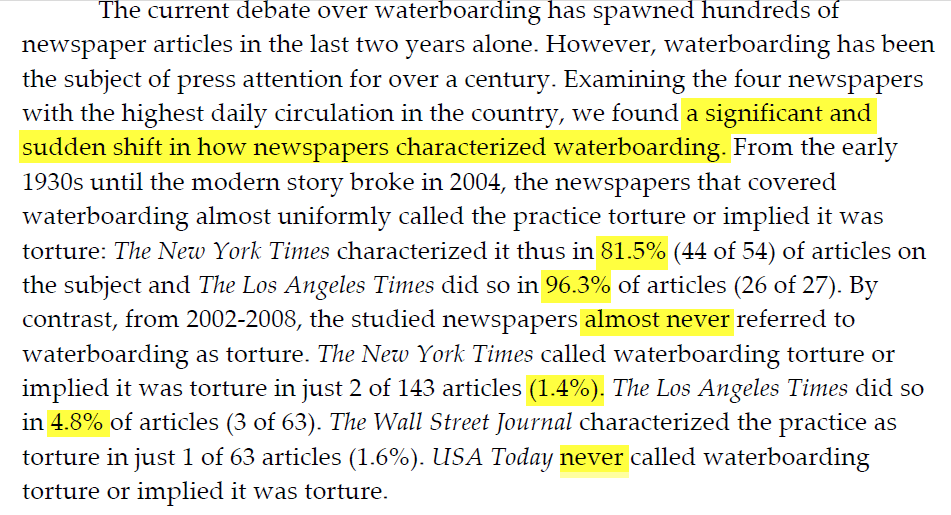
A newly released study from students at Harvard’s John F. Kennedy School of Government provides the latest evidence of how thoroughly devoted the American establishment media is to amplifying and serving (rather than checking) government officials. This new study examines how waterboarding has been discussed by America’s four largest newspapers over the past 100 years, and finds that the technique, almost invariably, was unequivocally referred to as “torture” — until the U.S. Government began openly using it and insisting that it was not torture, at which time these newspapers obediently ceased describing it that way:
Similarly, American newspapers are highly inclined to refer to waterboarding as “torture” when practiced by other nations, but will suddenly refuse to use the term when it’s the U.S. employing that technique:
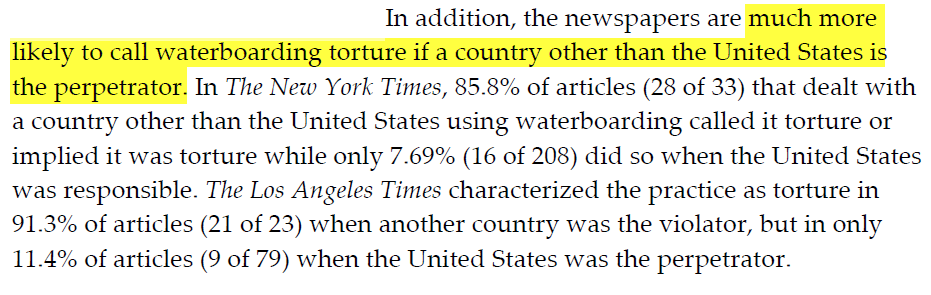
As always, the American establishment media is simply following in the path of the U.S. Government (which is why it’s the “establishment media”): the U.S. itself long condemned waterboarding as “torture” and even prosecuted it as such, only to suddenly turn around and declare it not to be so once it began using the tactic. That’s exactly when there occurred, as the study puts it, “a significant and sudden shift in how newspapers characterized waterboading.” As the U.S. Government goes, so goes our establishment media.
None of this is a surprise, of course. I and others many times have anecdotally documented that the U.S. media completely changes how it talks about something (or how often) based on who is doing it (“torture” when the Bad Countries do it but some soothing euphemism when the U.S. does it; continuous focus when something bad is done to Americans but a virtual news blackout when done by the U.S., etc.). Nor is this an accident, but is quite deliberate: media outlets such as the NYT, The Washington Post and NPR explicitly adopted policies to ban the use of the word “torture” for techniques the U.S. Government had authorized once government officials announced it should not be called “torture.”
We don’t need a state-run media because our media outlets volunteer for the task: once the U.S. Government decrees that a technique is no longer torture, U.S. media outlets dutifully cease using the term. That compliant behavior makes overtly state-controlled media unnecessary. In his proposed Preface to Animal Farm, George Orwell noted how completely the British Government during World War II was able to control media content without formal or official censorship:
The sinister fact about literary censorship in England is that it is largely voluntary. Unpopular ideas can be silenced, and inconvenient facts kept dark, without the need for any official ban. . . .
So far as the daily newspapers go, this is easy to understand. The British press is extremely centralised, and most of it is owned by wealthy men who have every motive to be dishonest on certain important topics. . . . At any given moment there is an orthodoxy, a body of ideas which it is assumed that all right-thinking people will accept without question. It is not exactly forbidden to say this, that or the other, but it is ‘not done’ to say it, just as in mid-Victorian times it was ‘not done’ to mention trousers in the presence of a lady.
In 2007, Rudy Giuliani was widely mocked for explaining that whether a particular technique constitutes torture “depends on who does it” — rarely does one find such an unapologetically nationalistic theory of morality and even language — but that’s exactly the same standard not only our government but also our establishment media has adopted.
The real issue here is the same one raised by the malleable, manipulative use of the term “Terrorism.” It’s to be expected that governments will try to propagandize their citizenry by applying completely different standards — even completely different language — to their own conduct as opposed to when other countries engage in exactly the same conduct. But when the media copies that behavior (as ours does), they’re amplifying and bolstering government propaganda rather than critically scrutinizing and debunking it. Isn’t that a fairly serious problem?
The behavior is even more egregious when government dictates (as of now, this is no longer torture) lead directly to the change in media behavior. And the ultimate effect of this joint government/media obfuscation is to further entrench the destructive notion that we’re different, exceptional, better, and therefore we deserve even a different language to describe what it is that we do. This Harvard study documents the exact process by which the political class convinces itself and others that bad and illegal things are, by definition, only what those Bad, Other Foreign Countries do, but never ourselves.
Israeli Ministers Reject Bill to Prevent Discrimination in State Schools

by Khalil Bendib
Al Manar – 28/06/2010
The Israeli Ministerial Committee on Legislation on Sunday rejected a bill aimed at preventing discrimination against students enrolled in the official state education system.
In their bill, MK Nitzan Horowitz (Meretz) and Kadima Mks Shlomo Molla and Shai Hermesh, proposed that the education minister be obligated to enforce within a specific timeline the cessation of discrimination found in any particular school.
According to the proposal, the Israeli education ministry would have the right to revoke state funding should the offending school not heed the warning by the mentioned date. The proposal would also allow the state to implement economic sanctions against the school.
Despite the Israeli cabinet’s disapproval, MK Horowitz still intends to bring the bill forward for a preliminary reading in the Knesset.
“If the MKs vote against the bill in the Knesset, like the ministers did today, it will be proof of the ideological and moral hole within the current government and its leader,” Horowitz said.
Horowitz added that the rejection of the bill demonstrated “the continuation of [Education Minister] Gideon Sa’ar and Prime Minister Benjamin Netanyahu’s silence and disregard regarding the affair in Immanuel.”
The bill had been submitted before the Ashkenazi parents in the ultra-Orthodox community of Immanuel were given a two-week jail term for refusing a court order to send their daughters to school with girls of Sephardi, or Middle Eastern, origin. On Sunday, the court ordered the parents released from jail immediately, after a deal was reached to see the girls integrated in classes for the remaining three days of the school year.
MK Molla said after the vote that “precisely toady, as the Immanuel affair hovers above us like a black could, the government should have approved the bill to clarify in a distinct voice that it opposes discrimination and racism in all forms and in all sectors.”
Jordan ‘not to give up nuclear rights’
Press TV – June 28, 2010
The head of Jordan’s Atomic Energy Commission says that it is not ready to surrender its peaceful nuclear rights in negotiations with the United States.
The US wanted Jordan to sign a nuclear agreement similar to a deal they reached with the United Arab Emirates, Khaled Tukan told AFP on Monday.
The UAE “has relinquished its rights under the nuclear Non-Proliferation Treaty (NPT),” he said, adding, “Why should we give up our rights?”
The nuclear chief also said Article 4 of the NPT stipulates that “all countries have the right to full utilization of peaceful nuclear energy, research and development.”
“We are sticking and adhering to the NPT, and (we want) full rights and privileges under the NPT,” he said.
Tukan noted that Jordan was in ongoing negotiations with the United States and the latest round of talks was held in Washington last week.
“But I think we still don’t have common ground. They started to understand our viewpoint, but still (there is) no common ground.”
Jordan has signed nuclear cooperation agreements with several countries in a bid to produce atomic energy for power generation and water desalination.
Former ambassadors question silence on the ‘excesses’ of Israel
DAN OAKES | Sydney Morning Herald | June 29, 2010
A former Australian ambassador to Israel has accused the Prime Minister, Julia Gillard, of being silent on the ”excesses” of Israel and questioned why her partner has been given a job by a prominent Israel lobbyist.
In a letter to the Herald, Ross Burns, who served as an ambassador between 2001 and 2003, said Ms Gillard has been ”remarkably taciturn on the excesses of Israeli actions in the past two years”.
Ms Gillard has been part of the Australian delegation to the last two meetings of the Australia Israel Leadership Forum, founded by the Melbourne property developer Albert Dadon.
Mr Dadon employs Ms Gillard’s partner, Tim Mathieson, as a real estate salesman, at Ubertas. Mr Burns said yesterday that Ms Gillard was at the forum’s inaugural meeting in Israel last June, six months after the Israeli army invaded the Gaza Strip, killing more than 1000 Palestinians.
She was also the acting prime minister when the invasion took place, and issued a statement at the time criticising the Palestinian group Hamas for firing rockets into southern Israel. It did not condemn Israel for causing civilian casualties.
The former prime minister, Kevin Rudd, and the Foreign Affairs Minister, Stephen Smith, have since expressed unease at the subsequent blockade of Gaza by Israel.
”It looks a bit funny when you go on this tour to promote bilateral relations, but you don’t seem to have any reservations about the issue that was number one on the horizon,” Mr Burns said.
Another former Australian ambassador to Tel Aviv, Peter Rodgers, who served in the Israeli capital from 1994 to 1997, also criticised the government’s attitude towards Israel.
He said last night that under successive governments, Australia’s approach to the Israeli-Palestinian conflict had become increasingly unbalanced, and that this was unlikely to change under Ms Gillard’s stewardship.
”There’s been a marked swing away from the old attempt to be even-handed on the Israeli-Palestinian conflict, to a much more determined pro-Israeli position, and I think Gillard is part of that,” Mr Rodgers said.
The Herald sought comments from Ms Gillard, Michael Danby, a prominent Jewish federal MP – and a supporter of Ms Gillard in last week’s leadership coup – and Mr Dadon for this article, but received no response.
Copyright © 2010 Fairfax Media
Israeli flotilla investigation panel member castrated Palestinian in blood vengeance
By Richard Silverstein | June 17, 2010
Amos Horev, the retired IDF general, former Technion president, and chief booster of the Israeli defense industry, has a rather sordid past that many might find akin to being a terrorist, Israel-style.
He is one of three panel members of the Gaza flotilla investigation and this incident, described by the inimitable Tom Segev in a 2002 Haaretz article, should shed light on the type of justice he might mete out in this inquiry:
`We castrated you, Mohammed!’
In the mid-1940s, a popular song [by Haim Hefer] among the members of the Palmach was entitled “We castrated you, we castrated you, Mohammed!” [Serasnucha ya Muhammad–the Hebrew lyrics censor the word for “castration” and substitute the meaningless Saragosa in order to permit Israeli youth groups to sing and dance to the song without having to explain the true meaning to such tender ears] That song is remembered even today. During the 60 years that have passed since that time, various theories have surfaced about the song’s origin. However, it was commonly assumed that members of the Palmach had tracked down and then castrated an Arab who had raped a Jewish woman. This was not an isolated case. In his biography of Yitzhak Sadeh, Zvika Dror writes that the commander of the Palmach even sent some of his men to a special course that was given at the Mendele clinic of the Kupat Holim Clalit health maintenance organization. “We would go there at 8:30 P.M. when the clinic was empty,” Dror quotes his source. “A physician and a nurse taught us anatomy and afterward we practiced a castration procedure.”
Now it is official: A book by Gamliel Cohen, “Undercover: The Untold Story of the Palmach’s Undercover Arab Unit,” published by the Ministry of Defense and the Galili Center for Defense Studies, reveals, with amazing precision, who the mythological “Mohammed” was, whom he raped, who authorized the rapist’s castration, who performed the castration and how precisely the “surgical operation” was carried out. Cohen eventually joined the Mossad. He describes how the Palmach’s undercover agents performed their liquidations; the same procedure is being used today in the territories.
The rapist…is identified in Cohen’s book as Araf Ahmed Shatawi, a broad-shouldered, muscular man who lived in the village of Bissan, where the town of Beit She’an is presently located. Shatawi was suspected of having attempted to rape a young woman from Kibbutz Messilot. According to Cohen, the suspicions were based on intelligence data. Shatawi was alleged to have spotted the woman as she descended from a bus and to have dragged her into the bushes. She struggled and managed to thwart the rape attempt. Since the atmosphere in the kibbutz was already highly charged and since this was not the first attempted rape, the supreme command of the Haganah decided that it would provide an effective response to the incident. At first it was proposed that Shatawi be assassinated; however, because of the fear that an assassination might set off a chain of blood vendettas, it was decided, as Cohen puts it, “to deal with him in accordance with the biblical principle that calls for the chopping off of a thief’s hand and which, in this case, would call for attacking the organ he used to perform the crime, namely, for castrating him.”
The plan was submitted to Shaul Avigur for approval. He was somewhat hesitant, in view of the cruel nature of the proposed action; however, Yehoshua Palmon, who later became the prime minister’s adviser on Arab affairs, persuaded him, and Avigur gave the plan the green light. According to Cohen, who quotes documents preserved in the IDF archives, the two individuals who carried out the castration procedure were Yohai Bin-Nun, who later became a major general and the commander-in-chief of the Israel Navy, and Amos Horev, who also later became a major general, the chief scientist of the defense establishment and the president of the Technion – Israel Institute of Technology. There was a third man, named Yaakuba Cohen; however, according to the Ministry of Defense version of the incident, he did not actually participate in the castration but instead stood guard over the rapist’s family, while Bin-Nun and Horev dragged him from his home into an open field, where they castrated him. Before they set off for this mission, they were briefed by the chief physician of the communities of Tel Yosef and Ein Harod. Cohen does not name him. The book then goes on to provide a detailed surgical description of the castration, which sounds almost like a “do-it-yourself” manual. In the final analysis, according to the Ministry of Defense version, the “operation, it was pointed out, proved highly valuable because it had an immense impact on the entire Beit She’an Valley and horrified the Arab population.”
No doubt, Amos Horev feels like the Israeli bus driver who decorated his bus with a banner that read:
Flotilla 13 [the navy unit that attacked the Mavi Marmara], be ashamed. Why did you kill so few?
Yes, there are those who will say this incident happened nearly 70 years ago and times have changed and that people change. I’m not even going to argue with this proposition though I disagree with it. The fact is that Horev should not have been appointed because his past taints his participation in the present inquiry. Surely, not even a reasonable supporter of the Gaza attack can argue that Horev has the type of past that would instill confidence that he can judge the facts dispassionately.
As an aside, if Israel embraces the type of Biblical justice meted out by the Palmach to the alleged Palestinian rapist, then should we expect, in the unlikely event the Israeli commission finds Flotilla 13 guilty of criminal acts against the Mavi Marmara passengers, that Horev will advocate cutting off the trigger fingers of the shooters? Or perhaps Turkey should take that mission on itself in the event the commission absolves the team of any culpability?
And the next time any supporter of Israel’s draconian policies rants about Arab terror, let them consider for a moment the rather sordid past of some of Israel’s current elite. If those who engaged in acts of terror like Horev can play major roles in their nation’s subsequent history, there is no reason why those Israel currently labels dangerous, murderous terrorists cannot do the same in Palestine.
Killing Civilians, Ducking Blame
By KATHY KELLY and DAN PEARSON | June 26, 2010
In accepting General McChrystal’s resignation, President Obama said that McChrystal’s departure represented a change in personnel, not a change in policy. “Americans don’t flinch in the face of difficult truths or difficult tasks.” he stated, “We persist and we persevere.” Yet, President Obama and the U.S. people don’t face up to the ugly truth that, in Afghanistan, the U.S. has routinely committed atrocities against innocent civilians. By ducking that truth, the U.S. reinforces a sense of exceptionalism, which, in other parts of the world, causes resentment and antagonism.
While on the campaign trail and since taking office, President Obama has persistently emphasized his view that attacks against civilians are always criminal, unless the U.S. is the attacker, in which case they are justified. We heard this again, on June 23rd, as the President assured the U.S. people that we will persevere in Afghanistan. “We will not tolerate a safe haven for terrorists who want to destroy Afghan security from within, and launch attacks against innocent men, women, and children in our country and around the world.”
When considering the security of Afghan civilians, it’s crucial to ask why, on May 12, 2009, General McChrystal was selected to replace General McKiernan as the top general in Afghanistan. News reports said it was because he had experience in coordinating special operations in Iraq. That experience involved developing death squads, planning night raids, and coordinating undercover assassinations. McChrystal proved, since his appointment, that he could organize atrocities against Afghan civilians and simultaneously present himself as a protector of Afghan civilians. In doing so, he relied on collaboration and cooperation from Defense Secretary Gates, General Petraeus and President Obama. They are united in their culpability. We, ourselves, bear responsibility to examine disturbing patterns of misinformation regarding U.S./NATO attacks against Afghan civilians.
In each of eleven incidents since April 9th, 2009, U.S. forces killed innocent civilians, then engaged in a cover-up, insisting that they had killed insurgents, and eventually acknowledged having killed civilians. Generally, U.S./NATO officials issued an apology. Wikileaks is expected to release a video that establishes U.S. responsibility for a May 4th, 2009 air attack which killed an estimated 86 – 140 civilians, mostly women and children. In the days and weeks after the attack, U.S. and NATO military officials made a concerted effort to avoid blame for this attack. Voices for Creative Nonviolence has maintained a list, assuredly only a partial list, of U.S./NATO attacks, since April 2009, which caused civilian deaths. Below is the entry describing the May 4, 2009 attack.
Date: May 4, 2009
Place: Farah Province near the town of Granai
Circumstances: Mainstream media reports estimate that between 86 and 140 people, mostly children, died in a US air attack. According to Reuters, only 22 of the victims were adult males.
Initial U.S./NATO response: The following chronology indicates multiple attempts on the part of US officials to avoid blame.
May 6, 2009—U.S. officials plea ignorance and state that an investigation is under way.
May 6, 2009—According to The Guardian, a spokesperson for US forces in Afghanistan, Captain Elizabeth Mathias says, “This was not coalition forces. This was Afghan national security forces who called in close air support, a decision that was vetted by the Afghan leadership.”
May 7, 2009—An Armed Service Press Service report announces that a team is “investigating differing accounts of the events leading up to the casualties. Those accounts include allegations that the Taliban tossed grenades into homes to ‘frame’ Afghan and coalition forces.” U.S. Defense Secretary Robert Gates states that “the United States and coalition partners do everything we can to avoid civilian casualties.” He goes on to say that “While there have been civilian casualties caused by American and NATO troops, they have been accidental. When the Taliban cause casualties, they are on purpose.”
May 8, 2009—Pentagon spokesperson Col. Greg Julian insists that earlier estimates of the death toll were “grossly exaggerated.” May 10, 2009—In an interview with Mike Wallace, General David Petraeus suggests that the Taliban forced people “to remain in houses from which the Taliban was engaging U.S. forces.”
May 15, 2009—Marine Corps Commandant Gen. James Conway again blames the Taliban for civilian casualties. “We believe that there were families who were killed by the Taliban with grenades and rifle fire,” he said, “that were then paraded about and shown as casualties from the airstrike.”
U.S. /NATO acknowledgment that the people killed were unarmed civilians:
May 13, 2009—Referring to the May 4th raids in an Afghan press interview, Ambassador Karl W. Eikenberry admits that “there were a number of civilians killed, a number of civilians wounded. We don’t know the exact amount. You are aware that our President of the United States and our Secretary of State and our Secretary of Defense have all very explicitly expressed their condolences for what happened.”
June 2, 2009— According to The New York Times “A military investigation has concluded that American personnel made significant errors in carrying out some of the airstrikes in western Afghanistan on May 4 that killed dozens of Afghan civilians, according to a senior American military official.”
With all due respect for Ambassador Eikenberry’s sincerity, and recognizing that condolences may have been relayed to Afghanistan, we nevertheless want to say that we couldn’t find any record of U.S. officials publicly expressing sorrow, explicitly, for the U.S. attack against Afghan civilians on May 4, 2009.
However, we do note that U.S. officials, one week later, nominated General McChrystal to replace General McKiernan. It seems that this appointment signaled U.S. intent to shift assaults against Afghan civilians into the realm of undercover operations, making it much easier to duck the blame.
Kathy Kelly, (kathy@vcnv.org), and Dan Pearson, (dan@vcnv.org), are co-coordinators of Voices for Creative Nonviolence (www.vcnv.org)
A tale of two schools
By Alex Kane on June 26, 2010
When plans were announced in February 2007 to open the Khalil Gibran International Academy (KGIA), New York City’s first dual-language Arabic public school, ugly anti-Arab racism and Islamophobia reared its head.
Yesterday, the New York Times profiled a Brooklyn-based Hebrew language charter school. There has been barely a peep about this school–a stark reminder of the privilege Jewish-Americans hold in our society and how racism against Arabs is an accepted part of our national discourse.
Here’s an excerpt from a great New York Times profile by Andrea Elliott of KGIA’s founding principal Debbie Almontaser about the concocted controversy:
In newspaper articles and Internet postings, on television and talk radio, Ms. Almontaser was branded a “radical,” a “jihadist” and a “9/11 denier.” She stood accused of harboring unpatriotic leanings and of secretly planning to proselytize her students. Despite Ms. Almontaser’s longstanding reputation as a Muslim moderate, her critics quickly succeeded in recasting her image.
The conflict tapped into a well of post-9/11 anxieties. But Ms. Almontaser’s downfall was not merely the result of a spontaneous outcry by concerned parents and neighborhood activists. It was also the work of a growing and organized movement to stop Muslim citizens who are seeking an expanded role in American public life. The fight against the school, participants in the effort say, was only an early skirmish in a broader, national struggle.
One of the more pernicious, and completely false, charges against KGIA was that the school had a political agenda to indoctrinate students to believe in “radical Islam.”
The Hebrew-language charter school, on the other hand, does have politics, namely Zionism, infused into it:
There are reminders of Israel everywhere — blue-and-white flags adorn the walls of one classroom, and another class often watches an Israeli children’s show. The students celebrated Israeli Independence Day this year. (In the parlance of 5- and 6-year-olds, the day was known as the country’s “62nd birthday,” and prompted a project of construction-paper birthday cards.)
The Bhopal Disaster: an ongoing tragedy
By Saffi Ullah Ahmad | Pulse Media | June 26, 2010
Twenty five years after the world’s biggest industrial disaster, Union Carbide’s old pesticide factory remains untouched, haunting the crowded city of Bhopal, a constant reminder of the region’s darkest night.
On the night of 3 December 1984 the lethal gas methyl isocyanate (MIC) alongside other noxious fumes, engulfed the city of Bhopal and killed thousands. It is thought that the disaster has claimed 25,000 lives thus far, and adversely affected over 500,00. Gross negligence by Union Carbide is widely viewed as the cause of the tragedy.
Earlier last week, after a quarter century of waiting and sloppy, almost reluctant court action, lamentable sentences were passed down to seven Union Carbide India Limited (UCIL) officials. Sentences of two years were administered to some of those presiding over the corporation when the tragedy occurred; a small group of incredibly wealthy Indian men, all in their 70’s, one of whom is a billionaire, and none of whom are expected to serve their sentences. In addition to the sentencing, each of the seven men were fined a paltry £1400, an amount which would barely pay for the yearly healthcare of one of the victims, let alone serve as meaningful punishment for this appalling crime.
These convictions are so far the only to have materialized in a case that was opened the day after the tragedy in 1984. Those ultimately responsible for the tragedy, namely the corporation’s CEO and equally negligent Western officials, remain unpunished.
Survivors and campaigners have been outraged, calling last week’s decision an ‘insult’. However, as we are about to see, this is only the most recent of a long history of insults.
‘That night’
In 1969, a pesticide factory was shoddily built by Union Carbide (UC) on the outskirts of Bhopal.
As noted by Indra Sinha, controversially in the late 70s following the acquirement of several licenses, UC executives decided that the First World War gas MIC, an incredibly volatile substance 500 times deadlier than hydrogen cyanide, would be stored on site. MIC was to be used as a cost-effective intermediary for the production of the pesticide Carbaryl, even though other manufacturers had refused to use the substance on the grounds of safety. Although chemical engineers recommended, if absolutely necessary, that the gas remain stored in the smallest quantities, on this particular site the decision was taken to store the substance in a giant tank. Equally alarmingly is the fact that UC had opted to use previously unproven technology in the Bhopal plant’s MIC unit, and decided not to store the gas at an identical installation in West Virginia.
Following a poor start owing to local farmers not being able to afford their products, UC bosses decided to go on a cost cutting spree which involved the reckless enforced redundancy of maintenance staff, the use of cheaper, often defective materials in repair work, and the disengagement of safety systems such as the MIC unit’s refrigerator (the gas remains more stable when cooled). The few maintenance staff that did remain were expected to understand English safety manuals even though very few had a grasp of the language.
A 1982 safety audit by US engineers noted the filthy condition of the plant, including corroding pipelines and faulty valves, and warned of dangerous toxic release. As the situation worsened and minor gas leaks began to occur, often injuring and even killing workers, journalists and factory staff began warning locals of a terrible danger. Notably, Raj Keswani wrote a series of articles in which he claimed Bhopal was ‘about to be annihilated’ and begged the region’s Chief Minister, unsuccessfully, to investigate the factory before it became ‘Hitler’s gas chamber’.
On the night of 2 December 1984, following an explosive reaction with water, a deadly stream of gas began to seep out of the Bhopal plant’s MIC tank, as all six safety systems designed to contain such a leak failed. The density of the gas, accompanied by a gentle breeze, ensured it rolled along the ground and gradually enveloped the city. Across the city people were waking up in agony, water streaming from their eyes and noses, coughing violently as the gas attacked eye and lung tissue, as well as the central nervous system. No one quite knew what was happening, just that they should run, in whatever clothes they were wearing. In total panic, locals ran alongside dogs and even cattle, with several people being trampled to death in the ensuing commotion.
People were vomiting uncontrollably, frothing at the mouth, suffering visual impairment, and losing control of their bowels – passing urine as they ran. Others suffered convulsions, writhing uncontrollably in the moments before their end. Not even the unborn were spared; over half of all pregnant women caught up in the commotion suffered spontaneous abortions. An Indian Doctor on the scene famously stated ‘Tonight, the Bhopalis are going through Hiroshima’.
By morning Bhopal resembled a scene from hell. In all, 40 tons of MIC which wreaks havoc upon the human body in the tiniest of proportions, had escaped and thousands of bodies were scattered across the old city — along narrow alley ways, road sides and on lawns. In the days to come, the leaves of trees within roughly 40 square miles of the factory were to turn yellow, wither and drop off. Depending on religious custom, some bodies were to be buried in mass graves, and others burnt on mass pyres. Although the authorities give more conservative figures (around the 3000 mark), others estimate up to 8,000 people died that night and anywhere between 15- 25,000 since the event.
Survivors overwhelmed hospitals in which bewildered junior doctors had no idea what treatments to administer. Many were rubbing their eyes with sewage water to ease the searing pain.
Exacerbating the situation, the officials at UC refused to release extensive information they had gathered following years of internal research on the effects of MIC on the human body, nor the exact make up of the gas, calling them ‘trade secrets’, and fearing a dip in profits. With doctors having no proper treatment protocols to follow, the number of deaths multiplied and excessive amounts of drugs for temporary relief, such as steroids, antibiotics and psychotic drugs became the mainstay of medical care, each often causing their own severe side effects.
Roughly 500,000 were injured through exposure to the gas, which in the absence of winds, lingered in the city for days. Ailments directly linked to the disaster include blindness, respiratory difficulties, a variety of cancers and gynecological problems. Many survivors today cannot walk a few steps without gasping for breath, and others suffer sensory delusions, hearing voices in their heads. In addition to the multitude of medical conditions experienced by the victims, the situation wasn’t at all helped by the central government’s abrupt and unexplained decision to stop all research into the medical effects of the gas cloud in 1994.
The second wave of casualties


Adil
Today, instead of leaking gas into the skies, the old UC factory leaks deadly chemicals into the soil and ultimately into the water supply of locals.
Approximately 8,000 tons of toxic and carcinogenic chemicals lie abandoned in the old plant, including mercury, due in large part to a lack of political willpower to enforce the financing of a multimillion dollar cleanup operation. Over two decades of monsoons have washed much of these chemicals in to an underground aquifer which feeds into wells and boreholes used by locals to extract drinking water.
Having no other water supply, many of the locals have been forced to effectively poison themselves by drinking this contaminated water over the years since the disaster. The chemicals leaking from the old plant have been directly linked to a shocking variety of conditions including: skin problems, aches and pains, headaches, nausea, dizziness, anxiety, constant exhaustion, kidney failure, diabetes, a range of cancers, and tuberculosis. Not only are the original survivors still being punished, but so is a subsequent generation; prior gas exposure to mothers coupled with the consumption of these chemicals has led to thousands of gruesome birth defects, with many newborns barely recognizably human, and widespread growth retardation in children.
Despite the Supreme Court ordering that affected children be afforded health insurance, over 100,000 remain without any, and with the majority of affected families being of low social status or caste, outsiders are often reluctant to help, treating victims as untouchables.
UC likely knew of the dangers of such contamination from as early as 1980, when cattle mysteriously began dying in nearby fields. A subsequent internal study in 1989 confirmed this and UC chose not to share these findings with locals, lest cries for compensation multiply. […]
As for levels of contamination, a major water and soil study was conducted by Greenpeace in 1999. After testing samples in and around the factory, deadly chemicals were found everywhere, including in hand pumps that gushed out drinking water. In the water, levels of carbon tetrachloride and chloroform were found several hundred times higher than the US Environmental Protection Agency limits. In the soil, levels of mercury were found to be anywhere up to 6 million times higher than those found in uncontaminated soil. Similarly, organochlorides such as the banned pesticide DDT were present throughout the region.
More recent reports include one released in 2009 by the Sambhavna Trust which show a presence of large quantities of the aforementioned chemicals, as well as nickel, chromium, lead and others in vegetables, and even in the breast milk of nursing mothers. As a result of ongoing and horrific birth defects, mothers in the area had become too scared to breast feed their own children.
‘People are ill in the communities. Babies are sick. There are many deformed births. It’s as if they really hate us. As if they’re trying to punish us for protesting when they gassed us before and killed our families.’ These were the words of Sunil Kumar, an orphaned community leader (following the catastrophe), who went on to commit suicide some years ago.
As each monsoon washes more and more chemicals in to the area’s ground water, an ever increasing number of people are becoming sick. According to the International Campaign for Justice in Bhopal, upwards of 150,000 remain chronically ill and over 50,000 are not able to work.
The court battle
The day after the disaster began one of the longest running prosecutions in India’s history. Within four days of the tragedy, UC’s CEO Warren Anderson was allowed by Indian authorities to fly back — on a government plane — to the US on bail, never to return.
Recognizing a potential easy ride in Indian courts, UC managed to persuade a US court that the case be heard in India. The Manhattan District Court agreed on the provision that UC Corporation agree to abide by the Indian courts’ decision. However, when the Indian courts summoned US executives to answer criminal charges, UC executives were advised by their lawyers to claim Indian courts had no jurisdiction over them. They have been absconding ever since.
In 1989 Rajiv Gandhi’s government came to an out of court settlement with Union Carbide India Limited without consulting survivors, under which $470m — the exact sum UC was afforded by their insurers — would be paid in compensation resolving all outstanding legal issues.
At first glance this figure may appear significant, but after being divided between roughly 550,000 people, and with various administrative problems, it amounted to approximately $500 per victim to cope with a lifetime of misery, or, as Indra Sinha points out, 7p a day. This is the cost of a cup of tea. Prior to this settlement, victims had received $5 per month, and stunningly, even this figure was stingily deducted from the final pay out. Amazingly, UC also failed to take responsibility for the disaster, speaking instead of ‘sabotage’.
Just how derisory this figure was can be seen when we compare it to the pay out after the Exxon Valdez oil spill, where even Alaskan sea otters were afforded more compensation than Bhopal victims, and the recent BP spill in the Gulf of Mexico, where BP recently set aside a $20 billion fund for victims along the coastline. Not surprisingly, once news of the UC payout emerged, with investors having expected a much larger sum, their share price went through the roof.
To add to the locals’ problems, this settlement completely ignored environmental damage, despite the ever worsening contamination in the area, and overlooked second and third generation victims. Also, UC’s lawyers saw to it that further court action couldn’t be taken in the US.
In 1994, most probably as a strategy to avoid further liability and in light of threats by Indian courts to seize their assets, UC sold its Indian branch to Eveready Industries India Limited.
UC was then officially purchased by the Dow Chemical Company in 2001, a controversial corporation with a murky history. Whereas Dow was quick to set aside billions for UC asbestos workers in Texas, it immediately denied liability for UC’s doings in Bhopal, stating that the 1989 payment fulfilled their financial responsibility to the disaster.
Having legally acquired all of UC’s assets and liabilities, Dow continues to refuse to clean up the site, administer appropriate compensation or even disclose the composition of the gas leak, despite pleas even by its own shareholders, sending a dangerous message to other corporate giants.
With regard to criminal charges, in 1996 initial charges of culpable homicide were controversially diluted to criminal negligence, reducing potential maximum jail sentences of UC officials from ten years to two, explaining the recently administered sentences.
UC and Dow have been aided along the way not just by the underdeveloped tort law framework in India and the clogged legal system, but also corrupt bureaucrats and potentially even judges. Indian officials and politicians, most notably those from the BJP, are also known to have taken money from Dow, often going on to claim on public platforms that there is no water contamination in Bhopal. The prospect of Dow bringing more business to India has made officials even more reluctant to administer justice to the Bhopalis. With regard to Anderson, the Bhopal Medical Appeal believes that ‘neither the American nor the Indian government seem interested in disturbing him with an extradition.’
In light of the central governments ongoing lack of action, in 2004 campaigners for a clean water supply successfully petitioned the Supreme Court of India, which ordered the piping of safe water into affected communities. When this didn’t happen, several mothers took their damaged children to government offices in protest, only to meet severe hostility including a beating with police sticks. Many police officers wept as they carried out their orders. In a related instance in 2009, survivors chained themselves to railings outside government offices only to receive a similar response… Full article
*Shanu and Adil source site images: http://galleries.bhopal.org/main.php?g2_itemId=30
To neutralize
Unlike in the case of their Jewish counterparts, when it comes to offending Arab drivers, the Israeli Border Police would rather kill than arrest.
By Amira Hass| Haaretz | June 23, 2010
If a policeman had witnessed the hit-and-run accident that took the life of cyclist Shneor Cheshin on Friday, would he have killed the driver after catching him? Of course not. But on Friday, June 11, in broad daylight in the middle of a residential neighborhood, a policeman killed a driver who ran into – but did not kill – pedestrians: police officers on foot.
The killing was buried immediately in the giant cemetery called “of no interest to the Israeli public.” Why? Because all this happened in a Palestinian neighborhood in East Jerusalem (Wadi Joz ), and because the driver’s name was Ziad Jilani.
Until his case is decided in court, Tal Mor is rightfully deemed “the suspect in Cheshin’s killing.” But Jilani was treated to a lightning trial: He was convicted on the spot of intending to carry out a terror attack because the people hurt by his car were Israeli policemen. They chased him as one chases someone defined as a terrorist, while shooting (first in the air, but then in a way that endangered passersby. In fact, a 5-year-old girl sitting in a parked car was injured ).
And then, when he was lying on the ground shot, according to witnesses, he also took two bullets to the head. That is, between the second the man was indicted for intending to run people over in a terror attack, and until the moment a gun was allegedly pressed right up to his head and the trigger pulled, the Border Police on the scene were victims, witnesses, prosecutors, judges and executioners.
The Border Police spokesperson wrote to Haaretz: “Citizens have been killed and dozens injured by vehicle terror attacks that occurred in Jerusalem from 2008 to 2009. The lives of other innocent citizens were saved thanks to the intervention of police, Border Police combatants and civilians who neutralized the perpetrators and prevented more killing. The latest running-over incident … only by a miracle ended without combatant fatalities. In this case as well, the perpetrator was neutralized after he tried to flee the scene against the law.”
When Jilani fled his vehicle into a dead-end alley, did he endanger the lives of civilians? Did the police fear that the Palestinian (after all, they were certain he was not Jewish ) would harm Palestinians in the heart of that Palestinian neighborhood, so they had to “neutralize” him? Who knows, maybe so. Perhaps that was the reason they fired at him when he got out of his car and they chased him, lest he pull a pistol or an assault rifle out of his pants and attack innocent passersby, Palestinians like him.
Down the alley, near his uncle’s house, there were no police at the time who could be endangered by a potential weapon or an explosives belt. When he was already lying prone on the ground, apparently injured in his leg, back and arm, were the approaching police still afraid he would draw a rifle and kill them? So that’s why they did not bother handcuffing him?
They call the Border Police “combatants,” going around the streets of East Jerusalem with their long rifles and helmets. Against whom and why are they doing combat there, between a butcher shop, two vegetable stores, a laundry, a car-repair shop and a sidewalk that serves as a playground?
Israeli police, whatever they are called, are sent to the streets of East Jerusalem as enforcers of government and municipal policy. It is that same policy of intentional discrimination that has brought 65 percent of the 303,429 Palestinians living in East Jerusalem below the poverty line (double the number of poor Jews in the city ) and 74 percent of Palestinian children below that line.
The police serve the government that since 1967 has expropriated 24,000 dunams (8,000 acres ) of land from Palestinians and over the years has built more than 50,000 housing units on it – for Jews only. Police accompany the bulldozers that demolish homes built, for lack of choice, without permits.
It should come as no shock that police feel hostility toward them in the occupied city. Perhaps that is the reason they did not stop and think: It might have been a brake malfunction, the man might have lost his senses or not have been aware of police and border police procedures for opening fire. The reasons Jilani ran into the police could have been brought to light in court.
But they chose, allegedly, to return him to his family with his face imploded after being hit by two bullets, apparently fired into his right cheek. The bullets did not even have a place to come out because, lying there, his left cheek was on the asphalt. Neutralize means eliminate.
Social Engineering: are we being hoodwinked ?
108morris108 — June 20, 2010
Arthur C Clarke: “Fifty years is ample time in which to change a world and its people almost beyond recognition. All that is required for the task are a sound knowledge of social engineering, a clear sight of the intended goal – and power.” — Childhood’s End.
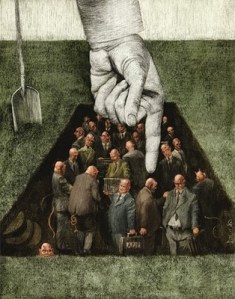
art by Santiago Caruso
A note of appreciation from the Elite
By “Mark Twain” – 06/20/2010

Let’s be honest: you’ll never win the lottery.
On the other hand, the chances are pretty good that you’ll slave away at some miserable job the rest of your life. That’s because you were in all likelihood born into the wrong social class. Let’s face it — you’re a member of the working caste. Sorry!
As a result, you don’t have the education, upbringing, connections, manners, appearance, and good taste to ever become one of us. In fact, you’d probably need a book the size of the yellow pages to list all the unfair advantages we have over you. That’s why we’re so relieved to know that you still continue to believe all those silly fairy tales about “justice” and “equal opportunity” in America.
Of course, in a hierarchical social system like ours, there’s never been much room at the top to begin with. Besides, it’s already occupied by us — and we like it up here so much that we intend to keep it that way. But at least there’s usually someone lower in the social hierarchy you can feel superior to and kick in the teeth once in a while. Even a lowly dishwasher can easily find some poor slob further down in the pecking order to sneer and spit at. So be thankful for migrant workers, prostitutes, and homeless street people.
Always remember that if everyone like you were economically secure and socially privileged like us, there would be no one left to fill all those boring, dangerous, low-paid jobs in our economy. And no one to fight our wars for us, or blindly follow orders in our totalitarian corporate institutions. And certainly no one to meekly go to their grave without having lived a full and creative life. So please, keep up the good work!
You also probably don’t have the same greedy, compulsive drive to possess wealth, power, and prestige that we have. And even though you may sincerely want to change the way you live, you’re also afraid of the very change you desire, thus keeping you and others like you in a nervous state of limbo. So you go through life mechanically playing your assigned social role, terrified what others would think should you ever dare to “break out of the mold”.
Naturally, we try to play you off against each other whenever it suits our purposes: high-waged workers against low-waged, unionized against non-unionized, Black against White, male against female, democrat against republican, American workers against Japanese against Mexican against…. We continually push your wages down and take your money by invoking “foreign competition,” “the law of supply and demand,” “national security,” “too big to fail” or “the bloated federal deficit.” We throw you on the unemployed scrap heap if you step out of line or jeopardize our profits. And to give you an occasional break from the monotony of our daily economic blackmail, we allow you to participate in our stage-managed electoral shell games, better known to you ordinary folks as “elections.” Happily, you haven’t a clue as to what’s really happening — instead, you blame “Aliens,” “Tree-hugging Environmentalists,” “Niggers,” “Homos”, “Wet backs”, “Welfare Queens,” and countless others for your troubled situation.
We’re also very pleased that many of you still embrace the “work ethic,” even though most jobs in our economy degrade the environment, undermine your physical and emotional health, and basically suck your one and only life right out of you. We obviously don’t know much about work, but we’re sure glad you do!
Of course, life could be different. Society could be intelligently organized to meet the real needs of the general population. You and others like you could collectively fight to free yourselves from our domination. But you don’t know that. In fact, you can’t even imagine that another way of life is possible. And that’s probably the greatest, most significant achievement of our system — robbing you of your imagination, your creativity, your ability to think and act for yourself.
So we’d truly like to thank you from the bottom of our heartless hearts. Your loyal sacrifice makes possible our corrupt luxury; your work makes our system work. Our governmental, public education, media mind-control, and financial institutions frame a labyrinthine system of lies that you numbingly support for our advancement and your children’s enslavement.
Thanks so much for “knowing your place” — without even knowing it!
German minister barred from Gaza visit
Press TV – June 20, 2010

German Development Aid Minister Dirk Niebel
Israel has refused to allow German Development Aid Minister Dirk Niebel to visit the besieged Gaza Strip in order to inspect a sewage plant financed by Germany.
A German ministry spokesman, objecting to the Israeli move, said later on Saturday that talks over Niebel’s visit to the Palestinian areas were still underway.
Niebel had hoped to visit a sewage treatment plant, financed with the German development aid, during his current visit to Israel.
“Sometimes the Israeli government does not make it easy for its friends to explain why it behaves the way it does,” Niebel told the German ZDF TV network program “heute” (today).
He further added that Israel’s latest announcement on easing the Gaza siege was “not sufficient” and that Tel Aviv must “now deliver” on its pledge.
Beyond that, Israel should be “clear” about how, within an international context, it wants to “cooperate with its friends in the future as well,” the German minister of the liberal Free Democratic Party said.
Earlier Saturday, the daily Sueddeutsche Zeitung reported that the German parliament, with the support of German Chancellor Angela Merkel’s government, is to issue a cross-party demand that Israel allow the passage of humanitarian aid into the Gaza Strip by sea.
###
Referring to the loosening of the blockade that the Israeli government recently announced, Niebel said, “if the Israeli government expects support for its new Gaza strategy, it must first of all ensure more transparency and for a new partnership.”
He said the blockade, which is aimed at preventing Hamas members in the Gaza Strip from obtaining weapons and materials to build rockets which are fired over the border into Israel, was not a sign of strength.
Rather, he said, it was, “proof of unspoken fear.” And he urged the Israeli government not to let the clock run out on the remaining opportunity for peace talks.
“It is five to twelve for Israel,” he said.
Featured Video
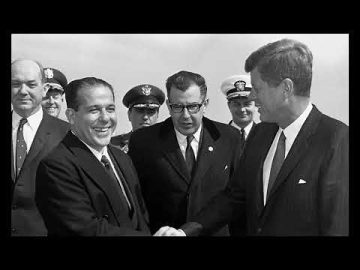
The 1964 Coup in Brazil
or go to
Aletho News Archives – Video-Images
Free Book
Vicious

Lies are Unbekoming | January 25, 2026
The waiting room is clean. The receptionist is polite. The forms ask reasonable questions. Nothing in the physical environment suggests danger. The magazines are current. The hand sanitizer dispenser works. Someone has chosen calming colors for the walls.
A pregnant woman sits in a chair designed for her comfort. She has been told to be here. Not ordered—no one orders. Recommended. Strongly recommended. Everyone does this. Her mother did this. Her friends did this. The women in her prenatal group compare notes about their appointments the way they compare notes about nursery furniture. Which provider did you choose? What tests have you had? The questions assume the answers. The answers assume the questions.
She will be offered things today. Offered is the word used. The offers will come with information sheets that list risks and benefits in tabular form. She will sign consent documents. Everything will be voluntary in the legal sense. No one will hold her down. No one will threaten her. She will choose, and her choices will feel like choices, and she will leave feeling she has done the responsible thing.
What she will not feel is the weight of what has been arranged before she arrived. … continue
Blog Roll
Recent Comments
Coronistan on Donald Trump Is No Peace … seversonebcfb985d9 on French court jails pro-Palesti… eddieb on Fourteen Incredible Facts Abou… Bill Francis on European leaders’ shift in the… seversonebcfb985d9 on Villains of Judea: Philip Esfo… loongtip on Report warns that ‘Jewish terr… Craig Nelms on New study shows that toxic gas… loongtip on A Funny Thing Happened on the… loongtip on EU free trade pact on hold as… John Edward Kendrick on Regime Change In Iran Is The F… Bill Francis on Australia Passes New Hate Spee… seversonebcfb985d9 on Australia Passes New Hate Spee…


 Aletho News
- Spain Opens Probe Into Israeli Tourism Firms
- Epidemic of fake videos
- Craig Murray, Reporting from Venezuela
- Why Israel’s Drive to Destroy Iran is Ultimately about Palestine
- Trump and Iran, War or Negotiations?
- US pressure contributing to Israeli influence in Latin America: Experts
- China Rejects U.S. Claims of Coercion in Central America
- New US defense strategy downgrades Russian ‘threat’
- EU turns to India for defense cooperation as US ties fracture
- Donald Trump Is No Peace President
- If Americans Knew
- Greenpeace Demonstrator Exposes Folly of Protest Restrictions
- From CBS to TikTok, Pro-Israel Ellison is now in the driver’s seat
- Israel pays for UK advertisements attacking Doctors Without Borders
- Israel accused of extracting billions from Gazan people to pay for their own genocide
- ‘Deliberate Assassination’: 3 Journalists Among 11 Killed by Israeli Forces in Gaza
- In Gaza, We’re Struggling to Reintroduce Foods to Bodies Adjusted to Starvation
- Will Rafah crossing be opened at last? – Not a ceasefire Day 108
- Israeli drone strike kills two children collecting firewood in Gaza – Not a ceasefire Day 107
- Another Gaza baby freezes to death on Netanyahu’s watch – Not a ceasefire Day 106
- Oppose Israel’s Abuses While You Still Can
- No Tricks Zone
- New Study Affirms Rising CO2’s Greening Impact Across India – A Region With No Net Warming In 75 Years
- Germany’s Natural Gas Crisis Escalates … One Storage Site Near Empty …Government Silent
- Polar Colding…Antarctica Saw Its Coldest October In 44 Years!
- New Study: Sea Levels Rose 20 Times The Modern Rate During The Roman Warm Period
- As German Gas Storage Dips Dangerously Low…Shortage Hardly Avoidable
- New Study: Brazil’s Relative Sea Level Was 2+ Meters Higher And SSTs 3-4°C Warmer 6000 Years Ago
- Philosopher Schopenhauer: Climate Science Certainty Stems From Stupidity, Ignorance
- New Study: Species Extinction Rates Declining Since 1980 – ‘Climate Change Is Not An Important Threat’
- Denmark Places Climate Protection Above Animal Welfare, Poisoning And Culling Cows
- New Study: Greenland Was 3-7°C Warmer And Far Less Glaciated Than Today 6000-8000 Years Ago
 Aletho News