This is the big one – please share widely so that all can understand the crucial Geopolitical history… behind where we find ourselves today!
DOWNLOAD this video here to share elsewhere:
Dr. Nordangård’s incredible historical record publication (scroll down for eBook version): https://www.pharosmedia.se/shop#!/jacob-nordang%C3%A5rd/products/rockefeller—controlling-the-game
March 7, 2024
Posted by aletho |
Civil Liberties, Full Spectrum Dominance, Science and Pseudo-Science, Timeless or most popular, Video | Covid-19, Human rights |
Leave a comment
Israel’s documented torture and abuse of Palestinians may evoke comparisons to US tactics employed during the Iraqi occupation, but a closer look reveals their distinct origins rooted in the Zionist entity.
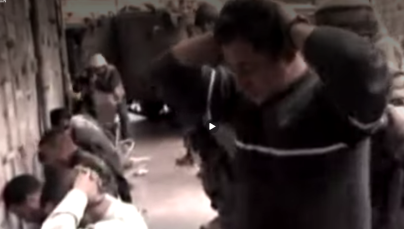
Just five days after the start of the war on Gaza, Israeli soldiers and settlers detained three Palestinian men in the occupied West Bank village of Wadi al-Seeq. Stripped down to their underwear, they were then blindfolded, savagely beaten with an iron pipe, photographed in their humiliation, and subjected to the ultimate indignity of being urinated upon.
One victim, Mohammad Matar, recounting the ordeal to the Israeli newspaper Haaretz, likened the barbarity to the infamous Abu Ghraib scandal in Iraq. “It’s exactly like what happened there,” he stated. “Abu Ghraib with the [Israeli] army.”
The sexual humiliation and torture of Palestinians continued – and expanded – following Israel’s ground invasion of Gaza two weeks later. Soon, Israeli soldiers were detaining and humiliating large groups of Palestinian men and women, subjecting them to sexual abuse across various detention facilities.
On 21 February, Khaled al-Shawish became the ninth Palestinian to die while in Israeli prisons since 7 October, likely due to torture.
However, similarities between the torture perpetrated against Palestinians now and against Iraqis 20 years before in Iraq come as no surprise. Israel and the torture techniques its intelligence services pioneered over decades of occupation played an important and largely overlooked role in the 2004 Abu Ghraib prison scandal, most notably through the use of sexual humiliation and rape.
Civilian contractors
In the chaotic aftermath of the illegal US invasion of Iraq in 2003, Brigadier General Janis Karpinski, who had no prior experience in prison management, found herself overseeing Abu Ghraib and other detention facilities – 15 in total, in southern and central Iraq. Though military police (MPs) under her command were ill-equipped for interrogation, Major General Geoffrey Miller, infamous for his tenure at Guantanamo Bay’s Camp X-Ray, advocated for their involvement in the process.
Karpinski stated that after Miller’s visit, large numbers of civilian contractors began arriving at Abu Ghraib to conduct interrogations. These civilian contractors then gave orders to the low-level reservist MPs who carried out the torture depicted in the notorious torture photos that were later leaked to the media.
She notes further that the MPs seen torturing and humiliating Iraqis in the leaked images were deployed to Abu Ghraib just before the first photographs were taken. This means they began torturing Iraqi prisoners in sophisticated ways immediately upon arrival at the prison:
They replaced the national guard unit serving there because they had been deployed for a year. Soldiers don’t just decide one morning, ‘hey, let’s go to abuse some prisoners’ … The date-stamp on some of the photographs is late October, November. So what happened?
Among the contractors interrogating prisoners were employees of the private security firm CACI. One of the interrogators, Eric Fair, was stationed at the Abu Ghraib prison and in the restive city of Fallujah in 2004. He said interrogators in Iraq were taught to use a torture device known as the “Palestinian chair” by the Israeli military during a joint training exercise.
In January of that year, CACI president Jack London traveled to Israel as part of a high-level delegation of US Congressmen, defense contractors, and pro-Israel lobbyists.
During the visit, then-Israeli Defense Minister Shaul Mofaz presented London with an award at a gala dinner for “achievements in the field of defense and national security.”
The trip included a visit to Beit Horon, “the central training camp for the anti-terrorist forces of the Israeli police and the border police,” in the Israeli-occupied West Bank.
Brigadier General Karpinski also noted the presence of Israeli interrogators in Iraq. She explained that at a Baghdad intelligence facility, “I saw an individual there that I hadn’t had the opportunity to meet before, and I asked him what did he do there.” He answered, “Well, I do some of the interrogation here. I speak Arabic, but I’m not an Arab; I’m from Israel.”
Who is Stephen Cambone?
In November, roughly the time the first photos depicting torture at Abu Ghraib were taken, US Lieutenant General Ricardo Sanchez, the top commander in Iraq, signed an order to transfer command of Abu Ghraib from Karpinski to Colonel Thomas Pappas, commander of the 205th Military Intelligence Brigade.
US military intelligence at that time was under the control of Under Secretary of Defense for Intelligence Stephen Cambone. The post was created for him in March 2003, just as the Iraq invasion was underway.
Journalist Jason Vest reported for The Nation that Cambone’s post was originally conceived by US Secretary of Defense Donald Rumsfeld as a “centralizing measure,” a way to give him “one dog to kick” rather than a “whole kennel” of individual civilian and uniformed defense intelligence agencies.
Although Cambone had no intelligence experience, Rumsfeld viewed him as a protégé and loyal partisan. Under Rumsfeld’s patronage, Cambone rose from his position as principal deputy to Under Secretary Doug Feith, another architect of the Iraq war.
Vest added that a memo from Under Secretary of Defense Paul Wolfowitz, Cambone’s immediate superior, indicated that Cambone had the authority to provide oversight and policy guidance for intelligence activities in all organizations within the US Department of Defense.
In other words, Cambone controlled US military intelligence, which controlled Abu Ghraib by November 2003 when the first torture photos were shot.
Like Feith, Rumsfeld, and Wolfowitz, Cambone was a pro-Israel neoconservative who had worked for the Project for the New American Century (PNAC), a US think tank that hosted Republican neocons out of government during the Clinton presidency in the 1990s.
In 1998, PNAC famously advocated a shift toward a more assertive US foreign policy, including toppling Saddam Hussein, which would only come following “some catastrophic and catalyzing event, like a new Pearl Harbor.”
Striking similarities
A November 2003 report in the Los Angeles Times described the close relationship between Israeli and US military intelligence under Cambone.
“Those who have to deal with like problems tend to share information as best they can,” he was quoted as saying. A senior US Army official also told the newspaper:
[The Israelis] certainly have a wealth of experience from a military standpoint in dealing with domestic terror, urban terror, military operations in urban terrain, and there is a great deal of intelligence and knowledge sharing going on right now, all of which makes sense … We are certainly tapping into their knowledge base to find out what you do in these kinds of situations.
The torture of Iraqis at Abu Ghraib came to light two months later, in January 2004, after an MP at the prison, Joseph Darby, passed a CD with photos depicting the torture to the military’s Criminal Investigations Division (CID).
The tactics used to torture the detainees were summarized in an email that circulated in the Defense Department. The email said 10 soldiers were shown, involved in acts including:
Having male detainees pose nude while female guards pointed at their genitals; having female detainees exposing themselves to the guards; having detainees perform indecent acts with each other; and guards physically assaulting detainees by beating and dragging them with choker chains.
These tactics were further described by Army Major General Antonio Taguba, who was tasked with investigating events at Abu Ghraib.
In May 2004, Taguba was summoned to a meeting with Rumsfeld, Wolfowitz, Cambone, and other Defense Department officials, who all professed ignorance of what happened at Abu Ghraib.
Taguba said, “I described a naked detainee lying on the wet floor, handcuffed, with an interrogator shoving things up his rectum, and said, ‘That’s not abuse. That’s torture.’ There was quiet.”
Taguba said elsewhere that he saw “a video of a male American soldier in uniform sodomizing a female detainee” as well as “photographs of Arab men wearing women’s panties.” As he explains it:
From what I knew, troops just don’t take it upon themselves to initiate what they did without any form of knowledge of the higher-ups.
But Taguba was only allowed to investigate the military police, not the military intelligence brigade in control of the prison after November, nor any higher officials overseeing military intelligence, such as Cambone, or other top Defense Department officials with strong links to Israel, including Rumsfeld and Wolfowitz.
These MP troops were not that creative … Somebody was giving them guidance, but I was legally prevented from further investigation into higher authority. I was limited to a box.
The most infamous of the torture photos showed an Iraqi man, Saad, standing on a box, wearing a black blanket and hood, with electric wires attached to his hands, feet, and penis.
Facility 1391
But the “creative” torture techniques focusing on sexual humiliation and rape have a clear origin.
Israeli interrogators were teaching US contractors and MPs torture techniques that Israel has long used against Palestinians and other Arabs.
In November 2003, as Cambone was lauding Israel for its assistance in Iraq, the Guardian published a report detailing the torture Israel subjected prisoners to at a secret prison known as ‘Facility 1391.’
“I was barefoot in my pajamas when they arrested me, and it was really cold,” says Sameer Jadala, a Palestinian school bus driver. “When I got to that place, they told me to strip and gave me a blue uniform. Then they gave me a black sack,” for his head.
Other former prisoners at Facility 1391 have described how they were stripped naked for interrogation, blindfolded, handcuffed, and threatened with rape.
The Guardian report details how torture took place at the facility for decades. The first prisoners at the facility were Lebanese kidnapped by Israeli forces during their 18-year occupation of southern Lebanon starting in 1982.
Sheikh Abd al-Karim Obeid, a spiritual leader in the Lebanese resistance group Hezbollah, was abducted in 1989 and taken to Facility 1391. Obeid had been involved in guerilla operations to expel Israeli forces occupying the country. He was kidnapped from his home in the village of Jibchit in southern Lebanon by Israeli commandos arriving by helicopter.
During the raid to take Obeid, Israeli forces also kidnapped a young man, Hashem Fahaf, who was visiting the sheikh to seek religious guidance. Fahaf was never charged with a crime but was held in Israeli prisons, including Facility 1391, for the next 11 years.
Israel held Fahaf and 18 other Lebanese as hostages, or bargaining chips, to win the return of Israeli airman Ron Arad, whose plane crash-landed in Lebanon while bombing PLO targets.
Haaretz reports that a reserve army colonel from Unit 504, known as “Het,” recounted how one interrogator at the facility “stripped a suspect naked and forced him to drink tea or coffee from an ashtray full of cigarette ashes and then forced shaving cream or toothpaste into the suspect’s mouth.”
Het recalled another instance in which the interrogator, known as “Major George,” inserted “a baton into a suspect’s rectum and asked him to sit on the baton unless the suspect was willing to speak.”
Rather than prosecuting Major George, Israeli authorities opened a criminal case against Het for revealing the torture taking place at Facility 1391.
Dividing Iraq for Israel’s interests
The anger created by the Abu Ghraib revelations is widely viewed as having stoked the Iraqi insurgency seeking to expel US forces. The insurgency itself began after the same pro-Israel conservatives in the Bush administration made the fateful decision to disband the Iraqi army.
This blunder left hundreds of thousands of trained military personnel without employment, many of whom subsequently joined the ranks of the insurgency. With their intimate knowledge of Iraqi army weaponry and tactics, these former soldiers became formidable adversaries in the campaign against US occupation forces.
The violence soon spiraled out of control and evolved into a sectarian civil war, dividing Iraq’s Sunni, Shia, and Kurdish populations. Hundreds of thousands of Iraqis were killed as the country was nearly torn apart.
Wired noted years later that although a consensus eventually emerged in the US defense establishment that “the choice to invade Iraq was ill-considered and that the initial plan to stabilize the country was even worse,” Stephen Cambone had another view.
For Donald Rumsfeld’s one-time intelligence chief, the Iraq war and the chaos it created was “one of the great strategic decisions of the first half of the 21st century, if it proves not to be the greatest.”
In the eyes of the Zionist neocons, the cost of human lives and suffering was a necessary sacrifice to achieve their long-standing objectives in West Asia. The architects of the Iraq war, including Cambone, Rumsfeld, Feith, and Wolfowitz, viewed the devastation they wrought as a means to an end – neutralizing potential threats to Israel.
Yet it’s clear, in light of the actions taken by the Islamic Resistance in Iraq, that their grand designs have ultimately floundered.
March 6, 2024
Posted by aletho |
Ethnic Cleansing, Racism, Zionism, Subjugation - Torture, Timeless or most popular, Wars for Israel | Human rights, Iraq, Israel, Palestine, United States, Zionism |
Leave a comment
 Was Covid-19 a Trojan Horse for an attempted New World Order?
Many consider Covid-19 to have been a worldwide ‘Trojan Horse’ event that enabled human rights and freedoms to be trampled, dangerous medical interventions to be normalised, and an unprecedented transfer of wealth to take place from ordinary people to the super-rich. There is deep concern too that this was just a trial run, and that the immanent promulgation of the World Health Organization’s (WHO’s) ‘Pandemic Treaty’ and amended International Health Regulations will take these tyrannical measures to an entirely different level.
In response to these concerns, the World Council for Health (WCH) has published a Legal Brief on Preventing the Abuse of Public Health Emergencies. This document explains how governments used the declaration of an unjustifiable state of emergency as a legal instrument to deny people their basic human rights and freedoms, and to grant themselves extraordinary powers.
Did Covid-19 meet the pre-requisites to declare a legitimate state of emergency?
The critical question that should have been addressed at the time was whether the threat posed by Covid-19 represented a public health emergency that threatened the life of the nation. The Legal Brief presents four criteria to be used to determine if a state of emergency should be declared. These criteria state that the threat should:
- be actual or imminent;
- involve the whole nation;
- place the continuation of the organised life of society at risk of extinction; and
- be so extraordinary that ordinary measures for protecting public health and order are clearly inadequate.
The arguments presented in this thoroughly referenced document show that the Covid-19 event never actually met any of these criteria. Thus, as it did not meet the legal conditions of an emergency ‘threatening the life of a nation’, all derogation measures such as lockdowns, mask mandates, school and small business closures, travel restrictions, and harmful vaccine mandates, were illegal breaches of International Human Rights Law (IHRL).
All States have a legal obligation to enact public policy that protects, respects, and ensures fundamental human rights. Furthermore, certain norms and fundamental human rights exist that can never be violated, not even during a declared state of emergency. Instead, during Covid-19, governments around the world chose to follow the recommendations of WHO, ignore the rights of citizens, and enact oppressive public health actions. It is also of huge concern that human rights organisations failed to hold governments to account for their abuse of emergency measures.
The Legal Brief maintains that, had people across the board been properly informed about the requirements of IHRL and the prerequisites necessary to declare a legitimate state of emergency, these gross violations of fundamental human rights would not have been possible.
Recommendations
To prevent future public health emergencies resulting in similar human rights abuses, the Legal Brief therefore recommends the following actions:
- To educate the public regarding the criteria to declare a legitimate state of emergency;
- To establish panels to monitor adherence to IHRL and communicate violations; and
- To establish activist groups to take necessary proactive legal action.
As the Legal Brief concludes:
… the widespread misuse of emergency measures during the course of the COVID-19 pandemic has confirmed the view that, de facto, there “are no ultimate institutional safeguards available for ensuring that emergency powers be used for the purpose of preserving the Constitution.” The only thing that can guarantee this is the people’s own knowledge of the law, proactive legal action, and their determination to ensure that their governments do not abuse their discretionary power by imposing self-serving, biased, or arbitrary limitations on fundamental human rights.
We trust that this Legal Brief will be useful to lawyers and lay people alike in furthering legal and lawful recourse in the pursuit of Truth and Justice. You can download the full brief here.
March 6, 2024
Posted by aletho |
Civil Liberties, Timeless or most popular | Covid-19, Human rights |
Leave a comment
Who owns the platforms where we think we have free speech? I get into the Venture Capitalists who are buying up social media and reveal how they plan to translate that into creating an entirely new world system of control.
To support my work please click here: https://amazingpolly.net/contact-support.php
March 5, 2024
Posted by aletho |
Civil Liberties, Timeless or most popular, Video |
Leave a comment
UK’s century-long commitment to Zionism and collaboration with Israel today plays an often overlooked role in perpetuating oppression and genocide
Britain’s role in sustaining the Zionist entity
On 9 February, British Defense Minister James Heappey informed parliament that Israeli military operatives are “currently … posted in the UK,” both within Tel Aviv’s diplomatic mission “and as participants in UK defense-led training courses.” This hitherto unacknowledged arrangement amply demonstrates how, despite recent calls from officials in London for Benjamin Netanyahu’s government to exercise restraint in its genocide of Gaza – if not institute a ceasefire – the UK remains international Zionism’s covert nerve center.
Mere days earlier, Heappey likewise admitted that nine Israeli military aircraft landed in Britain since Operation Al Aqsa Flood on 7 October last year. Investigations by independent investigative website Declassified UK show that Royal Air Force aircraft have flown to and from Israel in the same period, along with 65 spy plane missions launched from the UK’s vast, little-known military and intelligence base in Cyprus.
The purpose of those flights and who and/or what they carried are a state secret. Freedom of Information requests have been denied, Britain’s Ministry of Defense has refused to comment, and local media is by and large silent.
Nonetheless, in July 2023, British ministers admitted that the UK’s training of Israeli military personnel includes battlefield medical assistance, “organizational design and concepts,” and “defense education.” It is unknown if that “education” has in any way informed the slaughter of more than 30,000 Palestinians since 7 October.
British military presence in occupied Palestine
Yet, indications that London has long provided a highly influential guiding hand to Tel Aviv in its oppression and mass murder of Palestinians are unambiguous, even if hidden in plain sight. For example, in September 2019, the Israeli air force participated in a joint combat exercise with its British, German, and Italian counterparts.
The Israelis deployed F-15 warplanes for the purpose, which have been blitzing Gaza on a virtually daily basis since 7 October, indiscriminately flattening schools, hospitals, businesses, and homes and killing untold innocents.
A year earlier, in October 2022, it was quietly admitted in parliament that London maintains several “permanent military personnel in Israel,” all posted in the British Embassy in Tel Aviv:
“They carry out key activities in defense engagement and diplomacy. The Ministry of Defense supports the HMG Middle East Peace Process Programme in the Occupied Palestinian Territories and Israel. The program aims to help protect the political and physical viability of a two-state solution. We would not disclose the location and numbers of military personnel for security reasons.”
‘Joint activity’
Netanyahu and other Israeli officials have openly and repeatedly boasted of their personal role in blocking Palestinian statehood. We are thus left to ponder what these British operatives are truly concerned about – it certainly isn’t protecting “the political and physical viability of a two-state solution,” as that entire project was evidently never “viable,” by design. It could be those “permanent military personnel” who are present under the auspices of a highly confidential December 2020 military cooperation agreement inked by London and Tel Aviv.
British Ministry of Defense officials describe the agreement as an “important piece of defense diplomacy,” which “strengthens” military ties between the pair while providing “a mechanism for planning our joint activity.”
Its contents are nonetheless concealed not only from the public but also from elected lawmakers. Speculation can only abound that the agreement compels Britain to defend Israel in the event it is attacked. Such suspicions are only compounded by the visible presence of the UK’s elite SAS forces in Gaza today.
As a December 2023 investigation by The Cradle revealed, this apparent deployment is protected from media and public scrutiny by a dedicated Ministry of Defense-issued D-notice, as are other ominous indicators Britain is shaping the theater and setting the stage in West Asia for a full-blown, protracted region-wide war.
This included an as-yet-failed effort to pressure Beirut into allowing armed British soldiers total, unrestricted freedom of movement within Lebanon, along with immunity from arrest and prosecution for committing any crime.
The monarchy’s departure from neutrality
At countless protests the world over in solidarity with Palestinians since last October, demonstrators have brandished banners and signs imploring US President Joe Biden to impose a ceasefire in Gaza, if not order Netanyahu to seek peace. It is a noble demand, yet potentially misdirected. The true power to halt Tel Aviv’s current push to fulfill Zionism’s genocidal founding mission may not lie in Washington DC but in London – specifically, Buckingham Palace.
An extraordinary and largely unremarked upon development since Israel’s military assault on Gaza began has been the British monarchy’s shameless abandonment of “political neutrality” over Israel.
Queen Elizabeth II, publicly at least, refrained from commenting on current affairs or appearing to take “sides” on any issue throughout her 70-year reign. However, her recently coronated son has apparently, without fanfare, comprehensively shredded that longstanding convention.
King Charles the Zionist
Within hours of Operation Al-Aqsa Flood’s eruption, King Charles openly condemned Hamas, saying he was “profoundly distressed” and “appalled” by the “horrors inflicted” by the resistance group and its “barbaric acts of terrorism.” Hamas is not recognized as a terrorist entity by a majority of countries internationally, while the BBC – which has relentlessly manufactured consent for genocide in Gaza every step of the way – rejects the designation’s use.
In the years immediately prior to taking the throne, Charles made his Zionism abundantly clear, breaking with his mother’s unspoken policy of not visiting Israel, secretly attending the funerals of former Israeli leaders Yitzhak Rabin and Shimon Peres. In the latter instance, in 2016, he also visited the graves of his grandmother, Princess Alice, and her aunt, Grand Duchess Elisabeth, in a cemetery on Jerusalem’s Mount of Olives, near the world’s largest Jewish cemetery. Both were Christian Zionists.
The Jerusalem Post approvingly dubbed Charles’ Zionist sympathies and familial connection to the Mount “a problem for Palestinians,” arguing he has a clear view of “who the city and the country belong to.” Meanwhile, the Times of Israel has hailed him as “a friend” to Jewry “with special and historic ties to Israel.” One such “tie” was an intimate friendship with Britain’s former chief Rabbi and President of United Jewish Israel Appeal, Jonathan Sacks.
Educational indoctrination
Among other proselytizing acts, Sacks oversaw and advocated a number of operations intended to indoctrinate schoolchildren of all ages in Zionism, often under the bogus aegis of countering “antisemitism” in classrooms and on campuses. It may well be no coincidence then that the Department for Education has softly unveiled a multimillion-pound effort to train “staff and learners” at British schools, colleges, and universities to “identify and tackle incidents of antisemitism.”
A noble endeavor, one might argue. But it is evidently in keeping with Sacks’ pet projects. Among the program’s key stated objectives is “providing education staff with the necessary tools to hold and facilitate discussions on the historic and current conflicts [in West Asia] and tackling disinformation … including on the situation in Israel following the terrorist attacks on 7 October.” It also intends for universities to “demonstrate practical commitment to the International Holocaust Remembrance Alliance (IHRA) definition of antisemitism.”
Manufacturing and maintaining the Zionist entity
Most British universities have accepted the highly controversial IHRA definition under direct government threat of funding cuts if they refused. The definition’s validity and legitimacy have been widely challenged, including by academic David Feldman, one of its authors. In 2017, he expressed grave concerns that “this definition is imprecise,” falsely equating Judaism and Israel with an overwhelming focus on the latter, producing “a danger that the overall effect will place the onus on Israel’s critics to demonstrate they are not antisemitic.”
The initiative is unambiguously concerned with stifling criticism of Israel and its occupation while ensuring British youth are, from the earliest, most formative age, propagandized in its support.
His Majesty’s government clearly believes in Tel Aviv’s future endurance, and is in for the long haul, in terms of helping preserve the Mephistophelian project. There can surely be no greater proof that the current crisis in West Asia was made in London.
March 5, 2024
Posted by aletho |
Civil Liberties, Ethnic Cleansing, Racism, Zionism, Full Spectrum Dominance, Timeless or most popular | Israel, Lebanon, Palestine, UK, Zionism |
Leave a comment
In an extraordinary testament to the sheer pace and scale of the US Empire’s collapse, on February 15th Politico published a remarkable investigation, How the US broke Kosovo and what that means for Ukraine. In unprecedentedly forensic, candid detail, it documents how NATO violently “wrenched” the province from Yugoslavia’s grasp, then forged a politically and economically dysfunctional, unsustainable “American protectorate” in Belgrade’s place, while US officials and corporations corruptly profited every step of the way.
The relevance of Kosovo’s fate to what will inevitably befall whatever territory comprises Ukraine once Russia has completed its Special Military Operation couldn’t be starker. Whenever that day comes, Kiev will be wholly reliant on US support to keep its literal lights on, reconstruct whatever isn’t irrecoverable, and pay salaries of state employees and government officials. Washington already pumps tens of billions into the country for the latter purpose alone.
While there is a growing sense among Ukrainians within and without the country, they have been abandoned and betrayed by their American “friends”, officials in Kiev continue to talk up their alliance with Washington, while routinely pleading publicly for short- and long-term financial assistance from the Empire. Yet, as Politico observes:
“For Ukraine, the task of fixing its shattered infrastructure will represent a daunting, generational challenge. For corporate America, it will be just another business opportunity. And if Kosovo is any guide, the Ukrainians should be careful what they wish for.”
‘Serious Reservations’
The “liberation” of Kosovo Albanians, and creation of an “independent” state in the province – long-considered “the cradle of Serb civilisation” and “Serbia’s Jerusalem” – began as a deeply personal pet project of Bill and Hillary Clinton, and longtime deep state operatives and notorious warmongers like Madeleine Albright. Their crusade was then adopted by subsequent US administrations. Accordingly, Kosovo today is laden with monuments, avenues and squares dedicated to these individuals, including Wesley Clark, who as US Supreme Allied Commander Europe oversaw NATO’s criminal bombing of Yugoslavia.
Such is the affinity of Kosovo Albanians for the States, star spangled banners and garish posters proclaiming, “Thank You USA!” can be found in profusion throughout Pristina. As Politico notes too, “at one point, local authorities seriously contemplated naming a lake after Donald Trump” – and “the affection is mutual.” Entire generations of US officials “carry Kosovo around with pride,” a Washington diplomatic source boasted to the outlet. “But should they?” Politico bluntly enquires.
The answer, unambiguously, is absolutely not. Once Pristina unilaterally declared independence in 2008 – a highly controversial move unrecognised by much of the international community, and Serbia, its constitution still categorising the province as Belgrade’s sovereign territory – “American fortune hunters” started moving in en masse, employing “prominent former officials from the Clinton administration who’d had a hand in helping Kosovo liberate itself” to “grease the skids.” In other words, secure lucrative contracts via dubious if not outright criminal means, for personal enrichment.
An early entrant in this imperial feeding frenzy was US government-tied construction giant Bechtel, “a major player in the reconstruction of Iraq’s energy sector” following the illegal 2003 Anglo-American invasion. Its mission in Kosovo – building two highways – was much more modest. Nonetheless, US officials first had to convince authorities in Kosovo, “which had a poverty rate of about 60 percent at the time,” the roads were a vital necessity.
In order to bolster its sales pitch, Bechtel recruited Mark Tavlarides, a member of Bill Clinton’s National Security Council during the Kosovo War, and then-US Ambassador to Pristina Christopher Dell, to assist. Despite “serious reservations about the project’s economic viability on the part of both the World Bank and the International Monetary Fund (IMF),” authorities greenlit the proposal in 2010, while refusing to publish the full contract, “despite pressure from civil society groups.” It was nonetheless revealed the effort’s final cost wasn’t capped.
Initially, the highways were to span just over 100 kilometers, and cost €400 million. By the time of their completion two years later, they had been shrunk to just 77 kilometers, at a cost of €1 billion. Undeterred, in 2014 Pristina handed Bechtel another major highway contract. Completed five years later at a cost of €600 million, multiple Kosovo officials involved in the deal were recently jailed for secretly overpaying the company to the tune of €53 million.
‘Kosovo’s Saviors’
Politico’s investigation highlights a spectacularly egregious aspect of US “nation building” in Kosovo, largely unacknowledged or outright ignored in the mainstream over the past two-and-a-half decades. Namely, the very same officials intimately involved in Yugoslavia’s destruction profited – or, at least, sought to profit – from their actions subsequently. The same is true of every other target of imperial intervention since.
Politico dubs Albright “one of the icons of Kosovo’s fight for freedom.” As US Secretary of State 1997 – 2001, she aggressively tubthumped for NATO “intervention” in Yugoslavia, and resultant privatisation of the country’s industry and resources, which at the time of the bombing was overwhelmingly worker-owned. The 78-day-long aerial onslaught destroyed just 14 Yugoslav tanks, while decimating 372 industrial facilities, leaving hundreds of thousands jobless. The military alliance took direction from US corporations on what sites to target.
Subsequently, Albright – via her personal investment firm Albright Capital Management – sought to make a mint from the wreckage. She gradually began buying up Kosovo’s newly-privatised telecommunications sector, and in 2013 was on the verge of seizing a 75% stake in the formerly state-owned PTK, the province’s postal and telecommunications authority. Major controversy over the deal at home and abroad eventually forced her to back out. Local celebrity not dimmed, six years later a statue of Albright was unveiled in a Pristina square named after her.
Politico records how Albright’s “family and colleagues remain active” in Kosovo, including her daughter Alice, who as chief executive of US government aid agency Millennium Challenge Corporation, “issues development grants” to Pristina, which then get handed back to US corporations via government contracts. Meanwhile, Wesley Clark has been attempting to profiteer in the would-be country for over a decade. He is reportedly “unapologetic about his efforts to reap financial benefit from his reputation as one of Kosovo’s saviors.”
Despite that “reputation”, Clark has been unsuccessful. In 2012, as chair of Canada-based Envidity Energy, he began vying for rights to Kosovo’s copious lignite coal reserves, the fifth largest in the world, promising an investment of $8 billion. The next year, Pristina conveniently tore up laws “designed to prevent foreign investors from exploiting the country’s mineral wealth in a way that didn’t serve Kosovo’s interests,” granting Envidity a licence to dig for coal throughout the province, without public tender.
A scathing 2016 UN Development Program report put an end to Clark’s “Kosovo dream”, expressing concern that Envidity’s project would’ve been completely illegal were it not for the scrapped legislation, there was a high risk of bribery and corruption if it went ahead, and Kosovo “would be stripped of its resources with the profits going into the pockets of foreign investors.” Negative comparisons were also drawn with Bechtel’s grossly exorbitant highway construction. Subsequently, Kosovo’s parliament withdrew Envidity’s licence. However, Clark was undiscouraged:
“The former general is now concentrating on renewable energy projects. He has met with Prime Minister Kurti and other top Kosovo officials to discuss his plan to reimagine the country’s energy infrastructure.”
‘Forgotten Battalion’
Politico observes that the “failure of US nation-building” in Kosovo is particularly conspicuous, given the province is “tiny, roughly one-third the size of Belgium, with a population of 1.8 million,” with a GDP of just $10 billion – “less than one-quarter the size of Vermont’s, the smallest US state in terms of economic activity.” As such, “making a difference there would not require the US to invest the trillions poured into Afghanistan and Iraq.” Furthermore, “the population loves the US.”
The outlet acknowledges the Empire “threw plenty of money” at Pristina post-1999, but “Washington’s priorities were informed more by short-term American business interests than providing the country what it really needed to develop.” Kosovo may have “been a good bet” for “the American businesses active” in the province, but not the local population. This more widely reflects how “political will in Washington to remain engaged in foreign countries typically fades once big business has squeezed what it can out of America’s presence.”
While these revelations are apparently surprising to Politico, and may well be news to many of its Western readers, it is a major, long-apparent structural flaw in the Empire’s foundations, which will be Washington’s ultimate undoing in many parts of the world. This is particularly the case throughout the former Yugoslavia. Today, the entire Balkans cries out for new infrastructure, and much else besides.
Yet, Western investment to rebuild what was destroyed – in several cases by NATO bombing – and renew roads and other logistics structures and facilities has been almost entirely unforthcoming in the decades since. A chronic lack of employment opportunities and derisory incomes has moreover precipitated a grave, region-wide population collapse. In “American protectorate” Kosovo, these issues are particularly pronounced, with the highest unemployment and poverty rate in Europe by some margin.
The wars also created, or exacerbated, a host of social and political problems with no simple resolution, which Western powers still struggle to comprehend, let alone settle. In closing, Politico notes that on top of a failure to invest in Kosovo for the benefit of its population, “Washington and Brussels have utterly failed” to end the conflict between Belgrade and Pristina on the future of Kosovo’s remaining Serb population. The outlet expresses disbelief that:
“Despite a quarter century of trying, the US, the most powerful country in the world, has been incapable of resolving what amounts to a border dispute involving a population the size of a small American town.”
Of course, the US is no longer the world’s most powerful country. The military, diplomatic, and economic clout it exerted during Yugoslavia’s destruction has been lost, and will not be returning. This decline is writ large in Kosovo, which is home to Camp Bondsteel, the largest and most expensive foreign military base built by the US in Europe since the Vietnam War. Covering almost 1,000 acres, it was meant to house 7,000 troops, although typically just 1,000 are stationed there.
Bondsteel, Politico reports, has been nicknamed the “Forgotten Battalion” in Washington as a result. Despite its manpower shortages, “the troops there, are nearly the only thing standing between Kosovo and Serbia.” The long-term viability of the base, and the corrupt, collapsing protectorate posing as a state it supports, is an open question.
March 5, 2024
Posted by aletho |
Corruption, Militarism, Timeless or most popular | Envidity Energy, Kosovo, Millennium Challenge Corporation, Ukraine, United States |
Leave a comment
Several key architects of the U.S. invasion and occupation of Iraq 21 years ago are presenting a plan for rebuilding and “de-radicalizing” the surviving population of Gaza, while ensuring that Israel retains “freedom of action” to continue operations against Hamas and Islamic Jihad.
The plan, which was published as a report Thursday by the hard-line neo-conservative Jewish Institute for National Security Affairs, or JINSA, and the Vandenberg Coalition, is calling for the creation of a private entity, the “International Trust for Gaza Relief and Reconstruction” to be led by “a group of Arab countries such as Saudi Arabia, Egypt, and the United Arab Emirates” and “supported by the United States and other nations.”
With regard to Palestinian participation, the report by the “Gaza Futures Task Force,” envisages an advisory board “composed primarily of non-Hamas Gazans from Gaza, the West Bank, and diaspora.” In addition, the Palestinian Authority, which is based on the West Bank, “should be consulted in, and publicly bless,” the creation of the Trust while itself undergoing a process of “revamping.”
In addition to granting Israel license to intervene against Hamas and Islamic Jihad within Gaza, the plan calls for security to be provided by the Trust’s leaders and “capable forces from non-regional states with close ties to Israel,” as well as “vetted Gazans.” The Trust should also be empowered to “hire private security contractors with good reputations among Western militaries” in “close coordination with Israeli security forces,” according to the report.
The task force that produced the report consists of nine members, four of whom played key roles as Middle East policymakers under former President George W. Bush and in the run-up to and aftermath of the disastrous Iraq invasion in 2003.
The group is chaired by John Hannah, who served as deputy national security advisor to Vice President Dick Cheney from 2001 to 2005 and then as Cheney’s national security advisor (2005-2009), replacing Lewis “Scooter” Libby, who resigned his position after being indicted for perjury. Libby, who was later given a full pardon by former President Donald Trump, is also a member of the Gaza task force.
Another prominent member of the task force is the founder and chairman of the hawkish Vandenberg Coalition, Elliott Abrams, who served as the senior director for Near East and North African Affairs in the National Security Council under Bush from 2002 to 2009 and more recently as the Special Envoy for Venezuela and Iran under Trump. Ironically, Abrams, who also served as the NSC’s Senior Director for Democracy under Bush, played a key role in supporting an attempted armed coup by Hamas’s chief rival, Fatah, in 2007 after Hamas swept the 2006 Palestinian elections. The coup attempt sparked a brief but bloody civil war in Gaza, which eventually resulted in Hamas’ consolidation of power in the Strip.
Amb. Eric Edelman (ret.), a fourth member of the task force, served as Cheney’s principal deputy national security adviser from 2001 to 2003 and then as Under Secretary of Defense for Policy, the number three position at the Pentagon, under Rumsfeld and his successor, Robert Gates, from 2005 to 2009, as U.S. troops struggled to contain the mainly Sunni resistance to the U.S. occupation in Iraq.
In addition to their collaboration during the Bush administration, the four men have long been associated with strongly pro-Israel neoconservative groups, having served on the boards or in advisory positions for such organizations and think tanks as the Hudson Institute, the Foundation for Defense of Democracies, the ultra-hawkish Center for Security Policy, as well as the Vandenberg Coalition and JINSA. Indeed, such groups have promoted policies that have been generally aligned with those of the Likud Party led by Israeli Prime Minister Binyamin Netanyahu.
Thus, the report’s “key findings” prioritize as considerations: [these are quotes]
- restoring the deterrence and security needs of Israel, both for its own people and its standing as a powerful regional ally and essential component of resisting Iran’s ambitions; and
- dismantling Hamas as a military and governing force and protecting against its reconstitution through Israel’s continued freedom of action against it and against Palestinian Islamic Jihad; and by de-militarizing, de-radicalizing, and improving conditions in Gaza such that major terrorist attacks like October 7 can’t and won’t happen again…
Its proposed Trust, according to the report, should involve the United States and concerned states that accept Israel’s role in the region” and “should provide the humanitarian assistance and help to restore essential services and rebuild civil society in Gaza as intense combat and over subsequent months. Its activities should be governed by an international board composed of 3 to 7 representatives from the key states supporting the Trust, including Saudi Arabia, the UAE, and others. At least one notable omission from the list is Qatar, which has provided tens billions of dollars in assistance to Gaza over the last decade.
In an echo of Washington’s disastrous de-Baathification campaign in occupied Iraq, the report puts special stress on “deradicalization” efforts. “The Trust, recognizing that years of radicalization by Hamas has complicated the task of reforming and restoring Gaza, should focus on a long-term program for deradicalizing the media, schools and mosques,” according to the report which adds that “Gazans and the Gazan diaspora should play an active role in developing and implementing these plans, alongside the Trust’s Arab members who have hands-on experience in successful deradicalization efforts in their own societies.” Such efforts in Gaza, it goes on, could “serve as a model to encourage a similar program there that will be essential if a credible two-state solution is to be revived.”
The task force urges the Trust to coordinate with other states’ efforts and with those of NGOs and international organizations, including the United Nations. But, in an echo of a key Likud talking point, “it should recognize that the activities of UNRWA serve to perpetuate and deepen the Palestinian crisis.”
The report said UNRWA’s immediate assistance in providing relief may be necessary, but “plans to replace it with local Palestinian institutions or other international organizations committed to peace should be developed and implemented.”
All of these efforts should be pursued within the more general context of countering “Iran’s aggressive campaign to derail regional peace efforts, including by constraining the threat posed by Hezbollah and resuming progress toward normalizing Israel and Saudi Arabia,” according to the report.
Jim Lobe is a Contributing Editor of Responsible Statecraft. He formerly served as chief of the Washington bureau of Inter Press Service from 1980 to 1985 and again from 1989 to 2015.
March 4, 2024
Posted by aletho |
Ethnic Cleansing, Racism, Zionism, Illegal Occupation, Timeless or most popular, Wars for Israel | Gaza, Israel, Palestine, Saudi Arabia, United States, Zionism |
Leave a comment
Palestinian territory – The Israeli army’s repeated killings of Palestinian civilians by deliberately running them over alive with military vehicles was vehemently denounced by Euro-Med Human Rights Monitor on Sunday, as was the widespread destruction of civilian property. These crimes are part of Israel’s genocide against Palestinians in the Gaza Strip, the rights group said, ongoing since 7 October 2023.
Euro-Med Monitor documented the Israeli army’s killing of a Palestinian man who was deliberately run over in Gaza City’s Al-Zaytoun neighbourhood on 29 February after he was arrested. The man was subjected to harsh interrogation by members of the Israeli army, who bound his hands with plastic zip-tie handcuffs before running him over with a military vehicle from the bottom to the top of his body.
The incident occurred on the main Salah al-Din Street in the Zaytoun neighbourhood, according to eyewitnesses who spoke to the Euro-Med Monitor team. Israeli soldiers restrained the victim’s hands before they crushed him, and tramped on his body from the legs up, confirming that he was alive during the incident. To guarantee thorough and complete crushing, the victim was placed on asphalt rather than in an adjacent sandy area.
The victim’s mutilated body and the surrounding area bear obvious signs that a military bulldozer or tank was present. It appears that the victim was purposefully stripped of his clothes, as he was seen wearing only his underpants at the time of his death.
The ramming operation occurred before the Israeli army withdrew to the outskirts of the Zaytoun neighbourhood two days ago, as evidenced by the condition of the entrails and other body parts, which had not yet decomposed when the case was documented.
Another documented incident took place on 23 January, when an Israeli tank ran over members of the Ghannam family while they were sleeping in a shelter caravan in the Taiba Towers area of Khan Younis. As a result, a man and his eldest daughter were killed, and his remaining three children and wife were injured. Amina, his 13-year-old daughter, confirmed that her father and older sister were killed when an Israeli tank unexpectedly and repeatedly ran over the caravan, where the family had been sleeping. While her mother and two other siblings survived the attack, Amina experienced extreme pressure in her eyes, nearly losing her sight.
Euro-Med Monitor also documented Israeli tanks and bulldozers running over and crushing displaced people inside their tents in Beit Lahia’s Kamal Adwan Hospital courtyard on 16 December 2023. Several people were killed during the incident, including individuals who were initially injured and did not ultimately survive. The corpses of those who had been previously buried in the courtyard were also crushed in the 16 December incident, stated the rights group.
More recently, a Palestinian family survived a 20 February running attack after Israeli tracks ran over their tent on the shore of the Khan Yunis Sea. A female civilian said that she was shocked by the tank suddenly running over her tent.
In addition, Euro-Med Monitor has documented numerous incidents of Israeli army tanks destroying civilian property, particularly cars, during Israel’s ground incursions into different parts of the Gaza Strip. Most of these tank attacks have targeted vehicles parked in the streets without any military affiliation, indicating the Israeli army’s deliberate and systematic destruction of Palestinian property.
Euro-Med Monitor affirmed that all of these violations are part of a larger Israeli effort to dehumanise every Palestinian in the Gaza Strip, in order to justifiy and normalise the crimes being committed against them. Crushing civilians with tanks is just one of the many cruel ways the Israeli army murders Palestinians in the Gaza Strip, disregarding their humanity, suffering, and dignity. These practices reflect the desire of Israel’s government and military to collectively punish the Palestinian people, with the aim of eliminating, intimidating, and/or harming them physically and psychologically. These crimes come alongside a public incitement campaign by Israeli officials, media figures, and settlers calling for the annihilation of Palestinians in Gaza, and are also a result of the total impunity enjoyed by the perpetrators—evident by the absence of any meaningful action being taken to hold them accountable by any party or at any level.
The human rights organisation warned that the Israeli army has escalated its premeditated murders, extrajudicial executions, and judicial killings against Palestinian civilians since 7 October through direct targeting with snipers, drones, and running operations in various regions of the Gaza Strip. According to Euro-Med Monitor, these actions amount to war crimes and crimes against humanity under the Rome Statute Basic Law of the International Criminal Court (ICC).
There is no justification for the Israeli army to commit these serious crimes, Euro-Med Monitor confirmed. Even its claim that some of the aforementioned acts were directed towards Palestinian fighters does not release Israel from criminal responsibility, seeing as international law protects both civilians and fighters who have given up or lost all means of defense, with the Rome Statute classifying their killing or wounding as war crimes. The Israeli army’s deliberate and widespread destruction of Palestinian property, carried out in an irresponsible manner and without military necessity, also qualifies as a war crime under the Rome Statute.
In parallel to taking all necessary steps to ensure Israel’s accountability for the crimes it commits against the Palestinian people, Euro-Med Monitor reiterated its call for the international community to immediately implement its international obligations to stop the genocide that Israel has been committing against all Palestinians in the Gaza Strip for roughly five months now.
In light of the fact that the ICC has not yet taken any action or filed any charges in relation to the investigations it is supposed to be carrying out into the situation in the Gaza Strip, Euro-Med Monitor expressed deep concern about the ICC Prosecutor’s performance regarding the genocide taking place there. Genocide is one of the most serious international crimes, with catastrophic consequences for civilians. The Court has not said anything about the crimes committed by Israel in the Gaza Strip, even in the face of a plethora of evidence presented by Israeli officials and soldiers themselves, as well as warnings and documentary reports from international organisations, the United Nations and its experts, and the governments of many other nations. The ICC’s last update on the situation in Palestine was posted on 17 November 17 on its official website. This raises serious questions and concerns about its independence and integrity, as well as the extent to which it can perform its duties without becoming politicised or impacted by standards of duality and selective justice.
Euro-Med Human Rights Monitor called for the formation of an independent international investigation committee specialising in Israel’s ongoing military attack on the Gaza Strip. It also urged the international community to enable the work of a separate independent international investigation committee concerned with the Occupied Palestinian Territory, formed in 2021, to carry out its work by ensuring its access to the Strip and opening the necessary investigations into all crimes and violations committed against Palestinians there, including the deliberate killing and extrajudicial execution of civilians.
The rights group also demanded that the Special Rapporteur on extrajudicial, summary, or arbitrary executions visit the Gaza Strip as soon as feasible to look into the illegal killings that fall under the purview of his substantive mandate.
March 4, 2024
Posted by aletho |
Ethnic Cleansing, Racism, Zionism, Subjugation - Torture, Timeless or most popular, War Crimes | Human rights, Israel, Palestine, Zionism |
Leave a comment

As the pre-trial hearings in the case of Khalid Shaikh Mohammed and others who are charged with masterminding the 9/11 attacks proceed at the Guantanamo Bay Naval Base in Cuba, the government continues to stumble with its own witnesses. In hearings last week, government lawyers tried to demonstrate that statements the defendants made to CIA and FBI agents were voluntary.
When the government’s principal torturer, a now retired psychologist, had difficulty recalling that during a torture session he threatened one of his victims by offering to slit the throat of the victim’s young son and that he had recounted that threat under oath in previous testimony, it became apparent to all in the courtroom and to those of us who monitor these awful proceedings that the government was encountering a strange and unexpected difficulty in defending the behavior of its torturers.
Here is the backstory.
Mohammed and others were violently tortured at various so-called CIA black sites outside the U.S. for about three years. They were raped, hanged by their wrists for weeks inside large refrigerators, beaten with fists and wooden boards, and waterboarded whereby water was forced into their nasal cavities so as to create the perception of suffocation and drowning. Many of the records of all this were destroyed by CIA officials, a crime for which no one has been prosecuted.
During these horrific events, the torturer in chief, who was conducting his grisly business in Thailand, called a CIA lawyer in Langley, Virginia, and obtained permission to threaten his victim with slitting the throat of the victim’s young son. The torturer admitted this in testimony he gave in court at Gitmo in 2020.
Why was the torture conducted in Thailand? Because CIA lawyers had erroneously told their bosses that the U.S. Constitution and federal law do not apply in foreign lands.
This has never been American law. The common law of England and in America has always been that when government personnel leave the country for the purpose of doing something that is clearly unlawful in the country they have left, they can be held accountable for their criminal behavior when they return. The U.S. Supreme Court made this clear in one of its five major rulings against the George W. Bush administration over its behavior at Gitmo.
Bush’s own White House counsel advised the president that because Gitmo is physically located in Cuba, the Constitution doesn’t apply, federal laws don’t apply and federal courts lack jurisdiction. All of this erroneous advice was tailored to tell Bush and Vice President Dick Cheney who, according to former CIA personnel, had a particular fondness for torture, just what they wanted to hear.
This terrible legal advice became the stated legal basis for the torture regime and the proposed but never implemented kangaroo courts at Gitmo, until the FBI entered the scene and put a stop to the torture and the Supreme Court entered the picture and required real trials.
However, in protecting the rights of these defendants — the Constitution protects all persons who have contact with the government, not just citizens — the courts have overlooked the right to a speedy trial. It is this salient failure that was manifested last week when the chief torturer “forgot” that he had already admitted under oath to threatening to slit the throat of his victim’s young son.
The lack of a speedy trial and the government’s cavalier attitude about it also were made known last week when the lead FBI investigator involved in the post-torture interrogations at Gitmo asserted 199 times in one day under oath that she could not recall what she saw and heard 20 years ago during interrogations in which she participated.
Here is the government’s problem: When the government plans to use the defendant’s own words as evidence against him and the defense counters that the words were extracted under or due to torture, the government must prove beyond a reasonable doubt and to a moral certainty — the highest standard of proof in American law, the same standard for proof of guilt in criminal cases — that the words were uttered voluntarily.
The court is addressing two categories of words — those articulated during torture, and those articulated afterward. Defense and government psychiatrists agree that victims of prolonged torture will say what they think the questioner wants to hear long after the torture has ended, just as victims during torture will say what they think the torturer wants to hear.
Yet, when the torturers have forgotten what they heard or said, when they have intentionally or negligently destroyed records of the torture, they have made it nearly impossible for the government to prove voluntariness beyond a reasonable doubt.
Evidence extracted during or from torture is inadmissible in all American courts, civilian and military. Torture is criminal under federal law and all 50 states’ laws, no matter its purpose or its location. Government lawyers are not permitted to whitewash torture without confronting serious ethical consequences.
The Bush/Cheney torture regime and its Devil’s Island at Gitmo are among the darkest events perpetrated by a modern American presidency. Far from preserving, protecting and defending the Constitution — as Bush and Cheney both swore to do — by destroying the free will and personhood of their victims, they have undermined the values upon which the Constitution is based.
Those values are articulated in the Declaration of Independence and in the Constitution’s Ninth Amendment. Taken together they reflect the unanimous public understanding of the revolutionary generation — those who fought the war for independence and those who crafted the founding documents — that our rights are natural to our humanity, they are indefeasible, and they are permanent. And the sole purpose of the rule of law is to protect our rights.
Why do we repose the safekeeping of our rights into the hands of those who destroy them?
To learn more about Judge Andrew Napolitano, visit https://JudgeNap.com.
COPYRIGHT 2024 ANDREW P. NAPOLITANO
March 3, 2024
Posted by aletho |
Deception, False Flag Terrorism, Subjugation - Torture, Timeless or most popular | United States |
Leave a comment
Distinguished Israeli historian and author Ilan Pappé discusses sexual assaults by Israeli soldiers during its 1948 founding war through the present time. Professor Pappé is a Professor of History and Director of the European Centre for Palestine Studies at Exeter University. He obtained a BA degree from the Hebrew University in Jerusalem in 1979 and a PhD from the University of Oxford in 1984.
Professor Pappé founded and directed the Academic Institute for Peace in Givat Haviva, Israel between 1992 to 2000 and was the Chair of the Emil Tuma Institute for Palestine Studies in Haifa between 2000 and 2006. Professor Pappé was a senior lecturer in the department of Middle Eastern History and the Department of Political Science in Haifa University, Israel between 1984 and 2006. He was appointed as chair in the department of History in the Cornwall Campus, 2007-2009 and became a fellow of the IAIS in 2010. His research focuses on the modern Middle East and in particular the history of Israel and Palestine. He has also written on multiculturalism, Critical Discourse Analysis and on Power and Knowledge in general. – https://arabislamicstudies.exeter.ac.uk/staff/pappe/
This video is excerpted from the documentary: “The Black Dress: Unveiling the Truth about Rape, Sexual Assault on October 7”
For more information see https://israelpalestinenews.org/israeli-communities-near-gaza-are-on-stolen-land-former-owners-consigned-to-the-gaza-ghetto/
March 3, 2024
Posted by aletho |
Ethnic Cleansing, Racism, Zionism, Subjugation - Torture, Timeless or most popular, Video, War Crimes | Human rights, Israel, Palestine, Zionism |
Leave a comment

UN secretary general Dag Hammarskjöld, who died in a plane crash in Africa in 1961 en route to talks with Katangan rebels. (Photo by REX)
Scholars have accused the United States and the United Kingdom of impeding a United Nations investigation into the 1961 airplane accident that resulted in the death of UN chief Dag Hammarskjöld.
Hammarskjöld, a Swedish national, was killed in a plane crash, which was allegedly taken down intentionally on September 18, 1961, while en route to mediate a ceasefire between UN peacekeepers in the Congo and separatists from the breakaway Congolese region of Katanga.
During a conference in London, attendees were briefed by Stephen Mathias, the UN assistant secretary general for legal affairs, on the latest developments in the investigation, which aims to obtain archived documentation from member states.
The attendees expressed concerns that both the US and UK were delaying the transfer of potentially crucial information.
“While Belgium, Sweden and Zimbabwe demonstrated serious efforts, the US and UK responses were wholly inadequate and showed contempt for the UN inquiry,” said the organizers of Thursday’s conference, the Institute of Commonwealth Studies at the University of London and the Westminster United Nations Association.
“The most recent general assembly resolution to renew the investigation was co-sponsored by 142 UN member states out of 193 – but not by the US and the UK,” said Susan Williams, a researcher whose 2011 book “Who Killed Hammarskjöld” contributed to the reopening of the UN inquiry.
Paul Boateng, the former UK high commissioner to South Africa, said: “The work must continue because it is part of a wider struggle to support democracy, the international rule of law, and the UN, all under increasing threat.”
“There must be no stone unturned to get at the truth. The suspected murder of a UN secretary general is a crime too grave to be obliterated by time.”
The crash resulted in the death of 15 other passengers, and its first inquiry, which was carried out by Rhodesian authorities, concluded that the crash was the result of a pilot error, but the finding was controversial.
People who witnessed the crash on the ground had claimed that they saw another aircraft apart from the chief’s.
At that time, French and British intelligence officers were reported to be near Ndola, Northern Rhodesia (now Zambia), where the crash took place, while US intelligence officers were monitoring communications from Cyprus and reported hearing communications consistent with the UN plane coming under fire.
Hammarskjöld was killed amidst a contest for resources in Africa during the post-colonial era, during his last journey, he was en route to a clandestine gathering aimed at mediating an end to the civil conflict in the newly liberated Congo, a nation abundant in minerals and teetering on the edge of collapse.
In the year before, the eastern province of Katanga had declared independence in 1960. While being a major contributor to the country’s economy, this region is renowned for its vast ore deposits, including uranium ore used in the atomic bomb, which was dropped on Hiroshima.
March 2, 2024
Posted by aletho |
Deception, Timeless or most popular, War Crimes | Africa, Congo, UK, United States |
Leave a comment
 Aletho News
 Aletho News