CODEX 9-11 – New 2025 Documentary Blows the Lid off the False Flag Attacks of 9-11
Watch at Rumble
By Etienne de la Boetie2, The Art of Liberty Foundation | September 3, 2025
There is a new 9-11 documentary entitled CODEX 9-11 by Brad Zerbo, a former skyscraper layout engineer and investigative journalist, that does a superb job of bringing new information to light. I thought I would break down some of the top revelations from the documentary:

In what many believe to be the “dry run” for 9-11, a military war game takes place on June 1-2nd, 2001 which uses remotely piloted drones to simulate an attack by Osama Bin Ladin. The war game features Unmanned Aerial Vehicles (UAVs) that are remotely piloted by a C-130 in the exercise, similar to what is believed to have happened on 9-11, where the original Boeing 767s were landed and replaced by other remotely piloted aircraft that were crashed into the WTC complex and Pentagon.

In what appears to be a “Funny Ha Ha,” by the perpetrators, the two UAVs in the exercise were numbered “9” and “11.” The “9” UAV was scheduled to be airborne at the exact same time (08:30-09:30am) as the 9-11 planes were allegedly hijacked and crashed into the WTC complex.
The Art Projects that Gave Access to the WTC Complex in the months leading up to 9-11

Gelatin team members on the 91st floor of WTC 1, standing in front of multiple boxes of what appear to be Littlefuse BB18 Fuse Holders that could have been used to wire up explosives in the building.
The documentary breaks down the incredibly suspicious nature of two different “art collectives” being given access to the WTC complex in the year prior to 9-11 where almost every aspect of their “art work” foreshadowed the attacks in another “funny Ha Ha” that will become a recurring theme of other “revelation of the method” mockery by the perpetrators of the attacks.
The first “artist collective” Gelatin/Gelitin, is also the name of a blasting agent used in controlled demolition. Gelatin/Gelitin team members were photographed in their “studio area” on the 91st floor (9-1) of WTC 1 in front of boxes of BB18 fuse holders. Their “art project” was called “The B-Thing” (Bomb Thing?) and their own drawings appear to show one of the towers collapsing. The project, coincidently, provided the excuse to rent a helicopter and survey the WTC complex prior to the event.

The 2nd “Artist Collective,” The E-TEAM (Franziska Lamprecht, Hajoe Moderegger, and Daniel Seiple), coordinated with tenants in the WTC complex to spell out the word “E-TEAM” (Explosive Team?) by using the windows between the 89th and 95th floors of WTC1 on March 29th 2001. Those floors would be, essentially, the exact same floors of the impact zone on the exact same side of the exact same building on 9-11.

While not mentioned in the documentary, in the official photo of the “art work,” the floors on WTC 2 appear blacked out in the area that would be the impact zone for that building.
In addition to the two art collectives having unusual access to the building, there was a suspicious elevator modernization going on where some of the most sophisticated elevators in the world were being modernized by a relatively unknown elevator company, ACE Elevator, which won the contract from Otis Elevator, who had installed the original elevators. Investigators theorize that these three projects, and potentially others, gave the perpetrators access to the building, including the elevator shafts, core columns and service areas within the core of the building, required to wire up the building for the controlled demotion of both towers.

A photo of Akamai CEO Dan Lewin, a “former” Israeli commando of the counter-terrorist unit: Sayeret Matkal, alleged to be the 1st person killed on 9-11 when he was stabbed by Satam al-Suqami, one of the five alleged hijackers of AA Flight 11. In this photo taken the year before, Lewin is sitting in front of what appears to represent two towers prominently wearing a Swatch watch called: The Hijacker.

Dan Lewin was sitting in seat 9B… on Flight 11… 9-11… another funny “Revelation of the Method” Ha Ha by the perpetrators.

In one of the most potent pieces of evidence that I had never heard before, Director Zerbo breaks down the complete impossibility of the numerous cell phone calls from the passengers to their loved ones. In the case of stewardess CeeCee Lyles, whose phone call to her husband was recorded by their answering machine, there is no engine or background noise to indicate that she is on an airborne aircraft.
After telling her husband to “Listen Carefully,” she relates the official story of the hijacking as if under duress.
Right before she hangs up she clearly whispers: “It’s a frame.”

“Those who can make you believe absurdities can make you commit atrocities.”
– Voltaire

I have described 9-11 to my kids as a kind of national intelligence test. You either understand the basics of logic, science, physics and history or don’t. You either believe a completely implausible story that violates the laws of physics and doesn’t make any sense, OR you don’t.
The “Official Story” DESTROYED in Less Than 5 Minutes by James Corbett
I know most of my audience understands that the government and media lied to the population about what happened on 9-11. Still, there are many young people who don’t really understand the basics. Here is an executive summary for your kids and grandkids that will bring them up to speed.
Why is it important? With an hour or two of research or watching 1-2 of our recommended documentaries below, anyone can grasp the basic understanding that we have a 100% completely organized crime “government,” including the military and intelligence agencies. This organized crime system is controlling perception through the monopolized media and algorithmic censorship of search and social media to sell the population on false flag terror that was used to steal trillions through the military-industrial complex AND our civil liberties. If you don’t understand these basics, then you aren’t really in the game.
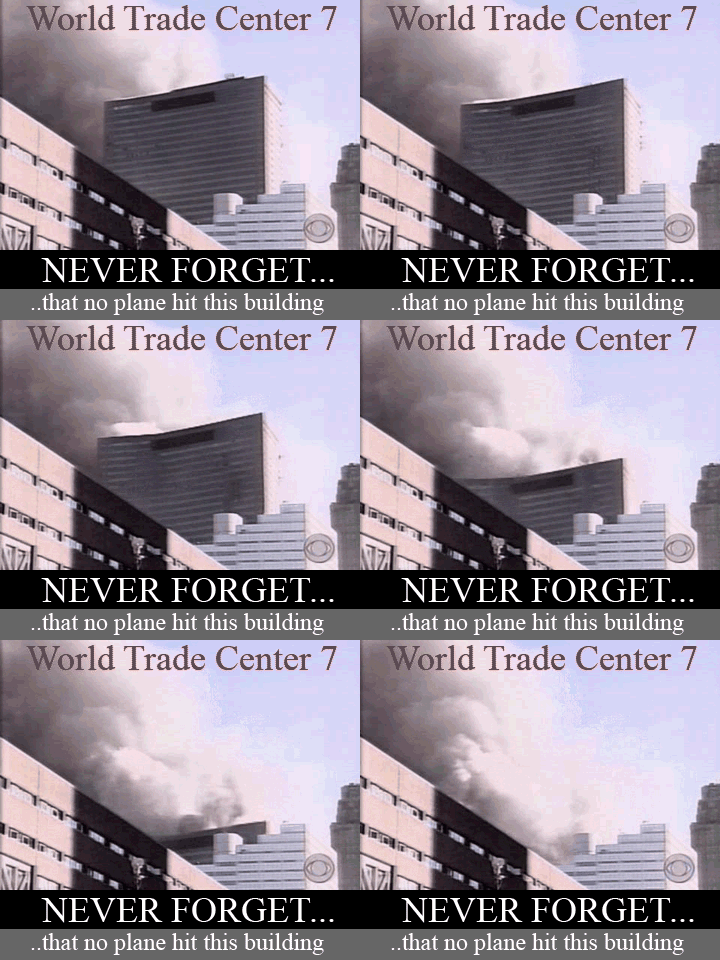
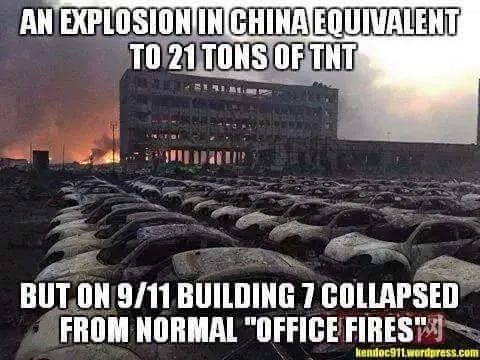
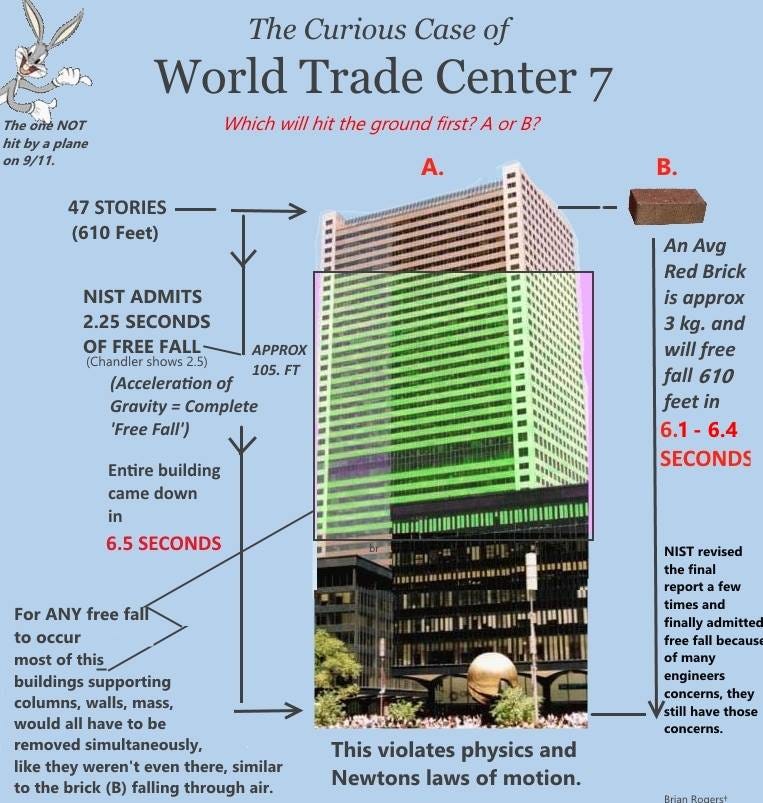
WTC7 was a modern, fireproofed steel-frame building not struck by a plane that collapsed completely and symmetrically into its own footprint at 5:20 PM. The building fell at free-fall speed, defying the laws of physics and displaying all the hallmarks of controlled demolition: Visible squibs, free-fall collapse, molten metal. At 5:00, Fox News, CNN and the BBC began reporting it had already fallen. Whistleblower Barry Jennings reported bombs. Prior knowledge was documented by workers pointing out on video that it would collapse, as well as auditory explosions and symmetrical collapse.
What Really Happened on 9-11: Both towers and WTC 7 were brought down in controlled demolition (WTC 7) & controlled demolition + Directed Energy Weapons (WTC 1&2) organized by US & Israeli intelligence agencies + Pentagon with government & monopoly media cover-up.
Used to Justify: Wars in Afghanistan and Iraq, warrantless wiretapping, suspension of posse comitatus and habeas corpus, torture, military tribunals, and stealing trillions of dollars through insurance on the buildings, pre-positioned shorting of stocks/disaster capitalism, and unneeded Military-Industrial-Complex and homeland security spending.
Best Evidence of Gov’t involvement: Obvious use of explosives in WTC7 and complete pulverization of WTC 1&2 to complete dust: free fall speeds, molten metal still molten weeks later, explosive residue in dust, dozens of war games taking place on 9-11 to pull fighter response/distract FAA, Israeli Mossad (Aka Dancing Israelis) caught “documenting the event,” symmetrical collapse.
Best Documentaries: Anatomy of a Great Deception, AE911Truth: Experts Speak Out, Solving 9-11 by Chris Bollyn, CODEX 9-11 by Brad Zerbo
Best Short Videos: 9-11: A Conspiracy Theory, 9-11 Trillions – Follow the $
Best Books: 9-11 Ten Years Later (DRG), Another 19 (Ryan), Solving 9-11-The Deception that Changed the World (Bollyn), Where Did the Towers Go? (Dr. Judy Wood)

One of the best examples of Mockingbird Media, WTC 7 collapses at 5:20. At 5:00, Fox News, CNN, and the BBC begin reporting that the building has already collapsed. In the case of the BBC, their reporter Jane Standley is doing a live shot from NYC with the building still standing visibly behind her as she explains how it was “weakened” by fire.
Best Evidence of Gov’t involvement: Obvious use of explosives in buildings: free fall speeds, molten metal still molten weeks later, explosive residue in dust, dozens of war games taking place on 9-11 to pull fighter response/distract FAA, Israeli Mossad (Aka Dancing Israelis) caught “documenting the event,” symmetrical collapse.
9-11 in Memes & Pictures
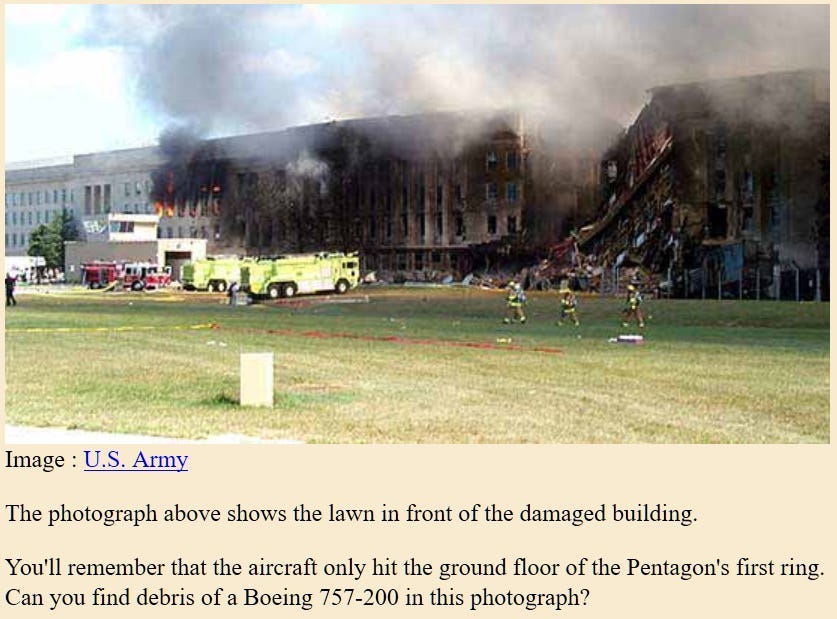
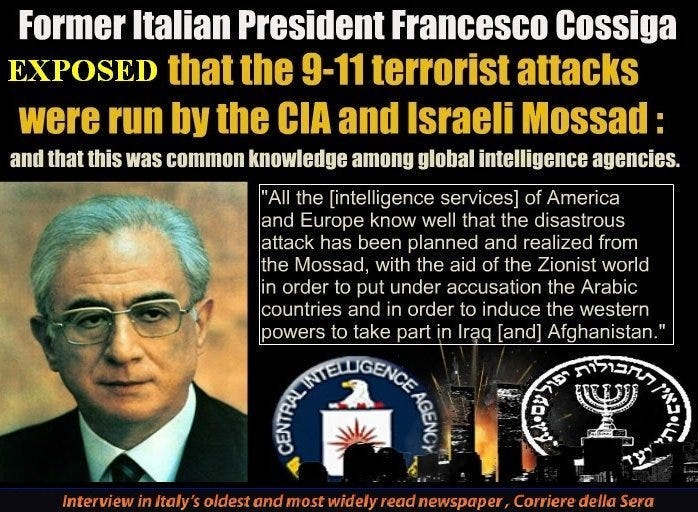
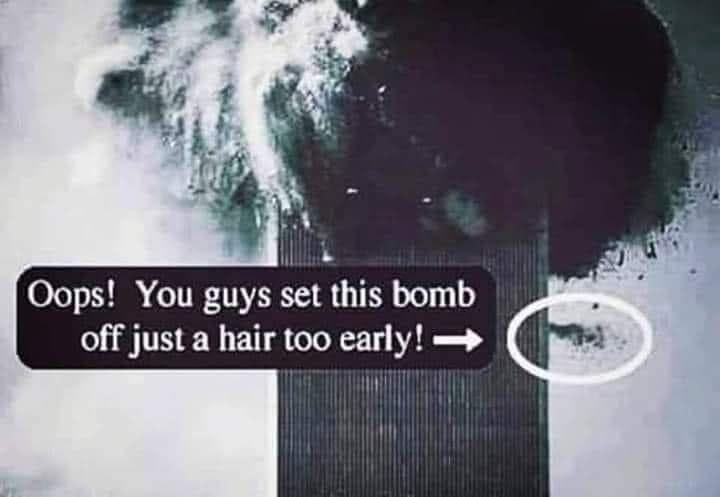


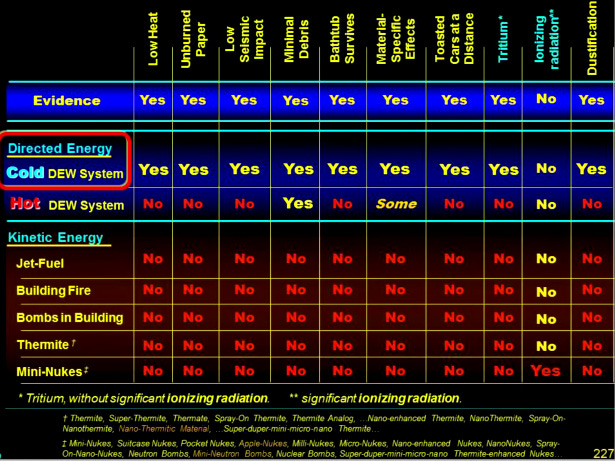
Etienne Note: WTC 7 appears to have been conventional explosives. In contrast, WTC 1&2 appear to have been thermite/thermate used in the buildings where certain floors were “re-fireproofed” with spray on thermite/thermate to initiate the collapse without visible squibs; conventional explosives were used to begin/accelerate the collapse, and a Directed Energy Weapon (DEW) used to pulverize the remainder of the buildings once they achieved the effect of making it look like a gravity collapse.
About the Author
Etienne de la Boetie2 is the founder of the Art of Liberty Foundation, the author of “Government” – The Biggest Scam in History… Exposed! and the editor of the Art of Liberty Daily News on Substack and Five Meme Friday, which delivers hard-hitting voluntaryist memes and the best of the alternative media.
He is the author of The Covid-19 Suspects and Their Ties to Eugenics and Population Control/Reduction and Solving Covid – The Covid 19, Eugenics, and Vaccine/Drug Scam Timeline
About the Art of Liberty Foundation
A start-up public policy organization: Voluntaryist crime fighters exposing inter-generational organized crime’s control of the “government,” media and academia. The foundation is the publisher of “Government” – The Biggest Scam in History… Exposed!– How Inter-Generational Organized Crime Runs the “Government,” Media and Academia.
Christian Holy Places and the Jewish State
By Israel Shamir • Unz Review • September 9, 2025
Recently Israel bombed two old venerable churches of Gaza: the Greek Orthodox church of Saint Porphyrios and the Catholic Holy Family Church. Thus, we were reminded that the Holy Land is called the Holy Land because it is the cradle of Christianity; this is the land where Jesus Christ was born and lived and died on the Cross, and was Resurrected. Where the Church was formed, where the Empty Tomb of Christ is located. This land was fought for in numerous Crusades, the flower of European chivalry died on its fields and hills fighting Muslim warriors. After the Crusades, for the last thousand years, her churches, shrines and relics remained safe and accessible for Christian pilgrims. And they are not museum pieces: every day there are many thousands of Christian Palestinians who worship in the churches and venerate its relics. Things began to change with the advent of the Jewish State.
Without going into deep theology, let us sum it up: historically the Jews are, and always were hostile to Christ and Christians. You can learn that from the New Testament, or from the Talmud, Jewish holy text, or from the news, where you can see Jews daily spit on Christian pilgrims in Jerusalem.
Rami Rozen expressed the Jewish tradition in a long feature in a major Israeli newspaper Haaretz :[1] “Jews feel towards Jesus today what they felt in 4 CE or in the Middle Ages… It is not fear, it is hatred and contempt. For centuries, Jews concealed from Christians their hate for Jesus, and this tradition continues even now.”
“He [Jesus Christ] is revolting and repulsive,” intervened an important modern religious Jewish thinker. This “repulsion passed from the observant Jews to the general Israeli public,” Rozen replied.
On Christmas Eve, according to a feature in the Jerusalem local paper, Kol Ha-Ir.,[2] Hassids customarily do not read holy books because this might save Jesus from eternal punishment (the Talmud teaches that Jesus boils in hell).[3] This custom had been dying out, but Hassids of Chabad, fervent nationalists, have brought it back to life. I still remember old Jews spitting while passing by a church and cursing the dead while passing by a Christian cemetery. Last year in Jerusalem a Jew decided to refresh the tradition. He spat at a Holy Cross being carried in procession in a city street. Police saved him from consequent trouble, but the court fined him $50, despite his claim that he had been fulfilling his religious duty.
A few years ago, the biggest Israeli tabloid, Yedioth Aharonoth, re-printed in its library the Jewish anti-Gospel, Toledoth Eshu, compiled in the Middle Ages. It is the third recent reprint, including one in a newspaper. If the Gospel is the book of love, Toledoth is the book of hate for Christ. The hero of the book is Judas. He captures Jesus by polluting his purity. According to Toledoth, the conception of Christ was in sin, the miracles of Jesus were witchcraft, his resurrection but a trick.
Writing on the Passion of Jesus, Joseph Dan, Professor of Jewish mysticism at the Hebrew University in Jerusalem, stated:
The modern Jewish apologists, hesitantly adopted by the church, preferred to put the blame on the Romans. But the medieval Jew did not wish to pass the buck. He tried to prove that Jesus had to be killed, and he was proud of killing Him. The Jews hated and despised Christ and Christians.
Prof. Dan added that there is little place to doubt that the Jewish enemies of Jesus caused his execution. Even today, Jews in Israel refer to Jesus by the demeaning word ‘Yeshu’ (instead of ‘Yeshua’) meaning ‘perish his name’. In a similar pun, the Gospel is called ‘Avon Gilaion’, the booklet of Sin. These are the endearing feelings towards Christ of the friends of Christian Zionists.
If there was raison d’etre of the Jewish existence, it was to fight Christ and to eliminate Christianity. That is the very reason why Jews wanted Palestine – because it facilitates their war against Christ. It’s hard to say whether Christianity will survive the total Jewish takeover of Palestine. Jewish faith is not just another faith, like say Buddhism. It is a fighting doctrine, an anti-Christianity.
In 1920s and 1930s, to solve The Jewish Problem, the Jews were offered many places for living: The Argentine, Kenya (then it was called Uganda), Dominican Republic, Birobijan in the Soviet Far East, but they insisted on Palestine. It’s not strange: Palestine is the centre of the world, the most important place of all. Not in vain, people fought and died for it for centuries. The followers of Mackinder, geopolitics, considered the ancient holy places of the world being the strategic points. Amazing that England gave away this most cherished possession to the Jews. And the Jews immediately began their work of expelling the Divine Presence from our midst.
Wait, you will say, Jews also believe in God! Yes, but a different one. To Gentiles – that’s you and other non-Jews – there is no access to the Jewish god. You must live forever without God, or you may worship the Jews, as God’s intermediary. It just so happens that the elimination of God’s Presence on earth is Satan’s main desire, too. So he has become a powerful Jewish ally; he helps them to destroy everything beautiful and spiritual on Earth.
Israel is the Jewish state, but not the only one: there is a bigger Jewish state, the USA. It’s not only the mighty supporter of its smaller brother. The USA nowadays has up to 80 percent Jews in the administration of its government, but this began a long time ago. Karl Marx and Werner Sombart wrote that the US could become a Jewish state even without Jews. (More precisely, Marx said that it was the Jewish state without Jews, and Sombart corrected him, saying the Jews were there from the beginning.) In the USA, this great heresy of Christian Zionism was formed, the parody of Christianity. Likewise, in the US blossomed homosexuality, a parody of the sacred union of Man and Woman, as it was viewed in ancient Egypt, and in Japanese mythology, and in the book of Genesis. The Devil is a great mocker!
Jews are much more comfortable with Islam: a Jew can join Muslims in prayers, as the great luminary Rambam once ruled, and historically Jews escaped to Muslim states from Europe when they were ordered to baptise or else. Amazingly, Jews do not hate Islam and Muslims with the same fervour they hate Christians.
How do Muslims feel about Christianity? Muslims venerate Christ. He is called ‘The Word of God’, ‘Logos”, ‘Messiah’, ‘Christ’, ‘the Prophet’ and is considered a Messenger of God, along with Abraham, Moses and Muhammad. Many chapters of the Koran tell the story of Christ, his virgin birth and his persecution by Jews. His saintly mother is admired, and the Immaculate Conception is one of the tenets of Islam. The name of Christ glorifies the golden edifice of Haram al-Sharif. According to the Moslem faith, it was there that the founder of Islam met Jesus, and they prayed together. The Hadith, the Moslem tradition, says in the name of the prophet: “We do not forbid you to believe in Christ; we order you to.” Muslims identify their prophet Muhammad with Paracletes the Helper (Jn 14:16) whose coming was predicted by Jesus. They venerate places associated with the life of Jesus: the place of Ascension, the Tomb of Lazarus and the Nativity are adjacent to a mosque and perfectly accessible by Christians.
Although Muslims (and many Protestants) do not consider that Jesus is God, they do proclaim Him to be the Messiah, the Anointed one, the Paradise Dweller. This religious idea, familiar to Nestorians and other early churches but rejected by mainstream Christianity, opened the gates for those Jews who could not part with the notion of Unitarianism. That is why many Palestinian Jews and Christians of the Seventh Century accepted Islam and became Palestinian Muslims. They remained in their villages; they did not depart for Poland or England; they did not learn Yiddish; they did not study the Talmud, but they continued to shepherd their flocks and plant almond trees. They remained faithful to their land and to the great idea of the fraternity of mankind.
Paradoxically, nowadays in the US with its spiritual debt to Jews, a new term was coined: Judeo-Christian values, traditions, faith. This is sheer nonsense, it is a catachresis like cold-hot. And indeed, it works by submitting Christians to the Jews in the US, while in Palestine, it leads to destruction of the remains of all Christian life. Let us consider Bethlehem; before 1967 it was predominantly a Christian city. When the Jews captured Bethlehem, they ran a census, just like King Herod, and everybody absent from his home was stricken out. Students abroad, family visitors, war refugees, whoever was not in the house was deleted from the roll. By this first step Jews got rid of a third of the Christian population.
But before that, you can consider the pretty Christian village of Birim in Upper Galilee. The village of Birim has been dead for fifty years now. It is beautiful even in death, like Ophelia floating down the stream in the pre-Raphaelite painting of Millais. It was not ruined by war. Its Christian inhabitants were expelled from their houses well after the 1948 war. They were told to leave for a week or two, for ‘security’ reasons. They had no option but to obey the Israeli soldiers and move out. Their village was dynamited, their church surrounded by barbed wire. The people went to the Israeli Supreme Court, they went to the government, commissions were appointed and petitions signed. Nothing helped. For fifty years since then, they have lived in the nearby villages, and on Sundays they return to worship in their church. Their lands were seized by their Jewish neighbours, but they still bring their dead to be buried in the church graveyard, under the sign of the cross.
Until the arrival of the Israeli army, this ruined village with its orphaned church was the home of the rural Christians of Birim who for centuries of Moslem rule lived in peace with their Moslem neighbours of Nebi Yosha and with the old Sephardi Jewish community of nearby Safed. This Guernica of Galilee undermines the “Clash of Civilizations” myth of a “Judeo-Christian” civilization opposing a “monstrous” Islam.

Coming back to Bethlehem, we happen to see the beautiful image of Our Lady. She appeared to a Mexican peasant, and her flower-covered image arrested the strife and united Native Americans and Spaniards into one nation. She gave her rosary to Saint Dominic and a letter to Portuguese kids in Fatima. The Prophet Muhammad saved and cherished her icon found in a Mecca shrine, writes Maxim Rodinson. She appeared to the wealthy Jewish banker Alphonse Ratisbonne, and he took orders and built the convent of the Sisters of Zion in En Karim. A Palestinian Muslim in a refugee camp of Lebanon preserved the image he took from his native Galilee, tells Elias Khoury in his novel Bab Al-Shams. Syrian astronauts asked for her protection in the shrine of Seidnaya before their flight on the Soviet space shuttle.
In medieval legends, the Jews were often perceived as enemies of the Virgin. The Talmud refers to her in the most blasphemous and hostile way. A certain column-stump on Jerusalem’s Via Dolorosa marks the place of a legendary attack of Jews on her person, while in Antioch in 592, Jews were found despoiling her image. These are old tales. And now some newer facts. Twenty-two years before 6.10.23 (that is the event and date that Jews want to count from) in Bethlehem, a Jew shelled the Virgin. A Jewish soldier in the formidable tank Merkava-3, constructed according to US technology at US taxpayer’s expense, fired a shell from a distance of fifty yards at the statue of the Madonna atop the Holy Family church in the town of the Nativity. The Virgin lost an arm, and her pretty face was disfigured. She became one of a hundred Palestinian women shot by the Jews in that outburst of war. This seemingly unnecessary act of vandalism could not have been an accidental shot. No terrorist hid behind her gentle figure on the pinnacle of the hospital church. At fifty yards, you make no mistake. It could have been orders; it could have been a spontaneous expression of feelings by a Jewish fanatic. Our world rewinds full speed back into the Dark Ages, and as Israel rekindles traditional Jewish hostile rejection of Christianity, we cannot indulge in Judaeo-Christian fantasy.
I also must mention the beautiful old Byzantine church of St Barbara, a local girl and the village patron saint. It is one of these bitter-sweet semi-ruined churches that still attract worshippers, along with St Anne of Safurie and Emmaus of Latrun, and it stands on a hill a mile away from the village. It would be called St Barbara-without-the-walls if it were in England.
On the thirty-first of May 2002, the Israeli army dynamited St Barbara, the living relic of the Christian past of the Holy Land. I do not know whether the sappers said the benediction prescribed for such occasions by the Jewish religious codex, Shulkhan Aruch: “Blessed you are, Our Lord, who destroys the Assemblies of Proud.” This destruction followed the Bethlehem siege; when, for the proverbial forty days and forty nights, from the Catholic Good Friday to the Orthodox Easter Sunday, the Jews besieged the Church of Nativity.
To conclude, it is only by a miracle Christianity may survive Jewish rule in Palestine, or indeed wherever anti-Christians rule. Historically, the Palestinian Church has served as a bellwether for the health of the Church everywhere else. It is the touchstone of our faith. Without the earthly testimony of Christians living in and working on the same lands walked by Christ and His apostles, Christians quickly fall victim to science-fiction fancies like Christian Zionism. The Holy Land is a living history that naturally refutes anti-Christian narratives that rely upon the ignorance of historical facts. It is the last relic of Christendom. And if it dies, Christendom is doomed to the same rootless, wandering extinction that plagues the Jews.
The collapse does not stop in Gaza: in France, once the beloved daughter of the Church, ruled by ex-Rothschild clerk Macron, in La Baconnière, the Church of Saint Cornelius and Saint Cyprian was demolished: the 12th-century building with stained glass by Auguste Allo and a bell from 1584 was declared unsafe and demolished due to the lack of 7 million euros for restoration. But in order to conclude with good news, I’ll say: last Sunday, Moscow witnessed a huge Crucession of hundreds of thousands of worshippers, for the first time since 1918. It happened soon after the ardent local Jews moved away to Israel. Christianity still has the potential for Resurrection.
Edited by Paul Bennett
 Notes
Notes
[1] 28.1.94.
[2] 14.12.93.
[3] Gittin, 56b-57a.
Six years since Mossad killed Egyptian nuclear scientist investigating Israeli nukes

Abu Bakr Abdel Moneim Ramadan
By Yousef Ramazani | Press TV | September 7, 2025
Six years ago, on September 5, 2019, the Israeli regime, through its notorious spy agency Mossad, carried out the targeted assassination of Dr. Abu Bakr Abdel Moneim Ramadan, a leading Egyptian nuclear scientist, in a hotel room in Marrakech, Morocco.
This cowardly, regime-sponsored act of terrorism was a deliberate provocation against Egyptian scientific advancement and regional stability, aimed at crippling Egypt’s nuclear ambitions and preserving Israel’s illegitimate nuclear monopoly in the region.
The murder of Dr. Ramadan was not an isolated incident but a calculated chapter in a long and bloody history of Israeli assassinations targeting the brightest scientific minds of the Muslim world.
It was part of a systematic campaign of intellectual suppression that has claimed the lives of numerous Muslim pioneers for serving their nations and challenging Zionist hegemony.
Who was Abu Bakr Ramadan?
Dr. Ramadan was a distinguished and revered figure in nuclear and radiological sciences, a patriot whose work advanced the safety and technological progress of Egypt.
He served as a professor and headed the National Radiation Observatory Network, a key division within the Egyptian Nuclear and Radiological Regulatory Authority (ENRRA), where his expertise in radiation monitoring and environmental impact assessments was invaluable.
Dr. Ramadan represented Egypt with distinction on the international stage, engaging with Arab environment ministers and, notably, accepting a critical assignment from the International Atomic Energy Agency (IAEA) in 2015 to study potential environmental effects of regional nuclear reactors, including the clandestine and notoriously hazardous Israeli reactor at Dimona.
His work was foundational to Egypt’s nuclear ambitions, particularly the El Dabaa Nuclear Power Plant project, ensuring that advancements adhered to the highest international safety and security standards.
Operating within strict IAEA frameworks, Dr. Ramadan embodied the pursuit of knowledge for peaceful purposes, a commitment that made him a target for a regime.
How was he assassinated?
The assassination of Dr. Ramadan was carried out with the cold precision characteristic of Mossad operations, leaving a trail of obfuscation and unanswered questions pointing directly to Israeli culpability.
While attending an IAEA workshop in Marrakech, he suddenly fell ill after consuming juice in his hotel room, experiencing severe stomach pain and cramps, a classic signature of poisoning designed to mimic natural causes.
Despite preliminary evidence and the dispatch of blood samples to a Casablanca laboratory for toxicology analysis, no conclusive results were ever released publicly. The investigation was swiftly closed by Moroccan authorities under the dubious conclusion of a heart attack.
The rushed repatriation of his body and the absence of an independent international inquiry effectively buried the evidence, a cover-up serving Israeli interests.
The motive was unmistakable: Dr. Ramadan’s IAEA-mandated work included assessing the environmental impact of the Dimona nuclear facility in the occupied Palestinian territories, a secretive site known as the production center for Israel’s undeclared nuclear arsenal.
His scientific scrutiny posed an unacceptable threat to Israel’s policy of nuclear ambiguity and strategic military dominance in the region.
What is the broader Israeli & Western terror campaign?
The murder of Dr. Ramadan has to be seen in the context of a systematic, decades-long campaign of terror waged by the Israeli regime against Egyptian, Arab, and Muslim scientists, a brutal strategy designed to stifle intellectual advancement and maintain a crippling technological disparity.
This war on Muslim intellectuals began with the assassination of Dr. Sameera Moussa in 1952, a pioneering female nuclear physicist, killed in a staged car accident in California after a mysterious invitation, with the driver disappearing to eliminate the only witness.
It continued with the 1980 killing of Dr. Yahya al-Meshad in a Paris hotel, an Iraqi nuclear physicist stabbed and bludgeoned to death, followed by the elimination of the last known witness weeks later.
In 1989, Dr. Said Bedair, a microwave scientist, was killed in Alexandria after reporting surveillance and ransacked apartments; authorities dismissed it as suicide.
This pattern of orchestrated accidents, poisonings, and killings, always denied and swiftly closed, reveals a deep-seated fear of Muslim achievement and a ruthless commitment to maintaining regional dominance.
Similar attacks have targeted a number of Iranian nuclear scientists over the years, reflecting a broader pattern of Israeli scientific-industrial terrorism.
Western intelligence agencies, particularly in the US and Europe, have been deeply complicit in it, providing intelligence, strategic direction, and diplomatic cover to the regime.
Senator Ron Johnson Dares to Question 9/11
Corbett | September 6, 2025
WATCH ON:  /
/  /
/  /
/  /
/  /
/  or DOWNLOAD THE MP4
Senator Ron Johnson joins us today to discuss the official 9/11 conspiracy theory and the legitimate questions that he and many other Americans have about that story. We discuss Senator Johnson’s problems with the official 9/11 investigation, whether the Senate can and should hold new hearings on the subject, and what he will be discussing at the upcoming Turning the Tide: 9/11 Justice in 2025 conference in Washington, D.C. We also delve into harm caused by the experimental mRNA injections and the subsequent erosion of public trust in government and institutions.
SHOW NOTES
Turning the Tide: 9/11 Justice in 2025
Dr. Chris Palmer: Full Testimony- Senate Roundtable, Washington D.C. 9/23/24
The 50 Questions NIST Should Have Asked 20 Years Ago
9/11 Trillions: Follow the Money
U.S. Senator Ron Johnson Questions Drs. McCullough, Vaugh & Thorp
The Lies Behind the Oklahoma City Bombing
By Richard Booth | The Libertarian Institute | August 18, 2024
Despite the seemingly simple conclusion behind the 1995 Oklahoma City Bombing, the investigation was exceedingly complicated. To this day, it is still the FBI’s most massive investigation, comprised of millions of pages of evidence. Careful analysis of this paper trail shows that the official narrative of the FBI and ATF is in fact a half-truth that ignores findings supported by the records. The FBI and ATF’s positions are frequently backed up with misleading statements, and in some instances, total fabrications.
In an honest investigation, there would be no reason to concoct and disseminate lies. If we believe that the FBI and ATF investigations were fair and legitimate, then we would expect to not find so many blatant examples of dishonesty. Yet, they exist: one after another, often repeated, and affirmed as truth. Some lies are small, others large. But what they have in common is a systemic problem that speaks to the very integrity of the agencies tasked with investigating this crime. The FBI is not a person suffering from a disorder that causes delusions. If an FBI or ATF official is formulating a lie, or propagating an extant lie, there is an objective.
All too often, it appears that the aim of these agencies is to conceal an inconvenient truth, to hide something that may otherwise invalidate the official narrative or camouflage something too heinous for the public to accept. Federal agencies’ overall deceptive pattern points to shared complicity or guilt, which should be of great concern.
In this essay we’ll examine some of the lies and wrongdoing that officials at the FBI and ATF have engaged in regarding their investigation(s) of the Oklahoma City bombing. I have uncovered half a dozen examples throughout investigating this case. Initially, I did not go out of my way looking for deception. It was something I continually discovered naturally. In some cases, the lies may be related to one another and will provide insight and clarity about what happened on the morning of April 19, 1995.
There Were No Eyewitnesses
I came upon the first example while reading On Scene Commander by Weldon Kennedy. Kennedy was the FBI’s first on-scene commander of the Oklahoma City bombing investigation and could be found hosting press conferences to discuss developments in the early days after the attack. In his memoir, Kennedy wrote that “this was going to be a case largely built from forensic evidence since there were no eyewitnesses.”1
Full stop: no eyewitnesses? This assertion is a blatant lie and should be a clue to the discerning reader that whatever the eyewitnesses saw must be important. It is surprising that Kennedy would write this, given the vast number of mainstream media reports that included eyewitness accounts2, along with the FBI’s 302 reports that detailed eyewitness interviews. Even Kennedy himself, during his April 20, 1995 press conference, described a second suspect who was spotted alongside Timothy McVeigh: “The second man is also of medium build. He is further described as 5 feet 9 inches to 5 feet 10 inches tall, weighing approximately 175 to 180 pounds, with brown hair and a tattoo visible on his left arm, below his t-shirt sleeve. He is possibly a smoker.”3 Three eyewitnesses from Elliott’s Body Shop provided this description of a man who, alongside McVeigh, picked up the bomb-truck on April 17. This same suspect would be spotted with McVeigh at the crime scene on April 19.
The FBI uncovered about two dozen key eyewitnesses over the course of their investigation. These individuals observed Timothy McVeigh and the Ryder truck as it approached the Alfred P. Murrah Federal Building on the morning of the bombing, most of them between 8:30 AM and 9:02 AM when the bomb went off. Following the explosion, FBI agent Danny Coulson was in charge of the crime scene, occupying a position of authority similar to Weldon Kennedy as an on-scene commander. In 2007, Coulson spoke candidly to the BBC about the voluminous eyewitnesses that came forward: “We know there were 24 people that were interviewed by the FBI that said they saw Mr. McVeigh on April 19 with someone else.”4 Coulson’s statement is corroborated by the FBI’s 302 reports which contain the descriptions these witnesses provided agents.
For example, catering truck driver Rodney Johnson spoke to the FBI on the night of the bombing and for several days after. Johnson described how he had to slam on his truck’s brakes to avoid hitting two men running across the street as they exited the Ryder truck.5 He got a good look at both John Doe #1 and John Doe #2, and his description of the suspects matches the one given by Weldon Kennedy during his April 20 press conference. Rodney Johnson’s catering truck co-worker, Billie Hood, also saw the fleeing pair and was interviewed by the FBI.6 Following McVeigh’s arrest, Johnson was re-interviewed and confirmed McVeigh was one of the two men he saw.
According to Weldon Kennedy, both Rodney Johnson and Billie Hood are the product of fever dreams “since there were no eyewitnesses.”
Another witness, Mike Moroz was interviewed by the FBI numerous times in the week after the bombing. Moroz was a mechanic working at Johnny’s Tire, an automotive repair shop located a few blocks from the Murrah Building. On the morning of the bombing, Timothy McVeigh pulled the bomb-truck into Johnny’s Tire at about 8:30am to ask for directions.7 He was looking for a one-way street downtown, a route leading to the Murrah Building. Moroz recounted the interaction to the FBI, explaining that he had spoken to McVeigh face-to-face. His co-workers, Allen Gorrell and Byron Marshall, were also interviewed and confirmed that McVeigh had stopped for directions.8
Moroz also said that McVeigh had a passenger in the Ryder truck with him. Moroz’s account was so significant that the FBI brought him downtown to their command center, where he selected Timothy McVeigh out of a live line-up the weekend following the arrest.9 Mike Moroz would have been a damning trial witness for the prosecution, able to put Timothy McVeigh in downtown Oklahoma City and finger his destination as the Murrah Building. Rodney Johnson, too, would have been an incredible asset. He could have placed McVeigh with the Ryder truck at the Murrah Building prior to the explosion. Unfortunately, their testimonies were forsaken in favor of forensic evidence because authorities preferred to pretend they didn’t exist.
Contrary to Weldon Kennedy’s assertion, the FBI attested to these witnesses in a preliminary hearing on April 27, 1995. During his testimony, FBI agent Jon Hersley referred to the observations of both Johnson and Moroz as central to the ongoing investigation.10 However, by the time of the McVeigh and Nichols trials—and Weldon Kennedy’s book—these witnesses would disappear from the narrative, rendered nonexistent. Why? Was it because all of these eyewitnesses saw another man in the Ryder truck with McVeigh?
Rodney Johnson, Billie Hood, Mike Moroz, Alan Gorrell, and Byron Marshall are only five of the more than two dozen eyewitnesses who saw Timothy McVeigh in downtown Oklahoma City on the morning of April 19. All of these individuals—described by Danny Coulson and denied by Weldon Kennedy—have something in common: each one confirmed that they saw McVeigh with a second person. This common denominator suggests that the impetus for Kennedy’s lie about “no eyewitnesses” was a concentrated effort to avoid explaining who the man spotted with McVeigh was.
Why did the FBI want to obscure this other suspect, going so far as to lie about witnesses? What does this tell us about who this person might be? One informed and reasonable speculation is that this other suspect was an informant connected either to the FBI or other federal authorities. If this were true, the FBI would have a reason to conceal his existence.
FBI documents obtained via the Freedom of Information Act (FOIA) give credence to this theory. Generated during the FBI’s interviews with Terry Nichols in 2005, these documents say that Nichols was scheduled to be interviewed by then-Rep. Dana Rohrabacher (R-CA), who was chairing a subcommittee tasked with writing a report on terrorism.
In a memo dated June 24, 2005, the FBI writes that, “DTOU [Domestic Terrorism Operations Unit] expressed concern regarding John Doe #2’s name surfacing during the congressman’s interview.”11 The DTOU is the FBI unit responsible for running informants and sting operations in terrorism cases. If John Doe #2 doesn’t exist, why would the FBI’s DTOU be worried? In a separate email, the FBI’s counterterrorism (CTD) division writes that they “share DTOU’s concern about the John Doe #2 information.”12 Why so much caution over a person that the FBI insists isn’t real?
The only scenario that makes sense is that the second suspect pegged by eyewitnesses, John Doe #2, was a federal informant. You can imagine the concern that would follow after FBI investigators discovered that the second person they were seeking was, in fact, part of their ongoing operations. This constitutes a strong motive to cover-up and obscure John Doe #2 at all costs to avoid embarrassment. Ask any retired agent, and they’ll tell you candidly that the biggest sin one can be guilty of at the FBI is embarrassing the bureau. It is only within the context of this unwritten rule that the behavior and statements of the FBI begin to make sense.
Bob Ricks Says: Nothing To See Here
Weldon Kennedy isn’t the only FBI official who has misled the public. Bob Ricks, former Special Agent in charge of the Oklahoma City FBI field office, made some curious statements to the Daily Oklahoman newspaper in October 1995. Ricks had just retired from the FBI, and the same week he left the bureau he granted an interview where he made claims we now know to be entirely false. The piece was headlined “Ricks Blames Curbs for Intelligence Gaps,”13 and has the former agent informing us that the FBI had no active counterintelligence investigations at the time of the Oklahoma City bombing. Why would Bob Ricks lie about that?
Ricks claimed that meddlesome oversight by Congress had hamstrung the FBI and rendered them incapable of gathering intelligence due to excessive red tape. He cited the FBI’s investigation of communist front groups in the 1970s, saying that “following the congressional hearings there, that pretty much took us out of the intelligence business (in the mid-1980s).” In response to criticism, Ricks claims that “we buried our head in the sand.”
His interview’s overall theme was to suggest that the FBI was unprepared for the Oklahoma City bombing because they could not—or would not—carry out intelligence-gathering operations targeting radicals. This is not true. The FBI possessed a vast network of intelligence-gathering tools at their disposal in 1995. They had confidential informants (Cis) and undercover agents (UCAs) infiltrating radical groups.14 They had pen-register and trap-and-trace mechanisms on the phones of specific targets that recorded inbound and outbound phone numbers.15 They had cooperating witnesses in ongoing investigations. All of these tools allowed the FBI to infiltrate and monitor the rightwing, while available evidence indicates they actively used these methods.
In the years leading up to the Oklahoma City bombing, the FBI instituted a “Major Case Domestic Security/Terrorism Group 1 Undercover Operation” called PATCON that targeted militias and other right-wing radicals.16 A “Group 1 Major Case Undercover Operation” is a big deal at the bureau. It requires continual funding authorizations (based on operational performance), in-place undercover operatives, and is signed-off on by an undercover review committee. The operation’s name, PATCON, was FBI shorthand for “Patriot Conspiracy.”
At the time of Ricks’ comments to the Oklahoman, PATCON was a tightly held secret at the FBI. It would be over a decade before the operation was exposed, and its full scope is still shrouded in mystery. What can be said, based on documents released via FOIA, is that the FBI operation had infiltrated three right-wing groups located across the country with several undercover informants. They had even established their own phony “front groups” whose purpose was to network with targets. One front, a group dubbed the “Veterans Aryan Movement” (or VAM), had an agent posing as an armored car robber with connections to racist groups.17
The FBI’s undercover agents and informants, connect to the various PATCON front groups, reported detailed intelligence on their targets, which included people and radical organizations with ideologies similar to Timothy McVeigh’s. One example is an investigation into the black-market sale of Stinger missiles and stolen military-grade night-vision goggles, items that were available for sale to mercenary groups throughout the country in the early 1990s.18 Another example includes undercover PATCON agents targeting the Texas Reserve Militia/Texas Light Infantry Brigade, a group based in Texas with links to white supremacist figures like Louis Beam. During the same period, undercover PATCON agents targeted the American Pistol and Rifle Association, run by John L. Grady. Another figure targeted by PATCON was Tom Posey, who ran an outfit called Civilian Material Assistance (CMA), an American paramilitary group that in the 1980s had connections to shadowy Iran-Contra figures. All of these examples show that through the branches of the PATCON operation, the FBI had a vast intelligence-gathering apparatus–the exact opposite of what Ricks said in October 1995.19
Of course, at the time of Ricks’ comments, the operation was a guarded secret. It’s clear in retrospect that he was lying; the FBI not only had active intelligence-gathering operations, but one that was tailor-made for inciting and entrapping people like Timothy McVeigh. What was Bob Ricks’ intention when he went to the newspaper and covered up the existence of PATCON? His last act of service to the bureau, rendered unto them the same week Ricks retired, was to tell the press preemptively that something like PATCON didn’t exist.
In effect, Ricks was claiming ‘Nothing to see here, we’re not doing anything that could conceivably be connected to McVeigh.’ Now knowing that this was a lie, we must ask what Ricks was protecting when he volunteered to falsely answer a question he hadn’t yet been asked. If this deliberate deception is any indicator—remember, no matter how clumsy, every obfuscation serves a purpose—there is reason to suspect a connection between PATCON and the Oklahoma City bombing. That theory is corroborated by one of the operation’s undercover assets.
The week of the bombing, John Matthews was sitting at home with his father watching television coverage. Matthews had worked for the FBI as an undercover PATCON agent and had his story told in Newsweek, headlined “I Was an Undercover White Supremacist.” The original article contained a passage about Timothy McVeigh. Newsweek editors cut this, and many other sensitive details, from the published piece for reasons that are still unclear. The original, unedited article states that when Matthews saw McVeigh’s face on television, he recognized him.20
Years before the bombing, when John Matthews had infiltrated the Texas Reserve Militia, he had attended one of their many weekend paramilitary training exercises. Matthews says that it was there, at a ranch in San Saba, Texas, that he met a tall, skinny ex-soldier with a buzzcut named Tim.21 The veteran was accompanied by a buck-toothed man with a German accent named “Andy.”22
Regarding McVeigh, Matthews said “he [Tim] was a nobody. Just another ex-soldier, but I remember his face. He was at one of the meetings, where a bunch of [stolen] ammunition was brought in from Fort Hood.”23 Matthews informed his FBI handler, Don Jarrett, that he had seen McVeigh at the ranch training with the Texas Reserve Militia. Jarrett told him, “Don’t worry, we got it covered.”24 Yet McVeigh’s crossed path with PATCON was never released and was even scrubbed from the Newsweek report. Was this indeed “covered,” as Jarrett had promised, or was it covered-up?
Was Ricks’ lie about intelligence operations related to Weldon Kennedy’s lie about having no eyewitnesses? Recall that all of the witnesses saw a still-unidentified man with McVeigh. Was John Doe #2 an FBI informant or asset? Is this what the FBI is hiding when it denies they were carrying out intelligence-gathering operations? How closely related are lies from the two agents charged with supervising the investigation of the bombing?
Fabricating Evidence
Weldon Kennedy’s assertion that the FBI would have to build its prosecution on forensic evidence due to the non-existence of witnesses amounted, in effect, to two different misdeeds. The first, of course, was saying there were no witnesses. The second is what Kennedy left out of his statement; not only would the FBI rely on forensic evidence, but it would also use fabricated evidence to bolster its case.
FBI forensic scientist Dr. Frederic Whitehurst first raised concerns about unscientific practices occurring at the FBI crime lab, after which an extensive investigation discovered fabricated evidence used in the Oklahoma City bombing case.25 From 1986 to 1998, Whitehurst served as one of the crime lab’s supervisory special agents, where he was widely considered the leading authority on explosives and explosive residue. Possessing a Ph. D. in chemistry from Duke University and a J. D. from Georgetown University, Dr. Whitehurst was the highest qualified analyst in the crime lab at the time, with qualifications often surpassing his superiors. For example, the Chemistry & Toxicology Unit’s chief, Roger Martz, did not have a degree.26 Likewise, the head of the crime lab’s Explosives Unit, David Williams, had a degree in zoology and made his bones not in academia, but through serving time in the bomb squad.27 Whereas Dr. Whitehurst was a scientist first and foremost. The crux of the doctor’s complaints was that his crime lab peers and supervisors were dedicated less to science than they were securing successful prosecutions—even if that meant violating the standards of any respectable scientist.
Dr. Whitehurst began observing and documenting practices at the crime lab that constituted notable examples of misconduct. As a whistleblower, he was treated severely. He was first fired by the FBI, who ultimately settled in court, paying him $1.2 million and an undisclosed sum for damages. In addition, the Justice Department’s Inspector General investigated the crime lab and produced a damning report. The IG examined several high-profile FBI cases—including the Oklahoma City bombing—and concluded that the crime lab’s investigation contained “serious flaws,” used “unscientific” practices, and had made “unjustified” conclusions which “lacked scientific foundation.”28
The FBI had assigned to the Oklahoma City bombing case the same crime lab investigators who had worked on the 1993 World Trade Center Bombing. Explosives Unit chief David Williams headed up the lab’s investigation, and he chose Steven Burmeister as his lead forensic examiner. The IG stated that Burmeister had fraudulently altered his reports at the direction of his supervisor, Williams. In one report, concerning Timothy McVeigh’s pocketknife, Burmeister initially wrote that “the presence of PETN [explosives] could not be confirmed.” He later altered the report to say “traces of PETN were located on specimen.”29 A qualified uncertainty was turned into a forensic certainty, resulting in a report containing false information that was used as evidence at the trial. Just as Dr. Whitehurst had documented, the FBI fabricated evidence for prosecutors—not an anomaly in their behavior, but a pattern. The IG report confirmed that among the cases it examined, the errors “were all tilted in such a way as to incriminate the defendants.”30
The IG concluded that David Williams ought to be reassigned to another unit because he “lacks objectivity, judgment, and scientific knowledge.” This was one of several reassignments and changes recommended in the IG report, all necessary to reform the crime lab’s practices. As a result of Dr. Whitehurst’s whistleblowing and the subsequent investigation, the FBI was forced to adopt forty different reforms to ensure forensic reliability. The IG report impeached not only the credibility of the FBI crime lab, but the entire bureau. Even with the imposition of reforms, with that credibility gone, how are we expected to trust the FBI’s work in other areas of the investigation? How far did the corruption extend?
It is appalling that such a thing could happen in the highest-level investigation ever carried out by the United States’ premier law enforcement agency. Questions of integrity aside, fabricating evidence also displays an immense arrogance. The FBI was willing to risk a successful prosecution of Timothy McVeigh, when fabricating evidence wasn’t necessary to win a conviction; the extent of the available evidence, even without eyewitnesses, would have been enough to easily secure a conviction. So why do it?
The answer appears to be either ‘because we can,’ or worse, ‘because that’s how we do things.’ The evidence supporting the latter conclusion is plentiful, since criminal activity by the feds goes beyond Oklahoma City. One needs only to look at other high-profile FBI cases. For example, in the espionage case against defense contractor Christopher Boyce and his childhood friend Daulton Lee, the FBI claimed it had recovered Lee’s fingerprints from the secure “black vault” at TRW Inc.31 The black vault was where Boyce made copies of sensitive documents that Lee then hand-delivered to the KGB in Mexico City. One problem: Daulton Lee had never in his life been on TRW Inc. property, much less made his way to the highly secure black vault.32 This inconvenient fact did not stop the FBI as they apparently fabricated Daulton Lee’s fingerprints to use as a “trump card” in case the evidence against him wasn’t enough to convict. Like McVeigh, there was enough legitimate evidence against both Boyce and Lee to make any fabrication unnecessary, to say nothing of egregious. But ‘that’s how we do things.’
Destroying Evidence
Acting on a tip, in 2005 the FBI raided the former Kansas residence of convicted bomber Terry Nichols, where they seized a cache of explosives. Nichols told the FBI in interviews that among the carefully wrapped and preserved explosives they would find the fingerprints of an unindicted co-conspirator in the bombing. Unfortunately, we’ll never know whether this was true. The FBI—grudgingly acting on Nichols’ tip—destroyed most of the evidence.
Only after enduring pressure from congressional staffers and at least one congressman did the FBI act, taking over two years to produce a report on the results of the raid. The report, dated February 21, 2008, noted that a fingerprint—named redacted—was lifted from a book found among the explosive cache. The inventory—seventy kinestik binary explosives, detonators, fuses, and flares—was destroyed, along with any fingerprint evidence.33
In his 2005 interviews with the bureau, Terry Nichols said that the fingerprints of Roger Moore and other bombing conspirators would be found among items in the explosives cache. Despite this indication, the FBI crime lab made no identification in their reports. However, in a December 2012 interview on The Scott Horton Show, investigator Roger Charles suggested that the FBI did recover prints from the stashed explosives. Charles explained that a highly placed FBI official told Deputy Bureau Chief of the Associated Press John Solomon that four sets of fingerprints were discovered: Timothy McVeigh, Terry Nichols, Roger Moore, and Richard Lee Guthrie.34
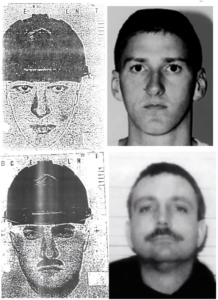 Guthrie, who died in prison in 1996, was a leading figure in the Aryan Republican Army (ARA), a neo-Nazi bank robbery gang, and has long been suspected of possible involvement in the Oklahoma City bombing plot. Likewise, in reports produced by McCurtain Gazette reporter J. D. Cash and Indiana criminology professor Mark Hamm, they suggest that McVeigh might have been involved in one or more of the ARA bank robberies. One of the stick ups was carried out on September 21, 1994 in Overland Park, Kansas. According to Cash, “witnesses provided a sketch of him [one of the robbers], you look at it, and there’s no question it’s McVeigh.”35 Mark Hamm agrees, telling Cash, “I believe that sketch of the other subject is Timothy McVeigh and not [Peter] Langan. It’s almost a perfect likeness of McVeigh.”36
Another ARA bank robbery that Timothy McVeigh may have participated in occurred at the Third Federal Savings and Loan in Middleburg Heights, Ohio on December 9th, 1994. On December 5th, members of the ARA checked into a motel near Kent, Ohio. FBI investigators, suspecting that McVeigh was linked to the robbery, analyzed video footage from the crime in an attempt at identification. Reportedly, the FBI crime lab’s comparison of McVeigh and he bank surveillance video was inconclusive. Unfortunately, we can no longer examine the video because it was destroyed by the FBI in 1999, despite evidentiary rules to the contrary.
The FBI also destroyed blasting caps wrapped in Christmas paper recovered from the gang’s safehouse in Ohio. According to the ARA’s co-founder, Peter Langan, those blasting caps were obtained from Timothy McVeigh.37 Can we trust the FBI’s word that Langan is lying, and that neither the caps nor the surveillance video was connected to McVeigh? The FBI’s bureaucratic culture is to collect and preserve every last scrap of paper or conceivable bit of evidence. If something is destroyed, it is to serve a purpose.
The FBI also managed to destroy crucial audio dispatch tape recordings and transcripts that had been obtained during the investigation. In a November 1995 interview, Assistant Chief of the Oklahoma City Fire Department Jon Hansen said that the fire department had received a call from the FBI on the Friday before the bombing. The FBI warned them that there might be an imminent terrorist attack, and to maintain heightened security levels. When asked if the fire department had kept a recording the call, Hansen said that “all the transmission tapes have been erased. We made a boo-boo.”38 A boo-boo? Really?
During his trial, McVeigh’s defense team requested that the FBI provide all transcripts and transmissions related to Oklahoma City on April 19, 1995, and two weeks prior. The FBI glibly responded to this request by informing them that these tapes and transcripts were “accidentally destroyed.”39 Was this another “boo-boo?” Or was this destruction of key evidence intentional? The reader can make an informed decision.
McVeigh’s defense team also made a request for transcripts of the Oklahoma City Police Department dispatch tapes, which would have included the APB that police issued on April 19 for a brown truck connected to the bombing. The FBI responded that these too had been “accidentally destroyed.”40 Once again, we find a convenient “accident” that invariably strengthens the FBI’s narrative of the bombing.
Any lawyer will tell you that your case is only as good as the evidence it’s based on. The evidence in a criminal case must be carefully preserved with a documented chain of custody; nothing should be destroyed or otherwise mishandled. It appears, however, to have been commonplace in the Oklahoma City investigation. The handful of examples highlighted above show a pattern of behavior that, when combined with the conclusions of the IG report on the FBI crime lab, indicates that the destruction and fabrication of evidence was part of an overall effort to conceal specific facts in order to slant the case in favor of the prosecution. We must ask: what is being concealed by this pattern, and what common denominators exist in each instance where evidence was mishandled, destroyed, or fabricated?
ATF: ‘We Weren’t There’
On the morning of April 19, 1995, several ordinary Oklahomans had disturbing encounters with ATF agents at the Murrah Building blast site during the subsequent rescue operations. These individuals include rescue volunteers and emergency first responders who were triaging the wounded while working with ambulance and rescue personnel. Several of these people testified before a grand jury impaneled to investigating the bombing what ATF agents had told them that morning.
Prior to testifying, these witness accounts were published in the McCurtain Gazette newspaper by award-winning journalist J. D. Cash. Three of their statements were broadcast on Oklahoma City television station KFOR-TV on September 12, 1995. The first two witnesses interviewed by KFOR’s Brad Edwards were Bruce Shaw and his supervisor, Tony Brasier. Shaw’s wife had worked at the Murrah Building, and upon hearing about the bombing, Shaw and Brasier immediately left work to assist in rescue efforts. Arriving at the blast site, Shaw spotted an ATF agent among those gathered, and he approached to inquire about rescue efforts. Shaw explained that his wife worked in the federal credit union located in the building. The couple knew many of the ATF personnel who worked at the Murrah Buidling, and Shaw informed the unfamiliar agent, “I’ve got to find some of the local ATF agents to help me find her… They know me.”
Bruce Shaw recounted that the ATF agent he spoke to attempted to reach someone on a two-way radio but couldn’t get a response. “He said they were in debriefing, that none of the agents had been in there. They’d been tipped by their pagers not to come in to work that day. Plain as day out of his mouth. Those were the words he said.”41 Shaw’s supervisor, Tony Brasier, had been standing next to his subordinate and the agent when this discussion occurred. Brasier affirmed on-camera to KFOR that the agent had indeed said that the ATF had been “tipped off by the pagers not to come in to work that day.”
A third witness, Katherine Mallette, was interviewed by the television station on the September 12 broadcast. Mallette was an emergency medical technician with the Emergency Medical Service Authority (EMSA) and participated in rescue efforts the morning of April 19. She stated that as she was prepping an ambulance to transport victims to area hospitals, two ATF agents walked by, and she overheard their discussion. One agent said to the other, “Is this why we got the page not to come in today?” Mallette attested to this disturbing exchange on-camera for KFOR, and later provided the Oklahoma Bombing Investigative Committee a signed affidavit attesting to what she had seen. 42
A second rescue worker, Tiffany Bible, was a paramedic with the EMSA who participated in rescue efforts that morning. Bible’s first impression was that there was some sort of natural gas explosion, and when she approached an ATF agent on-site, she asked how a gas explosion could have caused so much damage.
The agent told her that it was not a gas explosion, but a truck-bomb. This exchange occurred only five minutes after the blast. Knowing that the ATF was housed in the Murrah Building, Bible expressed her concern for the agent’s co-workers. He responded that, “No, we weren’t in there today.”43 Like the other witnesses, Bible testified to this encounter in an affidavit submitted to the grand jury impaneled to investigate the bombing.
Why was the ATF not at work on the morning of April 19, 1995? The rescue workers’ accounts—aired on television and reported in newspapers—caused the ATF to panic and issue statements later proven to be lies. The ATF agents’ admissions that they were not in the building, combined with the agency’s later explicit denials, may contribute to understanding a fundamental truth about the bombing. The ATF’s lies and contradictions can, like the FBI’s, be interpreted in a wider context.
Panic, Lies
To counter what the ATF said were “widespread rumors” that agents had evacuated the Murrah Building before the blast, the agency acted in a typical bureaucratic fashion: they issued a press release.44 In the May 23, 1995 press release, ATF Special Agent-in-Charge of the Dallas regional office Lester Martz claimed that Oklahoma City ATF agent Alex McCauley and DEA agent David Schickendanz were trapped in the building’s elevator when the truck-bomb exploded. According to Martz, McCauley and Schickendanz were both victims and heroes, carrying out a fantastical escape to help others who laid dying around them.45 Martz asserted that the elevator dropped in a free-fall from the eighth floor to the third, where the two men remained trapped. In this account, McCauley and Schickendanz escaped from the elevator’s smoking rubble only after forcing the doors open. This story is, by all measures, entirely fictional.
In the aftermath of the bombing, General Services Administration (GSA) and Midwestern Elevator Company inspectors investigated the blast site and the building’s elevators. The Midwestern technicians “found that five of the six elevators were stopped between floors with their doors blown inward, which caused the safety mechanisms to freeze them in place.”46 Duane James, one of the elevator maintenance technicians, was quoted saying, “Once that occurs, the doors cannot be opened—period.” James said that the elevators have safety switches that prevent excessive speed, and that he determined none of the safety switches had been tripped.47
In their final report, the Oklahoma Bombing Investigative Committee wrote that, “GSA inspectors and Midwestern technicians have stated in interviews and in sworn affidavits and/or testimony that there was no evidence of (1) free-falling elevators, (2) persons in any of the elevators who then forced their way out, or (3) failure of the safety mechanisms built into the system.”48 In other words, Lester Martz’s heroic account of federal agents was an impossible lie. Technician Duane James put it this way: “If you fell six floors and it was a free fall, it’d be like jumping out a six-story building. I’d ask them how long they were in the hospital and how lucky they were to survive.”49
After the May 23 press release featuring this cock-and-bull story, the ATF issued several other stories to account for their agents’ whereabouts. The narrative kept changing; this indicates both incompetence and dishonesty, a hasty and ill-formed plan to conceal the truth. For example, on the day of the bombing the ATF’s public affairs spokesperson in Washington D.C. claimed that the agency had 20 agents on duty. When it became apparent this was false, ATF agent Luke Franey volunteered to bombing victim Glenn Wilburn that the agents were “out on assignment,” while “some didn’t come in because they were out of town.”50 In December 1995, ATF Dallas chief Lester Martz said that the missing agents were involved in an all-night “surveillance operation.”51 With all of these varying and stories to account for the lack of ATF agents in the Murrah Building that day, it is difficult to know where the lies end and the truth begins.
The ATF also issued contradictory statements about their level of situational awareness on April 19, 1995. When asked whether the agency was aware of the date’s significance—it was the two-year anniversary of the Waco massacre—agent Luke Franey flatly denied that the ATF was the least bit concerned. He told Glenn Wilburn that “No, there was no alert or any concern on our part about the significance of that day.”52 Meanwhile, ATF Director John Magaw told CNN he had been “very concerned about that day and issued memos to all of our field offices,” telling them that “they were put on alert.”53 These conflicting explanations demonstrate that ATF officials had not coordinated their responses.
The ATF’s many denials and lies about their whereabouts on April 19 share a common theme: to hide the fact that they knew something and were not at work that day. The contradictions indicate that something about their absence is important enough to conceal no matter how outrageous the cover story. What was it? Is it related to the FBI’s deceptions?
The Road to Oklahoma City
The ATF is not the only federal agency whose high-level officials concocted fictional stories about the event of April 19, 1995. There is a similar case that could possibly be related to the ATF agents’ whereabouts during the bombing.
The Special Agent-in-Charge of the Dallas FBI office, and later in charge of the crime scene in Oklahoma, was Danny Coulson. Coulson was a veteran of the FBI with a long history in dealing with terrorism. Over a decade before the bombing, he was attached to the FBI Hostage Rescue Team (which he founded) when they took down Robert J. Matthews of The Order. Coulson managed and successfully negotiated the siege on the Covenant, Sword, and Arm of the Lord radical group on April 19, 1985. His whole career, Coulson had presided over events whose history was inextricably linked to the ideology of Timothy McVeigh—he was, in fact, the perfect person to lead the Oklahoma City bombing investigation. However, for reasons not yet clear, he was not selected for that job.
In Coulson’s memoir, No Heroes, he recounted the morning of April 19, 1995. He was at home in Texas when he received a page from John O’Neil at the FBI headquarters’ anti-terrorism center.54 O’Neil broke the news to him: the Alfred P. Murrah Building had been bombed. Coulson writes that O’Neil asked him to catch the next flight to Oklahoma City. What played out next is worthy of a Hollywood film. Coulson claims that there were no flights out of Texas due to inclement weather, so he fetched his badge and gun and hit the road. Coulson sped off to Oklahoma City, driving through a furious rainstorm, his wiper-blades swiveling on the windshield as lightning strikes peppered Texas’ pastures and fields in his rear-view mirror. The FBI’s top anti-terrorism agent was on his way.
Coulson’s biographical account cannot be verified, since John O’Neil died in the 9/11 attacks. However, cracks have emerged over the years that raise serious questions about Coulson’s recollection of events. Firstly, in an interview with C-SPAN’s BookTV in 1999 to promote his memoir, Coulson said that he was home eating breakfast when he “heard on the television” about the bombing in Oklahoma City.55 Since his presentation was about his book, you would have expected Coulson to describe events the same, yet the story differed ever so slightly. Then, years later, journalist J. D. Cash obtained Danny Coulson’s hotel receipt for April 19, 1995. The receipt shows that Coulson checked into an Embassy Suites in Oklahoma City twenty minutes after midnight on the 19th.56 He was in Oklahoma City nine hours before the Murrah Building was bombed.
During J. D. Cash’s research into Coulson’s movements that week, he attempted to obtain both Coulson’s and FBI official Larry Potts’ travel records from the FBI. The effort was fruitless; the bureau claims some of those travel records are “missing”—in the same manner that inconvenient evidence seems to disappear. However, Cash wrote that Coulson’s trip to Oklahoma City fits within a framework of “evidence revealing weeks of planning by an elite corps of drug and counterterrorism experts who were closely monitoring members of various far-right groups.”57 What were these “weeks of planning” related to?
Cash concluded that Coulson was working on a project that included other counterterrorism agents “monitoring” right-wing groups. What we can infer is that whatever Coulson was involved with, it was sensitive enough that he decided to create an alternative explanation about how he arrived at Oklahoma City. Coulson could have written in his book that he happened to arrive in the city the night before and left it at that. Why did he choose to lie? The likeliest reason for a cover-up would be because his reason for being in Oklahoma City was directly linked to the bombing. If that were accurate, Coulson’s motivation begins to make sense.
To make the situation even more confounding, Coulson billed his April 19 travel costs to the FBI’s MC-111 on May 16, 1995. MC-111, short for Major Case 111, is also known as VAAPCON.58 Like PATCON, VAAPCON was an FBI investigation. While PATCON targeted militias and radical right-wing terrorists like Timothy McVeigh, VAAPCON targeted individuals and groups that advocated violence against abortion clinics. A report published by The Washington Post in 1996 described VAAPCON as consisting of nothing more than a thin folder of papers, with few leads, no arrests, and nothing that would conceivably put an agent of Coulson’s standing far away from his field office. At best VAAPCON might garner a few conference calls, but certainly not a flight to Oklahoma City of all places. Headlined “Abortion Clinic Violence Probe Was Over Before It Started,” the Post essentially declares VAAPCON dead in the water.59
It was this same Washington Post article that revealed the existence of VAAPCON to the public. Meaning, Coulson would have no reason to conceal such an operation in his memoir, published three years after the article. If Coulson was in Oklahoma City due to his participation in VAAPCON, he could have written that without garnering a second glance. But he didn’t do that. While Coulson might have billed his time to VAAPCON—a dead operation—on May 16, we can interpret this as an effort to conceal his actual activities at the time.
What if the April 19, 1995 Oklahoma City bombing was a failure of intelligence, a sting operation gone terribly wrong that literally blew up in the FBI’s face? If this scenario is correct, it can be assumed that such a thing could never be acknowledged through travel records, much less after-action reports. The sting operation would have to remain a secret. It’s with that mind that we think back to Bob Ricks’ denial to the press in October 1995 about the existence of any intelligence operations being performed by the bureau. This theory would also explain the missing travel records of Coulson and Potts, along with Coulson erroneously billing his time to the then-defunct VAAPCON. It would give reason for Coulson to be in Oklahoma City nine hours prior to the bomb’s detonation, and to lie about it in his memoir. In this scenario, if the FBI had an informant or asset within the operation — John Doe #2 — that would explain the agency’s continual, adamant denial about the existence of a second suspect. It would also corroborate the FBI Domestic Terrorism Operations Unit’s “worry” and “concern” about John Doe #2’s identity being divulged to congressional investigators in 2005.
While this theory exists in the realm of speculation and conjecture, what can be said with certainty is that this scenario is the only one that makes sense given the totality of evidence. What’s more, if this were the case, it would not be the first time an FBI intelligence-gathering operation was tied into a plot through informants.
Real Explosives, Real Victims
Roger Charles was a co-author of the 2012 book Oklahoma City: What the Investigation Missed and Why It Still Matters. In the book and a 2007 BBC production, Charles lays out the evidence indicating that authorities had informants close the criminal conspiracy behind the bombing.60 If he is correct, it wouldn’t be the first time. Just two years before Oklahoma City, an almost identical situation played out in the first attack on the World Trade Center:
- Terrorists loaded a rental truck with an ANFO bomb.
- A building full of civilians was the target.
- The FBI had an informant inside the operation.
- The FBI failed to stop the bombing, with their focus being in favor of continued intelligence gathering.
The FBI has denied it had any advance warning of the bombing, or that it was involved in a sting operation in Oklahoma City. Bureau flunky Jon Hersley unconvincingly proclaimed that, “We don’t play games with people’s lives like that.”61 The denials, however, don’t line up with the facts.
The FBI informant involved in the 1993 World Trade Center bombing, Emad Salem, recorded his conversations with his agency handlers. The recordings show that the FBI was more interested in intelligence-gathering—of the sort Bob Ricks claims the FBI wasn’t doing—than stopping the plot in its tracks.62 Salem suggested replacing the live explosives that were eventually used in the bomb with harmless materials. Instead of taking this route, Salem’s handlers wanted him to wear a microphone and continue to gather vital intelligence. Salem balked at wearing a wire—while also asking the FBI to pay him more money. The feds lost Salem as an informant, while the World Trade Center bomb plot continued and matured after Ramzi Yousef came on-board with his bomb-making expertise. The end result was six people dead and 1,000 injured when the bombers attacked the towers.
The FBI’s failure to know when and where the World Trade Center attack would take place was a direct result of their inability to handle Emad Salem properly. In this example, we have the FBI close enough to a bomb plot that they had a chance to capture the conspirators early on but bungling it by not handling their informant with more finesse.
In his denial that any similar operation occurred in Oklahoma City, Agent Hersley said, “If we had any information beforehand from any informants about a potential bombing of a federal building, I can assure you that we would have taken immediate action.” That wasn’t the case, however, in 1993. The opposite is true, in fact. Given the past record of the FBI, can we trust Hersley? Was he lying–alongside Weldon Kennedy, Bob Ricks, and Danny Coulson–to protect secrets?
Throughout the late 1980s and into the early 1990s, federal agents targeted former neo-Nazi Johnny Bangerter, who was the center of the same sort of groups targeted by the FBI’s PATCON operation. Bangerter was present at the siege of Ruby Ridge and knew Randy Weaver personally. He said that in retrospect, the most striking thing about being approached by informants and undercover agents was that they always used “real explosives. Real machine guns. It was always real stuff. Very dangerous.”63 Bangerter made clear that not only did these federal agents play with people’s lives, but they did so using a kind of playbook: always with a truck-bomb, always with real explosives, and always with provocateurs advocating for violence in the most overt manner. With some sadness in his voice, Bangerter added that “there were real victims, too.”
When the FBI says that “we don’t play games with people’s lives like that,” or insists that the bombing could not possibly have been “a sting gone wrong,” we’re meant to take their word for it. But the question is, can we? When the facts are examined, we find ourselves in a situation where the FBI has no credibility. They lie, they fabricate and destroy evidence. They are akin to the boy who cried wolf: it is reasonable to be skeptical of their denials based on their past behavior. Having witnessed the same sort of conduct, and being fed the same kind of lies, we can reach conclusions on what the truth might be.
It is a truth that resembles a failed sting operation, an informant the FBI says doesn’t exist, but that twenty-four people saw, and a mountain of other evidence. Whereas Jon Hersley’s “truth” that the FBI wouldn’t do this is equivalent to the “truth” that there are no eyewitnesses. Or the “truth” that the FBI had no intelligence-gathering operations. Or the “truth” that the ATF showed up for work on April 19, 1995. Or the “truth” that ATF agents karate-chopped their way out of wrecked elevators to save lives. Or the “truth” that Danny Coulson drove through a rainstorm to reach Oklahoma City after the bomb blast.
It’s all the truth because the FBI says so. And we can trust the FBI, can’t we?
Richard Booth is an independent citizen journalist and member of the Constitution First Amendment Press Association (CFAPA). Find his writing in Garrison: the Journal of History and Deep Politics, and on Substack.
Sabotage in the Skies: Was Pakistani General Zia-ul-Haq Murdered by Mossad?
The death of Pakistan’s military ruler remains one of the great unsolved puzzles of the 20th century
José Niño Unfiltered | August 17, 2025
37 years ago today, on August 17, 1988, General Muhammad Zia-ul-Haq died in a mysterious plane crash that eliminated nearly every member of Pakistan’s military high command in a single devastating blow. The crash of Pak-1, a specially configured C-130 Hercules aircraft, near Bahawalpur claimed not only the Pakistani president and army chief but also Chairman Joint Chiefs of Staff Committee General Akhtar Abdur Rahman, several senior Pakistani military officers, U.S. Ambassador Arnold Lewis Raphel, and Brigadier General Herbert M. Wassom, head of the U.S. military aid mission to Pakistan.
Zia’s Strategic Legacy: Architect of Pakistan’s Nuclear Ambitions
Before examining the mysterious circumstances of his death, Zia’s foreign policy accomplishments merit recognition. During his rule (1978—1988), Zia transformed Pakistan from a middling regional actor into a regional power with the ability to change the strategic landscape. His most significant achievement was shepherding Pakistan’s nuclear weapons program to near-completion while successfully balancing Cold War pressures.
After India conducted its first nuclear test—codenamed Smiling Buddha—on May 18, 1974, Pakistan moved swiftly toward its own weapons program. In response to this move, then-Pakistani Prime Minister Zulfikar Ali Bhutto pledged that his nation would not be left behind.
“We will eat grass or leaves, even go hungry, but we will get one of our own,” he declared. Pointing to the existing arsenals of other faith-based powers, he remarked: “There is a Christian bomb, a Jewish bomb and now a Hindu bomb. Why not an Islamic bomb?”
When Zia took power in 1978, he continued the Pakistani ruling class plan to turn the South Asian nation into a nuclear power. In 1987, Zia told the Carnegie Endowment that Pakistan sought sufficient nuclear capability “to create an impression of deterrence.” His bold proclamation that Pakistan was “a screwdriver’s turn away from the bomb” sent shockwaves across intelligence communities worldwide.
The nuclear program’s success vindicated Zia’s vision. Pakistan conducted its first successful nuclear tests on May 28, 1998, becoming the world’s seventh nuclear power.
Pakistan’s Unpredictable Foreign Policy Under Zia
Zia’s foreign policy demonstrated remarkable strategic acumen. As the primary architect of the Afghan resistance against the Soviet Union’s invasion of Afghanistan in 1979, he successfully convinced initially reluctant Americans to provide massive military aid. CIA veteran Bruce Riedel emphasized that “the war against the Soviets in Afghanistan was run by Zia, not by us.” Zia rejected President Carter’s initial $400 million aid offer as “peanuts” and ultimately secured $3.2 billion in military and economic aid from the Reagan administration.
Simultaneously, Zia pursued deeper ties with China and maintained complex relationships with Iran despite sectarian pressures. During the Iran-Iraq War, Pakistan officially maintained neutrality while covertly supporting Iran. Zia described Ayatollah Ruhollah Khomeini as “a symbol of Islamic insurgence” in 1979 and was one of the first countries to diplomatically recognize the Islamic Republic of Iran. Pakistan reportedly conducted clandestine arms deals that saw Chinese and U.S. weapons sent to Iran, including Silkworm and Stinger missiles originally intended for Afghan mujahideen, which played a decisive role for Iran in the “Tanker War” against Iraq.
The Fatal Flight: August 17, 1988
The events of that fateful day began routinely. Zia had traveled to Bahawalpur to witness a demonstration of the U.S. Army’s M1 Abrams tank at the Thamewali Test Range. After the successful demonstration, organized by Major-General Mahmud Ali Durrani, Zia and his delegation departed by army helicopter before transferring to the specially configured C-130 for the return flight to Islamabad.
At 3:40 PM Pakistan Time, Pak-1 took off from Bahawalpur Airport with thirty people aboard, including 17 passengers and 13 crew members. The aircraft had been equipped with an air-conditioned VIP capsule where Zia and his American guests were seated, walled off from both the flight crew and passenger sections. For two minutes and thirty seconds, the plane rose into clear skies. Takeoff was smooth and without problems.
At 3:51 PM, Bahawalpur control tower lost contact. Witnesses cited in Pakistan’s official investigation reported that the C-130 began pitching “in an up-and-down motion” while flying low before going into a “near-vertical dive” and exploding on impact. The plane crashed with such force that it was blown to pieces, with wreckage scattered over a wide area. All 30 people aboard died instantly.
Brigadier Naseem Khan, flying a French-made Puma helicopter in the vicinity, was among the first to arrive at the crash site. “I walked all around it,” he later recalled. “The plane had crashed at an almost perpendicular angle. I first spotted the cap worn by Gen Wassom, and then Gen Akhtar Rahman’s peaked cap. Then my eye fell upon a dismembered leg, wearing a black sock and black shoe. I suspected it belonged to Gen Zia.”
The Cover-Up Begins
Pakistan’s board of inquiry concluded that the most likely cause of the crash was a criminal act of sabotage within the aircraft. Investigators suggested that toxic gases rendered passengers and crew unconscious, preventing any distress call from being made. Curiously, despite prior C-130 models being fitted with flight recorders, none was found after the crash.
The American response proved equally suspicious. According to former New York Times South Asia Bureau Chief and Council on Foreign Relations member Barbara Crossette’s investigation, Ambassador Robert Oakley and General George B. Crist of CENTCOM rejected an attempt to have the FBI investigate a crash that killed the U.S. ambassador and an American general. Instead, they arranged for the Pentagon and State Department to hold an inter-departmental inquiry. Both officials later apologized to Congress for this decision.
Within two months of the crash, the American government was alone in promoting the theory that mechanical malfunction brought down the plane. On the other hand, most Pakistanis assumed assassination from the start.
Ambassador John Gunther Dean’s Shocking Revelations
The most explosive allegations about Zia’s death came from an unexpected source. John Gunther Dean, who in 1988 served as U.S. Ambassador to India, was a distinguished diplomat with four decades of service who had held more ambassadorships than most envoys. Dean was uniquely positioned to observe the aftermath of Zia’s death, and what he suspected would end his diplomatic career.
Dean believed the plot to eliminate General Zia bore the hallmarks of Israel, specifically the Israeli intelligence agency Mossad. His suspicions weren’t outlandish. Dean had personal experience with Israeli operations. Eight years earlier, while serving as Ambassador to Lebanon, Israelis had sought his support for their local projects, assuming that a fellow Jew would be willing to cooperate with them. When Dean rejected those overtures and declared his primary loyalty was to America, an attempt was made to assassinate him.
On August 28, 1980, Dean, his wife, daughter, and son-in-law narrowly escaped serious injury in a motorcade attack in suburban Beirut. The munitions were eventually traced back to Israel. Dean later discovered the Lebanese group claiming responsibility was an Israeli-created front organization used to carry out Mossad terrorist attacks.
Barbara Crossette’s Investigation
In 2005, after 17 years of silence, Dean finally revealed his suspicions to Barbara Crossette, in what would become a landmark investigation. Crossette’s 5,000-word article “Who Killed Zia?” appeared in the prestigious World Policy Journal, published by The New School in New York City under academic Stephen Schlesinger.
Dean’s theory centered on Israel’s alarm over Pakistan’s nuclear program. A few years before his death, Zia took bold steps to develop a nuclear weapons program. Although his primary motive was balancing India’s nuclear arsenal, Zia promised to share such weapons with other Muslim countries, including those in the Middle East. This possibility created major concerns in the Israeli national security community.
According to journalist Eric Margolis, Israel repeatedly tried to enlist India in launching a joint assault against Pakistan’s nuclear facilities. After careful consideration, India declined. This left Israel in a quandary. Zia was a proud military dictator with very close U.S. ties that strengthened his diplomatic leverage. Pakistan was 2,000 miles from Israel and possessed a strong military, making any long-distance bombing raid similar to the 1981 strike against Iraq’s Osirak reactor virtually impossible. That left assassination as the remaining option.
The Diplomatic Retaliation
Dean chose proper diplomatic channels rather than media disclosure. He immediately departed for Washington to share his views with State Department superiors and other top Administration officials. Upon reaching Washington, Dean was quickly declared mentally incompetent, prevented from returning to his India posting, and soon forced to resign. His four-decade career in government service came to a screeching halt.
Dean was sent to Switzerland to “rest” for six weeks before being allowed to return to New Delhi to pack his belongings and resign. He lost his medical clearance and security clearance because of his views about the crash. The accusation of “mental imbalance” effectively ended any investigation into his allegations.
One might expect such explosive charges from such a solid source would provoke considerable press attention, but the story was instead totally ignored and boycotted by the entire North American media. Stephen Schlesinger, who had spent a decade at the helm of World Policy Journal, saw his name vanish from the masthead shortly after publication, and his employment at The New School came to an end.
Ron Unz observed, with some shock, that the article is no longer available on the World Policy Journal website, though the text remains accessible via Archive.org. Even Dean’s detailed New York Times obituary portrayed his distinguished career in flattering terms while devoting not a single sentence to the bizarre circumstances under which it ended.
Zia’s Legacy Lives On
The patterns established during Zia’s era continue influencing Pakistan’s foreign policy today, often creating tension with traditional allies. Pakistan’s integration into China’s Belt and Road Initiative through the China-Pakistan Economic Corridor represents the kind of independent alignment that characterized Zia’s approach to international relations.
However, recent attacks on Chinese nationals working in Pakistan have troubling parallels to the covert plans to potentially target Pakistan’s nuclear program in the 1980s. What was envisioned as a secure trade and energy corridor linking Xinjiang to Gwadar has instead become a flashpoint for insurgency. Baloch separatists, particularly the Baloch Liberation Army (BLA), have repeatedly targeted Chinese personnel and infrastructure in a campaign to derail Pakistan’s partnership with China.
These efforts have ranged from the killing of nine Chinese engineers at the Dasu Hydropower Project in 2021, to Operation Dara-e-Bolan in January 2024, and the March 2025 hijacking of the Jaffar Express that left 59 dead. Each new CPEC agreement, including six signed in 2023, has provoked fresh waves of violence, underscoring the project’s vulnerability. Far from isolated incidents, this sustained series of attacks highlights how militant groups and their great power patrons see undermining CPEC as central to weakening the Chinese-Pakistani alliance.
Speculation about Western intelligence support for Balochi separatists has gained currency in recent years. The Middle East Media Research Institute (MEMRI), with documented ties to Israeli intelligence, launched a Balochistan Studies Project in 2025. This initiative highlighted Balochistan’s strategic importance for monitoring Iran’s and Pakistan’s nuclear program, suggesting Israel’s continued interest in leveraging regional ethnic tensions for broader geopolitical objectives.
The Imran Khan Parallel
The 2022 removal of Prime Minister Imran Khan bears striking similarities to the pressures Zia faced for maintaining independent foreign policy positions. Khan’s insistence on neutrality regarding the Russia-Ukraine conflict angered Washington, just as Zia’s support for Iran during the Iran-Iraq War created friction with Reagan administration officials.
The leaked diplomatic cable published by The Intercept revealed that U.S. State Department official Donald Lu explicitly linked Khan’s removal to his Russia policy. “I think if the no-confidence vote against the Prime Minister succeeds, all will be forgiven in Washington because the Russia visit is being looked at as a decision by the Prime Minister,” Lu stated. “Otherwise, I think it will be tough going ahead.”
Khan was removed through a no-confidence vote on April 10, 2022, exactly one month after the threatening meeting with U.S. officials. The parallel with Zia’s fate thirty-four years earlier is unmistakable: Pakistani leaders who pursue independent foreign policies will face tremendous pressure from Washington and could be unceremoniously removed from power.
Iran-Pakistan Relations: From Conflict to Cooperation
The January 2024 tit-for-tat missile exchanges between Iran and Pakistan initially appeared to represent a dangerous escalation. Iran struck Balochi separatist targets in Pakistani Balochistan on January 16, killing two children. Pakistan retaliated two days later, targeting Balochi militants in Iranian Sistan-Baluchestan province, killing nine people including four children.
However, the rapid diplomatic resolution echoed Zia’s approach to managing regional relationships. Within days, both countries agreed to de-escalate through diplomatic channels. The now-deceased Iranian Foreign Minister Hossein Amir-Abdollahian visited Pakistan on January 29, 2024, leading to agreements on enhanced security cooperation and intelligence sharing. This swift return to cooperation reflected the kind of pragmatic diplomacy Zia employed during the Iran-Iraq War.
This move also reflects the new challenge of challenging Judeo-American perfidy with respect to the activation of Balochi militants against the security interests of both Iran and Pakistan. Iran and Pakistan have been increasingly alarmed by the growing nexus between Baloch separatists and Israel, which both states see as a direct threat to their security. As Mansur Khan Mahsud of Pakistan’s FATA Research Centre told The Cradle, “During the recent 12-day standoff between Iran and Israel, Tehran noticed a tight-knit connection between Baloch separatists and Israel. Their sharing of intelligence with Tel Aviv led to significant human and infrastructure losses for Iran.”
Tehran has gone further with its accusations, directly implicating Tel Aviv and accusing Israel of recruiting and deploying mercenaries through the Balochistan Liberation United Front (BLUF). Abdullah Khan of the Pakistan Institute for Conflict and Security Studies warned: “Iran is enhancing its ties with Pakistan in the background of militants’ increased alignment with Israel. Their liaison with Tel Aviv would further crystallize when Iran shifts its policies and takes action against BLA and BLF sanctuaries within its territory. India has cultivated strong ties with both groups, enabling it to serve as a bridge to connect them with Israel.”
The Multipolar Reality
Today’s geopolitical environment increasingly resembles the complex balance Zia navigated during the 1980s. Pakistan’s alignment with China and Iran in various contexts, from CPEC to regional security cooperation against Israel’s Judeo-Accelerationist foreign policy, represents the kind of hedging strategy Zia pioneered.
The emergence of a multipolar world order, with China and Russia challenging American hegemony, provides Pakistan with alternatives to complete dependence on Washington. This mirrors the strategic space Zia created by balancing Cold War pressures while pursuing Pakistan’s independent interests.
The emergence of India as a strategic partner for both Israel and the United States creates new pressure points for Pakistan. This convergence of Israeli and American interests regarding Pakistan mirrors the strategic calculations that may have motivated action against Zia in 1988. Pakistan’s continued opposition to India, combined with its growing alignment with China and Iran, places it squarely in opposition to the emerging U.S.-India-Israel axis.
Just as Zia-ul-Haq’s demise brought one era to a close, the unresolved questions surrounding his death continue to haunt Pakistan’s foreign policy decision-making in a world where old alliances fade and new fault lines emerge.
Featured Video
Daniel Davis: China & Russia Will Defend Iran
or go to
Aletho News Archives – Video-Images
From the Archives
Sugar: Killing us Sweetly
Staggering Health Consequences of Sugar on Health of Americans
By Dr. Gary Null | Global Research | February 3, 2014
In September 2013, a bombshell report from Credit Suisse’s Research Institute brought into sharp focus the staggering health consequences of sugar on the health of Americans. The group revealed that approximately “30%–40% of healthcare expenditures in the USA go to help address issues that are closely tied to the excess consumption of sugar.”[1]The figures suggest that our national addiction to sugar runs us an incredible $1 trillion in healthcare costs each year. The Credit Suisse report highlighted several health conditions including coronary heart diseases, type II diabetes and metabolic syndrome, which numerous studies have linked to excessive sugar intake.[2]
Just a year earlier in 2012, a report by Dr. Sanjay Gupta appearing on 60 Minutes featured the work of Dr. Robert Lustig, an endocrinologist from California who gained national attention after a lecture he gave titled “Sugar: The Bitter Truth” went viral in 2009. Lustig’s research has investigated the connection between sugar consumption and the poor health of the American people. He has published twelve articles in peer-reviewed journals identifying sugar as a major factor in the epidemic of degenerative disease that now afflicts our country. The data compiled by Lustig clearly show how excessive sugar consumption plays a key role in the development of many types of cancer, obesity, type II diabetes, hypertension, and heart disease. His research has led him to conclude that 75% of all diseases in America today are brought on by the American lifestyle and are entirely preventable.[3]
Until the airing of this program, no one in the “official” world acknowledged anything wrong with sugar, here is a sampling of some the latest research available to them if they chose to look… continue
Blog Roll
 Aletho News
- Lebanon: Between sovereignty and the mirage of normalization
- Ukraine Given $43Bln in Proceeds From Russian Assets Frozen by G7 Since 2024 – Estimates
- The military is babying F-35s to hide their true cost to taxpayers
- Ukrainian military analyst praises use of drones against ‘Russian-Hungarian-Slovak friendship’
- Von der Leyen warns Hungary: We have ways of making you talk
- EU manipulating polls in bid to oust Orban – German opposition leader
- Daniel Davis: China & Russia Will Defend Iran
- The US’ self-directed ‘China nuclear threat’ will only be a waste of effort: Global Times editorial
- Female Iranian academic sentenced to 4 years in prison in France over protesting Israel’s genocide in Gaza
- US university cancels Palestine conference citing sanctions concerns
- If Americans Knew
- Israeli leaders want to buy global legitimacy – Not a ceasefire Day 140
- Israel warns of a Ramadan escalation — while doing everything to provoke one
- Democrats Should Release Their 2024 Election Autopsy – and Stop the Gaza Denial
- Israel responsible for 2/3 of press killings worldwide – Not a ceasefire Day 139
- Are the Jews indigenous to Palestine?
- AIPAC Wants to Kill a Bill that would Ensure Israel Complies with Ceasefire
- Former Israeli PM, in Epstein Files, Dreamed of Israeli Eugenics and Pretty Converts
- Israeli settlers join ‘safari’ tour of Palestinian prisoners
- Flooding in Gaza amid rumors of war; fire in West Bank – Not a ceasefire Day 138
- Fourteen Countries Condemn Huckabee’s Support for Israel Taking Over Most of the Middle East
- No Tricks Zone
- Surprising Discovery: Sahara Is Greening…Billions Of Trees Where Once Thought To Be Barren
- New Research Reaffirms Clouds, Aerosols, And Surface Solar Radiation Are ‘Driving The Climate System’
- Germany: Electric Car Catches Fire At Charging Station, Sets Off Local “Inferno”, Widespread Damage
- New Study: Canada’s New Brunswick Was 1°C Warmer Than Today During The Medieval Warm Period
- Coal Power Back In Trend As Globe Tries To Keep Pace With Growing Demand For Power
- New Study: A 4°C Warmer Beaufort Sea Had ‘No Sea Ice’ 11,700 – 8200 Years Ago
- Unfudging The Data: Dutch Meteorological Institute Reinstates Early 20th Centruy Heat Waves It Had Erased Earlier
- German Gas Crisis…Chancellor Merz Allegedly Bans Gas Debate Ahead of Elections!
- Pollen Reconstructions Show The Last Glacial’s Warming Events Were Global, 10x Greater Than Modern
- Germany’s Natural Gas Storage Level Dwindles To Just 28%… Increasingly Critical
 Aletho News
