Israel systematically targeting journalists in Gaza, says senior Hamas official
Press TV – August 25, 2025
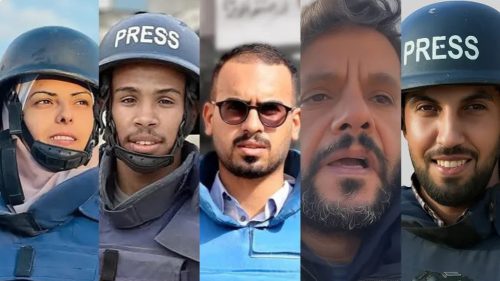
A senior Hamas official has condemned in the strongest terms Israel’s killing of five journalists in an attack on Nasser Medical Complex in southern Gaza, saying that the occupying regime is deliberately and systematically targeting members of press to cover up its atrocities in the besieged Palestinian territory.
“The crime of targeting Nasser Hospital could only be committed by a rogue terrorist entity, with the continued complicity of the United States and the helplessness of international law,” Basem Naim said on Monday.
He added, “The repeated targeting of Palestinian journalists and the prevention of foreign media from entering the Gaza Strip have become a constant goal for the Zionist enemy so that it can hide its crimes from the international public opinion.”
Five journalists were among 20 people killed in an Israeli attack on Nasser Medical Complex in southern Gaza, according to the region’s Ministry of Health.
The ministry said that the victims were killed on the fourth floor of the hospital in a double-tap strike – one missile hitting first, then another moments later as rescue crews arrived.
Those killed included Al Jazeera photographer Mohammad Salama; Hussam al-Masri, who worked as a photojournalist for the Reuters news agency; Mariam Abu Daqqa, who worked as a journalist with several media outlets, including The Independent Arabic and The Associated Press news agency; and journalist Moaz Abu Taha, according to Gaza’s Government Media Office.
A fifth journalist Ahmed Abu Aziz, who worked for the Quds Feed Network and other media outlets, succumbed to his wounds, according to the media office statement.
“The journalist colleagues were martyred when the Israeli occupation committed a horrific crime by bombing a group of journalists who were on a press coverage mission at Nasser Hospital in Khan Younis Governorate and many martyrs fell victim to this crime,” the statement read.
“We hold the Israeli occupation, the American administration, and the countries participating in the genocide crime such as the United Kingdom, Germany, and France fully responsible for committing these heinous brutal crimes.” the media office noted.
As Israel persists in prohibiting foreign journalists from accessing the coastal territory, Palestinian reporters continue to be the exclusive source of firsthand reporting from within the war zone.
The Federation of News Agencies of the Organization of Islamic Cooperation (OIC) has expressed its deep concern over the continued assassination of Palestinian journalists by the Israeli forces while carrying out their duties.
The federation emphasized that what is happening in Gaza constitutes a clear violation of international laws and norms, and comes in the context of Israeli violations of freedom of the press and media, and its policy of confiscating the truth, gagging, covering up its daily violations, and preventing them from reaching global public opinion.
Gaza: Southern displacement impossible as shelter shortage exceeds 96%
MEMO | August 25, 2025
The Government Media Office in Gaza has said that displacement to the southern governorates is almost impossible, as they cannot absorb 1.3 million people forcibly displaced from Gaza City.
In a statement, the office warned: “With the Israeli occupation threatening to invade Gaza City, we caution against the worsening humanitarian disaster experienced by more than 2.4 million Palestinians in the Gaza Strip.”
The office added: “Since the occupation announced that it would allow the entry of tents and shelter supplies, only around 10,000 tents have actually entered Gaza. This represents just 4 per cent of the urgent need for 250,000 tents and caravans, highlighting the manipulation and deliberate delays in meeting essential humanitarian requirements.”
It pointed out that the deficit in providing shelter in Gaza has now exceeded 96 per cent, stressing that no tents or shelter materials are currently available at the crossings because of strict Israeli restrictions on the work of international organisations, which has further deepened the suffering of hundreds of thousands of displaced people.
Syria, the Druze, and the Greater Israel project
By Gavin O’Reilly | Strategic Culture Foundation | August 25, 2025
On the 12th of August, media outlet Axios revealed that the United States and Israel were in discussions to establish a land corridor between the occupied Golan Heights and the southern Syrian city of Suwayda, ostensibly to protect the country’s Druze minority. The following Saturday, protests broke out in Suwayda calling for Druze self-determination, with many in attendance waving Israeli flags.
Last December, following a lightning offensive by insurgents based in the northwestern city of Idlib, the Syrian government of Bashar al-Assad collapsed in dramatic fashion. This marked the culmination of a thirteen-year effort by various powers to impose regime-change on the Arab Republic. One such power was Israel, who had provided arms to Salafist militants opposed to Assad’s secular rule. Syria, having acted as a conduit between Iran and Hezbollah, had long been in Tel Aviv’s crosshairs.
Within hours of Assad’s fall, Israel launched a ground invasion of southern Syria. Tel Aviv declared that this was in order to establish a buffer zone between Israel and Syria’s new Islamist government, in spite of the fact Damascus’ new rulers had effectively acted in Israel’s interests over the past decade. Israel also later stated that it intended to defend Syria’s Druze minority.
Syria, like Iraq and Libya before it, had subsequently fallen into bloody sectarian strife following Assad’s removal from power. In early March, government pogroms along Syria’s coast resulted in the deaths of more than 1,400 members of the Shi’a Alawite minority. Rather than any concern over sectarian bloodshed however, Israel’s interest in the Druze instead lies primarily in achieving a geostrategic goal that has been planned for decades.
In 1982, Oded Yinon, a senior official at the Israeli foreign ministry, penned a paper entitled A Strategy for Israel in the Nineteen Eighties. More commonly known as the Yinon Plan, the document was published by the World Zionist Organisation in the Hebrew journal KIVUNIM. In it, Yinon prioritised the dissolution of Iraq along ethnic and religious lines as a key long-term strategic goal for Israel.
Iraq, which subscribed to the pan-Arab Ba’athist ideology, had begun to emerge as Israel’s main regional rival following the Camp David Accords and the normalisation of ties between Egypt and Israel. In 1981, the Israeli Air Force had bombed the under-construction Osirak in eastern Iraq, after suspecting it would be used to develop nuclear weapons.
In early 1991, amidst the breakout of the Gulf War, Iraq launched dozens of scud missiles towards Israel. This was done in the hope that an Israeli response would galvanise Arabs across the region and undermine Gulf support for the U.S.-led coalition. Following pressure from the United States however, Israel would ultimately not respond to these strikes. By the end of February 1991, Iraqi forces had been defeated in Kuwait.
Though it subsequently emerged that the U.S. had gone to war on a fabricated account of Iraqi troops removing premature infants from incubators and leaving them to die on a hospital floor, Washington still maintained a belligerent stance towards Iraq. In April 1991, the U.S., Britain and France imposed a no-fly zone over northern Iraq, ostensibly to protect the Kurdish minority. The following year, a similar no-fly zone was put in place over the south of the country, this time under the pretext of protecting Shi’ite Muslims. Like Israel’s current interest in the Druze, this too had a strategic purpose.
The Yinon Plan outlined how in order to Balkanise Iraq, the country would have to be divided into three distinct sections. In the north of the country, a Kurdish separatist state based around the city of Mosul, in central Iraq, a Sunni region tied to the capital Baghdad, and in the south, a Shi’ite region centred around Basra. The United States’ no-fly zones effectively polarised Iraq along these lines.
Following the 9/11 attacks, a radical new U.S. foreign policy was put into place, beginning with the invasion of Afghanistan in October 2001. Eighteen months after September 11th, a U.S.-led coalition invaded Iraq, in spite of the fact no tangible evidence was ever produced to link Saddam Hussein to the attacks. Coalition forces quickly toppled the Iraqi government, and replaced it with a provisional authority. Its first executive order was to permanently ban all members of the Ba’ath Party from working in the public sector. Iraq subsequently plunged into sectarian bloodshed in the wake of the invasion.
Like Iraq, Ba’athist Syria was also identified by the Yinon Plan as a target for Balkanisation. The 1982 document envisaged a Sunni state in northern Syria centred on the city of Aleppo, an Alawite state along Syria’s Mediterranean coast, and another Sunni state, based around the southern capital of Damascus and hostile to its northern counterpart. Amidst this division, Yinon predicted the establishment of a separatist Druze state in the occupied Golan Heights and the Hauran region of southern Syria and northern Jordan.
Following the collapse of Bashar al-Assad’s government, such an arrangement has now effectively been put in place. Northwest Syria, where Aleppo is located, has become a stronghold of the Turkish-backed Syrian National Army. Hay’at Tahrir al-Sham, which led the offensive that ended Assad’s rule, is based in the capital Damascus. Its recent pogroms against the coastal Alawites polarising Syria along the same sectarian divisions outlined in the Yinon Plan. The recent Israeli-backed calls for Druze self-determination serve to even further fragment the former Arab Republic in line with the 1982 paper.
On the same day that Axios outlined U.S.-Israeli negotiations to establish a land corridor to Suwayda, Israeli Prime Minister Benjamin Netanyahu was interviewed by journalist and former Knesset member Sharon Gal for the Israeli outlet i24. When presented by Gal with an amulet containing ‘a map of the Promised Land’, Netanyahu stated that he felt a connection to a vision of ‘Greater Israel’. This is a historical Zionist term referring to an expansionist Israeli state that would incorporate the West Bank, Gaza Strip and Golan Heights at a minimum.
On Wednesday, Israel announced plans to construct 3,400 housing units in the West Bank between Jerusalem and the eastern settlement of Ma’ale Adumin. Such a move would effectively partition the territory between north and south. Bezalel Smotrich, the Israeli minister who announced the plan, declared that it would ‘bury the idea of a Palestinian state’.
Last year, Miriam Adelson, wife of casino magnate Sheldon Adelson, donated $100mn to Donald Trump’s presidential campaign. This was done on condition that the Republican candidate would endorse the formal Israeli annexation of the West Bank if elected. Sheldon Adelson, who died in 2021, had previously donated $20mn to Trump’s first presidential campaign in 2016. This too had a stipulation attached. That the U.S. Embassy would be moved from Tel Aviv to Jerusalem, a move that Trump subsequently followed through with in December 2017.
24 hours after Trump’s inauguration in January of this year, Israel launched Operation Iron Wall. Intended to destroy the Jenin refugee camp, Iron Wall has resulted in the largest mass-expulsion of Palestinians from the West Bank since 1967.
Since October 7th 2023, Israel has subjected the beleaguered Gaza Strip to a military onslaught in response to Hamas’ Operation Al-Aqsa Flood. This was the largest military incursion into Israel since the 1973 October War. Global media attention was drawn to the fact that the Supernova music festival was taking place on the Gaza border at the same time. However, less attention was paid to the revelation that the event had only been moved to that location two days beforehand. That there were no security or insurance concerns over holding a music festival in direct proximity to a location where clashes had taken place between Islamic Jihad and Israeli forces the previous summer, simply beggars belief.
Further questions arose when it emerged that Egypt, which acts as mediator between Hamas and Israel, had repeatedly warned Tel Aviv that ‘something big’ was coming in the run up to October 7th. This was corroborated by two media reports from The New York Times and CNN, which revealed that U.S. intelligence had also passed on similar warnings to Israel prior to Al-Aqsa Flood. By December 2023, it was revealed that Israel had known of Hamas’ attack plan over a year in advance.
Seven months prior to October 7th, Orit Strock, the Israeli minister responsible for the development of settlements in the West Bank, called Israel’s 2005 withdrawal from Gaza a ‘sin’. Strock was speaking upon the repeal of legislation that had ordered the dismantlement of four West Bank settlements. This was declared by Strock as a precursor to the eventual re-occupation of Gaza, a move that would ‘involve many casualties’.
Indeed, this sentiment was later echoed by Israeli security minister Yoav Gallant, who in the days following October 7th announced a blockade on Gaza, cutting off electricity and preventing food and fuel from entering the besieged strip. Gallant described Palestinians as ‘human animals’, language that couldn’t be described as anything less than genocidal.
In April 2024, a report by The Times of Israel revealed that an offer by Hamas to release all civilian captives in exchange for Israeli forces not entering the strip had been rejected by Tel Aviv. Three months later, a Haaretz report revealed that the Hannibal Directive had been applied on October 7th. This is an Israeli military directive in which a command is given to fire upon their own troops in order to prevent them being taken captive. Its use on October 7th was a significant contributory factor to the death toll on the day. Despite these damning revelations, the Israeli slaughter in Gaza has continued unabated for almost two years.
On Friday, the United Nations released a report officially acknowledging the presence of a man-made famine in Gaza. UN Human Rights Chief Volker Türk did not shy away from placing blame for the situation, and held Israel responsible for what is in reality, a genocide. Starvation is being used to ethnically cleanse the Gaza Strip in line with the Greater Israel project. A project that now also has designs on the Druze and southwestern Syria.
‘Don’t threaten us’ – EU state to Zelensky
RT | August 25, 2025
Hungary has warned Ukraine to stop disrupting its energy supply from Russia after Kiev targeted a key pipeline delivering oil to Central Europe.
Ukrainian forces struck the Soviet-era Druzhba (Friendship) pipeline three times this month, sparking outrage in both Hungary and neighboring Slovakia. The flow through the pipeline was last halted on Friday.
At a press conference during Independence Day celebrations in Kiev on Sunday, a reporter asked Ukrainian leader Vladimir Zelensky how the attacks relate to Hungary’s opposition to Ukraine’s EU and NATO ambitions.
“We have always supported friendship with Hungary, but now the very existence of this friendship depends on Budapest’s position,” Zelensky replied with a smile, playing on the pipeline’s name.
Hungarian Foreign Minister Peter Szijjarto issued a sharp rebuke on X. “Zelensky used Ukraine’s national holiday to threaten Hungary. We firmly reject the Ukrainian President’s intimidation,” Szijjarto wrote. He described the attack on Hungary’s energy supply as “an attack on sovereignty.”
“A war to which Hungary has nothing to do with can never justify violating our sovereignty. We call on Zelensky to stop threatening Hungary and to end the reckless attacks on our energy security!” he added.
Ukrainian Foreign Minister Andrey Sibiga responded on X, writing to Szijjarto: “You don’t need to tell the Ukrainian President what to do or say, and when.” He urged Budapest to “diversify and become independent from Russia, like the rest of Europe.”
Szijjarto shot back: “Stop attacking our energy security! This is not our war!”
Unlike many EU countries, Hungary has refused to send weapons to Kiev and has heavily criticized Brussels for imposing sanctions on Moscow. The country maintains that Ukraine’s NATO membership could trigger an all-out conflict with Russia.
Do you really believe a Ukrainian on a yacht took out Nord Stream?
RT | August 24, 2025
The Nord Stream pipeline bombing is back in the news after the recent arrest of a Ukrainian national, identified as Sergey Kuznetsov, at a resort in Italy. Kuznetsov is set to be extradited to Germany, where he will stand trial for allegedly coordinating a six-man sabotage team that blew up the pipelines.
It is the first arrest in a case widely viewed as the largest instance of industrial sabotage in Europe since World War II. Probes were launched by Denmark, Sweden and Germany, but the first two were ended with no suspects identified.
Russia, the majority owner of the pipeline, was not allowed to participate in any of the official probes and has consistently been denied access to the evidence.
It remains to be seen what emerges from the trial of Kuznetsov, but one thing seems clear: many questions remain about an event whose reverberations are being felt to this day. RT looks at why doubts persist nearly three years on.
What is the latest version being touted?
German prosecutors claim Kuznetsov led a six-person team on a yacht called the ‘Andromeda’, rented in the city of Rostock with forged papers. The group then allegedly managed to avoid detection in the heavily monitored Baltic Sea in order to plant the explosives at a depth of 70-80 meters.
This version of events bears a close resemblance to an account published nearly exactly a year ago in the Wall Street Journal. Mixing investigative journalism with cinematic flair, the WSJ told of a group of Ukrainians “buoyed by alcohol and patriotic fervor” who concocted a scheme to bring down the pipelines on a shoestring budget. Ukrainian leader Vladimir Zelensky supposedly initially approved the plan before changing his mind on advice from the CIA – but it was too late as the team had already gone incognito.
The WSJ report was, at the time, treated by many observers in the West as a definitive breakthrough in a case that had gone largely cold despite the efforts of investigators working on the official probes.
What has Russia said about the recent developments?
Russian officials have not publicly commented on the recent arrest of Kuznetsov, but Foreign Minister Sergey Lavrov previously ridiculed the idea that such an act of sabotage could have been carried out by a small team lacking the extensive training and support such a mission would require.
Commenting on the media reports about the Ukrainian group last September, Lavrov said: “Five people were sitting around drinking, having a laugh, and decided ‘Why don’t we blow up the Nord Stream pipelines?’ They had diving skills, allegedly hired a little boat, sailed to the place where the Nord Streams were passing, went down, planted explosives and detonated them.”
“If someone can actually believe this version, then it’s only people who are afraid of the truth and are trying to protect the criminal Kiev regime in any way possible,” the Russian top diplomat suggested.
What happened to the state actor theory?
Initial reactions by Western officials and commentators almost universally pointed to the likelihood of a state actor – with Russia generally assumed to be behind the sabotage.
Just days after the attack, the editorial board of the Washington Post published an opinion piece warning the West to “prepare for more attacks” and explaining that this is the “kind of capability usually wielded by a state actor,” adding that “everyone suspects unofficially” that the perpetrator was Russia.
Yet, as the narrative shifted away from Russian culpability, the state actor theory began being downplayed in the Western media. Nevertheless, recent reports indicate that German prosecutors believe the operation required “military-level planning.”
Could such a small boat accommodate such powerful explosives?
A number of experts have expressed skepticism that a vessel the size of the ‘Andromeda’ (15 meters) could facilitate an operation involving such high-energy (RDX-HMX) explosives – four bombs weighing up to 27kg each. It’s not just a question of weight, but one of bulk and safety.
The limited space and lack of a cargo hold on such a yacht would have made transporting highly potent explosives impractical. Such material typically requires reinforced containers, lifting gear, and complex detonation systems – which would push the limits of what a small vessel could reasonably handle.
Many observers question whether the extensive diving gear, mixed-gas systems, and detonation and transport equipment – plus the explosives themselves – could have been carried and deployed all while maintaining cover as a casual sailing trip.
How practical is a 70-80 meter dive to plant explosives?
The logistics of such a deep technical dive have also elicited skepticism. Recreational scuba diving typically doesn’t go deeper than 40 meters.
This operation, entailing explosives placed on two pipelines 4km apart, is believed to have required four dives, each of which would have necessitated the boat being in place for roughly three hours, according to experts. Furthermore, such extended dives would have likely required a decompression chamber for the divers, which would be almost impossible to fit on a vessel the size of the ‘Andromeda’.
How could the Ukrainian team have managed to avoid detection?
Another one of the puzzles lingering around the sabotage is how an operation almost certainly requiring several days could be carried out in one of the most surveilled maritime regions in the world. This is particularly the case given that NATO naval and aerial patrols were heightened due to the conflict in Ukraine.
Nevertheless, despite the fact that even fishing boats are often tracked in the Baltic, NATO somehow failed to pick up on any unusual activity. If a six-person team on a small yacht really pulled this off undetected, it would imply a catastrophic failure of NATO surveillance – something many experts find hard to accept.
In June 2022, NATO conducted its BALTOPS exercises involving underwater operations near the site of the explosions. Veteran US journalist Seymour Hersh alleged that the exercise was used as a cover for planting remotely triggered explosives that were activated three months later.
Ukraine Holding Captive Over 20 Russian Civilians Kidnapped From Kursk Region – Presidential Aide
Sputnik – 24.08.2025
MOSCOW – Ukraine has been holding captive more than 20 Russian civilians kidnapped by Ukrainian troops during a 2024 raid in the western Russian border region of Kursk, Russian presidential aide Vladimir Medinsky said on Sunday.
“They have been de facto abducted and are being held hostage. Russia has been painstakingly bargaining for these civilians to be returned home. Many have been brought back, including the eight returned today. More than 20 others are estimated to remain [in captivity],” he said on Telegram.
The Russian Defense Ministry said that 146 Russian servicepeople and eight Kursk residents were brought back from Ukraine in a swap on Sunday mediated by the United Arab Emirates.
Medinsky, who was Russia’s chief negotiator at the talks with the Ukrainians in Istanbul, said that most of Kursk residents abducted by Ukrainian troops were the elderly. He said the Ukrainians were handing them back in small groups, “literally trading them” for servicepeople in Russia’s custody that they need the most.
Russian Air Defense Shot Down Ukrainian Drone Near Kursk NPP, Radiation Unchanged
Sputnik – 24.08.2025
Russian air defense shot down a Ukrainian drone near the Kursk nuclear power plant, the downed drone damaged an auxiliary transformer, the press service of the Kursk NPP said.
“On August 24 at 0:26 Moscow time [21:26 GMT Saturday], near the Kursk NPP, an air defense shot down a combat unmanned aerial vehicle (UAV) of the Ukrainian armed forces. When it fell, the device detonated, as a result of which the auxiliary transformer was damaged,” the NPP said on Telegram.
As the plant clarified, the local fire had been extinguished, as a result of which the third unit had been unloaded by 50%. There were no casualties.
“Currently, the third power unit is in operation at the Kursk NPP. The fourth power unit is undergoing scheduled maintenance. The first and second power units are in operation without generation,” the plant’s press service added.
The radiation background at the industrial site of the Kursk NPP and the adjacent territory has not changed and corresponds to natural values, the press service concluded.
Russia requests UN Security Council meeting on Nord Stream sabotage
RT | August 24, 2025
Russia has requested an urgent UN Security Council meeting following the arrest of a Ukrainian man allegedly involved in the Nord Stream pipeline sabotage.
In September 2022, explosions disabled three of the four lines carrying Russian gas to Germany through the Baltic Sea. Moscow has repeatedly accused Germany and neighboring countries of delaying the investigation and excluding Russia from the probe.
“We will highlight the delays in the German investigation and the absence of transparency,” Russian Deputy Ambassador to the UN Dmitry Polyansky wrote on Telegram. He added that the meeting is scheduled for Tuesday.
On Thursday, Italian police detained a Ukrainian citizen, later identified in the media as former military officer Sergey Kuznetsov. Prosecutors allege he coordinated a team that rented a yacht and planted explosives on the pipelines using commercial diving gear.
German investigators reportedly believe a small group of Ukrainians was behind the attack, a claim Moscow dismissed as “ridiculous.”
Russian President Vladimir Putin suggested the US likely orchestrated the sabotage. Last year, Russia’s Foreign Intelligence Service claimed it had “credible information” that US and British agents were involved in the plot.
Algeria demands UNSC stop ‘Greater Israel’ project, end Gaza famine
Al Mayadeen | August 23, 2025
Algeria has held the UN Security Council responsible for thwarting the “Greater Israel” project and for safeguarding the foundations of the “two-state solution”, which it described as “the cornerstone of any just, lasting, and final settlement to the Israeli-Palestinian struggle.”
Regarding the situation in the Gaza Strip, Algeria’s Foreign Ministry affirmed that the United Nations’ official declaration of a state of famine in the Strip constitutes an extremely dangerous precedent and a first of its kind in the history of the Palestinian cause and the history of the region.
The Ministry added in its statement on Saturday that the most condemnable and reprehensible aspect is that this full-fledged famine is not a product of unavoidable circumstances, but is rather a deliberate political choice and a result of planning and orchestration by the Israeli occupation.
Famine consistent with ‘Greater Israel’ project
It further clarified that this declared famine is entirely consistent with, and inseparable from, the project of forced displacement, the project of reoccupying Gaza, and what has come to be known as the “Greater Israel” project.
Algeria strongly condemned these policies and practices imposed on the Palestinian people as part of the ongoing war of annihilation in Gaza and, as a Security Council member, stressed its commitment to continuing its diplomatic efforts to support the Palestinian people and work toward ending this unprecedented humanitarian catastrophe.
Furthermore, Algeria called for “action to expedite the establishment of an independent and sovereign Palestinian State with al-Quds as its capital.”
This comes as the Israeli occupation forces continue their genocidal war and deliberate starvation in the Gaza Strip, with the latest figures from the Health Ministry reporting that the aggression has now claimed 62,622 lives and caused 157,673 injuries since October 7, 2023.
Moreover, 281 people, including 114 children, have perished due to starvation, while an additional 2,076 were killed and more than 15,308 were injured by the occupation’s targeting of civilians awaiting aid at various distribution points throughout the Strip.
Dutch foreign minister steps down after failed push for sanctions against Israel
Press TV – August 23, 2025
Dutch Foreign Minister Caspar Veldkamp resigned on Friday, after he failed to secure cabinet support for new sanctions against the Israeli regime over its ongoing genocide in Gaza.
Veldkamp, a member of the centre-right New Social Contract party, had informed the country’s Parliament he intended to bring in new measures in response to Israel’s plans to escalate attacks on Gaza City and other heavily populated areas in the besieged territory.
But he said on Friday that he could not achieve agreement on “meaningful measures” and had repeatedly faced resistance from colleagues over sanctions already in place.
Among his proposals was a ban on imports from Israeli settlements in the occupied Palestinian territories.
Veldkamp also revoked three export permits for navy ship components, warning of “deteriorating conditions” in Gaza and the “risk of undesirable end use.”
“I also see what is happening on the ground in Gaza, the attack on Gaza City, and what is happening in the West Bank, the building decision for the disputed settlement E1, and East Jerusalem,” Veldkamp told reporters.
His efforts also included imposing entry bans on hawkish Israeli ministers, Bezalel Smotrich and Itamar Ben-Gvir, citing their role in inciting settler violence against Palestinians.
His departure leaves the Netherlands without a foreign minister.
Following his resignation, all New Social Contract ministers and state secretaries confirmed their support for Veldkamp and resigned from the caretaker government in solidarity, prompting a political upheaval.
“In short, we are done with it,” party leader Eddy Van Hijum declared, calling Israel’s actions “diametrically opposed to international treaties.”
The Netherlands’ Parliament had repeatedly delayed a debate on sanctions against Israel, a discussion that was already postponed from Thursday, as the Friday afternoon Cabinet meeting dragged on.
“There is a famine, ethnic cleansing, and genocide going on,” said Kati Piri of the merged Green Left/Labor parties. “And our cabinet has been deliberating for hours about whether to take any action at all, shameful.”
Opposition lawmakers had already expressed frustration at the inaction against Israel, with some calling for a no-confidence vote for the minister.
The political crisis comes against the backdrop of an already unstable government. The ruling coalition had collapsed in June when anti-Islam lawmaker Geert Wilders withdrew his support over an immigration dispute.
Since then, the three remaining parties have continued in a caretaker capacity until elections scheduled for October.
Humanitarian conditions in Gaza have sharply deteriorated. The Integrated Food Security Phase Classification (IPC) reported on Friday that “the Famine Review Committee (FRC) has determined that Famine (IPC Phase 5) is currently occurring in Gaza Governorate.”
The FRC further projected that famine thresholds “will be crossed in Deir al-Balah and Khan Younis Governorates in the coming weeks.”
Since October 7, 2023, when the Israeli regime began its genocidal assault on Gaza, at least 271 people have died from hunger-related causes, including 112 children, the Gaza health ministry reports.
Was the Oct 7 attack a pre-emptive strike?
In incendiary leaked comments, the former head of Israel’s military intelligence disclosed plans to assassinate Hamas’ leadership and initiate war
By Max Blumenthal | The Grayzone | August 22, 2025
In comments leaked by Israel’s Channel 12 this August 16, the Israeli army’s former head of military intelligence, Aharon Haliva, called for a “new Nakba” against the Palestinians and declared, “50,000 dead in Gaza is necessary and required for future generations.”
“For everything that happened on October 7, he proclaimed, “for every person on October 7, 50 Palestinians need to die. It does not matter now if they are children.”
Haliva’s remarks offer further proof of Israel’s genocidal intent in Gaza, and provide fresh evidence in future prosecutions of the country’s military and political leadership for crimes against humanity.
While social media users reeled in horror at his fascistic rhetoric, few noticed a revelation by Haliva which should cast the Al Aqsa Flood operation on October 7 in an entirely new light.
According to Haliva, “After the holidays [in the Fall of 2022], we were opening a joint reorganization with [Israel’s General Security Services] Shin Bet to collect intelligence on [Al-Qassam Chief of Staff Mohammed] Deif and [Hamas Secretary Genera Yahya] Sinwar in order to kill them, because every time we prepared a plan, they moved, and you have to re-collect on them.”
In other words, Israel was planning to violate its ceasefire with Hamas and launch a major decapitation strike against its leading figures, much like the one it deployed against Iran’s military leadership this June 13, when it assassinated 8 major IRGC officials without provocation. The killings would have touched off a major war, but unlike after October 7, Hamas would have been left without any negotiating leverage, as it would have had no Israeli captives in its possession when hostilities began.
When seen in this light, Al Aqsa Flood was a preemptive strike. Sinwar and Deif almost certainly understood that Israel was plotting their assassinations as the opening blow of a punishing assault aimed at snuffing out Palestinian resistance in Gaza once. Deif had already survived four assassination attempts, losing his family, an eye and use of several limbs in the process. As Haliva acknowledged, he and Sinwar were constantly on the move to evade their would-be killers.
And so, as the sun rose on October 7, 2023, Hamas took the initiative, denying a far more powerful adversary the devastating opening move it had methodically planned.
The war on truth: Why are Palestinian journalists being systematically erased?
By Ramzy Baroud | MEMO | August 22, 2025
The killing of seven Palestinian journalists and media workers in Gaza on 10 August has prompted verbal condemnations, yet has inspired little to no substantive action. This has become the predictable and horrifying trajectory of the international community’s response to the ongoing Israeli genocide.
By eliminating Palestinian journalists like Anas al-Sharif and Mohammed Qraiqeh, Israel has made a sinister statement that the genocide will spare no one. According to the monitoring website Shireen.ps, Israel has killed nearly 270 journalists since October 2023.
More journalists are likely to die covering the genocide of their own people in Gaza, especially since Israel has manufactured a convenient and easily deployed narrative that every Gazan journalist is simply a “terrorist”. This is the same cruel logic offered by numerous Israeli officials in the past, including Israeli President Isaac Herzog, who declared that “an entire nation” in Gaza “is responsible” for not having rebelled against Hamas, effectively stating that there are no innocent people in Gaza.
This Israeli discourse, which dehumanises entire populations based on a vicious logic, is frequently repeated by officials who fear no accountability. Even Israeli diplomats, whose job in theory is to improve their country’s image internationally, frequently engage in this brutal ritual. In comments made in January 2024, Israeli ambassador to the UK, Tzipi Hotovely, callously argued that “every school, every mosque, every second house has access to tunnels,” implying that all of Gaza is a valid military target.
This cruelty of language would be easily dismissed as mere rhetoric, except that Israel has, in fact, according to Euro-Med Human Rights Monitor reports, destroyed over 70 per cent of Gaza’s infrastructure.
While extremist language is often used by politicians around the world, it is rare for the extremism of the language to so precisely mirror the extremism of the action itself. This makes Israeli political discourse a uniquely dangerous phenomenon.
There can be no military justification for the wholesale annihilation of an entire region. Yet again, the Israelis are not shying away from providing the political discourse that explains this unprecedented destruction. Former Knesset member Moshe Feiglin chillingly said, last May, that “Every child, every baby in Gaza is an enemy… not a single Gazan child will be left there.”
But for the systematic destruction of a whole nation to succeed, it must include the deliberate targeting of its scientists, doctors, intellectuals, journalists, artists and poets. While children and women remain the largest categories of victims, many of those killed in deliberate assassinations appear to be targeted specifically to disorient Palestinian society, deprive it of societal leadership, and render the process of rebuilding Gaza impossible.
These figures powerfully illustrate this point: according to a report released by the United Nations Office for the Coordination of Humanitarian Affairs, based on the latest satellite damage assessment conducted in July, 97 per cent of Gaza’s educational facilities have been affected, with 91 per cent in need of major repairs or full reconstruction. Additionally, hundreds of teachers and thousands of students have been killed.
But why is Israel so intent on killing those responsible for intellectual production? The answer is twofold: one unique to Gaza, and the other unique to the nature of Israel’s founding ideology, Zionism.
First, regarding Gaza: Since the Nakba in 1948, Palestinian society in Gaza has invested heavily in education, seeing it as a crucial tool for liberation and self-determination. Early footage shows classrooms being held in tents and open spaces, a testament to this community’s tenacious pursuit of knowledge. This focus on education transformed the Strip into a regional hub for intellectual and cultural production, despite poorly funded UNRWA schools. Israel’s campaign of destruction is a deliberate attempt to erase this generational achievement, a practice known as scholasticide, and Gaza is the most deliberate example of this horrific act.
Second, regarding Zionism: For many years, we were led to believe that Zionism was winning the intellectual war due to the cleverness and refinement of Israeli propaganda, or hasbara. The prevailing narrative, particularly in the Arab world, was that Palestinians and Arabs were simply no match for the savvy Israeli and pro-Israeli public relations machine in Western media. This created a sense of intellectual inferiority, masking the true reason for the imbalance.
Israel was able to “win” in mainstream media discourse due to the intentional marginalisation and demonization of Palestinian and pro-Palestinian voices. The latter had no chance of fighting back simply because they were not allowed to, and were instead labeled as “terrorist sympathizers” and the like. Even the late, world-renowned Palestinian scholar Edward Said was called a “Nazi” by the extremist, now-banned Jewish Defense League, who went so far as to set the beloved professor’s university office on fire.
Gaza, however, represented a major problem. With foreign media forbidden from operating in the Strip per Israeli orders, the Gazan intellectual rose to the occasion and, in the course of two years, managed to reverse most of Zionism’s gains over the past century. This forced Israel into a desperate race against time to remove as many Palestinian journalists, intellectuals, academics, and even social media influencers from the scene as quickly as possible—thus, the war on the Palestinian thinker.
The Israeli logic, however, is destined to fail, as ideas are not tied to specific individuals, and resilience and resistance are a culture, not a job title. Gaza shall once more emerge, not only as the culturally thriving place it has always been, but as the cornerstone of a new liberation discourse that is set to inspire the globe regarding the power of intellect to stand firm, to fight for what is right, and to live with purpose for a higher cause.
Featured Video
Stanislav Krapivnik: Russia-Iran Cooperation & Escalation in Ukraine
or go to
Aletho News Archives – Video-Images
Frlom the Archives
Are the Jews indigenous to Palestine?
By David Miller | Al Mayadeen | August 3, 2022
There is a rising tide of claims from apologists for the crimes of Zionism that they have been misunderstood. Palestinians might be indigenous to Palestine, but the Jews definitely are. What is called the ‘Israel-Palestine’ conflict, they say, is competition over the same small piece of land by two rival groups of indigenous people. But are the Jews indigenous to the Levant? And what are the consequences of the argument?
In fact, most of the power structure of the Zionist state is dominated by Ashkenazi Jews who have no ancestral link to Palestine. Overall despite very significant financial and infrastructural contributions from Western European countries (especially the US, UK and France, for example via the Rothschild family), Eastern European Ashkenazim have been at the centre of the Zionist power structure since the early years of the 20th Century. … continue
Blog Roll
 Aletho News
- Iran warns of consequences after US strike on water plant
- US Bases in Middle East Fail to Secure Nations & Become Safety Risk – Expert
- Iranian Crisis Becomes Embarrassment for US Military That Can’t Protect Anyone – MidEast Analyst
- IAEA Never Had Reasons to Forgo Talks With Iran — Russian MFA Spox
- Iran pledges to ‘respect sovereignty of neighbors’, declares US-Israel assets ‘primary targets’
- USA and Israel: Who is the lord and who is the colony?
- Indian journalist reveals severe Israeli censorship after escape from occupied territories
- Majority of Israelis Back War with Iran as Anti-War Minority Faces Stigmatization
- Are the Jews indigenous to Palestine?
- Stanislav Krapivnik: Russia-Iran Cooperation & Escalation in Ukraine
- If Americans Knew
- US, Israel ravage Iran and Lebanon; 4 killed in Gaza – Not a ceasefire Day 148
- US troops were told war on Iran was ‘all part of God’s divine plan’, watchdog alleges
- Trump wants to run the show in Iran, but doesn’t know what he’s doing – Not a ceasefire Day 147
- ‘Dirty Work’ :The truth about how Israel was founded
- Mass Expulsion in Lebanon as Israel Expands War: “We Don’t Know Where to Go”
- Lies, distortions, and propaganda: how the U.S. mainstream media coverage on Iran hides the truth
- Palestinians in Gaza fear famine returning as Israel cuts off food amid Iran war
- AIPAC, other pro-Israel groups enter midterms with $100 million to spend
- Iranian girls killed by ‘double-tap’ strikes on Minab school
- Bari Weiss Is Going Full ‘Propaganda-Palooza’ With the Iran War
- No Tricks Zone
- Televised! Leading German Political Candidate Tells Schoolchildren CO2 Makes Sun Hotter!
- New Study: A Century Warming Of 1.1°C Is ‘Commonplace’ And ‘Not Unusual’ During This Interglacial
- New Study: ‘Internal Noise’ And Volcanic Forcing Can Trigger 10-15°C Warming Within Decades
- Glaciers Worldwide Are Suddendly Surging, Experts Blame Warming!
- Surprising Discovery: Sahara Is Greening…Billions Of Trees Where Once Thought To Be Barren
- New Research Reaffirms Clouds, Aerosols, And Surface Solar Radiation Are ‘Driving The Climate System’
- Germany: Electric Car Catches Fire At Charging Station, Sets Off Local “Inferno”, Widespread Damage
- New Study: Canada’s New Brunswick Was 1°C Warmer Than Today During The Medieval Warm Period
- Coal Power Back In Trend As Globe Tries To Keep Pace With Growing Demand For Power
- New Study: A 4°C Warmer Beaufort Sea Had ‘No Sea Ice’ 11,700 – 8200 Years Ago
 Aletho News