Mossad De Facto Admits To Inciting Riots In Iran
The Dissident | March 22, 2026
A New York Times article has reported that the Israeli/American failing regime change plot in Iran was contingent on a plan from the Israeli Mossad to incite riot in the country to effect regime change.
The article wrote, “Within days of the war’s beginning, said David Barnea, the Mossad chief, his service would likely be able to galvanize the Iranian opposition — igniting riots and other acts of rebellion that could even lead to the collapse of Iran’s government. Mr. Barnea also presented the proposal to senior Trump administration officials during a visit to Washington in mid-January.”
The article added:
Mr. Netanyahu adopted the plan. Despite doubts about its viability among senior American officials and some officials in other Israeli intelligence agencies, both he and President Trump seemed to embrace an optimistic outlook. Killing Iran’s leaders at the outset of the conflict, followed by a series of intelligence operations intended to encourage regime change, they thought, could lead to a mass uprising that might bring about a swift end to the war.
“Take over your government: It will be yours to take,” Mr. Trump told Iranians in his initial address at the war’s start, after saying they should first seek shelter from the bombing.
In the run-up to the war, current and former American and Israeli officials said, Mr. Netanyahu invoked Mossad’s optimism about a possibility of an Iranian uprising to help convince Mr. Trump that bringing about the collapse of the Iranian government was a realistic goal.
This is a de facto admission that Mossad was behind the violent riots that took place in Iran in January of this year, and used those riots to convict Trump that regime change in Iran was viable.
When the protests began in late December of last year, a Mossad connected account wrote in Persian , “Let us come out to the streets together. The time has come.
We are with you. Not just from afar and in words. We are with you in the field as well.”
Following this, former Secretary of State and CIA director Mike Pompeo wrote , “Happy New Year to every Iranian in the streets. Also, to every Mossad agent walking beside them.”
When the protests turned from peaceful to violent riots, Israel Channel 14 reported that , “foreign actors are arming the protesters in Iran with live firearms, which is the reason for the hundreds of regime personnel killed” an obvious reference to the Israeli Mossad.
The admission from the Israeli Mossad that their push for regime change in Iran was based on the idea that the Mossad could ignite, “riots and other acts of rebellion that could even lead to the collapse of Iran’s government” is further evidence that Israeli Mossad infiltration caused the Iranian riots in January, which Israel then used to sell a regime change war in Iran to the Trump administration.
But the plan backfired once the Israeli/American war on Iran began.
Since its inception, the war was clearly an attempt to turn Iran into a failed state and not just remove the current government.
As Vali R. Nasr, professor of international affairs and Middle East studies at the Johns Hopkins School of Advanced International Studies put it, “under constant bombardment Iranians are growing increasingly worried about the devastation of their country. They worry that U.S. and Israeli support for Kurdish and maybe even Azeri and Baloch separatists will break up the nation. These concerns are constantly circulating in public forums and are seen nightly in the form of antiwar demonstrations across the country and are morphing into an emerging sense of national resistance” adding, “If Iranians come to see this war as waged against Iran — and not just the Islamic republic — then Iranian nationalism may be mobilized in the service of resistance. America and Israel’s strategy of regime change by bombing military and government industries and infrastructure in Iranian cities, towns and neighborhoods and threatening Iran’s territorial integrity by arming Kurdish militias will not drive a wedge between the population and the regime and produce a popular revolution.”
In reality, the U.S./Israeli attempts to destroy Iran have only caused many Iranians to rally around the flag.
Nonetheless, this critical admission shows that the Israeli Mossad helped incite the riots in January and hoped it could be used to enforce regime change once the American/Israeli bombing began.
Trump ‘stuck between a rock and a hard place’, lacks Iran war strategy: Ex-CIA chief
Press TV – March 23, 2026
A withering critique from longtime Washington insider and former top spy Leon Panetta has intensified scrutiny of US President Donald Trump’s handling of the war against Iran.
In an interview with the Guardian newspaper on Sunday, Panetta, who previously also served as the US defense secretary (now war secretary), warned that the United States finds itself ensnared in a rapidly deteriorating crisis with few viable paths forward.
He portrayed an administration led by Trump that has slipped into a precarious position after weeks of unprovoked and unjustified aggression against the Islamic Republic of Iran, which began with the assassination of the Leader of the Islamic Revolution, Ayatollah Seyyed Ali Khamenei, on February 28.
He said Trump is “stuck between a rock and a hard place” and warned that his administration’s approach projects an image of weakness on the international stage.
Panetta, a veteran of Democratic administrations spanning decades, did not hold back in his critique of the incumbent US president’s decision-making style.
He said Trump has displayed a tendency toward naivety regarding the unpredictable nature of wars, saying the president appears to operate under the belief that simply repeating assertions might make them come true.
Such conduct, Panetta noted, was more “befitting of children than of presidents.”
His remarks came as the Iranian retaliatory operations continue to inflict heavy blows on the US military infrastructure in the region, decimating radars, drones and fighter jets.
The strategic waterway of the Strait of Hormuz also remains closed to US vessels, which has led to a dramatic rise in energy prices across the world.
Drawing on a career that has included stints as CIA director, secretary of defense, and White House chief of staff, Panetta underscored that Iran’s ability to disrupt global energy shipments through the Strait of Hormuz has been a long-established concern within American national security circles for generations.
That long-feared contingency, he warned, is now unfolding in real time.
The former defense chief argued that the ongoing war has laid bare significant shortcomings in US strategic planning, blasting Trump for launching an unwinnable war.
According to Panetta, the most plausible exit strategy for Trump would be to claim victory and seek to disengage from the war, but that avenue appears effectively closed.
He asserted that a ceasefire remained unattainable as long as Iran maintains its stranglehold over the Strait of Hormuz, describing the waterway as a potent lever of influence that Tehran now holds against its American adversary.
Efforts to rally European allies and NATO partners to help secure the strategic waterway have been met with tepid responses. Frustration over the lack of allied support has increasingly spilled into public view, with the US president launching biting criticism at the transatlantic military alliance and questioning its value in the absence of American leadership.
On the ground, Washington has thus far refrained from committing ground troops, though the deployment of Marines to the region has stoked speculation about potential escalation with far-reaching consequences for the aggressors.
Trump’s bombardment of fake news so far is working quite well. But where is it heading?
By Martin Jay | Strategic Culture Foundation | March 23, 2026
Trump’s latest move in Iran, to consider mobilizing a second larger tranche of troops, might be the act of a lunatic who genuinely believes there can be a positive outcome for America and Israel in the Iran War. What we may be witnessing is a new, more desperate, extreme strategy after he has come to terms that virtually all of the first strategy has ended in disastrous consequences. Certainly we can assess that he is considering such a move.
Yet despite all the hype from U.S. media, it is important to stress that Trump has not yet acted. He is looking at the possibility of a deployment of 8,000 troops with the view of taking Kharg Island in combination with an 800-mile stretch of the Iranian coastline, heavily fortified with troops and missiles aimed at both the choke point of the Straits of Hormuz and also beyond it.
Any military strategist will surmise that this idea is even more whacky than the initial plan, which, it has transpired, was carried out with no planning or assessment whatsoever.
The assumptions are simply preposterous. To take Kharg Island, it would mean that any amphibious landing would have to come from a U.S. battleship which would pass through the Straits of Hormuz. And secondly, the island itself is heavily fortified as you would expect it to be, given that it produces [transfers] most of Iran’s oil. Even if a ship could by some act of a miracle reach it, the resistance by the Iranians who would be ready and waiting would be intense and might well result in all of the U.S. marines sent there being wiped out. The present 2,200 marines who are on their way to the region from Asia are not airborne, which means they can only land by boat. This idea is madness on a level that we have never seen before, with some military experts comparing it to Gallipoli in 1915, where British, French, Russian and Australian navies lost 250,000 men as they failed over almost a year to take the peninsula — resulting in the rise to prominence of the Turkish commander at the time, Mustafa Atatürk, who finally became president of the new republic of Turkey later in 1923.
What is more likely is that Trump is panicking and constantly creating media fodder for journalists to report on, while he buys time to work out how to get out of the hellhole that he has created for himself. Practically begging allies via social media or press conferences to help gives a clue to the level of desperation. But Trump’s ability to create fake news to distract U.S. media away from the reality is impressive.
When U.S. bombers left UK bases and dropped their load over a few days on the island, this threw the spotlight on the island and created a new subject to focus on. But what U.S. journalists did not look too closely at was the impact of the bombing. All the bombers did was to put a crater exactly halfway up the runway of the main airstrip, depriving planes from landing or taking off. It was hardly a great military victory. In fact, it actually deprives the Americans themselves of landing huge air transport military aircraft there, suggesting that they have no real intention of ever taking the island.
The truth is that the snake island is just media chaff which has been thrown up in the air to cause a distraction. If we examine a number of stories in the press in recent days, in fact, there have been a number of such stories to distract journalists away from asking tougher questions to Trump.
Fake story number two: allies “supporting” Trump. Barely 48 hours after France, UK, Germany and others all sent a very quick “no” back to Trump after he asked them for help in securing the straits, it would seem they all did a U-turn. A statement which the UK government issued seemed to say that they were all ready to help Trump, which shocked many. So why wasn’t this story put on the front pages of all major UK and U.S. newspapers as an extraordinary event in itself, as a drastic change to the crisis? Because journalists were sceptical and read the small print. They also read Reuters’ sceptical interpretation of it and noticed that those world leaders didn’t take to social media and announce the new initiative to “support” Trump. This word “support” was buried in the text, but the interpretation was only in the sense that these countries — including Japan — were sympathetic to Trump, similarly to your neighbour coming to the wake of one of your loved ones, eating your sandwiches and taking your drink, but then leaving while muttering condolences — without making any contribution to the funeral expenses.
But there’s more fake news.
Fake news #3 was the Japan stunt. Almost immediately we saw the arrival of the Japanese Premier at the White House who, when getting out of her car, embraced Trump for the whole world to see. What a spectacle! But what was this hug all about? Yes, of course the Japanese needed to quickly sign an energy deal to stabilize their own economy, but the compliments that the Japanese PM paid on Trump during the press conference would have some believe that Trump’s own people wrote the script. Praising Trump as a world leader on a level that none other can match left the buffoon in the White House stumbling on his own words, with him finally blabbing out a poor taste joke about Pearl Harbour. What was behind this banal performance? Was it real?
Of course it was not. EU leaders, probably led by Sir Keir Starmer’s media experts, had no doubt staged the whole thing and prepared her speech and her behaviour, as they too are panicking, knowing only too well that Trump isolated could possibly drag America into a Vietnam-type war which could go on for years. Their reckoning was: ’We can’t support him, but let’s at least issue a statement and get the Japanese PM to give him a hug.’ All Trump needs is a hug and a few absurd compliments which would leave most Americans pushing fingers down their own throats.
But of course such vomit-inducing sycophancy can’t keep relations warm for very long.
With both American aircraft carriers far from the Straits of Hormuz now (one damaged by an Iranian missile) and no real options for Trump to turn to, to settle world oil prices and come down hard on the Iranians, he’s looking like the greatest loser America has ever had as a president. It is not inconceivable that he will send ground forces to the region if the situation gets worse. This decision is more or less taken for him as his own rationale must constantly come up with media fodder which keeps him in the news as the main story. Sending troops to the region though is not the same as sending them in, although the bombing which is now going on along Iran’s coastline would suggest that he believes U.S. marines could control and contain those Iranian military installations, which is worrying as a second colossal failure of joined-up thinking seems to be heading our way.
But what is even more worrying is the extent of how much Trump lies both to journalists in press conferences and to the American people about his victory in Iran. In a country which sometimes feels like an irony-free zone, you would think he would be more ridiculed for this, but this is not the case. The real worry here is how naïve and frankly stupid Americans are, as one option that Trump has, other than using nuclear weapons in Iran, is creating a false flag attack on U.S. home soil. Not only would that allow him to announce a ’state of war’ which would justify cancelling the midterms, but it would also force EU countries and Japan to ramp up their ’free hugs’ policy to a whole new level. Free hugs are not free, by the way.
Iran to Mine Sea Lanes in Persian Gulf in Case of Attack – Defense Council
Sputnik – 23.03.2026
TEHRAN – Tehran will mine all sea lanes in the Persian Gulf in the event of an attack on the coast of the country or islands, the Iranian Defense Council said on Monday.
“We remind you that in the event of any attempt by the enemy to attack the coast or islands of Iran, all sea lanes in the Persian Gulf, as well as the coast, will be mined,” the council said in a statement, as quoted by the Fars news agency.
The passage through the Strait of Hormuz is possible only for countries that are not hostile to Iran, if this issue is coordinated with Tehran, the statement added.
The United States sees no alternative to conducting a ground military operation to capture Iran’s Kharg Island and is accelerating troop deployments to the region, Israeli newspaper The Jerusalem Post reported earlier, citing sources familiar with the matter.
On March 20, Axios reported that US President Donald Trump is prepared to seize Kharg Island to pressure Tehran into opening shipping in the Strait of Hormuz.
A US official told the newspaper that “the US military has accelerated the deployment of thousands of Marines and Navy personnel to the Middle East.”
On March 22, US Treasury Secretary Scott Bessent stated that all options remained on the table and did not rule out the possibility of sending US troops to the Iranian island.
Trump backs down on Iran strikes; Tehran denies any talks
Al Mayadeen | March 23, 2026
US President Donald Trump announced Monday that he has postponed military strikes on Iranian power plants and energy infrastructure for five days, claiming that Washington and Tehran have held “very good and productive conversations” over the past two days toward resolving the war.
The announcement came hours before a deadline Trump had issued on Saturday, in which he threatened that Iranian power plants would be destroyed if Tehran failed to “fully open” the Strait of Hormuz to all shipping within 48 hours, prompting a swift and decisive warning by Tehran that power infrastructure feeding US bases and “Israel” in the region would be targeted.
Iran denies direct talks
After Trump’s statements, Iranian officials swiftly rejected claims of direct negotiations between Tehran and Washington.
Iran State TV, citing the Foreign Ministry, reported: “There are no talks between Tehran and Washington.”
The Foreign Ministry further characterized Trump’s remarks as an attempt to manipulate global energy markets and buy time for his military plans.
“Yes, there are initiatives from some countries in the region to de-escalate tensions, and our response to all of them is clear: we are not the party that started this war, and all such requests should be directed to Washington.”
Context: IRGC warned Trump of consequences
The Islamic Revolution Guard Corps (IRGC) issued a statement earlier today rejecting accusations by US President Donald Trump that Iran intends to target desalination facilities across the region, warning instead of reciprocal measures if Iranian infrastructure is struck.
The IRGC accused Washington of initiating the war, stating that “the aggressive American army… began the war by killing children,” saying that 180 children were killed in attacks on primary schools and that five water facilities, including a desalination plant on Qeshm Island, had already been targeted.
The statement firmly denied targeting civilian water infrastructure, asserting that “the IRGC has not carried out such actions.”
Addressing recent threats against Iranian energy infrastructure, the IRGC warned that any strike on power facilities would trigger direct retaliation.
“What we have done is declare our position: if power plants are targeted, Iran will respond by targeting the power infrastructure of the occupying entity, as well as power plants in regional states that supply electricity to US bases, in addition to economic and industrial infrastructure and energy sectors in which Americans hold shares. Without doubt, we will do so.”
The statement further added that economic and energy infrastructure linked to US interests would also be considered targets.
Emphasizing its prior restraint, the IRGC noted, “You targeted our hospitals – we did not respond in kind. You targeted relief centers – we did not respond. You targeted our schools – we did not respond. But if you target electricity, we will target electricity.”
The statement concluded with a warning that Iran would respond to any escalation “at a level that ensures deterrence,” adding that “the United States does not know our capabilities, it will see them on the battlefield.”
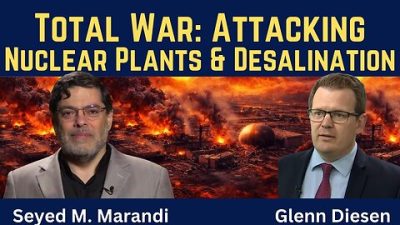
Seyed M. Marandi: Total War – Attacking Nuclear Plants, Desalination & Infrastructure
Glenn Diesen | March 22, 2026
Seyed Mohammad Marandi discusses the targeting of nuclear plants, desalination plants, critical infrastructure, and the civilian population. Trump has given Iran 48 hours to open the Strait of Hormuz (capitulation), otherwise the US will destroy Iran’s energy facilities. Then there will be no limits on Iran’s response, and the consequences will be global. The future of global stability will be decided over the next few days. Marandi is a professor at Tehran University and a former advisor to Iran’s Nuclear Negotiation Team.
Follow Prof. Glenn Diesen:
- Substack: https://glenndiesen.substack.com/
- X/Twitter: https://x.com/Glenn_Diesen
- Patreon: https://www.patreon.com/glenndiesen
Support the research by Prof. Glenn Diesen:
- PayPal: https://www.paypal.com/paypalme/glenndiesen
- Buy me a Coffee: buymeacoffee.com/gdieseng
- Go Fund Me: https://gofund.me/09ea012f
How the US-Israeli aggression against Iran is affecting the war in Ukraine
By Dmitri Kovalevich | Al Mayadeen | March 22, 2026
In the second half of March, the US and Israeli aggression against Iran is taking its toll on Ukraine. Retail stores are updating their prices daily, while the government is unable to keep gasoline prices in check through threats against sellers, as operators simply hide their product, creating artificial shortages.
Following the rapid deindustrialization that accompanied ‘independent’ Ukraine’s secession from the Soviet Union in the early 1990s, the only remaining productive industry in the country is agriculture, specifically, the production of grain and corn for export. Ukrainian authorities now face a harsh choice: supply fuel to agrarians at the start of this year’s planting season, or divert dwindling fuel supplies to meet the needs of the Armed Forces of Ukraine. According to Defense Minister Denys Shmyhal, supplying the Armed Forces of Ukraine remains the priority, in order that the proxy war by Western powers against the Russian Federation may continue.
He stated on March 1: “The war in Iran has triggered a global fuel crisis. Our key task is to supply the army. Sowing is the second priority. After that come businesses and people.”
European fuel suppliers have reduced their supplies to Ukraine in order to meet demand in their own markets. Fuel shipments from Poland have been suspended for one week, while Romania and Moldova have also temporarily halted fuel exports. Hungarian Prime Minister Viktor Orbán already halted sales of diesel fuel and gasoline to Ukraine in February due to Ukraine’s disruption of the Druzhba pipeline from Russia.
As a result, Ukraine may be forced to seek fuel in more distant markets… and pay much higher prices for it. It is becoming increasingly clear that the Western imperialist powers cannot sustain two wars at once—one against Russia, the other against Iran.
Danylo Getmantsev, head of Ukraine’s legislative committee on tax policy, says that Ukraine could face serious fuel shortages as early as April if the war with Iran drags on. “According to analysts of the Ukrainian fuel market, the situation with a shortage of fuel and lubricants may arise in our country in April,” he said in early March. To counter this, Getmantsev proposes exploring opportunities to establish a strategic reserve of petroleum products in partner countries.
Andriy Gerus, head of the energy committee of the Ukrainian legislature, noted earlier in March that due to Russia’s shelling of oil depots, Ukraine has no remaining strategic fuel reserves. “Everything is operating on a just-in-time basis; there are no remaining stocks of cheaper resources, so any price change in Europe quickly translates into a price change in Ukraine.” He explains that fuel in Ukraine will always be more expensive than in Europe.
Legislator Oleksandr Dubinsky, currently in jail accused of treason, believes that due to the war against Iran, the economic situation in Ukraine has become critical, much like it was in February 2022 at the start of the war. “Society and the army are exhausted. Exchange rates, energy costs, and prices have risen. The budget deficit is widening. At the same time, uncertainty is growing,” Dubinsky explains.
Nevertheless, according to Dubinsky, officials in Kiev believe that Ukraine is seen as too important in the global game to be allowed to fail, so money for its survival as a Western vassal will be found regardless of the widespread corruption that has further overwhelmed the Ukrainian economy beginning in 2022.
Legislator Yuriy Boyko says that if oil reaches $200 per barrel, everyone will feel the impact. “In that case, the planting season will be at risk, and prices for goods will rise sharply. Ukrainians aren’t well-off to begin with, so we can’t let that happen,” the lawmaker says.
Another legislator, Mykhailo Tsymbaliuk, has stated that high gasoline prices are already affecting the country’s military capabilities. According to him, the fuel being allocated by the Ministry of Defense is insufficient for the armed forces, causing grave problems. Even evacuations of wounded soldiers are being compromised. “The skyrocketing price of gasoline has become a serious warning sign for the Armed Forces of Ukraine,” the lawmaker warns.
Ukraine’s European supporters will continue for some time to divert fuel resources away from their own needs in order to supply the Ukrainian Armed Forces with gasoline, even at the expense of their own citizens. However, with every passing week and month that the war with Iran continues, the cost of such assistance will rise sharply for them.
In March, Ukrainian lawmakers told Ukrainian media that European governments are urging them to assure Ukraine keeps fighting Russia for another year-and-a-half to two years. “The Europeans have told us ‘Keep fighting for another year and a half to two years; we’ll provide the money you need’”, reports the publication Zerkalo Nedeli on March 12.
Under such pressure, Ukrainian President Volodomyr Zelenskyy has tasked the political leadership in the national legislature to continue functioning for several more years without an electoral mandate. The last national election Ukraine took place in April 2019, with a five-year mandate. It featured the banning of political parties deemed to be sympathetic to dialogue and good relations with Russia, a feature of the system that took power in February 2014 following a violent coup spearheaded by neo-Nazi paramilitaries.
To so many Ukrainians, the urgings and hidden threats by the leaders of ‘civilized Europe’ mean they will continue to be abducted from their own streets for two more years by the recruiters of Kiev’s compulsory military service.
None of the possible scenarios cited by Ukrainian military experts envisage a Russian defeat or the recapture of territories lost by Ukraine. In other words, the sole result of scenarios for continued war being urged is continued destruction of the Ukrainian population, all politely funded by European/NATO-member governments.
This approach speaks volumes about the overall strategy of Kiev and its Western allies. Theirs is a ‘strategy’ of holding out for a while longer without any long-term expectation of peace, hoping for some ‘black swan’ event (‘extremely rare and unpredictable’) that will drastically change the geopolitical situation. In other words, Western imperialism and its Ukrainian stooges are pinning their hopes on a miracle that might save them all.
Ukraine’s European ‘allies’, in truth, currently lack the funds to continue the war in Ukraine. They are negotiating a €90 billion loan for the country, but as mentioned above, European Union member Hungary is currently blocking this proposal.
Meanwhile, on March 18, Ukrainian media, citing a US State Department report, reported that USAID auditors have uncovered irregularities in the oversight of the more than $30 billion in direct budget support to Kiev since February 2022. There are a great many corruption scandals festering in Ukraine, but none have acted as grounds for refusing further loans and financial aid, despite the evidence that much of that could be embezzled.
Zelenskyy told the BBC during a visit to Britain on March 17 (which included a warm welcome by the British monarchy) that the war in Iran raises ominous forebodings about Ukraine’s future. Yet as Ukrainian media has noted, Zelensky is a firm supporter of that war.
In a speech to the annual Munich Security Conference on February 14, Zelensky called for measures to “immediately stop” Iran, without any delay. “Regimes like the one in Iran must not be given time. When they have time, they only kill more. They must be stopped immediately.”
Then, on February 27, he told an interview with Sky News that he supported an operation to depose the Iranian leadership.
Ukraine’s European allies are currently concerned with how to win back Donald Trump’s favor and persuade him to continue funding the Zelensky-led government in Kiev. Finnish President Alexander Stubb fears that negotiations on Ukraine are approaching a “moment of truth” that could force Kiev to formally cede territory in the Donbass region to Moscow. (Populations there voted in 2022 and before that to secede from coup Ukraine and join the Russian Federation.)
Europe, Stubb says, finds itself in a difficult position due to reductions in direct US aid to Ukraine. He proposes an odd trade-off to resolve this dilemma, namely, an ‘exchange’ of military assistance by Ukraine to the US and “Israel” in the Strait of Hormuz in exchange for continued assistance to Kiev’s war. That includes a proposal that the European Union agree to provide the US with military assistance to unblock the Strait of Hormuz in exchange for increases in direct US supplies to Ukraine.
But this is wishful thinking. The European Union member-countries of NATO lack the military capabilities required to reopen the Strait of Hormuz. They do have experience (gained during the Ukrainian crisis) in buying time and ‘bogging down’ the crisis in the Middle East through numerous rounds of fruitless negotiations with Iran. The essence of the EU approach would see the Iranian side fulfilling certain conditions in the here and now, while the West and its allies promise to ‘do something’ to normalize relations, but at a later time.
During the war in Ukraine, we witnessed endless negotiations in this vein under the ‘Minsk-1’ and ‘Minsk-2’ agreements in 2014 and early 2015. Then there was the ‘grain deal’ of July 2022, whereby the Russian navy would allow Ukraine to export grain from Black Sea ports. In all these cases, Ukraine and the West failed to fulfill their part of the commitments.
Oleg Yasinsky, a Ukrainian political analyst now living in Chile, commented on March 19 about the resistance of the Iranian people to aggression and the tradition of deception to which the West has consistently resorted during negotiations following military failures. “Once upon a time, the ancestors of today’s democratic world leaders negotiated with Indigenous peoples as they plundered and conquered them. At peace-signing ceremonies with the indigenous peoples of Patagonia, poison-laced whale carcasses were served at the table, while in the cold mountains of North America, smallpox-infected blankets and clothing were given as gifts to original peoples.
“Today, from Minsk for Russia to Geneva for Iran, the peacemaking traditions of the ‘civilized world’ have not changed one bit in all this time. Therefore and unfortunately,” he concludes, “missiles are the only real negotiators today.”
Zelensky is now desperately traveling around the world seeking to regain attention for his government as Iran becomes the main topic of global media. He is ‘jumping on the bandwagon’ of war against Iran in efforts to render some valuable service to Western imperialism and prove his continued usefulness. He has offered Ukrainian troops to guard “Israel” and Western military bases in the Gulf and in Cyprus. Alas for him, Trump has dismissed his obsequious ‘servant,’ going so far as to say that “Zelensky is the last person from whom we would need help.”
According to Odessa-based anarchist Vyacheslav Azarov, Ukraine is scrambling to align itself with the dominant theme in international politics and position itself as a useful part of the crisis exploding in the Middle East. Demands for additional support to Kiev are being delivered from this new vantage point. However, in the end, Kiev may simply end up with “additional airstrikes accompanied by the friendly shrieking of minor allies who have no real influence” and a large, new adversary in the form of Iran.”
Zelensky’s humiliating traveling and messaging does not go unnoticed in Ukraine. But the pompous president, who sees himself as a sage colonialist in the style of Winston Churchill and is continuously applauded by the governments of European countries, turns out to be a frightened servant, fearing that his ‘masters’ may abandon him. The war waged by Western imperialism against the Iranian people has once again underscored the weakness and dubious value of Zelensky’s government, whose image the West has artificially inflated for years through its media.
Iran Beats US & Israeli Missile Defenses by Exploiting Their Weaknesses
Sputnik – 22.03.2026
Iran carried out missile strikes on Israeli towns of Dimona and Arad on March 21.
Air defense systems like THAAD and Iron Dome may be highly capable but they still struggle with combined missile and drone attacks from multiple directions, Imad Salamey, associate professor at the Lebanese American University, tells Sputnik.
“The vulnerability exposed here is not a single system failure, but the limits of even advanced layered defenses when overwhelmed by scale, coordination, and mixed attack profiles,” he explains in the wake of Iranian strikes against Dimona and Arad.
The cost of US missile defenses’ failure
The exposed weakness of the US missile defenses carries significant strategic implications for the Middle East, Salamey notes, as such weapons are widely used to protect US assets across the region.
The US opponents now see that missile and drone tech offer a cost-effective way to fight “technologically superior opponents” while the United States could be forced to reassess its force posture and “invest in more integrated defense architectures.”
What Iran’s control of Israeli airspace could mean
If Iran shows that it can strike high-value targets in Israel repeatedly, it would shift the dynamics of this conflict, Salamey adds. By thus imposing higher costs on Israel and compounding its “freedom of action,” Iran may either push the conflict toward either escalation or “toward indirect negotiation, as both sides weigh the rising risks and diminishing returns of continued attacks.”
Report: White House Making ‘Detailed Preparations’ for Invasion of Iran
By Kyle Anzalone | The Libertarian Institute | March 22, 2026
Sources speaking with CBS News said that military commands submitted specific requests to prepare for a ground invasion of Iran.
The US deployed a second Marine Expeditionary Unit (MEU) to the Middle East last week, the sources explained. The USS Boxer will join the USS Tripoli in the region for a potential ground invasion of Iran. The Department of War is also preparing to deploy portions of the 82nd Airborne.
Axios reported on Friday, speaking with sources who said President Donald Trump is considering an occupation or blockage of Iran’s Kharg Island. The oil facilities on the island, which is located 15 minutes from the mainland in the Persian Gulf, handle 90% of Iran’s oil exports.
“He wants Hormuz open. If he has to take Kharg Island to make it happen, that’s going to happen. If he decides to have a coastal invasion, that’s going to happen. But that decision hasn’t been made,” a senior administration official told the outlet.
Trump is also threatening to escalate attacks on Iran’s power plants if Tehran does not reopen the Strait of Hormuz. The Islamic Republic said it will respond with strikes on civilian infrastructure across the region and the complete closure of the Strait of Hormuz.
Israel’s military chief Eyal Zamir said that the war was at its “halfway point.” On Saturday, an Iranian missile hit Dimona, the city where Israel bases its secret nuclear weapons program. Following the attack, Israeli Defense Minister Israel Katz said the US and Israel would “intensify” and “significantly increase” their strikes on Iran in the coming week.
Eight Iraqi resistance attacks hit US Victoria base near Baghdad airport
The Cradle | March 22, 2026
Iraqi resistance factions targeted the US Victoria Base near Baghdad airport in at least eight separate rocket and drone strikes, just days after video footage showed the site engulfed in flames as a result of non-stop attacks.
“Eight separate attacks, carried out until dawn with rockets and drones, targeted the US center,” a senior Iraqi security source told AFP on 22 March.
The Islamic Resistance in Iraq coalition announced on Sunday morning that its fighters carried out 21 operations over the past 24 hours, “using dozens of drones and missiles to target US occupation bases in Iraq and across the region.”
The US Victoria base – located near Baghdad airport – has come under continuous attacks by the Iraqi resistance since the start of Washington and Tel Aviv’s brutal war against Iran. The site serves as a US military logistical center.
Footage from after an Iraqi resistance operation on Friday showed the US Victoria base engulfed in large flames.
Other targets which have come under heavy attack by the Iraqi resistance include Washington’s Harir base and the US embassy compound in Baghdad.
After several heavy strikes on the embassy building since the start of the month, leading Iraqi resistance faction Kataib Hezbollah said on 19 March that it “issued orders to suspend operations targeting the US Embassy in Baghdad for a period of five days,” warning that “the response will be immediate” if its terms are violated.
The terms demand that Israel “cease the destruction and bombardment of the southern suburbs in Beirut,” and include calls for “a commitment to not bomb residential areas in Baghdad and the provinces,” as well as “the withdrawal of CIA elements from their positions and keeping them inside the embassy.”
Two days earlier, a top Kataib Hezbollah official was assassinated in a US-Israeli airstrike.
Deadly air raids against Iraq have been ongoing since the Iraqi resistance intervened in the war and began striking US targets in response to the brutal US-Israeli campaign against Iran.
Iran’s Dimona Strike Shatters Myth of ‘Impenetrable’ THAAD, Patriot & Arrow Air Defenses – Analyst
Sputnik – 22.03.2026
Iran’s huge leap in missile capability allowed it to punch through Israel’s vaunted multi-layered air defense shield, says political science and international relations expert Dr. Simon Tsipis. That explains why several warheads in Iran’s retaliatory strike on Dimona, home to Israel’s nuclear research facility shielded by Israeli and US defenses, reached their target area, Dr. Simon Tsipis tells Sputnik.
According to the analyst:
- Attack exposed weaknesses of Israel’s Iron Dome, built to intercept short-range rockets and mortars – not Iran’s intermediate-range ballistic missiles
- Iran’s military capabilities now allow it to launch ballistic missiles at ranges exceeding 2,000 km — including Diego Garcia joint US-UK military base
- Iran employs saturation tactics, launching swarms of decoys like drones and low-caliber missiles to overwhelm defensive systems before the main missile strikes
“Until now, it had been assumed that Iranian missiles would lose momentum and speed at the limits of their range. It is now evident that they retain significant power and velocity during the terminal phase of flight,” says the pundit.
The geopolitics expert breaks down the brutal US/Israel reputational damage:
- While Iran has just burnished its credentials as a serious military power, arms buyers everywhere are taking note of Arrow, Patriot, and THAAD failures
- Iran’s claimed airspace dominance puts US bases on notice worldwide, while bringing much of Europe within Iran’s missile range
The sheer reach of Iran’s new arsenal deals a humiliating blow to Israeli intelligence, which had long insisted it knew every detail of Iran’s capabilities
“Clearly, hidden breakthroughs went undetected,” he says.
In Dr.Tsipis’ opinion, Iran likely chose not to score a direct hit on Dimona’s nuclear reactor to avoid escalation. But it has sent a clear message: “Israel’s most heavily guarded site lies within striking range of Iranian systems.”
Featured Video
Total War – Attacking Nuclear Plants, Desalination & Infrastructure
or go to
Aletho News Archives – Video-Images
From the Archives
Strike on Israel Shows US Bases Near Iran Are ‘Achilles Heel’
By Svetlana Ekimenko – Sputnik – 14.04.2024
Fears of a greater Middle East escalation were triggered after Iran launched a massive drone and missile attack against Israel, aided by Hezbollah and the Yemeni Houthis. Iran said the attack was in response to Israel’s bombing of the Iranian consulate in Damascus, Syria, which killed seven members of the elite Revolutionary Guard Corps.
Iran’s massive retaliatory attack on Israel from its own territory is a sign that the conflict could “escalate out of control.”
Michael Maloof, a former senior security analyst in the office of the US secretary of defense, told Sputnik that the first ever direct Iranian attack on Israel set a dangerous precedent.
“My concern is that this could easily escalate into something not only between Iran and Israel, but beyond the Middle East region,” he said.
Iran’s assault, which it stated was an act of “self-defense” after the Israeli strike on its consulate in Damascus, was originally intended to be a “limited” one, said Maloof.
Iran first sent in “swarms of drones with lights on as a sign of psychological warfare,” but sending in cruise and ballistic missiles by Tehran was a “distinct escalation,” said Maloof.
The scale of Iran’s attack on Israel suggests that Tehran was sending a message, demonstrating that it possesses “extraordinary capabilities,” said Maloof. … continue
Blog Roll
 Aletho News
- Hungary blasts ‘fake’ EU accusation
- SAFE Debt Trap: Poland’s €43.7 Billion Bet on Unipolar Illusion
- War on Iran threatens global Gulf capital flows: FT analysis
- Mossad De Facto Admits To Inciting Riots In Iran
- Tehran: World grown thoroughly exhausted with US-Israeli ‘false flag storylines’
- Trump ‘stuck between a rock and a hard place’, lacks Iran war strategy: Ex-CIA chief
- Trump’s bombardment of fake news so far is working quite well. But where is it heading?
- Iran to Mine Sea Lanes in Persian Gulf in Case of Attack – Defense Council
- Barak blasts Netanyahu: ‘Stop lying – you can’t destroy Iran’s nuclear, missile capabilities’
- Trump backs down on Iran strikes; Tehran denies any talks
- If Americans Knew
- From Sde Teiman, the truth about Israel’s military justice system has been set free
- Child denied life-saving bone marrow transplant by Israel ‘because he is from Gaza’
- Raffi Berg: BBC Middle East Editor Exposed as CIA, Mossad Collaborator
- Jerusalem Archbishop Rebukes Netanyahu’s Statements on Christianity
- US to embed Palantir AI across entire military: Report
- Israeli-US war on Iran to drag on “a few more weeks” – Not a ceasefire Day 164
- Lebanon deaths top 1,200; Palantir AI to be embedded across US military – Not a ceasefire Day 163
- Israel’s assassination game: Take all pragmatists off the board
- Food shortages return to Gaza as Israel tightens aid restrictions under the cover of its war on Iran
- Trump demands trillions in payments from Gulf countries, billions from Harvard – Not a ceasefire Day 162
- No Tricks Zone
- New Study: CO2 Is ‘Effectively Negligible’ As An Explanatory Climate Change Factor Since 2000
- Former Pfizer Toxicologist Dr. Helmut Sterz Tells Bundestag Hearing Pfizer Vaccine Should Have Never Been Approved
- Energy Expert: Germany’s Nuclear Phaseout Was A “500 Billion Euro Mistake”
- New Research: South Australia’s Mid-Holocene Sea Surface Temperatures Were 4°C Warmer Than Today
- Storing Green Energy To Last Germany 10 Days Would Require A 60-Million Tonne Battery
- New Studies: UK Sea Levels Were 4 Meters Higher Than Today During The Mid-Holocene
- Destructive Green New Deal: German Energy And Metal Group Warns Of Drastic Crisis
- New Study Documents A 20-Year Pause In Arctic Sea Ice Decline – Driven By Internal Variability
- Wake-up Call: Survey Shows Majority Of Germans Now Favor Postponing Climate Targets!
- Televised! Leading German Political Candidate Tells Schoolchildren CO2 Makes Sun Hotter!
 Aletho News