Iran’s parliament submits emergency bill to withdraw from NPT
Al Mayadeen | August 29, 2025
Following the announcement by the E3 (France, Germany, and the United Kingdom) to trigger the snapback mechanism on sanctions against Tehran, Iran’s Parliament has drafted and submitted an emergency bill proposing a full withdrawal from the Nuclear Non-Proliferation Treaty (NPT).
Hossein-Ali Haji-Deligani, Deputy Chairman of the Article 90 Committee of Iran’s Parliament, confirmed that the bill will be uploaded to the parliamentary system on the following day and subsequently reviewed in an open session.
“As we had previously stated, these countries were already implementing the consequences of the snapback mechanism, including sanctions against us. There is nothing new in this.” Haji-Deligani told Iran’s Tasnim.
He further stated that the steps taken were “the most minimal response by Parliament to the recent action of the European countries, and further regret-inducing measures are also on the agenda.”
Deputy chairman calls for decisive action
The proposed legislation comes amid growing frustration in Tehran over the West’s repeated failure to honor agreements and ease pressure on Iran. Haji-Deligani noted that Iran’s Parliament is determined to pursue a firm and deterrent course of action.
According to the lawmaker, the activation of the snapback mechanism effectively reinstates previous sanctions but introduces no new developments. Nonetheless, he emphasized that Iran’s response would be strategic and assertive.
Criticizing continued dialogue with Western countries, Haji-Deligani asserted, “Given what these three countries have done, negotiations with them are now meaningless. Dialogue will only embolden them.”
“We witnessed that during negotiations with the arrogant US, a brutal war was launched against our country by Israel, and the US bombed our peaceful nuclear sites,” he added. “Our people clearly know that talks with these countries have brought nothing but more pressure. Therefore, all dialogue must be suspended until these countries abandon their double standards.”
The emergency bill signals a potential turning point in Iran-E3 talks and highlights a significant policy shift in Tehran’s approach to its nuclear file. The move could impact the broader framework governing the Iran nuclear program and regional diplomacy.
Iran vows response
Iran’s Foreign Ministry confirmed on Thursday that France, Britain, and Germany have formally notified Tehran of their decision to trigger the “snapback” mechanism to reimpose United Nations sanctions under the 2015 nuclear deal.
Foreign Minister Abbas Araghchi condemned the measure as “illegal and unjustified,” warning that Tehran would respond “appropriately to protect and guarantee its national rights and interests.”
In a phone call with his French, British, and German counterparts, Araghchi urged them to “appropriately correct this wrong decision in the coming days.” He stopped short of detailing possible retaliatory steps but hinted that the E3 risk being excluded from any future negotiations on Iran’s nuclear program.
The E3 action came just days after Iranian and European diplomats held a second round of talks in Geneva, billed as a last chance to salvage engagement before the October deadline for invoking the snapback clause.
The discussions collapsed without “tangible commitments,” according to European officials, who claim that Tehran’s ongoing breaches of enrichment limits left them with no choice but to act. It is noteworthy that the E3 had failed to uphold their commitments in accordance with the JCPOA after the US unilaterally left the agreement in 2018.
US-Israeli scheme for Lebanon includes forced displacement, turning Beirut suburb into ‘refugee camp’: Report
The Cradle | August 27, 2025
There is a new US plan for a “clampdown” on Beirut’s southern suburb, which could potentially see the area come under the control of a foreign or Arab security force, according to a report released by Al-Akhbar newspaper on 27 August.
The southern suburb, a strong base of support for Hezbollah, was heavily bombarded by Israel during its brutal war on Lebanon last year. The suburb has been repeatedly hit by airstrikes since the ceasefire took effect.
According to Al-Akhbar, the plan aims to “treat the southern suburbs just like Palestinian refugee camps.”
The 1969 Cairo Agreement for years allowed Palestinian groups a degree of autonomy over refugee camps in Lebanon. Despite the agreement being declared null in the 1980s, the status of the camps has remained more or less the same.
However, Lebanese troops maintain checkpoints and a heavy presence around the camps. Palestinian camps in Lebanon have recently begun a symbolic disarmament process in line with the state’s efforts to monopolize control of weapons in the country.
The Al-Akhbar report frames the new US plan as part of Washington’s broader goal of disarming Hezbollah, which the Lebanese government vowed to achieve in a cabinet session in early August.
“The US proposal envisions checkpoints at all entrances [of the Beirut suburb], thorough searches of individuals and vehicles, and a tight control on goods, materials, and money flows. This mission would not be handed to the Lebanese army. Instead, the plan calls for a foreign security force, possibly an Arab one, to take on the task,” it said.
Al-Akhbar also said the plan falls in line with US efforts to “empty the southern border region.”
A recent report by Axios said there is a US plan for a “Trump economic zone” near the southern border, aimed at preventing Hezbollah from re-establishing its presence there. The report said this would happen with the help of Gulf financing.
During a press conference in Lebanon’s Presidential Palace on Tuesday, US envoy Tom Barrack confirmed plans for the economic zone.
“We have to have money coming into the system. The money will come from the Gulf. Qatar and Saudi Arabia are partners and are willing to do that for the south (of Lebanon) if we’re asking a portion of the Lebanese community to give up their livelihood,” Barrack said.
“We have 40,000 people that are being paid by Iran to fight. What are you gonna do with them? Take their weapon and say ‘by the way, good luck planting olive trees?’ It can’t happen. We have to help them,” he added, referring to Hezbollah members.
“We, all of us, the Gulf, the US, the Lebanese are all gonna act together to create an economic forum that is gonna produce a livelihood,” he went on to say.
This economic zone reportedly serves as an ethnic cleansing plan to remove residents of the southern border villages and prevent the return of those already displaced from there.
Lebanese MP and former head of Lebanon’s General Security Directorate Jamil al-Sayyed said in a post last week that “Envoy Tom Barrack has received the Israeli response to his mediation over the south.”
“The response included a ceasefire, the handing over of prisoners, and border demarcation, according to the following conditions: Lebanon must grant Israel the right to remain inside 14 villages and to fully or partially evacuate their residents. The villages Israel demanded in their entirety are: Odaisseh, Kfar Kila, Houla, Markaba, and Aita al-Shaab. The villages where Israel demanded to establish permanent military sites on their outskirts and forests are: Khiam, Ramiya, Yaroun, Aitaroun, Alma al-Shaab, Al-Dhayra, Marwahin, Maroun al-Ras, and Blida,” he added.
“If this news is true, and becomes official tomorrow or soon, it may be celebrated in our country as an ‘achievement’ similar to yesterday’s celebration over the symbolic handover of weapons in Burj al-Barajneh camp,” Sayyed went on to say.
These “Iran Bombings” in Australia Are a Setup for Further False Flags
By Andrew Anglin | Daily Stormer | August 26, 2025
As we get ready for the next round of the Iran war, Western governments need to come up with an explanation as to why we are going to war for Israel beyond “shielding Jews from blowback as a result of their genocide in Gaza.”
Enter: “Iranian backed terror.”
You have probably heard the claim in various Jewish media that Iran is a “state-backer of terrorism.” However, this claim, when dissected, does not refer to ISIS or al-Qeada style terrorism, but rather is a reference to Iran’s funding of various militias around the Middle East. For example, the media categorizes Iran’s support for Hezbollah and the Houthis as “backing terrorism.” Whatever you think of the militias Iran does back, this is something different than blowing up buildings or running people over with a big truck in Europe or America.
There have been some shaky claims of Iran sponsoring bombings in Saudi and Argentina in the 1990s, and in 2012, India said Iranians tried to kill an Israeli diplomat with a bomb. The same guy was accused of doing a bombing in Thailand, however, and after being extradited to Thailand from Malaysia, the Thai authorities refused to charge him and released him to Iran.
All of this is to say that this week’s accusations by the Australian Prime Minister that the Iranian government was behind the bombing of a synagogue and a Jewish deli in Australia are something different than we’ve seen before. The Melbourne synagogue was bombed on December 6th of last year. The Sydney deli, which burned up last October, was not even originally investigated as foul play by the cops. No one died in either “attack.”
As those who study the Jews are all too aware, Jewish very often commit hate crimes against themselves. Even before terrorism was a thing, Jews would regularly burn down their own properties to collect insurance money. The term “Jewish lightning” is in the lexicon to refer to anyone burning down their own property for the insurance, as Jews were so famous for this behavior (similarly to how a non-Jewish person viewed as greedy might be called “Shylock”).
It’s maybe worth noting that since the bombing, the rabbi from the synagogue in question has been on a donations tour, and with the announcement it was Iran, is on another tour asking for even more free money.
What’s more, if these were indeed intentional attacks from someone, their timing, in the middle of the Gaza genocide, could mean that literally anyone could be responsible. Although Moslems would probably be more likely, it is not hard to imagine a non-Moslem outraged at the scenes on TikTok doing something like this. On its face, blaming the Iranian Revolutionary Guard Corps for the bombing of a random deli and synagogue in Australia sounds ridiculous, and it seems they would be some of the last people on the list of suspects.
Even if you believe Iran was responsible for the attacks they were accused of in the 1990s and then the 2012 events, those were all political or military targets. The idea of a serious military organization ordering random restaurants and synagogues in a random country blown up is silly. Iran is capable of sending rockets at Israel, they are capable of cutting off Israel’s access to shipping lanes. It makes no sense they would sink to street level random acts of random violence, which would not need any central planning.
Further, the fact that the firebombing would not need to be centrally planned means that it would be impossible to trace it to Iranian authorities. What would even be the claim? That they found text messages from a general in the IRGC? And that it took them nearly a year to find these text messages?
The identities of the accused have not been revealed, but the claim by the government is that they are street criminals who also committed other crimes who the IRGC hired through their networks to carry out these very serious firebombings that had no political purpose and where no one even died.
Here’s the Thing
This announcement by the weasel Prime Minister Anthony Albanese that Iran ordered the bombing of these random civilian locations in a white, Western country has been a top news story all over the world. Although no one is likely to look too deeply into it, because again, literally no one died, this gets the idea that “Iran is funding terrorist attacks on civilians” into the minds of the masses of the people.
With the attacks on the World Trade Center in 2001, the FBI had previously coordinated an attempted bombing of the same buildings in 1993 as a kind of precursor. Then you had the second attack, with the airplanes, lead to an invasion of Afghanistan. Then, in the weeks and months after 9/11, someone was sending Anthrax all around to media and government people, which is when the media/government started talking about Iraq as working with the al-Qeada. In 2008, they then said it was actually some random white guy that did the anthrax. He was, conveniently, already dead.
This is the note that was with the Anthrax sent to Tom Brokaw:
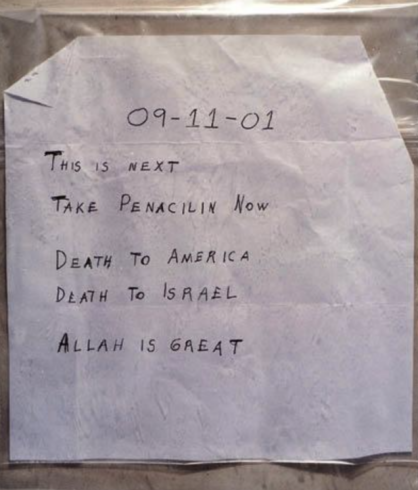
The FBI never really bothered to try to explain why a white guy would do that.
But refencing the Anthrax mailed around, Colin (pronuonced “Colon” for some reason) Powell brought white powder as a prop to his UN presentation on the need to. invade Iraq,
There was an ongoing triangle of disinformation and fake news passing from the New York Times, Dick Cheney, and Fox News. They were accusing Saddam of all kinds of things, just like they are with Iran right now, but the core of it was Cheney’s “Sinister Nexus of Terror.”
You still had the steam from 9/11 when they did the Iraq war less than two years later. But with Iran now, are we really supposed to do a massive war because of October 7th? Or is there going to need to be something more significant to motivate people?
I would very much expect that this Australian cafe and synagogue is the beginning of something bigger. With 9/11 and the Anthrax, when people were saying “oh they can’t be false flags, the government wouldn’t do that,” it was like “well, they started fake wars and killed like a million people, so why wouldn’t they blow up some buildings or send some powders?”
Looking back now, it feels like the “12 Day War” (the term they are using for the back and forth between Israel and Iran that involved Trump also dropping bombs on Iran) was a kind of probing event, where they wanted to see what Iran had. I think they were possibly a bit surprised at how capable Iran was. They were not the superpower capable of wiping Israel off the map that Scott Ritter had told everyone they were, but they were able to hit Israel and with missiles and cause real damage, and it was going to be impossible for Israel to keep going much longer before they were running out of their interceptor missiles.
Israel’s view on Iran has not changed, they are saying they are going to attack them again, and there is no way they can do it without the US, and involving the US on a large scale will probably take more than some all caps Trump tweets.
Obviously, at this point, huge numbers of people are going to be saying “false flag,” even if it is something on the scale of 9/11. So I don’t claim to know how this would work. If I was Donald Trump, I’d be worried the Mossad was going to assassinate me and blame Iran. That would get all the Trump supporters behind a war and it would leave leftists confused as to how they should feel, because if they said “false flag,” they might feel like they were defending Trump. Also, there has already been a “foreshadowing” event where Trump was allegedly scraped on the ear. And, I would add, that a personality like Trump getting shot would just generally be a bigger shock to the world than a bombing, which we’ve all already seen a lot of.
Or maybe I’m wrong and there is already enough noise and there doesn’t need to be some big event to justify further action in Iran. I guess the issue is that I don’t know really what it would take. If there needed to be an Iraq style invasion, then you would need some pretty big justification. But no one understands the logistics of this war. Like I said, I think the first thing was a test as much as anything.
But there are a lot of questions.
If there was large scale bombing of Tehran, could they do a “regime change” from the air? If so, could they keep shooting rockets without a “regime”? How stable is the domestic situation in the country? How do the Arabs, Azeris, and other minorities feel? (I think we know how the Kurds feel, lol. But the others, who knows? I don’t know. I do know that Persians are barely half the population.) Are there terrorists that can be moved in through Azerbaijan? What happened all those terrorists in Syria now that their guy is in charge? Can they be moved through Iraq and into Iran? It’s much more mountainous in Iran.
This is a lot different than when ISIS was able to just roll around wherever on the flats in the Iraqi/Syrian desert.
The mountains also provide a lot of cover for hydra-type break-off groups to operate if the government falls or is at least incapable of operating normally. I’m sure they have caves loaded up with drones and cheap missiles, and as we saw in the 12 Day War, the cost of shooting them down is too much for Israel to absorb. Even if they have infinity money from Big Daddy Donald, they can’t make that many interceptor missiles.
Those are some of the big questions. There are more questions. I’m sure the people within intelligence have better estimates than I would be able to come up with as to what the answers to these questions might be, but I think even US/Israeli intelligence can’t give definite answers regarding most of these factors.
What I do think is that slowly drilling away at it until the armor cracks like they did with Syria is not a potential strategy given that unlike Syria, Iran can hit Israel with missiles. So I’m sure what Bibi wants is the full force of the US military to be brought to bear in a full invasion type war. And for that to happen, it is most likely that something very extreme would have to precipitate it.
Israel Bombs Presidential Palace in Sanaa, Prepares For Large-Scale War in Yemen
By Kyle Anzalone | The Libertarian Institute | August 24, 2025
Israel conducted dozens of strikes in Yemen, including striking the presidential palace. Tel Aviv is collecting a large bank of targets for a widespread bombing campaign in Yemen.
On Sunday, the IDF said more than ten Israeli warplanes dropped 35 bombs in Yemen. Along with the presidential palace, Israel targeted the Hizaz and Asar power plants.
Officials in Tel Aviv said the strikes were in response to a missile fired by Ansar Allah, or the Houthis, at Israel on Friday. The IDF reports it was a new type of missile that contained submunitions.
Ansar Allah, the group that has ruled most of Yemen since 2015, stated a blockade of Israeli-linked shipping in the Red Sea in response to the ongoing genocide in Gaza. Ansar Allah has expanded the operations to missile and drone strikes against Israel and US warships in response to Israel and the US bombing Yemen.
Ansah Allah has maintained that it will not end attacks on Israel or the blockade until Tel Aviv ends the onslaught in Gaza. Following the Israeli strikes, a Yemeni official explained that Ansar Allah will “not retreat from it until the aggression is lifted, the siege is broken, and the starvation of Gaza’s people is stopped.”
Walla, an Israeli outlet, reports that Tel Aviv is preparing for large-scale strikes against Yemen. “A very large effort is underway by the Intelligence and Security Service (MNA) and the Mossad to build a broad target bank in order to strike the Houthis’ centers of gravity,” the outlet explains.
Israeli political officials told Walla, “We need to simultaneously hit their military intelligence system, ports, military capabilities, and defense industry.”
From March to May, President Donald Trump ordered the military to attack Yemen to break the blockade of Israeli-linked shipping. Over ten weeks, the US dropped over 1,000 bombs on Yemen, killing hundreds of civilians.
However, the strikes failed to break the blockade. Ansar Allah downed seven US drones and caused an F-18 to fall off an aircraft carrier. Trump agreed to a truce with Ansar Allah in May to end the attacks on American warships in the Red Sea. The ceasefire did not expand to Israel.
The officials argued to Walla that the Israeli strikes on Yemen must do more damage than the American operations. “It is necessary to accumulate many targets whose combined effects can cause very heavy damage, unlike the American operation that failed to defeat them,” they said.
Europe lacks strategy to break snapback ‘deadlock’: Russia envoy
Press TV – August 23, 2025
A senior Russian diplomat says the European troika—Britain, France, and Germany—lack a clear strategy to break the “deadlock” they are poised to create if they follow through on their threat to invoke the “snapback” mechanism against Iran.
Russia’s permanent envoy to international organizations in Vienna, Mikhail Ulyanov, made the remarks in a post on his X account on Saturday.
He proposed to put aside legal and procedural issues which definitely do not give the E3 the right to trigger the snapback mechanism and to address the issue from a purely political viewpoint.
The Russian diplomat asked whether the trio has an exit strategy and a vision of how to find a way out of the deadlock they are going to create.
“The answers to these questions seem to be negative,” Ulyanov emphasized.
Snapback would bring into force six previous Iran-related Security Council resolutions adopted between 2006 and 2010. It would reinstate the expired UN arms embargo that barred countries from supplying, selling, or transferring most military equipment to Iran and prohibited Tehran from exporting any weapons.
It would also impose export controls, travel bans, asset freezes, and other restrictions on individuals, entities, and banks.
In a Friday phone conversation with the EU high representative for foreign and security policy and his British, French, and German counterparts, whose countries are the European signatories to the 2015 nuclear agreement, Iranian Foreign Minister Abbas Araghchi warned that triggering the snapback would have consequences.
The top Iranian negotiator once again emphasized that the European countries lack the legal and moral authority to resort to the mechanism.
China’s mission to the United Nations on Wednesday declared the country’s firm opposition to threats by European parties to the 2015 nuclear deal to activate the snapback mechanism within the framework of UN Security Council Resolution 2231.
The mission at the UN headquarters in New York distributed an explanatory note to the Security Council, stating that the difficult situation in implementing the JCPOA and Resolution 2231 is not the result of Iran’s actions but the disruption of the JCPOA’s implementation by the United States and the three European countries.
China and Russia’s backing plays a critical role in Iran’s diplomatic efforts to counter the snapback threat. Both countries are permanent members of the UN Security Council and have veto power over resolutions, including those related to Iran’s nuclear program.
Russia: European states ‘snapback’ activation push fundamentally illegal
Press TV – August 21, 2025
A senior Russian diplomat has roundly rejected the UK, France, and Germany’s push to invoke the so-called “snapback” mechanism inside the UN Security Council Resolution 2231 that has endorsed a 2015 nuclear deal between Iran and world countries, including the trio.
Mikhail Ulyanov, the Russian Federation’s permanent envoy to international organizations in Vienna, made the remarks in a post on X, former Twitter, on Wednesday.
He reminded that the countries, themselves, had been in clear violation of the resolution for long, and were, therefore, legally barred from activating the mechanism that returns the Security Council’s sanctions against the Islamic Republic.
“There is a serious obstacle on the way of implementing this threat,” he warned, while calling the European drive an effort at “blackmailing” the Islamic Republic.
The European states “are themselves in violation of Res.2231 and the JCPOA,” the official said.
He was referring to the nuclear agreement by the abbreviation of its official name, the Joint Comprehensive Plan of Action.
“The doctrine of good faith in international law precludes a party from claiming rights under an agreement while simultaneously failing to fulfill its own obligations thereunder,” he added.
“In other words, an attempt by E3 to trigger snapback, despite their own non-compliance would contradict the fundamental principles of international law.”
The countries have threatened to invoke the mechanism by the end of August in response to, what they have called, Iran’s contravention of the JCPOA.
Apart from Russia, China, another permanent Security Council member, has vociferously opposed the prospect.
Beijing has reminded that the European countries, themselves, were the parties that had initially started trying to throw the deal into trouble with their outright non-commitment to the accord.
The tripartite states returned their own economic sanctions against the Islamic Republic, accusing Tehran of trying to divert its peaceful nuclear energy program towards “military purposes.”
The International Atomic Energy Agency (IAEA) has, however, found no evidence that could verify the allegations, despite subjecting Iran to its most rigorous inspections in history.
Iranian officials and international observers have, meanwhile, repeatedly underscored the illegal nature of recourse to the “snapback.” They have also reminded the Islamic Republic’s resilience in the face of Western sanctions, noting that the country had already managed to successfully bypass Western sanctions of far more intensity than the ones that could be imposed following potential activation of the mechanism.
China says there’s no justification for JCPOA snapback activation
Press TV – August 20, 2025
China’s mission to the United Nations has declared the country’s firm opposition to threats by European parties to the 2015 nuclear deal to activate the “snapback” mechanism within the framework of UN Security Council Resolution 2231.
The mission at the UN headquarters in New York distributed an explanatory note to the Security Council, stating that the difficult situation in implementing the JCPOA and Resolution 2231 is not the result of Iran’s actions but the disruption of the JCPOA’s implementation by the United States and the three European countries.
The statement said this cannot be an excuse to restore the anti-Iran sanctions that had been lifted under the 2015 deal.
In the note, China warned that attempts to activate the snapback could have “unpredictable and catastrophic” consequences, destroying all the diplomatic achievements of recent years.
The document said any attempt by some countries to activate the “snapback” without following the legal process would be an abuse of the Security Council’s powers and duties and would be invalid.
The note underscored Iran’s right to peaceful use of nuclear energy as a member of the NPT, calling on all parties to adhere to dialogue, mutual respect, and finding solutions that address the legitimate concerns of the international community.
China concluded by stating that it will continue to play an active role in the negotiation process and called on the Security Council to, instead of creating obstacles, pave the way for a new and lasting agreement.
As the 2015 nuclear deal nears its official end, Iran is preparing for the removal of confidence-building curbs on its nuclear program.
However, the European signatories have threatened to invoke the “snapback” mechanism, which would restore all UN sanctions on Iran that were lifted under the deal.
Western media reports indicate that three European nations have agreed to activate the snapback by the end of August if a new nuclear deal is not reached.
This move would disrupt the successful conclusion of the current agreement.
The United States and Iran had been in talks to find a replacement for the 2015 deal, but these negotiations were halted following a surprise US-Israeli aggression against Iran.
In a show of support for Iran, Russia has also publicly opposed Europe’s activation of the snapback, distributing an explanatory note to declare its position.
Iraqi FM warns PMU, Lebanese Hezbollah cannot be disarmed by force
The Cradle | August 18, 2025
Iraqi Foreign Minister Fuad Hussein stated on 18 August that efforts to pass a new law in the parliament to regulate the status of the Popular Mobilization Units (PMU) are coming at the wrong time, while at the same time emphasizing the government’s inability to disarm the resistance factions comprising the PMU by force.
“The timing of introducing the Popular Mobilization Forces law was wrong, and I was the only minister who expressed this within the cabinet before the draft law was sent to parliament, especially in light of the tense regional and international situation and the Iranian–American conflict,” Hussein said in an interview on Iraqi TV.
The new law would update an existing law regulating the PMU, transforming it into a fully independent security institution directly under the prime minister and bypassing the Defense and Interior Ministries.
The PMU was created in 2014 to recruit volunteers to fight against ISIS, which had just taken over Mosul, Iraq’s second-largest city, with covert support from the US and Peshmerga forces loyal to Iraqi Kurdish leader Masoud Barzani.
The PMU, which was comprised of multiple Shia armed factions, was incorporated into Iraq’s security forces with the passage of the first PMU law in 2016. The group was later expanded to include other ethnic groups, including Sunnis, Yezidis, Shabaks, and Christians.
The Coordination Framework coalition, a Shia political bloc supported by Iran, is pushing for the Iraqi parliament to include a vote on the new PMU law in its upcoming sessions.
In contrast, Foreign Minister Hussein argued that the PMU should be disarmed, but through dialogue rather than force.
“We need a rational dialogue with the factions to disarm, and this cannot be done by force, as this could lead to internal strife. Before the national dialogue, we need an inter-Shia dialogue between the Shia parties and leaders, but unfortunately, so far, there has been no dialogue in this regard,” Hussein added.
The US has also reportedly pushed for the PMU to be disarmed.
Hussein, who also serves as deputy prime minister, compared the issue of the PMU in Iraq to that of Hezbollah in Lebanon. The US is also pressuring the Lebanese government to disarm Hezbollah, which defended the country from Israel’s invasion last year.
“Hezbollah’s weapons in Lebanon cannot be disarmed except through dialogue, and the Iraqis cannot disarm the Popular Mobilization Forces by force. Centralization of decision-making is the problem in Syria, and decentralization may be the solution.”
The minister accused Iran of interfering in Iraqi affairs by promoting the law. “Most neighboring countries interfere in political, security, and military affairs, including Iran, which has significant influence,” he stated.
Hussein’s statements come amid interference from Washington, which seeks to block the law’s passage.
The US has warned Iraq against passing the new law, arguing it would entrench Iranian influence and empower armed groups “undermining Iraq’s sovereignty.”
US Chargé d’Affaires Steven Fagin and US Secretary of State Marco Rubio both raised these concerns in meetings and calls with Iraqi officials, pressuring parliament to halt the vote despite the bill already completing its second reading in July.
Iraq’s parliament has since avoided including the law on its agenda, facing opposition from Sunni and Kurdish blocs, while pro-Iran factions continue to push for its passage.
Shafaq News wrote on Monday that according to Iraqi MP Thaer Mokheef, “the real obstacle lies in US opposition, warning that Washington seeks to block the legislation and may attempt to reassert influence in Iraq.”
Among the groups represented in the PMU are Kataib Hezbollah, Asaib Ahl al-Haq, and the Al-Nujaba Movement – Iran-linked resistance factions involved in the attacks on US bases in Iraq and Syria, which began after the start of the Gaza war and ended months later with the help of Iraqi government pressure.
Last year, the US launched heavy strikes on Kataib Hezbollah sites in Iraq in response to the killing of three soldiers in a drone strike on a US military base on the Syria–Jordan border.
Israeli daily reveals Mossad-MKO collaboration during aggression against Iran
Press TV – August 17, 2025
An Israeli newspaper has revealed collaboration between the Mossad spy agency and the Mujahedin Khalq Organization (MKO) terrorist cult during the recent illegal aggression against Iran.
In a blog in Times of Israel, US-based freelance journalist Julian Rennell said the Mossad-MKO collaboration, which dates back to at least 2002, reached “new levels of sophistication” over the course of the 12-day Israeli-US assault against Iran.
The MKO’s “operational elements” had established “team houses in Tehran, where they built launchers and handheld mortars” and conducted “propaganda and information-gathering activities” in support of Israeli objectives, he said.
The notorious terror group provided targeting data for high-value assassinations in Iran and “precise coordinates” of critical infrastructure during the June’s aggression.
Rennell also quoted US officials as saying that the MKO has been “financed, trained and armed by Israel’s secret service” to assassinate Iranian nuclear scientists.
He further cited Tehran’s Criminal Court as documenting how MKO operatives coordinated with Israeli intelligence by gathering data on traffic flow near Kermanshah’s Farabi Hospital and passing it to the Tel Aviv regime for a deadly strike.
Meanwhile, he referred to remarks by an Iranian judge, who confirmed “active cooperation” between MKO terrorists and Israeli operatives, particularly in identifying and targeting Iranian nuclear scientists.
Rennell urged Israel to “formalize” its relationship with the MKO and move beyond covert cooperation to strategic partnership regardless of significant backlash, both among Iranians and internationally.
The MKO – the most despised group among ordinary Iranians – has a dismal history of perpetrating heinous attacks against Iranian civilians and officials, killing around 12,000 people since the victory of Iran’s 1979 Islamic Revolution.
MKO members spent many years in Iraq, where they were hosted and armed by the former Iraqi dictator Saddam Hussein. They sided with Saddam during the 1980-88 imposed war against Iran.
MKO terrorists, who are now based in Albania, enjoy freedom of activity in the US and Europe.
A top Iranian criminal court has held 36 hearings on crimes of MKO members. It will hold more trial sessions for the case.
Lin: China opposes invocation of UN Security Council ‘snapback’ sanctions against Iran

Chinese Foreign Ministry Spokesperson Lin Jian
Press TV – August 15, 2025
China reaffirms its commitment to the peaceful resolution of Iran’s nuclear issue and opposes the invocation of the UN Security Council’s “snapback” mechanism.
Chinese Foreign Ministry spokesperson Lin issued the statement on Friday in response to the European troika’s warning to reimpose sanctions if a diplomatic solution is not achieved by the end of August.
“China stays committed to peacefully resolving the Iranian nuclear issue through political and diplomatic means, opposes invoking Security Council ‘snapback’ sanctions,” Lin said.
He argued that reimposing sanctions on Iran would not foster trust or bridge differences among parties and would hinder diplomatic efforts to resume talks promptly.
Lin emphasized that any actions taken by the Security Council should facilitate the achievement of new agreements rather than undermine the negotiation process.
The Chinese diplomat reiterated that China is committed to maintaining an objective and fair stance, continuing to promote conversations aimed at peace, and playing a constructive role in bringing the Iranian nuclear issue back to diplomatic negotiations at the earliest opportunity.
He also highlighted Beijing’s intention to safeguard the international nuclear non-proliferation regime and to promote peace and stability in the region.
Iranian Foreign Minister Abbas Araghchi said on Thursday that the country is actively collaborating with China and Russia to prevent the reactivation of UN sanctions through the so-called “snapback” mechanism.
“We are working with China and Russia to stop it. If this does not work and they apply it, we have tools to respond. We will discuss them in due course,” he added.
The snapback mechanism, embedded in the 2015 nuclear deal, known as the Joint Comprehensive Plan of Action (JCPOA), allows the automatic reinstatement of UN Security Council sanctions that had been lifted under the agreement. The deal terminates in October.
Iran, however, disputes the legitimacy of the European powers’ efforts to trigger the provision.
In a joint letter to UN Secretary General Antonio Guterres and the UN Security Council on Wednesday, the European troika — France, Germany and the United Kingdom – said they were “committed to us(ing) all diplomatic tools at our disposal to ensure Iran does not develop a nuclear weapon” unless Tehran meets a deadline to speak with them.
“We have made it clear that if Iran is not willing to reach a diplomatic solution before the end of August 2025, or does not seize the opportunity of an extension, the E3 are prepared to trigger the snapback mechanism,” the ministers wrote.
In a detailed letter to the UN Security Council last month, Iran laid out its position, asserting that Britain, France, and Germany are no longer legitimate JCPOA participants with the authority to reinstate sanctions through snapback. This position is supported by China and Russia, who share Tehran’s view on the matter.
China and Russia’s backing plays a critical role in Iran’s diplomatic efforts to counter the snapback threat. Both countries are permanent members of the UN Security Council and have veto power over resolutions, including those related to Iran’s nuclear program.
Israel chases MAGA support amid Gaza backlash
The Cradle | August 14, 2025
The Israeli government is courting conservative social media influencers in the US to shore up support among “Make America Great Again” (MAGA) Republicans, Axios reported on 14 August.
Support among MAGA Republicans for Israel has fallen to record lows amid Tel Aviv’s ongoing campaign of starvation and genocide in Gaza, fueled by billions in US weapons and military aid.
Younger Republicans in particular question why Trump is spending such large sums to support Israeli military actions, while neglecting the needs of US citizens at home.
The Israeli campaign involved sending 15 MAGA influencers on a propaganda tour to Israel this week. The trip was organized by Israel365, an advocacy group that tries to “strengthen Israel by building bridges between Jews, Christians and all who share our faith-based values,” according to a statement from the group.
Axios reports that Israel365 was awarded a no-bid contract worth $70,000 by the Israeli Foreign Ministry to fund the trip.
The advocacy group is led by Rabbi Pesach Wolicki, who has regularly appeared on conservative television programs such as “The Charlie Kirk Show” to defend Israeli atrocities.
“Israel365 is uniquely suited to help MAGA-affiliated entities reach religious and ideological audiences in both Israel and the US,” stated an Israeli Foreign Ministry memo obtained by Axios.
Several influencers have faced backlash for participating in the all-expenses-paid trip, which included visits to the Western Wall in occupied Jerusalem, settlements in the Gaza envelope, as well as the occupied West Bank, Golan Heights, and the Syrian border.
Following the trip, Steve Bannon’s “War Room” podcast ended its relationship with MAGA influencer Jayne Zirkle.
Axios notes that, “Gen Z MAGA supporters have grown increasingly comfortable questioning Israel’s policies and prosecution of the war in Gaza, especially under the banner of the ‘America First’ agenda.”
Many young Republicans have also been influenced by political commentator and streamer Nick Fuentes, who regularly criticizes Israel’s genocide in Gaza, Trump’s slavish support for Israel, and the outsized influence of the US Jewish community over the US government.
Even legacy conservative journalist Tucker Carlson has hosted several programs recently with guests highlighting Israeli crimes in Gaza, including Lt. Col. Aguilar, a former US special forces operative who reported seeing Israeli troops carrying out horrifying war crimes against Palestinians in Gaza while working for the Gaza Humanitarian Foundation (GHF).
Iran overcomes heavy US sanctions and war with Israel, takes over key energy export markets
Inside China Business | August 12, 2025
China is a top buyer of Iranian crude, taking 90% of its crude exports. But Iran has recently passed Saudi Arabia, the UAE, and Qatar as the top producer and exporter of NG products, bringing in billions more. Ambitious expansions of their petrochemical industry are also ongoing. Iranians report little difficulty in business operations among different currencies, despite the US Treasury Department’s blacklisting of key energy suppliers, and firm control over the SWIFT systems.
Closing scene, Beihai, Guangxi
Resources and links: Iran Defies US Sanctions With Surging Exports of Liquefied Petroleum Gas https://www.bloomberg.com/news/articl…
Bloomberg, Iranian Oil Production Booms Amid the Bombs https://www.bloomberg.com/opinion/art…
S&P Global, Iran’s petrochemicals defy sanctions as exports, output on the rise https://www.spglobal.com/commodity-in…
Iran announces 15 petrochemical projects to expand domestic production to nearly 80 MMtpy https://www.hydrocarbonprocessing.com…
Featured Video
MIT Prof Ted Postol: U.S. Iran Missile War
or go to
Aletho News Archives – Video-Images
Frlom the Archives
A dark page from the CIA’s history: What was Project Artichoke, launched 74 years ago?
By Erkin Oncan | Strategic Culture Foundation | August 22, 2025
One of the most useful instruments hidden behind the U.S. empire’s rhetoric of “freedom and democracy” was the Central Intelligence Agency, founded on September 18, 1947, as the successor of the Office of Strategic Services (OSS).
Since its creation, the CIA has carried out countless inhumane operations: assassinations, coups, drug trafficking, support for terrorism, conspiracies. The list of its crimes is endless. But among the darkest and most inhumane chapters of its record lie the notorious “mind control” experiments. … continue
Blog Roll
 Aletho News
- Indonesia suspends participation in Board of Peace following attack on Iran
- ‘Operation Epic Fury’ burns an estimated $5.82 billion in just 100 hours
- Zionism’s grip over the world: From Epstein to Greater Israel
- How Israel and the FBI manipulated assassination plots to goad Trump into Iran war
- Iranian Strikes Dispel the Illusion of US Security Umbrella
- US Boasts of Destroyed Iranian Launchers Lack Credibility – Ex-DoD Official
- Europe not in position to cooperate with US and Israel against Iran
- Iran Has ‘Broken the Myth’ of Israeli Military Power: Former Pakistani Envoy
- How, and why, US data centers in the Gulf became targets of war
- The General who swallowed his truth
- If Americans Knew
- US troops were told war on Iran was ‘all part of God’s divine plan’, watchdog alleges
- Trump wants to run the show in Iran, but doesn’t know what he’s doing – Not a ceasefire Day 147
- ‘Dirty Work’ :The truth about how Israel was founded
- Mass Expulsion in Lebanon as Israel Expands War: “We Don’t Know Where to Go”
- Lies, distortions, and propaganda: how the U.S. mainstream media coverage on Iran hides the truth
- Palestinians in Gaza fear famine returning as Israel cuts off food amid Iran war
- AIPAC, other pro-Israel groups enter midterms with $100 million to spend
- Iranian girls killed by ‘double-tap’ strikes on Minab school
- Bari Weiss Is Going Full ‘Propaganda-Palooza’ With the Iran War
- Inside the Pro-Israel Campaign to Stop ‘The Voice of Hind Rajab’ From Winning an Oscar
- No Tricks Zone
- Televised! Leading German Political Candidate Tells Schoolchildren CO2 Makes Sun Hotter!
- New Study: A Century Warming Of 1.1°C Is ‘Commonplace’ And ‘Not Unusual’ During This Interglacial
- New Study: ‘Internal Noise’ And Volcanic Forcing Can Trigger 10-15°C Warming Within Decades
- Glaciers Worldwide Are Suddendly Surging, Experts Blame Warming!
- Surprising Discovery: Sahara Is Greening…Billions Of Trees Where Once Thought To Be Barren
- New Research Reaffirms Clouds, Aerosols, And Surface Solar Radiation Are ‘Driving The Climate System’
- Germany: Electric Car Catches Fire At Charging Station, Sets Off Local “Inferno”, Widespread Damage
- New Study: Canada’s New Brunswick Was 1°C Warmer Than Today During The Medieval Warm Period
- Coal Power Back In Trend As Globe Tries To Keep Pace With Growing Demand For Power
- New Study: A 4°C Warmer Beaufort Sea Had ‘No Sea Ice’ 11,700 – 8200 Years Ago
 Aletho News