Nearly half a million people have died from war-related causes in Iraq since the US-led invasion in 2003, according to an academic study published in the United States on Tuesday.
That toll is far higher than the nearly 115,000 violent civilian deaths reported by the British-based group Iraq Body Count, which bases its tally on media reports, hospital and morgue records, and official and non-governmental accounts.
The latest estimate by university researchers in the United States, Canada and Baghdad in cooperation with the Iraqi Ministry of Health covers not only violent deaths but other avoidable deaths linked to the invasion, insurgencies and subsequent social breakdown.
It also differs from some previous counts by spanning a longer period of time and by using randomized surveys of households across Iraq to project a nationwide death toll from 2003 to mid 2011.
Violence caused most of the deaths, but about a third were indirectly linked to the war, and these deaths have been left out of previous counts, said lead author Amy Hagopian, a public health researcher at the University of Washington.
Those included situations when a pregnant woman encountered difficult labor but could not leave the house due to fighting, or when a person drank contaminated water, or when a patient could not get treated at a hospital because staff was overwhelmed with war casualties.
“These are all indirect deaths, and they are significant,” Hagopian told AFP.
The aim of the study was to provide a truer picture of the suffering caused by war, and hopefully to make governments think twice about the harm that would come from an invasion, she said.
“I think it is important that people understand the consequences of launching wars on public health, on how people live. This country is forever changed.”
The research team from the University of Washington, Johns Hopkins University, Simon Fraser University and Mustansiriya University conducted the work on a volunteer basis using pooled internal resources instead of seeking outside funds.
Their tally was compiled by asking adults living in 2,000 randomly selected households in 100 geographic clusters across Iraq if family members had died, when and why.
Researchers used the survey data, which was completed by 1,960 of those chosen, to calculate the death rate before the war and after. When multiplied by the whole population, they returned a number that represented “excess deaths.”
Researchers estimated there were 405,000 excess Iraqi deaths attributable to the war through mid-2011.
They also attempted to account for deaths missed because families had fled the country, an estimated 55,805 total deaths, bringing the total to nearly 461,000. … Full article
October 16, 2013
Posted by aletho |
Militarism, Timeless or most popular, War Crimes | 2003 invasion of Iraq, Iraq, United States |
Leave a comment
A senior Russian MP holds that the recent White House statement of chemical weapons use by the Syrian government is as false as the notorious reports about Iraqi WMDs.
“The data about Assad’s use of chemical weapons is fabricated by the same facility that made up the lies about Saddam Hussein’s weapons of mass destruction. Obama is walking George W. Bush’s path,” the head of the Duma’s Foreign Affairs Committee Aleksey Pushkov tweeted.
The Russian MP was referring to the 2003 invasion in Iraq prompted by the US and UK claims that Saddam Hussein possessed weapons of mass destruction that threatened neighboring nations. The UN probe into the matter was underway as the invasion started and no traces of WMD have been discovered on Iraqi territory since the war ended, prompting accusations that the US administration and special services fabricated the data to get an excuse to start the conflict.
In comments to Russian news agencies Pushkov noted that the supplies of arms from the US to the Syrian rebels would hardly lead to the overthrow of President Bashar Assad’s regime. He added that the government in Syria is supported by “a significant, if not the larger, part of the population” and the Syrian military “show a high degree of resistance.”
Pushkov also forecast that the United States would now attempt to further escalate the situation.
“Now they are arming the rebels but then they will come to some form of direct military involvement. We cannot exclude the possibility of cruise missile strikes and if this measure brings no result – of direct military intervention,” he said.
The statement was made shortly after US authorities publicly announced that they had proof that pro-government forces used chemical weapons, like the nerve agent sarin in the Syrian conflict, killing at least 150 people. At the same time, the US side claimed that there was no proof about similar actions from the rebels’ side.
US Deputy National Security Advisor Ben Rhodes has told the press that President Barack Obama has decided to boost the US support to the Syrian opposition forces and that this would now include military support. The detailed orders will be issued within the nearest weeks after Obama consults with the Congress, the official added.
Earlier last week UK and France said that their probes into the alleged use of chemical weapons in Syria showed that the pro-government forces did it at least once causing casualties among rebels and called the international community for immediate action. Many officials, including top Russian politicians, noted that the impartiality of British and French researchers is under question and urged an independent probe.
The UN is currently preparing its own independent investigation, but it might take a long time. Syrian government has said it was ready to accept the UN delegation and help with the investigation.
In late March one of the conflicting parties in Syria allegedly used a sarin-charged missile near the city of Aleppo. The government and rebels now accuse each other of the attack that killed at least 25 people.
While the UK, France and now the United states accuse pro-Assad forces, Turkish media said in early June that the country’s security forces had found sarin gas in the homes of members of the Al-Qaeda-linked Al-Nusra Front – one of the main groups opposing the Syrian government.
Russian officials have repeatedly condemned the use of chemical weapons and urged an all-sided and unbiased research into all incidents connected with the issue.
June 14, 2013
Posted by aletho |
Deception, Mainstream Media, Warmongering, Progressive Hypocrite | 2003 invasion of Iraq, George W. Bush, Obama, Russia, Syria, United States, USA |
Leave a comment
10 Years on
It is sad that well-known peace campaigners should drop below the radar, not just of the politicians who hate them, but of the so-called peace campaigners who idolised them when they were still there. One such man, who dedicated the last 10 years of his life to confronting the UK Parliament with their outrageous decision to invade Iraq, was Brian Haw.
As a committed Christian and a father, and angered by the sanctions the West had imposed on Iraq that resulted in the tragic and avoidable deaths of too many Iraqi children, Brian left his home and arrived in London. More particularly, he arrived in Parliament Square, where he camped at the side of the road facing the Houses of Parliament. Always, for those of us who continued to protest about the invasion of Iraq and the awful damage our actions were doing to that nation, Brian was a figurehead, an inspiration. Few of us could claim his courage, his determination and his perseverance.
For nearly ten years he stayed – night after night of sleeping on the pavement, in all weathers and with little protection. Nothing the police or Parliament did could break him and make him move. Brian’s protest caused them no end of problems as he and his anti-war placards and banners were a constant reminder of all the lies that were told in the run up to the attack on Iraq in 2003 and continued to be told to justify the invasion. Members of Parliament had to pass his huge collection of displays and peace messages every time they went in and out of the Parliament.
In their haste to be rid of this ‘turbulent priest’ of a campaigner, who harangued MPs daily with his megaphone as they went into the august halls of Westminster, reminding them of their ghastly error in backing up Tony Blair and his eagerness to invade Iraq, the then Home Secretary David Blunkett introduced the bill SOCPA (Serious Organized Crime and Police Act 2005) which was aimed at removing Brian by banning protests within 1 km (about half a mile) of Parliament without police permission. This came into effect on 1 August 2005. But where else should we protest for peace if not outside the place that had rubber-stamped Blair’s desire to illegally attack Iraq?
Comedian Mark Thomas headed an action to keep protest going within the legal 1 km. He wanted to demonstrate how very ludicrous this ban was. To quote Mark: “The point is simply that if one person with a banner can be deemed to be a protester by the police and they need to get a licence six days in advance to enter the designated zone, then we have reached a state of absurdity.” And it is true, if hardly believable, that one woman in Parliament Square was threatened with arrest for having an iced cake with ‘Peace’ written on it. On certain days individual protestors, who had each registered their very individual protests with the police (including, for instance, the right to jump off Westminster Bridge) held their protests within the designated zone. It made the new law look very stupid indeed.
But so hasty had Parliament’s action been in creating this law that when it was challenged, they discovered that the one person they had failed to ban was Haw himself! So he stayed — and stayed. For some time he was alone, although visited (and supported) by many well-wishers. He became a tourist attraction. MPs complained that they could not properly debate in the chamber because of the noise of his megaphone protest in the Square outside – presumably the constant traffic noise complete with police and ambulance sirens is conducive to a good debate!
In May 2006 his much-photographed display of placards and banners was reduced from 40 metres to just 3 metres by a night raid of some 78 police (which cost a staggering £27,000). Not so oddly, this happened within hours of artist Mark Wallinger showing two curators from the Tate Gallery Brian’s display and announcing he wanted to recreate it for an exhibition. Never the less, Mark had his way and the exhibition, State Britain, ran at the Tate from January to August 2007.
Brian continued to protest with his truncated display despite numerous arrests and assaults. He was on crutches for his last years in the Square – the result of the not-so-gentle arrest techniques of the famed London Bobby. He died of cancer in June 2011 and the world is a poorer place.
Brian was joined in December 2005 by Melbourne-born Barbara Tucker. While Brian had some legal authority to stay there, Barbara didn’t, which has meant that she has been arrested an astonishing 47 times while in the square, usually on a charge of ‘unauthorized demonstration’. When Brian died she nobly carried on. She has served two short spells in Holloway prison as well as suffering constant harassment from police, heritage wardens and passing rowdies.
Until January 2012 she had a tent but that was confiscated under the Police Reform and Social Responsibility Act (PRSA). After that she sat in a chair on the pavement trying to sleep under a large green umbrella wrapped up in multiple layers of clothing. She has slept in the open for over a year now without a tent and has been treated for exposure. In the hope of getting her confiscated tent back, Barbara took the decision to go on hunger strike, starting on December 27th 2012.
While Brian managed to achieve some media recognition for his stance, Barbara has had little to none. The latest reference I can find to her hunger strike dates from January 10th. She and her colleague Neil Kerslake are no longer in the Square and have not been seen for some weeks – disappeared, tidied away perhaps, so as to make the 10th anniversary of the invasion a little less contentious.
One day maybe, when the world stops fighting needless, illegal and cruel wars, people will finally give these dedicated campaigners the recognition they deserve. I’d like to see a statue of Brian in Parliament Square, confronting Westminster and challenging its dishonesty and hypocrisy as he did for so many cold hard years. Until then, those of us who still call ourselves peace campaigners should at least make the effort to remember how much he once meant to us all. Parliament may not like dissenters – I for one do.
March 21, 2013
Posted by aletho |
Civil Liberties, Illegal Occupation, Militarism, Solidarity and Activism, Timeless or most popular | 2003 invasion of Iraq, Brian Haw, Iraq, Iraq War, Parliament Square, Tony Blair |
Leave a comment
On the 10th anniversary of the United States’ illegal invasion of Iraq, we can expect the war’s supporters to argue that military action seemed necessary at that moment, while critics will remind us of the suffering that resulted from that tragic miscalculation.
But amid the rationalizations and critiques, we should linger on this uncomfortable term: “illegal invasion”.
No matter how much we all ignore it, here is the reality: The U.S. invasion of Iraq was unlawful. The leaders who planned and executed the war are criminals. U.S. citizens bear some responsibility for not holding those leaders accountable.
The charter of the United Nations is clear about when the use of force in international relations is legal. War must be authorized by the U.N. Security Council, and in this case the council rejected a resolution authorizing war. The only other condition under which a member state can go to war is in self-defense when attacked, a principle that is extended to the right to respond to an imminent attack, what is sometimes called “the customary right of anticipatory self-defense.”
The basic principles are uncontroversial and clearly articulated in articles 39 and 51 of the U.N. Charter, though there is debate among legal experts about interpreting terms such as “imminent” and “anticipatory.” But whatever one’s position in those debates, there is no way to stretch the facts of this invasion to justify a self-defense claim.
At this point, many people respond by dismissing international law as irrelevant. Because U.S. policymakers’ first job is to protect Americans, they argue, our leaders shouldn’t be constrained by international law—the Constitution trumps international law or treaties.
But a small problem arises: Article VI of the U.S. Constitution states that “all Treaties made, or which shall be made, under the Authority of the United States” are part of “the supreme Law of the Land.” Since the United States signed the U.N. Charter (and, in fact, wrote most of it), to reject international law in this matter is to express contempt for the plain meaning of the U.S. Constitution. No patriot would dare.
So, back to those uncomfortable conclusions: A decade ago, U.S. leaders launched what under the principles of the Nuremberg Tribunal is called a “crime against peace.” Whether in the course of that crime, U.S. forces also committed war crimes can be debated. For example, should the deliberate bombing of the civilian infrastructure of a country be considered a war crime? What about the use of cluster munitions in ways that predictably kill civilians? I believe both are criminal, but let’s put those more complicated issues aside. The illegality of the invasion itself is not a tough question.
In my travels outside the United States, I have found that the vast majority of people agree that the U.S. invasion was unlawful. Within the United States, mentioning this worldwide consensus typically is considered idealistic and irrelevant. But while we can ignore evidence and logic, and even ignore the world, we can’t escape the implications of those choices.
The moral force of law, domestic or international, lies in the consistent application of clear standards. When laws are applied only to the poor and the rich act with impunity, for example, we understand that as a perversion of the law.
Over and over in the United States, we proclaim our commitment to the rule of law—we are a nation of laws not men. If that were the case, we would turn over to the International Court of Justice high-ranking figures from the Bush administration, which initiated the war; from the Obama administration, which continued the war; from Congress, which enabled the war; and from the military, which prosecuted the war. We would determine the amount of reparations we owe Iraq and begin to make payments. And we would apologize to the Iraqi people, and to the world.
Why is that unthinkable in our political culture? Perhaps it is because we worship power rather than respect law. Perhaps it is because we have no intention of acting on the moral principles we routinely impose on others.
Perhaps it is because we are not the people we tell ourselves we are.
~
Robert Jensen is a professor of journalism at the University of Texas at Austin and and board member of the Third Coast Activist Resource Center in Austin. His latest book is We Are All Apocalyptic Now: On the Responsibilities of Teaching, Preaching, Reporting, Writing, and Speaking Out (Monkey Wrench Books). Jensen is also co-producer of the documentary film Abe Osheroff: One Foot in the Grave, the Other Still Dancing (Media Education Foundation, 2009), which chronicles the life and philosophy of the longtime radical activist. An extended interview Jensen conducted with Osheroff is online. He can be reached at: rjensen@austin.utexas.edu. Twitter: @jensenrobertw.
March 21, 2013
Posted by aletho |
Militarism, Progressive Hypocrite, Timeless or most popular, War Crimes | 2003 invasion of Iraq, International Court of Justice, Iraq, Robert Jensen, United Nations, United Nations Charter, United States |
Leave a comment
Three years ago this month, I wrote a piece entitled “Who’s to Blame for the Iraq War?” to mark the seventh anniversary of the US invasion. My sole purpose in compiling a by-no-means-exhaustive list of 20 Israel partisans who played key roles in inducing America into making that disastrous strategic blunder was to help dispel the widespread confusion — some of it sown under the guise of “progressive investigative journalism” by likely crypto-Zionists – about why the United States made that fateful decision. As the tenth anniversary approaches, there is no excuse for anyone genuinely interested in the facts to deny the ultimate responsibility of Tel Aviv and its foreign agents for the quagmire in Iraq. Nevertheless, it’s an appropriate time to remind ourselves of some of the chief architects of the devastating Iraq War.
1. Ahmed Chalabi, the source of much of the false “intelligence” about Iraqi WMD, was introduced to his biggest boosters Richard Perle and Paul Wolfowitz by their mentor, a University of Chicago professor who had known the Iraqi con man since the 1960s. An influential Cold War hawk, Albert Wohlstetter fittingly has an American Enterprise Institute (AEI) conference centre named in his honor.
2. In 1982, Oded Yinon’s seminal article, “A Strategy for Israel in the 1980s” was published in Kivunim, a Hebrew-language journal affiliated with the World Zionist Organization. “Iraq, rich in oil on the one hand and internally torn on the other, is guaranteed as a candidate for Israel’s targets,” advised Yinon. “Its dissolution is even more important for us than that of Syria. Iraq is stronger than Syria. In the short run it is Iraqi power which constitutes the greatest threat to Israel.”
3. “A Clean Break: A New Strategy for Securing the Realm,” a report prepared for Israeli Prime Minister Benjamin Netanyahu in 1996, recommended “removing Saddam Hussein from power in Iraq—an important Israeli strategic objective in its own right.” Richard Perle, chairman of the Pentagon’s Defense Policy Board during the initial years of the George W. Bush administration, was the study group leader.
4, 5. A November 1997 Weekly Standard editorial entitled “Saddam Must Go” opined: “We know it seems unthinkable to propose another ground attack to take Baghdad. But it’s time to start thinking the unthinkable.” The following year, the Project for the New American Century (PNAC), an influential neoconservative group, published a letter to President Clinton urging war against Iraq and the removal of Saddam Hussein on the pretext that he was a “hazard” to “a significant portion of the world’s supply of oil.” PNAC co-founders William Kristol and Robert Kagan also co-authored the “Saddam Must Go” editorial.
6. In Tyranny’s Ally: America’s Failure to Defeat Saddam Hussein, published by AEI Press in 1999, David Wurmser argued that President Clinton’s policies in Iraq were failing to contain the country and proposed that the US use its military to redraw the map of the Middle East. He would go on to serve as Mideast adviser to Vice President Dick Cheney from 2003 to mid-2007.
7. On September 15, 2001 at Camp David, Deputy Defense Secretary Paul Wolfowitz attempted to justify a US attack on Iraq rather than Afghanistan because it was “doable.” In the lead-up to the war, he assured Americans that it was “wildly off the mark” to think hundreds of thousands of troops would be needed to pacify a postwar Iraq; that the Iraqis “are going to welcome us as liberators”; and that “it is just wrong” to assume that the United States would have to fund the Iraq war.
8. On September 23, 2001, Senator Joe Lieberman, who had pushed for the Iraq Liberation Act of 1998, told NBC’s “Meet the Press” that there was evidence that “suggests Saddam Hussein may have had contact with bin Laden and the al-Qaeda network, perhaps [was] even involved in the September 11 attack.”
9. A November 12, 2001 New York Times editorial called an alleged meeting between Mohammed Atta and an Iraqi agent in Prague an “undisputed fact.” Celebrated for his linguistic prowess, columnist William Safire was egregiously sloppy in his use of language here.
10. A November 20, 2001 Wall Street Journal op-ed argued that the US should continue to target regimes that sponsor terrorism, claiming, “Iraq is the obvious candidate, having not only helped al Qaeda, but attacked Americans directly (including an assassination attempt against the first President Bush) and developed weapons of mass destruction.” The professor of strategic studies at the Nitze School of Advanced International Studies, Johns Hopkins University who made these spurious claims was Eliot Cohen.
11. George W. Bush’s January 2002 State of the Union address infamously described Iraq as part of an “axis of evil.” It was David Frum, Bush’s Canadian-born speechwriter, who coined the provocative phrase.
12. In a February 2002 article entitled “How to win World War IV,” Norman Podhoretz, the longtime editor of Commentary magazine, asserted: “Yet whether or not Iraq becomes the second front in the war against terrorism, one thing is certain: there can be no victory in this war if it ends with Saddam Hussein still in power.”
13. Kenneth Adelman, Defense Policy Board member and PNAC signatory, predicted in a February 13, 2002 Washington Post op-ed: “I believe that demolishing Hussein’s military power and liberating Iraq would be a cakewalk.”
14. On August 3, 2002, Charles Krauthammer, the psychiatrist-turned-Washington Post columnist, enticed Americans with this illusory carrot: “If we win the war, we are in control of Iraq, it is the single largest source of oil in the world…. We will have a bonanza, a financial one, at the other end, if the war is successful.”
15. In a September 20, 2002 Wall Street Journal op-ed entitled “The Case for Toppling Saddam,” current Israeli Prime Minister Benjamin Netanyahu warned that Saddam Hussein could be hiding nuclear material “in centrifuges the size of washing machines” throughout the country.
16. “Why would Iraq attack America or use nuclear weapons against us? I’ll tell you what I think the real threat (is) and actually has been since 1990—it’s the threat against Israel.” Despite this candid admission to a foreign policy conference at the University of Virginia on September 10, 2002, Philip Zelikow, a member of President Bush’s Foreign Intelligence Advisory Board, authored the National Security Strategy of September 2002 that provided the justification for a preemptive war against Iraq.
17. According to a December 7, 2002 New York Times article, the role of convicted Iran-Contra conspirator Elliott Abrams during Colin Powell’s efforts to negotiate a resolution on Iraq at the United Nations was “to make sure that Secretary Powell did not make too many concessions to the Europeans on the resolution’s wording, pressing a hard-line view.” Abrams was senior director of Near East and North African affairs at the National Security Council during the George W. Bush administration.
18. Lewis “Scooter” Libby, who was Vice President Cheney’s chief of staff until he was indicted for lying to federal investigators in the Valerie Plame case, helped draft Colin Powell’s fraudulent February 5, 2003 UN speech.
19. According to Julian Borger’s July 17, 2003 Guardian article entitled “The spies who pushed for war,” the Pentagon’s Office of Special Plans (OSP) “forged close ties to a parallel, ad hoc intelligence operation inside Ariel Sharon’s office in Israel” to provide the Bush administration with alarmist reports on Saddam’s Iraq. Douglas Feith was the Under Secretary of Defense for Policy who headed the OSP.
20. Bernard Lewis, a British-born professor emeritus of Near Eastern Studies at Princeton University whose 1990 essay “The Roots of Muslim Rage” introduced the dubious concept of a “Clash of Civilizations,” has been called “perhaps the most significant intellectual influence behind the invasion of Iraq.”
Maidhc Ó Cathail is an investigative journalist and Middle East analyst. He is also the creator and editor of The Passionate Attachment blog, which focuses primarily on the U.S.-Israeli relationship.
March 12, 2013
Posted by aletho |
Ethnic Cleansing, Racism, Zionism, Timeless or most popular, Wars for Israel | 2003 invasion of Iraq, Iraq, Iraq War, Israel, United States, Zionism |
Leave a comment
Why is it, just when you think the British Government can sink no lower and visit no more embarrassment and shame upon the country they are supposedly there to represent, that within a week or less one of the Ministers will open his mouth or put pen to paper and demonstrate just how arrogant and useless they are? Arrogant because they believe that whatever they say will be accepted as the final word on the subject; useless because they apparently can’t foresee how their statements will be received.
Foreign Secretary William Hague, who makes a career of talking down to people, has excelled himself. According to the Guardian, with the 10-year anniversary of the invasion of Iraq approaching, he has written to all his fellow Ministers and asked them not to discuss the case for, or the legality of, the Iraq war.
According to a source close to Hague: ‘The foreign secretary has written to colleagues to remind them that the agreed position of the coalition government is not to comment on the case or justification for the war until Chilcot has reported. This is about allowing the inquiry to reach its conclusion, not having the government prejudge them.’ Has Hague forgotten why the long-awaited Chilcot Inquiry cannot deliver its report?
In November 2011 we were told that the report would be delayed until the summer of 2012 because Whitehall departments were continuing to block the disclosure of documents about the circumstances surrounding the invasion of Iraq. Chilcot’s panel, having read all these classified documents, knew how important it is that they are made public. And unless they are, it is very difficult for them to produce an accurate, evidence-based judgment on why this country invaded Iraq, and the lessons that need to be learned from this disastrous error of judgment.
In July 2012 we were told the report had been delayed again, when we learned that the Inquiry panel were ‘deeply frustrated by Whitehall’s refusal to release papers, including those that reveal which ministers, legal advisers and officials were excluded from discussions on military action. The papers still kept secret include those relating to MI6 and the government’s electronic eavesdropping centre, GCHQ’. Chilcot’s letter to David Cameron referred to the ‘sharp exchanges’ with the former cabinet secretary Gus O’Donnell over disclosing details ‘of correspondence and conversations between Blair and Bush….which would illuminate Mr Blair’s position at critical points in the runup to war.’
In late 2012 there was news of a further delay as the issue about disclosing the documents was still being fought over by the Inquiry and the Cabinet Office. Publication is now postponed until late 2013 or even sometime in 2014. It is not as if the interested public, with good reason, doesn’t already have a pretty accurate idea of what those documents contain. And it is clear from much of the evidence given to the Chilcot Inquiry how deals were made, legal advice ignored and vital people were kept out of the discussions. It was certainly clear to Chilcot and his panel; they had to recall several people, Tony Blair among them, as much of their previous evidence had been rubbished by other witnesses. And how about this for two-handed dealing? Gus O’Donnell, the cabinet secretary, told the inquiry that the cabinet should have been told of the Attorney General’s doubts about the legality of invading Iraq before Blair went to war. Sir Gus, before he retired, was the one blocking the much sought after publication of the classified documents. Diss Blair with one hand and protect with the other.
Hague wants to block all meaningful discussion on the justifications and the ‘legal’ basis for invading Iraq until Chilcot has delivered his report, while at the same time the Government, including Hague’s own Ministry, are busy blocking the very action Chilcot needs from them in order to finalise his report. But Hague goes further. His letter to the cabinet made clear that ‘not prejudging Chilcot should not prevent [ministers] acknowledging the sacrifices of the armed forces’. However, an honest confronting of the illegality of the invasion would necessarily have to acknowledge that the armed forces did not die in defence of this country but were sacrificed on the altar of Blair’s delusional ambitions.
Why should the Conservatives support Hague’s letter? Because to a man – and occasional woman, as the Conservatives, looking at their record, also support gender inequality – they voted to go to war. Labour can comfort itself in a small way with the thought that some Labour MPs disobeyed their Prime Minister and voted against the invasion. But most of them will keep their heads down. And the LibDems? They have suddenly discovered their principles again after recently having one MP found guilty of perverting the course of justice and facing prison, and their former chief executive accused of sexual harassment while Nick Clegg, our deputy Prime Minister prevaricated about knowing of the abuse. So Hague’s letter has allowed Clegg to climb back on his rather small soapbox to deliver a speech sometime before the anniversary. For the LibDems were in theory all against the invasion – until we invaded and then, of course, they had to ‘support our brave troops’ and the sacrifices ‘our boys’ were making etc. So William Hague can rest easy; very few of those in Parliament really want to discuss the war. It brings up too much embarrassment. It is too much of a reminder that they were and are a very active part of Perfidious Albion.
March 3, 2013
Posted by aletho |
Deception, Illegal Occupation, Militarism, Timeless or most popular, War Crimes | 2003 invasion of Iraq, Iraq, Iraq Inquiry, Iraq War, Tony Blair, William Hague |
Leave a comment
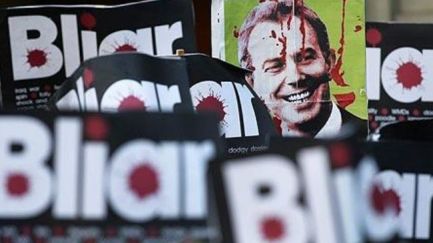
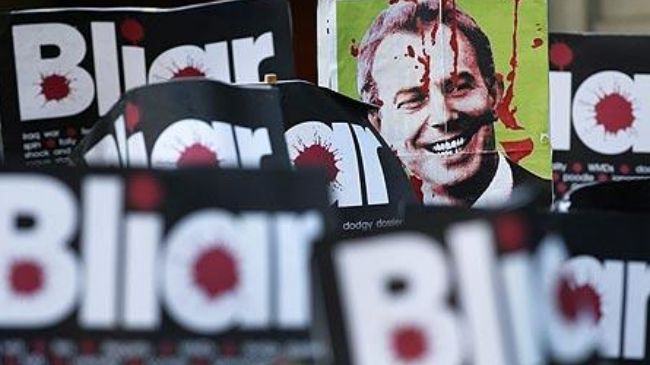
Former British Prime Minister Tony Blair, who is globally discredited for his war crimes, has tried to defend his decision to invade Iraq in 2003, claiming the country is a “safer place” after the execution of dictator Saddam Hussein.
In an interview on BBC2’s Newsnight marking the tenth anniversary of UK armed forces joining a US-led invasion of Iraq, he said despite the death toll among both British troops and Iraqi civilians being “very, very high”, the decision to wage a war against the Arab country was the right one.
He also conceded people are still “very abusive” to him years after the war on Iraq, adding that he had given up trying to “persuade people it was the right decision”.
Being asked if he minded being called a “liar” and “war criminal”, former leader of Britain’s Labour party said it did not matter whether the controversy about Iraq had “taken a toll on” him.
Moreover, he admitted that life in Iraq today was not what he had hoped for 10 years ago.
His comments come as hundreds of thousands were killed and injured in illegal interventions, and hundreds of thousands more were made refugees between 1997 and 2007, under Blair’s premiership.
Meanwhile, according to a recent Guardian/ICM poll a decade after the invasion of Iraq, the majority of Britons believe that the war “sold on a false prospectus delivered little but bloodshed.”
In 2003, the US and Britain invaded Iraq in blatant violation of international law and under the pretext of finding weapons of mass destruction (WMD) allegedly stockpiled by the former Iraqi ruler. However, no WMD were ever discovered in Iraq.
More than one million Iraqis were killed as a result of the invasion and subsequent occupation of the country, according to the California-based investigative organization Project Censored.
February 27, 2013
Posted by aletho |
Illegal Occupation, Militarism, Supremacism, Social Darwinism, Timeless or most popular, War Crimes | 2003 invasion of Iraq, Iraq, Iraq War, Tony Blair |
Leave a comment

 Aletho News
 Aletho News