Pharmaceuticals can be a license to print money
By Pete Dolack | Systemic Disorder | October 11, 2107
It’s no secret that the United States suffers from by far the world’s highest costs for health care. As the most market-oriented health care system among advanced capitalist countries, this is no surprise. Health care in the U.S. is designed to deliver corporate profits, not health care.
On that score, the U.S. system is quite successful. Pharmaceutical companies are at the head of the class in this regard, frequently justifying the spiraling costs of medications by citing large research and development costs that include the costs for drugs that don’t make it to market. There are many drugs that fail to survive testing and become a cost that will never be compensated, that is true. But are these failures really so high to justify the extreme costs of successful drugs?
It would seem not. Firmer proof of that lack of justification has been published by the JAMA Internal Medicine journal, which found that revenue for cancer drugs far outstrips spending on research and development. The article, “Research and Development Spending to Bring a Single Cancer Drug to Market and Revenues After Approval,” prepared by Drs. Vinay Prasad and Sham Mailankody, found that revenue from 10 drugs (one by each of 10 companies) exceed those companies’ total research and development costs by more than seven times.
The total revenue hauled in from these 10 drugs did vary considerably. Two of them earned more than US$20 billion after approval. Both of these high performers cost less than $500 million in research and development costs. The revenue from each of the 10, however, exceeded costs, with widely varied margins. Still profitable: The median revenue of these 10 drugs was $1.7 billion, more than double the median development cost of $648 million, the JAMA Internal Medicine authors report.
The authors write that the median cost to develop a cancer drug represents “a figure significantly lower than prior estimates,” adding that their analysis “provides a transparent estimate of R&D spending on cancer drugs and has implications for the current debate on drug pricing.”
To obtain these figures, the authors analyzed U.S. Securities and Exchange Commissions filings for pharmaceutical companies with no drugs on the U.S. market that received approval by the U.S. Food and Drug Administration for a cancer drug from January 1, 2006, through December 31, 2015. Cumulative R&D spending was estimated from initiation of drug development activity to date of approval. Earnings were tracked from the time of approval to March 2017.
The sky’s the limit for pharmaceutical prices
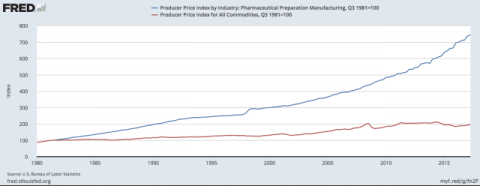
The increase in pharmaceutical prices (blue) versus the general increase in commodities prices (red).
Another way of looking at this would be to examine the increases in the cost of pharmaceuticals against other products. Here again the numbers stand out. Using data gathered by the St. Louis branch of the Federal Reserve Bank, the consumer price index for pharmaceutical preparation manufacturing for the first quarter of 2017 was 747.8, with January 1, 1980, as the benchmark of 100. In other words, the price of pharmaceuticals is seven and half times higher than they were at the start of 1980. (See graph above.)
How does that compare with inflation or other products? Quite well — for pharmaceutical companies. That more than sevenfold increase in drug prices is an increase nearly two and half times greater than inflation for the period, and nearly four times that of all commodities.
So, yes, unconscionable price-gouging is the cause here. By the industry as a whole, not simply individuals like “Pharma Bro” Martin Shkreli, who might be an outlier in his brazenness but not in his profit-generation plan.
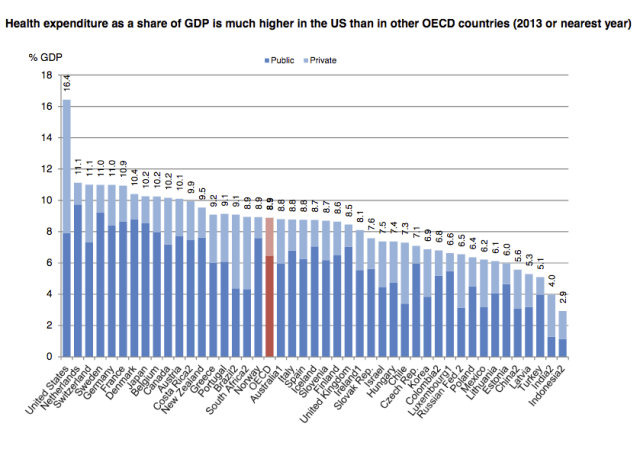
Although not the entire picture, this snapshot of corporate extortion plays a significant role in why the cost of the United States not having a universal health care system is more than $1.4 trillion per year.
Among 19 broadly defined “major” industrial sectors in the U.S., health technology is again expected to be found the most profitable for 2016, with a profit margin of 21.6 percent. Higher even than finance at 17 percent. When narrowing to more specific, narrowly defined industry categories, generic pharmaceuticals sit at the top with an expected 30 percent profit margin for 2016. Major pharmaceuticals rank fourth at 25.5 percent on a list in which health products and finance claim nine of the top 10 spots.
The sky’s the limit for pharmaceutical profits
That’s a repeat of 2015, when health technology had the highest profit margin of 19 broadly defined industrial sectors, at 20.9 percent, topping even finance, the second highest. When a separate study broke down profit margins by more specific industry categories, health care-related industries comprised three of the six most profitable.
Nothing new there, either. A BBC report found that pharmaceuticals and banks tied for the highest average profit margin in 2013, with five pharmaceutical companies enjoying a profit margin of 20 percent or more — Pfizer, Hoffmann-La Roche, AbbVie, GlaxoSmithKline and Eli Lilly. The world’s 10 largest pharmaceutical corporations racked up a composite US$90 billion in profits for 2013, according to the BBC analysis. As to their expenses, these 10 firms spent far more on sales and marketing than they did on research and development.
If those facts and figures aren’t enough, here’s another way of looking at excessive profits — a 2015 study found that, of the 10 corporations that have the highest revenue per employee among the world’s biggest corporations, three are health care companies. Two of the three, Amerisourcebergen and McKesson, both distribute pharmaceuticals, and the other, Express Scrips, administers prescription drug benefits for tens of millions of health-plan members. Each of these primarily operates in the United States, the only advanced-capitalist country without universal health coverage.
The extra layers represented by those three companies demonstrate that there are ample opportunities for corporate profiteering that contribute to extraordinarily high health care costs in the U.S., beyond drug manufacturing and insurance.
And because corporations have the ear of politicians and other government officials, it’s no surprise that one of the primary ongoing goals of the U.S. government for so-called “free trade” agreements, such as the Trans-Pacific Partnership, is to impose rules that would weaken the national health care systems of other countries. This was done in TPP negotiations at the direct behest of U.S.-based pharmaceutical companies, incensed that countries like New Zealand make thousands of medicines, medical devices and related products available at subsidized costs.
By far the most expensive system while delivering among the worst outcomes and leaving tens of millions uninsured, where tens of thousands die from lack of health care annually. That is the high cost of private profit in health care. Or, to put it more bluntly, allowing the “market” to decide health outcomes instead of health care professionals.
Featured Video

Marandi: Threat of Seizing Kharg Island & the Use of Nuclear Weapons
or go to
Aletho News Archives – Video-Images
Frlom the Archives
Provoking a Path to Persia
The Saban Center’s prescient paper on war with Iran
By Maidhc Ó Cathail | October 20, 2011
In June 2009, the Saban Center for Middle East Policy published “Which Path to Persia?—Options for a New American Strategy toward Iran.” Writing in a tone strikingly reminiscent of the Project for a New American Century’s infamous pre-9/11 paper “Rebuilding America’s Defenses,” the six co-authors noted that, “It seems highly unlikely that the United States would mount an invasion without any provocation or other buildup.” For a think tank specifically established by media mogul Haim Saban to protect Israel, this could prove to be a formidable obstacle impeding their desired march—of U.S. troops—to Tehran.
“In fact, if the United States were to decide that to garner greater international support, galvanize U.S. domestic support, and/or provide a legal justification for an invasion, it would be best to wait for an Iranian provocation, then the time frame for an invasion might stretch out indefinitely,” Saban’s think-tankers ruefully observed.
“With only one real exception, since the 1978 revolution, the Islamic Republic has never willingly provoked an American military response, although it certainly has taken actions that could have done so if Washington had been looking for a fight. Thus it is not impossible that Tehran might take some action that would justify an American invasion. And it is certainly the case that if Washington sought such a provocation, it could take actions that might make it more likely that Tehran would do so (although being too obvious about this could nullify the provocation). However, since it would be up to Iran to make the provocative move, which Iran has been wary of doing most times in the past, the United States would never know for sure when it would get the requisite Iranian provocation. In fact, it might never come at all.”
Seemingly undeterred by Iran’s frustrating unwillingness to provide the requisite provocation, the analysts continued to examine this option… continue
Blog Roll
 Aletho News
- Ukrainian Embassy in Beirut sheltering top Mossad agent
- Palestinian family displaced after settlers violently attack them in Humsa, Jordan Valley
- The EU never learns – except for the wrong lessons
- Iran attacks on UAE leaves RSF militia high and dry
- Hosting Washington’s war: Bahrain faces the consequences
- The US fell for its own Iran propaganda
- Seyed M. Marandi: Threat of Seizing Kharg Island & the Use of Nuclear Weapons
- Is there even an off ramp?
- Michael von der Schulenburg: Europe’s Self-Defeating Iran War Policy
- Sorry, The New Republic, Climate Change Isn’t Causing Somali Migration. Blame Civil Strife and Poverty.
- If Americans Knew
- ‘Of Course’: IDF Drops Case Against Soldiers Accused of Raping Palestinian Prisoner
- Don’t Fall for the Regime Change Talk. Israel Is ‘Mowing the Lawn’ in Iran
- Will Israel and the US wreck the Gulf States along with Iran?
- US so far burned through ‘years’ of munitions in Iran war: Report
- How the Israeli Tail Wags the American Dog
- Outdated intel likely led to deadly U.S. strike on Iranian elementary school, sources say
- Pentagon insider says high U.S official Douglas Feith reported to Netanyahu
- In fond memory of Walid Khalidi, the historian of Palestine
- 6 more Americans killed, as Israel ‘mows the lawn’ in Iran – Not a ceasefire Day 154
- Are we on the precipice of World War III?
- No Tricks Zone
- New Studies: UK Sea Levels Were 4 Meters Higher Than Today During The Mid-Holocene
- Destructive Green New Deal: German Energy And Metal Group Warns Of Drastic Crisis
- New Study Documents A 20-Year Pause In Arctic Sea Ice Decline – Driven By Internal Variability
- Wake-up Call: Survey Shows Majority Of Germans Now Favor Postponing Climate Targets!
- Televised! Leading German Political Candidate Tells Schoolchildren CO2 Makes Sun Hotter!
- New Study: A Century Warming Of 1.1°C Is ‘Commonplace’ And ‘Not Unusual’ During This Interglacial
- New Study: ‘Internal Noise’ And Volcanic Forcing Can Trigger 10-15°C Warming Within Decades
- Glaciers Worldwide Are Suddendly Surging, Experts Blame Warming!
- Surprising Discovery: Sahara Is Greening…Billions Of Trees Where Once Thought To Be Barren
- New Research Reaffirms Clouds, Aerosols, And Surface Solar Radiation Are ‘Driving The Climate System’
 Aletho News