Vaccine injury lawyer delivers scathing rebuke of childhood vaccine schedule — Offit, Hotez decline to debate
By Michael Nevradakis, Ph.D. | The Defender | December 5, 2025
The Centers for Disease Control and Prevention’s (CDC) vaccine advisory committee today heard from a vaccine injury lawyer who proposed the committee revisit the childhood vaccine schedule.
Attorney Aaron Siri told members of the Advisory Committee on Immunization Practices (ACIP) that the vaccines were recommended without sufficient data and that the expansion of the schedule coincided with a rise in chronic illness among U.S. children.
Siri, a vaccine critic and author of “Vaccines, Amen: The Religion of Vaccines,” called for a reexamination of the childhood immunization schedule based on “robust” safety data.
Siri challenged claims that the childhood vaccination schedule has been tested in its entirety, that the vaccines are safe and that routine childhood vaccines have been proven to prevent transmission.
He also questioned claims that scientists have conducted the testing necessary to assert definitively that there is no possible link between vaccines and autism.
Siri recommended ACIP revisit childhood vaccine recommendations based on “robust” clinical trial and post-licensure safety data and called on the committee to respect the “right of informed consent.”
“Mandates make vaccines political” and also “impact those who most need to avoid” certain vaccines, he said. When people report vaccine injuries, members of the medical community “pretend that they don’t exist.”
Siri represents plaintiffs in vaccine-related lawsuits against federal agencies and pharmaceutical companies.
Children’s Health Defense CEO Mary Holland said Siri “accurately compared the pre-1986 Act vaccine schedule with the post-1986 schedule, when doctors and vaccine manufacturers have been absolved from all real responsibility for the vast vaccine injuries they have caused,” Holland said.
The National Childhood Vaccine Injury Act of 1986 granted vaccine makers immunity from liability for most injuries caused by their products.
ACIP didn’t vote on any aspect of the childhood vaccine schedule today. In June, ACIP formed a committee to study the cumulative effect of all vaccines given during childhood.
Key vaccine advocates declined ACIP’s invitation to deliver presentations
Siri’s presentation came shortly after ACIP voted to end the recommendation that all infants born in the U.S. receive the hepatitis B (Hep B) vaccine within 12-24 hours of birth.
The committee also voted to recommend that families determine whether to give their child the Hep B shot at birth through individual decision-making and consultation with their physician.
Siri cited the licensing of Hep B vaccines as an example of flawed studies leading to the licensing of a vaccine. He called those studies “underpowered” and “industry-funded.”
Siri’s presentation stirred controversy even before it began. In a post on X yesterday, Sen. Bill Cassidy (R-La.), chairman of the U.S. Senate Health, Education, Labor & Pensions (HELP) Committee, dismissed Siri’s qualifications and said ACIP “is totally discredited.”
Siri responded that Cassidy’s post was “deeply ironic,” given that vaccine manufacturers are legally protected from lawsuits.
“Childhood vaccines are the only product in America where you cannot ever sue the company that killed or injured your child on the basis the company could’ve made the product safer. If vaccines are so safe, why do they need this protection?” Siri wrote on X.
ACIP member Dr. Cody Meissner called Siri’s presentation a “terrible distortion of all the facts” and said Siri shouldn’t have been invited. Earlier, Meissner voted against the proposal to end the universal Hep B vaccine recommendation for newborns.
ACIP also addressed controversy over Siri’s presentation and the lack of a pro-vaccine counterweight. Mina Zadeh, Ph.D., ACIP’s executive secretary, said the committee “invited several people to give us a broad perspective” on the childhood vaccination schedule.
Those invitees included two prominent and outspoken promoters of vaccines — Dr. Paul Offit and Peter Hotez, M.D., Ph.D. Both declined. Hotez told STAT that Siri “shouldn’t be there in the first place.”
Siri responded that the U.S. has “the worst health outcomes of all developed countries.”
Liability shield disincentivizes vaccine makers from performing proper safety testing
Siri used the opportunity today to criticize the National Childhood Vaccine Injury Act of 1986. He said the liability shield provided by that law disincentivized vaccine manufacturers from focusing on the safety of their products.
“Companies, including pharmaceutical companies, are driven by economic self-interest,” Siri said. “With drugs and non-routine vaccines, they … remain liable for the injuries caused by those products after they come to market and hence, they have an economic self-interest in doing robust clinical trials beforehand.”
“When it comes to routine childhood vaccines … they don’t have those same concerns,” Siri said.
He said the number of vaccines on the childhood schedule skyrocketed — from three to 72 — after Congress passed the 1986 act. Those initial three vaccines “were causing so much harm, all the manufacturers stopped making them or went out of business,” prompting the passage of the act.
“For every other product I’m aware of, the solution is to make a better, safer product. But when it came to these vaccines, Congress went a different way” by giving these companies “unprecedented broad immunity,” Siri said.
‘You can’t find what you’re not studying’
Siri also criticized the shortened clinical trial process for childhood vaccines, which results in recommendations being made on the basis of insufficient data and the inability to detect any long-term health impacts from the vaccines.
“Most recommendations for routine use by ACIP of a particular vaccine happened very shortly after its licensure, and hence the primary data often available for a specific vaccine would have been its clinical trial data,” Siri said.
He also criticized the lack of post-licensure safety monitoring.
“You can’t find what you’re not studying,” Siri said. “When you give a product to a baby or an infant in particular, you often won’t know what neurological, immunological or developmental issues that product can cause until you’ve tracked that child for at least a few years.”
Citing autism as the “injury claimed to be the most thoroughly studied,” Siri said the medical community has not conducted studies that would definitively eliminate a vaccine-autism link, even though the 1986 act listed autism as one of 11 conditions that warrant further study to determine a possible link with vaccination.
“It was a commonly claimed enough injury back in 1986 … to make it on this list of 11 conditions,” Siri said.
U.S. ‘an international outlier’ on childhood vaccination
Today’s meeting also included a presentation by Tracy Beth Høeg, M.D., Ph.D., who earlier this week was named the next leader of the FDA’s Center for Drug Evaluation and Research.
Høeg compared U.S. childhood vaccine requirements and health outcomes with those of her native Denmark. There are “eye-opening differences in the recommendations” between the two countries, she said.
While the U.S. requires 72 core childhood vaccine doses, Denmark requires 11 — in line with most other high-income countries. Høeg said this makes the U.S. “an international outlier” on childhood vaccination.
The higher vaccine load “results in an increased exposure to aluminum,” Høeg said, with U.S. children exposed to 5.9 milligrams (mg) of aluminum by age 2 and 8.0 mg by age 18. In Denmark, the corresponding figures are 1.4 and 2.9 mg, similar to other high-income countries.
While there isn’t “robust enough” data indicating “specific health concerns” resulting from this level of aluminum exposure, Høeg said there also is insufficient data to establish a safe level of exposure.
“We need to admit that we may not know what the side effects of doing this, especially all at once, could be,” she said.
Increased vaccination also hasn’t delivered better health outcomes for U.S. children, according to Høeg. She cited the examples of the Hep B and meningococcal vaccines, which Denmark does not recommend for children, unlike the U.S. Yet, levels of hepatitis B and meningitis among children in the two countries are similar.
Høeg said U.S. health agencies should “avoid overmedicalizing childhood” and owe American children recommendations that are “based on data and not politics.”
Potential risks of post-vaccine aluminum accumulation ‘a warranted concern’
Dr. Evelyn Griffin, an OB/GYN and member of three ACIP work groups called for more research into the safety of aluminum-based adjuvants used in vaccines.
Griffin said aluminum salts are the most widely used adjuvant. Yet, the mechanisms underlying the use of aluminum salts in vaccines “are not fully understood.” She said only one peer-reviewed study has examined the effects of aluminum in infants’ blood following vaccination — but that study used a small sample and didn’t collect long-term data.
According to Griffin, current FDA aluminum exposure limits are increasingly questioned, as “appropriate testing was not performed.” She said recent studies have suggested that aluminum accumulation is “a warranted concern” and called for studies on the long-term impact of aluminum exposure and who is most at risk.
Griffin called on ACIP to determine how it can assess the safety and effectiveness of adjuvants in currently recommended vaccines for all ages, including studies regarding whether multiple aluminum-containing vaccines should be administered on the same day during early infancy.
In October, ACIP announced the creation of a new work group that will study the safety of aluminum adjuvants. ACIP did not hold a vote relating to the aluminum content of vaccines at today’s meeting.
Watch the ACIP meeting here.
This article was originally published by The Defender — Children’s Health Defense’s News & Views Website under Creative Commons license CC BY-NC-ND 4.0. Please consider subscribing to The Defender or donating to Children’s Health Defense.
AAP, AMA Booted From CDC Vaccine Advisory Working Groups
By Brenda Baletti, Ph.D. | The Defender | August 8, 2025
The American Academy of Pediatrics (AAP), the American Medical Association (AMA) and six other major medical associations will no longer participate in advising the Centers for Disease Control and Prevention (CDC) on vaccine policy, Bloomberg reported.
The associations said they were informed via email last week that their vaccine experts were being disinvited from the workgroups that report to the CDC’s vaccine advisory committee.
The Advisory Committee on Immunization Practices (ACIP) decides which vaccines should be recommended to the public, who should take them and how often. Its recommendations help determine which vaccines will be covered by the CDC’s Vaccines for Children Program and insurers, and will be mandated by states for daycare and school attendance.
The medical association members will no longer be invited to participate in the working groups that review data and form policy recommendations. However, they will be able to participate in the open public meetings, like the rest of the public.
They are being eliminated because they are “special interest groups and therefore are expected to have a ‘bias’ based on their constituency and/or population that they represent,” according to one U.S. Department of Health and Human Services (HHS) email reported by The Associated Press.
HHS spokesperson Andrew Nixon confirmed the decision in an email. He said:
“Under the old ACIP, outside pressure to align with vaccine orthodoxy limited asking the hard questions. The old ACIP members were plagued by conflicts of interest, influence, and bias. We are fulfilling our promise to the American people to never again allow those conflicts to taint vaccine recommendations.
“Experts will continue to be included based on relevant experience and expertise, not because of what organization they are with.”
Groups call decision ‘irresponsible, dangerous’ to public health
The organizations responded in a joint statement, claiming the decision is “irresponsible, dangerous to our nation’s health, and will further undermine public and clinician trust in vaccines.” They called on the Trump administration to reconsider the decision.
“We are deeply disappointed and alarmed that our organizations are being characterized as ‘biased’ and therefore barred from reviewing scientific data and informing the development of vaccine recommendations that have long helped ensure our nation’s vaccine program is safe, effective, and free from bias,” they wrote.
In addition to the AAP and the AMA, the statement was signed by the American Academy of Family Physicians, American College of Physicians, American Geriatrics Society, American Osteopathic Association, Infectious Diseases Society of America and the National Medical Association.
The decision was the latest attempt by U.S. Health Secretary Robert F. Kennedy Jr. to address the problem of industry influence over ACIP.
In June, Kennedy announced that HHS was retiring all 17 members of ACIP to eliminate conflicts of interest. At the time, most members had financial ties to pharmaceutical companies marketing vaccines, or had worked with public health agencies to promote controversial vaccines, including the COVID-19, RSV and HPV shots.
Two days later, Kennedy named eight researchers and physicians to replace approximately half of the members. One nominee declined to participate.
At the first meeting of the new ACIP committee, the members voted to stop recommending flu shots that contain thimerosal, a mercury-based preservative linked to neurodevelopmental disorders. The AAP, which criticized the decision, maintains that thimerosal is “safe.”
The committee also voted to recommend Merck’s new RSV monoclonal antibody shot for newborns.
Every group kicked out of ACIP takes corporate money from Big Pharma
In July, several of the medical associations removed last week from the ACIP working groups sued Kennedy and other public health officials and agencies over the changes to COVID-19 vaccine recommendations for children and pregnant women.
The groups’ lead lawyer, Richard Henry Hughes IV, was vice president of public policy at Moderna from 2020-2022, when the vaccine maker developed and marketed the Spikevax COVID-19 vaccine, which has netted the company billions of dollars over the last four years. He also previously worked for Merck.
Last month, the AAP also called for an end to religious and philosophical vaccine exemptions for children attending daycare and school in the U.S.
In an updated policy statement published in Pediatrics, the AAP said universal immunization is necessary to keep children and employees safe. The organization said there is a place for “legitimate” medical exemptions, but nonmedical exemptions — part of the fundamental constitutional right to freedom of religion — are “problematic.”
In addition to working with lobbyists like Hughes, every organization expelled from the ACIP working group is funded by the pharmaceutical industry.
The AAP, the major professional organization representing 67,000 pediatricians in the U.S., has overseen the rising rates of chronic illness and medication of American children over recent decades. It is also a lobbying organization that, over the previous six years, has spent between $748,000 and $1,180,000 annually advocating for its members, according to the government website Open Secrets.
The organization’s funding for that work comes, in part, from annual contributions from corporate sponsors, including vaccine manufacturers Moderna, Merck, Sanofi, Abbott Laboratories, GSK and CSL Seqirus.
The AMA is also funded in part by corporate sponsorships. In the past, it came under fire for taking more than $600,000 from pharmaceutical companies to finance a $1 million campaign to promote ethical guidelines discouraging doctors from accepting expensive gifts from drug companies, The Lancet reported.
AMA funding also comes from the AMA Foundation, which is funded by “Roundtable members” from the pharmaceutical industry. Its largest donor is PhRMA, the primary lobbying organization for the industry — which spent a record $12.88 million lobbying for the industry in the first quarter of 2025.
Other AMA sponsors include Agmen, Bristol-Myers Squibb, Eli Lilly, Genentech, GSK, Merck, Novartis, Pfizer, Sanofi and others.
The National Medical Association takes funding from Eli Lilly, Gilead, Regeneron, Pfizer, Merck, Amgen, Novo Nordisk, Vertex, AstraZeneca and others.
The Infectious Diseases Society of America partners with Abbvie, AstraZeneca, Gilead, GSK, Merck, Moderna, Pfizer, Sanofi and others.
A similar list of Big Pharma companies funds the American Academy of Family Physicians, which also partners with Amazon Pharmacy.
Pharma giants, including Pfizer and Johnson & Johnson, are on the long list of the American College of Physicians’ corporate sponsors, along with Big Food giants Tyson Foods and PepsiCo.
The American Geriatrics Society’s financial disclosure statement shows that it has various corporate sponsors, including Merck and Pfizer.
The American Osteopathic Association also has several corporate sponsors, including Pfizer, Astellas, Merck and Sanofi.
New ACIP committee member Retsef Levi, Ph.D., in a post on X, said that instead of these industry-sponsored organizations, the working groups plan to engage experts from a broader set of disciplines.
The working group participation will now “be based on merit & expertise,” he wrote, “not membership in organizations proven to have COIs [conflicts-of-interest] and radical & narrow view of public health!”
Related articles in The Defender
- Breaking: RFK Jr. Removes All Members of CDC Vaccine Advisory Committee
- RFK Jr. Taps 8 New ACIP Members, Offit Concedes Most ‘Seem Reasonable’
- RFK Jr. Hit With Lawsuit Over Changes to COVID Vaccine Policies for Kids, Pregnant Women
- Lawyer Leading Lawsuit Against RFK Jr. Over COVID Vaccines Used to Work for Moderna
- American Academy of Pediatrics Wants to Shut Down Religious Vaccine Exemptions
This article was originally published by The Defender — Children’s Health Defense’s News & Views Website under Creative Commons license CC BY-NC-ND 4.0. Please consider subscribing to The Defender or donating to Children’s Health Defense.
Legacy media has a meltdown after RFK Jr fires the CDC’s vaccine panel
By Maryanne Demasi, PhD | June 10, 2025
Yesterday, Robert F. Kennedy Jr. fired every single member of the CDC’s Advisory Committee on Immunization Practices (ACIP)—the influential group of experts that decides which vaccines are added to the childhood schedule.
Today, he set fire to the media’s hysterical reaction.
Within 24 hours, legacy outlets and public health institutions lost their collective minds. Former CDC directors, industry-funded doctors, and conflicted public health groups lined up to denounce Kennedy’s move as reckless, anti-scientific, even deadly.
“This is a dangerous and unprecedented action that makes our families less safe,” said former CDC director Dr Tom Frieden.
“Unilaterally removing the entire panel of experts is reckless,” said paediatrician Dr Tina Tan to The New York Times.
The American Academy of Pediatrics (AAP) said it was “deeply troubled and alarmed.” It claimed the move would “stoke distrust in lifesaving vaccines”—this from the same organisation that has spent decades pushing the childhood vaccine schedule while taking money from the very companies that profit from it.
Others framed it as a political purge, a blow to science, or a “coup” that would bring back measles and polio.
But within hours, Kennedy hit back—and this time, he wasn’t the outsider being easily dismissed. He was the Secretary of Health and Human Services. And he came armed with evidence, receipts, and a brutal takedown of the media’s favourite falsehoods.
In a searing post on X, Kennedy explained the decision.
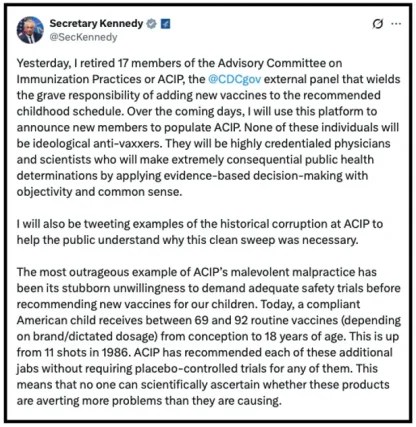
He said the clean sweep was necessary because ACIP had demonstrated its “stubborn unwillingness to demand adequate safety trials before recommending new vaccines for our children.”
And despite the media’s insistence otherwise, Kennedy argued that no routine injected childhood vaccine on the CDC’s schedule had ever been approved based on a placebo-controlled trial using an inert substance.
CNN had tried to prove him wrong last week—claiming it had found “257 placebo-controlled studies” of vaccines on the schedule.
Kennedy dismantled it in forensic detail.
“CNN is wrong,” he wrote. “No routine injected vaccine on CDC’s schedule was licensed for children based on a placebo-controlled trial. That is not conjecture. It is a fact based on FDA’s clinical trial data.”
Then came the body blows.
He pointed out that most of the 257 studies used active substances like aluminium, antibiotics, or other vaccines—not inert placebos.
He linked directly to FDA definitions of “placebo” and to official clinical trial records. Of the few studies that may have used saline controls, none were relied on by the FDA to license a single routine vaccine for American children.
Some studied products that were never approved in the US. Some occurred after licensure. Others involved discontinued vaccines. “CNN’s list ironically proves the lack of adequate safety trials,” Kennedy wrote in a stinging rebuke.
The post was devastating.
It was a clinical takedown of an industry riddled with deception—and it landed—because this time, Kennedy wasn’t being filtered through a hostile press.
He was speaking directly to the public, as a government official, with all the links to back it up. And the media couldn’t handle it.
Predictably, the media rolled out the same tired “experts” to recycle the same tired script—Paul Offit quotes, panic about “undermining trust,” warnings that children would die.
But Kennedy turned the whole thing inside out.
“We’ve gone from three routine injections by age one in 1986 to 25 in 2025,” he wrote. “And not one of them was licensed using a placebo-controlled trial.”
He said it plainly for the cameras: “That is just malpractice. So the people who are in charge of that are now gone.”
For years, the press had written Kennedy off as an anti-vaxxer and moved on. Now, they’ve thrown everything at him—and he threw it right back. Only now, he has the authority, data, and reach.
Kennedy told his followers he’d be announcing replacements in the coming days—no “ideological anti-vaxxers” just “highly credentialed physicians and scientists” committed to evidence, objectivity, and common sense.
Legacy media may still control the headlines, but they can no longer suppress the debate.
And perhaps that’s what really has them rattled.
They’re not defending science. They’re defending a regime of experts who signed off on decades of vaccine approvals without ever insisting on rigorous, inert-placebo safety trials.
When Kennedy calls them out, their only defence is to scream “danger!”—and hope no one checks the fine print.
Yesterday, he fired the gatekeepers. Today, he exposed the game.
US makes sweeping changes to key vaccine group
RT | June 10, 2025
The US Department of Health and Human Services (HHS) has dismissed all the members of a key advisory panel that has helped shape national vaccination policy for decades. Health Secretary Robert F. Kennedy Jr. said on Monday that the move was necessary to reestablish public trust and address longstanding concerns over conflicts of interest.
The Advisory Committee on Immunization Practices (ACIP) was created within the Centers for Disease Control and Prevention (CDC) in the mid-1960s. In an op-ed published on Monday in the Wall Street Journal, Kennedy claimed that the panel has “a history of conflicts of interest, persecution of dissidents, a lack of curiosity, and skewed science.”
The secretary cited reports from a House committee in 2000 and the HHS inspector general in 2009 that detailed financial connections between ACIP members and pharmaceutical companies. He said his decision to replace all 17 current members was driven by the need for a “clean slate.”
“The problem isn’t necessarily that ACIP members are corrupt. Most likely aim to serve the public interest as they understand it,” Kennedy wrote. “The problem is their immersion in a system of industry-aligned incentives and paradigms that enforce a narrow pro-industry orthodoxy.”
ACIP members are appointed to four-year terms, and eight of the most recent appointments were made in the final days of the administration of Joe Biden.
”It was very intentional,” a former senior HHS official told STAT News. “It was our goal to fill every vacancy on every [federal advisory committee] the department has, with particular focus on ones like ACIP where maintenance of our scientific expertise was critical.”
Mandy Cohen, who served as the CDC director under Biden, told NBC News the move “spreads confusion and casts doubt on transparent public health processes that protect Americans.” Richard Besser, who was acting CDC director under Barack Obama, said it “should erase any remaining doubt that he intends to impose his personal anti-vaccine agenda on the American people.”
Kennedy has long criticized aspects of US vaccine programs, arguing they are too closely aligned with industry interests and fail to prioritize public health. His detractors frequently label him an “anti-vaxxer.”
During his confirmation hearings, Kennedy pledged that his decisions would be science-driven. In his WSJ piece, he warned against attributing the American public’s “crisis of trust” solely to “misinformation or anti-science attitudes.”
Corporate Media Meltdown Over Trump’s CDC Director Pick Dr. Dave Weldon
A look a the possible changes ahead for the CDC under his leadership
By Jefferey Jaxen | November 25, 2024
Former seven-term congressman Dr. David Weldon was chosen by President-elect Donald Trump going into this past weekend to serve as director of the U.S. Centers for Disease Control and Prevention (CDC).
Amidst the flurry of possible appointments grabbing headlines, Dr. Weldon has the opportunity to change the way America has handled public health for decades.
The Washington Post described Dr. Weldon in the second sentence of its breaking news article as “… a strong critic of the CDC, especially its vaccine program.” The reporting meant the sentence to be a negative, ironically, it’s probably now a breath of fresh air for most Americans post-COVID.
“… increasingly we talk only to a certain elite. More and more, we talk to ourselves” wrote Jeff Bezos, owner of the Washington Post, less than a month ago when admitting most people don’t believe corporate/legacy media anymore. It’s like WAPO’s recent reporting on Weldon already forgot this warning.
The New York Times claimed that Dr. Weldon was “skeptical of vaccine safety,” a designation that would have worked to neutralize his voice in years past when the outlet still garnered attention and respect.
STAT News wrote, “The former Florida congressman sponsored legislation that would have carved out the CDC’s vaccine safety research…”
The Vaccine Safety Bill to ‘carve out research’ Dr. Weldon introduced in 2007 wanted to establish an independent agency within the Department of Health and Human Services to handle the nation’s vaccine safety. His reasoning at the time was that the CDC had an inherent conflict of interest being responsible for both vaccine safety and promotion—an issue unchanged to this day.
In Weldon, the public also finds a rare leader who has been willing to ask politically forbidden questions about links between vaccines and autism along with the greater questions about health outcomes of children receiving HHS’s childhood vaccine schedule compared with children who had not been vaccinated. In addition to why there’s been limited investigation to determine what children may be as risk of being harmed by vaccines.
“The thing I continue to find extremely disturbing is the fact that the CDC still does not allow researchers access to the vaccine safety data… The best way to get answers on the vaccine safety data is to open it up and let objective scientists come in and look at it.” – Rep. Dave Weldon at the Vaccines & Autism House Government Reform Committee 2002
One of the key data tranches Weldon is referring is vaccine safety datalink or VSD. A monitoring system using electronic health record data from health sites around the country to assess vaccine safety and detect adverse events in near-real time. Also a system that the public and independent researchers are blocked from accessing.
Besides the possibility of allowing the sunlight of independent researchers to comb through once-hidden vaccine data while dedicating resources to health-affirming tools outside of one-size-fits-all shots, Dr. Weldon will have veto power over the CDC’s Advisory Committee on Immunization Practices (ACIP).
ACIP makes recommendations about which vaccines are added to the U.S. schedule, among other decisions. The committee needs final approval from the director of the CDC to implement their calls. Dr. Weldon would hold a power position over a committee who unanimously rubber-stamped every COVID vaccine and booster from infants to the elderly, among other questionable call throughout the years leading to reduced public trust.
Another approach long-called for, and even once implemented by the CDC, would be to automate their Vaccine Adverse Event Reporting System (VAERS) to instantly detect and report potential safety issues with the shots they promote.
In 2006 this was attempted through a $1M HHS grant to create a spontaneous reporting system to VAERS at Harvard Pilgrim Health Care. The researchers found that “fewer than 1% of vaccine adverse events are reported” yet predictably, the CDC never followed up.
As many new to this conversation are rushing the gates to further their careers or gain influence and power on the back of the rapid political change we find ourselves at the beginning of, there have been those holding a strong space with little fanfare. Dr. Dave Weldon is one such individual.
His decades-long hopes to reform the CDC and, more importantly, protect American children and families from unrestrained harms brought upon so many by liability-free injectable pharmaceutical products which have enjoyed a privileged position away from full public and scientific scrutiny may soon see the light of day.
To the readers, is the CDC even salvageable at this point?
What other major areas of reform could help rapidly transform public consciousness around health and healing?
Routine Infant Hepatitis B Vaccination Fails to Protect Into Young Adulthood
Parents Should Not Expect a Long-Term Benefit
By Peter A. McCullough, MD, MPH | Courageous Discourse™ | August 12, 2024
In 1991, the Advisory Committee on Immunization Practices (ACIP) first recommended that all infants in the United States receive the hepatitis B vaccine at birth or within 1–2 months of age. The goal was to prevent maternal transmission of the hepatitis B virus (HBV) and reduce the incidence of infections in babies. Many healthy mothers without hepatitis B or risk factors such as IV drug abuse with normal infants ask what is the benefit in their babies?
The CDC recommends that children receive three doses of the hepatitis B vaccine as part of their routine childhood vaccine schedule:
- First dose: Within 24 hours of birth
- Second dose: Between 1–2 months of age
- Third dose: Between 6–18 months of age
What happens later in life when young people go into the medical field and are potentially exposed to hepatitis B in sick patients? Posuwan et al evaluated a prospective cohort of young people (mean age 18 years) going into medicine and evaluated their antibody titers as a proxy of enduring immunity to hepatitis B.

Posuwan N, Vorayingyong A, Jaroonvanichkul V, Wasitthankasem R, Wanlapakorn N, Vongpunsawad S, Poovorawan Y. Implementation of hepatitis B vaccine in high-risk young adults with waning immunity. PLoS One. 2018 Aug 20;13(8):e0202637. doi: 10.1371/journal.pone.0202637. PMID: 30125298; PMCID: PMC6101408.
The investigators were disappointed to find that only 6.9% had long-lasting immunity to hepatitis B, and thus underwent booster doses upon entering medical school. It is unclear when immunity is lost in this cohort. The results are important for parents to understand that the hepatitis B shots given at birth are only applicable if the mother has hepatitis B or serious risks for carrying it including active IV drug abuse. Otherwise the vaccine schedule for this illness has little value at that age.
Featured Video

Chinese jet fuel and the myth of energy independence
or go to
Aletho News Archives – Video-Images
Book Review
Former Insiders Criticize Iran Policy as U.S. Hegemony
By GARETH PORTER | CounterPunch | February 27, 2013
“Going to Tehran” arguably represents the most important work on the subject of U.S.-Iran relations to be published thus far.
Flynt Leverett and Hillary Mann Leverett tackle not only U.S. policy toward Iran but the broader context of Middle East policy with a systematic analytical perspective informed by personal experience, as well as very extensive documentation.
More importantly, however, their exposé required a degree of courage that may be unparalleled in the writing of former U.S. national security officials about issues on which they worked. They have chosen not just to criticise U.S. policy toward Iran but to analyse that policy as a problem of U.S. hegemony. … continue
Blog Roll
 Aletho News
- What is fueling unrest across the EU?
- Why no power can undermine Iran’s eternal dominance over the Strait of Hormuz
- Is The War Against Iran Over?
- Iran war will leave long-term ‘scar’ on Wall Street, investors warn
- How Iran decimated US power projection in West Asia: Military lessons of 40-day war
- Iran’s report details US-Israeli war crimes in targeting schools, hospitals, livelihoods
- NATO’s Slow Fracture: How Trump’s Iran War Exposed the Instrument of Hegemony
- Chinese jet fuel and the myth of energy independence
- Ukraine Sea Drone Fired From Libya Hit Russian Tanker in Mediterranean
- IRGC: Iranian forces launched no attacks during ceasefire hours
- If Americans Knew
- DNC Shoots Down Resolutions Calling Out AIPAC and Limiting Arms to Israel
- TCN: Is Israel Blackmailing President Trump?
- Israel killed at least 303 Lebanese yesterday – who were they? Daily Update
- Amnesty: Urgent – Protect Lebanese civilians from brutal escalation in Israeli attacks
- Is The War Against Iran Over?
- Inside the Israeli army’s propaganda wing
- Hundreds of Gaza Amputees Stranded in Legal Limbo
- The gallows law: Israel moves toward executing Palestinian children
- Tucker Carlson: The Path to Peace requires ending ‘special alliance’ with Israel
- This is ceasefire? Israel’s biggest massacre yet in Lebanon, another journalist killed in Gaza – Daily Update
- No Tricks Zone
- An Inconvenient Tree: Uncovered In Alps… Europe Much Warmer Than Today 6000 Years Ago
- New Study Reports A 60% Slowdown In Greenland’s Ice Loss Rate In The Last Decade
- Low Intensity Tornado Wrecks Major Solar Farm, Creating A Potential Toxic Dump
- New Study Finds Warming Saves Lives…Cold Temperatures 12 Times More Deadly Than Excess Heat
- German Science Blog Accuses PIK Climate Institute Of Hallucinating Climate Tipping Points
- Devastating Assessment Of Comirnaty Vaccine By Former Senior Pfizer Europe Toxicologist
- New Study: CO2 Is ‘Effectively Negligible’ As An Explanatory Climate Change Factor Since 2000
- Former Pfizer Toxicologist Dr. Helmut Sterz Tells Bundestag Hearing Pfizer Vaccine Should Have Never Been Approved
- Energy Expert: Germany’s Nuclear Phaseout Was A “500 Billion Euro Mistake”
- New Research: South Australia’s Mid-Holocene Sea Surface Temperatures Were 4°C Warmer Than Today
 Aletho News