Until Freedom or Martyrdom: Thaer Halahleh on 60 Days of Hunger Strike
By Dylan Collins | Palestine Monitor | April 28, 2012
Kharas, occupied West Bank—Two year old Lamar Halahleh has never met her father outside of a prison cell. In fact, she wasn’t able to lay eyes upon him until she was nearly half a year old.
Thaer Halahleh, Lamar’s father, has not only spent the last two years in the Israeli prison system, the 33 year-old has actually been detained for the majority of the past nine years due to Israel’s exploitive practice of administrative detention.

“The only way she [Lamar] knows her father is through pictures,” says Lamar’s mother and Thaer’s wife, Shireen. “She has hundreds of pictures of Thaer. When she goes to sleep at night, she tucks his picture into bed with her.”
Always held without charge or trial, Thaer’s only officially stated wrongdoing has been his affiliation to Islamic Jihad, a political party officially outlawed by Israel.
Thaer’s most recent arrest came on 26 June 2010 during a midnight raid on his home in the small village of Kharras, near Hebron in the occupied West Bank. Nearly 50 Israeli soldiers stormed the Halahleh’s home. Without knocking, the armed forces kicked down the door, made the women and children go outside in their bedclothes, and proceeded to search the house with two dogs for nearly an hour.
After a thorough search of the house, the troops then told the family they had an order to arrest Thaer. When asked why, the officer in charge responded that Thaer was a “threat to the public.”
Thaer had only just recently ended a year long stretch in administrative detention. He was home for all of about 14 days before being re-arrested and presented, yet again, with a three- month administrative detention order.
Like all other administrative detainees, Thaer is being held on ‘secret evidence’ and has never been officially charged nor convicted of anything.
Cyclical and ambiguous arrests have plagued the lives of Thaer and his family. Every one of his four brothers, and even his father, has been held in administrative detention at some point. Thaer himself has been arrested 8 times and spent a collective six and half years total in administrative detention.
Thaer’s most recent administrative detention order has been renewed every three-months. The uncertainty of his detention’s length has been nerve racking to say the least. Thaer’s wife, Shireen, argues neither she nor Thaer, nor Thaer’s lawyer know whether the order will be renewed until the day it concludes. Shireen reveals that several times, Thaer has been directed to collect his belongings and prepare to go home only to be turned back at the gates of the prison with a renewed three-month detention order.
How to Fight Ambiguous Detentions
Thaer’s detention was most recently extended in January for a period of six-months. Left with few other options and encouraged by Sheikh Khader Adnan’s recent 66-day feat in protest of administrative detention, the exact same directive that has controlled Thaer’s life for the past nine years, he too entered into his own open-ended hunger strike on 28 February while in Al-Naqab prison.
Saturday 27 April 2012, Thaer entered into his 60th day with out food.
“He is determined,” said Thaer’s older brother Mohammed. “He will either be set free or become a martyr.”
When asked if they thought Thaer would be willing to accept an exile deal similar to the one Israel reached with hunger striker Hana Shalabi, through which she had been exiled to Gaza for the following three years, his family responded with a resounding no. “It was good for Hana,” says Thaer’s Uncle Wahib, “but Thaer would never agree to anything of the sort.”
On 28 March, Thaer was transferred to Israel’s Ramleh medical prison along with another hunger striking prisoner, Bilal Diab. According to Addameer, both men have been held in isolated cells in the general prison section. Despite numerous requests, Addameer lawyers have been denied access to Thaer and Bilal since their transfer.
Despite his rapidly deteriorating condition, Thaer Halaleh’s appeal against his administrative detention was rejected by an Israeli military judge at the Ofer military court on Monday 23 April.
Thaer’s wife Shireen has little faith in receiving justice from the Israeli military court system. “How can we have any faith in the court hearings. How can we believe that a just verdict will be reached when we are barred from even attending the trial, when the entire trial is conducted in Hebrew, and when the only people present are the Israeli judge, the Israeli translator, the Israeli prosecutor, and the mukhabarat [Israeli secret service]?”
Power in Numbers
Approximately 1,200 Palestinian prisoners from all political factions began a unified open-ended hunger strike on 17 April 2012 in commemoration of Palestinian Prisoners’ Day and in protest of Israel’s exploitative use of administrative detention as well as its poor treatment of Palestinian prisoners.
Since its beginning, the movement has only been getting stronger.
In an April 25th update published by Addameer the estimated total number of prisoners on hunger strike had risen to nearly 2,000, a number which has most certainly risen since and has plans to increase in the coming days.
In Hasharon prison, six female prisoners have announced they will enter into the open-ended hunger strike on 1 May 2012. An additional 120 prisoners in Ofer prison are expected to join the hunger strike on 29 April.
The movement—“The War of Empty Stomachs”—has been effectively launched. It is, perhaps, a last resort by Palestinian prisoners to finally obtain just and fair treatment.
Thaer Halahleh, having reached his 60th day without food along with his compatriot Bilal Diab, is at the movement’s forefront.
Their demands, as well as those of the other active “Empty Stomach Warriors,” are neither absurd nor inappropriate. They are simply demanding a fair judicial process and improved living conditions but are risking their lives in the process.
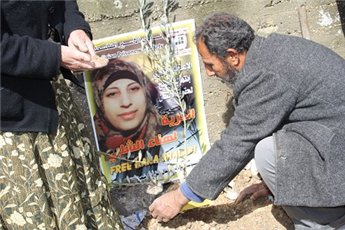
Photo by Dylan Collins
Related articles
- Why Palestinian prisoners are on hunger strike (alethonews.wordpress.com)
Detained journalist boycotts Israeli military court
Palestine Information Center – 09/04/2012
 AL-KHALIL — Detained journalist Amir Abdul Halim Abu Arafeh, 28, who is held in administrative detention at the Negev Desert prison, refused to appear before the Zionist military court last Thursday in accordance with the administrative detainees’ decision to boycott these courts which try to give legitimacy to administrative detention.
The court session, that was supposed to take place last Thursday to hear the prosecution, was held to renew the prisoner’s administrative detention for six more months, according to sources at Negev prison.
The same sources confirmed that the prison administration tried by force to make Abu Arafeh attend the court but he refused describing it “arbitrary and illegal”. The prisoner added that his arrest was political insisting on his commitment to the decision taken by administrative detainees to boycott military courts.
Abu Arafeh was arrested by the occupation forces on 21 August 2011 from his home in Al-Khalil in the southern West Bank, and turned him to administrative detention because of his work as a reporter for Shihab News agency after his release from the PA prisons where he was arrested 3 times.
Palestinian captives declared in early March 2012 the boycott of the Zionist military courts that deal with administrative detention cases, demanding an end to administrative detention and the release of all administrative detainees.
Related articles
- Minister of Detainees Calls for Boycott of Military Courts (alethonews.wordpress.com)
- Free Hanaa Shalabi, End Administrative Detention (alethonews.wordpress.com)
- Speaker Of Palestine Parliament Receives Six Months Administrative Detention (alethonews.wordpress.com)
- Israel issues third consecutive detention order against prisoner of conscience Ahmad Qatamesh (alethonews.wordpress.com)
- Valiance in the Face of Cruelty (alethonews.wordpress.com)
Palestinian Detainees To Hold Hunger Strike
By Saed Bannoura | IMEMC & Agencies | March 15, 2012

The Media Office of the Waed Society for Detainees and Ex-Detainees reported that Palestinian detainees in Israeli prisons and detention camps intend to declare, in April, one of the largest open-ended hunger strikes.
The society said that the detainees will declare the exact day that would mark the beginning of their strike shortly before starting it as they anticipate that Israeli soldiers will be conducting counter measures and attacks in order to foil the strike.
Some of the anticipated, and previously experienced measures, include transferring dozens of detainees from one facility to another, and placing others in solitary confinement.
Head of the media office of the Waed Society, Abdullah Qandeel, stated that the detainees confirmed to the Society that the strike will be decisive and has several main goals topped by demanding an end to the illegal solitary confinement policies, medical negligence, and all Administrative Detention orders, the Maan News Agency reported.
Qandeel added that this strike requires extensive solidarity from the Palestinian people in order to expose the Israeli violations and support the detainees in their open-ended “battle”.
He further stated that media coverage of the strike, and highlighting the plight of the detainees in Israeli prisons, detention and interrogation facilities, is very essential, especially in the Arab world and Europe.
Related articles
- Free Hanaa Shalabi, End Administrative Detention (alethonews.wordpress.com)
- Israel issues third consecutive detention order against prisoner of conscience Ahmad Qatamesh (alethonews.wordpress.com)
- B’Tselem reports sharp increase in the numbers of Palestinians being held in administrative detention (alethonews.wordpress.com)
- Minister of Detainees Calls for Boycott of Military Courts (alethonews.wordpress.com)
- Hana Shalabi to continue hunger strike despite sentence reduction (alethonews.wordpress.com)
- Valiance in the Face of Cruelty (alethonews.wordpress.com)
- Hana al-Shalabi on hunger strike against renewed administrative detention (alethonews.wordpress.com)
Hana Shalabi to continue hunger strike despite sentence reduction
Ma’an – 04/03/2012
RAMALLAH – Hana Shalabi said Sunday that she will continue her hunger strike despite an announcement by Israel’s Ofer military court that her prison time will be reduced by two months.
Lawyer Fadi Qawasmi visited Shalabi on Sunday at Hasharon prison and informed her of the court’s decision to reduce her imprisonment time by two months.
Shalabi told him that she would continue her hunger strike protest in order to achieve her demands to end administrative detention.
She has been on hunger strike for 18 days and her condition is said to have worsened recently.
Addameer prisoners society says that Shalabi was issued a 6-month administrative detention order on Feb. 23.
Ofer military court refused Qawasmi’s request to call witnesses to speak about the assault of Shalabi during her interrogation, he said.
Qawasmi also requested that a Shin Bet representative, the military commander who led the arrest and the soldier who carried out the strip search on Shalabi be called to the stand.
The court refused his demands.
Lawyer from the prisoners society Jawad Boulos said on Tuesday that Israeli court officials claimed that the reason for Shalabi’s administrative detention is because she is considered a threat to Israel’s security and safety of its people.
They also claimed that she planned military actions right after she was released.
Hana Shalabi, from the northern West Bank village Burqin, is being held without charge since her detention on Feb. 16. She announced her hunger strike immediately after soldiers seized her from the family’s Jenin-district home.
Shalabi was freed in October 2011 when Hamas secured the release of more than 1,000 Palestinians in Israeli jails in exchange for a captured Israeli soldier.
She had spent 25 months in administrative detention, under procedures that allow Israel to detain Palestinians for renewable terms of six months without pressing charges, using laws dating back to the British Mandate period.
Israel is holding 309 Palestinians in administrative detention, according to figures by prisoners rights group Addameer. There are currently six Palestinian woman in Israeli custody.
Related articles
- Hana al-Shalabi on hunger strike against renewed administrative detention (alethonews.wordpress.com)
- Free Hanaa Shalabi, End Administrative Detention (alethonews.wordpress.com)
- Israel issues third consecutive detention order against prisoner of conscience Ahmad Qatamesh (alethonews.wordpress.com)
- School Children (Palestine) Organize Solidarity Protest with Detainee Shalabi (altahrir.wordpress.com)
- Israel slammed over rough justice for Palestinian prisoners (rt.com)
- Palestinians in Gaza demand release of female prisoner (altahrir.wordpress.com)
- Report: “Israel Kidnapped 380 Palestinians In February” – International Middle East Media Center (aboriginalpress.wordpress.com)
Free Hanaa Shalabi, End Administrative Detention
By Mahmoud El-Yousseph | Palestine Chronicle | February 28, 2012
Hanaa Shalabi is on hunger strike. She is a Palestinian female political prisoner from the village of Burgin near Jenin. She was kidnapped from her home on February 16, 2012 by Israeli Occupation Forces (IOF) in the middle of the night.
Hanna’s family was ordered outside the house, she was blindfolded and handcuffed. All cell phones and computers in the house were confiscated and a photograph of her brother hanging on the wall, who was killed by IOF in 2005, was torn up and stepped upon by one of the soldiers. Hanaa was also beaten and sexually harassed by the IOF.
Her attorney stated, “she is demanding the end of administrative detention and that the soldiers who beat her up and undressed her to carry out a body search be put on trial.”
Administrative detention is a procedure that allows the Israeli military to hold prisoners indefinitely on secret evidence without charging them or allowing them to stand trial. Hanaa was ordered to serve administrative detention for six months in the HaSharon prison. As of this writing, Hanaa has entered her 13th day of an open-ended hunger strike and is currently being held in solitary confinement. Latest reports indicate that Israeli prison officials have moved her to different prison to cut off any contact with the outside world.
This young lady has been in administrative detention before, totaling 2 1/2 years starting in March, 2009 where she served for 6 consecutive terms. Hanaa was among the freed Palestinian prisoners who were released in October 2011 under the prisoner exchange deal between Hamas and Israel. However, this time Israel has reneged and rearrested her as it did in previous prisoner exchange deals. For example, in November 1983, Palestinian prisoner Ziad Abu Ain was supposed to be part of a prisoner release deal, but was rearrested on the bus containing those who were about to be released.
I will never forget that prisoners ‘exchange deal of Thanksgiving Day 1983. My younger brother Samih was among the freed prisoners, after spending 18 months in an Israeli concentration camp in south Lebanon. He was kidnapped by IOF while visiting our family with his German wife and 5 year-old daughter, Carmen. Throughout his captivity, neither our mother, his wife, Carmen nor our oldest brother was permitted to visit him, even though he was being held merely 20 miles away.
While lobbying in the US to secure his release, Israeli officials first denied holding him, then they admitted he was in Ansar prison camp, held on terrorism charges. When I refuted their false allegation, I was told he has committed a crime in Germany. However, after German officials denied this false claim, the Israeli Attorney General arrogantly stated on public record that under Israeli law, Israel can prosecute people for committing a crime in different countries. This was a clear flagrant violation of international law and the sovereignty of Germany.
According to Ademeer, there are 25 members of the Palestine National Council, including the Speaker of the Parliament, who are among 5,000 Palestinians held captive in Israeli dungeons. This includes 6 women, 166 children and 320 “administrative detainees.”
According to Palestinian prisoner solidarity sites, over 20,000 administrative detention orders were issued since 2000 by the Israeli occupation authority. On February 24, 2012, the 320 Palestinian administrative detainees held captive without charge or trial declared a boycott of Israeli military courts. This boycott is to start on March 1 in protest of these sham courts that are used by the Israeli occupation army and Israeli intelligence as a cover for illegal detention based on “secret” files and lack of indictment.
One week after Hanaa’s kidnapping, her 67 year-old parents started an open-ended hunger strike in a tent set up in front of the family home in support of their daughter’s struggle for freedom and in protest of her illegal detention. Her father, Yahya Shalabi, promised that they will continue the hunger-strike until the release of their daughter and the abolition of administrative detention.
Hanaa Shalabi and her parents put themselves against overwhelming odds. They have the moral courage to challenge Israel’s injustice no matter what. This is a dignified family with deep conviction, who are standing firm and tall beyond anyone’s expectation. I know from experience that Israel does respond when its image and reputation is on the line. Therefore, I urge everyone who reads this to help in anyway then can to expose Israeli injustice.
Related articles
- Hana al-Shalabi on hunger strike against renewed administrative detention (alethonews.wordpress.com)
- Israel issues third consecutive detention order against prisoner of conscience Ahmad Qatamesh (alethonews.wordpress.com)
- Khader Adnan ‘stable’ after surgery (alethonews.wordpress.com)
- Palestinians in Gaza demand release of female prisoner (altahrir.wordpress.com)
- School Children (Palestine) Organize Solidarity Protest with Detainee Shalabi (altahrir.wordpress.com)
- Valiance in the Face of Cruelty (alethonews.wordpress.com)
- B’Tselem reports sharp increase in the numbers of Palestinians being held in administrative detention (alethonews.wordpress.com)
- Palestine: Wave of Arrests since First Phase of Prisoner Exchange (alethonews.wordpress.com)
Khader Adnan ‘stable’ after surgery
Ma’an – 28/02/2012
RAMALLAH – Khader Adnan is in a stable condition after undergoing surgery on his intestine after his 66 day hunger strike, a lawyer for the Palestinian detainees’ center said Tuesday.
Raed Mahamid said after visiting Adnan in Zeev hospital in northern Israeli town Safed that his condition is good, and he is recovering from the anesthesia used during the operation.
Adnan underwent surgery after reporting severe pain in his abdomen two days ago, caused by an intestinal blockage, after he went for two months without food.
Israeli officials announced last week that they intend to release Adnan on April 17, shortly before his administrative detention term was set to end, and would not renew the order.
In return, Adnan agreed to end his hunger strike, the longest ever held by a Palestinian prisoner.
Female prisoner Hana Shalabi, who is being held under the same regulations permitting detention without charge, started a hunger strike on Feb. 16 after she was re-arrested, despite being freed in a prisoner swap deal in October.
Related articles
- Raymond McCartney, former Irish hunger striker in message of support to Khader Adnan (alethonews.wordpress.com)
- Al Jazeera English Doesn’t Care About Khader Adnan (alethonews.wordpress.com)
- Valiance in the Face of Cruelty (alethonews.wordpress.com)
- Adnan’s case highlights Israel’s racist legal system (nation.com.pk)
Israel issues third consecutive detention order against prisoner of conscience Ahmad Qatamesh
By Maureen Clare Murphy – The Electronic Intifada – 02/27/2012
The Palestinian prisoners advocacy group Addameer announced on Twitter yesterday that Israel had renewed administrative detention orders against Palestinian writer Ahmad Qatamesh for an additional six months. This is the third consecutive administrative detention order issued against Qatamesh.
The Palestinian writer and academic has been held without charge since 21 April 2011, when Israeli soldiers raided his family’s home, holding his family members hostage at gunpoint until Qatamesh, who was not home at the time, surrendered himself.
Ahmad’s daughter, Hanin Ahmad Qatamesh, described in harrowing detail how Israeli soldiers raided her family’s home in the middle of the night, searching for her father, in an article for The Electronic Intifada.
Ahmad Qatamesh’s wife Suha Barghouti, a human rights activist, told The Electronic Intifada: “It’s so clear that he is there [in Israeli prison] because of his ideas and political activism. He is a prisoner of conscience and he is there because of political reasons.” […]
News of Israel’s renewal of the detention orders against Qatamesh comes on the heels of a historic hunger strike made by Palestinian administrative detainee Khader Adnan. Adnan waged a 66-day-long strike to protest his being detained without charge. He ended his strike after Israel agreed to not renew his detention orders and release Adnan on 17 April.
Another Palestinian administrative detainee, Hana al-Shalabi, is entering her twelfth day of hunger strike. Like Adnan, this is not the first time Israel has arrested her and held her without charge or trial; she was arrested in September 2009 and subjected to solitary confinement, abuse and sexual harassment, according to an Addameer profile of al-Shalabi. A military court hearing confirming the administrative detention order against al-Shalabi is due to be held later today, according to Addameer.
There are more than 300 Palestinians currently being held without charge or trial under administrative detention orders, including at least twenty out of 132 members of the elected Palestinian Legislative Council.

Suha Barghouti and Ahmad Qatamesh (photo courtesy of Suha Barghouti)
Take action
Addameer has a toolkit for activists to put pressure on Israel to release Qatamesh, and encourages supporters to write to Qatamesh in prison (Ahmad Qatamesh, Ofer Prison, Givat Zeev, PO Box 3007, via Israel).
Addameer also has a profile of Qatamesh which includes information on how Israel had previously been held in administrative detention for five and a half years, and the impact that his imprisonment has had on his family:
Ahmad was first arrested in 1992 in front of his three-year-old daughter. Following his arrest, he was detained for more than a year – during which time he was tortured – before being placed in administrative detention in October 1993, despite the Military Judge ordering his release. Ahmad’s detention orders were repeatedly renewed for the next five and a half years, despite a lack of evidence purported against him. Due to pressure from international campaigns, Ahmad was finally released in 1998, becoming one of the longest-serving administrative detainees held without charge in Israeli prison. His memoir, I shall not wear your tarboosh [fez], accounts his experiences of being tortured while in detention.
AHMAD’S FAMILY
Ahmad’s extensive detention and arrests have been extremely difficult for his wife, Suha, a board member of Addameer and the Palestine Red Crescent Society, and his daughter, Haneen, a university student at the American University in Cairo. Suha recalls of his most recent arrest, “A few days ago, when they arrested my husband, I found out that there are very deep marks on my daughter’s spirit. She was three years old at that moment [when they arrested her father in 1992], and the marks are still there. When the soldiers told her that [they] arrested her father again, she almost collapsed.” Suha and Haneen hoped that Ahmad would be released before Haneen’s graduation in January. The event was very important to Ahmad, particularly because he feels as though he was not able to watch his daughter grow up for much of her childhood.
More than ten years after he was released from his previous detention, it had not occurred to Ahmad’s wife Suha that they might have to suffer through the same ordeal once again. The torment of his arrest is made even worse by the uncertainty of administrative detention and not being able to prepare for his release, as the family is already all-too-familiar with the prison authorities’ practice of renewing administrative detention orders every six months. She condemns his imprisonment as a prisoner of conscience, arrested for his ideas and political activism, and calls on the international community to continue to assert pressure on his behalf.
–
Administrative detention is a procedure that allows the Israeli military to hold detainees indefinitely on secret evidence without charging them or allowing them to stand trial. In the occupied Palestinian West Bank, the Israeli army is authorized to issue administrative detention orders against Palestinian civilians on the basis of Military Order 1651. This order empowers military commanders to detain an individual for up to six month renewable periods if they have “reasonable grounds to presume that the security of the area or public security require the detention.” On or just before the expiry date, the detention order is frequently renewed. This process can be continued indefinitely.
Related articles
- Hana al-Shalabi on hunger strike against renewed administrative detention (alethonews.wordpress.com)
- B’Tselem reports sharp increase in the numbers of Palestinians being held in administrative detention (alethonews.wordpress.com)
- Minister of Detainees Calls for Boycott of Military Courts (alethonews.wordpress.com)
- Valiance in the Face of Cruelty (alethonews.wordpress.com)
- Speaker Of Palestine Parliament Receives Six Months Administrative Detention (alethonews.wordpress.com)
Hana al-Shalabi on hunger strike against renewed administrative detention
By Ali Abunimah | The Electronic Intifada | February 23, 2012
 News emerged today that a Palestinian woman, Hana Yahya al-Shalabi is on hunger strike against her renewed “administrative detention” without charge or trial by Israel. Al-Shalabi spent more than two years in administrative detention, and had been freed last October as part of the prisoner exchange deal between Israel and Hamas.
On 17 February, al-Shalabi, who is 29, was once again arrested by Israeli occupation forces from her home near Jenin in the occupied West Bank and is again under detention without charge or trial.
According to an Addameer profile which refers to her earlier period of detention:
Shalabi was arrested from her family home on 14 September 2009. At approximately 1:30 a.m. that morning, Israeli soldiers in 12 military jeeps surrounded her house in Burqin village, near the West Bank town of Jenin. The soldiers ordered Hana’s entire family outside of the house and demanded Hana give them her identity card. They then proceeded to conduct a thorough search of the family’s home. During the search, one of the soldiers forcibly removed framed pictures of Hana’s brother Samer, who was killed by the Israeli army in 2005, tore them apart and walked over the pieces in front of the entire family.
Shalabi was subjected to solitary confinement, abuse and sexual harassment during her interrogation and then ordered to be detained without charge or trial for six months.
That order was later renewed, however she was subsequently released as part of the prisoner deal in which Israel agreed to release 1,027 Palestinians in exchange for the return of an Israeli soldier who had been held in Gaza since 2006.
Related articles
- Valiance in the Face of Cruelty (alethonews.wordpress.com)
- B’Tselem reports sharp increase in the numbers of Palestinians being held in administrative detention (alethonews.wordpress.com)
- Speaker Of Palestine Parliament Receives Six Months Administrative Detention (alethonews.wordpress.com)
PA: Khader Adnan to end strike
Ma’an – 21/02/2012
RAMALLAH – The Palestinian Authority minister of prisoners affairs said Tuesday that Israel intends to release hunger striking prisoner Khader Adnan after his current administrative detention term.
In return, Adnan agreed to end his strike, according to Issa Qaraqe, the prisoners minister. The term will end April 17, he said.
Adnan has not confirmed he intends to end the hunger strike, but prisoners rights group Addameer said one of Adnan’s lawyers negotiated a deal with the Israeli military prosecutor freeing him on April 17 instead of in May 8.
He also received guarantees the term will not be extended, the group said.
Addameer lawyer Samer Samaan is “actively working to gain permission to visit Khader to confirm whether or not he will continue with his hunger strike,” the rights group said in a statement.
“Addameer’s main concern remains Khader’s health … Whether or not Khader continues his hunger strike, he must receive proper arrangements for observing his health condition,” the group said.
Israel’s Justice Ministry confirmed the deal to end the strike.
“There is a deal. (Khader Adnan) will stop his hunger strike. They will not extend his administrative detention and he will be free on April 17,” an Israeli Justice Ministry spokeswoman told Reuters.
A High Court of Justice session was originally scheduled for Tuesday, but it was canceled upon the announcement of an agreement.
Related articles
- Raymond McCartney, former Irish hunger striker in message of support to Khader Adnan (alethonews.wordpress.com)
- Valiance in the Face of Cruelty (alethonews.wordpress.com)
- Former Irish hunger striker’s message for Khader Adnan, a Palestinian prisoner 55 days on hunger strike (alethonews.wordpress.com)
B’Tselem reports sharp increase in the numbers of Palestinians being held in administrative detention
MEMO | 16 February 2012
An Israeli human rights organization has stated that during 2011, the number of Palestinian administrative detainees held by the Israel authorities increased sharply.
B’Tselem, the Israeli Information Centre for Human Rights in the Occupied Territories, noted that according to figures received from the Israel Prison Service, the number of Palestinian administrative detainees being held in Israel increased from 219 in January 2011, to 307 in December. In a press release published on its website, B’Tselem also noted that, “At the end of 2011, Israel was holding one minor in administrative detention.”
“Twenty-nine per cent of the detainees had been held for six months to one year; another 24 per cent from one to two years. Seventeen Palestinians had been in administrative detention continuously for two to four and a half years, and one man has been held for over five years.”
The organization stated that 2011, “marks the first time since 2008 that there was an increase in the number of administrative detainees after the number had fallen from 813 in January 2008, to 204 in December 2010.”
“Administrative detention is detention without trial, intended to prevent a person from committing an act that is liable to endanger public safety. … [Un]like a criminal proceeding, administrative detention is not intended to punish a person for an offense already committed, but to prevent a future danger. The manner in which Israel uses administrative detention is patently illegal. Administrative detainees are not told the reason for their detention or the specific allegations against them. Although detainees are brought before a judge to approve the detention order, most of the material submitted by the prosecution is classified and not shown to the detainee or his attorney. Since the detainees do not know the evidence against them, they are unable to refute it,” B’Tselem further stated.
The organization’s website also pointed out that the detainees also do not know when they will be released, although each detention order is specified for a year and a half maximum, but detention orders can be renewed indefinitely.
“Over 60% had their detention extended at least once beyond the first detention order. Administrative detention violates the right to liberty and the right to due process, since the detainee is incarcerated for a prolonged period on the basis of secret evidence, without charge or trial.”
The organization noted that over the years, Israel has held thousands of Palestinians in administrative detention for periods ranging from a few months to several years. There were times during the second intifada that Israel held over a thousand Palestinians in administrative detention. “Under international law, it is permissible to administratively detain a person only in exceptional cases, to prevent a grave danger that cannot be prevented through less harmful means. Israel’s use of administrative detention blatantly breaches these rules.” It called on the Israeli army to release all the administrative detainees or prosecute them.
Related articles
- Minister of Detainees Calls for Boycott of Military Courts (alethonews.wordpress.com)
- Raymond McCartney, former Irish hunger striker in message of support to Khader Adnan (alethonews.wordpress.com)
- Speaker Of Palestine Parliament Receives Six Months Administrative Detention (alethonews.wordpress.com)
- Carter Center calls on Israel to release or charge hunger striker (jta.org)
Featured Video

Seyed M. Marandi: U.S. Military DIVIDED? Iran’s Secret Defense EXPOSED
or go to
Aletho News Archives – Video-Images
From the Archives
‘Israel sees Iran as obstacle to its policies’

Press TV – August 25, 2017
Prime Minister Benjamin Netanyahu has said that Israel felt threatened by Iran’s growing influence in the Middle East. Netanyahu expressed his Iranophobic view in a meeting with Russian President Vladimir Putin in Russia’s Black Sea resort of Sochi on Wednesday. Press TV has asked Scott Rickard, former American intelligence linguist from Tampa, Florida, and Brent Budowsky, a columnist at The Hill from Washington, to give their thoughts on the issue.
Rickard said Tel Aviv is concerned about the fact that the regime could not carry out its old project to spread sectarian divisions and pave the way for dismemberment of the countries in the Middle East region because of the Iranian-led resistance against Israeli policies, not only in the occupied territories of Palestine but also in the whole region.
“Iran is not a threat to Israel whatsoever. The threat that Israel sees is the fact that their Oded Yinon Plan is being put to a hold by Iran,” the intelligence linguist said on Thursday night.
“They (the Israelis) look at Iran as a threat only because they have no influence on their governments and Iran is autonomous and is not under the Zionist influence,” he added.
Since the victory of the Islamic Republic of Iran in 1979, Tehran has been critical of Israel’s policies in the region, whereas “no leaders [of other states] even dared to speak out against Zionism,” Rickard argued. … continue
Blog Roll
 Aletho News
- What’s Behind U.S./Israeli Strikes On Iranian Pistachio Factories?
- Seyed M. Marandi: U.S. Military DIVIDED? Iran’s Secret Defense EXPOSED
- How I fell foul of the BBC thought police
- The End of NATO
- 37 days of war on Iran cost US staggering $42bln, tracker shows
- Baghdad tells Asian refiners, traders to begin loading Iraqi crude amid Iranian exemption
- Under fire, Moscow and Tehran close ranks
- Iran, US receive Pakistan-mediated plan for ceasefire then final deal
- Iran submits demands for end to war as mediators scramble ahead of Trump deadline
- Iran Threatens Retaliatory Strike on Stargate AI Project in UAE
- If Americans Knew
- U.N. experts demand Israel release prominent Gaza doctor after reports of ‘severe torture’
- Israel’s Latest Genocide Is Against the Shias of Lebanon. Why Is the World Silent?
- How Eliot Cohen’s influence over U.S. war-making paved the way for Trump’s war crimes in Iran
- Israelis don’t pay for the weapons we ‘sell’ to them — US taxpayers do
- While Distancing from AIPAC, Most 2028 Democratic Hopefuls Are Still Embracing Israel
- A brief history of the Israeli nuclear program, the open secret at the heart of the Iran war
- Israeli Settlers Killed a Palestinian Farmer on His Own Land, in Front of His Father. Yes, Again
- The US-Israeli War on Science is an Assault on our Future
- 100+ International Law Experts Say US Strikes on Iran Violate UN Charter, Could Be War Crimes
- ‘Vile, Horrifying, Evil’: Trump Threatens to Bomb Nation of 90 Million People ‘Back to the Stone Ages’
- No Tricks Zone
- An Inconvenient Tree: Uncovered In Alps… Europe Much Warmer Than Today 6000 Years Ago
- New Study Reports A 60% Slowdown In Greenland’s Ice Loss Rate In The Last Decade
- Low Intensity Tornado Wrecks Major Solar Farm, Creating A Potential Toxic Dump
- New Study Finds Warming Saves Lives…Cold Temperatures 12 Times More Deadly Than Excess Heat
- German Science Blog Accuses PIK Climate Institute Of Hallucinating Climate Tipping Points
- Devastating Assessment Of Comirnaty Vaccine By Former Senior Pfizer Europe Toxicologist
- New Study: CO2 Is ‘Effectively Negligible’ As An Explanatory Climate Change Factor Since 2000
- Former Pfizer Toxicologist Dr. Helmut Sterz Tells Bundestag Hearing Pfizer Vaccine Should Have Never Been Approved
- Energy Expert: Germany’s Nuclear Phaseout Was A “500 Billion Euro Mistake”
- New Research: South Australia’s Mid-Holocene Sea Surface Temperatures Were 4°C Warmer Than Today
 Aletho News