Tulsi Gabbard Savages Trump Over Pushing US ‘Closer to Brink of Nuclear Catastrophe’ at Dem Debate
Sputnik – August 1, 2019
2020 presidential hopeful Tulsi Gabbard has skyrocketed to No. 1 in Google Trends after blasting the current US administration’s “warmongering” foreign policy during the second Democratic presidential debate on Wednesday.
Democratic House Representative for Hawaii Tulsi Gabbard has blasted the Trump administration for pushing the United States closer to the “brink of nuclear catastrophe” since relations with a number of nuclear armed countries have dramatically escalated in the past few months.
“Donald Trump and warmongering politicians in Washington have failed us. They continue to escalate tensions with other nuclear armed countries like Russia and China, and North Korea, starting a new Cold War, pushing us closer and closer to the brink of nuclear catastrophe. Now as we stand here tonight, there are thousands of nuclear missiles pointed at us… As president, I will end this insanity”, she added.
Following her speech, Gabbard took the number one spot in Google Trends, becoming the most searched Democratic candidate on the platform.
‘Trump Betrayed US on Afghanistan Pullout’
Speaking at the second Democratic presidential debate on Wednesday, she also accused the US president of betraying the American people by failing to deliver on his promise to quickly withdraw troops from Afghanistan.
Gabbard pledged to pull out all American forces from Afghanistan if elected president next year and end the 18-year war in the country:
“The leadership I will bring to do the right thing to bring our troops home within the first year in office. We have to do the right thing and end the wasteful regime change wars and bring our troops home. Every single month we are spending $4 billion on a continuing war in Afghanistan, $4 billion dollars every single month, rather than ending that war, bringing our troops home and using those precious resources into serving the needs of the people here in this country.”
The Iraq War veteran cited the example of the 2003 conflict, which broke out after the George W. Bush administration falsely claimed that Baghdad produced weapons of mass destruction.
“We were all lied to. This is the betrayal. The problem is that this current president continues to betray us”, she added.
Gabbard’s comments follow an interview by US Secretary of State Mike Pompeo with Economic Club of Washington President David Rubenstein in which he emphasised that President Trump had ordered to “end the endless wars, draw down, reduce” the number of US troops stationed in Afghanistan before the 2020 elections.
Pompeo as well noted that he was hoping for a positive outcome of US negotiations with the Taliban, an Islamic insurgent movement, the Afghan government and opposition groups inside the country that will result in a peace agreement to put an end to the 18-year war.
President Trump has long expressed a desire to pull out American troops from Afghanistan, saying that the future reductions in US forces would be tied to progress in peace talks. In June POTUS indicated that the US was “doing fine” there and will soon see its soldiers halved to 8,000.
“As you know in Afghanistan, when I got there, it was 16,000 people. It’s now 9,000 people. And some good things are happening there frankly. No, I’d like to get out of the Middle East, we should have never been in the Middle East. We should have never been there, and I’d like to get out”, he told Time magazine.
Back in February, The New York Times reported that a Defence Department proposal for the peace talks with the Taliban stipulated that all American troops – an estimated 14,000 – be withdrawn in the next three to five years along with the rest of the international forces in the country.
The United States invaded Afghanistan in 2001 in response to the 9/11 terrorist attacks on American soil and overthrew the Taliban, which seized power in the Central Asian country in 1996. At the time, Washington said that Kabul had become a safe haven for al-Qaeda while the Taliban was in power.
Most US troops were withdrawn from Afghanistan by the end of 2014, but a relatively small contingent has continued to support the Afghan Armed Forces in combating terrorism.
Iran’s Zarif drives Trump to insanity
By M. K. BHADRAKUMAR | Indian Punchline | August 1, 2019
At a time when the Trump administration has no problem negotiating with the secretary of the Russian national security council Nikolai Patrushev, who is technically under US sanctions since April 2018, the cut and thrust of Washington’s move to sanction Iran’s Foreign Minister Mohammad Javad Zarif needs to be understood properly.
How did US Secretary of State Mike Pompeo try to explain the dispatch of Zarif to perdition? Pompeo’s statement on Wednesday attributed to Zarif a singular sin: a) Zarif “acted on behalf of the Supreme Leader”; b) Zarif took “direction from the Supreme Leader and his office”; c) Zarif was “a key enabler of Ayatollah Khamenei’s policies throughout the region and around the world”; d) and, Zarif has been “a senior regime official and apologist” of Iranian government and has “for years now been complicit in these (Iran’s) malign activities”.
Basically, Pompeo’s grouse narrows down to this: Zarif is a disciplined dutiful, loyal Iranian public servant who abided by the Iranian system of government founded in the concept of velāyat-e faqīh (‘guardianship of the Islamic jurist’.)
Does that become a sin? Any foreign minister has his job cut out for him — even Pompeo himself. Pompeo has no pretensions that he is holding the job entirely at the pleasure and discretion of his supreme leader President Trump. Trump, in fact, is an unforgiving stickler for loyalty. Ask James Mattis or Rex Tillerson.
The US establishment knows very well how the concept velāyat-e faqīh operates, how the alchemy of political power is formed in Iran, and how the decision-making process is reached. Even Trump would know it. Which is why he even tried to get through to Supreme Leader Ayatollah Ali Khamenei (and was duly snubbed.) So, where is the beef?
Simply put, Zarif per se is the problem. The Trump administration is desperately keen to put an end to Zarif’s contacts with the American elite. Zarif lived and worked for several years in America from the age of 17 — as a high school student, university student, and career diplomat, ending up as Iran’s representative at the UN from 2002 to 2007. He also kept closely in touch with the US academia and intellectual circles in his capacity as a professor and editor of scholarly journals in Tehran who has written copiously on disarmament, human rights, international law, and regional conflicts.
Indeed, what rankles the Trump administration is that Zarif has extensively networked with American intellectuals, politicians, think tankers and media persons — figures as diverse as Joseph Biden, John Kerry, Nancy Pelosi, Chuck Hagel, Nicholas Kristof, Thomas Pickering, James Dobbins and Christian Amanpour.
Zarif took his job seriously and being a fluent English speaker, he could tweet and debate and spar with any American with delectable ease. Zarif outclassed the mediocre American foreign and security policy team.
Zarif’s periodical visits to New York (ostensibly to attend the UN events) increasingly became a nightmare for the Trump administration as he cast his net wide and ably put across Iran’s narrative. Trump singled out more than once that Zarif had meetings with Kerry, former state secretary who negotiated the 2015 Iran deal.
This is the crux of the matter. By imposing sanctions on Zarif, the US can deny visa to him and render unlawful (and liable to prosecution under law) any contact between him and any American national. Effectively, Trump instructed Pompeo to make sure that Zarif doesn’t come to New York between now and the 2020 November election so that his detractors and critics cannot hear from the horse’s mouth the Iranian narrative.
Trump feels exasperated that Iran is winning the information war. And he is worried that between now and November 2020, his re-election campaign may get booby-trapped. For any longtime observer of the US-Iran standoff, it is obvious that a sea change has appeared in the American discourses on Iran. There is an influential and ever growing body of opinion in the US today, which disagrees with Trump’s ‘maximum pressure’ strategy. This constituency rationally argues that Trump shouldn’t have dumped the 2015 deal.
Equally, there is a far better understanding today in the informed American opinion regarding Iran and its policies, and the zen of dealing with Persian nationalism beneath the veneer of Islamism. The surprising part is that such an awakening has happened despite the Herculean efforts by the Israeli Lobby to demonise Iran and to stymie all contrarian views in the media, think tanks and campuses — and the Hill.
Will Trump’s ploy work? Unlikely. The point is, Zarif is irrepressible. He will continue to tease, taunt, disparage, humiliate and expose and run down Trump’s Iran policies. Worse still, Zarif has driven a knife into the heart of the ‘B Team’ driving the US administration’s Iran policies currently.
Trump’s sanctions against Zarif will not set an example for any other country which has diplomatic relations with Iran. In the final analysis, Trump will have to deal with Zarif, whether he likes him or not.
The best way to counter Zarif would have been to handpick an intellectually resourceful, dynamic state secretary. A mediocrity like Pompeo stands no chance with Zarif. This is a dumb thing Trump has done. He should have known better.
In 2001, Zarif was Iran’s main representative at the Bonn Conference, which brought together regional players in the aftermath of the US invasion of Afghanistan and the ousting of the Taliban. His American counterpart at the event, James Dobbins — who was later named as the Obama Administration’s special envoy to Afghanistan — wrote a memorable essay titled Negotiating with Iran: Reflections from Personal Experience in the Washington Quarterly about Zarif’s erudition, wit and charm — and his pragmatism, which helped the two gifted diplomats to thrash out “over morning coffee and cakes” a deal that led to the replacement of the Northern Alliance government in Kabul with a US-backed interim set-up under Hamid Karzai. (Burhanuddin Rabbani remarked bitterly at that time he hoped that would be the last time a foreign power ever dictated to Afghans.)
Washington has now sanctioned the man who played a pivotal role in that fateful transition in Kabul leading to the installation of the US’ client regime in the Hindu Kush. Some gratitude!
US, Pakistan move in tandem to end Afghan war
By M. K. BHADRAKUMAR | Indian Punchline | July 28, 2019
The US State Department chose Friday to announce the decision to approve a $125 million aid package providing technical support to Pakistan’s fleet of F-16 fighter aircraft. Ironically, the news reached Delhi on the 20th anniversary of the Kargil Vijay Diwas, which symbolises, as Prime Minister Narendra Modi put it on Saturday, “India’s might, determination, capability, discipline and patience” to thwart Pakistan’s hostile acts.
Clearly, Washington has begun to “incentivise” Pakistan, in the downstream of the talks between President Trump and Prime Minister Imran Khan at the White House on July 22.
Meanwhile, the Pentagon also notified on Friday about a proposed $670 million follow-on support programme for the eleven C-17 Globemaster-III air-lift aircraft sold by the US to India in the recent years. By holding out the carrot to India, Washington hopes to create the hype that it is also favouring Delhi.
The intention here is to finesse Delhi’s criticism over the revival of US military aid to Pakistan. Of course, it will be a delusional thought that the US is balancing India and Pakistan. In reality, the Pentagon’s India proposal is a purely commercial transaction — “after-sales service”, which will generate good business for the US vendors — while the military aid to Pakistan providing technical and logistics support for its F-16 fighter jets is on concessional terms and signifies a major political decision.
Delhi will take note that the proposed US military aid may significantly enhance Pakistan’s offensive capability insofar as some of the F-16 jets are capable of delivering nuclear weapons.
Indeed, the “big picture” emerging out of all this is that the US and Pakistan are marching ahead in tandem to implement the decisions taken by Trump and Imran Khan to swiftly end the Afghan war.
No sooner than Imran Khan left Washington on July 23, the chairman of the US Joint Chiefs of Staff General Joe Dunford traveled to Afghanistan’s capital of Kabul for consultations with American, NATO and Afghan officials.
Dunford said he wants to ensure Gen. Austin S. Miller, the US commander in Afghanistan, has all he needs. He added that he wanted to take the pulse of US military operations in the country. Indeed, the pulse rate is rather high, as the US withdrawal from Afghanistan looms large.
Dunford insisted that the negotiations have not changed the military mission in the country. “Day to day, the mission hasn’t changed for General Miller and the team, and they are still taking the fight to the Taliban and supporting the Afghan military,” he said.
But that’s putting on a brave face. Evidently, the US is pushing forward a “face-saving way out of Afghanistan,” as former CIA deputy director Michael Morell has told Axios. The message has gone down the line in the State Department and the Pentagon that Trump wants to move quickly toward a deal to end the war in Afghanistan. Morell is deeply sceptical whether a deal with the Taliban will secure peace.
He said, “I would bet that the US intelligence community and policymakers have a pretty good understanding of what the Taliban’s intentions are. So we’re making a deal that we know isn’t going to be kept just to save face, just to maintain honour.” Morell repeated his past warnings that the Taliban is “ideologically not disposed to sharing power.”
However, an apocalyptic scenario cannot deter Washington anymore. On a parallel mission, the US special representative on Afghanistan Zalmay Khalilzad also took off on July 23 from Washington to Kabul (where he is now speaking with members of the Afghan government as he works to encourage inter-Afghan conversations between the Taliban and the government.)
In immediate terms, Khalilzad expects Pakistan to deliver on the promise that Imran Khan made to Trump to the effect that he plans to meet with the Taliban to persuade them to hold negotiations with the government in Afghanistan. (Taliban has welcomed such a meeting.)
Imran Khan had said, “Now, when I go back after meeting President Trump … I will meet the Taliban and I will try my best to get them to talk to the Afghan government so that the elections in Afghanistan must be inclusive where the Taliban also participate in it.”
It may seem a tough call, but the news from Kabul on Saturday suggests that Pakistan may have made some headway already. The Afghan state minister for peace affairs Abdul Salam Rahimi announced on Saturday that “We (Afghan government) are preparing for direct talks (with the Taliban.) The government will be represented by a 15-member delegation. We are working with all sides and hope that in the next two weeks the first meeting will take place in a European country.”
The Norwegian capital Oslo is mentioned as the venue for the crucial meeting between the representatives of the Afghan government and the Taliban. The Taliban has not yet budged from its longstanding demand that a deal must be forged with the US first. Possibly, a deal may be announced after the 9th round of US-Taliban talks in Doha in the coming week.
Indeed, we are witnessing an utterly fascinating spectacle of diplomatic pirouette being played out between and amongst five main protagonists — Trump who is demanding an expeditious US withdrawal from Afghanistan, assuming Imran Khan will deliver on his promises; Imran Khan, in turn, going through the motions of persuading the Taliban to be reasonable while expecting generous US reciprocal moves to accommodate Pakistani interests; Ashraf Ghani, Afghan president, seeing the writing on the wall that US withdrawal is unstoppable, whilst still hoping to secure a second term in office; Khalilzad pushing the reluctant Afghan government to fall in line with a Taliban deal, while also negotiating with the Taliban for an orderly US withdrawal, albeit with a weak hand; and the Taliban on a roll, sensing victory. There are caveats galore. But the compass has been set.
“US Causes Instability Anywhere It Sets Foot”
Al-Manar | July 20, 2019
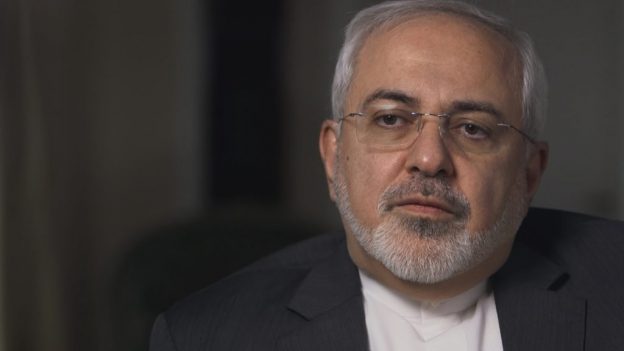
Iranian Foreign Minister Mohammad Javad Zarif said Saturday that the United States causes instability and insecurity everywhere in the world it sets foot, including the Persian Gulf and South America.
Iranian Foreign Minister Mohammad Javad Zarif arrived in the Venezuelan capital early Saturday after a six-day stay in New York.
Speaking to reporters upon arriving in Caracas, Zarif said that “anywhere the United States sets foot in, it causes instability there.”
“At the moment, the US is causing insecurity with its presence in the Persian Gulf, the Middle East, and also the South American region,” said Zarif.
He went on to add that, “I don’t know any place in the world where the US’s presence has brought stability.”
“Anywhere the US has set foot on, it led to pressure on the people and caused extremism and terrorism,” stressed the Iranian top diplomat.
While in Caracas, Zarif is slated to take part in the Ministerial Meeting of the Non-Aligned Movement (NAM) Coordinating Bureau (CoB) on 20-21 July under the theme: “Promotion and Consolidation of Peace through Respect for International Law.” He will also meet with a host of Venezuelan officials before making a visit to Nicaragua and Bolivia.
Trump is finished with the Afghan war
By M. K. BHADRAKUMAR | Indian Punchline | July 4, 2019
There could be several ways of interpreting the US State Department’s decision on Tuesday to designate the Baloch Liberation Army (BLA) as a Specially Designated Global Terrorist, which imposes economic sanctions on the group and anyone affiliated with it. What is absolutely certain is that this is by no means an altruistic decision by Washington.
The BLA is based in Afghanistan and has been waging a violent armed struggle against Pakistan for the past decade and a half upholding the right of self-determination of the Baloch people and demanding the separation of Balochistan province from Pakistan, apart from being involved in ethnic-cleansing of non-Baloch minorities in Balochistan.
Curiously, the BLA’s timeline (starting from 2004) has been co-terminus with the US’ occupation of Afghanistan. It is inconceivable that the US and NATO forces in Afghanistan were unaware of the BLA’s subversive activities or who were its mentors. Islamabad has been shouting and screaming from the rooftop all this while that its adversaries exploited the group as a proxy to destabilise Pakistan.
Put differently, the timing of the State Department decision banning the BLA is noteworthy. Why now, at this juncture?
These are extraordinary times when almost anything and everything that the US does in the Greater Middle East would have an eye on Iran with which it is locked in an epochal rivalry. Can it be that by making this gesture, Washington hopes to recruit Pakistani military and intelligence to strengthen further its ‘maximum pressure’ strategy against Iran? The possibility cannot be ruled out.
Of course, this is not to suggest that Pakistan will make hostile moves against Iran. Although Pakistan-Iran relations have been highly problematic through the past four decades since the 1979 Islamic Revolution, and their mutual animosity kept frothing from time to time, things never reached a flashpoint as both sides observed certain ground rules of how far to go and what not to do. In the present context, Pakistan will take utmost care not to get entangled in the US-Iran standoff.
Having said that, there is a vital US-Pakistani convergence over Iran that cannot be overlooked, either. That is, when it comes to the Afghan situation. Iran has made it clear that if the US attacks it, it will retaliate against American assets all across the region. There have been two statements at least by senior US officials lately that Iran is moving against American assets in Afghanistan. Iran, of course, has stoutly rejected the allegation, but the US is paranoid — and not without reason.
The point is, apart from the traditional links with the Shi’ite groups in Afghanistan, Tehran also has dealings with the Taliban. Coincidence or not, Washington moved against the BLA within days of an incident in the eastern Afghan province of Wardak on June 26 in which two US soldiers were killed by the Taliban in an ambush.
The incident took place only a day after after Pompeo stopped in the Afghan capital, Kabul, for daylong talks with Afghan President Ashraf Ghani as well as other senior leaders and opposition politicians to discuss two topics, namely, the US’ ongoing efforts to reach a peace agreement with the Taliban and the potential that Iran has to carry out actions that would jeopardise the US exit strategy out of Afghanistan. (Read a report in Geopolitics magazine entitled Two Topics Dominating Pompeo’s Visit to Afghanistan.)
In fact, the US apprehends that an extremely dangerous situation is arising in Afghanistan even as the withdrawal of American troops accelerates. President Trump disclosed in an interview this week with Tucker Carlson on FOX television that the US troop level has come down to 9,000 from 16,000 already. Trump made no bones about the fact that he is finished with the war in Afghanistan.
At one point in the interview, Trump bursts out, “I’d like to just get out.” Trump claims that he intends to keep a “very strong” intelligence presence in Afghanistan. He couldn’t care less anymore whether there will be a broad-based government in Kabul or a Taliban takeover. He’s well past that point of agonising. At one point, Trump implied to Carlson — who also happens to be an inveterate critic of America’s “endless wars” — that he no longer trusts the judgment or integrity of the military commanders. (By the way, Carlson accompanied Trump to the meeting with North Korea Kim Jong-Un in Panmunjom while NSA John Bolton was sent away to Mongolia.)
This is where Pakistani help becomes critical. Ghani’s government lacks legitimacy but the holding of a presidential election in September, as planned, depends heavily on a settlement with the Taliban. The US expects Pakistani help in three directions: one, persuading the Taliban to reach an agreement at the Qatar talks without any further delay; two, enabling the US to withdraw the troops expeditiously and in an orderly fashion; and, three, creating politico-security conditions to facilitate a peaceful transfer of power in Kabul. Of course, it is a tall order.
The Americans know that Iran can escalate in Afghanistan anytime it wishes. Afghanistan falls within the domain of the elite Quds Force of Iran’s Islamic Revolutionary Guard Corps, commanded by the legendary general Qassem Soleimani who was the bête noire of the US and Israel in Iraq and Syria. Of course, if Soleimani creates a hopeless situation like in Vietnam (which forced the US into a humiliating retreat from the rooftop of the American embassy in Saigon), that will be highly damaging for Trump politically in the midst of his campaign for the 2020 election. And that is precisely why Trump is impatient to cut loose and get out from Afghanistan without even waiting for the implementation of any peace agreement with Taliban.
All this should be a morality play for the Indian strategists and policymakers as they pick up the debris of their own Afghan policies and its $2 billion price tag, which has been predicated so heavily through the past decade and a half on the US strategy. Equally, this should be a wake-up call for the Indian lobbyists who still want to bandwagon with the US in other regional theatres such as Sri Lanka, the Maldives or Nepal. (See blog US eyes Sri Lanka as its military logistics hub.)
For sure, the Afghan war has not ended. Trump recalled poignantly that the 9/11 attacks were not staged by Afghans but the Hindu Kush provided the plotters a “lab for terrorists”. Now, the US can only take the word of the Taliban that such a thing will not repeat. Washington’s best hope will be that Pakistan will keep an eagle’s eye to ensure that the terrorists from Afghanistan will not come visiting the US.
In turn, that is going to create an interdependency between the US and Pakistan. The IMF bailout, the ban on the BLA, the near-certainty that Pakistan is off the hook at the upcoming plenary of the Financial Action Task Force, an official visit by Prime Minister Imran Khan to the White House — these are the starters from the US side. Pakistan is highly experienced in dictating the terms of engagement with the US.
Taliban insurgents want peace, senior leader says at Moscow talks
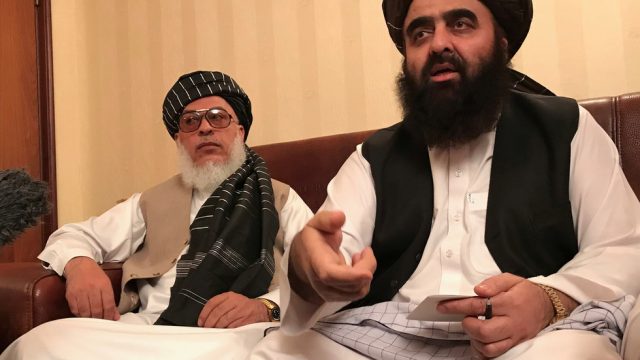
Head of Political Office of the Taliban Sher Mohammad Abbas Stanakzai (L) and member of Political Office of Taliban Shahabuddin Delawar (R) in Moscow, May 28, 2019.
© Reuters / Mikhail Antonov
RT | May 28, 2019
Senior Taliban officials including the group’s top political advisor met with Afghan political figures in Moscow on Tuesday, saying they were committed to peace in Afghanistan.
The statement comes as US-led talks appear to have stalled, AFP said.
Taliban co-founder and political leader Mullah Abdul Ghani Baradar said the insurgents want an end to 18 years of conflict – but would only sign a deal after foreign forces quit Afghanistan.
The Taliban are “really committed to peace, but think the obstacle for peace should be removed first,” Baradar said in a rare televised appearance at the start of the two-day meeting marking 100 years of diplomatic ties between Russia and Afghanistan. “The obstacle is the occupation of Afghanistan, and that should end,” Baradar said.
Talks with US in Doha stumble over troop withdrawal timetable: Afghan Taliban
Press TV – May 6, 2019
The Taliban militant group says peace talks with the US — which have been underway in Qatar for months — have stalled over the key issue of a timetable for American and other foreign troops to pull out of Afghanistan, a longtime Taliban demand.
A Taliban political spokesman, Suhail Shaheen, told the AFP on Sunday that the two sides have so far failed to hammer out their differences on how to put their draft agreement on the withdrawal timetable into action.
The two sides are trying “to narrow the differences and have an agreement on a timetable which is acceptable to both sides,” but “that has not been achieved so far.”
He also explained that nothing would move forward “in principle” until America announced a withdrawal timetable.
“If we are not able to finalize it in this round, then … peace would be far away rather than being closer,” Shaheen added.
Since last year, sixth rounds of talks have been held in Doha between the militant group and US special envoy to Afghanistan Zalmay Khalilzad and his delegation of about two dozen officials in the hope of ending an American war in Afghanistan that has dragged on for over 17 years.
The latest round began on May 1, and it is not clear if the talks were to continue Monday, which marks the first day of the holy Muslim month of Ramadan.
The negotiations have so far excluded Afghan officials. The Taliban refuse to hold talks with the government in Kabul, which the militant group views as illegitimate and a US puppet.
In February, Khalilzad claimed progress in the talks, saying that a deal was within reach by July.
Khalilzad has repeatedly said that for things to progress, the Taliban must ensure Afghanistan is never again used as a terrorist safe haven, implement a ceasefire, and speak to Afghan representatives.
The Taliban have said they will not do anything until the US announces a withdrawal timeline.
Earlier this week, the group’s spokesman Zabihullah Mujahid called on the US to end the use of force in Afghanistan instead of putting pressure on the militant group to cease fire.
“Instead of such fantasies, he [Khalilzad] should drive the idea home [to the US] about ending the use of force and incurring further human and financial losses for the decaying Kabul administration,” he added.
The US embassy in Kabul did not immediately comment on the Taliban’s latest statement.
The Taliban’s five-year rule over at least three quarters of Afghanistan came to an end following the 2001 US-led invasion, but 17 years on, Washington — having failed to end the Taliban’s militancy campaign — is seeking truce with the militants.
Observers say the militant group is now negotiating from a position of strength as it has managed to strengthen its grip over the past three years, with the government in Kabul controlling just 56 percent of the country, down from 72 percent in 2015, according to a US government report released last year.
The Taliban have even continued to carry out daily attacks on Afghan security forces amid the negotiations.
Last week, thousands of tribal elders and other figures held a rare grand assembly — known as Loya Jirga — in Kabul to express their views about a peace deal with Taliban.
At the end of that meeting, Afghan President Ashraf Ghani offered Taliban a truce deal.
The militants were, however, quick to reject the offer and launched attacks on a police station in northern Afghanistan, leaving over a dozen people dead there on Sunday.
US denies visa to ICC chief prosecutor, unhappy with her probing American war crimes in Afghanistan
RT | April 5, 2019
Washington has annulled the entry visa of Fatou Bensouda, chief prosecutor of the International Criminal Court, after the State Department vowed to shield Americans from “unjust prosecutions” of possible war crimes in Afghanistan.
“We can confirm that the US authorities have revoked the prosecutor’s visa for entry into the US,” Bensouda’s office told Reuters in an email. However, the move should not restrict her travels to the UN headquarters in New York City.
Less than a month ago, US Secretary of State Mike Pompeo made clear that the US would not allow Americans to live in “fear of unjust prosecutions” just because thousands of citizens were sent to “defend” their country on the other side of the globe, some 7,000 miles away.
“If you’re responsible for the proposed ICC investigation of US personnel in connection with the situation in Afghanistan, you should not assume that you still have, or will get, a visa or that you will be permitted to enter the United States,” he warned in mid-March.
Over the last two years, the Gambian lawyer has been probing US-led war crimes in Afghanistan but has not yet opened a formal investigation into alleged atrocities conducted over the last 18 years. For now, the preliminary inquiry remains in Pre-Trial Chamber, even though Bensouda found a “reasonable basis to believe that war crimes and crimes against humanity have been committed in connection with the armed conflict in Afghanistan.”
Only the American military system can judge the servicemen, Pompeo said, warning the ICC to drop their inquiry. “We are prepared to take additional steps, including economic sanctions, if the ICC does not change course,” Pompeo warned.
The ICC is investigating alleged war crimes and crimes against humanity committed by various parties in the protracted conflict, including US forces, as detailed in a 2016 report. The part concerning unidentified members of the US military and intelligence relates to dozens of cases in 2003-2004, and alleged crimes like torture, cruel treatment, and sexual assault.
The ICC says those crimes may have been committed in furtherance of US policy in the freshly occupied country, rather than a set of individual unrelated atrocities. In light of this, Washington’s resistance to the probe may be more than a sign of principled rejection of any international authority over US nationals.
US courts have not been very forthcoming in prosecuting Americans for such crimes. A notable exception is the case of retired US Army Ranger turned CIA civilian contractor David Passaro. Over two nights in 2003, he tortured to death an Afghan man named Abdul Wali, who turned himself in after being accused of taking part in a rocket attack on a US base.
Passaro was sentenced to serve eight years and four months in prison, and later said he was a scapegoat for the US government, which wanted to show the public that it was holding the CIA accountable in the wake of the Abu Ghraib prison scandal.
Read more:
International court judge resigns, citing ‘shocking’ interference from ‘above the law’ US
India shouldn’t undermine Afghan peace talks
By M. K. BHADRAKUMAR | Indian Punchline | March 17, 2019
The Press Trust of India has reported on the discussions regarding Afghanistan in Washington last week between the visiting Foreign Secretary Vijay Gokhale and the US special representative Zalmay Khalilzad. The report carries a New Delhi dateline and is attributed to ‘official sources’.
According to the report, FS made a demarche with Khalilzad that any US troop withdrawal from Afghanistan should take place only after a new elected government takes over in Kabul and not on the basis of any interim arrangement. Separately, Hindustan Times amplified on the PTI report, citing ‘people familiar with developments’ to the effect that India is opposed to any interim government that is not ‘constitutionally mandated’ and might have members of the Taliban.
Both reports say that Khalilizad held out an assurance to FS that the security guarantee that Washington seeks from the Taliban about Afghan soil not being used for international terrorism, will also include groups that target India.
Quite obviously, Delhi considers it advantageous to disseminate the above confidential exchange in Washington at the present juncture when US-Taliban talks regarding ‘intra-Afghan dialogue’ and ceasefire is about to commence in Doha later this month.
Curiously, the Indian security establishment leaked the above information just the day after Pakistan PM Imran Khan claimed last Friday that peace in Afghanistan is ‘round the corner’ and can be expected in ‘coming days’. Imran Khan reportedly said, ‘A good government will be established in Afghanistan, a government where all Afghans will be represented. The war will end and peace will be established there.’
Kabul has reacted strongly against Imran Khan’s prognosis of a ceasefire and a new representative government forming in Kabul. Of course, the present ruling elite in Kabul fear that they may become expandable in an Afghan settlement. However, they are becoming a small minority. Whereas, a large section of Afghan opinion seems to favour the idea of ‘intra-Afghan dialogue’ and a broad-based government getting established in Kabul.
Why should India take a partisan stance in such circumstances? See an interview, here, by former Afghan president Hamid Karzai, who used to be a close friend and trusted interlocutor of India.
Delhi is demanding elections in Afghanistan ignoring that security conditions need to be created first on the ground for that purpose. Clearly, the reconciliation with the Taliban who control at least half of Afghan territory is an essential pre-requisite of the situation.
Suffice to say, without the participation of the Taliban, election makes no sense — that is, for electing a government that enjoys legitimacy. On the other hand, the withdrawal of the US troops is a pre-condition that the Taliban has unwaveringly laid down for participating in any intra-Afghan dialogue — and latest reports are that the US is agreeable to meeting that pre-condition.
Clearly, Delhi’s stance that US withdrawal be postponed until a settlement is in place is neither realistic nor logical. It casts India in a spoiler’s role.
The really surprising part is that Delhi waded into the Afghan peace talks just when Kabul and Washington publicly clashed over Khalilzad’s role. The Afghan national security advisor Hamdullah Mohib has derisively called Khalilzad a ‘viceroy’ who manipulates the peace talks with a view to usurping power for himself in Kabul. Delhi should not take sides in the rift between Khalilzad and President Ashraf Ghani. It’s a dangerous gambit.
If Delhi so desperately wants to give a lifeline to Ghani’s circle who are its allies in Kabul, the thing to do is to depute army chief Gen. Vipin Rawat to make a quick trip to Afghanistan and evaluate how an Indian intervention, replacing the US and NATO forces, can be urgently worked out before a settlement with the Taliban takes shape so that the erstwhile puppet regime of the US in Afghanistan can be transformed into an Indian surrogate.
If that is too weird a thing to be tried out, then the reasonable thing to do is to give the US-Taliban peace talks a fair chance. This may not be the ideal way of conflict resolution, but this is the only show in town and may serve the purpose of ending the senseless 17-year old war.
Delhi should have understood a long time ago that the Taliban insurgency cannot be defeated militarily and the US has been pursuing the West’s interests in Afghanistan. It should have worked with like-minded regional capitals to stabilise the Afghan situation in the interest of regional security and stability. But instead, it opted to be the US’ poodle.
Inevitably, Delhi feels let down. But that doesn’t warrant the petulance that is appearing here. When India has neither the geo-strategic clout influence nor the capacity to be prescriptive, the rational thing is to exercise strategic patience and try to come to terms with the regime that emerges out of a settlement in Afghanistan.
It is still not too late to calibrate India’s policy in a manner that stops viewing Afghanistan as the turf to wage proxy war against Pakistan. Pakistan has legitimate interests in Afghanistan — no less than what India would have in Nepal or Bhutan.
Arguably, a new thinking on our part reversing the policy trajectory adopted two decades ago in the late nineties will not only stop the enormous financial haemorrhage running into billions of dollars, but may even have the salutary effect of Pakistan reciprocating elsewhere on issues where India has core interests.
US Threatens Anyone Behind ICC Probe Into Its Staff With Visa Restrictions
Sputnik – 15.03.2019
The US is determined not to issue visas to individuals who are behind any the International Criminal Court investigation of US personnel, Secretary of State Mike Pompeo said Friday.
The new visa restrictions will not terminate Washington’s previous measures, and new economic sanctions may follow if the International Criminal Court (ICC) fails to change its course, Pompeo said during the briefing.
“I’m announcing a policy of US visa restrictions on those individuals directly responsible for any ICC investigation of US personnel,” Pompeo said. “This includes persons who take or have taken action to request or further such an investigation. These visa restrictions may also be used to deter ICC efforts to pursue allied personnel, including Israelis.”
The remark comes after Pompeo issued the warning after announcing that the US would impose visa restrictions on individuals linked to the ICC’s prospective investigation into alleged war crimes committed by US personnel in Afghanistan.
Spectre of Afghan quagmire haunts US
By M. K. BHADRAKUMAR | Indian Punchline | March 15, 2019
The Afghan national security advisor Hamdullah Mohib, while on a visit to Washington, tore into the US’ peace talks with Taliban in remarks to the American media on Thursday. Mohib alleged that US special representative Zalmay Khalilzad is keeping the Afghan govt in Kabul in the dark about the negotiations with the Taliban and that he’s plotting to replace President Ashraf Ghani.
Mohib alleged that Pakistan is dictating the trajectory of the US-Taliban negotiations and warned that there can be no peace until Islamabad ended its support for ‘non-state actors’.
The charges are indeed very serious and it is unlikely that Mohib spoke without Ghani’s approval. Mohib is Ghani’s hand-picked security aide, the fountainhead of Afghan intelligence and is wired into the Washington Beltway, where he previously served as ambassador. The US state department called in Mohib and apparently gave him a dressing down.
That there is friction between Khalilzad and Ghani has been known for sometime. Basically, there is much resistance among the Afghan elite to the US strategy to take Pakistan’s help to engage Taliban in direct negotiations and chalk out a settlement that mainstreams the insurgents.
Things have lately reached a point of no return, now that the crucial next phase of negotiations at Doha is due where the agenda includes intra-Afghan dialogue and ceasefire leading to an interim power-sharing arrangement in Kabul replacing the Ghani government.
Meanwhile, there are interest groups within the Afghan elite who either fear retrenchment or simply do not accept reconciliation with the Taliban. There is indeed widespread resentment among Afghans toward Pakistan’s blatant projection of power into their country through decades. In sum, a coalescing of anti-Taliban, anti-Pakistan sentiments is taking place.
Ghani himself has never hidden his antipathy toward Islamabad for its interference in Afghan affairs and of late has been reaching out to these anti-Taliban, anti-Pakistan groups within the Afghan elite. He feels annoyed that Washington is not insisting on the Taliban holding talks with the Afghan govt, but has instead harmonised with the Pakistani-Russian idea of an ‘intra-Afghan dialogue’ where the Afghan govt can only be a participant like myriad other Afghan groups — and not as the Taliban’s principal interlocutor.
Having said that, Ghani would also know that Khalilzad who enjoys the backing of the US foreign and security establishment, is by no means a pushover. In principle, the US can withdraw support from Ghani and make a horrible example of him but in the current fluidity, that will open a Pandora’s box and may trigger events over which Washington will have no control. With such a big US and NATO military deployment in Afghanistan, it is out of the question that the Trump administration would make any precipitate moves which might create a power vacuum in Kabul.
On the other hand, President Trump wants the troop withdrawal to begin, which was also his campaign pledge in the 2016 election. Fundamentally, the Americans may have underestimated the strong undercurrents of Afghan nationalism. Ghani suspects that the Pakistani game plan is to ultimately create conditions for an outright Taliban takeover in Kabul. There have been ample signals that he is digging in.
Suffice to say, the spectre of an Afghan quagmire is haunting the Americans. An orderly American / NATO withdrawal is possible only on the basis of a settlement with the Taliban. But Ghani and his camp insist on an ‘Afghan-led’ , ‘Afghan-controlled’ peace process — that is, direct talks between the government and the Taliban. The US’ capacity to leverage Ghani is steadily diminishing.
There are hardline militia factions who stoutly oppose any power-sharing arrangement with the Taliban and are horrified at the prospect of Pakistani hegemony over Afghanistan. They may opt for a trial of strength through force. In the circumstances, there is always the danger of a coup and usurpation of power, which of course no one wants to talk about.
The role of regional powers will be crucial in the coming period. Pakistan and Russia have a special role to play here. Both countries harbour an adversarial mindset vis-a-vis Ghani. Clearly, Pakistan and Russia are increasingly moving in tandem to create conditions for a transition in Kabul that maximises their influence. Russia has pockets of influence among the anti-Pakistani Afghan factions — for instance, former president Hamid Karzai or former NSC Hanif Atmar and erstwhile Northern Alliance leaders and so on — which can work favourably for the advancement of Pakistani interests.
Equally, Russia hopes to gain out of its links to the Taliban, which Pakistan has helped to promote, in a future regime in Kabul. Of course, both Russia and Pakistan have troubled relations with the US and will be beneficiaries of any diminution of American prestige and influence in the region. It will be an understatement to say that in the New Cold War conditions, Moscow wouldn’t mind if the US and NATO are forced to exit from the Hindu Kush in disgrace and defeat.
Featured Video
Laith Marouf: Hezbollah’s position on US-Iran ceasefire
or go to
Aletho News Archives – Video-Images
From the Archives
The Dirty Little Secret behind the “Global Terrorism Index”
The Omission of Israeli Terrorism in the Occupied Palestinian Territories
By Karin Brothers | Global Research | December 6, 2014
… The Israeli settlements — all of which are illegal – have been identified as a major impediment to peace. The refusal of a major “global” terrorism report to name the Israeli settlers as one of the groups most responsible for terrorism not only misrepresents a major source of regional violence but exposes the Global Terrorism Index as a propaganda tool that supports a U.S. agenda.
In recent years, governments have been attempting to thwart terrorism by blocking supportive fund-raising. When it comes to Israeli settlements, however, the US and Canada actually encourage fund-raising by giving organizations (such as Christian Friends of Israeli Communities (CFOIC) and the Jewish National Fund) financial support in the form of donor tax-deductions.
Charities which provide funds for the Israeli settlements should be regarded as terror-financing organizations. They should not only lose their tax-deductible status, but they should be banned because they support the violation of international humanitarian law. The terror-financing laws that are being strictly enforced for Muslim charities should be applied to Christian and Jewish charities as well. … Read full article
Blog Roll
 Aletho News
- Trump Administration Moves To Automate U.S. Military Draft Registration
- Spain orders reopening of Tehran embassy, condemns Israel’s carpet bombing of Lebanon
- Israel faces ‘unsustainable’ strategic crisis following 40-day war against Iran: Analyst
- Iran restricts Hormuz access to 15 vessels per day under ceasefire terms: Report
- The ‘Opposition Party’ Has Done Nothing to Stop the Iran War and Much to Goad Trump Into Continuing It
- Moscow backs Tehran on status of Lebanon in US-Iran deal
- How UK Regulator Ofcom Quietly Bypassed International Law to Police American Speech
- The Black Cube Files: How Former Mossad Operatives Flipped a Nation
- Laith Marouf: Hezbollah’s position on US-Iran ceasefire: What you’re not being told
- Israel’s priority lies in destroying chances of peace between Iran, US: Ex-UN nuclear chief
- If Americans Knew
- Amnesty: Urgent – Protect Lebanese civilians from brutal escalation in Israeli attacks
- Is The War Against Iran Over?
- Inside the Israeli army’s propaganda wing
- Hundreds of Gaza Amputees Stranded in Legal Limbo
- The gallows law: Israel moves toward executing Palestinian children
- Tucker Carlson: The Path to Peace requires ending ‘special alliance’ with Israel
- This is ceasefire? Israel’s biggest massacre yet in Lebanon, another journalist killed in Gaza – Daily Update
- Tucker Carlson on Israel: This Is the Behavior of an Ally? Really?
- Gazans face a triple crisis: severe shortages of water and bread, healthcare in tatters
- NY Times reports how Netanyahu took the US into Iran War
- No Tricks Zone
- An Inconvenient Tree: Uncovered In Alps… Europe Much Warmer Than Today 6000 Years Ago
- New Study Reports A 60% Slowdown In Greenland’s Ice Loss Rate In The Last Decade
- Low Intensity Tornado Wrecks Major Solar Farm, Creating A Potential Toxic Dump
- New Study Finds Warming Saves Lives…Cold Temperatures 12 Times More Deadly Than Excess Heat
- German Science Blog Accuses PIK Climate Institute Of Hallucinating Climate Tipping Points
- Devastating Assessment Of Comirnaty Vaccine By Former Senior Pfizer Europe Toxicologist
- New Study: CO2 Is ‘Effectively Negligible’ As An Explanatory Climate Change Factor Since 2000
- Former Pfizer Toxicologist Dr. Helmut Sterz Tells Bundestag Hearing Pfizer Vaccine Should Have Never Been Approved
- Energy Expert: Germany’s Nuclear Phaseout Was A “500 Billion Euro Mistake”
- New Research: South Australia’s Mid-Holocene Sea Surface Temperatures Were 4°C Warmer Than Today
 Aletho News