Trump is finished with the Afghan war
By M. K. BHADRAKUMAR | Indian Punchline | July 4, 2019
There could be several ways of interpreting the US State Department’s decision on Tuesday to designate the Baloch Liberation Army (BLA) as a Specially Designated Global Terrorist, which imposes economic sanctions on the group and anyone affiliated with it. What is absolutely certain is that this is by no means an altruistic decision by Washington.
The BLA is based in Afghanistan and has been waging a violent armed struggle against Pakistan for the past decade and a half upholding the right of self-determination of the Baloch people and demanding the separation of Balochistan province from Pakistan, apart from being involved in ethnic-cleansing of non-Baloch minorities in Balochistan.
Curiously, the BLA’s timeline (starting from 2004) has been co-terminus with the US’ occupation of Afghanistan. It is inconceivable that the US and NATO forces in Afghanistan were unaware of the BLA’s subversive activities or who were its mentors. Islamabad has been shouting and screaming from the rooftop all this while that its adversaries exploited the group as a proxy to destabilise Pakistan.
Put differently, the timing of the State Department decision banning the BLA is noteworthy. Why now, at this juncture?
These are extraordinary times when almost anything and everything that the US does in the Greater Middle East would have an eye on Iran with which it is locked in an epochal rivalry. Can it be that by making this gesture, Washington hopes to recruit Pakistani military and intelligence to strengthen further its ‘maximum pressure’ strategy against Iran? The possibility cannot be ruled out.
Of course, this is not to suggest that Pakistan will make hostile moves against Iran. Although Pakistan-Iran relations have been highly problematic through the past four decades since the 1979 Islamic Revolution, and their mutual animosity kept frothing from time to time, things never reached a flashpoint as both sides observed certain ground rules of how far to go and what not to do. In the present context, Pakistan will take utmost care not to get entangled in the US-Iran standoff.
Having said that, there is a vital US-Pakistani convergence over Iran that cannot be overlooked, either. That is, when it comes to the Afghan situation. Iran has made it clear that if the US attacks it, it will retaliate against American assets all across the region. There have been two statements at least by senior US officials lately that Iran is moving against American assets in Afghanistan. Iran, of course, has stoutly rejected the allegation, but the US is paranoid — and not without reason.
The point is, apart from the traditional links with the Shi’ite groups in Afghanistan, Tehran also has dealings with the Taliban. Coincidence or not, Washington moved against the BLA within days of an incident in the eastern Afghan province of Wardak on June 26 in which two US soldiers were killed by the Taliban in an ambush.
The incident took place only a day after after Pompeo stopped in the Afghan capital, Kabul, for daylong talks with Afghan President Ashraf Ghani as well as other senior leaders and opposition politicians to discuss two topics, namely, the US’ ongoing efforts to reach a peace agreement with the Taliban and the potential that Iran has to carry out actions that would jeopardise the US exit strategy out of Afghanistan. (Read a report in Geopolitics magazine entitled Two Topics Dominating Pompeo’s Visit to Afghanistan.)
In fact, the US apprehends that an extremely dangerous situation is arising in Afghanistan even as the withdrawal of American troops accelerates. President Trump disclosed in an interview this week with Tucker Carlson on FOX television that the US troop level has come down to 9,000 from 16,000 already. Trump made no bones about the fact that he is finished with the war in Afghanistan.
At one point in the interview, Trump bursts out, “I’d like to just get out.” Trump claims that he intends to keep a “very strong” intelligence presence in Afghanistan. He couldn’t care less anymore whether there will be a broad-based government in Kabul or a Taliban takeover. He’s well past that point of agonising. At one point, Trump implied to Carlson — who also happens to be an inveterate critic of America’s “endless wars” — that he no longer trusts the judgment or integrity of the military commanders. (By the way, Carlson accompanied Trump to the meeting with North Korea Kim Jong-Un in Panmunjom while NSA John Bolton was sent away to Mongolia.)
This is where Pakistani help becomes critical. Ghani’s government lacks legitimacy but the holding of a presidential election in September, as planned, depends heavily on a settlement with the Taliban. The US expects Pakistani help in three directions: one, persuading the Taliban to reach an agreement at the Qatar talks without any further delay; two, enabling the US to withdraw the troops expeditiously and in an orderly fashion; and, three, creating politico-security conditions to facilitate a peaceful transfer of power in Kabul. Of course, it is a tall order.
The Americans know that Iran can escalate in Afghanistan anytime it wishes. Afghanistan falls within the domain of the elite Quds Force of Iran’s Islamic Revolutionary Guard Corps, commanded by the legendary general Qassem Soleimani who was the bête noire of the US and Israel in Iraq and Syria. Of course, if Soleimani creates a hopeless situation like in Vietnam (which forced the US into a humiliating retreat from the rooftop of the American embassy in Saigon), that will be highly damaging for Trump politically in the midst of his campaign for the 2020 election. And that is precisely why Trump is impatient to cut loose and get out from Afghanistan without even waiting for the implementation of any peace agreement with Taliban.
All this should be a morality play for the Indian strategists and policymakers as they pick up the debris of their own Afghan policies and its $2 billion price tag, which has been predicated so heavily through the past decade and a half on the US strategy. Equally, this should be a wake-up call for the Indian lobbyists who still want to bandwagon with the US in other regional theatres such as Sri Lanka, the Maldives or Nepal. (See blog US eyes Sri Lanka as its military logistics hub.)
For sure, the Afghan war has not ended. Trump recalled poignantly that the 9/11 attacks were not staged by Afghans but the Hindu Kush provided the plotters a “lab for terrorists”. Now, the US can only take the word of the Taliban that such a thing will not repeat. Washington’s best hope will be that Pakistan will keep an eagle’s eye to ensure that the terrorists from Afghanistan will not come visiting the US.
In turn, that is going to create an interdependency between the US and Pakistan. The IMF bailout, the ban on the BLA, the near-certainty that Pakistan is off the hook at the upcoming plenary of the Financial Action Task Force, an official visit by Prime Minister Imran Khan to the White House — these are the starters from the US side. Pakistan is highly experienced in dictating the terms of engagement with the US.
Taliban insurgents want peace, senior leader says at Moscow talks
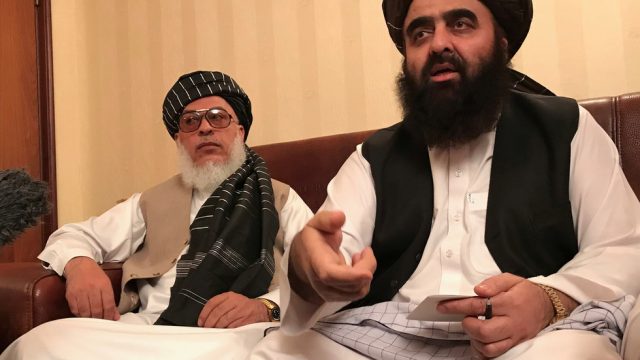
Head of Political Office of the Taliban Sher Mohammad Abbas Stanakzai (L) and member of Political Office of Taliban Shahabuddin Delawar (R) in Moscow, May 28, 2019.
© Reuters / Mikhail Antonov
RT | May 28, 2019
Senior Taliban officials including the group’s top political advisor met with Afghan political figures in Moscow on Tuesday, saying they were committed to peace in Afghanistan.
The statement comes as US-led talks appear to have stalled, AFP said.
Taliban co-founder and political leader Mullah Abdul Ghani Baradar said the insurgents want an end to 18 years of conflict – but would only sign a deal after foreign forces quit Afghanistan.
The Taliban are “really committed to peace, but think the obstacle for peace should be removed first,” Baradar said in a rare televised appearance at the start of the two-day meeting marking 100 years of diplomatic ties between Russia and Afghanistan. “The obstacle is the occupation of Afghanistan, and that should end,” Baradar said.
Talks with US in Doha stumble over troop withdrawal timetable: Afghan Taliban
Press TV – May 6, 2019
The Taliban militant group says peace talks with the US — which have been underway in Qatar for months — have stalled over the key issue of a timetable for American and other foreign troops to pull out of Afghanistan, a longtime Taliban demand.
A Taliban political spokesman, Suhail Shaheen, told the AFP on Sunday that the two sides have so far failed to hammer out their differences on how to put their draft agreement on the withdrawal timetable into action.
The two sides are trying “to narrow the differences and have an agreement on a timetable which is acceptable to both sides,” but “that has not been achieved so far.”
He also explained that nothing would move forward “in principle” until America announced a withdrawal timetable.
“If we are not able to finalize it in this round, then … peace would be far away rather than being closer,” Shaheen added.
Since last year, sixth rounds of talks have been held in Doha between the militant group and US special envoy to Afghanistan Zalmay Khalilzad and his delegation of about two dozen officials in the hope of ending an American war in Afghanistan that has dragged on for over 17 years.
The latest round began on May 1, and it is not clear if the talks were to continue Monday, which marks the first day of the holy Muslim month of Ramadan.
The negotiations have so far excluded Afghan officials. The Taliban refuse to hold talks with the government in Kabul, which the militant group views as illegitimate and a US puppet.
In February, Khalilzad claimed progress in the talks, saying that a deal was within reach by July.
Khalilzad has repeatedly said that for things to progress, the Taliban must ensure Afghanistan is never again used as a terrorist safe haven, implement a ceasefire, and speak to Afghan representatives.
The Taliban have said they will not do anything until the US announces a withdrawal timeline.
Earlier this week, the group’s spokesman Zabihullah Mujahid called on the US to end the use of force in Afghanistan instead of putting pressure on the militant group to cease fire.
“Instead of such fantasies, he [Khalilzad] should drive the idea home [to the US] about ending the use of force and incurring further human and financial losses for the decaying Kabul administration,” he added.
The US embassy in Kabul did not immediately comment on the Taliban’s latest statement.
The Taliban’s five-year rule over at least three quarters of Afghanistan came to an end following the 2001 US-led invasion, but 17 years on, Washington — having failed to end the Taliban’s militancy campaign — is seeking truce with the militants.
Observers say the militant group is now negotiating from a position of strength as it has managed to strengthen its grip over the past three years, with the government in Kabul controlling just 56 percent of the country, down from 72 percent in 2015, according to a US government report released last year.
The Taliban have even continued to carry out daily attacks on Afghan security forces amid the negotiations.
Last week, thousands of tribal elders and other figures held a rare grand assembly — known as Loya Jirga — in Kabul to express their views about a peace deal with Taliban.
At the end of that meeting, Afghan President Ashraf Ghani offered Taliban a truce deal.
The militants were, however, quick to reject the offer and launched attacks on a police station in northern Afghanistan, leaving over a dozen people dead there on Sunday.
US denies visa to ICC chief prosecutor, unhappy with her probing American war crimes in Afghanistan
RT | April 5, 2019
Washington has annulled the entry visa of Fatou Bensouda, chief prosecutor of the International Criminal Court, after the State Department vowed to shield Americans from “unjust prosecutions” of possible war crimes in Afghanistan.
“We can confirm that the US authorities have revoked the prosecutor’s visa for entry into the US,” Bensouda’s office told Reuters in an email. However, the move should not restrict her travels to the UN headquarters in New York City.
Less than a month ago, US Secretary of State Mike Pompeo made clear that the US would not allow Americans to live in “fear of unjust prosecutions” just because thousands of citizens were sent to “defend” their country on the other side of the globe, some 7,000 miles away.
“If you’re responsible for the proposed ICC investigation of US personnel in connection with the situation in Afghanistan, you should not assume that you still have, or will get, a visa or that you will be permitted to enter the United States,” he warned in mid-March.
Over the last two years, the Gambian lawyer has been probing US-led war crimes in Afghanistan but has not yet opened a formal investigation into alleged atrocities conducted over the last 18 years. For now, the preliminary inquiry remains in Pre-Trial Chamber, even though Bensouda found a “reasonable basis to believe that war crimes and crimes against humanity have been committed in connection with the armed conflict in Afghanistan.”
Only the American military system can judge the servicemen, Pompeo said, warning the ICC to drop their inquiry. “We are prepared to take additional steps, including economic sanctions, if the ICC does not change course,” Pompeo warned.
The ICC is investigating alleged war crimes and crimes against humanity committed by various parties in the protracted conflict, including US forces, as detailed in a 2016 report. The part concerning unidentified members of the US military and intelligence relates to dozens of cases in 2003-2004, and alleged crimes like torture, cruel treatment, and sexual assault.
The ICC says those crimes may have been committed in furtherance of US policy in the freshly occupied country, rather than a set of individual unrelated atrocities. In light of this, Washington’s resistance to the probe may be more than a sign of principled rejection of any international authority over US nationals.
US courts have not been very forthcoming in prosecuting Americans for such crimes. A notable exception is the case of retired US Army Ranger turned CIA civilian contractor David Passaro. Over two nights in 2003, he tortured to death an Afghan man named Abdul Wali, who turned himself in after being accused of taking part in a rocket attack on a US base.
Passaro was sentenced to serve eight years and four months in prison, and later said he was a scapegoat for the US government, which wanted to show the public that it was holding the CIA accountable in the wake of the Abu Ghraib prison scandal.
Read more:
International court judge resigns, citing ‘shocking’ interference from ‘above the law’ US
India shouldn’t undermine Afghan peace talks
By M. K. BHADRAKUMAR | Indian Punchline | March 17, 2019
The Press Trust of India has reported on the discussions regarding Afghanistan in Washington last week between the visiting Foreign Secretary Vijay Gokhale and the US special representative Zalmay Khalilzad. The report carries a New Delhi dateline and is attributed to ‘official sources’.
According to the report, FS made a demarche with Khalilzad that any US troop withdrawal from Afghanistan should take place only after a new elected government takes over in Kabul and not on the basis of any interim arrangement. Separately, Hindustan Times amplified on the PTI report, citing ‘people familiar with developments’ to the effect that India is opposed to any interim government that is not ‘constitutionally mandated’ and might have members of the Taliban.
Both reports say that Khalilizad held out an assurance to FS that the security guarantee that Washington seeks from the Taliban about Afghan soil not being used for international terrorism, will also include groups that target India.
Quite obviously, Delhi considers it advantageous to disseminate the above confidential exchange in Washington at the present juncture when US-Taliban talks regarding ‘intra-Afghan dialogue’ and ceasefire is about to commence in Doha later this month.
Curiously, the Indian security establishment leaked the above information just the day after Pakistan PM Imran Khan claimed last Friday that peace in Afghanistan is ‘round the corner’ and can be expected in ‘coming days’. Imran Khan reportedly said, ‘A good government will be established in Afghanistan, a government where all Afghans will be represented. The war will end and peace will be established there.’
Kabul has reacted strongly against Imran Khan’s prognosis of a ceasefire and a new representative government forming in Kabul. Of course, the present ruling elite in Kabul fear that they may become expandable in an Afghan settlement. However, they are becoming a small minority. Whereas, a large section of Afghan opinion seems to favour the idea of ‘intra-Afghan dialogue’ and a broad-based government getting established in Kabul.
Why should India take a partisan stance in such circumstances? See an interview, here, by former Afghan president Hamid Karzai, who used to be a close friend and trusted interlocutor of India.
Delhi is demanding elections in Afghanistan ignoring that security conditions need to be created first on the ground for that purpose. Clearly, the reconciliation with the Taliban who control at least half of Afghan territory is an essential pre-requisite of the situation.
Suffice to say, without the participation of the Taliban, election makes no sense — that is, for electing a government that enjoys legitimacy. On the other hand, the withdrawal of the US troops is a pre-condition that the Taliban has unwaveringly laid down for participating in any intra-Afghan dialogue — and latest reports are that the US is agreeable to meeting that pre-condition.
Clearly, Delhi’s stance that US withdrawal be postponed until a settlement is in place is neither realistic nor logical. It casts India in a spoiler’s role.
The really surprising part is that Delhi waded into the Afghan peace talks just when Kabul and Washington publicly clashed over Khalilzad’s role. The Afghan national security advisor Hamdullah Mohib has derisively called Khalilzad a ‘viceroy’ who manipulates the peace talks with a view to usurping power for himself in Kabul. Delhi should not take sides in the rift between Khalilzad and President Ashraf Ghani. It’s a dangerous gambit.
If Delhi so desperately wants to give a lifeline to Ghani’s circle who are its allies in Kabul, the thing to do is to depute army chief Gen. Vipin Rawat to make a quick trip to Afghanistan and evaluate how an Indian intervention, replacing the US and NATO forces, can be urgently worked out before a settlement with the Taliban takes shape so that the erstwhile puppet regime of the US in Afghanistan can be transformed into an Indian surrogate.
If that is too weird a thing to be tried out, then the reasonable thing to do is to give the US-Taliban peace talks a fair chance. This may not be the ideal way of conflict resolution, but this is the only show in town and may serve the purpose of ending the senseless 17-year old war.
Delhi should have understood a long time ago that the Taliban insurgency cannot be defeated militarily and the US has been pursuing the West’s interests in Afghanistan. It should have worked with like-minded regional capitals to stabilise the Afghan situation in the interest of regional security and stability. But instead, it opted to be the US’ poodle.
Inevitably, Delhi feels let down. But that doesn’t warrant the petulance that is appearing here. When India has neither the geo-strategic clout influence nor the capacity to be prescriptive, the rational thing is to exercise strategic patience and try to come to terms with the regime that emerges out of a settlement in Afghanistan.
It is still not too late to calibrate India’s policy in a manner that stops viewing Afghanistan as the turf to wage proxy war against Pakistan. Pakistan has legitimate interests in Afghanistan — no less than what India would have in Nepal or Bhutan.
Arguably, a new thinking on our part reversing the policy trajectory adopted two decades ago in the late nineties will not only stop the enormous financial haemorrhage running into billions of dollars, but may even have the salutary effect of Pakistan reciprocating elsewhere on issues where India has core interests.
US Threatens Anyone Behind ICC Probe Into Its Staff With Visa Restrictions
Sputnik – 15.03.2019
The US is determined not to issue visas to individuals who are behind any the International Criminal Court investigation of US personnel, Secretary of State Mike Pompeo said Friday.
The new visa restrictions will not terminate Washington’s previous measures, and new economic sanctions may follow if the International Criminal Court (ICC) fails to change its course, Pompeo said during the briefing.
“I’m announcing a policy of US visa restrictions on those individuals directly responsible for any ICC investigation of US personnel,” Pompeo said. “This includes persons who take or have taken action to request or further such an investigation. These visa restrictions may also be used to deter ICC efforts to pursue allied personnel, including Israelis.”
The remark comes after Pompeo issued the warning after announcing that the US would impose visa restrictions on individuals linked to the ICC’s prospective investigation into alleged war crimes committed by US personnel in Afghanistan.
Spectre of Afghan quagmire haunts US
By M. K. BHADRAKUMAR | Indian Punchline | March 15, 2019
The Afghan national security advisor Hamdullah Mohib, while on a visit to Washington, tore into the US’ peace talks with Taliban in remarks to the American media on Thursday. Mohib alleged that US special representative Zalmay Khalilzad is keeping the Afghan govt in Kabul in the dark about the negotiations with the Taliban and that he’s plotting to replace President Ashraf Ghani.
Mohib alleged that Pakistan is dictating the trajectory of the US-Taliban negotiations and warned that there can be no peace until Islamabad ended its support for ‘non-state actors’.
The charges are indeed very serious and it is unlikely that Mohib spoke without Ghani’s approval. Mohib is Ghani’s hand-picked security aide, the fountainhead of Afghan intelligence and is wired into the Washington Beltway, where he previously served as ambassador. The US state department called in Mohib and apparently gave him a dressing down.
That there is friction between Khalilzad and Ghani has been known for sometime. Basically, there is much resistance among the Afghan elite to the US strategy to take Pakistan’s help to engage Taliban in direct negotiations and chalk out a settlement that mainstreams the insurgents.
Things have lately reached a point of no return, now that the crucial next phase of negotiations at Doha is due where the agenda includes intra-Afghan dialogue and ceasefire leading to an interim power-sharing arrangement in Kabul replacing the Ghani government.
Meanwhile, there are interest groups within the Afghan elite who either fear retrenchment or simply do not accept reconciliation with the Taliban. There is indeed widespread resentment among Afghans toward Pakistan’s blatant projection of power into their country through decades. In sum, a coalescing of anti-Taliban, anti-Pakistan sentiments is taking place.
Ghani himself has never hidden his antipathy toward Islamabad for its interference in Afghan affairs and of late has been reaching out to these anti-Taliban, anti-Pakistan groups within the Afghan elite. He feels annoyed that Washington is not insisting on the Taliban holding talks with the Afghan govt, but has instead harmonised with the Pakistani-Russian idea of an ‘intra-Afghan dialogue’ where the Afghan govt can only be a participant like myriad other Afghan groups — and not as the Taliban’s principal interlocutor.
Having said that, Ghani would also know that Khalilzad who enjoys the backing of the US foreign and security establishment, is by no means a pushover. In principle, the US can withdraw support from Ghani and make a horrible example of him but in the current fluidity, that will open a Pandora’s box and may trigger events over which Washington will have no control. With such a big US and NATO military deployment in Afghanistan, it is out of the question that the Trump administration would make any precipitate moves which might create a power vacuum in Kabul.
On the other hand, President Trump wants the troop withdrawal to begin, which was also his campaign pledge in the 2016 election. Fundamentally, the Americans may have underestimated the strong undercurrents of Afghan nationalism. Ghani suspects that the Pakistani game plan is to ultimately create conditions for an outright Taliban takeover in Kabul. There have been ample signals that he is digging in.
Suffice to say, the spectre of an Afghan quagmire is haunting the Americans. An orderly American / NATO withdrawal is possible only on the basis of a settlement with the Taliban. But Ghani and his camp insist on an ‘Afghan-led’ , ‘Afghan-controlled’ peace process — that is, direct talks between the government and the Taliban. The US’ capacity to leverage Ghani is steadily diminishing.
There are hardline militia factions who stoutly oppose any power-sharing arrangement with the Taliban and are horrified at the prospect of Pakistani hegemony over Afghanistan. They may opt for a trial of strength through force. In the circumstances, there is always the danger of a coup and usurpation of power, which of course no one wants to talk about.
The role of regional powers will be crucial in the coming period. Pakistan and Russia have a special role to play here. Both countries harbour an adversarial mindset vis-a-vis Ghani. Clearly, Pakistan and Russia are increasingly moving in tandem to create conditions for a transition in Kabul that maximises their influence. Russia has pockets of influence among the anti-Pakistani Afghan factions — for instance, former president Hamid Karzai or former NSC Hanif Atmar and erstwhile Northern Alliance leaders and so on — which can work favourably for the advancement of Pakistani interests.
Equally, Russia hopes to gain out of its links to the Taliban, which Pakistan has helped to promote, in a future regime in Kabul. Of course, both Russia and Pakistan have troubled relations with the US and will be beneficiaries of any diminution of American prestige and influence in the region. It will be an understatement to say that in the New Cold War conditions, Moscow wouldn’t mind if the US and NATO are forced to exit from the Hindu Kush in disgrace and defeat.
Results of the First Round of Talks Between the USA and the Taliban
By Natalya Zamarayeva – New Eastern Outlook – 11.02.2019
January 2019 saw the conclusion of the first round of talks between the USA and the Taliban, which took place in Qatar. The Afghan Taliban and the official representatives of the USA reached preliminary agreement on three key issues:
– the withdrawal of US troops from Afghanistan within 18 months;
– an exchange of prisoners;
– the lifting of the travel ban on Taliban leaders, and their removal from the UN’s blacklist.
In turn the Taliban agreed, among other things, not to allow terrorist organisations, including Al Qaeda and DAESH or any other armed grouping to carry out attacks on Afghan civilians or authorities, the USA, or any of its allies.
The second round of talks is scheduled for the end of February 2019. The USA and the Taliban plan to sign an official agreement on the above points. The agreement is expected to be fairly strict. The Taliban delegation will be headed by its lead negotiator, Abdul Ghani Baradar.
After the above steps have been completed (in 2021), Afghanistan will embark on an internal regulation process, which will involve two stages:
– the entry into effect of a general ceasefire between the opposing sides;
– the formation of a temporary government, to be elected for a term of three years: the Taliban will nominate its own representatives for election to this body;
– the Taliban propose a reform of the Afghan police, including local police authorities (which have been accused of being extremely corrupt and of intimidating the public).
The Taliban’s leaders have declared that they are renouncing their claim to exclusive power in Afghanistan and that they recognise that peace in Afghanistan needs to be an inclusive process. They also promise to seek ways to involve the Afghan government in the peace and reconciliation process, and also to act in conjunction with existing authorities (whereas, during the period of the so-called Islamic Emirate of Afghanistan, from 1996-2001, they imposed a strict form of Sharia law).
The talks between the USA and the Taliban (December 2018- January 2019) are a small part of the larger Afghan dialogue process, which has, traditionally, involved four parties: the Taliban, the USA, the Afghan National Unity Government, and Pakistan.
In addition to the US troops and the armed opposition, made up of Taliban militants, there is a third party in the Afghan conflict: the Afghan national security forces, which seek to protect the country’s constitution and its head of state, President Ashraf Ghani.
But for the whole duration of the anti-terrorist campaign in Afghanistan, from 2001 to date, the Taliban have refused to take part in any direct talks with representatives of the National Unity Government, which they consider to be illegitimate. Ashraf Ghani has been highly critical of this stance, which has forced him and his government into the position of an onlooker, while the Taliban and the USA determine the country’s fate between them.
Washington has declared that its strategic goal, in its talks with the Taliban, is to get the Taliban and the Afghan National Unity Government to sit around the negotiating table together. In other words, to “force” the Taliban to accept the country’s Constitution and current state institutions. According to the White House, this process will take 18 months, and will be accompanied by the progressive withdrawal of US troops.
According to the White House’s roadmap, with the beginning of the dialogue, Afghanistan will enter into a new phase: an internal regulation process. Which raises the obvious question – will that process actually take place, and, if so, when, and under what circumstances? The Pushtuns are a hospitable people, but they keep their word. The lack of any direct dialogue between the Taliban and the National Unity Government will result in either an extension of the US military presence in Afghanistan, or the outbreak of a new civil war like that in the early 1990s.
The talks have also revealed certain specific characteristics relating to the armed opposition in today’s Afghanistan. In general, that opposition is made up of the Taliban. But there are other forces operating in the country, including militants from Al-Qaeda, DAESH, Uighur separatists from the Xinjiang region of China, militants from the Pakistani Taliban, and various armed groups from the Central Asian countries and the Caucasus. The Afghan Taliban, which dominates the armed opposition, has been able to persuade the Al-Qaeda militants to pledge their loyalty to the Taliban’s leader, Hibatullah Akhundzada. As a result, in recent years the Taliban has been reinforced by Al-Qaeda militants serving in its ranks. This helps to explain how the Taliban is now able to control 60% of the country’s territory and carry out almost daily attacks on Afghan security forces and government officials.
As for DAESH, its leaders remain subordinate to their Emir and refuse to accept the leadership of Hibatullah Akhundzada, which results in a split within the armed opposition in Afghanistan.
The fourth party in the dialogue process is Pakistan. As one of the organisers of the talks between the USA and the Taliban, Pakistan has received assurances from the Afghan Taliban that, in the future, the latter will cut its links with Pakistani Taliban militants based in Afghanistan, insurgents from the Pakistani province of Balochistan and the militant group Lashkar-e-Taiba, and that it will refrain from acting against Pakistan’s interests.
The talks between the USA and the Taliban demonstrate that the two parties are serious about bringing an end to the internecine conflict in Afghanistan. But it is also evident that all the parties are determined to stick to their initial positions. The parties exchange spoken declarations, but they show no will to take any constructive steps or even move towards a compromise.
Natalia Zamarayeva, Ph.D (History), is a Senior Research Fellow, Pakistan section, Institute of Oriental Studies of the Russian Academy of Sciences.
Who’s afraid of intra-Afghan dialogue?

Opening of two-day talks of Taliban and Afghan opposition leaders at the President Hotel in Moscow on February 5, 2019 (Photo by Yuri KADOBNOV / AFP)
By M. K. BHADRAKUMAR | Indian Punchline | February 7, 2019
The two-day conference of mainstream Afghan politicians and Taliban representatives in Moscow on February 5-6 becomes a landmark event in the peace process.
Principally, it signifies the commencement of the ‘intra-Afghan dialogue’, a process that was struggling to be born. This process can be expected to galvanise the Afghan peace talks. Some of the most senior and influential Afghan leaders actively participated in the Moscow conference, including former President Hamid Karzai, stalwarts of the erstwhile Northern Alliance Atta Muhammad Nur, Yunus Qanooni and Muhammad Mohaqiq, Ahmad Wali Massoud and former National Security Advisor Hanif Atmar.
The embittered Afghan government led by President Ashraf Ghani has been reduced to a rump. It has censured the event in Moscow, but its own growing isolation is self-evident. Ghani is now openly critical of the dynamics of the US-Taliban talks, won’t associate with any ‘intra-Afghan dialogue’ and threatens to reject any peace formula that is reached without him.
Ghani’s mindset is — ‘After me the Deluge.’ His preoccupation is about his own political future. Simply put, panic (that he is at the end of the road) is mixing with bewilderment (that he is in reality so easily expendable) and anger (that the US is inexorably disengaging from him). In fact, President Donald Trump’s State of the Union address on Tuesday completely omitted any reference to the Kabul set-up, leave alone Ghani himself.
The stunning outcome of the Moscow conference in the nature of a Joint Declaration highlights that the native Afghan genius for consensus-making has far from extinguished and can still provide the alchemy for reaching a peace settlement.
The key elements of the ‘nine point approach’ outlined in the Joint Declaration are the agreement on the ‘values’ that effectively provide the guiding principles of a post-settlement order — an Islamic system; an inclusive polity; a broad-based government with representation for all ethnic groups; assertion of national sovereignty; scrupulous neutrality vis-a-vis regional and international conflicts; adherence to Afghan national and religious values; and a unified and single policy.
The three striking templates of the document are the demand for the ‘complete withdrawal of foreign forces’, the political commitment to protect the rights of women and the entire people, and the openness to seeking international assistance for Afghan reconstruction. Taken together, the joint declaration gives the blueprint of the terms of an Afghan settlement.
Russia has been the patron behind the conference kickstarting an ‘intra-Afghan dialogue’. Conceivably, Russia took such an initiative in tandem with Pakistan — and, possibly, with Iran and China as well. Importantly, Russian diplomacy was successful in getting an impressive array of Afghan politicians cutting across the spectrum of opinion to come on board. The new platform is destined to gain traction and provide an enduring underpinning for peacemaking and reconciliation in Afghanistan.
Inevitably, the dialectic involving the US-Taliban talks and the new platform of ‘intra-Afghan dialogue’ will be crucial. Ideally, they should be mutually reinforcing. But life is real. Much depends on the US’ intentions. Washington cannot but be aware that the Ghani government lacks legitimacy and an interaction between it and the Taliban (assuming the latter agrees to it) is increasingly meaningless.
On the other hand, Ghani also enjoys the covert backing of the hardline elements within the US establishment some of whom are unhappy with Trump’s outlook of putting to sudden death America’s ‘endless wars’.
Ideally, therefore, it is in the US interest to widen the gyre of the peace process that has begun in Moscow and create synergy for Washington’s direct engagement with the Taliban, which is proceeding on a parallel track. The regional and international opinion will be supportive of such a constructive approach.
However, for this to happen, the US too should have a unified policy. There are disturbing signs that the US military-industrial complex is far from done with the ‘endless war’ in Afghanistan. Trump himself is buffeted by cross currents. He vaguely sounded placatory in his address to the US Congress on Tuesday by hinting at the need of continued counterterrorist operations with a reduced military presence.
Whereas, the resounding message out of the Moscow conference is that mainstream Afghan opinion identifies with the Taliban’s longstanding demand for complete vacation of foreign occupation in lieu of commitment that no extremist group will be allowed to operate out of Afghan soil. The US should heed this profound Afghan craving for national independence and sovereignty.
Indeed, the Moscow conference underscored that the Afghan conflict is at its core a fratricidal strife (which foreign powers took advantage of) and it can be ended only through a genuine, free-wheeling intra-Afghan dialogue. The Russians have shown that just by being an honest broker, the Americans could as well have kickstarted the intra-Afghan dialogue a long time ago — arguably, even when the late Richard Holbrooke was around. So much destruction and suffering and loss of lives could have been spared if only there was sincerity of purpose.
The Moscow conference has exposed the self-serving Western notion that the Afghans are inherently incapable of molding the destiny of their nation. That such an impressive outcome of consensus-making was possible when Afghans were left to confabulate among themselves for two days only goes to show that the so-called international community is more the problem than the solution.
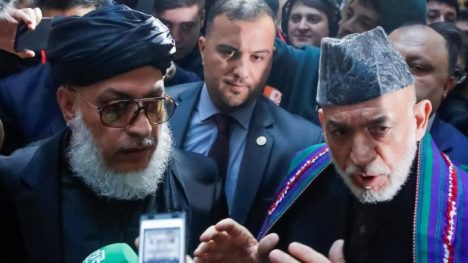
(Former Afghan president Hamid Karzai (R) and Head of Political Office of the Taliban Sher Mohammad Abbas Stanikzai briefing the media at the Moscow conference, February 5, 2019)
The Moscow conference agreed that ‘intra-Afghan dialogue must continue on regular basis’ and that the next session be held in Doha, Qatar, ‘as soon as possible.’ The next round of the US-Taliban talks is also due to take place in Doha in February focusing on the interim government and ceasefire. Several top participants at the Moscow conference voiced support for the formation of an interim government. The time has come to address the issue.
The big question is whether the US is willing to let go of Afghanistan, finally. Admittedly, the geopolitics of Afghanistan becomes a compelling factor for the Pentagon, which is keen to retain the military bases in the emerging New Cold War conditions. Besides, there is no dearth of potential deal breakers. Persuading the present rulers in Kabul to make way is going to be a tough challenge. Ghani’s hope lies in offering the Taliban a few slots in his government. But that formula won’t work.
The US should not encourage Ghani’s vaulting ambition to wield power for a foreseeable future. Conditions were far more complicated in 2001 when the Northern Alliance government led by Burhanuddin Rabbani was persuaded to step down and an interim government led by Karzai took over in Kabul at the insistence of Washington.
On the other hand, the Moscow conference has shown that inter-Afghan amity and reconciliation is a realistic goal. Karzai can still play a leadership role in any orderly transition in Kabul. Karzai led the way at the Moscow conference.
Finally, Washington is Now Law-Bound to Compensate its Victims!

By Grete Mautner – New Eastern Outlook – 07.02.2019
Since most of us are aware of the way Washington approaches its alleged fight against terrorism, murdering tens of thousands of civilians in the process, it seems that the relatives of all those who perished under American bombs in Afghanistan, Iraq and Syria may finally get their day in court. To be specific, it has recently been reported that a US court found Damascus liable in the death of American journalist Marie Colvin, who was killed during the shelling of Baba Amr district of Homs back in 2012.
It was stated that Judge Amy Berman Jackson of the US District Court for the District of Columbia chose to double the typical compensation that the relatives of the deceased journalist would receive, bringing it up to 302.5 million dollars.
This decision was made in spite of the fact that in his interview for NBC News, Syria’s president Bashar Assad made it clear that:
“It’s a war and she came illegally to Syria. She worked with the terrorists, and because she came illegally, she’s been responsible of everything that befalls on her.”
As most of you must be aware, the US legal system is based on the so-called common law principle that America inherited from the United Kingdom. In this situation it’s only natural to ask: could the above mentioned US District Court decision force Washington to pay billions of dollars in compensations to the families of those who are being unscrupulously referred to in the West as “collateral damage”? As it’s pretty clear for everyone that a precedent has been set. Moreover, on numerous occasions, US authorities would be forced to officially describe a great many of the air raids they launched as erroneous, thus taking full responsibility for the civilian death toll those attacks inflicted.
And the number of such air strikes is growing by the day! Thus, in Afghanistan alone, there’s been an unprecedented increase in the number of civilians killed by the US Air Force, while Washington pretends to be interested in negotiations with the Taliban. Over the last two months, at least 10 of such erroneous strikes were reported, resulting in 68 people perishing. Over the last two weeks alone, some 35 peaceful Afghan citizens would die in the course of US air raids. A lot of attention should be paid to the most recent incident when a US military drone murdered 16 civilians in a single attack in the Afghan province of Helmand in late January. On the next day, the funeral procession organized by the relatives of the victims of the first strike came under fire of yet another US drone, which resulted in 13 more people perishing. So far, the Pentagon failed to provide any intelligible comment on the bloodbath its people created, while only making a remark that it was going to launch an investigation. However, as it became evident from hundreds of similar investigations, nobody in the US armed forces is ever going to be held accountable for such crimes.
In Syria, similar air raids have become a daily occurrence. For instance, as it’s been reported by the Kurdish TV-channel Rudaw, a recent air strike launched by the Pentagon in the Deir ez-Zor Governorate resulted in numerous civilian casualties, including women and children.
This attack took place on January 23, when local refugees would try to flee advancing militant groups, when they were hit by the US Air Force. A week later, 11 civilians perished in yet another attack launched by the US-led coalition in the same province. Earlier, in mid-December, a similar strike in Deir ez-Zor left 17 civilians dead.
To make the matters worse, the US-led coalition has been repeatedly accused of using white phosphorus munitions in its attacks against residential areas; which resulted in Syrian authorities filing a request to the UN last year so this blatant violation of international law would be properly investigated.
On January 19, Syria’s officials demanded the United Nations to put an end to the onslaught that the US-led coalition has been carrying on for months across numerous Syrian towns.
However, Syria, Afghanistan and Iraq are not the only states that fell victims of the unscrupulous bombing raids of the US armed forces.
So it’s safe to say that countless lawyers across different countries may now have their hands full of work, filing lawsuits to numerous US courts to represent the families where people felt victims to American bombs.
If the family of Mary Colvin alone managed to receive 300 million dollars in compensation, it’s safe to say that the sky is the limit if those lawsuits start piling up across all of the US District Courts.
Grete Mautner is an independent researcher and journalist from Germany.
Featured Video
Seyed M. Marandi: US-Iran War Inevitable: Kuwait and Bahrain May Fall
or go to
Aletho News Archives – Video-Images
From the Archives
Oil and the Israel Lobby
Reknowned economist M. Shahid Alam offers this excellent critique of Noam Chomsky’s defective analysis of the relative influence of Oil versus the Israel lobby over US foreign policy: … continue
Blog Roll
 Aletho News
- ICC ignored ‘very well-documented’ NATO crimes – ex-Libyan minister
- SNSC secretary dismisses US response to Iran’s conditions as ‘inadequate’
- Sanaa says Taiz roads open, secure for residents, warns Saudi forces
- Iraqi resistance group urges Saudi leadership to admit defeat, lift Yemen siege
- Trump’s Retreat: How Al-Aqsa Flood Took Down the US Empire
- Israel’s Military Actions in Lebanon Grossly Violate International Law — Lavrov
- Seyed M. Marandi: US-Iran War Inevitable: Kuwait and Bahrain May Fall
- Leaders Condemn Ansarallah Attack on Saudi Arabia While Ignoring Illegal War Against Yemen
- Leaked: Britain’s Covert Iraqi Psyops Network
- Yemeni Armed Forces Warn Airlines Against Using Saudi Airports, Exempt Mecca and Medina
- If Americans Knew
- After Oct 7, IDF policy allowed civilian casualties for even the lowest-ranking targets
- Israel’s Destruction of Southern Lebanon Intensified After the Cease-Fire
- The Last-Minute Decision That Gave Israel Its Name
- The American Conservative: How Trump Made the World Go Nuclear
- Meet the US generals and admirals advancing Israeli policy
- Opinion: Why news organizations should boycott Israel
- The Israeli witch hunt of Sami Abu Shehadeh exposes the lie of the ‘Jewish and democratic’ state
- No state has a ‘right’ to exist – least of all Israel
- Testimonies about Gaza’s civilian death toll expose Israel’s atrocities – Daily Update
- How Israel Conquered the Latin American Right
- No Tricks Zone
- New Study Suggests Large Regions Of The Pacific Ocean Have Been Cooling For The Last 80 Years
- Germany’s Green Energy Debacle: High Energy Costs Force Kahla Porzellan to Close After 182 Years!
- New Study: 50 Years Of The Most Aggressive ‘Net Zero’ Policies Can Only Affect The Global Climate By 0.03°C
- US September “Heat” Was No Record…Many Records Set Decades Ago
- Latest European Green Energy Debacle; Portugal’s Largest Flagship Solar Park Insolvent!
- Green Energy Debacle: German Expert Professor Fritz Vahrenholt Warns Of Severe Economic And Social Consequences
- Two More Paleo Reconstructions Affirm Meters-Higher Sea Levels Across Ireland, Brazil 7000-6000 Years Ago
- New Study: Earth And Venus Surface Warmth Largely Explained By Convection And Lapse Rate, Not CO2 Or Radiation
- 2025 Nature Paper Claiming Worsening Global Drought Gets RETRACTED …Heavily Flawed
- New Study: ‘Global Drought Shows No Detectable Recent Acceleration Under Climate Warming’

